Pre-­‐Calculus	
  
Kevin	
  Small	
  –	
  www.cxctutor.org	
  
An	
  Introduc<on	
  To	
  Func<ons	
  and	
  Rela<ons	
  
Topics	
  To	
  Be	
  Covered	
  	
  
•  	
  Define	
  What	
  is	
  a	
  Func/on	
  
– Show	
  Simple	
  Examples	
  of	
  Func<ons	
  
– Explain	
  How	
  Func<on	
  Nota<on	
  Works	


•  	
  Define	
  What	
  is	
  a	
  Rela/on	
  
– Define	
  The	
  Terms	
  Domain	
  and	
  Range	
  
– Learn	
  How	
  To	
  Draw	
  Mapping	
  Diagrams	
  
– Learn	
  The	
  Different	
  Types	
  of	
  Rela<ons	
  
– Lean	
  How	
  To	
  Test	
  For	
  Func<ons	
  
What	
  is	
  a	
  Func<on	
  
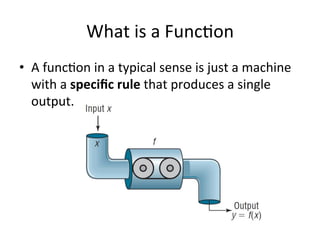
•  A	
  func<on	
  in	
  a	
  typical	
  sense	
  is	
  just	
  a	
  machine	
  
with	
  a	
  specific	
  rule	
  that	
  produces	
  a	
  single	
  
output.	


Example	
  
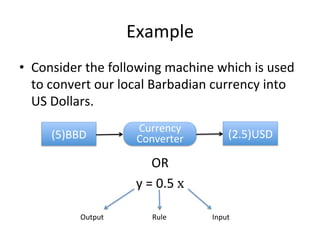
•  Consider	
  the	
  following	
  machine	
  which	
  is	
  used	
  
to	
  convert	
  our	
  local	
  Barbadian	
  currency	
  into	
  
US	
  Dollars.	


OR	
  
y	
  =	
  0.5	
  x	


(5)BBD	


Currency	
  
Converter	


(2.5)USD	


Output	
   Rule	
   Input	
  
Example	
  Con<nued	
  
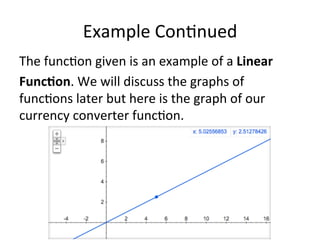
The	
  func<on	
  given	
  is	
  an	
  example	
  of	
  a	
  Linear	
  	
  
Func/on.	
  We	
  will	
  discuss	
  the	
  graphs	
  of	
  
func<ons	
  later	
  but	
  here	
  is	
  the	
  graph	
  of	
  our	
  
currency	
  converter	
  func<on.	


Func<on	
  Nota<on	
  
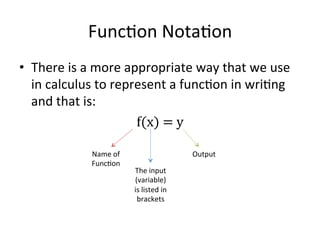
•  There	
  is	
  a	
  more	
  appropriate	
  way	
  that	
  we	
  use	
  
in	
  calculus	
  to	
  represent	
  a	
  func<on	
  in	
  wri<ng	
  
and	
  that	
  is:	
  
f(x)  =  y
The	
  input	
  
(variable)	
  
is	
  listed	
  in	
  
brackets	
  
Output	
  	
  Name	
  of	
  
Func<on	
  
Func<on	
  Nota<on	
  Examples	
  
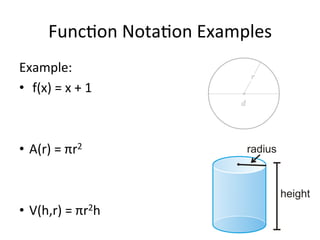
Example:	
  
•  	
  f(x)	
  =	
  x	
  +	
  1	


•  A(r)	
  =	
  πr2	


•  V(h,r)	
  =	
  πr2h	
  
Rela<ons	
  
The	
  topic	
  of	
  func<ons	
  is	
  in	
  fact	
  in	
  sub-­‐topic	
  under	
  
him	
  much	
  broader	
  subject	
  In	
  mathema<cs	
  called	
  
Rela/ons.	


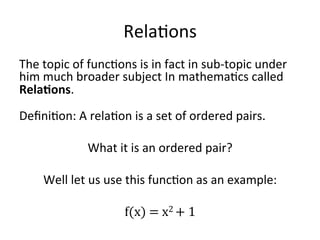
Defini<on:	
  A	
  rela<on	
  is	
  a	
  set	
  of	
  ordered	
  pairs.	


What	
  it	
  is	
  an	
  ordered	
  pair?	


Well	
  let	
  us	
  use	
  this	
  func<on	
  as	
  an	
  example:	


f(x)  =  x2  +  1
	
  
Let	
  us	
  list	
  our	
  inputs	
  from	
  1	
  to	
  5	
  and	
  calculate	
  their	
  corresponding	
  outputs:	


Now	
  we	
  can	
  pair	
  our	
  inputs	
  with	
  our	
  outputs	
  in	
  an	
  orderly	
  fashion	
  like	
  this:	
  
Formal	
  Defini<on	
  of	
  a	
  Func<on	
  
•  A	
  func<on	
  a	
  special	
  rela<on	
  in	
  which	
  each	
  
element	
  x  	
  in	
  the	
  Domain	
  is	
  paired	
  using	
  a	
  
rule,	
  with	
  exactly	
  one	
  and	
  only	
  one	
  element	
  
f(x)	
  in	
  the	
  Range.	
  
•  There	
  are	
  two	
  types	
  of	
  rela<ons	
  that	
  sa<sfy	
  
this	
  criteria	
  and	
  they	
  are	
  called	
  one-­‐to-­‐one	
  
and	
  many-­‐to-­‐one	
  rela<ons.	


•  A	
  one-­‐to-­‐many	
  rela<on	
  is	
  NOT	
  a	
  func<on.	
  
Example	
  of	
  One-­‐To-­‐One	
  Func<on	
  
Consider	
  the	
  rela<on	
  	
  f:	
  x	
  →	
  2x	
  +	
  5	
  	
  given	
  that	
  the	
  domain	
  is	


Find	
  the	
  corresponding	
  range	
  values	
  and	
  hence	
  draw	
  a	
  mapping	
  diagram	
  to	
  
represent	
  the	
  rela<on.	


0,	
  1,	
  2,	
  3	
  	
  
One-­‐To-­‐One	
  Func<ons	
  Con<nued	
  
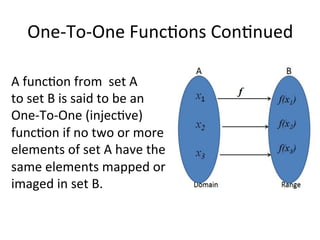
A	
  func<on	
  from	
  	
  set	
  A	
  
to	
  set	
  B	
  is	
  said	
  to	
  be	
  an	
  
One-­‐To-­‐One	
  (injec<ve)	
  
func<on	
  if	
  no	
  two	
  or	
  more	
  
elements	
  of	
  set	
  A	
  have	
  the	
  
same	
  elements	
  mapped	
  or	
  
imaged	
  in	
  set	
  B.	
  
Many-­‐To-­‐One	
  Func<ons	
  
Consider	
  the	
  func<on	
  f(x)	
  =	
  x2	
  and	
  let	
  our	
  domain	
  be	
  {-­‐2  ≤  x  ≤  2}.	
  
Many-­‐To-­‐One	
  Func<ons	
  Con<nued	
  
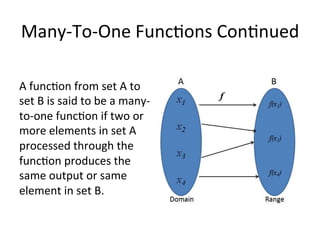
A	
  func<on	
  from	
  set	
  A	
  to	
  
set	
  B	
  is	
  said	
  to	
  be	
  a	
  many-­‐
to-­‐one	
  func<on	
  if	
  two	
  or	
  
more	
  elements	
  in	
  set	
  A	
  
processed	
  through	
  the	
  
func<on	
  produces	
  the	
  
same	
  output	
  or	
  same	
  
element	
  in	
  set	
  B.	
  
One-­‐To-­‐Many	
  is	
  Not	
  A	
  Func<on	
  
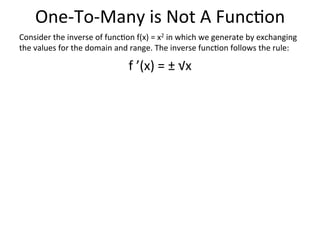
Consider	
  the	
  inverse	
  of	
  func<on	
  f(x)	
  =	
  x2	
  in	
  which	
  we	
  generate	
  by	
  exchanging	
  
the	
  values	
  for	
  the	
  domain	
  and	
  range.	
  The	
  inverse	
  func<on	
  follows	
  the	
  rule:	
  
f	
  ’(x)	
  =	
  ±	
  √x	
  
A	
  Visual	
  Test	
  For	
  Func<ons	
  
We	
  can	
  use	
  a	
  very	
  simple	
  test	
  called	
  the	
  Ver/cal	
  
Line	
  Test	
  to	
  determine	
  whether	
  the	
  Graph	
  of	
  A	
  
Rela/on	
  in	
  indeed	
  a	
  func<on	
  or	
  not.	


•  Defini<on:	
  	
  
– Given	
  a	
  curve	
  drawn	
  in	
  the	
  coordinate	
  
plane.	
  Then	
  this	
  curve	
  is	
  a	
  graph	
  of	
  a	
  
func<on	
  if	
  and	
  only	
  if	
  no	
  ver<cal	
  line	
  can	
  be	
  
made	
  to	
  intersect	
  the	
  curve	
  at	
  more	
  than	
  
one	
  point.	


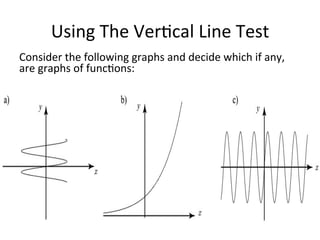
Using	
  The	
  Ver<cal	
  Line	
  Test	
  
Consider	
  the	
  following	
  graphs	
  and	
  decide	
  which	
  if	
  any,	
  
are	
  graphs	
  of	
  func<ons:	


CSEC Mathematics Review - Introduction To Functions & Relations

  • 1.
    Pre-­‐Calculus   Kevin  Small  –  www.cxctutor.org   An  Introduc<on  To  Func<ons  and  Rela<ons  
  • 2.
    Topics  To  Be  Covered     •   Define  What  is  a  Func/on   – Show  Simple  Examples  of  Func<ons   – Explain  How  Func<on  Nota<on  Works     •   Define  What  is  a  Rela/on   – Define  The  Terms  Domain  and  Range   – Learn  How  To  Draw  Mapping  Diagrams   – Learn  The  Different  Types  of  Rela<ons   – Lean  How  To  Test  For  Func<ons  
  • 3.
    What  is  a  Func<on   •  A  func<on  in  a  typical  sense  is  just  a  machine   with  a  specific  rule  that  produces  a  single   output.    
  • 4.
    Example   •  Consider  the  following  machine  which  is  used   to  convert  our  local  Barbadian  currency  into   US  Dollars.       OR   y  =  0.5  x     (5)BBD     Currency   Converter     (2.5)USD     Output   Rule   Input  
  • 5.
    Example  Con<nued   The  func<on  given  is  an  example  of  a  Linear     Func/on.  We  will  discuss  the  graphs  of   func<ons  later  but  here  is  the  graph  of  our   currency  converter  func<on.    
  • 6.
    Func<on  Nota<on   • There  is  a  more  appropriate  way  that  we  use   in  calculus  to  represent  a  func<on  in  wri<ng   and  that  is:   f(x)  =  y The  input   (variable)   is  listed  in   brackets   Output    Name  of   Func<on  
  • 7.
    Func<on  Nota<on  Examples   Example:   •   f(x)  =  x  +  1       •  A(r)  =  πr2       •  V(h,r)  =  πr2h  
  • 8.
    Rela<ons   The  topic  of  func<ons  is  in  fact  in  sub-­‐topic  under   him  much  broader  subject  In  mathema<cs  called   Rela/ons.     Defini<on:  A  rela<on  is  a  set  of  ordered  pairs.       What  it  is  an  ordered  pair?     Well  let  us  use  this  func<on  as  an  example:     f(x)  =  x2  +  1  
  • 9.
    Let  us  list  our  inputs  from  1  to  5  and  calculate  their  corresponding  outputs:                           Now  we  can  pair  our  inputs  with  our  outputs  in  an  orderly  fashion  like  this:  
  • 10.
    Formal  Defini<on  of  a  Func<on   •  A  func<on  a  special  rela<on  in  which  each   element  x    in  the  Domain  is  paired  using  a   rule,  with  exactly  one  and  only  one  element   f(x)  in  the  Range.   •  There  are  two  types  of  rela<ons  that  sa<sfy   this  criteria  and  they  are  called  one-­‐to-­‐one   and  many-­‐to-­‐one  rela<ons.     •  A  one-­‐to-­‐many  rela<on  is  NOT  a  func<on.  
  • 11.
    Example  of  One-­‐To-­‐One  Func<on   Consider  the  rela<on    f:  x  →  2x  +  5    given  that  the  domain  is         Find  the  corresponding  range  values  and  hence  draw  a  mapping  diagram  to   represent  the  rela<on.                             0,  1,  2,  3    
  • 12.
    One-­‐To-­‐One  Func<ons  Con<nued   A  func<on  from    set  A   to  set  B  is  said  to  be  an   One-­‐To-­‐One  (injec<ve)   func<on  if  no  two  or  more   elements  of  set  A  have  the   same  elements  mapped  or   imaged  in  set  B.  
  • 13.
    Many-­‐To-­‐One  Func<ons   Consider  the  func<on  f(x)  =  x2  and  let  our  domain  be  {-­‐2  ≤  x  ≤  2}.  
  • 14.
    Many-­‐To-­‐One  Func<ons  Con<nued   A  func<on  from  set  A  to   set  B  is  said  to  be  a  many-­‐ to-­‐one  func<on  if  two  or   more  elements  in  set  A   processed  through  the   func<on  produces  the   same  output  or  same   element  in  set  B.  
  • 15.
    One-­‐To-­‐Many  is  Not  A  Func<on   Consider  the  inverse  of  func<on  f(x)  =  x2  in  which  we  generate  by  exchanging   the  values  for  the  domain  and  range.  The  inverse  func<on  follows  the  rule:   f  ’(x)  =  ±  √x  
  • 16.
    A  Visual  Test  For  Func<ons   We  can  use  a  very  simple  test  called  the  Ver/cal   Line  Test  to  determine  whether  the  Graph  of  A   Rela/on  in  indeed  a  func<on  or  not.     •  Defini<on:     – Given  a  curve  drawn  in  the  coordinate   plane.  Then  this  curve  is  a  graph  of  a   func<on  if  and  only  if  no  ver<cal  line  can  be   made  to  intersect  the  curve  at  more  than   one  point.      
  • 17.
    Using  The  Ver<cal  Line  Test   Consider  the  following  graphs  and  decide  which  if  any,   are  graphs  of  func<ons: