CRYSTAL
SYSTEM
Mr. Vikram B. Nalawade
vbnalawade@sitcoe.og.in
Assistant Professor,
Mechatronics Engineering Department,
Sharad Institute of Technology College of Engineering, Yadrav -
Ichalkaranji
Index
• Lattice
• Basis
• Crystal Structure
• Unit Cell
• Crystal System
Crystal Structure = Lattice + Basis
Basics of Crystal Structure
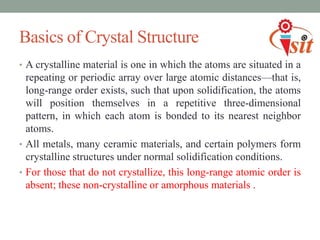
• A crystalline material is one in which the atoms are situated in a
repeating or periodic array over large atomic distances—that is,
long-range order exists, such that upon solidification, the atoms
will position themselves in a repetitive three-dimensional
pattern, in which each atom is bonded to its nearest neighbor
atoms.
• All metals, many ceramic materials, and certain polymers form
crystalline structures under normal solidification conditions.
• For those that do not crystallize, this long-range atomic order is
absent; these non-crystalline or amorphous materials .
For the face-centered cubic crystal structure, (a) a hard-sphere unit cell representation, (b)
a reduced sphere unit cell, and (c) an aggregate of many atoms.
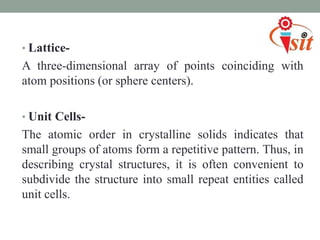
• Lattice-
A three-dimensional array of points coinciding with
atom positions (or sphere centers).
• Unit Cells-
The atomic order in crystalline solids indicates that
small groups of atoms form a repetitive pattern. Thus, in
describing crystal structures, it is often convenient to
subdivide the structure into small repeat entities called
unit cells.
Crystal Lattice and Unit Cells
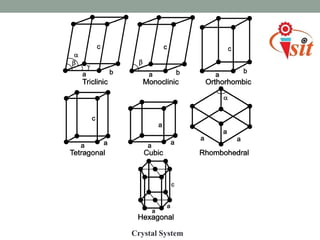
Crystal System
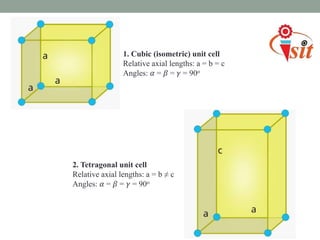
1. Cubic (isometric) unit cell
Relative axial lengths: a = b = c
Angles: 𝛼 = 𝛽 = 𝛾 = 90o
2. Tetragonal unit cell
Relative axial lengths: a = b ≠ c
Angles: 𝛼 = 𝛽 = 𝛾 = 90o
3. Orthorhombic unit cell
Relative axial lengths: a ≠ b ≠ c
Angles: 𝛼 = 𝛽 = 𝛾 = 90o
4. Rhombohedral (trigonal) unit cell
Relative axial lengths: a = b = c
Angles: 𝛼 = 𝛽 = 𝛾 ≠ 90o
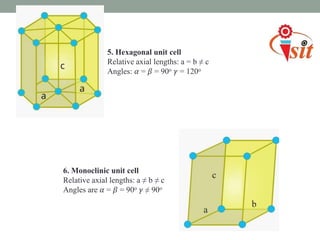
5. Hexagonal unit cell
Relative axial lengths: a = b ≠ c
Angles: 𝛼 = 𝛽 = 90o 𝛾 = 120o
6. Monoclinic unit cell
Relative axial lengths: a ≠ b ≠ c
Angles are 𝛼 = 𝛽 = 90o 𝛾 ≠ 90o
7. Triclinic unit cell
Relative axial lengths: a ≠ b ≠ c
Angles: 𝛼 ≠ 𝛽 ≠ 𝛾 ≠ 90o
Crystal System
Crystal System.pptx

Crystal System.pptx

  • 1.
    CRYSTAL SYSTEM Mr. Vikram B.Nalawade vbnalawade@sitcoe.og.in Assistant Professor, Mechatronics Engineering Department, Sharad Institute of Technology College of Engineering, Yadrav - Ichalkaranji
  • 2.
    Index • Lattice • Basis •Crystal Structure • Unit Cell • Crystal System Crystal Structure = Lattice + Basis
  • 3.
    Basics of CrystalStructure • A crystalline material is one in which the atoms are situated in a repeating or periodic array over large atomic distances—that is, long-range order exists, such that upon solidification, the atoms will position themselves in a repetitive three-dimensional pattern, in which each atom is bonded to its nearest neighbor atoms. • All metals, many ceramic materials, and certain polymers form crystalline structures under normal solidification conditions. • For those that do not crystallize, this long-range atomic order is absent; these non-crystalline or amorphous materials .
  • 4.
    For the face-centeredcubic crystal structure, (a) a hard-sphere unit cell representation, (b) a reduced sphere unit cell, and (c) an aggregate of many atoms.
  • 5.
    • Lattice- A three-dimensionalarray of points coinciding with atom positions (or sphere centers). • Unit Cells- The atomic order in crystalline solids indicates that small groups of atoms form a repetitive pattern. Thus, in describing crystal structures, it is often convenient to subdivide the structure into small repeat entities called unit cells.
  • 6.
  • 7.
  • 8.
    1. Cubic (isometric)unit cell Relative axial lengths: a = b = c Angles: 𝛼 = 𝛽 = 𝛾 = 90o 2. Tetragonal unit cell Relative axial lengths: a = b ≠ c Angles: 𝛼 = 𝛽 = 𝛾 = 90o
  • 9.
    3. Orthorhombic unitcell Relative axial lengths: a ≠ b ≠ c Angles: 𝛼 = 𝛽 = 𝛾 = 90o 4. Rhombohedral (trigonal) unit cell Relative axial lengths: a = b = c Angles: 𝛼 = 𝛽 = 𝛾 ≠ 90o
  • 10.
    5. Hexagonal unitcell Relative axial lengths: a = b ≠ c Angles: 𝛼 = 𝛽 = 90o 𝛾 = 120o 6. Monoclinic unit cell Relative axial lengths: a ≠ b ≠ c Angles are 𝛼 = 𝛽 = 90o 𝛾 ≠ 90o
  • 11.
    7. Triclinic unitcell Relative axial lengths: a ≠ b ≠ c Angles: 𝛼 ≠ 𝛽 ≠ 𝛾 ≠ 90o
  • 12.