Structures of
Materials 3
Fundamental Concepts
1. Atoms in crystalline solids are positioned in
orderly and repeated patterns that are in
contrast to the random and disordered atomic
distribution found in noncrystalline or
amorphous materials.
2. Crystal structures are specified in terms of
parallelepiped unit cells, which are
characterized by geometry and atom positions
within.
1.3 Crystalline and non-crystalline
structures
3. Unit cell- small repeating entity of the atomic
structure. The basic building block of the crystal
structure. It defines the entire crystal structure with
the atom positions within.
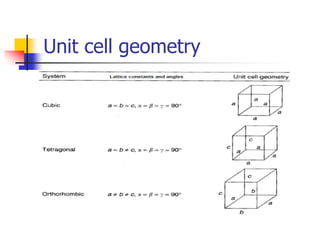
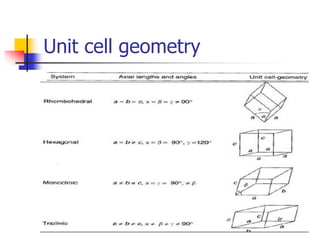
4. The concept of crystal system is used to classify
crystal structures on the basis of
unit cell geometry—that is, unit cell edge lengths
and interaxial angles. There are seven crystal
systems: cubic, tetragonal, hexagonal,
orthorhombic, rhombohedral (trigonal), monoclinic,
and triclinic.
Unit cell geometry
Unit cell geometry
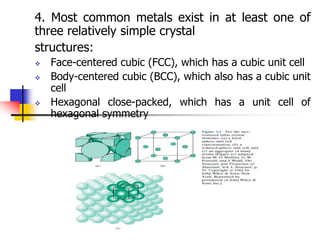
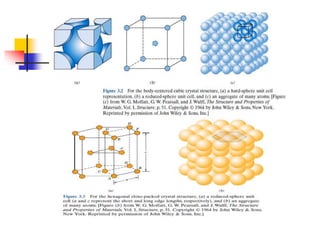
4. Most common metals exist in at least one of
three relatively simple crystal
structures:
 Face-centered cubic (FCC), which has a cubic unit cell
 Body-centered cubic (BCC), which also has a cubic unit
cell
 Hexagonal close-packed, which has a unit cell of
hexagonal symmetry
• William D. Callister, David G. Rethwisch (2018)
Materials Science and Engineering: An
Introduction. 10th Edition. John Wiley and Sons
Australia, Limited.
• William D. Callister, David G. Rethwisch (2015)
Materials Science and Engineering. 9th Edition.
John Wiley and Sons Australia, Limited,
• William D. Callister, David G. Rethwisch (2009)
Materials Science and Engineering: An
Introduction. 8th Edition. John Wiley and Sons
Australia, Limited,
References

Structures of Materials 3 .ppt

  • 1.
  • 2.
    Fundamental Concepts 1. Atomsin crystalline solids are positioned in orderly and repeated patterns that are in contrast to the random and disordered atomic distribution found in noncrystalline or amorphous materials. 2. Crystal structures are specified in terms of parallelepiped unit cells, which are characterized by geometry and atom positions within. 1.3 Crystalline and non-crystalline structures
  • 3.
    3. Unit cell-small repeating entity of the atomic structure. The basic building block of the crystal structure. It defines the entire crystal structure with the atom positions within. 4. The concept of crystal system is used to classify crystal structures on the basis of unit cell geometry—that is, unit cell edge lengths and interaxial angles. There are seven crystal systems: cubic, tetragonal, hexagonal, orthorhombic, rhombohedral (trigonal), monoclinic, and triclinic.
  • 4.
  • 5.
  • 6.
    4. Most commonmetals exist in at least one of three relatively simple crystal structures:  Face-centered cubic (FCC), which has a cubic unit cell  Body-centered cubic (BCC), which also has a cubic unit cell  Hexagonal close-packed, which has a unit cell of hexagonal symmetry
  • 8.
    • William D.Callister, David G. Rethwisch (2018) Materials Science and Engineering: An Introduction. 10th Edition. John Wiley and Sons Australia, Limited. • William D. Callister, David G. Rethwisch (2015) Materials Science and Engineering. 9th Edition. John Wiley and Sons Australia, Limited, • William D. Callister, David G. Rethwisch (2009) Materials Science and Engineering: An Introduction. 8th Edition. John Wiley and Sons Australia, Limited, References