Cryptography or Smalltalkers 2 Public Key Cryptography Martin Kobetic Cincom Smalltalk Development ESUG 2006
Contents Public Key Algorithms Encryption (RSA) Key Establishment (RSA, DH) Signing Hashes (SHA, MD5) MACs (HMAC, CBC-MAC) Digital Signatures (RSA, DSA)
Public Key Algorithms public and private key hard to compute private from the public sparse key space => much longer keys based on “hard” problems factoring, discrete logarithm much slower RSA, DSA, DH, ElGamal elliptic curves: ECDSA, ECDH, …
Encryption provides: confidentiality symmetric (secret) key ciphers same (secret) key => encrypt and decrypt DES, AES, RC4 asymmetric (public) key ciphers public key => encrypt private key => decrypt RSA,ElGammal
RSA (1977) RSA Security, PKCS #1 modulus n = product of 2 large primes p, q public: e = relatively prime to (p-1)(q-1) private: d = e -1  mod ((p-1)(q-1)) C = P e  mod n [ P < n ] P = C d  mod n small e => faster encryption
RSA keys := RSAKeyGenerator keySize: 512. alice := RSA new publicKey: keys publicKey. ctxt := alice encrypt: 'Hello World' asByteArray. ctxt asHexString bob := RSA new privateKey: keys privateKey. (bob decrypt: ctxt) asString
RSA keys := RSAKeyGenerator keySize: 512. alice := RSA new publicKey: keys publicKey. msg := 'Hello World' asByteArrayEncoding: #utf8. msg := alice encrypt: msg. bob := RSA new privateKey: keys privateKey. msg := bob decrypt: msg. msg asStringEncoding: #utf8
Key Establishment public key too slow for bulk encryption public key => secure symmetric key symmetric key => bulk encryption key exchange (RSA) generate one-time symmetric key public key => encrypt the symmetric key  key agreement (DH) parties cooperate to generate a shared secret
RSA – Key Exchange key := DSSRandom default byteStream next: 40. msg := 'Hello World!' asByteArray. msg := (ARC4 key: key) encrypt: msg. alice := RSA new publicKey: keys publicKey. key := alice encrypt: key. bob := RSA new privateKey: keys privateKey. key := bob decrypt: key ((ARC4 key: key) decrypt: msg) asString.
Diffie-Hellman (1976) shared secret over unprotected channel http://www.ietf.org/rfc/rfc2631. txt modulus p: large prime (>=512b) order q: large prime (>=160b) generator g: order q mod p private x: random 1 < x < q - 1 public y: g^x mod p public y’: other party’s y = g^x’ (mod p) shared secret: y’^x = y^x’ (mod p)
Diffie-Hellman (interactive) gen := DHParameterGenerator m: 160 l: 512. alice := DH p: gen p q: gen q g: gen g. ya := alice publicValue. bob := DH p: alice p q: alice q g: alice g. yb := bob publicValue. ss := bob sharedSecretUsing: ya ss = (alice sharedSecretUsing: yb)
Diffie-Hellman (offline) bob := DH newFrom: gen. yb := bob publicValue. alice := DH newFrom: gen. ya := alice publicValue. ss := (alice sharedSecretUsing: yb) asByteArray. msg := 'Hello World!' asByteArray. msg := (ARC4 key: ss) encrypt: msg. ss := (bob sharedSecretUsing: ya) asByteArray. ((ARC4 key: ss) decrypt: msg) asString.
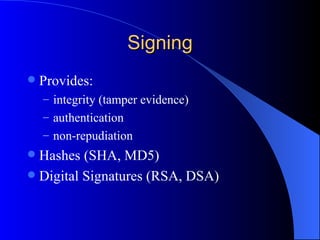
Signing Provides: integrity (tamper evidence) authentication non-repudiation Hashes (SHA, MD5) Digital Signatures (RSA, DSA)
Hash Functions provides: data “fingerprinting” unlimited input size => fixed output size must be: one-way :  h(m) => m collision resistant :  m1,m2 => h(m1) = h(m2)  MD2, MD4, MD5, SHA, RIPE-MD
Hash Functions compression function: M = M 1 , M 2 , … h i  = f(M i , h i-1 ) MD-strengthening: include message length (in the padding) doesn’t completely prevent “length extension”
MD5 (1992) http://www.ietf.org/rfc/rfc1321. txt (Ron Rivest) digest: 128-bits (16B) block: 512-bits (64B) padding: M | 10...0 | length (64bits) broken in 2004, avoid MD5!
MD5 (MD5 hash: 'Hello' asByteArray) asHexString (MD5 hash: #[1 2 3 4 5] from: 2 to: 4) asHexString input := #[1 2 3 4 5 6 7 8 9] readStream. (MD5 hashNext: 3 from: input) asHexString (MD5 hashFrom: input) asHexString
SHA (1993) SHS - NIST FIPS PUB 180 digest: 160 bits (20B) block: 512 bits (64B) padding: M | 10...0 | length (64bits) FIPS 180-1: SHA-1 (1995) FIPS 180-2: SHA-256, 384, 512 (2002) SHA-1 broken in 2005!
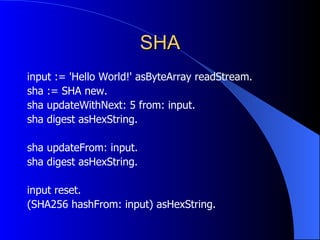
SHA input := 'Hello World!' asByteArray readStream. sha := SHA new. sha updateWithNext: 5 from: input. sha digest asHexString. sha updateFrom: input. sha digest asHexString. input reset. (SHA256 hashFrom: input) asHexString.
Digital Signatures authentic, non-reusable, unalterable signing uses the  private  key message, key => signature verification uses the  public  key message, key, signature => true/false
RSA signing: hash the plaintext encode digest encrypt digest with private key verifying: decrypt digest with public key decode digest hash the plaintext compare the digests
RSA alice := RSA new privateKey: keys privateKey. msg := 'Hello World' asByteArray. sig := alice sign: msg. sig asHexString bob := RSA new publicKey: keys publicKey. bob verify: sig of: msg
DSA (1994) NIST FIPS PUB 186 p prime (modulus): (512 + k*64 <= 1024) q prime factor of p – 1 (160 bits) g > 1; g^q mod p = 1 (g has order q mod p) x < q (private key) y = g^x mod p (public key) FIPS 186-1 (1998): RSA(X9.31) FIPS 186-2 (2001): ECDSA(X9.62) FIPS 186-3 (?2006): bigger keys up to 15K bits
DSA keys := DSAKeyGenerator keySize: 512. alice := DSA new privateKey: keys privateKey. sig := alice sign: 'Hello World' asByteArray bob := DSA new publicKey: keys publicKey. bob verify: sig of: 'Hello World' asByteArray
Books [1] Anderson: Security Engineering [2] Ferguson, Schneier: Practical Cryptography [3] Kahn: The Codebreakers [4] Menezes, van Oorschot, Vanstone:  Handbook of Applied Cryptography  [5] Schneier: Applied Cryptography

Cryptography for Smalltalkers 2 - ESUG 2006

  • 1.
    Cryptography or Smalltalkers2 Public Key Cryptography Martin Kobetic Cincom Smalltalk Development ESUG 2006
  • 2.
    Contents Public KeyAlgorithms Encryption (RSA) Key Establishment (RSA, DH) Signing Hashes (SHA, MD5) MACs (HMAC, CBC-MAC) Digital Signatures (RSA, DSA)
  • 3.
    Public Key Algorithmspublic and private key hard to compute private from the public sparse key space => much longer keys based on “hard” problems factoring, discrete logarithm much slower RSA, DSA, DH, ElGamal elliptic curves: ECDSA, ECDH, …
  • 4.
    Encryption provides: confidentialitysymmetric (secret) key ciphers same (secret) key => encrypt and decrypt DES, AES, RC4 asymmetric (public) key ciphers public key => encrypt private key => decrypt RSA,ElGammal
  • 5.
    RSA (1977) RSASecurity, PKCS #1 modulus n = product of 2 large primes p, q public: e = relatively prime to (p-1)(q-1) private: d = e -1 mod ((p-1)(q-1)) C = P e mod n [ P < n ] P = C d mod n small e => faster encryption
  • 6.
    RSA keys :=RSAKeyGenerator keySize: 512. alice := RSA new publicKey: keys publicKey. ctxt := alice encrypt: 'Hello World' asByteArray. ctxt asHexString bob := RSA new privateKey: keys privateKey. (bob decrypt: ctxt) asString
  • 7.
    RSA keys :=RSAKeyGenerator keySize: 512. alice := RSA new publicKey: keys publicKey. msg := 'Hello World' asByteArrayEncoding: #utf8. msg := alice encrypt: msg. bob := RSA new privateKey: keys privateKey. msg := bob decrypt: msg. msg asStringEncoding: #utf8
  • 8.
    Key Establishment publickey too slow for bulk encryption public key => secure symmetric key symmetric key => bulk encryption key exchange (RSA) generate one-time symmetric key public key => encrypt the symmetric key key agreement (DH) parties cooperate to generate a shared secret
  • 9.
    RSA – KeyExchange key := DSSRandom default byteStream next: 40. msg := 'Hello World!' asByteArray. msg := (ARC4 key: key) encrypt: msg. alice := RSA new publicKey: keys publicKey. key := alice encrypt: key. bob := RSA new privateKey: keys privateKey. key := bob decrypt: key ((ARC4 key: key) decrypt: msg) asString.
  • 10.
    Diffie-Hellman (1976) sharedsecret over unprotected channel http://www.ietf.org/rfc/rfc2631. txt modulus p: large prime (>=512b) order q: large prime (>=160b) generator g: order q mod p private x: random 1 < x < q - 1 public y: g^x mod p public y’: other party’s y = g^x’ (mod p) shared secret: y’^x = y^x’ (mod p)
  • 11.
    Diffie-Hellman (interactive) gen:= DHParameterGenerator m: 160 l: 512. alice := DH p: gen p q: gen q g: gen g. ya := alice publicValue. bob := DH p: alice p q: alice q g: alice g. yb := bob publicValue. ss := bob sharedSecretUsing: ya ss = (alice sharedSecretUsing: yb)
  • 12.
    Diffie-Hellman (offline) bob:= DH newFrom: gen. yb := bob publicValue. alice := DH newFrom: gen. ya := alice publicValue. ss := (alice sharedSecretUsing: yb) asByteArray. msg := 'Hello World!' asByteArray. msg := (ARC4 key: ss) encrypt: msg. ss := (bob sharedSecretUsing: ya) asByteArray. ((ARC4 key: ss) decrypt: msg) asString.
  • 13.
    Signing Provides: integrity(tamper evidence) authentication non-repudiation Hashes (SHA, MD5) Digital Signatures (RSA, DSA)
  • 14.
    Hash Functions provides:data “fingerprinting” unlimited input size => fixed output size must be: one-way : h(m) => m collision resistant : m1,m2 => h(m1) = h(m2) MD2, MD4, MD5, SHA, RIPE-MD
  • 15.
    Hash Functions compressionfunction: M = M 1 , M 2 , … h i = f(M i , h i-1 ) MD-strengthening: include message length (in the padding) doesn’t completely prevent “length extension”
  • 16.
    MD5 (1992) http://www.ietf.org/rfc/rfc1321.txt (Ron Rivest) digest: 128-bits (16B) block: 512-bits (64B) padding: M | 10...0 | length (64bits) broken in 2004, avoid MD5!
  • 17.
    MD5 (MD5 hash:'Hello' asByteArray) asHexString (MD5 hash: #[1 2 3 4 5] from: 2 to: 4) asHexString input := #[1 2 3 4 5 6 7 8 9] readStream. (MD5 hashNext: 3 from: input) asHexString (MD5 hashFrom: input) asHexString
  • 18.
    SHA (1993) SHS- NIST FIPS PUB 180 digest: 160 bits (20B) block: 512 bits (64B) padding: M | 10...0 | length (64bits) FIPS 180-1: SHA-1 (1995) FIPS 180-2: SHA-256, 384, 512 (2002) SHA-1 broken in 2005!
  • 19.
    SHA input :='Hello World!' asByteArray readStream. sha := SHA new. sha updateWithNext: 5 from: input. sha digest asHexString. sha updateFrom: input. sha digest asHexString. input reset. (SHA256 hashFrom: input) asHexString.
  • 20.
    Digital Signatures authentic,non-reusable, unalterable signing uses the private key message, key => signature verification uses the public key message, key, signature => true/false
  • 21.
    RSA signing: hashthe plaintext encode digest encrypt digest with private key verifying: decrypt digest with public key decode digest hash the plaintext compare the digests
  • 22.
    RSA alice :=RSA new privateKey: keys privateKey. msg := 'Hello World' asByteArray. sig := alice sign: msg. sig asHexString bob := RSA new publicKey: keys publicKey. bob verify: sig of: msg
  • 23.
    DSA (1994) NISTFIPS PUB 186 p prime (modulus): (512 + k*64 <= 1024) q prime factor of p – 1 (160 bits) g > 1; g^q mod p = 1 (g has order q mod p) x < q (private key) y = g^x mod p (public key) FIPS 186-1 (1998): RSA(X9.31) FIPS 186-2 (2001): ECDSA(X9.62) FIPS 186-3 (?2006): bigger keys up to 15K bits
  • 24.
    DSA keys :=DSAKeyGenerator keySize: 512. alice := DSA new privateKey: keys privateKey. sig := alice sign: 'Hello World' asByteArray bob := DSA new publicKey: keys publicKey. bob verify: sig of: 'Hello World' asByteArray
  • 25.
    Books [1] Anderson:Security Engineering [2] Ferguson, Schneier: Practical Cryptography [3] Kahn: The Codebreakers [4] Menezes, van Oorschot, Vanstone: Handbook of Applied Cryptography [5] Schneier: Applied Cryptography

Editor's Notes

  • #4 much slower than secret key encryption: expensive operations (x^y mod z), long keys (1-8K bits) =&gt; used for key encryption/exchange, signing elliptic curve crypto (ECC) same ciphers, different number field allows much shorter keys for comparable security =&gt; faster heavily patented (www.certicom.com) some royalty free licenses for specific purposes (NIST/IETF)
  • #5 Usage: sender uses the *public* key of the recipient to encrypt the message receiver uses her *private* key to decrypt the message encryption does not provide integrity protection!
  • #6 Rivest, Shamir, Adelman can be used for both encryption and digital signatures use small e to optimize encryption/verification Pitfalls: don’t use the same key to encrypt and sign; decrypting c is the same operation as signing c ! not good with small messages; if modular reduction doesn’t occur (good chance with small e), the plaintext can be recovered by simple (non-modular) e-th root computation; =&gt; PKCS#1 applies padding in fact any kind of structure in the message seems to facilitate attacks; messages should be protected against that using suitable “encoding”; including padding =&gt; use PKCS#1 v2.1 – OAEP padding
  • #8 public key structure: n, e ciphertext size is 512 bits! (depends on the key size) private key structure: n, d p, q: CRT =&gt; 3-4 times speed up of decryption.
  • #10 you have to transfer both the encrypted key and the encrypted message
  • #11 allows to establish a shared, secret value over an unprotected communication channel used to establish a secret session key for further communication (DH handshake) doesn’t provide authentication of the parties =&gt; doesn’t protect against the man-in-the-middle attack small subgroup attack –small order g the shared secret is in that subgroup, if the group is small enough, it can be searched for the secret =&gt; solution: safe primes p = 2q + 1; q prime
  • #12 m – bit size of q =&gt; bit size of x (at least twice the size of symmetric key) l – bit size of p =&gt; bit size of y - Ephemeral-ephemeral DH - perfect forward secrecy (PFS)
  • #13 Ephemeral-static DH Unlike RSA with DH Bob needs ya to decrypt!
  • #15 a.k.a “message digest” one-way : hard to find the input for given output collision resistant : hard to find two distinct inputs with the same output used a lot in MACs and digital signatures used for file “fingerprints”: md5sum, sha1sum
  • #16 MD-strengthening: with inclusion of the length no encoded input is a prefix of another encoded input MD-stregthening helps a lot but doesn’t completely prevent “length extension” if M2 = M1’ || X =&gt; h(M2) = h ( h (M1) || X)) M1’ means, the original M1 message padded as prescribed by the hash function possible fixes: h(h(M), M) – expensive, or h(h(M)) - weaker; MACs usually address the weakness as well
  • #17 derived from MD4 (fixing known MD4 weaknesses) broken in 2004 by Wang, Yin; furher improved by others currently collision in a few hours on common desktop PC
  • #18 higher level API, processes entire input at once both stream and byte array based parameter support
  • #19 also derived from MD4 SHA-0 broken (Wang, Yin, Yu 2004): collisions in 2**69 instead of 2**80 SHA-1 broken (Wang, Yin, Yu 2005): collisions in 2**69 instead of 2**80
  • #20 lower-level API, processes input in arbitrary chunks can get digest value in progress, I.e can continue with updates after a #digest call can clone a digest in progress (#copy) can be queried for #blockSize and #digestSize and current #messageLength can reuse algorithm instances after #reset
  • #21 - bound to the key and to the data being signed (it won’t validate with any other data)
  • #22 digest encoding is to expand the digest to match the bit-size of n destroy any structure that the encoded bytes might have seed a random generator with the digest and use as many bytes as possible
  • #24 based on “discrete logarithm” problem used for signatures only signing: Generate a random per message value k where 0 &lt; k &lt; q (this is known as a nonce ) Calculate r = ( g k mod p ) mod q Calculate s = ( k -1 (SHA-1( m ) + x * r )) mod q Recalculate the signature in the unlikely case that r =0 or s =0 The signature is ( r , s ) verification: Reject the signature if either 0&lt; r &lt;q or 0&lt; s &lt;q is not satisfied. Calculate w = ( s ) -1 mod q Calculate u 1 = (SHA-1( m )* w ) mod q Calculate u 2 = ( r * w ) mod q Calculate v = (( g u 1 * y u 2 ) mod p ) mod q The signature is valid if v = r Note: FIPS-186-2, change notice 1 specifies that L should only assume the value 1024 forthcoming FIPS 186-3 (described, e.g., in SP 800-57) uses SHA-224, SHA-256, SHA-384, and SHA-512 as a hash function, q of size 224, 256, 384, and 512 bits, with L equal to 2048, 3072, 7680, and 15360, respectively.