Coastal Navigation
Jack Dale
CRYA Yachtmaster Ocean Instructor Evaluator
IYT Yachtmaster Coastal Instructor
© Jack Dale and CRYA
Why Not Use a GPS
Most vessels of any kind in Canada have an obligation to carry and
use official charts and publications and to keep them up to date. The
chart carriage requirements are listed in the Charts and Nautical
Publications Regulations, 1995 of the Canada Shipping Act.
© Jack Dale and CRYA
CHS paper charts meet the requirements of the chart carriage regulations.
CHS digital charts meet the requirements of the chart carriage regulations
under certain circumstances. CHS Electronic Navigational Charts (ENCs)
meet the requirements provided they are used with an Electronic Chart
Display and Information System (ECDIS). CHS raster charts meet the
requirements only if paper charts are carried and used as a backup.
© Jack Dale and CRYA
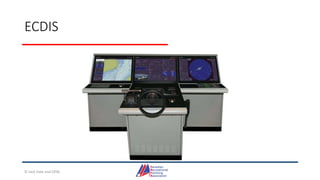
ECDIS
© Jack Dale and CRYA
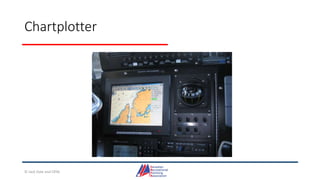
Chartplotter
© Jack Dale and CRYA
Section 2
Coastal Navigation Standard
© Jack Dale and CRYA
Chart Notation
Guidelines for labeling
Draw your lines lightly and no longer than necessary.
Allow for the thickness of your pencil.
Label a line immediately after drawing it.
The label for any line is placed along that line, that is,
parallel to the line.
The label for any point should not be along any line,
that is, at an angle to the line.
© Jack Dale and CRYA
Abbreviations Found on Labels
C = course to steer, also know as the heading (shown at
beginning of the label)
CMG = course made good
 M = magnetic heading (shown at end of the label)
T = true heading (shown at end of the label)
C = compass heading (shown at end of the label)
S = speed through water in knots
SMG = speed made good (sometimes called speed over
ground)
D = distance
© Jack Dale and CRYA
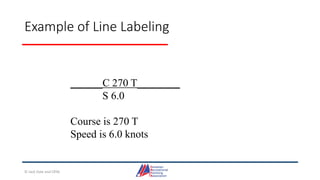
Example of Line Labeling
______C 270 T________
S 6.0
Course is 270 T
Speed is 6.0 knots
© Jack Dale and CRYA
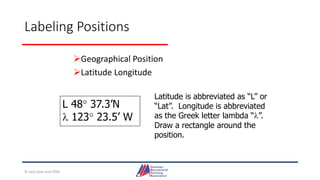
Labeling Positions
Geographical Position
Latitude Longitude
L 48 37.3’N
 123 23.5’ W
Latitude is abbreviated as “L” or
“Lat”. Longitude is abbreviated
as the Greek letter lambda “”.
Draw a rectangle around the
position.
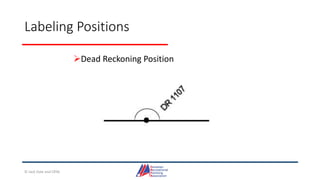
© Jack Dale and CRYA
Labeling Positions
Dead Reckoning Position
© Jack Dale and CRYA
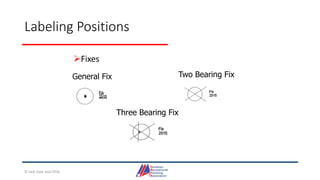
Labeling Positions
Fixes
General Fix Two Bearing Fix
Three Bearing Fix
© Jack Dale and CRYA
Labeling Positions
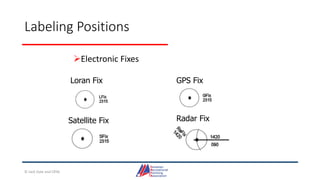
Electronic Fixes
Loran Fix GPS Fix
Satellite Fix Radar Fix
© Jack Dale and CRYA
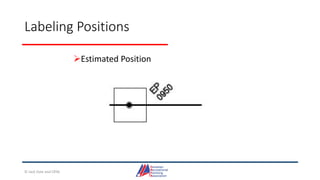
Labeling Positions
Estimated Position
© Jack Dale and CRYA
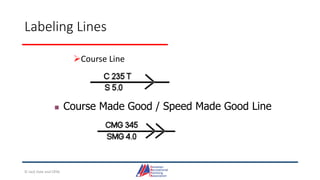
Labeling Lines
Course Line
 Course Made Good / Speed Made Good Line
© Jack Dale and CRYA
Labeling Lines
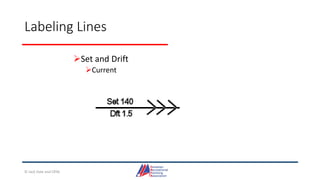
Set and Drift
Current
© Jack Dale and CRYA
Labeling Lines
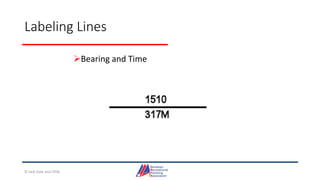
Bearing and Time
© Jack Dale and CRYA
Labeling Lines
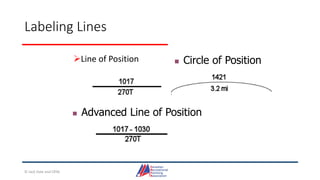
Line of Position  Circle of Position
 Advanced Line of Position
© Jack Dale and CRYA
Labeling Lines
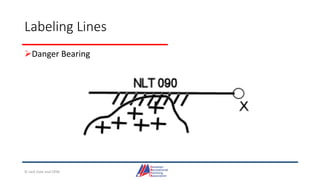
Danger Bearing
© Jack Dale and CRYA
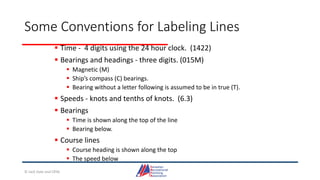
Some Conventions for Labeling Lines
 Time - 4 digits using the 24 hour clock. (1422)
 Bearings and headings - three digits. (015M)
 Magnetic (M)
 Ship’s compass (C) bearings.
 Bearing without a letter following is assumed to be in true (T).
 Speeds - knots and tenths of knots. (6.3)
 Bearings
 Time is shown along the top of the line
 Bearing below.
 Course lines
 Course heading is shown along the top
 The speed below
© Jack Dale and CRYA
Some Conventions for Labeling Lines
 As a general guide, the information with the most digits is shown
along the top of the line.
© Jack Dale and CRYA
Section 3
Tools and Publications
© Jack Dale and CRYA
Navigational Equipment
Plotters
Dividers
Hand Bearing Compass
Ship’s Compass
TSD Computer
Calculator
Pencils / Erasers
Binoculars
Knotmeter
Depth Sounder / Lead Line
Watch
Barometer
GPS
VHF Radio
© Jack Dale and CRYA
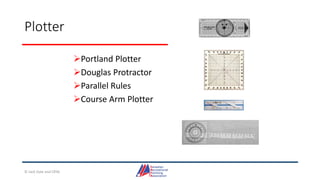
Plotter
Portland Plotter
Douglas Protractor
Parallel Rules
Course Arm Plotter
© Jack Dale and CRYA
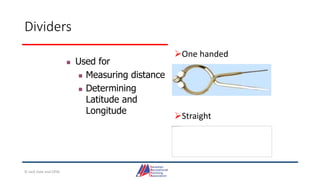
Dividers
One handed
Straight
 Used for
 Measuring distance
 Determining
Latitude and
Longitude
© Jack Dale and CRYA
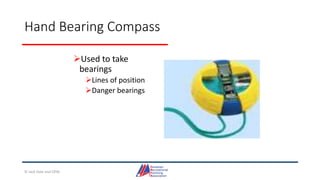
Hand Bearing Compass
Used to take
bearings
Lines of position
Danger bearings
© Jack Dale and CRYA
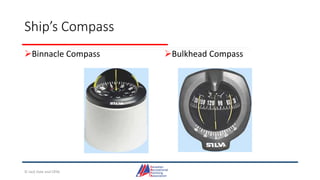
Ship’s Compass
Binnacle Compass Bulkhead Compass
© Jack Dale and CRYA
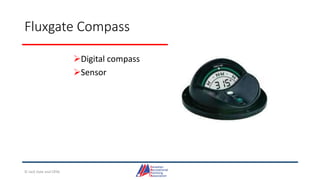
Fluxgate Compass
Digital compass
Sensor
© Jack Dale and CRYA
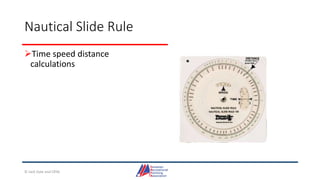
Nautical Slide Rule
Time speed distance
calculations
© Jack Dale and CRYA
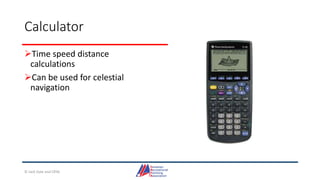
Calculator
Time speed distance
calculations
Can be used for celestial
navigation
© Jack Dale and CRYA
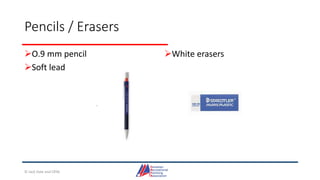
Pencils / Erasers
O.9 mm pencil
Soft lead
White erasers
© Jack Dale and CRYA
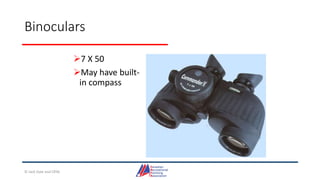
Binoculars
7 X 50
May have built-
in compass
© Jack Dale and CRYA
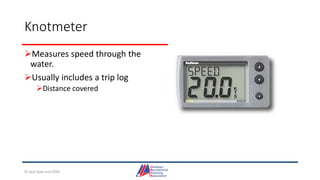
Knotmeter
Measures speed through the
water.
Usually includes a trip log
Distance covered
© Jack Dale and CRYA
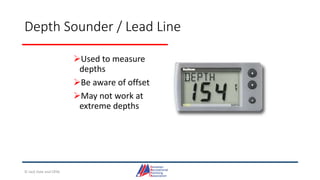
Depth Sounder / Lead Line
Used to measure
depths
Be aware of offset
May not work at
extreme depths
© Jack Dale and CRYA
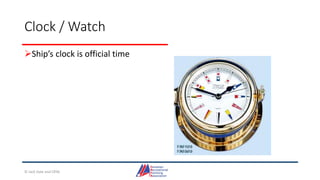
Clock / Watch
Ship’s clock is official time
© Jack Dale and CRYA
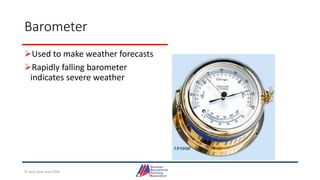
Barometer
Used to make weather forecasts
Rapidly falling barometer
indicates severe weather
© Jack Dale and CRYA
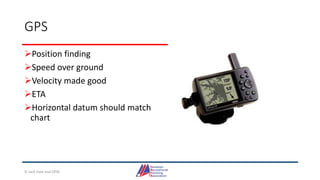
GPS
Position finding
Speed over ground
Velocity made good
ETA
Horizontal datum should match
chart
© Jack Dale and CRYA
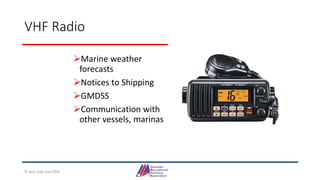
VHF Radio
Marine weather
forecasts
Notices to Shipping
GMDSS
Communication with
other vessels, marinas
© Jack Dale and CRYA
Navigational Publications
Notices to Mariners
Chart 1 - Symbols and
Abbreviations
Catalogue of Nautical Charts
and Related Publications
Sailing Directions
Current Atlas
Canadian Aids to Navigation
System
Tide and Current Tables
List of Lights, Buoys and Fog
Signals
Radio Aids to Marine Navigation
© Jack Dale and CRYA
Other Publications
International Regulations for the Prevention of Collisions at Sea
(ColRegs)
Safe Boating Guide
© Jack Dale and CRYA
Section 6
Charts
© Jack Dale and CRYA
Charts
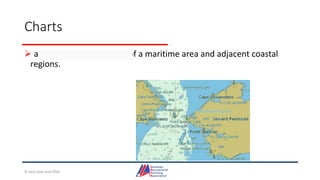
 a graphic representation of a maritime area and adjacent coastal
regions.
© Jack Dale and CRYA
Chart Information
Charts show
depths of water and heights of land,
natural features of the seabed,
details of the coastline,
navigational hazards,
locations of natural and man-made aids to navigation,
information on tides and currents,
local details of the Earth's magnetic field,
man-made structures such as harbours and bridges
© Jack Dale and CRYA
Chart Classification
Sailing Charts
Offshore passages
1:600,000
Very little detail
General Charts
Making landfalls
1:150,000 to 1:600,000
© Jack Dale and CRYA
Chart Classification
Coastal Charts
Inshore navigation
1:50,000 to 1:150,000
Harbour Charts
Navigating harbours and waterways
Larger than 1:50,000
Large scale = lots of detail
© Jack Dale and CRYA
Care of Charts
Use soft pencils only
Use white erasers only
Level, flat surface
Keep them updated
Keep them dry
Use below decks
Stow flat / folded
© Jack Dale and CRYA
Reading Charts
Title Block
Chart Symbols and Abbreviations
© Jack Dale and CRYA
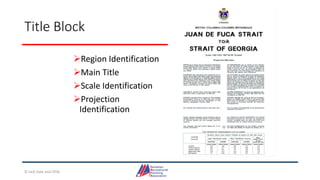
Title Block
Region Identification
Main Title
Scale Identification
Projection
Identification
© Jack Dale and CRYA
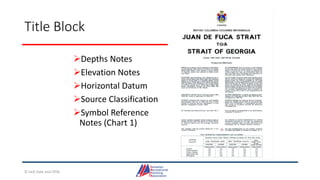
Title Block
Depths Notes
Elevation Notes
Horizontal Datum
Source Classification
Symbol Reference
Notes (Chart 1)
© Jack Dale and CRYA
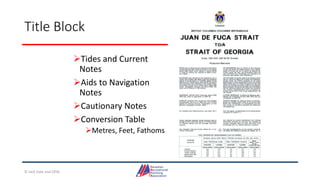
Title Block
Tides and Current
Notes
Aids to Navigation
Notes
Cautionary Notes
Conversion Table
Metres, Feet, Fathoms
© Jack Dale and CRYA
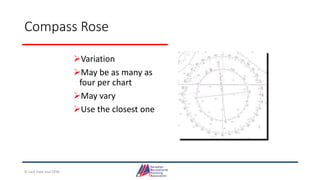
Compass Rose
Variation
May be as many as
four per chart
May vary
Use the closest one
© Jack Dale and CRYA
Transferring Charts
Determine position
Determine range and bearing to object on both charts
Verify with latitude and longitude
© Jack Dale and CRYA
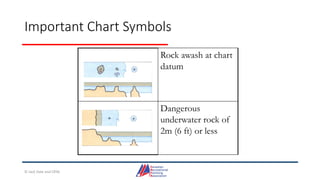
Important Chart Symbols
Rock awash at chart
datum
Dangerous
underwater rock of
2m (6 ft) or less
© Jack Dale and CRYA
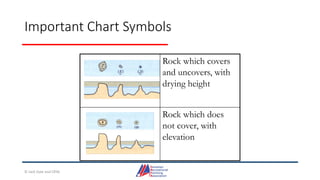
Important Chart Symbols
Rock which covers
and uncovers, with
drying height
Rock which does
not cover, with
elevation
© Jack Dale and CRYA
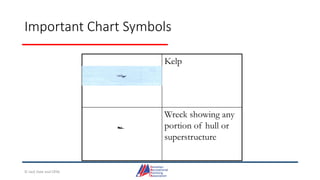
Important Chart Symbols
Kelp
Wreck showing any
portion of hull or
superstructure
© Jack Dale and CRYA
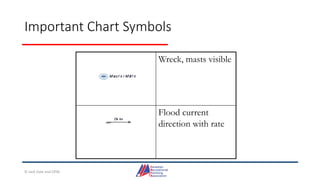
Important Chart Symbols
Wreck, masts visible
Flood current
direction with rate
© Jack Dale and CRYA
Important Chart Symbols
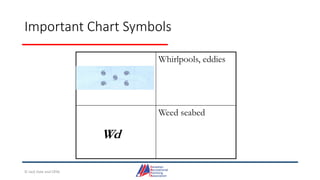
Whirlpools, eddies
Wd
Weed seabed
© Jack Dale and CRYA
Important Chart Symbols
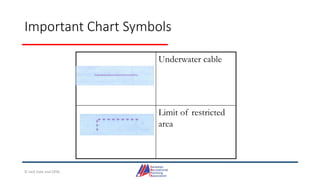
Underwater cable
Limit of restricted
area
© Jack Dale and CRYA
Important Chart Symbols
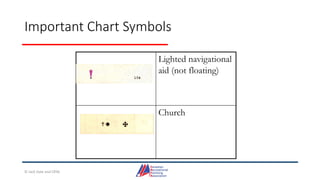
Lighted navigational
aid (not floating)
Church
© Jack Dale and CRYA
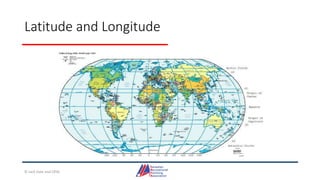
Coordinates
Latitude (L)
Parallels run east and west
Denote location north or south of the Equator
Poles are 90º North and 90º South
Longitude (λ)
Meridians run north and south
Denote location east or west of Prime Meriden
Greenwich
Converge at poles
© Jack Dale and CRYA
Latitude and Longitude
© Jack Dale and CRYA
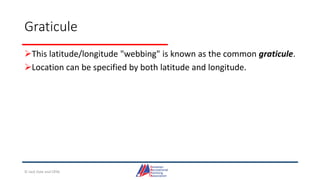
Graticule
This latitude/longitude "webbing" is known as the common graticule.
Location can be specified by both latitude and longitude.
© Jack Dale and CRYA
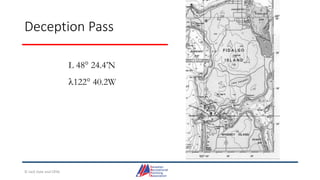
Deception Pass
L 48 24.4’N
122 40.2W
© Jack Dale and CRYA
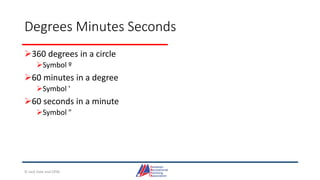
Degrees Minutes Seconds
360 degrees in a circle
Symbol º
60 minutes in a degree
Symbol '
60 seconds in a minute
Symbol "
© Jack Dale and CRYA
Formats
Latitude – Longitude
DM Degree:Minute
L 49º 30.0’ N λ123º 30.0’W
DMS Degree:Minute:Second
L49 º 30’ 00”N λ123º 30’ 00”W
DD Decimal Degree
L49.5000º N λ123.5000ºW
generally with 4 decimal numbers.
© Jack Dale and CRYA
Chart Projections
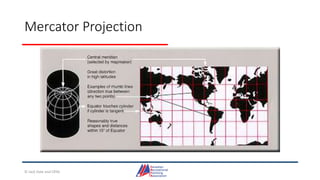
Mercator
“Normal” projection for charts
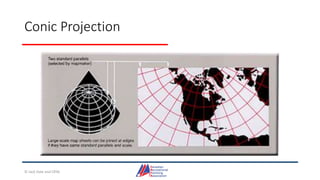
Polyconic
May be used in the Great Lakes
© Jack Dale and CRYA
Mercator Projection
© Jack Dale and CRYA
Conic Projection
© Jack Dale and CRYA
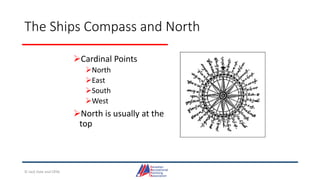
The Ships Compass and North
Cardinal Points
North
East
South
West
North is usually at the
top
© Jack Dale and CRYA
North
True North
No variation or deviation
Magnetic North
Accounts for variation only
Compass North
Accounts for variation and deviation
© Jack Dale and CRYA
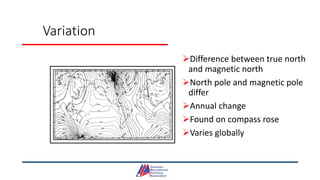
Variation
Difference between true north
and magnetic north
North pole and magnetic pole
differ
Annual change
Found on compass rose
Varies globally
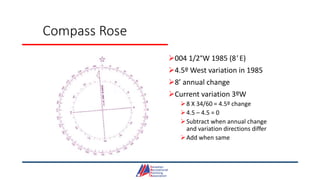
Compass Rose
004 1/2°W 1985 (8' E)
4.5º West variation in 1985
8’ annual change
Current variation 3ºW
8 X 34/60 = 4.5º change
4.5 – 4.5 = 0
Subtract when annual change
and variation directions differ
Add when same
Deviation
Difference between ship’s compass and magnetic
bearing
Ferrous metal affects magnetic field on vessel
Relative to vessel’s heading
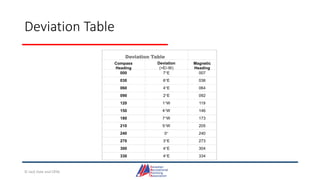
Found on deviation card / table
No deviation in hand bearing compass
Deviation Table
Deviation Table
Compass
Heading
Deviation
(+E/-W)
Magnetic
Heading
000 7E 007
030 6E 036
060 4E 064
090 2E 092
120 1W 119
150 4W 146
180 7W 173
210 5W 205
240 0 240
270 3E 273
300 4E 304
330 4E 334
© Jack Dale and CRYA
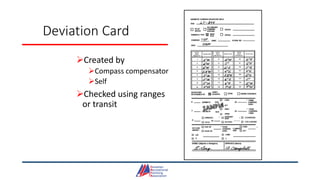
Deviation Card
Created by
Compass compensator
Self
Checked using ranges
or transit
Accounting for Variation and Deviation
Helm reads the ship’s compass
Navigator works in true
Navigator makes conversions
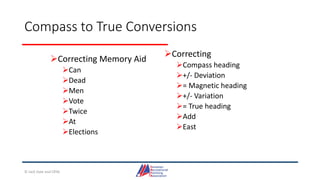
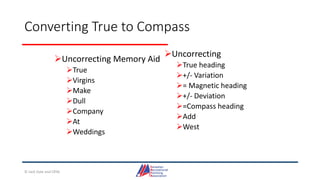
Correcting
Compass to True
Uncorrecting
True to Compass
© Jack Dale and CRYA
Compass to True Conversions
Correcting Memory Aid
Can
Dead
Men
Vote
Twice
At
Elections
Correcting
Compass heading
+/- Deviation
= Magnetic heading
+/- Variation
= True heading
Add
East
© Jack Dale and CRYA
Converting True to Compass
Uncorrecting Memory Aid
True
Virgins
Make
Dull
Company
At
Weddings
Uncorrecting
True heading
+/- Variation
= Magnetic heading
+/- Deviation
=Compass heading
Add
West
© Jack Dale and CRYA
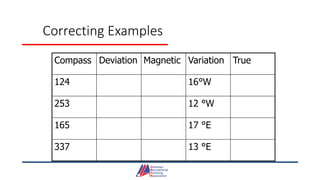
Correcting Examples
Compass Deviation Magnetic Variation True
124 16°W
253 12 °W
165 17 °E
337 13 °E
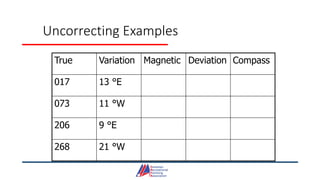
Uncorrecting Examples
True Variation Magnetic Deviation Compass
017 13 °E
073 11 °W
206 9 °E
268 21 °W
Checking Deviation (page 96)
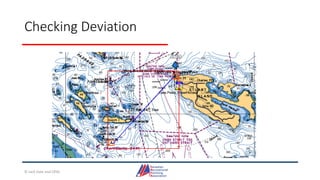
Maintain a course that keeps Rum Island and Turn Point in line
Determine heading from ship’s compass
020 C
True heading
042
© Jack Dale and CRYA
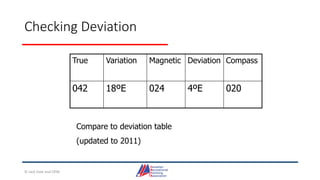
Checking Deviation
True Variation Magnetic Deviation Compass
042 18ºE 024 4ºE 020
Compare to deviation table
(updated to 2011)
© Jack Dale and CRYA
Checking Deviation
© Jack Dale and CRYA
Sources of Error in Deviation Cards
Electronic Interference
Radio speakers near compass
Old deviation card
Winch handles or other metal near compass
© Jack Dale and CRYA
Section Four
Tide and Current Tables
© Jack Dale and CRYA
Reference and Secondary Ports
Reference ports ar those for which tides tables are given on a every
date.
Secondary ports are those locations for which corrections are
required to get daily tides.
© Jack Dale and CRYA
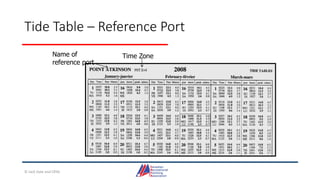
Tide Table – Reference Port
Name of
reference port
Time Zone
© Jack Dale and CRYA
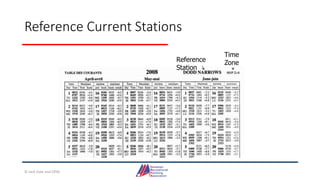
Reference Current Stations
Reference
Station
Time
Zone
© Jack Dale and CRYA
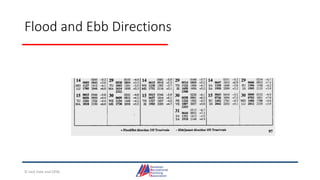
Flood and Ebb Directions
© Jack Dale and CRYA
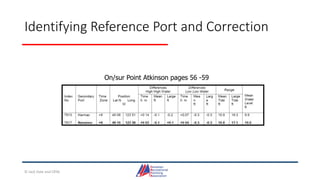
Identifying Reference Port and Correction
On/sur Point Atkinson pages 56 -59
© Jack Dale and CRYA
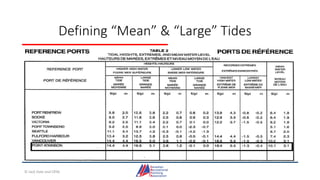
Defining “Mean” & “Large” Tides
© Jack Dale and CRYA
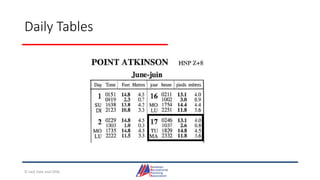
Daily Tables
© Jack Dale and CRYA
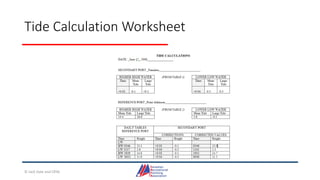
Tide Calculation Worksheet
© Jack Dale and CRYA
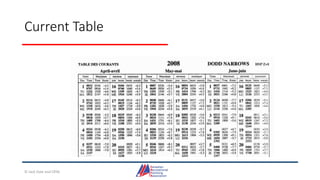
Current Table
© Jack Dale and CRYA
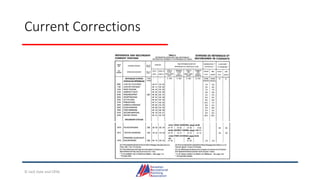
Current Corrections
© Jack Dale and CRYA
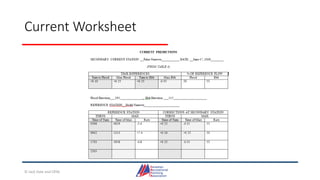
Current Worksheet
© Jack Dale and CRYA
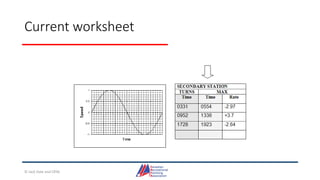
Current worksheet
© Jack Dale and CRYA
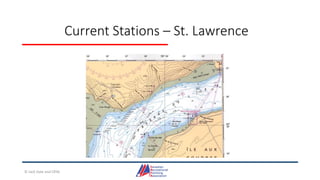
Current Stations – St. Lawrence
© Jack Dale and CRYA
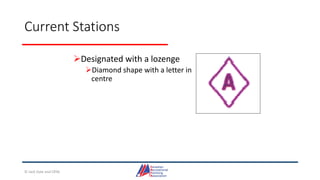
Current Stations
Designated with a lozenge
Diamond shape with a letter in
centre
© Jack Dale and CRYA
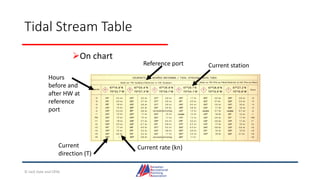
Tidal Stream Table
On chart
Hours
before and
after HW at
reference
port
Current
direction (T)
Current rate (kn)
Reference port Current station
© Jack Dale and CRYA
Scenario
On July 22, 2007 in the early afternoon you are sailing along the
range toward Cap de Diable in the St. Lawrence River. Your course
will take you over an abandoned cable located at L47 24.15’N 70
27.0’ W. You expect to encounter some current in the vicinity. What
will be the expected currents when the reference station is at High
Water?
© Jack Dale and CRYA
Step One
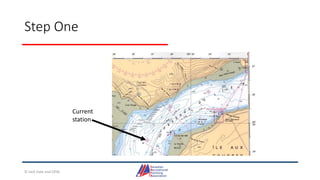
Step 1 - Identify the nearest current station. The
letter in the lozenge will correspond to the
appropriate column on the table. In this case the
secondary current station is marked with a
It is located at L 47 24.4’N  070 27.3’W.
B
© Jack Dale and CRYA
Step One
Current
station
© Jack Dale and CRYA
Step Two
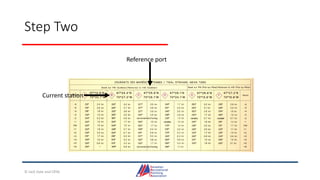
Identify the appropriate reference port in the second row of the
table. At the row above the position of the secondary station we note
that this is referenced to High Water (HW) at Québec.
© Jack Dale and CRYA
Step Two
Current station
Reference port
© Jack Dale and CRYA
Step Three
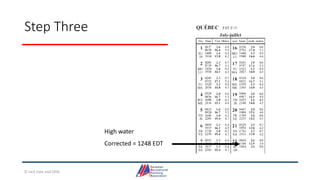
Using the correct pages of the Tide and Current Tables find the High
Water times for the reference port. Using the Tide and Current Tables
we note that in the early afternoon that High Water is at 1148 EST,
which we correct by adding 1 hour for daylight savings and get 1248
EDT.
© Jack Dale and CRYA
Step Three
High water
Corrected = 1248 EDT
© Jack Dale and CRYA
Step 4
- Note the time difference between High Water at the reference port
and the time for which you want information. We will be at the
current station at 1248, which is also High Water at Québec.
© Jack Dale and CRYA
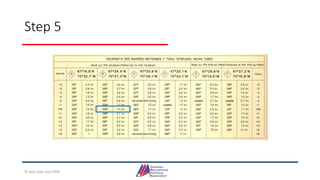
Step 5
Locate the correct row for the time difference and
the column for the current lozenge. The direction of
current in given in degrees true and current rate is
given in knots. From the table we find:
Time: 1248 Rate: 1.0 kn Direction: 040
© Jack Dale and CRYA
Step 5
© Jack Dale and CRYA
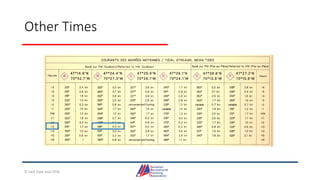
Other Times
When calculating the rate and direction for times other than High
Water at the reference port, determine the number hours from High
Water at the reference port to the time in which you are interested.
For example, you are at this current station at 1548 (3 hours later).
The characteristics of the current are:
Time: 1548 Rate: 4 kn Direction: 018
© Jack Dale and CRYA
Other Times
© Jack Dale and CRYA
Section 5
Aids to Navigation
© Jack Dale and CRYA
Upstream Rules
AKA Local Direction of Buoyage
Returning from sea
Entering a harbour or marina
Upstream in a river
Traveling in the direction as the flood current
© Jack Dale and CRYA
General Direction of Buoyage
Clockwise around continents
North – West Coast
East – Arctic
South Atlantic
Supersedes Upstream Rules when in conflict.
North of Campbell River
© Jack Dale and CRYA
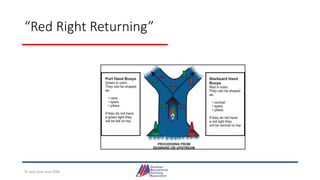
“Red Right Returning”
© Jack Dale and CRYA
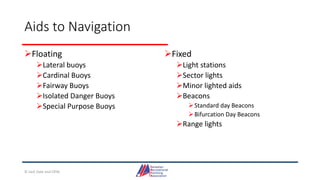
Aids to Navigation
Floating
Lateral buoys
Cardinal Buoys
Fairway Buoys
Isolated Danger Buoys
Special Purpose Buoys
Fixed
Light stations
Sector lights
Minor lighted aids
Beacons
Standard day Beacons
Bifurcation Day Beacons
Range lights
© Jack Dale and CRYA
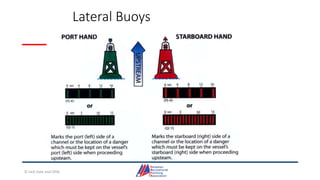
Lateral Buoys
© Jack Dale and CRYA
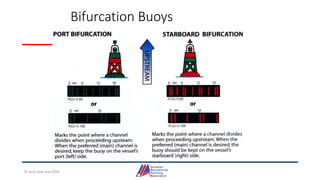
Bifurcation Buoys
© Jack Dale and CRYA
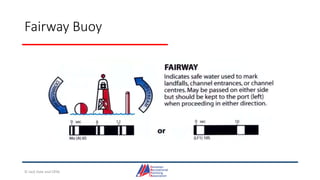
Fairway Buoy
© Jack Dale and CRYA
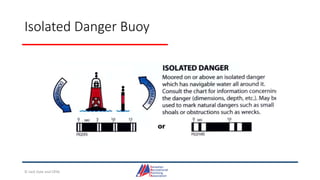
Isolated Danger Buoy
© Jack Dale and CRYA
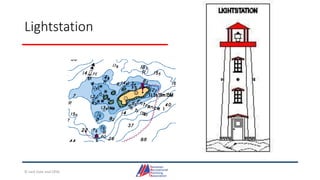
Lightstation
© Jack Dale and CRYA
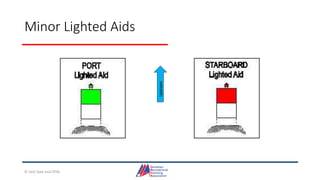
Minor Lighted Aids
Upstream
© Jack Dale and CRYA
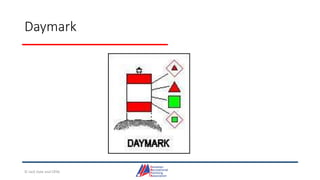
Daymark
© Jack Dale and CRYA
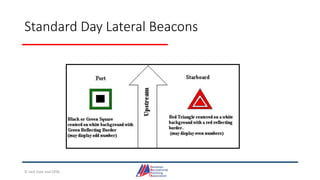
Standard Day Lateral Beacons
© Jack Dale and CRYA
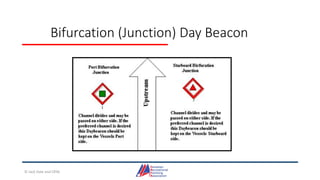
Bifurcation (Junction) Day Beacon
© Jack Dale and CRYA
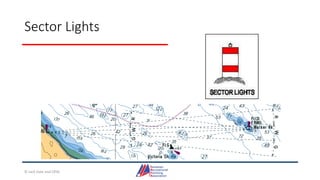
Sector Lights
© Jack Dale and CRYA
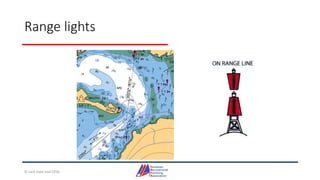
Range lights
© Jack Dale and CRYA
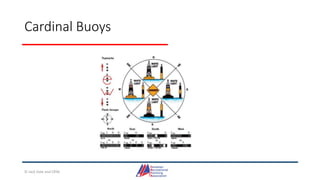
Cardinal Buoys
© Jack Dale and CRYA
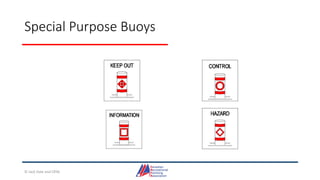
Special Purpose Buoys
© Jack Dale and CRYA
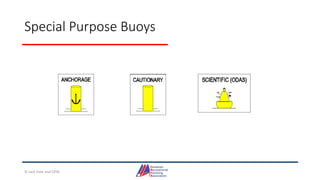
Special Purpose Buoys
© Jack Dale and CRYA
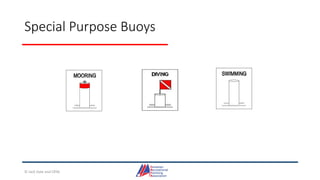
Special Purpose Buoys
© Jack Dale and CRYA
Section 7
Dead Reckoning, The Deck Log and Chart Notation
© Jack Dale and CRYA
Time, Speed, Distance
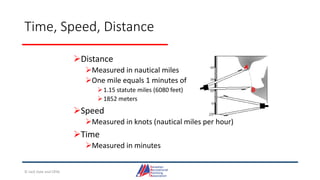
Distance
Measured in nautical miles
One mile equals 1 minutes of latitude
1.15 statute miles (6080 feet)
1852 meters
Speed
Measured in knots (nautical miles per hour)
Time
Measured in minutes
© Jack Dale and CRYA
The formula
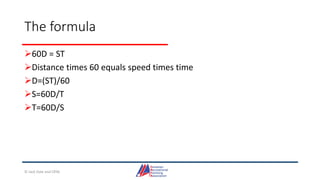
60D = ST
Distance times 60 equals speed times time
D=(ST)/60
S=60D/T
T=60D/S
© Jack Dale and CRYA
Guidelines
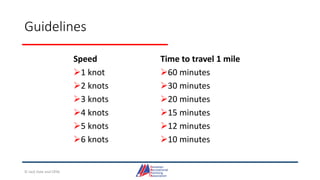
Speed
1 knot
2 knots
3 knots
4 knots
5 knots
6 knots
Time to travel 1 mile
60 minutes
30 minutes
20 minutes
15 minutes
12 minutes
10 minutes
© Jack Dale and CRYA
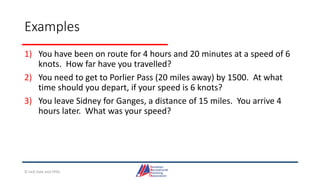
Examples
1) You have been on route for 4 hours and 20 minutes at a speed of 6
knots. How far have you travelled?
2) You need to get to Porlier Pass (20 miles away) by 1500. At what
time should you depart, if your speed is 6 knots?
3) You leave Sidney for Ganges, a distance of 15 miles. You arrive 4
hours later. What was your speed?
© Jack Dale and CRYA
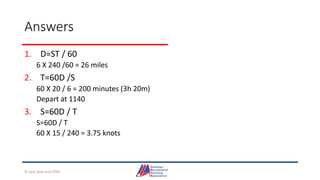
Answers
1. D=ST / 60
6 X 240 /60 = 26 miles
2. T=60D /S
60 X 20 / 6 = 200 minutes (3h 20m)
Depart at 1140
3. S=60D / T
S=60D / T
60 X 15 / 240 = 3.75 knots
© Jack Dale and CRYA
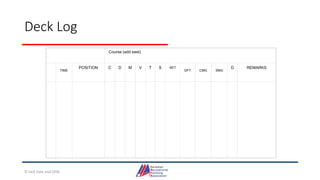
Deck Log
Course (add east)
TIME
POSITION C D M V T S SET
DFT CMG SMG
D REMARKS
© Jack Dale and CRYA
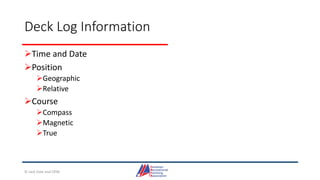
Deck Log Information
Time and Date
Position
Geographic
Relative
Course
Compass
Magnetic
True
© Jack Dale and CRYA
Deck Log Information
Speed (through water)
Set and Drift
Course and Speed Made Good
Distance Covered
© Jack Dale and CRYA
Deck Log Information
Remarks
Engine hours
Bearings taken
Adjacent nav aids
Sail / power
Weather conditions
Wind strength / direction
Barometer
Clouds /Precipitation
Where anchored / moored
Customs & immigration info
Notes re: anchorage / dock
Any incidents
Any other pertinent information
© Jack Dale and CRYA
Accounting for Current-Definitions
Set
The direction the current is flowing in degrees true. For example, a set of 180
is a current flowing due south.
Drift
The rate of the current in knots
© Jack Dale and CRYA
Universal Shorthand Labeling
Course to Steer (CTS)
The direction the boat was steered through the water.
Course (C)
Ship’s compass – converted to true
Speed (S)
Ship’s knotmeter
© Jack Dale and CRYA
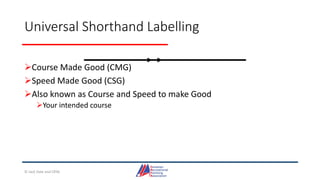
Universal Shorthand Labelling
Course Made Good (CMG)
Speed Made Good (CSG)
Also known as Course and Speed to make Good
Your intended course
© Jack Dale and CRYA
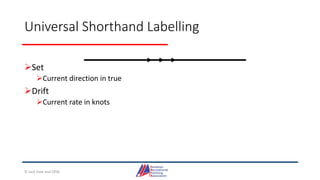
Universal Shorthand Labelling
Set
Current direction in true
Drift
Current rate in knots
© Jack Dale and CRYA
Taking Currents into Account
Finding Course to Steer
Known
Set
Drift
CMG
Speed (through water)
Determining Set and Drift
Known
Two fixes
Dead reckoning position
© Jack Dale and CRYA
Estimated Position based on Current
© Jack Dale and CRYA
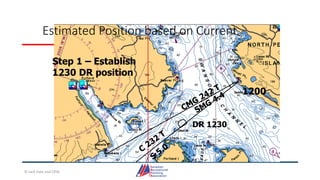
Estimated Position based on Current
1200
Step 1 – Establish
1230 DR position
DR 1230
© Jack Dale and CRYA
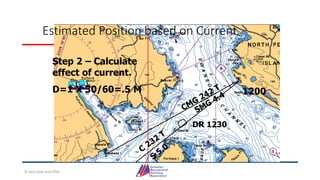
Estimated Position based on Current
1200
Step 2 – Calculate
effect of current.
D=1 X 30/60=.5 M
DR 1230
© Jack Dale and CRYA
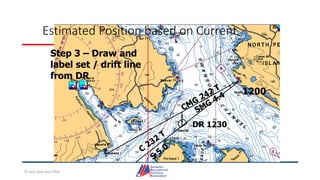
Estimated Position based on Current
1200
Step 3 – Draw and
label set / drift line
from DR
DR 1230
© Jack Dale and CRYA
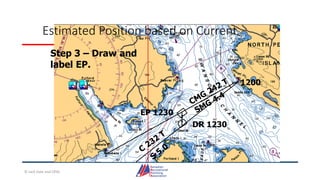
Estimated Position based on Current
1200
Step 3 – Draw and
label EP.
DR 1230
EP 1230
© Jack Dale and CRYA
Section 7 continued
Bearings and Fixes
© Jack Dale and CRYA
Bearings and LOPs
Bearings
Types
True
Magnetic
Relative
Taken with handbearing
compass
Noted on deck log
Line of Position
Bearing transferred to chart
Labelled
© Jack Dale and CRYA
Establishing Fixes
In determining positions:
A fix is the most accurate
An estimated position is more accurate than dead reckoning, but less
accurate than a fix, and
Dead reckoning is the least accurate (but better than nothing).
© Jack Dale and CRYA
Methods of Determining Fixes
No visible charted object
Dead reckoning
One visible charted object
Distance off and a bearing
Sounding and a bearing
Running fix
© Jack Dale and CRYA
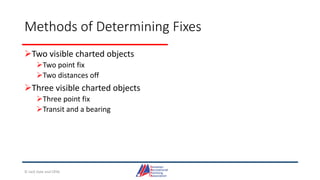
Methods of Determining Fixes
Two visible charted objects
Two point fix
Two distances off
Three visible charted objects
Three point fix
Transit and a bearing
© Jack Dale and CRYA
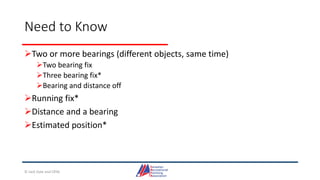
Need to Know
Two or more bearings (different objects, same time)
Two bearing fix
Three bearing fix*
Bearing and distance off
Running fix*
Distance and a bearing
Estimated position*
© Jack Dale and CRYA
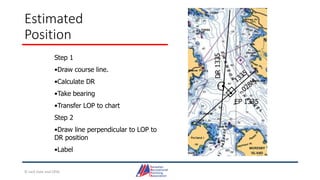
Estimated
Position
EP 1335
Step 1
•Draw course line.
•Calculate DR
•Take bearing
•Transfer LOP to chart
Step 2
•Draw line perpendicular to LOP to
DR position
•Label
© Jack Dale and CRYA
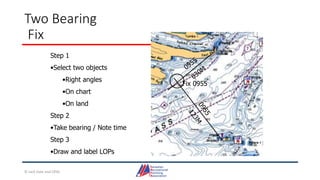
Two Bearing
Fix
Fix 0955
Step 1
•Select two objects
•Right angles
•On chart
•On land
Step 2
•Take bearing / Note time
Step 3
•Draw and label LOPs
© Jack Dale and CRYA
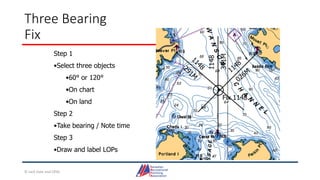
Three Bearing
Fix
1148
341M
Fix 1148
Step 1
•Select three objects
•60° or 120°
•On chart
•On land
Step 2
•Take bearing / Note time
Step 3
•Draw and label LOPs
© Jack Dale and CRYA
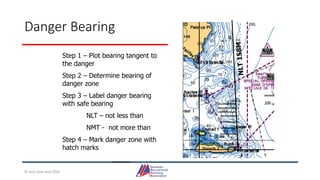
Danger Bearing
Step 1 – Plot bearing tangent to
the danger
Step 2 – Determine bearing of
danger zone
Step 3 – Label danger bearing
with safe bearing
NLT – not less than
NMT - not more than
Step 4 – Mark danger zone with
hatch marks
© Jack Dale and CRYA
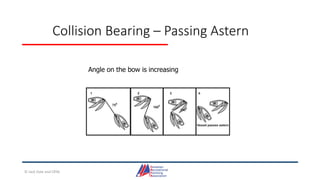
Collision Bearing – Passing Astern
Angle on the bow is increasing
© Jack Dale and CRYA
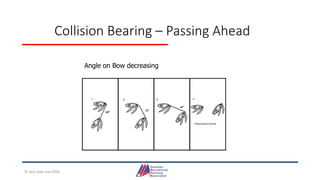
Collision Bearing – Passing Ahead
Angle on Bow decreasing
© Jack Dale and CRYA
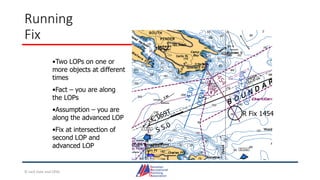
Running
Fix
R Fix 1454
•Two LOPs on one or
more objects at different
times
•Fact – you are along
the LOPs
•Assumption – you are
along the advanced LOP
•Fix at intersection of
second LOP and
advanced LOP
© Jack Dale and CRYA
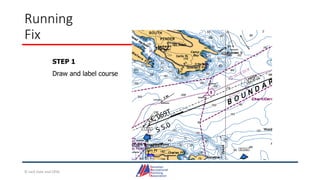
Running
Fix
STEP 1
Draw and label course
© Jack Dale and CRYA
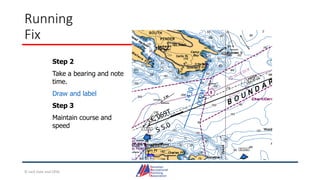
Running
Fix
Step 2
Take a bearing and note
time.
Draw and label
Step 3
Maintain course and
speed
© Jack Dale and CRYA
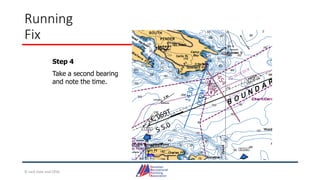
Running
Fix
Step 4
Take a second bearing
and note the time.
© Jack Dale and CRYA
Running
Fix
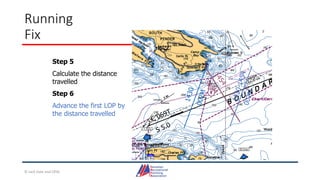
Step 5
Calculate the distance
travelled
Step 6
Advance the first LOP by
the distance travelled
© Jack Dale and CRYA
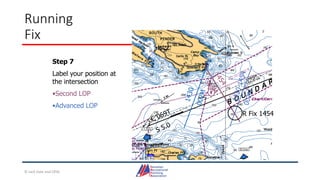
Running
Fix
R Fix 1454
Step 7
Label your position at
the intersection
•Second LOP
•Advanced LOP
© Jack Dale and CRYA
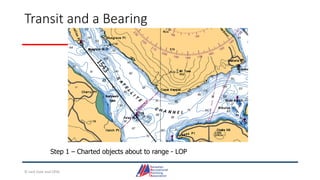
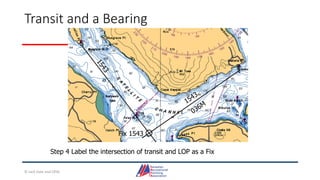
Transit and a Bearing
Step 1 – Charted objects about to range - LOP
© Jack Dale and CRYA
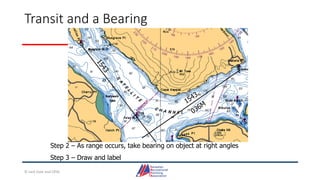
Transit and a Bearing
Step 2 – As range occurs, take bearing on object at right angles
Step 3 – Draw and label
© Jack Dale and CRYA
Transit and a Bearing
Step 4 Label the intersection of transit and LOP as a Fix
Fix 1543
© Jack Dale and CRYA
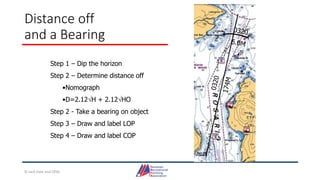
Distance off
and a Bearing
Step 1 – Dip the horizon
Step 2 – Determine distance off
•Nomograph
•D=2.12H + 2.12HO
Step 2 - Take a bearing on object
Step 3 – Draw and label LOP
Step 4 – Draw and label COP
© Jack Dale and CRYA
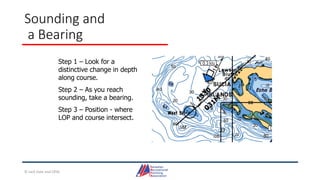
Sounding and
a Bearing
Step 1 – Look for a
distinctive change in depth
along course.
Step 2 – As you reach
sounding, take a bearing.
Step 3 – Position - where
LOP and course intersect.
© Jack Dale and CRYA
Section 8
Set and Drift
© Jack Dale and CRYA
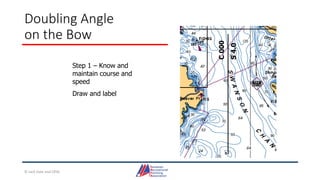
Doubling Angle
on the Bow
Step 1 – Know and
maintain course and
speed
Draw and label
C
000
S
4.0
© Jack Dale and CRYA
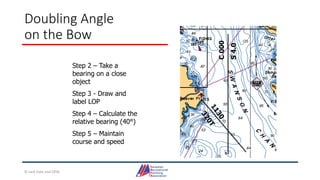
Doubling Angle
on the Bow
Step 2 – Take a
bearing on a close
object
Step 3 - Draw and
label LOP
Step 4 – Calculate the
relative bearing (40°)
Step 5 – Maintain
course and speed
C
000
S
4.0
© Jack Dale and CRYA
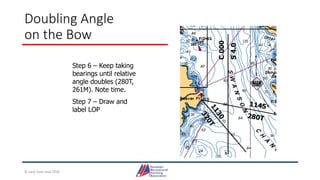
Doubling Angle
on the Bow
Step 6 – Keep taking
bearings until relative
angle doubles (280T,
261M). Note time.
Step 7 – Draw and
label LOP
C
000
S
4.0
© Jack Dale and CRYA
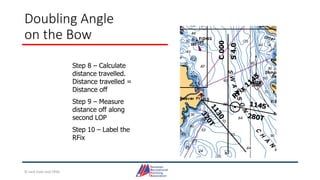
Doubling Angle
on the Bow
Step 8 – Calculate
distance travelled.
Distance travelled =
Distance off
Step 9 – Measure
distance off along
second LOP
Step 10 – Label the
RFix
C
000
S
4.0
© Jack Dale and CRYA
Section 9
Set and Drift Calculations
© Jack Dale and CRYA
Determining
Set and Drift
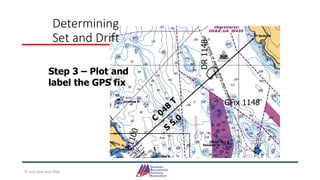
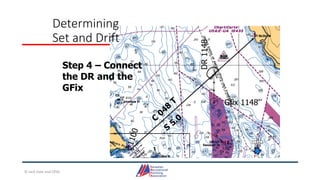
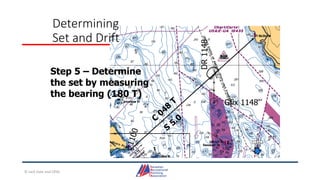
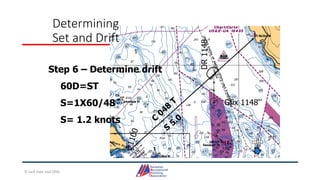
In this example we intend on traveling from
Cadboro Point (L4827.02’N 12315.83’W) to
Lime Kiln Light (L4830.95’N 12318.08’W). We
depart Cadboro Point at 1100 at a speed of 5
knots on a course of 048T. At 1148 our GPS starts
working and gives us a position of L4828.7’N
12311.3’W. which we plot on our chart. We can
also plot our 1148 DR position. Now we can
determine the set and drift.
© Jack Dale and CRYA
Determining
Set and Drift
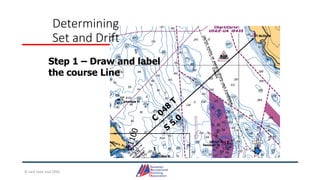
Step 1 – Draw and label
the course Line
© Jack Dale and CRYA
Determining
Set and Drift
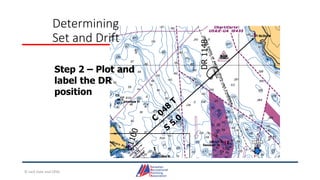
Step 2 – Plot and
label the DR
position
© Jack Dale and CRYA
GFix 1148
Determining
Set and Drift
Step 3 – Plot and
label the GPS fix
© Jack Dale and CRYA
Gfix 1148
Determining
Set and Drift
Step 4 – Connect
the DR and the
GFix
© Jack Dale and CRYA
Gfix 1148
Determining
Set and Drift
Step 5 – Determine
the set by measuring
the bearing (180 T)
© Jack Dale and CRYA
Gfix 1148
Determining
Set and Drift
Step 6 – Determine drift
60D=ST
S=1X60/48
S= 1.2 knots
© Jack Dale and CRYA
Determining Course
to Steer
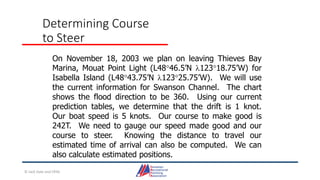
On November 18, 2003 we plan on leaving Thieves Bay
Marina, Mouat Point Light (L4846.5’N 12318.75’W) for
Isabella Island (L4843.75’N 12325.75’W). We will use
the current information for Swanson Channel. The chart
shows the flood direction to be 360. Using our current
prediction tables, we determine that the drift is 1 knot.
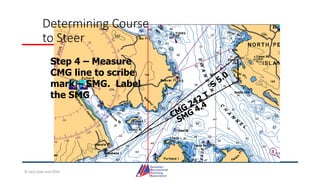
Our boat speed is 5 knots. Our course to make good is
242T. We need to gauge our speed made good and our
course to steer. Knowing the distance to travel our
estimated time of arrival can also be computed. We can
also calculate estimated positions.
© Jack Dale and CRYA
Determining Course
to Steer
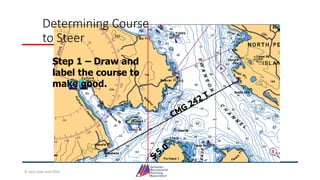
Step 1 – Draw and
label the course to
make good.
© Jack Dale and CRYA
Determining Course
to Steer
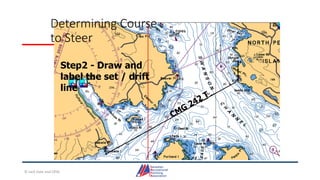
Step2 - Draw and
label the set / drift
line
© Jack Dale and CRYA
Determining Course
to Steer
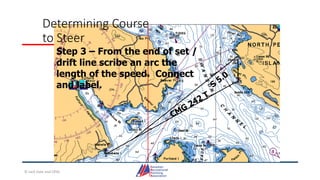
Step 3 – From the end of set /
drift line scribe an arc the
length of the speed. Connect
and label.
© Jack Dale and CRYA
Determining Course
to Steer
Step 4 – Measure
CMG line to scribe
mark – SMG. Label
the SMG
© Jack Dale and CRYA
Determining Course
to Steer
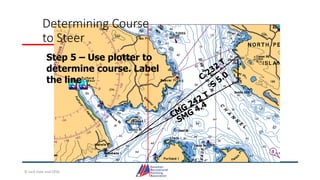
Step 5 – Use plotter to
determine course. Label
the line
© Jack Dale and CRYA
Determining Course
to Steer
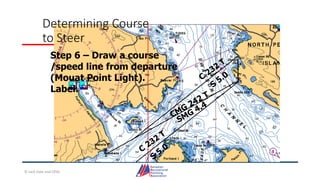
Step 6 – Draw a course
/speed line from departure
(Mouat Point Light).
Label.
© Jack Dale and CRYA
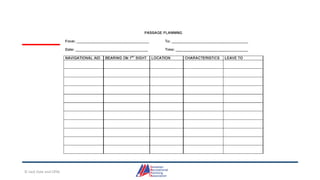
Passage Planning
Overall Plan
Assessment
Go / No go
Detailed Piloting Plan
More specific
© Jack Dale and CRYA
Overall Plan
Safe Route
Minimum distance travelled
Crew capability and condition
Equipment availability and
dependability
Navigational hazard proximity
Navigation methods to be
used
Potential actions in case of
emergency, weather
deterioration, fog
Favourable conditions for
passage
Weather
Sea state
Timing
© Jack Dale and CRYA
Detailed Piloting Plan
Characteristics of narrow and harbours to be
entered
Timing of departure from and and arrival at
narrows, harbours, landfalls
Proximity / availability / placement of navigational
aids
Tidal heights and tidal currents when near hazards
or shoreline
Weather conditions that might make navigation
hazardous in specific areas
© Jack Dale and CRYA

Crya coastal navigation

  • 1.
    Coastal Navigation Jack Dale CRYAYachtmaster Ocean Instructor Evaluator IYT Yachtmaster Coastal Instructor © Jack Dale and CRYA
  • 2.
    Why Not Usea GPS Most vessels of any kind in Canada have an obligation to carry and use official charts and publications and to keep them up to date. The chart carriage requirements are listed in the Charts and Nautical Publications Regulations, 1995 of the Canada Shipping Act. © Jack Dale and CRYA
  • 3.
    CHS paper chartsmeet the requirements of the chart carriage regulations. CHS digital charts meet the requirements of the chart carriage regulations under certain circumstances. CHS Electronic Navigational Charts (ENCs) meet the requirements provided they are used with an Electronic Chart Display and Information System (ECDIS). CHS raster charts meet the requirements only if paper charts are carried and used as a backup. © Jack Dale and CRYA
  • 4.
  • 5.
  • 6.
    Section 2 Coastal NavigationStandard © Jack Dale and CRYA
  • 7.
    Chart Notation Guidelines forlabeling Draw your lines lightly and no longer than necessary. Allow for the thickness of your pencil. Label a line immediately after drawing it. The label for any line is placed along that line, that is, parallel to the line. The label for any point should not be along any line, that is, at an angle to the line. © Jack Dale and CRYA
  • 8.
    Abbreviations Found onLabels C = course to steer, also know as the heading (shown at beginning of the label) CMG = course made good  M = magnetic heading (shown at end of the label) T = true heading (shown at end of the label) C = compass heading (shown at end of the label) S = speed through water in knots SMG = speed made good (sometimes called speed over ground) D = distance © Jack Dale and CRYA
  • 9.
    Example of LineLabeling ______C 270 T________ S 6.0 Course is 270 T Speed is 6.0 knots © Jack Dale and CRYA
  • 10.
    Labeling Positions Geographical Position LatitudeLongitude L 48 37.3’N  123 23.5’ W Latitude is abbreviated as “L” or “Lat”. Longitude is abbreviated as the Greek letter lambda “”. Draw a rectangle around the position. © Jack Dale and CRYA
  • 11.
    Labeling Positions Dead ReckoningPosition © Jack Dale and CRYA
  • 12.
    Labeling Positions Fixes General FixTwo Bearing Fix Three Bearing Fix © Jack Dale and CRYA
  • 13.
    Labeling Positions Electronic Fixes LoranFix GPS Fix Satellite Fix Radar Fix © Jack Dale and CRYA
  • 14.
  • 15.
    Labeling Lines Course Line Course Made Good / Speed Made Good Line © Jack Dale and CRYA
  • 16.
    Labeling Lines Set andDrift Current © Jack Dale and CRYA
  • 17.
    Labeling Lines Bearing andTime © Jack Dale and CRYA
  • 18.
    Labeling Lines Line ofPosition  Circle of Position  Advanced Line of Position © Jack Dale and CRYA
  • 19.
  • 20.
    Some Conventions forLabeling Lines  Time - 4 digits using the 24 hour clock. (1422)  Bearings and headings - three digits. (015M)  Magnetic (M)  Ship’s compass (C) bearings.  Bearing without a letter following is assumed to be in true (T).  Speeds - knots and tenths of knots. (6.3)  Bearings  Time is shown along the top of the line  Bearing below.  Course lines  Course heading is shown along the top  The speed below © Jack Dale and CRYA
  • 21.
    Some Conventions forLabeling Lines  As a general guide, the information with the most digits is shown along the top of the line. © Jack Dale and CRYA
  • 22.
    Section 3 Tools andPublications © Jack Dale and CRYA
  • 23.
    Navigational Equipment Plotters Dividers Hand BearingCompass Ship’s Compass TSD Computer Calculator Pencils / Erasers Binoculars Knotmeter Depth Sounder / Lead Line Watch Barometer GPS VHF Radio © Jack Dale and CRYA
  • 24.
    Plotter Portland Plotter Douglas Protractor ParallelRules Course Arm Plotter © Jack Dale and CRYA
  • 25.
    Dividers One handed Straight  Usedfor  Measuring distance  Determining Latitude and Longitude © Jack Dale and CRYA
  • 26.
    Hand Bearing Compass Usedto take bearings Lines of position Danger bearings © Jack Dale and CRYA
  • 27.
    Ship’s Compass Binnacle CompassBulkhead Compass © Jack Dale and CRYA
  • 28.
  • 29.
    Nautical Slide Rule Timespeed distance calculations © Jack Dale and CRYA
  • 30.
    Calculator Time speed distance calculations Canbe used for celestial navigation © Jack Dale and CRYA
  • 31.
    Pencils / Erasers O.9mm pencil Soft lead White erasers © Jack Dale and CRYA
  • 32.
    Binoculars 7 X 50 Mayhave built- in compass © Jack Dale and CRYA
  • 33.
    Knotmeter Measures speed throughthe water. Usually includes a trip log Distance covered © Jack Dale and CRYA
  • 34.
    Depth Sounder /Lead Line Used to measure depths Be aware of offset May not work at extreme depths © Jack Dale and CRYA
  • 35.
    Clock / Watch Ship’sclock is official time © Jack Dale and CRYA
  • 36.
    Barometer Used to makeweather forecasts Rapidly falling barometer indicates severe weather © Jack Dale and CRYA
  • 37.
    GPS Position finding Speed overground Velocity made good ETA Horizontal datum should match chart © Jack Dale and CRYA
  • 38.
    VHF Radio Marine weather forecasts Noticesto Shipping GMDSS Communication with other vessels, marinas © Jack Dale and CRYA
  • 39.
    Navigational Publications Notices toMariners Chart 1 - Symbols and Abbreviations Catalogue of Nautical Charts and Related Publications Sailing Directions Current Atlas Canadian Aids to Navigation System Tide and Current Tables List of Lights, Buoys and Fog Signals Radio Aids to Marine Navigation © Jack Dale and CRYA
  • 40.
    Other Publications International Regulationsfor the Prevention of Collisions at Sea (ColRegs) Safe Boating Guide © Jack Dale and CRYA
  • 41.
  • 42.
    Charts  a graphicrepresentation of a maritime area and adjacent coastal regions. © Jack Dale and CRYA
  • 43.
    Chart Information Charts show depthsof water and heights of land, natural features of the seabed, details of the coastline, navigational hazards, locations of natural and man-made aids to navigation, information on tides and currents, local details of the Earth's magnetic field, man-made structures such as harbours and bridges © Jack Dale and CRYA
  • 44.
    Chart Classification Sailing Charts Offshorepassages 1:600,000 Very little detail General Charts Making landfalls 1:150,000 to 1:600,000 © Jack Dale and CRYA
  • 45.
    Chart Classification Coastal Charts Inshorenavigation 1:50,000 to 1:150,000 Harbour Charts Navigating harbours and waterways Larger than 1:50,000 Large scale = lots of detail © Jack Dale and CRYA
  • 46.
    Care of Charts Usesoft pencils only Use white erasers only Level, flat surface Keep them updated Keep them dry Use below decks Stow flat / folded © Jack Dale and CRYA
  • 47.
    Reading Charts Title Block ChartSymbols and Abbreviations © Jack Dale and CRYA
  • 48.
    Title Block Region Identification MainTitle Scale Identification Projection Identification © Jack Dale and CRYA
  • 49.
    Title Block Depths Notes ElevationNotes Horizontal Datum Source Classification Symbol Reference Notes (Chart 1) © Jack Dale and CRYA
  • 50.
    Title Block Tides andCurrent Notes Aids to Navigation Notes Cautionary Notes Conversion Table Metres, Feet, Fathoms © Jack Dale and CRYA
  • 51.
    Compass Rose Variation May beas many as four per chart May vary Use the closest one © Jack Dale and CRYA
  • 52.
    Transferring Charts Determine position Determinerange and bearing to object on both charts Verify with latitude and longitude © Jack Dale and CRYA
  • 53.
    Important Chart Symbols Rockawash at chart datum Dangerous underwater rock of 2m (6 ft) or less © Jack Dale and CRYA
  • 54.
    Important Chart Symbols Rockwhich covers and uncovers, with drying height Rock which does not cover, with elevation © Jack Dale and CRYA
  • 55.
    Important Chart Symbols Kelp Wreckshowing any portion of hull or superstructure © Jack Dale and CRYA
  • 56.
    Important Chart Symbols Wreck,masts visible Flood current direction with rate © Jack Dale and CRYA
  • 57.
    Important Chart Symbols Whirlpools,eddies Wd Weed seabed © Jack Dale and CRYA
  • 58.
    Important Chart Symbols Underwatercable Limit of restricted area © Jack Dale and CRYA
  • 59.
    Important Chart Symbols Lightednavigational aid (not floating) Church © Jack Dale and CRYA
  • 60.
    Coordinates Latitude (L) Parallels runeast and west Denote location north or south of the Equator Poles are 90º North and 90º South Longitude (λ) Meridians run north and south Denote location east or west of Prime Meriden Greenwich Converge at poles © Jack Dale and CRYA
  • 61.
    Latitude and Longitude ©Jack Dale and CRYA
  • 62.
    Graticule This latitude/longitude "webbing"is known as the common graticule. Location can be specified by both latitude and longitude. © Jack Dale and CRYA
  • 63.
    Deception Pass L 4824.4’N 122 40.2W © Jack Dale and CRYA
  • 64.
    Degrees Minutes Seconds 360degrees in a circle Symbol º 60 minutes in a degree Symbol ' 60 seconds in a minute Symbol " © Jack Dale and CRYA
  • 65.
    Formats Latitude – Longitude DMDegree:Minute L 49º 30.0’ N λ123º 30.0’W DMS Degree:Minute:Second L49 º 30’ 00”N λ123º 30’ 00”W DD Decimal Degree L49.5000º N λ123.5000ºW generally with 4 decimal numbers. © Jack Dale and CRYA
  • 66.
    Chart Projections Mercator “Normal” projectionfor charts Polyconic May be used in the Great Lakes © Jack Dale and CRYA
  • 67.
  • 68.
  • 69.
    The Ships Compassand North Cardinal Points North East South West North is usually at the top © Jack Dale and CRYA
  • 70.
    North True North No variationor deviation Magnetic North Accounts for variation only Compass North Accounts for variation and deviation © Jack Dale and CRYA
  • 71.
    Variation Difference between truenorth and magnetic north North pole and magnetic pole differ Annual change Found on compass rose Varies globally
  • 72.
    Compass Rose 004 1/2°W1985 (8' E) 4.5º West variation in 1985 8’ annual change Current variation 3ºW 8 X 34/60 = 4.5º change 4.5 – 4.5 = 0 Subtract when annual change and variation directions differ Add when same
  • 73.
    Deviation Difference between ship’scompass and magnetic bearing Ferrous metal affects magnetic field on vessel Relative to vessel’s heading Found on deviation card / table No deviation in hand bearing compass
  • 74.
    Deviation Table Deviation Table Compass Heading Deviation (+E/-W) Magnetic Heading 0007E 007 030 6E 036 060 4E 064 090 2E 092 120 1W 119 150 4W 146 180 7W 173 210 5W 205 240 0 240 270 3E 273 300 4E 304 330 4E 334 © Jack Dale and CRYA
  • 75.
    Deviation Card Created by Compasscompensator Self Checked using ranges or transit
  • 76.
    Accounting for Variationand Deviation Helm reads the ship’s compass Navigator works in true Navigator makes conversions Correcting Compass to True Uncorrecting True to Compass © Jack Dale and CRYA
  • 77.
    Compass to TrueConversions Correcting Memory Aid Can Dead Men Vote Twice At Elections Correcting Compass heading +/- Deviation = Magnetic heading +/- Variation = True heading Add East © Jack Dale and CRYA
  • 78.
    Converting True toCompass Uncorrecting Memory Aid True Virgins Make Dull Company At Weddings Uncorrecting True heading +/- Variation = Magnetic heading +/- Deviation =Compass heading Add West © Jack Dale and CRYA
  • 79.
    Correcting Examples Compass DeviationMagnetic Variation True 124 16°W 253 12 °W 165 17 °E 337 13 °E
  • 80.
    Uncorrecting Examples True VariationMagnetic Deviation Compass 017 13 °E 073 11 °W 206 9 °E 268 21 °W
  • 81.
    Checking Deviation (page96) Maintain a course that keeps Rum Island and Turn Point in line Determine heading from ship’s compass 020 C True heading 042 © Jack Dale and CRYA
  • 82.
    Checking Deviation True VariationMagnetic Deviation Compass 042 18ºE 024 4ºE 020 Compare to deviation table (updated to 2011) © Jack Dale and CRYA
  • 83.
  • 84.
    Sources of Errorin Deviation Cards Electronic Interference Radio speakers near compass Old deviation card Winch handles or other metal near compass © Jack Dale and CRYA
  • 85.
    Section Four Tide andCurrent Tables © Jack Dale and CRYA
  • 86.
    Reference and SecondaryPorts Reference ports ar those for which tides tables are given on a every date. Secondary ports are those locations for which corrections are required to get daily tides. © Jack Dale and CRYA
  • 87.
    Tide Table –Reference Port Name of reference port Time Zone © Jack Dale and CRYA
  • 88.
  • 89.
    Flood and EbbDirections © Jack Dale and CRYA
  • 90.
    Identifying Reference Portand Correction On/sur Point Atkinson pages 56 -59 © Jack Dale and CRYA
  • 91.
    Defining “Mean” &“Large” Tides © Jack Dale and CRYA
  • 92.
    Daily Tables © JackDale and CRYA
  • 93.
  • 94.
    Current Table © JackDale and CRYA
  • 95.
  • 96.
  • 97.
  • 98.
    Current Stations –St. Lawrence © Jack Dale and CRYA
  • 99.
    Current Stations Designated witha lozenge Diamond shape with a letter in centre © Jack Dale and CRYA
  • 100.
    Tidal Stream Table Onchart Hours before and after HW at reference port Current direction (T) Current rate (kn) Reference port Current station © Jack Dale and CRYA
  • 101.
    Scenario On July 22,2007 in the early afternoon you are sailing along the range toward Cap de Diable in the St. Lawrence River. Your course will take you over an abandoned cable located at L47 24.15’N 70 27.0’ W. You expect to encounter some current in the vicinity. What will be the expected currents when the reference station is at High Water? © Jack Dale and CRYA
  • 102.
    Step One Step 1- Identify the nearest current station. The letter in the lozenge will correspond to the appropriate column on the table. In this case the secondary current station is marked with a It is located at L 47 24.4’N  070 27.3’W. B © Jack Dale and CRYA
  • 103.
  • 104.
    Step Two Identify theappropriate reference port in the second row of the table. At the row above the position of the secondary station we note that this is referenced to High Water (HW) at Québec. © Jack Dale and CRYA
  • 105.
    Step Two Current station Referenceport © Jack Dale and CRYA
  • 106.
    Step Three Using thecorrect pages of the Tide and Current Tables find the High Water times for the reference port. Using the Tide and Current Tables we note that in the early afternoon that High Water is at 1148 EST, which we correct by adding 1 hour for daylight savings and get 1248 EDT. © Jack Dale and CRYA
  • 107.
    Step Three High water Corrected= 1248 EDT © Jack Dale and CRYA
  • 108.
    Step 4 - Notethe time difference between High Water at the reference port and the time for which you want information. We will be at the current station at 1248, which is also High Water at Québec. © Jack Dale and CRYA
  • 109.
    Step 5 Locate thecorrect row for the time difference and the column for the current lozenge. The direction of current in given in degrees true and current rate is given in knots. From the table we find: Time: 1248 Rate: 1.0 kn Direction: 040 © Jack Dale and CRYA
  • 110.
    Step 5 © JackDale and CRYA
  • 111.
    Other Times When calculatingthe rate and direction for times other than High Water at the reference port, determine the number hours from High Water at the reference port to the time in which you are interested. For example, you are at this current station at 1548 (3 hours later). The characteristics of the current are: Time: 1548 Rate: 4 kn Direction: 018 © Jack Dale and CRYA
  • 112.
    Other Times © JackDale and CRYA
  • 113.
    Section 5 Aids toNavigation © Jack Dale and CRYA
  • 114.
    Upstream Rules AKA LocalDirection of Buoyage Returning from sea Entering a harbour or marina Upstream in a river Traveling in the direction as the flood current © Jack Dale and CRYA
  • 115.
    General Direction ofBuoyage Clockwise around continents North – West Coast East – Arctic South Atlantic Supersedes Upstream Rules when in conflict. North of Campbell River © Jack Dale and CRYA
  • 116.
    “Red Right Returning” ©Jack Dale and CRYA
  • 117.
    Aids to Navigation Floating Lateralbuoys Cardinal Buoys Fairway Buoys Isolated Danger Buoys Special Purpose Buoys Fixed Light stations Sector lights Minor lighted aids Beacons Standard day Beacons Bifurcation Day Beacons Range lights © Jack Dale and CRYA
  • 118.
    Lateral Buoys © JackDale and CRYA
  • 119.
  • 120.
    Fairway Buoy © JackDale and CRYA
  • 121.
    Isolated Danger Buoy ©Jack Dale and CRYA
  • 122.
  • 123.
  • 124.
  • 125.
    Standard Day LateralBeacons © Jack Dale and CRYA
  • 126.
    Bifurcation (Junction) DayBeacon © Jack Dale and CRYA
  • 127.
    Sector Lights © JackDale and CRYA
  • 128.
    Range lights © JackDale and CRYA
  • 129.
  • 130.
    Special Purpose Buoys ©Jack Dale and CRYA
  • 131.
    Special Purpose Buoys ©Jack Dale and CRYA
  • 132.
    Special Purpose Buoys ©Jack Dale and CRYA
  • 133.
    Section 7 Dead Reckoning,The Deck Log and Chart Notation © Jack Dale and CRYA
  • 134.
    Time, Speed, Distance Distance Measuredin nautical miles One mile equals 1 minutes of latitude 1.15 statute miles (6080 feet) 1852 meters Speed Measured in knots (nautical miles per hour) Time Measured in minutes © Jack Dale and CRYA
  • 135.
    The formula 60D =ST Distance times 60 equals speed times time D=(ST)/60 S=60D/T T=60D/S © Jack Dale and CRYA
  • 136.
    Guidelines Speed 1 knot 2 knots 3knots 4 knots 5 knots 6 knots Time to travel 1 mile 60 minutes 30 minutes 20 minutes 15 minutes 12 minutes 10 minutes © Jack Dale and CRYA
  • 137.
    Examples 1) You havebeen on route for 4 hours and 20 minutes at a speed of 6 knots. How far have you travelled? 2) You need to get to Porlier Pass (20 miles away) by 1500. At what time should you depart, if your speed is 6 knots? 3) You leave Sidney for Ganges, a distance of 15 miles. You arrive 4 hours later. What was your speed? © Jack Dale and CRYA
  • 138.
    Answers 1. D=ST /60 6 X 240 /60 = 26 miles 2. T=60D /S 60 X 20 / 6 = 200 minutes (3h 20m) Depart at 1140 3. S=60D / T S=60D / T 60 X 15 / 240 = 3.75 knots © Jack Dale and CRYA
  • 139.
    Deck Log Course (addeast) TIME POSITION C D M V T S SET DFT CMG SMG D REMARKS © Jack Dale and CRYA
  • 140.
    Deck Log Information Timeand Date Position Geographic Relative Course Compass Magnetic True © Jack Dale and CRYA
  • 141.
    Deck Log Information Speed(through water) Set and Drift Course and Speed Made Good Distance Covered © Jack Dale and CRYA
  • 142.
    Deck Log Information Remarks Enginehours Bearings taken Adjacent nav aids Sail / power Weather conditions Wind strength / direction Barometer Clouds /Precipitation Where anchored / moored Customs & immigration info Notes re: anchorage / dock Any incidents Any other pertinent information © Jack Dale and CRYA
  • 143.
    Accounting for Current-Definitions Set Thedirection the current is flowing in degrees true. For example, a set of 180 is a current flowing due south. Drift The rate of the current in knots © Jack Dale and CRYA
  • 144.
    Universal Shorthand Labeling Courseto Steer (CTS) The direction the boat was steered through the water. Course (C) Ship’s compass – converted to true Speed (S) Ship’s knotmeter © Jack Dale and CRYA
  • 145.
    Universal Shorthand Labelling CourseMade Good (CMG) Speed Made Good (CSG) Also known as Course and Speed to make Good Your intended course © Jack Dale and CRYA
  • 146.
    Universal Shorthand Labelling Set Currentdirection in true Drift Current rate in knots © Jack Dale and CRYA
  • 147.
    Taking Currents intoAccount Finding Course to Steer Known Set Drift CMG Speed (through water) Determining Set and Drift Known Two fixes Dead reckoning position © Jack Dale and CRYA
  • 148.
    Estimated Position basedon Current © Jack Dale and CRYA
  • 149.
    Estimated Position basedon Current 1200 Step 1 – Establish 1230 DR position DR 1230 © Jack Dale and CRYA
  • 150.
    Estimated Position basedon Current 1200 Step 2 – Calculate effect of current. D=1 X 30/60=.5 M DR 1230 © Jack Dale and CRYA
  • 151.
    Estimated Position basedon Current 1200 Step 3 – Draw and label set / drift line from DR DR 1230 © Jack Dale and CRYA
  • 152.
    Estimated Position basedon Current 1200 Step 3 – Draw and label EP. DR 1230 EP 1230 © Jack Dale and CRYA
  • 153.
    Section 7 continued Bearingsand Fixes © Jack Dale and CRYA
  • 154.
    Bearings and LOPs Bearings Types True Magnetic Relative Takenwith handbearing compass Noted on deck log Line of Position Bearing transferred to chart Labelled © Jack Dale and CRYA
  • 155.
    Establishing Fixes In determiningpositions: A fix is the most accurate An estimated position is more accurate than dead reckoning, but less accurate than a fix, and Dead reckoning is the least accurate (but better than nothing). © Jack Dale and CRYA
  • 156.
    Methods of DeterminingFixes No visible charted object Dead reckoning One visible charted object Distance off and a bearing Sounding and a bearing Running fix © Jack Dale and CRYA
  • 157.
    Methods of DeterminingFixes Two visible charted objects Two point fix Two distances off Three visible charted objects Three point fix Transit and a bearing © Jack Dale and CRYA
  • 158.
    Need to Know Twoor more bearings (different objects, same time) Two bearing fix Three bearing fix* Bearing and distance off Running fix* Distance and a bearing Estimated position* © Jack Dale and CRYA
  • 159.
    Estimated Position EP 1335 Step 1 •Drawcourse line. •Calculate DR •Take bearing •Transfer LOP to chart Step 2 •Draw line perpendicular to LOP to DR position •Label © Jack Dale and CRYA
  • 160.
    Two Bearing Fix Fix 0955 Step1 •Select two objects •Right angles •On chart •On land Step 2 •Take bearing / Note time Step 3 •Draw and label LOPs © Jack Dale and CRYA
  • 161.
    Three Bearing Fix 1148 341M Fix 1148 Step1 •Select three objects •60° or 120° •On chart •On land Step 2 •Take bearing / Note time Step 3 •Draw and label LOPs © Jack Dale and CRYA
  • 162.
    Danger Bearing Step 1– Plot bearing tangent to the danger Step 2 – Determine bearing of danger zone Step 3 – Label danger bearing with safe bearing NLT – not less than NMT - not more than Step 4 – Mark danger zone with hatch marks © Jack Dale and CRYA
  • 163.
    Collision Bearing –Passing Astern Angle on the bow is increasing © Jack Dale and CRYA
  • 164.
    Collision Bearing –Passing Ahead Angle on Bow decreasing © Jack Dale and CRYA
  • 165.
    Running Fix R Fix 1454 •TwoLOPs on one or more objects at different times •Fact – you are along the LOPs •Assumption – you are along the advanced LOP •Fix at intersection of second LOP and advanced LOP © Jack Dale and CRYA
  • 166.
    Running Fix STEP 1 Draw andlabel course © Jack Dale and CRYA
  • 167.
    Running Fix Step 2 Take abearing and note time. Draw and label Step 3 Maintain course and speed © Jack Dale and CRYA
  • 168.
    Running Fix Step 4 Take asecond bearing and note the time. © Jack Dale and CRYA
  • 169.
    Running Fix Step 5 Calculate thedistance travelled Step 6 Advance the first LOP by the distance travelled © Jack Dale and CRYA
  • 170.
    Running Fix R Fix 1454 Step7 Label your position at the intersection •Second LOP •Advanced LOP © Jack Dale and CRYA
  • 171.
    Transit and aBearing Step 1 – Charted objects about to range - LOP © Jack Dale and CRYA
  • 172.
    Transit and aBearing Step 2 – As range occurs, take bearing on object at right angles Step 3 – Draw and label © Jack Dale and CRYA
  • 173.
    Transit and aBearing Step 4 Label the intersection of transit and LOP as a Fix Fix 1543 © Jack Dale and CRYA
  • 174.
    Distance off and aBearing Step 1 – Dip the horizon Step 2 – Determine distance off •Nomograph •D=2.12H + 2.12HO Step 2 - Take a bearing on object Step 3 – Draw and label LOP Step 4 – Draw and label COP © Jack Dale and CRYA
  • 175.
    Sounding and a Bearing Step1 – Look for a distinctive change in depth along course. Step 2 – As you reach sounding, take a bearing. Step 3 – Position - where LOP and course intersect. © Jack Dale and CRYA
  • 176.
    Section 8 Set andDrift © Jack Dale and CRYA
  • 177.
    Doubling Angle on theBow Step 1 – Know and maintain course and speed Draw and label C 000 S 4.0 © Jack Dale and CRYA
  • 178.
    Doubling Angle on theBow Step 2 – Take a bearing on a close object Step 3 - Draw and label LOP Step 4 – Calculate the relative bearing (40°) Step 5 – Maintain course and speed C 000 S 4.0 © Jack Dale and CRYA
  • 179.
    Doubling Angle on theBow Step 6 – Keep taking bearings until relative angle doubles (280T, 261M). Note time. Step 7 – Draw and label LOP C 000 S 4.0 © Jack Dale and CRYA
  • 180.
    Doubling Angle on theBow Step 8 – Calculate distance travelled. Distance travelled = Distance off Step 9 – Measure distance off along second LOP Step 10 – Label the RFix C 000 S 4.0 © Jack Dale and CRYA
  • 181.
    Section 9 Set andDrift Calculations © Jack Dale and CRYA
  • 182.
    Determining Set and Drift Inthis example we intend on traveling from Cadboro Point (L4827.02’N 12315.83’W) to Lime Kiln Light (L4830.95’N 12318.08’W). We depart Cadboro Point at 1100 at a speed of 5 knots on a course of 048T. At 1148 our GPS starts working and gives us a position of L4828.7’N 12311.3’W. which we plot on our chart. We can also plot our 1148 DR position. Now we can determine the set and drift. © Jack Dale and CRYA
  • 183.
    Determining Set and Drift Step1 – Draw and label the course Line © Jack Dale and CRYA
  • 184.
    Determining Set and Drift Step2 – Plot and label the DR position © Jack Dale and CRYA
  • 185.
    GFix 1148 Determining Set andDrift Step 3 – Plot and label the GPS fix © Jack Dale and CRYA
  • 186.
    Gfix 1148 Determining Set andDrift Step 4 – Connect the DR and the GFix © Jack Dale and CRYA
  • 187.
    Gfix 1148 Determining Set andDrift Step 5 – Determine the set by measuring the bearing (180 T) © Jack Dale and CRYA
  • 188.
    Gfix 1148 Determining Set andDrift Step 6 – Determine drift 60D=ST S=1X60/48 S= 1.2 knots © Jack Dale and CRYA
  • 189.
    Determining Course to Steer OnNovember 18, 2003 we plan on leaving Thieves Bay Marina, Mouat Point Light (L4846.5’N 12318.75’W) for Isabella Island (L4843.75’N 12325.75’W). We will use the current information for Swanson Channel. The chart shows the flood direction to be 360. Using our current prediction tables, we determine that the drift is 1 knot. Our boat speed is 5 knots. Our course to make good is 242T. We need to gauge our speed made good and our course to steer. Knowing the distance to travel our estimated time of arrival can also be computed. We can also calculate estimated positions. © Jack Dale and CRYA
  • 190.
    Determining Course to Steer Step1 – Draw and label the course to make good. © Jack Dale and CRYA
  • 191.
    Determining Course to Steer Step2- Draw and label the set / drift line © Jack Dale and CRYA
  • 192.
    Determining Course to Steer Step3 – From the end of set / drift line scribe an arc the length of the speed. Connect and label. © Jack Dale and CRYA
  • 193.
    Determining Course to Steer Step4 – Measure CMG line to scribe mark – SMG. Label the SMG © Jack Dale and CRYA
  • 194.
    Determining Course to Steer Step5 – Use plotter to determine course. Label the line © Jack Dale and CRYA
  • 195.
    Determining Course to Steer Step6 – Draw a course /speed line from departure (Mouat Point Light). Label. © Jack Dale and CRYA
  • 196.
    Passage Planning Overall Plan Assessment Go/ No go Detailed Piloting Plan More specific © Jack Dale and CRYA
  • 197.
    Overall Plan Safe Route Minimumdistance travelled Crew capability and condition Equipment availability and dependability Navigational hazard proximity Navigation methods to be used Potential actions in case of emergency, weather deterioration, fog Favourable conditions for passage Weather Sea state Timing © Jack Dale and CRYA
  • 198.
    Detailed Piloting Plan Characteristicsof narrow and harbours to be entered Timing of departure from and and arrival at narrows, harbours, landfalls Proximity / availability / placement of navigational aids Tidal heights and tidal currents when near hazards or shoreline Weather conditions that might make navigation hazardous in specific areas © Jack Dale and CRYA
  • 199.
    © Jack Daleand CRYA