CYA Intermediate Cruising
Jack Dale
Advanced CYA Instructor #2066
Objective
 To be able to cruise safely in familiar
waters as both skipper and crew of a
sailing yacht of 8 - 12 meters in
moderate wind and sea conditions by
day.
 Emphasizes on-the-water skills at a
level acceptable for bareboat
chartering.
Prerequisites
 Basic Cruising Standard
 Recommended
 First aid and CPR
 VHF ROC
 Coastal Navigation
Section I
Planning
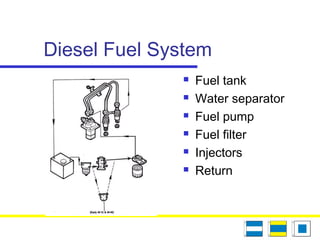
Diesel Fuel System
 Fuel tank
 Water separator
 Fuel pump
 Fuel filter
 Injectors
 Return
Fuel Efficiency
 Fuel consumption
 Diesel

O.1 litres per horsepower per hour

56 hp = 5.6 liters per hour

400 litres

Range @ 5 knots = 400 / 5.6 X 5 = 357 miles
 Gasoline

0.3 litres per horsepower per hour

20 hp 6 litres per hour

100 litres

Range @5 knots = 100/6 X 5 = 83 miles
Fuel Efficiency
 Affected by
 Engine

Tune

RPM

# of cylinders

Prop type
 Folding
 Feathering
 # of blades
Fuel Efficiency
 Affected by
 Other factors

Cleanliness of hull

Dinghy
 Towing (drag)
 On deck (windage)

Wind and current, sea conditions

Steering

Motorsailing
Fresh Water
 Requirements
 Minimum – 2 litres (.5 US gallon) per person per
day

Primarily drinking water
 Normal - 8 litres (2 US gallons) per person per
day

Washing dishes, brief showers
 Stored in tanks under berths and settees
 Use one tank at a time
Domestic Water System
Multiple tank
systems has valves
to prevent
simultaneous use of
tanks.
Foot or hand pumps
might also be used.
Seasickness Causes
 Mixed messages
 Inner ear
 Eyes
 Other motion sensors
 Worsened by
 Odours
 Alcohol
 Fatty foods
 Spicy foods
 Overheating
Seasickness Symptoms
 Drowsiness
 Nausea
 Clammy skin
 Pale skin
 Vomiting
 Dry heaves
Seasickness Prevention
 Avoid alcohol and coffee
 Avoid greasy food
 Get plenty of rest
 Avoid excessive time below
 Navigating
 Cooking
 Avoid discussions and thoughts of mal
de mer
Seasickness Medication
 Meclizine (Bonine)
 Dimenhydrinate (Gravol)
 Transderm-Scopolamine Patch
 Side effects
 Drowsiness, dry mouth, constipation, blurred
vision
 Take it before
 Trip (side effects)
 Onset
Seasickness – Non-medicinal
Treatment
 Ginger ale (rehydrate)
 Dry crackers
 Focus on horizon
 Steer
 If incapacitated
 Lie on centre line of cabin sole
 Close eyes
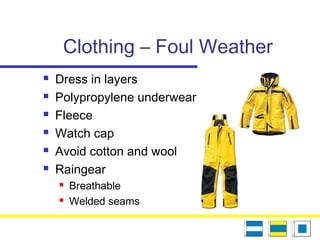
Clothing – Foul Weather
 Dress in layers
 Polypropylene underwear
 Fleece
 Watch cap
 Avoid cotton and wool
 Raingear
 Breathable
 Welded seams
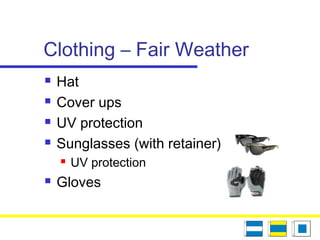
Clothing – Fair Weather
 Hat
 Cover ups
 UV protection
 Sunglasses (with retainer)
 UV protection
 Gloves
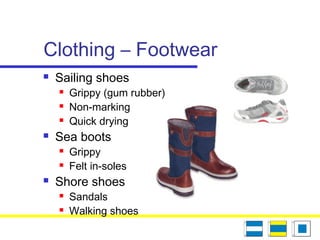
Clothing – Footwear
 Sailing shoes
 Grippy (gum rubber)
 Non-marking
 Quick drying
 Sea boots
 Grippy
 Felt in-soles
 Shore shoes
 Sandals
 Walking shoes
Packing Clothing
 Hanging space at a premium
 Usually wet lockers
 Use soft bags
 Roll pants
 Organize clothes in laundry bags /
mesh organizers
Menu Planning
 Check galley
 How many burners on stove?
 Oven?
 What pots and pans are on board?
 What containers?

Juice

Storage
 Barbeque?
 Propane or briquettes
Provisioning
 Three nutritious meals per day
 Snacks
 Water
 Beverages
 Herbs, spices and sauces
 Dietary requirements of crew
Stowing Provisions
 Beverages will stay cool if stored under
water line
 Dry stowage
 Longer voyages
 Stowage plan
 Long lasting vegetables
 Turn eggs
 Remove labels and mark cans
Packing the Fridge
 First in – last out
 Coldest at bottom near freezer plate
 Keep lettuce and salads way from
freezer plate
Minimizing Fridge Power
Consumption
 Pre-freeze / pre-chill foods
 Keep fridge full
 Organize to minimize opening
 Top opening more efficient
 Block ice in bottom
 Beverages stowed below waterline (not
fridge)
 Extra insulation
First Aid Kits
 Take first aid and CPR
 Charter boats may not have
medications
First Aid Kit Contents
 Box
 Bandages
 Gauze
 Elastic
 Adhesive
 Triangular
 Sterile pads
 Thermometer
 Surgical tape
 First aid manual
 Medications
 Sun block and screen
 Sunburn lotion
 Burn cream
 Antihistamines
 Laxatives
 Antacid
 Diarrhea medication
 Analgesics
 Antiseptic lotion
 Antibiotic cream
 Personal medication
Scissors
Tweezers
Safety pins
Gloves
Cold packs
AR shield
Splints
Space Blanket
Eye wash kit
Engine Spare Parts
 Oil
 Oil filter
 Fuel filter
 Impellor(s)
 Belts
 Duct tape
 Electrical tape
 Fuses
 Penetrating oil
 Transmission fluid
 Mechanics wire
 Wire ties
 Hose clamps
 Points, plugs,
condenser (gas)
 Gasket cement
Tools
 General
 Crescent wrenches
 Box wrenches
 Vice grips
 Socket set
 Pliers
 Screwdrivers
 Hammer
 Allen keys
 Sail and Rigging
 Marlinespike
 Rigging knife
 Sail maker’s palm
 Needles
 Sail thread
 Bolt cutter
Engine Checks
 Daily
 Engine oil level
 Coolant level
 Belt tension
 Leaks under engine
 Fuel level
 Bilge

Oil

Fuel

Propane
 Weekly
 Transmission fluid
 Transmission linkage
 Stuffing box
 Sea strainer
 Battery connections
Clearing Customs and
Immigration
 Into USA
 Port of entry
 Skipper only ashore
 Boat

Registration #

Name / length

Cruising permit
 Crew

Names

Addresses

Nationalities (passport)

Place / date of birth
 Clearance #
 Into Canada
 Port of entry
 Skipper only ashore
 Boat

Registration #

Name / length
 Crew

Names

Addresses

Nationalities (passport)

Place / date of birth
 Clearance #
Clearing Customs and
Immigration
 Pre- departure
 Check requirements

Departure clearance

Crew documentation

Vessel documentation
 Import restrictions
 “Q” flag?
 Courtesy flag?
Section II
Living Aboard
Galley Safety
 Cooking underway
 Stove gimbaled

Be careful opening oven
 Hand rail in front of stove
 Pots half full
 Pots clamped into place
 Wear foul weather pants
 Use harness in rough weather
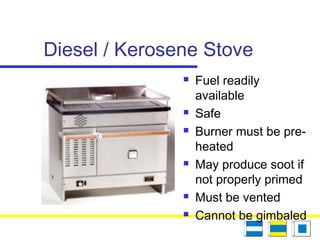
Diesel / Kerosene Stove
 Fuel readily
available
 Safe
 Burner must be pre-
heated
 May produce soot if
not properly primed
 Must be vented
 Cannot be gimbaled
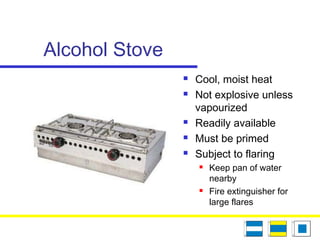
Alcohol Stove
 Cool, moist heat
 Not explosive unless
vapourized
 Readily available
 Must be primed
 Subject to flaring
 Keep pan of water
nearby
 Fire extinguisher for
large flares
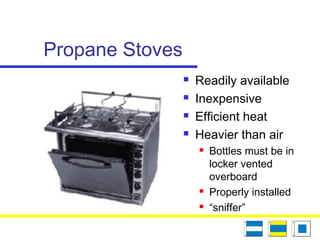
Propane Stoves
 Readily available
 Inexpensive
 Efficient heat
 Heavier than air
 Bottles must be in
locker vented
overboard
 Properly installed
 “sniffer”
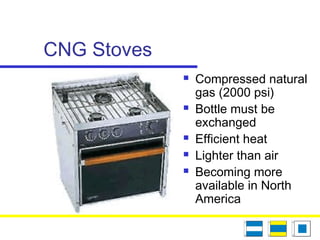
CNG Stoves
 Compressed natural
gas (2000 psi)
 Bottle must be
exchanged
 Efficient heat
 Lighter than air
 Becoming more
available in North
America
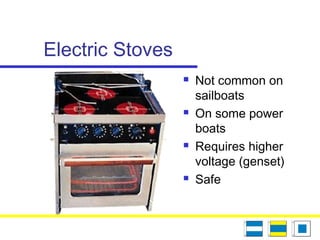
Electric Stoves
 Not common on
sailboats
 On some power
boats
 Requires higher
voltage (genset)
 Safe
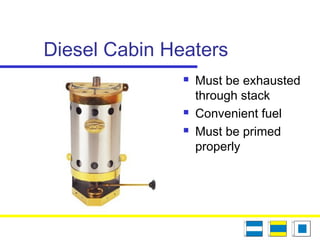
Diesel Cabin Heaters
 Must be exhausted
through stack
 Convenient fuel
 Must be primed
properly
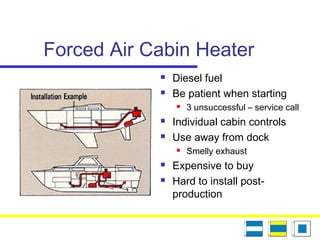
Forced Air Cabin Heater
 Diesel fuel
 Be patient when starting
 3 unsuccessful – service call
 Individual cabin controls
 Use away from dock
 Smelly exhaust
 Expensive to buy
 Hard to install post-
production
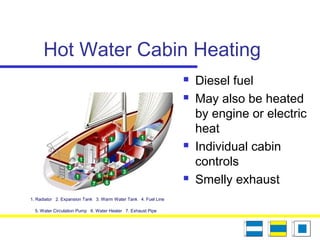
Hot Water Cabin Heating
 Diesel fuel
 May also be heated
by engine or electric
heat
 Individual cabin
controls
 Smelly exhaust
1. Radiator 2. Expansion Tank 3. Warm Water Tank 4. Fuel Line
5. Water Circulation Pump 6. Water Heater 7. Exhaust Pipe
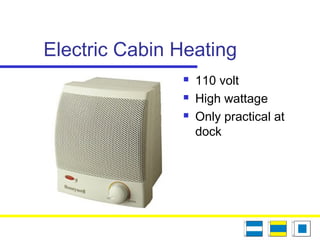
Electric Cabin Heating
 110 volt
 High wattage
 Only practical at
dock
Electrical System
 Sources of 12 volt DC power
 Sources of 120 volt AC power
 Battery banks
Sources of 12 Volt DC
 Alternator
 Solar panels
 Wind generator
Sources of 120 Volt AC
 Shore power
 Genset
 Inverter
Battery Banks
 Normally 2 Banks
 Engine starting battery – isolated

May be smaller
 House power

Normally 2 or more batteries

Deep cycle
Section III
Weather
Thermal Generated Winds
 Land heats up faster than water
 Water cools slower than land
 Temperature and pressure differences
result in
 Breezes
 Clouds
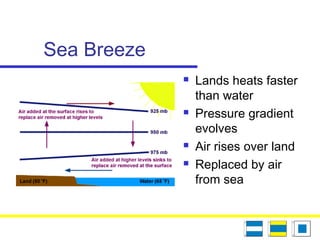
Sea Breeze
 Lands heats faster
than water
 Pressure gradient
evolves
 Air rises over land
 Replaced by air
from sea
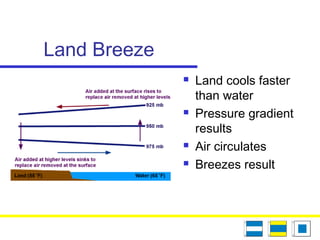
Land Breeze
 Land cools faster
than water
 Pressure gradient
results
 Air circulates
 Breezes result
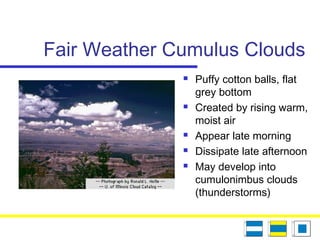
Fair Weather Cumulus Clouds
 Puffy cotton balls, flat
grey bottom
 Created by rising warm,
moist air
 Appear late morning
 Dissipate late afternoon
 May develop into
cumulonimbus clouds
(thunderstorms)
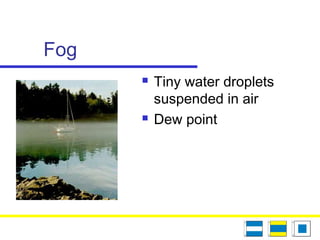
Fog
 Tiny water droplets
suspended in air
 Dew point
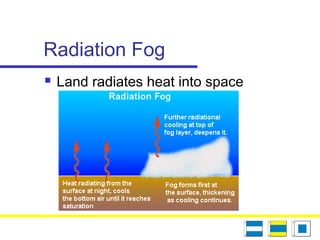
Radiation Fog
 Land radiates heat into space
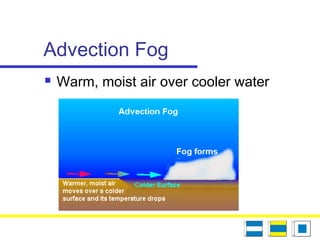
Advection Fog
 Warm, moist air over cooler water
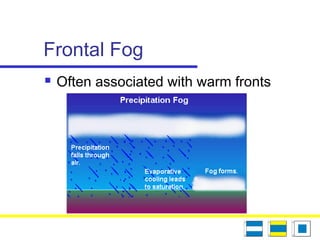
Frontal Fog
 Often associated with warm fronts
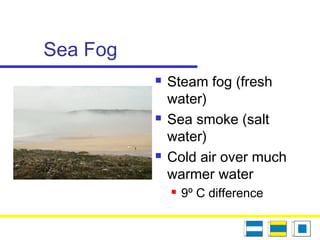
Sea Fog
 Steam fog (fresh
water)
 Sea smoke (salt
water)
 Cold air over much
warmer water
 9º C difference
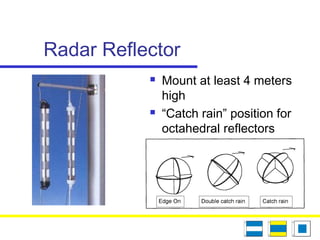
Radar Reflector
 Mount at least 4 meters
high
 “Catch rain” position for
octahedral reflectors
Section IV
Seamanship
Emergencies
 Four rules of preparation
 Respect the boat

Worst case scenarios
 Prepare the crew

Location and use of equipment

Assign duties and chain of command

Standing orders
 Choose a safe route
 Prepare for emergencies

Practice
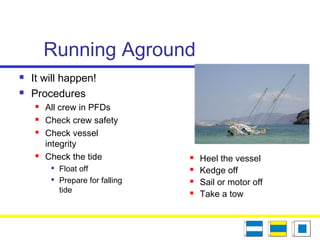
Running Aground
 It will happen!
 Procedures
 All crew in PFDs
 Check crew safety
 Check vessel
integrity
 Check the tide

Float off

Prepare for falling
tide
 Heel the vessel
 Kedge off
 Sail or motor off
 Take a tow
Preparing for a Falling Tide
 Kedge anchor
 Heel boat
 Mast to shore
 Secure items below
 Close hatches and ports
 Cushion hull
Avoiding Running Aground
 Know
 Where you are
 Where you are going
 Consult charts regularly
 Take a coastal navigation course
 In shallow water, use depth sounder or lead line
 Be aware of tides and currents
 Avoid lee shores
 Post lookouts in narrow passes
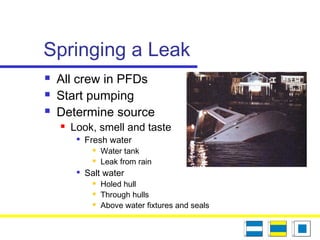
Springing a Leak
 All crew in PFDs
 Start pumping
 Determine source
 Look, smell and taste

Fresh water
 Water tank
 Leak from rain

Salt water
 Holed hull
 Through hulls
 Above water fixtures and seals
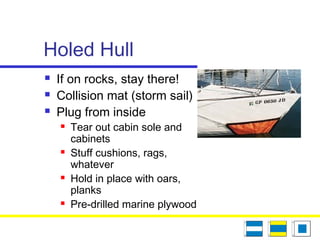
Holed Hull
 If on rocks, stay there!
 Collision mat (storm sail)
 Plug from inside
 Tear out cabin sole and
cabinets
 Stuff cushions, rags,
whatever
 Hold in place with oars,
planks
 Pre-drilled marine plywood
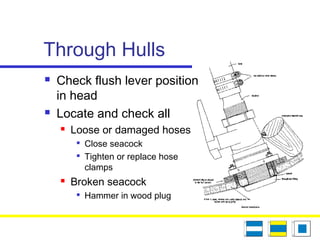
Through Hulls
 Check flush lever position
in head
 Locate and check all
 Loose or damaged hoses

Close seacock

Tighten or replace hose
clamps
 Broken seacock

Hammer in wood plug
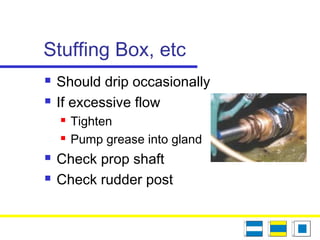
Stuffing Box, etc
 Should drip occasionally
 If excessive flow
 Tighten
 Pump grease into gland
 Check prop shaft
 Check rudder post
Above Water Leaks
 Check ventilators and deck pipes
 Close and dog all hatches
 Inspect hull-deck join
 Especially near chain plates)
 Check all deck fills
 Check mast partner and boot
 Clogged drains
 Cockpit
 Anchor well
Avoiding Leaks
 Same measures to avoid running aground
 Look out for objects in water
 Deadheads
 Fill tanks slowly
 Inspect all hoses
 Stainless hose clamps
 Anti-siphoning loops
 Check and lubricate seacocks
Avoiding Leaks (2)
 Sacrificial anode on prop shaft
 Check prop shaft alignment
 Inspect stuffing box
 Check operation of bilge pumps
 Inspect hatches, ports and ventilators
 Replace gaskets
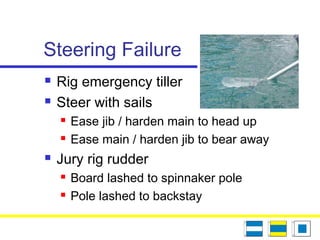
Steering Failure
 Rig emergency tiller
 Steer with sails
 Ease jib / harden main to head up
 Ease main / harden jib to bear away
 Jury rig rudder
 Board lashed to spinnaker pole
 Pole lashed to backstay
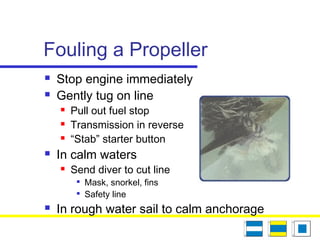
Fouling a Propeller
 Stop engine immediately
 Gently tug on line
 Pull out fuel stop
 Transmission in reverse
 “Stab” starter button
 In calm waters
 Send diver to cut line

Mask, snorkel, fins

Safety line
 In rough water sail to calm anchorage
Collision With Another Vessel
 Check crew and vessel
 Pan pan or Mayday as required
 All crew in PFDs
 Stay in proximity until released
by
 Other vessel
 Coast Guard
 Exchange insurance
information
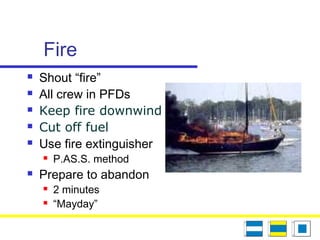
Fire
 Shout “fire”
 All crew in PFDs
 Keep fire downwind
 Cut off fuel
 Use fire extinguisher
 P.AS.S. method
 Prepare to abandon
 2 minutes
 “Mayday”
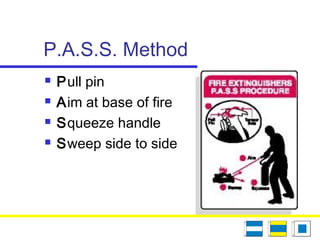
P.A.S.S. Method
 Pull pin
 Aim at base of fire
 Squeeze handle
 Sweep side to side
Cooling Water Fails
 Shut off engine
 Check raw water seacock
 Check sea strainer
 Check hoses and hose clamps
 Check impeller
 Wait for engine to cool
 Restart
 Blocked inlet
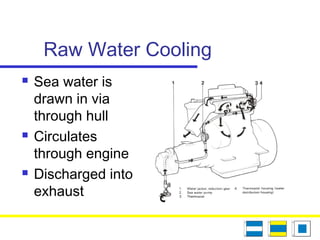
Raw Water Cooling
 Sea water is
drawn in via
through hull
 Circulates
through engine
 Discharged into
exhaust
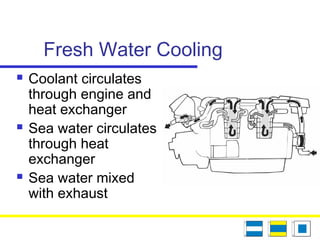
Fresh Water Cooling
 Coolant circulates
through engine and
heat exchanger
 Sea water circulates
through heat
exchanger
 Sea water mixed
with exhaust
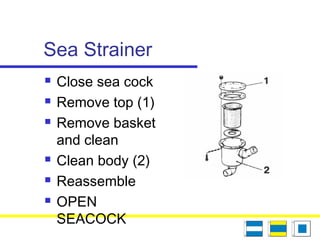
Sea Strainer
 Close sea cock
 Remove top (1)
 Remove basket
and clean
 Clean body (2)
 Reassemble
 OPEN
SEACOCK
Engine Failure in Anchorage
 Not safe to sail
 Anchor
 Boat hook
 Fenders
 Tow with dinghy
Engine Failure in Channel
 Issue “Pan Pan”
 Attempt to sail
 Keep anchor at ready
 Tow with dinghy
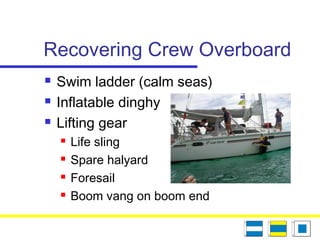
Recovering Crew Overboard
 Swim ladder (calm seas)
 Inflatable dinghy
 Lifting gear
 Life sling
 Spare halyard
 Foresail
 Boom vang on boom end
Emergencies and VHF
 Mayday
 Imminent danger to vessel or crew
 Pan Pan
 Broken down
 Securité
 Safety message
Components of Mayday
Message
 The distress signal MAYDAY
 The call sign of the station in distress
 Position (relative or geographical)
 Nature of distress and assistance required
 Vessel description
 The number of persons on board and injuries
 Other information that might facilitate rescue
 Vessel name
Anchoring
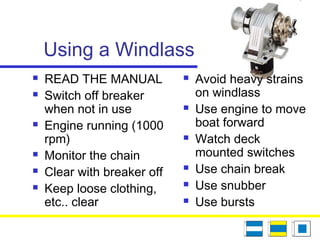
Using a Windlass
 READ THE MANUAL
 Switch off breaker
when not in use
 Engine running (1000
rpm)
 Monitor the chain
 Clear with breaker off
 Keep loose clothing,
etc.. clear
 Avoid heavy strains
on windlass
 Use engine to move
boat forward
 Watch deck
mounted switches
 Use chain break
 Use snubber
 Use bursts
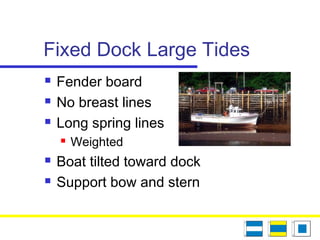
Fixed Dock Large Tides
 Fender board
 No breast lines
 Long spring lines
 Weighted
 Boat tilted toward dock
 Support bow and stern
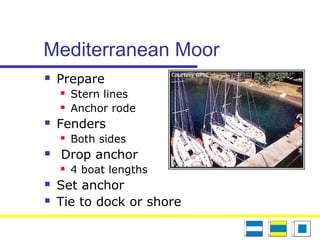
Mediterranean Moor
 Prepare
 Stern lines
 Anchor rode
 Fenders
 Both sides
 Drop anchor
 4 boat lengths
 Set anchor
 Tie to dock or shore
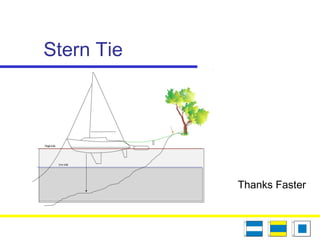
Stern Tie
Thanks Faster
Breast Anchor
 Hold a boat away from dock
 Rode abeam of amidships
 Bridle from anchor rode to stern cleat
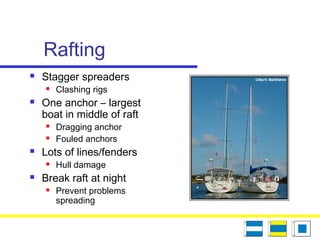
Rafting
 Stagger spreaders
 Clashing rigs
 One anchor – largest
boat in middle of raft
 Dragging anchor
 Fouled anchors
 Lots of lines/fenders
 Hull damage
 Break raft at night
 Prevent problems
spreading
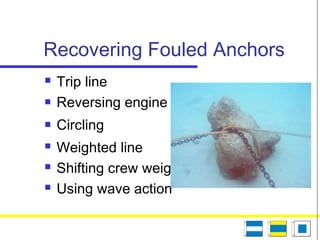
Recovering Fouled Anchors
 Trip line
 Reversing engine
 Circling
 Weighted line
 Shifting crew weight
 Using wave action
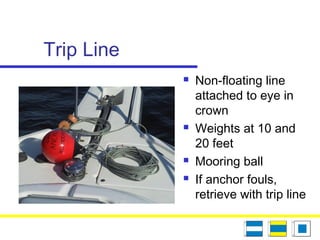
Trip Line
 Non-floating line
attached to eye in
crown
 Weights at 10 and
20 feet
 Mooring ball
 If anchor fouls,
retrieve with trip line
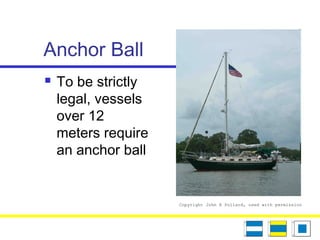
Anchor Ball
 To be strictly
legal, vessels
over 12
meters require
an anchor ball
Copyright John R Pollard, used with permission
The Dinghy
 Hardshell / Inflatable
 At Night
 Under Way
Hardshell vs Inflatable
 Hardshell
 May be less
expensive
 Less stable than
inflatable
 Easier to row
 May bang against
hull at night
 Inflatable
 More expensive
 Harder to row
 Will take larger
engine
 More stable than
hardshell
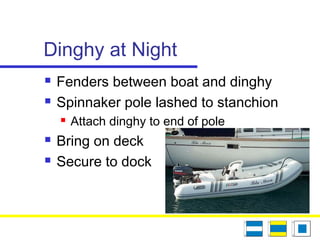
Dinghy at Night
 Fenders between boat and dinghy
 Spinnaker pole lashed to stanchion
 Attach dinghy to end of pole
 Bring on deck
 Secure to dock
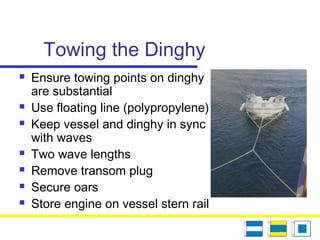
Towing the Dinghy
 Ensure towing points on dinghy
are substantial
 Use floating line (polypropylene)
 Keep vessel and dinghy in sync
with waves
 Two wave lengths
 Remove transom plug
 Secure oars
 Store engine on vessel stern rail
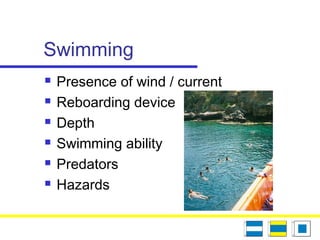
Swimming
 Presence of wind / current
 Reboarding device
 Depth
 Swimming ability
 Predators
 Hazards
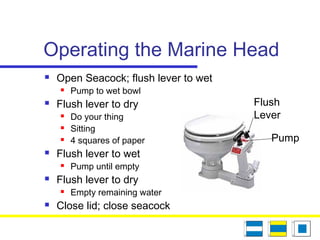
Operating the Marine Head
 Open Seacock; flush lever to wet
 Pump to wet bowl
 Flush lever to dry
 Do your thing
 Sitting
 4 squares of paper
 Flush lever to wet
 Pump until empty
 Flush lever to dry
 Empty remaining water
 Close lid; close seacock
Flush
Lever
Pump
Precautions – Marine Head
 If it did not go through your digestive system,
it does not go into the head.
 Except small amounts of toilet paper
 No
 Tissue
 Dental floss
 Feminine hygiene products
 Be aware of holding tank capacity
 If pump pressure increases – stop identify
problem
Courtesies and Customs
 Permission to board
 Raft at dock
 3 deep at government docks
 Crossing rafted boats
 Foredeck
 Anchoring rights
 First boat
 Keep clear of races
Flag Etiquette
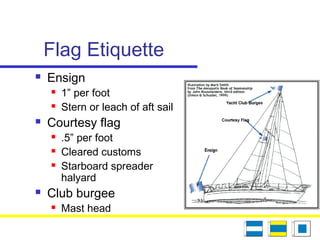
 Ensign
 1” per foot
 Stern or leach of aft sail
 Courtesy flag
 .5” per foot
 Cleared customs
 Starboard spreader
halyard
 Club burgee
 Mast head
Rendering Assistance
 A legal requirement
 Canada Shipping Act and the Criminal Code of
Canada
 Watch for signals that indicate distress and need
of assistance
 Render assistance to every person who is found at
sea and in danger of being lost .. without posing
serious danger to their own craft and the persons
on board
 Stop and offer assistance when the operator is
involved in an accident
Rope on a Boat
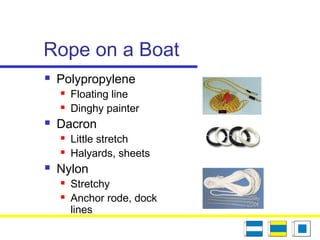
 Polypropylene
 Floating line
 Dinghy painter
 Dacron
 Little stretch
 Halyards, sheets
 Nylon
 Stretchy
 Anchor rode, dock
lines
Sail Management Systems
 Main sail
 Lazy Jacks
 Stackpacks
 In Boom Furling
 In Mast Furling
 Foresail / Headsail
 Furling
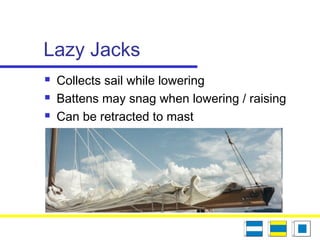
Lazy Jacks
 Collects sail while lowering
 Battens may snag when lowering / raising
 Can be retracted to mast
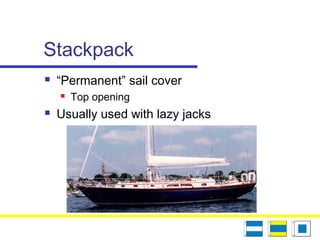
Stackpack
 “Permanent” sail cover
 Top opening
 Usually used with lazy jacks
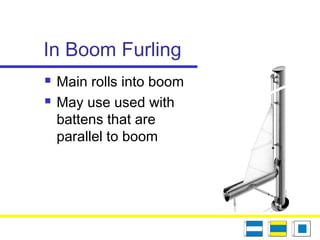
In Boom Furling
 Main rolls into boom
 May use used with
battens that are
parallel to boom
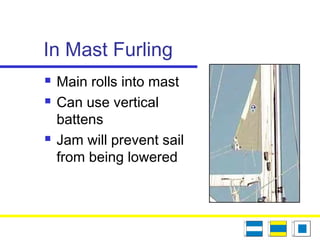
In Mast Furling
 Main rolls into mast
 Can use vertical
battens
 Jam will prevent sail
from being lowered
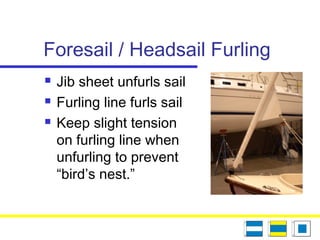
Foresail / Headsail Furling
 Jib sheet unfurls sail
 Furling line furls sail
 Keep slight tension
on furling line when
unfurling to prevent
“bird’s nest.”
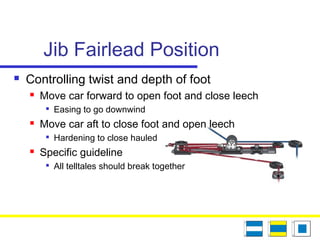
Jib Fairlead Position
 Controlling twist and depth of foot
 Move car forward to open foot and close leech

Easing to go downwind
 Move car aft to close foot and open leech

Hardening to close hauled
 Specific guideline

All telltales should break together
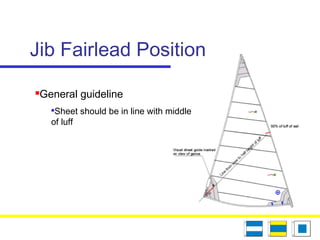
Jib Fairlead Position
General guideline

Sheet should be in line with middle
of luff
Jib Fairlead Position (leech
and foor shape)
 Jib lead aft moves the draft in the top of the sail
forward and moves the draft in the bottom of the sail
aft. With the lead aft, the leech is loose and foot is
tight.
 Jib lead forward moves the draft in the top of the
sail aft and moves the draft in the bottom of the sail
forward. The leech is tight and the foot is loose.
 The correct jib lead position distributes draft
evenly in the sail and the tension on the leech and
foot are relatively equal.
Job Fairlead Position (luff)
 Jib leads can be located by observing
which portion of the sail begins to luff first.
 Luffing in the upper portion means that the lead
should be moved forward. Too much twist.
 Luffing in the lower portion requires the lead point
to be moved aft. Too little twist.
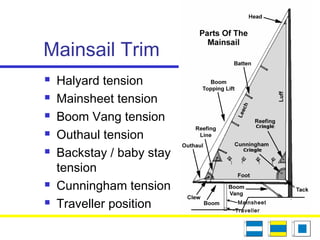
Mainsail Trim
 Halyard tension
 Mainsheet tension
 Boom Vang tension
 Outhaul tension
 Backstay / baby stay
tension
 Cunningham tension
 Traveller position Traveller
Mainsheet
Mainsail Halyard Tension
 Controls draft in mainsail
 Do not take headboard past the black
line near top of mast
 Harden luff to move draft forward
 About 50% draft
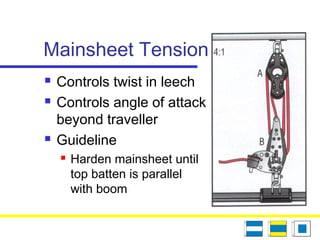
Mainsheet Tension
 Controls twist in leech
 Controls angle of attack
beyond traveller
 Guideline
 Harden mainsheet until
top batten is parallel
with boom
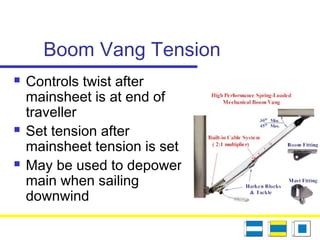
Boom Vang Tension
 Controls twist after
mainsheet is at end of
traveller
 Set tension after
mainsheet tension is set
 May be used to depower
main when sailing
downwind
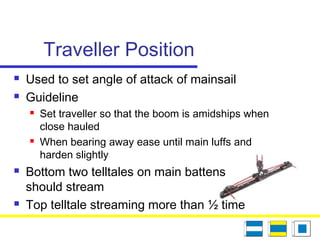
Traveller Position
 Used to set angle of attack of mainsail
 Guideline
 Set traveller so that the boom is amidships when
close hauled
 When bearing away ease until main luffs and
harden slightly
 Bottom two telltales on main battens
should stream
 Top telltale streaming more than ½ time
Section V
Navigation
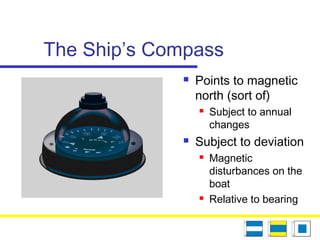
The Ship’s Compass
 Points to magnetic
north (sort of)
 Subject to annual
changes
 Subject to deviation
 Magnetic
disturbances on the
boat
 Relative to bearing
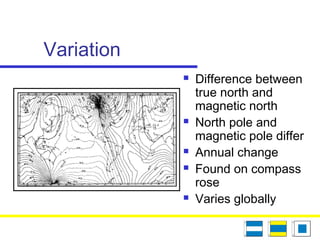
Variation
 Difference between
true north and
magnetic north
 North pole and
magnetic pole differ
 Annual change
 Found on compass
rose
 Varies globally
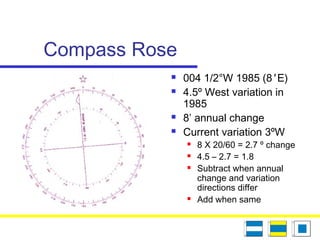
Compass Rose
 004 1/2°W 1985 (8' E)
 4.5º West variation in
1985
 8’ annual change
 Current variation 3ºW
 8 X 20/60 = 2.7 º change
 4.5 – 2.7 = 1.8
 Subtract when annual
change and variation
directions differ
 Add when same
Deviation
 Difference between ship’s compass and
magnetic bearing
 Ferrous metal affects magnetic field on vessel
 Relative to vessel’s heading
 Found on deviation card / table
 No deviation in hand bearing compass
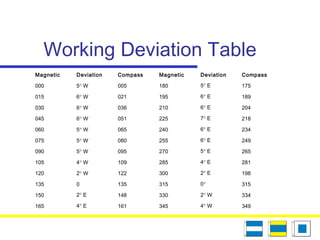
Working Deviation Table
Magnetic Deviation Compass Magnetic Deviation Compass
000 5° W 005 180 5° E 175
015 6° W 021 195 6° E 189
030 6° W 036 210 6° E 204
045 6° W 051 225 7° E 218
060 5° W 065 240 6° E 234
075 5° W 080 255 6° E 249
090 5° W 095 270 5° E 265
105 4° W 109 285 4° E 281
120 2° W 122 300 2° E 198
135 0 135 315 0° 315
150 2° E 148 330 2° W 334
165 4° E 161 345 4° W 349
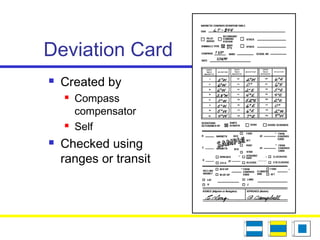
Deviation Card
 Created by
 Compass
compensator
 Self
 Checked using
ranges or transit
Accounting for Variation and
Deviation
 Helm reads the ship’s compass
 Navigator works in true
 Navigator makes conversions
 Correcting

Compass to True
 Uncorrecting

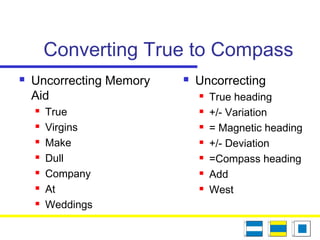
True to Compass
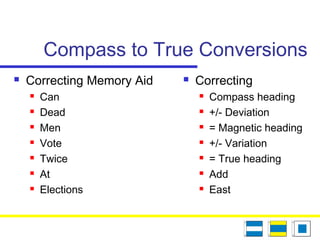
Compass to True Conversions
 Correcting Memory Aid
 Can
 Dead
 Men
 Vote
 Twice
 At
 Elections
 Correcting
 Compass heading
 +/- Deviation
 = Magnetic heading
 +/- Variation
 = True heading
 Add
 East
Converting True to Compass
 Uncorrecting Memory
Aid
 True
 Virgins
 Make
 Dull
 Company
 At
 Weddings
 Uncorrecting
 True heading
 +/- Variation
 = Magnetic heading
 +/- Deviation
 =Compass heading
 Add
 West
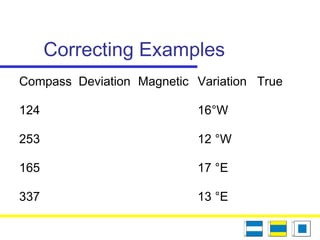
Correcting Examples
Compass Deviation Magnetic Variation True
124 16°W
253 12 °W
165 17 °E
337 13 °E
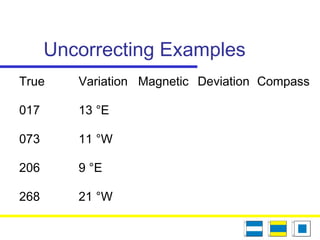
Uncorrecting Examples
True Variation Magnetic Deviation Compass
017 13 °E
073 11 °W
206 9 °E
268 21 °W
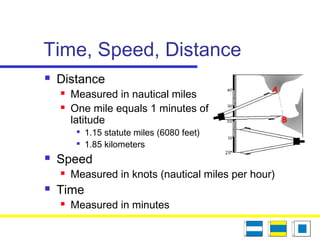
Time, Speed, Distance
 Distance
 Measured in nautical miles
 One mile equals 1 minutes of
latitude

1.15 statute miles (6080 feet)

1.85 kilometers
 Speed
 Measured in knots (nautical miles per hour)
 Time
 Measured in minutes
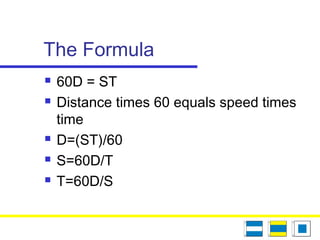
The Formula
 60D = ST
 Distance times 60 equals speed times
time
 D=(ST)/60
 S=60D/T
 T=60D/S
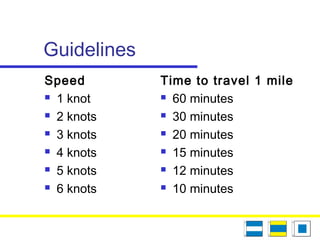
Guidelines
Speed
 1 knot
 2 knots
 3 knots
 4 knots
 5 knots
 6 knots
Time to travel 1 mile
 60 minutes
 30 minutes
 20 minutes
 15 minutes
 12 minutes
 10 minutes
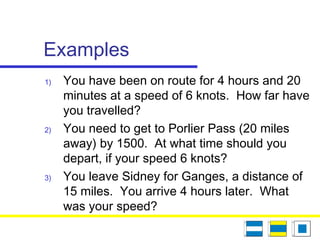
Examples
1) You have been on route for 4 hours and 20
minutes at a speed of 6 knots. How far have
you travelled?
2) You need to get to Porlier Pass (20 miles
away) by 1500. At what time should you
depart, if your speed 6 knots?
3) You leave Sidney for Ganges, a distance of
15 miles. You arrive 4 hours later. What
was your speed?
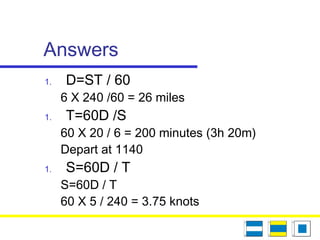
Answers
1. D=ST / 60
6 X 240 /60 = 26 miles
1. T=60D /S
60 X 20 / 6 = 200 minutes (3h 20m)
Depart at 1140
1. S=60D / T
S=60D / T
60 X 5 / 240 = 3.75 knots
Colregs
International Regulations for the
Prevention of Collisions at Sea
Application (Rule 1)
 All vessels upon the high seas
 All waters connected to the high seas
navigable by seagoing vessels
 Shall not interfere in the operation of
special rules made by an appropriate
authority (Victoria – seaplane
aerodrome)
 Traffic separation schemes (rules differ)
Responsibility (Rule 2)
 Shall not exonerate any vessel, or the
owner, master, or crew
 Required by the ordinary practice of
seamen
 Due regard shall be had to all dangers
of navigation and collision and to any
special circumstances
Definitions (Rule 3)
 Read carefully
 May be counter-intuitive
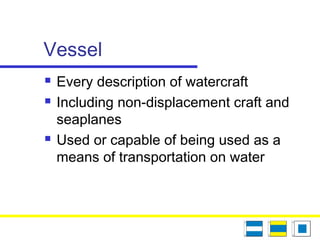
Vessel
 Every description of watercraft
 Including non-displacement craft and
seaplanes
 Used or capable of being used as a
means of transportation on water
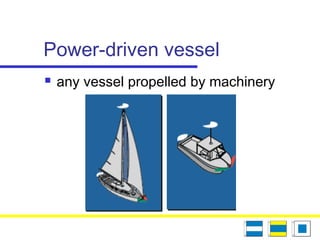
Power-driven vessel
 any vessel propelled by machinery
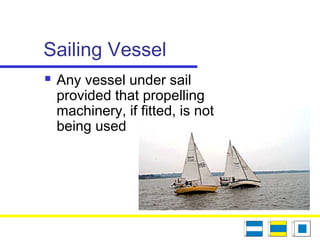
Sailing Vessel
 Any vessel under sail
provided that propelling
machinery, if fitted, is not
being used
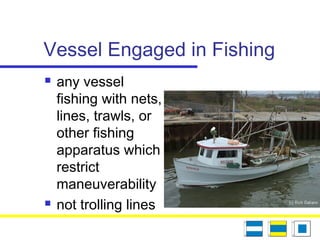
Vessel Engaged in Fishing
 any vessel
fishing with nets,
lines, trawls, or
other fishing
apparatus which
restrict
maneuverability
 not trolling lines
Not Under Command
 A vessel which through some
exceptional circumstance is unable to
maneuver as required by these Rules
 Broken rudder
 No propulsion
Restricted in Ability to
Maneuver
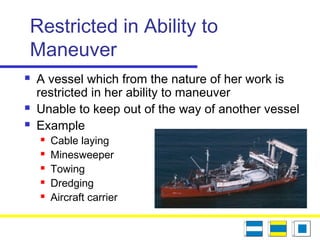
 A vessel which from the nature of her work is
restricted in her ability to maneuver
 Unable to keep out of the way of another vessel
 Example
 Cable laying
 Minesweeper
 Towing
 Dredging
 Aircraft carrier
Underway
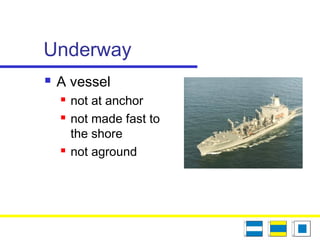
 A vessel
 not at anchor
 not made fast to
the shore
 not aground
In Sight
 Vessels shall be deemed to be in sight
of one another only when one can be
observed visually from the other.
Restricted Visibility
 Visibility is restricted by
 fog
 mist
 falling snow
 heavy rainstorms
 sandstorms
 any other similar causes.
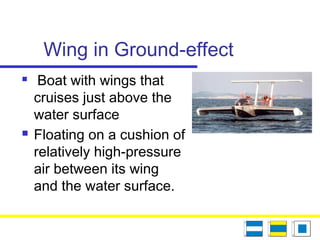
Wing in Ground-effect
 Boat with wings that
cruises just above the
water surface
 Floating on a cushion of
relatively high-pressure
air between its wing
and the water surface.
Look Out (Rule 5)
 Every vessel shall at all times maintain
a proper look-out
 by sight
 by hearing
 by all available means appropriate
 make a full appraisal of the situation and of
the risk of collision
Safe Speed (Rule 6)
 All Vessels
 Visibility
 Traffic density
 Stopping distance and
turning ability
 Background light
 State of wind, sea and
current
 Proximity of navigational
hazards
 Draft
 Equipped with Radar
 Characteristics,
efficiency and limitations
of equipment
 Radar range scale
 Sea state, weather and
other sources of
interference
 Objects may not be
detected
 Number, location and
movement of vessels
Risk of Collision (Rule 7)
 Shall use all available means appropriate
 Radar shall be used if fitted and operating
 Assumptions shall not be made on the basis of
scanty information
 Determining risk of collision
 Compass bearing does not change substantially
 May still exist if change is substantial

Large vessel, tow, or close range
Avoiding Collision (Rule 8)
 Alter speed, alter course or both
 “Make it big and make it early”
 Due regard to good seamanship
 Avoid close calls
 until the other vessel is finally past and
clear
 Avoid creating another collision
situation
Narrow Channels (Rule 9)
 Keep as far to starboard as possible
 Vessels of 20 m or less and sailboat
shall not impede larger vessels
 Do not cross if you will impede
 Use appropriate sounds
 Overtaking
 Bends or obscured vision
 Avoid anchoring
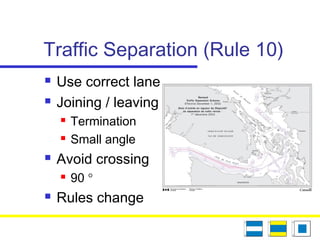
Traffic Separation (Rule 10)
 Use correct lane
 Joining / leaving
 Termination
 Small angle
 Avoid crossing
 90 °
 Rules change
Application
 Rules for Section II apply to unrestricted
visibility
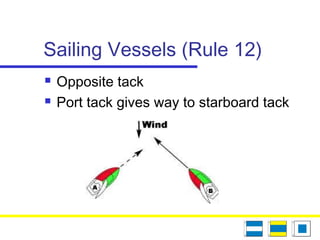
Sailing Vessels (Rule 12)
 Opposite tack
 Port tack gives way to starboard tack
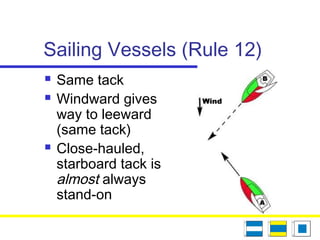
Sailing Vessels (Rule 12)
 Same tack
 Windward gives
way to leeward
(same tack)
 Close-hauled,
starboard tack is
almost always
stand-on
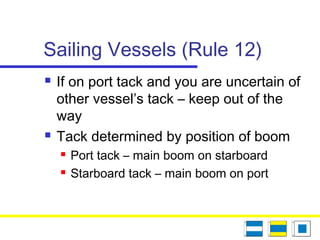
Sailing Vessels (Rule 12)
 If on port tack and you are uncertain of
other vessel’s tack – keep out of the
way
 Tack determined by position of boom
 Port tack – main boom on starboard
 Starboard tack – main boom on port
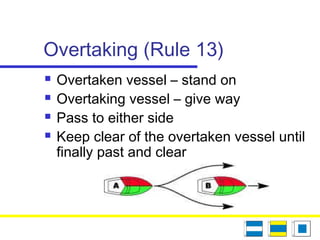
Overtaking (Rule 13)
 Overtaken vessel – stand on
 Overtaking vessel – give way
 Pass to either side
 Keep clear of the overtaken vessel until
finally past and clear
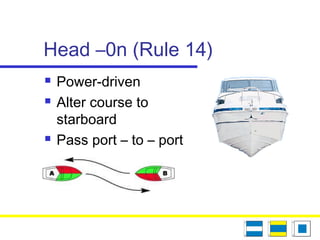
Head –0n (Rule 14)
 Power-driven
 Alter course to
starboard
 Pass port – to – port
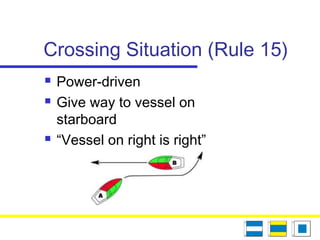
Crossing Situation (Rule 15)
 Power-driven
 Give way to vessel on
starboard
 “Vessel on right is right”
Action by Give Way Vessel
(Rule 16)
 Alter course
 Alter speed
 Alter course and speed
 “Do it big and do it early”
Action by Stand-on Vessel
(Rule 17)
 Maintain course and speed
 May have to avoid collision if give way
does nothing
 Avoid altering course to port
Responsibilities between
Vessels (Rule 18)
 Over
 Night
 Room
 For
 Sale
 Plus
 Snacks &
 Whisky
 Overtaken (Rule 13)
 Not under command
 Restricted in Ability to Maneuver
 Fishing
 Sailboat
 Powerboat
 Seaplane
 WIG – taking off
Conduct of Vessels in
Restricted Visibility (Rule 19)
 Safe speed with engine(s) ready
 When using radar
 Avoid altering course to port forward of beam
 Avoid altering course towards vessels abeam or
abaft the beam
 Fog signal forward of beam
 Slow down and navigate carefully until risk of
collision is over
Sounds Signals (Rules 32-37)
 Definitions
 Short blast – one seconds
 Prolonged blast – 4 to 6 seconds
 Requirements
 Under 12 meters – whistle (horn)
 12 meters and over – whistle and bell
Maneuvering and Warning
Signals
 1 short blast
 2 short blasts
 3 short blasts
 5 short blasts
 May also be light flashes
 Altering course to starboard
 Altering course to port
 Operating astern propulsion
 Your intentions are unclear
Overtaking Signals
 2 long, 1 short
 2 long, 2 short
 1 long, 1 short, 1
long, 1 short
 I intend to overtake on your
starboard
 I intend to overtake on your
port
 I am in agreement with your
intentions
Sound Signals –Restricted
Visibility
 1 prolonged blast
 2 prolonged blasts
 1 prolonged, 2 short
 Each signal within 2 minutes
 Moving (under power)
 Not moving
 Almost all others
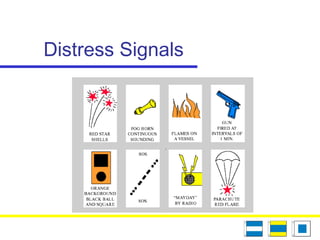
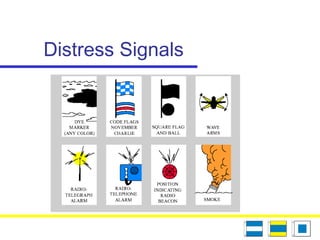
Distress Signals
Distress Signals
Radar Reflectors (Rule 40)
 Required if
 Under 20 meters, or
 Non-metallic construction
 Mounted 4 meters above waterline
 Strong return
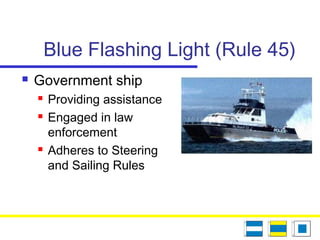
Blue Flashing Light (Rule 45)
 Government ship
 Providing assistance
 Engaged in law
enforcement
 Adheres to Steering
and Sailing Rules

CYA Intermediate Cruising

  • 1.
    CYA Intermediate Cruising JackDale Advanced CYA Instructor #2066
  • 2.
    Objective  To beable to cruise safely in familiar waters as both skipper and crew of a sailing yacht of 8 - 12 meters in moderate wind and sea conditions by day.  Emphasizes on-the-water skills at a level acceptable for bareboat chartering.
  • 3.
    Prerequisites  Basic CruisingStandard  Recommended  First aid and CPR  VHF ROC  Coastal Navigation
  • 4.
  • 5.
    Diesel Fuel System Fuel tank  Water separator  Fuel pump  Fuel filter  Injectors  Return
  • 6.
    Fuel Efficiency  Fuelconsumption  Diesel  O.1 litres per horsepower per hour  56 hp = 5.6 liters per hour  400 litres  Range @ 5 knots = 400 / 5.6 X 5 = 357 miles  Gasoline  0.3 litres per horsepower per hour  20 hp 6 litres per hour  100 litres  Range @5 knots = 100/6 X 5 = 83 miles
  • 7.
    Fuel Efficiency  Affectedby  Engine  Tune  RPM  # of cylinders  Prop type  Folding  Feathering  # of blades
  • 8.
    Fuel Efficiency  Affectedby  Other factors  Cleanliness of hull  Dinghy  Towing (drag)  On deck (windage)  Wind and current, sea conditions  Steering  Motorsailing
  • 9.
    Fresh Water  Requirements Minimum – 2 litres (.5 US gallon) per person per day  Primarily drinking water  Normal - 8 litres (2 US gallons) per person per day  Washing dishes, brief showers  Stored in tanks under berths and settees  Use one tank at a time
  • 10.
    Domestic Water System Multipletank systems has valves to prevent simultaneous use of tanks. Foot or hand pumps might also be used.
  • 11.
    Seasickness Causes  Mixedmessages  Inner ear  Eyes  Other motion sensors  Worsened by  Odours  Alcohol  Fatty foods  Spicy foods  Overheating
  • 12.
    Seasickness Symptoms  Drowsiness Nausea  Clammy skin  Pale skin  Vomiting  Dry heaves
  • 13.
    Seasickness Prevention  Avoidalcohol and coffee  Avoid greasy food  Get plenty of rest  Avoid excessive time below  Navigating  Cooking  Avoid discussions and thoughts of mal de mer
  • 14.
    Seasickness Medication  Meclizine(Bonine)  Dimenhydrinate (Gravol)  Transderm-Scopolamine Patch  Side effects  Drowsiness, dry mouth, constipation, blurred vision  Take it before  Trip (side effects)  Onset
  • 15.
    Seasickness – Non-medicinal Treatment Ginger ale (rehydrate)  Dry crackers  Focus on horizon  Steer  If incapacitated  Lie on centre line of cabin sole  Close eyes
  • 16.
    Clothing – FoulWeather  Dress in layers  Polypropylene underwear  Fleece  Watch cap  Avoid cotton and wool  Raingear  Breathable  Welded seams
  • 17.
    Clothing – FairWeather  Hat  Cover ups  UV protection  Sunglasses (with retainer)  UV protection  Gloves
  • 18.
    Clothing – Footwear Sailing shoes  Grippy (gum rubber)  Non-marking  Quick drying  Sea boots  Grippy  Felt in-soles  Shore shoes  Sandals  Walking shoes
  • 19.
    Packing Clothing  Hangingspace at a premium  Usually wet lockers  Use soft bags  Roll pants  Organize clothes in laundry bags / mesh organizers
  • 20.
    Menu Planning  Checkgalley  How many burners on stove?  Oven?  What pots and pans are on board?  What containers?  Juice  Storage  Barbeque?  Propane or briquettes
  • 21.
    Provisioning  Three nutritiousmeals per day  Snacks  Water  Beverages  Herbs, spices and sauces  Dietary requirements of crew
  • 22.
    Stowing Provisions  Beverageswill stay cool if stored under water line  Dry stowage  Longer voyages  Stowage plan  Long lasting vegetables  Turn eggs  Remove labels and mark cans
  • 23.
    Packing the Fridge First in – last out  Coldest at bottom near freezer plate  Keep lettuce and salads way from freezer plate
  • 24.
    Minimizing Fridge Power Consumption Pre-freeze / pre-chill foods  Keep fridge full  Organize to minimize opening  Top opening more efficient  Block ice in bottom  Beverages stowed below waterline (not fridge)  Extra insulation
  • 25.
    First Aid Kits Take first aid and CPR  Charter boats may not have medications
  • 26.
    First Aid KitContents  Box  Bandages  Gauze  Elastic  Adhesive  Triangular  Sterile pads  Thermometer  Surgical tape  First aid manual  Medications  Sun block and screen  Sunburn lotion  Burn cream  Antihistamines  Laxatives  Antacid  Diarrhea medication  Analgesics  Antiseptic lotion  Antibiotic cream  Personal medication Scissors Tweezers Safety pins Gloves Cold packs AR shield Splints Space Blanket Eye wash kit
  • 27.
    Engine Spare Parts Oil  Oil filter  Fuel filter  Impellor(s)  Belts  Duct tape  Electrical tape  Fuses  Penetrating oil  Transmission fluid  Mechanics wire  Wire ties  Hose clamps  Points, plugs, condenser (gas)  Gasket cement
  • 28.
    Tools  General  Crescentwrenches  Box wrenches  Vice grips  Socket set  Pliers  Screwdrivers  Hammer  Allen keys  Sail and Rigging  Marlinespike  Rigging knife  Sail maker’s palm  Needles  Sail thread  Bolt cutter
  • 29.
    Engine Checks  Daily Engine oil level  Coolant level  Belt tension  Leaks under engine  Fuel level  Bilge  Oil  Fuel  Propane  Weekly  Transmission fluid  Transmission linkage  Stuffing box  Sea strainer  Battery connections
  • 30.
    Clearing Customs and Immigration Into USA  Port of entry  Skipper only ashore  Boat  Registration #  Name / length  Cruising permit  Crew  Names  Addresses  Nationalities (passport)  Place / date of birth  Clearance #  Into Canada  Port of entry  Skipper only ashore  Boat  Registration #  Name / length  Crew  Names  Addresses  Nationalities (passport)  Place / date of birth  Clearance #
  • 31.
    Clearing Customs and Immigration Pre- departure  Check requirements  Departure clearance  Crew documentation  Vessel documentation  Import restrictions  “Q” flag?  Courtesy flag?
  • 32.
  • 33.
    Galley Safety  Cookingunderway  Stove gimbaled  Be careful opening oven  Hand rail in front of stove  Pots half full  Pots clamped into place  Wear foul weather pants  Use harness in rough weather
  • 34.
    Diesel / KeroseneStove  Fuel readily available  Safe  Burner must be pre- heated  May produce soot if not properly primed  Must be vented  Cannot be gimbaled
  • 35.
    Alcohol Stove  Cool,moist heat  Not explosive unless vapourized  Readily available  Must be primed  Subject to flaring  Keep pan of water nearby  Fire extinguisher for large flares
  • 36.
    Propane Stoves  Readilyavailable  Inexpensive  Efficient heat  Heavier than air  Bottles must be in locker vented overboard  Properly installed  “sniffer”
  • 37.
    CNG Stoves  Compressednatural gas (2000 psi)  Bottle must be exchanged  Efficient heat  Lighter than air  Becoming more available in North America
  • 38.
    Electric Stoves  Notcommon on sailboats  On some power boats  Requires higher voltage (genset)  Safe
  • 39.
    Diesel Cabin Heaters Must be exhausted through stack  Convenient fuel  Must be primed properly
  • 40.
    Forced Air CabinHeater  Diesel fuel  Be patient when starting  3 unsuccessful – service call  Individual cabin controls  Use away from dock  Smelly exhaust  Expensive to buy  Hard to install post- production
  • 41.
    Hot Water CabinHeating  Diesel fuel  May also be heated by engine or electric heat  Individual cabin controls  Smelly exhaust 1. Radiator 2. Expansion Tank 3. Warm Water Tank 4. Fuel Line 5. Water Circulation Pump 6. Water Heater 7. Exhaust Pipe
  • 42.
    Electric Cabin Heating 110 volt  High wattage  Only practical at dock
  • 43.
    Electrical System  Sourcesof 12 volt DC power  Sources of 120 volt AC power  Battery banks
  • 44.
    Sources of 12Volt DC  Alternator  Solar panels  Wind generator
  • 45.
    Sources of 120Volt AC  Shore power  Genset  Inverter
  • 46.
    Battery Banks  Normally2 Banks  Engine starting battery – isolated  May be smaller  House power  Normally 2 or more batteries  Deep cycle
  • 47.
  • 48.
    Thermal Generated Winds Land heats up faster than water  Water cools slower than land  Temperature and pressure differences result in  Breezes  Clouds
  • 49.
    Sea Breeze  Landsheats faster than water  Pressure gradient evolves  Air rises over land  Replaced by air from sea
  • 50.
    Land Breeze  Landcools faster than water  Pressure gradient results  Air circulates  Breezes result
  • 51.
    Fair Weather CumulusClouds  Puffy cotton balls, flat grey bottom  Created by rising warm, moist air  Appear late morning  Dissipate late afternoon  May develop into cumulonimbus clouds (thunderstorms)
  • 52.
    Fog  Tiny waterdroplets suspended in air  Dew point
  • 53.
    Radiation Fog  Landradiates heat into space
  • 54.
    Advection Fog  Warm,moist air over cooler water
  • 55.
    Frontal Fog  Oftenassociated with warm fronts
  • 56.
    Sea Fog  Steamfog (fresh water)  Sea smoke (salt water)  Cold air over much warmer water  9º C difference
  • 57.
    Radar Reflector  Mountat least 4 meters high  “Catch rain” position for octahedral reflectors
  • 58.
  • 59.
    Emergencies  Four rulesof preparation  Respect the boat  Worst case scenarios  Prepare the crew  Location and use of equipment  Assign duties and chain of command  Standing orders  Choose a safe route  Prepare for emergencies  Practice
  • 60.
    Running Aground  Itwill happen!  Procedures  All crew in PFDs  Check crew safety  Check vessel integrity  Check the tide  Float off  Prepare for falling tide  Heel the vessel  Kedge off  Sail or motor off  Take a tow
  • 61.
    Preparing for aFalling Tide  Kedge anchor  Heel boat  Mast to shore  Secure items below  Close hatches and ports  Cushion hull
  • 62.
    Avoiding Running Aground Know  Where you are  Where you are going  Consult charts regularly  Take a coastal navigation course  In shallow water, use depth sounder or lead line  Be aware of tides and currents  Avoid lee shores  Post lookouts in narrow passes
  • 63.
    Springing a Leak All crew in PFDs  Start pumping  Determine source  Look, smell and taste  Fresh water  Water tank  Leak from rain  Salt water  Holed hull  Through hulls  Above water fixtures and seals
  • 64.
    Holed Hull  Ifon rocks, stay there!  Collision mat (storm sail)  Plug from inside  Tear out cabin sole and cabinets  Stuff cushions, rags, whatever  Hold in place with oars, planks  Pre-drilled marine plywood
  • 65.
    Through Hulls  Checkflush lever position in head  Locate and check all  Loose or damaged hoses  Close seacock  Tighten or replace hose clamps  Broken seacock  Hammer in wood plug
  • 66.
    Stuffing Box, etc Should drip occasionally  If excessive flow  Tighten  Pump grease into gland  Check prop shaft  Check rudder post
  • 67.
    Above Water Leaks Check ventilators and deck pipes  Close and dog all hatches  Inspect hull-deck join  Especially near chain plates)  Check all deck fills  Check mast partner and boot  Clogged drains  Cockpit  Anchor well
  • 68.
    Avoiding Leaks  Samemeasures to avoid running aground  Look out for objects in water  Deadheads  Fill tanks slowly  Inspect all hoses  Stainless hose clamps  Anti-siphoning loops  Check and lubricate seacocks
  • 69.
    Avoiding Leaks (2) Sacrificial anode on prop shaft  Check prop shaft alignment  Inspect stuffing box  Check operation of bilge pumps  Inspect hatches, ports and ventilators  Replace gaskets
  • 70.
    Steering Failure  Rigemergency tiller  Steer with sails  Ease jib / harden main to head up  Ease main / harden jib to bear away  Jury rig rudder  Board lashed to spinnaker pole  Pole lashed to backstay
  • 71.
    Fouling a Propeller Stop engine immediately  Gently tug on line  Pull out fuel stop  Transmission in reverse  “Stab” starter button  In calm waters  Send diver to cut line  Mask, snorkel, fins  Safety line  In rough water sail to calm anchorage
  • 72.
    Collision With AnotherVessel  Check crew and vessel  Pan pan or Mayday as required  All crew in PFDs  Stay in proximity until released by  Other vessel  Coast Guard  Exchange insurance information
  • 73.
    Fire  Shout “fire” All crew in PFDs  Keep fire downwind  Cut off fuel  Use fire extinguisher  P.AS.S. method  Prepare to abandon  2 minutes  “Mayday”
  • 74.
    P.A.S.S. Method  Pullpin  Aim at base of fire  Squeeze handle  Sweep side to side
  • 75.
    Cooling Water Fails Shut off engine  Check raw water seacock  Check sea strainer  Check hoses and hose clamps  Check impeller  Wait for engine to cool  Restart  Blocked inlet
  • 76.
    Raw Water Cooling Sea water is drawn in via through hull  Circulates through engine  Discharged into exhaust
  • 77.
    Fresh Water Cooling Coolant circulates through engine and heat exchanger  Sea water circulates through heat exchanger  Sea water mixed with exhaust
  • 78.
    Sea Strainer  Closesea cock  Remove top (1)  Remove basket and clean  Clean body (2)  Reassemble  OPEN SEACOCK
  • 79.
    Engine Failure inAnchorage  Not safe to sail  Anchor  Boat hook  Fenders  Tow with dinghy
  • 80.
    Engine Failure inChannel  Issue “Pan Pan”  Attempt to sail  Keep anchor at ready  Tow with dinghy
  • 81.
    Recovering Crew Overboard Swim ladder (calm seas)  Inflatable dinghy  Lifting gear  Life sling  Spare halyard  Foresail  Boom vang on boom end
  • 82.
    Emergencies and VHF Mayday  Imminent danger to vessel or crew  Pan Pan  Broken down  Securité  Safety message
  • 83.
    Components of Mayday Message The distress signal MAYDAY  The call sign of the station in distress  Position (relative or geographical)  Nature of distress and assistance required  Vessel description  The number of persons on board and injuries  Other information that might facilitate rescue  Vessel name
  • 84.
  • 85.
    Using a Windlass READ THE MANUAL  Switch off breaker when not in use  Engine running (1000 rpm)  Monitor the chain  Clear with breaker off  Keep loose clothing, etc.. clear  Avoid heavy strains on windlass  Use engine to move boat forward  Watch deck mounted switches  Use chain break  Use snubber  Use bursts
  • 86.
    Fixed Dock LargeTides  Fender board  No breast lines  Long spring lines  Weighted  Boat tilted toward dock  Support bow and stern
  • 87.
    Mediterranean Moor  Prepare Stern lines  Anchor rode  Fenders  Both sides  Drop anchor  4 boat lengths  Set anchor  Tie to dock or shore
  • 88.
  • 89.
    Breast Anchor  Holda boat away from dock  Rode abeam of amidships  Bridle from anchor rode to stern cleat
  • 90.
    Rafting  Stagger spreaders Clashing rigs  One anchor – largest boat in middle of raft  Dragging anchor  Fouled anchors  Lots of lines/fenders  Hull damage  Break raft at night  Prevent problems spreading
  • 91.
    Recovering Fouled Anchors Trip line  Reversing engine  Circling  Weighted line  Shifting crew weight  Using wave action
  • 92.
    Trip Line  Non-floatingline attached to eye in crown  Weights at 10 and 20 feet  Mooring ball  If anchor fouls, retrieve with trip line
  • 93.
    Anchor Ball  Tobe strictly legal, vessels over 12 meters require an anchor ball Copyright John R Pollard, used with permission
  • 94.
    The Dinghy  Hardshell/ Inflatable  At Night  Under Way
  • 95.
    Hardshell vs Inflatable Hardshell  May be less expensive  Less stable than inflatable  Easier to row  May bang against hull at night  Inflatable  More expensive  Harder to row  Will take larger engine  More stable than hardshell
  • 96.
    Dinghy at Night Fenders between boat and dinghy  Spinnaker pole lashed to stanchion  Attach dinghy to end of pole  Bring on deck  Secure to dock
  • 97.
    Towing the Dinghy Ensure towing points on dinghy are substantial  Use floating line (polypropylene)  Keep vessel and dinghy in sync with waves  Two wave lengths  Remove transom plug  Secure oars  Store engine on vessel stern rail
  • 98.
    Swimming  Presence ofwind / current  Reboarding device  Depth  Swimming ability  Predators  Hazards
  • 99.
    Operating the MarineHead  Open Seacock; flush lever to wet  Pump to wet bowl  Flush lever to dry  Do your thing  Sitting  4 squares of paper  Flush lever to wet  Pump until empty  Flush lever to dry  Empty remaining water  Close lid; close seacock Flush Lever Pump
  • 100.
    Precautions – MarineHead  If it did not go through your digestive system, it does not go into the head.  Except small amounts of toilet paper  No  Tissue  Dental floss  Feminine hygiene products  Be aware of holding tank capacity  If pump pressure increases – stop identify problem
  • 101.
    Courtesies and Customs Permission to board  Raft at dock  3 deep at government docks  Crossing rafted boats  Foredeck  Anchoring rights  First boat  Keep clear of races
  • 102.
    Flag Etiquette  Ensign 1” per foot  Stern or leach of aft sail  Courtesy flag  .5” per foot  Cleared customs  Starboard spreader halyard  Club burgee  Mast head
  • 103.
    Rendering Assistance  Alegal requirement  Canada Shipping Act and the Criminal Code of Canada  Watch for signals that indicate distress and need of assistance  Render assistance to every person who is found at sea and in danger of being lost .. without posing serious danger to their own craft and the persons on board  Stop and offer assistance when the operator is involved in an accident
  • 104.
    Rope on aBoat  Polypropylene  Floating line  Dinghy painter  Dacron  Little stretch  Halyards, sheets  Nylon  Stretchy  Anchor rode, dock lines
  • 105.
    Sail Management Systems Main sail  Lazy Jacks  Stackpacks  In Boom Furling  In Mast Furling  Foresail / Headsail  Furling
  • 106.
    Lazy Jacks  Collectssail while lowering  Battens may snag when lowering / raising  Can be retracted to mast
  • 107.
    Stackpack  “Permanent” sailcover  Top opening  Usually used with lazy jacks
  • 108.
    In Boom Furling Main rolls into boom  May use used with battens that are parallel to boom
  • 109.
    In Mast Furling Main rolls into mast  Can use vertical battens  Jam will prevent sail from being lowered
  • 110.
    Foresail / HeadsailFurling  Jib sheet unfurls sail  Furling line furls sail  Keep slight tension on furling line when unfurling to prevent “bird’s nest.”
  • 111.
    Jib Fairlead Position Controlling twist and depth of foot  Move car forward to open foot and close leech  Easing to go downwind  Move car aft to close foot and open leech  Hardening to close hauled  Specific guideline  All telltales should break together
  • 112.
    Jib Fairlead Position Generalguideline  Sheet should be in line with middle of luff
  • 113.
    Jib Fairlead Position(leech and foor shape)  Jib lead aft moves the draft in the top of the sail forward and moves the draft in the bottom of the sail aft. With the lead aft, the leech is loose and foot is tight.  Jib lead forward moves the draft in the top of the sail aft and moves the draft in the bottom of the sail forward. The leech is tight and the foot is loose.  The correct jib lead position distributes draft evenly in the sail and the tension on the leech and foot are relatively equal.
  • 114.
    Job Fairlead Position(luff)  Jib leads can be located by observing which portion of the sail begins to luff first.  Luffing in the upper portion means that the lead should be moved forward. Too much twist.  Luffing in the lower portion requires the lead point to be moved aft. Too little twist.
  • 115.
    Mainsail Trim  Halyardtension  Mainsheet tension  Boom Vang tension  Outhaul tension  Backstay / baby stay tension  Cunningham tension  Traveller position Traveller Mainsheet
  • 116.
    Mainsail Halyard Tension Controls draft in mainsail  Do not take headboard past the black line near top of mast  Harden luff to move draft forward  About 50% draft
  • 117.
    Mainsheet Tension  Controlstwist in leech  Controls angle of attack beyond traveller  Guideline  Harden mainsheet until top batten is parallel with boom
  • 118.
    Boom Vang Tension Controls twist after mainsheet is at end of traveller  Set tension after mainsheet tension is set  May be used to depower main when sailing downwind
  • 119.
    Traveller Position  Usedto set angle of attack of mainsail  Guideline  Set traveller so that the boom is amidships when close hauled  When bearing away ease until main luffs and harden slightly  Bottom two telltales on main battens should stream  Top telltale streaming more than ½ time
  • 120.
  • 121.
    The Ship’s Compass Points to magnetic north (sort of)  Subject to annual changes  Subject to deviation  Magnetic disturbances on the boat  Relative to bearing
  • 122.
    Variation  Difference between truenorth and magnetic north  North pole and magnetic pole differ  Annual change  Found on compass rose  Varies globally
  • 123.
    Compass Rose  0041/2°W 1985 (8' E)  4.5º West variation in 1985  8’ annual change  Current variation 3ºW  8 X 20/60 = 2.7 º change  4.5 – 2.7 = 1.8  Subtract when annual change and variation directions differ  Add when same
  • 124.
    Deviation  Difference betweenship’s compass and magnetic bearing  Ferrous metal affects magnetic field on vessel  Relative to vessel’s heading  Found on deviation card / table  No deviation in hand bearing compass
  • 125.
    Working Deviation Table MagneticDeviation Compass Magnetic Deviation Compass 000 5° W 005 180 5° E 175 015 6° W 021 195 6° E 189 030 6° W 036 210 6° E 204 045 6° W 051 225 7° E 218 060 5° W 065 240 6° E 234 075 5° W 080 255 6° E 249 090 5° W 095 270 5° E 265 105 4° W 109 285 4° E 281 120 2° W 122 300 2° E 198 135 0 135 315 0° 315 150 2° E 148 330 2° W 334 165 4° E 161 345 4° W 349
  • 126.
    Deviation Card  Createdby  Compass compensator  Self  Checked using ranges or transit
  • 127.
    Accounting for Variationand Deviation  Helm reads the ship’s compass  Navigator works in true  Navigator makes conversions  Correcting  Compass to True  Uncorrecting  True to Compass
  • 128.
    Compass to TrueConversions  Correcting Memory Aid  Can  Dead  Men  Vote  Twice  At  Elections  Correcting  Compass heading  +/- Deviation  = Magnetic heading  +/- Variation  = True heading  Add  East
  • 129.
    Converting True toCompass  Uncorrecting Memory Aid  True  Virgins  Make  Dull  Company  At  Weddings  Uncorrecting  True heading  +/- Variation  = Magnetic heading  +/- Deviation  =Compass heading  Add  West
  • 130.
    Correcting Examples Compass DeviationMagnetic Variation True 124 16°W 253 12 °W 165 17 °E 337 13 °E
  • 131.
    Uncorrecting Examples True VariationMagnetic Deviation Compass 017 13 °E 073 11 °W 206 9 °E 268 21 °W
  • 132.
    Time, Speed, Distance Distance  Measured in nautical miles  One mile equals 1 minutes of latitude  1.15 statute miles (6080 feet)  1.85 kilometers  Speed  Measured in knots (nautical miles per hour)  Time  Measured in minutes
  • 133.
    The Formula  60D= ST  Distance times 60 equals speed times time  D=(ST)/60  S=60D/T  T=60D/S
  • 134.
    Guidelines Speed  1 knot 2 knots  3 knots  4 knots  5 knots  6 knots Time to travel 1 mile  60 minutes  30 minutes  20 minutes  15 minutes  12 minutes  10 minutes
  • 135.
    Examples 1) You havebeen on route for 4 hours and 20 minutes at a speed of 6 knots. How far have you travelled? 2) You need to get to Porlier Pass (20 miles away) by 1500. At what time should you depart, if your speed 6 knots? 3) You leave Sidney for Ganges, a distance of 15 miles. You arrive 4 hours later. What was your speed?
  • 136.
    Answers 1. D=ST /60 6 X 240 /60 = 26 miles 1. T=60D /S 60 X 20 / 6 = 200 minutes (3h 20m) Depart at 1140 1. S=60D / T S=60D / T 60 X 5 / 240 = 3.75 knots
  • 137.
    Colregs International Regulations forthe Prevention of Collisions at Sea
  • 138.
    Application (Rule 1) All vessels upon the high seas  All waters connected to the high seas navigable by seagoing vessels  Shall not interfere in the operation of special rules made by an appropriate authority (Victoria – seaplane aerodrome)  Traffic separation schemes (rules differ)
  • 139.
    Responsibility (Rule 2) Shall not exonerate any vessel, or the owner, master, or crew  Required by the ordinary practice of seamen  Due regard shall be had to all dangers of navigation and collision and to any special circumstances
  • 140.
    Definitions (Rule 3) Read carefully  May be counter-intuitive
  • 141.
    Vessel  Every descriptionof watercraft  Including non-displacement craft and seaplanes  Used or capable of being used as a means of transportation on water
  • 142.
    Power-driven vessel  anyvessel propelled by machinery
  • 143.
    Sailing Vessel  Anyvessel under sail provided that propelling machinery, if fitted, is not being used
  • 144.
    Vessel Engaged inFishing  any vessel fishing with nets, lines, trawls, or other fishing apparatus which restrict maneuverability  not trolling lines
  • 145.
    Not Under Command A vessel which through some exceptional circumstance is unable to maneuver as required by these Rules  Broken rudder  No propulsion
  • 146.
    Restricted in Abilityto Maneuver  A vessel which from the nature of her work is restricted in her ability to maneuver  Unable to keep out of the way of another vessel  Example  Cable laying  Minesweeper  Towing  Dredging  Aircraft carrier
  • 147.
    Underway  A vessel not at anchor  not made fast to the shore  not aground
  • 148.
    In Sight  Vesselsshall be deemed to be in sight of one another only when one can be observed visually from the other.
  • 149.
    Restricted Visibility  Visibilityis restricted by  fog  mist  falling snow  heavy rainstorms  sandstorms  any other similar causes.
  • 150.
    Wing in Ground-effect Boat with wings that cruises just above the water surface  Floating on a cushion of relatively high-pressure air between its wing and the water surface.
  • 151.
    Look Out (Rule5)  Every vessel shall at all times maintain a proper look-out  by sight  by hearing  by all available means appropriate  make a full appraisal of the situation and of the risk of collision
  • 152.
    Safe Speed (Rule6)  All Vessels  Visibility  Traffic density  Stopping distance and turning ability  Background light  State of wind, sea and current  Proximity of navigational hazards  Draft  Equipped with Radar  Characteristics, efficiency and limitations of equipment  Radar range scale  Sea state, weather and other sources of interference  Objects may not be detected  Number, location and movement of vessels
  • 153.
    Risk of Collision(Rule 7)  Shall use all available means appropriate  Radar shall be used if fitted and operating  Assumptions shall not be made on the basis of scanty information  Determining risk of collision  Compass bearing does not change substantially  May still exist if change is substantial  Large vessel, tow, or close range
  • 154.
    Avoiding Collision (Rule8)  Alter speed, alter course or both  “Make it big and make it early”  Due regard to good seamanship  Avoid close calls  until the other vessel is finally past and clear  Avoid creating another collision situation
  • 155.
    Narrow Channels (Rule9)  Keep as far to starboard as possible  Vessels of 20 m or less and sailboat shall not impede larger vessels  Do not cross if you will impede  Use appropriate sounds  Overtaking  Bends or obscured vision  Avoid anchoring
  • 156.
    Traffic Separation (Rule10)  Use correct lane  Joining / leaving  Termination  Small angle  Avoid crossing  90 °  Rules change
  • 157.
    Application  Rules forSection II apply to unrestricted visibility
  • 158.
    Sailing Vessels (Rule12)  Opposite tack  Port tack gives way to starboard tack
  • 159.
    Sailing Vessels (Rule12)  Same tack  Windward gives way to leeward (same tack)  Close-hauled, starboard tack is almost always stand-on
  • 160.
    Sailing Vessels (Rule12)  If on port tack and you are uncertain of other vessel’s tack – keep out of the way  Tack determined by position of boom  Port tack – main boom on starboard  Starboard tack – main boom on port
  • 161.
    Overtaking (Rule 13) Overtaken vessel – stand on  Overtaking vessel – give way  Pass to either side  Keep clear of the overtaken vessel until finally past and clear
  • 162.
    Head –0n (Rule14)  Power-driven  Alter course to starboard  Pass port – to – port
  • 163.
    Crossing Situation (Rule15)  Power-driven  Give way to vessel on starboard  “Vessel on right is right”
  • 164.
    Action by GiveWay Vessel (Rule 16)  Alter course  Alter speed  Alter course and speed  “Do it big and do it early”
  • 165.
    Action by Stand-onVessel (Rule 17)  Maintain course and speed  May have to avoid collision if give way does nothing  Avoid altering course to port
  • 166.
    Responsibilities between Vessels (Rule18)  Over  Night  Room  For  Sale  Plus  Snacks &  Whisky  Overtaken (Rule 13)  Not under command  Restricted in Ability to Maneuver  Fishing  Sailboat  Powerboat  Seaplane  WIG – taking off
  • 167.
    Conduct of Vesselsin Restricted Visibility (Rule 19)  Safe speed with engine(s) ready  When using radar  Avoid altering course to port forward of beam  Avoid altering course towards vessels abeam or abaft the beam  Fog signal forward of beam  Slow down and navigate carefully until risk of collision is over
  • 168.
    Sounds Signals (Rules32-37)  Definitions  Short blast – one seconds  Prolonged blast – 4 to 6 seconds  Requirements  Under 12 meters – whistle (horn)  12 meters and over – whistle and bell
  • 169.
    Maneuvering and Warning Signals 1 short blast  2 short blasts  3 short blasts  5 short blasts  May also be light flashes  Altering course to starboard  Altering course to port  Operating astern propulsion  Your intentions are unclear
  • 170.
    Overtaking Signals  2long, 1 short  2 long, 2 short  1 long, 1 short, 1 long, 1 short  I intend to overtake on your starboard  I intend to overtake on your port  I am in agreement with your intentions
  • 171.
    Sound Signals –Restricted Visibility 1 prolonged blast  2 prolonged blasts  1 prolonged, 2 short  Each signal within 2 minutes  Moving (under power)  Not moving  Almost all others
  • 172.
  • 173.
  • 174.
    Radar Reflectors (Rule40)  Required if  Under 20 meters, or  Non-metallic construction  Mounted 4 meters above waterline  Strong return
  • 175.
    Blue Flashing Light(Rule 45)  Government ship  Providing assistance  Engaged in law enforcement  Adheres to Steering and Sailing Rules