The Cruiser Business Plan -Werner Egipsy Souza
Mission Statement Create a new foray in digital media development through creation of digital solutions consisting of: mobile products with high utility, and  Web analytics based on these products which facilitate creation of a global database fulfilling needs for On-ground Below the Line Activities and Corporate Social Responsibility solutions.
Market Summary The past: The mobile and online space was the domain of the hardware manufacturers i.e. Apple, IBM, HP, Motorola, Nokia and Samsung. The present: Google has just bought Motorola Mobility, showing the growth of a company with strong focus on free software and use of strong analytics for the lion’s share of online advertising. The future: The mobile device supersedes the laptop, the desktop, to be the only device any person will use for any and all utilities. As costs fall and bandwidths increase, the dependency of these devices on the internet, are only going to increase.
Target User Group Profile Today's individual is well travelled, usually more on their vehicle than by air. They are buying more and more expensive vehicles(cruiser motorbikes like Harley Davidson and SUVs like the Mitsubishi Pajero), without the roads to drive them on. The current need of the hour, is the ability to travel long distances without actually encountering deep potholes which create a strain  on the vehicle, and the vehicle's owner. In places like Mumbai, the need is for a way to cut through traffic, and reach their destination faster.
Target Customer Group Profile Brands and therefore companies, are looking for ways to reach out to the consumer, by projecting themselves as more socially responsible. They are trying to seek avenues whereby consumers look at these brands as individuals trying to make a difference. One example is the interest to use traffic flow information to direct vehicle movement.
Opportunities Problems: Due to more rural penetration and increased mobility, more users are travelling by road, with a weekly travel of almost 2000 kilometres. This creates very large health issues, due to constant exposure to airconditioning and bad road conditions. Road Conditions: Pot holes Ditches Full road cuts for pipe laying Manholes Bad traffic due to processions, morchas or Dahi Handis
Business Concept
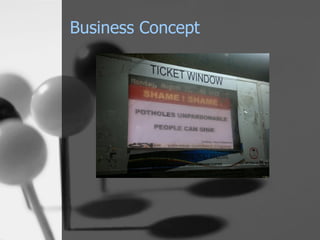
Business Concept Creation of a mobile application (The Cruiser) which detects potholes and marks them using location co-ordinates (GPS). When the user approaches the pothole again, the Cruiser (which is running and constantly monitoring location) starts to give a beeping sound to warn the user that a pothole is nearby. The display will also show the distance from the pothole in metres. If the user wants to see other potholes detected, he connects the application to the internet, where potholes detected by other users is also stored in the application.
Competition Preliminary study, shows no real world implementation of the Cruiser. With regards to collection of traffic information, Navteq(A fully owned subsidiary of Nokia) claims full traffic coverage with  www.traffic.com   Navteq have a Traffic.com Pro application being sold for $3 for non-Nokia platforms. Google Maps has recently launched traffic information for 13 European countries in addition to existing coverage in Australia, America, France, Britain, Australia and Canada.
Competition Traditionally, traffic information is collected from the police. Hence usual traffic updates on radio networks, is provided via links to police systems and police frequencies. In U.S.A. , Metro networks is a leading provider of local and regional news and traffic. They have been bought over by Clear Channel for $119.25 million. Clear Channel also owns Total Traffic Networks(the only competitor to Metro networks), giving it a monopoly in this space. In India, most radio stations provide traffic information, but there is no clear leader in this regard.
Competition With extensive online and mobile experience, we are suitably placed to deploy the Cruiser, and create a strong analytical web engine which will use the information on-ground to provide: Traffic information Information on average driving speeds for specific locations, so drivers new to an area, can get information regarding suspected accident prone zones.
User Acquisition strategy The way we acquire more users, is by offering the Cruiser application free, across mobile platforms across the world. By keeping the user interface icon based, and free of language, we keep the application language dependent. The application by being freely shared, will achieve a high critical mass in a short period of time.
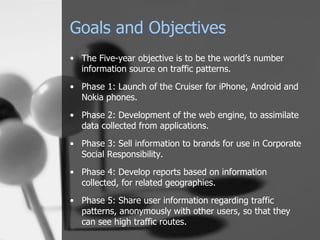
Goals and Objectives The Five-year objective is to be the world’s number information source on traffic patterns. Phase 1: Launch of the Cruiser for iPhone, Android and Nokia phones. Phase 2: Development of the web engine, to assimilate data collected from applications. Phase 3: Sell information to brands for use in Corporate Social Responsibility. Phase 4: Develop reports based on information collected, for related geographies. Phase 5: Share user information regarding traffic patterns, anonymously with other users, so that they can see high traffic routes.
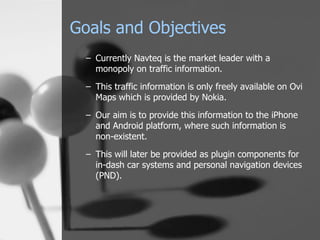
Goals and Objectives Currently Navteq is the market leader with a monopoly on traffic information. This traffic information is only freely available on Ovi Maps which is provided by Nokia. Our aim is to provide this information to the iPhone and Android platform, where such information is non-existent.  This will later be provided as plugin components for in-dash car systems and personal navigation devices (PND).
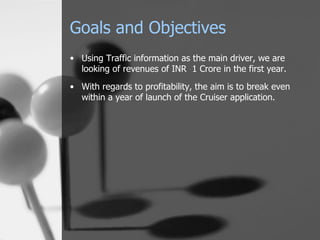
Goals and Objectives Using Traffic information as the main driver, we are looking of revenues of INR  1 Crore in the first year. With regards to profitability, the aim is to break even within a year of launch of the Cruiser application.
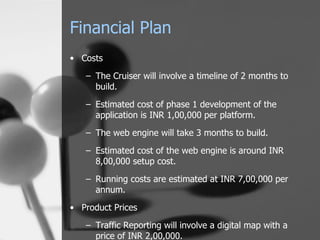
Financial Plan Costs The Cruiser will involve a timeline of 2 months to build. Estimated cost of phase 1 development of the application is INR 1,00,000 per platform. The web engine will take 3 months to build. Estimated cost of the web engine is around INR 8,00,000 setup cost. Running costs are estimated at INR 7,00,000 per annum. Product Prices Traffic Reporting will involve a digital map with a price of INR 2,00,000. Printed usage reports will be sold at INR 5,000 per copy.
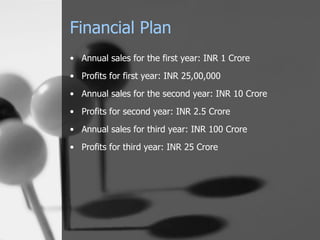
Financial Plan Annual sales for the first year: INR 1 Crore Profits for first year: INR 25,00,000 Annual sales for the second year: INR 10 Crore Profits for second year: INR 2.5 Crore Annual sales for third year: INR 100 Crore Profits for third year: INR 25 Crore
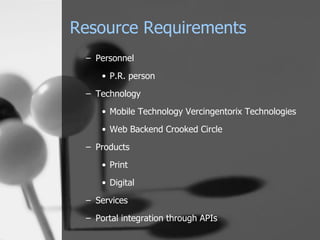
Resource Requirements Personnel P.R. person Technology Mobile Technology Vercingentorix Technologies Web Backend Crooked Circle Products Print Digital Services Portal integration through APIs
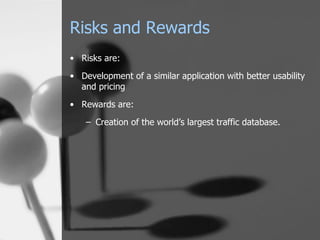
Risks and Rewards Risks are: Development of a similar application with better usability and pricing Rewards are: Creation of the world’s largest traffic database.
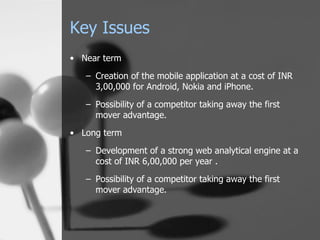
Key Issues Near term Creation of the mobile application at a cost of INR 3,00,000 for Android, Nokia and iPhone. Possibility of a competitor taking away the first mover advantage. Long term Development of a strong web analytical engine at a cost of INR 6,00,000 per year . Possibility of a competitor taking away the first mover advantage.
Thank you! -Werner Egipsy Souza

Cruiser business plan_v1.1

  • 1.
    The Cruiser BusinessPlan -Werner Egipsy Souza
  • 2.
    Mission Statement Createa new foray in digital media development through creation of digital solutions consisting of: mobile products with high utility, and Web analytics based on these products which facilitate creation of a global database fulfilling needs for On-ground Below the Line Activities and Corporate Social Responsibility solutions.
  • 3.
    Market Summary Thepast: The mobile and online space was the domain of the hardware manufacturers i.e. Apple, IBM, HP, Motorola, Nokia and Samsung. The present: Google has just bought Motorola Mobility, showing the growth of a company with strong focus on free software and use of strong analytics for the lion’s share of online advertising. The future: The mobile device supersedes the laptop, the desktop, to be the only device any person will use for any and all utilities. As costs fall and bandwidths increase, the dependency of these devices on the internet, are only going to increase.
  • 4.
    Target User GroupProfile Today's individual is well travelled, usually more on their vehicle than by air. They are buying more and more expensive vehicles(cruiser motorbikes like Harley Davidson and SUVs like the Mitsubishi Pajero), without the roads to drive them on. The current need of the hour, is the ability to travel long distances without actually encountering deep potholes which create a strain on the vehicle, and the vehicle's owner. In places like Mumbai, the need is for a way to cut through traffic, and reach their destination faster.
  • 5.
    Target Customer GroupProfile Brands and therefore companies, are looking for ways to reach out to the consumer, by projecting themselves as more socially responsible. They are trying to seek avenues whereby consumers look at these brands as individuals trying to make a difference. One example is the interest to use traffic flow information to direct vehicle movement.
  • 6.
    Opportunities Problems: Dueto more rural penetration and increased mobility, more users are travelling by road, with a weekly travel of almost 2000 kilometres. This creates very large health issues, due to constant exposure to airconditioning and bad road conditions. Road Conditions: Pot holes Ditches Full road cuts for pipe laying Manholes Bad traffic due to processions, morchas or Dahi Handis
  • 7.
  • 8.
    Business Concept Creationof a mobile application (The Cruiser) which detects potholes and marks them using location co-ordinates (GPS). When the user approaches the pothole again, the Cruiser (which is running and constantly monitoring location) starts to give a beeping sound to warn the user that a pothole is nearby. The display will also show the distance from the pothole in metres. If the user wants to see other potholes detected, he connects the application to the internet, where potholes detected by other users is also stored in the application.
  • 9.
    Competition Preliminary study,shows no real world implementation of the Cruiser. With regards to collection of traffic information, Navteq(A fully owned subsidiary of Nokia) claims full traffic coverage with www.traffic.com Navteq have a Traffic.com Pro application being sold for $3 for non-Nokia platforms. Google Maps has recently launched traffic information for 13 European countries in addition to existing coverage in Australia, America, France, Britain, Australia and Canada.
  • 10.
    Competition Traditionally, trafficinformation is collected from the police. Hence usual traffic updates on radio networks, is provided via links to police systems and police frequencies. In U.S.A. , Metro networks is a leading provider of local and regional news and traffic. They have been bought over by Clear Channel for $119.25 million. Clear Channel also owns Total Traffic Networks(the only competitor to Metro networks), giving it a monopoly in this space. In India, most radio stations provide traffic information, but there is no clear leader in this regard.
  • 11.
    Competition With extensiveonline and mobile experience, we are suitably placed to deploy the Cruiser, and create a strong analytical web engine which will use the information on-ground to provide: Traffic information Information on average driving speeds for specific locations, so drivers new to an area, can get information regarding suspected accident prone zones.
  • 12.
    User Acquisition strategyThe way we acquire more users, is by offering the Cruiser application free, across mobile platforms across the world. By keeping the user interface icon based, and free of language, we keep the application language dependent. The application by being freely shared, will achieve a high critical mass in a short period of time.
  • 13.
    Goals and ObjectivesThe Five-year objective is to be the world’s number information source on traffic patterns. Phase 1: Launch of the Cruiser for iPhone, Android and Nokia phones. Phase 2: Development of the web engine, to assimilate data collected from applications. Phase 3: Sell information to brands for use in Corporate Social Responsibility. Phase 4: Develop reports based on information collected, for related geographies. Phase 5: Share user information regarding traffic patterns, anonymously with other users, so that they can see high traffic routes.
  • 14.
    Goals and ObjectivesCurrently Navteq is the market leader with a monopoly on traffic information. This traffic information is only freely available on Ovi Maps which is provided by Nokia. Our aim is to provide this information to the iPhone and Android platform, where such information is non-existent. This will later be provided as plugin components for in-dash car systems and personal navigation devices (PND).
  • 15.
    Goals and ObjectivesUsing Traffic information as the main driver, we are looking of revenues of INR 1 Crore in the first year. With regards to profitability, the aim is to break even within a year of launch of the Cruiser application.
  • 16.
    Financial Plan CostsThe Cruiser will involve a timeline of 2 months to build. Estimated cost of phase 1 development of the application is INR 1,00,000 per platform. The web engine will take 3 months to build. Estimated cost of the web engine is around INR 8,00,000 setup cost. Running costs are estimated at INR 7,00,000 per annum. Product Prices Traffic Reporting will involve a digital map with a price of INR 2,00,000. Printed usage reports will be sold at INR 5,000 per copy.
  • 17.
    Financial Plan Annualsales for the first year: INR 1 Crore Profits for first year: INR 25,00,000 Annual sales for the second year: INR 10 Crore Profits for second year: INR 2.5 Crore Annual sales for third year: INR 100 Crore Profits for third year: INR 25 Crore
  • 18.
    Resource Requirements PersonnelP.R. person Technology Mobile Technology Vercingentorix Technologies Web Backend Crooked Circle Products Print Digital Services Portal integration through APIs
  • 19.
    Risks and RewardsRisks are: Development of a similar application with better usability and pricing Rewards are: Creation of the world’s largest traffic database.
  • 20.
    Key Issues Nearterm Creation of the mobile application at a cost of INR 3,00,000 for Android, Nokia and iPhone. Possibility of a competitor taking away the first mover advantage. Long term Development of a strong web analytical engine at a cost of INR 6,00,000 per year . Possibility of a competitor taking away the first mover advantage.
  • 21.
    Thank you! -WernerEgipsy Souza