Crosslinking Technology for Latex or Acrylic Emulsions Katie L. Skok and Roeland J. Tuinman, PhD Auburn Hills, Michigan
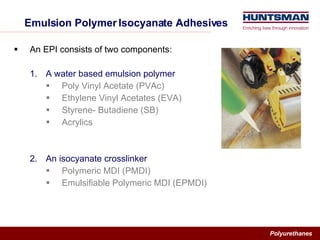
Emulsion Polymer Isocyanate Adhesives An EPI consists of two components: A water based emulsion polymer Poly Vinyl Acetate (PVAc) Ethylene Vinyl Acetates (EVA) Styrene- Butadiene (SB)  Acrylics An isocyanate crosslinker Polymeric MDI (PMDI) Emulsifiable Polymeric MDI (EPMDI)
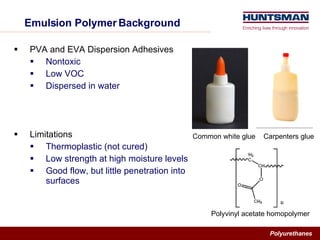
Emulsion Polymer Background PVA and EVA Dispersion Adhesives Nontoxic Low VOC Dispersed in water Limitations Thermoplastic (not cured) Low strength at high moisture levels Good flow, but little penetration into surfaces Polyvinyl acetate homopolymer Common white glue Carpenters glue
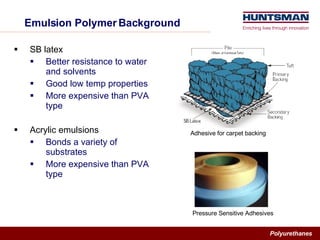
Emulsion Polymer Background SB latex Better resistance to water and solvents Good low temp properties More expensive than PVA type Acrylic emulsions Bonds a variety of substrates More expensive than PVA type Pressure Sensitive Adhesives Adhesive for carpet backing
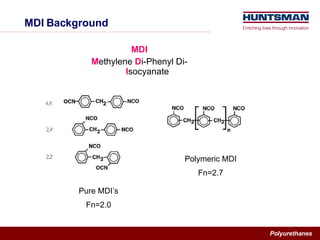
MDI Background MDI M ethylene  D i-Phenyl Di- I socyanate Polymeric MDI Fn=2.7 Pure MDI’s Fn=2.0
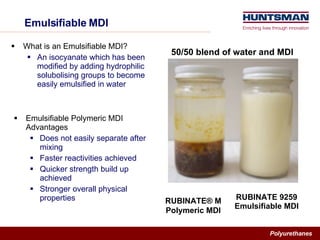
Emulsifiable MDI 50/50 blend of water and MDI RUBINATE® M Polymeric MDI RUBINATE 9259 Emulsifiable MDI Emulsifiable Polymeric MDI Advantages Does not easily separate after mixing Faster reactivities achieved Quicker strength build up achieved Stronger overall physical properties What is an Emulsifiable MDI? An isocyanate which has been modified by adding hydrophilic solubolising groups to become easily emulsified in water
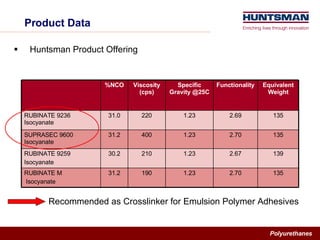
Product Data Huntsman Product Offering Recommended as Crosslinker for Emulsion Polymer Adhesives 139 2.67 1.23 210 30.2 RUBINATE 9259 Isocyanate 2.70 2.70 2.69 Functionality 135 1.23 190 31.2 RUBINATE M Isocyanate 135 1.23 400 31.2 SUPRASEC 9600 Isocyanate 135 1.23 220 31.0 RUBINATE 9236 Isocyanate Equivalent Weight Specific Gravity @25C Viscosity (cps) %NCO
Emulsifiable MDI for Emulsion Polymer Adhesives RUBINATE 9236  Isocyanate  Standard product for use as a crosslinker for Latex emulsions  Improves adhesion Chemical resistance Physical properties SUPRASEC 9600  Isocyanate Similar in performance to RUBINATE 9236  Provides an extended open time  Strength build maximized
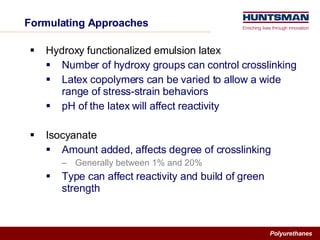
Formulating Approaches Hydroxy functionalized emulsion latex Number of hydroxy groups can control crosslinking Latex copolymers can be varied to allow a wide range of stress-strain behaviors  pH of the latex will affect reactivity Isocyanate Amount added, affects degree of crosslinking Generally between 1% and 20% Type can affect reactivity and build of green strength
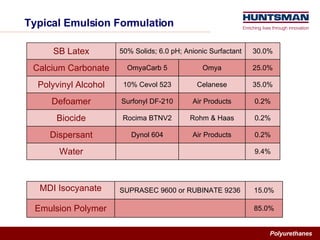
Typical Emulsion Formulation 9.4% Water 0.2% Air Products Dynol 604 Dispersant 0.2% Rohm & Haas Rocima BTNV2 Biocide 0.2% Air Products Surfonyl DF-210 Defoamer 35.0% Celanese 10% Cevol 523 Polyvinyl Alcohol 25.0% Omya OmyaCarb 5 Calcium Carbonate 30.0% 50% Solids; 6.0 pH; Anionic Surfactant SB Latex 85.0% Emulsion Polymer 15.0% SUPRASEC 9600 or RUBINATE 9236 MDI Isocyanate
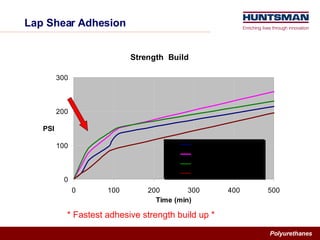
Lap Shear Adhesion * Fastest adhesive strength build up *
Viscosity Profiles * Suprasec 9600 builds viscosity at a slower rate *
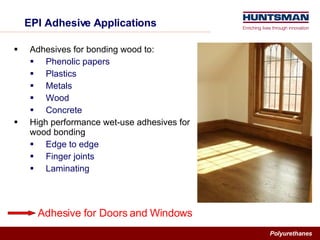
EPI Adhesive Applications Adhesives for bonding wood to: Phenolic papers Plastics Metals Wood Concrete High performance wet-use adhesives for wood bonding Edge to edge Finger joints Laminating Adhesive for Doors and Windows
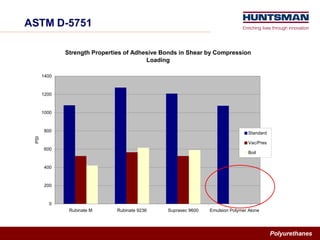
Door and Window Adhesive Benefits of an EPI Improved adhesion at low and elevated temps Good water resistance and durability Faster development of adhesive strength Improved physical properties Test Requirements ASTM D 5751  Adhesives used for Laminate Joints in Nonstructural Lumber Products
ASTM D-5751 Dry Specimens tested “as is” Vacuum/Pressure test Specimens submerged under water and sealed in a vacuum at 25 inch of Hg for 30 minutes Followed by pressurizing the tank to 75 PSI for 30 minutes Samples tested wet Boiling Samples are boiled for 4 hrs and then placed in an oven at 160F for 20 hours The 4 hour boil is repeated Samples tested wet
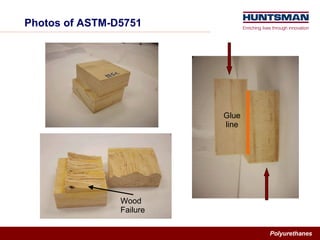
Photos of ASTM-D5751 Glue line Wood Failure
ASTM D-5751
Conclusions The addition of a MDI crosslinker to an emulsion polymer: Increases green strength development Increases overall physical properties Is necessary for “wet use” applications Emulsifiable MDI’s: Provide better mixing Flexibility in reactivity rate Higher physical properties than traditional MDI
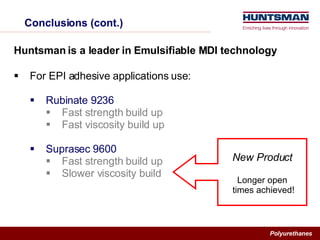
Conclusions (cont.) Huntsman is a leader in Emulsifiable MDI technology For EPI adhesive applications use: Rubinate 9236 Fast strength build up Fast viscosity build up Suprasec 9600 Fast strength build up Slower viscosity build  New Product Longer open times achieved!
Thank You!

Crosslinkers For Latex Adhesives 2008

  • 1.
    Crosslinking Technology forLatex or Acrylic Emulsions Katie L. Skok and Roeland J. Tuinman, PhD Auburn Hills, Michigan
  • 2.
    Emulsion Polymer IsocyanateAdhesives An EPI consists of two components: A water based emulsion polymer Poly Vinyl Acetate (PVAc) Ethylene Vinyl Acetates (EVA) Styrene- Butadiene (SB) Acrylics An isocyanate crosslinker Polymeric MDI (PMDI) Emulsifiable Polymeric MDI (EPMDI)
  • 3.
    Emulsion Polymer BackgroundPVA and EVA Dispersion Adhesives Nontoxic Low VOC Dispersed in water Limitations Thermoplastic (not cured) Low strength at high moisture levels Good flow, but little penetration into surfaces Polyvinyl acetate homopolymer Common white glue Carpenters glue
  • 4.
    Emulsion Polymer BackgroundSB latex Better resistance to water and solvents Good low temp properties More expensive than PVA type Acrylic emulsions Bonds a variety of substrates More expensive than PVA type Pressure Sensitive Adhesives Adhesive for carpet backing
  • 5.
    MDI Background MDIM ethylene D i-Phenyl Di- I socyanate Polymeric MDI Fn=2.7 Pure MDI’s Fn=2.0
  • 6.
    Emulsifiable MDI 50/50blend of water and MDI RUBINATE® M Polymeric MDI RUBINATE 9259 Emulsifiable MDI Emulsifiable Polymeric MDI Advantages Does not easily separate after mixing Faster reactivities achieved Quicker strength build up achieved Stronger overall physical properties What is an Emulsifiable MDI? An isocyanate which has been modified by adding hydrophilic solubolising groups to become easily emulsified in water
  • 7.
    Product Data HuntsmanProduct Offering Recommended as Crosslinker for Emulsion Polymer Adhesives 139 2.67 1.23 210 30.2 RUBINATE 9259 Isocyanate 2.70 2.70 2.69 Functionality 135 1.23 190 31.2 RUBINATE M Isocyanate 135 1.23 400 31.2 SUPRASEC 9600 Isocyanate 135 1.23 220 31.0 RUBINATE 9236 Isocyanate Equivalent Weight Specific Gravity @25C Viscosity (cps) %NCO
  • 8.
    Emulsifiable MDI forEmulsion Polymer Adhesives RUBINATE 9236 Isocyanate Standard product for use as a crosslinker for Latex emulsions Improves adhesion Chemical resistance Physical properties SUPRASEC 9600 Isocyanate Similar in performance to RUBINATE 9236 Provides an extended open time Strength build maximized
  • 9.
    Formulating Approaches Hydroxyfunctionalized emulsion latex Number of hydroxy groups can control crosslinking Latex copolymers can be varied to allow a wide range of stress-strain behaviors pH of the latex will affect reactivity Isocyanate Amount added, affects degree of crosslinking Generally between 1% and 20% Type can affect reactivity and build of green strength
  • 10.
    Typical Emulsion Formulation9.4% Water 0.2% Air Products Dynol 604 Dispersant 0.2% Rohm & Haas Rocima BTNV2 Biocide 0.2% Air Products Surfonyl DF-210 Defoamer 35.0% Celanese 10% Cevol 523 Polyvinyl Alcohol 25.0% Omya OmyaCarb 5 Calcium Carbonate 30.0% 50% Solids; 6.0 pH; Anionic Surfactant SB Latex 85.0% Emulsion Polymer 15.0% SUPRASEC 9600 or RUBINATE 9236 MDI Isocyanate
  • 11.
    Lap Shear Adhesion* Fastest adhesive strength build up *
  • 12.
    Viscosity Profiles *Suprasec 9600 builds viscosity at a slower rate *
  • 13.
    EPI Adhesive ApplicationsAdhesives for bonding wood to: Phenolic papers Plastics Metals Wood Concrete High performance wet-use adhesives for wood bonding Edge to edge Finger joints Laminating Adhesive for Doors and Windows
  • 14.
    Door and WindowAdhesive Benefits of an EPI Improved adhesion at low and elevated temps Good water resistance and durability Faster development of adhesive strength Improved physical properties Test Requirements ASTM D 5751 Adhesives used for Laminate Joints in Nonstructural Lumber Products
  • 15.
    ASTM D-5751 DrySpecimens tested “as is” Vacuum/Pressure test Specimens submerged under water and sealed in a vacuum at 25 inch of Hg for 30 minutes Followed by pressurizing the tank to 75 PSI for 30 minutes Samples tested wet Boiling Samples are boiled for 4 hrs and then placed in an oven at 160F for 20 hours The 4 hour boil is repeated Samples tested wet
  • 16.
    Photos of ASTM-D5751Glue line Wood Failure
  • 17.
  • 18.
    Conclusions The additionof a MDI crosslinker to an emulsion polymer: Increases green strength development Increases overall physical properties Is necessary for “wet use” applications Emulsifiable MDI’s: Provide better mixing Flexibility in reactivity rate Higher physical properties than traditional MDI
  • 19.
    Conclusions (cont.) Huntsmanis a leader in Emulsifiable MDI technology For EPI adhesive applications use: Rubinate 9236 Fast strength build up Fast viscosity build up Suprasec 9600 Fast strength build up Slower viscosity build New Product Longer open times achieved!
  • 20.