Impact Factor: 8.40 (2016)
5 year IF : 8.94 (2016)
Date : 10 Feb 2017
1
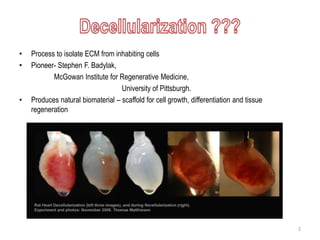
• Process to isolate ECM from inhabiting cells
• Pioneer- Stephen F. Badylak,
McGowan Institute for Regenerative Medicine,
University of Pittsburgh.
• Produces natural biomaterial – scaffold for cell growth, differentiation and tissue
regeneration
2
Figure : Combinations of agents used for the decellularization of (A) thin laminate tissues, (B) thicker
laminate tissues, (C) adipose tissues, (D) whole simple organs, (E) essential and complex organs .
3
• Physical Treatments : a. Freeze-thaw, b. Pressure, and c. Electric disruption [Non
thermal irreversible electroporation (NTIRE)].
•Chemical Treatment : a. Ionic detergents (SDS), b. Alkaline & acid treatments, and
c. Non-ionic detergents (Triton X-100, EDTA)
•Enzymatic Treatments : Lipase, Thermolysine, Galactosidase, Nuclease, Trypsin, Dipase,
and Collagenase
Perfusion and Immersion Decellularization Techniques
Figure 1
Ref : Trends in Molecular Medicine , Volume 17, Issue 8, Pages 424-432 (August 2011) ,
DOI: 10.1016/j.molmed.2011.03.005
Perfusion-decellularized whole organ scaffolds. The native ECMs of cadaveric organs can be isolated by the perfusion of the native vascular system with detergent solutions. The resulting
scaffolds are acellular, but maintain the structure of the native organ. (a) Rat heart scaffold generated from cadaveric heart by perfusion decellularization (i). The ascending aorta was cannulated
for perfusion. Cadaveric human heart before and after perfusion decellularization (ii). (b) Rat lung scaffold generated from cadaveric lung by perfusion decellularization (i). Perfusion was
performed via the pulmonary artery. Cadaveric sheep lung before and after decellularization (ii). (c) Rat kidney scaffold generated from cadaveric kidney by perfusion decellularization (i). The
abdominal aorta was cannulated for perfusion. Porcine kidney before and after perfusion decellularization (ii). (d) Rat pancreas scaffold generated from cadaveric pancreas by perfusion
decellularization (i). The abdominal aorta was cannulated for perfusion. Human pancreas before and after perfusion decellularization (ii).
4
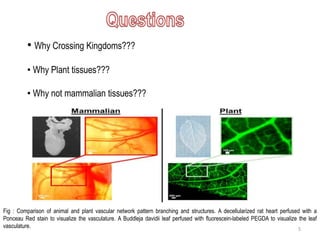
• Why Crossing Kingdoms???
• Why Plant tissues???
• Why not mammalian tissues???
Fig : Comparison of animal and plant vascular network pattern branching and structures. A decellularized rat heart perfused with a
Ponceau Red stain to visualize the vasculature. A Buddleja davidii leaf perfused with fluorescein-labeled PEGDA to visualize the leaf
vasculature. 5
6
10% SDS
for 5 days
&
Triton X-
100 in sod.
chlorite
bleach,
48 hrs
7
Figure : Depiction of the cannulation of a spinach leaf. (A) The petiole of the
spinach leaf is identified. (B, C) A cannula is inserted into the petiole of the stem of
the spinach leaf and is held in place with suture.
8
Fig : Time lapse of spinach leaf decellularization. (A) Leaf is dark green and opaque Day 0.
(B) Day 1, loss of dark color (C) Day 5, completely translucent while a light green hue. (D)
After being treated and sterilized with sodium chlorite, the leaf loses the remainder of its
coloring and becomes completely decellularized on Day 7.
9
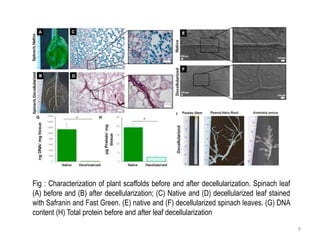
Fig : Characterization of plant scaffolds before and after decellularization. Spinach leaf
(A) before and (B) after decellularization; (C) Native and (D) decellularized leaf stained
with Safranin and Fast Green. (E) native and (F) decellularized spinach leaves. (G) DNA
content (H) Total protein before and after leaf decellularization
10
Figure : Loss of plant total protein during the decellularization process
11
Fig : Comparison of the mechanical properties of native and decellularized spinach
leaves. (A) dogbone shape to ensure uniformity, (B) The maximum tangent
modulus (MTM), (C) ultimate tensile strength (UTS), and (D) strain at failure
12
Fig. 4. Spinach leaf vascular scaffolds retain patency and perfusion capabilities after
decellularization. Decellularized leaf (A) before and (B) after perfusion of Ponceau Red.
Fluorescent microspheres of various diameters (1, 10, 50, and 100 mm)
13
Fig. (A) Dil-Ac-LDL-labeled human umbilical vein endothelial cells (HUVECs)
Scale bar: 250 mm. (B) Human mesenchymal stem cells (hMSCs) labeled with
quantum dots Scale bars: 250 mm for main image, 50 mm for insert.
14
Fig : HUVECs remain viable after recellularization in decellularized spinach stems.
Unlabeled HUVECs incubated in medium containing Dil-Ac-LDL. (A, B) prior to
incubation in LDL; (C, D) 24 and (E, F) 48 hours incubation
Cell viability determination through Low Density
Lipoprotein (Dil-Ac-LDL) uptake assay
15
Fig : (A) hPS-CMs adhere and form cell clusters. Scale bar: 50 mm. (B) Contractile strain of
hPS-CMs quantified at 1% strain. (C) tissue culture platiic,Contractile through a heatmap.
(D) Contractile strain 21 days (E) Day 21 lowered contractile strain magnitude. (F) hPS-
CMs modified with a GCaMP3 reporter
16
• Decellularization of Spinach leaves was successfully performed
through perfusion.
• Plant vasculature determined similarity with human vasculature.
• Recellularization and cell viability achieved
• Human pluripotent stem cell derived cardiomyocytes (hPS-Ms)
attachment and contractile ability determined.
17

Crossing kingdoms-Using decellularized plants as perfusable tissue-

  • 1.
    Impact Factor: 8.40(2016) 5 year IF : 8.94 (2016) Date : 10 Feb 2017 1
  • 2.
    • Process toisolate ECM from inhabiting cells • Pioneer- Stephen F. Badylak, McGowan Institute for Regenerative Medicine, University of Pittsburgh. • Produces natural biomaterial – scaffold for cell growth, differentiation and tissue regeneration 2
  • 3.
    Figure : Combinationsof agents used for the decellularization of (A) thin laminate tissues, (B) thicker laminate tissues, (C) adipose tissues, (D) whole simple organs, (E) essential and complex organs . 3 • Physical Treatments : a. Freeze-thaw, b. Pressure, and c. Electric disruption [Non thermal irreversible electroporation (NTIRE)]. •Chemical Treatment : a. Ionic detergents (SDS), b. Alkaline & acid treatments, and c. Non-ionic detergents (Triton X-100, EDTA) •Enzymatic Treatments : Lipase, Thermolysine, Galactosidase, Nuclease, Trypsin, Dipase, and Collagenase Perfusion and Immersion Decellularization Techniques
  • 4.
    Figure 1 Ref :Trends in Molecular Medicine , Volume 17, Issue 8, Pages 424-432 (August 2011) , DOI: 10.1016/j.molmed.2011.03.005 Perfusion-decellularized whole organ scaffolds. The native ECMs of cadaveric organs can be isolated by the perfusion of the native vascular system with detergent solutions. The resulting scaffolds are acellular, but maintain the structure of the native organ. (a) Rat heart scaffold generated from cadaveric heart by perfusion decellularization (i). The ascending aorta was cannulated for perfusion. Cadaveric human heart before and after perfusion decellularization (ii). (b) Rat lung scaffold generated from cadaveric lung by perfusion decellularization (i). Perfusion was performed via the pulmonary artery. Cadaveric sheep lung before and after decellularization (ii). (c) Rat kidney scaffold generated from cadaveric kidney by perfusion decellularization (i). The abdominal aorta was cannulated for perfusion. Porcine kidney before and after perfusion decellularization (ii). (d) Rat pancreas scaffold generated from cadaveric pancreas by perfusion decellularization (i). The abdominal aorta was cannulated for perfusion. Human pancreas before and after perfusion decellularization (ii). 4
  • 5.
    • Why CrossingKingdoms??? • Why Plant tissues??? • Why not mammalian tissues??? Fig : Comparison of animal and plant vascular network pattern branching and structures. A decellularized rat heart perfused with a Ponceau Red stain to visualize the vasculature. A Buddleja davidii leaf perfused with fluorescein-labeled PEGDA to visualize the leaf vasculature. 5
  • 6.
    6 10% SDS for 5days & Triton X- 100 in sod. chlorite bleach, 48 hrs
  • 7.
    7 Figure : Depictionof the cannulation of a spinach leaf. (A) The petiole of the spinach leaf is identified. (B, C) A cannula is inserted into the petiole of the stem of the spinach leaf and is held in place with suture.
  • 8.
    8 Fig : Timelapse of spinach leaf decellularization. (A) Leaf is dark green and opaque Day 0. (B) Day 1, loss of dark color (C) Day 5, completely translucent while a light green hue. (D) After being treated and sterilized with sodium chlorite, the leaf loses the remainder of its coloring and becomes completely decellularized on Day 7.
  • 9.
    9 Fig : Characterizationof plant scaffolds before and after decellularization. Spinach leaf (A) before and (B) after decellularization; (C) Native and (D) decellularized leaf stained with Safranin and Fast Green. (E) native and (F) decellularized spinach leaves. (G) DNA content (H) Total protein before and after leaf decellularization
  • 10.
    10 Figure : Lossof plant total protein during the decellularization process
  • 11.
    11 Fig : Comparisonof the mechanical properties of native and decellularized spinach leaves. (A) dogbone shape to ensure uniformity, (B) The maximum tangent modulus (MTM), (C) ultimate tensile strength (UTS), and (D) strain at failure
  • 12.
    12 Fig. 4. Spinachleaf vascular scaffolds retain patency and perfusion capabilities after decellularization. Decellularized leaf (A) before and (B) after perfusion of Ponceau Red. Fluorescent microspheres of various diameters (1, 10, 50, and 100 mm)
  • 13.
    13 Fig. (A) Dil-Ac-LDL-labeledhuman umbilical vein endothelial cells (HUVECs) Scale bar: 250 mm. (B) Human mesenchymal stem cells (hMSCs) labeled with quantum dots Scale bars: 250 mm for main image, 50 mm for insert.
  • 14.
    14 Fig : HUVECsremain viable after recellularization in decellularized spinach stems. Unlabeled HUVECs incubated in medium containing Dil-Ac-LDL. (A, B) prior to incubation in LDL; (C, D) 24 and (E, F) 48 hours incubation Cell viability determination through Low Density Lipoprotein (Dil-Ac-LDL) uptake assay
  • 15.
    15 Fig : (A)hPS-CMs adhere and form cell clusters. Scale bar: 50 mm. (B) Contractile strain of hPS-CMs quantified at 1% strain. (C) tissue culture platiic,Contractile through a heatmap. (D) Contractile strain 21 days (E) Day 21 lowered contractile strain magnitude. (F) hPS- CMs modified with a GCaMP3 reporter
  • 16.
    16 • Decellularization ofSpinach leaves was successfully performed through perfusion. • Plant vasculature determined similarity with human vasculature. • Recellularization and cell viability achieved • Human pluripotent stem cell derived cardiomyocytes (hPS-Ms) attachment and contractile ability determined.
  • 17.