Discourse Analysis Research Method in English Studies ppt.pptx
1.
Discourse Analysis asa Research
Method in English Studies
(Understanding Language in Context)
Dr. E. Krishna Chaitanya
Associate Professor, Department of English
Central University of Kashmir
2.
Introduction to DiscourseAnalysis ( DA)
• Definition: Discourse analysis is a research methodology that examines language in use,
considering its social, cultural, and historical contexts.
• Understands language as a tool for shaping identity, power relations, and social realities.
• Considers how discourse operates in social contexts & studies broader implications of
language use.
• Studies content of communication & structures and strategies that shape how messages
are delivered and interpreted.
• DA is interdisciplinary: insights from linguistics, sociology, psychology, and cultural
studies.
• It’s broad & powerful tool for exploring areas literature, media, and everyday communic.
3.
Methodological Approaches toDiscourse Analysis
Types of Discourse Analysis:
• Conversation Analysis (CA): Focuses on the organization of talk in interaction - turn-
taking, pauses, and repairs - studies micro-level features of spoken discourse &
mechanics of communication.
• Critical Discourse Analysis (CDA): Relationship between language & power, revealing
how discourse shapes and reflects social inequalities. Studies political texts/ media
representations/institutional discourse to uncover underlying ideologies and assumption
• Narrative Analysis: Concentrates on the structure and function of narratives - how
stories are told and meanings they convey. understanding personal & collective identities
through the lens of storytelling.
4.
Methodological Approaches toDiscourse Analysis
Data Collection:
• Wide range of texts for examination - transcripts of conversations, literary works, media
articles, speeches, and social media posts.
• Data choice should align with the research questions & study’s theoretical framework.
Analytical Frameworks:
• Frameworks and techniques aligns with specific approach taken.
• CDA may focus on identifying linguistic features: modality, presupposition, and
metaphor that reveal power dynamics.
• In contrast, narrative analysis prioritize themes, character development, plot structures.
5.
Methodological Approaches toDiscourse Analysis
Contextual Analysis:
• Understanding the context in which discourse occurs is crucial.
• Examines social, cultural, historical, and political factors that influence language use.
• Must consider how context shapes both the production and interpretation of discourse.
Interpretation and Presentation:
• After data analysis, interpret the findings and present via papers/presentations etc
• Discuss broader implications of findings: social issue/identity formation/cultural
practice
6.
Applications of DiscourseAnalysis in English Studies
Literary Analysis:
• Examines how authors use language to construct characters, themes, and narratives.
• Analyzing dialogue, imagery, & narrative structure can reveal deeper meanings/critiques
embedded in literary texts. Language of characters says social attitudes/cultural tensions.
Media Studies:
• Examines how language in media texts influences public perceptions and ideologies.
• Analyzing news articles/advertisements/social media content, reveals how language
perpetuates stereotypes, constructs social norms, and shapes understanding of events.
7.
Applications of DiscourseAnalysis in English Studies
Identity and Language: Explores how individuals construct their identities through language.
• Analysis of aspects: gender/race/class/identity markers are expressed and negotiated in
various contexts. Ex: varied language use in different social groups/settings, says issues of
belong/exclus
Educational Discourse: Applied to classroom interactions, curricula, and educational policies
to understand how language shapes learning experiences.
• Analyzing teacher-student dialogues or instructional materials can reveal underlying
pedagogical assumptions and power dynamics within educational contexts.
Political Discourse: Valuable in political language: speeches, debates, campaign materials.
• By examining how politicians use rhetoric and framing, it uncovers strategies employed to
persuade, manipulate, mobilize audiences. Insights to political ideologies and public
sentiments.
8.
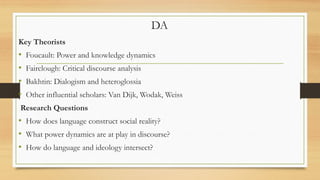
DA
Key Theorists
• Foucault:Power and knowledge dynamics
• Fairclough: Critical discourse analysis
• Bakhtin: Dialogism and heteroglossia
• Other influential scholars: Van Dijk, Wodak, Weiss
Research Questions
• How does language construct social reality?
• What power dynamics are at play in discourse?
• How do language and ideology intersect?
9.
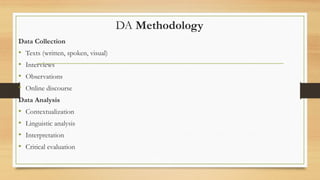
DA Methodology
Data Collection
•Texts (written, spoken, visual)
• Interviews
• Observations
• Online discourse
Data Analysis
• Contextualization
• Linguistic analysis
• Interpretation
• Critical evaluation
10.
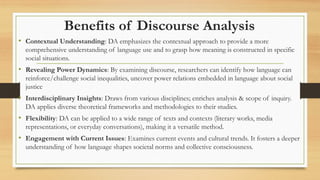
Benefits of DiscourseAnalysis
• Contextual Understanding: DA emphasizes the contextual approach to provide a more
comprehensive understanding of language use and to grasp how meaning is constructed in specific
social situations.
• Revealing Power Dynamics: By examining discourse, researchers can identify how language can
reinforce/challenge social inequalities, uncover power relations embedded in language about social
justice
• Interdisciplinary Insights: Draws from various disciplines; enriches analysis & scope of inquiry.
DA applies diverse theoretical frameworks and methodologies to their studies.
• Flexibility: DA can be applied to a wide range of texts and contexts (literary works, media
representations, or everyday conversations), making it a versatile method.
• Engagement with Current Issues: Examines current events and cultural trends. It fosters a deeper
understanding of how language shapes societal norms and collective consciousness.
11.
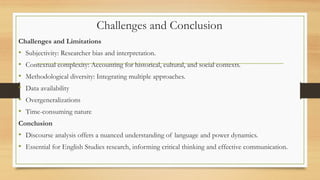
Challenges and Conclusion
Challengesand Limitations
• Subjectivity: Researcher bias and interpretation.
• Contextual complexity: Accounting for historical, cultural, and social contexts.
• Methodological diversity: Integrating multiple approaches.
• Data availability
• Overgeneralizations
• Time-consuming nature
Conclusion
• Discourse analysis offers a nuanced understanding of language and power dynamics.
• Essential for English Studies research, informing critical thinking and effective communication.