Criterion-Referenced Language Test Development: Linking Curricula     Teachers         & Tests                              +                          +                                                               Brian K. Lunch & Fred Davidson TESOL Quarterly, Vol. 28, No. 4. (Winter, 1994), pp. 727-743.
Criterion-Reference Measurement & the development of Language Testing Focus of paper:  The use of criterion referenced testing as a means of linking ESL curricula, teacher experience and language tests.
Criterion-Referenced Language Test Development (CRLTD) The development of test specifications and test items or tasks through a process that works back and forth between specification and the item to refine the notion of the  criterion , or "what" is being tested. Specifically, linked to the early stages of test development as seen on the next slide.
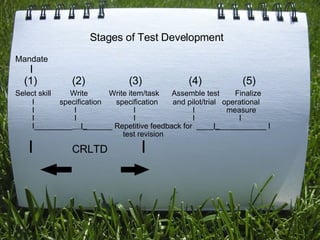
Stages of Test Development Mandate      I    (1)            (2)               (3)                (4)              (5) Select skill         Write          Write item/task      Assemble test         Finalize          I            specification       specification       and pilot/trial   operational         I                   I                           I                           I               measure         I                   I                           I                           I                     I         I_________     I_ ______ Repetitive feedback for  ____ I_ ___________ I                                                    test revision       I                    CRLTD                  I
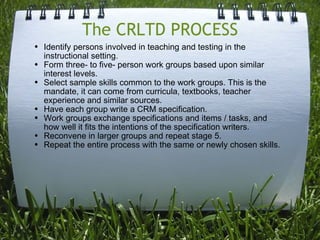
The CRLTD PROCESS Identify persons involved in teaching and testing in the instructional setting. Form three- to five- person work groups based upon similar interest levels. Select sample skills common to the work groups. This is the mandate, it can come from curricula, textbooks, teacher experience and similar sources. Have each group write a CRM specification. Work groups exchange specifications and items / tasks, and how well it fits the intentions of the specification writers.  Reconvene in larger groups and repeat stage 5. Repeat the entire process with the same or newly chosen skills.
Findings of the CRLTD Process Participants in the process found the following mismatches were identified: Gaps between teaching and testing methods. Error correction methods. Text and Test mismatches. Accuracy versus fluency gaps.
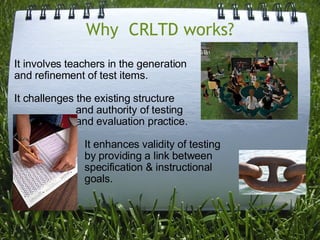
Why  CRLTD works? It involves teachers in the generation  and refinement of test items. It challenges the existing structure                      and authority of testing                      and evaluation practice.                         It enhances validity of testing                          by providing a link between                           specification & instructional                         goals.      
Conclusion CRLTD according to Lynch & Davidson (1994) Process objective  Administration 1994 Challenges the status quo

Criterion-Referenced Language Testing

  • 1.
    Criterion-Referenced Language TestDevelopment: Linking Curricula     Teachers         & Tests                             +                          +                                                             Brian K. Lunch & Fred Davidson TESOL Quarterly, Vol. 28, No. 4. (Winter, 1994), pp. 727-743.
  • 2.
    Criterion-Reference Measurement &the development of Language Testing Focus of paper: The use of criterion referenced testing as a means of linking ESL curricula, teacher experience and language tests.
  • 3.
    Criterion-Referenced Language TestDevelopment (CRLTD) The development of test specifications and test items or tasks through a process that works back and forth between specification and the item to refine the notion of the criterion , or "what" is being tested. Specifically, linked to the early stages of test development as seen on the next slide.
  • 4.
    Stages of TestDevelopment Mandate      I    (1)            (2)               (3)                (4)              (5) Select skill         Write          Write item/task      Assemble test         Finalize         I            specification       specification       and pilot/trial   operational         I                   I                           I                           I               measure         I                   I                           I                           I                     I         I_________    I_ ______ Repetitive feedback for  ____ I_ ___________ I                                                    test revision      I                   CRLTD                 I
  • 5.
    The CRLTD PROCESSIdentify persons involved in teaching and testing in the instructional setting. Form three- to five- person work groups based upon similar interest levels. Select sample skills common to the work groups. This is the mandate, it can come from curricula, textbooks, teacher experience and similar sources. Have each group write a CRM specification. Work groups exchange specifications and items / tasks, and how well it fits the intentions of the specification writers. Reconvene in larger groups and repeat stage 5. Repeat the entire process with the same or newly chosen skills.
  • 6.
    Findings of theCRLTD Process Participants in the process found the following mismatches were identified: Gaps between teaching and testing methods. Error correction methods. Text and Test mismatches. Accuracy versus fluency gaps.
  • 7.
    Why  CRLTD works?It involves teachers in the generation and refinement of test items. It challenges the existing structure                      and authority of testing                      and evaluation practice.                         It enhances validity of testing                         by providing a link between                          specification & instructional                         goals.      
  • 8.
    Conclusion CRLTD accordingto Lynch & Davidson (1994) Process objective Administration 1994 Challenges the status quo