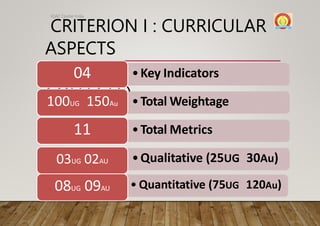
CRITERION I : CURRICULAR
ASPECTS
(UG/PG/AUTONOMOUS
COLLEGES)
IQAC Cluster India
•Key Indicators
•Total Weightage
04
100UG 150Au
•Total Metrics
•Qualitative (25UG 30Au)
• Quantitative (75UG 120Au)
11
03UG 02AU
08UG 09AU
Criteria I : Curricular Aspects
Distribution of weightage
Key Indicators (KIs) UG/PG Autono.
1.1 Curriculum Planning &
Implementation (UG-PG)
1.1 Curriculum Design &
Development
20 50
1.2 Academic Flexibility 30 40
1.3 Curriculum Enrichment 30 40
1.4 Feedback System 20 20
Total 100 150
IQAC Cluster India
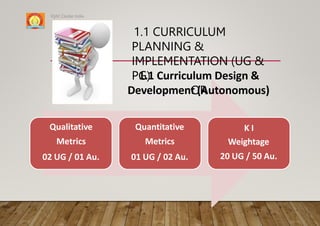
Qualitative
Metrics
02 UG / 01 Au.
Quantitative
Metrics
01 UG / 02 Au.
K I
Weightage
20 UG / 50 Au.
1.1 CURRICULUM
PLANNING &
IMPLEMENTATION (UG &
PG)
OR
IQAC Cluster India
1.1 Curriculum Design &
Development (Autonomous)
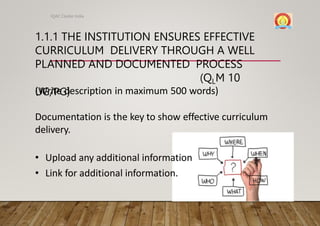
1.1.1 THE INSTITUTION ENSURES EFFECTIVE
CURRICULUM DELIVERY THROUGH A WELL
PLANNED AND DOCUMENTED PROCESS
(QLM 10
UG/PG)
IQAC Cluster India
(Write description in maximum 500 words)
Documentation is the key to show effective curriculum
delivery.
• Upload any additional information
• Link for additional information.
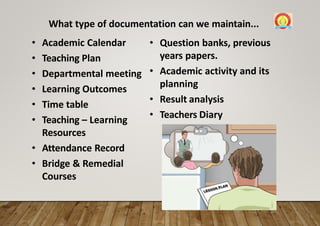
• Academic Calendar
• Teaching Plan
• Departmental meeting
• Learning Outcomes
• Time table
• Teaching – Learning
Resources
• Attendance Record
• Bridge & Remedial
Courses
What type of documentation can we maintain...
• Question banks, previous
years papers.
• Academic activity and its
planning
• Result analysis
• Teachers Diary
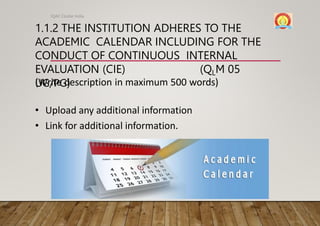
1.1.2 THE INSTITUTION ADHERES TO THE
ACADEMIC CALENDAR INCLUDING FOR THE
CONDUCT OF CONTINUOUS INTERNAL
EVALUATION (CIE) (QLM 05
UG/PG)
IQAC Cluster India
(Write description in maximum 500 words)
• Upload any additional information
• Link for additional information.
1.1.3 Teachers of the institute participate in following
activities related to curriculum development and
assessment of the affiliating University and/are
represented on the following academic bodies during
the last five years...
1. Academic Council/ BoS of Affiliating University
2. Paper setting for UG/PG Programs
3. Design and Development of Curriculum for Add-on/
Certificate/ Diploma Courses
4. Assessment/ evaluation process of the affiliating
University. (QnM 05 UG/PG)
... ...
IQAC Cluster India
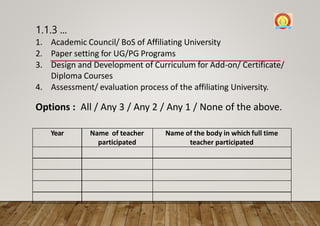
Year Name of teacher
participated
Name of the body in which full time
teacher participated
1.1.3 ...
1. Academic Council/ BoS of Affiliating University
2. Paper setting for UG/PG Programs
3. Design and Development of Curriculum for Add-on/ Certificate/
Diploma Courses
4. Assessment/ evaluation process of the affiliating University.
Options : All / Any 3 / Any 2 / Any 1 / None of the above.
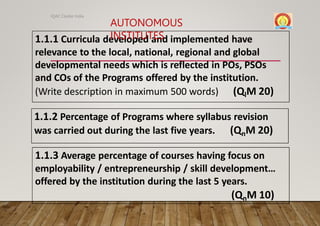
1.1.1 Curricula developed and implemented have
relevance to the local, national, regional and global
developmental needs which is reflected in POs, PSOs
and COs of the Programs offered by the institution.
(Write description in maximum 500 words) (QlM 20)
1.1.2 Percentage of Programs where syllabus revision
was carried out during the last five years. (QnM 20)
1.1.3 Average percentage of courses having focus on
employability / entrepreneurship / skill development…
offered by the institution during the last 5 years.
(QnM 10)
AUTONOMOUS
INSTITUTES
IQAC Cluster India
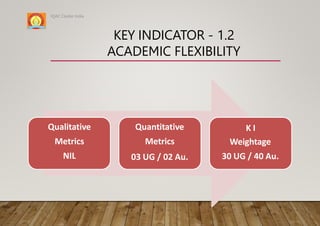
KEY INDICATOR - 1.2
ACADEMIC FLEXIBILITY
IQAC Cluster India
Qualitative
Metrics
NIL
Quantitative
Metrics
03 UG / 02 Au.
K I
Weightage
30 UG / 40 Au.
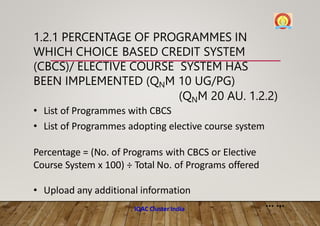
1.2.1 PERCENTAGE OF PROGRAMMES IN
WHICH CHOICE BASED CREDIT SYSTEM
(CBCS)/ ELECTIVE COURSE SYSTEM HAS
BEEN IMPLEMENTED (QNM 10 UG/PG)
(QNM 20 AU. 1.2.2)
• List of Programmes with CBCS
• List of Programmes adopting elective course system
Percentage = (No. of Programs with CBCS or Elective
Course System x 100) ÷ Total No. of Programs offered
• Upload any additional information
... ...
IQAC Cluster India
1.2.1 ...
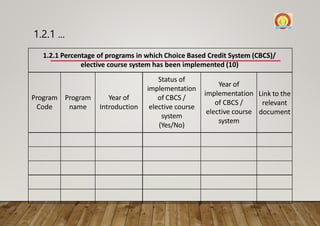
1.2.1 Percentage of programs in which Choice Based Credit System (CBCS)/
elective course system has been implemented (10)
Status of
Year of
implementation
of CBCS /
elective course
system
Link to the
relevant
document
implementation
Program Program Year of of CBCS /
Code name Introduction elective course
system
(Yes/No)
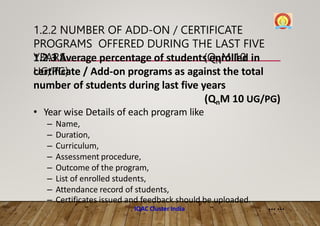
1.2.2 NUMBER OF ADD-ON / CERTIFICATE
PROGRAMS OFFERED DURING THE LAST FIVE
YEARS (QNM 10
UG/PG)
1.2.3 Average percentage of students enrolled in
certificate / Add-on programs as against the total
number of students during last five years
(QnM 10 UG/PG)
• Year wise Details of each program like
– Name,
– Duration,
– Curriculum,
– Assessment procedure,
– Outcome of the program,
– List of enrolled students,
– Attendance record of students,
– Certificates issued and feedback should be uploaded.
IQAC Cluster India ... ...
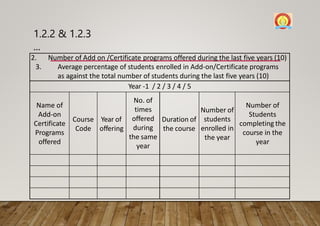
2. Number of Add on /Certificate programs offered during the last five years (10)
3. Average percentage of students enrolled in Add-on/Certificate programs
as against the total number of students during the last five years (10)
Year -1 / 2 / 3 / 4 / 5
Name of
Add-on
Certificate
Programs
offered
Course
Code
Year of
offering
No. of
times
offered
during
the same
year
Duration of
the course
Number of
students
enrolled in
the year
Number of
Students
completing the
course in the
year
1.2.2 & 1.2.3
...
1.2.1 Percentage of new courses introduced of the total
number of courses across all programs offered during
AUTONOMOUS
INSTITUTES
IQAC Cluster India
the last five years. (QnM 20)
KEY INDICATOR - 1.3
CURRICULUM
ENRICHMENT
IQAC Cluster India
Qualitative
Metrics
01
Quantitative
Metrics
02 UG / 03 Au.
K I
Weightage
30 UG / 40 Au.
1.3.1 INSTITUTION INTEGRATES
CROSSCUTTING ISSUES RELEVANT TO
PROFESSIONAL ETHICS, GENDER, HUMAN
VALUES, ENVIRONMENT AND SUSTAINABILITY
INTO THE CURRICULUM (QLM 10
UG/PG/AUTO.)
IQAC Cluster India
(Write description in maximum 500 words)
• Cross cutting means something that is disturbing in the
society – gender balance, environmental hazards, changing
human values, religion and religious sentiments, dowry etc.
• Description of courses and list of Core Courses from syllabus
and enrichment offered.
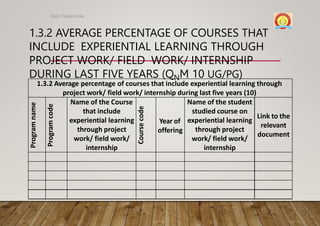
1.3.2 AVERAGE PERCENTAGE OF COURSES THAT
INCLUDE EXPERIENTIAL LEARNING THROUGH
PROJECT WORK/ FIELD WORK/ INTERNSHIP
DURING LAST FIVE YEARS (QNM 10 UG/PG)
IQAC Cluster India
1.3.2 Average percentage of courses that include experiential learning through
project work/ field work/ internship during last five years (10)
Program
name
Program
code
Name of the Course
that include
experiential learning
through project
work/ field work/
internship
Course
code
Year of
offering
Name of the student
studied course on
experiential learning
through project
work/ field work/
internship
Link to the
relevant
document
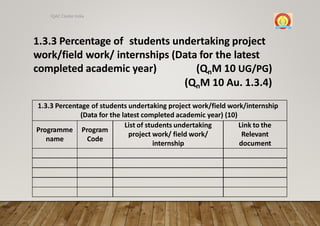
1.3.3 Percentage of students undertaking project
work/field work/ internships (Data for the latest
completed academic year) (QnM 10 UG/PG)
(QnM 10 Au. 1.3.4)
1.3.3 Percentage of students undertaking project work/field work/internship
(Data for the latest completed academic year) (10)
Programme
name
Program
Code
List of students undertaking
project work/ field work/
internship
Link to the
Relevant
document
IQAC Cluster India
2.Number of value added courses for imparting
transferable and life skills offered during last five years.
(QnM 10)
3. Average Percentage of students enrolled in the
AUTONOMOUS
INSTITUTES
IQAC Cluster India
courses under 1.3.2 above. (QnM 10)
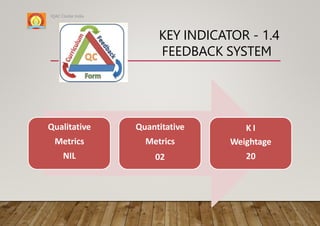
KEY INDICATOR - 1.4
FEEDBACK SYSTEM
IQAC Cluster India
Qualitative
Metrics
NIL
Quantitative
Metrics
02
K I
Weightage
20
KI - 1.4 Feedback System
• The process of revision and redesign of curricula
is based on recent developments and feedback
from the stakeholders.
• It helps in improving the inputs.
• The HEI with feedback system in place will have
an active process of not only collecting feedback
from all stakeholders, but also analysing it and
identifying and drawing relevant pointers to
enhance the learning effectiveness.
IQAC Cluster India
1.4.1 INSTITUTION OBTAINS FEEDBACK ON
THE SYLLABUS AND ITS TRANSACTION AT
THE INSTITUTION FROM THE FOLLOWING
STAKEHOLDERS
• 1. Students 2. Teachers 3. Employers 4. Alumni
• (QnM
10)
• Options : All / Any 3 / Any 2 / Any 1 / None of
the above.
• Feedback should be related to design and
review of syllabus only
• Sample filled forms (at least 3) from each
stakeholder to be provided
• DVV may ask for feedback form for randomly
IQAC Cluster India
1.4.2 FEEDBACK PROCESS OF THE INSTITUTION
MAY BE
IQAC Cluster India
classified as follows: (QnM 10)
• Feedback should be –
– Collected,
– Analysed,
– Action taken ,
– Feedback and Action Taken Report available on website.
• Feedback and Action Taken Report signed by the Head
of Institute should be provided and should be uploaded
on the institutional website.
• Documents showing feedback communicated to
University and action taken by university should be
provided.
Criteria-1.pptx
Criteria-1.pptx

Criteria-1.pptx

  • 1.
    CRITERION I :CURRICULAR ASPECTS (UG/PG/AUTONOMOUS COLLEGES) IQAC Cluster India •Key Indicators •Total Weightage 04 100UG 150Au •Total Metrics •Qualitative (25UG 30Au) • Quantitative (75UG 120Au) 11 03UG 02AU 08UG 09AU
  • 2.
    Criteria I :Curricular Aspects Distribution of weightage Key Indicators (KIs) UG/PG Autono. 1.1 Curriculum Planning & Implementation (UG-PG) 1.1 Curriculum Design & Development 20 50 1.2 Academic Flexibility 30 40 1.3 Curriculum Enrichment 30 40 1.4 Feedback System 20 20 Total 100 150 IQAC Cluster India
  • 3.
    Qualitative Metrics 02 UG /01 Au. Quantitative Metrics 01 UG / 02 Au. K I Weightage 20 UG / 50 Au. 1.1 CURRICULUM PLANNING & IMPLEMENTATION (UG & PG) OR IQAC Cluster India 1.1 Curriculum Design & Development (Autonomous)
  • 4.
    1.1.1 THE INSTITUTIONENSURES EFFECTIVE CURRICULUM DELIVERY THROUGH A WELL PLANNED AND DOCUMENTED PROCESS (QLM 10 UG/PG) IQAC Cluster India (Write description in maximum 500 words) Documentation is the key to show effective curriculum delivery. • Upload any additional information • Link for additional information.
  • 5.
    • Academic Calendar •Teaching Plan • Departmental meeting • Learning Outcomes • Time table • Teaching – Learning Resources • Attendance Record • Bridge & Remedial Courses What type of documentation can we maintain... • Question banks, previous years papers. • Academic activity and its planning • Result analysis • Teachers Diary
  • 6.
    1.1.2 THE INSTITUTIONADHERES TO THE ACADEMIC CALENDAR INCLUDING FOR THE CONDUCT OF CONTINUOUS INTERNAL EVALUATION (CIE) (QLM 05 UG/PG) IQAC Cluster India (Write description in maximum 500 words) • Upload any additional information • Link for additional information.
  • 7.
    1.1.3 Teachers ofthe institute participate in following activities related to curriculum development and assessment of the affiliating University and/are represented on the following academic bodies during the last five years... 1. Academic Council/ BoS of Affiliating University 2. Paper setting for UG/PG Programs 3. Design and Development of Curriculum for Add-on/ Certificate/ Diploma Courses 4. Assessment/ evaluation process of the affiliating University. (QnM 05 UG/PG) ... ... IQAC Cluster India
  • 8.
    Year Name ofteacher participated Name of the body in which full time teacher participated 1.1.3 ... 1. Academic Council/ BoS of Affiliating University 2. Paper setting for UG/PG Programs 3. Design and Development of Curriculum for Add-on/ Certificate/ Diploma Courses 4. Assessment/ evaluation process of the affiliating University. Options : All / Any 3 / Any 2 / Any 1 / None of the above.
  • 9.
    1.1.1 Curricula developedand implemented have relevance to the local, national, regional and global developmental needs which is reflected in POs, PSOs and COs of the Programs offered by the institution. (Write description in maximum 500 words) (QlM 20) 1.1.2 Percentage of Programs where syllabus revision was carried out during the last five years. (QnM 20) 1.1.3 Average percentage of courses having focus on employability / entrepreneurship / skill development… offered by the institution during the last 5 years. (QnM 10) AUTONOMOUS INSTITUTES IQAC Cluster India
  • 10.
    KEY INDICATOR -1.2 ACADEMIC FLEXIBILITY IQAC Cluster India Qualitative Metrics NIL Quantitative Metrics 03 UG / 02 Au. K I Weightage 30 UG / 40 Au.
  • 11.
    1.2.1 PERCENTAGE OFPROGRAMMES IN WHICH CHOICE BASED CREDIT SYSTEM (CBCS)/ ELECTIVE COURSE SYSTEM HAS BEEN IMPLEMENTED (QNM 10 UG/PG) (QNM 20 AU. 1.2.2) • List of Programmes with CBCS • List of Programmes adopting elective course system Percentage = (No. of Programs with CBCS or Elective Course System x 100) ÷ Total No. of Programs offered • Upload any additional information ... ... IQAC Cluster India
  • 12.
    1.2.1 ... 1.2.1 Percentageof programs in which Choice Based Credit System (CBCS)/ elective course system has been implemented (10) Status of Year of implementation of CBCS / elective course system Link to the relevant document implementation Program Program Year of of CBCS / Code name Introduction elective course system (Yes/No)
  • 13.
    1.2.2 NUMBER OFADD-ON / CERTIFICATE PROGRAMS OFFERED DURING THE LAST FIVE YEARS (QNM 10 UG/PG) 1.2.3 Average percentage of students enrolled in certificate / Add-on programs as against the total number of students during last five years (QnM 10 UG/PG) • Year wise Details of each program like – Name, – Duration, – Curriculum, – Assessment procedure, – Outcome of the program, – List of enrolled students, – Attendance record of students, – Certificates issued and feedback should be uploaded. IQAC Cluster India ... ...
  • 14.
    2. Number ofAdd on /Certificate programs offered during the last five years (10) 3. Average percentage of students enrolled in Add-on/Certificate programs as against the total number of students during the last five years (10) Year -1 / 2 / 3 / 4 / 5 Name of Add-on Certificate Programs offered Course Code Year of offering No. of times offered during the same year Duration of the course Number of students enrolled in the year Number of Students completing the course in the year 1.2.2 & 1.2.3 ...
  • 15.
    1.2.1 Percentage ofnew courses introduced of the total number of courses across all programs offered during AUTONOMOUS INSTITUTES IQAC Cluster India the last five years. (QnM 20)
  • 16.
    KEY INDICATOR -1.3 CURRICULUM ENRICHMENT IQAC Cluster India Qualitative Metrics 01 Quantitative Metrics 02 UG / 03 Au. K I Weightage 30 UG / 40 Au.
  • 17.
    1.3.1 INSTITUTION INTEGRATES CROSSCUTTINGISSUES RELEVANT TO PROFESSIONAL ETHICS, GENDER, HUMAN VALUES, ENVIRONMENT AND SUSTAINABILITY INTO THE CURRICULUM (QLM 10 UG/PG/AUTO.) IQAC Cluster India (Write description in maximum 500 words) • Cross cutting means something that is disturbing in the society – gender balance, environmental hazards, changing human values, religion and religious sentiments, dowry etc. • Description of courses and list of Core Courses from syllabus and enrichment offered.
  • 18.
    1.3.2 AVERAGE PERCENTAGEOF COURSES THAT INCLUDE EXPERIENTIAL LEARNING THROUGH PROJECT WORK/ FIELD WORK/ INTERNSHIP DURING LAST FIVE YEARS (QNM 10 UG/PG) IQAC Cluster India 1.3.2 Average percentage of courses that include experiential learning through project work/ field work/ internship during last five years (10) Program name Program code Name of the Course that include experiential learning through project work/ field work/ internship Course code Year of offering Name of the student studied course on experiential learning through project work/ field work/ internship Link to the relevant document
  • 19.
    1.3.3 Percentage ofstudents undertaking project work/field work/ internships (Data for the latest completed academic year) (QnM 10 UG/PG) (QnM 10 Au. 1.3.4) 1.3.3 Percentage of students undertaking project work/field work/internship (Data for the latest completed academic year) (10) Programme name Program Code List of students undertaking project work/ field work/ internship Link to the Relevant document IQAC Cluster India
  • 20.
    2.Number of valueadded courses for imparting transferable and life skills offered during last five years. (QnM 10) 3. Average Percentage of students enrolled in the AUTONOMOUS INSTITUTES IQAC Cluster India courses under 1.3.2 above. (QnM 10)
  • 21.
    KEY INDICATOR -1.4 FEEDBACK SYSTEM IQAC Cluster India Qualitative Metrics NIL Quantitative Metrics 02 K I Weightage 20
  • 22.
    KI - 1.4Feedback System • The process of revision and redesign of curricula is based on recent developments and feedback from the stakeholders. • It helps in improving the inputs. • The HEI with feedback system in place will have an active process of not only collecting feedback from all stakeholders, but also analysing it and identifying and drawing relevant pointers to enhance the learning effectiveness. IQAC Cluster India
  • 23.
    1.4.1 INSTITUTION OBTAINSFEEDBACK ON THE SYLLABUS AND ITS TRANSACTION AT THE INSTITUTION FROM THE FOLLOWING STAKEHOLDERS • 1. Students 2. Teachers 3. Employers 4. Alumni • (QnM 10) • Options : All / Any 3 / Any 2 / Any 1 / None of the above. • Feedback should be related to design and review of syllabus only • Sample filled forms (at least 3) from each stakeholder to be provided • DVV may ask for feedback form for randomly IQAC Cluster India
  • 24.
    1.4.2 FEEDBACK PROCESSOF THE INSTITUTION MAY BE IQAC Cluster India classified as follows: (QnM 10) • Feedback should be – – Collected, – Analysed, – Action taken , – Feedback and Action Taken Report available on website. • Feedback and Action Taken Report signed by the Head of Institute should be provided and should be uploaded on the institutional website. • Documents showing feedback communicated to University and action taken by university should be provided.