Assessment Framework of NAAC
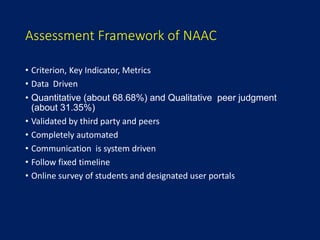
• Criterion, Key Indicator, Metrics
• Data Driven
• Quantitative (about 68.68%) and Qualitative peer judgment
(about 31.35%)
• Validated by third party and peers
• Completely automated
• Communication is system driven
• Follow fixed timeline
• Online survey of students and designated user portals
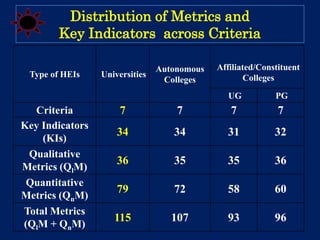
Type of HEIs Universities
Autonomous
Colleges
Affiliated/Constituent
Colleges
UG PG
Criteria 7 7 7 7
Key Indicators
(KIs)
34 34 31 32
Qualitative
Metrics (QlM)
36 35 35 36
Quantitative
Metrics (QnM)
79 72 58 60
Total Metrics
(QlM + QnM)
115 107 93 96
Distribution of Metrics and
Key Indicators across Criteria
Quality Indicator Framework(QIF)
Components – (Universities)
• CRITERION 1: Curricular Aspects [W-150]
4 KEY INDICATORS = ∑ QL METRICS (2) + ∑ QN METRICS (9)
• CRITERION 2 : Teaching- Learning and Evaluation [W-200]
7 KEY INDICATORS = ∑ QL METRICS (6) + ∑ QN METRICS (13)
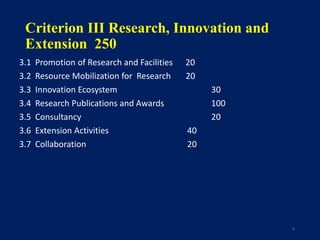
• CRITERION 3: Research, Extension and Innovations [W-250]
7 KEY INDICATORS = ∑ QL METRICS (4) + ∑ QN METRICS (25)
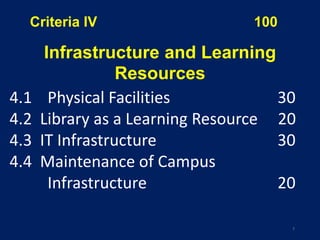
• CRITERION 4: Infrastructure and Learning Resources [W-100]
4 KEY INDICATORS = ∑ QL METRICS (6) + ∑ QN METRICS (9)
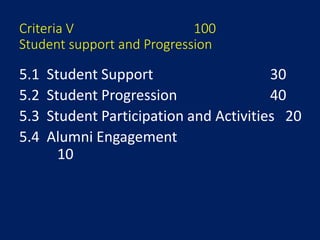
• CRITERION 5 : Student Support and Progression [W-100]
4 KEY INDICATORS = ∑ QL METRICS (2) + ∑ QN METRICS (10)
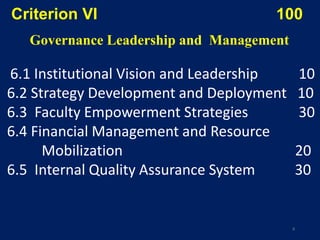
• CRITERION 6 : Governance, Leadership and Management [W-100]
5 KEY INDICATORS = ∑ QL METRICS (9) + ∑ QN METRICS (7)
• CRITERION 7: Institutional Values and Best Practices [W-100]
3 KEY INDICATORS = ∑ QL METRICS (7) + ∑ QN METRICS (6)
W=Weight
QL= Qualitative Metric
QN= Quantitative Metric
4
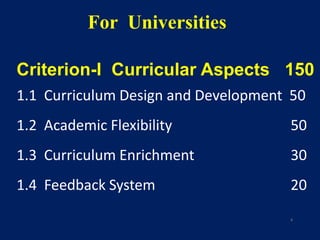
Criterion-I Curricular Aspects 150
1.1 Curriculum Design and Development 50
1.2 Academic Flexibility 50
1.3 Curriculum Enrichment 30
1.4 Feedback System 20
For Universities
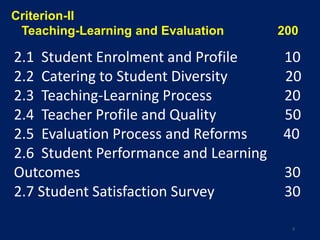
Criterion-II
Teaching-Learning and Evaluation 200
2.1 Student Enrolment and Profile 10
2.2 Catering to Student Diversity 20
2.3 Teaching-Learning Process 20
2.4 Teacher Profile and Quality 50
2.5 Evaluation Process and Reforms 40
2.6 Student Performance and Learning
Outcomes 30
2.7 Student Satisfaction Survey 30
5
Criterion III Research, Innovation and
Extension 250
3.1 Promotion of Research and Facilities 20
3.2 Resource Mobilization for Research 20
3.3 Innovation Ecosystem 30
3.4 Research Publications and Awards 100
3.5 Consultancy 20
3.6 Extension Activities 40
3.7 Collaboration 20
6
7
Criteria IV 100
4.1 Physical Facilities 30
4.2 Library as a Learning Resource 20
4.3 IT Infrastructure 30
4.4 Maintenance of Campus
Infrastructure 20
Infrastructure and Learning
Resources
Criteria V 100
Student support and Progression
5.1 Student Support 30
5.2 Student Progression 40
5.3 Student Participation and Activities 20
5.4 Alumni Engagement
10
9
Criterion VI 100
6.1 Institutional Vision and Leadership 10
6.2 Strategy Development and Deployment 10
6.3 Faculty Empowerment Strategies 30
6.4 Financial Management and Resource
Mobilization 20
6.5 Internal Quality Assurance System 30
Governance Leadership and Management
10
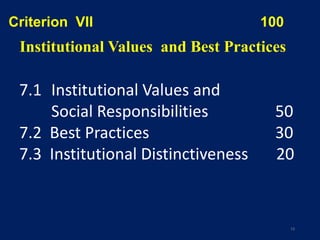
Criterion VII 100
7.1 Institutional Values and
Social Responsibilities 50
7.2 Best Practices 30
7.3 Institutional Distinctiveness 20
Institutional Values and Best Practices
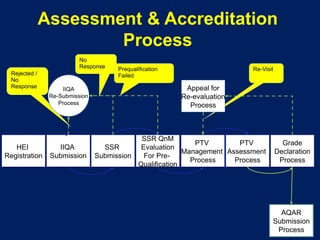
Rejected /
No
Response
No
Response Re-Visit
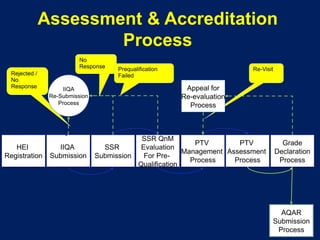
Assessment & Accreditation
Process
IIQA
Submission
SSR
Submission
PTV
Management
Process
HEI
Registration
PTV
Assessment
Process
Grade
Declaration
Process
SSR QnM
Evaluation
For Pre-
Qualification
IIQA
Re-Submission
Process
Appeal for
Re-evaluation
Process
AQAR
Submission
Process
Prequalification
Failed
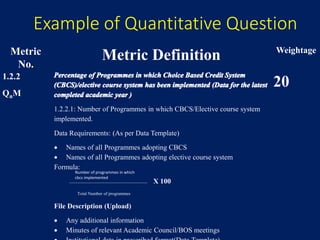
Example of Quantitative Question
Metric
No.
Metric Definition Weightage
1.2.2
QnM
1.2.2.1: Number of Programmes in which CBCS/Elective course system
implemented.
Data Requirements: (As per Data Template)
 Names of all Programmes adopting CBCS
 Names of all Programmes adopting elective course system
Formula:
X 100
Total Number of programmes
File Description (Upload)
 Any additional information
 Minutes of relevant Academic Council/BOS meetings
20
Number of programmes in which
cbcs implemented
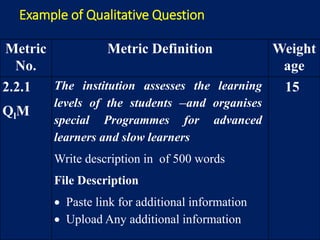
Example of Qualitative Question
Metric
No.
Metric Definition Weight
age
2.2.1
QlM
The institution assesses the learning
levels of the students and organises
special Programmes for advanced
learners and slow learners
Write description in of 500 words
File Description
 Paste link for additional information
 Upload Any additional information
15
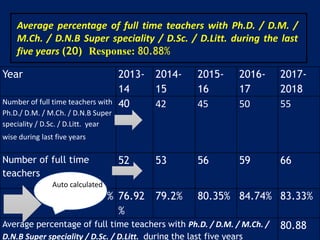
Year 2013-
14
2014-
15
2015-
16
2016-
17
2017-
2018
Number of full time teachers with
Ph.D./ D.M. / M.Ch. / D.N.B Super
speciality / D.Sc. / D.Litt. year
wise during last five years
40 42 45 50 55
Number of full time
teachers
52 53 56 59 66
% 76.92
%
79.2% 80.35% 84.74% 83.33%
Average percentage of full time teachers with Ph.D. / D.M. / M.Ch. /
D.N.B Super speciality / D.Sc. / D.Litt. during the last five years
80.88
Average percentage of full time teachers with Ph.D. / D.M. /
M.Ch. / D.N.B Super speciality / D.Sc. / D.Litt. during the last
five years (20) Response: 80.88%
Auto calculated
15
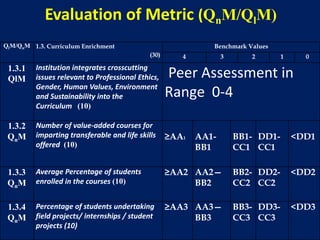
Evaluation of Metric (QnM/QlM)
QlM/QnM 1.3. Curriculum Enrichment
(30)
Benchmark Values
4 3 2 1 0
1.3.1
QlM
Institution integrates crosscutting
issues relevant to Professional Ethics,
Gender, Human Values, Environment
and Sustainability into the
Curriculum (10)
Peer Assessment in
Range 0-4
1.3.2
QnM
Number of value-added courses for
imparting transferable and life skills
offered (10)
≥AA1 AA1-
BB1
BB1-
CC1
DD1-
CC1
<DD1
1.3.3
QnM
Average Percentage of students
enrolled in the courses (10)
≥AA2 AA2—
BB2
BB2-
CC2
DD2-
CC2
<DD2
1.3.4
QnM
Percentage of students undertaking
field projects/ internships / student
projects (10)
≥AA3 AA3—
BB3
BB3-
CC3
DD3-
CC3
<DD3
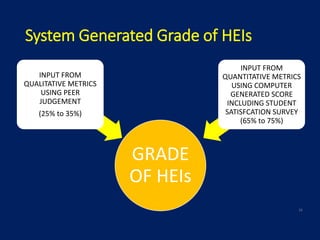
System Generated Grade of HEIs
GRADE
OF HEIs
INPUT FROM
QUALITATIVE METRICS
USING PEER
JUDGEMENT
(25% to 35%)
INPUT FROM
QUANTITATIVE METRICS
USING COMPUTER
GENERATED SCORE
INCLUDING STUDENT
SATISFCATION SURVEY
(65% to 75%)
16
Work Flows
Rejected /
No
Response
No
Response Re-Visit
Assessment & Accreditation
Process
IIQA
Submission
SSR
Submission
PTV
Management
Process
HEI
Registration
PTV
Assessment
Process
Grade
Declaration
Process
SSR QnM
Evaluation
For Pre-
Qualification
IIQA
Re-Submission
Process
Appeal for
Re-evaluation
Process
AQAR
Submission
Process
Prequalification
Failed
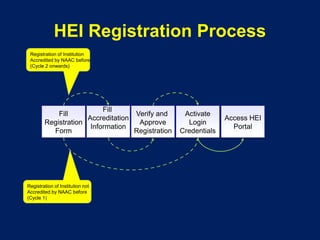
HEI Registration Process
Fill
Accreditation
Information
Verify and
Approve
Registration
Access HEI
Portal
Fill
Registration
Form
Activate
Login
Credentials
Registration of Institution
Accredited by NAAC before
(Cycle 2 onwards)
Registration of Institution not
Accredited by NAAC before
(Cycle 1)

Assessment.ppt

  • 1.
    Assessment Framework ofNAAC • Criterion, Key Indicator, Metrics • Data Driven • Quantitative (about 68.68%) and Qualitative peer judgment (about 31.35%) • Validated by third party and peers • Completely automated • Communication is system driven • Follow fixed timeline • Online survey of students and designated user portals
  • 2.
    Type of HEIsUniversities Autonomous Colleges Affiliated/Constituent Colleges UG PG Criteria 7 7 7 7 Key Indicators (KIs) 34 34 31 32 Qualitative Metrics (QlM) 36 35 35 36 Quantitative Metrics (QnM) 79 72 58 60 Total Metrics (QlM + QnM) 115 107 93 96 Distribution of Metrics and Key Indicators across Criteria
  • 3.
    Quality Indicator Framework(QIF) Components– (Universities) • CRITERION 1: Curricular Aspects [W-150] 4 KEY INDICATORS = ∑ QL METRICS (2) + ∑ QN METRICS (9) • CRITERION 2 : Teaching- Learning and Evaluation [W-200] 7 KEY INDICATORS = ∑ QL METRICS (6) + ∑ QN METRICS (13) • CRITERION 3: Research, Extension and Innovations [W-250] 7 KEY INDICATORS = ∑ QL METRICS (4) + ∑ QN METRICS (25) • CRITERION 4: Infrastructure and Learning Resources [W-100] 4 KEY INDICATORS = ∑ QL METRICS (6) + ∑ QN METRICS (9) • CRITERION 5 : Student Support and Progression [W-100] 4 KEY INDICATORS = ∑ QL METRICS (2) + ∑ QN METRICS (10) • CRITERION 6 : Governance, Leadership and Management [W-100] 5 KEY INDICATORS = ∑ QL METRICS (9) + ∑ QN METRICS (7) • CRITERION 7: Institutional Values and Best Practices [W-100] 3 KEY INDICATORS = ∑ QL METRICS (7) + ∑ QN METRICS (6) W=Weight QL= Qualitative Metric QN= Quantitative Metric
  • 4.
    4 Criterion-I Curricular Aspects150 1.1 Curriculum Design and Development 50 1.2 Academic Flexibility 50 1.3 Curriculum Enrichment 30 1.4 Feedback System 20 For Universities
  • 5.
    Criterion-II Teaching-Learning and Evaluation200 2.1 Student Enrolment and Profile 10 2.2 Catering to Student Diversity 20 2.3 Teaching-Learning Process 20 2.4 Teacher Profile and Quality 50 2.5 Evaluation Process and Reforms 40 2.6 Student Performance and Learning Outcomes 30 2.7 Student Satisfaction Survey 30 5
  • 6.
    Criterion III Research,Innovation and Extension 250 3.1 Promotion of Research and Facilities 20 3.2 Resource Mobilization for Research 20 3.3 Innovation Ecosystem 30 3.4 Research Publications and Awards 100 3.5 Consultancy 20 3.6 Extension Activities 40 3.7 Collaboration 20 6
  • 7.
    7 Criteria IV 100 4.1Physical Facilities 30 4.2 Library as a Learning Resource 20 4.3 IT Infrastructure 30 4.4 Maintenance of Campus Infrastructure 20 Infrastructure and Learning Resources
  • 8.
    Criteria V 100 Studentsupport and Progression 5.1 Student Support 30 5.2 Student Progression 40 5.3 Student Participation and Activities 20 5.4 Alumni Engagement 10
  • 9.
    9 Criterion VI 100 6.1Institutional Vision and Leadership 10 6.2 Strategy Development and Deployment 10 6.3 Faculty Empowerment Strategies 30 6.4 Financial Management and Resource Mobilization 20 6.5 Internal Quality Assurance System 30 Governance Leadership and Management
  • 10.
    10 Criterion VII 100 7.1Institutional Values and Social Responsibilities 50 7.2 Best Practices 30 7.3 Institutional Distinctiveness 20 Institutional Values and Best Practices
  • 11.
    Rejected / No Response No Response Re-Visit Assessment& Accreditation Process IIQA Submission SSR Submission PTV Management Process HEI Registration PTV Assessment Process Grade Declaration Process SSR QnM Evaluation For Pre- Qualification IIQA Re-Submission Process Appeal for Re-evaluation Process AQAR Submission Process Prequalification Failed
  • 12.
    Example of QuantitativeQuestion Metric No. Metric Definition Weightage 1.2.2 QnM 1.2.2.1: Number of Programmes in which CBCS/Elective course system implemented. Data Requirements: (As per Data Template)  Names of all Programmes adopting CBCS  Names of all Programmes adopting elective course system Formula: X 100 Total Number of programmes File Description (Upload)  Any additional information  Minutes of relevant Academic Council/BOS meetings 20 Number of programmes in which cbcs implemented
  • 13.
    Example of QualitativeQuestion Metric No. Metric Definition Weight age 2.2.1 QlM The institution assesses the learning levels of the students and organises special Programmes for advanced learners and slow learners Write description in of 500 words File Description  Paste link for additional information  Upload Any additional information 15
  • 14.
    Year 2013- 14 2014- 15 2015- 16 2016- 17 2017- 2018 Number offull time teachers with Ph.D./ D.M. / M.Ch. / D.N.B Super speciality / D.Sc. / D.Litt. year wise during last five years 40 42 45 50 55 Number of full time teachers 52 53 56 59 66 % 76.92 % 79.2% 80.35% 84.74% 83.33% Average percentage of full time teachers with Ph.D. / D.M. / M.Ch. / D.N.B Super speciality / D.Sc. / D.Litt. during the last five years 80.88 Average percentage of full time teachers with Ph.D. / D.M. / M.Ch. / D.N.B Super speciality / D.Sc. / D.Litt. during the last five years (20) Response: 80.88% Auto calculated
  • 15.
    15 Evaluation of Metric(QnM/QlM) QlM/QnM 1.3. Curriculum Enrichment (30) Benchmark Values 4 3 2 1 0 1.3.1 QlM Institution integrates crosscutting issues relevant to Professional Ethics, Gender, Human Values, Environment and Sustainability into the Curriculum (10) Peer Assessment in Range 0-4 1.3.2 QnM Number of value-added courses for imparting transferable and life skills offered (10) ≥AA1 AA1- BB1 BB1- CC1 DD1- CC1 <DD1 1.3.3 QnM Average Percentage of students enrolled in the courses (10) ≥AA2 AA2— BB2 BB2- CC2 DD2- CC2 <DD2 1.3.4 QnM Percentage of students undertaking field projects/ internships / student projects (10) ≥AA3 AA3— BB3 BB3- CC3 DD3- CC3 <DD3
  • 16.
    System Generated Gradeof HEIs GRADE OF HEIs INPUT FROM QUALITATIVE METRICS USING PEER JUDGEMENT (25% to 35%) INPUT FROM QUANTITATIVE METRICS USING COMPUTER GENERATED SCORE INCLUDING STUDENT SATISFCATION SURVEY (65% to 75%) 16
  • 17.
  • 18.
    Rejected / No Response No Response Re-Visit Assessment& Accreditation Process IIQA Submission SSR Submission PTV Management Process HEI Registration PTV Assessment Process Grade Declaration Process SSR QnM Evaluation For Pre- Qualification IIQA Re-Submission Process Appeal for Re-evaluation Process AQAR Submission Process Prequalification Failed
  • 19.
    HEI Registration Process Fill Accreditation Information Verifyand Approve Registration Access HEI Portal Fill Registration Form Activate Login Credentials Registration of Institution Accredited by NAAC before (Cycle 2 onwards) Registration of Institution not Accredited by NAAC before (Cycle 1)