Crisis or Opportunity?Cataloging, Catalogers, RDA, and ChangeDiane I. HilllmannConnecticut Library AssociationNovember 20, 2009
It’s About Perspective … “Our traditions! Nothing must change. Everything is perfect as it is! We like our ways.” –Tevye11/20/09CLA TSS Seminar, Farmington2
I Much Prefer …“You never want a serious crisis to go to waste. And what I mean by that is an opportunity to do things you think you could not do before.” – Rahm Emmanuel11/20/09CLA TSS Seminar, Farmington3
Part 1: What’s the Crisis?Libraries are no longer the first place people come for informationThe Internet has changed the way people (including us) behave when seeking informationOur former “granularity consensus” is coming apartTo compete effectively for user attention, we must:Join the larger world of information, where our users areLearn how the competition attracts users, draws them in, and takes good advantage of their interest in participatingFind a better balance between protecting privacy and capturing usage behavior11/20/094CLA TSS Seminar, Farmington
And What’s Our Role?The comfortable certainties we know are coming undone, whether we’re ready or notWe have much experience and insight to offer the larger information world (but not everything we’ve learned is relevant)We are collectively about the size of the Queen Mary, unable to turn on a dime—this change will take time, and each of us has a role to playResistance is futile—we are not in charge of this new world, and our options are two: adapt or retire11/20/095CLA TSS Seminar, Farmington
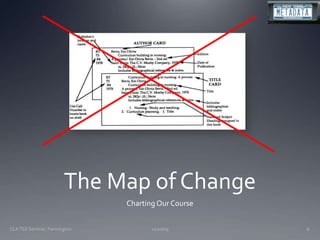
The Map of ChangeCharting Our Course11/20/09CLA TSS Seminar, Farmington6
What We Must Leave BehindA view of metadata based on catalog cardsLibrary software that can’t sort search results better than “random” or “alphabetic”Search interfaces even Librarians hate (and we know the data!)Clunky static HTML pages that don’t attract our user’s interest, or guide them wellOne silo for books, others for journal articles, images, digitized books, etc. (explain that to a user!)11/20/097CLA TSS Seminar, Farmington
Starting to Move ForwardA Starting Point: The Working Group on the Future of Bibliographic Control (Library of Congress)“On the Record”—final report, January 2008 http://www.loc.gov/bibliographic-future/A good, comprehensive overview of our new world and what we need to doRecommendations for LC, OCLC, ALA, library educators and all of usExtensively discussed at the Library of Congress and within the profession at large11/20/09CLA TSS Seminar, Farmington8
“The Web is our platform”1.2.4.2 All: Explore tools and techniques for sharing bibliographic data at the network level using both centralized and non-centralized techniques (e.g., OAI-PMH). 3.1.2.1 All: Express library standards in machine-readable and machine-actionable formats, in particular those developed for use on the Web. 3.1.2.2 All: Provide access to standards through registries or Web sites so that the standards can be used by any and all Web applications. 11/20/09CLA TSS Seminar, Farmington9
A New Look at Library Systems4.1.1.1 All: Encourage and support development of systems capable of relating evaluative data, such as reviews and ratings, to bibliographic records. 4.1.1.2 All: Encourage the enhancement of library systems to provide the capability to link to appropriate user-added data available via the Internet (e.g., Amazon.com, LibraryThing, Wikipedia). At the same time, explore opportunities for developing mutually beneficial partnerships with commercial entities that would stand to benefit from these arrangements. 11/20/0910CLA TSS Seminar, Farmington
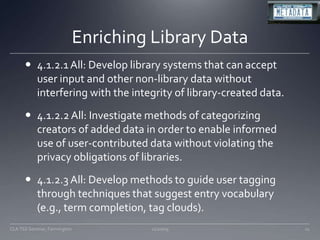
Enriching Library Data4.1.2.1 All: Develop library systems that can accept user input and other non-library data without interfering with the integrity of library-created data. 4.1.2.2 All: Investigate methods of categorizing creators of added data in order to enable informed use of user-contributed data without violating the privacy obligations of libraries. 4.1.2.3 All: Develop methods to guide user tagging through techniques that suggest entry vocabulary (e.g., term completion, tag clouds). 11/20/0911CLA TSS Seminar, Farmington
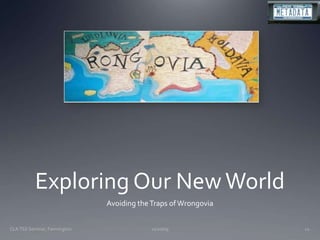
Exploring Our New WorldAvoiding the Traps of Wrongovia11/20/09CLA TSS Seminar, Farmington12
Taking a Look AroundWhat’s all this about new catalogs?Is RDA really going to happen?Is it that different from AACR2?Why can’t we use RDA with MARC?What’s this Semantic Web thingy all about, and why do we care?How will RDA implementation affect cataloging?How can we best prepare for all this?11/20/0913CLA TSS Seminar, Farmington
First, Let’s Nix the Silos!Why not expand resource availability in the current catalog?Demo: Dartmouth College Library Summon BetaWhat you’ll see: combined newspaper, journal and traditional book dataOnly those resources, including licensed resources, available to Dartmouth community (no dead ends)Ranking by relevance, date, etc.Filtering by resource type (filtering of search result set immediately)How do they do this? What are the limitation?11/20/09CLA TSS Seminar, Farmington14
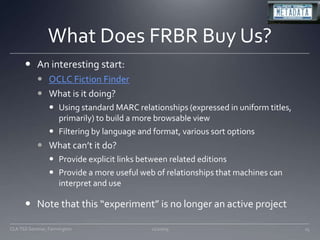
What Does FRBR Buy Us?An interesting start:OCLC Fiction FinderWhat is it doing?Using standard MARC relationships (expressed in uniform titles, primarily) to build a more browsable viewFiltering by language and format, various sort optionsWhat can’t it do?Provide explicit links between related editionsProvide a more useful web of relationships that machines can interpret and useNote that this “experiment” is no longer an active project11/20/09CLA TSS Seminar, Farmington15
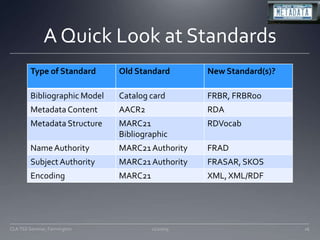
A Quick Look at Standards11/20/0916CLA TSS Seminar, Farmington
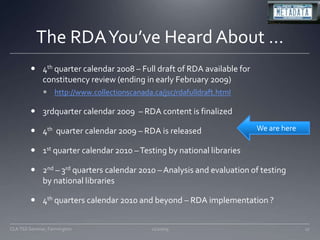
The RDA You’ve Heard About …4th quarter calendar 2008 – Full draft of RDA available for constituency review (ending in early February 2009)http://www.collectionscanada.ca/jsc/rdafulldraft.html3rdquarter calendar 2009  – RDA content is finalized4th  quarter calendar 2009 – RDA is released1st quarter calendar 2010 – Testing by national libraries2nd – 3rd quarters calendar 2010 – Analysis and evaluation of testing by national libraries4th quarters calendar 2010 and beyond – RDA implementation ?11/20/0917CLA TSS Seminar, FarmingtonWe are here
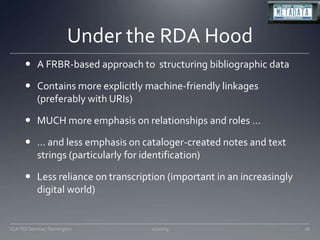
Under the RDA HoodA FRBR-based approach to  structuring bibliographic dataContains more explicitly machine-friendly linkages (preferably with URIs)MUCH more emphasis on relationships and roles …… and less emphasis on cataloger-created notes and text strings (particularly for identification)Less reliance on transcription (important in an increasingly digital world) 11/20/0918CLA TSS Seminar, Farmington
RDA: The Text1300+ pages and countingLooks a lot like it was designed by a committeeAvailable only electronically, although many have called for a printed version (obviously can’t include 1300 pages!)Costs not yet finalized for the online productText designed explicitly for online access, with user-configurable aspectsStill very oriented towards textual resources11/20/0919CLA TSS Seminar, Farmington
What You Might Not Have HeardJSC has gradually backed away from their original stance that RDA could be expressed easily in MARCFull integration of FRBR entities into RDA has made that problematicRDA has been developed explicitly to take advantage of the Semantic Web (although there are still residues of past practice)Changes made in MARC to support RDA are insufficient to allow full RDA expression (particularly relationships) in MARC11/20/0920CLA TSS Seminar, Farmington
JSC ScenariosScenario 1: separate records for all FRBR entities with linked identifiersScenario 2: composite bibliographic records (with authority records representing each entity)Scenario 3: one flat record, with all Group 1 entities on a single recordThis is the only scenario that MARC can handle11/20/0921CLA TSS Seminar, Farmington
The Rest of the StoryRDA elements, roles and vocabularies have been provisionally registered  The vocabularies and the text will be tied together in freely available RDA XML schemasSome efforts have begun to consider how MARC21 data can be parsed into FRBR entities and RDAeXtensible Catalog Project moving strongly in this directionUnfortunately, we don’t know much about what OCLC is planningDiscussions about long term maintenance of both RDA and the vocabularies will begin after RDA releaseThe push is already on for a multi-language RDA Vocabulary11/20/0922CLA TSS Seminar, Farmington
RDF VocabulariesHosted at the Metadata Registryhttp://metadataregistry.org/rdabrowse.htm7 Upper ontologies (+ FRBR in RDA)69  Value vocabulariesExtracted from Entity Relationship Diagrams (built by RDA Online contractor, based on JSC decisions)11/20/0923CLA TSS Seminar, Farmington
RDA & FRBR: Registered!RDA Group 1 Elements: http://metadataregistry.org/schema/show/id/1.htmlRDA Roles:http://metadataregistry.org/schema/show/id/4.htmlRDA Vocabulary example: Base Materialhttp://metadataregistry.org/vocabulary/show/id/35.htmlFRBR Entities for RDAhttp://metadataregistry.org/schema/show/id/14.html11/20/0924CLA TSS Seminar, Farmington
Who’s Doing This?DCMI/RDA Task GroupSee: http://dublincore.org/dcmirdataskgroup/Set up during the April 2007 London meeting between JSC and DCMIGordon Dunsire and Diane Hillmann, co-chairsKaren Coyle & Alistair Miles, consultantsIFLA Classification and Indexing SectionGordon Dunsire, Centre for Digital Library Research, University of Strathclyde, will be registering FRBR entities and relationshipsPossible inclusion of ISBDs, FRAD, etc., in future11/20/0925CLA TSS Seminar, Farmington
How Soon Will All This Happen?The bad news: This isn’t like 1981, when there was a “start date” and we knew exactly when to change gearsMore bad news: This transition is likely to be a pretty messy one, and last longer than we would likeOne unknown is OCLC’s role—at present they seem to be focused on consolidating control over library data and promoting WorldCat LocalWhat little they have said indicates that they’ll be cramming data into MARC for the foreseeable future …Some vendors are starting to announce plans …11/20/0926CLA TSS Seminar, Farmington
What Are the Challenges?Coordination with JSC (or it’s successor, given the need to move beyond  “Anglo-American”) on long-term maintenance planningNeed for lightweight process for expansion and extension, where change is not a multi-year marathonContinuing development towards a more Semantic web-friendly RDA (less reliance on transcription, for instance)Tool development (at all levels, including ILS vendors)We need lots of innovation in this realm!11/20/0927CLA TSS Seminar, Farmington
Yet More ChallengesDescription Set Profiles that express more than one notion of “Work” and more than one communitypoint of view JSC still seeing the process through the lens of a text cataloger Their “core elements” make most sense for traditional books, serials, and other text-based objectsMoving the MARC legacy data into RDAIncluding authority filesMulti-lingual and specialized extensionsNon-Anglo-American communities eager to participate11/20/0928CLA TSS Seminar, Farmington
Multi-lingual RDAThe NSDL Registry approach:Translations of labels, definitions and comments reside within the save vocabulary, with separate language attributesURIs stay the same, as do relationshipsResponsibility for updating translations rests with translation “owner”—who is enabled as a maintainer in the main vocabularyDisadvantagesUnsure how extensively this strategy will “scale”Requires a “web of trust” and organizational commitment11/20/09CLA TSS Seminar, Farmington29
RDA With GermanThe Registry team has been working with the Deutsche Nationalbibliothek to build German language labels, definitions, etc. into the RDA elements and vocabulariesThe group developing these extensions consists of librarians from an array of German and Austrian librariesSee Veronika Leibrecht’s blog post: http://metadataregistry.org/blog/2009/10/12/the-german-national-library-translating-and-registering-rda-elements-and-vocabularies/A sample: RDA Content Type, still image:http://metadataregistry.org/concept/show/id/523.html11/20/09CLA TSS Seminar, Farmington30
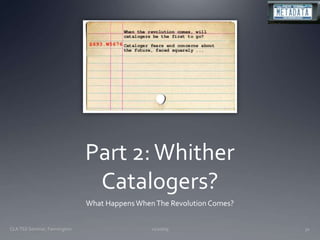
Part 2: Whither Catalogers?What Happens When The Revolution Comes?11/20/09CLA TSS Seminar, Farmington31
Focus on CatalogersWhat do we anticipate will be different about our changed working environment?How will workflow change?How will the data look?What will the library vendor systems do with it?How will we integrate user data?  What kinds of user data?What do we need to know to operate in this new environment?11/20/09CLA TSS Seminar, Farmington32
Approaching ChangeCatalogers will need to separate what they know about information based on their current systems from what is more general in natureMuch of the knowledge is portable, but needs updatingThe new environment is not as well organized (yet), so much learning will need to be self-directedCatalogers’ role may become closer to that of Metadata LibrarianManaging data at a more abstract level (not as creators)Understanding the goals of changes anticipated and new requirements will be essential11/20/09CLA TSS Seminar, Farmington33
Walking through a concrete example …From the DCMI/RDA Cataloger Scenarios11/20/09CLA TSS Seminar, Farmington34
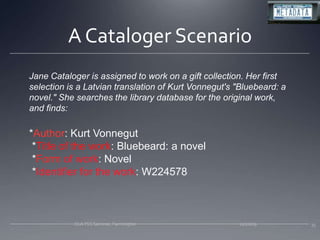
Jane Cataloger is assigned to work on a gift collection. Her first selection is a Latvian translation of Kurt Vonnegut's "Bluebeard: a novel." She searches the library database for the original work, and finds:*Author: Kurt Vonnegut *Title of the work: Bluebeard: a novel *Form of work: Novel *Identifier for the work: W2245783511/20/09CLA TSS Seminar, FarmingtonA Cataloger Scenario
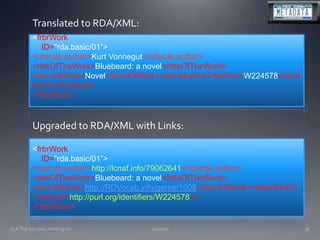
11/20/09CLA TSS Seminar, Farmington36Translated to RDA/XML:<frbrWork    ID="rda.basic/01”>	<rdarole:author>Kurt Vonnegut</rdarole:author>	<titleOfTheWork>Bluebeard: a novel</titleOfTheWork>	<formOfWork>Novel</formOfWork>	<identifierForTheWork>W224578<identifierForTheWork></frbrWork>Upgraded to RDA/XML with Links:<frbrWork    ID="rda.basic/01”>	<rdarole:author>http://lcnaf.info/79062641</rdarole:author>	<titleOfTheWork>Bluebeard: a novel</titleOfTheWork>	<formOfWork>http://RDVocab.info/genre/1008</formOfWork>	<identifierForTheWork>http://purl.org/identifiers/W224578</></frbrWork>
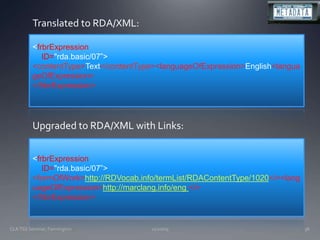
11/20/09CLA TSS Seminar, Farmington37with links to the following expression information:*Language of expression: English *Content type: Textand one manifestation:*Edition statement: 1st trade edition *Place of publication: New York *Publisher’s name: Delacorte Press *Date of publication: 1987 *Extent of text: 300 pages *Identifier for the manifestation: [ISBN]0385295901
11/20/09CLA TSS Seminar, Farmington38Translated to RDA/XML:<frbrExpression    ID="rda.basic/07”>	<contentType>Text</contentType>	<languageOfExpression>English<languageOfExpression></frbrExpression>Upgraded to RDA/XML with Links:<frbrExpression    ID="rda.basic/07”><formOfWork>http://RDVocab.info/termList/RDAContentType/1020</>	<languageOfExpression>http://marclang.info/eng </></frbrExpression>
11/20/09CLA TSS Seminar, Farmington39Translated to RDA/XML (with links below):<frbrManifestation    ID="rda.basic/09”>	<editionStatement>1st Trade Edition</>	<placeOfPublication>New York<placeOfPublication>	<publishersName>Delacorte Press</publishersName>	<dateOfPublication>1987</dateOfPublication>	<extentOfText>300 pages</extentOfText>	<identifierForTheManifestation>[ISBN]0385295901</></frbrManifestation><frbrManifestatiion    ID="rda.basic/09”><editionStatement>1st Trade Edition</><placeOfPublication>http://www.getty.edu/tgn/7007567</>	<publishersName>http://onixpub.info/2039987</>	<dateOfPublication>1987</dateOfPublication>	<extentOfText>300 pages</extentOfText>	<identifierForTheManifestation>urn:ISBN:0385295901</></frbrManifestation>
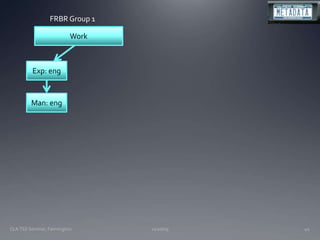
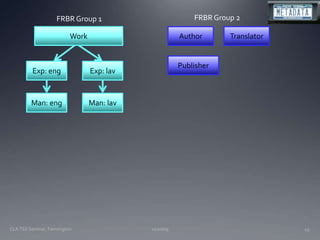
11/20/09CLA TSS Seminar, Farmington40FRBR Group 1WorkExp: engMan: eng
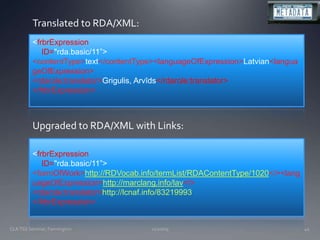
11/20/09CLA TSS Seminar, Farmington41Jane begins her description by linking to the existing Work entity. She then creates an expression description:*Content type: text*Language of expression: Latvian*Translator:Grigulis, ArvīdsShe creates an authority record for the translator since none yet existed. She continues by creating a fuller description for the new manifestation, linking to the authority record for the Latvian publisher (what luck, it already existed!).*Title: [in Latvian]*Place of publication: Riga*Publisher’s name: Liesma*Date of publication: 1997*Extent of Text: 315 pages
11/20/09CLA TSS Seminar, Farmington42Translated to RDA/XML:<frbrExpression    ID="rda.basic/11”>	<contentType>text</contentType>	<languageOfExpression>Latvian<languageOfExpression>	<rdarole:translator>Grigulis, Arvīds</rdarole:translator></frbrExpression>Upgraded to RDA/XML with Links:<frbrExpression    ID="rda.basic/11”><formOfWork>http://RDVocab.info/termList/RDAContentType/1020</>	<languageOfExpression>http://marclang.info/lav</>	<rdarole:translator>http://lcnaf.info/83219993 </frbrExpression>
11/20/09CLA TSS Seminar, Farmington43Translated to RDA/XML (with links below):<frbrManifestation    ID="rda.basic/09”>	<title>[in Latvian]</>	<placeOfPublication>Riga<placeOfPublication>	<publishersName>Liesma</publishersName>	<dateOfPublication>1997</dateOfPublication>	<extentOfText>315 pages</extentOfText></frbrManifestation><frbrManifestatiion    ID="rda.basic/09”><placeOfPublication>http://www.getty.edu/tgn/7006484</>	<publishersName>http://onixpub.info/6770094</>	<dateOfPublication>1997</dateOfPublication>	<extentOfText>315 pages</extentOfText></frbrManifestation>
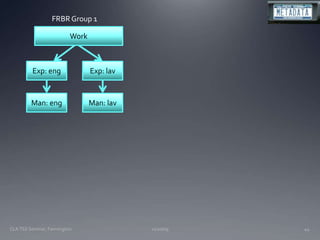
11/20/09CLA TSS Seminar, Farmington44FRBR Group 1WorkExp: engExp: lavMan: engMan: lav
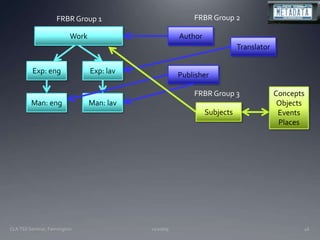
11/20/09CLA TSS Seminar, Farmington45FRBR Group 2FRBR Group 1WorkAuthorTranslatorPublisherExp: engExp: lavMan: engMan: lav
11/20/09CLA TSS Seminar, Farmington46FRBR Group 2FRBR Group 1WorkAuthorTranslatorExp: engExp: lavPublisherFRBR Group 3ConceptsObjectsEventsPlacesMan: engMan: lavSubjects
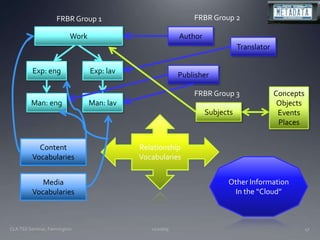
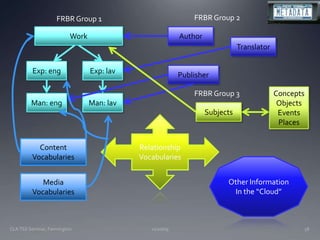
11/20/09CLA TSS Seminar, Farmington47FRBR Group 2FRBR Group 1WorkAuthorTranslatorExp: engExp: lavPublisherFRBR Group 3ConceptsObjectsEventsPlacesMan: engMan: lavSubjectsRelationshipVocabulariesContent VocabulariesOther InformationIn the “Cloud”Media Vocabularies
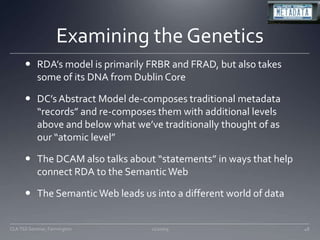
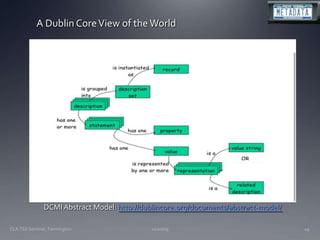
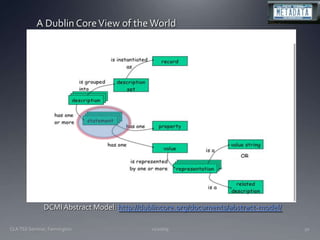
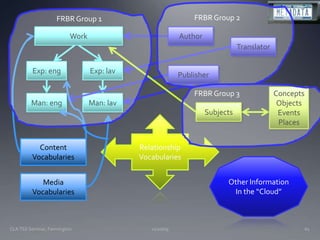
Examining the GeneticsRDA’s model is primarily FRBR and FRAD, but also takes some of its DNA from Dublin CoreDC’s Abstract Model de-composes traditional metadata “records” and re-composes them with additional levels above and below what we’ve traditionally thought of as our “atomic level”The DCAM also talks about “statements” in ways that help connect RDA to the Semantic WebThe Semantic Web leads us into a different world of data11/20/09CLA TSS Seminar, Farmington48
11/20/09CLA TSS Seminar, Farmington49A Dublin Core View of the WorldDCMI Abstract Model: http://dublincore.org/documents/abstract-model/
11/20/09CLA TSS Seminar, Farmington50A Dublin Core View of the WorldDCMI Abstract Model: http://dublincore.org/documents/abstract-model/
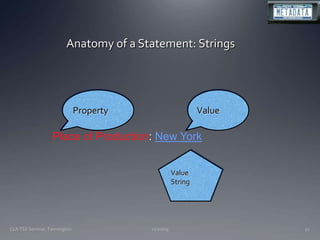
11/20/09CLA TSS Seminar, Farmington51Anatomy of a Statement: StringsPropertyValuePlace of Production: New YorkValueString
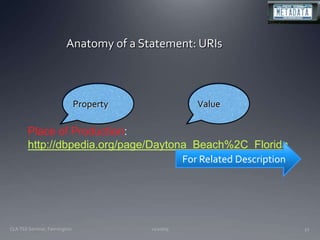
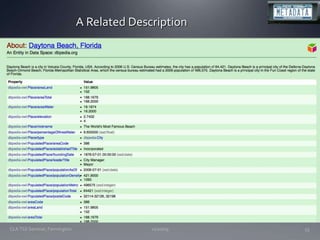
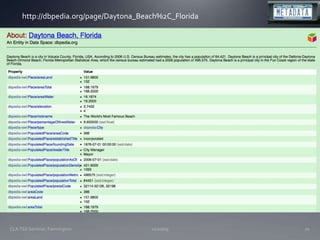
11/20/09CLA TSS Seminar, Farmington52Anatomy of a Statement: URIsPropertyValuePlace of Production: http://dbpedia.org/page/Daytona_Beach%2C_FloridaFor Related Description
11/20/09CLA TSS Seminar, Farmington53A Related Description
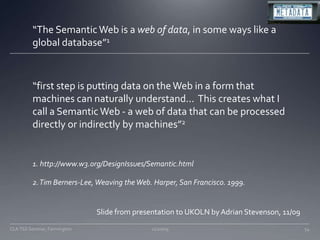
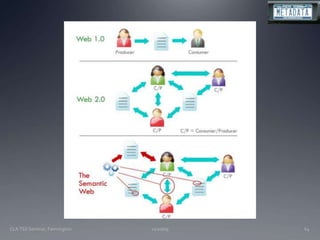
“The Semantic Web is a web of data, in some ways like a global database”1“first step is putting data on the Web in a form that machines can naturally understand...  This creates what I call a Semantic Web - a web of data that can be processed directly or indirectly by machines”21. http://www.w3.org/DesignIssues/Semantic.html2. Tim Berners-Lee, Weaving the Web. Harper, San Francisco. 1999.Slide from presentation to UKOLN by Adrian Stevenson, 11/0911/20/0954CLA TSS Seminar, Farmington
SetsCats, Descriptions, Whatever11/20/09CLA TSS Seminar, Farmington55
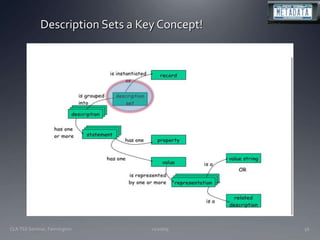
11/20/09CLA TSS Seminar, Farmington56Description Sets a Key Concept!
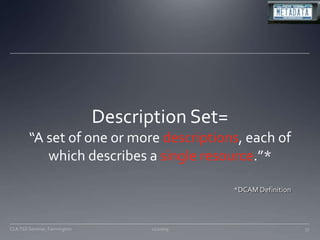
Description Set=“A set of one or more descriptions, each of which describes a single resource.”*57*DCAM Definition11/20/09CLA TSS Seminar, Farmington
11/20/09CLA TSS Seminar, Farmington58FRBR Group 2FRBR Group 1WorkAuthorTranslatorExp: engExp: lavPublisherFRBR Group 3ConceptsObjectsEventsPlacesMan: engMan: lavSubjectsRelationshipVocabulariesContent VocabulariesOther InformationIn the “Cloud”Media Vocabularies
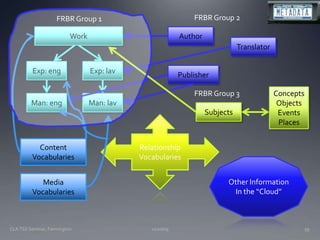
11/20/09CLA TSS Seminar, Farmington59FRBR Group 2FRBR Group 1WorkAuthorTranslatorExp: engExp: lavPublisherFRBR Group 3ConceptsObjectsEventsPlacesMan: engMan: lavSubjectsRelationshipVocabulariesContent VocabulariesOther InformationIn the “Cloud”Media Vocabularies
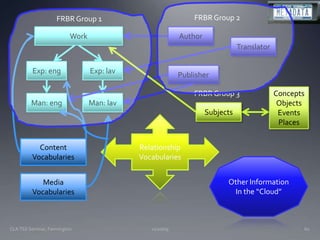
11/20/09CLA TSS Seminar, Farmington60FRBR Group 2FRBR Group 1WorkAuthorTranslatorExp: engExp: lavPublisherFRBR Group 3ConceptsObjectsEventsPlacesMan: engMan: lavSubjectsRelationshipVocabulariesContent VocabulariesOther InformationIn the “Cloud”Media Vocabularies
11/20/09CLA TSS Seminar, Farmington61FRBR Group 2FRBR Group 1WorkAuthorTranslatorExp: engExp: lavPublisherFRBR Group 3ConceptsObjectsEventsPlacesMan: engMan: lavSubjectsRelationshipVocabulariesContent VocabulariesOther InformationIn the “Cloud”Media Vocabularies
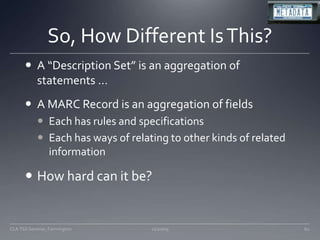
So, How Different Is This?A “Description Set” is an aggregation of statements …A MARC Record is an aggregation of fieldsEach has rules and specificationsEach has ways of relating to other kinds of related informationHow hard can it be?11/20/09CLA TSS Seminar, Farmington62
New Tools, New KnowledgeGetting There From Here11/20/09CLA TSS Seminar, Farmington63
11/20/09CLA TSS Seminar, Farmington64
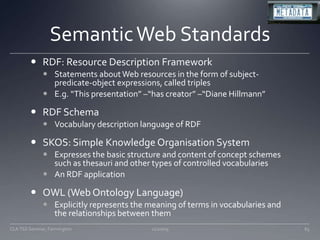
Semantic Web StandardsRDF: Resource Description FrameworkStatements about Web resources in the form of subject-predicate-object expressions, called triplesE.g. “This presentation” –“has creator” –“Diane Hillmann”RDF SchemaVocabulary description language of RDFSKOS: Simple Knowledge Organisation SystemExpresses the basic structure and content of concept schemes such as thesauri and other types of controlled vocabulariesAn RDF applicationOWL (Web Ontology Language)Explicitly represents the meaning of terms in vocabularies and the relationships between them11/20/0965CLA TSS Seminar, Farmington
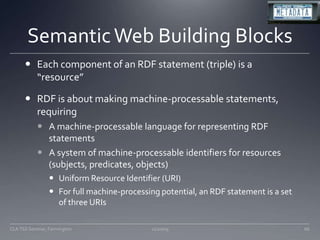
Semantic Web Building BlocksEach component of an RDF statement (triple) is a “resource”RDF is about making machine-processable statements, requiringA machine-processable language for representing RDF statementsA system of machine-processable identifiers for resources (subjects, predicates, objects)Uniform Resource Identifier (URI) For full machine-processing potential, an RDF statement is a set of three URIs11/20/0966CLA TSS Seminar, Farmington
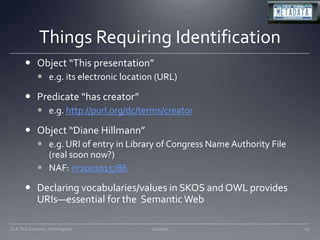
Things Requiring IdentificationObject “This presentation”e.g. its electronic location (URL)Predicate “has creator”e.g. http://purl.org/dc/terms/creatorObject “Diane Hillmann”e.g. URI of entry in Library of Congress Name Authority File (real soon now?)NAF: nr2001015786Declaring vocabularies/values in SKOS and OWL provides URIs—essential for the  Semantic Web11/20/0967CLA TSS Seminar, Farmington
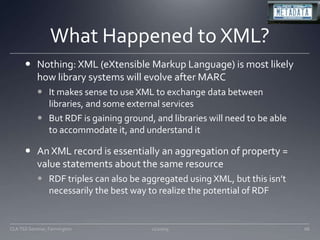
What Happened to XML?Nothing: XML (eXtensible Markup Language) is most likely how library systems will evolve after MARCIt makes sense to use XML to exchange data between libraries, and some external servicesBut RDF is gaining ground, and libraries will need to be able to accommodate it, and understand itAn XML record is essentially an aggregation of property = value statements about the same resourceRDF triples can also be aggregated using XML, but this isn’t necessarily the best way to realize the potential of RDF11/20/09CLA TSS Seminar, Farmington68
New Sources of DataGovernments The UK government is looking for ways to distribute it’s data widely: http://news.bbc.co.uk/2/hi/technology/8311627.stmThe US government is joining the party: http://www.data.gov/Geographic names: http://www.geonames.org/New York Times: http://data.nytimes.com/Other information (being used by the NYTimes)Dbpedia: http://dbpedia.org/AboutFreebase: http://www.freebase.com/11/20/09CLA TSS Seminar, Farmington69
11/20/09CLA TSS Seminar, Farmington70http://dbpedia.org/page/Daytona_Beach%2C_Florida
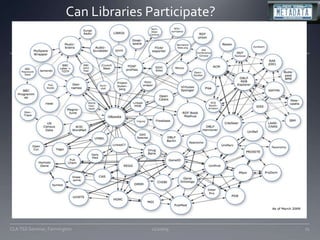
Can Libraries Participate?11/20/0971CLA TSS Seminar, Farmington
Users Bringing Users (and Usage) Into the Conversation11/20/09CLA TSS Seminar, Farmington72
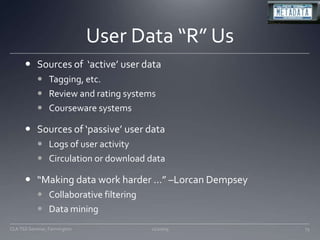
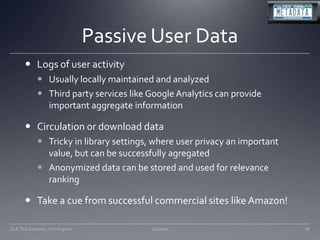
User Data “R” UsSources of  ‘active’ user dataTagging, etc. Review and rating systemsCourseware systemsSources of ‘passive’ user dataLogs of user activityCirculation or download data“Making data work harder …” –Lorcan DempseyCollaborative filteringData mining 11/20/09CLA TSS Seminar, Farmington73
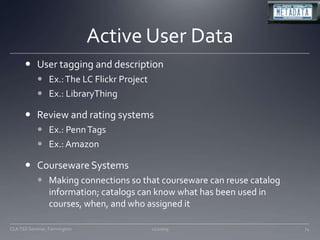
Active User DataUser tagging and descriptionEx.: The LC Flickr ProjectEx.: LibraryThingReview and rating systemsEx.: Penn TagsEx.: AmazonCourseware SystemsMaking connections so that courseware can reuse catalog information; catalogs can know what has been used in courses, when, and who assigned it11/20/09CLA TSS Seminar, Farmington74
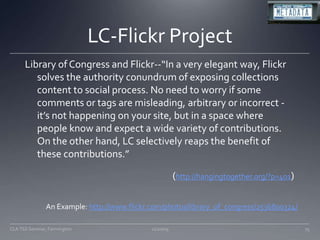
LC-Flickr ProjectLibrary of Congress and Flickr--“In a very elegant way, Flickr solves the authority conundrum of exposing collections content to social process. No need to worry if some comments or tags are misleading, arbitrary or incorrect - it’s not happening on your site, but in a space where people know and expect a wide variety of contributions. On the other hand, LC selectively reaps the benefit of these contributions.” (http://hangingtogether.org/?p=401)11/20/09CLA TSS Seminar, Farmington75An Example: http://www.flickr.com/photos/library_of_congress/2536800324/
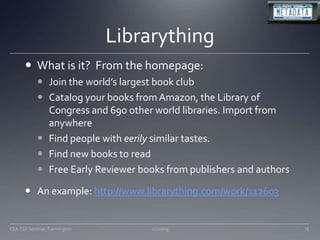
LibrarythingWhat is it?  From the homepage:Join the world’s largest book clubCatalog your books from Amazon, the Library of Congress and 690 other world libraries. Import from anywhereFind people with eerily similar tastes. Find new books to readFree Early Reviewer books from publishers and authorsAn example: http://www.librarything.com/work/11260311/20/09CLA TSS Seminar, Farmington76
11/20/09CLA TSS Seminar, Farmington77What is PennTags?“PennTags is a social bookmarking tool for locating, organizing, and sharing your favorite online resources. Members of the Penn Community can collect and maintain URLs, links to journal articles, and records in Franklin, our online catalog and VCat, our online video catalog. Once these resources are compiled, you can organize them by assigning tags (free-text keywords) and/or by grouping them into projects, according to your specific preferences. PennTags can also be used collaboratively, because it acts as a repository of the varied interests and academic pursuits of the Penn community, and can help you find topics and users related to your own favorite online resources.nPennTags was developed by librarians at the University of Pennsylvania. “An example:  http://tags.library.upenn.edu/
Passive User DataLogs of user activityUsually locally maintained and analyzedThird party services like Google Analytics can provide important aggregate informationCirculation or download dataTricky in library settings, where user privacy an important value, but can be successfully agregatedAnonymized data can be stored and used for relevance rankingTake a cue from successful commercial sites like Amazon!11/20/09CLA TSS Seminar, Farmington78
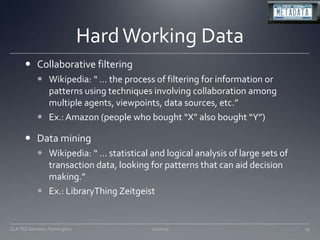
Hard Working DataCollaborative filteringWikipedia: “ … the process of filtering for information or patterns using techniques involving collaboration among multiple agents, viewpoints, data sources, etc.”Ex.: Amazon (people who bought “X” also bought “Y”)Data miningWikipedia: “ … statistical and logical analysis of large sets of transaction data, looking for patterns that can aid decision making.”Ex.: LibraryThing Zeitgeist11/20/09CLA TSS Seminar, Farmington79
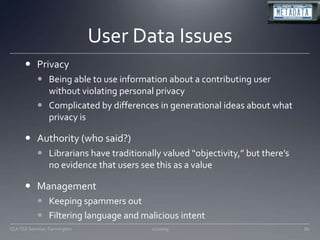
User Data IssuesPrivacyBeing able to use information about a contributing user without violating personal privacyComplicated by differences in generational ideas about what privacy isAuthority (who said?)Librarians have traditionally valued “objectivity,” but there’s no evidence that users see this as a valueManagementKeeping spammers outFiltering language and malicious intent11/20/09CLA TSS Seminar, Farmington80
Sharing User ContributionsNote how LibraryThing pulls Amazon descriptionsAmazon has an API that allows other services to use its dataPositioning Amazon data in other sites drives users back to Amazon—Libraries need to do this!As libraries move more of their unique data to the Web, they need to be aware of the marketing value of sharing data and allowing other services to combine it in new waysTo do this, libraries will need to be able to package the data in ways hat others can capture itEx.: XC Project is planning to share Courseware information11/20/09CLA TSS Seminar, Farmington81
Preparing OurselvesFiguring Out What We Need To Know11/20/09CLA TSS Seminar, Farmington82
Learning StrategiesGroup LearningSeminars (like this one!)Conference presentationsLocal study groupsSelf-directed learningTutorialsBlogsKeeping up with the discussion--You need a plan!11/20/09CLA TSS Seminar, Farmington83
Self-directed LearningWeb tutorials:http://www.w3schools.com/BlogsGet a Bloglines account (free)Start with a few, and expand:Lorcan Dempsey (http://orweblog.oclc.org/) Karen Coyle (http://kcoyle.blogspot.com/) The FRBR Blog (http://www.frbr.org/) Catalogablog (http://catalogablog.blogspot.com/) Cataloging Futures (http://www.catalogingfutures.com/) Metadata Matters (http://managemetadata.org/blog/) 11/20/0984CLA TSS Seminar, Farmington
Mailing listsEvaluate your current reading habitsAre  you spending too much time on lists that  focus on  MARC and AACR2 problem solving?Do you hear too much whining about change?Migrate to some of the lists discussing newer ideasweb4lib@webjunction.orgmetadatalibrarians@lists.monarchos.comRDA-L@INFOSERV.NLC-BNC.CADC-RDA@JISCMAIL.AC.UKAsk questions! Network!11/20/0985CLA TSS Seminar, Farmington
Acronymia, We Are HereRDA: Resource Description and AccessRDF: Resource Description Framework (a W3C standard)FRBR: Functional Requirements for Bibliographic RecordsFRBRoo: Object Oriented FRBR (harmonized with CIDOC CRM)FRAD: Functional Requirements for Authority DataFRASAR: Functional Requirements for Subject Authority RecordsSKOS: Simple Knowledge Organisation System (a W3C standard)11/20/0986CLA TSS Seminar, Farmington
Thanks & AcknowledgementsThanks for your attention!Slides and ideas from Karen Coyle, Gordon Dunsire, and too many others to count!Contact for Diane:Email: metadata.maven@gmail.comWebsite: http://managemetadata.com/11/20/0987CLA TSS Seminar, Farmington

Crisis or Opportunity

  • 1.
    Crisis or Opportunity?Cataloging,Catalogers, RDA, and ChangeDiane I. HilllmannConnecticut Library AssociationNovember 20, 2009
  • 2.
    It’s About Perspective… “Our traditions! Nothing must change. Everything is perfect as it is! We like our ways.” –Tevye11/20/09CLA TSS Seminar, Farmington2
  • 3.
    I Much Prefer…“You never want a serious crisis to go to waste. And what I mean by that is an opportunity to do things you think you could not do before.” – Rahm Emmanuel11/20/09CLA TSS Seminar, Farmington3
  • 4.
    Part 1: What’sthe Crisis?Libraries are no longer the first place people come for informationThe Internet has changed the way people (including us) behave when seeking informationOur former “granularity consensus” is coming apartTo compete effectively for user attention, we must:Join the larger world of information, where our users areLearn how the competition attracts users, draws them in, and takes good advantage of their interest in participatingFind a better balance between protecting privacy and capturing usage behavior11/20/094CLA TSS Seminar, Farmington
  • 5.
    And What’s OurRole?The comfortable certainties we know are coming undone, whether we’re ready or notWe have much experience and insight to offer the larger information world (but not everything we’ve learned is relevant)We are collectively about the size of the Queen Mary, unable to turn on a dime—this change will take time, and each of us has a role to playResistance is futile—we are not in charge of this new world, and our options are two: adapt or retire11/20/095CLA TSS Seminar, Farmington
  • 6.
    The Map ofChangeCharting Our Course11/20/09CLA TSS Seminar, Farmington6
  • 7.
    What We MustLeave BehindA view of metadata based on catalog cardsLibrary software that can’t sort search results better than “random” or “alphabetic”Search interfaces even Librarians hate (and we know the data!)Clunky static HTML pages that don’t attract our user’s interest, or guide them wellOne silo for books, others for journal articles, images, digitized books, etc. (explain that to a user!)11/20/097CLA TSS Seminar, Farmington
  • 8.
    Starting to MoveForwardA Starting Point: The Working Group on the Future of Bibliographic Control (Library of Congress)“On the Record”—final report, January 2008 http://www.loc.gov/bibliographic-future/A good, comprehensive overview of our new world and what we need to doRecommendations for LC, OCLC, ALA, library educators and all of usExtensively discussed at the Library of Congress and within the profession at large11/20/09CLA TSS Seminar, Farmington8
  • 9.
    “The Web isour platform”1.2.4.2 All: Explore tools and techniques for sharing bibliographic data at the network level using both centralized and non-centralized techniques (e.g., OAI-PMH). 3.1.2.1 All: Express library standards in machine-readable and machine-actionable formats, in particular those developed for use on the Web. 3.1.2.2 All: Provide access to standards through registries or Web sites so that the standards can be used by any and all Web applications. 11/20/09CLA TSS Seminar, Farmington9
  • 10.
    A New Lookat Library Systems4.1.1.1 All: Encourage and support development of systems capable of relating evaluative data, such as reviews and ratings, to bibliographic records. 4.1.1.2 All: Encourage the enhancement of library systems to provide the capability to link to appropriate user-added data available via the Internet (e.g., Amazon.com, LibraryThing, Wikipedia). At the same time, explore opportunities for developing mutually beneficial partnerships with commercial entities that would stand to benefit from these arrangements. 11/20/0910CLA TSS Seminar, Farmington
  • 11.
    Enriching Library Data4.1.2.1All: Develop library systems that can accept user input and other non-library data without interfering with the integrity of library-created data. 4.1.2.2 All: Investigate methods of categorizing creators of added data in order to enable informed use of user-contributed data without violating the privacy obligations of libraries. 4.1.2.3 All: Develop methods to guide user tagging through techniques that suggest entry vocabulary (e.g., term completion, tag clouds). 11/20/0911CLA TSS Seminar, Farmington
  • 12.
    Exploring Our NewWorldAvoiding the Traps of Wrongovia11/20/09CLA TSS Seminar, Farmington12
  • 13.
    Taking a LookAroundWhat’s all this about new catalogs?Is RDA really going to happen?Is it that different from AACR2?Why can’t we use RDA with MARC?What’s this Semantic Web thingy all about, and why do we care?How will RDA implementation affect cataloging?How can we best prepare for all this?11/20/0913CLA TSS Seminar, Farmington
  • 14.
    First, Let’s Nixthe Silos!Why not expand resource availability in the current catalog?Demo: Dartmouth College Library Summon BetaWhat you’ll see: combined newspaper, journal and traditional book dataOnly those resources, including licensed resources, available to Dartmouth community (no dead ends)Ranking by relevance, date, etc.Filtering by resource type (filtering of search result set immediately)How do they do this? What are the limitation?11/20/09CLA TSS Seminar, Farmington14
  • 15.
    What Does FRBRBuy Us?An interesting start:OCLC Fiction FinderWhat is it doing?Using standard MARC relationships (expressed in uniform titles, primarily) to build a more browsable viewFiltering by language and format, various sort optionsWhat can’t it do?Provide explicit links between related editionsProvide a more useful web of relationships that machines can interpret and useNote that this “experiment” is no longer an active project11/20/09CLA TSS Seminar, Farmington15
  • 16.
    A Quick Lookat Standards11/20/0916CLA TSS Seminar, Farmington
  • 17.
    The RDA You’veHeard About …4th quarter calendar 2008 – Full draft of RDA available for constituency review (ending in early February 2009)http://www.collectionscanada.ca/jsc/rdafulldraft.html3rdquarter calendar 2009 – RDA content is finalized4th quarter calendar 2009 – RDA is released1st quarter calendar 2010 – Testing by national libraries2nd – 3rd quarters calendar 2010 – Analysis and evaluation of testing by national libraries4th quarters calendar 2010 and beyond – RDA implementation ?11/20/0917CLA TSS Seminar, FarmingtonWe are here
  • 18.
    Under the RDAHoodA FRBR-based approach to structuring bibliographic dataContains more explicitly machine-friendly linkages (preferably with URIs)MUCH more emphasis on relationships and roles …… and less emphasis on cataloger-created notes and text strings (particularly for identification)Less reliance on transcription (important in an increasingly digital world) 11/20/0918CLA TSS Seminar, Farmington
  • 19.
    RDA: The Text1300+pages and countingLooks a lot like it was designed by a committeeAvailable only electronically, although many have called for a printed version (obviously can’t include 1300 pages!)Costs not yet finalized for the online productText designed explicitly for online access, with user-configurable aspectsStill very oriented towards textual resources11/20/0919CLA TSS Seminar, Farmington
  • 20.
    What You MightNot Have HeardJSC has gradually backed away from their original stance that RDA could be expressed easily in MARCFull integration of FRBR entities into RDA has made that problematicRDA has been developed explicitly to take advantage of the Semantic Web (although there are still residues of past practice)Changes made in MARC to support RDA are insufficient to allow full RDA expression (particularly relationships) in MARC11/20/0920CLA TSS Seminar, Farmington
  • 21.
    JSC ScenariosScenario 1:separate records for all FRBR entities with linked identifiersScenario 2: composite bibliographic records (with authority records representing each entity)Scenario 3: one flat record, with all Group 1 entities on a single recordThis is the only scenario that MARC can handle11/20/0921CLA TSS Seminar, Farmington
  • 22.
    The Rest ofthe StoryRDA elements, roles and vocabularies have been provisionally registered The vocabularies and the text will be tied together in freely available RDA XML schemasSome efforts have begun to consider how MARC21 data can be parsed into FRBR entities and RDAeXtensible Catalog Project moving strongly in this directionUnfortunately, we don’t know much about what OCLC is planningDiscussions about long term maintenance of both RDA and the vocabularies will begin after RDA releaseThe push is already on for a multi-language RDA Vocabulary11/20/0922CLA TSS Seminar, Farmington
  • 23.
    RDF VocabulariesHosted atthe Metadata Registryhttp://metadataregistry.org/rdabrowse.htm7 Upper ontologies (+ FRBR in RDA)69 Value vocabulariesExtracted from Entity Relationship Diagrams (built by RDA Online contractor, based on JSC decisions)11/20/0923CLA TSS Seminar, Farmington
  • 24.
    RDA & FRBR:Registered!RDA Group 1 Elements: http://metadataregistry.org/schema/show/id/1.htmlRDA Roles:http://metadataregistry.org/schema/show/id/4.htmlRDA Vocabulary example: Base Materialhttp://metadataregistry.org/vocabulary/show/id/35.htmlFRBR Entities for RDAhttp://metadataregistry.org/schema/show/id/14.html11/20/0924CLA TSS Seminar, Farmington
  • 25.
    Who’s Doing This?DCMI/RDATask GroupSee: http://dublincore.org/dcmirdataskgroup/Set up during the April 2007 London meeting between JSC and DCMIGordon Dunsire and Diane Hillmann, co-chairsKaren Coyle & Alistair Miles, consultantsIFLA Classification and Indexing SectionGordon Dunsire, Centre for Digital Library Research, University of Strathclyde, will be registering FRBR entities and relationshipsPossible inclusion of ISBDs, FRAD, etc., in future11/20/0925CLA TSS Seminar, Farmington
  • 26.
    How Soon WillAll This Happen?The bad news: This isn’t like 1981, when there was a “start date” and we knew exactly when to change gearsMore bad news: This transition is likely to be a pretty messy one, and last longer than we would likeOne unknown is OCLC’s role—at present they seem to be focused on consolidating control over library data and promoting WorldCat LocalWhat little they have said indicates that they’ll be cramming data into MARC for the foreseeable future …Some vendors are starting to announce plans …11/20/0926CLA TSS Seminar, Farmington
  • 27.
    What Are theChallenges?Coordination with JSC (or it’s successor, given the need to move beyond “Anglo-American”) on long-term maintenance planningNeed for lightweight process for expansion and extension, where change is not a multi-year marathonContinuing development towards a more Semantic web-friendly RDA (less reliance on transcription, for instance)Tool development (at all levels, including ILS vendors)We need lots of innovation in this realm!11/20/0927CLA TSS Seminar, Farmington
  • 28.
    Yet More ChallengesDescriptionSet Profiles that express more than one notion of “Work” and more than one communitypoint of view JSC still seeing the process through the lens of a text cataloger Their “core elements” make most sense for traditional books, serials, and other text-based objectsMoving the MARC legacy data into RDAIncluding authority filesMulti-lingual and specialized extensionsNon-Anglo-American communities eager to participate11/20/0928CLA TSS Seminar, Farmington
  • 29.
    Multi-lingual RDAThe NSDLRegistry approach:Translations of labels, definitions and comments reside within the save vocabulary, with separate language attributesURIs stay the same, as do relationshipsResponsibility for updating translations rests with translation “owner”—who is enabled as a maintainer in the main vocabularyDisadvantagesUnsure how extensively this strategy will “scale”Requires a “web of trust” and organizational commitment11/20/09CLA TSS Seminar, Farmington29
  • 30.
    RDA With GermanTheRegistry team has been working with the Deutsche Nationalbibliothek to build German language labels, definitions, etc. into the RDA elements and vocabulariesThe group developing these extensions consists of librarians from an array of German and Austrian librariesSee Veronika Leibrecht’s blog post: http://metadataregistry.org/blog/2009/10/12/the-german-national-library-translating-and-registering-rda-elements-and-vocabularies/A sample: RDA Content Type, still image:http://metadataregistry.org/concept/show/id/523.html11/20/09CLA TSS Seminar, Farmington30
  • 31.
    Part 2: WhitherCatalogers?What Happens When The Revolution Comes?11/20/09CLA TSS Seminar, Farmington31
  • 32.
    Focus on CatalogersWhatdo we anticipate will be different about our changed working environment?How will workflow change?How will the data look?What will the library vendor systems do with it?How will we integrate user data? What kinds of user data?What do we need to know to operate in this new environment?11/20/09CLA TSS Seminar, Farmington32
  • 33.
    Approaching ChangeCatalogers willneed to separate what they know about information based on their current systems from what is more general in natureMuch of the knowledge is portable, but needs updatingThe new environment is not as well organized (yet), so much learning will need to be self-directedCatalogers’ role may become closer to that of Metadata LibrarianManaging data at a more abstract level (not as creators)Understanding the goals of changes anticipated and new requirements will be essential11/20/09CLA TSS Seminar, Farmington33
  • 34.
    Walking through aconcrete example …From the DCMI/RDA Cataloger Scenarios11/20/09CLA TSS Seminar, Farmington34
  • 35.
    Jane Cataloger isassigned to work on a gift collection. Her first selection is a Latvian translation of Kurt Vonnegut's "Bluebeard: a novel." She searches the library database for the original work, and finds:*Author: Kurt Vonnegut *Title of the work: Bluebeard: a novel *Form of work: Novel *Identifier for the work: W2245783511/20/09CLA TSS Seminar, FarmingtonA Cataloger Scenario
  • 36.
    11/20/09CLA TSS Seminar,Farmington36Translated to RDA/XML:<frbrWork ID="rda.basic/01”> <rdarole:author>Kurt Vonnegut</rdarole:author> <titleOfTheWork>Bluebeard: a novel</titleOfTheWork> <formOfWork>Novel</formOfWork> <identifierForTheWork>W224578<identifierForTheWork></frbrWork>Upgraded to RDA/XML with Links:<frbrWork ID="rda.basic/01”> <rdarole:author>http://lcnaf.info/79062641</rdarole:author> <titleOfTheWork>Bluebeard: a novel</titleOfTheWork> <formOfWork>http://RDVocab.info/genre/1008</formOfWork> <identifierForTheWork>http://purl.org/identifiers/W224578</></frbrWork>
  • 37.
    11/20/09CLA TSS Seminar,Farmington37with links to the following expression information:*Language of expression: English *Content type: Textand one manifestation:*Edition statement: 1st trade edition *Place of publication: New York *Publisher’s name: Delacorte Press *Date of publication: 1987 *Extent of text: 300 pages *Identifier for the manifestation: [ISBN]0385295901
  • 38.
    11/20/09CLA TSS Seminar,Farmington38Translated to RDA/XML:<frbrExpression ID="rda.basic/07”> <contentType>Text</contentType> <languageOfExpression>English<languageOfExpression></frbrExpression>Upgraded to RDA/XML with Links:<frbrExpression ID="rda.basic/07”><formOfWork>http://RDVocab.info/termList/RDAContentType/1020</> <languageOfExpression>http://marclang.info/eng </></frbrExpression>
  • 39.
    11/20/09CLA TSS Seminar,Farmington39Translated to RDA/XML (with links below):<frbrManifestation ID="rda.basic/09”> <editionStatement>1st Trade Edition</> <placeOfPublication>New York<placeOfPublication> <publishersName>Delacorte Press</publishersName> <dateOfPublication>1987</dateOfPublication> <extentOfText>300 pages</extentOfText> <identifierForTheManifestation>[ISBN]0385295901</></frbrManifestation><frbrManifestatiion ID="rda.basic/09”><editionStatement>1st Trade Edition</><placeOfPublication>http://www.getty.edu/tgn/7007567</> <publishersName>http://onixpub.info/2039987</> <dateOfPublication>1987</dateOfPublication> <extentOfText>300 pages</extentOfText> <identifierForTheManifestation>urn:ISBN:0385295901</></frbrManifestation>
  • 40.
    11/20/09CLA TSS Seminar,Farmington40FRBR Group 1WorkExp: engMan: eng
  • 41.
    11/20/09CLA TSS Seminar,Farmington41Jane begins her description by linking to the existing Work entity. She then creates an expression description:*Content type: text*Language of expression: Latvian*Translator:Grigulis, ArvīdsShe creates an authority record for the translator since none yet existed. She continues by creating a fuller description for the new manifestation, linking to the authority record for the Latvian publisher (what luck, it already existed!).*Title: [in Latvian]*Place of publication: Riga*Publisher’s name: Liesma*Date of publication: 1997*Extent of Text: 315 pages
  • 42.
    11/20/09CLA TSS Seminar,Farmington42Translated to RDA/XML:<frbrExpression ID="rda.basic/11”> <contentType>text</contentType> <languageOfExpression>Latvian<languageOfExpression> <rdarole:translator>Grigulis, Arvīds</rdarole:translator></frbrExpression>Upgraded to RDA/XML with Links:<frbrExpression ID="rda.basic/11”><formOfWork>http://RDVocab.info/termList/RDAContentType/1020</> <languageOfExpression>http://marclang.info/lav</> <rdarole:translator>http://lcnaf.info/83219993 </frbrExpression>
  • 43.
    11/20/09CLA TSS Seminar,Farmington43Translated to RDA/XML (with links below):<frbrManifestation ID="rda.basic/09”> <title>[in Latvian]</> <placeOfPublication>Riga<placeOfPublication> <publishersName>Liesma</publishersName> <dateOfPublication>1997</dateOfPublication> <extentOfText>315 pages</extentOfText></frbrManifestation><frbrManifestatiion ID="rda.basic/09”><placeOfPublication>http://www.getty.edu/tgn/7006484</> <publishersName>http://onixpub.info/6770094</> <dateOfPublication>1997</dateOfPublication> <extentOfText>315 pages</extentOfText></frbrManifestation>
  • 44.
    11/20/09CLA TSS Seminar,Farmington44FRBR Group 1WorkExp: engExp: lavMan: engMan: lav
  • 45.
    11/20/09CLA TSS Seminar,Farmington45FRBR Group 2FRBR Group 1WorkAuthorTranslatorPublisherExp: engExp: lavMan: engMan: lav
  • 46.
    11/20/09CLA TSS Seminar,Farmington46FRBR Group 2FRBR Group 1WorkAuthorTranslatorExp: engExp: lavPublisherFRBR Group 3ConceptsObjectsEventsPlacesMan: engMan: lavSubjects
  • 47.
    11/20/09CLA TSS Seminar,Farmington47FRBR Group 2FRBR Group 1WorkAuthorTranslatorExp: engExp: lavPublisherFRBR Group 3ConceptsObjectsEventsPlacesMan: engMan: lavSubjectsRelationshipVocabulariesContent VocabulariesOther InformationIn the “Cloud”Media Vocabularies
  • 48.
    Examining the GeneticsRDA’smodel is primarily FRBR and FRAD, but also takes some of its DNA from Dublin CoreDC’s Abstract Model de-composes traditional metadata “records” and re-composes them with additional levels above and below what we’ve traditionally thought of as our “atomic level”The DCAM also talks about “statements” in ways that help connect RDA to the Semantic WebThe Semantic Web leads us into a different world of data11/20/09CLA TSS Seminar, Farmington48
  • 49.
    11/20/09CLA TSS Seminar,Farmington49A Dublin Core View of the WorldDCMI Abstract Model: http://dublincore.org/documents/abstract-model/
  • 50.
    11/20/09CLA TSS Seminar,Farmington50A Dublin Core View of the WorldDCMI Abstract Model: http://dublincore.org/documents/abstract-model/
  • 51.
    11/20/09CLA TSS Seminar,Farmington51Anatomy of a Statement: StringsPropertyValuePlace of Production: New YorkValueString
  • 52.
    11/20/09CLA TSS Seminar,Farmington52Anatomy of a Statement: URIsPropertyValuePlace of Production: http://dbpedia.org/page/Daytona_Beach%2C_FloridaFor Related Description
  • 53.
    11/20/09CLA TSS Seminar,Farmington53A Related Description
  • 54.
    “The Semantic Webis a web of data, in some ways like a global database”1“first step is putting data on the Web in a form that machines can naturally understand...  This creates what I call a Semantic Web - a web of data that can be processed directly or indirectly by machines”21. http://www.w3.org/DesignIssues/Semantic.html2. Tim Berners-Lee, Weaving the Web. Harper, San Francisco. 1999.Slide from presentation to UKOLN by Adrian Stevenson, 11/0911/20/0954CLA TSS Seminar, Farmington
  • 55.
  • 56.
    11/20/09CLA TSS Seminar,Farmington56Description Sets a Key Concept!
  • 57.
    Description Set=“A setof one or more descriptions, each of which describes a single resource.”*57*DCAM Definition11/20/09CLA TSS Seminar, Farmington
  • 58.
    11/20/09CLA TSS Seminar,Farmington58FRBR Group 2FRBR Group 1WorkAuthorTranslatorExp: engExp: lavPublisherFRBR Group 3ConceptsObjectsEventsPlacesMan: engMan: lavSubjectsRelationshipVocabulariesContent VocabulariesOther InformationIn the “Cloud”Media Vocabularies
  • 59.
    11/20/09CLA TSS Seminar,Farmington59FRBR Group 2FRBR Group 1WorkAuthorTranslatorExp: engExp: lavPublisherFRBR Group 3ConceptsObjectsEventsPlacesMan: engMan: lavSubjectsRelationshipVocabulariesContent VocabulariesOther InformationIn the “Cloud”Media Vocabularies
  • 60.
    11/20/09CLA TSS Seminar,Farmington60FRBR Group 2FRBR Group 1WorkAuthorTranslatorExp: engExp: lavPublisherFRBR Group 3ConceptsObjectsEventsPlacesMan: engMan: lavSubjectsRelationshipVocabulariesContent VocabulariesOther InformationIn the “Cloud”Media Vocabularies
  • 61.
    11/20/09CLA TSS Seminar,Farmington61FRBR Group 2FRBR Group 1WorkAuthorTranslatorExp: engExp: lavPublisherFRBR Group 3ConceptsObjectsEventsPlacesMan: engMan: lavSubjectsRelationshipVocabulariesContent VocabulariesOther InformationIn the “Cloud”Media Vocabularies
  • 62.
    So, How DifferentIs This?A “Description Set” is an aggregation of statements …A MARC Record is an aggregation of fieldsEach has rules and specificationsEach has ways of relating to other kinds of related informationHow hard can it be?11/20/09CLA TSS Seminar, Farmington62
  • 63.
    New Tools, NewKnowledgeGetting There From Here11/20/09CLA TSS Seminar, Farmington63
  • 64.
  • 65.
    Semantic Web StandardsRDF:Resource Description FrameworkStatements about Web resources in the form of subject-predicate-object expressions, called triplesE.g. “This presentation” –“has creator” –“Diane Hillmann”RDF SchemaVocabulary description language of RDFSKOS: Simple Knowledge Organisation SystemExpresses the basic structure and content of concept schemes such as thesauri and other types of controlled vocabulariesAn RDF applicationOWL (Web Ontology Language)Explicitly represents the meaning of terms in vocabularies and the relationships between them11/20/0965CLA TSS Seminar, Farmington
  • 66.
    Semantic Web BuildingBlocksEach component of an RDF statement (triple) is a “resource”RDF is about making machine-processable statements, requiringA machine-processable language for representing RDF statementsA system of machine-processable identifiers for resources (subjects, predicates, objects)Uniform Resource Identifier (URI) For full machine-processing potential, an RDF statement is a set of three URIs11/20/0966CLA TSS Seminar, Farmington
  • 67.
    Things Requiring IdentificationObject“This presentation”e.g. its electronic location (URL)Predicate “has creator”e.g. http://purl.org/dc/terms/creatorObject “Diane Hillmann”e.g. URI of entry in Library of Congress Name Authority File (real soon now?)NAF: nr2001015786Declaring vocabularies/values in SKOS and OWL provides URIs—essential for the Semantic Web11/20/0967CLA TSS Seminar, Farmington
  • 68.
    What Happened toXML?Nothing: XML (eXtensible Markup Language) is most likely how library systems will evolve after MARCIt makes sense to use XML to exchange data between libraries, and some external servicesBut RDF is gaining ground, and libraries will need to be able to accommodate it, and understand itAn XML record is essentially an aggregation of property = value statements about the same resourceRDF triples can also be aggregated using XML, but this isn’t necessarily the best way to realize the potential of RDF11/20/09CLA TSS Seminar, Farmington68
  • 69.
    New Sources ofDataGovernments The UK government is looking for ways to distribute it’s data widely: http://news.bbc.co.uk/2/hi/technology/8311627.stmThe US government is joining the party: http://www.data.gov/Geographic names: http://www.geonames.org/New York Times: http://data.nytimes.com/Other information (being used by the NYTimes)Dbpedia: http://dbpedia.org/AboutFreebase: http://www.freebase.com/11/20/09CLA TSS Seminar, Farmington69
  • 70.
    11/20/09CLA TSS Seminar,Farmington70http://dbpedia.org/page/Daytona_Beach%2C_Florida
  • 71.
  • 72.
    Users Bringing Users(and Usage) Into the Conversation11/20/09CLA TSS Seminar, Farmington72
  • 73.
    User Data “R”UsSources of ‘active’ user dataTagging, etc. Review and rating systemsCourseware systemsSources of ‘passive’ user dataLogs of user activityCirculation or download data“Making data work harder …” –Lorcan DempseyCollaborative filteringData mining 11/20/09CLA TSS Seminar, Farmington73
  • 74.
    Active User DataUsertagging and descriptionEx.: The LC Flickr ProjectEx.: LibraryThingReview and rating systemsEx.: Penn TagsEx.: AmazonCourseware SystemsMaking connections so that courseware can reuse catalog information; catalogs can know what has been used in courses, when, and who assigned it11/20/09CLA TSS Seminar, Farmington74
  • 75.
    LC-Flickr ProjectLibrary ofCongress and Flickr--“In a very elegant way, Flickr solves the authority conundrum of exposing collections content to social process. No need to worry if some comments or tags are misleading, arbitrary or incorrect - it’s not happening on your site, but in a space where people know and expect a wide variety of contributions. On the other hand, LC selectively reaps the benefit of these contributions.” (http://hangingtogether.org/?p=401)11/20/09CLA TSS Seminar, Farmington75An Example: http://www.flickr.com/photos/library_of_congress/2536800324/
  • 76.
    LibrarythingWhat is it? From the homepage:Join the world’s largest book clubCatalog your books from Amazon, the Library of Congress and 690 other world libraries. Import from anywhereFind people with eerily similar tastes. Find new books to readFree Early Reviewer books from publishers and authorsAn example: http://www.librarything.com/work/11260311/20/09CLA TSS Seminar, Farmington76
  • 77.
    11/20/09CLA TSS Seminar,Farmington77What is PennTags?“PennTags is a social bookmarking tool for locating, organizing, and sharing your favorite online resources. Members of the Penn Community can collect and maintain URLs, links to journal articles, and records in Franklin, our online catalog and VCat, our online video catalog. Once these resources are compiled, you can organize them by assigning tags (free-text keywords) and/or by grouping them into projects, according to your specific preferences. PennTags can also be used collaboratively, because it acts as a repository of the varied interests and academic pursuits of the Penn community, and can help you find topics and users related to your own favorite online resources.nPennTags was developed by librarians at the University of Pennsylvania. “An example: http://tags.library.upenn.edu/
  • 78.
    Passive User DataLogsof user activityUsually locally maintained and analyzedThird party services like Google Analytics can provide important aggregate informationCirculation or download dataTricky in library settings, where user privacy an important value, but can be successfully agregatedAnonymized data can be stored and used for relevance rankingTake a cue from successful commercial sites like Amazon!11/20/09CLA TSS Seminar, Farmington78
  • 79.
    Hard Working DataCollaborativefilteringWikipedia: “ … the process of filtering for information or patterns using techniques involving collaboration among multiple agents, viewpoints, data sources, etc.”Ex.: Amazon (people who bought “X” also bought “Y”)Data miningWikipedia: “ … statistical and logical analysis of large sets of transaction data, looking for patterns that can aid decision making.”Ex.: LibraryThing Zeitgeist11/20/09CLA TSS Seminar, Farmington79
  • 80.
    User Data IssuesPrivacyBeingable to use information about a contributing user without violating personal privacyComplicated by differences in generational ideas about what privacy isAuthority (who said?)Librarians have traditionally valued “objectivity,” but there’s no evidence that users see this as a valueManagementKeeping spammers outFiltering language and malicious intent11/20/09CLA TSS Seminar, Farmington80
  • 81.
    Sharing User ContributionsNotehow LibraryThing pulls Amazon descriptionsAmazon has an API that allows other services to use its dataPositioning Amazon data in other sites drives users back to Amazon—Libraries need to do this!As libraries move more of their unique data to the Web, they need to be aware of the marketing value of sharing data and allowing other services to combine it in new waysTo do this, libraries will need to be able to package the data in ways hat others can capture itEx.: XC Project is planning to share Courseware information11/20/09CLA TSS Seminar, Farmington81
  • 82.
    Preparing OurselvesFiguring OutWhat We Need To Know11/20/09CLA TSS Seminar, Farmington82
  • 83.
    Learning StrategiesGroup LearningSeminars(like this one!)Conference presentationsLocal study groupsSelf-directed learningTutorialsBlogsKeeping up with the discussion--You need a plan!11/20/09CLA TSS Seminar, Farmington83
  • 84.
    Self-directed LearningWeb tutorials:http://www.w3schools.com/BlogsGeta Bloglines account (free)Start with a few, and expand:Lorcan Dempsey (http://orweblog.oclc.org/) Karen Coyle (http://kcoyle.blogspot.com/) The FRBR Blog (http://www.frbr.org/) Catalogablog (http://catalogablog.blogspot.com/) Cataloging Futures (http://www.catalogingfutures.com/) Metadata Matters (http://managemetadata.org/blog/) 11/20/0984CLA TSS Seminar, Farmington
  • 85.
    Mailing listsEvaluate yourcurrent reading habitsAre you spending too much time on lists that focus on MARC and AACR2 problem solving?Do you hear too much whining about change?Migrate to some of the lists discussing newer ideasweb4lib@webjunction.orgmetadatalibrarians@lists.monarchos.comRDA-L@INFOSERV.NLC-BNC.CADC-RDA@JISCMAIL.AC.UKAsk questions! Network!11/20/0985CLA TSS Seminar, Farmington
  • 86.
    Acronymia, We AreHereRDA: Resource Description and AccessRDF: Resource Description Framework (a W3C standard)FRBR: Functional Requirements for Bibliographic RecordsFRBRoo: Object Oriented FRBR (harmonized with CIDOC CRM)FRAD: Functional Requirements for Authority DataFRASAR: Functional Requirements for Subject Authority RecordsSKOS: Simple Knowledge Organisation System (a W3C standard)11/20/0986CLA TSS Seminar, Farmington
  • 87.
    Thanks & AcknowledgementsThanksfor your attention!Slides and ideas from Karen Coyle, Gordon Dunsire, and too many others to count!Contact for Diane:Email: metadata.maven@gmail.comWebsite: http://managemetadata.com/11/20/0987CLA TSS Seminar, Farmington

Editor's Notes

  • #20 Print version will probably not include the whole thing.
  • #87 The CIDOC Conceptual Reference Model (CRM) provides definitions and a formal structure for describing the implicit and explicit concepts and relationships used in cultural heritage documentation.