Credit control
Meaning
 Credit Control refers to the regulation of
credit by the Central Bank for achieving
definite objectives
Objectives of Credit Control
 Internal Price stability
 Exchange rate stability
 Achievement of a high level of
Employment and output
 Control over trade cycles
 Economic planning
Methods of Credit Control
Credit Control
Quantitative Qualitative
Quantitative credit control
 Bank rate
 Open market
 Change in cash reserve ratio
 Change in liquidity ratio
Qualitative Credit Control
 Regulation of consumer’s credit
 Change in marginal requirements of loans
 Rationing of credit
 Moral Persuasion
 Publicity
 Direct action
Quantitative Credit Control
 Bank Rate
 It is rate of interest at which the central
bank rediscounts the first class securities
of other banks.
 Also called Discount Rate
Bank rate policy
 Bank rate policy is that policy by which the
Central Bank controls the credit creation of
the banks
 Contraction of credit
 Expansion of credit
Conditions of success of Bank Rate
 Relationship between different rates
 Elasticity in the economy
 Psychology of the investors
Limitations of Bank rate policy in
underdeveloped countries
 Long term effect
 Less elastic
 Unorganised bill market
 No increase in deposits
 International flow of capital
 Less dependence
 Ignores the rate of profit
 Less effective in planned economies
Open market operations
 In broader sense, open market operation
refers to the sale and purchase of
securities by central bank in the open
market
 In narrow sense, when the central bank or
the Government buys or sells only the
government securities then it is called
open market operations
Open Market Operation Policy
 Contraction of credit
 Expansion of credit
Objectives of open market
operations
 To remove the effects of inflow and outflow of gold
under gold standard
 To check the export of capital to other countries
 To regulate the power of the banks to expand credit
 To remove the shortage of money in money market
 To control credit properly by supplementing bank rate
policy in the event of bank rate proving ineffective
Limitations of open market
operations
 Influence on the cash reserve ratio of banks
 Change in the credit policy of the banks
 Demand and supply of securities
 No change in the credit policy of the customers
 Powers of the central bank to purchase and sell
securities
 The money market should be well organised
 Normal conditions
Difference between Bank rate and
open market operations
Open market
1. Function independently
2. It influence the rate of interest
directly
3. Have immediate effect on both
short and long term effect on ROI
4. They can be changed as many
times as possible during a week,
day and month
5. This policy is free from such
compulsions on all banks
Bank rate
Does not function independently
It influence rate of interest indirectly
Has immediate effect on short term
ROI and but its long term effect is very
slow
It is not possible to change bank rate
again and again
Change in bank rate implies a sort of
compulsion on the commercial banks
to increase or decrease the market
rate of interest
Change in cash reserve ratio
 According to this policy all banks must
keep a certain percentage of their deposits
with the central bank as reserve fund
Policy of variation in CRR
 When central bank has to control credit it
raises the ratio of CRR
 When central bank has to expand credit it
lowers its CRR
Change in liquidity ratio
 According to it, the banks have to keep
compulsorily a certain portion of their
assets in liquid form. It comprises cash
and government securities, it also curtails
the power of the commercial banks to
create credit
Qualitative or Selective credit
control
 Changes in the marginal requirement of
loans
 Regulation of consumers credit
 Moral persuasion
 Publicity and propaganda
 Direct action
Choice between qualitative and
quantitative control
Qualitative credit control
1. It is more direct and
effective
2. It influence both
creditors and debtors
3. It do not make any
distinction between
essential and non
essential credit
4. It control the entire
quantity of method
Quantitative credit control
It has its initial impact on
some external conditions
It influence creditors alone
It makes the distinction
It control the use of credit
for specific purposes
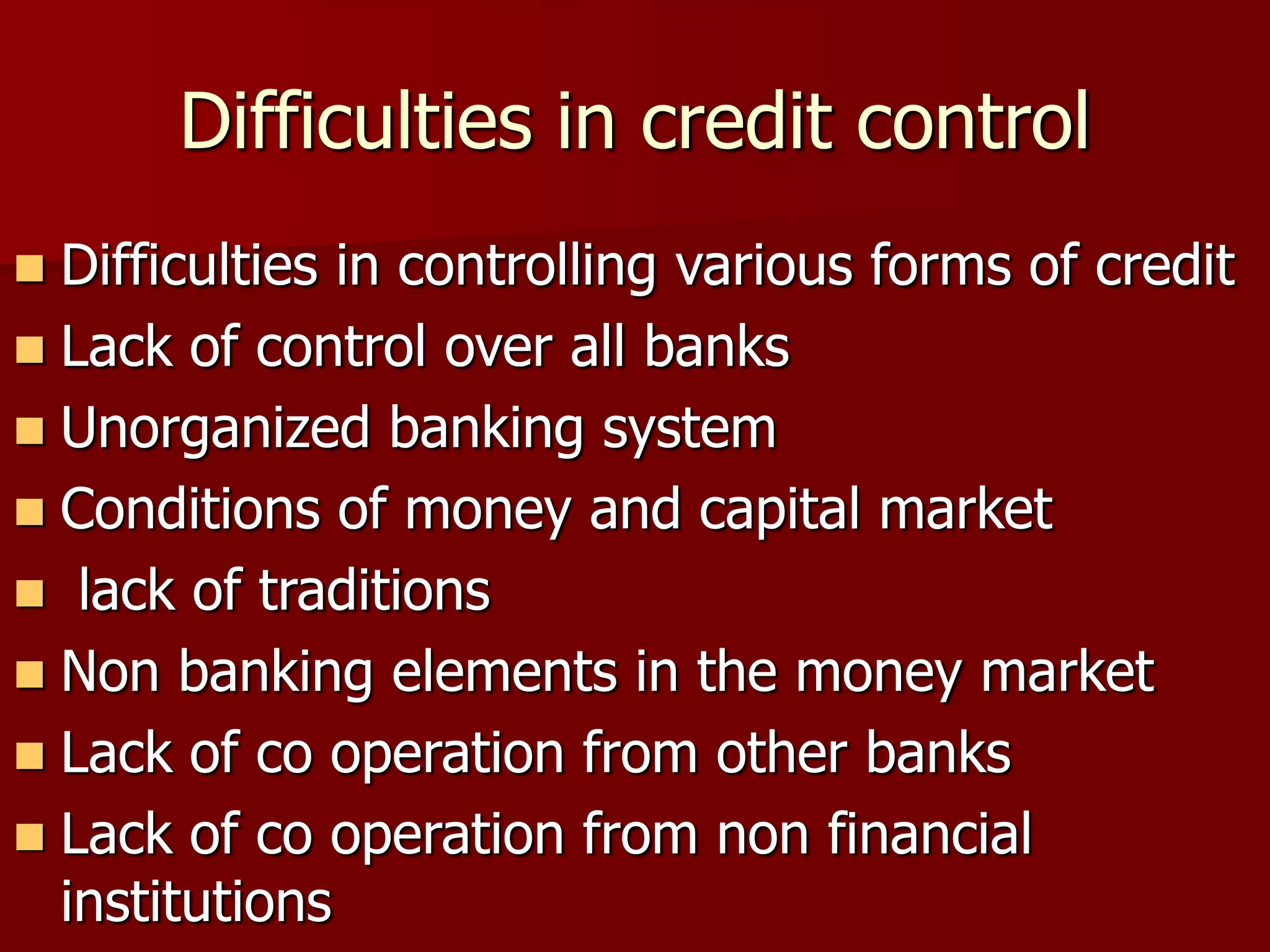
Difficulties in credit control
 Difficulties in controlling various forms of credit
 Lack of control over all banks
 Unorganized banking system
 Conditions of money and capital market
 lack of traditions
 Non banking elements in the money market
 Lack of co operation from other banks
 Lack of co operation from non financial
institutions

Credit-control (1).ppt

  • 1.
  • 2.
    Meaning  Credit Controlrefers to the regulation of credit by the Central Bank for achieving definite objectives
  • 3.
    Objectives of CreditControl  Internal Price stability  Exchange rate stability  Achievement of a high level of Employment and output  Control over trade cycles  Economic planning
  • 4.
    Methods of CreditControl Credit Control Quantitative Qualitative
  • 5.
    Quantitative credit control Bank rate  Open market  Change in cash reserve ratio  Change in liquidity ratio
  • 6.
    Qualitative Credit Control Regulation of consumer’s credit  Change in marginal requirements of loans  Rationing of credit  Moral Persuasion  Publicity  Direct action
  • 7.
    Quantitative Credit Control Bank Rate  It is rate of interest at which the central bank rediscounts the first class securities of other banks.  Also called Discount Rate
  • 8.
    Bank rate policy Bank rate policy is that policy by which the Central Bank controls the credit creation of the banks  Contraction of credit  Expansion of credit
  • 9.
    Conditions of successof Bank Rate  Relationship between different rates  Elasticity in the economy  Psychology of the investors
  • 10.
    Limitations of Bankrate policy in underdeveloped countries  Long term effect  Less elastic  Unorganised bill market  No increase in deposits  International flow of capital  Less dependence  Ignores the rate of profit  Less effective in planned economies
  • 11.
    Open market operations In broader sense, open market operation refers to the sale and purchase of securities by central bank in the open market  In narrow sense, when the central bank or the Government buys or sells only the government securities then it is called open market operations
  • 12.
    Open Market OperationPolicy  Contraction of credit  Expansion of credit
  • 13.
    Objectives of openmarket operations  To remove the effects of inflow and outflow of gold under gold standard  To check the export of capital to other countries  To regulate the power of the banks to expand credit  To remove the shortage of money in money market  To control credit properly by supplementing bank rate policy in the event of bank rate proving ineffective
  • 14.
    Limitations of openmarket operations  Influence on the cash reserve ratio of banks  Change in the credit policy of the banks  Demand and supply of securities  No change in the credit policy of the customers  Powers of the central bank to purchase and sell securities  The money market should be well organised  Normal conditions
  • 15.
    Difference between Bankrate and open market operations Open market 1. Function independently 2. It influence the rate of interest directly 3. Have immediate effect on both short and long term effect on ROI 4. They can be changed as many times as possible during a week, day and month 5. This policy is free from such compulsions on all banks Bank rate Does not function independently It influence rate of interest indirectly Has immediate effect on short term ROI and but its long term effect is very slow It is not possible to change bank rate again and again Change in bank rate implies a sort of compulsion on the commercial banks to increase or decrease the market rate of interest
  • 16.
    Change in cashreserve ratio  According to this policy all banks must keep a certain percentage of their deposits with the central bank as reserve fund
  • 17.
    Policy of variationin CRR  When central bank has to control credit it raises the ratio of CRR  When central bank has to expand credit it lowers its CRR
  • 18.
    Change in liquidityratio  According to it, the banks have to keep compulsorily a certain portion of their assets in liquid form. It comprises cash and government securities, it also curtails the power of the commercial banks to create credit
  • 19.
    Qualitative or Selectivecredit control  Changes in the marginal requirement of loans  Regulation of consumers credit  Moral persuasion  Publicity and propaganda  Direct action
  • 20.
    Choice between qualitativeand quantitative control Qualitative credit control 1. It is more direct and effective 2. It influence both creditors and debtors 3. It do not make any distinction between essential and non essential credit 4. It control the entire quantity of method Quantitative credit control It has its initial impact on some external conditions It influence creditors alone It makes the distinction It control the use of credit for specific purposes
  • 21.
    Difficulties in creditcontrol  Difficulties in controlling various forms of credit  Lack of control over all banks  Unorganized banking system  Conditions of money and capital market  lack of traditions  Non banking elements in the money market  Lack of co operation from other banks  Lack of co operation from non financial institutions