Pratiksha
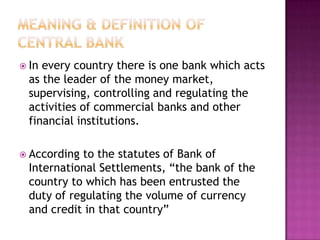
 In

every country there is one bank which acts
as the leader of the money market,
supervising, controlling and regulating the
activities of commercial banks and other
financial institutions.

 According

to the statutes of Bank of
International Settlements, “the bank of the
country to which has been entrusted the
duty of regulating the volume of currency
and credit in that country”
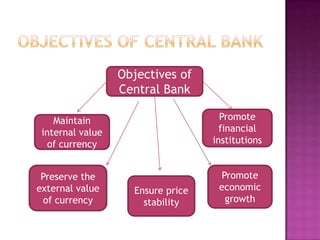
Objectives of
Central Bank
Promote
financial
institutions

Maintain
internal value
of currency
Preserve the
external value
of currency

Ensure price
stability

Promote
economic
growth
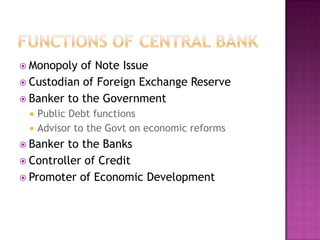
 Monopoly

of Note Issue
 Custodian of Foreign Exchange Reserve
 Banker to the Government




Public Debt functions
Advisor to the Govt on economic reforms

 Banker

to the Banks
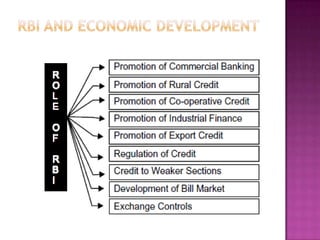
 Controller of Credit
 Promoter of Economic Development
 Custodian
 Lender

of cash reserves

of last resort

 Clearing

agent
 It

means the regulation of the creation and
contraction of credit in the economy.

 Objectives






of Credit control

Stability of Internal Price-level
Checking Booms and Depressions
Promotion of Economic Development
Stability of the Money Market
Stability in Exchange Rates
 Quantitative

controls are designed to
regulate the volume of credit created by the
banking system. These measures work
through influencing the demand and supply
of credit.

 Qualititative

measures, on the other hand,
are designed to regulate the flow of credit in
specific uses.
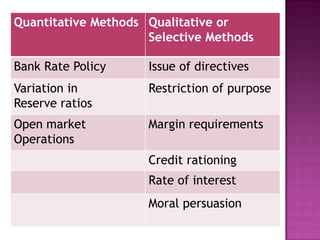
Quantitative Methods Qualitative or
Selective Methods
Bank Rate Policy

Issue of directives

Variation in
Reserve ratios

Restriction of purpose

Open market
Operations

Margin requirements
Credit rationing
Rate of interest
Moral persuasion
 Bank

rate refers to the official minimum lending
rate of interest of the central bank.
 It is the rate at which the central bank advances
loans to the commercial banks by rediscounting
the approved first class bills of exchange of the
banks.
 Hence, bank rate is also called as the discount
rate.
 Theory

of Bank Rate- affects the supply of

credit.
 Working



of Bank Rate

Inflationary scenario
Deflationary scenario

 The

Process of Bank Rate Influence

 Limitations

for Bank Rate
 Open

market operations refer to the
purchase and sale of securities by the central
bank.
 In its broader sense, the term includes the
purchase and sale of both government and
private securities.
 But, in its narrow connotation, open market
operations embrace the purchase and sale of
government securities only
 Theory

of Open Market Operations

 Objectives







of Open Market Operations

To eliminate the effects of exports and imports
to gold under the gold standard.
To impose a check on the export of capital.
To remove the shortage of money in the money
market.
To make bank rate more effective.
To prevent a „run on the bank‟.
 Conditions







for OPM

Institutional Framework
Legal Framework
Maintenance of a Definite Cash Reserve Ratio
Non-operation of Extraneous Factors
Non-existence of Direct Access of Commercial
Banks to the Central Bank

 Limitations

for OPM
 Variable

Reserve Ratio refers to the
percentage of the deposits of the
commercial banks to be maintained with the
central bank, being subject to variations by
the central bank.

 In

other words, altering the reserve
requirements of the commercial banks is
called variable reserve ratio.
 Theory


of VRR

The theory underlying the mechanism of variable
reserve ratio is that by varying the reserve
requirements of the banks, the central bank is in a
position to influence the size of credit multiplier
of the banks and therefore the supply of credit in
the economy.

 Working

of Variable Reserve Ratio

 Limitations

of VRR
o





Distinguish between
essential and nonessential uses of bank
credit.
Only non-essential uses
are brought under the
scope of central bank
controls.
Affect not only the
lenders but also the
borrowers.











Features of Selective
Measures

Divert the flow of credit
Regulate a particular sector of
the economy
Regulate the supply of
consumer credit.
Stabilise the prices of inflation
sensitive goods.
Stabilise the value of
securities.
Correct an unfavourable BoP
Bring under the control of the
central bank
Exercise control upon the
lending operations of the
commercial banks.

Objectives
 Margin

Requirements
 Regulation of Consumer Credit




They limited the amount of credit that might be
granted for the purchase of any article listed in
the regulations; and
They limited the time that might be agreed upon
for repaying the obligation

 Rationing



of Credit

Fixes a limit upon its rediscounting facilities for any
particular bank.
Fixes the quota of every affiliated bank for financial
accommodation from the central bank.
 Control


through Directives

With direct power of controlling bank advances
either by statute or by mutual consent between
the central bank and commercial banks.

 Moral

Suasion

 Direct

Action

 Publicity









The selective controls embrace the commercial banks
only and hence the nonbanking financial institutions are
not covered by these controls.
It is very difficult to control the ultimate use of credit by
the borrowers.
It is rather difficult to draw a line of distinction between
the productive and unproductive uses of credit.
It is quite possible that the banks themselves through
manipulations advance loans for unproductive purposes.
Selective controls do not have much scope under a
system of unit banking.
Development of alternative methods of business
financing has reduced the importance of selective
controls.


Quantitative or general methods or instruments.
Bank rate
 Open Market Operations
 Cash Reserve Ratio (CRR)
 Statutory Liquidity Ratio (SLR)




Qualitative or selective methods or instruments.







Variation of Margin Requirements
Credit Authorization Scheme (CAS) & Credit
Monitoring Arrangement (CAM)
Control of Bank Advances
Differential Interest Rates
Credit Squeeze Policy
Moral suasion
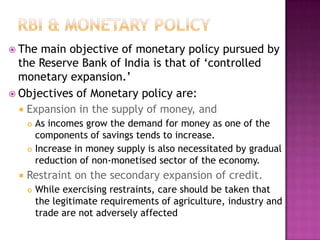
 The

main objective of monetary policy pursued by
the Reserve Bank of India is that of „controlled
monetary expansion.‟
 Objectives of Monetary policy are:
 Expansion in the supply of money, and
As incomes grow the demand for money as one of the
components of savings tends to increase.
 Increase in money supply is also necessitated by gradual
reduction of non-monetised sector of the economy.




Restraint on the secondary expansion of credit.


While exercising restraints, care should be taken that
the legitimate requirements of agriculture, industry and
trade are not adversely affected
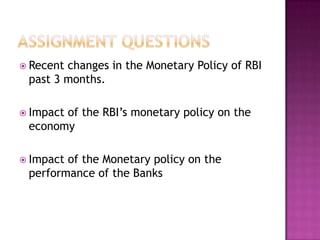
 Recent

changes in the Monetary Policy of RBI
past 3 months.

 Impact

of the RBI‟s monetary policy on the
economy

 Impact

of the Monetary policy on the
performance of the Banks

Central banks

  • 1.
  • 2.
     In every countrythere is one bank which acts as the leader of the money market, supervising, controlling and regulating the activities of commercial banks and other financial institutions.  According to the statutes of Bank of International Settlements, “the bank of the country to which has been entrusted the duty of regulating the volume of currency and credit in that country”
  • 3.
    Objectives of Central Bank Promote financial institutions Maintain internalvalue of currency Preserve the external value of currency Ensure price stability Promote economic growth
  • 4.
     Monopoly of NoteIssue  Custodian of Foreign Exchange Reserve  Banker to the Government   Public Debt functions Advisor to the Govt on economic reforms  Banker to the Banks  Controller of Credit  Promoter of Economic Development
  • 5.
     Custodian  Lender ofcash reserves of last resort  Clearing agent
  • 6.
     It means theregulation of the creation and contraction of credit in the economy.  Objectives      of Credit control Stability of Internal Price-level Checking Booms and Depressions Promotion of Economic Development Stability of the Money Market Stability in Exchange Rates
  • 7.
     Quantitative controls aredesigned to regulate the volume of credit created by the banking system. These measures work through influencing the demand and supply of credit.  Qualititative measures, on the other hand, are designed to regulate the flow of credit in specific uses.
  • 8.
    Quantitative Methods Qualitativeor Selective Methods Bank Rate Policy Issue of directives Variation in Reserve ratios Restriction of purpose Open market Operations Margin requirements Credit rationing Rate of interest Moral persuasion
  • 9.
     Bank rate refersto the official minimum lending rate of interest of the central bank.  It is the rate at which the central bank advances loans to the commercial banks by rediscounting the approved first class bills of exchange of the banks.  Hence, bank rate is also called as the discount rate.
  • 10.
     Theory of BankRate- affects the supply of credit.  Working   of Bank Rate Inflationary scenario Deflationary scenario  The Process of Bank Rate Influence  Limitations for Bank Rate
  • 11.
     Open market operationsrefer to the purchase and sale of securities by the central bank.  In its broader sense, the term includes the purchase and sale of both government and private securities.  But, in its narrow connotation, open market operations embrace the purchase and sale of government securities only
  • 12.
     Theory of OpenMarket Operations  Objectives      of Open Market Operations To eliminate the effects of exports and imports to gold under the gold standard. To impose a check on the export of capital. To remove the shortage of money in the money market. To make bank rate more effective. To prevent a „run on the bank‟.
  • 13.
     Conditions      for OPM InstitutionalFramework Legal Framework Maintenance of a Definite Cash Reserve Ratio Non-operation of Extraneous Factors Non-existence of Direct Access of Commercial Banks to the Central Bank  Limitations for OPM
  • 14.
     Variable Reserve Ratiorefers to the percentage of the deposits of the commercial banks to be maintained with the central bank, being subject to variations by the central bank.  In other words, altering the reserve requirements of the commercial banks is called variable reserve ratio.
  • 15.
     Theory  of VRR Thetheory underlying the mechanism of variable reserve ratio is that by varying the reserve requirements of the banks, the central bank is in a position to influence the size of credit multiplier of the banks and therefore the supply of credit in the economy.  Working of Variable Reserve Ratio  Limitations of VRR
  • 16.
    o   Distinguish between essential andnonessential uses of bank credit. Only non-essential uses are brought under the scope of central bank controls. Affect not only the lenders but also the borrowers.         Features of Selective Measures Divert the flow of credit Regulate a particular sector of the economy Regulate the supply of consumer credit. Stabilise the prices of inflation sensitive goods. Stabilise the value of securities. Correct an unfavourable BoP Bring under the control of the central bank Exercise control upon the lending operations of the commercial banks. Objectives
  • 17.
     Margin Requirements  Regulationof Consumer Credit   They limited the amount of credit that might be granted for the purchase of any article listed in the regulations; and They limited the time that might be agreed upon for repaying the obligation  Rationing   of Credit Fixes a limit upon its rediscounting facilities for any particular bank. Fixes the quota of every affiliated bank for financial accommodation from the central bank.
  • 18.
     Control  through Directives Withdirect power of controlling bank advances either by statute or by mutual consent between the central bank and commercial banks.  Moral Suasion  Direct Action  Publicity
  • 19.
          The selective controlsembrace the commercial banks only and hence the nonbanking financial institutions are not covered by these controls. It is very difficult to control the ultimate use of credit by the borrowers. It is rather difficult to draw a line of distinction between the productive and unproductive uses of credit. It is quite possible that the banks themselves through manipulations advance loans for unproductive purposes. Selective controls do not have much scope under a system of unit banking. Development of alternative methods of business financing has reduced the importance of selective controls.
  • 20.
     Quantitative or generalmethods or instruments. Bank rate  Open Market Operations  Cash Reserve Ratio (CRR)  Statutory Liquidity Ratio (SLR)   Qualitative or selective methods or instruments.       Variation of Margin Requirements Credit Authorization Scheme (CAS) & Credit Monitoring Arrangement (CAM) Control of Bank Advances Differential Interest Rates Credit Squeeze Policy Moral suasion
  • 21.
     The main objectiveof monetary policy pursued by the Reserve Bank of India is that of „controlled monetary expansion.‟  Objectives of Monetary policy are:  Expansion in the supply of money, and As incomes grow the demand for money as one of the components of savings tends to increase.  Increase in money supply is also necessitated by gradual reduction of non-monetised sector of the economy.   Restraint on the secondary expansion of credit.  While exercising restraints, care should be taken that the legitimate requirements of agriculture, industry and trade are not adversely affected
  • 24.
     Recent changes inthe Monetary Policy of RBI past 3 months.  Impact of the RBI‟s monetary policy on the economy  Impact of the Monetary policy on the performance of the Banks