Creative Nonfiction
Creative nonfiction is a genre that
combines elements of both
literature and journalism to
present factual information in a
compelling and artistic manner.
Fiction VS Creative Nonfiction
Fiction involves
creating imaginary
stories and
characters.
Creative nonfiction
focuses on real
events, people, and
experiences
TYPES OF CREATIVE
NONFICTION
Blog Travelogue
Personal
Narrative
Testimonio Biography Autobiography
Memoir
Literary
Journalism
Personal
journal
Blog
 Blog, short for "weblog," is a website or a section
of a website where written content is regularly
published in a chronological order.
 Blogs typically consist of articles, essays, or posts
written in a conversational or informative style.
 Blogs allow for longer-form written content and
provide the opportunity for readers to engage
through comments and discussions.
 Bloggers often cover a wide range of topics and
have the flexibility to include various media
elements such as images, videos, and links within
their posts.
Vlog
A vlog, short for "video blog," is a form of online content
creation where individuals or creators record and publish
videos instead of written articles.
Vlogs are usually hosted on platforms such as YouTube or
Vimeo and feature the vlogger speaking directly to the camera,
documenting their experiences, sharing opinions, or providing
information.
Vlog
Vlogs often have a more personal and intimate
feel compared to blogs, as viewers get to see and
hear the vlogger in action.
Vlogs can also incorporate additional visual
elements, such as music, animations, or video
clips, to enhance the storytelling.
Differences
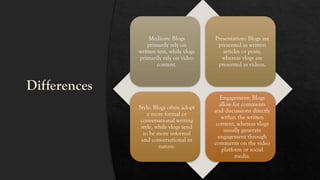
Medium: Blogs
primarily rely on
written text, while vlogs
primarily rely on video
content.
Presentation: Blogs are
presented as written
articles or posts,
whereas vlogs are
presented as videos.
Style: Blogs often adopt
a more formal or
conversational writing
style, while vlogs tend
to be more informal
and conversational in
nature.
Engagement: Blogs
allow for comments
and discussions directly
within the written
content, whereas vlogs
usually generate
engagement through
comments on the video
platform or social
media.
Travelogue
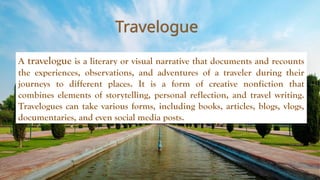
A travelogue is a literary or visual narrative that documents and recounts
the experiences, observations, and adventures of a traveler during their
journeys to different places. It is a form of creative nonfiction that
combines elements of storytelling, personal reflection, and travel writing.
Travelogues can take various forms, including books, articles, blogs, vlogs,
documentaries, and even social media posts.
Key elements and characteristics of travelogues include:
 Destination Focus: Travelogues center around specific locations or regions that the traveler
explores. They may encompass multiple destinations or focus on a single place in detail.
 Personal Perspective: Travelogues reflect the author's unique viewpoint and experiences,
incorporating their personal reflections, emotions, and interactions with the people and
environment.
 Descriptive Detail: Travelogues use descriptive language to paint a vivid picture of the places
visited, capturing the sights, sounds, smells, tastes, and overall atmosphere of each location.
 Cultural Exploration: Travelogues often delve into the local customs, traditions, history, and
social dynamics of the places visited, providing insights into the cultural fabric of the
destinations.
 Adventure and Discovery: Travelogues often highlight the traveler's sense of adventure, as they
embark on new experiences, explore unfamiliar terrain, and encounter unexpected situations.
 Informative and Practical: Travelogues may include practical information such as tips,
recommendations, and advice for other travelers who may visit the same destinations.
Personal Narratives
 Personal narratives are a
form of writing in which the
writer relates one event,
incident, or experience from
his/her life. Personal
narratives allow you, the
writer, to share your life with
others, vicariously
experiencing the things you
describe.
Personal
Narratives
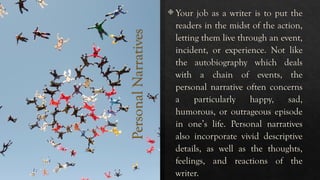
 Your job as a writer is to put the
readers in the midst of the action,
letting them live through an event,
incident, or experience. Not like
the autobiography which deals
with a chain of events, the
personal narrative often concerns
a particularly happy, sad,
humorous, or outrageous episode
in one’s life. Personal narratives
also incorporate vivid descriptive
details, as well as the thoughts,
feelings, and reactions of the
writer.
• Engages the reader by
introducing the narrator
and situation
• Organizes events to
unfold naturally;
manipulates time and
pacing
• Develops details of
events with description
and action
• Develops characters
with physical description
and dialogue
• Uses vivid verbs,
sensory details, similes,
metaphors, alliteration,
onomatopoeia, and
personification to set tone
and mood
• Uses transitions and
varies sentence beginnings
• Closes with a
reflection
• Has all no excuse
words and conventions
correct
• Has exemplary
presentation (neat writing
that is pleasant to read).
When you write personal narratives use the first-person point of view. Also, write a Personal
Narrative that:
Testimonio
Testimonio is a form of creative
nonfiction that emerged in Latin
America as a powerful tool for
marginalized and oppressed communities
to share their stories and challenge
dominant narratives. It combines
elements of oral history, personal
testimony, and literary techniques to give
voice to individuals or communities who
have experienced social injustice, political
repression, or human rights violations.
Key characteristics of testimonio as a creative
nonfiction genre include:
 Authenticity: Testimonio emphasizes the authenticity and veracity of the narrator's account. It seeks to provide an
accurate and truthful representation of the narrator's experiences, often focusing on personal and lived realities.
 Collective Experience: Testimonio often amplifies the voices and perspectives of marginalized communities or
groups rather than individual narratives. It seeks to convey a collective experience of struggle, resistance, or
resilience.
 Collaborative Process: Testimonio is often a collaborative effort between the narrator and a writer or editor who
helps shape and refine the testimonial narrative. This collaboration ensures that the testimonio remains true to
the narrator's voice while adhering to literary standards.
 Political and Social Context: Testimonio is deeply rooted in political and social contexts. It aims to expose and
critique systemic injustices, inequality, human rights abuses, or historical events, offering insights into the social,
cultural, and political realities of a particular time and place.
 Emotional Impact: Testimonio seeks to evoke empathy and emotional connection from readers or listeners. It
often employs vivid storytelling techniques, descriptive language, and personal anecdotes to engage the audience
and generate a deeper understanding of the narrator's experiences.
Biography
Biography
Biography is a form of creative nonfiction
that explores and narrates the life story of
an individual. It involves in-depth
research, interviews, and the synthesis of
factual information to construct a
comprehensive and engaging account of
a person's life.
Biography
Biographies aim to provide an accurate
and objective portrayal of the subject,
while also incorporating literary
techniques to captivate readers and
convey a sense of the person's character,
motivations, and impact.
Key characteristics of biography as a creative nonfiction genre
include:
 Thorough Research: Biographers extensively research their subjects, drawing from
a variety of sources such as historical records, personal letters, interviews with
family, friends, and colleagues, and other primary and secondary sources. The goal
is to gather reliable and comprehensive information about the subject's life.
 Narrative Structure: Biographies often adopt a narrative structure, following the
subject's life chronologically or organizing the story thematically. This allows for a
coherent and engaging presentation of the subject's experiences, achievements, and
challenges.
 Contextualization: Biographies provide historical, cultural, and social context to
situate the subject's life within a broader framework. This contextualization helps
readers understand the influences and impact of the subject on their time and
society.
Key characteristics of biography as a creative nonfiction genre
include:
 Psychological Insight: Biographers delve into the subject's thoughts, emotions, and
motivations, using their research and analysis to offer insights into the person's
character, beliefs, and decision-making processes. This psychological dimension
adds depth and complexity to the narrative.
 Interpretation and Analysis: While biographies strive for objectivity, biographers
often offer interpretations and analysis of the subject's life and actions. This allows
for a deeper understanding of the person's significance and their place in history or
society.
 Engaging Writing Style: Biographies employ literary techniques such as vivid
descriptions, dialogue, and storytelling elements to bring the subject and their story
to life. These techniques make the biography more engaging and readable for the
audience.
Autobiography
Autobiography is a form of creative
nonfiction in which an individual
writes their own life story, recounting
personal experiences, reflections, and
memories. It is a genre that combines
self-reflection, storytelling, and factual
information to create a narrative that
captures the essence of the author's life.
Autobiographies serve as a means for individuals to
reflect on their lives, share their unique perspectives,
and leave a legacy. Through their personal narratives,
authors can inspire, educate, and connect with
readers, providing insight into the human condition
and the diversity of human experiences.
 First-Person Perspective: Autobiographies are written in the first person,
allowing the author to directly share their personal thoughts, feelings, and
experiences. This perspective offers a sense of intimacy and authenticity.
 Subjectivity: Autobiographies reflect the subjective experiences and memories
of the author. They present a personal interpretation of events and provide
insight into the author's emotions, motivations, and growth over time.
 Narrative Structure: Autobiographies often follow a chronological or thematic
structure, organizing events and experiences in a coherent and meaningful
way. This structure helps create a compelling narrative that engages readers
and provides a sense of the author's journey.
Here are key characteristics of autobiography as a creative nonfiction
genre:
 Reflection and Insight: Autobiographies go beyond mere recollections and include
introspection and reflection. Authors analyze their experiences, relationships, and choices,
offering insights into their personal development, beliefs, and values.
 Emotional Connection: Autobiographies aim to establish an emotional connection
between the author and the reader. Through personal anecdotes, descriptions, and
evocative language, authors invite readers to share their joys, challenges, and transformative
moments.
 Authenticity and Truthfulness: Autobiographies are expected to be authentic and truthful
accounts of the author's life. While memory can be fallible, authors strive to provide an
accurate representation of their experiences and events.
Here are key characteristics of autobiography as a creative nonfiction
genre:
 Literary Techniques: Autobiographies often employ various literary
techniques to enhance the storytelling. These techniques include

dialogue, vivid descriptions, character development, and the use of
figurative language to engage readers and bring the narrative to life.
Famous examples of autobiographies include
"The Diary of a Young Girl" by Anne Frank,
"The Autobiography of Malcolm X" as told to
Alex Haley, and "The Story of My Experiments
with Truth" by Mahatma Gandhi.
Memoir
 Memoir is a form of creative
nonfiction that focuses on a
specific period, theme, or
aspect of a person's life. It is
a deeply personal genre that
combines elements of
storytelling, self-reflection,
and factual accuracy to
provide a subjective account
of the author's experiences
and memories.
Here are key characteristics of memoir as a creative
nonfiction genre:
 Personal Perspective: Memoirs are written from the author's personal point of
view, allowing them to delve into their own thoughts, emotions, and memories.
The author's subjective experience and reflections are central to the narrative.
 Selective Focus: Memoirs narrow their scope to a particular time period, theme,
or aspect of the author's life. They may focus on significant events, relationships,
challenges, or transformative moments that have shaped the author's identity or
worldview.
 Emotional Truth: Memoirs aim to convey the emotional truth of the author's
experiences. While facts are important, the focus is on capturing the feelings,
perceptions, and impact of those experiences rather than adhering strictly to a
chronological or factual account.
Here are key characteristics of memoir as a creative
nonfiction genre:
 Introspection and Reflection: Memoirs often delve into the author's self-
reflection and introspection. They explore the author's thoughts, motivations,
and personal growth, offering insights into their own identity and
understanding of the world.
 Narrative Structure: Memoirs follow a narrative structure that weaves together
various events, experiences, and reflections into a cohesive and engaging story.
This structure may employ techniques such as character development, plot arcs,
and storytelling elements to captivate readers.
 Voice and Style: Memoirs showcase the author's unique voice and writing style.
They allow for personal expression, creativity, and literary techniques to enhance
the narrative and engage the reader.
Here are key characteristics of memoir as a creative
nonfiction genre:
 Introspection and Reflection: Memoirs often delve into the author's self-
reflection and introspection. They explore the author's thoughts, motivations,
and personal growth, offering insights into their own identity and
understanding of the world.
 Narrative Structure: Memoirs follow a narrative structure that weaves together
various events, experiences, and reflections into a cohesive and engaging story.
This structure may employ techniques such as character development, plot arcs,
and storytelling elements to captivate readers.
 Voice and Style: Memoirs showcase the author's unique voice and writing style.
They allow for personal expression, creativity, and literary techniques to enhance
the narrative and engage the reader.
Notable examples of memoirs include
"The Glass Castle" by Jeannette Walls,
"Wild" by Cheryl Strayed, and "Angela's
Ashes" by Frank McCourt.
Literary Journalism
Literary journalism is a form of creative
nonfiction that combines elements of
factual reporting with literary techniques
to create engaging and compelling
narratives. It seeks to present nonfiction
stories in a way that incorporates the
artistry and narrative techniques
typically associated with fiction and
literature.
Literary Journalism
Personal Essay: Personal essays in
literary journalism draw on the writer's
personal experiences, reflections, and
observations to explore broader themes
or societal issues. They combine
introspection, storytelling, and analysis
to offer a subjective perspective while
connecting with readers on a personal
level.
Literary Journalism
Personal Essay: Personal essays in
literary journalism draw on the writer's
personal experiences, reflections, and
observations to explore broader themes
or societal issues. They combine
introspection, storytelling, and analysis
to offer a subjective perspective while
connecting with readers on a personal
level.
Literary Journalism
Literary Profiles: Literary profiles
delve into the lives and personalities
of individuals, often prominent
figures or intriguing characters.
They combine biographical details,
personal interviews, and narrative
techniques to offer a compelling
portrait of the subject.
Personal Journal
Personal journaling can indeed be considered a form of creative
nonfiction. Creative nonfiction encompasses various literary
forms that combine elements of storytelling, personal reflection,
and factual accuracy. Personal journaling fits within this
definition as it involves the writer documenting their thoughts,
emotions, experiences, and observations in a creative and
expressive manner.

CREATIVE-NONFICTION-Creative writing.pptx

  • 1.
    Creative Nonfiction Creative nonfictionis a genre that combines elements of both literature and journalism to present factual information in a compelling and artistic manner.
  • 2.
    Fiction VS CreativeNonfiction Fiction involves creating imaginary stories and characters. Creative nonfiction focuses on real events, people, and experiences
  • 3.
    TYPES OF CREATIVE NONFICTION BlogTravelogue Personal Narrative Testimonio Biography Autobiography Memoir Literary Journalism Personal journal
  • 4.
    Blog  Blog, shortfor "weblog," is a website or a section of a website where written content is regularly published in a chronological order.  Blogs typically consist of articles, essays, or posts written in a conversational or informative style.  Blogs allow for longer-form written content and provide the opportunity for readers to engage through comments and discussions.  Bloggers often cover a wide range of topics and have the flexibility to include various media elements such as images, videos, and links within their posts.
  • 5.
    Vlog A vlog, shortfor "video blog," is a form of online content creation where individuals or creators record and publish videos instead of written articles. Vlogs are usually hosted on platforms such as YouTube or Vimeo and feature the vlogger speaking directly to the camera, documenting their experiences, sharing opinions, or providing information.
  • 6.
    Vlog Vlogs often havea more personal and intimate feel compared to blogs, as viewers get to see and hear the vlogger in action. Vlogs can also incorporate additional visual elements, such as music, animations, or video clips, to enhance the storytelling.
  • 7.
    Differences Medium: Blogs primarily relyon written text, while vlogs primarily rely on video content. Presentation: Blogs are presented as written articles or posts, whereas vlogs are presented as videos. Style: Blogs often adopt a more formal or conversational writing style, while vlogs tend to be more informal and conversational in nature. Engagement: Blogs allow for comments and discussions directly within the written content, whereas vlogs usually generate engagement through comments on the video platform or social media.
  • 8.
    Travelogue A travelogue isa literary or visual narrative that documents and recounts the experiences, observations, and adventures of a traveler during their journeys to different places. It is a form of creative nonfiction that combines elements of storytelling, personal reflection, and travel writing. Travelogues can take various forms, including books, articles, blogs, vlogs, documentaries, and even social media posts.
  • 9.
    Key elements andcharacteristics of travelogues include:  Destination Focus: Travelogues center around specific locations or regions that the traveler explores. They may encompass multiple destinations or focus on a single place in detail.  Personal Perspective: Travelogues reflect the author's unique viewpoint and experiences, incorporating their personal reflections, emotions, and interactions with the people and environment.  Descriptive Detail: Travelogues use descriptive language to paint a vivid picture of the places visited, capturing the sights, sounds, smells, tastes, and overall atmosphere of each location.  Cultural Exploration: Travelogues often delve into the local customs, traditions, history, and social dynamics of the places visited, providing insights into the cultural fabric of the destinations.  Adventure and Discovery: Travelogues often highlight the traveler's sense of adventure, as they embark on new experiences, explore unfamiliar terrain, and encounter unexpected situations.  Informative and Practical: Travelogues may include practical information such as tips, recommendations, and advice for other travelers who may visit the same destinations.
  • 10.
    Personal Narratives  Personalnarratives are a form of writing in which the writer relates one event, incident, or experience from his/her life. Personal narratives allow you, the writer, to share your life with others, vicariously experiencing the things you describe.
  • 11.
    Personal Narratives  Your jobas a writer is to put the readers in the midst of the action, letting them live through an event, incident, or experience. Not like the autobiography which deals with a chain of events, the personal narrative often concerns a particularly happy, sad, humorous, or outrageous episode in one’s life. Personal narratives also incorporate vivid descriptive details, as well as the thoughts, feelings, and reactions of the writer.
  • 12.
    • Engages thereader by introducing the narrator and situation • Organizes events to unfold naturally; manipulates time and pacing • Develops details of events with description and action • Develops characters with physical description and dialogue • Uses vivid verbs, sensory details, similes, metaphors, alliteration, onomatopoeia, and personification to set tone and mood • Uses transitions and varies sentence beginnings • Closes with a reflection • Has all no excuse words and conventions correct • Has exemplary presentation (neat writing that is pleasant to read). When you write personal narratives use the first-person point of view. Also, write a Personal Narrative that:
  • 13.
    Testimonio Testimonio is aform of creative nonfiction that emerged in Latin America as a powerful tool for marginalized and oppressed communities to share their stories and challenge dominant narratives. It combines elements of oral history, personal testimony, and literary techniques to give voice to individuals or communities who have experienced social injustice, political repression, or human rights violations.
  • 14.
    Key characteristics oftestimonio as a creative nonfiction genre include:  Authenticity: Testimonio emphasizes the authenticity and veracity of the narrator's account. It seeks to provide an accurate and truthful representation of the narrator's experiences, often focusing on personal and lived realities.  Collective Experience: Testimonio often amplifies the voices and perspectives of marginalized communities or groups rather than individual narratives. It seeks to convey a collective experience of struggle, resistance, or resilience.  Collaborative Process: Testimonio is often a collaborative effort between the narrator and a writer or editor who helps shape and refine the testimonial narrative. This collaboration ensures that the testimonio remains true to the narrator's voice while adhering to literary standards.  Political and Social Context: Testimonio is deeply rooted in political and social contexts. It aims to expose and critique systemic injustices, inequality, human rights abuses, or historical events, offering insights into the social, cultural, and political realities of a particular time and place.  Emotional Impact: Testimonio seeks to evoke empathy and emotional connection from readers or listeners. It often employs vivid storytelling techniques, descriptive language, and personal anecdotes to engage the audience and generate a deeper understanding of the narrator's experiences.
  • 15.
  • 16.
    Biography Biography is aform of creative nonfiction that explores and narrates the life story of an individual. It involves in-depth research, interviews, and the synthesis of factual information to construct a comprehensive and engaging account of a person's life.
  • 17.
    Biography Biographies aim toprovide an accurate and objective portrayal of the subject, while also incorporating literary techniques to captivate readers and convey a sense of the person's character, motivations, and impact.
  • 18.
    Key characteristics ofbiography as a creative nonfiction genre include:  Thorough Research: Biographers extensively research their subjects, drawing from a variety of sources such as historical records, personal letters, interviews with family, friends, and colleagues, and other primary and secondary sources. The goal is to gather reliable and comprehensive information about the subject's life.  Narrative Structure: Biographies often adopt a narrative structure, following the subject's life chronologically or organizing the story thematically. This allows for a coherent and engaging presentation of the subject's experiences, achievements, and challenges.  Contextualization: Biographies provide historical, cultural, and social context to situate the subject's life within a broader framework. This contextualization helps readers understand the influences and impact of the subject on their time and society.
  • 19.
    Key characteristics ofbiography as a creative nonfiction genre include:  Psychological Insight: Biographers delve into the subject's thoughts, emotions, and motivations, using their research and analysis to offer insights into the person's character, beliefs, and decision-making processes. This psychological dimension adds depth and complexity to the narrative.  Interpretation and Analysis: While biographies strive for objectivity, biographers often offer interpretations and analysis of the subject's life and actions. This allows for a deeper understanding of the person's significance and their place in history or society.  Engaging Writing Style: Biographies employ literary techniques such as vivid descriptions, dialogue, and storytelling elements to bring the subject and their story to life. These techniques make the biography more engaging and readable for the audience.
  • 20.
    Autobiography Autobiography is aform of creative nonfiction in which an individual writes their own life story, recounting personal experiences, reflections, and memories. It is a genre that combines self-reflection, storytelling, and factual information to create a narrative that captures the essence of the author's life.
  • 21.
    Autobiographies serve asa means for individuals to reflect on their lives, share their unique perspectives, and leave a legacy. Through their personal narratives, authors can inspire, educate, and connect with readers, providing insight into the human condition and the diversity of human experiences.
  • 22.
     First-Person Perspective:Autobiographies are written in the first person, allowing the author to directly share their personal thoughts, feelings, and experiences. This perspective offers a sense of intimacy and authenticity.  Subjectivity: Autobiographies reflect the subjective experiences and memories of the author. They present a personal interpretation of events and provide insight into the author's emotions, motivations, and growth over time.  Narrative Structure: Autobiographies often follow a chronological or thematic structure, organizing events and experiences in a coherent and meaningful way. This structure helps create a compelling narrative that engages readers and provides a sense of the author's journey. Here are key characteristics of autobiography as a creative nonfiction genre:
  • 23.
     Reflection andInsight: Autobiographies go beyond mere recollections and include introspection and reflection. Authors analyze their experiences, relationships, and choices, offering insights into their personal development, beliefs, and values.  Emotional Connection: Autobiographies aim to establish an emotional connection between the author and the reader. Through personal anecdotes, descriptions, and evocative language, authors invite readers to share their joys, challenges, and transformative moments.  Authenticity and Truthfulness: Autobiographies are expected to be authentic and truthful accounts of the author's life. While memory can be fallible, authors strive to provide an accurate representation of their experiences and events. Here are key characteristics of autobiography as a creative nonfiction genre:
  • 24.
     Literary Techniques:Autobiographies often employ various literary techniques to enhance the storytelling. These techniques include dialogue, vivid descriptions, character development, and the use of figurative language to engage readers and bring the narrative to life.
  • 25.
    Famous examples ofautobiographies include "The Diary of a Young Girl" by Anne Frank, "The Autobiography of Malcolm X" as told to Alex Haley, and "The Story of My Experiments with Truth" by Mahatma Gandhi.
  • 26.
    Memoir  Memoir isa form of creative nonfiction that focuses on a specific period, theme, or aspect of a person's life. It is a deeply personal genre that combines elements of storytelling, self-reflection, and factual accuracy to provide a subjective account of the author's experiences and memories.
  • 27.
    Here are keycharacteristics of memoir as a creative nonfiction genre:  Personal Perspective: Memoirs are written from the author's personal point of view, allowing them to delve into their own thoughts, emotions, and memories. The author's subjective experience and reflections are central to the narrative.  Selective Focus: Memoirs narrow their scope to a particular time period, theme, or aspect of the author's life. They may focus on significant events, relationships, challenges, or transformative moments that have shaped the author's identity or worldview.  Emotional Truth: Memoirs aim to convey the emotional truth of the author's experiences. While facts are important, the focus is on capturing the feelings, perceptions, and impact of those experiences rather than adhering strictly to a chronological or factual account.
  • 28.
    Here are keycharacteristics of memoir as a creative nonfiction genre:  Introspection and Reflection: Memoirs often delve into the author's self- reflection and introspection. They explore the author's thoughts, motivations, and personal growth, offering insights into their own identity and understanding of the world.  Narrative Structure: Memoirs follow a narrative structure that weaves together various events, experiences, and reflections into a cohesive and engaging story. This structure may employ techniques such as character development, plot arcs, and storytelling elements to captivate readers.  Voice and Style: Memoirs showcase the author's unique voice and writing style. They allow for personal expression, creativity, and literary techniques to enhance the narrative and engage the reader.
  • 29.
    Here are keycharacteristics of memoir as a creative nonfiction genre:  Introspection and Reflection: Memoirs often delve into the author's self- reflection and introspection. They explore the author's thoughts, motivations, and personal growth, offering insights into their own identity and understanding of the world.  Narrative Structure: Memoirs follow a narrative structure that weaves together various events, experiences, and reflections into a cohesive and engaging story. This structure may employ techniques such as character development, plot arcs, and storytelling elements to captivate readers.  Voice and Style: Memoirs showcase the author's unique voice and writing style. They allow for personal expression, creativity, and literary techniques to enhance the narrative and engage the reader.
  • 30.
    Notable examples ofmemoirs include "The Glass Castle" by Jeannette Walls, "Wild" by Cheryl Strayed, and "Angela's Ashes" by Frank McCourt.
  • 31.
    Literary Journalism Literary journalismis a form of creative nonfiction that combines elements of factual reporting with literary techniques to create engaging and compelling narratives. It seeks to present nonfiction stories in a way that incorporates the artistry and narrative techniques typically associated with fiction and literature.
  • 32.
    Literary Journalism Personal Essay:Personal essays in literary journalism draw on the writer's personal experiences, reflections, and observations to explore broader themes or societal issues. They combine introspection, storytelling, and analysis to offer a subjective perspective while connecting with readers on a personal level.
  • 33.
    Literary Journalism Personal Essay:Personal essays in literary journalism draw on the writer's personal experiences, reflections, and observations to explore broader themes or societal issues. They combine introspection, storytelling, and analysis to offer a subjective perspective while connecting with readers on a personal level.
  • 34.
    Literary Journalism Literary Profiles:Literary profiles delve into the lives and personalities of individuals, often prominent figures or intriguing characters. They combine biographical details, personal interviews, and narrative techniques to offer a compelling portrait of the subject.
  • 35.
    Personal Journal Personal journalingcan indeed be considered a form of creative nonfiction. Creative nonfiction encompasses various literary forms that combine elements of storytelling, personal reflection, and factual accuracy. Personal journaling fits within this definition as it involves the writer documenting their thoughts, emotions, experiences, and observations in a creative and expressive manner.