Our goal:
“Universal access to research
and education, full participation
in culture.”
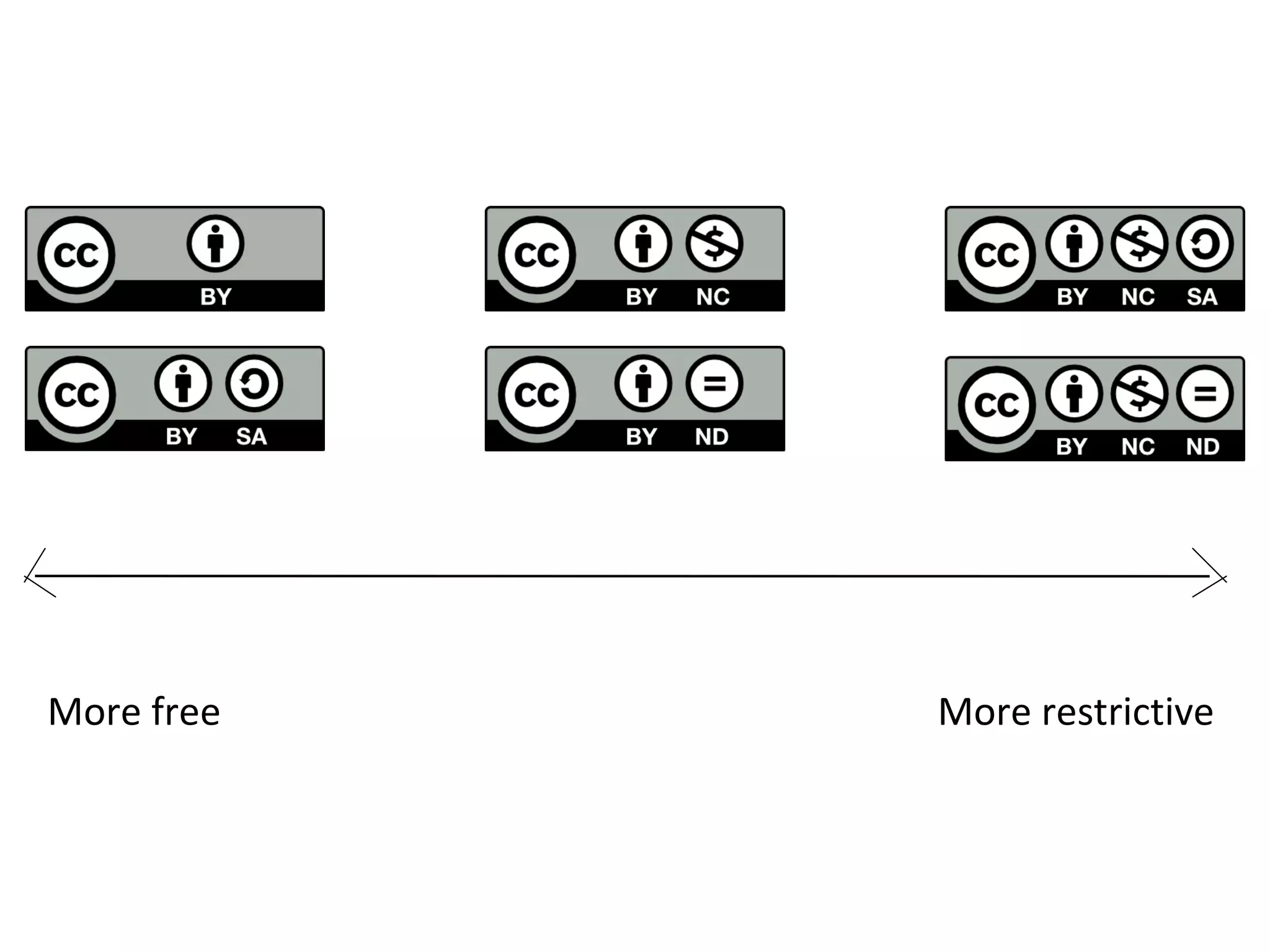
More free More restrictive
1
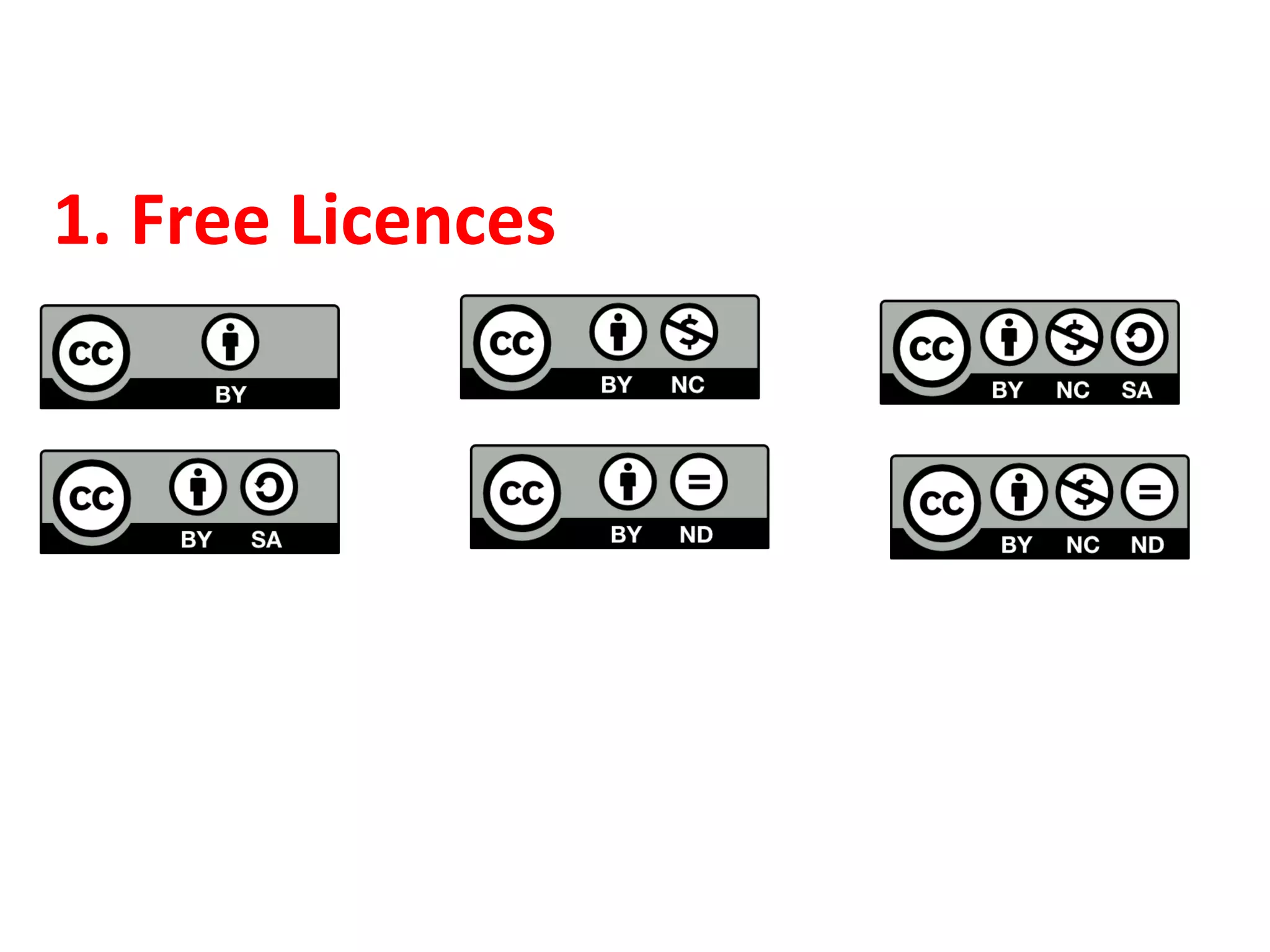
1. Free Licences
2. Projects
We argue:
Educational resources should be
shared openly, to enable anyone
to share, adapt and reuse
First (obvious) point:
It's much easier to share work for
collaboration and reuse.
This massively increases the
potential audience for (your)
educational resources
→ not just the teachers in your
school, area or email list
This means you cannot predict
who will find your work useful.
Media Text Hack
There's more content than ever
(and it's easy to find & use).
Man from the city, 1971, by Jan Nigro. Purchased 1971. Te Papa
(1971-0036-2)
Creative Commons BY-NC-ND 3.0 New Zealand licenceTe Papa
The technical barriers to access
and reuse are dropping
‘Lego Life Lessons’ by the Manning Brothers.
CC-BY-NC-SA
youtube.com/watch?v=z9p6n3lhpcsLego Life Lessons
However, the legal barriers to
dissemination & reuse remain.
Copyright Graffiti Sign by Horia Varlan
CC-BY
https://flic.kr/p/7vBD4TCopyright
Copyright is very restrictive.
Automatic.
Applies online.
No 'c' required.
Lasts for 50 years after death.
Teachers don’t own copyright
to resources they produce in
the course of their employment
→ the BoT does.
Most schools don't have clear
IP policies on sharing & reuse.
“Grayson, Westley, Stanislaus County...” via US Nat. Archives
No Known Copyright
https://flic.kr/p/8UAPVTWhat to Do?.
Solution:
Develop, share and reuse Open
Educational Resources
#1:
School: Adopt clear & transparent
copyright policies
BoTs can adapt our free off-the-shelf
policy at
resources.creativecommons.org.nz
This policy simply gives
permission for teachers to
share.
Cabinet encourages BoTs to take
NZGOAL into account & use CC
licensing when releasing
resources
1. No need to ask permission
2. Keep resources when you leave
3. Teachers receive credit when
their work is reused
4. Share your work on Pond.
#2:
Teacher: Introduce finding,
reusing and making open content
into your 'workflow'
Bake in openness from the
beginning by reusing open
content
Here's the pitch:
Creative Commons licences are
clear, simple, free, legally robust
and you keep your copyright.
Here's the pitch:
CC policies clarify IP at schools,
while enabling sharing and
collaboration.
Four Licence Elements
Attribution
Non Commercial
No Derivatives
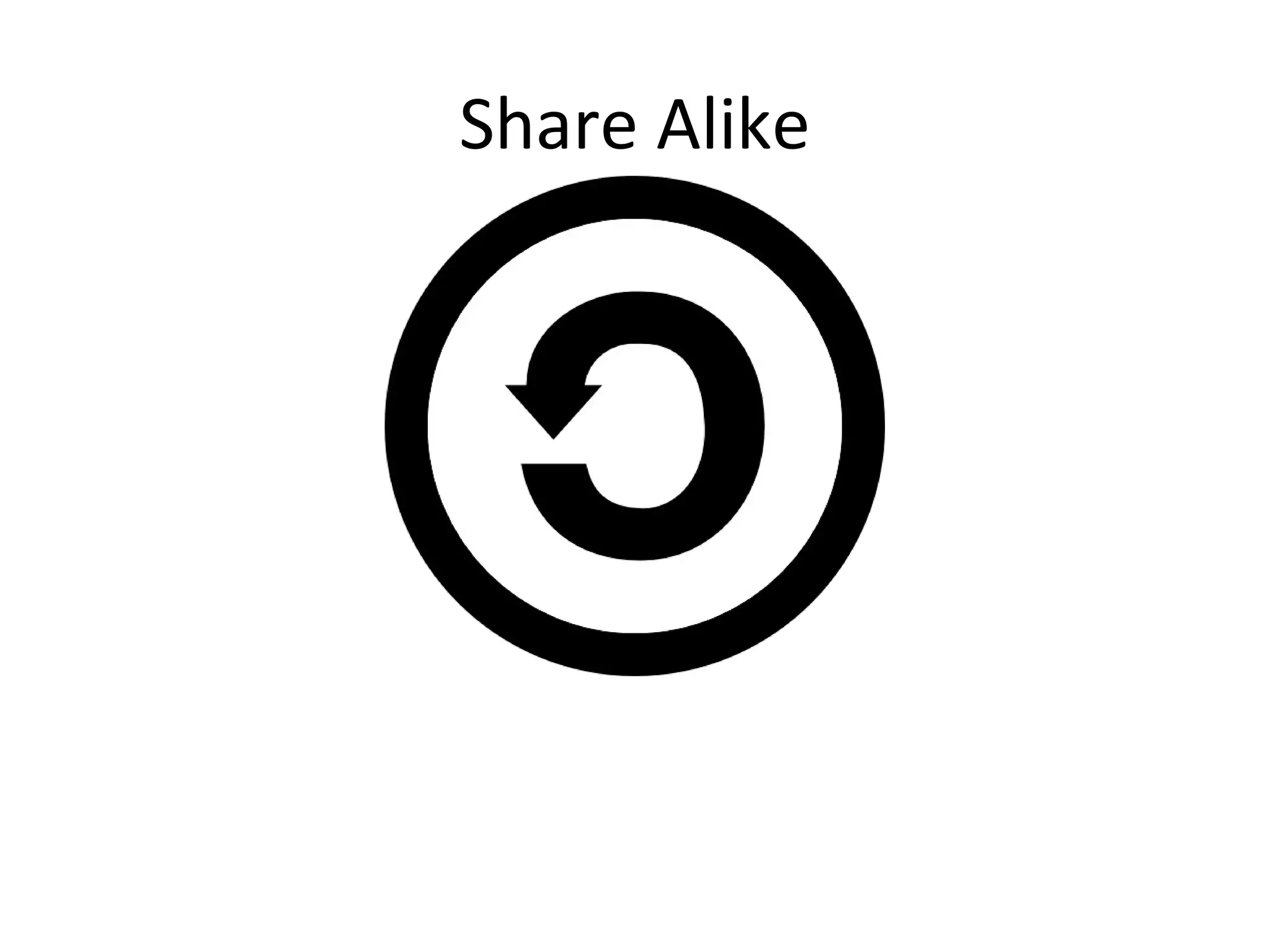
Share Alike
Six Licences
More free More restrictive
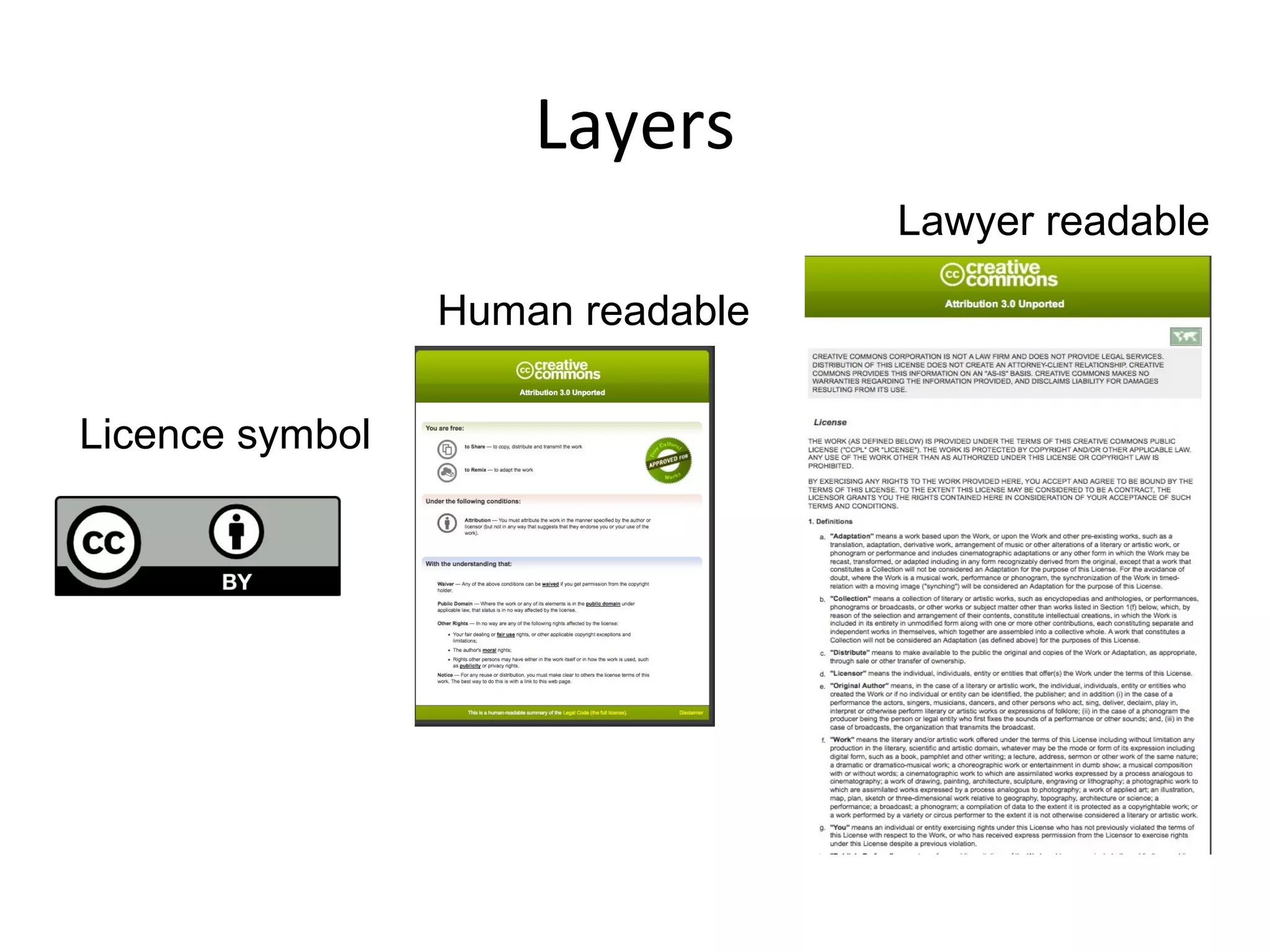
Layers
Licence symboll
Human readable
Lawyer readable
Go to creativecommons.org/choose
https://docs.google.com/document/d/1cIW
mV5nCF8o97Nrb8wYZWfQ97FG-
4ylNuXezh2nlBBM/edit
What else is happening in New
Zealand?
LINZ
National Imagery Photography by LINZ.
Licensed CC-BY
data.linz.govt.nz/data/category/aerial-photos/
Man from the city, 1971, by Jan Nigro. Purchased 1971. Te Papa
(1971-0036-2)
Creative Commons BY-NC-ND 3.0 New Zealand licenceTe Papa
Massed troops at a New Zealand Division thanksgiving service, World
War I. Ref: 1/2-013806-G. No known copyright.
http://natlib.govt.nz/records/22684353NLNZ; WW100
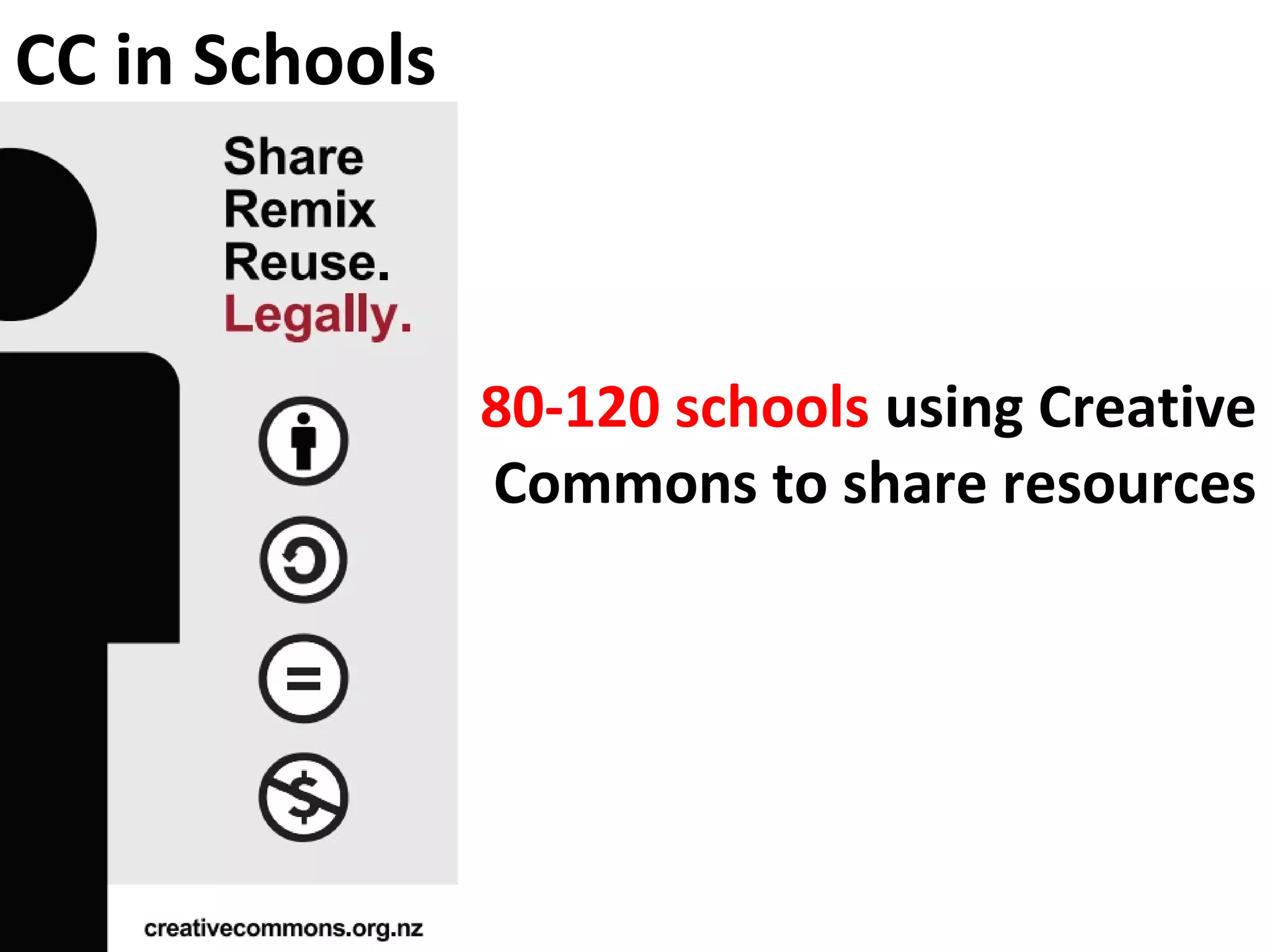
CC in Schools
80-120 schools using Creative
Commons to share resources
Open Access
Research
Open Textbooks
Meena Kadri
‘Uttarayan Sunset’ by Meena Kadri.
CC-BY-NC-ND
flickr.com/photos/meanestindian/5357432362/
“Folding Kimono” by Jem Yoshioka
CC-BY-SA
http://jemshed.com/comic/folding-kimono/Jem Yoshioka
New resources to help:
resources.creativecommons.org.nz
–Introductory paper
–Annotated policy
–Brochure
–Poster
–Videos
–Case studies
–And more to come...
creativecommons.org.nz
@cc_aotearoa
matt@creativecommons.org.nz
groups.creativecommons.org.nz
This work is licensed under a
Creative Commons Attribution 4.0
International License.

Creative Commons for Koroanui School