







Creating
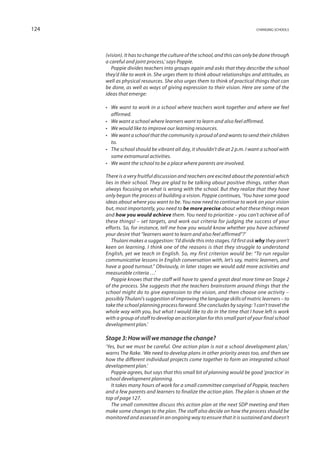
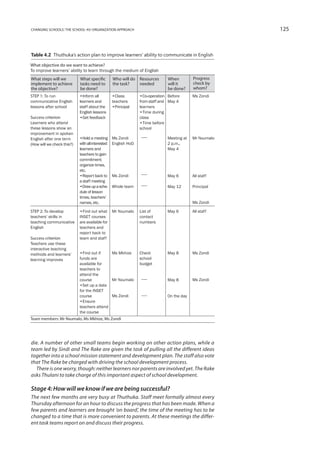
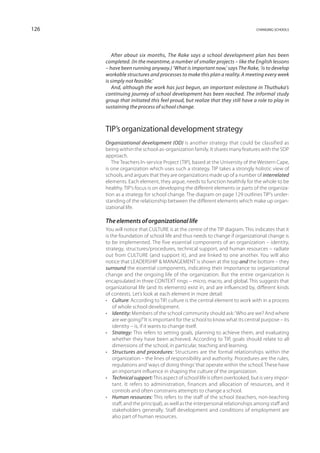
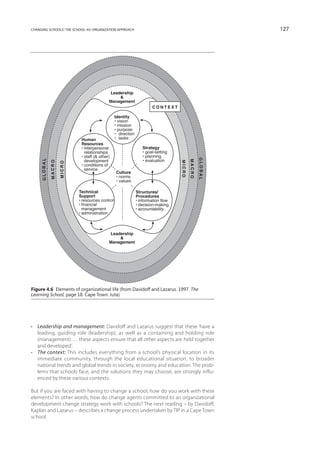
People-centred
Schools
School Organization and Change
in South Africa
Writers | Themba Ndhlovu, Carol Bertram,
Nonhlanhla Mthiyane and Neil Avery
Editor | John Gultig, Dawn Butler


The SAIDE Teacher Education Series
Creating
People-centred
       Schools
        School Organization
  and Change in South Africa


     Learning Guide

             Themba Ndhlovu
                Carol Bertram
          Nonhlanhla Mthiyane
                    Neil Avery


                     Series Editor

                    John Gultig
                    Dawn Butler
Creating People-Centred Schools
ISBN 978-0-9869837-1-9
© 2010 SAIDE
               This work, a digital version of the SAIDE/Oxford publication of 2002, is
               released under the Creative Commons Attribution 3.0 licence.


1ST EDITION EDITOR: John Gultig, Dawn Butler
1ST EDITION VIDEOTAPE: Kagiso Educational Television, with Themba Ndhlovu and John Gultig
1ST EDITION AUDIOTAPE: Ulwazi Educational Radio, with John Gultig and Mike Adendorff
DESIGN FOR DIGITAL VERSION: Michelle Randell
ILLUSTRATIONS: Carol Sieweke

SAIDE	
PO Box 31822	
Braamfontein 2017	
T: (011) 403 2813	
F: (011) 403 2814	
www.saide.org.za; www.oerafrica.org
The first edition was funded by the WK Kellogg foundation. This digital
version has been funded through the International Association of
Digital Publications.
Section Four


Changing schools


4.1	 Understanding change: first ideas  ...............................................  95

4.2	The complexity of change processes  ..........................................  99

4.3	 Approaching change systemically  ............................................   107

4.4	 Coping with the fears evoked by change  . ..............................   113

4.5	 Leading and managing change  .................................................   116

4.6	Changing schools: the school-as-organization
     approach  ............................................................................................   118

4.7	Changing schools: the school-as-community
     approach  ............................................................................................   129

4.8	 Final tutor-marked assignment  ..................................................   134
95


Understanding change:
first ideas                                                                                      4.1
Introduction
In Section Two we looked at ways in which South African schools have been organ-
ized until now. We found that, traditionally, South African schools were hierarchi-
cally structured organizations in which key decisions were taken by people at the           13
top and communicated down to ordinary teachers. There was a high level of work
specialization and little collaboration, and there was little or no communication
between peers.
   In Section Three we found that changing global and local contexts, as well as new
government policies, suggested that South African schools would have to change.
The new vision of schools is characterized by less hierarchical structures, more
participative decision-making, more flexible job functions, a great deal more team-
work, and a commitment to ongoing personal and organizational development.
Our analysis of school organization research revealed that there is a great deal of
commonality in what different researchers regard as ‘effective’ or ‘good’ schools. We
also noticed that there are many similarities between the characteristics good
schools are regarded to possess, and those seen as important in new South African
education policy. Finally, we explored the concept of a learning organization – a
popular form of this new organizational vision which is used within both education
and business.
   This information has given us a fair idea of what our school could or should be like.
But we still have only a hazy notion of how we can go about changing our present
organizations. In this final section of the module, we will explore the concept of
change. We will begin our investigation into how change occurs by reading a case
study of an enterprising school principal who has to implement Curriculum 2005 in
her primary school.


  Case study: Advanced Primary School
      Ms Zondi has been the principal of Advanced Primary School for many years
  now. Most teachers respect her because she is well-organized, but some have
  criticized her for wanting to ‘do everything herself’. Although she has learnt about
  the importance of delegation in the management courses she has attended, she
  still finds it difficult to entrust teachers with responsibility because she feels they
  ‘won’t do things right’.
      At a principals’ meeting, Ms Zondi heard about the launch of Curriculum 2005.
  Being organized, she immediately invited a departmental official to visit her
  school and speak to her 18 teachers about the new curriculum. Ms Zondi told her
  teachers that they had to attend the meeting – scheduled for the following Tuesday
  – because it would give them important information about how they would have
  to change their classrooms. Most of the teachers were pleased that teaching
  would finish early, but were rather nervous about the meeting: it wasn’t usual to
  have an outside person addressing them in their school, and they were also not
  used to discussing their own teaching with other teachers.
      However, the next Tuesday the staffroom was full. Ms Majozi (from the depart-
  ment) began by handing out a pile of notes to each teacher. She said there was a
  lot to learn about Curriculum 2005, so she would briefly summarize the notes she
96                                                                                                    changing schools


                                    was handing out, but expected staff to read them more thoroughly at home. She
                                    invited them to ask questions, and then began explaining why South Africa
                                    needed a new school curriculum, and what the key changes would be. For the
                                    next hour, the teachers heard phrases like ‘focus on skills, not content’, ‘allow
                                    learners to work co-operatively’, ‘design meaningful learning activities’, ‘allow
                                    learners to discover knowledge for themselves’, ‘make sure learning occurs in
                                    groups’, and ‘assess your learners through portfolios, projects and oral tasks, as
                                    well as using written tests and exams’.
                                         Ms Majozi’s input was very entertaining. She spoke well, and told a number of
                                    funny stories. But the teachers felt quite confused. They were not sure what a
                                    number of Ms Majozi’s terms meant in practice. For instance, many felt they were
                                    already engaged in ‘meaningful activities’ and teaching children skills! So what
                                    did Ms Majozi really mean? And some wondered how changes like ‘discovery
                                    teaching’ or ‘group work’ were possible, because they had so few resources, and
      … teachers                    very little space in their classrooms. But, despite the confusion, most teachers
                                    were too nervous to ask questions because Mrs Majozi seemed to be so knowl-
       said they                    edgeable – and in such a hurry. In fact, she had so much to say that there was no
  taught the learning               time left for questions. She apologized for this, and then rushed away to another
      area called                   appointment. The teachers left the school feeling quite overwhelmed.
                                         Ms Zondi, however, felt happy: her teachers told her that they had found the
 ‘Communication’, but               talk ‘interesting and enlightening’. Her opinion was that the talk really had
      what they                     covered all the things the teachers needed to know, and that her school was now
                                    ahead of other schools in the area. In her pleasant way, she told the teachers that
      did in their
                                    she would be ‘looking out’ to see that they were changing the way they taught.
classrooms still resem-             This made the teachers feel even more overwhelmed, and increasingly nervous.
  bled what they had                     The main topic of discussion among the staff over the next week was
                                    Curriculum 2005. Some teachers began complaining that it was ‘unfair’ for Ms
  done when teaching
                                    Zondi to expect them to change. ‘I’ve been teaching for more than ten years, and
the subject ‘English’ …             the methods I’ve been using are fine. Very few learners ever fail. Why must I
                                    change?’ said one. ‘What nonsense this new curriculum is!’ said another. ‘How am
                                    I expected to try out all these fancy ideas and still get the Std 5s ready for high
                                    school?’ ‘The department and Ms Zondi should try this group work themselves
                                    and see what a waste of time it is,’ complained a third. Yet another teacher added:
                                    ‘I have tried using different assessment methods before. But my learners don’t
                                    take these methods seriously because they say the marking is biased … they say
                                    it’s just my opinion.’
                                         By the end of the week, the attitude among the majority of teachers towards
                                    Curriculum 2005 had turned very negative. Teachers were talking more and more
                                    about how OBE had ‘failed elsewhere’, about how the department was ‘out of
                                    touch with reality’, and about how Ms Zondi – whom they used to like – was actu-
                                    ally lazy and authoritarian. Some teachers were suggesting that OBE was simply
                                    a way of getting rid of teachers!
                                         However, there were a few teachers who were trying to make some of the
                                    changes. But they were struggling. They found they didn’t have enough books for
                                    learners to do their own research, that learners often don’t take group work seri-
                                    ously, and that school periods were simply too short for learner-centred activi-
                                    ties. They were also angry at Ms Zondi because she was always ‘too busy’ when
                                    they asked her for assistance. Still, after a couple of months, some of the wording
                                    in the school’s curriculum and even in teachers’ work-plans did reflect OBE
                                    language. So, for instance, teachers said they taught the ‘learning area’ called
     Spend a few minutes thinking
     about why Ms Zondi’s attempt   ‘Communication’, but what they did in their classrooms still closely resembled
     to change the school’s         what they had done for years when they had taught the subject ‘English’.
     curriculum went wrong. What
                                         Ms Zondi was happy … until she did her surprise ‘inspection’. She found that
     could she have done
     differently?                   very little had changed, although many teachers talked positively about the ‘new
understanding change: first ideas                                                                                            97


  methods’ when they were talking to her. Feeling quite angry that ‘all her efforts’
  had simply been ignored by ‘ungrateful teachers’, she called a staff meeting. Only
  half the staff attended, most of whom said they agreed with the new methods and
  were trying to implement them. They said it was the other teachers – ‘those who
  never attended meetings’ – who were the cause of the problem.


Analysing the school’s approach to change
Before we can begin making suggestions about what we think went wrong, we
need to understand why Ms Zondi (and the teachers) thought and behaved the way
they did. A good place to start is to examine their underlying beliefs, or the ‘mental
models’ (to use Senge’s language) that they had about their school and about how
change should happen in the school.

Ms Zondi’s approach to change
1	 She heard about the new curriculum and wanted the teachers in her school to
   know about it.
2	 She called a one-hour staff meeting (at relatively short notice) and invited an
   outside expert to tell teachers about the new ideas.
3	 She was happy with the input, which was both extensive and entertaining.
4	 She told teachers that she expected them to change their teaching methods.
5	 She was angry when the teachers did not change.

What were Ms Zondi’s assumptions about change? She assumed that if teachers
heard about new ideas from an outside expert, and if she instructed them to change,
then they would change their teaching practices. She realized that teachers needed
to be given time to ask questions and, when they didn’t do so during the meeting,
she was convinced the new ideas had been understood and accepted by her staff.
   Ms Zondi understood change as a simple, linear process: she believed that if she      linear: things follow one another in a
                                                                                              straight line of cause and effect
followed the correct steps, change would happen as she planned it. She believed
that teachers would, to a large extent, welcome these new methods and want to
make the changes in their classrooms. After all, they had all suffered under Bantu
Education, so surely all teachers would welcome the ideas of the new, democratic
and non-racial government? She didn’t anticipate that teachers might resist, or that
there would be reasons why they didn’t want to – or couldn’t – change.
   Ms Zondi assumed that change could be introduced in a top-down way: that she
could order or mandate it. She didn’t allow teachers the time to discuss, understand
and ultimately accept that these changes could benefit them. In other words, she
did not allow time for teachers to ‘own’ the changes, nor did she take into account
other factors which might make implementation difficult, such as a lack of skills or
resources.

The teachers’ experience of the change process
1	 When they were told about the meeting to introduce changes, most teachers
   were pleased, but nervous.
2	 During the meeting, a number of teachers weren’t really sure about the ideas
   being conveyed, but were too nervous to ask questions. While they liked the
   ideas and reasons for the change, they didn’t really understand how they applied
   to their teaching.
3	 After the meeting, teachers discussed the changes among themselves, but felt it
   was unfair of Ms Zondi to expect them to change the ways they taught. Some felt
   they should give it a try, while others simply refused (and found press clippings
   which, they said, showed how ‘impractical’ the new ideas were).
4	 The teachers who rejected the ‘new methods’ felt that those who were trying to
   implement changes were discrediting them and their refusal to change their
98                                                                                                            changing schools


                                        teaching. The teachers trying to implement changes felt that they were being
                                        undermined by these teachers, by the lack of support from Ms Zondi, and by the
                                        lack of resources.
                                     5	 The school continued much as it always had. Some teachers tried half-heartedly
                                        to implement new ideas, but became increasingly disillusioned, while the major-
                                        ity of teachers simply taught as they always had. However, when they spoke to
                                        Ms Zondi, they used the new OBE terminology to describe their teaching.


                                     Thuthuka teachers discuss the experience of Advanced
                                     Primary
                                     ‘Hmnn … this sounds like my experience at Thuthuka!’ says The Rake, smiling
                                     broadly. ‘I can sympathize with Ms Zondi!’
                                        ‘Ja, you would!’ replies Nomusa, with an equally broad smile. ‘I sympathize with
                                     the teachers … particularly those teachers who tried to change, but got support
                                     from no one! But joking aside, I think you’d agree with me that we would no longer
                                     make the mistakes Advanced Primary made, now that we know something about
                                     change …’
                                        ‘Absolutely,’ says The Rake. ‘Going back to my old point … Ms Zondi’s problem was
                                     that she didn’t think holistically. She didn’t take into account that she needed to
                                     think of all the different things that might get in the way of change actually happen-
                                     ing … like teachers’ fears and attitudes, like a lack of resources, a lack of skills and a
                                     lack of understanding on the part of teachers, like inappropriate timetabling …’
                                        ‘Yes, we know from that reading by Hopkins that change requires work on both
                                     structures and cultures,’ says Sindi. ‘But there are other issues that I found interesting
                                     – and so familiar. First, the teachers never really expressed their grievances to Ms
                                     Zondi. They actually lied to her … probably because they didn’t want to offend her!
                                     And she never really set out to discover the real feelings of the teachers. Also, linked
                                     to this, was the complete lack of any structures through which teachers could partic-
                                     ipate in decision-making. This ultimately led to tensions among teachers and all
                                     sorts of misunderstandings about the ‘new methods’. In fact, by the end of the case
                                     study, teachers had rejected even the ideas which they had liked initially!’
                                        The Rake reminds the group of the Senge article. ‘You remember that he talks
                                     about many of these problems there. He says, for instance, that change can only be
                                     sustained if strong teams are built, if teachers are motivated and enabled to perform
                                     competently (they have personal mastery), and if we all stop thinking in our old,
                                     linear models and begin seeing factors at school as interrelated.’
                                        The discussion also reminds Sipho of a diagram in the book by McLagan and Nel
                                     (see page 23 of your Reader). ‘Although this deals with the “big” change from author-
 You will notice that we often       itarian to participatory organizations that we spoke of earlier, I think it does provide
 refer back to various articles –
 like those by Hopkins and
                                     us with some ideas,’ he says.
 Senge. This should alert you to        ‘For instance, the writers talk of two “transition tensions” being “embedded and
 two things:                         habitual practices and traditions” and “resistance to change”. I think this goes some
 •  these are obviously
    first,
                                     way towards explaining why staff did not implement change. They also talk about
    regarded as key readings
    within this module and need      “using the language of participation to describe authoritarian practices” – which
    to be well understood;           seems much like what the staff were doing when talking to Ms Zondi!’ says Sipho.
 • second, we understand
    learning to be cumulative –
    we use knowledge from            There is a lot more we can say – and hopefully that you are saying! – about this case
    previous articles (Hopkins, or   study and its ‘lessons’ for implementing change. Probably the most important lesson
    Christie and Potterton, for
    instance) to understand new
                                     is that change is complex: it has many dimensions and needs to be approached
    concepts and ideas.              thoughtfully. Ms Zondi’s experience demonstrates strongly that there is a difference
                                     between telling people about change and creating a process in which change actu-
                                     ally begins occurring.
99


The complexity of change
processes                                                                                4.2
What can we learn from research about change?
Clearly, the way Ms Zondi approached changing her school’s curriculum was not
successful. Michael Fullan, a Canadian school organization researcher, has written
about educational change for many years. He believes that one of the reasons why
so many change projects in schools fail is that people have a faulty way of looking
at change.
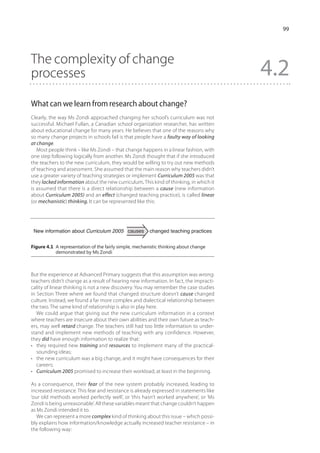
   Most people think – like Ms Zondi – that change happens in a linear fashion, with
one step following logically from another. Ms Zondi thought that if she introduced
the teachers to the new curriculum, they would be willing to try out new methods
of teaching and assessment. She assumed that the main reason why teachers didn’t
use a greater variety of teaching strategies or implement Curriculum 2005 was that
they lacked information about the new curriculum. This kind of thinking, in which it
is assumed that there is a direct relationship between a cause (new information
about Curriculum 2005) and an effect (changed teaching practice), is called linear
(or mechanistic) thinking. It can be represented like this:


 New information about Curriculum 2005 causes           changed teaching practices


Figure 4.1  representation of the fairly simple, mechanistic thinking about change
           A
           demonstrated by Ms Zondi


But the experience at Advanced Primary suggests that this assumption was wrong:
teachers didn’t change as a result of hearing new information. In fact, the impracti-
cality of linear thinking is not a new discovery. You may remember the case studies
in Section Three where we found that changed structure doesn’t cause changed
culture. Instead, we found a far more complex and dialectical relationship between
the two. The same kind of relationship is also in play here.
   We could argue that giving out the new curriculum information in a context
where teachers are insecure about their own abilities and their own future as teach-
ers, may well retard change. The teachers still had too little information to under-
stand and implement new methods of teaching with any confidence. However,
they did have enough information to realize that:
•	 they required new training and resources to implement many of the practical-
   sounding ideas;
•	 the new curriculum was a big change, and it might have consequences for their
   careers;
•	 Curriculum 2005 promised to increase their workload, at least in the beginning.

As a consequence, their fear of the new system probably increased, leading to
increased resistance. This fear and resistance is already expressed in statements like
‘our old methods worked perfectly well’, or ‘this hasn’t worked anywhere’, or ‘Ms
Zondi is being unreasonable’. All these variables meant that change couldn’t happen
as Ms Zondi intended it to.
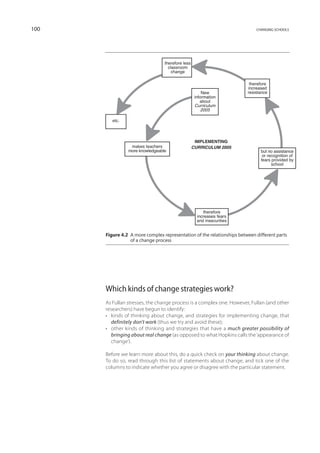
   We can represent a more complex kind of thinking about this issue – which possi-
bly explains how information/knowledge actually increased teacher resistance – in
the following way:
100                                                                         changing schools


                                 therefore less
                                   classroom
                                     change

                                                                         therefore
                                                                        increased
                                                       New              resistance
                                                   information
                                                      about
                                                   Curriculum
                                                       2005

         etc.


                                                   IMPLEMENTING
                 makes teachers                   CURRICULUM 2005
                more knowledgeable                                            but no assistance
                                                                               or recognition of
                                                                              fears provided by
                                                                                    school


                                                       therefore
                                                    increases fears
                                                    and insecurities


      Figure 4.2  more complex representation of the relationships between different parts
                 A
                 of a change process


      Which kinds of change strategies work?
      As Fullan stresses, the change process is a complex one. However, Fullan (and other
      researchers) have begun to identify:
      •	 kinds of thinking about change, and strategies for implementing change, that
         definitely don’t work (thus we try and avoid these);
      •	 other kinds of thinking and strategies that have a much greater possibility of
         bringing about real change (as opposed to what Hopkins calls the ‘appearance of
         change’).

      Before we learn more about this, do a quick check on your thinking about change.
      To do so, read through this list of statements about change, and tick one of the
      columns to indicate whether you agree or disagree with the particular statement.
the complexity of change processes                                                                                     101


Table 4.1  Fullan’s list of ‘common-sense’ ideas about change
Statements about change	Agree	Disagree

•	 Resistance is inevitable, because people resist change

•	 Every school is unique

•	 The more things change, the more they stay the same

•	 Schools are essentially conservative institutions, harder to
	 change than other organizations

•	 You just have to live reform one day at a time

•	 You need a mission, objectives, and a series of tasks laid
	 out well in advance

•	 You can never please everyone, so just push ahead with reforms

•	 Full participation of everyone involved in a change is essential

•	 Keep it simple: go for small, easy changes rather than big,
	 demanding ones


   Activity 18: Fullan and Miles – Getting school
                reform right
   Turn to Part 6 of your audiotape (side 2; after section on learning organiza-
   tions). Listen to Nel and Mahanjana talk about the challenges of change,
   and some of the skills and strategies we require to be successful change               This is a long but important
                                                                                          activity. We suggest you spend
   agents. Note important points in your workbook. Now read ‘Getting school               about 21 hours on it. Make sure
                                                                                                    2
   reform right’, by Michael Fullan and Mathew Miles (Readings, Section Three,            you link these new ideas to
   ‘Schools: The processes and constraints of change’). In Part 1 of this reading,        work you have done so far, as
                                                                                          well as to your own school
   the authors suggest that there are seven key reasons why school reforms                experiences.
   fail. In Part 2, they offer a number of ‘lessons’ for successful change. You will
   notice that many of these ‘lessons’ are direct responses to the reasons the
   authors give for failures in change processes.
       As you read, prepare to do the activities below. But notice that the
   writers emphasize the importance of making links between the different
   parts of an argument in order to understand the issue under discussion.
   When you read, take this advice seriously: make the links! And do so – criti-
   cally – by trying to apply their ideas to change processes in South Africa,
   and to the ideas offered by Nel and Mahanjana.
   a	Draw up a table with two columns in your workbook. Head the first
       column WHY REFORMS FAIL and the second column LESSONS FOR
       SUCCESS. In your own words, and with your own examples, summarize
       the advice Fullan and Miles, and Nel and Mahanjana offer us about
       change under these headings.
   b 	In the section headed Individualism and collectivism must have equal
       power (Part 2, page 80), Fullan states that ‘Collaboration is celebrated as
       automatically good. Participatory site-based management is (seen as)
       the answer. Mentoring and peer coaching are a must. Well, yes and no …’
       What reservations about participation does Fullan express? Does Nel             reservations: private doubt or concern
                                                                                           about aspects of the thing being
       have similar reservations and advice about participation? What lessons              considered
       do these hold for your actions?
   c	 Ms Zondi still wants the teachers in her school to grapple with the
       requirements of Curriculum 2005. Write down some suggestions of how
       she might go about it differently, drawing on the knowledge that you
       have learned from Fullan and Miles, as well as Nel and Mahanjana, to do
       so.
102                                                                                      changing schools


                          d	Reasses your answers on Table 4.1. Does your thinking differ from that of
                            Fullan and Miles, and Nel and Mahanjana? Who is correct?


                        Re-evaluating Advanced Primary’s change process
                        This is how Thulani used Fullan and Miles to analyse the change process at Advanced
                        Primary School. Keep in mind that Thulani’s suggestions may not necessarily be wise
                        and correct! So read through them critically, compare them with your own, and then
                        make a judgement about whether he or you have understood Fullan’s and Miles’
                        ideas better.


                        A memo to Advanced Primary
                        by Thulani Shabalala
                        Advice to management
                        Ms Zondi, there is little research evidence to suggest that authori-
                        ties can order (‘mandate’) people to change. This is particularly so
                        in education, where change processes are complex: many linked factors
                        either assist or constrain change. But second, fear of change plays a
                        great role in increasing people’s resistance. Thus, I’d strongly
                        suggest that you involve teachers in ongoing discussions about the
                        change. In these discussions, you should:
                        •	 deal with teacher fears on an ongoing basis;
                        •	 thoroughly discuss why the change is necessary, and allow staff to
                           raise their concerns about difficulties with implementation;
 … deal with teacher    •	 recognize that change requires the use of resources and, within
fears of change on an      realistic limits, try together to find ways of overcoming these
                           limitations.
  ongoing basis …
                        The important point is to realize that change is a journey: it takes
                        time, but it also requires that all staff are on the bus! If this is
                        done, teachers will feel that they own the process of change, so it
                        will have a much greater chance of success.

                        Fullan and Miles, experts on implementing educational change, argue
                        that change processes need to be managed. You cannot just tell staff
                        about the change and then sit back and hope it happens! This management
                        function must include, I think:
                        •	 inspiring and leading your team (which includes developing – in the
                           processes of change – a vision towards which your school can move,
                           as well as the benefits change holds for all stakeholders);
                        •	 taking difficult decisions when necessary (in other words, as prin-
                           cipal, you need to make decisions and use the authority you have to
                           ensure that change happens!);
                        •	 creating the processes and atmosphere at Advanced Primary which
                           make the problems you face ‘your friends’; this may sound strange,
                           but it means that you must see change as a learning process and not
                           be afraid to take risks, as long as you reflect on the consequenc-
                           es;
                        •	 ensuring that both you and your staff don’t settle for simple solu-
                           tions – for symbols rather than substance; instead, constantly
                           think systemically – think about the relationships between all the
                           parts of a school, and ask how they are impacting on the change
                           process.

                        Advice to staff

                        As a teacher, I understand your fears and anger at the change that Ms
                        Zondi implemented. I also think that many of your criticisms of the
the complexity of change processes                                                                                       103


process were legitimate. For instance, we do need to understand how to
change our teaching rather than simply know what the new ideas are.
And the change does have resource and timetabling implications.

But equally, as teachers, we need to be more active in deciding on the
direction school change should take. It is no good pretending we are
changing and then talking behind management’s back: we now have a
right to be involved in decision-making. I think this fear at confront-
ing authority and taking responsibility for decisions is a particular
version of what Fullan and Miles call ‘faulty maps’, and Senge calls
‘problematic mental models’: we are still behaving as if we have no
right to participate in making change decisions. We must change this
mindset! We need to begin to see ourselves as leaders too!

So, the first important point to realize is that successful change can
only occur with teachers’ participation: it can’t be mandated. But
second, we need to recognize that principals have the right and duty
to take decisions – even if some of us disagree, as long as they have
consulted us properly. Otherwise this process of change will simply
die. Third, we need to be patient – change takes time. What we need to                      Note again how Thulani uses
do is reflect constantly on how well we are doing in this journey,                          the theory developed by Fullan
rather than expect immediate miracles or simply give up. Finally, we                        to understand why change
need to work with all stakeholders – learners, parents, management,                         didn’t occur at Advanced
                                                                                            Primary. He constantly applies
other teachers – and on all parts of the organization. We need to
                                                                                            it to the problem he is dealing
understand the school as a system where, if one part doesn’t function                       with.
well, other parts of the change process will die. For instance, in your
case, some teachers rejected the change and it never happened, and
timetabling wasn’t altered so teaching in a new way was prejudiced.
Change is complex!


External and internal factors
in processes of change                                                                                   14

External change factors
Advanced Primary School was trying to deal with change that was coming from
outside the school. The national Department of Education had issued a policy about
the new curriculum and Ms Zondi was responding to an external pressure for
change. External policy is often difficult to implement, for a number of reasons:
•	 Macro (countrywide) policies can’t take the particular contexts of different schools
   into account. For example, the Schools Act requires that all schools must establish
   governing bodies, and that parents have the greatest representation. In second-
   ary schools, learners also need to be represented. Here is what the principal of a
   school near Isandlwana, KwaZulu-Natal, said:
         We are experiencing great difficulty in setting up this governing body.
         Parents refuse to have students sitting with them. They say that
         students do not have the authority or the understanding to make deci-
         sions.
	 Other schools might not experience the same problems. For instance, it seems
   that these problems could emerge because of deep, traditional beliefs about
   respect for elders, a problem not likely to be encountered in urban schools in
   Cape Town or Soweto.
•	 A second problem with externally-driven change is that it is often initiated to
   meet some rather broad and often abstract-sounding policy. So, even though the
   change may be very important, the reasons why it needs to be implemented are
   not always clear to teachers in schools. As a consequence, it is far more likely to be
   rejected, or only implemented at an appearance level rather than a real level.
   Change agents – including principals who may themselves not be completely
   convinced of the need to change – will have to work a great deal harder to sell the
104                                                                                                         changing schools


                                      need for change to teachers. It is more difficult to get local teachers to ‘own’ exter-
                                      nally-driven change.
                                   •	 Linked to these points is the fact that sometimes the initiators of macro changes
                                      – like national departments of education – are more concerned with the symbols
  Think of the way in which
                                      rather than the substance of change. While, ideally, they may want policies to
  outcomes-based education and        work well, in practice they would not be unhappy if they only seemed to be
  Curriculum 2005 have been           working well in schools. In other words, some people argue, governments which
  implemented in South Africa.
  Do these points make sense in
                                      initiate curriculum changes (like OBE, for example) want to be seen to be doing
  our context?                        something good … regardless of whether it is actually happening in practice. This
                                      may lead to a great deal of money and time being spent on publicizing the change
                                      process, rather than on the difficult internal implementation processes in
                                      schools.

                                   Internal change factors
                                   In other situations, schools may decide to change certain aspects because they are
                                   facing internal problems. For example, a primary school may find that many of its
                                   learners are struggling to read, and might want to introduce a different kind of
                                   reading programme for learners. Or an urban high school may be experiencing
                                   problems because some learners are bringing knives and guns to school which is
                                   making teaching (and life generally) more difficult (and unpleasant) for teachers
                                   and the other learners. In both cases, the local school community has a real interest
                                   in change – in other words, they will find it relatively easy to identify with a project
                                   aimed at dealing with these problems. It is also more likely that teachers will focus
                                   on real rather than symbolic changes, because the latter won’t make life or teaching
                                   any easier for them!
                                      But as Fullan and Miles suggest, well-functioning systems require a balance of
                                   internal and external influences. While it is important for schools to work on internal
                                   development continuously, they should also realize that they are part of a wider
                                   educational movement. They need to learn from ideas outside their own school if
 If you have the video that        they want to contribute to the development of a learning society.
 accompanies this module, fast
                                      This issue emerges again later (in a slightly different form) when we discuss differ-
 for­ ard to counter number 4
     w
 and watch the section titled      ent strategies for school change. Within school change literature (and practice)
 ‘The school-as-organization       there is fierce debate about whether external facilitators should play a role in inter-
 approach’. Notice the way in
                                   nal school change processes and, if so, what kind of role they should play. While
 which external facilitators are
 used in these school develop-     external facilitators do bring new ideas and a sense of authority into local change
 ment approaches.                  processes, their lack of knowledge of local contexts may lead to the suggestion of
                                   inappropriate actions or the alienation of local stakeholders.


                                   Summing up: thinking about possible
                                   barriers to change
                                   Before we move to the next sub-section – in which we explore three key problems
                                   in change – we’d like you to read this summary of an article on change by Per Dalin.
                                   Dalin is an important Scandinavian researcher in the area of school change. In his
                                   book called Limits to Educational Change (1978), he reports on his analysis of a
                                   number of school change processes in different countries. He argues that four broad
                                   categories of barriers to change were noticeable in all the countries studied. Here is
                                   a summary of his list (with our examples).
the complexity of change processes                                                                                            105


  Barriers to change
  1	 Value barriers
  	   Value barriers exist because individuals and groups have different ways of seeing
      things. This means that two people can look at the same innovation in a
      completely different light. One person will think it is a good idea, and another
      person will think it is the wrong way to go. All changes – and responses to
      changes – come from an underlying value perspective. Think about the introduc-
      tion of Model C schools in South Africa in the early 1990s. Some people welcomed
      the change, others did not. They were seeing it from their own understanding of
      what was important.

  2	 Power barriers
  	   Significant innovations usually involve a redistribution of resources and changes
      of authority structures in the system. There is often resistance when power
      changes hands. This question is also related to who has the power to make the
      decisions about change. Often we want to resist change if we are told that we         You may notice that many of
      must change by someone who has more power than we do.                                 Dalin’s ideas are similar to those
                                                                                            you have learnt about earlier,
  3	 Practical barriers                                                                     although he organizes them
                                                                                            differently. What is the
  	   One of the biggest problems with change is to bridge the gap between the idea         implication of this repetition for
      or plan and the implementation of that plan in the school or the classroom. There     you, as the learner?
                                                                                            •   irst, it suggests that different
                                                                                               F
      are a number of key factors that are important to help the implementation of             researchers in different parts
      change. Per Dalin lists five main factors:                                               of the world have noticed
                                                                                               similar features in change
      •	 Time: On a macro level, this means allowing many years for the innovation
                                                                                               processes. This should give
         to happen. It took Britain 25 years to usher in the large-scale reform of intro-      you confidence that these
         ducing comprehensive schools. While change may not always take this long,             features would probably also
                                                                                               occur in any change project
         we still need to allow time for it. The South African Ministry of Education has
                                                                                               you were to implement.
         said that the phasing in of a new curriculum will take up to ten years (if not     •   econd, don’t simply write all
                                                                                               S
         longer). On a micro level, teachers in schools need time to change also. If they      these ideas down again.
                                                                                               Rather ask: ‘What new ways
         need to implement a new curriculum, they need time to attend staff develop-           of thinking does Dalin add to
         ment courses, time and space to try out new teaching methods, and time to             my understanding of
         discuss issues with their colleagues. Too often, schools expect teachers to try       change?’ Then write down
                                                                                               only those new
         new things on top of a heavy workload.                                                understandings, in your own
      •	 Knowledge: Schools need to have knowledge about the innovation they are               words.
         trying to adopt, as well as about how change happens. For example, teachers
         need to know why they should change their teaching methods, as well as how
         they should do so.
      •	 Organizational development: For implementation to be successful, schools
         need to develop their capacity to manage the process. There must be support
         for teachers, both in terms of resources and skills. When the roles in an
         organization change, as often happens in a change process, this can create
         interpersonal conflicts.
      •	 Specific objectives: If innovation is going to work, everyone involved needs
         to know what is happening and why. One of the problems with implement-
         ing external policies like the new curriculum, or introducing representative
         governing bodies, is that schools simply do not have the information they
         need, or the information they do have is too vague.
      •	 Resources: Change requires resources. It is difficult for teachers to change
         their teaching styles if there is not enough learning material available to
         support this.

  4	 Psychological barriers
  	   Experience shows that people find it difficult to change. We tend to continue
      doing things that we are familiar with. Familiarity provides security, and it is
106                                                                                                              changing schools


                                        difficult to enter into the unknown. To be willing to change, we need to believe
                                        that the change is worthwhile. We need to see some meaning and advantage for
                                        ourselves in the change. This does not necessarily mean we get money for it! A
                                        change could be worthwhile, for instance, if it improves our working condi-
                                        tions, if it will lessen our workload, if it reduces conflict, or if it makes our teach-
                                        ing more interesting.


                                   In the next sub-section we focus on three issues that both Fullan and Miles, and
                                   Dalin, have identified as critical to successful change:
                                   •	 The need to think about and approach change systemically.
                                   •	 The need to take into account the personal fears that are evoked by change.
                                   •	 The need for good leadership to manage the process of change.

                                   You may legitimately ask ‘But why these three issues? There are so many other issues.’
                                   And this would be a good question. Many other books may well focus on different
                                   issues and treat them differently. As we suggested earlier, this is one particular story
                                   – our story – about school organization and change. So, take our ideas seriously, but
                                   also understand that they must be critically assessed.
 A particularly good but
 different view of school change
                                      But here are some justifications for our curriculum choice. We focus on:
 in South Africa is Davidoff and   •	 The need to think about and approach change systemically or holistically. So
 Lazarus. 1997. The Learning          much recent literature on organizational change (and on learning organizations)
 School. Cape Town: Juta. We
 have used an excerpt from this
                                      – as well as our experience of change in the institutions in which we work –
 book as a reading in this            emphasizes the interconnectedness of things. It seems that successful change
 section.                             agents – and we hope you will be at least apprentice change agents by the end of
                                      this module – have to be able to think systemically.
                                   •	 The need to take into account the personal fears that are evoked by change. First,
                                      our own experiences, as well as studies from elsewhere in the world, have made
                                      it clear that fear is a common reason why change projects fail. But second, if you
                                      understand organizations to be essentially human institutions, as we do, then
                                      dealing with basic human emotions must be a central task of change agents.
                                   •	 The need for good leadership to manage the process of change. So often in South
                                      Africa, change is either imposed by an authoritarian leader or else, in so-called
                                      ‘democratic’ structures, it is not managed at all. In both extremes, change fails. So,
                                      if we are committed to the success of change, we need to develop a leadership
                                      which balances wide participation with firm decision-making.
107


Approaching change
systemically
                                                                                                   4.3
Introduction
You may have noticed that The Rake – Thuthuka’s deputy principal – is a fervent
disciple of systemic thinking (he calls it holistic thinking). In fact, he has become the
butt of many good-natured jokes at Thuthuka because of this. However, since reading
the article on learning organizations by Peter Senge, and attending a workshop he
ran in Durban, the Thuthuka study group have become fans too. But, as Nomusa
complains: ‘It sounds so sensible, but it’s so difficult to think like that … and to
analyse Thuthuka in that way.’
   Nomusa is right. It is difficult to break old habits, and thinking in a particular way
– whether systemic or non-systemic – is a habit. The first step is knowing about new
ideas and thinking that they make sense. But the second, more difficult step is to
know how to use these new ideas. We will introduce you to a few more ideas about
systemic or holistic thinking, and will begin giving you practice in using these ideas.
However, to become a good systemic thinker, you need to practise and read, and
practise and read … until this kind of thinking becomes a habit.


Thinking about Thuthuka’s discipline problem
Let’s begin with a problem. You may remember various discussions among Thuthuka             … to become a good
teachers about their difficulties with late-comers (and discipline more generally).         systemic thinker, you
Well, since The Rake is part of this study group – and is in charge of discipline – he
thought he’d ask the group for some assistance in dealing with this problem. You            need to practise and
may remember that the initial response from Thuthuka teachers was a flurry of                    read, and
comments like:
•	 ‘It is these hooligan learners we have to deal with who make some of us lose hope
                                                                                                practise and
   and give up’;                                                                                  read …
•	 ‘Lack of discipline is the cause of the destruction of the culture of learning and
   teaching … Learners should be learners, and unless we emphasize and enforce
   respect, we may as well forget it’;
•	 ‘Abolishing corporal punishment … was a recipe for disaster.’

We were also told that teachers did not help to get learners inside on time as they
thought this was The Rake’s job. In fact, many teachers also wandered into school
and class late.
   What’s wrong with staff suggestions about how to change this situation? As The
Rake said earlier, the staff are treating the school’s problems in parts rather than
trying to get a ‘whole’ picture of them. This lack of systemic thinking leads to change
suggestions being limited to obvious but simplistic suggestions, like learner disci-
pline. The staff were thinking in a linear, cause-and-effect fashion: ‘If we increase the
severity of our discipline, the effect will be better behaviour from learners.’ They
reduced the situation to a simple problem that had a simple solution, rather than
asking questions like:
•	 Why are students undisciplined?
•	 What impact does the way the school is managed have on the poor discipline?
•	 Does teacher behaviour affect learner behaviour? How? Why?
•	 What impact does the family background of learners have on discipline?
•	 Is it possible that the caning that occurs actually contributes to – in other words,
   partly causes – the discipline problem?
108                                                                                                            changing schools


                                       Okay. So we have possibly identified the problem with the way in which Thuthuka
                                       teachers think about their disciplinary problems. But where can we go to get new
                                       ideas – ideas about how we can begin thinking about these problems in more
                                       insightful ways?


                                       Relating systems thinking and Hopkins’ link between
                                       structure and culture
                                       You may remember that Fullan and Miles had this to say about systemic thinking:

                                               What does it mean to work systemically? There are two aspects:
                                               • reform must focus on the development and interrelationships of
                                                  all the main components of the system simultaneously – curricu-
                                                  lum, teaching and teacher development, community, student
                                                  support systems, and so on;
                                               • reform must focus not just on structure, policy, and regulations, but
                                                  on deeper issues of the culture of the system.

                                       So, systems thinking is about asking why questions … again and again … rather
                                       than simply assuming a one-cause, one-solution answer to problems. By asking why
                                       in this way:
                                       •	 we have a means of finding out how many different factors contribute to prob-
                                          lems;
                                       •	 we have more chance of finding out which of these many ‘causes’ are more impor-
                                          tant than others.

                                       We can then begin changing the situation by making a number of changes simulta-
                                       neously, but in a more targeted way.
 At this point, we suggest you            Fullan and Miles also point to the need to focus on the ‘deeper issues of the culture
 re-read the excerpt by Hopkins        of the system’, not just on the obvious and visible parts, like structures. They believe
 et al. – titled ‘Culture and struc-
                                       there are two main reasons why educational change fails. First, problems are complex
 ture in school improve­ ent’
                           m
 (Readings, Section Three). It is      and hard to handle. We have looked at this issue, and suggested that a systemic way
 an interesting and important          of thinking is a useful strategy for understanding complex problems. Second, they
 reading. You might also want to
                                       argue, strategies used often don’t focus on the things that will really make a differ-
 re-read the two case studies we
 analysed on pages 42–45 of this       ence. They assert that strategies which focus only on changing the structure of the
 Learning Guide, and re-listen to      school are likely to fail because the real issue is changing the culture.
 the discussions about the diffi-
                                          This reminds us again of the importance of exploring both structure and culture,
 culties of changing school
 cultures in Part 3 of your audio-     and understanding the interrelationship between the two, when we attempt to
 tape. Would you change your           change organizations. It certainly provides a clue about Thuthuka’s problems:
 analysis of these case studies
                                       perhaps the culture of late-coming and demoralization is so strong at Thuthuka that
 now that you know so much
 more?                                 learners simply don’t realize that their behaviour is problematic. In other words, this
                                       careless behaviour is the ‘norm’ – among teachers and learners – that has been learnt
                                       by all members of Thuthuka. Is this possible? And if it is, then will harsher discipline
                                       on its own, and directed only at learners, have the desired effect?


                                       The five whys: a strategy for systems thinking
                                       Many of Peter Senge’s ‘five disciplines’ have been adapted and used as tools for
                                       analysing organizations and organizational dynamics in a book called The Fifth
                                       Discipline Fieldbook. The following excerpt, from an article in the book by Rick Ross
                                       called ‘The five whys’, is a demonstration of one such thinking tool. It is a fictitious
                                       story about a problem in a factory, but it demonstrates the kind of faulty thinking we
                                       often bring to bear on solving school problems. In telling this story, Ross demon-
                                       strates an alternative and more systemic way in which we can tackle common prob-
                                       lems.
approaching change systemically                                                                                            109


  The five whys
  A story
  It’s mid-afternoon, an hour before the shift changes at a manufacturing plant, and
  I’m the foreman. I’m walking through the plant, giving a tour to a friend who
  happens to be a systems thinker. Suddenly, I see a pool of oil on the floor so I grab
  the nearest worker and tell him: ‘Hey! There’s oil on the floor! For Pete’s sake, some-
  body could slip in that! Clean it up!’ When I’m finished, my systems thinking friend
                                                                                              This excerpt from Rick Ross’
  breaks in with a quiet question: ‘Why is there oil on the floor?’                           article is taken from Peter
      ‘Yeah,’ I repeat to the worker, ‘how’d the oil get on the floor?’ The worker replies,   Senge et al. 1994. The Fifth
  ‘Well, the gabungie’s leaking.’ All of us automatically look up. Sure enough, there’s       Discipline Fieldbook. Published
                                                                                              by Nicholas Brealey Publishing,
  a visible leak up there in the gabungie. ‘Oh, okay,’ I sigh. ‘Well, clean up the oil and    36 John Street, London WC1N
  get the gabungie fixed right away.’                                                         2AT. Tel: 0171 430 0224; fax:
      My friend pulls me aside and murmurs, ‘But why is the gabungie broken?’ I say,          0171 404 8311.

  ‘Yeah, well, the ga–’ and turn to the worker: ‘Why is the gabungie broken?’ ‘The
  gaskets are defective,’ is the reply.
      ‘Oh well, then, look,’ I say. ‘Here. Clean the oil up, fix the gabungie, and, uh, do
  something about the gaskets!’
      My friend adds: ‘And why are the gaskets defective?’ ‘Yeah,’ I say. ‘Just out of
  curiosity, how come we got defective gaskets in the gabungie?’ The worker replies,
  ‘Well, we were told that the buying department got a good deal on those gaskets.’
  I can see my friend start to open his mouth, but this time I get there first. ‘Why did
  the buying department get such a great deal?’ I ask the worker. ‘How should I
  know?’ he replies, wandering off to find a mop and bucket.
      My friend and I go back to my office and make some phone calls. It turns out
  that we have a two-year-old policy in the company that encourages purchasing at
  the lowest price. That’s the reason for the defective gasket – of which there is a
  five-year supply – along with the leaking gabungie and the pool of oil. In addition,
  this policy is probably causing other problems throughout the organization, not
  closely related in time or space to the root ‘cause’.

  A problem-solving strategy
  Step 1 – The first why: Pick the symptom where you wish to start; the thread which
  you hope you can pull on to unravel the knot. Ask the first why of the group: ‘Why
  is such-and-such taking place?’ You will probably end up with three or four answers.
  Put them all on the wall, with plenty of room around them.
  Steps 2, 3, 4, 5 – The successive whys: Repeat the process for every statement on the
  wall, asking ‘why’ about each one. Post each answer near its ‘parent’. Follow up all
  the answers that seem likely. You will probably find them converging; a dozen
  separate symptoms may be traceable back to two or three systemic sources.
     As you trace the ‘whys’ back to their root causes, you will find yourself tangling
  with issues that not only affect the gabungie (whatever that may be in your school!),
  but the entire organization. The policy to get the lowest price on supplies might
  have been caused by a battle in the finance office. It might result from a purchasing
  strategy, or from under-investment in maintenance. The problem is not that the
  original policy was ‘wrongheaded’, but that its long-term and far-flung effects
  remained unseen.

  Avoiding the ‘fixation on events’
  To be effective, your answers to the five whys should steer away from blaming
  individuals. For example, in answer to the question: ‘Why is there oil on the floor?’,
  someone may say: ‘Because the maintenance crew didn’t clean it up.’ Don’t leave it
  there. Ask: ‘Why didn’t they clean it up?’ (‘Because their supervisor didn’t tell them
  to.’) ‘Why didn’t he do that?’ (‘Because the crew didn’t tell him about it.’) ‘Why
110                                                                                                           changing schools


                                        didn’t they tell him?’ (‘Because he didn’t ask.’) etc., etc.
                                           Blaming individual people leaves you with no option except to punish them;
                                        there’s no chance for substantive change. One of the benefits of the five whys exer-
                                        cise is that it trains people to recognize the difference between an event-oriented
 This book – Senge et al. 1994.         explanation and a systemic explanation. The systemic explanations are the ones
 The Fifth Discipline Fieldbook –
 has interesting descriptions of a      which, as you trace them back, lead to the reasons why they didn’t clean it up, or
 large range of organizations –         he didn’t tell them to, or they didn’t ask. (Maybe, for example, poor training of
 from hospitals to companies,           maintenance people contributed to the oil puddle problem: but even the best-
 and from local authorities to
 schools – that have used               trained, hardest-working custodians in the world could not stop the gasket from
 Senge’s ideas to change them-          leaking.)
 selves into learning organiza-            To avoid being distracted by event- and blame-related ‘answers’, try this tech-
 tions. It also includes a number
 of exercises that institutions can     nique: as an answer is recorded, say ‘Okay. Is that the only reason?’
 use to develop their under-
 standing of change and of
 learning organizations. It is a
 very useful ‘practical’ compan-
 ion to The Fifth Discipline.


                                         Activity 19: Using the five whys approach to analyse
                                                      a school problem
                                         a	 What is the difference between a ‘systemic explanation’ and an ‘event-
                                            oriented explanation’? Think about this in the context of a school: give
 Spend about 1 hour on this                 an example of how an issue would be explained differently, using the
 activity. We suggest you do it
 collaboratively with a few of              two different kinds of explanation.
 your fellow students.                   b	Take a common problem – such as absenteeism, or late-coming, or high
                                            failure rates, cheating in tests and exams, or violence in the playground
                                            – at a school you know. Write down all the possible causes for that
                                            problem. Ask ‘why’ of each. Don’t stop at the obvious reasons: try to
                                            think on a deeper level. Also, look out for the connections between the
                                            issues. Organize your ideas in the form of a diagram.


                                      Solving the problem of absenteeism systemically
                                      Thuthuka teachers are excited by this technique. ‘It seems relatively simple, but has
                                      the potential to get past our previous, rather simple, explanations of our problems,’
                                      says Sipho. ‘Let’s play around with this technique to get to a more complex under-
                                      standing of the late-coming and absenteeism problem. At the moment, this rather
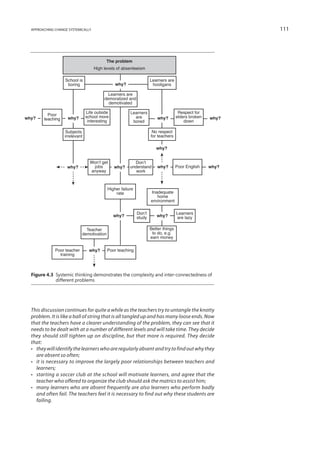
                                      simple diagram seems to represent our thinking,’ he says, holding up a diagram he
                                      has sketched on some newsprint.


                                        Non-systemic/linear problem solving

                                        Problem: 	  High absenteeism and frequent late-coming
                                        Why? 	      Learners are undisciplined hooligans
                                        Solution: 	Tighten up on punishment for late-coming and absenteeism


                                      A number of the group say that their thinking isn’t quite as simplistic as that. For
                                      instance, they did point to the problem of poor teaching too. But they agree that it is
                                      largely true.
                                         ‘But let’s get on with the “five whys” process,’ says Sindi. So they begin with Sipho
                                      leading the discussion (he asks the ‘why?’ questions) and summarizing it on the
                                      chalkboard. This is what the board looks like after about half an hour’s brainstorm
                                      …
approaching change systemically                                                                           111


                                            The problem
                                    High levels of absenteeism

                   School is                                         Learners are
                    boring                      why?                  hooligans

                                           Learners are
                                         demoralized and
                                           demotivated

                                Life outside            Learners                      Respect for
          Poor                  school more                                          elders broken
why?    teaching    why?                                  are            why?                        why?
                                 interesting             bored                           down

                    Subjects                                          No respect
                   irrelevant                                        for teachers

                                                                        why?
                                                                        why?


                                  Won’t get               Don’t
                    why?           jobs        why?     understand       why?        Poor English    why?
                                  anyway                   work


                                            Higher failure
                                                rate                 Inadequate
                                                                        home
                                                                     environment

                                                             Don’t                   Learners
                                               why?          study      why?         are lazy

                               Teacher                               Better things
                             demotivation                             to do, e.g.
                                                                     earn money

              Poor teacher       why?       Poor teaching
                training


  Figure 4.3 
             Systemic thinking demonstrates the complexity and inter-connectedness of
             different problems


  This discussion continues for quite a while as the teachers try to untangle the knotty
  problem. It is like a ball of string that is all tangled up and has many loose ends. Now
  that the teachers have a clearer understanding of the problem, they can see that it
  needs to be dealt with at a number of different levels and will take time. They decide
  they should still tighten up on discipline, but that more is required. They decide
  that:
  •	 they will identify the learners who are regularly absent and try to find out why they
     are absent so often;
  •	 it is necessary to improve the largely poor relationships between teachers and
     learners;
  •	 starting a soccer club at the school will motivate learners, and agree that the
     teacher who offered to organize the club should ask the matrics to assist him;
  •	 many learners who are absent frequently are also learners who perform badly
     and often fail. The teachers feel it is necessary to find out why these students are
     failing.
112                                                                             changing schools


      Making sense of the Thuthuka discussion
      Senge tells this story about a rainstorm in the reading you did earlier:

              A cloud masses, the sky darkens, leaves twist upward, and we know
              that it will rain. We also know that after the storm, the runoff will feed
              into groundwater miles away, and the sky will grow clear by tomorrow.
              And these events are distant in time and space, and yet they are all
              connected within the same pattern. Each has an influence on the rest,
              an influence that is usually hidden from view. You can only understand
              the system of a rainstorm by contemplating the whole, not any indi-
              vidual part of the pattern.

      The ‘five whys’ brainstorm at Thuthuka made clear just how true Senge’s statement
      is. Many of the possible reasons for absenteeism unearthed in this process were
      ‘events … distant in time and space, and yet … connected within the same pattern’.
      This observation has important implications for the actions we take in change proc-
      esses. Initially the solution – increased discipline – was the immediate and obvious
      action to take. But now the staff realize that the best actions might be seemingly far
      removed, such as dealing with a lack of learning facilities at home, or working to
      motivate teachers, or building a better all-round culture at the school by starting
      extramural activities.
          Senge says we need to understand:
      •	 that we are all ‘bound by invisible fabrics of interrelated actions’ (in other words,
          that our individual actions have limited power to change things unless conceived
          of as part of other actions);
      •	 that these actions (and thus change) take ‘years to fully play out their effects on
          each other’ (so we need to put in place processes, not just to stage events);
      •	 that, since we are part of that fabric ourselves, ‘it’s doubly hard to see the whole
          pattern’ (in other words, we often cannot see how we contribute to the problems
          … we are simply too close to them).

      Senge suggests that this ‘shift of mind’ – from seeing ourselves as separate from the
      world, to seeing ourselves as connected to the world; from seeing problems as
      caused by someone or something ‘out there’, to seeing how our own actions often
      create the problems we experience – is a key characteristic of a learning organiza-
      tion. Systemic thinking is thus a crucial characteristic of a learning school.
113


Coping with the fears evoked
by change
                                                                                                                   4.4
Introduction
Many people have argued that Senge’s ‘shift of mind’ isn’t possible in a context of fear
and uncertainty which is common in times of change. Change, as we have suggest-
ed, is difficult and prone to resistance from those affected, even when it is regarded                          15
by most people as good and beneficial. If we want to initiate and sustain change
successfully, then it seems important to find out why this is so and develop strate-
gies for dealing with it. Otherwise, our aim of changing our school into a learning
organization will fail.
   Fullan and Miles tell of asking a group of principals to list the problems they faced
in a specific change project:

         More than half said ‘resistance’ – variously known as intransigence,                 intransigence: stubbornness,
                                                                                                   unwillingness to co-operate
         entrenchment, fearfulness, reluctance to buy in, complacency, unwill-
                                                                                              entrenchment: being firmly
         ingness to alter behaviours, and failure to recognize the need for                        established in a particular position
         change. These traits were attributed to teachers and other staff                     complacency: self-satisfaction, seeing
                                                                                                   no reason to change
         members, though not to the principals themselves.

But, they argue, to label these attitudes as ‘resistance’ diverts our attention away
from the real problems of implementation. They say the label places the blame (and
thus the responsibility for the solution) on others – those who ‘resist’, rather than on
the implementers of change. The thrust of their argument – which fits with Senge’s
ideas about understanding change as the consequence of a number of integrated
actions – places an emphasis on reducing fears in any change process by having:
•	 clear and achievable goals;
•	 inclusive processes;
•	 the intellectual and other resources to make it possible.

In a sense they are arguing: ‘Plan well, and fears and “resistance” will decrease.’ In sub-
sections 4.6 and 4.7, we provide a number of strategies for school change that take
into account these principles.


Managing personal fears of change
But this is only half the story, and Fullan and Miles admit this:

         During transitions from a familiar to a new state of affairs, individuals
         must normally confront the loss of the old and commit themselves to
         the new, unlearn old beliefs and behaviours and learn new ones, and
         move from anxiousness and uncertainty to stabilization and coher-
         ence. Any significant change involves a period of intense personal and
         oral learning and problem-solving. People need support for such work,
         not displays of impatience.

In other words, Miles and Fullan argue that people are not simply rational beings
whose fears can be satisfied by a clear and logical argument as to why change is
necessary and good. Because we are creatures of habit, any change is experienced
as a loss. It is a loss of those routines and procedures that were familiar and, in many
ways, gave meaning to our life. Think of the feelings that the introduction of OBE has
114                                                                                                        changing schools


                                    generated in schools. Most teachers think we need to change the way we teach.
                                    Rationally then, most teachers support most of the new ideas. But that understand-
                                    ing doesn’t mean that we don’t have fears about it. These fears are evoked primarily
                                    by two things:
                                    •	 the fact that we are uncertain about what is required of us by this change (in other
                                       words, by a lack of information, and of concrete models of the new teaching);
                                    •	 the fact that we are being asked to give up the ways of thinking and implement-
                                       ing education with which we have become comfortable, and which have served
                                       us well. This is so even among those who did not agree with Bantu Education or
                                       CNE or rote learning!

                                    In other words, the fear and uneasiness is evoked by the loss of the familiar and an
                                    absence of any concrete and visible alternative. Psychologist Peter Marris explains in
                                    the next reading why no matter how unsatisfactory this old meaning might be, or
                                    how good the change might be, the most common response to change will be
                                    ‘resistance’. As a consequence, good change agents must give people the time and
                                    the space in which they can work through their feeling of loss and integrate the
                                    changes into their ‘meaning systems’.


                                       Activity 20:  Marris’ ideas about change
                                       Read the article written by Peter Marris (Readings, Section Three, ‘Schools:
                                       The processes and constraints of change’). Then answer the following ques-
                                       tions in your workbook:
 The Marris reading is complex,        a	Explain why Marris believes it is important to encourage conflict during
 so read it carefully and more
 than once. You should spend
                                          change processes. Do you think he is correct? Can you support your
 about 2 hours on this activity.          answer with an experience of your own?
 Try to apply Marris’ ideas to         b	 Marris compares the fears evoked by organizational change with the
 your own personal experiences
 of change. It might also be
                                          feelings of personal loss. Is this a legitimate comparison? (If you can, you
 useful to share these ideas with         may want to describe the feelings you had when you lost someone close
 other students or teachers.              to you, and compare these with feelings you have when you enter into
                                          new and strange situations.)
                                       c	 What lessons does Marris have for those involved in change processes?


                                    The importance of encouraging conflict
                                    in change processes
                                    Marris has important warnings for people interested in implementing change and
                                    for ordinary teachers involved in change processes. He argues – in contrast to much
                                    current thinking – that, first, processes of reform must expect and even encourage
                                    conflict. This, he says, gives people the time and space to confront the change, react
                                    to it, articulate their often confused feelings about it, and work out their own sense
                                    of it. This is a controversial position but one that we believe is enormously impor-
                                    tant. We all know that when we experience loss – of a loved one, or simply a loss of
                                    the routines which made our life or teaching simpler – our feelings of sadness, anger,
                                    and emptiness cannot simply be resolved by someone telling us that ‘life’s like that’.
                                    We know this is true, but we still feel sad and angry.
                                       Marris argues that this is why processes of change – which evoke the same feel-
                                    ings of loss – should allow people involved in that change to express their feelings
                                    of anger by encouraging conflict (and not trying to resolve it prematurely). Otherwise,
                                    change occurs but participants remain filled with unresolved feelings of loss and
                                    anger which, in time, will undermine both the change process and the individual.
                                       Second, change processes must respect different feelings and interpretations of
                                    change and work with these rather than impose some ‘alien conception’ on the
                                    process. And, third, says Marris, there must be time and patience so that different
coping with the fears evoked by change                                                                                115


people affected by the change can work through their conflicting interests, but also
so that individuals can re-establish a ‘continuity’ – a consistency – in their lives.
   Moreover, Marris makes the seemingly uncontroversial statement that, ultimately,
change has to be implemented by those who will resist change. But, despite the
seeming obviousness of this, we know that change agents – who have already
worked through their own internal conflicts about change – do get impatient and:
•	 try to rush through change by co-opting a couple of people to take their change
   message forward (rather than creating processes through which the majority
   have time to work through the implications of change for themselves);
•	 overlook or prematurely resolve conflicts in groups. This often means that change
   is implemented with resentment from certain people, and frequently leads to the
   appearance rather than the reality of change, or heightened tensions in organiza-
   tions, or change that simply fizzles out after a while.


Harnessing community ‘fears’ to build new
organizations
While Marris focuses strongly on individual fears and suggests ways of overcoming
these, Lovemore Mbigi explores how a clash of interests and beliefs between
‘modern’ reformers and traditionalists can be harnessed to enrich change processes.
Mbigi, a business consultant, writes about how traditional African beliefs – which
are often regarded as ‘resistance’ in modern business organizations – can be used to
transform businesses in Africa into more efficient and humane organizations. In the
next reading, Mbigi tells the story of transformation in a company where he was
manager, to demonstrate how the seemingly ‘irrational’ and ‘impractical’ beliefs and
demands of local communities can be used to strengthen organizations.


   Activity 21: Using community ‘fears’ to build strong
                African organizations
   Turn to Part 7 of your audiotape (side 2; after narrator asks you to complete
   Activity 19). Listen to the excerpt in which Lovemore Mbigi talks about how
                                                                                        Activity 21 develops your
   he has used African ideas and ritual to revitalize organizations he has              understanding of holism a
   worked in. When you have completed this, read the article by Mbigi titled            great deal more, and in
   ‘The Spirit of African Management’. (Readings, Section Two) Then answer              interesting new ways. Mbigi
                                                                                        draws mainly from his
   the following questions in your workbook:                                            experience in a company. Try to
   a 	 Mbigi talks about creating ‘psychic communities’. What does he mean by           link his ideas to schools and, in
       this? How are Mbigi’s ideas similar and different from Marris’ ideas? And        particular, your own school.
                                                                                        Spend about 2 hours on this
       what implications do they have for our ideas about changing schools?             activity.
   b 	 Mbigi’s major argument is that we need to draw on African tradition in
       order to energize people for change, and then synthesize these ideas             Note: The audiotape incorrectly
                                                                                        refers you to Activity 22. It
       with Western ideas in order to maximize the impact of organizational             should be Activity 21.
       change. Can you think of any other ‘traditions’ that can be drawn on in
       order to change schools?
116                                                                                                                changing schools


                                           Mbigi also has important advice for those interested in change: don’t judge people’s
                                           actions too soon or too simplistically. Rather harness the energy that drives these
                                           actions by:
                                           •	 acknowledging the fears that exist as legitimate, and addressing them;
                                           •	 recognizing that ‘ownership’ of change is not a matter simply of understanding’, or
                                              vision simply a matter of words on paper. Instead, it is a ‘deep psychological’
                                              matter. Change agents have to create a situation where people feel that they own
                                              the process and where vision statements become actions.

                                           Mbigi’s ideas are interesting in that he doesn’t reject Western organizational ideas
                                           but does argue that they are – on their own – deficient. He suggests ways in which
                                           we can integrate traditional African ideas and Western ideas to develop a new local-
                                           ly-appropriate form of organizational change. You might notice that many of these
                                           ideas – while expressed in terms of African traditional belief – are similar to those
                                           raised by Senge and other writers. Later you will read about the ‘school-as-commu-
                                           nity’ approach to school change. The ideas expressed by Schofield – who works in
                                           Soshanguve near Pretoria – reflect similar sentiments to those of Mbigi.


                                           Leading and managing
4.5                                        change

                                           Introduction
                 16                        An interesting dilemma is raised by the need to manage fears. Marris (and Fullan and
                                           Miles) warn about autocratic leaders rushing change through. Yet highly ‘participa-
                                           tive’ styles of management often ignore the depth of fears expressed too. In fact, the
                                           lack of direction in many ‘participative’ processes heightens fears because partici-
                                           pants don’t know where they are going and thus can’t begin to make personal sense
                                           of the change. Mbigi is also intriguing. On first reading, it sounds as if the manager
                                           takes an enormously directive approach: he decides what will be done. But then he
                                           sets in place processes that are extremely participative (although structured), and
                                           he leads in a manner where listening becomes very important and judgements are
                                           suspended.
                                              What is becoming increasingly clear is that change towards a more democratic
                                           ‘learning’ organization requires leadership and firm decision-making. So the crucial
                                           difference to authoritarian organizations is not that leadership must cease. Instead,
                                           the manner in which people lead must change.


authoritative: to possess acknowledged
    authority, or authority that engages
                                           Towards democratic and authoritative leadership
    people’s trust. It is different from
    authoritarian, which refers to a       For some, ‘leadership’ and ‘management’ have become dirty words in a newly demo-
    leadership style that does not
    consult or respect democracy and
                                           cratic South Africa in which ‘participation’ and ‘flat structures’ are promoted. Yet the
    individual freedom                     ‘Changing management to manage change’ report suggests that all teachers need
                                           to be leaders and managers. And, as we noticed above, a lack of leadership often
                                           results in heightened fears and no change.
leading and managing change                                                                                               117


   The challenge for ‘new’ organizations is to redefine these two functions as demo-
cratic functions. We also need to devolve management functions downwards. In
other words, we need to create schools in which many more people participate in
decision-making and, in order to ensure the success of these schools, we need to
develop teacher and learner understandings of democracy and the skills required
to manage and lead democratically. Schools, for one, cannot run without strong
management skills at all levels. Now listen to Christo Nel, who talks about ‘new’ lead-
ership and management styles, and Lovemore Mbigi, who explains the complexity
of a teacher’s management function.
   What do you think of Mbigi’s claim that a teacher’s management role is as complex
                                                                                           Rewind your audiotape to Part
as that of a business manager?
                                                                                           1. Listen to the way speakers
   He seems to suggest that the work of teachers has always required advanced              talk about the managerial and
management skills. These, he says, are of two kinds:                                       leader­ hip roles of teachers
                                                                                                   s
                                                                                           today. Do you perform in this
•	 people management: so that teachers can manage learners, organize their class-
                                                                                           kind of way? Do other teachers
   rooms effectively and participate in new decision-making structures at schools;         in your school? Why or why
•	 knowledge management: so that teachers can access, select and organize the              not?
   information they need to teach learners. This, suggests both Nel and Mbigi, will
   become an increasingly important function for teachers as we move into the
   information age.

Davidoff and Lazarus provide a particularly interesting explanation of leadership
and management. They take a strongly humanistic, rather than a technical, approach
to these functions. While most management literature suggests that good leader-
ship and management is a matter of implementing efficient rules and procedures,
these writers argue that, while it is important to have rules and procedures in schools,
good leadership is ultimately an art. This is so because it relies on intuition and
personal judgement rather than following established procedures. As such, good
leaders must explore and develop their own personal dispositions, not simply learn
new skills.
   This kind of thinking – as you may recognize – fits closely with the kinds of ideas
raised by new management writers, like Peter Senge, and is at the heart of building
‘learning organizations’. Let’s read Davidoff and Lazarus …


   Activity 22: The role of leadership and
                management in change
   Turn to the reading by Davidoff and Lazarus (Readings, Section Three).
   Then answer the following questions in your workbook:
                                                                                           Read this article carefully. Note
   a	 What are the qualities of good leaders and managers? Why does Davidoff               down how the writers’ views
      call leadership an ‘art’?                                                            differ from your ideas of
   b	The authors distinguish between leadership and management. What                       leadership and management.
                                                                                           Spend about 3 hours on this
      are the main differences they mention? Do you think this distinction is              activity.
      useful?
   c	 Having a flatter hierarchy in schools means that leadership and manage-
      ment capacity need to be built throughout the whole school. What
      suggestions do the authors make about building leadership and
      management capacity?


Conclusion: developing a humane leadership style
Clearly, then, leadership and management are crucial both for:
•	 change to occur;
•	 building democratic schools.
But, we do need to rethink our old assumptions about leadership and management
in at least three ways:
•	 First, we need to widen participation in decision-making. For this, we need to
118                                                                                                         changing schools


                                       develop new structures as well as a democratic culture, and to teach the skills
                                       required to operate democratically among all stakeholders.
                                    •	 Second, we need to balance innovation (leadership) and maintenance (manage-
                                       ment). While it is important for schools to change the way they operate – and
                                       constantly be prepared to think of new ways of doing things – it is also important
                                       that schools have some stability, that they maintain and manage processes effi-
                                       ciently.
                                    •	 Third, we need to think of management as a human function, an art, rather than as
                                       a technical procedure. This requires that we develop the ability to listen, to toler-
                                       ate irrational fears, rather than being set on rushing ahead with ideas that people
                                       have not fully internalized.

                                    In the next two sub-sections, we explore a number of case studies of change that
                                    illustrate some of these ideas more concretely.


                                    Changing schools: the school-as-
4.6                                 organization approach

                                    Introduction: two approaches to school change
                                    There are many different strategies for school change. Some strategies provide very
                                    specific steps that a school should follow, while others are more flexible: they provide
 These strategies are mostly        only general principles. The point in this and the next sub-section is not to learn
 inspired by the school             about and be able to describe different strategies of school change. Instead, we
 improvement research you read
 about in Section Three. You will
                                    would like you to:
 remember that school               •	 read through the case studies in order to add to your understanding of change, so
 improvement researchers were          that you feel more able to actually begin changing – or contributing to change in
 particularly interested in what
 kinds of internal processes gave
                                       – your school;
 schools the capacity to            •	 understand that different strategies pay more attention to certain aspects of
 improve. The strategies which         school change (and thus have particular strengths), but they also neglect other
 follow are some of the ways in
 which they believe these
                                       aspects.
 ‘improved’ schools can be
 created.                           For the purposes of this module, we have chosen to classify the case studies into
                                    two broad approaches to school change and improvement. We have called these:
                                    •	 the school-as-organization approach which emphasizes the internal processes
                                       of change, in particular, the importance of teaching and learning (sub-section
                                       4.6);
                                    •	 the school-as-community approach which emphasizes the context within which
                                       the school is located, and how these external factors impact on the school (sub-
                                       section 4.7).

                                    While we have classified school change approaches into two ‘families’ or ‘clusters’ of
                                    strategies, we need to provide important warnings:
                                    •	 First, different change agents operating within an approach will develop school
changing schools: the school-as-organization approach                                                                    119


   change strategies that aren’t identical. While they will share many characteristics,
   they will also differ in their emphases and the way in which they do things. We will
   introduce you to two different strategies (case studies) within each approach in
   order to demonstrate how practitioners adapt the approach to their particular
   needs.
•	 Second, while the two approaches (the two ‘clusters’ of strategies) do have differ-
   ent emphases – the school-as-organization approach focuses on the internal
   dynamics of schools, and the school-as-community approach gives more empha-
   sis to external (out-of-school) dynamics – they aren’t mutually exclusive. They
   ‘borrow’ from each other quite freely, as you will notice when you read through
   the different case studies.

In other words, these two clusters of strategies are not necessarily in conflict; their
differences lie more in the emphasis they place on different factors than in substance.
In effect, they probably represent positions on a continuum of approaches to school
change, ranging from the IQEA’s school development planning strategy (page 122)
through TIP’s organizational development strategy (page 128) to SBRI’s (page 135)
and the Soshanguve schools (page 132) different school-as-community strategies.
One could represent these two approaches in this way – as emphases on a continu-
um with the different strategies located at different points on the continuum. The
approaches should not be thought of as being in different boxes!


      APPROACH              School-as-                  School-as-
                            organization                community
      Strong focus                                                     Strong focus
      on school                                                        on community
                         IQEA         TIP        SBRI     Soshanguve
      STRATEGIES


Figure 4.4  A continuum of approaches to school change


But let’s listen to two school change experts explain the similarities and differences
…


   Activity 23: Differences between school-as-organiza-
                tion and school-as-community
                approaches
   a 	 Listen to two South African school change practitioners – Mark Potterton
       and Andrew Schofield – explain what they believe are the key differ-               This activity should take no
                                                                                          longer than 90 minutes.
       ences between the school-as-organization and school-as-community
       approaches to school change (Part 8 of your audiotape; directly after              Note: The audiotape incorrectly
       narrator asks you to complete Activity 22). Note down in your workbook             refers you to Activity 24. It
                                                                                          should be Activity 23.
       the key differences mentioned, but also the similarities.
   b 	 Watch and listen to teachers at schools who are using school-as-organi-
       zation strategies to improve their schools. If you have a video, fast
       forward to counter number 4 and the title ‘Creating people-centred
       schools’. Watch the video until the next title – ‘The school-as-community
       approach’ – appears at counter number 24. Note down in your work-
       book how school-as-organization facilitators work in schools, why they
       work in this way, and what the strengths and weaknesses of the approach
       are.

Now let’s get practical! Let’s read about the different ways in which these approach-
120                                                                                                            changing schools


                                     es have been used to change schools. We will begin with an example of an impor-
                                     tant school-as-organization strategy – school development planning.


                                     The school-as-organization approach
                                     School-as-organization change strategies focus strongly on improving the internal
                                     functioning of the school. In particular, their interest lies in schools improving the
                                     way they perform their key function, namely teaching and learning. They believe
                                     this will probably best be achieved by getting all stakeholders within schools to
                                     think more carefully about what they have to achieve and how they are (or aren’t)
                                     achieving it.


                                     The IQEA and school development planning
                                     What do projects using school development planning (SDP)
                                     aim to achieve?
                                     School development planning (SDP) is a strategy for change which has been used
                                     in British and American schools for many years. SDP aims to improve the capacity of
 David Hopkins has written           the school, particularly the quality of its teaching and learning. Hopkins argues that
 widely about SDP and about          if one cannot understand what creates a school’s capacity for quality, then any
 the IQEA. The information in
 this summary has been taken
                                     school change strategy is severely limited in its ability to make real changes. SDP’s
 from a paper – titled ‘Strategies   strategy is to bring together key stakeholders within the school to identify problem
 for school development’ –           areas, agree where improvements can be made, and then decide how to make
 which Hopkins delivered to the
 Second International
                                     change happen with the people and resources they have available.
 Conference on School Manage­           A good example of this approach is the ‘Improving the Quality of Education for All’
 ment at the University of           (IQEA) Project, based at Cambridge University’s Institute of Education, but imple-
 Deusto in Spain in 1996.
                                     mented worldwide – including South Africa. IQEA focuses on student achievement
                                     and the school’s ability to cope with change. The Project often uses the metaphor of
                                     ‘the journey’ to describe the work that it does with schools. It ‘travels’ with schools in
                                     a direction which may not always be well signposted, but that is informed by its
                                     vision and principles. IQEA believes that the goal of school improvement is the
                                     transformation of the culture of the school: school members need to change the
                                     way they think about education in order for change in the school to be sustaina-
                                     ble.

                                     How do projects using SDP suggest that schools
                                     should implement change?
                                     SDP suggests that school change agents ask four key questions to get the change
                                     process going:
                                     1	 Where is the school now?
                                     	 This process aims to get internal stakeholders to review the school’s strengths,
                                        weaknesses, opportunities and potential threats. They often use what is called a
                                        SWOT analysis: identifying Strengths and Weaknesses, but then also identifying
                                        new Opportunities and potential Threats to those opportunities and the school
                                        as a whole.
                                     2	 Where would we like our school to be?
                                     	 This process aims to get all stakeholders to define a vision for the school. But it
                                        must go further than a mission statement or vision document: it must also set
                                        priorities for development (from among the many different things it could do to
                                        realize its vision), and then turn these priorities into specific targets (so the school
                                        can assess its progress continuously).
                                     3	 How will we manage these changes over time?
                                     	 The school must decide how to get where it wants to be. This means setting in
                                        place structures and processes that will make it possible to implement changes
changing schools: the school-as-organization approach                                         121


   and meet the planned targets. This is the vital step if schools want to turn their
   vision, plans and ideas into reality.
4	 How will we know if we’ve been successful in our changes?
	 It is important to keep the momentum going and to check regularly on progress.
   The school shouldn’t wait until the end to ask questions such as: Have we done
   what we hoped? If things do not work out as we hoped, will we be able to see
   why? What will we do differently next time?

SDP is not a simple step-by-step approach to change. Rather, it assumes that change
is a complex and dynamic process: it is cyclical. You will have noticed that the prac-
titioners you listened to on audiotape and video spoke of something called the
‘planning cycle’ or ‘action-reflection cycle’. This is strongly associated with SDP but,
as you will notice later, is widely used in other school change strategies too.


                                     Experience
                                   Reviewing where
                                   the school is now


         Evaluation                                                 Reflection
      Assessing success;                                   Agreeing on priorities: targets;
taking stock; reporting progress                            action plans; criteria which
                                                                 indicate success


                                       Action
                       Putting the plans into action: monitoring;
                                sustaining commitment;
                       overcoming problems; checking progress

Figure 4.5  Planning cycle or ‘action-reflection’ cycle


You will notice that the cycle begins from Experience (step 1 or the first key ques-
tion in the plan mentioned earlier), and then proceeds through Reflection (step 2
of SDP planning), Action (step 3), Evaluation (step 4) and then returns to the begin-
ning of the cycle again. It is important to note that school development planning
does not move through these steps in a linear way. In other words, evaluation occurs
continuously (in the action phase too) and not only at the end of each year, for
instance.


The strengths and weaknesses of SDP
According to Hargreaves and Hopkins, SDP offers schools a number of important
benefits if well implemented. Among these are:
•	 It focuses attention on teaching and, in particular, the learning achievement of
   learners. (This prevents schools from sliding into simply handling everyday
   administrative affairs, with little attention being paid to the quality of its most
   important function – learning.)
•	 It helps to relieve the stress felt by teachers in change processes because they
   have greater control over change, rather than being controlled by it. This increas-
122                                                                                 changing schools


              es the possibility that teachers will feel a sense of ownership.
           •	 It offers the possibility of improving the quality of staff development. Because of
              the analysis of strengths and weaknesses, and the clear outline of the plan that
              needs to be carried out, it is likely that staff development will become a priority in
              order to build internal capacity.

           But Hargreaves and Hopkins also warn that if SDP is badly implemented, it can cause
           problems. They argue that it:
           •	 should not be ‘added on’ to the existing work of a school, but should change the
              fundamental way in which the school manages itself;
           •	 needs careful management;
           •	 must not end with the production of a plan, but must pay attention to the process
              of development;
           •	 must involve as many stakeholders as possible: if key people are not included in
              planning from the beginning, they could stop the process by not co-operating;
           •	 should limit the number of priorities or goals to be focused on at the same time:
              if this isn’t done, people may become over-burdened and lose heart because they
              are doing too much.


           Using the SDP approach to begin
      17   changing Thuthuka
           Back at Thuthuka, the small group of teachers who started to ask questions about
           their school has grown to a much larger group. In fact, the presence of the group has
           been formally recognized as the Interim Development Committee. As yet, they do
           not have parents and community members ‘on board’, but they are working towards
           this. The principal has not yet attended any of the meetings because he is so busy,
           but he has expressed his support for the process.
              The Interim Development Committee decides to invite an outside facilitator to run
           the school development workshop for them. They feel an outsider will get more
           respect from other teachers, as well as having more ability to deal with sensitive
           issues that might arise. They invite Poppie Ndhlovu, a respected local educationist
           who was a principal for 16 years before joining an educational publishing
           company.
              All but four of Thuthuka’s teachers gather in the library for the first meeting. There
           is a general air of expectation, although one group of teachers sitting at a table at
           the back is clearly not all that keen to be involved in the process. They would much
           rather be at home. Poppie introduces herself to the staff and says she is glad that
           they have asked her to accompany them on their journey of school change. She then
           introduces the four important SDP stages in the form of questions: Where is Thuthuka
           now?, Where do we want to be?, How will we manage the change?, and How will we
           know if we are being successful?

           Stage 1: Where is Thuthuka now?
           ‘A good way to start is to do a brainstorm of Thuthuka’s strengths, weaknesses,
           opportunities and threats (a SWOT analysis),’ Poppie suggests to the staff. ‘This will
           help us identify what we can build on and what our priorities should be. Let’s split
           into small groups with each group looking at a different aspect of the school: staff
           and teaching, learners and learning, resources, and links with the community and
           parents.’ ‘What about looking at the management team?’ a teacher asks, to loud
           laughter from the rest of the staff. This doesn’t please the HoDs who are all sitting at
           a table together.
              The Rake intervenes before things turn nasty. ‘Every one of us needs to think about
           the role we can play to make Thuthuka a better school. But your comment highlights
           the big gap between teachers and management. We need to think about how we
           can start working together better.’ As a consequence, Poppie suggests that a fifth
changing schools: the school-as-organization approach                                       123


group should look at the relationship between management and teachers.
   The teachers settle down to the task. They write down all their ideas first, and then
analyse these into main points (where there is large agreement in the group) and
minor points. The main points are written up on large pieces of newsprint which they
stick on the wall when Poppie asks them to close their discussion after about half an
hour. Everybody then walks around, reading the points made by the groups. This is
what the group who looked at staff and teaching has written down:

•	 Strengths: well-qualified teachers, good subject knowledge, many
   teachers studying further, reasonable teaching facilities, relatively
   good matric results
•	 Weaknesses: demotivation among teachers and learners, class sizes
   too large for individual attention, teachers not supporting one another,
   a discipline problem, no educational direction from management
•	Opportunities: much greater teaching involvement by local commu-
   nity, opening up an adult education centre, exciting new learning areas
   and teaching methods through Curriculum 2005
•	Threats: down-sizing, budget cuts, education department not replac-
   ing teachers, uncertainty about the new curriculum, best learners
   going to former Model C schools
Discussion follows in a large plenary group, and new ideas are added to the points
on the wall. Poppie notes how certain points appear on a number of charts, which
probably means that these are pressing issues which Thuthuka must address in the
near future. But she also emphasizes that this first phase only suggests where
Thuthuka is at this point: it does not explain why.
   It is 3:15 p.m. and many of the teachers are now anxious to get home. They have
already given up an hour of their own time for the workshop. ‘One of the best things
about this hour,’ says one teacher, ‘is that I can see that other teachers are facing
similar problems and have similar fears to me. That’s been really helpful.’
   ‘Yes,’ Jabu agrees. ‘But there’s one problem. We haven’t got any people from the
community or even any learners to give us their opinions. We really need to know
what they want to change at Thuthuka.’ The teachers agree that it is important to
get other stakeholders on board. The Rake says he will address this issue at the next
governing body meeting. Thulani says he will bring it up at the next SRC meeting,
where he is the staff representative.
   Poppie agrees that the workshop has gone well. ‘But it’s a real pity that the princi-
pal was not here. We must see if he can come the next time we all meet.’

Stage 2: Where do we want to be?
A week later the staff again gathers in the library. The Rake reports that the govern-
ing body meeting was cancelled, so he still has not spoken to them. Thulani says that
the SRC was sceptical about the process. ‘They still think that the teachers are out to
get them.’
   Poppie says the challenge for the day is to think about Thuthuka’s vision. She
explains that the process of discussing, debating and jointly agreeing on a vision is
at least as important as producing the final written document. The Rake agrees.
‘Zizamele went on and on about their mission statement, but I can’t see how a piece
of paper stuck on the wall of every classroom and put into peoples’ pigeonholes will
change peoples’ attitudes,’ he says. Poppie answers, ‘Yes, that is true if no action
follows the production of the mission statement. But that doesn’t mean a vision
document isn’t useful.’
   ‘The staff need to talk about what we want for Thuthuka. It would be great if we
could get learners and parents thinking about their vision as well. Once we have a
broad vision, then we can write a mission statement which describes what we stand
for and what we are aiming for. It will also help us to be sure that all stakeholders are
committed to working to ensure that we achieve our commonly agreed upon goals
124                                                                            changing schools


      (vision). It has to change the culture of the school, and this can only be done through
      a careful and joint process,’ says Poppie.
         Poppie divides teachers into groups again and asks that they describe the school
      they’d like to work in. She urges them to think about relationships and attitudes, as
      well as physical resources. She also urges them to think of practical things that can
      be done, as well as ways of giving expression to their vision. Here are some of the
      ideas that emerge:

      •	 We want to work in a school where teachers work together and where we feel
         affirmed.
      •	 We want a school where learners want to learn and also feel affirmed.
      •	 We would like to improve our learning resources.
      •	 We want a school that the community is proud of and wants to send their children
         to.
      •	 The school should be vibrant all day, it shouldn’t die at 2 p.m. I want a school with
         some extramural activities.
      •	 We want the school to be a place where parents are involved.

      There is a very fruitful discussion and teachers are excited about the potential which
      lies in their school. They are glad to be talking about positive things, rather than
      always focusing on what is wrong with the school. But they realize that they have
      only begun the process of building a vision. Poppie continues, ‘You have some good
      ideas about where you want to be. You now need to continue to work on your vision
      but, most importantly, you need to be more precise about what these things mean
      and how you would achieve them. You need to prioritize – you can’t achieve all of
      these things! – set targets, and work out criteria for judging the success of your
      efforts. So, for instance, tell me how you would know whether you have achieved
      your desire that “learners want to learn and also feel affirmed”?’
         Thulani makes a suggestion: ‘I’d divide this into stages. I’d first ask why they aren’t
      keen on learning. I think one of the reasons is that they struggle to understand
      English, yet we teach in English. So, my first criterion would be: “To run regular
      communicative lessons in English conversation with, let’s say, matric learners, and
      have a good turnout.” Obviously, in later stages we would add more activities and
      measurable criteria …’
         Poppie knows that the staff will have to spend a great deal more time on Stage 2
      of the process. She suggests that the teachers brainstorm around things that the
      school might do to give expression to the vision, and then choose one activity –
      possibly Thulani’s suggestion of improving the language skills of matric learners – to
      take the school planning process forward. She concludes by saying: ‘I can’t travel the
      whole way with you, but what I would like to do in the time that I have left is work
      with a group of staff to develop an action plan for this small part of your final school
      development plan.’

      Stage 3: How will we manage the change?
      ‘Yes, but we must be careful. One action plan is not a school development plan,’
      warns The Rake. ‘We need to develop plans in other priority areas too, and then see
      how the different individual projects come together to form an integrated school
      development plan.’
         Poppie agrees, but says that this small bit of planning would be good ‘practice’ in
      school development planning.
         It takes many hours of work for a small committee comprised of Poppie, teachers
      and a few parents and learners to finalize the action plan. The plan is shown at the
      top of page 127.
         The small committee discuss this action plan at the next SDP meeting and then
      make some changes to the plan. The staff also decide on how the process should be
      monitored and assessed in an ongoing way to ensure that it is sustained and doesn’t
changing schools: the school-as-organization approach                                     125


Table 4.2 
          Thuthuka’s action plan to improve learners’ ability to communicate in English


die. A number of other small teams begin working on other action plans, while a
team led by Sindi and The Rake are given the task of pulling all the different ideas
together into a school mission statement and development plan. The staff also vote
that The Rake be charged with driving the school development process.
  There is one worry, though: neither learners nor parents are involved yet. The Rake
asks Thulani to take charge of this important aspect of school development.

Stage 4: How will we know if we are being successful?
The next few months are very busy at Thuthuka. Staff meet formally almost every
Thursday afternoon for an hour to discuss the progress that has been made. When a
few parents and learners are brought ‘on board’, the time of the meeting has to be
changed to a time that is more convenient to parents. At these meetings the differ-
ent task teams report on and discuss their progress.
126                                                                            changing schools


         After about six months, The Rake says a school development plan has been
      completed. (In the meantime, a number of smaller projects – like the English lessons
      – have been running anyway.) ‘What is important now,’ says The Rake, ‘is to develop
      workable structures and processes to make this plan a reality. A meeting every week
      is simply not feasible.’
         And, although the work has just begun, an important milestone in Thuthuka’s
      continuing journey of school development has been reached. The informal study
      group that initiated this feel proud, but realize that they still have a role to play in
      sustaining the process of school change.


      TIP’s organizational development strategy
      Organizational development (OD) is another strategy that could be classified as
      being within the school-as-organization family. It shares many features with the SDP
      approach.
         The Teachers In-service Project (TIP), based at the University of the Western Cape,
      is one organization which uses such a strategy. TIP takes a strongly holistic view of
      schools, and argues that they are organizations made up of a number of interrelated
      elements. Each element, they argue, needs to function healthily for the whole to be
      healthy. TIP’s focus is on developing the different elements or parts of the organiza-
      tion as a strategy for school change. The diagram on page 129 outlines TIP’s under-
      standing of the relationship between the different elements which make up organ-
      izational life.

      The elements of organizational life
      You will notice that CULTURE is at the centre of the TIP diagram. This indicates that it
      is the foundation of school life and thus needs to change if organizational change is
      to be implemented. The five essential components of an organization – identity,
      strategy, structures/procedures, technical support, and human resources – radiate
      out from CULTURE (and support it), and are linked to one another. You will also
      notice that LEADERSHIP  MANAGEMENT is shown at the top and the bottom – they
      surround the essential components, indicating their importance to organizational
      change and the ongoing life of the organization. But the entire organization is
      encapsulated in three CONTEXT rings – micro, macro, and global. This suggests that
      organizational life (and its elements) exist in, and are influenced by, different kinds
      of contexts. Let’s look at each element in more detail:
      •	 Culture: According to TIP, culture is the central element to work with in a process
          of whole school development.
      •	 Identity: Members of the school community should ask: ‘Who are we? And where
          are we going?’ It is important for the school to know what its central purpose – its
          identity – is, if it wants to change itself.
      •	 Strategy: This refers to setting goals, planning to achieve them, and evaluating
          whether they have been achieved. According to TIP, goals should relate to all
          dimensions of the school, in particular, teaching and learning.
      •	 Structures and procedures: Structures are the formal relationships within the
          organization – the lines of responsibility and authority. Procedures are the rules,
          regulations and ‘ways of doing things’ that operate within the school. These have
          an important influence in shaping the culture of the organization.
      •	 Technical support: This aspect of school life is often overlooked, but is very impor-
          tant. It refers to administration, finances and allocation of resources, and it
          controls and often constrains attempts to change a school.
      •	 Human resources: This refers to the staff of the school (teachers, non-teaching
          staff, and the principal), as well as the interpersonal relationships among staff and
          stakeholders generally. Staff development and conditions of employment are
          also part of human resources.
changing schools: the school-as-organization approach                                                          127


                                              Leadership
                                                  
                                              Management
                                                                          CONTEXT

                                                   Identity
                                                   • vision
                                                   • mission
                                                   • purpose
                                                   • direction
                              Human                • tasks
                              Resources
                              • interpersonal                       Strategy
                                relationships                       • goal-setting
                              • staff ( other)                     • planning
                                development                         • evaluation


                                                                                                      GLOBAL
    GLOBAL


                                                                                              MACRO
             MACRO


                                                                                      MICRO
                     MICRO


                              • conditions of
                                service
                                                   Culture
                                                   • norms
                                                   • values

                             Technical                           Structures/
                             Support                             Procedures
                             • resources control                 • information flow
                             • financial                         • decision-making
                               management                        • accountability
                             • administration


                                              Leadership
                                                  
                                              Management


Figure 4.6  Elements of organizational life (from Davidoff and Lazarus. 1997. The
Learning School, page 18. Cape Town: Juta)


•	 Leadership and management: Davidoff and Lazarus suggest that these ‘have a
   leading, guiding role (leadership), as well as a containing and holding role
   (management) … these aspects ensure that all other aspects are held together
   and developed’.
•	 The context: This includes everything from a school’s physical location in its
   immediate community, through the local educational situation, to broader
   national trends and global trends in society, economy and education. The prob-
   lems that schools face, and the solutions they may choose, are strongly influ-
   enced by these various contexts.

But if you are faced with having to change a school, how do you work with these
elements? In other words, how do change agents committed to an organizational
development change strategy work with schools? The next reading – by Davidoff,
Kaplan and Lazarus – describes a change process undertaken by TIP in a Cape Town
school.
128                                                                                                           changing schools


                                       Activity 24:  Using organizational development to
                                                     change a school
                                       Read the extract from a paper by Davidoff et al (Readings, Section Three,
                                       ‘Leadership and management in building ‘learning’ schools’). Write your
 This activity should take you
 about 2 hours. Try to apply
                                       answers to the questions below in your workbook:
 Davidoff et al.’s experiences to      a	Read the first section entitled ‘The story begins’. Why do the authors see
 your own school.                         the situation as ‘a case of what Fullan refers to as “false clarity” ’ – that is,
                                          an oversimplified understanding of what the issues or problems are?
                                       b	Read the section entitled ‘The introductory workshop’. What were the
                                          purposes of the workshop? What did the school developers hope to
                                          achieve? Do you notice similarities between the SDP and OD strate-
                                          gies?
                                       c	Read the section entitled ‘A framework for understanding’. Also look
                                          back at Figure 4.6. Now write two to three lines on each of the elements
                                          of organizational life, and provide an example of each from your own
                                          experience.
                                       d	Read the last section entitled ‘The next workshop’. What spin-off effects
                                          did the writers notice in their next visit?

                                    Davidoff et al. provide a fascinating insight into how a group of external facilitators
                                    work with teachers to identify where a school improvement process should begin.
                                    They argue:

                                            There is no one entry point which holds for each school, for each situa-
                                            tion. There is no one element of organizational life that is intrinsically
                                            more important than another. Each school is different. Each situation
                                            is unique. There is no set order of where one might begin a process of
                                            change with a school.

                                    They then demonstrate how they use their particular framework to organize and
                                    understand the long lists of problems which emerge in all schools faced with
                                    change.
                                       School development planning and organizational development – as well as
                                    Senge’s and Fullan’s understandings of organization and change – seem to share a
                                    number of beliefs and practices. They all:
                                    •	 understand the different elements that make up a school to be interdependent
                                       and part of a system;
                                    •	 emphasize the importance of ‘digging beneath’ the symptom (what Davidoff et al.
                                       call the ‘presenting problem’) in order to uncover the real, deeper cause of the
                                       problem;
                                    •	 emphasize the need to work with all stakeholders – however slow and difficult the
                                       process – so that the change which does emerge is sustained.


                                    What does organizational development add to our
                                    understanding of school change?
                                    First, we’d argue that TIP’s version of organizational development highlights the
                                    impact of context on the organizational life of schools far more than SDP does.
                                    Davidoff suggests that we cannot simply implement a technical process – like a
                                    SWOT analysis and SDP’s four stages – without understanding how contextual/
                                    political issues will impact on this process. For instance, the micro-context of the
                                    school may well be characterized by an imbalance in power which makes it almost
                                    impossible for the opinions of women teachers to be heard. If this is not taken seri-
                                    ously, the entire success of the change process might be impeded.
                                       Second, it seems that TIP pursues a more actively holistic approach to change.
changing schools: the school-as-community approach                                                                         129


While SDP does mention the importance of considering the relationships between
the different parts of an organization in the processes of change, TIP’s version of
organizational development regards the different elements as integrally linked. In
addition, Davidoff emphasizes the importance of constantly exploring how partici-
pants understand and feel about the relationships between the different elements.
   But, third, Davidoff offers a very useful framework for sorting out the often long
lists of weaknesses that are generated in SWOT analyses. By organizing these under
the various elements of organizational life, Davidoff suggests that we can be more
precise about where we must prioritize and direct our change efforts.
   Interestingly, TIP’s use of system thinking and organizational development is far
more politically committed and community-sensitive than versions used elsewhere
in the world, and than school change strategies like SDP.


Changing schools: the school-as-
community approach                                                                                                4.7
Introduction
The school-as-community approach takes a far more political approach to school
change than the school-as-organization approach. While advocates of the school-
as-community approach accept that many of the internal change processes used                                 18
by school development planning or organizational development strategies are
useful, they add to our understanding by demonstrating that the internal changes
that emerge as a result of this work might be undermined by external community
factors. They suggest that school change agents pay a lot more attention to three
issues:
•	 First, they suggest that all school development projects, especially if they are to
   be sustained over time, must understand and take into account the community
   dynamics in which that school finds itself. For instance, projects cannot simply
   focus on improving teaching and learning processes, or management skills.
•	 Second, they warn against rigid planning because of the ‘chaotic’ and rapidly
   changing environments that schools are, and in which schools are located.
   Instead, they suggest that projects be guided by the (often changing) needs of
   communities, as long as the central function of education is occurring.
•	 Thirdly, their call is explicitly political (or ethical). They suggest school change is
   ultimately driven by moral imperatives and not by technical efficiency impera-            imperatives: urgent needs,
                                                                                                considerations that must
   tives. An implication of this is that schools must give to the community because
                                                                                                be acted on
   they are often nodes of relative privilege in developing country communities.
130                                                                                                        changing schools


                                    The Soshanguve School Project’s ‘sustainable school
                                    community’ strategy

                                       Activity 25: 
                                                    ‘Sustainable school community’ strategy
                                                    used in Soshanguve schools
                                       To begin, we’d like you to listen to South African practitioners who have
                                       used the school-as-community approach. If you have a video, fast forward
 Activity 25 introduces you to a       to counter number 24 and the title ‘The school-as-community approach’.
 particular interpretation of the
 school-as-community
                                       Listen to practitioners from Soshanguve who are using school-as-commu-
 approach. You will watch and          nity strategies to improve their schools. Note down in your workbook:
 listen to teachers at schools in      a	 how these people believe schools change, why they work in this way,
 Sosha­ guve and then read an
        n
 article by a leading advocate of
                                          and what the strengths and weaknesses of the approach are.
 this approach. Spend about 3
 hours on this activity.               Next, we’d like you to read an article by Andrew Schofield, who works in the
                                       Soshanguve district office of the Gauteng Education Department. He has
                                       written an interesting description and analysis of what he calls a sustaina-
                                       ble school community approach to school change. The paper – ‘It takes a
                                       village to educate a child’ – focuses on Schofield’s experience in the
                                       Soshanguve schools featured in the video. We have also included an
                                       excerpt from another paper in which Schofield’s experiences as a school
                                       change facilitator in Sharpeville are described. Read Schofield’s article
                                       (Readings, Section Four, ‘Strategies for school change’), then answer the
                                       following questions in your workbook:
                                       b	 What are Schofield’s criticisms of traditional school change approaches?
                                           Why are these approaches inappropriate to developing nation
                                           contexts?
                                       c	In the three main examples Schofield gives of a community-oriented
                                           approach, how do schools contribute to communities, and how can
                                           communities contribute to schools?
                                       d	If Schofield was the facilitator of Thuthuka’s school development plan-
                                           ning exercise, what do you think he would have done differently? Why
                                           do you say this?

                                    As you may have noticed, this school-as-community strategy echoes the kind of
                                    thinking you read about in ‘The spirit of African management’ by Lovemore Mbigi.
                                    Both are critical of the over-emphasis on organizational efficiency, and the scientific
                                    and rational approaches common to Western thinking about organization and
                                    management. They argue for change strategies which recognize the humanity – the
                                    feelings and desires – of people who make up organizations. (But, again, this is not
                                    unique to school-as-community strategies. As you would have noticed, Davidoff
                                    strongly urges that the feelings and desires of the people in organizations be valued.)
                                    But Schofield goes further – he describes schools themselves as communities rather
                                    than as organizations.
                                       These strategies to school change are gaining ground in many developing coun-
                                    tries. They view the school as being firmly embedded in its community, and recog-
                                    nize that many of these communities are unstable and fractured, or under other
                                    forms of stress. This poses a number of challenges to schools:
                                    •	 first, how do you design planning strategies that are flexible enough to work
                                        effectively, despite constant changes in the school’s environment (in other words,
                                        how do communities impact on the functioning of schools)?
                                    •	 second, how can schools be used to develop and stabilize communities rather
                                        than only educating children (in other words, how do schools impact on the
                                        communities in which they exist)?
changing schools: the school-as-community approach                                       131


Thuthuka explores another school-as-community
strategy for school change
Nomusa remembers that her friend, Mabo Juleka, and a small group of teachers at
Sakhisizwe Technical School, made both local and national news when they won an
award for being ‘Community Builders of the Year’. ‘There must be something we can
learn from them,’ she says to the team focusing on school change. After some discus-
sion, they decide that Nomusa should go to Sakhisizwe on their behalf to learn as
much as possible about this particular school-as-community strategy.
   When Nomusa arrived early at Sakhisizwe, she was surprised to find learners
milling around on the premises and walking up and down verandahs. Later, she
learned that there was a class boycott and the learners had submitted a list of griev-
ances to the principal. ‘How strange – even the nationally-acclaimed Sakhisizwe is
out on class boycotts and disruptions. What is all this talk about model schools, if
they are just the same as all of us?’ Nomusa thought to herself as she made her way
to the administration block.
   After a short wait Mabo appeared, apologizing that he had to attend to two boys
who were fighting, one of whom was apparently drunk. All this visibly surprised
Nomusa. Mabo noticed this and reassured her: ‘What you see and hear here is the
reality of change. People often think that we are a wonderful, well-resourced, high-
ly-organized school with everyone accepting a strong work ethic. That is our ideal.
The reality of change is that three steps forward today are often counter-balanced
by two steps backward tomorrow. Let us get on with our discussion before some-
thing else crops up.’
Here is the record of Nomusa’s interview with Mabo at Sakhisizwe:

Interview
Nomusa	 abo, could you please tell me what your school understands by
        M
             the concept of ‘schools as communities’?
Mabo	        W
             ell, first I must say that the concept of schools as communities
             is not a new thing. Nor is our school the only one to use it. Last
             year we had the luck to attend a course on school improvement
             where we learnt a bit about different approaches to school
             development. All these approaches make some reference to schools
             as communities. The difference is in the interpretation, and
             perhaps the definition, of the concept ‘community’. You see, in
             most cases ‘community’ is used in a limited way, referring to
             learners, teachers, non-teaching staff, and the parents (through
             their representation on the school governing body). In other
             words, the school fence marks the boundaries of the community.
Nomusa	      S
             o, by ‘community’, do you mean all the stakeholders within a
             school?
Mabo	        I
             n a way, yes. But I think there is a better way to use the word
             ‘community’. We can use the word to refer to a common purpose and
             unity. It refers to collegiality and working together. The ideal
             is for everybody to see themselves as part of the institution,
             and to pull together to make it work. We strive to strengthen the
             bonds between the different ‘stakeholders’ within the school.
             But there is yet another way of looking at the concept of a school
             community, which is much broader and deeper. The fences – where
             schools are fortunate enough to have fences – cease to be the
             boundary. The school is seen as an integral part of the big
             community in which it is located. We should not talk about the
             ‘outside community’. The goal is to make every individual member
             of the community – including those who don’t work at the school
             or attend as learners during the day – proud of the school and
             to take ‘ownership’ of it. Education is at the centre of politi-
132                                                               changing schools


              cal, economic and social transformation. Education institutions
              need to prepare people to be responsible members of the commu-
              nity, and also to be competent to make a living and to contribute
              to the economy.
      Nomusa	All of this sounds impressive, but what about those who see
              schools as targets – those who prey on schools by vandalizing
              them, stealing equipment, selling drugs through the fence or
              even abducting female students?
      Mabo	   T
              hat’s exactly why the most important aspect of this approach is
              that schools are seen as part of, and belonging to, local commu-
              nities – in partnership with the state. In many schools, the
              school building offers the only venue that is large enough for
              community meetings and adult education initiatives. It has at
              least some of the facilities needed, and is available a lot of
              the time when it isn’t being used by the learners. And, if the
              community really comes to see it as theirs in these ways, the
              whole effort towards reform and development – both in the school
              and in the community – becomes more sustainable.
      Nomusa	 Why?
      Mabo	  Because people care about it, and they care about it because they
              can see that it is helping to answer their needs – for basic
              education that is relevant to job creation, and so on. In so many
              schools, wonderful efforts towards improvement have broken down
              after a while because of demoralization among the teachers. They
              see themselves as fighting a losing battle without allies –
              against crime, against parents who don’t seem to care, against
              learners who don’t come to school, and so on. When we start to
              approach the problem more holistically, and see the school as
              part of the community – and act on that vision – something is
              generated that can begin to erode the forces that lead to demor-
              alization.
      Nomusa	 What does this mean in practical terms?
      Mabo	  I’m pleased you have asked that question. Maybe I should answer
              this in terms of our experience. Our school is a technical
              school. Since we opened in 1984, we have had numerous problems
              of violence, vandalism and crime. For many years, teachers have
              gone on with their work, becoming increasingly demoralized.
              Early last year, the school took on the challenge of the Masakhane
              Campaign. A small group of teachers came together and thought of
              ways in which they could improve their relations with the commu-
              nity, and contribute to the reconstruction and development
              process. Within three months, a few projects were on the go. We
              offered a number of courses – bricklaying, plastering and paint-
              ing, an evening knitting and sewing class, and a literacy class.
              We found that these courses transformed educator and learner
              roles because day-learners assumed the role of educator in the
              evenings and sometimes over the weekends. The benefits have been
              immense. Within a few months, the tone of the school has changed
              dramatically. And, with a bit of luck, it looks as if the momen-
              tum created by all this activity and interest will carry on for
              the foreseeable future. Small things like this can really make
              a big difference.
      Nomusa	 How have you managed to win over communities?
      Mabo	 think that local community leaders play an important role in
              I
              the mobilization of communities to support their schools and to
              perceive them as their wealth. In South Africa, communities
              often see schools as government property. If the school is
              vandalized, the department or the state is responsible for
              fixing it. You will surely agree with me that this is flawed
              logic, but we all know that it is a result of years of apartheid.
              What we need to do is to destroy these harmful attitudes and, in
              their place, develop new ones of communal ownership, responsi-
              bility and accountability.
changing schools: the school-as-community approach                                                                         133


To conclude sub-section 4.7, we will introduce you to another group of teachers
who argue that they are using school-as-community strategies to change their
schools. These teachers are from Pietermartizburg in KwaZulu-Natal, and are
involved in the School-based Reform Initiative (SBRI). The director of this initiative is
one of the writers of this module, Themba Ndhlovu. Listen to how he and other
teachers from SBRI interpret the school-as-community approach.


The School-based Reform Initiative’s
school-as-community strategy                                                                 Activity 26 is another listening
                                                                                             activity. Listen to module
                                                                                             co-ordinator Themba Ndhlovu
                                                                                             and some teachers talk about
                                                                                             their experiences of school
   Activity 26: SBRI – another school-as-                                                   change. Spend no longer than
                                                                                             50 minutes on this activity.
                community strategy
   Find Part 9 on your audiotape (directly after narrator asks you to complete
   Activity 24). Listen to the interview with Themba Ndhlovu and a number of
   teachers who have been involved in the School-based Reform Initiative, a
   school change project in the Pietermaritzburg region. In your workbook,
   make notes on what they say about:
   •   ow their strategies are similar to, and different from, other school-as-
      h
      organization and school-as-community strategies for change;
   •   he strengths and weaknesses of their strategy;
      t
   •   ow they believe they have strengthened their previous understanding
      h
      of school-as-community strategies for school change.

   Then, write about a one-page presentation to a group of teachers in which
   you draw together what you have learnt about different versions of the
   school-as-community approach. Your presentation should aim to provide
   your teachers with a number of practical steps they can embark on to
   change their schools.


Concluding comment
Those ‘voices from the ground’ bring this module to an end. We have deliberately
concluded by listening to practitioners, and by listening to stories that raise the
difficulties of school change. While this module has aimed to give you a theoretical
understanding of school organization and change, it has constantly asked that you
try to apply these ideas within the ‘messiness’ of real South African schools – and
then develop an ability to reflect on the difficulties that arise and to adapt strategies.
At this point we would strongly suggest you page back and re-read parts of the
module to see whether you can develop your own strategy for school change,
making use of the many ideas offered in this module.
   We hope you enjoyed working through this module with us. Good luck in your
attempts to develop better schools in South Africa.
134


4.8                                  Final tutor-marked assignment
                                     Here is a case study of a school with a problem that you are probably familiar with:
                                     absenteeism. Read through the case study, and then answer the questions which
               19                    follow.


                                       Bytheway Secondary School
                                           The teachers and the management at Bytheway are becoming increasingly
                                       frustrated at the high rate of absenteeism at their school. Learners are missing
                                       large amounts of work and are doing very badly in tests. Sometimes a third of a
                                       class are absent on test days, but they always have excuses which sound legiti-
                                       mate. Teachers then have to schedule another time and set a different test, which
                                       is very time-consuming.
                                           The principal, Mr Dlamini, runs the school in a fairly participatory manner. He
                                       calls a special staff meeting to look at this issue. About a quarter of the teachers
                                       attend the meeting, and they decide that the best way to deal with the issue is to
                                       keep a stricter control of class registers and to punish learners who are absent.
                                       Teachers agree that none of them will allow learners to write a re-scheduled test.
                                       One of the punishments is that learners will have to clean toilets after school.
                                           After a few weeks, it is clear that this is not having much effect on absenteeism.
                                       In fact, offenders are even absenting themselves from their punishment: they are
                                       not staying after school! The teachers are frustrated as the keeping of registers is
                                       time-consuming. And anyway, many teachers are simply not bothering to do it
                                       properly because they are often late or absent themselves. Some of them simply
                                       tick that learners are present when they aren’t. In effect, conscientious teachers
                                       are also being punished now because they have to stay after school to supervise
                                       the learners who are supposed to be cleaning toilets. These teachers are also
                                       coming under attack from parents who say they have no right to keep their chil-
                                       dren at school to do ‘dirty work’ when they are required to do work at home.


                                     a	 Use strategies associated with the school-as-organization approach to work out
                                        what the problems are at Bytheway, then suggest a strategy to overcome these
                                        problems. Explain why you are suggesting that certain action be taken by refer-
                                        ring to appropriate literature. (900 words)
 This is your final assignment. It   b	 Use ideas associated with the school-as-community approach to critique the
 aims to assess your ability to         approach you took in (a), and suggest an alternative strategy for dealing with the
 integrate and apply the ideas
 you have learnt to an authentic
                                        problem. Again, you need to justify your criticisms and alternative actions by refer-
 school situation. Remember             ring to appropriate literature. (900 words)
 this as you write the
 assignment. In other words,
 merely repeating theory
 without application cannot be
 rewarded! We suggest you
 spend at least 12 hours doing
 this assignment.
135


Selected additional reading
South Africa
Christie, P. and Potterton, M. 1997. ‘School development in South Africa: a research
project to investigate strategic interventions for quality improvement in South
African schools.’ Research report, Education Department, University of the
Witwatersrand. Johannesburg: University of the Wit­ aters­ and.
                                                    w     r
Davidoff, S. and Lazarus, S. 1997. The Learning School: An Organizational
Development Approach. Cape Town: Juta.
Harber, C. and Davies, L. 1997. School Management and Effectiveness in Developing
Countries – the Post Bureaucratic School. London: Cassell.
Moonsammy, G. and Hassett, A. 1997. Reconstructing Schools: Management and
Development from Within. Swaziland: Macmillan.
Potterton, M. 1998. Quality for All: Improving the Quality of Catholic Schools.
Johannesburg: Catholic Institute for Education.


International
Fullan, M. and Hargreaves, A. 1992. What’s Worth Fighting for in Your School? London:
Open University Press.
Mabey, C. and Iles, P. (Eds.) 1994. Managing Learning. London: Routledge and Open
University.
Mabey, C. and Mayon-White, B. (Eds.) 1993. Managing Change. London: Paul
Chapman and Open University.
Reynolds, D., Bollen, R., Creemers, B., Hopkins, D., Stoll, L., and Lagerweij, N. 1996.
Making Good Schools: Linking School Effectiveness and School Improve­m ent.
London: Routledge.
Schwan, C. and Spady, W. 1998. Total Leaders: Applying the Best Future-focused
Change Strategies in Education. Arlington: American Association of School
Administrators.
136   RUNNING HEAD

Creating People Centred Schools: Section Four. Changing schools

  • 1.
    Creating People-centred Schools School Organization andChange in South Africa Writers | Themba Ndhlovu, Carol Bertram, Nonhlanhla Mthiyane and Neil Avery Editor | John Gultig, Dawn Butler The SAIDE Teacher Education Series
  • 3.
    Creating People-centred Schools School Organization and Change in South Africa Learning Guide Themba Ndhlovu Carol Bertram Nonhlanhla Mthiyane Neil Avery Series Editor John Gultig Dawn Butler
  • 4.
    Creating People-Centred Schools ISBN978-0-9869837-1-9 © 2010 SAIDE This work, a digital version of the SAIDE/Oxford publication of 2002, is released under the Creative Commons Attribution 3.0 licence. 1ST EDITION EDITOR: John Gultig, Dawn Butler 1ST EDITION VIDEOTAPE: Kagiso Educational Television, with Themba Ndhlovu and John Gultig 1ST EDITION AUDIOTAPE: Ulwazi Educational Radio, with John Gultig and Mike Adendorff DESIGN FOR DIGITAL VERSION: Michelle Randell ILLUSTRATIONS: Carol Sieweke SAIDE PO Box 31822 Braamfontein 2017 T: (011) 403 2813 F: (011) 403 2814 www.saide.org.za; www.oerafrica.org The first edition was funded by the WK Kellogg foundation. This digital version has been funded through the International Association of Digital Publications.
  • 5.
    Section Four Changing schools 4.1 Understanding change: first ideas  ...............................................  95 4.2 The complexity of change processes  ..........................................  99 4.3 Approaching change systemically  ............................................   107 4.4 Coping with the fears evoked by change  . ..............................   113 4.5 Leading and managing change  .................................................   116 4.6 Changing schools: the school-as-organization approach  ............................................................................................   118 4.7 Changing schools: the school-as-community approach  ............................................................................................   129 4.8 Final tutor-marked assignment  ..................................................   134
  • 7.
    95 Understanding change: first ideas 4.1 Introduction In Section Two we looked at ways in which South African schools have been organ- ized until now. We found that, traditionally, South African schools were hierarchi- cally structured organizations in which key decisions were taken by people at the 13 top and communicated down to ordinary teachers. There was a high level of work specialization and little collaboration, and there was little or no communication between peers. In Section Three we found that changing global and local contexts, as well as new government policies, suggested that South African schools would have to change. The new vision of schools is characterized by less hierarchical structures, more participative decision-making, more flexible job functions, a great deal more team- work, and a commitment to ongoing personal and organizational development. Our analysis of school organization research revealed that there is a great deal of commonality in what different researchers regard as ‘effective’ or ‘good’ schools. We also noticed that there are many similarities between the characteristics good schools are regarded to possess, and those seen as important in new South African education policy. Finally, we explored the concept of a learning organization – a popular form of this new organizational vision which is used within both education and business. This information has given us a fair idea of what our school could or should be like. But we still have only a hazy notion of how we can go about changing our present organizations. In this final section of the module, we will explore the concept of change. We will begin our investigation into how change occurs by reading a case study of an enterprising school principal who has to implement Curriculum 2005 in her primary school. Case study: Advanced Primary School Ms Zondi has been the principal of Advanced Primary School for many years now. Most teachers respect her because she is well-organized, but some have criticized her for wanting to ‘do everything herself’. Although she has learnt about the importance of delegation in the management courses she has attended, she still finds it difficult to entrust teachers with responsibility because she feels they ‘won’t do things right’. At a principals’ meeting, Ms Zondi heard about the launch of Curriculum 2005. Being organized, she immediately invited a departmental official to visit her school and speak to her 18 teachers about the new curriculum. Ms Zondi told her teachers that they had to attend the meeting – scheduled for the following Tuesday – because it would give them important information about how they would have to change their classrooms. Most of the teachers were pleased that teaching would finish early, but were rather nervous about the meeting: it wasn’t usual to have an outside person addressing them in their school, and they were also not used to discussing their own teaching with other teachers. However, the next Tuesday the staffroom was full. Ms Majozi (from the depart- ment) began by handing out a pile of notes to each teacher. She said there was a lot to learn about Curriculum 2005, so she would briefly summarize the notes she
  • 8.
    96 changing schools was handing out, but expected staff to read them more thoroughly at home. She invited them to ask questions, and then began explaining why South Africa needed a new school curriculum, and what the key changes would be. For the next hour, the teachers heard phrases like ‘focus on skills, not content’, ‘allow learners to work co-operatively’, ‘design meaningful learning activities’, ‘allow learners to discover knowledge for themselves’, ‘make sure learning occurs in groups’, and ‘assess your learners through portfolios, projects and oral tasks, as well as using written tests and exams’. Ms Majozi’s input was very entertaining. She spoke well, and told a number of funny stories. But the teachers felt quite confused. They were not sure what a number of Ms Majozi’s terms meant in practice. For instance, many felt they were already engaged in ‘meaningful activities’ and teaching children skills! So what did Ms Majozi really mean? And some wondered how changes like ‘discovery teaching’ or ‘group work’ were possible, because they had so few resources, and … teachers very little space in their classrooms. But, despite the confusion, most teachers were too nervous to ask questions because Mrs Majozi seemed to be so knowl- said they edgeable – and in such a hurry. In fact, she had so much to say that there was no taught the learning time left for questions. She apologized for this, and then rushed away to another area called appointment. The teachers left the school feeling quite overwhelmed. Ms Zondi, however, felt happy: her teachers told her that they had found the ‘Communication’, but talk ‘interesting and enlightening’. Her opinion was that the talk really had what they covered all the things the teachers needed to know, and that her school was now ahead of other schools in the area. In her pleasant way, she told the teachers that did in their she would be ‘looking out’ to see that they were changing the way they taught. classrooms still resem- This made the teachers feel even more overwhelmed, and increasingly nervous. bled what they had The main topic of discussion among the staff over the next week was Curriculum 2005. Some teachers began complaining that it was ‘unfair’ for Ms done when teaching Zondi to expect them to change. ‘I’ve been teaching for more than ten years, and the subject ‘English’ … the methods I’ve been using are fine. Very few learners ever fail. Why must I change?’ said one. ‘What nonsense this new curriculum is!’ said another. ‘How am I expected to try out all these fancy ideas and still get the Std 5s ready for high school?’ ‘The department and Ms Zondi should try this group work themselves and see what a waste of time it is,’ complained a third. Yet another teacher added: ‘I have tried using different assessment methods before. But my learners don’t take these methods seriously because they say the marking is biased … they say it’s just my opinion.’ By the end of the week, the attitude among the majority of teachers towards Curriculum 2005 had turned very negative. Teachers were talking more and more about how OBE had ‘failed elsewhere’, about how the department was ‘out of touch with reality’, and about how Ms Zondi – whom they used to like – was actu- ally lazy and authoritarian. Some teachers were suggesting that OBE was simply a way of getting rid of teachers! However, there were a few teachers who were trying to make some of the changes. But they were struggling. They found they didn’t have enough books for learners to do their own research, that learners often don’t take group work seri- ously, and that school periods were simply too short for learner-centred activi- ties. They were also angry at Ms Zondi because she was always ‘too busy’ when they asked her for assistance. Still, after a couple of months, some of the wording in the school’s curriculum and even in teachers’ work-plans did reflect OBE language. So, for instance, teachers said they taught the ‘learning area’ called Spend a few minutes thinking about why Ms Zondi’s attempt ‘Communication’, but what they did in their classrooms still closely resembled to change the school’s what they had done for years when they had taught the subject ‘English’. curriculum went wrong. What Ms Zondi was happy … until she did her surprise ‘inspection’. She found that could she have done differently? very little had changed, although many teachers talked positively about the ‘new
  • 9.
    understanding change: firstideas 97 methods’ when they were talking to her. Feeling quite angry that ‘all her efforts’ had simply been ignored by ‘ungrateful teachers’, she called a staff meeting. Only half the staff attended, most of whom said they agreed with the new methods and were trying to implement them. They said it was the other teachers – ‘those who never attended meetings’ – who were the cause of the problem. Analysing the school’s approach to change Before we can begin making suggestions about what we think went wrong, we need to understand why Ms Zondi (and the teachers) thought and behaved the way they did. A good place to start is to examine their underlying beliefs, or the ‘mental models’ (to use Senge’s language) that they had about their school and about how change should happen in the school. Ms Zondi’s approach to change 1 She heard about the new curriculum and wanted the teachers in her school to know about it. 2 She called a one-hour staff meeting (at relatively short notice) and invited an outside expert to tell teachers about the new ideas. 3 She was happy with the input, which was both extensive and entertaining. 4 She told teachers that she expected them to change their teaching methods. 5 She was angry when the teachers did not change. What were Ms Zondi’s assumptions about change? She assumed that if teachers heard about new ideas from an outside expert, and if she instructed them to change, then they would change their teaching practices. She realized that teachers needed to be given time to ask questions and, when they didn’t do so during the meeting, she was convinced the new ideas had been understood and accepted by her staff. Ms Zondi understood change as a simple, linear process: she believed that if she linear: things follow one another in a straight line of cause and effect followed the correct steps, change would happen as she planned it. She believed that teachers would, to a large extent, welcome these new methods and want to make the changes in their classrooms. After all, they had all suffered under Bantu Education, so surely all teachers would welcome the ideas of the new, democratic and non-racial government? She didn’t anticipate that teachers might resist, or that there would be reasons why they didn’t want to – or couldn’t – change. Ms Zondi assumed that change could be introduced in a top-down way: that she could order or mandate it. She didn’t allow teachers the time to discuss, understand and ultimately accept that these changes could benefit them. In other words, she did not allow time for teachers to ‘own’ the changes, nor did she take into account other factors which might make implementation difficult, such as a lack of skills or resources. The teachers’ experience of the change process 1 When they were told about the meeting to introduce changes, most teachers were pleased, but nervous. 2 During the meeting, a number of teachers weren’t really sure about the ideas being conveyed, but were too nervous to ask questions. While they liked the ideas and reasons for the change, they didn’t really understand how they applied to their teaching. 3 After the meeting, teachers discussed the changes among themselves, but felt it was unfair of Ms Zondi to expect them to change the ways they taught. Some felt they should give it a try, while others simply refused (and found press clippings which, they said, showed how ‘impractical’ the new ideas were). 4 The teachers who rejected the ‘new methods’ felt that those who were trying to implement changes were discrediting them and their refusal to change their
  • 10.
    98 changing schools teaching. The teachers trying to implement changes felt that they were being undermined by these teachers, by the lack of support from Ms Zondi, and by the lack of resources. 5 The school continued much as it always had. Some teachers tried half-heartedly to implement new ideas, but became increasingly disillusioned, while the major- ity of teachers simply taught as they always had. However, when they spoke to Ms Zondi, they used the new OBE terminology to describe their teaching. Thuthuka teachers discuss the experience of Advanced Primary ‘Hmnn … this sounds like my experience at Thuthuka!’ says The Rake, smiling broadly. ‘I can sympathize with Ms Zondi!’ ‘Ja, you would!’ replies Nomusa, with an equally broad smile. ‘I sympathize with the teachers … particularly those teachers who tried to change, but got support from no one! But joking aside, I think you’d agree with me that we would no longer make the mistakes Advanced Primary made, now that we know something about change …’ ‘Absolutely,’ says The Rake. ‘Going back to my old point … Ms Zondi’s problem was that she didn’t think holistically. She didn’t take into account that she needed to think of all the different things that might get in the way of change actually happen- ing … like teachers’ fears and attitudes, like a lack of resources, a lack of skills and a lack of understanding on the part of teachers, like inappropriate timetabling …’ ‘Yes, we know from that reading by Hopkins that change requires work on both structures and cultures,’ says Sindi. ‘But there are other issues that I found interesting – and so familiar. First, the teachers never really expressed their grievances to Ms Zondi. They actually lied to her … probably because they didn’t want to offend her! And she never really set out to discover the real feelings of the teachers. Also, linked to this, was the complete lack of any structures through which teachers could partic- ipate in decision-making. This ultimately led to tensions among teachers and all sorts of misunderstandings about the ‘new methods’. In fact, by the end of the case study, teachers had rejected even the ideas which they had liked initially!’ The Rake reminds the group of the Senge article. ‘You remember that he talks about many of these problems there. He says, for instance, that change can only be sustained if strong teams are built, if teachers are motivated and enabled to perform competently (they have personal mastery), and if we all stop thinking in our old, linear models and begin seeing factors at school as interrelated.’ The discussion also reminds Sipho of a diagram in the book by McLagan and Nel (see page 23 of your Reader). ‘Although this deals with the “big” change from author- You will notice that we often itarian to participatory organizations that we spoke of earlier, I think it does provide refer back to various articles – like those by Hopkins and us with some ideas,’ he says. Senge. This should alert you to ‘For instance, the writers talk of two “transition tensions” being “embedded and two things: habitual practices and traditions” and “resistance to change”. I think this goes some •  these are obviously first, way towards explaining why staff did not implement change. They also talk about regarded as key readings within this module and need “using the language of participation to describe authoritarian practices” – which to be well understood; seems much like what the staff were doing when talking to Ms Zondi!’ says Sipho. • second, we understand learning to be cumulative – we use knowledge from There is a lot more we can say – and hopefully that you are saying! – about this case previous articles (Hopkins, or study and its ‘lessons’ for implementing change. Probably the most important lesson Christie and Potterton, for instance) to understand new is that change is complex: it has many dimensions and needs to be approached concepts and ideas. thoughtfully. Ms Zondi’s experience demonstrates strongly that there is a difference between telling people about change and creating a process in which change actu- ally begins occurring.
  • 11.
    99 The complexity ofchange processes 4.2 What can we learn from research about change? Clearly, the way Ms Zondi approached changing her school’s curriculum was not successful. Michael Fullan, a Canadian school organization researcher, has written about educational change for many years. He believes that one of the reasons why so many change projects in schools fail is that people have a faulty way of looking at change. Most people think – like Ms Zondi – that change happens in a linear fashion, with one step following logically from another. Ms Zondi thought that if she introduced the teachers to the new curriculum, they would be willing to try out new methods of teaching and assessment. She assumed that the main reason why teachers didn’t use a greater variety of teaching strategies or implement Curriculum 2005 was that they lacked information about the new curriculum. This kind of thinking, in which it is assumed that there is a direct relationship between a cause (new information about Curriculum 2005) and an effect (changed teaching practice), is called linear (or mechanistic) thinking. It can be represented like this: New information about Curriculum 2005 causes changed teaching practices Figure 4.1  representation of the fairly simple, mechanistic thinking about change A demonstrated by Ms Zondi But the experience at Advanced Primary suggests that this assumption was wrong: teachers didn’t change as a result of hearing new information. In fact, the impracti- cality of linear thinking is not a new discovery. You may remember the case studies in Section Three where we found that changed structure doesn’t cause changed culture. Instead, we found a far more complex and dialectical relationship between the two. The same kind of relationship is also in play here. We could argue that giving out the new curriculum information in a context where teachers are insecure about their own abilities and their own future as teach- ers, may well retard change. The teachers still had too little information to under- stand and implement new methods of teaching with any confidence. However, they did have enough information to realize that: • they required new training and resources to implement many of the practical- sounding ideas; • the new curriculum was a big change, and it might have consequences for their careers; • Curriculum 2005 promised to increase their workload, at least in the beginning. As a consequence, their fear of the new system probably increased, leading to increased resistance. This fear and resistance is already expressed in statements like ‘our old methods worked perfectly well’, or ‘this hasn’t worked anywhere’, or ‘Ms Zondi is being unreasonable’. All these variables meant that change couldn’t happen as Ms Zondi intended it to. We can represent a more complex kind of thinking about this issue – which possi- bly explains how information/knowledge actually increased teacher resistance – in the following way:
  • 12.
    100 changing schools therefore less classroom change therefore increased New resistance information about Curriculum 2005 etc. IMPLEMENTING makes teachers CURRICULUM 2005 more knowledgeable but no assistance or recognition of fears provided by school therefore increases fears and insecurities Figure 4.2  more complex representation of the relationships between different parts A of a change process Which kinds of change strategies work? As Fullan stresses, the change process is a complex one. However, Fullan (and other researchers) have begun to identify: • kinds of thinking about change, and strategies for implementing change, that definitely don’t work (thus we try and avoid these); • other kinds of thinking and strategies that have a much greater possibility of bringing about real change (as opposed to what Hopkins calls the ‘appearance of change’). Before we learn more about this, do a quick check on your thinking about change. To do so, read through this list of statements about change, and tick one of the columns to indicate whether you agree or disagree with the particular statement.
  • 13.
    the complexity ofchange processes 101 Table 4.1  Fullan’s list of ‘common-sense’ ideas about change Statements about change Agree Disagree • Resistance is inevitable, because people resist change • Every school is unique • The more things change, the more they stay the same • Schools are essentially conservative institutions, harder to change than other organizations • You just have to live reform one day at a time • You need a mission, objectives, and a series of tasks laid out well in advance • You can never please everyone, so just push ahead with reforms • Full participation of everyone involved in a change is essential • Keep it simple: go for small, easy changes rather than big, demanding ones Activity 18: Fullan and Miles – Getting school reform right Turn to Part 6 of your audiotape (side 2; after section on learning organiza- tions). Listen to Nel and Mahanjana talk about the challenges of change, and some of the skills and strategies we require to be successful change This is a long but important activity. We suggest you spend agents. Note important points in your workbook. Now read ‘Getting school about 21 hours on it. Make sure 2 reform right’, by Michael Fullan and Mathew Miles (Readings, Section Three, you link these new ideas to ‘Schools: The processes and constraints of change’). In Part 1 of this reading, work you have done so far, as well as to your own school the authors suggest that there are seven key reasons why school reforms experiences. fail. In Part 2, they offer a number of ‘lessons’ for successful change. You will notice that many of these ‘lessons’ are direct responses to the reasons the authors give for failures in change processes. As you read, prepare to do the activities below. But notice that the writers emphasize the importance of making links between the different parts of an argument in order to understand the issue under discussion. When you read, take this advice seriously: make the links! And do so – criti- cally – by trying to apply their ideas to change processes in South Africa, and to the ideas offered by Nel and Mahanjana. a Draw up a table with two columns in your workbook. Head the first column WHY REFORMS FAIL and the second column LESSONS FOR SUCCESS. In your own words, and with your own examples, summarize the advice Fullan and Miles, and Nel and Mahanjana offer us about change under these headings. b In the section headed Individualism and collectivism must have equal power (Part 2, page 80), Fullan states that ‘Collaboration is celebrated as automatically good. Participatory site-based management is (seen as) the answer. Mentoring and peer coaching are a must. Well, yes and no …’ What reservations about participation does Fullan express? Does Nel reservations: private doubt or concern about aspects of the thing being have similar reservations and advice about participation? What lessons considered do these hold for your actions? c Ms Zondi still wants the teachers in her school to grapple with the requirements of Curriculum 2005. Write down some suggestions of how she might go about it differently, drawing on the knowledge that you have learned from Fullan and Miles, as well as Nel and Mahanjana, to do so.
  • 14.
    102 changing schools d Reasses your answers on Table 4.1. Does your thinking differ from that of Fullan and Miles, and Nel and Mahanjana? Who is correct? Re-evaluating Advanced Primary’s change process This is how Thulani used Fullan and Miles to analyse the change process at Advanced Primary School. Keep in mind that Thulani’s suggestions may not necessarily be wise and correct! So read through them critically, compare them with your own, and then make a judgement about whether he or you have understood Fullan’s and Miles’ ideas better. A memo to Advanced Primary by Thulani Shabalala Advice to management Ms Zondi, there is little research evidence to suggest that authori- ties can order (‘mandate’) people to change. This is particularly so in education, where change processes are complex: many linked factors either assist or constrain change. But second, fear of change plays a great role in increasing people’s resistance. Thus, I’d strongly suggest that you involve teachers in ongoing discussions about the change. In these discussions, you should: • deal with teacher fears on an ongoing basis; • thoroughly discuss why the change is necessary, and allow staff to raise their concerns about difficulties with implementation; … deal with teacher • recognize that change requires the use of resources and, within fears of change on an realistic limits, try together to find ways of overcoming these limitations. ongoing basis … The important point is to realize that change is a journey: it takes time, but it also requires that all staff are on the bus! If this is done, teachers will feel that they own the process of change, so it will have a much greater chance of success. Fullan and Miles, experts on implementing educational change, argue that change processes need to be managed. You cannot just tell staff about the change and then sit back and hope it happens! This management function must include, I think: • inspiring and leading your team (which includes developing – in the processes of change – a vision towards which your school can move, as well as the benefits change holds for all stakeholders); • taking difficult decisions when necessary (in other words, as prin- cipal, you need to make decisions and use the authority you have to ensure that change happens!); • creating the processes and atmosphere at Advanced Primary which make the problems you face ‘your friends’; this may sound strange, but it means that you must see change as a learning process and not be afraid to take risks, as long as you reflect on the consequenc- es; • ensuring that both you and your staff don’t settle for simple solu- tions – for symbols rather than substance; instead, constantly think systemically – think about the relationships between all the parts of a school, and ask how they are impacting on the change process. Advice to staff As a teacher, I understand your fears and anger at the change that Ms Zondi implemented. I also think that many of your criticisms of the
  • 15.
    the complexity ofchange processes 103 process were legitimate. For instance, we do need to understand how to change our teaching rather than simply know what the new ideas are. And the change does have resource and timetabling implications. But equally, as teachers, we need to be more active in deciding on the direction school change should take. It is no good pretending we are changing and then talking behind management’s back: we now have a right to be involved in decision-making. I think this fear at confront- ing authority and taking responsibility for decisions is a particular version of what Fullan and Miles call ‘faulty maps’, and Senge calls ‘problematic mental models’: we are still behaving as if we have no right to participate in making change decisions. We must change this mindset! We need to begin to see ourselves as leaders too! So, the first important point to realize is that successful change can only occur with teachers’ participation: it can’t be mandated. But second, we need to recognize that principals have the right and duty to take decisions – even if some of us disagree, as long as they have consulted us properly. Otherwise this process of change will simply die. Third, we need to be patient – change takes time. What we need to Note again how Thulani uses do is reflect constantly on how well we are doing in this journey, the theory developed by Fullan rather than expect immediate miracles or simply give up. Finally, we to understand why change need to work with all stakeholders – learners, parents, management, didn’t occur at Advanced Primary. He constantly applies other teachers – and on all parts of the organization. We need to it to the problem he is dealing understand the school as a system where, if one part doesn’t function with. well, other parts of the change process will die. For instance, in your case, some teachers rejected the change and it never happened, and timetabling wasn’t altered so teaching in a new way was prejudiced. Change is complex! External and internal factors in processes of change 14 External change factors Advanced Primary School was trying to deal with change that was coming from outside the school. The national Department of Education had issued a policy about the new curriculum and Ms Zondi was responding to an external pressure for change. External policy is often difficult to implement, for a number of reasons: • Macro (countrywide) policies can’t take the particular contexts of different schools into account. For example, the Schools Act requires that all schools must establish governing bodies, and that parents have the greatest representation. In second- ary schools, learners also need to be represented. Here is what the principal of a school near Isandlwana, KwaZulu-Natal, said: We are experiencing great difficulty in setting up this governing body. Parents refuse to have students sitting with them. They say that students do not have the authority or the understanding to make deci- sions. Other schools might not experience the same problems. For instance, it seems that these problems could emerge because of deep, traditional beliefs about respect for elders, a problem not likely to be encountered in urban schools in Cape Town or Soweto. • A second problem with externally-driven change is that it is often initiated to meet some rather broad and often abstract-sounding policy. So, even though the change may be very important, the reasons why it needs to be implemented are not always clear to teachers in schools. As a consequence, it is far more likely to be rejected, or only implemented at an appearance level rather than a real level. Change agents – including principals who may themselves not be completely convinced of the need to change – will have to work a great deal harder to sell the
  • 16.
    104 changing schools need for change to teachers. It is more difficult to get local teachers to ‘own’ exter- nally-driven change. • Linked to these points is the fact that sometimes the initiators of macro changes – like national departments of education – are more concerned with the symbols Think of the way in which rather than the substance of change. While, ideally, they may want policies to outcomes-based education and work well, in practice they would not be unhappy if they only seemed to be Curriculum 2005 have been working well in schools. In other words, some people argue, governments which implemented in South Africa. Do these points make sense in initiate curriculum changes (like OBE, for example) want to be seen to be doing our context? something good … regardless of whether it is actually happening in practice. This may lead to a great deal of money and time being spent on publicizing the change process, rather than on the difficult internal implementation processes in schools. Internal change factors In other situations, schools may decide to change certain aspects because they are facing internal problems. For example, a primary school may find that many of its learners are struggling to read, and might want to introduce a different kind of reading programme for learners. Or an urban high school may be experiencing problems because some learners are bringing knives and guns to school which is making teaching (and life generally) more difficult (and unpleasant) for teachers and the other learners. In both cases, the local school community has a real interest in change – in other words, they will find it relatively easy to identify with a project aimed at dealing with these problems. It is also more likely that teachers will focus on real rather than symbolic changes, because the latter won’t make life or teaching any easier for them! But as Fullan and Miles suggest, well-functioning systems require a balance of internal and external influences. While it is important for schools to work on internal development continuously, they should also realize that they are part of a wider educational movement. They need to learn from ideas outside their own school if If you have the video that they want to contribute to the development of a learning society. accompanies this module, fast This issue emerges again later (in a slightly different form) when we discuss differ- for­ ard to counter number 4 w and watch the section titled ent strategies for school change. Within school change literature (and practice) ‘The school-as-organization there is fierce debate about whether external facilitators should play a role in inter- approach’. Notice the way in nal school change processes and, if so, what kind of role they should play. While which external facilitators are used in these school develop- external facilitators do bring new ideas and a sense of authority into local change ment approaches. processes, their lack of knowledge of local contexts may lead to the suggestion of inappropriate actions or the alienation of local stakeholders. Summing up: thinking about possible barriers to change Before we move to the next sub-section – in which we explore three key problems in change – we’d like you to read this summary of an article on change by Per Dalin. Dalin is an important Scandinavian researcher in the area of school change. In his book called Limits to Educational Change (1978), he reports on his analysis of a number of school change processes in different countries. He argues that four broad categories of barriers to change were noticeable in all the countries studied. Here is a summary of his list (with our examples).
  • 17.
    the complexity ofchange processes 105 Barriers to change 1 Value barriers Value barriers exist because individuals and groups have different ways of seeing things. This means that two people can look at the same innovation in a completely different light. One person will think it is a good idea, and another person will think it is the wrong way to go. All changes – and responses to changes – come from an underlying value perspective. Think about the introduc- tion of Model C schools in South Africa in the early 1990s. Some people welcomed the change, others did not. They were seeing it from their own understanding of what was important. 2 Power barriers Significant innovations usually involve a redistribution of resources and changes of authority structures in the system. There is often resistance when power changes hands. This question is also related to who has the power to make the decisions about change. Often we want to resist change if we are told that we You may notice that many of must change by someone who has more power than we do. Dalin’s ideas are similar to those you have learnt about earlier, 3 Practical barriers although he organizes them differently. What is the One of the biggest problems with change is to bridge the gap between the idea implication of this repetition for or plan and the implementation of that plan in the school or the classroom. There you, as the learner? •  irst, it suggests that different F are a number of key factors that are important to help the implementation of researchers in different parts change. Per Dalin lists five main factors: of the world have noticed similar features in change • Time: On a macro level, this means allowing many years for the innovation processes. This should give to happen. It took Britain 25 years to usher in the large-scale reform of intro- you confidence that these ducing comprehensive schools. While change may not always take this long, features would probably also occur in any change project we still need to allow time for it. The South African Ministry of Education has you were to implement. said that the phasing in of a new curriculum will take up to ten years (if not •  econd, don’t simply write all S longer). On a micro level, teachers in schools need time to change also. If they these ideas down again. Rather ask: ‘What new ways need to implement a new curriculum, they need time to attend staff develop- of thinking does Dalin add to ment courses, time and space to try out new teaching methods, and time to my understanding of discuss issues with their colleagues. Too often, schools expect teachers to try change?’ Then write down only those new new things on top of a heavy workload. understandings, in your own • Knowledge: Schools need to have knowledge about the innovation they are words. trying to adopt, as well as about how change happens. For example, teachers need to know why they should change their teaching methods, as well as how they should do so. • Organizational development: For implementation to be successful, schools need to develop their capacity to manage the process. There must be support for teachers, both in terms of resources and skills. When the roles in an organization change, as often happens in a change process, this can create interpersonal conflicts. • Specific objectives: If innovation is going to work, everyone involved needs to know what is happening and why. One of the problems with implement- ing external policies like the new curriculum, or introducing representative governing bodies, is that schools simply do not have the information they need, or the information they do have is too vague. • Resources: Change requires resources. It is difficult for teachers to change their teaching styles if there is not enough learning material available to support this. 4 Psychological barriers Experience shows that people find it difficult to change. We tend to continue doing things that we are familiar with. Familiarity provides security, and it is
  • 18.
    106 changing schools difficult to enter into the unknown. To be willing to change, we need to believe that the change is worthwhile. We need to see some meaning and advantage for ourselves in the change. This does not necessarily mean we get money for it! A change could be worthwhile, for instance, if it improves our working condi- tions, if it will lessen our workload, if it reduces conflict, or if it makes our teach- ing more interesting. In the next sub-section we focus on three issues that both Fullan and Miles, and Dalin, have identified as critical to successful change: • The need to think about and approach change systemically. • The need to take into account the personal fears that are evoked by change. • The need for good leadership to manage the process of change. You may legitimately ask ‘But why these three issues? There are so many other issues.’ And this would be a good question. Many other books may well focus on different issues and treat them differently. As we suggested earlier, this is one particular story – our story – about school organization and change. So, take our ideas seriously, but also understand that they must be critically assessed. A particularly good but different view of school change But here are some justifications for our curriculum choice. We focus on: in South Africa is Davidoff and • The need to think about and approach change systemically or holistically. So Lazarus. 1997. The Learning much recent literature on organizational change (and on learning organizations) School. Cape Town: Juta. We have used an excerpt from this – as well as our experience of change in the institutions in which we work – book as a reading in this emphasizes the interconnectedness of things. It seems that successful change section. agents – and we hope you will be at least apprentice change agents by the end of this module – have to be able to think systemically. • The need to take into account the personal fears that are evoked by change. First, our own experiences, as well as studies from elsewhere in the world, have made it clear that fear is a common reason why change projects fail. But second, if you understand organizations to be essentially human institutions, as we do, then dealing with basic human emotions must be a central task of change agents. • The need for good leadership to manage the process of change. So often in South Africa, change is either imposed by an authoritarian leader or else, in so-called ‘democratic’ structures, it is not managed at all. In both extremes, change fails. So, if we are committed to the success of change, we need to develop a leadership which balances wide participation with firm decision-making.
  • 19.
    107 Approaching change systemically 4.3 Introduction You may have noticed that The Rake – Thuthuka’s deputy principal – is a fervent disciple of systemic thinking (he calls it holistic thinking). In fact, he has become the butt of many good-natured jokes at Thuthuka because of this. However, since reading the article on learning organizations by Peter Senge, and attending a workshop he ran in Durban, the Thuthuka study group have become fans too. But, as Nomusa complains: ‘It sounds so sensible, but it’s so difficult to think like that … and to analyse Thuthuka in that way.’ Nomusa is right. It is difficult to break old habits, and thinking in a particular way – whether systemic or non-systemic – is a habit. The first step is knowing about new ideas and thinking that they make sense. But the second, more difficult step is to know how to use these new ideas. We will introduce you to a few more ideas about systemic or holistic thinking, and will begin giving you practice in using these ideas. However, to become a good systemic thinker, you need to practise and read, and practise and read … until this kind of thinking becomes a habit. Thinking about Thuthuka’s discipline problem Let’s begin with a problem. You may remember various discussions among Thuthuka … to become a good teachers about their difficulties with late-comers (and discipline more generally). systemic thinker, you Well, since The Rake is part of this study group – and is in charge of discipline – he thought he’d ask the group for some assistance in dealing with this problem. You need to practise and may remember that the initial response from Thuthuka teachers was a flurry of read, and comments like: • ‘It is these hooligan learners we have to deal with who make some of us lose hope practise and and give up’; read … • ‘Lack of discipline is the cause of the destruction of the culture of learning and teaching … Learners should be learners, and unless we emphasize and enforce respect, we may as well forget it’; • ‘Abolishing corporal punishment … was a recipe for disaster.’ We were also told that teachers did not help to get learners inside on time as they thought this was The Rake’s job. In fact, many teachers also wandered into school and class late. What’s wrong with staff suggestions about how to change this situation? As The Rake said earlier, the staff are treating the school’s problems in parts rather than trying to get a ‘whole’ picture of them. This lack of systemic thinking leads to change suggestions being limited to obvious but simplistic suggestions, like learner disci- pline. The staff were thinking in a linear, cause-and-effect fashion: ‘If we increase the severity of our discipline, the effect will be better behaviour from learners.’ They reduced the situation to a simple problem that had a simple solution, rather than asking questions like: • Why are students undisciplined? • What impact does the way the school is managed have on the poor discipline? • Does teacher behaviour affect learner behaviour? How? Why? • What impact does the family background of learners have on discipline? • Is it possible that the caning that occurs actually contributes to – in other words, partly causes – the discipline problem?
  • 20.
    108 changing schools Okay. So we have possibly identified the problem with the way in which Thuthuka teachers think about their disciplinary problems. But where can we go to get new ideas – ideas about how we can begin thinking about these problems in more insightful ways? Relating systems thinking and Hopkins’ link between structure and culture You may remember that Fullan and Miles had this to say about systemic thinking: What does it mean to work systemically? There are two aspects: • reform must focus on the development and interrelationships of all the main components of the system simultaneously – curricu- lum, teaching and teacher development, community, student support systems, and so on; • reform must focus not just on structure, policy, and regulations, but on deeper issues of the culture of the system. So, systems thinking is about asking why questions … again and again … rather than simply assuming a one-cause, one-solution answer to problems. By asking why in this way: • we have a means of finding out how many different factors contribute to prob- lems; • we have more chance of finding out which of these many ‘causes’ are more impor- tant than others. We can then begin changing the situation by making a number of changes simulta- neously, but in a more targeted way. At this point, we suggest you Fullan and Miles also point to the need to focus on the ‘deeper issues of the culture re-read the excerpt by Hopkins of the system’, not just on the obvious and visible parts, like structures. They believe et al. – titled ‘Culture and struc- there are two main reasons why educational change fails. First, problems are complex ture in school improve­ ent’ m (Readings, Section Three). It is and hard to handle. We have looked at this issue, and suggested that a systemic way an interesting and important of thinking is a useful strategy for understanding complex problems. Second, they reading. You might also want to argue, strategies used often don’t focus on the things that will really make a differ- re-read the two case studies we analysed on pages 42–45 of this ence. They assert that strategies which focus only on changing the structure of the Learning Guide, and re-listen to school are likely to fail because the real issue is changing the culture. the discussions about the diffi- This reminds us again of the importance of exploring both structure and culture, culties of changing school cultures in Part 3 of your audio- and understanding the interrelationship between the two, when we attempt to tape. Would you change your change organizations. It certainly provides a clue about Thuthuka’s problems: analysis of these case studies perhaps the culture of late-coming and demoralization is so strong at Thuthuka that now that you know so much more? learners simply don’t realize that their behaviour is problematic. In other words, this careless behaviour is the ‘norm’ – among teachers and learners – that has been learnt by all members of Thuthuka. Is this possible? And if it is, then will harsher discipline on its own, and directed only at learners, have the desired effect? The five whys: a strategy for systems thinking Many of Peter Senge’s ‘five disciplines’ have been adapted and used as tools for analysing organizations and organizational dynamics in a book called The Fifth Discipline Fieldbook. The following excerpt, from an article in the book by Rick Ross called ‘The five whys’, is a demonstration of one such thinking tool. It is a fictitious story about a problem in a factory, but it demonstrates the kind of faulty thinking we often bring to bear on solving school problems. In telling this story, Ross demon- strates an alternative and more systemic way in which we can tackle common prob- lems.
  • 21.
    approaching change systemically 109 The five whys A story It’s mid-afternoon, an hour before the shift changes at a manufacturing plant, and I’m the foreman. I’m walking through the plant, giving a tour to a friend who happens to be a systems thinker. Suddenly, I see a pool of oil on the floor so I grab the nearest worker and tell him: ‘Hey! There’s oil on the floor! For Pete’s sake, some- body could slip in that! Clean it up!’ When I’m finished, my systems thinking friend This excerpt from Rick Ross’ breaks in with a quiet question: ‘Why is there oil on the floor?’ article is taken from Peter ‘Yeah,’ I repeat to the worker, ‘how’d the oil get on the floor?’ The worker replies, Senge et al. 1994. The Fifth ‘Well, the gabungie’s leaking.’ All of us automatically look up. Sure enough, there’s Discipline Fieldbook. Published by Nicholas Brealey Publishing, a visible leak up there in the gabungie. ‘Oh, okay,’ I sigh. ‘Well, clean up the oil and 36 John Street, London WC1N get the gabungie fixed right away.’ 2AT. Tel: 0171 430 0224; fax: My friend pulls me aside and murmurs, ‘But why is the gabungie broken?’ I say, 0171 404 8311. ‘Yeah, well, the ga–’ and turn to the worker: ‘Why is the gabungie broken?’ ‘The gaskets are defective,’ is the reply. ‘Oh well, then, look,’ I say. ‘Here. Clean the oil up, fix the gabungie, and, uh, do something about the gaskets!’ My friend adds: ‘And why are the gaskets defective?’ ‘Yeah,’ I say. ‘Just out of curiosity, how come we got defective gaskets in the gabungie?’ The worker replies, ‘Well, we were told that the buying department got a good deal on those gaskets.’ I can see my friend start to open his mouth, but this time I get there first. ‘Why did the buying department get such a great deal?’ I ask the worker. ‘How should I know?’ he replies, wandering off to find a mop and bucket. My friend and I go back to my office and make some phone calls. It turns out that we have a two-year-old policy in the company that encourages purchasing at the lowest price. That’s the reason for the defective gasket – of which there is a five-year supply – along with the leaking gabungie and the pool of oil. In addition, this policy is probably causing other problems throughout the organization, not closely related in time or space to the root ‘cause’. A problem-solving strategy Step 1 – The first why: Pick the symptom where you wish to start; the thread which you hope you can pull on to unravel the knot. Ask the first why of the group: ‘Why is such-and-such taking place?’ You will probably end up with three or four answers. Put them all on the wall, with plenty of room around them. Steps 2, 3, 4, 5 – The successive whys: Repeat the process for every statement on the wall, asking ‘why’ about each one. Post each answer near its ‘parent’. Follow up all the answers that seem likely. You will probably find them converging; a dozen separate symptoms may be traceable back to two or three systemic sources. As you trace the ‘whys’ back to their root causes, you will find yourself tangling with issues that not only affect the gabungie (whatever that may be in your school!), but the entire organization. The policy to get the lowest price on supplies might have been caused by a battle in the finance office. It might result from a purchasing strategy, or from under-investment in maintenance. The problem is not that the original policy was ‘wrongheaded’, but that its long-term and far-flung effects remained unseen. Avoiding the ‘fixation on events’ To be effective, your answers to the five whys should steer away from blaming individuals. For example, in answer to the question: ‘Why is there oil on the floor?’, someone may say: ‘Because the maintenance crew didn’t clean it up.’ Don’t leave it there. Ask: ‘Why didn’t they clean it up?’ (‘Because their supervisor didn’t tell them to.’) ‘Why didn’t he do that?’ (‘Because the crew didn’t tell him about it.’) ‘Why
  • 22.
    110 changing schools didn’t they tell him?’ (‘Because he didn’t ask.’) etc., etc. Blaming individual people leaves you with no option except to punish them; there’s no chance for substantive change. One of the benefits of the five whys exer- cise is that it trains people to recognize the difference between an event-oriented This book – Senge et al. 1994. explanation and a systemic explanation. The systemic explanations are the ones The Fifth Discipline Fieldbook – has interesting descriptions of a which, as you trace them back, lead to the reasons why they didn’t clean it up, or large range of organizations – he didn’t tell them to, or they didn’t ask. (Maybe, for example, poor training of from hospitals to companies, maintenance people contributed to the oil puddle problem: but even the best- and from local authorities to schools – that have used trained, hardest-working custodians in the world could not stop the gasket from Senge’s ideas to change them- leaking.) selves into learning organiza- To avoid being distracted by event- and blame-related ‘answers’, try this tech- tions. It also includes a number of exercises that institutions can nique: as an answer is recorded, say ‘Okay. Is that the only reason?’ use to develop their under- standing of change and of learning organizations. It is a very useful ‘practical’ compan- ion to The Fifth Discipline. Activity 19: Using the five whys approach to analyse a school problem a What is the difference between a ‘systemic explanation’ and an ‘event- oriented explanation’? Think about this in the context of a school: give Spend about 1 hour on this an example of how an issue would be explained differently, using the activity. We suggest you do it collaboratively with a few of two different kinds of explanation. your fellow students. b Take a common problem – such as absenteeism, or late-coming, or high failure rates, cheating in tests and exams, or violence in the playground – at a school you know. Write down all the possible causes for that problem. Ask ‘why’ of each. Don’t stop at the obvious reasons: try to think on a deeper level. Also, look out for the connections between the issues. Organize your ideas in the form of a diagram. Solving the problem of absenteeism systemically Thuthuka teachers are excited by this technique. ‘It seems relatively simple, but has the potential to get past our previous, rather simple, explanations of our problems,’ says Sipho. ‘Let’s play around with this technique to get to a more complex under- standing of the late-coming and absenteeism problem. At the moment, this rather simple diagram seems to represent our thinking,’ he says, holding up a diagram he has sketched on some newsprint. Non-systemic/linear problem solving Problem: High absenteeism and frequent late-coming Why? Learners are undisciplined hooligans Solution: Tighten up on punishment for late-coming and absenteeism A number of the group say that their thinking isn’t quite as simplistic as that. For instance, they did point to the problem of poor teaching too. But they agree that it is largely true. ‘But let’s get on with the “five whys” process,’ says Sindi. So they begin with Sipho leading the discussion (he asks the ‘why?’ questions) and summarizing it on the chalkboard. This is what the board looks like after about half an hour’s brainstorm …
  • 23.
    approaching change systemically 111 The problem High levels of absenteeism School is Learners are boring why? hooligans Learners are demoralized and demotivated Life outside Learners Respect for Poor school more elders broken why? teaching why? are why? why? interesting bored down Subjects No respect irrelevant for teachers why? why? Won’t get Don’t why? jobs why? understand why? Poor English why? anyway work Higher failure rate Inadequate home environment Don’t Learners why? study why? are lazy Teacher Better things demotivation to do, e.g. earn money Poor teacher why? Poor teaching training Figure 4.3  Systemic thinking demonstrates the complexity and inter-connectedness of different problems This discussion continues for quite a while as the teachers try to untangle the knotty problem. It is like a ball of string that is all tangled up and has many loose ends. Now that the teachers have a clearer understanding of the problem, they can see that it needs to be dealt with at a number of different levels and will take time. They decide they should still tighten up on discipline, but that more is required. They decide that: • they will identify the learners who are regularly absent and try to find out why they are absent so often; • it is necessary to improve the largely poor relationships between teachers and learners; • starting a soccer club at the school will motivate learners, and agree that the teacher who offered to organize the club should ask the matrics to assist him; • many learners who are absent frequently are also learners who perform badly and often fail. The teachers feel it is necessary to find out why these students are failing.
  • 24.
    112 changing schools Making sense of the Thuthuka discussion Senge tells this story about a rainstorm in the reading you did earlier: A cloud masses, the sky darkens, leaves twist upward, and we know that it will rain. We also know that after the storm, the runoff will feed into groundwater miles away, and the sky will grow clear by tomorrow. And these events are distant in time and space, and yet they are all connected within the same pattern. Each has an influence on the rest, an influence that is usually hidden from view. You can only understand the system of a rainstorm by contemplating the whole, not any indi- vidual part of the pattern. The ‘five whys’ brainstorm at Thuthuka made clear just how true Senge’s statement is. Many of the possible reasons for absenteeism unearthed in this process were ‘events … distant in time and space, and yet … connected within the same pattern’. This observation has important implications for the actions we take in change proc- esses. Initially the solution – increased discipline – was the immediate and obvious action to take. But now the staff realize that the best actions might be seemingly far removed, such as dealing with a lack of learning facilities at home, or working to motivate teachers, or building a better all-round culture at the school by starting extramural activities. Senge says we need to understand: • that we are all ‘bound by invisible fabrics of interrelated actions’ (in other words, that our individual actions have limited power to change things unless conceived of as part of other actions); • that these actions (and thus change) take ‘years to fully play out their effects on each other’ (so we need to put in place processes, not just to stage events); • that, since we are part of that fabric ourselves, ‘it’s doubly hard to see the whole pattern’ (in other words, we often cannot see how we contribute to the problems … we are simply too close to them). Senge suggests that this ‘shift of mind’ – from seeing ourselves as separate from the world, to seeing ourselves as connected to the world; from seeing problems as caused by someone or something ‘out there’, to seeing how our own actions often create the problems we experience – is a key characteristic of a learning organiza- tion. Systemic thinking is thus a crucial characteristic of a learning school.
  • 25.
    113 Coping with thefears evoked by change 4.4 Introduction Many people have argued that Senge’s ‘shift of mind’ isn’t possible in a context of fear and uncertainty which is common in times of change. Change, as we have suggest- ed, is difficult and prone to resistance from those affected, even when it is regarded 15 by most people as good and beneficial. If we want to initiate and sustain change successfully, then it seems important to find out why this is so and develop strate- gies for dealing with it. Otherwise, our aim of changing our school into a learning organization will fail. Fullan and Miles tell of asking a group of principals to list the problems they faced in a specific change project: More than half said ‘resistance’ – variously known as intransigence, intransigence: stubbornness, unwillingness to co-operate entrenchment, fearfulness, reluctance to buy in, complacency, unwill- entrenchment: being firmly ingness to alter behaviours, and failure to recognize the need for established in a particular position change. These traits were attributed to teachers and other staff complacency: self-satisfaction, seeing no reason to change members, though not to the principals themselves. But, they argue, to label these attitudes as ‘resistance’ diverts our attention away from the real problems of implementation. They say the label places the blame (and thus the responsibility for the solution) on others – those who ‘resist’, rather than on the implementers of change. The thrust of their argument – which fits with Senge’s ideas about understanding change as the consequence of a number of integrated actions – places an emphasis on reducing fears in any change process by having: • clear and achievable goals; • inclusive processes; • the intellectual and other resources to make it possible. In a sense they are arguing: ‘Plan well, and fears and “resistance” will decrease.’ In sub- sections 4.6 and 4.7, we provide a number of strategies for school change that take into account these principles. Managing personal fears of change But this is only half the story, and Fullan and Miles admit this: During transitions from a familiar to a new state of affairs, individuals must normally confront the loss of the old and commit themselves to the new, unlearn old beliefs and behaviours and learn new ones, and move from anxiousness and uncertainty to stabilization and coher- ence. Any significant change involves a period of intense personal and oral learning and problem-solving. People need support for such work, not displays of impatience. In other words, Miles and Fullan argue that people are not simply rational beings whose fears can be satisfied by a clear and logical argument as to why change is necessary and good. Because we are creatures of habit, any change is experienced as a loss. It is a loss of those routines and procedures that were familiar and, in many ways, gave meaning to our life. Think of the feelings that the introduction of OBE has
  • 26.
    114 changing schools generated in schools. Most teachers think we need to change the way we teach. Rationally then, most teachers support most of the new ideas. But that understand- ing doesn’t mean that we don’t have fears about it. These fears are evoked primarily by two things: • the fact that we are uncertain about what is required of us by this change (in other words, by a lack of information, and of concrete models of the new teaching); • the fact that we are being asked to give up the ways of thinking and implement- ing education with which we have become comfortable, and which have served us well. This is so even among those who did not agree with Bantu Education or CNE or rote learning! In other words, the fear and uneasiness is evoked by the loss of the familiar and an absence of any concrete and visible alternative. Psychologist Peter Marris explains in the next reading why no matter how unsatisfactory this old meaning might be, or how good the change might be, the most common response to change will be ‘resistance’. As a consequence, good change agents must give people the time and the space in which they can work through their feeling of loss and integrate the changes into their ‘meaning systems’. Activity 20:  Marris’ ideas about change Read the article written by Peter Marris (Readings, Section Three, ‘Schools: The processes and constraints of change’). Then answer the following ques- tions in your workbook: The Marris reading is complex, a Explain why Marris believes it is important to encourage conflict during so read it carefully and more than once. You should spend change processes. Do you think he is correct? Can you support your about 2 hours on this activity. answer with an experience of your own? Try to apply Marris’ ideas to b Marris compares the fears evoked by organizational change with the your own personal experiences of change. It might also be feelings of personal loss. Is this a legitimate comparison? (If you can, you useful to share these ideas with may want to describe the feelings you had when you lost someone close other students or teachers. to you, and compare these with feelings you have when you enter into new and strange situations.) c What lessons does Marris have for those involved in change processes? The importance of encouraging conflict in change processes Marris has important warnings for people interested in implementing change and for ordinary teachers involved in change processes. He argues – in contrast to much current thinking – that, first, processes of reform must expect and even encourage conflict. This, he says, gives people the time and space to confront the change, react to it, articulate their often confused feelings about it, and work out their own sense of it. This is a controversial position but one that we believe is enormously impor- tant. We all know that when we experience loss – of a loved one, or simply a loss of the routines which made our life or teaching simpler – our feelings of sadness, anger, and emptiness cannot simply be resolved by someone telling us that ‘life’s like that’. We know this is true, but we still feel sad and angry. Marris argues that this is why processes of change – which evoke the same feel- ings of loss – should allow people involved in that change to express their feelings of anger by encouraging conflict (and not trying to resolve it prematurely). Otherwise, change occurs but participants remain filled with unresolved feelings of loss and anger which, in time, will undermine both the change process and the individual. Second, change processes must respect different feelings and interpretations of change and work with these rather than impose some ‘alien conception’ on the process. And, third, says Marris, there must be time and patience so that different
  • 27.
    coping with thefears evoked by change 115 people affected by the change can work through their conflicting interests, but also so that individuals can re-establish a ‘continuity’ – a consistency – in their lives. Moreover, Marris makes the seemingly uncontroversial statement that, ultimately, change has to be implemented by those who will resist change. But, despite the seeming obviousness of this, we know that change agents – who have already worked through their own internal conflicts about change – do get impatient and: • try to rush through change by co-opting a couple of people to take their change message forward (rather than creating processes through which the majority have time to work through the implications of change for themselves); • overlook or prematurely resolve conflicts in groups. This often means that change is implemented with resentment from certain people, and frequently leads to the appearance rather than the reality of change, or heightened tensions in organiza- tions, or change that simply fizzles out after a while. Harnessing community ‘fears’ to build new organizations While Marris focuses strongly on individual fears and suggests ways of overcoming these, Lovemore Mbigi explores how a clash of interests and beliefs between ‘modern’ reformers and traditionalists can be harnessed to enrich change processes. Mbigi, a business consultant, writes about how traditional African beliefs – which are often regarded as ‘resistance’ in modern business organizations – can be used to transform businesses in Africa into more efficient and humane organizations. In the next reading, Mbigi tells the story of transformation in a company where he was manager, to demonstrate how the seemingly ‘irrational’ and ‘impractical’ beliefs and demands of local communities can be used to strengthen organizations. Activity 21: Using community ‘fears’ to build strong African organizations Turn to Part 7 of your audiotape (side 2; after narrator asks you to complete Activity 19). Listen to the excerpt in which Lovemore Mbigi talks about how Activity 21 develops your he has used African ideas and ritual to revitalize organizations he has understanding of holism a worked in. When you have completed this, read the article by Mbigi titled great deal more, and in ‘The Spirit of African Management’. (Readings, Section Two) Then answer interesting new ways. Mbigi draws mainly from his the following questions in your workbook: experience in a company. Try to a Mbigi talks about creating ‘psychic communities’. What does he mean by link his ideas to schools and, in this? How are Mbigi’s ideas similar and different from Marris’ ideas? And particular, your own school. Spend about 2 hours on this what implications do they have for our ideas about changing schools? activity. b Mbigi’s major argument is that we need to draw on African tradition in order to energize people for change, and then synthesize these ideas Note: The audiotape incorrectly refers you to Activity 22. It with Western ideas in order to maximize the impact of organizational should be Activity 21. change. Can you think of any other ‘traditions’ that can be drawn on in order to change schools?
  • 28.
    116 changing schools Mbigi also has important advice for those interested in change: don’t judge people’s actions too soon or too simplistically. Rather harness the energy that drives these actions by: • acknowledging the fears that exist as legitimate, and addressing them; • recognizing that ‘ownership’ of change is not a matter simply of understanding’, or vision simply a matter of words on paper. Instead, it is a ‘deep psychological’ matter. Change agents have to create a situation where people feel that they own the process and where vision statements become actions. Mbigi’s ideas are interesting in that he doesn’t reject Western organizational ideas but does argue that they are – on their own – deficient. He suggests ways in which we can integrate traditional African ideas and Western ideas to develop a new local- ly-appropriate form of organizational change. You might notice that many of these ideas – while expressed in terms of African traditional belief – are similar to those raised by Senge and other writers. Later you will read about the ‘school-as-commu- nity’ approach to school change. The ideas expressed by Schofield – who works in Soshanguve near Pretoria – reflect similar sentiments to those of Mbigi. Leading and managing 4.5 change Introduction 16 An interesting dilemma is raised by the need to manage fears. Marris (and Fullan and Miles) warn about autocratic leaders rushing change through. Yet highly ‘participa- tive’ styles of management often ignore the depth of fears expressed too. In fact, the lack of direction in many ‘participative’ processes heightens fears because partici- pants don’t know where they are going and thus can’t begin to make personal sense of the change. Mbigi is also intriguing. On first reading, it sounds as if the manager takes an enormously directive approach: he decides what will be done. But then he sets in place processes that are extremely participative (although structured), and he leads in a manner where listening becomes very important and judgements are suspended. What is becoming increasingly clear is that change towards a more democratic ‘learning’ organization requires leadership and firm decision-making. So the crucial difference to authoritarian organizations is not that leadership must cease. Instead, the manner in which people lead must change. authoritative: to possess acknowledged authority, or authority that engages Towards democratic and authoritative leadership people’s trust. It is different from authoritarian, which refers to a For some, ‘leadership’ and ‘management’ have become dirty words in a newly demo- leadership style that does not consult or respect democracy and cratic South Africa in which ‘participation’ and ‘flat structures’ are promoted. Yet the individual freedom ‘Changing management to manage change’ report suggests that all teachers need to be leaders and managers. And, as we noticed above, a lack of leadership often results in heightened fears and no change.
  • 29.
    leading and managingchange 117 The challenge for ‘new’ organizations is to redefine these two functions as demo- cratic functions. We also need to devolve management functions downwards. In other words, we need to create schools in which many more people participate in decision-making and, in order to ensure the success of these schools, we need to develop teacher and learner understandings of democracy and the skills required to manage and lead democratically. Schools, for one, cannot run without strong management skills at all levels. Now listen to Christo Nel, who talks about ‘new’ lead- ership and management styles, and Lovemore Mbigi, who explains the complexity of a teacher’s management function. What do you think of Mbigi’s claim that a teacher’s management role is as complex Rewind your audiotape to Part as that of a business manager? 1. Listen to the way speakers He seems to suggest that the work of teachers has always required advanced talk about the managerial and management skills. These, he says, are of two kinds: leader­ hip roles of teachers s today. Do you perform in this • people management: so that teachers can manage learners, organize their class- kind of way? Do other teachers rooms effectively and participate in new decision-making structures at schools; in your school? Why or why • knowledge management: so that teachers can access, select and organize the not? information they need to teach learners. This, suggests both Nel and Mbigi, will become an increasingly important function for teachers as we move into the information age. Davidoff and Lazarus provide a particularly interesting explanation of leadership and management. They take a strongly humanistic, rather than a technical, approach to these functions. While most management literature suggests that good leader- ship and management is a matter of implementing efficient rules and procedures, these writers argue that, while it is important to have rules and procedures in schools, good leadership is ultimately an art. This is so because it relies on intuition and personal judgement rather than following established procedures. As such, good leaders must explore and develop their own personal dispositions, not simply learn new skills. This kind of thinking – as you may recognize – fits closely with the kinds of ideas raised by new management writers, like Peter Senge, and is at the heart of building ‘learning organizations’. Let’s read Davidoff and Lazarus … Activity 22: The role of leadership and management in change Turn to the reading by Davidoff and Lazarus (Readings, Section Three). Then answer the following questions in your workbook: Read this article carefully. Note a What are the qualities of good leaders and managers? Why does Davidoff down how the writers’ views call leadership an ‘art’? differ from your ideas of b The authors distinguish between leadership and management. What leadership and management. Spend about 3 hours on this are the main differences they mention? Do you think this distinction is activity. useful? c Having a flatter hierarchy in schools means that leadership and manage- ment capacity need to be built throughout the whole school. What suggestions do the authors make about building leadership and management capacity? Conclusion: developing a humane leadership style Clearly, then, leadership and management are crucial both for: • change to occur; • building democratic schools. But, we do need to rethink our old assumptions about leadership and management in at least three ways: • First, we need to widen participation in decision-making. For this, we need to
  • 30.
    118 changing schools develop new structures as well as a democratic culture, and to teach the skills required to operate democratically among all stakeholders. • Second, we need to balance innovation (leadership) and maintenance (manage- ment). While it is important for schools to change the way they operate – and constantly be prepared to think of new ways of doing things – it is also important that schools have some stability, that they maintain and manage processes effi- ciently. • Third, we need to think of management as a human function, an art, rather than as a technical procedure. This requires that we develop the ability to listen, to toler- ate irrational fears, rather than being set on rushing ahead with ideas that people have not fully internalized. In the next two sub-sections, we explore a number of case studies of change that illustrate some of these ideas more concretely. Changing schools: the school-as- 4.6 organization approach Introduction: two approaches to school change There are many different strategies for school change. Some strategies provide very specific steps that a school should follow, while others are more flexible: they provide These strategies are mostly only general principles. The point in this and the next sub-section is not to learn inspired by the school about and be able to describe different strategies of school change. Instead, we improvement research you read about in Section Three. You will would like you to: remember that school • read through the case studies in order to add to your understanding of change, so improvement researchers were that you feel more able to actually begin changing – or contributing to change in particularly interested in what kinds of internal processes gave – your school; schools the capacity to • understand that different strategies pay more attention to certain aspects of improve. The strategies which school change (and thus have particular strengths), but they also neglect other follow are some of the ways in which they believe these aspects. ‘improved’ schools can be created. For the purposes of this module, we have chosen to classify the case studies into two broad approaches to school change and improvement. We have called these: • the school-as-organization approach which emphasizes the internal processes of change, in particular, the importance of teaching and learning (sub-section 4.6); • the school-as-community approach which emphasizes the context within which the school is located, and how these external factors impact on the school (sub- section 4.7). While we have classified school change approaches into two ‘families’ or ‘clusters’ of strategies, we need to provide important warnings: • First, different change agents operating within an approach will develop school
  • 31.
    changing schools: theschool-as-organization approach 119 change strategies that aren’t identical. While they will share many characteristics, they will also differ in their emphases and the way in which they do things. We will introduce you to two different strategies (case studies) within each approach in order to demonstrate how practitioners adapt the approach to their particular needs. • Second, while the two approaches (the two ‘clusters’ of strategies) do have differ- ent emphases – the school-as-organization approach focuses on the internal dynamics of schools, and the school-as-community approach gives more empha- sis to external (out-of-school) dynamics – they aren’t mutually exclusive. They ‘borrow’ from each other quite freely, as you will notice when you read through the different case studies. In other words, these two clusters of strategies are not necessarily in conflict; their differences lie more in the emphasis they place on different factors than in substance. In effect, they probably represent positions on a continuum of approaches to school change, ranging from the IQEA’s school development planning strategy (page 122) through TIP’s organizational development strategy (page 128) to SBRI’s (page 135) and the Soshanguve schools (page 132) different school-as-community strategies. One could represent these two approaches in this way – as emphases on a continu- um with the different strategies located at different points on the continuum. The approaches should not be thought of as being in different boxes! APPROACH School-as- School-as- organization community Strong focus Strong focus on school on community IQEA TIP SBRI Soshanguve STRATEGIES Figure 4.4  A continuum of approaches to school change But let’s listen to two school change experts explain the similarities and differences … Activity 23: Differences between school-as-organiza- tion and school-as-community approaches a Listen to two South African school change practitioners – Mark Potterton and Andrew Schofield – explain what they believe are the key differ- This activity should take no longer than 90 minutes. ences between the school-as-organization and school-as-community approaches to school change (Part 8 of your audiotape; directly after Note: The audiotape incorrectly narrator asks you to complete Activity 22). Note down in your workbook refers you to Activity 24. It should be Activity 23. the key differences mentioned, but also the similarities. b Watch and listen to teachers at schools who are using school-as-organi- zation strategies to improve their schools. If you have a video, fast forward to counter number 4 and the title ‘Creating people-centred schools’. Watch the video until the next title – ‘The school-as-community approach’ – appears at counter number 24. Note down in your work- book how school-as-organization facilitators work in schools, why they work in this way, and what the strengths and weaknesses of the approach are. Now let’s get practical! Let’s read about the different ways in which these approach-
  • 32.
    120 changing schools es have been used to change schools. We will begin with an example of an impor- tant school-as-organization strategy – school development planning. The school-as-organization approach School-as-organization change strategies focus strongly on improving the internal functioning of the school. In particular, their interest lies in schools improving the way they perform their key function, namely teaching and learning. They believe this will probably best be achieved by getting all stakeholders within schools to think more carefully about what they have to achieve and how they are (or aren’t) achieving it. The IQEA and school development planning What do projects using school development planning (SDP) aim to achieve? School development planning (SDP) is a strategy for change which has been used in British and American schools for many years. SDP aims to improve the capacity of David Hopkins has written the school, particularly the quality of its teaching and learning. Hopkins argues that widely about SDP and about if one cannot understand what creates a school’s capacity for quality, then any the IQEA. The information in this summary has been taken school change strategy is severely limited in its ability to make real changes. SDP’s from a paper – titled ‘Strategies strategy is to bring together key stakeholders within the school to identify problem for school development’ – areas, agree where improvements can be made, and then decide how to make which Hopkins delivered to the Second International change happen with the people and resources they have available. Conference on School Manage­ A good example of this approach is the ‘Improving the Quality of Education for All’ ment at the University of (IQEA) Project, based at Cambridge University’s Institute of Education, but imple- Deusto in Spain in 1996. mented worldwide – including South Africa. IQEA focuses on student achievement and the school’s ability to cope with change. The Project often uses the metaphor of ‘the journey’ to describe the work that it does with schools. It ‘travels’ with schools in a direction which may not always be well signposted, but that is informed by its vision and principles. IQEA believes that the goal of school improvement is the transformation of the culture of the school: school members need to change the way they think about education in order for change in the school to be sustaina- ble. How do projects using SDP suggest that schools should implement change? SDP suggests that school change agents ask four key questions to get the change process going: 1 Where is the school now? This process aims to get internal stakeholders to review the school’s strengths, weaknesses, opportunities and potential threats. They often use what is called a SWOT analysis: identifying Strengths and Weaknesses, but then also identifying new Opportunities and potential Threats to those opportunities and the school as a whole. 2 Where would we like our school to be? This process aims to get all stakeholders to define a vision for the school. But it must go further than a mission statement or vision document: it must also set priorities for development (from among the many different things it could do to realize its vision), and then turn these priorities into specific targets (so the school can assess its progress continuously). 3 How will we manage these changes over time? The school must decide how to get where it wants to be. This means setting in place structures and processes that will make it possible to implement changes
  • 33.
    changing schools: theschool-as-organization approach 121 and meet the planned targets. This is the vital step if schools want to turn their vision, plans and ideas into reality. 4 How will we know if we’ve been successful in our changes? It is important to keep the momentum going and to check regularly on progress. The school shouldn’t wait until the end to ask questions such as: Have we done what we hoped? If things do not work out as we hoped, will we be able to see why? What will we do differently next time? SDP is not a simple step-by-step approach to change. Rather, it assumes that change is a complex and dynamic process: it is cyclical. You will have noticed that the prac- titioners you listened to on audiotape and video spoke of something called the ‘planning cycle’ or ‘action-reflection cycle’. This is strongly associated with SDP but, as you will notice later, is widely used in other school change strategies too. Experience Reviewing where the school is now Evaluation Reflection Assessing success; Agreeing on priorities: targets; taking stock; reporting progress action plans; criteria which indicate success Action Putting the plans into action: monitoring; sustaining commitment; overcoming problems; checking progress Figure 4.5  Planning cycle or ‘action-reflection’ cycle You will notice that the cycle begins from Experience (step 1 or the first key ques- tion in the plan mentioned earlier), and then proceeds through Reflection (step 2 of SDP planning), Action (step 3), Evaluation (step 4) and then returns to the begin- ning of the cycle again. It is important to note that school development planning does not move through these steps in a linear way. In other words, evaluation occurs continuously (in the action phase too) and not only at the end of each year, for instance. The strengths and weaknesses of SDP According to Hargreaves and Hopkins, SDP offers schools a number of important benefits if well implemented. Among these are: • It focuses attention on teaching and, in particular, the learning achievement of learners. (This prevents schools from sliding into simply handling everyday administrative affairs, with little attention being paid to the quality of its most important function – learning.) • It helps to relieve the stress felt by teachers in change processes because they have greater control over change, rather than being controlled by it. This increas-
  • 34.
    122 changing schools es the possibility that teachers will feel a sense of ownership. • It offers the possibility of improving the quality of staff development. Because of the analysis of strengths and weaknesses, and the clear outline of the plan that needs to be carried out, it is likely that staff development will become a priority in order to build internal capacity. But Hargreaves and Hopkins also warn that if SDP is badly implemented, it can cause problems. They argue that it: • should not be ‘added on’ to the existing work of a school, but should change the fundamental way in which the school manages itself; • needs careful management; • must not end with the production of a plan, but must pay attention to the process of development; • must involve as many stakeholders as possible: if key people are not included in planning from the beginning, they could stop the process by not co-operating; • should limit the number of priorities or goals to be focused on at the same time: if this isn’t done, people may become over-burdened and lose heart because they are doing too much. Using the SDP approach to begin 17 changing Thuthuka Back at Thuthuka, the small group of teachers who started to ask questions about their school has grown to a much larger group. In fact, the presence of the group has been formally recognized as the Interim Development Committee. As yet, they do not have parents and community members ‘on board’, but they are working towards this. The principal has not yet attended any of the meetings because he is so busy, but he has expressed his support for the process. The Interim Development Committee decides to invite an outside facilitator to run the school development workshop for them. They feel an outsider will get more respect from other teachers, as well as having more ability to deal with sensitive issues that might arise. They invite Poppie Ndhlovu, a respected local educationist who was a principal for 16 years before joining an educational publishing company. All but four of Thuthuka’s teachers gather in the library for the first meeting. There is a general air of expectation, although one group of teachers sitting at a table at the back is clearly not all that keen to be involved in the process. They would much rather be at home. Poppie introduces herself to the staff and says she is glad that they have asked her to accompany them on their journey of school change. She then introduces the four important SDP stages in the form of questions: Where is Thuthuka now?, Where do we want to be?, How will we manage the change?, and How will we know if we are being successful? Stage 1: Where is Thuthuka now? ‘A good way to start is to do a brainstorm of Thuthuka’s strengths, weaknesses, opportunities and threats (a SWOT analysis),’ Poppie suggests to the staff. ‘This will help us identify what we can build on and what our priorities should be. Let’s split into small groups with each group looking at a different aspect of the school: staff and teaching, learners and learning, resources, and links with the community and parents.’ ‘What about looking at the management team?’ a teacher asks, to loud laughter from the rest of the staff. This doesn’t please the HoDs who are all sitting at a table together. The Rake intervenes before things turn nasty. ‘Every one of us needs to think about the role we can play to make Thuthuka a better school. But your comment highlights the big gap between teachers and management. We need to think about how we can start working together better.’ As a consequence, Poppie suggests that a fifth
  • 35.
    changing schools: theschool-as-organization approach 123 group should look at the relationship between management and teachers. The teachers settle down to the task. They write down all their ideas first, and then analyse these into main points (where there is large agreement in the group) and minor points. The main points are written up on large pieces of newsprint which they stick on the wall when Poppie asks them to close their discussion after about half an hour. Everybody then walks around, reading the points made by the groups. This is what the group who looked at staff and teaching has written down: • Strengths: well-qualified teachers, good subject knowledge, many teachers studying further, reasonable teaching facilities, relatively good matric results • Weaknesses: demotivation among teachers and learners, class sizes too large for individual attention, teachers not supporting one another, a discipline problem, no educational direction from management • Opportunities: much greater teaching involvement by local commu- nity, opening up an adult education centre, exciting new learning areas and teaching methods through Curriculum 2005 • Threats: down-sizing, budget cuts, education department not replac- ing teachers, uncertainty about the new curriculum, best learners going to former Model C schools Discussion follows in a large plenary group, and new ideas are added to the points on the wall. Poppie notes how certain points appear on a number of charts, which probably means that these are pressing issues which Thuthuka must address in the near future. But she also emphasizes that this first phase only suggests where Thuthuka is at this point: it does not explain why. It is 3:15 p.m. and many of the teachers are now anxious to get home. They have already given up an hour of their own time for the workshop. ‘One of the best things about this hour,’ says one teacher, ‘is that I can see that other teachers are facing similar problems and have similar fears to me. That’s been really helpful.’ ‘Yes,’ Jabu agrees. ‘But there’s one problem. We haven’t got any people from the community or even any learners to give us their opinions. We really need to know what they want to change at Thuthuka.’ The teachers agree that it is important to get other stakeholders on board. The Rake says he will address this issue at the next governing body meeting. Thulani says he will bring it up at the next SRC meeting, where he is the staff representative. Poppie agrees that the workshop has gone well. ‘But it’s a real pity that the princi- pal was not here. We must see if he can come the next time we all meet.’ Stage 2: Where do we want to be? A week later the staff again gathers in the library. The Rake reports that the govern- ing body meeting was cancelled, so he still has not spoken to them. Thulani says that the SRC was sceptical about the process. ‘They still think that the teachers are out to get them.’ Poppie says the challenge for the day is to think about Thuthuka’s vision. She explains that the process of discussing, debating and jointly agreeing on a vision is at least as important as producing the final written document. The Rake agrees. ‘Zizamele went on and on about their mission statement, but I can’t see how a piece of paper stuck on the wall of every classroom and put into peoples’ pigeonholes will change peoples’ attitudes,’ he says. Poppie answers, ‘Yes, that is true if no action follows the production of the mission statement. But that doesn’t mean a vision document isn’t useful.’ ‘The staff need to talk about what we want for Thuthuka. It would be great if we could get learners and parents thinking about their vision as well. Once we have a broad vision, then we can write a mission statement which describes what we stand for and what we are aiming for. It will also help us to be sure that all stakeholders are committed to working to ensure that we achieve our commonly agreed upon goals
  • 36.
    124 changing schools (vision). It has to change the culture of the school, and this can only be done through a careful and joint process,’ says Poppie. Poppie divides teachers into groups again and asks that they describe the school they’d like to work in. She urges them to think about relationships and attitudes, as well as physical resources. She also urges them to think of practical things that can be done, as well as ways of giving expression to their vision. Here are some of the ideas that emerge: • We want to work in a school where teachers work together and where we feel affirmed. • We want a school where learners want to learn and also feel affirmed. • We would like to improve our learning resources. • We want a school that the community is proud of and wants to send their children to. • The school should be vibrant all day, it shouldn’t die at 2 p.m. I want a school with some extramural activities. • We want the school to be a place where parents are involved. There is a very fruitful discussion and teachers are excited about the potential which lies in their school. They are glad to be talking about positive things, rather than always focusing on what is wrong with the school. But they realize that they have only begun the process of building a vision. Poppie continues, ‘You have some good ideas about where you want to be. You now need to continue to work on your vision but, most importantly, you need to be more precise about what these things mean and how you would achieve them. You need to prioritize – you can’t achieve all of these things! – set targets, and work out criteria for judging the success of your efforts. So, for instance, tell me how you would know whether you have achieved your desire that “learners want to learn and also feel affirmed”?’ Thulani makes a suggestion: ‘I’d divide this into stages. I’d first ask why they aren’t keen on learning. I think one of the reasons is that they struggle to understand English, yet we teach in English. So, my first criterion would be: “To run regular communicative lessons in English conversation with, let’s say, matric learners, and have a good turnout.” Obviously, in later stages we would add more activities and measurable criteria …’ Poppie knows that the staff will have to spend a great deal more time on Stage 2 of the process. She suggests that the teachers brainstorm around things that the school might do to give expression to the vision, and then choose one activity – possibly Thulani’s suggestion of improving the language skills of matric learners – to take the school planning process forward. She concludes by saying: ‘I can’t travel the whole way with you, but what I would like to do in the time that I have left is work with a group of staff to develop an action plan for this small part of your final school development plan.’ Stage 3: How will we manage the change? ‘Yes, but we must be careful. One action plan is not a school development plan,’ warns The Rake. ‘We need to develop plans in other priority areas too, and then see how the different individual projects come together to form an integrated school development plan.’ Poppie agrees, but says that this small bit of planning would be good ‘practice’ in school development planning. It takes many hours of work for a small committee comprised of Poppie, teachers and a few parents and learners to finalize the action plan. The plan is shown at the top of page 127. The small committee discuss this action plan at the next SDP meeting and then make some changes to the plan. The staff also decide on how the process should be monitored and assessed in an ongoing way to ensure that it is sustained and doesn’t
  • 37.
    changing schools: theschool-as-organization approach 125 Table 4.2  Thuthuka’s action plan to improve learners’ ability to communicate in English die. A number of other small teams begin working on other action plans, while a team led by Sindi and The Rake are given the task of pulling all the different ideas together into a school mission statement and development plan. The staff also vote that The Rake be charged with driving the school development process. There is one worry, though: neither learners nor parents are involved yet. The Rake asks Thulani to take charge of this important aspect of school development. Stage 4: How will we know if we are being successful? The next few months are very busy at Thuthuka. Staff meet formally almost every Thursday afternoon for an hour to discuss the progress that has been made. When a few parents and learners are brought ‘on board’, the time of the meeting has to be changed to a time that is more convenient to parents. At these meetings the differ- ent task teams report on and discuss their progress.
  • 38.
    126 changing schools After about six months, The Rake says a school development plan has been completed. (In the meantime, a number of smaller projects – like the English lessons – have been running anyway.) ‘What is important now,’ says The Rake, ‘is to develop workable structures and processes to make this plan a reality. A meeting every week is simply not feasible.’ And, although the work has just begun, an important milestone in Thuthuka’s continuing journey of school development has been reached. The informal study group that initiated this feel proud, but realize that they still have a role to play in sustaining the process of school change. TIP’s organizational development strategy Organizational development (OD) is another strategy that could be classified as being within the school-as-organization family. It shares many features with the SDP approach. The Teachers In-service Project (TIP), based at the University of the Western Cape, is one organization which uses such a strategy. TIP takes a strongly holistic view of schools, and argues that they are organizations made up of a number of interrelated elements. Each element, they argue, needs to function healthily for the whole to be healthy. TIP’s focus is on developing the different elements or parts of the organiza- tion as a strategy for school change. The diagram on page 129 outlines TIP’s under- standing of the relationship between the different elements which make up organ- izational life. The elements of organizational life You will notice that CULTURE is at the centre of the TIP diagram. This indicates that it is the foundation of school life and thus needs to change if organizational change is to be implemented. The five essential components of an organization – identity, strategy, structures/procedures, technical support, and human resources – radiate out from CULTURE (and support it), and are linked to one another. You will also notice that LEADERSHIP MANAGEMENT is shown at the top and the bottom – they surround the essential components, indicating their importance to organizational change and the ongoing life of the organization. But the entire organization is encapsulated in three CONTEXT rings – micro, macro, and global. This suggests that organizational life (and its elements) exist in, and are influenced by, different kinds of contexts. Let’s look at each element in more detail: • Culture: According to TIP, culture is the central element to work with in a process of whole school development. • Identity: Members of the school community should ask: ‘Who are we? And where are we going?’ It is important for the school to know what its central purpose – its identity – is, if it wants to change itself. • Strategy: This refers to setting goals, planning to achieve them, and evaluating whether they have been achieved. According to TIP, goals should relate to all dimensions of the school, in particular, teaching and learning. • Structures and procedures: Structures are the formal relationships within the organization – the lines of responsibility and authority. Procedures are the rules, regulations and ‘ways of doing things’ that operate within the school. These have an important influence in shaping the culture of the organization. • Technical support: This aspect of school life is often overlooked, but is very impor- tant. It refers to administration, finances and allocation of resources, and it controls and often constrains attempts to change a school. • Human resources: This refers to the staff of the school (teachers, non-teaching staff, and the principal), as well as the interpersonal relationships among staff and stakeholders generally. Staff development and conditions of employment are also part of human resources.
  • 39.
    changing schools: theschool-as-organization approach 127 Leadership Management CONTEXT Identity • vision • mission • purpose • direction Human • tasks Resources • interpersonal Strategy relationships • goal-setting • staff ( other) • planning development • evaluation GLOBAL GLOBAL MACRO MACRO MICRO MICRO • conditions of service Culture • norms • values Technical Structures/ Support Procedures • resources control • information flow • financial • decision-making management • accountability • administration Leadership Management Figure 4.6  Elements of organizational life (from Davidoff and Lazarus. 1997. The Learning School, page 18. Cape Town: Juta) • Leadership and management: Davidoff and Lazarus suggest that these ‘have a leading, guiding role (leadership), as well as a containing and holding role (management) … these aspects ensure that all other aspects are held together and developed’. • The context: This includes everything from a school’s physical location in its immediate community, through the local educational situation, to broader national trends and global trends in society, economy and education. The prob- lems that schools face, and the solutions they may choose, are strongly influ- enced by these various contexts. But if you are faced with having to change a school, how do you work with these elements? In other words, how do change agents committed to an organizational development change strategy work with schools? The next reading – by Davidoff, Kaplan and Lazarus – describes a change process undertaken by TIP in a Cape Town school.
  • 40.
    128 changing schools Activity 24:  Using organizational development to change a school Read the extract from a paper by Davidoff et al (Readings, Section Three, ‘Leadership and management in building ‘learning’ schools’). Write your This activity should take you about 2 hours. Try to apply answers to the questions below in your workbook: Davidoff et al.’s experiences to a Read the first section entitled ‘The story begins’. Why do the authors see your own school. the situation as ‘a case of what Fullan refers to as “false clarity” ’ – that is, an oversimplified understanding of what the issues or problems are? b Read the section entitled ‘The introductory workshop’. What were the purposes of the workshop? What did the school developers hope to achieve? Do you notice similarities between the SDP and OD strate- gies? c Read the section entitled ‘A framework for understanding’. Also look back at Figure 4.6. Now write two to three lines on each of the elements of organizational life, and provide an example of each from your own experience. d Read the last section entitled ‘The next workshop’. What spin-off effects did the writers notice in their next visit? Davidoff et al. provide a fascinating insight into how a group of external facilitators work with teachers to identify where a school improvement process should begin. They argue: There is no one entry point which holds for each school, for each situa- tion. There is no one element of organizational life that is intrinsically more important than another. Each school is different. Each situation is unique. There is no set order of where one might begin a process of change with a school. They then demonstrate how they use their particular framework to organize and understand the long lists of problems which emerge in all schools faced with change. School development planning and organizational development – as well as Senge’s and Fullan’s understandings of organization and change – seem to share a number of beliefs and practices. They all: • understand the different elements that make up a school to be interdependent and part of a system; • emphasize the importance of ‘digging beneath’ the symptom (what Davidoff et al. call the ‘presenting problem’) in order to uncover the real, deeper cause of the problem; • emphasize the need to work with all stakeholders – however slow and difficult the process – so that the change which does emerge is sustained. What does organizational development add to our understanding of school change? First, we’d argue that TIP’s version of organizational development highlights the impact of context on the organizational life of schools far more than SDP does. Davidoff suggests that we cannot simply implement a technical process – like a SWOT analysis and SDP’s four stages – without understanding how contextual/ political issues will impact on this process. For instance, the micro-context of the school may well be characterized by an imbalance in power which makes it almost impossible for the opinions of women teachers to be heard. If this is not taken seri- ously, the entire success of the change process might be impeded. Second, it seems that TIP pursues a more actively holistic approach to change.
  • 41.
    changing schools: theschool-as-community approach 129 While SDP does mention the importance of considering the relationships between the different parts of an organization in the processes of change, TIP’s version of organizational development regards the different elements as integrally linked. In addition, Davidoff emphasizes the importance of constantly exploring how partici- pants understand and feel about the relationships between the different elements. But, third, Davidoff offers a very useful framework for sorting out the often long lists of weaknesses that are generated in SWOT analyses. By organizing these under the various elements of organizational life, Davidoff suggests that we can be more precise about where we must prioritize and direct our change efforts. Interestingly, TIP’s use of system thinking and organizational development is far more politically committed and community-sensitive than versions used elsewhere in the world, and than school change strategies like SDP. Changing schools: the school-as- community approach 4.7 Introduction The school-as-community approach takes a far more political approach to school change than the school-as-organization approach. While advocates of the school- as-community approach accept that many of the internal change processes used 18 by school development planning or organizational development strategies are useful, they add to our understanding by demonstrating that the internal changes that emerge as a result of this work might be undermined by external community factors. They suggest that school change agents pay a lot more attention to three issues: • First, they suggest that all school development projects, especially if they are to be sustained over time, must understand and take into account the community dynamics in which that school finds itself. For instance, projects cannot simply focus on improving teaching and learning processes, or management skills. • Second, they warn against rigid planning because of the ‘chaotic’ and rapidly changing environments that schools are, and in which schools are located. Instead, they suggest that projects be guided by the (often changing) needs of communities, as long as the central function of education is occurring. • Thirdly, their call is explicitly political (or ethical). They suggest school change is ultimately driven by moral imperatives and not by technical efficiency impera- imperatives: urgent needs, considerations that must tives. An implication of this is that schools must give to the community because be acted on they are often nodes of relative privilege in developing country communities.
  • 42.
    130 changing schools The Soshanguve School Project’s ‘sustainable school community’ strategy Activity 25:  ‘Sustainable school community’ strategy used in Soshanguve schools To begin, we’d like you to listen to South African practitioners who have used the school-as-community approach. If you have a video, fast forward Activity 25 introduces you to a to counter number 24 and the title ‘The school-as-community approach’. particular interpretation of the school-as-community Listen to practitioners from Soshanguve who are using school-as-commu- approach. You will watch and nity strategies to improve their schools. Note down in your workbook: listen to teachers at schools in a how these people believe schools change, why they work in this way, Sosha­ guve and then read an n article by a leading advocate of and what the strengths and weaknesses of the approach are. this approach. Spend about 3 hours on this activity. Next, we’d like you to read an article by Andrew Schofield, who works in the Soshanguve district office of the Gauteng Education Department. He has written an interesting description and analysis of what he calls a sustaina- ble school community approach to school change. The paper – ‘It takes a village to educate a child’ – focuses on Schofield’s experience in the Soshanguve schools featured in the video. We have also included an excerpt from another paper in which Schofield’s experiences as a school change facilitator in Sharpeville are described. Read Schofield’s article (Readings, Section Four, ‘Strategies for school change’), then answer the following questions in your workbook: b What are Schofield’s criticisms of traditional school change approaches? Why are these approaches inappropriate to developing nation contexts? c In the three main examples Schofield gives of a community-oriented approach, how do schools contribute to communities, and how can communities contribute to schools? d If Schofield was the facilitator of Thuthuka’s school development plan- ning exercise, what do you think he would have done differently? Why do you say this? As you may have noticed, this school-as-community strategy echoes the kind of thinking you read about in ‘The spirit of African management’ by Lovemore Mbigi. Both are critical of the over-emphasis on organizational efficiency, and the scientific and rational approaches common to Western thinking about organization and management. They argue for change strategies which recognize the humanity – the feelings and desires – of people who make up organizations. (But, again, this is not unique to school-as-community strategies. As you would have noticed, Davidoff strongly urges that the feelings and desires of the people in organizations be valued.) But Schofield goes further – he describes schools themselves as communities rather than as organizations. These strategies to school change are gaining ground in many developing coun- tries. They view the school as being firmly embedded in its community, and recog- nize that many of these communities are unstable and fractured, or under other forms of stress. This poses a number of challenges to schools: • first, how do you design planning strategies that are flexible enough to work effectively, despite constant changes in the school’s environment (in other words, how do communities impact on the functioning of schools)? • second, how can schools be used to develop and stabilize communities rather than only educating children (in other words, how do schools impact on the communities in which they exist)?
  • 43.
    changing schools: theschool-as-community approach 131 Thuthuka explores another school-as-community strategy for school change Nomusa remembers that her friend, Mabo Juleka, and a small group of teachers at Sakhisizwe Technical School, made both local and national news when they won an award for being ‘Community Builders of the Year’. ‘There must be something we can learn from them,’ she says to the team focusing on school change. After some discus- sion, they decide that Nomusa should go to Sakhisizwe on their behalf to learn as much as possible about this particular school-as-community strategy. When Nomusa arrived early at Sakhisizwe, she was surprised to find learners milling around on the premises and walking up and down verandahs. Later, she learned that there was a class boycott and the learners had submitted a list of griev- ances to the principal. ‘How strange – even the nationally-acclaimed Sakhisizwe is out on class boycotts and disruptions. What is all this talk about model schools, if they are just the same as all of us?’ Nomusa thought to herself as she made her way to the administration block. After a short wait Mabo appeared, apologizing that he had to attend to two boys who were fighting, one of whom was apparently drunk. All this visibly surprised Nomusa. Mabo noticed this and reassured her: ‘What you see and hear here is the reality of change. People often think that we are a wonderful, well-resourced, high- ly-organized school with everyone accepting a strong work ethic. That is our ideal. The reality of change is that three steps forward today are often counter-balanced by two steps backward tomorrow. Let us get on with our discussion before some- thing else crops up.’ Here is the record of Nomusa’s interview with Mabo at Sakhisizwe: Interview Nomusa abo, could you please tell me what your school understands by M the concept of ‘schools as communities’? Mabo W ell, first I must say that the concept of schools as communities is not a new thing. Nor is our school the only one to use it. Last year we had the luck to attend a course on school improvement where we learnt a bit about different approaches to school development. All these approaches make some reference to schools as communities. The difference is in the interpretation, and perhaps the definition, of the concept ‘community’. You see, in most cases ‘community’ is used in a limited way, referring to learners, teachers, non-teaching staff, and the parents (through their representation on the school governing body). In other words, the school fence marks the boundaries of the community. Nomusa S o, by ‘community’, do you mean all the stakeholders within a school? Mabo I n a way, yes. But I think there is a better way to use the word ‘community’. We can use the word to refer to a common purpose and unity. It refers to collegiality and working together. The ideal is for everybody to see themselves as part of the institution, and to pull together to make it work. We strive to strengthen the bonds between the different ‘stakeholders’ within the school. But there is yet another way of looking at the concept of a school community, which is much broader and deeper. The fences – where schools are fortunate enough to have fences – cease to be the boundary. The school is seen as an integral part of the big community in which it is located. We should not talk about the ‘outside community’. The goal is to make every individual member of the community – including those who don’t work at the school or attend as learners during the day – proud of the school and to take ‘ownership’ of it. Education is at the centre of politi-
  • 44.
    132 changing schools cal, economic and social transformation. Education institutions need to prepare people to be responsible members of the commu- nity, and also to be competent to make a living and to contribute to the economy. Nomusa All of this sounds impressive, but what about those who see schools as targets – those who prey on schools by vandalizing them, stealing equipment, selling drugs through the fence or even abducting female students? Mabo T hat’s exactly why the most important aspect of this approach is that schools are seen as part of, and belonging to, local commu- nities – in partnership with the state. In many schools, the school building offers the only venue that is large enough for community meetings and adult education initiatives. It has at least some of the facilities needed, and is available a lot of the time when it isn’t being used by the learners. And, if the community really comes to see it as theirs in these ways, the whole effort towards reform and development – both in the school and in the community – becomes more sustainable. Nomusa Why? Mabo Because people care about it, and they care about it because they can see that it is helping to answer their needs – for basic education that is relevant to job creation, and so on. In so many schools, wonderful efforts towards improvement have broken down after a while because of demoralization among the teachers. They see themselves as fighting a losing battle without allies – against crime, against parents who don’t seem to care, against learners who don’t come to school, and so on. When we start to approach the problem more holistically, and see the school as part of the community – and act on that vision – something is generated that can begin to erode the forces that lead to demor- alization. Nomusa What does this mean in practical terms? Mabo I’m pleased you have asked that question. Maybe I should answer this in terms of our experience. Our school is a technical school. Since we opened in 1984, we have had numerous problems of violence, vandalism and crime. For many years, teachers have gone on with their work, becoming increasingly demoralized. Early last year, the school took on the challenge of the Masakhane Campaign. A small group of teachers came together and thought of ways in which they could improve their relations with the commu- nity, and contribute to the reconstruction and development process. Within three months, a few projects were on the go. We offered a number of courses – bricklaying, plastering and paint- ing, an evening knitting and sewing class, and a literacy class. We found that these courses transformed educator and learner roles because day-learners assumed the role of educator in the evenings and sometimes over the weekends. The benefits have been immense. Within a few months, the tone of the school has changed dramatically. And, with a bit of luck, it looks as if the momen- tum created by all this activity and interest will carry on for the foreseeable future. Small things like this can really make a big difference. Nomusa How have you managed to win over communities? Mabo think that local community leaders play an important role in I the mobilization of communities to support their schools and to perceive them as their wealth. In South Africa, communities often see schools as government property. If the school is vandalized, the department or the state is responsible for fixing it. You will surely agree with me that this is flawed logic, but we all know that it is a result of years of apartheid. What we need to do is to destroy these harmful attitudes and, in their place, develop new ones of communal ownership, responsi- bility and accountability.
  • 45.
    changing schools: theschool-as-community approach 133 To conclude sub-section 4.7, we will introduce you to another group of teachers who argue that they are using school-as-community strategies to change their schools. These teachers are from Pietermartizburg in KwaZulu-Natal, and are involved in the School-based Reform Initiative (SBRI). The director of this initiative is one of the writers of this module, Themba Ndhlovu. Listen to how he and other teachers from SBRI interpret the school-as-community approach. The School-based Reform Initiative’s school-as-community strategy Activity 26 is another listening activity. Listen to module co-ordinator Themba Ndhlovu and some teachers talk about their experiences of school Activity 26: SBRI – another school-as- change. Spend no longer than 50 minutes on this activity. community strategy Find Part 9 on your audiotape (directly after narrator asks you to complete Activity 24). Listen to the interview with Themba Ndhlovu and a number of teachers who have been involved in the School-based Reform Initiative, a school change project in the Pietermaritzburg region. In your workbook, make notes on what they say about: •  ow their strategies are similar to, and different from, other school-as- h organization and school-as-community strategies for change; •  he strengths and weaknesses of their strategy; t •  ow they believe they have strengthened their previous understanding h of school-as-community strategies for school change. Then, write about a one-page presentation to a group of teachers in which you draw together what you have learnt about different versions of the school-as-community approach. Your presentation should aim to provide your teachers with a number of practical steps they can embark on to change their schools. Concluding comment Those ‘voices from the ground’ bring this module to an end. We have deliberately concluded by listening to practitioners, and by listening to stories that raise the difficulties of school change. While this module has aimed to give you a theoretical understanding of school organization and change, it has constantly asked that you try to apply these ideas within the ‘messiness’ of real South African schools – and then develop an ability to reflect on the difficulties that arise and to adapt strategies. At this point we would strongly suggest you page back and re-read parts of the module to see whether you can develop your own strategy for school change, making use of the many ideas offered in this module. We hope you enjoyed working through this module with us. Good luck in your attempts to develop better schools in South Africa.
  • 46.
    134 4.8 Final tutor-marked assignment Here is a case study of a school with a problem that you are probably familiar with: absenteeism. Read through the case study, and then answer the questions which 19 follow. Bytheway Secondary School The teachers and the management at Bytheway are becoming increasingly frustrated at the high rate of absenteeism at their school. Learners are missing large amounts of work and are doing very badly in tests. Sometimes a third of a class are absent on test days, but they always have excuses which sound legiti- mate. Teachers then have to schedule another time and set a different test, which is very time-consuming. The principal, Mr Dlamini, runs the school in a fairly participatory manner. He calls a special staff meeting to look at this issue. About a quarter of the teachers attend the meeting, and they decide that the best way to deal with the issue is to keep a stricter control of class registers and to punish learners who are absent. Teachers agree that none of them will allow learners to write a re-scheduled test. One of the punishments is that learners will have to clean toilets after school. After a few weeks, it is clear that this is not having much effect on absenteeism. In fact, offenders are even absenting themselves from their punishment: they are not staying after school! The teachers are frustrated as the keeping of registers is time-consuming. And anyway, many teachers are simply not bothering to do it properly because they are often late or absent themselves. Some of them simply tick that learners are present when they aren’t. In effect, conscientious teachers are also being punished now because they have to stay after school to supervise the learners who are supposed to be cleaning toilets. These teachers are also coming under attack from parents who say they have no right to keep their chil- dren at school to do ‘dirty work’ when they are required to do work at home. a Use strategies associated with the school-as-organization approach to work out what the problems are at Bytheway, then suggest a strategy to overcome these problems. Explain why you are suggesting that certain action be taken by refer- ring to appropriate literature. (900 words) This is your final assignment. It b Use ideas associated with the school-as-community approach to critique the aims to assess your ability to approach you took in (a), and suggest an alternative strategy for dealing with the integrate and apply the ideas you have learnt to an authentic problem. Again, you need to justify your criticisms and alternative actions by refer- school situation. Remember ring to appropriate literature. (900 words) this as you write the assignment. In other words, merely repeating theory without application cannot be rewarded! We suggest you spend at least 12 hours doing this assignment.
  • 47.
    135 Selected additional reading SouthAfrica Christie, P. and Potterton, M. 1997. ‘School development in South Africa: a research project to investigate strategic interventions for quality improvement in South African schools.’ Research report, Education Department, University of the Witwatersrand. Johannesburg: University of the Wit­ aters­ and. w r Davidoff, S. and Lazarus, S. 1997. The Learning School: An Organizational Development Approach. Cape Town: Juta. Harber, C. and Davies, L. 1997. School Management and Effectiveness in Developing Countries – the Post Bureaucratic School. London: Cassell. Moonsammy, G. and Hassett, A. 1997. Reconstructing Schools: Management and Development from Within. Swaziland: Macmillan. Potterton, M. 1998. Quality for All: Improving the Quality of Catholic Schools. Johannesburg: Catholic Institute for Education. International Fullan, M. and Hargreaves, A. 1992. What’s Worth Fighting for in Your School? London: Open University Press. Mabey, C. and Iles, P. (Eds.) 1994. Managing Learning. London: Routledge and Open University. Mabey, C. and Mayon-White, B. (Eds.) 1993. Managing Change. London: Paul Chapman and Open University. Reynolds, D., Bollen, R., Creemers, B., Hopkins, D., Stoll, L., and Lagerweij, N. 1996. Making Good Schools: Linking School Effectiveness and School Improve­m ent. London: Routledge. Schwan, C. and Spady, W. 1998. Total Leaders: Applying the Best Future-focused Change Strategies in Education. Arlington: American Association of School Administrators.
  • 48.
    136 RUNNING HEAD