Creating Narrow
Listening Libraries
  Poole Gakuin University
       Alan Bessette
   bessette@poole.ac.jp
   Anne-Marie Tanahashi
   anmarie@poole.ac.jp
What is a narrow listening
          library?
• A collection of listenings
  Of different topics
  By different speakers
  Of interest to students
Listenings
• Several listenings on one topic
• Brief (2 to 3 minutes)
• Natural speaking
Learners are free to decide
• When they listen
• How many times they listen
• Which topics they listen to
Rationale for Narrow Listening
• Comprehensible input
• Motivation
• Practicality
Comprehensible input
• Similar to narrow reading, narrow listening
  recycles input and makes it more
  comprehensible.
• Recycling facilitates language acquisition
  (Krashen 1996)
Research findings: Dupuy (1999)

• Learners reported that narrow listening was
  helpful in improving their French.
  Listening comprehension
  Fluency
  Vocabulary
• Learners made significant gains in listening
  comprehension.
• Comprehension increased with frequency of
  listenings.
Motivation
• Learners agree with their teachers that
  listening is important.
• Learners often find listening lab exercises
  not interesting or effective (Harlow &
  Muyskens (1994).
Student Reactions: Dupuy, 1999

• Narrow listening is more interesting and it
  allows to listen more carefully.
• It helps me to listen to people speaking
  French fluently even if I’m unable to
  understand everything they say.
• Narrow listening helps me feel better about
  French.
Our students
• I was surprised at how much more I could
  understand with each listening.
• I liked no pressure to answer questions. I
  liked that I could listen many times. I hate
  listening in class because never enough
  times.
• I got some new words.
Practicality
• A variety of listenings
• Listenings are readily accessible to students
• Immediate feedback
The bottom line
• Although empirical evidence for narrow
  listening is weak, student reactions and its
  possible positive effect on students’
  motivation, make the case for narrow
  listening.
• Narrow listening libraries are a practical
  means to provide our students with access
  to materials.
Evolution of the
narrow listening
library at Poole
First Steps
• Narrow listening was initially offered
  As a supplementary activity
  To 1st year learners in an elective class
• Learners were asked to write 3 or 4
  questions on a topic that interested them.
• The instructor wrote scripts to answer those
  topics and found 2 or 3 speakers for each
  topic.
First topics
• A total of 6 topics were prepared
  American High School Proms, Movie Locations
   for Harry Potter, Tea Time in England, etc.
• Listenings were scripted.
• Listenings were a bit longer (3 to 5
  minutes).
• Students were given the listenings on CDs or
  MDs.
• Students were advised to listen a minimum
  of 8 times.
Second Steps
• Other colleagues became interested.
• The listenings were expanded and moved to
  the Poole EnglishWeb site.
Narrow listening library
• Topics followed speaking class topics.
• There are now 20 topics with 59 listenings:
  Vacations, shopping, movies, hometowns, food,
   etc.
• Listenings are shorter (1 to 2.5 minutes).
• Listenings are unscripted.
Components
Listenings
• Focus questions
• Listenings
• Quizzes
Focus Questions
• 3 or 4 questions
• Two purposes
  Guide speakers so that listenings are similar
  Provide students with advanced organizer
Listenings
• Speakers are asked to speak
  for about 1 to 2 minutes
  naturally
  without a script
• Listenings are
  Recorded in a recording studio
  Edited with Audacity and saved as mp3 files
  Uploaded to our website.
Quizzes
• Optional
• Created within Moodle
• Short – five multiple choice or true/false
  questions
• Specific to one listening
• Two chances to take quizzes
Recording
and Editing
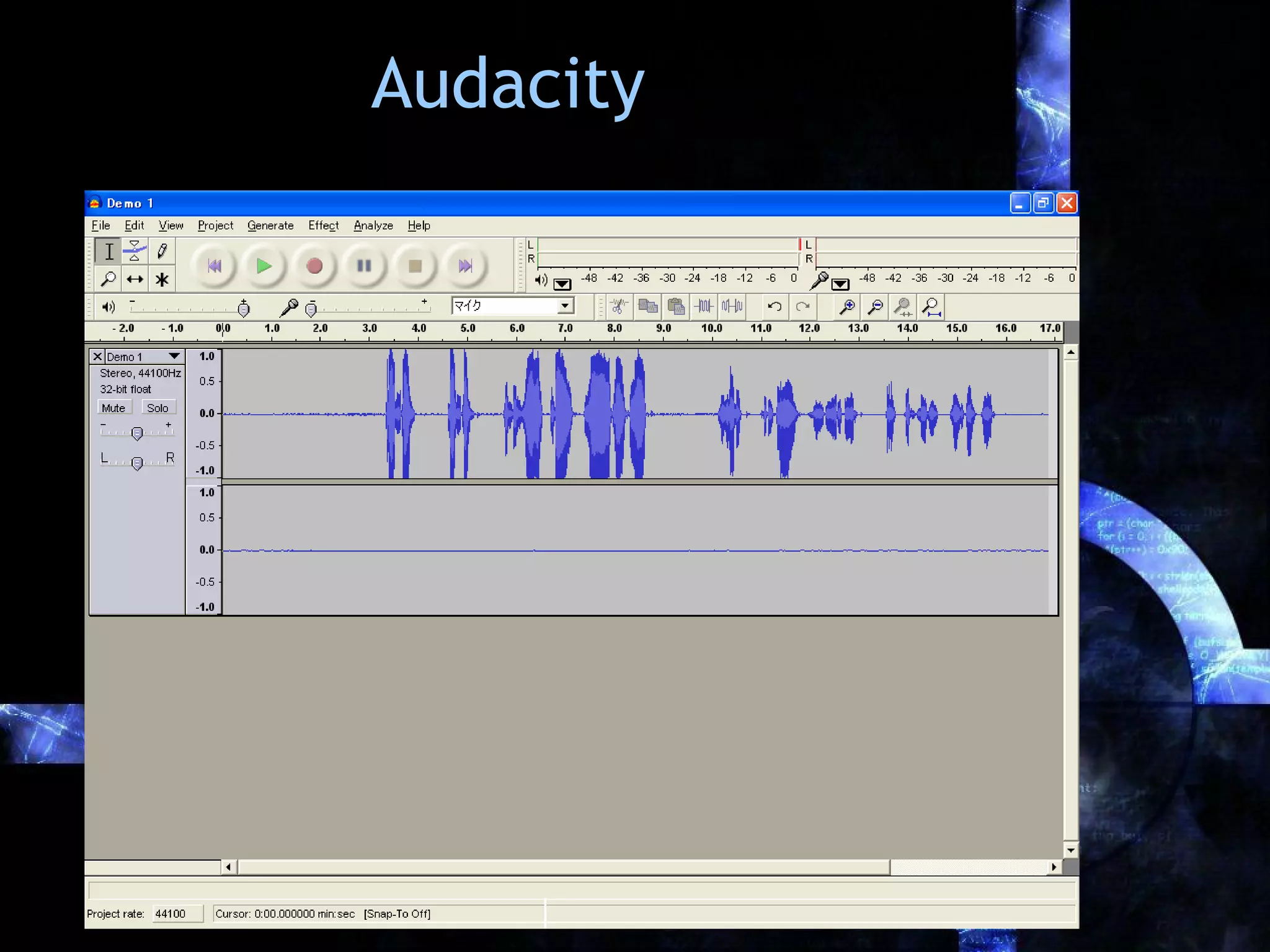
Audacity
• Audacity is a free, open-source recording
  and editing software.
• It’s very user-friendly.
Audacity
Key Audacity features
•   Import audio
•   Cut
•   Silence
•   Amplify
•   Noise removal
•   (Compress)
•   Export as mp3
Website
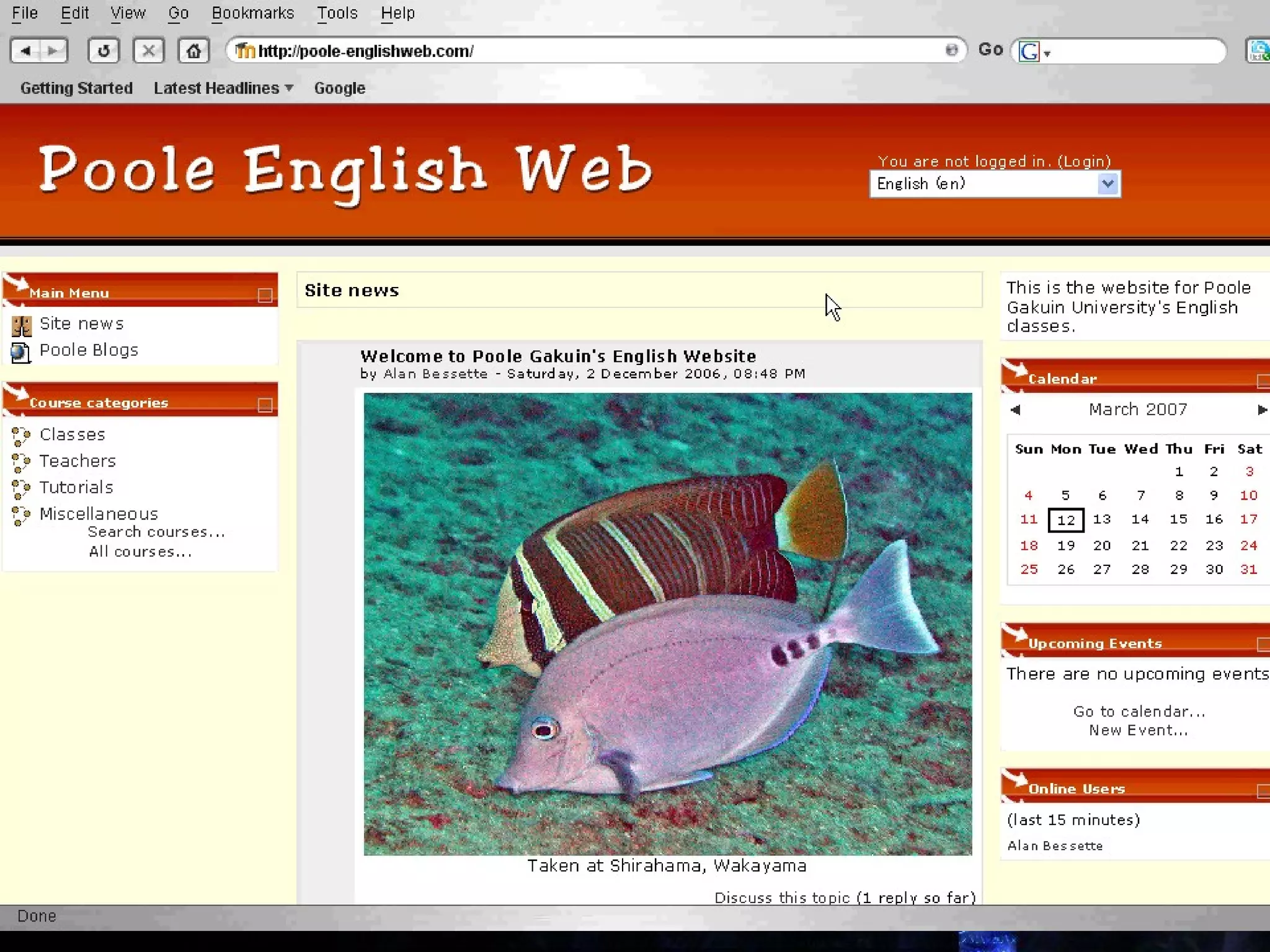
• Located at http://poole-englishweb.com
• It is stored on a Moodle site.
• Moodle is a free, open-source course
  management system.
• It is also user-friendly with extensive
  support and documentation available at
  http://moodle.org/.
Website
• Site organization
• Features
Moodle Features
•   Upload sound (and video) files
•   Make announcements about the site
•   Communicate with students
•   Keep track of student use and quiz scores
•   Create quizzes
    Multiple choice, true/false, matching, short
     answer, embedded answers (cloze), etc.
Website Considerations
• Webhost
  Budget, reliability and support
• FTP server to upload files
  Moodle uploads are limited to 2MB and most
   sound files exceed that limit.
Future Directions
•   More listenings
•   Conversations
•   Vocabulary glosses
•   Images and maps
•   Levels
Thank you for your attention

Creating Narrow Listening Libraries (Joint)

  • 1.
    Creating Narrow Listening Libraries Poole Gakuin University Alan Bessette bessette@poole.ac.jp Anne-Marie Tanahashi anmarie@poole.ac.jp
  • 2.
    What is anarrow listening library? • A collection of listenings Of different topics By different speakers Of interest to students
  • 3.
    Listenings • Several listeningson one topic • Brief (2 to 3 minutes) • Natural speaking
  • 4.
    Learners are freeto decide • When they listen • How many times they listen • Which topics they listen to
  • 5.
    Rationale for NarrowListening • Comprehensible input • Motivation • Practicality
  • 6.
    Comprehensible input • Similarto narrow reading, narrow listening recycles input and makes it more comprehensible. • Recycling facilitates language acquisition (Krashen 1996)
  • 7.
    Research findings: Dupuy(1999) • Learners reported that narrow listening was helpful in improving their French. Listening comprehension Fluency Vocabulary • Learners made significant gains in listening comprehension. • Comprehension increased with frequency of listenings.
  • 8.
    Motivation • Learners agreewith their teachers that listening is important. • Learners often find listening lab exercises not interesting or effective (Harlow & Muyskens (1994).
  • 9.
    Student Reactions: Dupuy,1999 • Narrow listening is more interesting and it allows to listen more carefully. • It helps me to listen to people speaking French fluently even if I’m unable to understand everything they say. • Narrow listening helps me feel better about French.
  • 10.
    Our students • Iwas surprised at how much more I could understand with each listening. • I liked no pressure to answer questions. I liked that I could listen many times. I hate listening in class because never enough times. • I got some new words.
  • 11.
    Practicality • A varietyof listenings • Listenings are readily accessible to students • Immediate feedback
  • 12.
    The bottom line •Although empirical evidence for narrow listening is weak, student reactions and its possible positive effect on students’ motivation, make the case for narrow listening. • Narrow listening libraries are a practical means to provide our students with access to materials.
  • 13.
    Evolution of the narrowlistening library at Poole
  • 14.
    First Steps • Narrowlistening was initially offered As a supplementary activity To 1st year learners in an elective class • Learners were asked to write 3 or 4 questions on a topic that interested them. • The instructor wrote scripts to answer those topics and found 2 or 3 speakers for each topic.
  • 15.
    First topics • Atotal of 6 topics were prepared American High School Proms, Movie Locations for Harry Potter, Tea Time in England, etc. • Listenings were scripted. • Listenings were a bit longer (3 to 5 minutes). • Students were given the listenings on CDs or MDs. • Students were advised to listen a minimum of 8 times.
  • 16.
    Second Steps • Othercolleagues became interested. • The listenings were expanded and moved to the Poole EnglishWeb site.
  • 17.
    Narrow listening library •Topics followed speaking class topics. • There are now 20 topics with 59 listenings: Vacations, shopping, movies, hometowns, food, etc. • Listenings are shorter (1 to 2.5 minutes). • Listenings are unscripted.
  • 18.
  • 19.
    Listenings • Focus questions •Listenings • Quizzes
  • 20.
    Focus Questions • 3or 4 questions • Two purposes Guide speakers so that listenings are similar Provide students with advanced organizer
  • 21.
    Listenings • Speakers areasked to speak for about 1 to 2 minutes naturally without a script • Listenings are Recorded in a recording studio Edited with Audacity and saved as mp3 files Uploaded to our website.
  • 22.
    Quizzes • Optional • Createdwithin Moodle • Short – five multiple choice or true/false questions • Specific to one listening • Two chances to take quizzes
  • 23.
  • 24.
    Audacity • Audacity isa free, open-source recording and editing software. • It’s very user-friendly.
  • 25.
  • 26.
    Key Audacity features • Import audio • Cut • Silence • Amplify • Noise removal • (Compress) • Export as mp3
  • 27.
    Website • Located athttp://poole-englishweb.com • It is stored on a Moodle site. • Moodle is a free, open-source course management system. • It is also user-friendly with extensive support and documentation available at http://moodle.org/.
  • 28.
  • 30.
    Moodle Features • Upload sound (and video) files • Make announcements about the site • Communicate with students • Keep track of student use and quiz scores • Create quizzes Multiple choice, true/false, matching, short answer, embedded answers (cloze), etc.
  • 31.
    Website Considerations • Webhost Budget, reliability and support • FTP server to upload files Moodle uploads are limited to 2MB and most sound files exceed that limit.
  • 32.
    Future Directions • More listenings • Conversations • Vocabulary glosses • Images and maps • Levels
  • 33.
    Thank you foryour attention

Editor's Notes

  • #7 Although there are differences between the listenings for one topic, many of the vocabulary, grammar features, expressions, etc. will be the same or similar. Repeated listenings with familiar input make the input more comprehensible for learners. Example: Food topic several of the speakers mention not liking natto because it is sticky and smelly.
  • #8 Learners reported that NL helped listening comprehension first, then fluency and finally vocabulary
  • #10 Last quote is half the battle.
  • #16 Students were provided with a listening log. It is on the back of the handout.
  • #18 Majority are unscripted.
  • #23 These are in response to a student request. The number of chances to take the quizzes is decided by the instructor. Some of the original longer listenings have more questions.
  • #25 Garage Band is an alternative for Apple users. Information about where to download and user’s manual is on the handout.
  • #27 Open Audacity and Show features: Record, Mic input level, stop and play Input demo listening and play: point out the first part is too loud. Too close to the mike and input level was too high Demonstrate features: cut, silence, amplify, (undo and redo), noise removal, compress Demonstrate Export as mp3
  • #31 Students have access to files at school and at home. Can be downloaded onto Mp3 players. Posts are automatically sent to participants
  • #32 See handout
  • #33 Vocabulary glosses, images and maps will help student understanding. As the number of listenings increase, it will be important to help students choose appropriate levels. One way that we will probably explore is to ask students to rate them as easy, so-so and difficult.