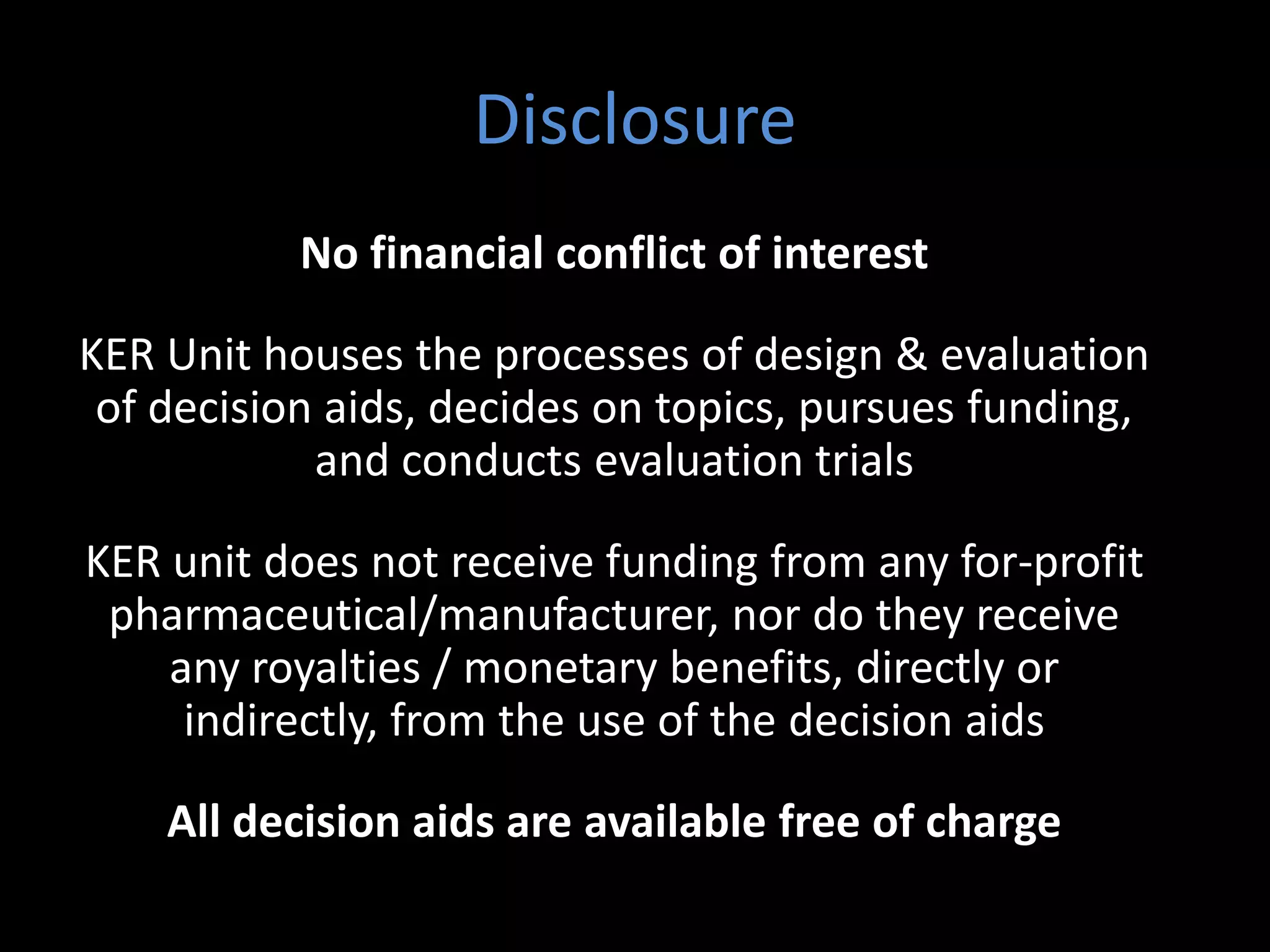
Creating Meaningful Conversations
Insights from Shared Decision Making at the point of care


                                                 Annie LeBlanc PhD
                       Knowledge and Evaluation Research (KER) Unit
                                  Mayo Clinic, Rochester, MN (USA)
Disclosure
           No financial conflict of interest

KER Unit houses the processes of design & evaluation
 of decision aids, decides on topics, pursues funding,
            and conducts evaluation trials

KER unit does not receive funding from any for-profit
 pharmaceutical/manufacturer, nor do they receive
    any royalties / monetary benefits, directly or
     indirectly, from the use of the decision aids

    All decision aids are available free of charge
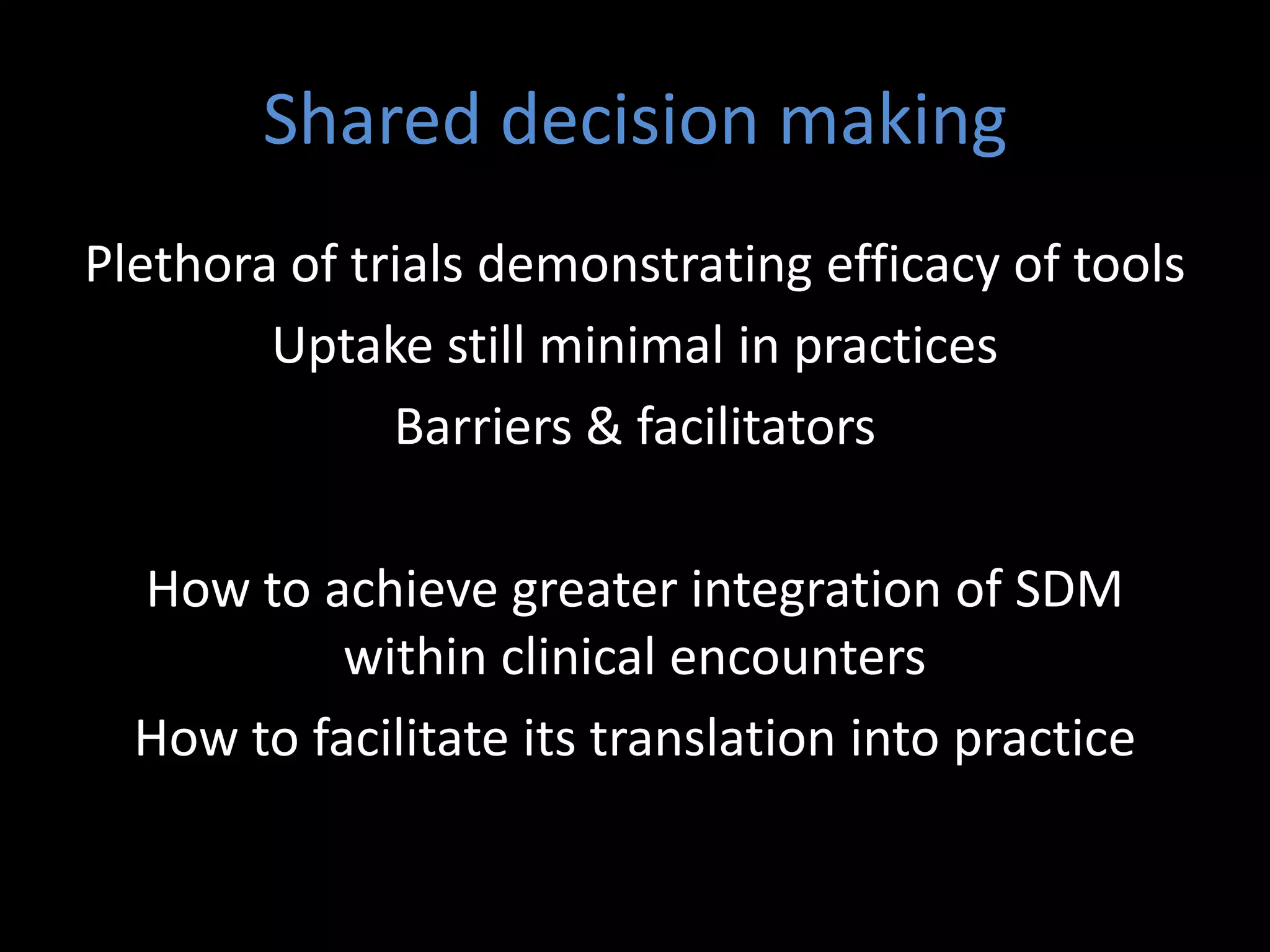
Why we came to shared decision making


    Patient centered high value healthcare
            Evidence based medicine
 Makes explicit the uncertainty of the evidence
 Gives a voice to patients (values/ preferences)
        Reduce unwarranted variations
                Right thing to do
Shared decision making
Plethora of trials demonstrating efficacy of tools
        Uptake still minimal in practices
              Barriers & facilitators

  How to achieve greater integration of SDM
           within clinical encounters
  How to facilitate its translation into practice
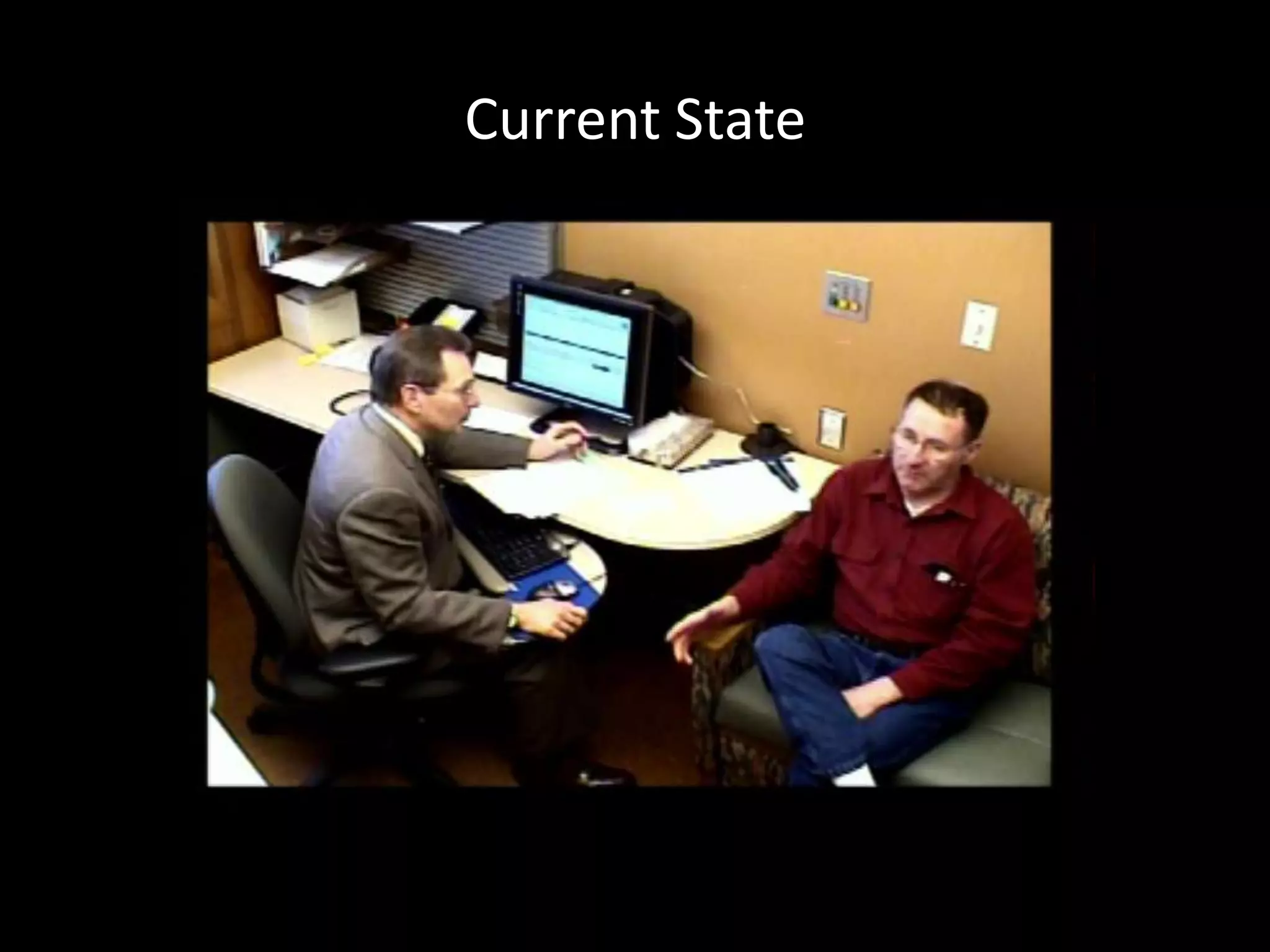
Current State
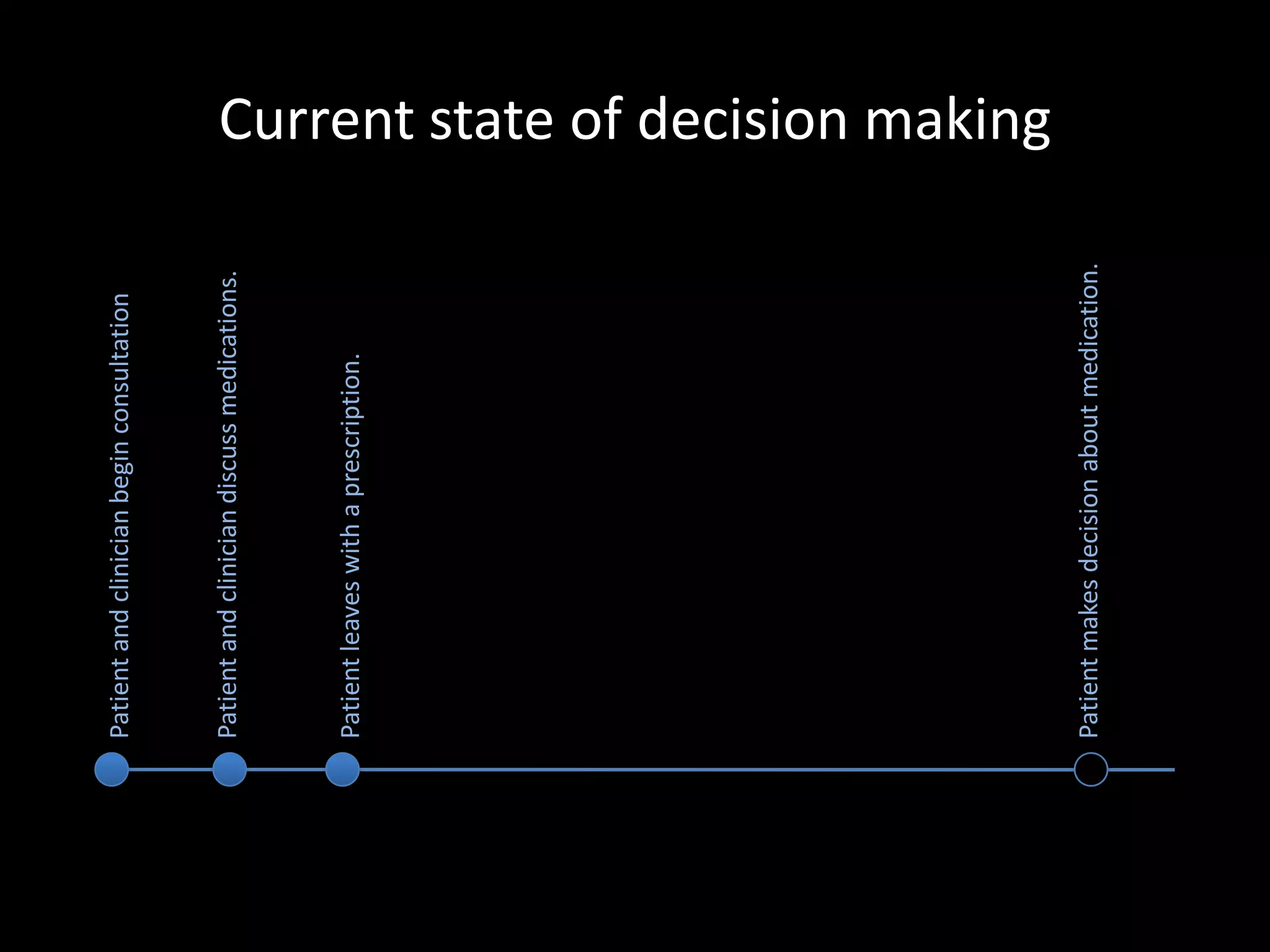
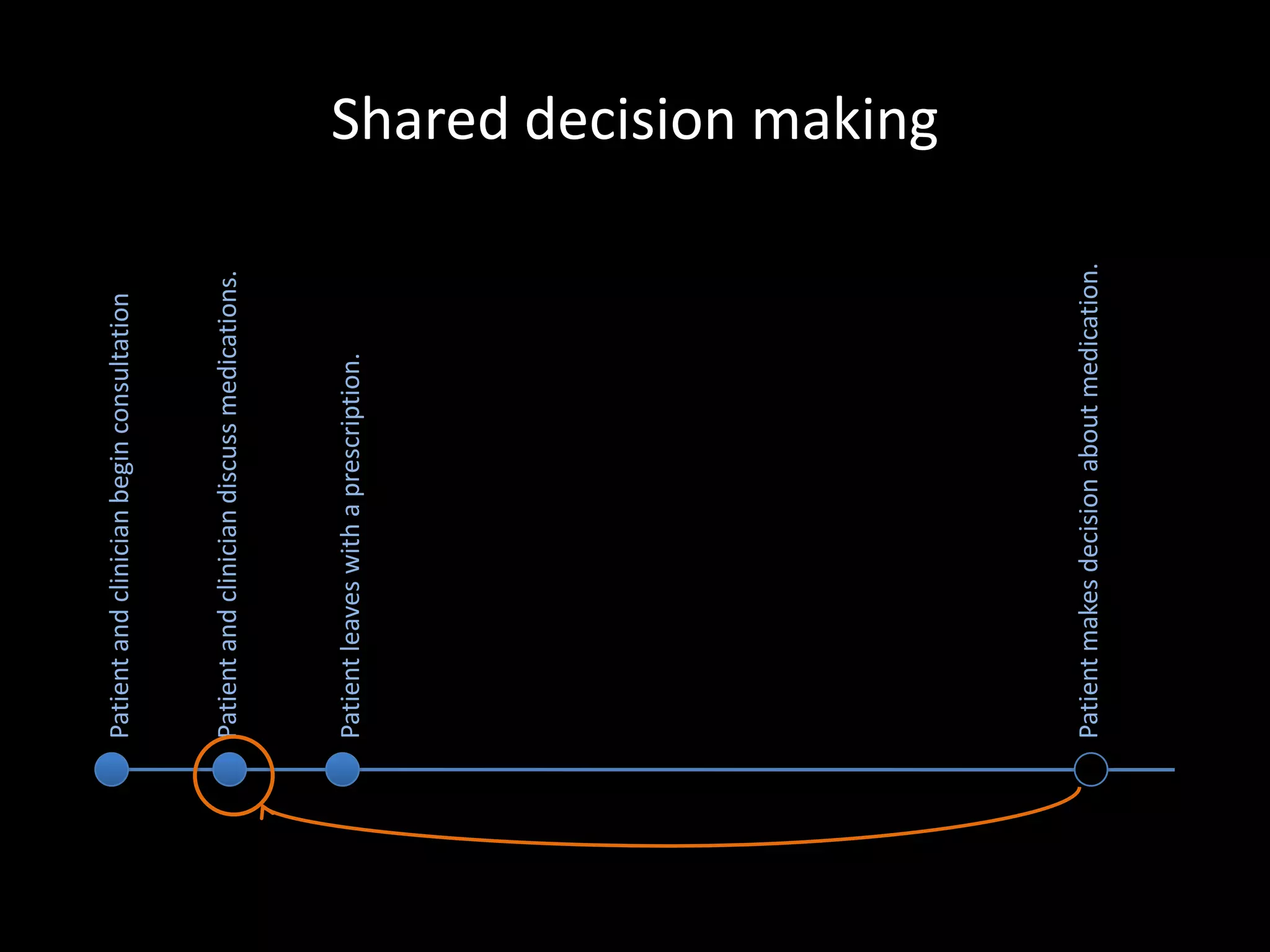
Patient and clinician begin consultation


Patient and clinician discuss medications.


Patient leaves with a prescription.
                                             Current state of decision making


Patient makes decision about medication.
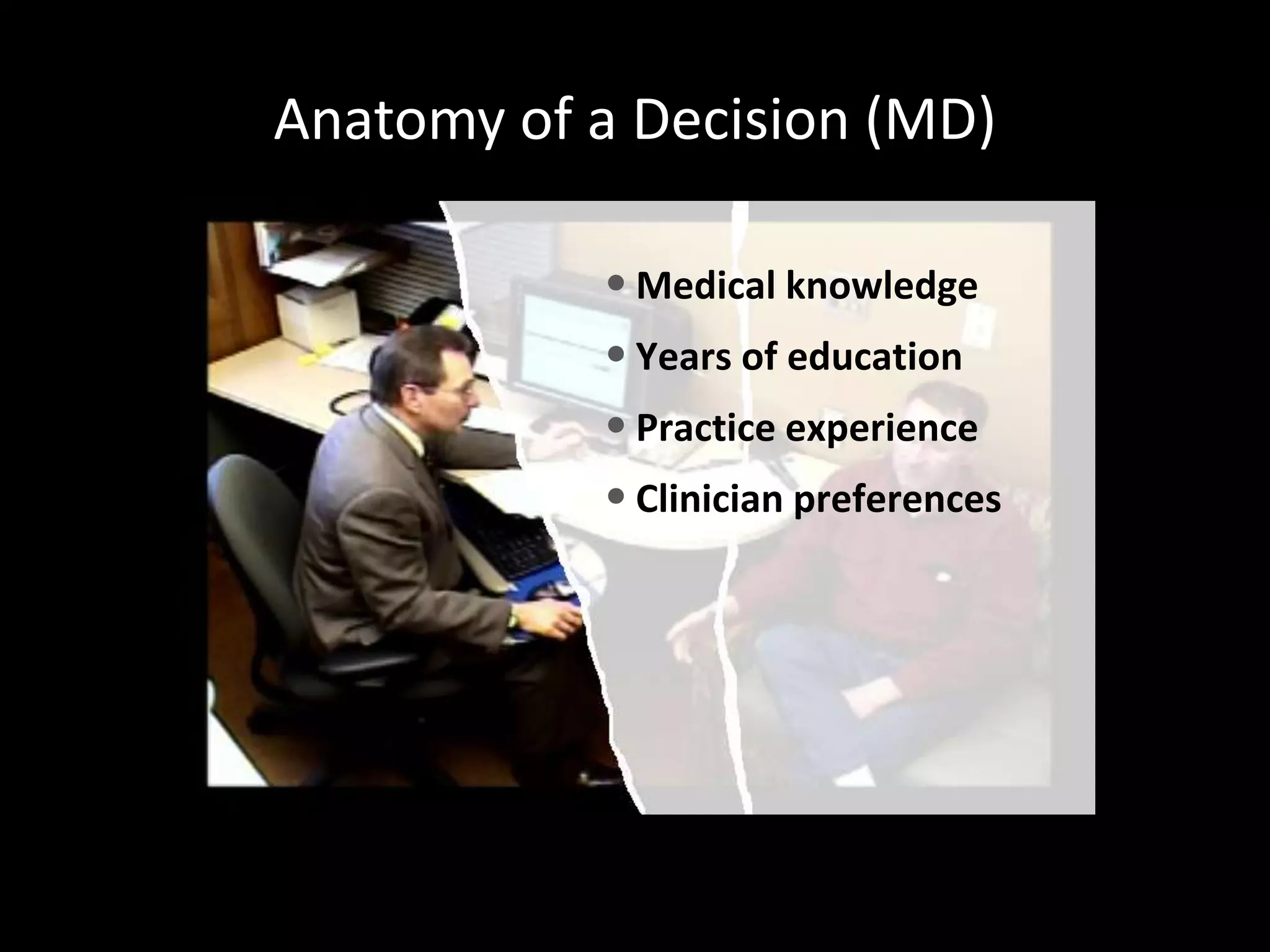
Anatomy of a Decision (MD)

           • Medical knowledge
           • Years of education
           • Practice experience
           • Clinician preferences
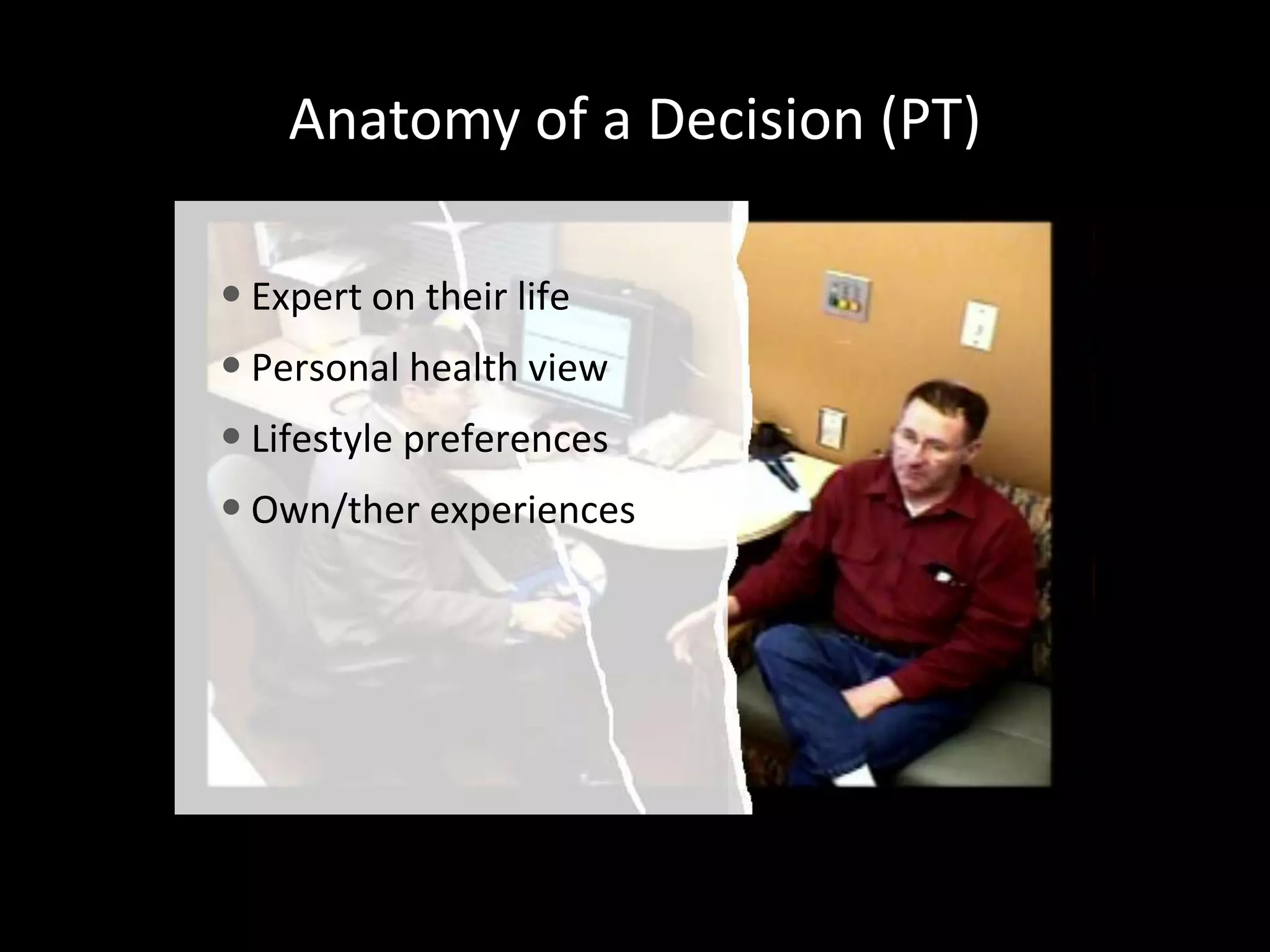
Anatomy of a Decision (PT)

• Expert on their life
• Personal health view
• Lifestyle preferences
• Own/ther experiences
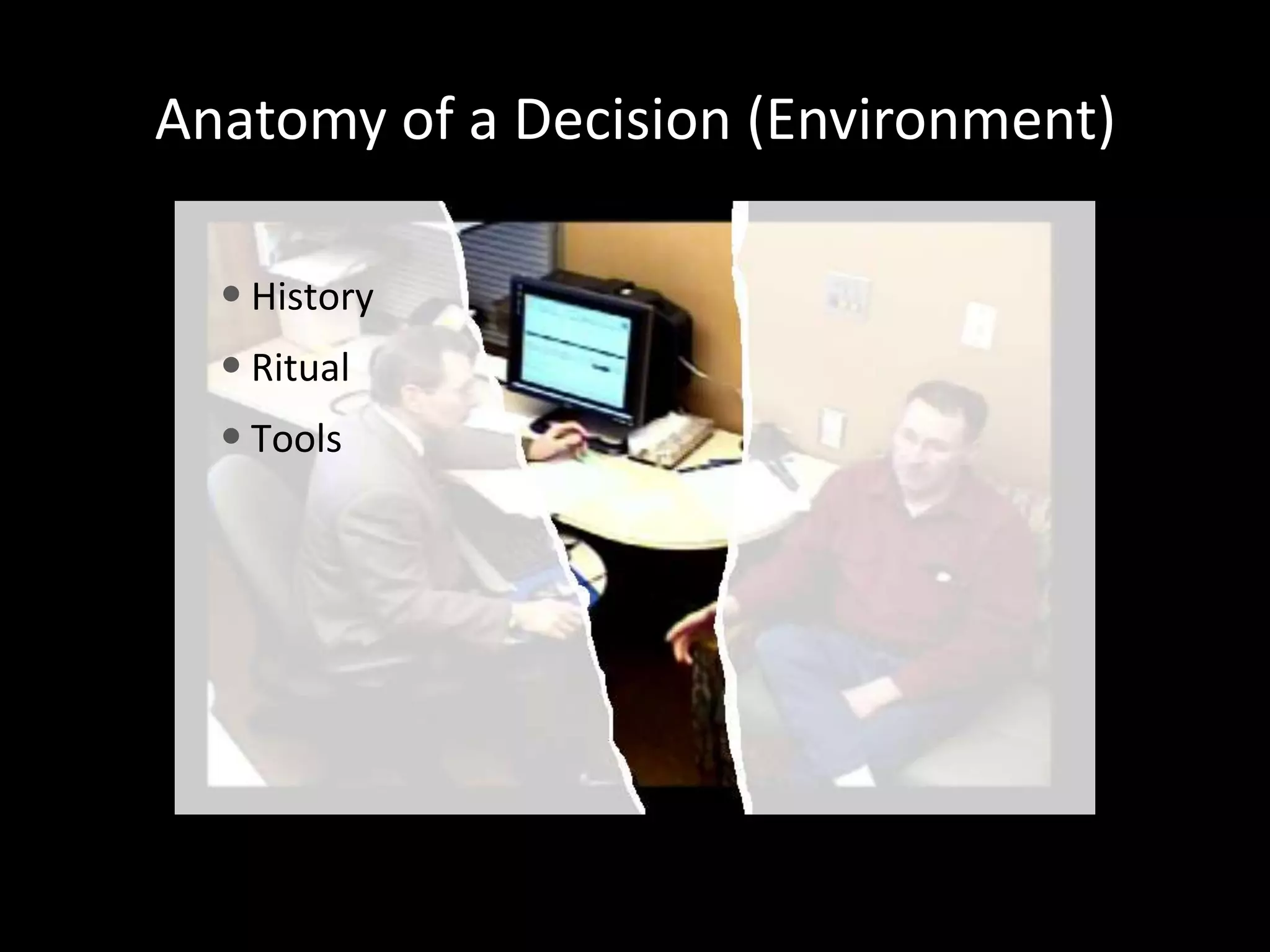
Anatomy of a Decision (Environment)

  • History
  • Ritual
  • Tools
Patient and clinician begin consultation


Patient and clinician discuss medications.


Patient leaves with a prescription.
                                             Shared decision making


Patient makes decision about medication.
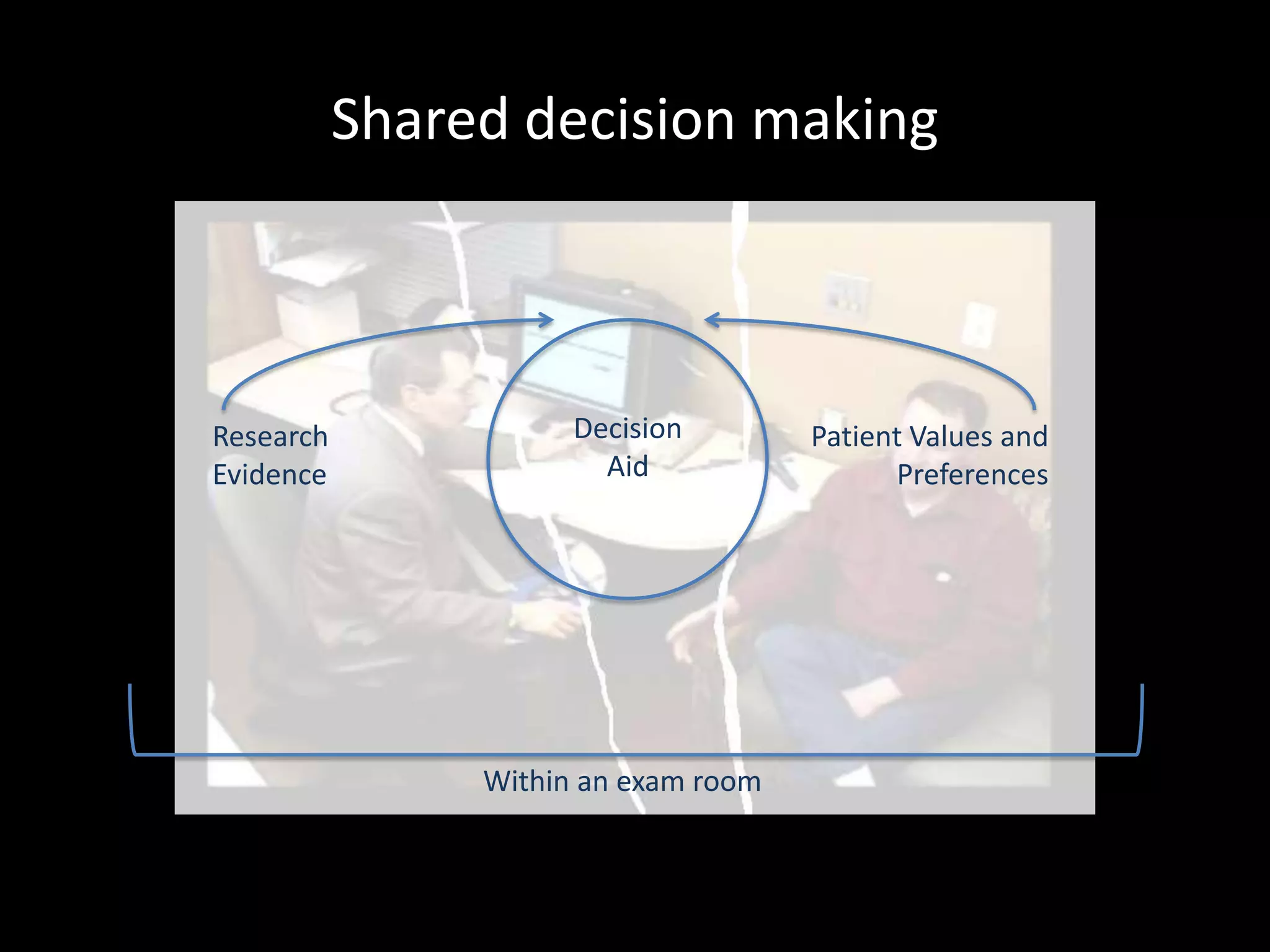
Shared decision making


Research              Decision        Patient Values and
Evidence                Aid                 Preferences


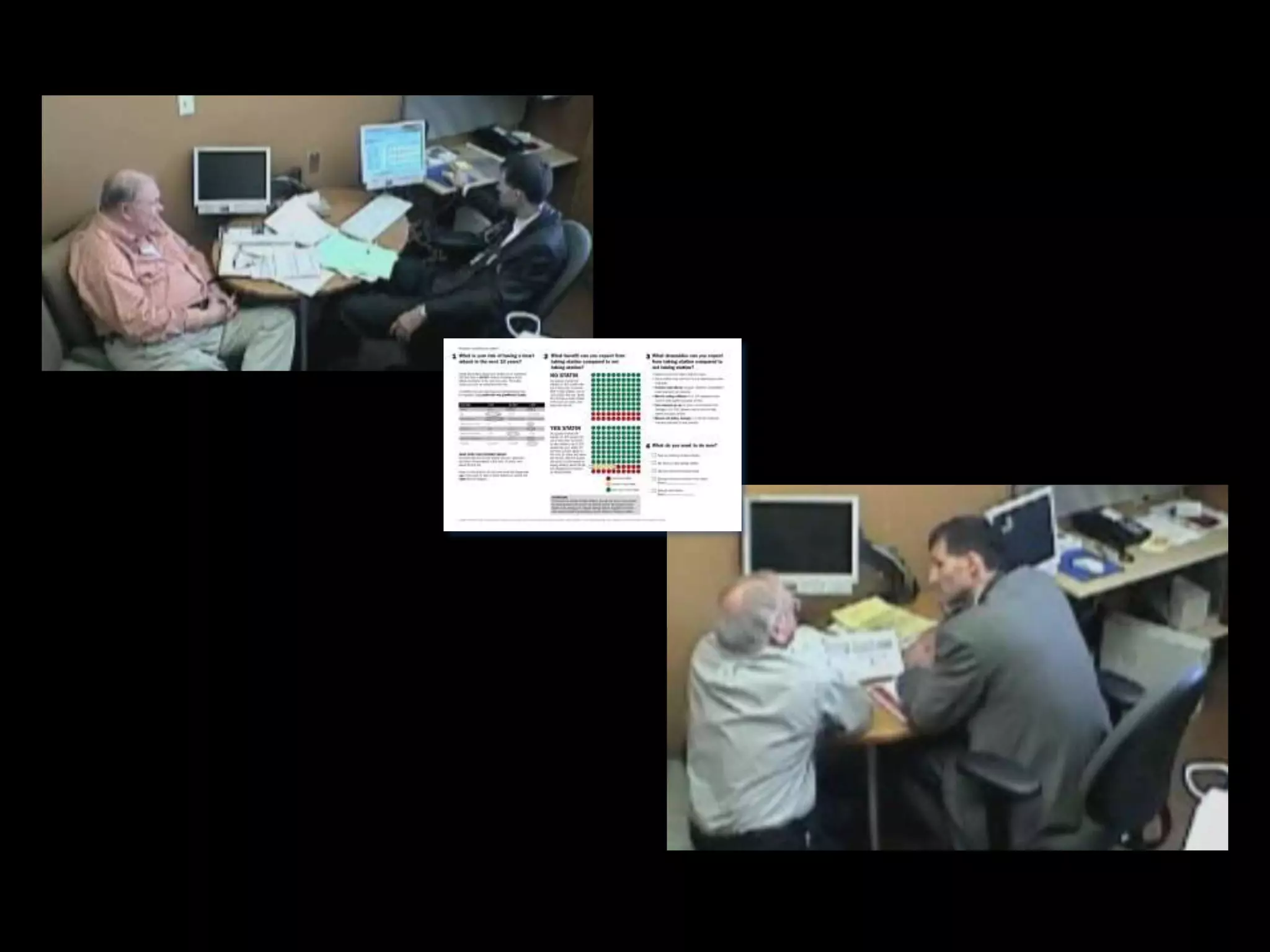
                Within an exam room
Our Decision Aids are focused
on facilitating a conversation between
  health professionals and patients
                and thus
  designed as tools intended for use
     during the clinical encounter
“What do we need to know to make this
         decision together ”
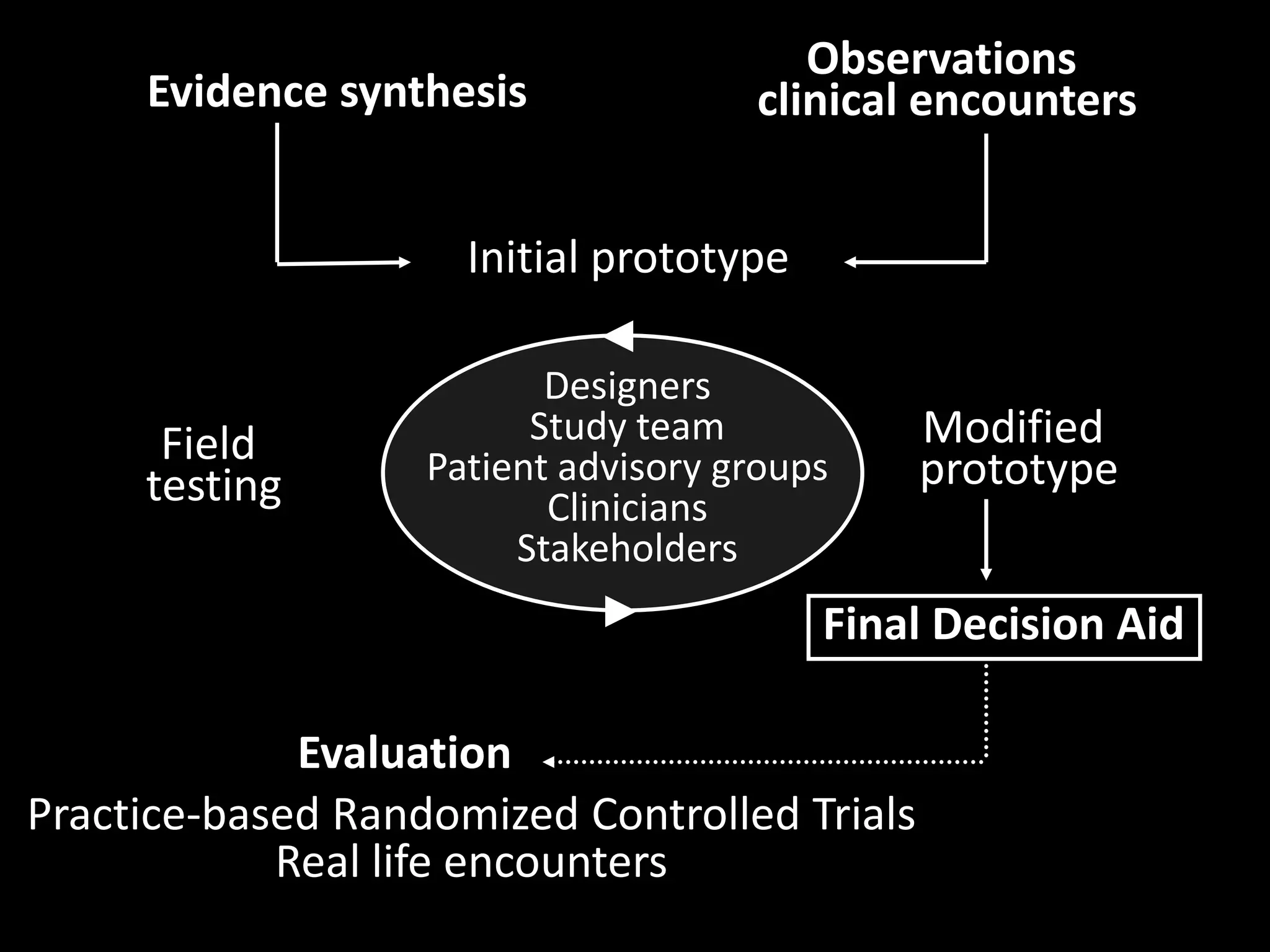
Observations
     Evidence synthesis              clinical encounters


                     Initial prototype

                          Designers
      Field              Study team           Modified
     testing       Patient advisory groups    prototype
                          Clinicians
                        Stakeholders
                                         Final Decision Aid

             Evaluation
Practice-based Randomized Controlled Trials
            Real life encounters
The case of diabetes medication
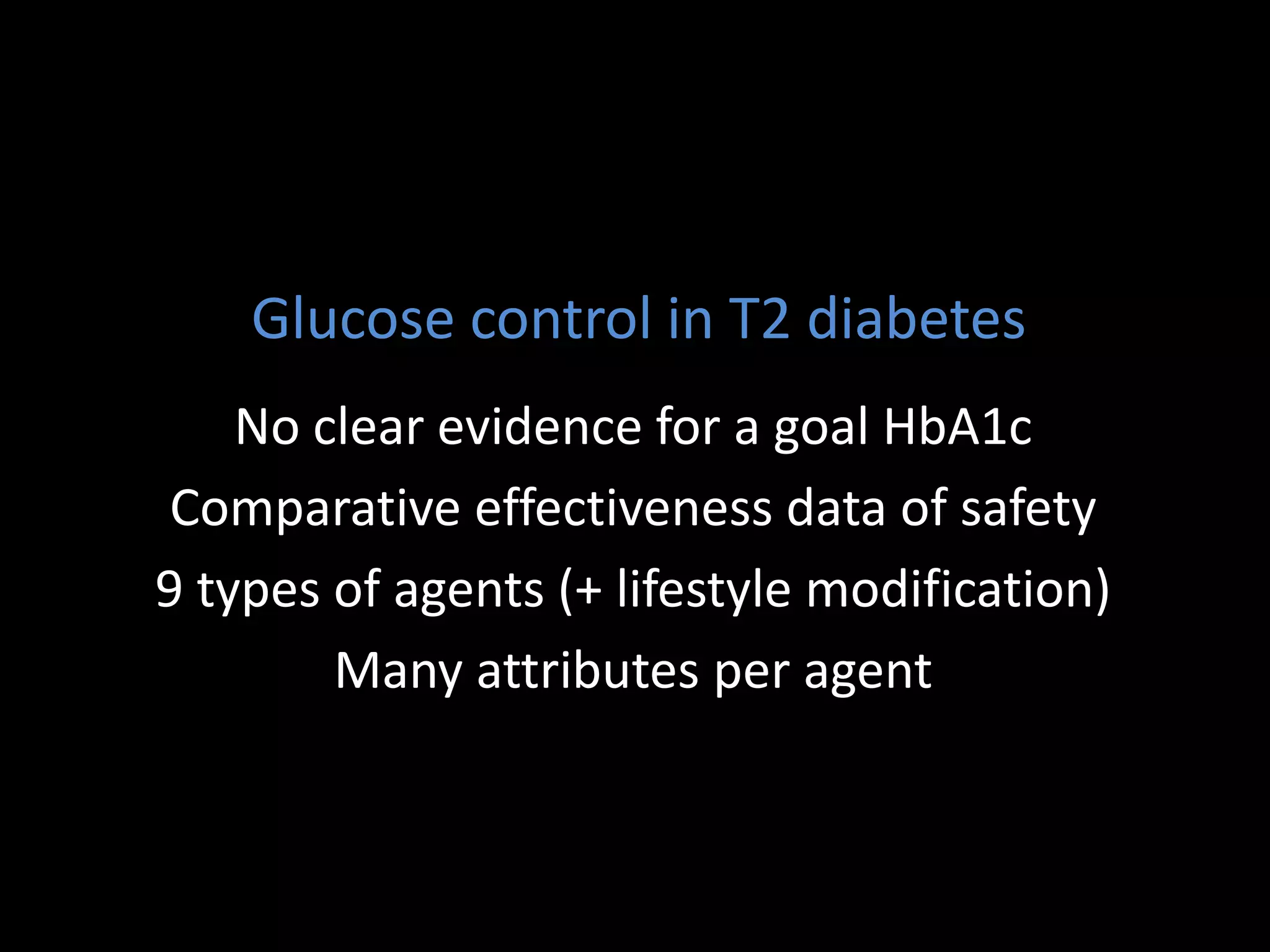
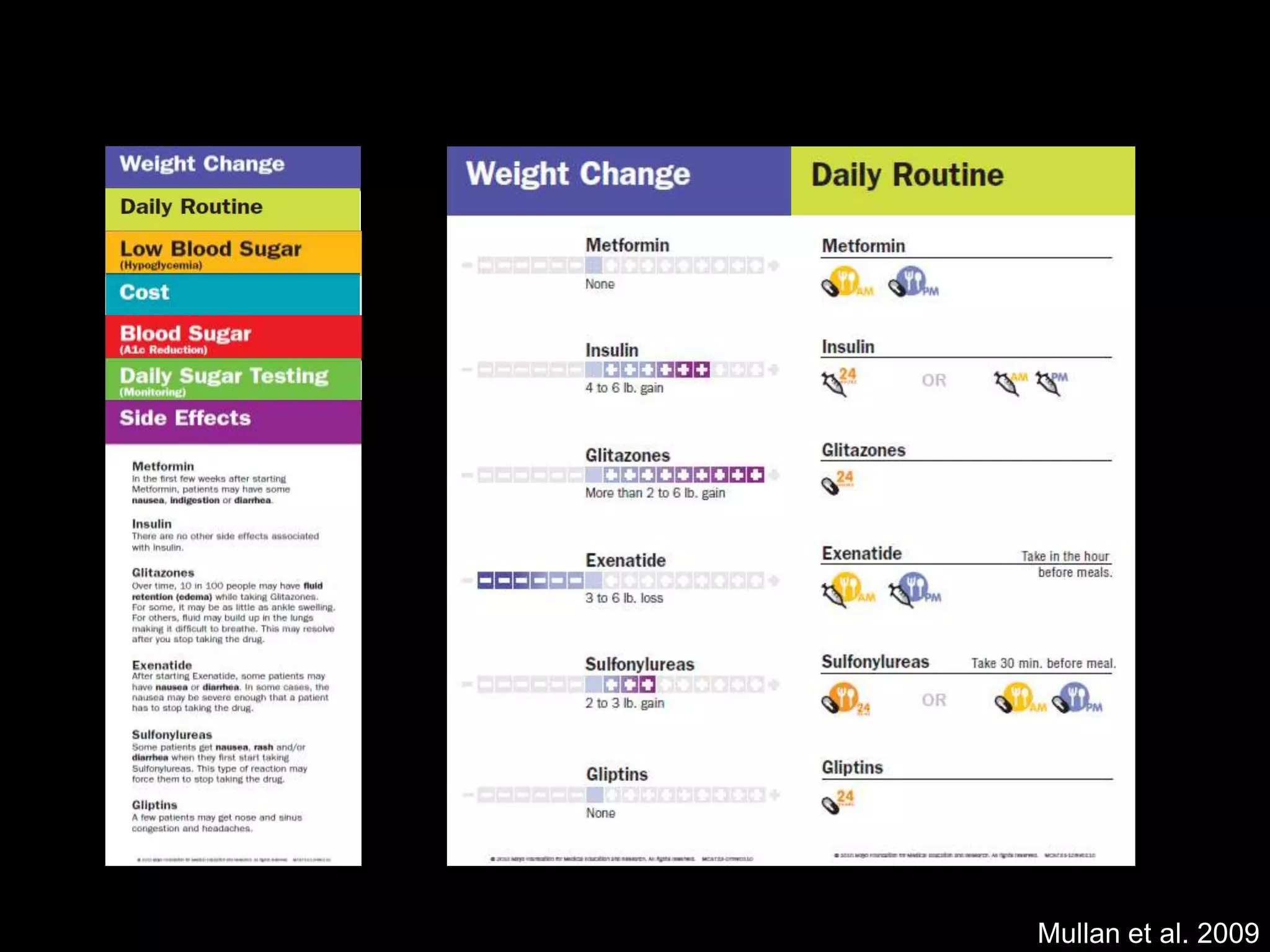
Glucose control in T2 diabetes
    No clear evidence for a goal HbA1c
 Comparative effectiveness data of safety
9 types of agents (+ lifestyle modification)
        Many attributes per agent
Mullan et al. 2009
Web-based Decision aids
http://diabetesdecisionaid.mayoclinic.org/
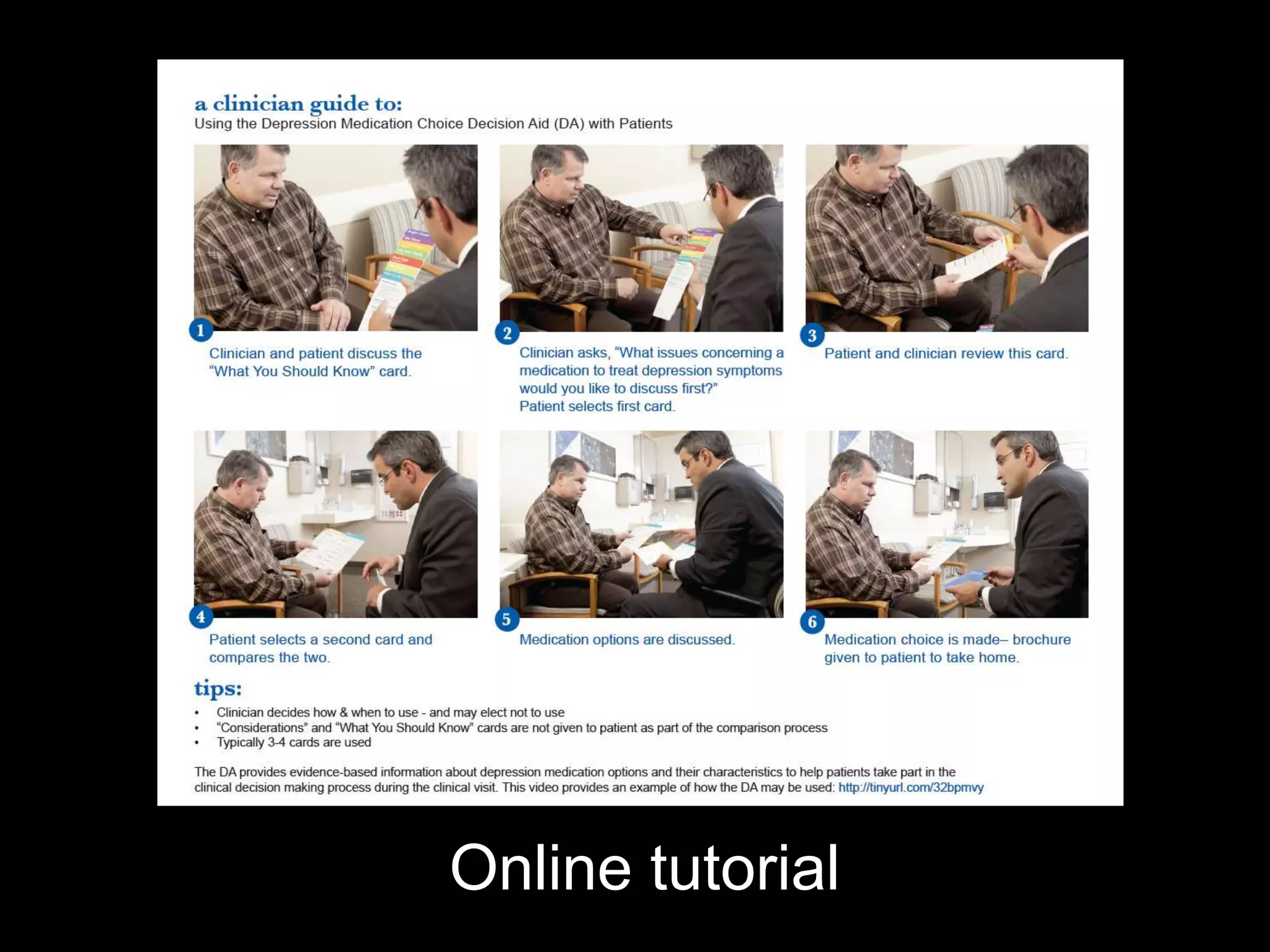
Online tutorial
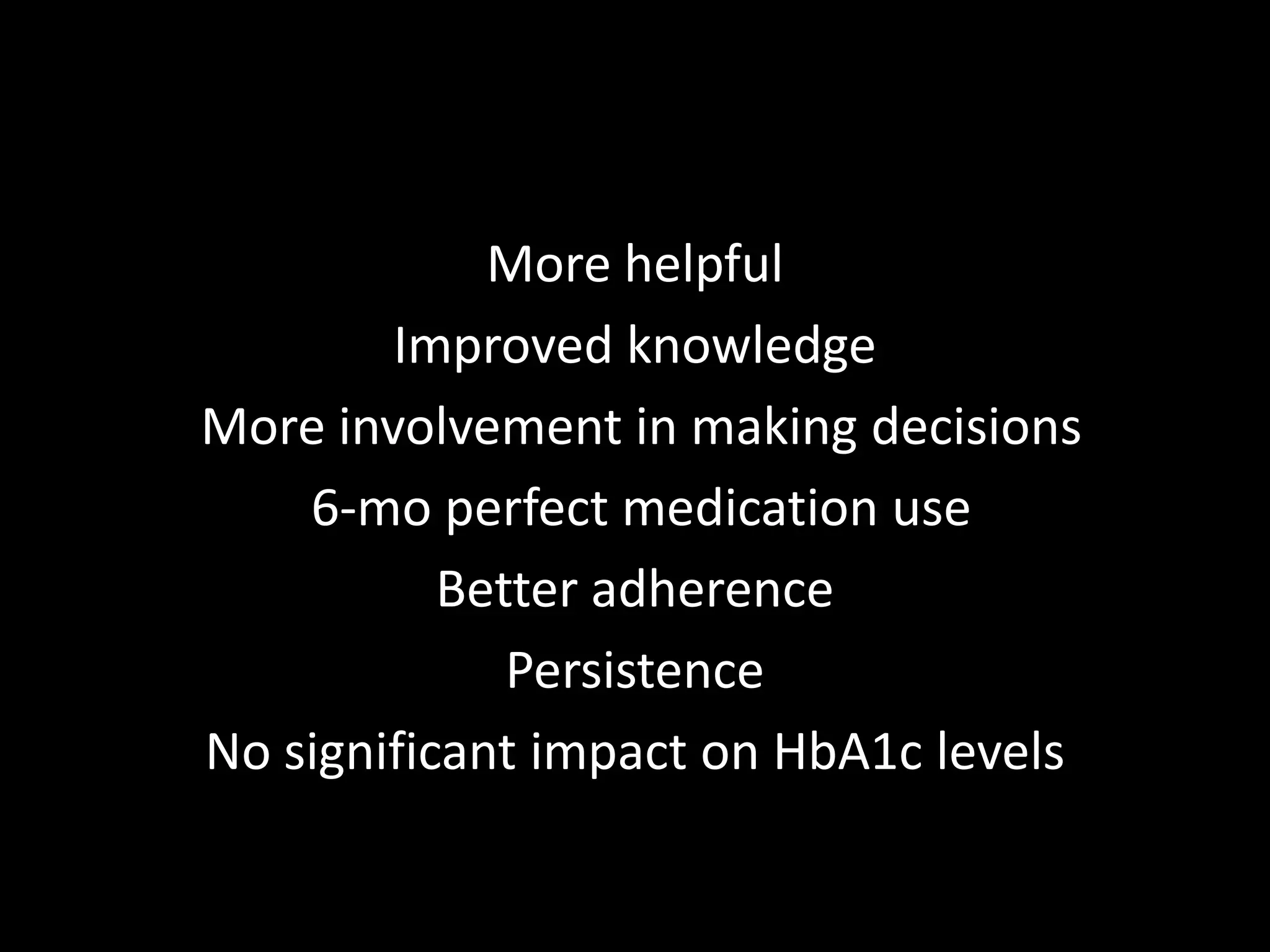
More helpful
        Improved knowledge
More involvement in making decisions
    6-mo perfect medication use
           Better adherence
              Persistence
No significant impact on HbA1c levels
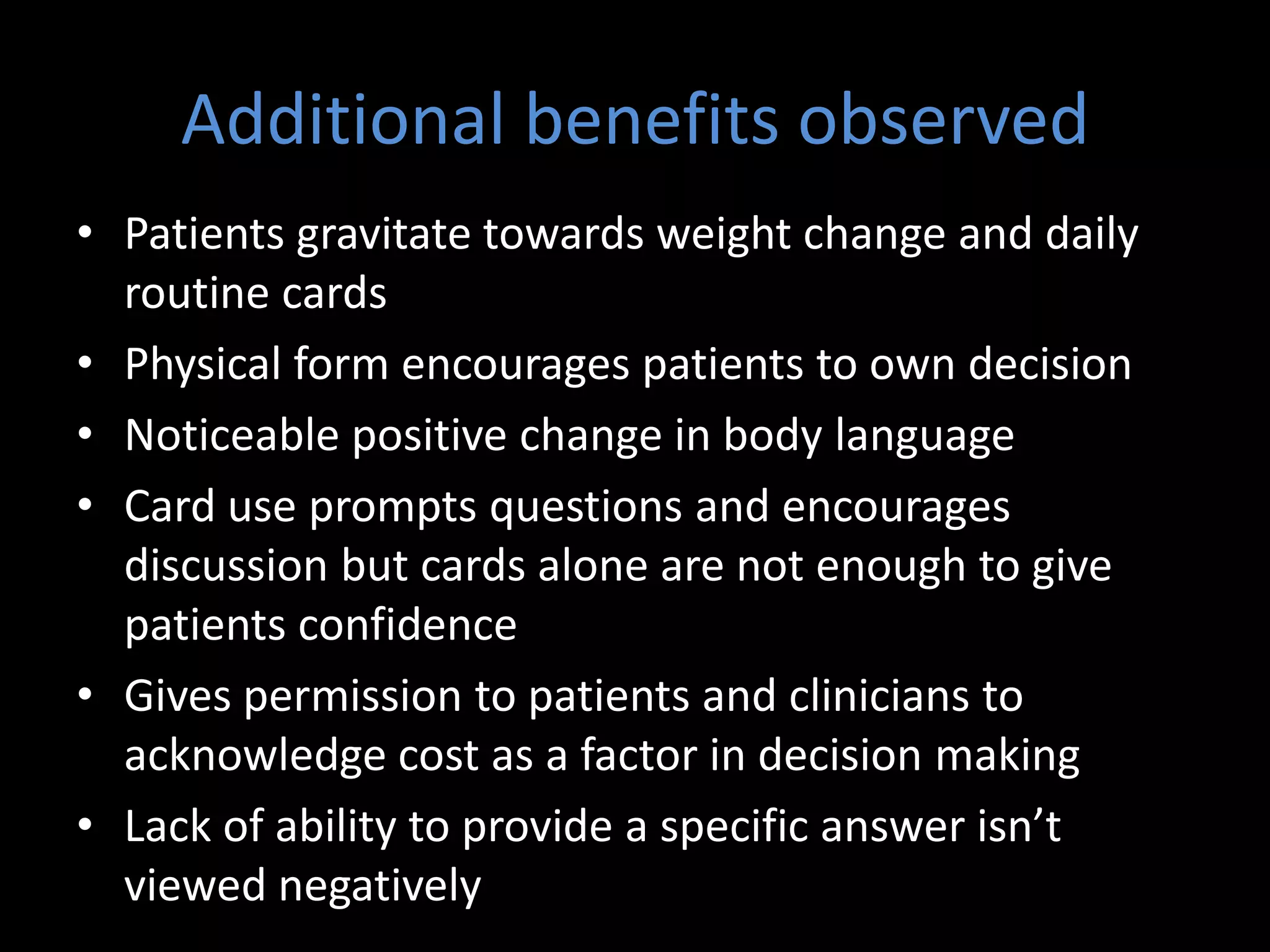
Additional benefits observed
• Patients gravitate towards weight change and daily
  routine cards
• Physical form encourages patients to own decision
• Noticeable positive change in body language
• Card use prompts questions and encourages
  discussion but cards alone are not enough to give
  patients confidence
• Gives permission to patients and clinicians to
  acknowledge cost as a factor in decision making
• Lack of ability to provide a specific answer isn’t
  viewed negatively
The story of our 92 y old patient
The case of Depression Care
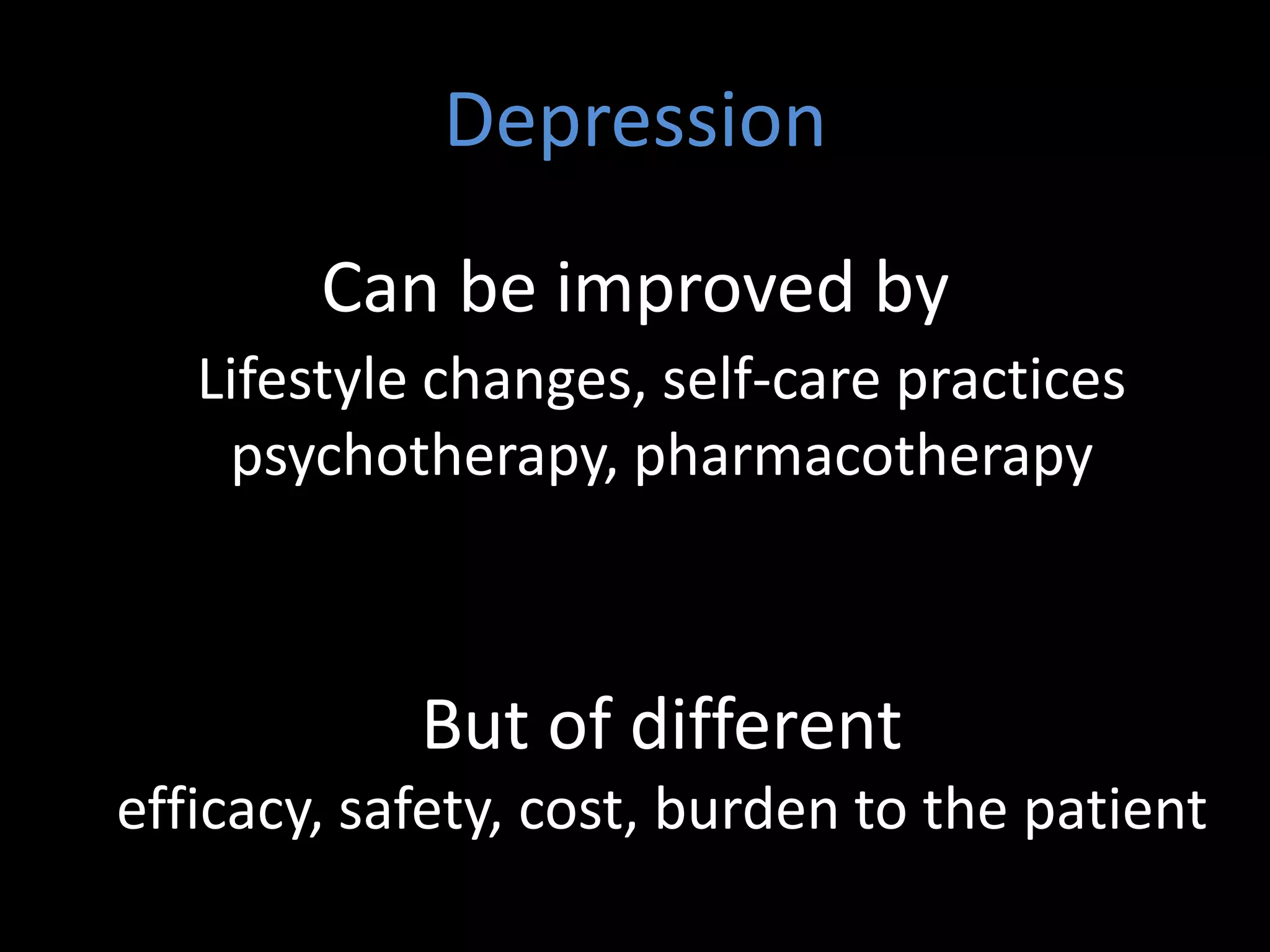
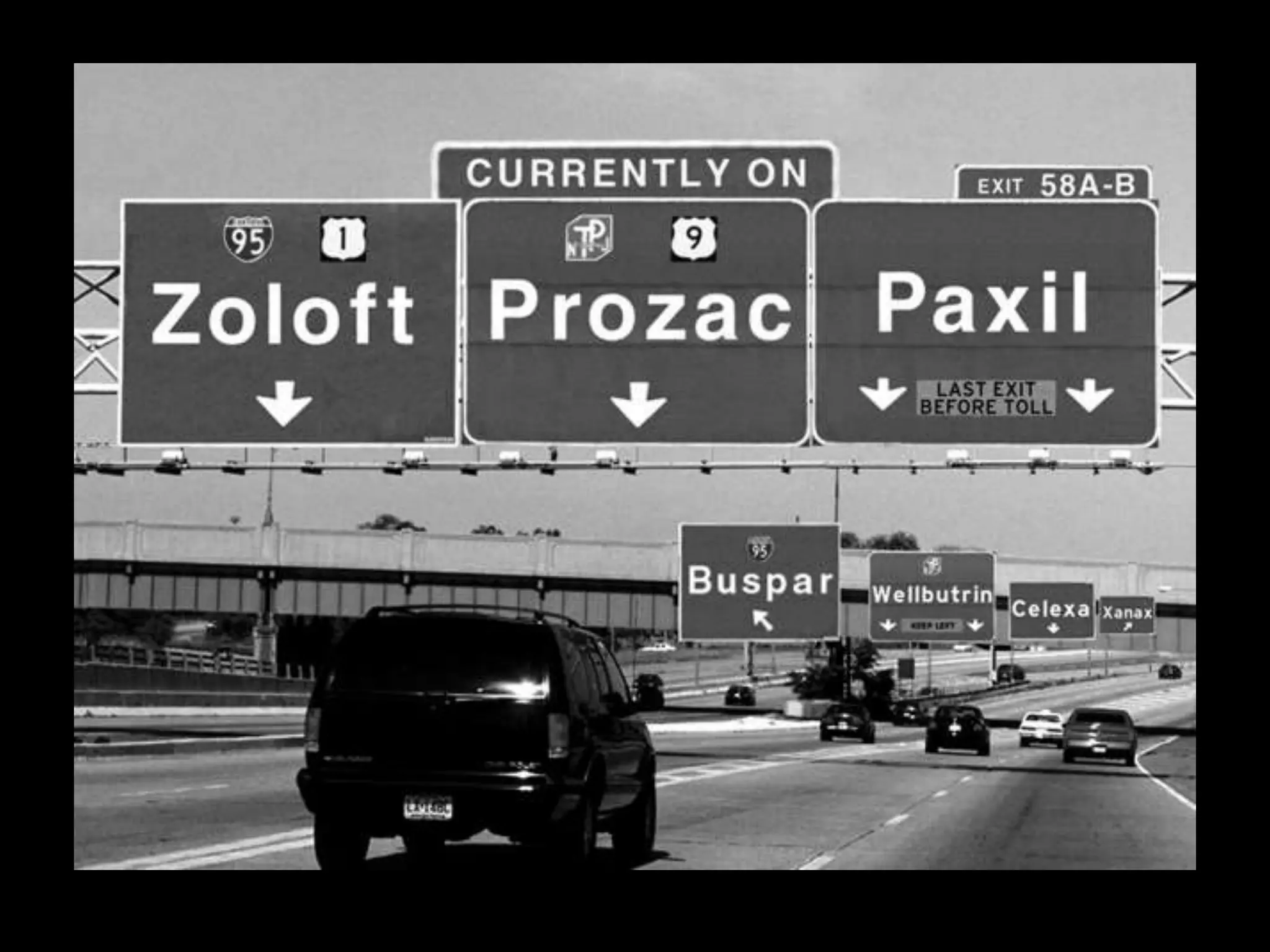
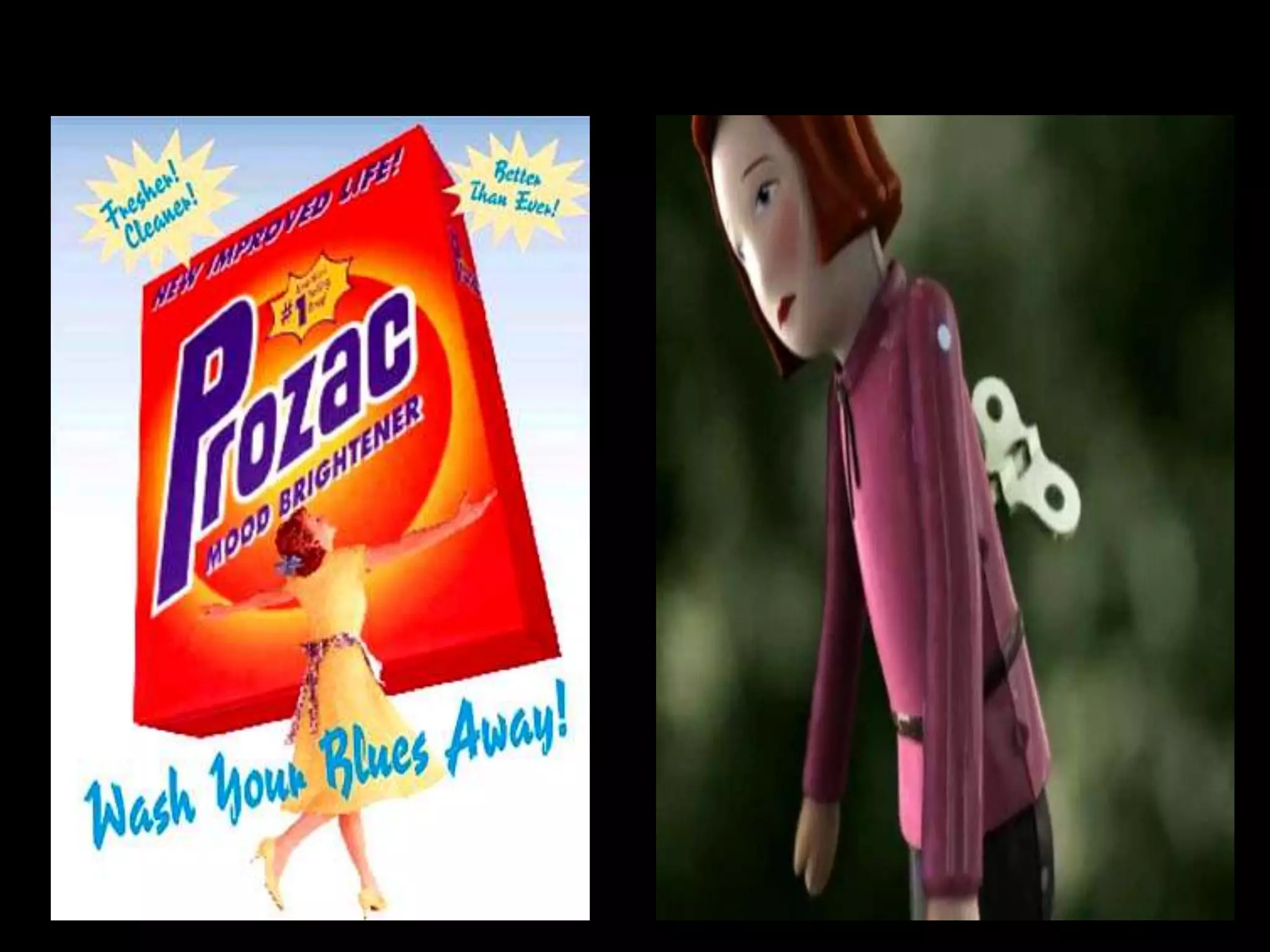
Depression
        Can be improved by
   Lifestyle changes, self-care practices
    psychotherapy, pharmacotherapy


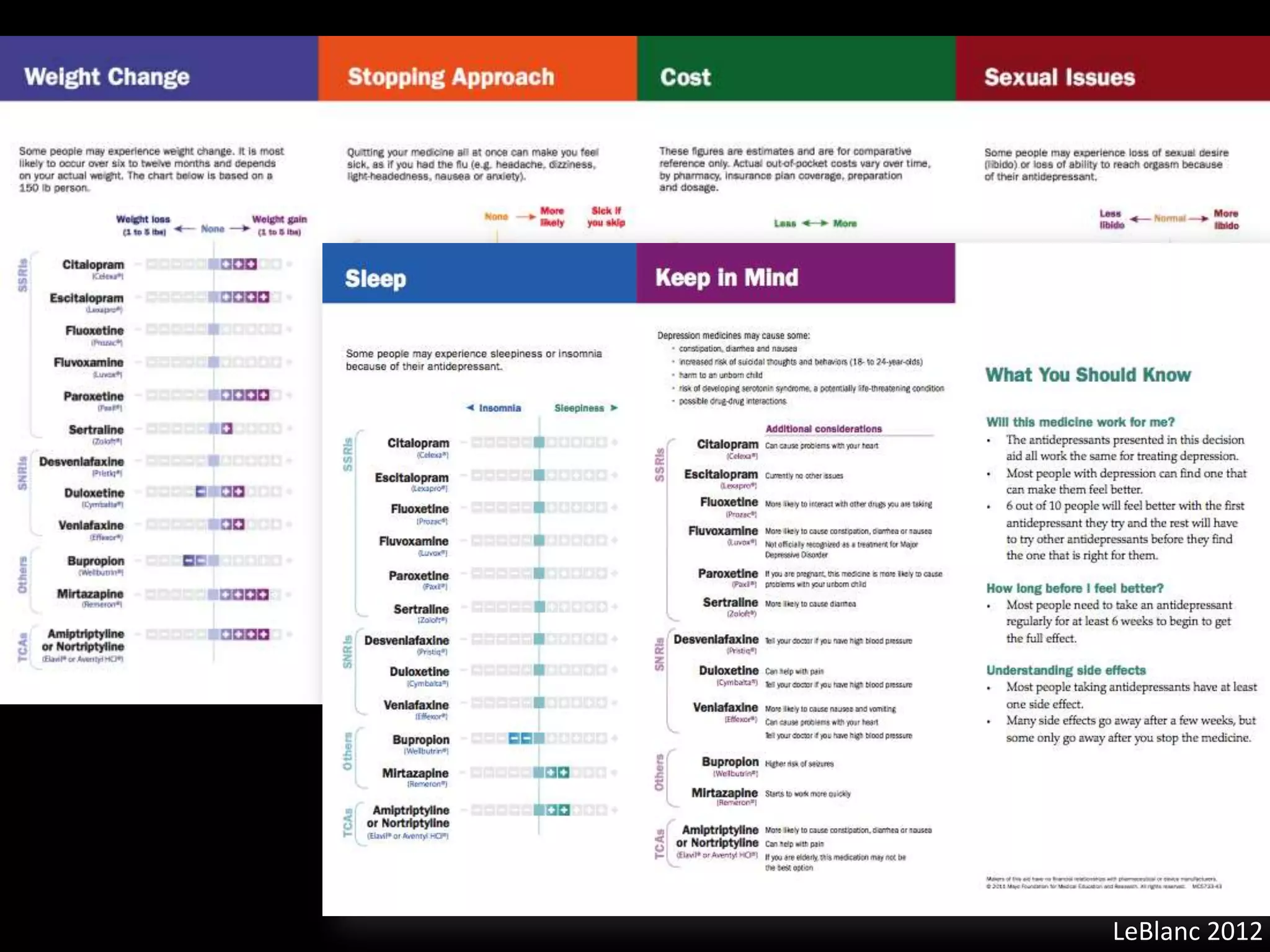
            But of different
efficacy, safety, cost, burden to the patient
LeBlanc 2012
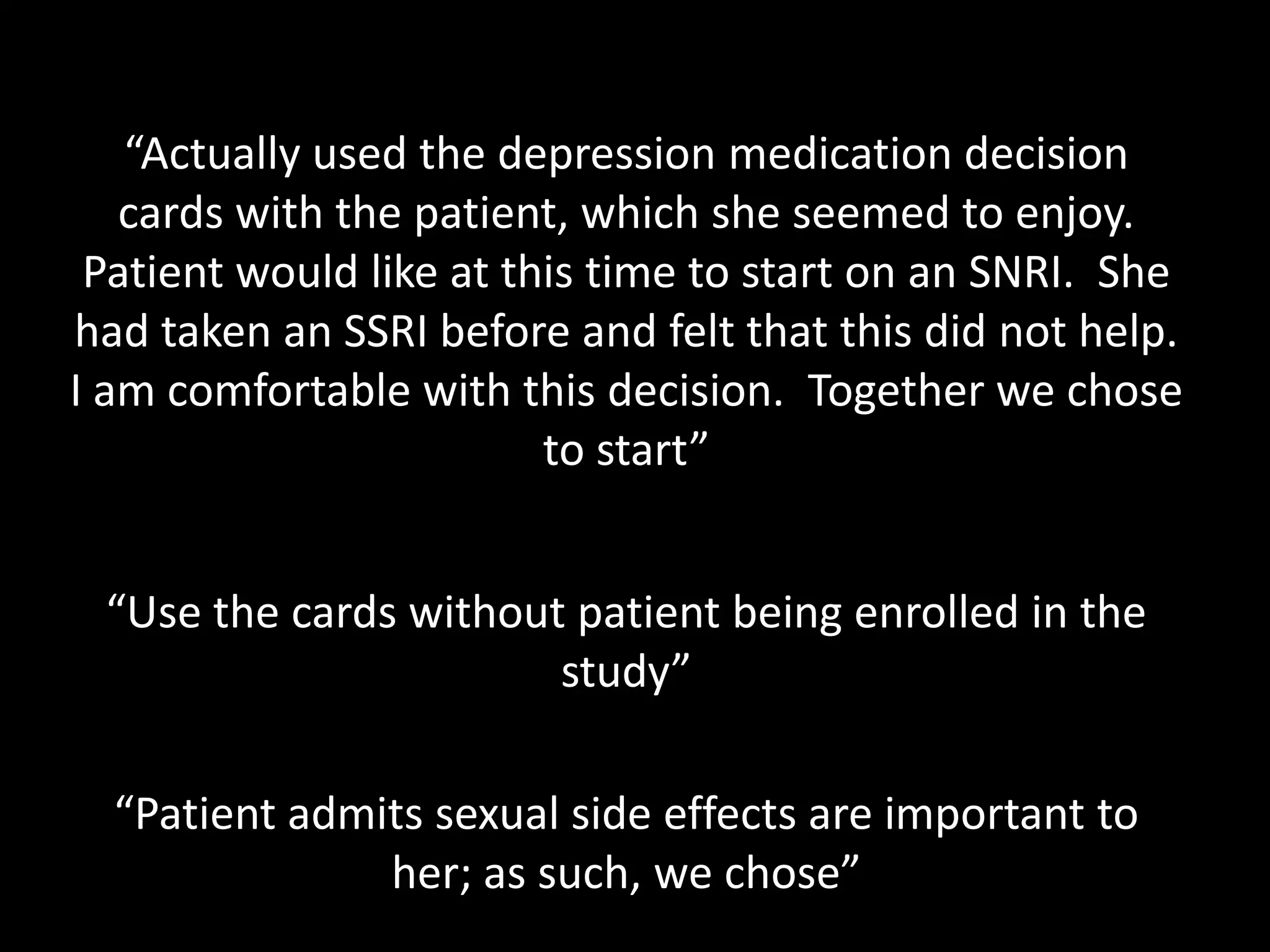
Cluster RCT in Rural & urban PC practices
(10 practices WI MN, 106 clinicians, 200/300 patients)
“Actually used the depression medication decision
   cards with the patient, which she seemed to enjoy.
 Patient would like at this time to start on an SNRI. She
had taken an SSRI before and felt that this did not help.
I am comfortable with this decision. Together we chose
                         to start”


 “Use the cards without patient being enrolled in the
                       study”

  “Patient admits sexual side effects are important to
               her; as such, we chose”
Other Wiser Choices Decision Aids
          Chronic and acute care
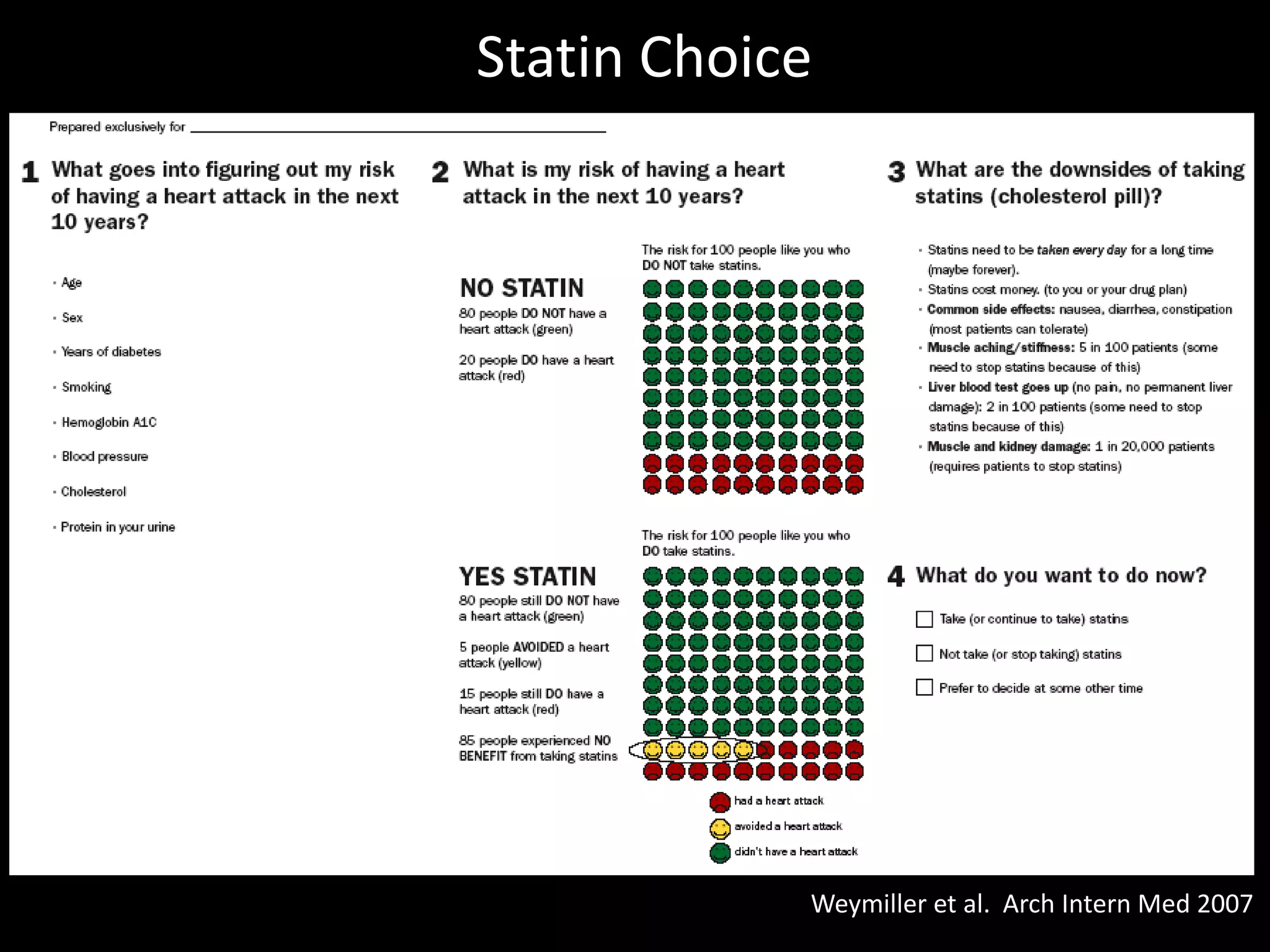
Statin Choice


            Weymiller et al. Arch Intern Med 2007
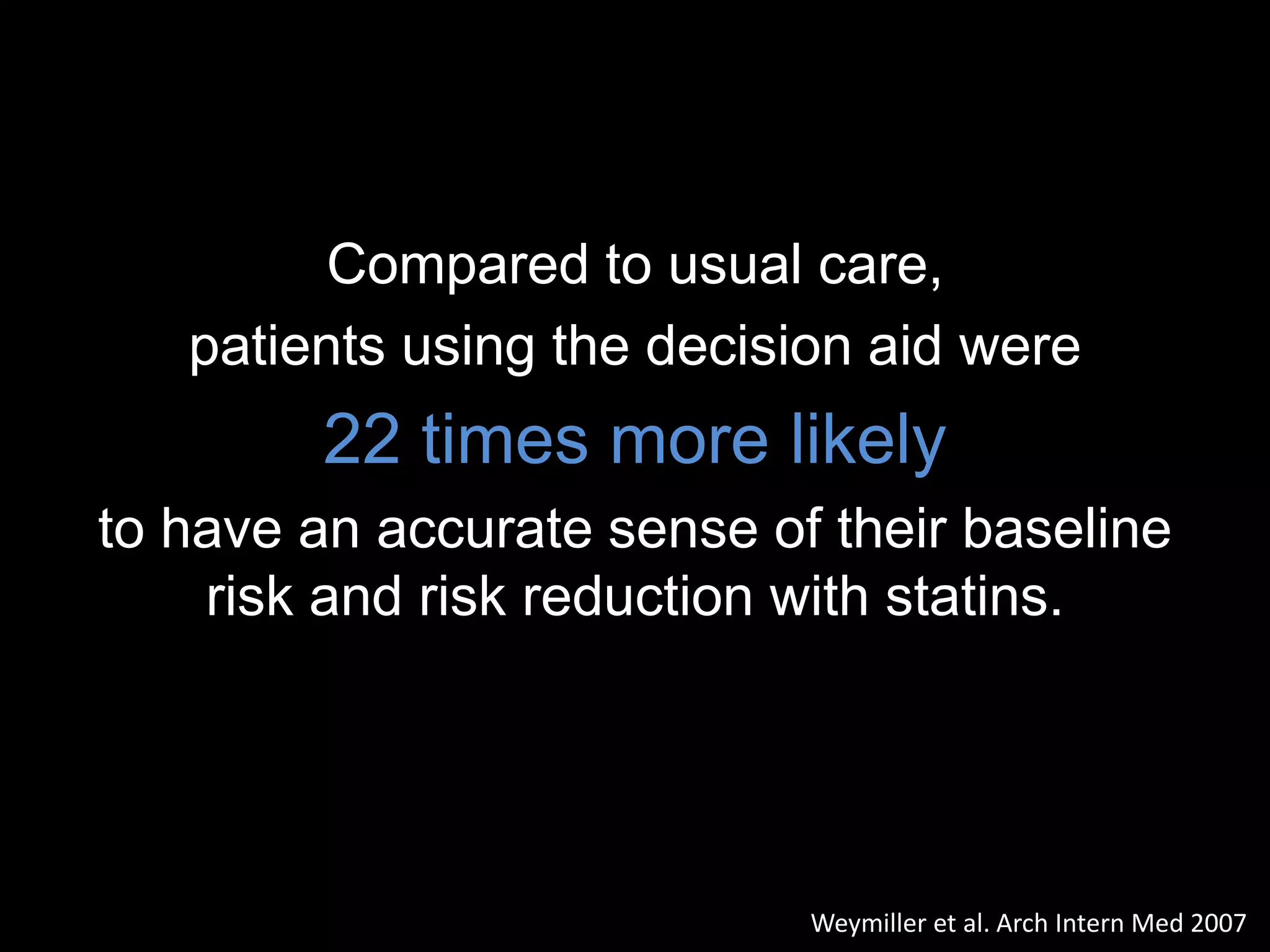
Compared to usual care,
   patients using the decision aid were
         22 times more likely
to have an accurate sense of their baseline
    risk and risk reduction with statins.


                            Weymiller et al. Arch Intern Med 2007
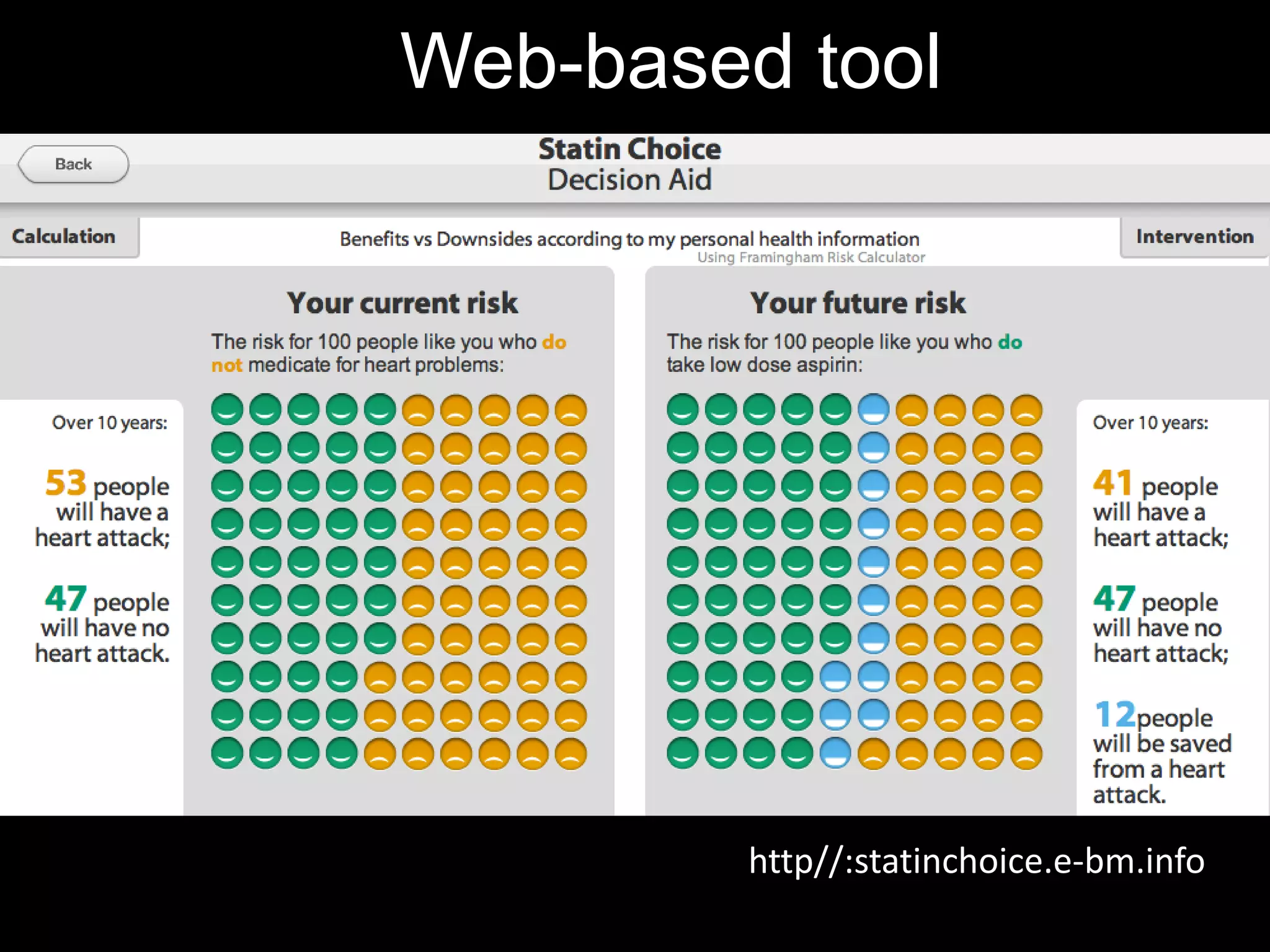
Web-based tool


        http//:statinchoice.e-bm.info
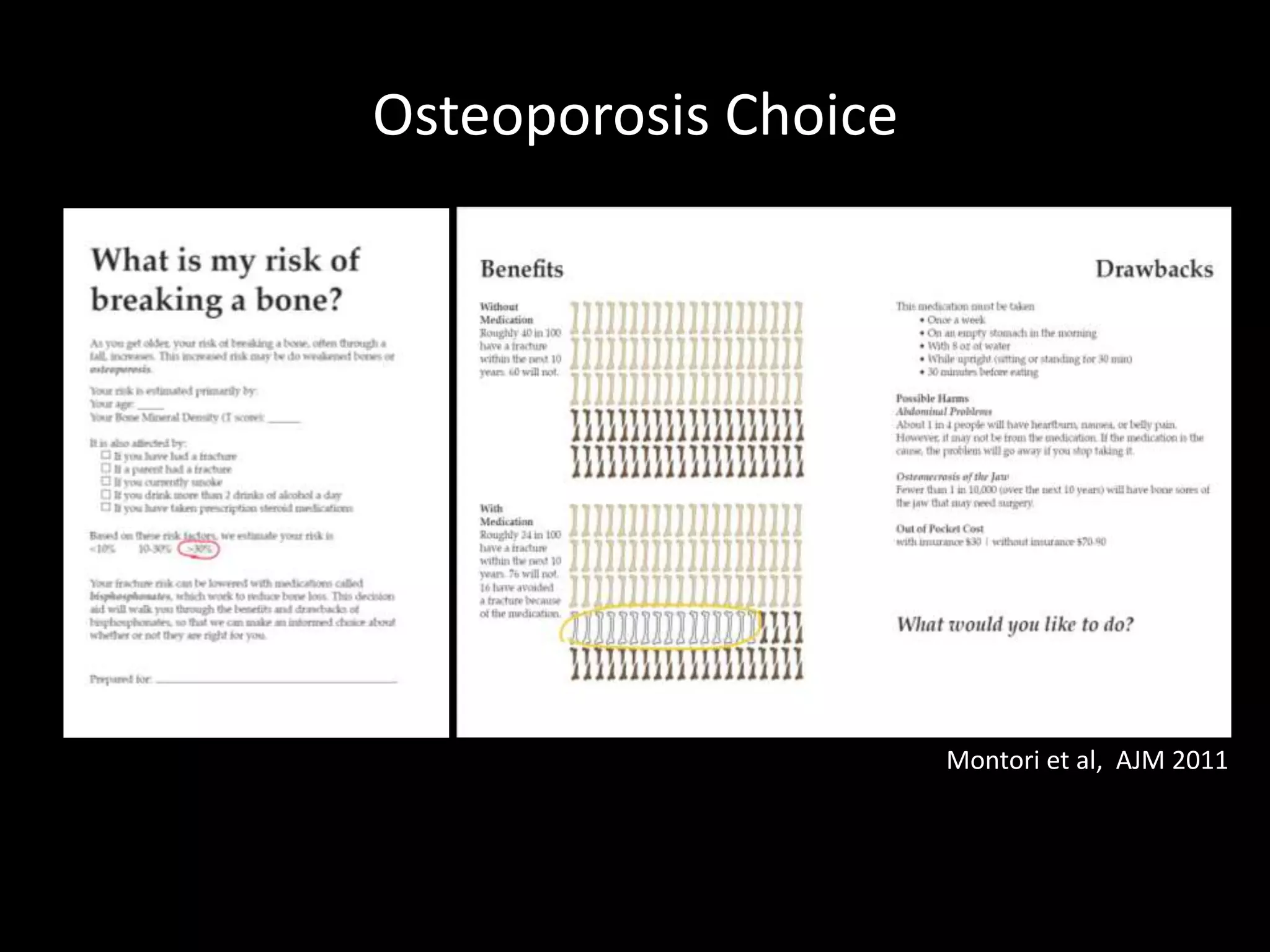
Osteoporosis Choice


                      Montori et al, AJM 2011
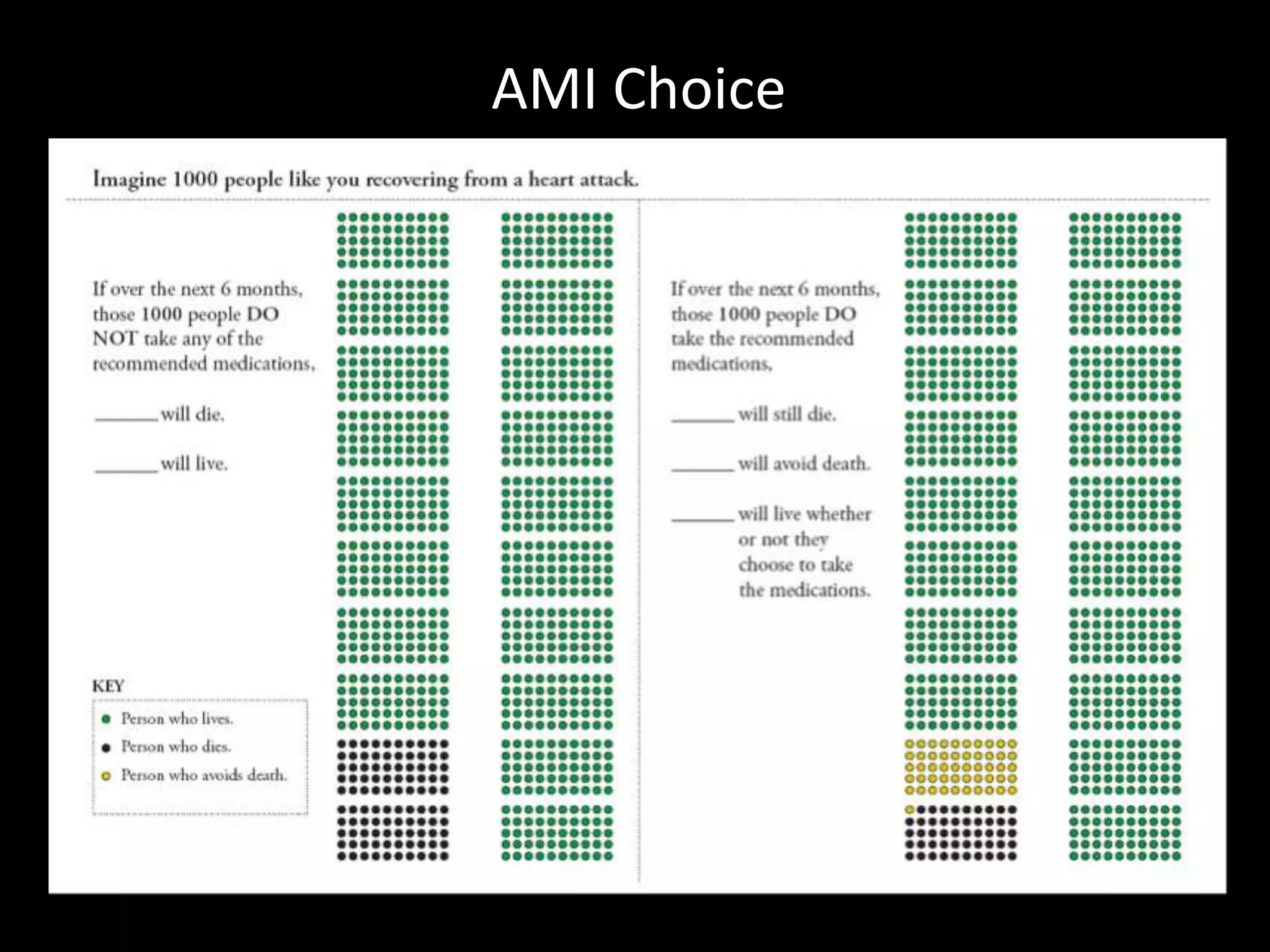
AMI Choice
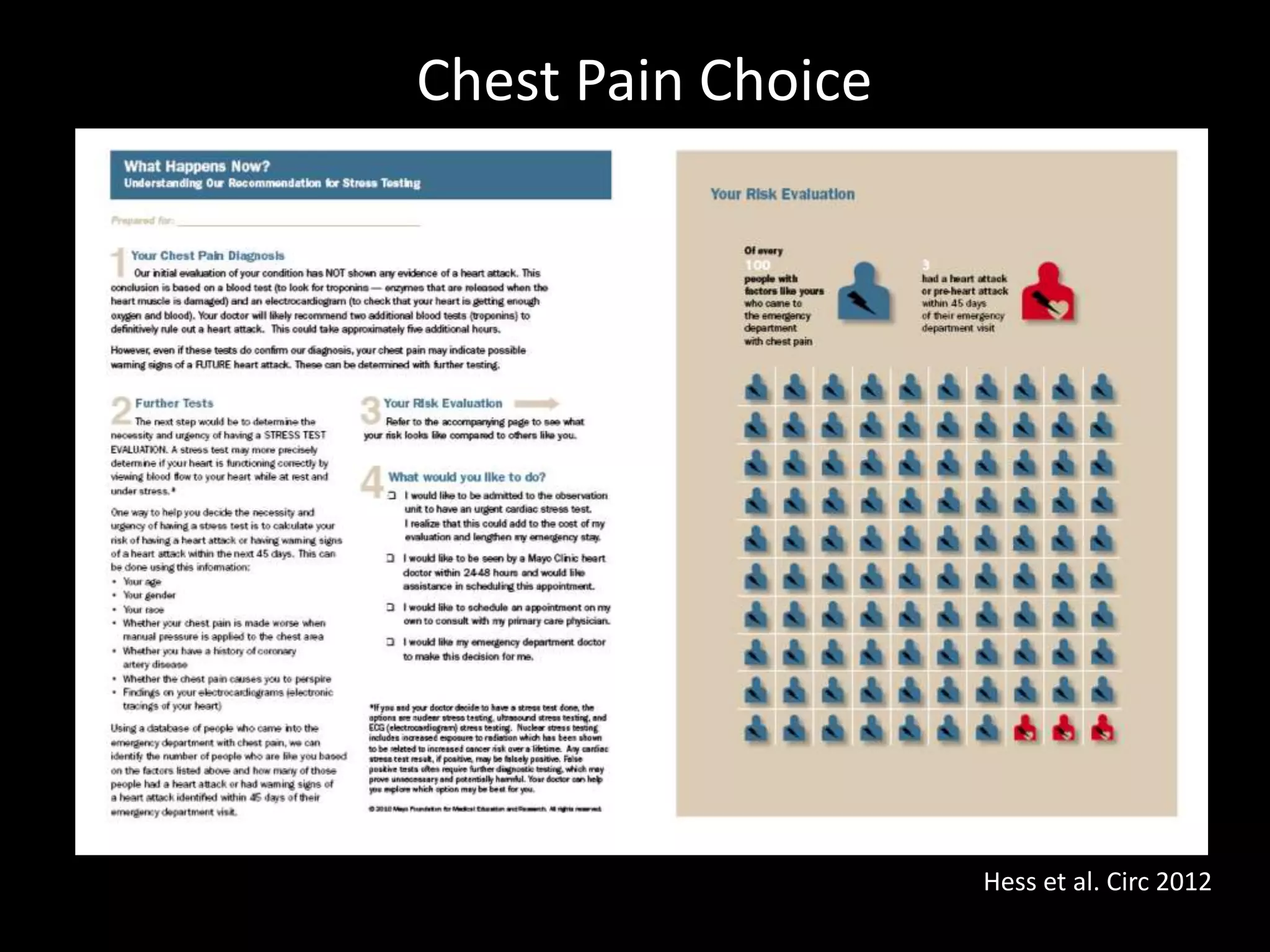
Chest Pain Choice


                    Hess et al. Circ 2012
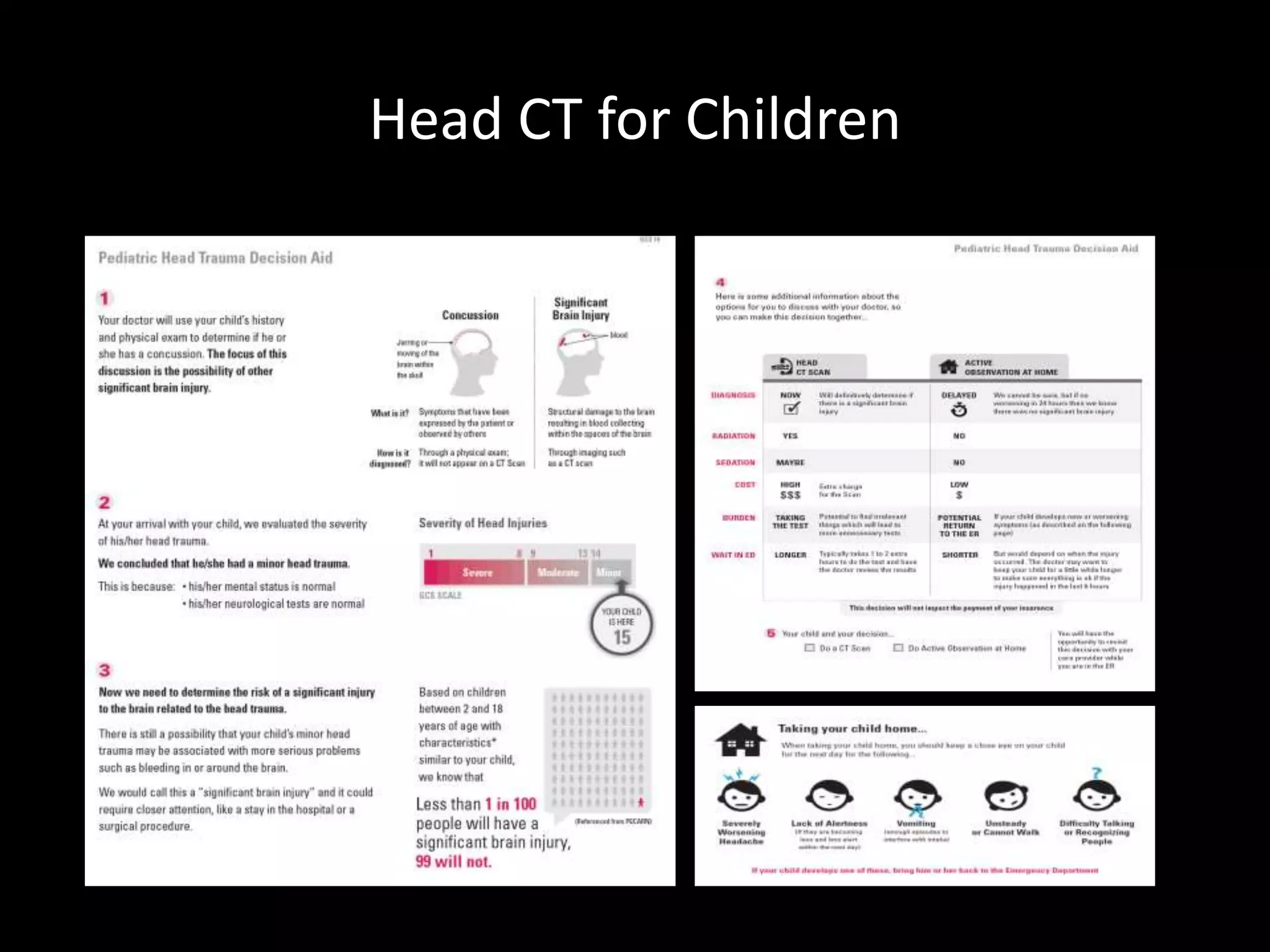
Head CT for Children
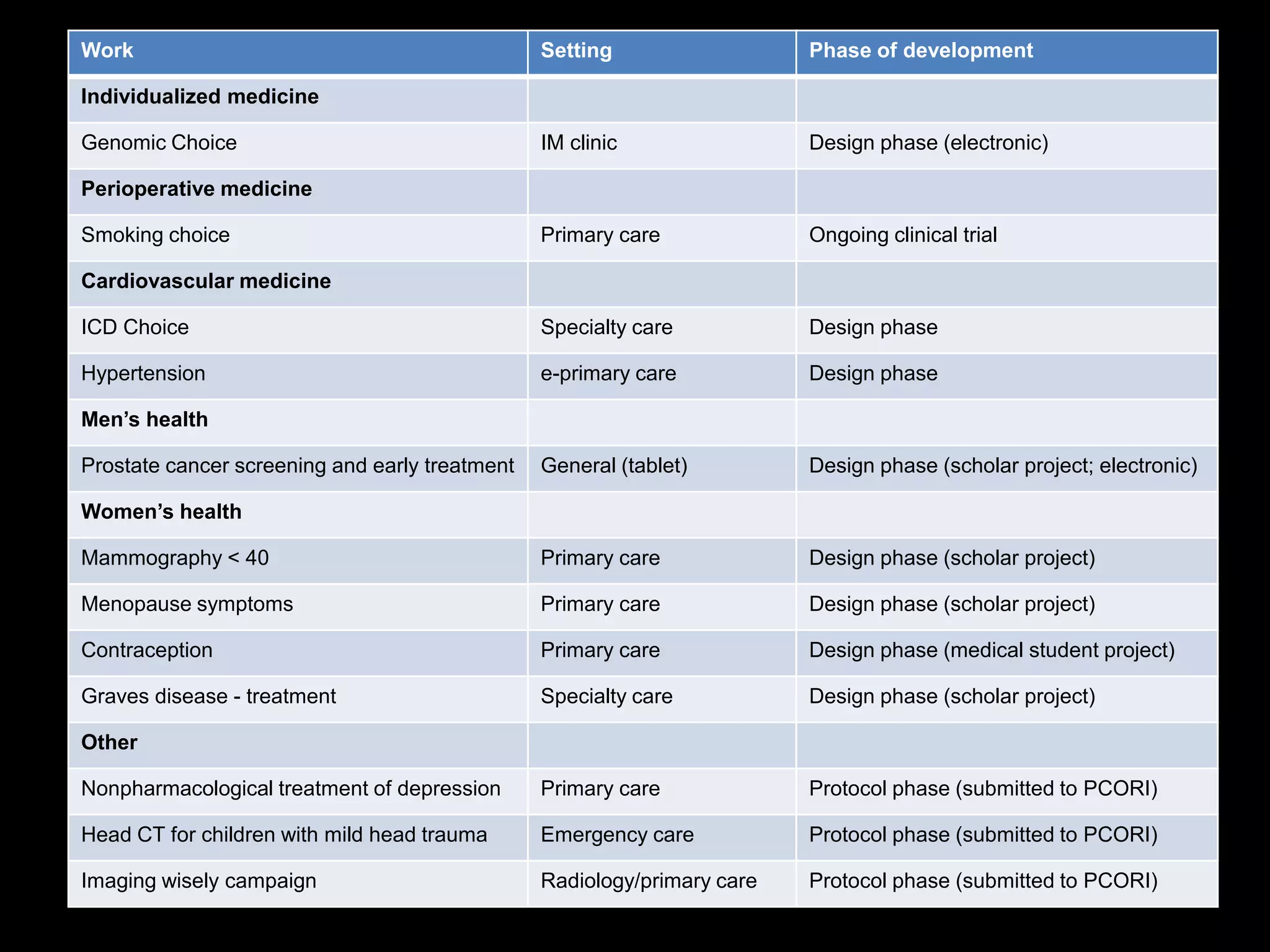
Work                                            Setting                  Phase of development

Individualized medicine

Genomic Choice                                  IM clinic                Design phase (electronic)

Perioperative medicine

Smoking choice                                  Primary care             Ongoing clinical trial

Cardiovascular medicine

ICD Choice                                      Specialty care           Design phase

Hypertension                                    e-primary care           Design phase

Men’s health

Prostate cancer screening and early treatment   General (tablet)         Design phase (scholar project; electronic)

Women’s health

Mammography < 40                                Primary care             Design phase (scholar project)

Menopause symptoms                              Primary care             Design phase (scholar project)

Contraception                                   Primary care             Design phase (medical student project)

Graves disease - treatment                      Specialty care           Design phase (scholar project)

Other

Nonpharmacological treatment of depression      Primary care             Protocol phase (submitted to PCORI)

Head CT for children with mild head trauma      Emergency care           Protocol phase (submitted to PCORI)

Imaging wisely campaign                         Radiology/primary care   Protocol phase (submitted to PCORI)
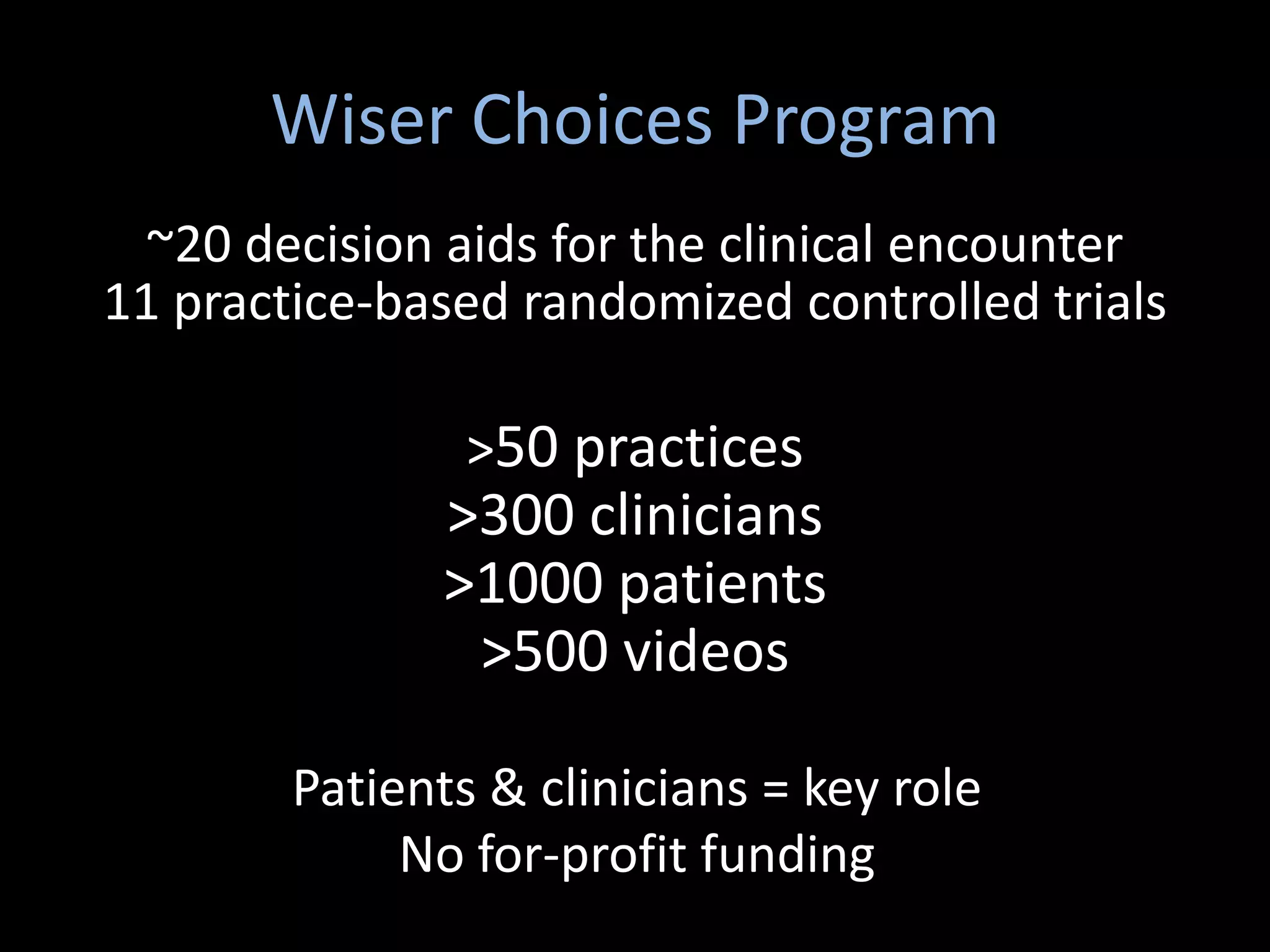
Wiser Choices Program
  ~20 decision aids for the clinical encounter
11 practice-based randomized controlled trials

                >50 practices
               >300 clinicians
               >1000 patients
                >500 videos

        Patients & clinicians = key role
             No for-profit funding
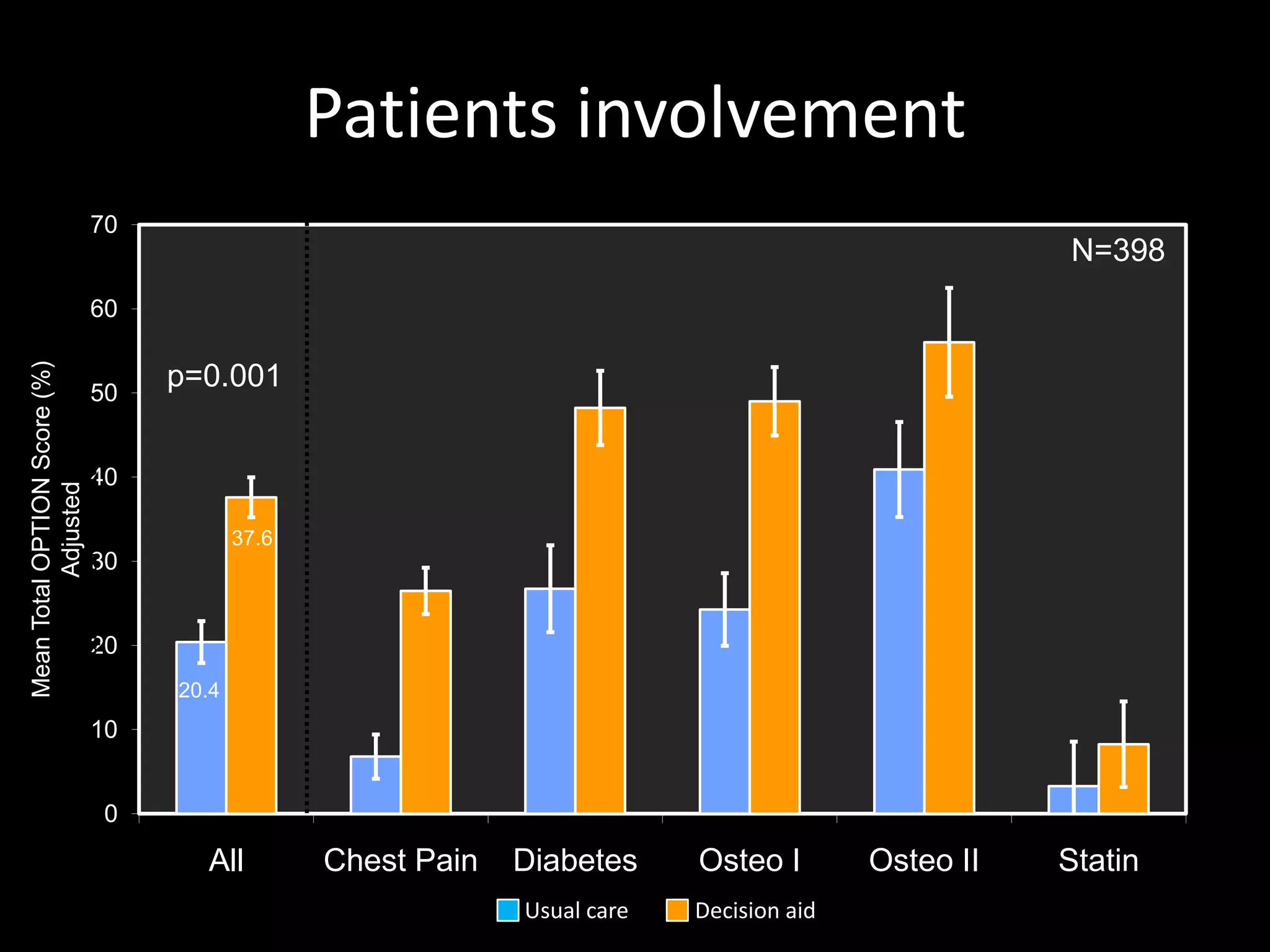
Patients involvement
                                    70
                                                                                                                             N=398
                                    60
Mean Total OPTION Score (%)


                                    50
                                                           p=0.001
                          Adjusted Mean OPTION Score


                                    40
          Adjusted


                                                                  37.6
                                    30


                                    20
                                                           20.4
                                    10


                                                       0
                                                             All         Chest Pain   Diabetes     Osteo I        Osteo II   Statin
                                                                                      Usual care   Decision aid
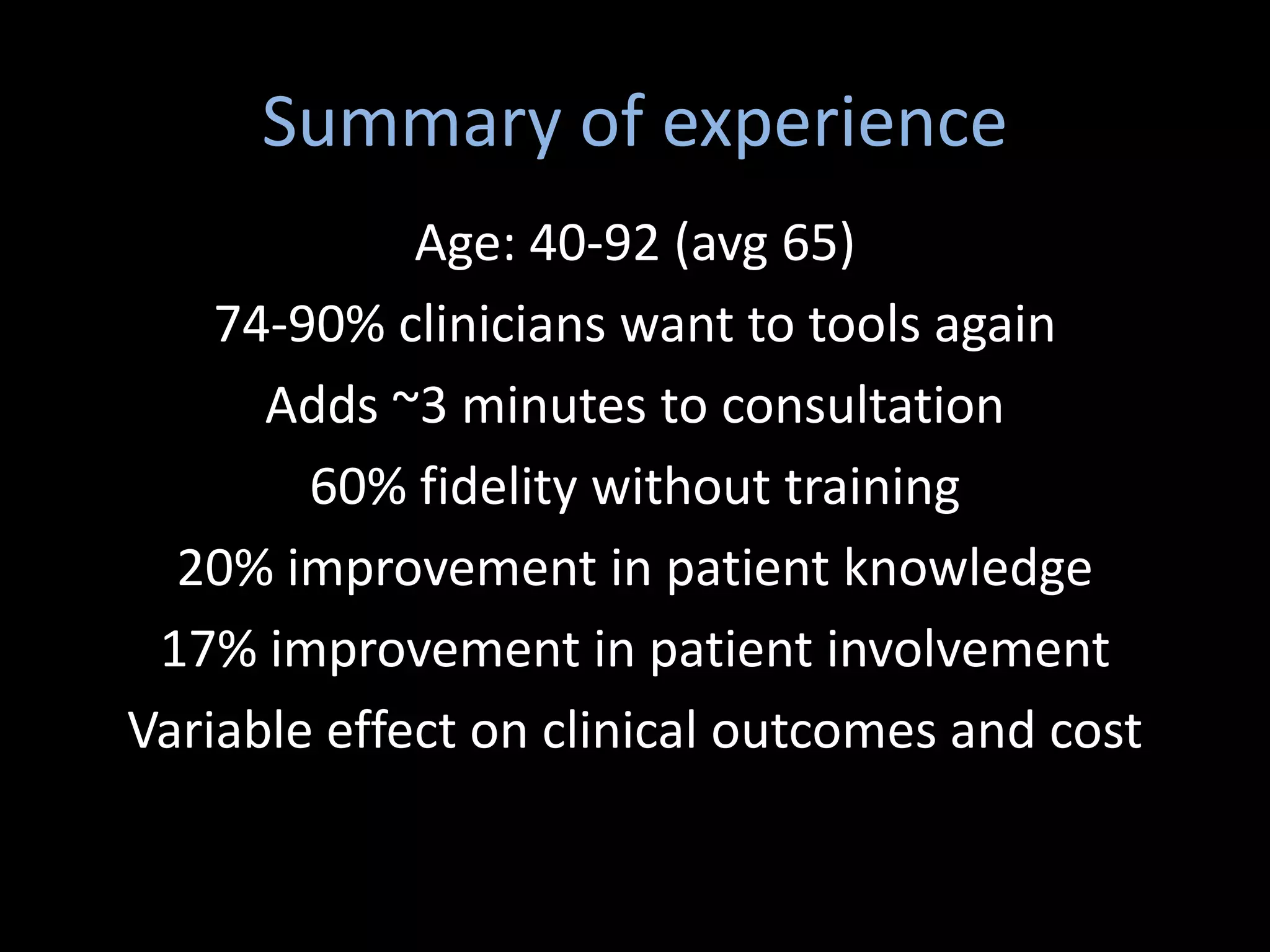
Summary of experience
             Age: 40-92 (avg 65)
    74-90% clinicians want to tools again
      Adds ~3 minutes to consultation
        60% fidelity without training
  20% improvement in patient knowledge
 17% improvement in patient involvement
Variable effect on clinical outcomes and cost
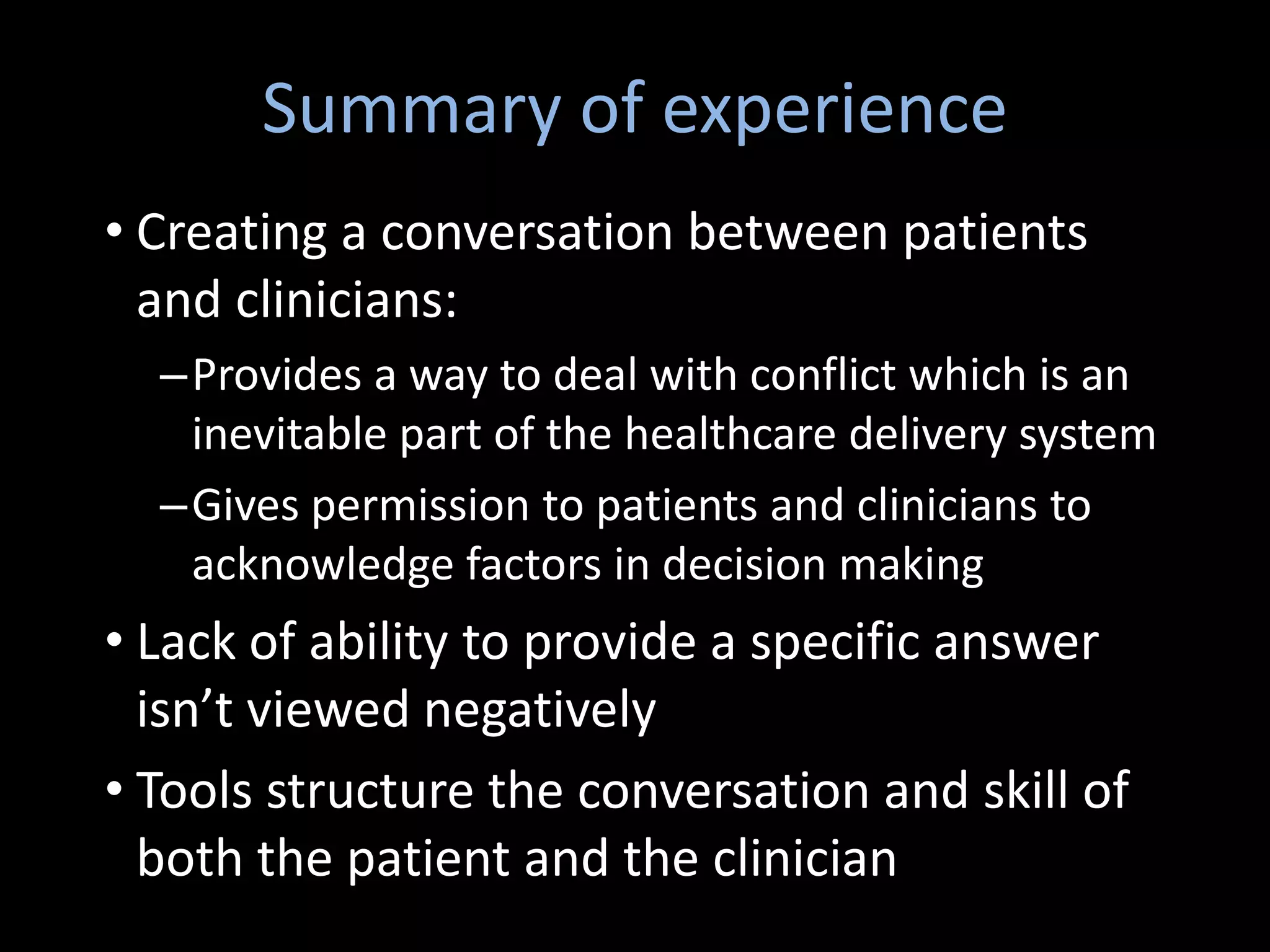
Summary of experience
• Creating a conversation between patients
  and clinicians:
  –Provides a way to deal with conflict which is an
   inevitable part of the healthcare delivery system
  –Gives permission to patients and clinicians to
   acknowledge factors in decision making
• Lack of ability to provide a specific answer
  isn’t viewed negatively
• Tools structure the conversation and skill of
  both the patient and the clinician
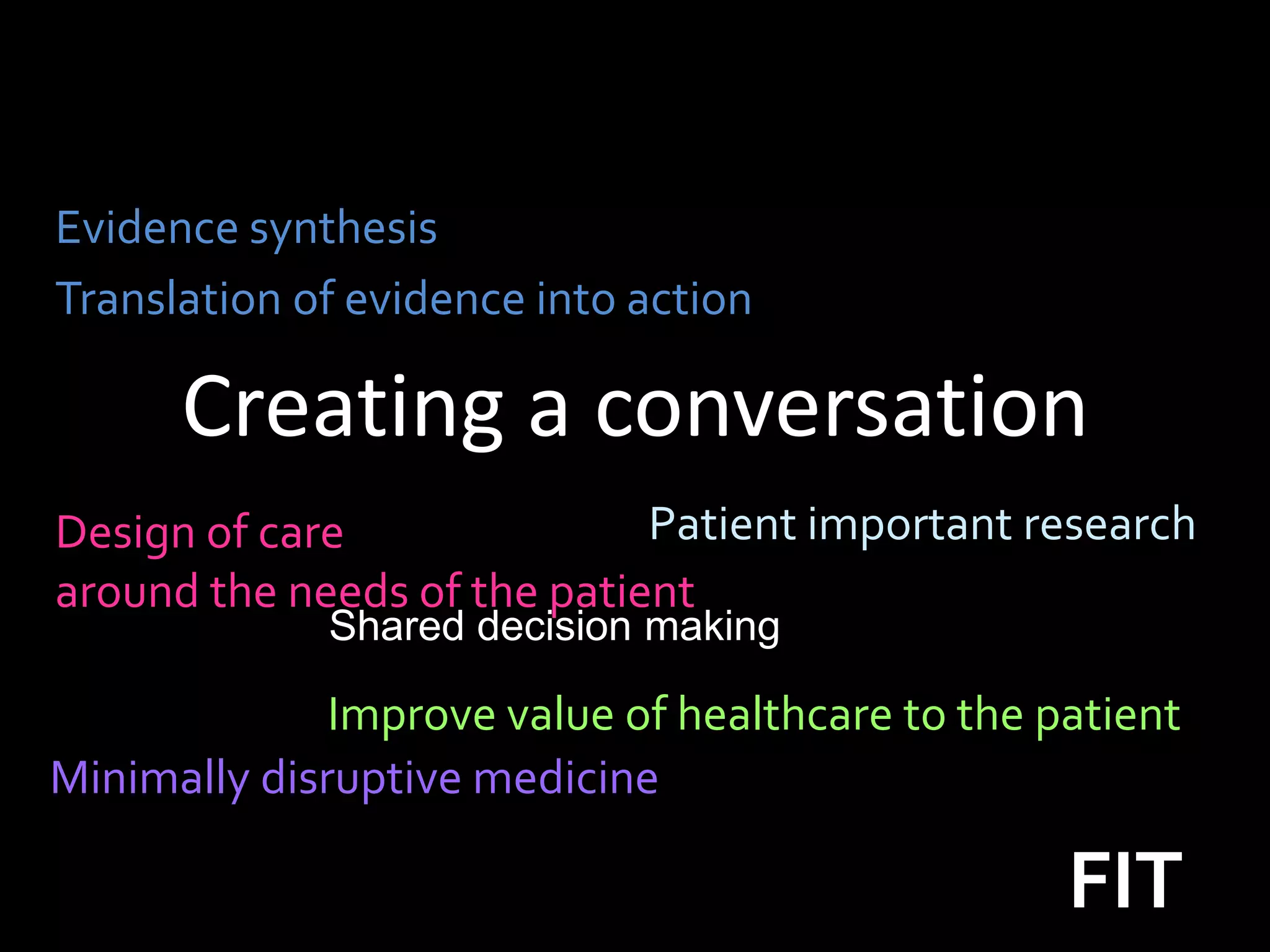
Evidence synthesis
Translation of evidence into action

      Creating a conversation
Design of care               Patient important research
around the needs of the patient
             Shared decision making

              Improve value of healthcare to the patient
Minimally disruptive medicine

                                                  FIT
Can we do this
Monday morning ?
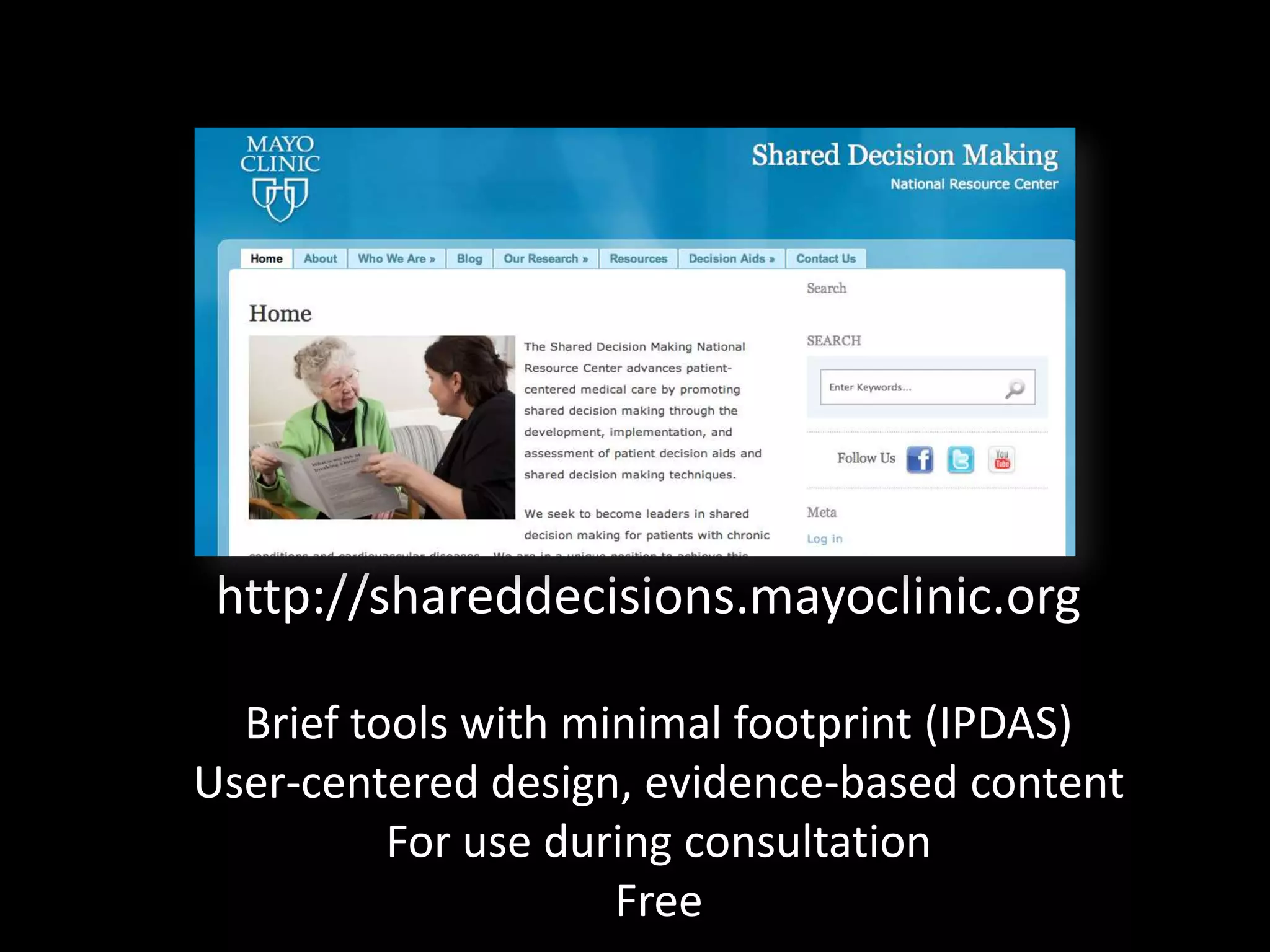
http://shareddecisions.mayoclinic.org

  Brief tools with minimal footprint (IPDAS)
User-centered design, evidence-based content
          For use during consultation
                     Free
7th International SDM Conference
              Lima, Perú - June 16-19 2013

             Globalizing SDM
entes @ centre of healthcare

                         www.isdm2013.org
leblanc.annie@mayo.edu
          @annie_leblanc

        http://kerunit.e-bm.org
      http://kercards.e-bm.info/
http://shareddecisions.mayoclinic.org/
          www.isdm2013.org

Creating Meaningful Conversations

  • 1.
    Creating Meaningful Conversations Insightsfrom Shared Decision Making at the point of care Annie LeBlanc PhD Knowledge and Evaluation Research (KER) Unit Mayo Clinic, Rochester, MN (USA)
  • 2.
    Disclosure No financial conflict of interest KER Unit houses the processes of design & evaluation of decision aids, decides on topics, pursues funding, and conducts evaluation trials KER unit does not receive funding from any for-profit pharmaceutical/manufacturer, nor do they receive any royalties / monetary benefits, directly or indirectly, from the use of the decision aids All decision aids are available free of charge
  • 3.
    Why we cameto shared decision making Patient centered high value healthcare Evidence based medicine Makes explicit the uncertainty of the evidence Gives a voice to patients (values/ preferences) Reduce unwarranted variations Right thing to do
  • 4.
    Shared decision making Plethoraof trials demonstrating efficacy of tools Uptake still minimal in practices Barriers & facilitators How to achieve greater integration of SDM within clinical encounters How to facilitate its translation into practice
  • 5.
  • 6.
    Patient and clinicianbegin consultation Patient and clinician discuss medications. Patient leaves with a prescription. Current state of decision making Patient makes decision about medication.
  • 7.
    Anatomy of aDecision (MD) • Medical knowledge • Years of education • Practice experience • Clinician preferences
  • 8.
    Anatomy of aDecision (PT) • Expert on their life • Personal health view • Lifestyle preferences • Own/ther experiences
  • 9.
    Anatomy of aDecision (Environment) • History • Ritual • Tools
  • 10.
    Patient and clinicianbegin consultation Patient and clinician discuss medications. Patient leaves with a prescription. Shared decision making Patient makes decision about medication.
  • 11.
    Shared decision making Research Decision Patient Values and Evidence Aid Preferences Within an exam room
  • 12.
    Our Decision Aidsare focused on facilitating a conversation between health professionals and patients and thus designed as tools intended for use during the clinical encounter
  • 14.
    “What do weneed to know to make this decision together ”
  • 15.
    Observations Evidence synthesis clinical encounters Initial prototype Designers Field Study team Modified testing Patient advisory groups prototype Clinicians Stakeholders Final Decision Aid Evaluation Practice-based Randomized Controlled Trials Real life encounters
  • 16.
    The case ofdiabetes medication
  • 17.
    Glucose control inT2 diabetes No clear evidence for a goal HbA1c Comparative effectiveness data of safety 9 types of agents (+ lifestyle modification) Many attributes per agent
  • 18.
  • 19.
  • 20.
  • 21.
    More helpful Improved knowledge More involvement in making decisions 6-mo perfect medication use Better adherence Persistence No significant impact on HbA1c levels
  • 22.
    Additional benefits observed •Patients gravitate towards weight change and daily routine cards • Physical form encourages patients to own decision • Noticeable positive change in body language • Card use prompts questions and encourages discussion but cards alone are not enough to give patients confidence • Gives permission to patients and clinicians to acknowledge cost as a factor in decision making • Lack of ability to provide a specific answer isn’t viewed negatively
  • 23.
    The story ofour 92 y old patient
  • 24.
    The case ofDepression Care
  • 25.
    Depression Can be improved by Lifestyle changes, self-care practices psychotherapy, pharmacotherapy But of different efficacy, safety, cost, burden to the patient
  • 28.
  • 29.
    Cluster RCT inRural & urban PC practices (10 practices WI MN, 106 clinicians, 200/300 patients)
  • 30.
    “Actually used thedepression medication decision cards with the patient, which she seemed to enjoy. Patient would like at this time to start on an SNRI. She had taken an SSRI before and felt that this did not help. I am comfortable with this decision. Together we chose to start” “Use the cards without patient being enrolled in the study” “Patient admits sexual side effects are important to her; as such, we chose”
  • 31.
    Other Wiser ChoicesDecision Aids Chronic and acute care
  • 32.
    Statin Choice Weymiller et al. Arch Intern Med 2007
  • 33.
    Compared to usualcare, patients using the decision aid were 22 times more likely to have an accurate sense of their baseline risk and risk reduction with statins. Weymiller et al. Arch Intern Med 2007
  • 34.
    Web-based tool http//:statinchoice.e-bm.info
  • 35.
    Osteoporosis Choice Montori et al, AJM 2011
  • 36.
  • 37.
    Chest Pain Choice Hess et al. Circ 2012
  • 38.
    Head CT forChildren
  • 39.
    Work Setting Phase of development Individualized medicine Genomic Choice IM clinic Design phase (electronic) Perioperative medicine Smoking choice Primary care Ongoing clinical trial Cardiovascular medicine ICD Choice Specialty care Design phase Hypertension e-primary care Design phase Men’s health Prostate cancer screening and early treatment General (tablet) Design phase (scholar project; electronic) Women’s health Mammography < 40 Primary care Design phase (scholar project) Menopause symptoms Primary care Design phase (scholar project) Contraception Primary care Design phase (medical student project) Graves disease - treatment Specialty care Design phase (scholar project) Other Nonpharmacological treatment of depression Primary care Protocol phase (submitted to PCORI) Head CT for children with mild head trauma Emergency care Protocol phase (submitted to PCORI) Imaging wisely campaign Radiology/primary care Protocol phase (submitted to PCORI)
  • 40.
    Wiser Choices Program ~20 decision aids for the clinical encounter 11 practice-based randomized controlled trials >50 practices >300 clinicians >1000 patients >500 videos Patients & clinicians = key role No for-profit funding
  • 41.
    Patients involvement 70 N=398 60 Mean Total OPTION Score (%) 50 p=0.001 Adjusted Mean OPTION Score 40 Adjusted 37.6 30 20 20.4 10 0 All Chest Pain Diabetes Osteo I Osteo II Statin Usual care Decision aid
  • 42.
    Summary of experience Age: 40-92 (avg 65) 74-90% clinicians want to tools again Adds ~3 minutes to consultation 60% fidelity without training 20% improvement in patient knowledge 17% improvement in patient involvement Variable effect on clinical outcomes and cost
  • 43.
    Summary of experience •Creating a conversation between patients and clinicians: –Provides a way to deal with conflict which is an inevitable part of the healthcare delivery system –Gives permission to patients and clinicians to acknowledge factors in decision making • Lack of ability to provide a specific answer isn’t viewed negatively • Tools structure the conversation and skill of both the patient and the clinician
  • 44.
    Evidence synthesis Translation ofevidence into action Creating a conversation Design of care Patient important research around the needs of the patient Shared decision making Improve value of healthcare to the patient Minimally disruptive medicine FIT
  • 45.
    Can we dothis Monday morning ?
  • 46.
    http://shareddecisions.mayoclinic.org Brieftools with minimal footprint (IPDAS) User-centered design, evidence-based content For use during consultation Free
  • 47.
    7th International SDMConference Lima, Perú - June 16-19 2013 Globalizing SDM entes @ centre of healthcare www.isdm2013.org
  • 48.
    leblanc.annie@mayo.edu @annie_leblanc http://kerunit.e-bm.org http://kercards.e-bm.info/ http://shareddecisions.mayoclinic.org/ www.isdm2013.org

Editor's Notes

  • #8 medical knowledge practice experience clinician preferences
  • #9 personal health view lifestyle preferences own/others experience
  • #10 HistoryRitualTools
  • #12 HistoryRitualTools
  • #44 Focusing on creating a conversation between patients and clinicians provides a way to deal with conflict which is an inevitable part of the healthcare delivery system.Tools structure the conversation and skill both the patient and the clinician.