Measuring and Improving
 Decision Quality

Karen Sepucha, PhD
Health Decision Science Center
Massachusetts General Hospital
ksepucha@partners.org
 http://www.massgeneral.org/decisionsciences/
Disclosure

   Dr Sepucha receives research and salary
    support from Informed Medical Decisions
    Foundation
   Dr. Sepucha is on the advisory board for Vital
    Decisions, LLC
Agenda
   What is a good decision?

   How to measure “decision quality”?
       Knowledge
       Matching treatment to goals


   How might the survey be used?
Case study: Mr. M’s Story
 71yo man referred to orthopedics, worsening
  right hip pain over past 2 years, x-rays confirm
  damage
 Orthopedic surgeon’s note: “I went over in some

  detail different treatment options. He very much
  wishes to proceed with right total hip
  replacement.”
 Talked with family and friends, saw PCP for pre-

  op evaluation


                                             4
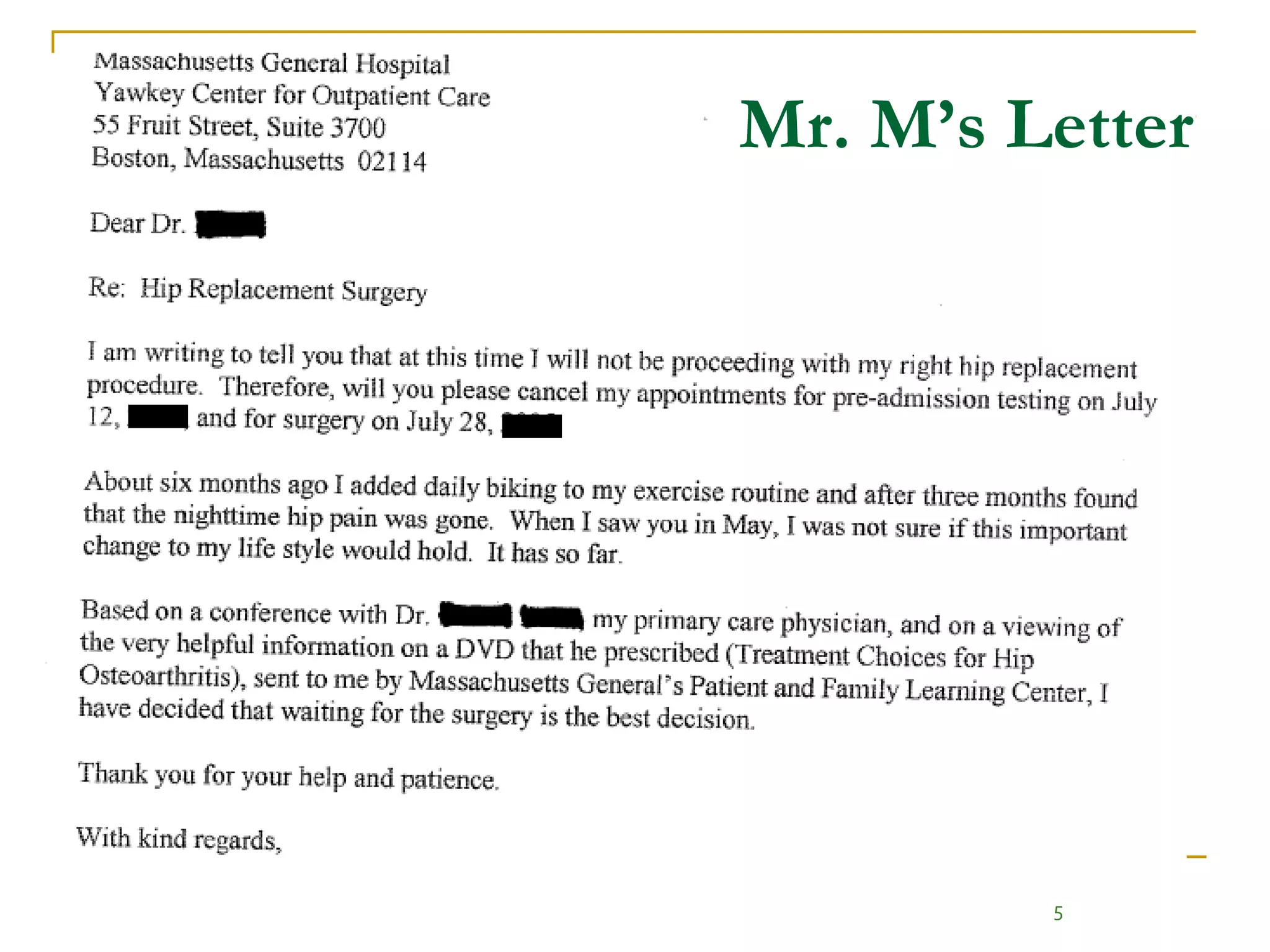
Mr. M’s Letter


         5
High quality, patient-centered care
       NQF
       National Quality Forum
                                Core Themes:
                                 fully informed

                                 treatments reflect patients’

                                  want, needs and preferences
                                 play a key role in making

                                  healthcare decisions
Agenda
   What is a good decision?

   How to measure “decision quality”?
       Knowledge
       Matching treatment to goals


   How might the survey be used?
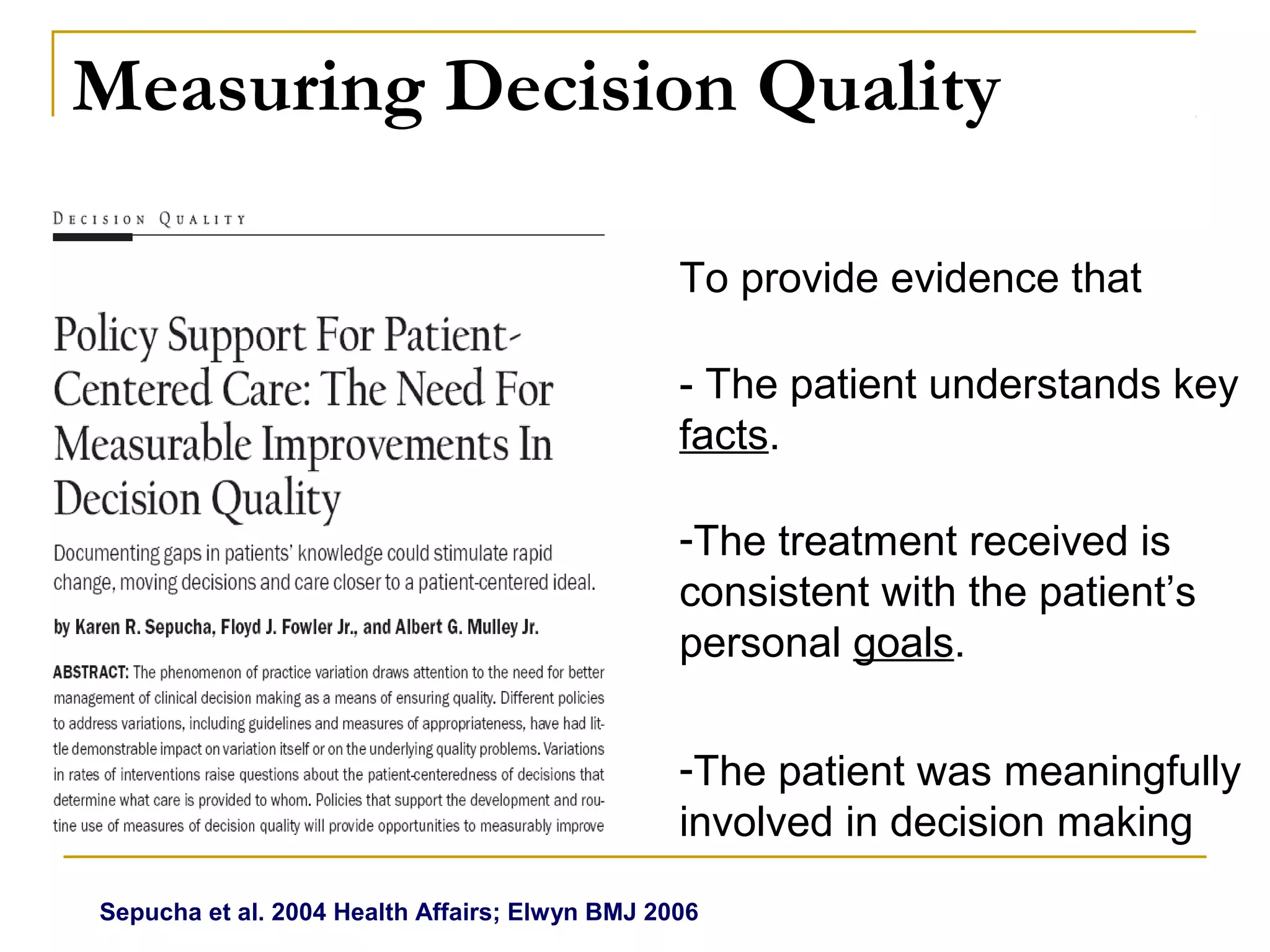
Measuring Decision Quality

                                                To provide evidence that

                                                - The patient understands key
                                                facts.

                                                -The treatment received is
                                                consistent with the patient’s
                                                personal goals.

                                                -The patient was meaningfully
                                                involved in decision making
Sepucha et al. 2004 Health Affairs; Elwyn BMJ 2006
Who made the decision about treatment of
 your breast cancer?
                          “they didn’t say to me, “Well, we could
                         remove the breast, we could do this,
                         we could do that.” They just said, “This
                         is what we’re going to do.” And that
   Mainly the doctor
                         was it—I wasn’t in on the decision.”

                         “She was compassionate, … [and] gave
                         me the data that I needed ... We talked
                         statistics and sizes and measurements
X Both equally

                         and things that helped me..with my
                         decision.”
                        “I made the decision. I’m very happy with
                        the lumpectomy because that’s what I
                        wanted to do from the beginning. They
   Mainly you          [my doctors] didn’t disagree. They didn’t
                        agree. They just said, “Okay.” They
                        understood.”
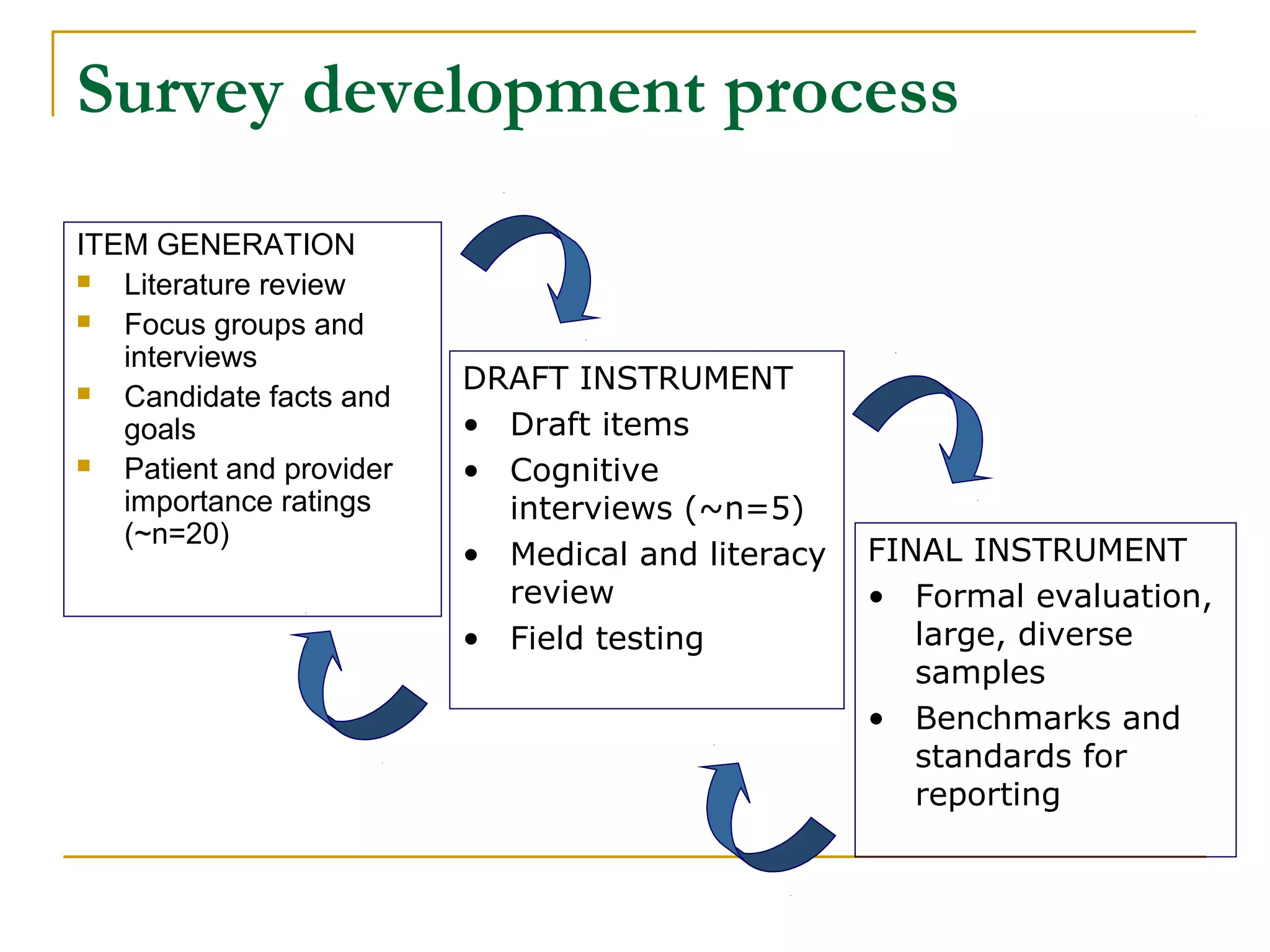
Survey development process
ITEM GENERATION
  Literature review
  Focus groups and
   interviews
                          DRAFT INSTRUMENT
  Candidate facts and
   goals                  • Draft items
  Patient and provider   • Cognitive
   importance ratings       interviews (~n=5)
   (~n=20)
                          • Medical and literacy   FINAL INSTRUMENT
                            review                 • Formal evaluation,
                          • Field testing             large, diverse
                                                      samples
                                                   • Benchmarks and
                                                      standards for
                                                      reporting
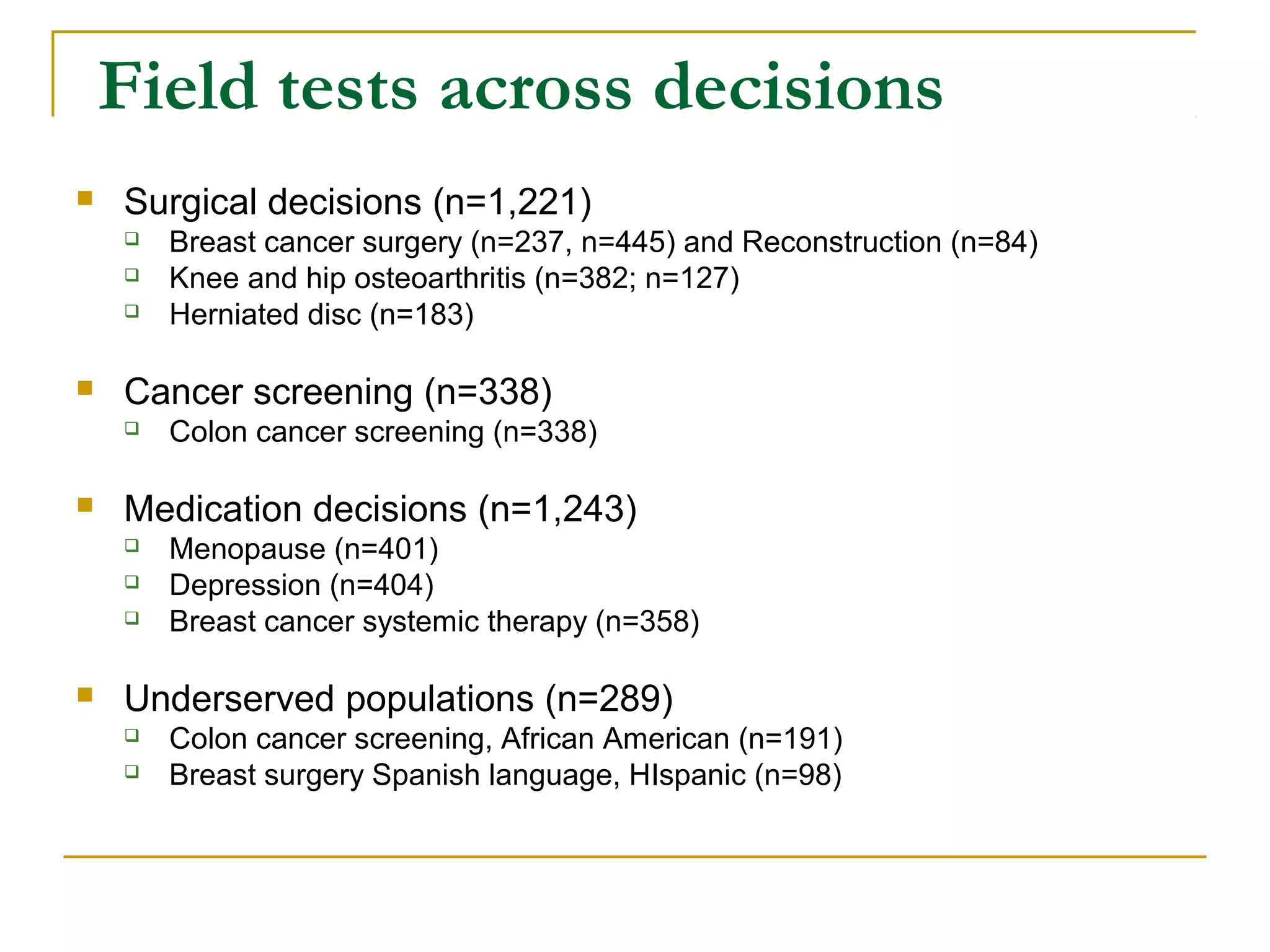
Field tests across decisions
   Surgical decisions (n=1,221)
       Breast cancer surgery (n=237, n=445) and Reconstruction (n=84)
       Knee and hip osteoarthritis (n=382; n=127)
       Herniated disc (n=183)

   Cancer screening (n=338)
       Colon cancer screening (n=338)

   Medication decisions (n=1,243)
       Menopause (n=401)
       Depression (n=404)
       Breast cancer systemic therapy (n=358)

   Underserved populations (n=289)
       Colon cancer screening, African American (n=191)
       Breast surgery Spanish language, HIspanic (n=98)
Measuring
    knowledge
   Key facts

   Mix of gist and
    quantitative
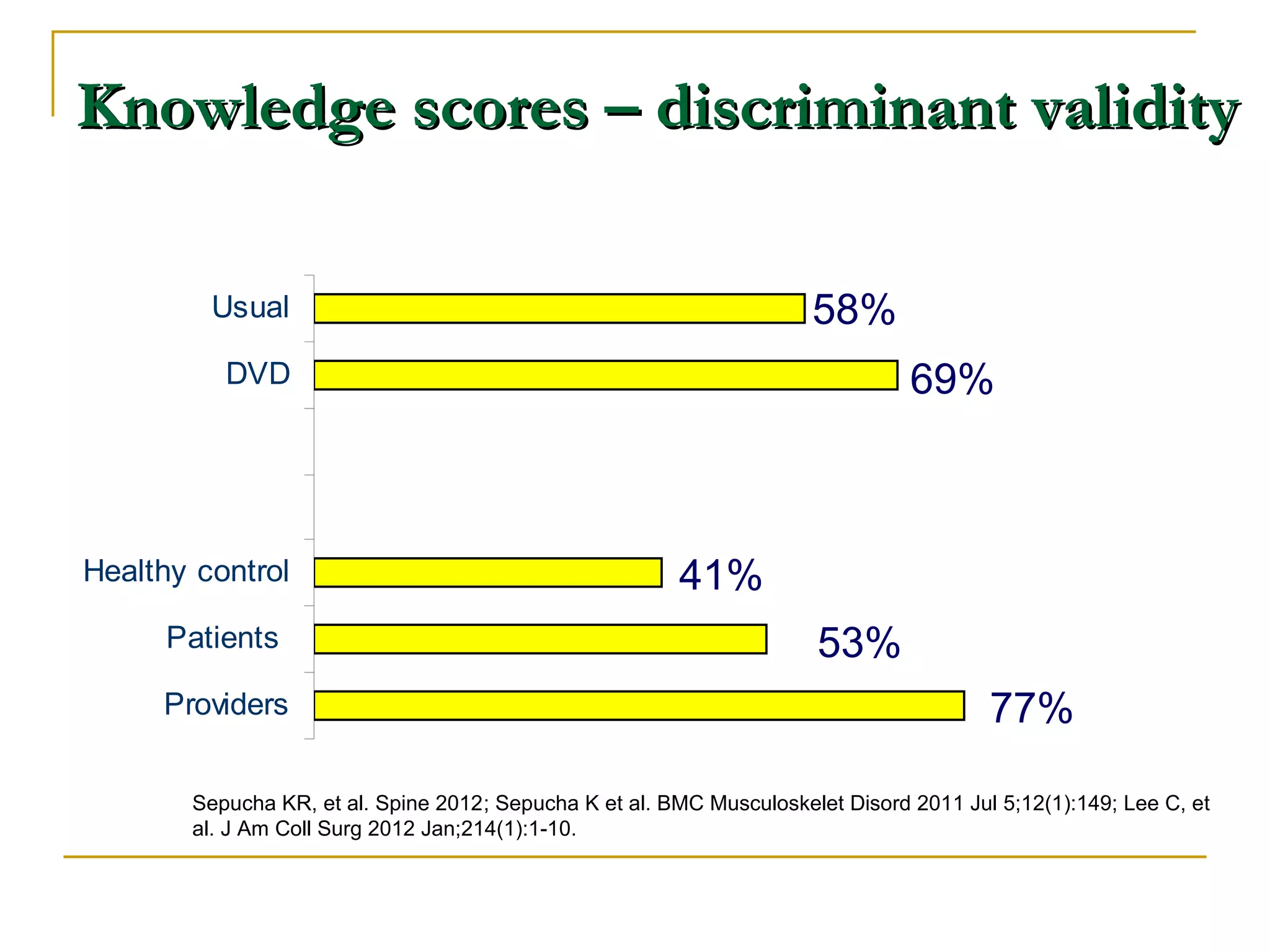
Knowledge scores – discriminant validity

         Usual                                                        58%
          DVD                                                                   69%


Healthy control                                          41%
      Patients                                                        53%
     Providers                                                                          77%
                  0                20               40               60                80              100
       Sepucha KR, et al. Spine 2012; Sepucha K et al. BMC Musculoskelet Disord 2011 Jul 5;12(1):149; Lee C, et
       al. J Am Coll Surg 2012 Jan;214(1):1-10.
Do treatments match patients’ goals?
       Key outcome in Cochrane systematic review of
        patient decision aids
           2009 update: 3 studies reported
           2011 update: 13 studies reported

       Systematic review of concordance methods
        (Sepucha and Ozanne 2010)
           Variability in definitions
           Variability in calculations


Stacey et al. Cochrane Database of Systematic Reviews. 2011, Issue 10. Art. No.: CD001431; Sepucha K and Ozanne E.
Patient Educ Couns 2010 Jan;78(1):12-23. .
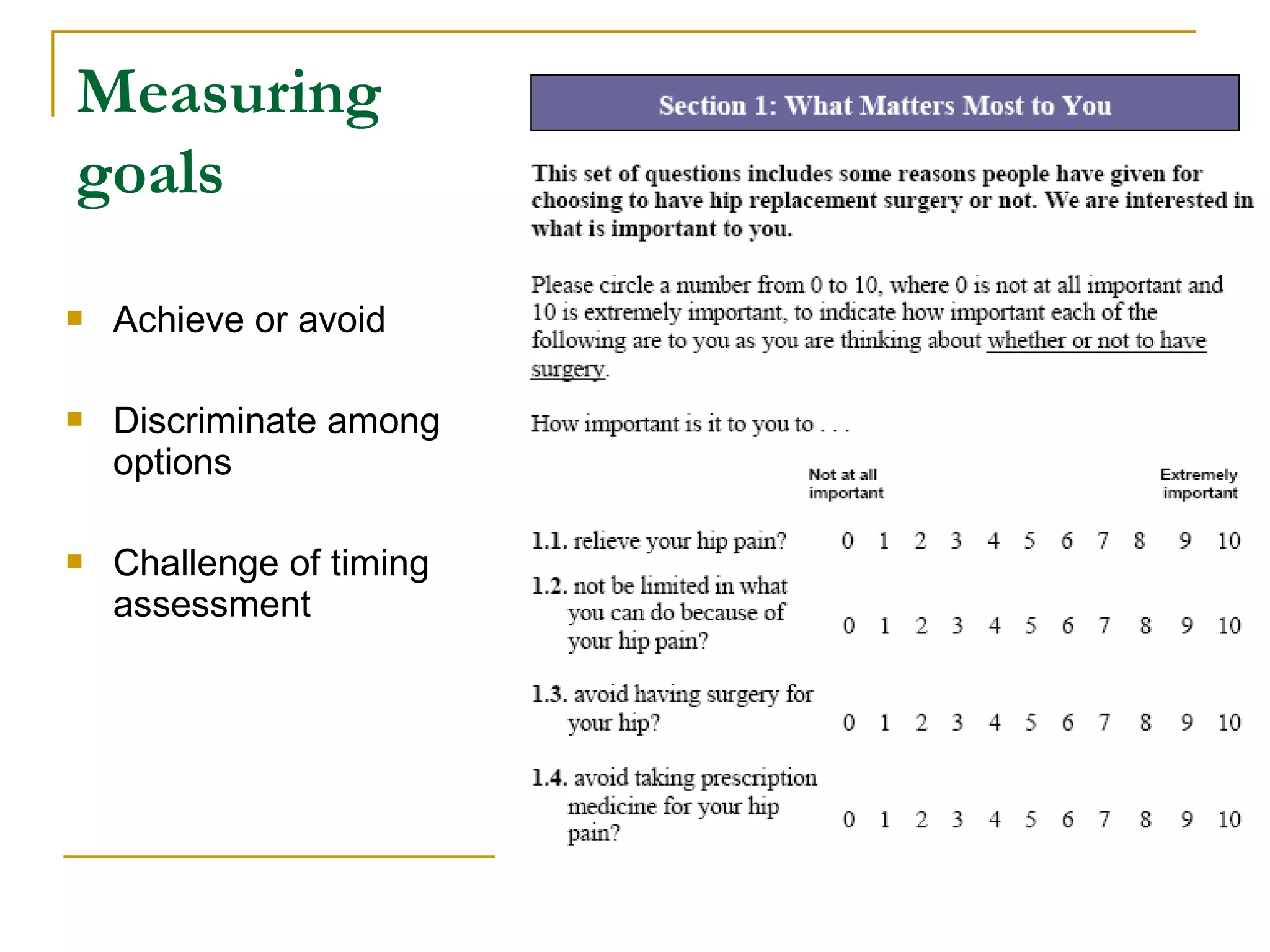
Measuring
goals
   Achieve or avoid

   Discriminate among
    options

   Challenge of timing
    assessment
Calculating a match

     Logistic regression model (treatment
      received) with goals as independent
      predictors

     Model returns predicted probability of having
      surgery based on patients’ goals

     Considered “match” if probability ≥0.5 and
      had surgery or if <0.5 and didn’t

Source: Sepucha K et al. Decision quality instrument for treatment of hip and knee osteoarthritis: a psychometric evaluation. BMC
Musculoskelet Disord 2011 Jul 5;12(1):149.
Validity: How well does model reflect
 patients’ preferences?
  Treatment preference


                         Non surgical options                                              40%


                                      Unsure                                                                    59%


                                     Surgery                                                                                        74%


                         Treatment Preference
                                                  Model predicted probability of surgery
                                          0    0.1   0.2   0.3   0.4  0.5    0.6   0.7   0.8
                         Model predicted probability, discriminates among those with
                         different stated treatment preferences, p<0.001 for all comparisons

Source: Sepucha K et al. Decision quality instrument for treatment of hip and knee osteoarthritis: a psychometric evaluation. BMC
Musculoskelet Disord 2011 Jul 5;12(1):149.
Do patients get treatments that
    match their goals? (n=383)
                                                                 Had
                                                                                                  Had non surgical
                                                                Surgery
                                                                                                     treatment


      Model predicted
         Surgery                                                   49%                                          13%


       Model predicted
                                                                   12%                                          25%
        Non surgical


    Those who matched had lower regret and more confidence
Source: Sepucha K et al. Decision quality instrument for treatment of hip and knee osteoarthritis: a psychometric evaluation. BMC
                                                                                                                               18
Musculoskelet Disord 2011 Jul 5;12(1):149.
Is there a “Decision Quality” score?

   Composite score
       Requires benchmark for considering patients
        “informed” (mean of group that watched
        decision aid)
       Variable across topics, populations
   Risk adjustment (e.g. literacy)
Agenda
   What is a good decision?

   How to measure “decision quality”?
       Knowledge
       Matching treatment to goals


   How might the survey be used?
What’s the purpose of measurement?


    Research             Clinical practice       Accountability
BasicTranslClinical   Care is implemented in     Performance
                           various settings       measured and
                                                    compared


    Detailed               Actionable             Benchmarks
    Theory                  Feasible              Cost/Feasible
   Controlled              Acceptable            Risk adjustment
Mr. M’s story, continued

   2 years later, pain worsened and night time
    pain came back

   Went back to surgeon and had replacement
    surgery

   Good relief of pain, good function, no regrets
Summary
   Decision quality definition: extent to which patients are informed
    and receive treatments match their goals

   Well tested survey instruments exist for common topics

   Potential uses span research, clinical care, accountability
     Research: evaluate different decision support protocols

     Diagnostic screen: identify knowledge gaps and goals in advance

      of visit
     Accountability: documentation required to proceed with elective

      surgery

Measuring and Improving Decision Quality

  • 1.
    Measuring and Improving Decision Quality Karen Sepucha, PhD Health Decision Science Center Massachusetts General Hospital ksepucha@partners.org http://www.massgeneral.org/decisionsciences/
  • 2.
    Disclosure  Dr Sepucha receives research and salary support from Informed Medical Decisions Foundation  Dr. Sepucha is on the advisory board for Vital Decisions, LLC
  • 3.
    Agenda  What is a good decision?  How to measure “decision quality”?  Knowledge  Matching treatment to goals  How might the survey be used?
  • 4.
    Case study: Mr.M’s Story  71yo man referred to orthopedics, worsening right hip pain over past 2 years, x-rays confirm damage  Orthopedic surgeon’s note: “I went over in some detail different treatment options. He very much wishes to proceed with right total hip replacement.”  Talked with family and friends, saw PCP for pre- op evaluation 4
  • 5.
  • 6.
    High quality, patient-centeredcare NQF National Quality Forum Core Themes:  fully informed  treatments reflect patients’ want, needs and preferences  play a key role in making healthcare decisions
  • 7.
    Agenda  What is a good decision?  How to measure “decision quality”?  Knowledge  Matching treatment to goals  How might the survey be used?
  • 8.
    Measuring Decision Quality To provide evidence that - The patient understands key facts. -The treatment received is consistent with the patient’s personal goals. -The patient was meaningfully involved in decision making Sepucha et al. 2004 Health Affairs; Elwyn BMJ 2006
  • 9.
    Who made thedecision about treatment of your breast cancer? “they didn’t say to me, “Well, we could remove the breast, we could do this, we could do that.” They just said, “This is what we’re going to do.” And that  Mainly the doctor was it—I wasn’t in on the decision.” “She was compassionate, … [and] gave me the data that I needed ... We talked statistics and sizes and measurements X Both equally  and things that helped me..with my decision.” “I made the decision. I’m very happy with the lumpectomy because that’s what I wanted to do from the beginning. They  Mainly you [my doctors] didn’t disagree. They didn’t agree. They just said, “Okay.” They understood.”
  • 10.
    Survey development process ITEMGENERATION  Literature review  Focus groups and interviews DRAFT INSTRUMENT  Candidate facts and goals • Draft items  Patient and provider • Cognitive importance ratings interviews (~n=5) (~n=20) • Medical and literacy FINAL INSTRUMENT review • Formal evaluation, • Field testing large, diverse samples • Benchmarks and standards for reporting
  • 11.
    Field tests acrossdecisions  Surgical decisions (n=1,221)  Breast cancer surgery (n=237, n=445) and Reconstruction (n=84)  Knee and hip osteoarthritis (n=382; n=127)  Herniated disc (n=183)  Cancer screening (n=338)  Colon cancer screening (n=338)  Medication decisions (n=1,243)  Menopause (n=401)  Depression (n=404)  Breast cancer systemic therapy (n=358)  Underserved populations (n=289)  Colon cancer screening, African American (n=191)  Breast surgery Spanish language, HIspanic (n=98)
  • 12.
    Measuring knowledge  Key facts  Mix of gist and quantitative
  • 13.
    Knowledge scores –discriminant validity Usual 58% DVD 69% Healthy control 41% Patients 53% Providers 77% 0 20 40 60 80 100 Sepucha KR, et al. Spine 2012; Sepucha K et al. BMC Musculoskelet Disord 2011 Jul 5;12(1):149; Lee C, et al. J Am Coll Surg 2012 Jan;214(1):1-10.
  • 14.
    Do treatments matchpatients’ goals?  Key outcome in Cochrane systematic review of patient decision aids  2009 update: 3 studies reported  2011 update: 13 studies reported  Systematic review of concordance methods (Sepucha and Ozanne 2010)  Variability in definitions  Variability in calculations Stacey et al. Cochrane Database of Systematic Reviews. 2011, Issue 10. Art. No.: CD001431; Sepucha K and Ozanne E. Patient Educ Couns 2010 Jan;78(1):12-23. .
  • 15.
    Measuring goals  Achieve or avoid  Discriminate among options  Challenge of timing assessment
  • 16.
    Calculating a match  Logistic regression model (treatment received) with goals as independent predictors  Model returns predicted probability of having surgery based on patients’ goals  Considered “match” if probability ≥0.5 and had surgery or if <0.5 and didn’t Source: Sepucha K et al. Decision quality instrument for treatment of hip and knee osteoarthritis: a psychometric evaluation. BMC Musculoskelet Disord 2011 Jul 5;12(1):149.
  • 17.
    Validity: How welldoes model reflect patients’ preferences? Treatment preference Non surgical options 40% Unsure 59% Surgery 74% Treatment Preference Model predicted probability of surgery 0 0.1 0.2 0.3 0.4 0.5 0.6 0.7 0.8 Model predicted probability, discriminates among those with different stated treatment preferences, p<0.001 for all comparisons Source: Sepucha K et al. Decision quality instrument for treatment of hip and knee osteoarthritis: a psychometric evaluation. BMC Musculoskelet Disord 2011 Jul 5;12(1):149.
  • 18.
    Do patients gettreatments that match their goals? (n=383) Had Had non surgical Surgery treatment Model predicted Surgery 49% 13% Model predicted 12% 25% Non surgical  Those who matched had lower regret and more confidence Source: Sepucha K et al. Decision quality instrument for treatment of hip and knee osteoarthritis: a psychometric evaluation. BMC 18 Musculoskelet Disord 2011 Jul 5;12(1):149.
  • 19.
    Is there a“Decision Quality” score?  Composite score  Requires benchmark for considering patients “informed” (mean of group that watched decision aid)  Variable across topics, populations  Risk adjustment (e.g. literacy)
  • 20.
    Agenda  What is a good decision?  How to measure “decision quality”?  Knowledge  Matching treatment to goals  How might the survey be used?
  • 21.
    What’s the purposeof measurement? Research Clinical practice Accountability BasicTranslClinical Care is implemented in Performance various settings measured and compared Detailed Actionable Benchmarks Theory Feasible Cost/Feasible Controlled Acceptable Risk adjustment
  • 22.
    Mr. M’s story,continued  2 years later, pain worsened and night time pain came back  Went back to surgeon and had replacement surgery  Good relief of pain, good function, no regrets
  • 23.
    Summary  Decision quality definition: extent to which patients are informed and receive treatments match their goals  Well tested survey instruments exist for common topics  Potential uses span research, clinical care, accountability  Research: evaluate different decision support protocols  Diagnostic screen: identify knowledge gaps and goals in advance of visit  Accountability: documentation required to proceed with elective surgery

Editor's Notes

  • #9 We laid out the proposal for for measuring decision quality in a Health affairs article a few years ago. Main concerns were response that focus on guidelines or “setting right rate” that ignored warranted sources fo variation. Instead we wanted to figure out whether the right treatment is being matched with the right patient, to do that you need treatment rates alone are not enough
  • #11 Three main phases to measure development First item generation – for us that means identifying the key facts and values that are salient for the decisions. TO do this we review clinical evidence for situation, review literature on decision making experiences, run focus groups and patients and providers to learn about their experiences, distill set of candidate facts and values, Those are then rated by samples of patients and providers for importance to select those facts and values that will be included in draft questionnaire. Items in the draft are run through cognitive testing to make sure patients comprehend the questions and responses and that their answers are refelcting what we hope to learn. In addition field testing of the instrument at this phase can help provide some evidence of acceptability (repsonse rates, missing items) test retest and some preliminary validity. Further refinements and formal testing with large diverse samples, result in a final instrument that is ready for widespread use. To date we are in the second phase.