
Patient-centered dissemination of
evidence-based medicine
A Journey Toward Shared Decision Making
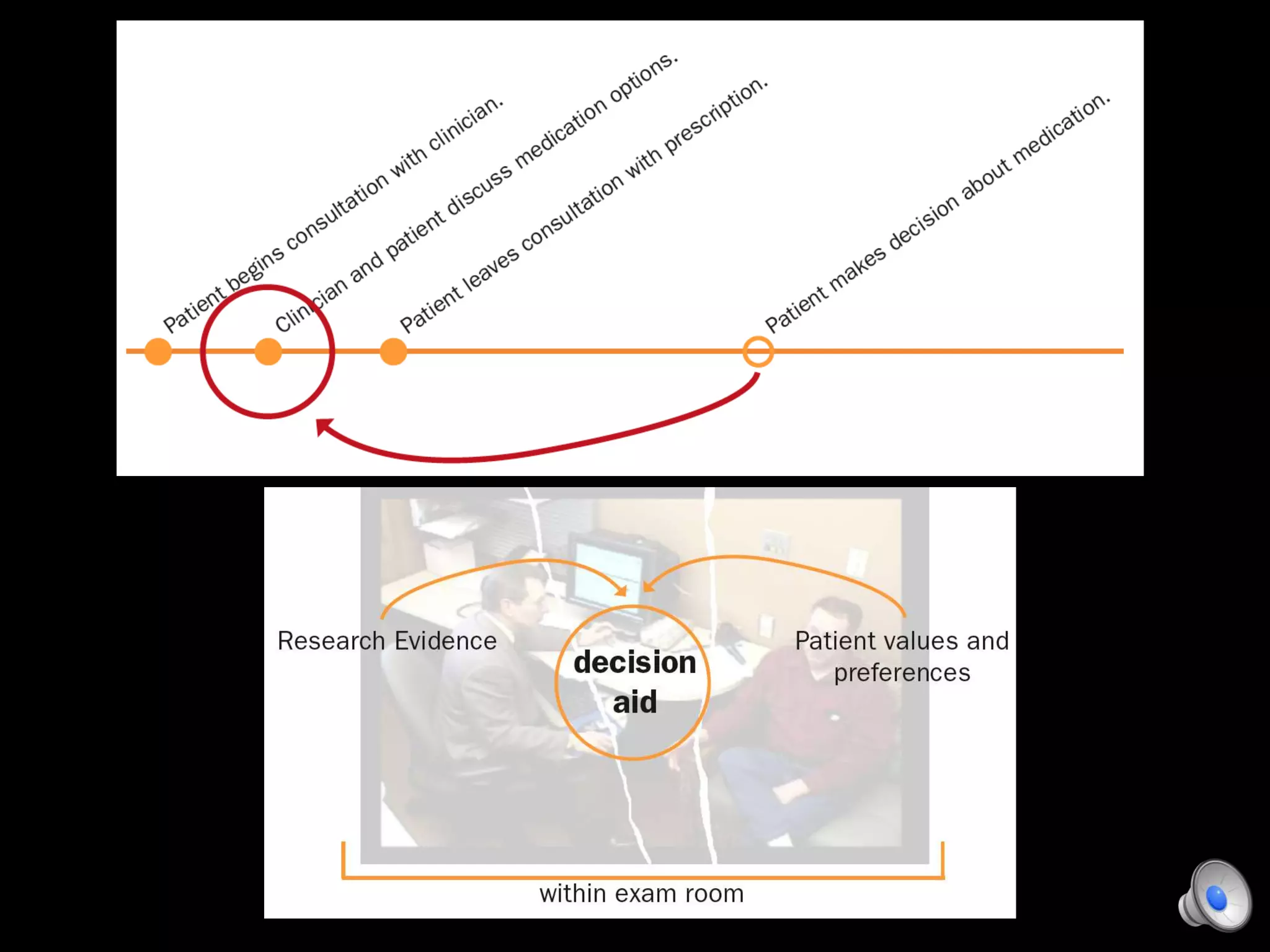
Encounter Research
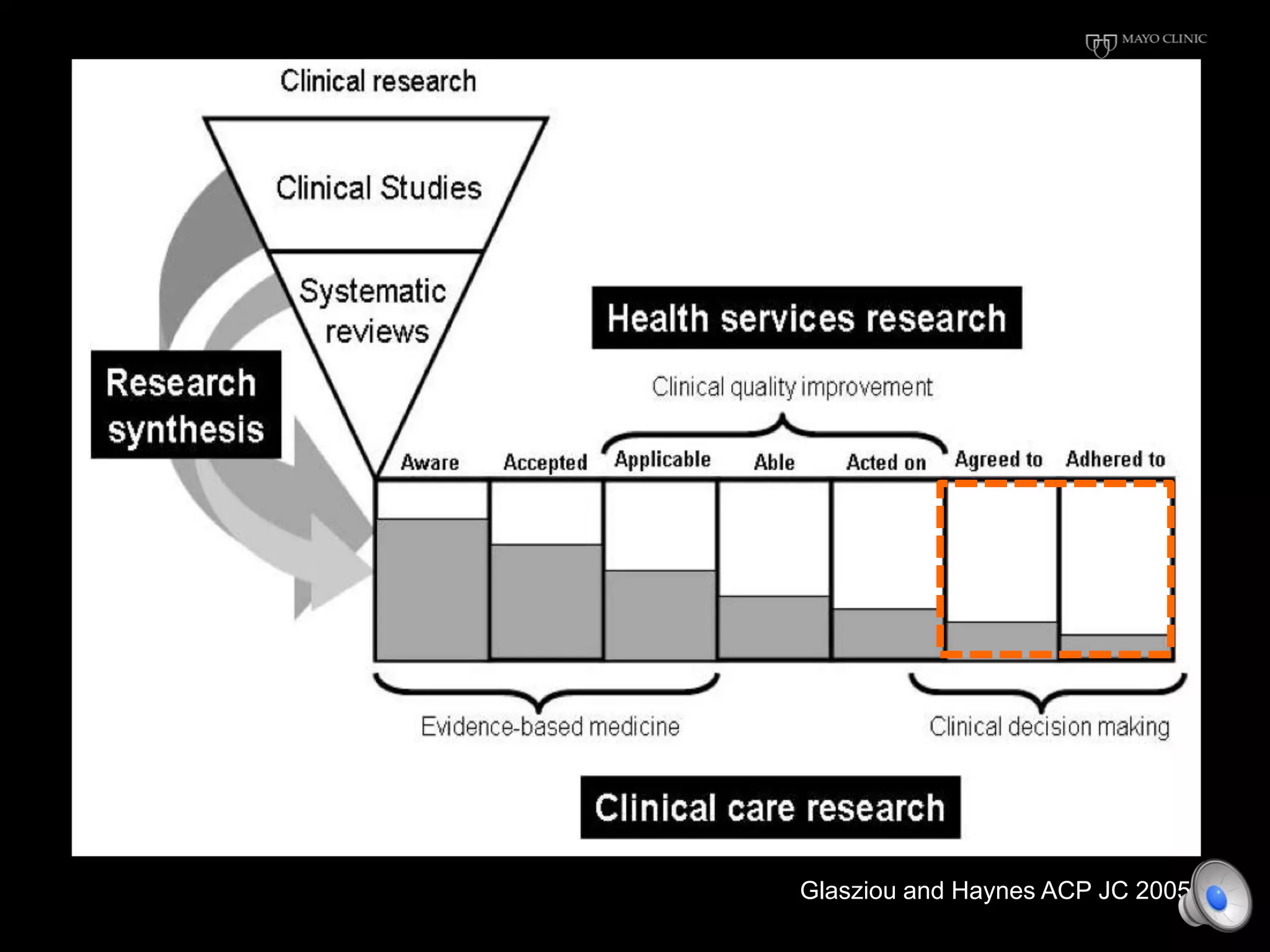
Glasziou and Haynes ACP JC 2005
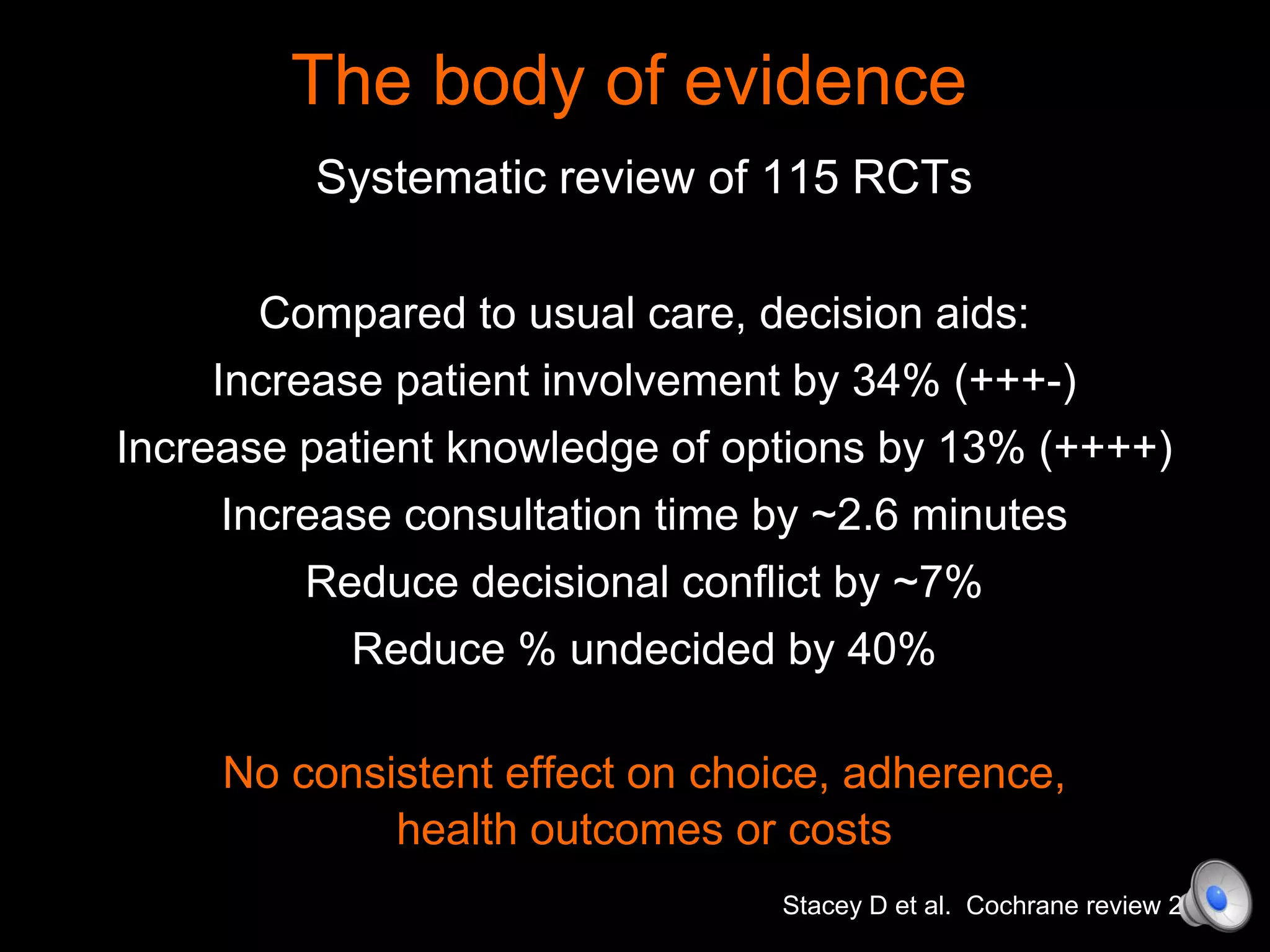
The body of evidence
Systematic review of 115 RCTs
Compared to usual care, decision aids:
Increase patient involvement by 34% (+++-)
Increase patient knowledge of options by 13% (++++)
Increase consultation time by ~2.6 minutes
Reduce decisional conflict by ~7%
Reduce % undecided by 40%
No consistent effect on choice, adherence,
health outcomes or costs
Stacey D et al. Cochrane review 2014
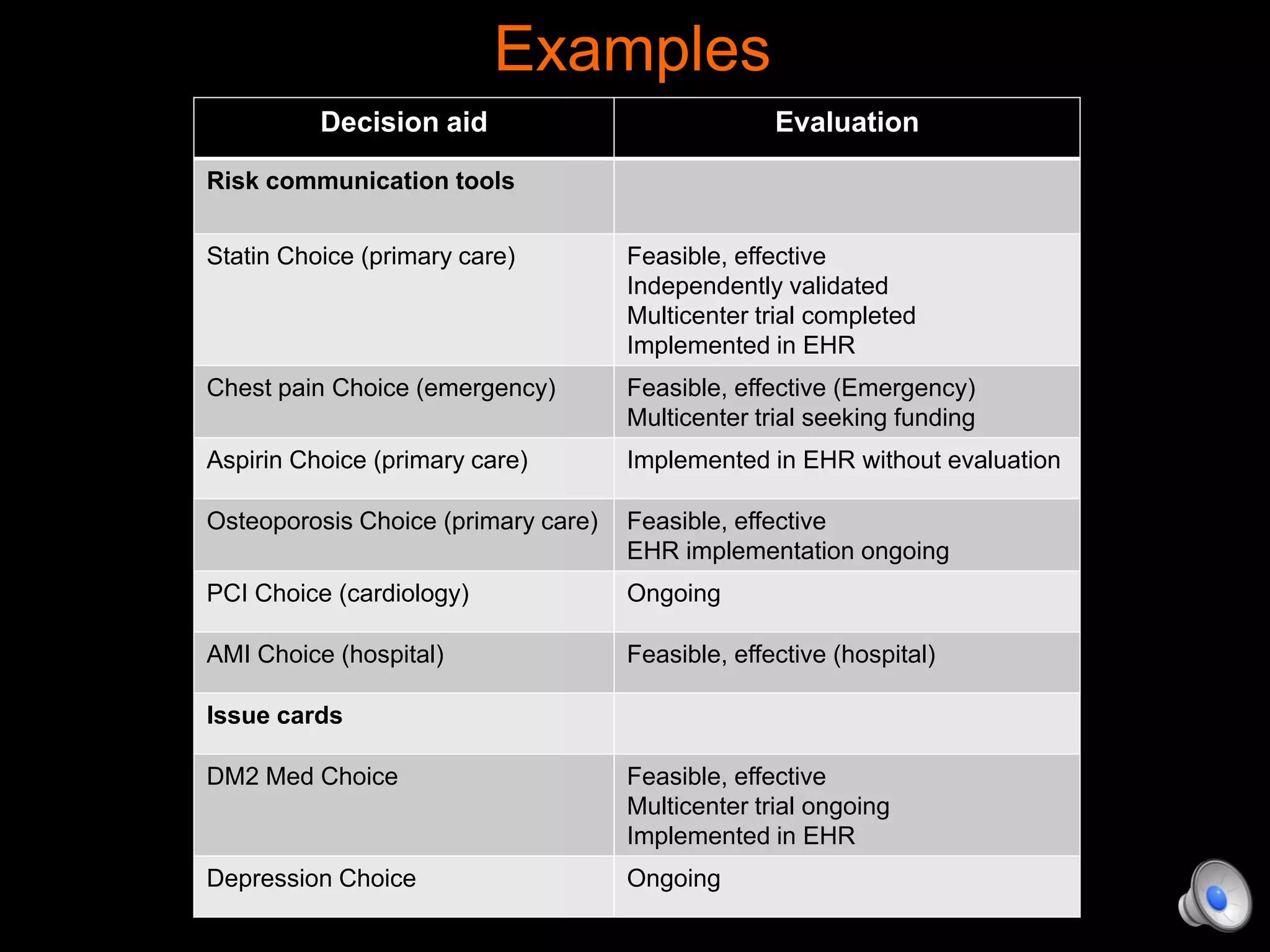
Examples
Decision aid Evaluation
Risk communication tools
Statin Choice (primary care) Feasible, effective
Independently validated
Multicenter trial completed
Implemented in EHR
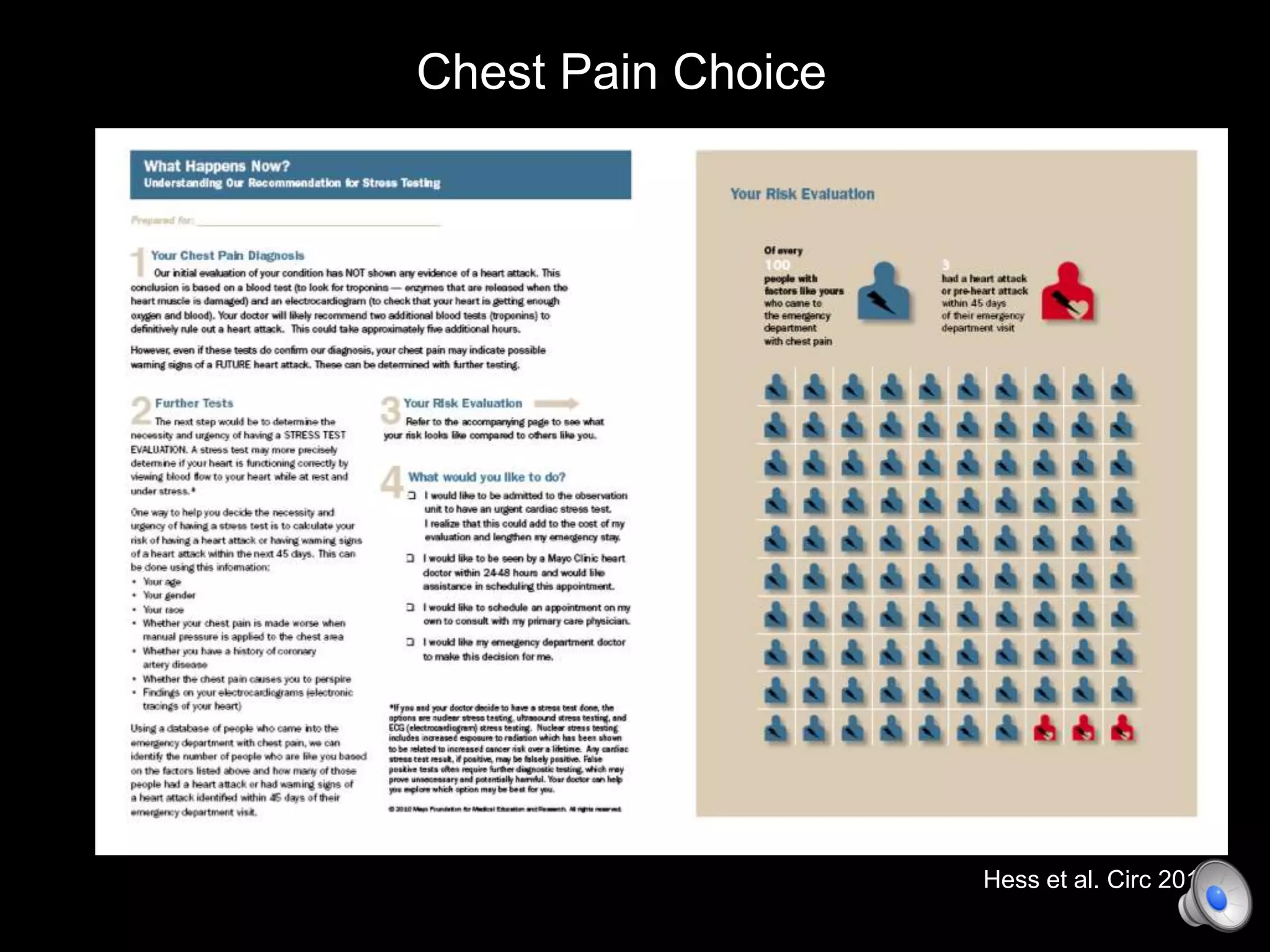
Chest pain Choice (emergency) Feasible, effective (Emergency)
Multicenter trial seeking funding
Aspirin Choice (primary care) Implemented in EHR without evaluation
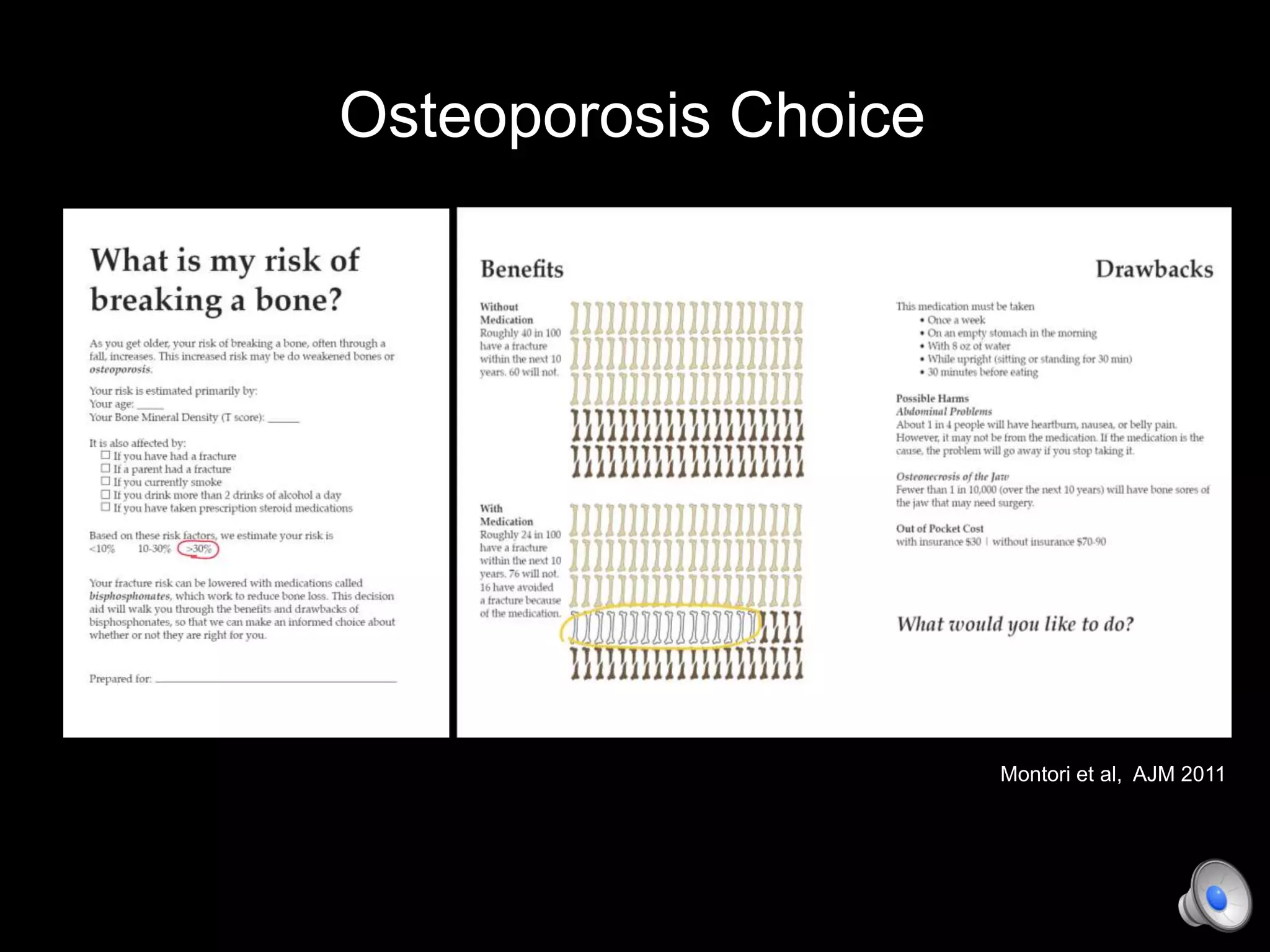
Osteoporosis Choice (primary care) Feasible, effective
EHR implementation ongoing
PCI Choice (cardiology) Ongoing
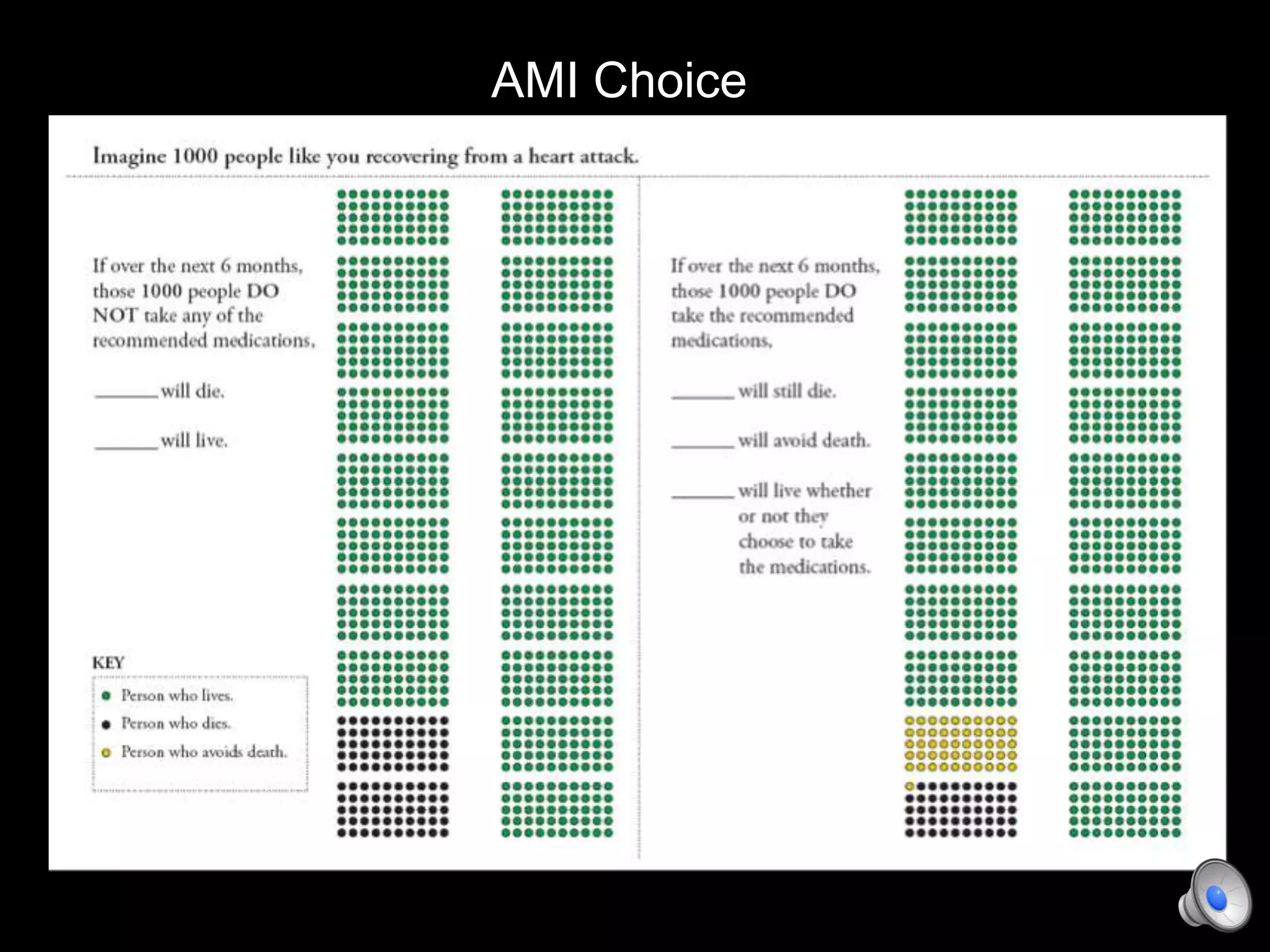
AMI Choice (hospital) Feasible, effective (hospital)
Issue cards
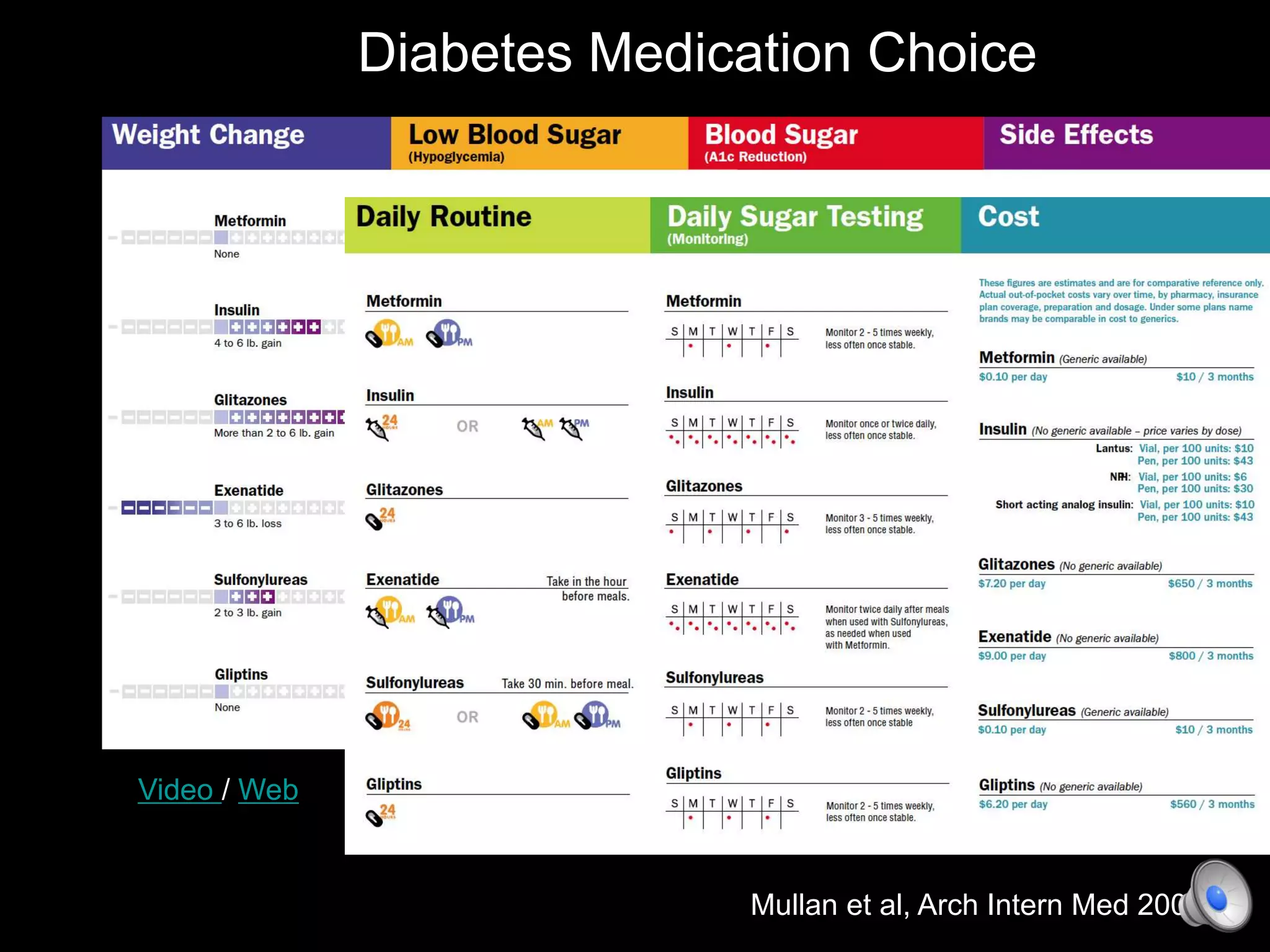
DM2 Med Choice Feasible, effective
Multicenter trial ongoing
Implemented in EHR
Depression Choice Ongoing
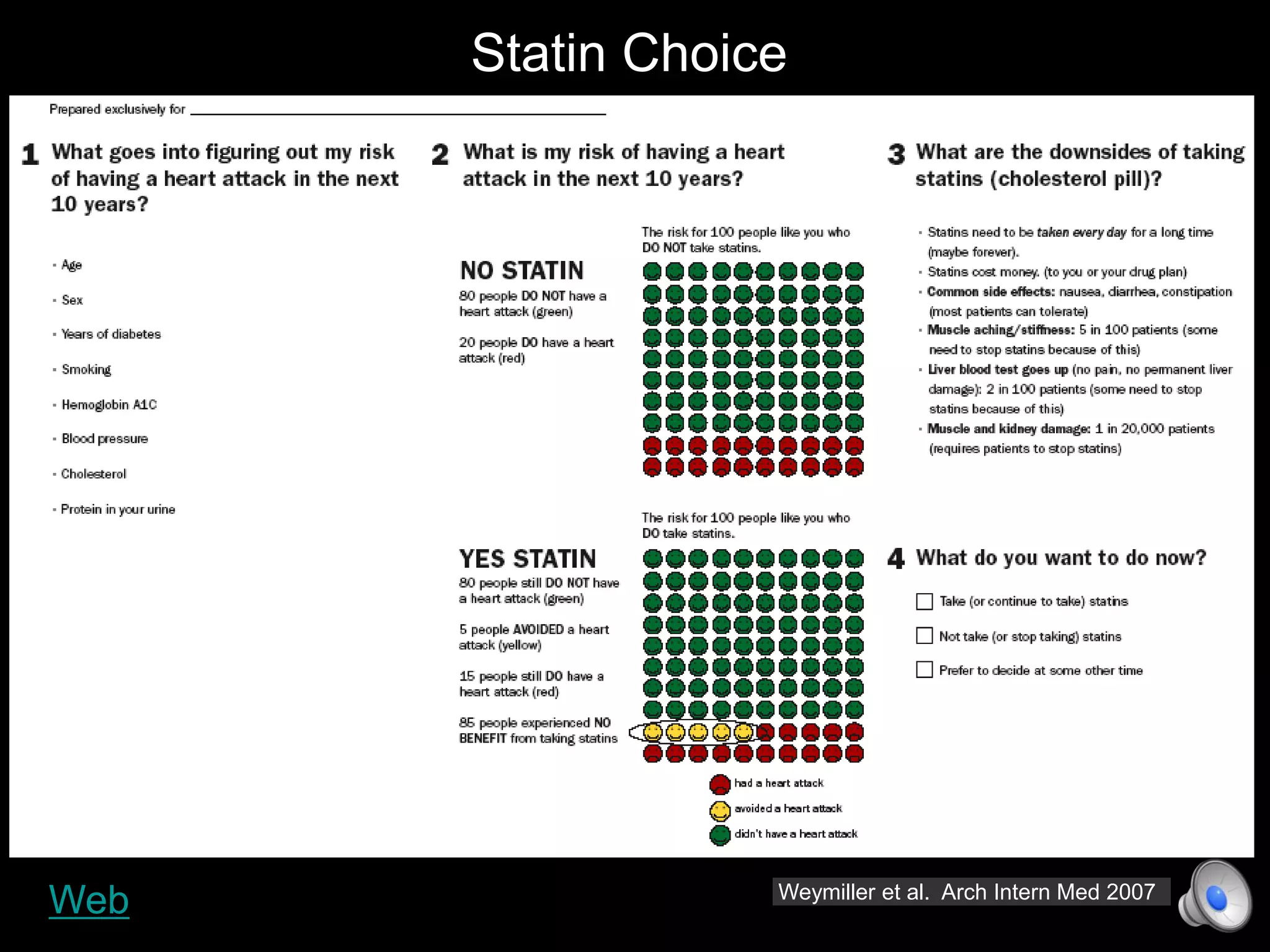
Weymiller et al. Arch Intern Med 2007
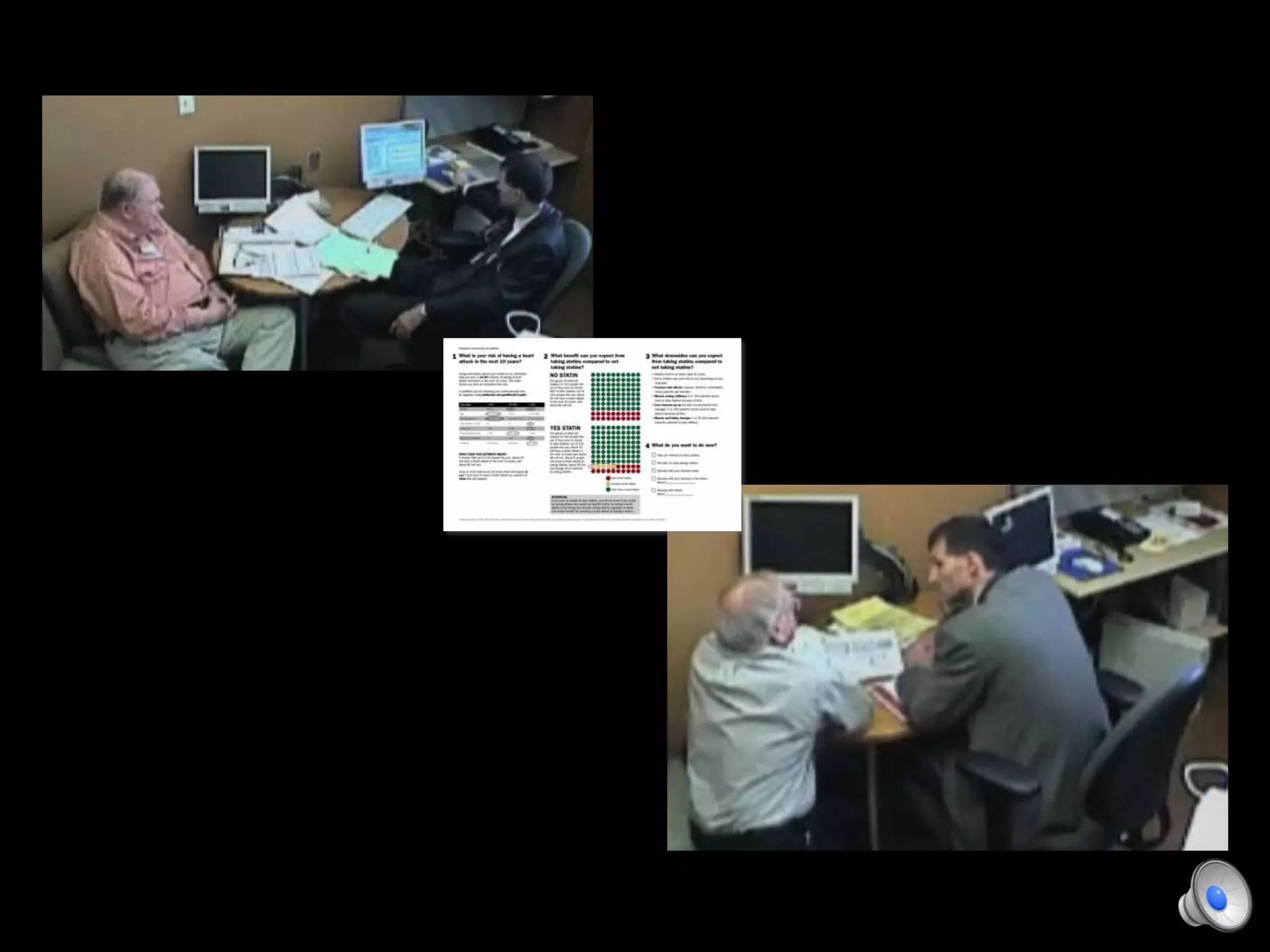
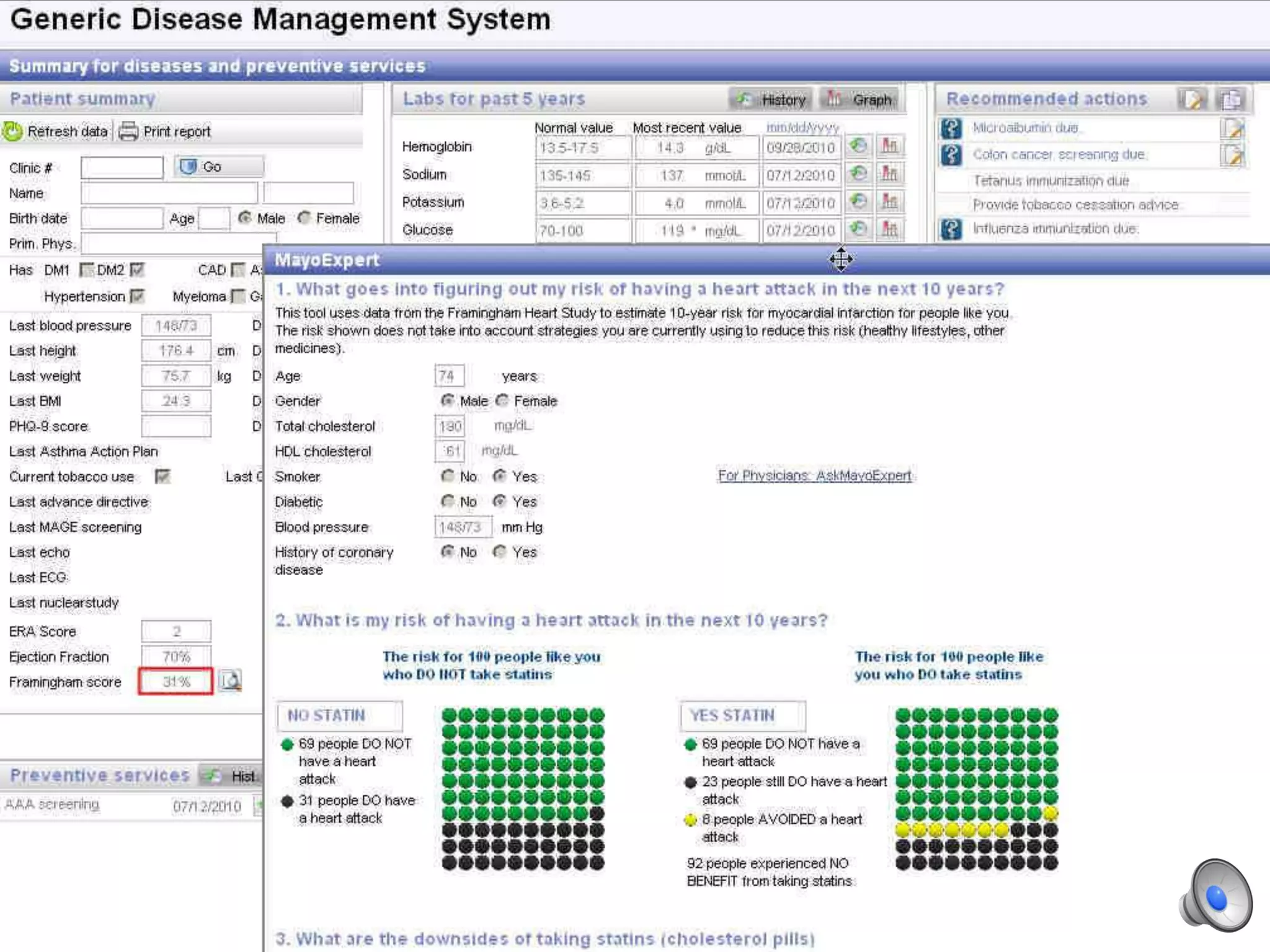
Statin Choice
Web
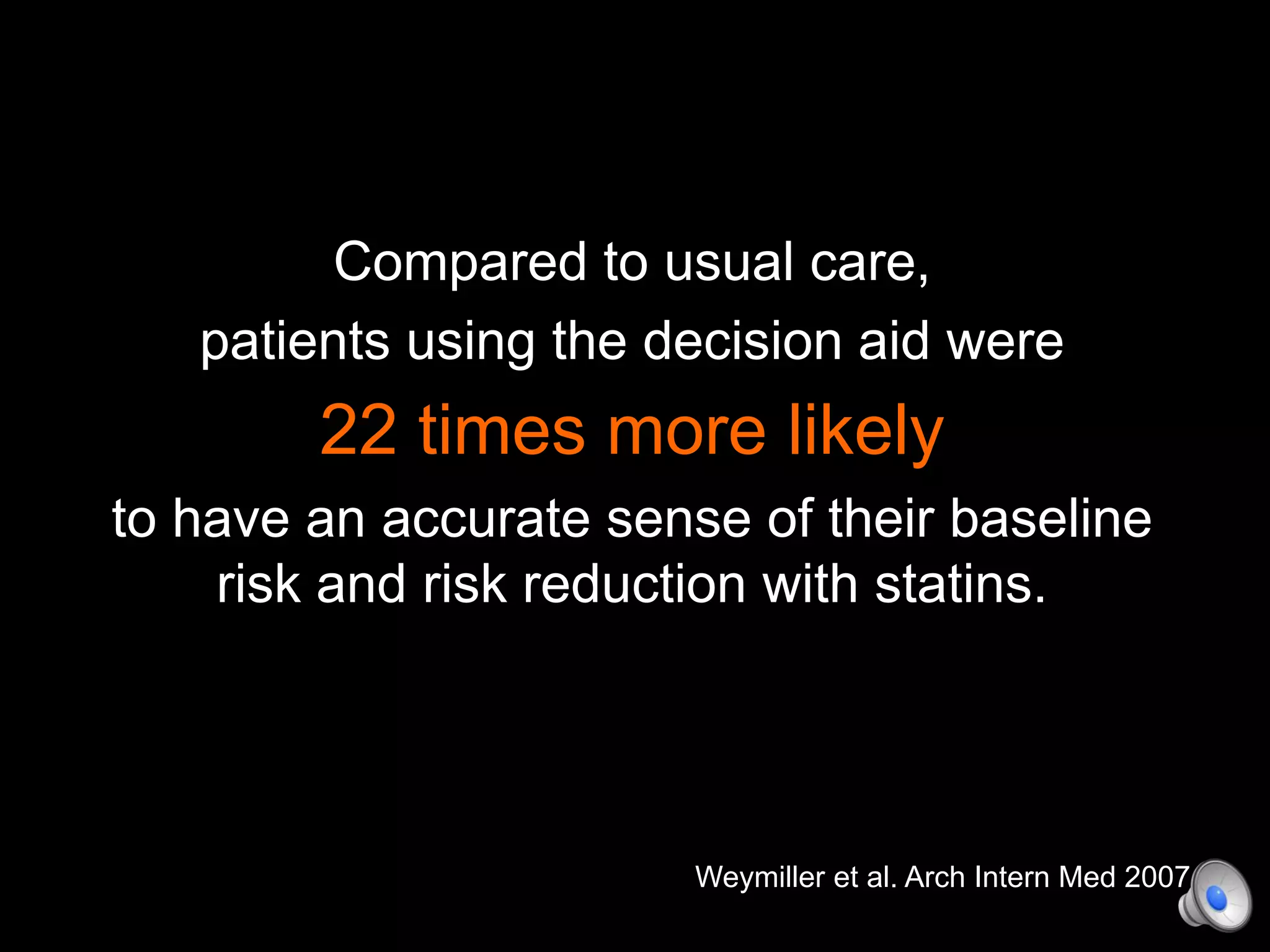
Compared to usual care,
patients using the decision aid were
22 times more likely
to have an accurate sense of their baseline
risk and risk reduction with statins.
Weymiller et al. Arch Intern Med 2007
Osteoporosis Choice
Montori et al, AJM 2011
AMI Choice
Chest Pain Choice
Hess et al. Circ 2012
Mullan et al, Arch Intern Med 2009
Diabetes Medication Choice
Video / Web
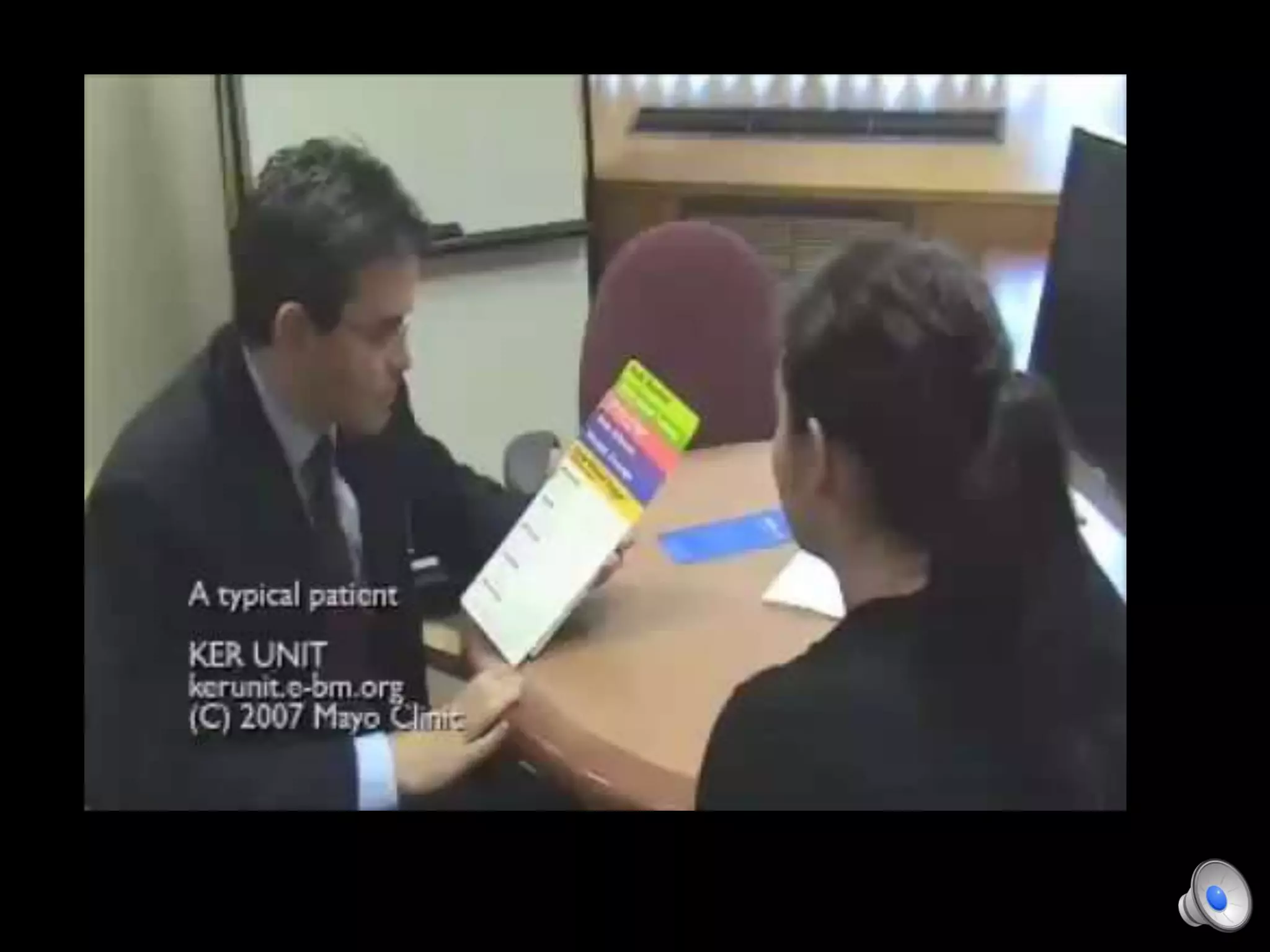
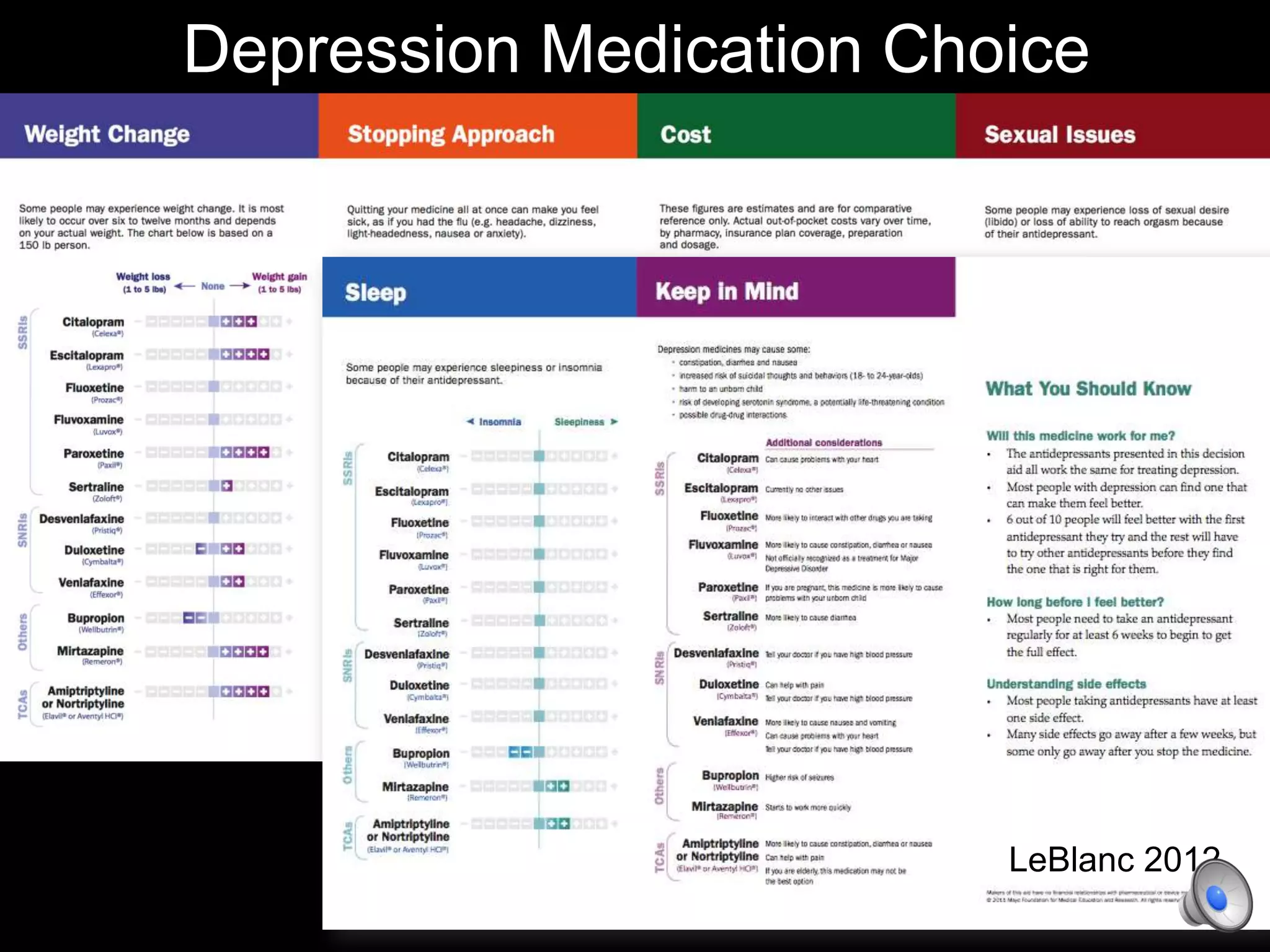
Depression Medication Choice
LeBlanc 2012
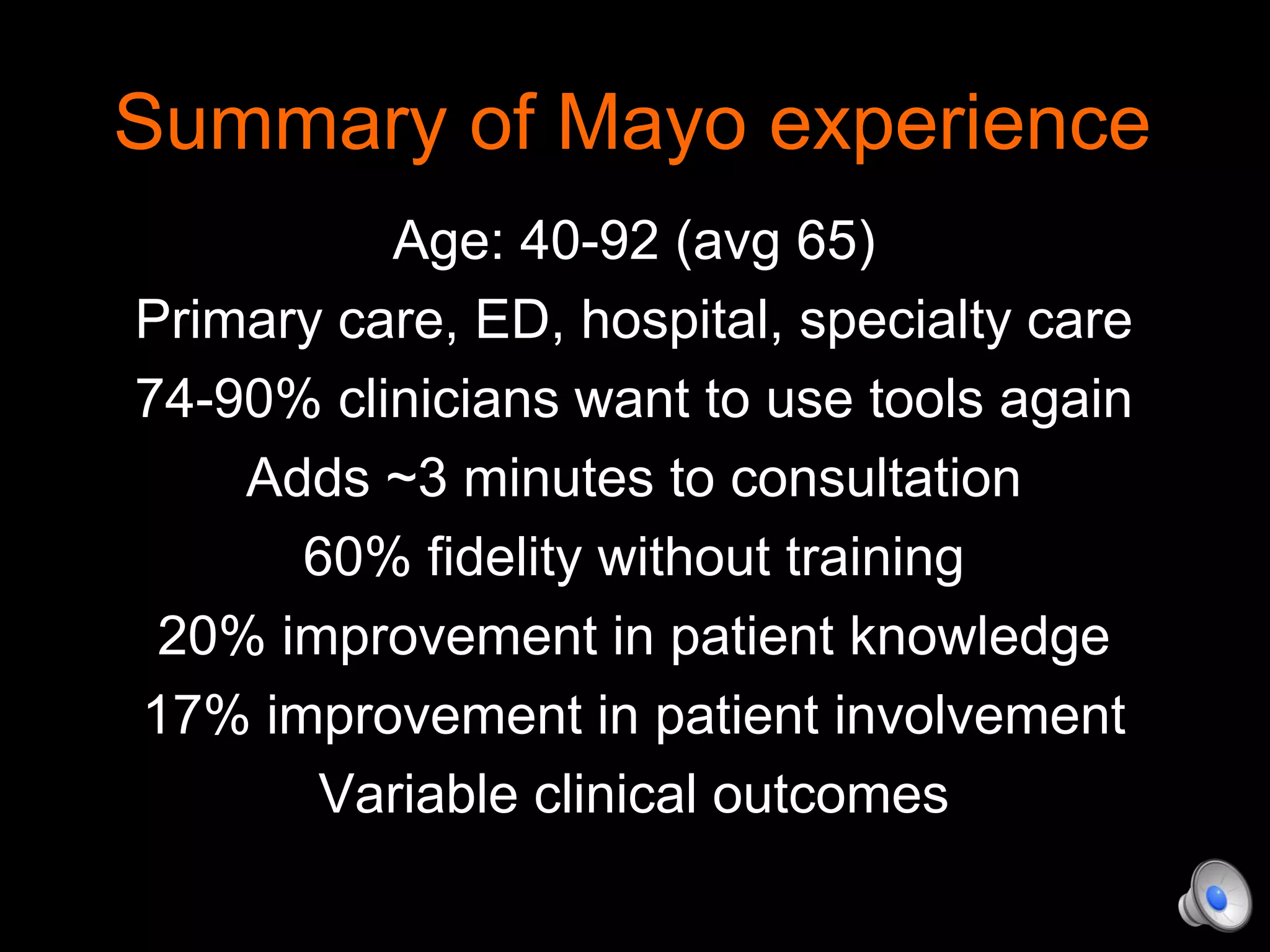
Summary of Mayo experience
Age: 40-92 (avg 65)
Primary care, ED, hospital, specialty care
74-90% clinicians want to use tools again
Adds ~3 minutes to consultation
60% fidelity without training
20% improvement in patient knowledge
17% improvement in patient involvement
Variable clinical outcomes
 
 
• Clinician decides how & when to use - and may elect not to use
• “Considerations” and “What You Should Know” cards are not given to patient as part of the comparison process
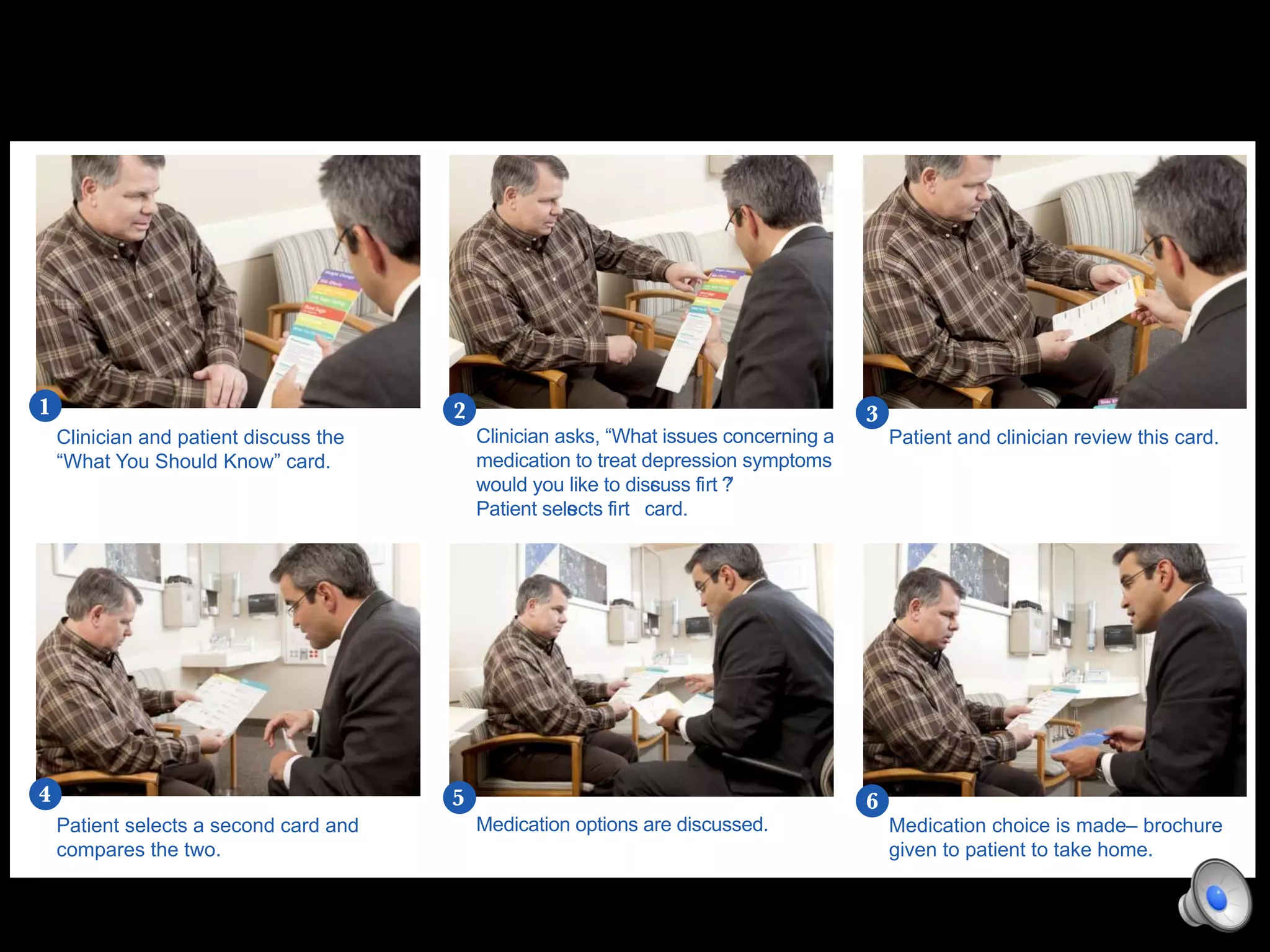
Clinician and patient discuss the
“What You Should Know” card.
Patient selects a second card and
compares the two.
Clinician asks, “What issues concerning a
medication to treat depression symptoms
would you like to discuss firs t ?”
Patient selects firs t card.
Medication options are discussed.
Patient and clinician review this card.
Medication choice is made– brochure
given to patient to take home.
a clinician guide to:
Using the Depression Medication Choice Decision Aid (DA) with Patients
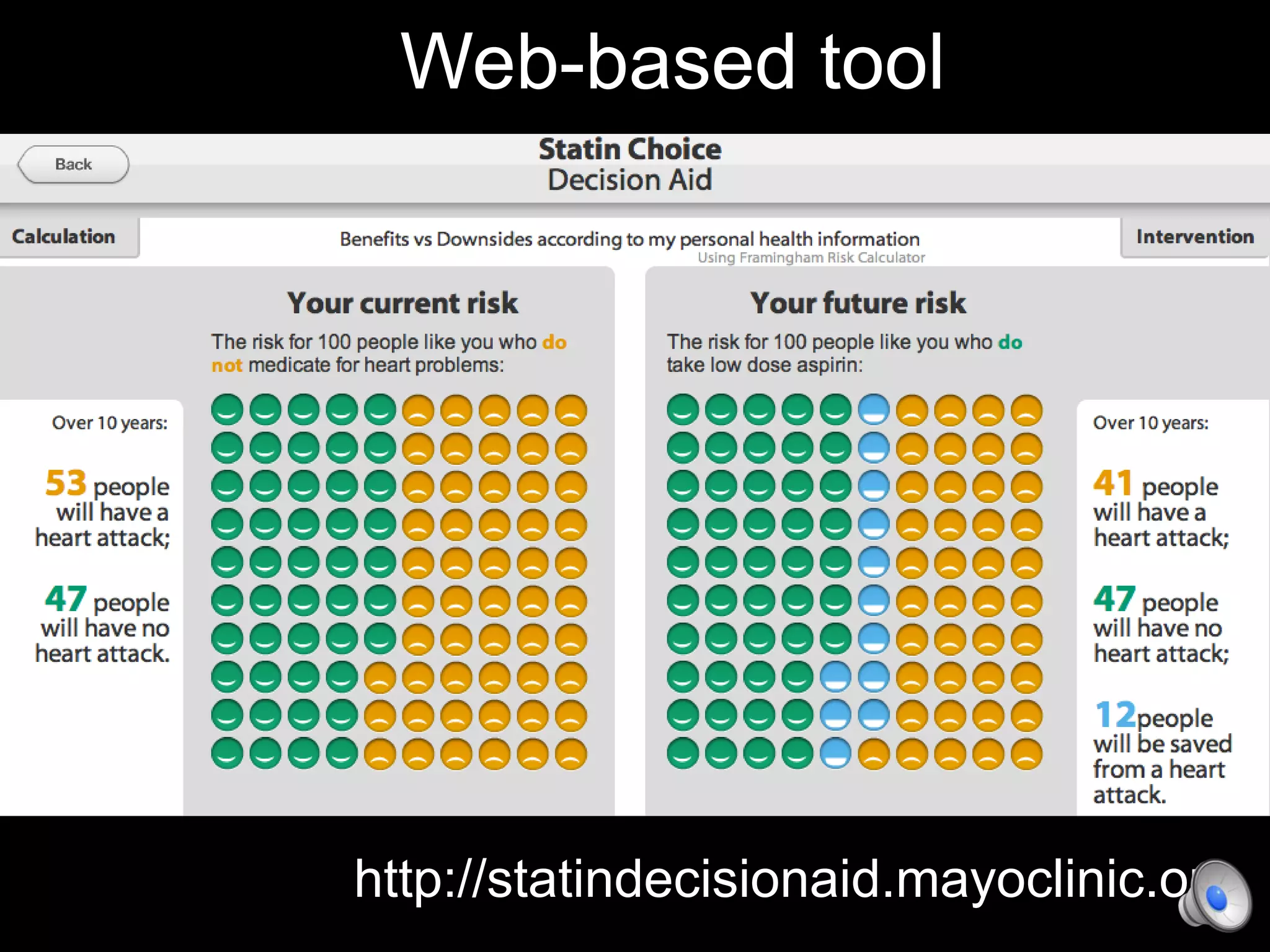
Statin Decision Aid
Web-based tool
http://statindecisionaid.mayoclinic.org
Empathic decision making
Partnership
Dance across models
Support deliberation
Incorporate research evidence
and clinician’s expertise into
patient decisions
Conclusions
• It is feasible to promote evidence-based
conversations during the clinical encounters
with patients with chronic conditions.
• Decision aids designed for this purpose are
efficient and effective in promoting shared
decision making.
• Tools tested in randomized trials and proven
effective are available for free.
• Partners to get to routine use in practice.
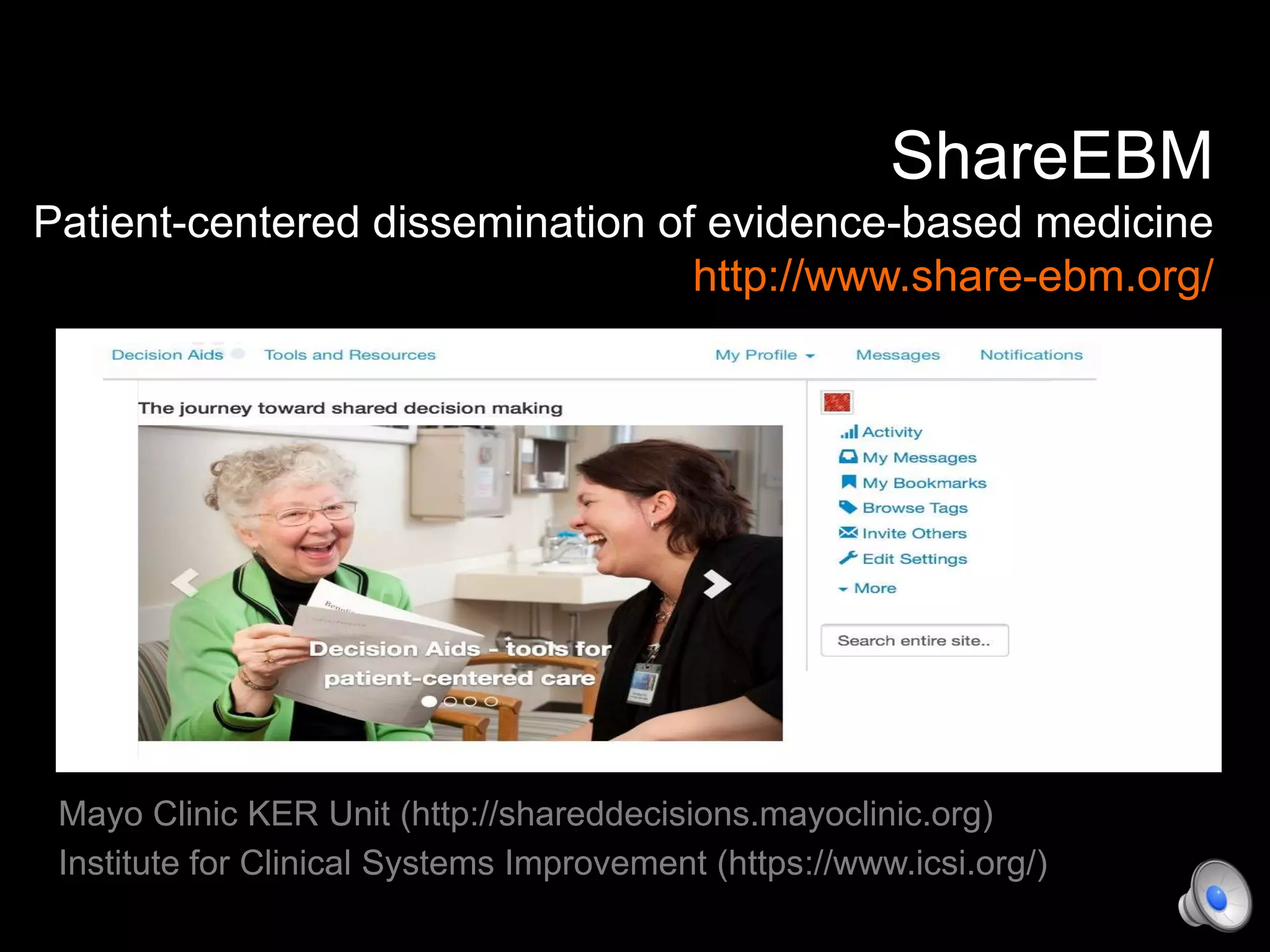
ShareEBM
Patient-centered dissemination of evidence-based medicine
http://www.share-ebm.org/
Mayo Clinic KER Unit (http://shareddecisions.mayoclinic.org)
Institute for Clinical Systems Improvement (https://www.icsi.org/)

Sdm midlength with_voice_over

  • 1.
    Patient-centered dissemination of evidence-basedmedicine A Journey Toward Shared Decision Making
  • 2.
  • 3.
  • 4.
    The body ofevidence Systematic review of 115 RCTs Compared to usual care, decision aids: Increase patient involvement by 34% (+++-) Increase patient knowledge of options by 13% (++++) Increase consultation time by ~2.6 minutes Reduce decisional conflict by ~7% Reduce % undecided by 40% No consistent effect on choice, adherence, health outcomes or costs Stacey D et al. Cochrane review 2014
  • 6.
    Examples Decision aid Evaluation Riskcommunication tools Statin Choice (primary care) Feasible, effective Independently validated Multicenter trial completed Implemented in EHR Chest pain Choice (emergency) Feasible, effective (Emergency) Multicenter trial seeking funding Aspirin Choice (primary care) Implemented in EHR without evaluation Osteoporosis Choice (primary care) Feasible, effective EHR implementation ongoing PCI Choice (cardiology) Ongoing AMI Choice (hospital) Feasible, effective (hospital) Issue cards DM2 Med Choice Feasible, effective Multicenter trial ongoing Implemented in EHR Depression Choice Ongoing
  • 7.
    Weymiller et al.Arch Intern Med 2007 Statin Choice Web
  • 8.
    Compared to usualcare, patients using the decision aid were 22 times more likely to have an accurate sense of their baseline risk and risk reduction with statins. Weymiller et al. Arch Intern Med 2007
  • 9.
  • 10.
  • 11.
    Chest Pain Choice Hesset al. Circ 2012
  • 12.
    Mullan et al,Arch Intern Med 2009 Diabetes Medication Choice Video / Web
  • 14.
  • 15.
    Summary of Mayoexperience Age: 40-92 (avg 65) Primary care, ED, hospital, specialty care 74-90% clinicians want to use tools again Adds ~3 minutes to consultation 60% fidelity without training 20% improvement in patient knowledge 17% improvement in patient involvement Variable clinical outcomes
  • 17.
        • Clinician decideshow & when to use - and may elect not to use • “Considerations” and “What You Should Know” cards are not given to patient as part of the comparison process Clinician and patient discuss the “What You Should Know” card. Patient selects a second card and compares the two. Clinician asks, “What issues concerning a medication to treat depression symptoms would you like to discuss firs t ?” Patient selects firs t card. Medication options are discussed. Patient and clinician review this card. Medication choice is made– brochure given to patient to take home. a clinician guide to: Using the Depression Medication Choice Decision Aid (DA) with Patients
  • 18.
  • 19.
  • 20.
    Empathic decision making Partnership Danceacross models Support deliberation
  • 21.
    Incorporate research evidence andclinician’s expertise into patient decisions
  • 22.
    Conclusions • It isfeasible to promote evidence-based conversations during the clinical encounters with patients with chronic conditions. • Decision aids designed for this purpose are efficient and effective in promoting shared decision making. • Tools tested in randomized trials and proven effective are available for free. • Partners to get to routine use in practice.
  • 23.
    ShareEBM Patient-centered dissemination ofevidence-based medicine http://www.share-ebm.org/ Mayo Clinic KER Unit (http://shareddecisions.mayoclinic.org) Institute for Clinical Systems Improvement (https://www.icsi.org/)

Editor's Notes

  • #2 A) Criteria involving decision attributes:Decision aids performed better than usual care interventions by increasing knowledge (MD 13.77 out of 100; 95% confidence interval (CI) 11.40 to 16.15; n = 26). When more detailed decision aids were compared to simpler decision aids, the relative improvement in knowledge was significant (MD 4.97 out of 100; 95% CI 3.22 to 6.72; n = 15). Exposure to a decision aid with expressed probabilities resulted in a higher proportion of people with accurate risk perceptions (RR 1.74; 95% CI 1.46 to 2.08; n = 14). The effect was stronger when probabilities were expressed in numbers (RR 1.93; 95% CI 1.58 to 2.37; n = 11) rather than words (RR 1.27; 95% CI 1.09 to 1.48; n = 3). Exposure to a decision aid with explicit values clarification compared to those without explicit values clarification resulted in a higher proportion of patients achieving decisions that were informed and consistent with their values (RR 1.25; 95% CI 1.03 to 1.52; n = 8).B) Criteria involving decision process attributes:Decision aids compared to usual care interventions resulted in: a) lower decisional conflict related to feeling uninformed (MD -6.43 of 100; 95% CI -9.16 to -3.70; n = 17); b) lower decisional conflict related to feeling unclear about personal values (MD -4.81; 95% CI -7.23 to -2.40; n = 14); c) reduced the proportions of people who were passive in decision making (RR 0.61; 95% CI 0.49 to 0.77; n = 11); and d) reduced proportions of people who remained undecided post-intervention (RR 0.57; 95% CI 0.44 to 0.74; n = 9). Decision aids appear to have a positive effect on patient-practitioner communication in the four studies that measured this outcome. For satisfaction with the decision (n = 12) and/or the decision making process (n = 12), those exposed to a decision aid were either more satisfied or there was no difference between the decision aid versus comparison interventions. There were no studies evaluating the decision process attributes relating to helping patients to recognize that a decision needs to be made or understand that values affect the choice.C) Secondary outcomesExposure to decision aids compared to usual care continued to demonstrate reduced choice of: major elective invasive surgery in favour of conservative options (RR 0.80; 95% CI 0.64 to 1.00; n = 11). Exposure to decision aids compared to usual care also resulted in reduced choice of PSA screening (RR 0.85; 95% CI 0.74 to 0.98; n = 7). When detailed compared to simple decision aids were used, there was reduced choice of menopausal hormones (RR 0.73; 95% CI 0.55 to 0.98; n = 3). For other decisions, the effect on choices was variable. The effect of decision aids on length of consultation varied from -8 minutes to +23 minutes (median 2.5 minutes). Decision aids do not appear to be different from comparisons in terms of anxiety (n = 20), and general health outcomes (n = 7), and condition specific health outcomes (n = 9). The effects of decision aids on other outcomes (adherence to the decision, costs/resource use) were inconclusive.