Creating a Data Governance Framework for Solvency IICopyright © 2011 DataFlux CorporationAll rights reserved
A combination of Technology, Methodology & ServicesDeveloped by DataFlux through working with 10 insurers on early-stage Solvency II Data Governance initiativesThe purpose is to provide both the technology required for Solvency II Data Governance and also a starter kit of examples built on a best practice approachWhat is the DataFlux Solvency II Data Governance Framework?
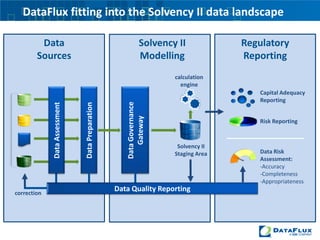
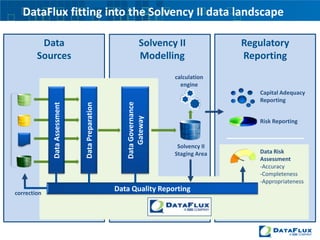
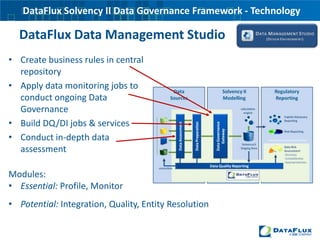
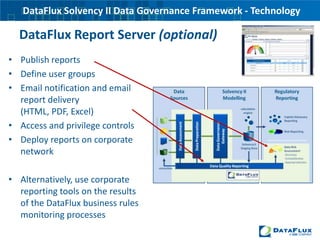
DataFlux fitting into the Solvency II data landscapeSolvency IIModellingDataSourcesRegulatory Reportingcalculation engineData Quality ReportingData Governance GatewayData PreparationData AssessmentCapital Adequacy ReportingRisk ReportingSolvency II Staging AreaData Risk Assessment:Accuracy
Completeness
Appropriatenesscorrection
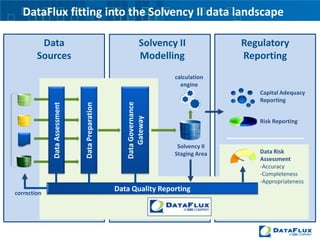
DataFlux fitting into the Solvency II data landscapeSolvency IIModellingDataSourcesRegulatory Reportingcalculation engineData Quality ReportingData Governance GatewayData PreparationData AssessmentCapital Adequacy ReportingRisk ReportingSolvency II Staging AreaData Risk AssessmentAccuracy
Completeness
Appropriatenesscorrection
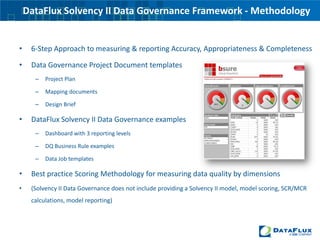
DataFlux Solvency II Data Governance Framework - Methodology6-Step Approach to measuring & reporting Accuracy, Appropriateness & CompletenessData Governance Project Document templatesProject PlanMapping documentsDesign BriefDataFlux Solvency II Data Governance examplesDashboard with 3 reporting levelsDQ Business Rule examplesData Job templatesBest practice Scoring Methodology for measuring data quality by dimensions(Solvency II Data Governance does not include providing a Solvency II model, model scoring, SCR/MCR calculations, model reporting)
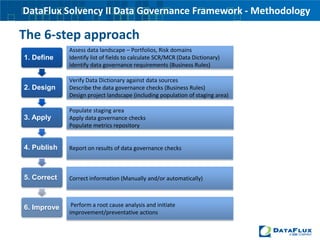
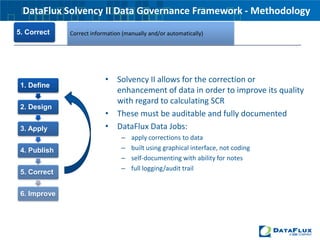
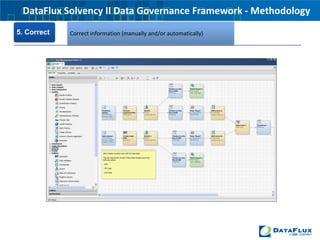
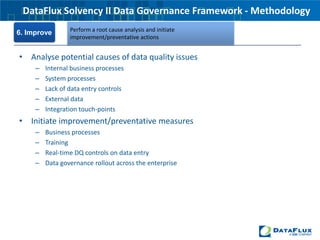
DataFlux Solvency II Data Governance Framework - MethodologyAssess data landscape – Portfolios, Risk domainsIdentify list of fields to calculate SCR/MCR (Data Dictionary)Identify data governance requirements (Business Rules)Verify Data Dictionary against data sourcesDescribe the data governance checks (Business Rules)Design project landscape (including population of staging area)Populate staging areaApply data governance checksPopulate metrics repositoryReport on results of data governance checksCorrect information (Manually and/or automatically) Perform a root cause analysis and initiate  improvement/preventative actionsThe 6-step approach
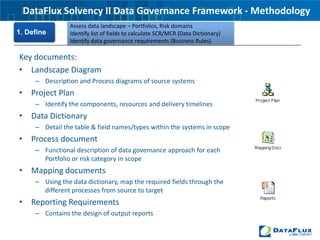
1. DefineDataFlux Solvency II Data Governance Framework - MethodologyAssess data landscape – Portfolios, Risk domainsIdentify list of fields to calculate SCR/MCR (Data Dictionary)Identify data governance requirements (Business Rules)Key documents:Landscape DiagramDescription and Process diagrams of source systemsProject PlanIdentify the components, resources and delivery timelinesData DictionaryDetail the table & field names/types within the systems in scopeProcess documentFunctional description of data governance approach for each Portfolio or risk category in scopeMapping documentsUsing the data dictionary, map the required fields through the different processes from source to targetReporting Requirements Contains the design of output reports
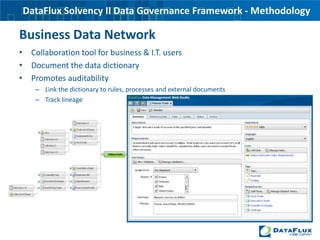
Collaboration tool for business & I.T. usersDocument the data dictionaryPromotes auditabilityLink the dictionary to rules, processes and external documentsTrack lineageBusiness Data NetworkDataFlux Solvency II Data Governance Framework - Methodology
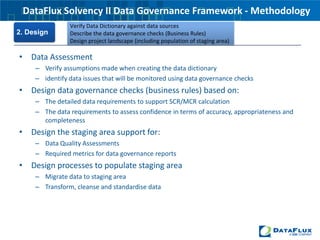
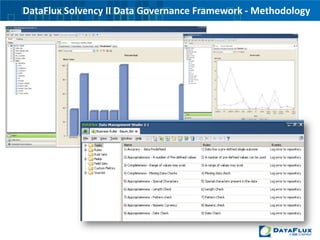
2. DesignDataFlux Solvency II Data Governance Framework - MethodologyVerify Data Dictionary against data sourcesDescribe the data governance checks (Business Rules)Design project landscape (including population of staging area)Data AssessmentVerify assumptions made when creating the data dictionaryidentify data issues that will be monitored using data governance checksDesign data governance checks (business rules) based on: The detailed data requirements to support SCR/MCR calculationThe data requirements to assess confidence in terms of accuracy, appropriateness and completenessDesign the staging area support for:Data Quality AssessmentsRequired metrics for data governance reportsDesign processes to populate staging areaMigrate data to staging areaTransform, cleanse and standardise data
DataFlux Solvency II Data Governance Framework - Methodology
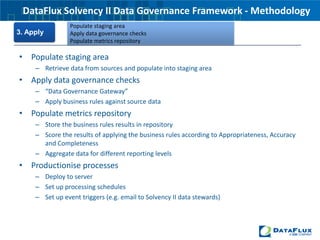
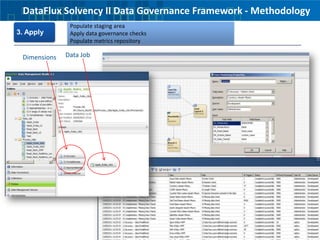
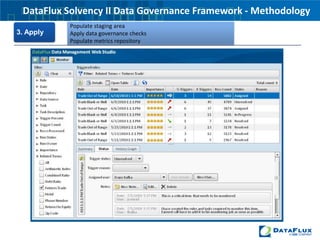
3. ApplyDataFlux Solvency II Data Governance Framework - MethodologyPopulate staging areaApply data governance checksPopulate metrics repositoryPopulate staging area
Retrieve data from sources and populate into staging area
Apply data governance checks
“Data Governance Gateway”
Apply business rules against source data
Populate metrics repository
Store the business rules results in repository
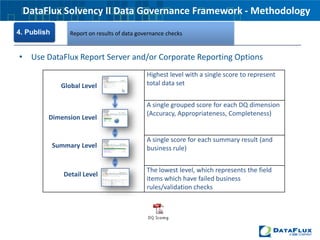
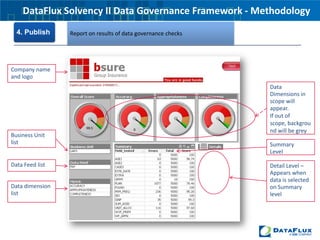
Score the results of applying the business rules according to Appropriateness, Accuracy and Completeness
Aggregate data for different reporting levels
Productionise processes

Creating A Solvency II Data Governance Framework

  • 1.
    Creating a DataGovernance Framework for Solvency IICopyright © 2011 DataFlux CorporationAll rights reserved
  • 2.
    A combination ofTechnology, Methodology & ServicesDeveloped by DataFlux through working with 10 insurers on early-stage Solvency II Data Governance initiativesThe purpose is to provide both the technology required for Solvency II Data Governance and also a starter kit of examples built on a best practice approachWhat is the DataFlux Solvency II Data Governance Framework?
  • 3.
    DataFlux fitting intothe Solvency II data landscapeSolvency IIModellingDataSourcesRegulatory Reportingcalculation engineData Quality ReportingData Governance GatewayData PreparationData AssessmentCapital Adequacy ReportingRisk ReportingSolvency II Staging AreaData Risk Assessment:Accuracy
  • 4.
  • 5.
  • 6.
    DataFlux fitting intothe Solvency II data landscapeSolvency IIModellingDataSourcesRegulatory Reportingcalculation engineData Quality ReportingData Governance GatewayData PreparationData AssessmentCapital Adequacy ReportingRisk ReportingSolvency II Staging AreaData Risk AssessmentAccuracy
  • 7.
  • 8.
  • 9.
    DataFlux Solvency IIData Governance Framework - Methodology6-Step Approach to measuring & reporting Accuracy, Appropriateness & CompletenessData Governance Project Document templatesProject PlanMapping documentsDesign BriefDataFlux Solvency II Data Governance examplesDashboard with 3 reporting levelsDQ Business Rule examplesData Job templatesBest practice Scoring Methodology for measuring data quality by dimensions(Solvency II Data Governance does not include providing a Solvency II model, model scoring, SCR/MCR calculations, model reporting)
  • 10.
    DataFlux Solvency IIData Governance Framework - MethodologyAssess data landscape – Portfolios, Risk domainsIdentify list of fields to calculate SCR/MCR (Data Dictionary)Identify data governance requirements (Business Rules)Verify Data Dictionary against data sourcesDescribe the data governance checks (Business Rules)Design project landscape (including population of staging area)Populate staging areaApply data governance checksPopulate metrics repositoryReport on results of data governance checksCorrect information (Manually and/or automatically) Perform a root cause analysis and initiate improvement/preventative actionsThe 6-step approach
  • 11.
    1. DefineDataFlux SolvencyII Data Governance Framework - MethodologyAssess data landscape – Portfolios, Risk domainsIdentify list of fields to calculate SCR/MCR (Data Dictionary)Identify data governance requirements (Business Rules)Key documents:Landscape DiagramDescription and Process diagrams of source systemsProject PlanIdentify the components, resources and delivery timelinesData DictionaryDetail the table & field names/types within the systems in scopeProcess documentFunctional description of data governance approach for each Portfolio or risk category in scopeMapping documentsUsing the data dictionary, map the required fields through the different processes from source to targetReporting Requirements Contains the design of output reports
  • 12.
    Collaboration tool forbusiness & I.T. usersDocument the data dictionaryPromotes auditabilityLink the dictionary to rules, processes and external documentsTrack lineageBusiness Data NetworkDataFlux Solvency II Data Governance Framework - Methodology
  • 13.
    2. DesignDataFlux SolvencyII Data Governance Framework - MethodologyVerify Data Dictionary against data sourcesDescribe the data governance checks (Business Rules)Design project landscape (including population of staging area)Data AssessmentVerify assumptions made when creating the data dictionaryidentify data issues that will be monitored using data governance checksDesign data governance checks (business rules) based on: The detailed data requirements to support SCR/MCR calculationThe data requirements to assess confidence in terms of accuracy, appropriateness and completenessDesign the staging area support for:Data Quality AssessmentsRequired metrics for data governance reportsDesign processes to populate staging areaMigrate data to staging areaTransform, cleanse and standardise data
  • 14.
    DataFlux Solvency IIData Governance Framework - Methodology
  • 15.
    3. ApplyDataFlux SolvencyII Data Governance Framework - MethodologyPopulate staging areaApply data governance checksPopulate metrics repositoryPopulate staging area
  • 16.
    Retrieve data fromsources and populate into staging area
  • 17.
  • 18.
  • 19.
    Apply business rulesagainst source data
  • 20.
  • 21.
    Store the businessrules results in repository
  • 22.
    Score the resultsof applying the business rules according to Appropriateness, Accuracy and Completeness
  • 23.
    Aggregate data fordifferent reporting levels
  • 24.