Transforming the educational landscape
by providing affordable and accessible
educational material to students
both locally and abroad.
2016 Year in Review
From Donations to
Partnerships
A Message From Our Team
Since January 2014, Textbooks for Change has transitioned from a small university project
into a thriving social enterprise with a focus on environmental and social impact. The
numbers and stories in this report capture our successes and achievements over the past
two years.
Particularly, this past year has been exciting for our community. Our team doubled,
appointed a Director of East African (EA) operations, made two visits to Kenya, created four
new campus partnership and donated to libraries in Kenya.
Our accomplishments have not come without critical thinking, constructive feedback or
reflection. A year ago, our team was tasked with identifying what our organization was set
out to change and then to construct a model to identify the impact that our social
enterprise would have both locally and abroad.
During these meetings, our team had to consider every stakeholder in our model. From our
students and customers in North America to our librarians and professors in East Africa, we
defined each input, output and outcome in our daily operations.
What our team could all agree upon was that we all envision a world where education is
a human right, regardless of a person’s socioeconomic status.
We then placed ourselves in a position to work towards that goal by providing affordable
and accessible educational materials to those both locally and abroad.
After the second trip to Kenya our team focused on our ability to collect data from libraries
that have or will accept a donation of textbooks from our social enterprise. Our goal is to
do more than simply donate relevant course material. We want to ensure that our
donations are accessible, used by students who are looking to increase their academic
success and save students money and time over the course of the school year.
You can probably already tell that the type of impact we are looking to create will take
time to quantify but we aren’t in this space for the short-term. To realize the goal of
education as a human right, we will start measuring textbook usage in the short-term and
work with our campus champions to understand our impact year after year. One of our
biggest goals is for our partners to see an influx of relevant course material into their
libraries, realize a decrease in short-term loan limits and in turn have more textbooks for
students to take out on a long-term basis.
In this report we hope that you are able to get a better sense of our partnerships, how we
aim to measure impact and the current state of educational resources in East Africa. We
hope to answer any questions you may have in the following pages and introduce you to a
world where education is a human right, not a privilege.
Thank you,
Textbooks for Change
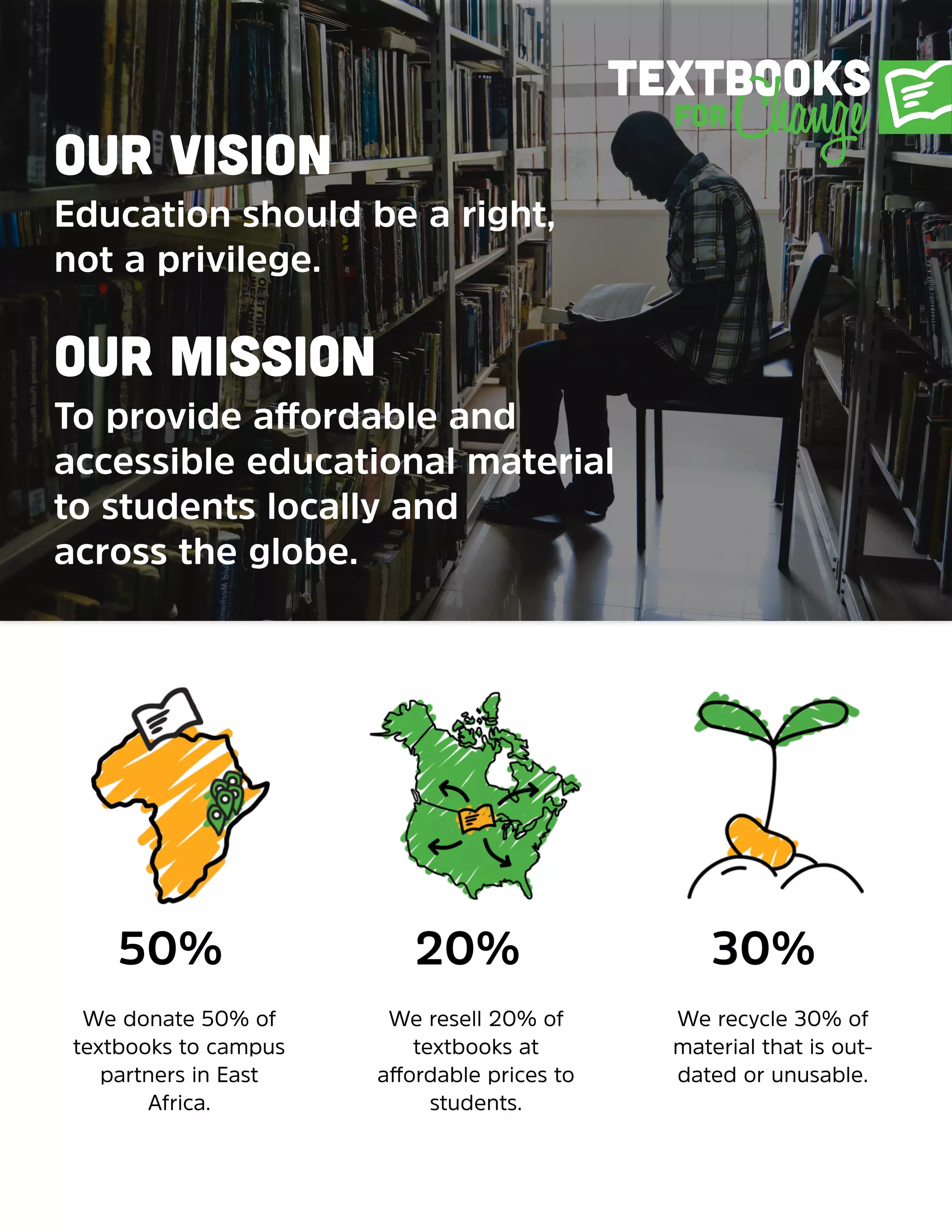
Our Vision
Education should be a right,
not a privilege.
Our Mission
To provide affordable and
accessible educational material
to students locally and
across the globe.
50% 20% 30%
We donate 50% of
textbooks to campus
partners in East
Africa.
We resell 20% of
textbooks at
affordable prices to
students.
We recycle 30% of
material that is out-
dated or unusable.
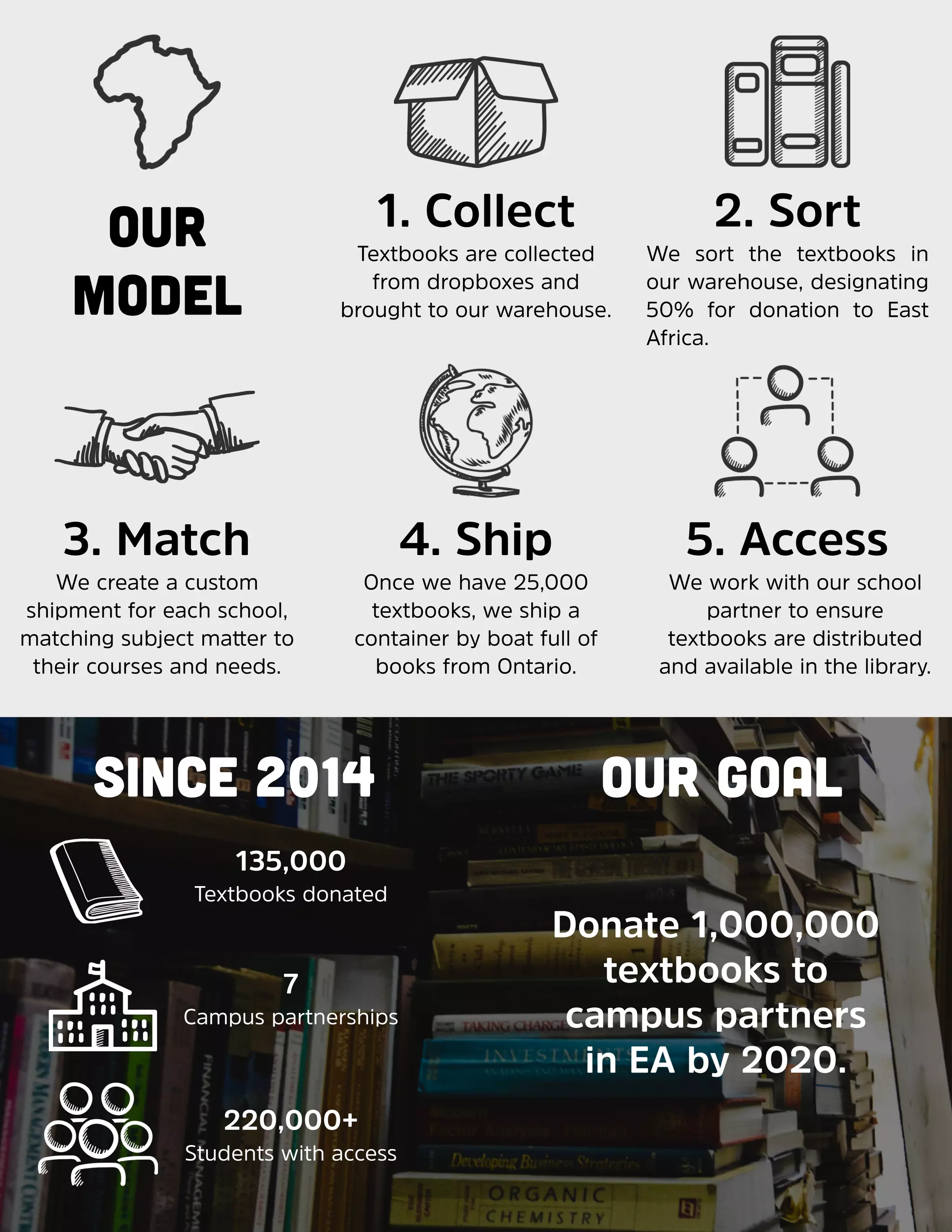
Our
Model
Textbooks are collected
from dropboxes and
brought to our warehouse.
1. Collect
We sort the textbooks in
our warehouse, designating
50% for donation to East
Africa.
2. Sort
We create a custom
shipment for each school,
matching subject matter to
their courses and needs.
3. Match
Once we have 25,000
textbooks, we ship a
container by boat full of
books from Ontario.
4. Ship 5. Access
We work with our school
partner to ensure
textbooks are distributed
and available in the library.
Since 2014 Our Goal
Donate 1,000,000
textbooks to
campus partners
in EA by 2020.
135,000
Textbooks donated
7
Campus partnerships
220,000+
Students with access
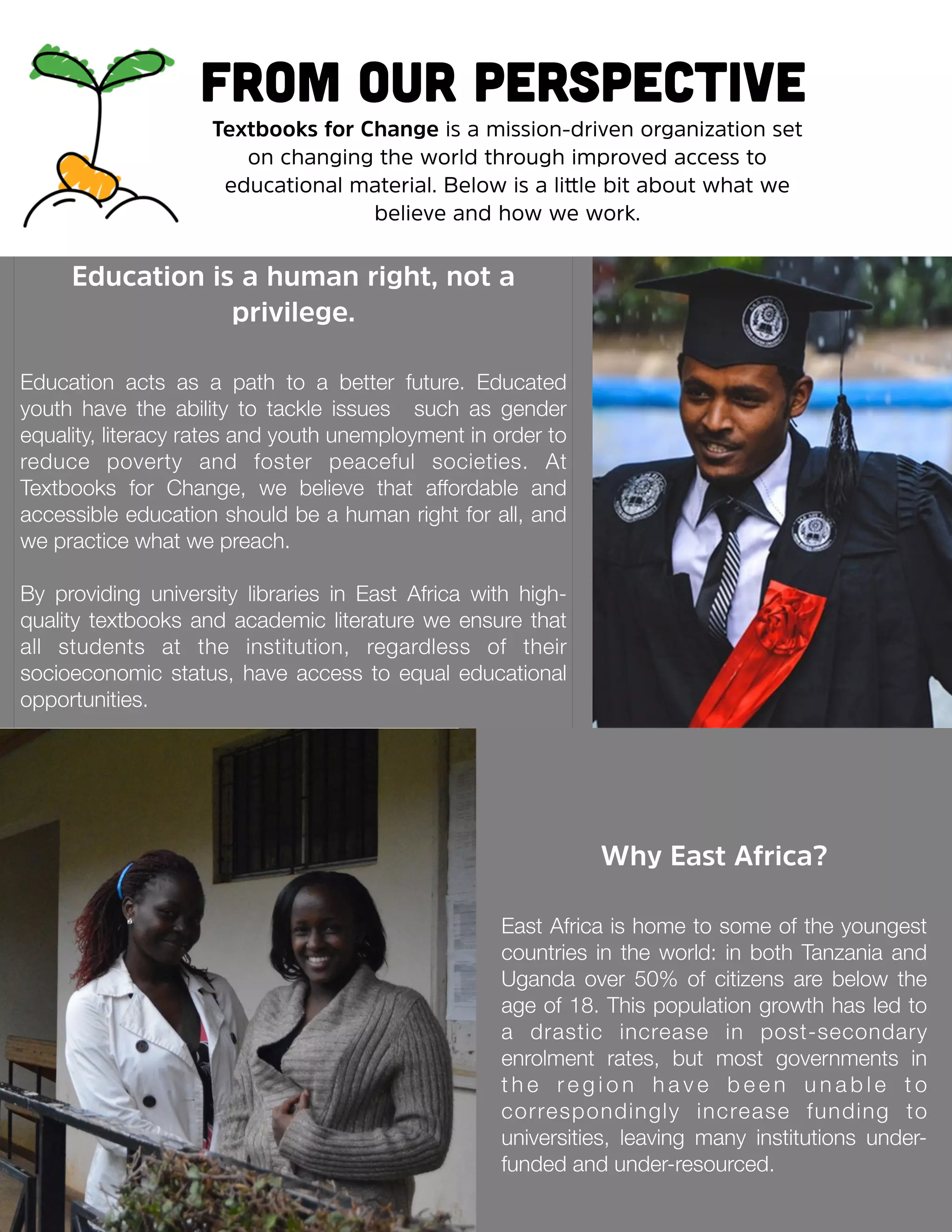
From Our Perspective
Textbooks for Change is a mission-driven organization set
on changing the world through improved access to
educational material. Below is a little bit about what we
believe and how we work.
Education is a human right, not a
privilege.
Education acts as a path to a better future. Educated
youth have the ability to tackle issues such as gender
equality, literacy rates and youth unemployment in order to
reduce poverty and foster peaceful societies. At
Textbooks for Change, we believe that affordable and
accessible education should be a human right for all, and
we practice what we preach.
By providing university libraries in East Africa with high-
quality textbooks and academic literature we ensure that
all students at the institution, regardless of their
socioeconomic status, have access to equal educational
opportunities.
Why East Africa?
East Africa is home to some of the youngest
countries in the world: in both Tanzania and
Uganda over 50% of citizens are below the
age of 18. This population growth has led to
a drastic increase in post-secondary
enrolment rates, but most governments in
t h e r e g i o n h a v e b e e n u n a b l e t o
correspondingly increase funding to
universities, leaving many institutions under-
funded and under-resourced.


A learning Hub:
Libraries in East Africa
1.14
7.06
1.87
5.15
13.88
138.39
0
 20
 40
 60
 80
 100
 120
 140
 160
Kenyan University A
Kenyan University B
Kenyan University C
Kenyan University D
Kenyan University E
University of Toronto

Books in Library per Enrolled Student
Interview with Kenyan Librarian:
“Have you, this academic year,
turned away students who needed
access to textbooks?”
“Very often. Of 10 students, about 4
might get their request.”
As opposed to North America, where purchasing material at campus
bookstores is common, both students and professors in East Africa rely on
checkouts from campus libraries for readings and research.Unfortunately,
there is a significant deficit in the educational material available to the
institutions we’ve met with in Kenya. The chart below indicates the number of
books in campus libraries per student at 5 Kenyan universities and compares
it to the same statistic from the University of Toronto.


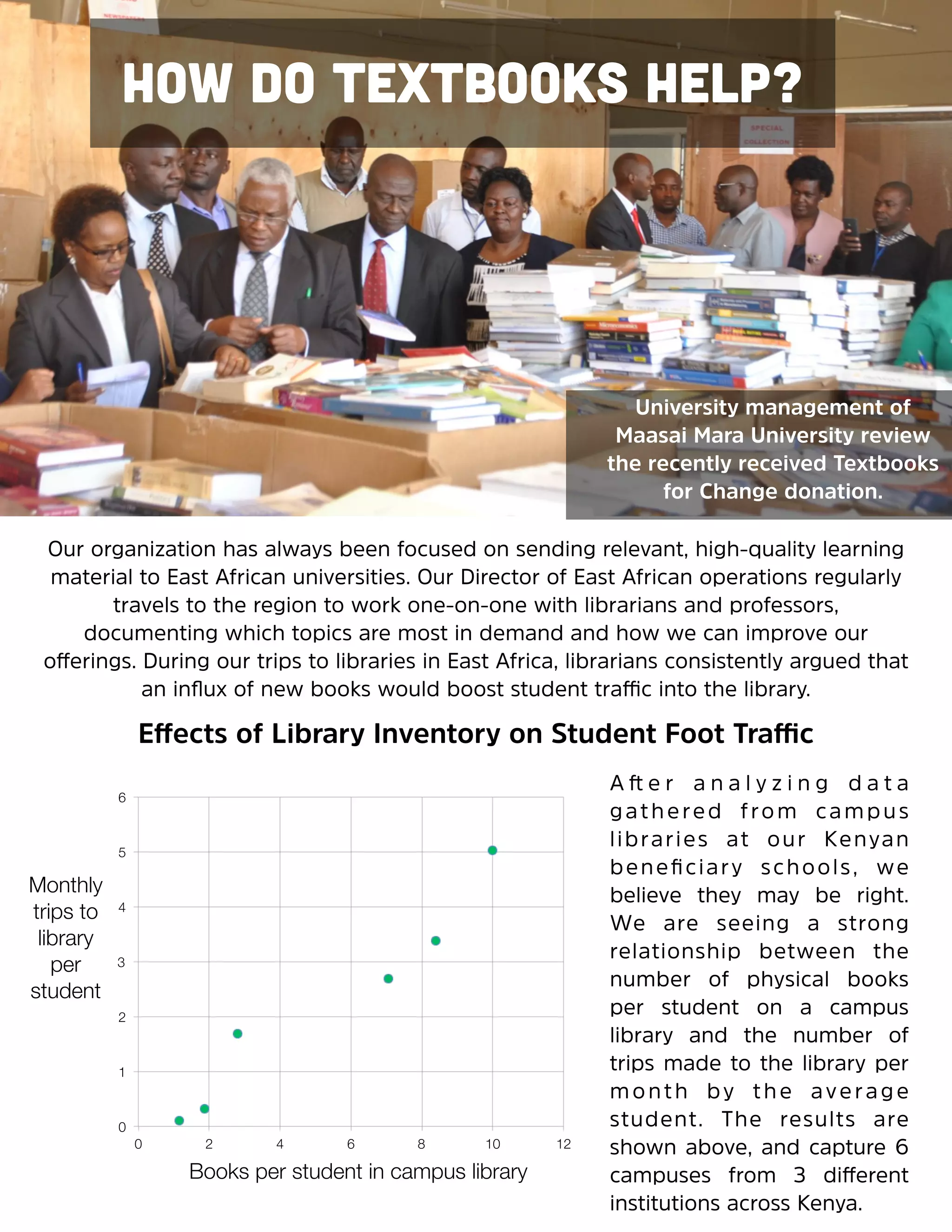
Effects of Library Inventory on Student Foot Traffic
Our organization has always been focused on sending relevant, high-quality learning
material to East African universities. Our Director of East African operations regularly
travels to the region to work one-on-one with librarians and professors,
documenting which topics are most in demand and how we can improve our
offerings. During our trips to libraries in East Africa, librarians consistently argued that
an influx of new books would boost student traffic into the library.
University management of
Maasai Mara University review
the recently received Textbooks
for Change donation.
A ft e r a n a l y z i n g d a t a
gathered from campus
libraries at our Kenyan
beneficiary schools, we
believe they may be right.
We are seeing a strong
relationship between the
number of physical books
per student on a campus
library and the number of
trips made to the library per
month by the average
student. The results are
shown above, and capture 6
campuses from 3 different
institutions across Kenya.
How do Textbooks help?
0
1
2
3
4
5
6
0
 2
 4
 6
 8
 10
 12
Books per student in campus library
Monthly
trips to
library
per
student


Why Textbooks?
Universities currently have access to e-resources, particularly in the form
of e-journals, but poor internet connectivity, insufficient hardware and
student preferences for print material mean that adoption has been
slow. Some libraries have only a dozen computers for use by thousands
of students, while others do not have any computers at all, and as a
result students rely heavily on printed books to study and learn.
Limitations of Digital Material
“Having e-resources in the
library without the gadgets to
access them makes them
obsolete from a user
experience perspective.”
Michael, Acting Head Librarian
Librarian, Pwani University
Most in Demand Material
Based on our ongoing insight, feedback,
and analysis, we have identified the
following textbooks to be of high need for
donations:
• Medicine, nursing, and sciences
• Business, accounting, finance, economics, and
math
• Teaching and childhood development
• Computer science and programming
• Hospitality, tourism and conservation
• Agriculture, ecology, forestry, and animals
• Law and criminology, social sciences and research
methods


Providing Accessible Material
Case Study:
The Impact of our
Donation at a
Campus
Unlike in North America, where course reserves of textbooks in the library are
typically utilized by only a few students, almost all students at Kenyan
institutions rely on books in the library to use for readings and coursework.
This puts extra pressure on librarians, who are forced to designate books in
extremely high demand as “short loan titles” that can be checked out for
limited time spans, usually 2 or 4 hours.
30.25%
Percentage of short
loan books checked
out in an average
month
2.09%
Percentage of general
holdings books
checked out in an
average month
14.47x
Short loan books are
14.47 times more
heavily used than
those in general
holdings
When librarians in East Africa receive a shipment of books, they immediately
separate those titles that will see the highest demand into the short loan
section so that these books can cycle through the student body smoothly.
After surveying the library of one sample campus, we found
that 11.5% of the titles donated by previous organizations,
or purchased by the library, were classified as short loan
books.
11.5%
26.7%
By contrast, a healthy 26.7% of our most recent donation
was classified as short loan material, demonstrating both
the high quality of our material as well as the applicability
of our donations to the programmes of study.


From Donations to
Partnerships
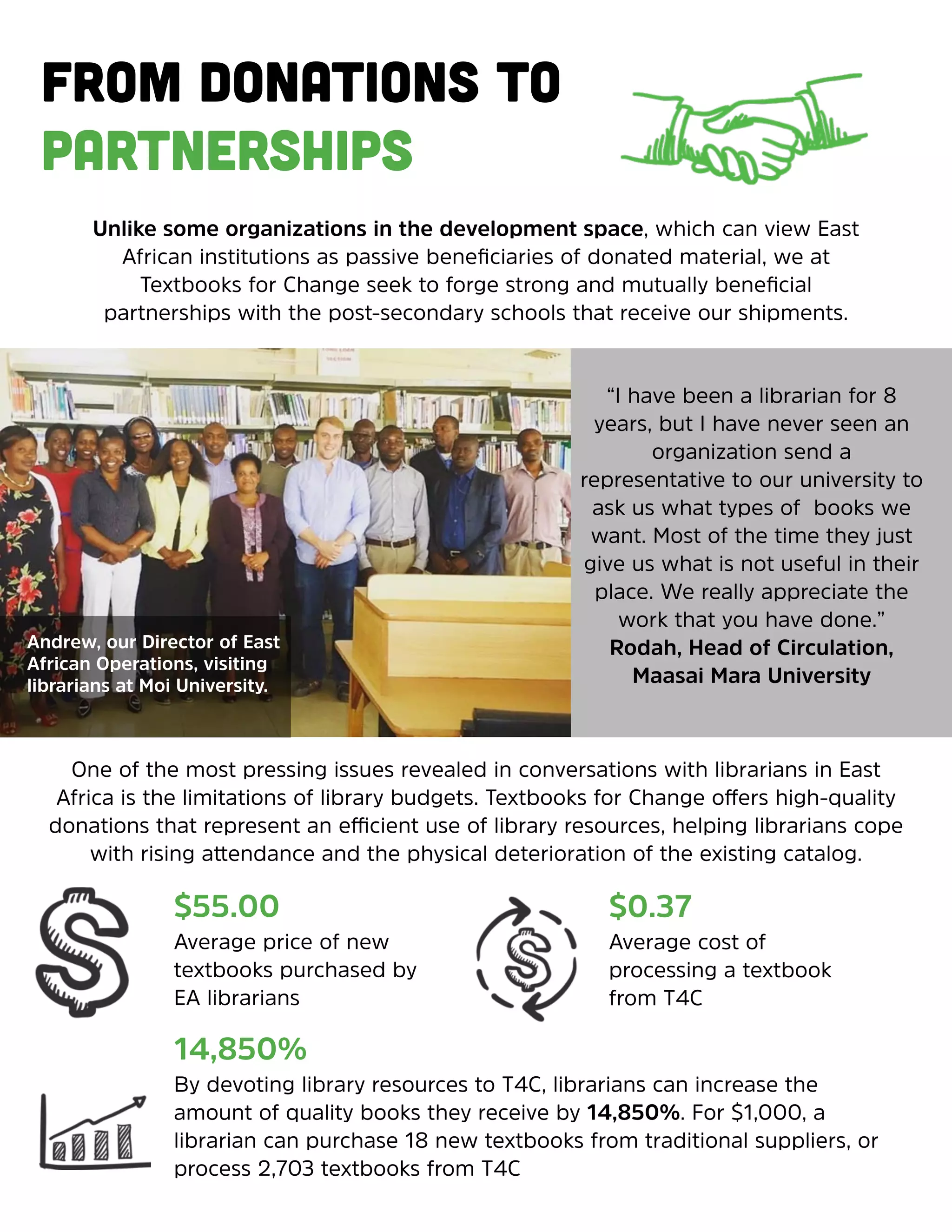
Unlike some organizations in the development space, which can view East
African institutions as passive beneficiaries of donated material, we at
Textbooks for Change seek to forge strong and mutually beneficial
partnerships with the post-secondary schools that receive our shipments.
“I have been a librarian for 8
years, but I have never seen an
organization send a
representative to our university to
ask us what types of books we
want. Most of the time they just
give us what is not useful in their
place. We really appreciate the
work that you have done.”
Rodah, Head of Circulation,
Maasai Mara University
Andrew, our Director of East
African Operations, visiting
librarians at Moi University.
$55.00
Average price of new
textbooks purchased by
EA librarians
$0.37
Average cost of
processing a textbook
from T4C
14,850%
By devoting library resources to T4C, librarians can increase the
amount of quality books they receive by 14,850%. For $1,000, a
librarian can purchase 18 new textbooks from traditional suppliers, or
process 2,703 textbooks from T4C
One of the most pressing issues revealed in conversations with librarians in East
Africa is the limitations of library budgets. Textbooks for Change offers high-quality
donations that represent an efficient use of library resources, helping librarians cope
with rising attendance and the physical deterioration of the existing catalog.


What our Partners
have Taught us
Our research at Kenyan universities has proven that by providing materials to libraries,
we have the maximum potential impact on students of all socioeconomic levels.
WiFi can contain hidden costs for students
"Sometimes we use our phones to access the
wireless internet, but when the wireless is
slow, or down, we prefer physical books.
Trying to use our phone's data to access
materials is too expensive, whereas looking at
book in the library is always free."
Milicent, Student at Pwani University
The importance of donated material to
libraries in East Africa
"[At Moi] we really rely on donations to get
new books in. More than 50% of our books
are donations. If we never had any donations,
I think the libraries would have closed some
time ago."
Isabel, Head Librarian at Moi University’s
Health Science Campus
A well-stocked library is the best option for lower-income students
"For some courses, books are not only important, they are essential. One example is
medical students. They need their anatomy books to study. But the books are
expensive, about five thousand shillings ($60). Not all of them can get the money
together … and some students go without the books for the whole semester. I have
heard of students failing exams, not because they didn't want to study, but because
they could not secure the books they needed to pass."
Abdia, Student at Kenyatta University


Campus Profile
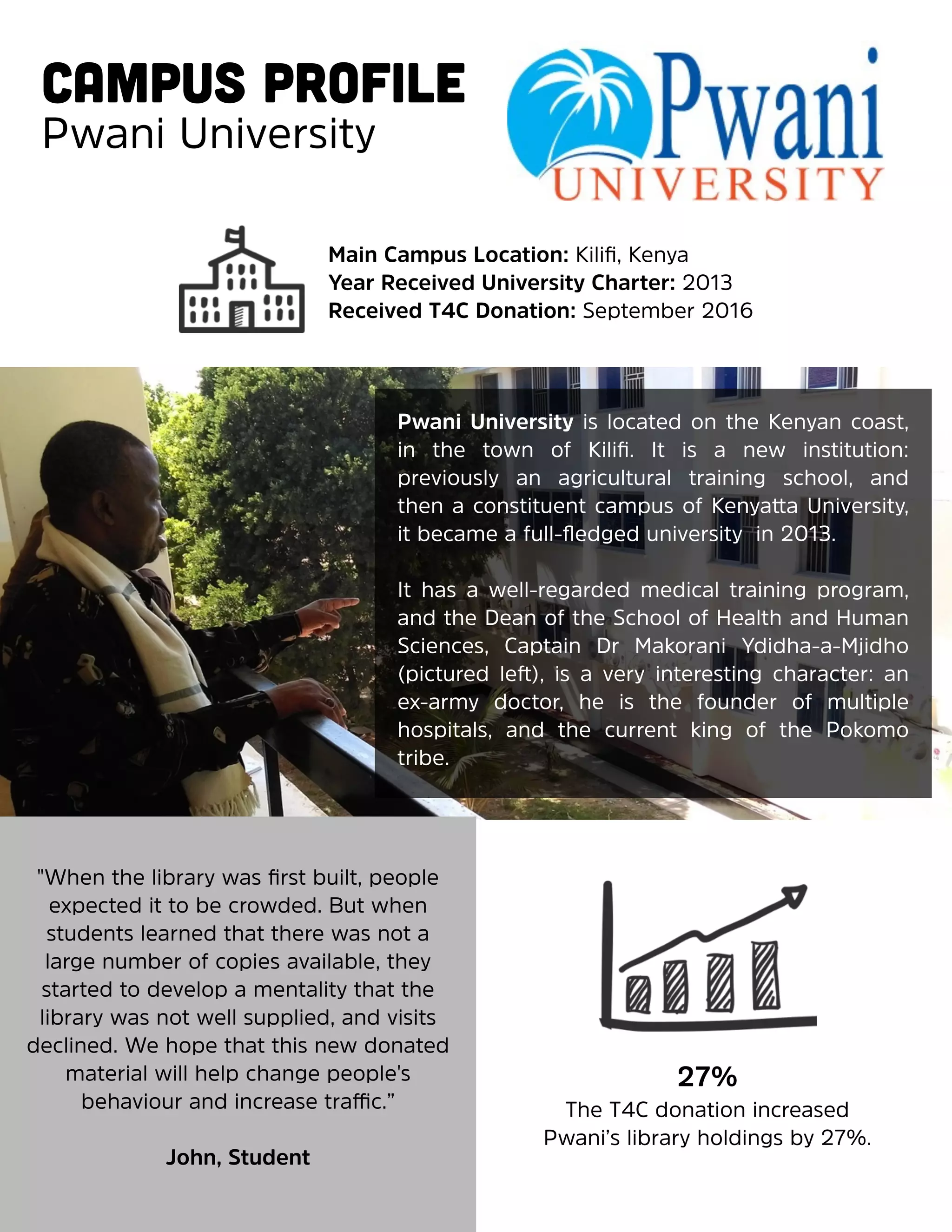
Pwani University
Main Campus Location: Kilifi, Kenya
Year Received University Charter: 2013
Received T4C Donation: September 2016
Pwani University is located on the Kenyan coast,
in the town of Kilifi. It is a new institution:
previously an agricultural training school, and
then a constituent campus of Kenyatta University,
it became a full-fledged university in 2013.
It has a well-regarded medical training program,
and the Dean of the School of Health and Human
Sciences, Captain Dr Makorani Ydidha-a-Mjidho
(pictured left), is a very interesting character: an
ex-army doctor, he is the founder of multiple
hospitals, and the current king of the Pokomo
tribe.
"When the library was first built, people
expected it to be crowded. But when
students learned that there was not a
large number of copies available, they
started to develop a mentality that the
library was not well supplied, and visits
declined. We hope that this new donated
material will help change people's
behaviour and increase traffic.”
John, Student
27%
The T4C donation increased
Pwani’s library holdings by 27%.


Main Campus Location: Eldoret, Kenya
Year Received University Charter: 1985
Received T4C Donation: November 2015
Campus Profile
Moi University
Moi University holds the
distinction of being the only
partner to tour our Canadian
facilities. We were honoured
to host Dr Loice Maru, the
Director of Moi’s Nairobi
Campus, and Dr Charles
Lagat, the Senior Lecturer at
School of Business at our
warehouse in Hamilton.
27,000
textbooks
donated in 2015
$500,000
value placed on
donation by
campus librarians
7 libraries
7 of Moi's campus
libraries across Kenya
(shown below) received
material
"We have some
professors who really rely
on the library to plan their
lessons. They are in here
every day, you cannot
miss them, and they are
always asking about
when we are getting new
books. Those professors
were very happy to see
the shipment you sent.”
Isabel, Head Librarian,
Health Science Library


Campus Profile
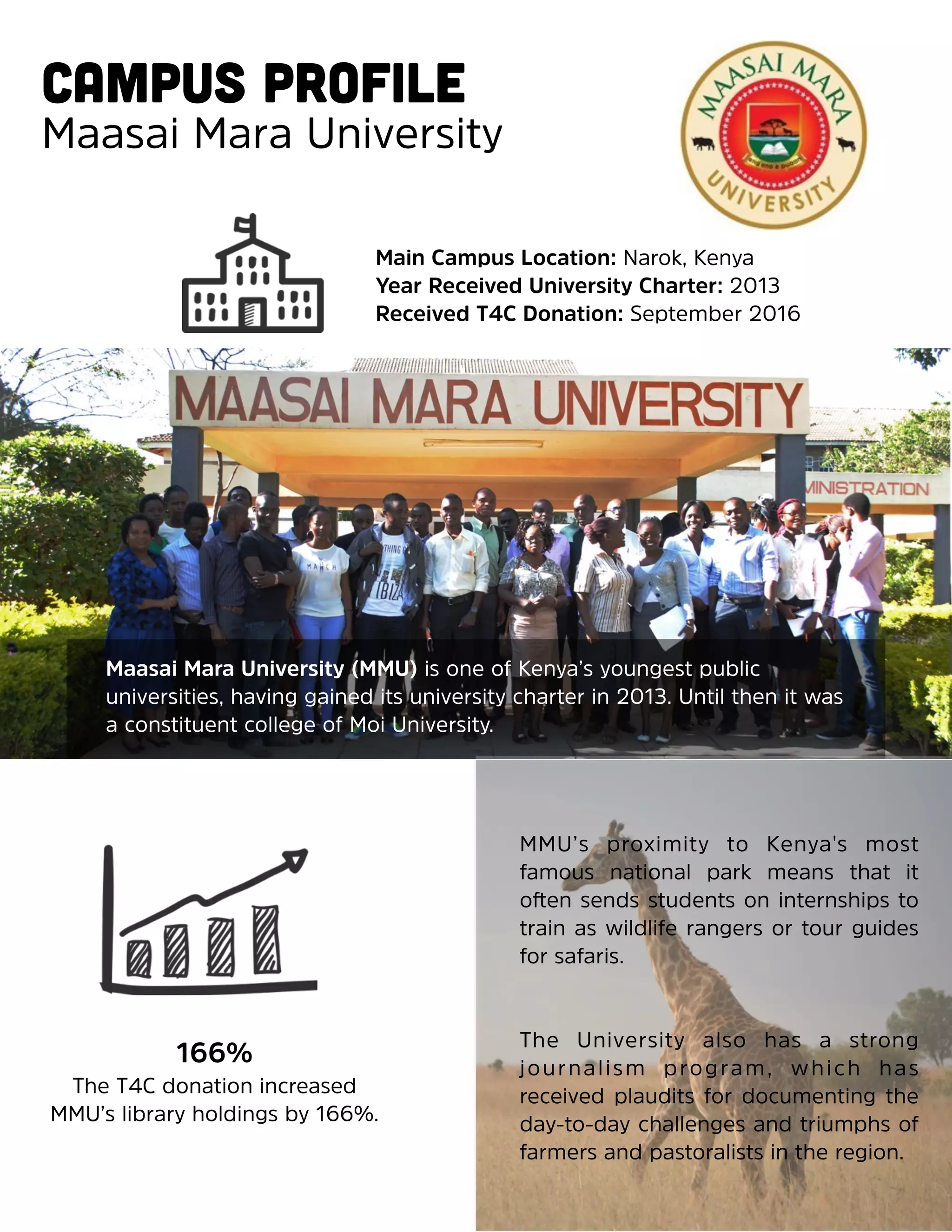
Maasai Mara University
Main Campus Location: Narok, Kenya
Year Received University Charter: 2013
Received T4C Donation: September 2016
Maasai Mara University (MMU) is one of Kenya’s youngest public
universities, having gained its university charter in 2013. Until then it was
a constituent college of Moi University.
166%
The T4C donation increased
MMU’s library holdings by 166%.
MMU’s proximity to Kenya's most
famous national park means that it
often sends students on internships to
train as wildlife rangers or tour guides
for safaris.
The University also has a strong
journalism program, which has
received plaudits for documenting the
day-to-day challenges and triumphs of
farmers and pastoralists in the region.
Looking Forward
Increased Linkages with East African Students
Building strong relationships with student associations and
leadership across schools in East Africa, and providing opportunities
to link these students with their Canadian counterparts.
Data Catchment and Analytics
Improving our ability to gather and interpret data in order to better
capture the impact that our donations have on the learning
environment of recipient institutions.
Digital Education
Conducting beta tests of several potential models of digital learning
platforms in order to select an approach that is accessible and
attractive to students in both North America and East Africa.


info@textbooksforchange.ca
Are you…
A post-secondary
institution in North
America?
Get Involved:
- Host a dropbox to collect
textbooks
- Run a textbook drive
- Become a community partner
A post-secondary
institution in East
Africa?
Engage with us if:
- Your library collections are
outdated
- Your library is under
resourced
- Your campus has the ability
to track book usage at
campus libraries

Social Impact Report - Textbooks for Change

  • 1.
    
 Transforming the educationallandscape by providing affordable and accessible educational material to students both locally and abroad. 2016 Year in Review From Donations to Partnerships
  • 2.
    A Message FromOur Team Since January 2014, Textbooks for Change has transitioned from a small university project into a thriving social enterprise with a focus on environmental and social impact. The numbers and stories in this report capture our successes and achievements over the past two years. Particularly, this past year has been exciting for our community. Our team doubled, appointed a Director of East African (EA) operations, made two visits to Kenya, created four new campus partnership and donated to libraries in Kenya. Our accomplishments have not come without critical thinking, constructive feedback or reflection. A year ago, our team was tasked with identifying what our organization was set out to change and then to construct a model to identify the impact that our social enterprise would have both locally and abroad. During these meetings, our team had to consider every stakeholder in our model. From our students and customers in North America to our librarians and professors in East Africa, we defined each input, output and outcome in our daily operations. What our team could all agree upon was that we all envision a world where education is a human right, regardless of a person’s socioeconomic status. We then placed ourselves in a position to work towards that goal by providing affordable and accessible educational materials to those both locally and abroad. After the second trip to Kenya our team focused on our ability to collect data from libraries that have or will accept a donation of textbooks from our social enterprise. Our goal is to do more than simply donate relevant course material. We want to ensure that our donations are accessible, used by students who are looking to increase their academic success and save students money and time over the course of the school year. You can probably already tell that the type of impact we are looking to create will take time to quantify but we aren’t in this space for the short-term. To realize the goal of education as a human right, we will start measuring textbook usage in the short-term and work with our campus champions to understand our impact year after year. One of our biggest goals is for our partners to see an influx of relevant course material into their libraries, realize a decrease in short-term loan limits and in turn have more textbooks for students to take out on a long-term basis. In this report we hope that you are able to get a better sense of our partnerships, how we aim to measure impact and the current state of educational resources in East Africa. We hope to answer any questions you may have in the following pages and introduce you to a world where education is a human right, not a privilege. Thank you, Textbooks for Change
  • 3.
    Our Vision Education shouldbe a right, not a privilege. Our Mission To provide affordable and accessible educational material to students locally and across the globe. 50% 20% 30% We donate 50% of textbooks to campus partners in East Africa. We resell 20% of textbooks at affordable prices to students. We recycle 30% of material that is out- dated or unusable.
  • 4.
    Our Model Textbooks are collected fromdropboxes and brought to our warehouse. 1. Collect We sort the textbooks in our warehouse, designating 50% for donation to East Africa. 2. Sort We create a custom shipment for each school, matching subject matter to their courses and needs. 3. Match Once we have 25,000 textbooks, we ship a container by boat full of books from Ontario. 4. Ship 5. Access We work with our school partner to ensure textbooks are distributed and available in the library. Since 2014 Our Goal Donate 1,000,000 textbooks to campus partners in EA by 2020. 135,000 Textbooks donated 7 Campus partnerships 220,000+ Students with access
  • 5.
    From Our Perspective Textbooksfor Change is a mission-driven organization set on changing the world through improved access to educational material. Below is a little bit about what we believe and how we work. Education is a human right, not a privilege. Education acts as a path to a better future. Educated youth have the ability to tackle issues such as gender equality, literacy rates and youth unemployment in order to reduce poverty and foster peaceful societies. At Textbooks for Change, we believe that affordable and accessible education should be a human right for all, and we practice what we preach. By providing university libraries in East Africa with high- quality textbooks and academic literature we ensure that all students at the institution, regardless of their socioeconomic status, have access to equal educational opportunities. Why East Africa? East Africa is home to some of the youngest countries in the world: in both Tanzania and Uganda over 50% of citizens are below the age of 18. This population growth has led to a drastic increase in post-secondary enrolment rates, but most governments in t h e r e g i o n h a v e b e e n u n a b l e t o correspondingly increase funding to universities, leaving many institutions under- funded and under-resourced.
  • 6.
    
 A learning Hub: Librariesin East Africa 1.14 7.06 1.87 5.15 13.88 138.39 0 20 40 60 80 100 120 140 160 Kenyan University A Kenyan University B Kenyan University C Kenyan University D Kenyan University E University of Toronto Books in Library per Enrolled Student Interview with Kenyan Librarian: “Have you, this academic year, turned away students who needed access to textbooks?” “Very often. Of 10 students, about 4 might get their request.” As opposed to North America, where purchasing material at campus bookstores is common, both students and professors in East Africa rely on checkouts from campus libraries for readings and research.Unfortunately, there is a significant deficit in the educational material available to the institutions we’ve met with in Kenya. The chart below indicates the number of books in campus libraries per student at 5 Kenyan universities and compares it to the same statistic from the University of Toronto.
  • 7.
    
 Effects of LibraryInventory on Student Foot Traffic Our organization has always been focused on sending relevant, high-quality learning material to East African universities. Our Director of East African operations regularly travels to the region to work one-on-one with librarians and professors, documenting which topics are most in demand and how we can improve our offerings. During our trips to libraries in East Africa, librarians consistently argued that an influx of new books would boost student traffic into the library. University management of Maasai Mara University review the recently received Textbooks for Change donation. A ft e r a n a l y z i n g d a t a gathered from campus libraries at our Kenyan beneficiary schools, we believe they may be right. We are seeing a strong relationship between the number of physical books per student on a campus library and the number of trips made to the library per month by the average student. The results are shown above, and capture 6 campuses from 3 different institutions across Kenya. How do Textbooks help? 0 1 2 3 4 5 6 0 2 4 6 8 10 12 Books per student in campus library Monthly trips to library per student
  • 8.
    
 Why Textbooks? Universities currentlyhave access to e-resources, particularly in the form of e-journals, but poor internet connectivity, insufficient hardware and student preferences for print material mean that adoption has been slow. Some libraries have only a dozen computers for use by thousands of students, while others do not have any computers at all, and as a result students rely heavily on printed books to study and learn. Limitations of Digital Material “Having e-resources in the library without the gadgets to access them makes them obsolete from a user experience perspective.” Michael, Acting Head Librarian Librarian, Pwani University Most in Demand Material Based on our ongoing insight, feedback, and analysis, we have identified the following textbooks to be of high need for donations: • Medicine, nursing, and sciences • Business, accounting, finance, economics, and math • Teaching and childhood development • Computer science and programming • Hospitality, tourism and conservation • Agriculture, ecology, forestry, and animals • Law and criminology, social sciences and research methods
  • 9.
    
 Providing Accessible Material CaseStudy: The Impact of our Donation at a Campus Unlike in North America, where course reserves of textbooks in the library are typically utilized by only a few students, almost all students at Kenyan institutions rely on books in the library to use for readings and coursework. This puts extra pressure on librarians, who are forced to designate books in extremely high demand as “short loan titles” that can be checked out for limited time spans, usually 2 or 4 hours. 30.25% Percentage of short loan books checked out in an average month 2.09% Percentage of general holdings books checked out in an average month 14.47x Short loan books are 14.47 times more heavily used than those in general holdings When librarians in East Africa receive a shipment of books, they immediately separate those titles that will see the highest demand into the short loan section so that these books can cycle through the student body smoothly. After surveying the library of one sample campus, we found that 11.5% of the titles donated by previous organizations, or purchased by the library, were classified as short loan books. 11.5% 26.7% By contrast, a healthy 26.7% of our most recent donation was classified as short loan material, demonstrating both the high quality of our material as well as the applicability of our donations to the programmes of study.
  • 10.
    
 From Donations to Partnerships Unlikesome organizations in the development space, which can view East African institutions as passive beneficiaries of donated material, we at Textbooks for Change seek to forge strong and mutually beneficial partnerships with the post-secondary schools that receive our shipments. “I have been a librarian for 8 years, but I have never seen an organization send a representative to our university to ask us what types of books we want. Most of the time they just give us what is not useful in their place. We really appreciate the work that you have done.” Rodah, Head of Circulation, Maasai Mara University Andrew, our Director of East African Operations, visiting librarians at Moi University. $55.00 Average price of new textbooks purchased by EA librarians $0.37 Average cost of processing a textbook from T4C 14,850% By devoting library resources to T4C, librarians can increase the amount of quality books they receive by 14,850%. For $1,000, a librarian can purchase 18 new textbooks from traditional suppliers, or process 2,703 textbooks from T4C One of the most pressing issues revealed in conversations with librarians in East Africa is the limitations of library budgets. Textbooks for Change offers high-quality donations that represent an efficient use of library resources, helping librarians cope with rising attendance and the physical deterioration of the existing catalog.
  • 11.
    
 What our Partners haveTaught us Our research at Kenyan universities has proven that by providing materials to libraries, we have the maximum potential impact on students of all socioeconomic levels. WiFi can contain hidden costs for students "Sometimes we use our phones to access the wireless internet, but when the wireless is slow, or down, we prefer physical books. Trying to use our phone's data to access materials is too expensive, whereas looking at book in the library is always free." Milicent, Student at Pwani University The importance of donated material to libraries in East Africa "[At Moi] we really rely on donations to get new books in. More than 50% of our books are donations. If we never had any donations, I think the libraries would have closed some time ago." Isabel, Head Librarian at Moi University’s Health Science Campus A well-stocked library is the best option for lower-income students "For some courses, books are not only important, they are essential. One example is medical students. They need their anatomy books to study. But the books are expensive, about five thousand shillings ($60). Not all of them can get the money together … and some students go without the books for the whole semester. I have heard of students failing exams, not because they didn't want to study, but because they could not secure the books they needed to pass." Abdia, Student at Kenyatta University
  • 12.
    
 Campus Profile Pwani University MainCampus Location: Kilifi, Kenya Year Received University Charter: 2013 Received T4C Donation: September 2016 Pwani University is located on the Kenyan coast, in the town of Kilifi. It is a new institution: previously an agricultural training school, and then a constituent campus of Kenyatta University, it became a full-fledged university in 2013. It has a well-regarded medical training program, and the Dean of the School of Health and Human Sciences, Captain Dr Makorani Ydidha-a-Mjidho (pictured left), is a very interesting character: an ex-army doctor, he is the founder of multiple hospitals, and the current king of the Pokomo tribe. "When the library was first built, people expected it to be crowded. But when students learned that there was not a large number of copies available, they started to develop a mentality that the library was not well supplied, and visits declined. We hope that this new donated material will help change people's behaviour and increase traffic.” John, Student 27% The T4C donation increased Pwani’s library holdings by 27%.
  • 13.
    
 Main Campus Location:Eldoret, Kenya Year Received University Charter: 1985 Received T4C Donation: November 2015 Campus Profile Moi University Moi University holds the distinction of being the only partner to tour our Canadian facilities. We were honoured to host Dr Loice Maru, the Director of Moi’s Nairobi Campus, and Dr Charles Lagat, the Senior Lecturer at School of Business at our warehouse in Hamilton. 27,000 textbooks donated in 2015 $500,000 value placed on donation by campus librarians 7 libraries 7 of Moi's campus libraries across Kenya (shown below) received material "We have some professors who really rely on the library to plan their lessons. They are in here every day, you cannot miss them, and they are always asking about when we are getting new books. Those professors were very happy to see the shipment you sent.” Isabel, Head Librarian, Health Science Library
  • 14.
    
 Campus Profile Maasai MaraUniversity Main Campus Location: Narok, Kenya Year Received University Charter: 2013 Received T4C Donation: September 2016 Maasai Mara University (MMU) is one of Kenya’s youngest public universities, having gained its university charter in 2013. Until then it was a constituent college of Moi University. 166% The T4C donation increased MMU’s library holdings by 166%. MMU’s proximity to Kenya's most famous national park means that it often sends students on internships to train as wildlife rangers or tour guides for safaris. The University also has a strong journalism program, which has received plaudits for documenting the day-to-day challenges and triumphs of farmers and pastoralists in the region.
  • 15.
    Looking Forward Increased Linkageswith East African Students Building strong relationships with student associations and leadership across schools in East Africa, and providing opportunities to link these students with their Canadian counterparts. Data Catchment and Analytics Improving our ability to gather and interpret data in order to better capture the impact that our donations have on the learning environment of recipient institutions. Digital Education Conducting beta tests of several potential models of digital learning platforms in order to select an approach that is accessible and attractive to students in both North America and East Africa.
  • 16.
    
 info@textbooksforchange.ca Are you… A post-secondary institutionin North America? Get Involved: - Host a dropbox to collect textbooks - Run a textbook drive - Become a community partner A post-secondary institution in East Africa? Engage with us if: - Your library collections are outdated - Your library is under resourced - Your campus has the ability to track book usage at campus libraries