Creating a Contemporary
Risk Management System
Using Python
Piero Ferrante
C2FO, Director of Data Science
@the_real_pdf
What is C2FO?
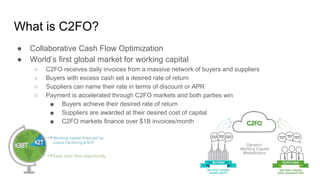
● Collaborative Cash Flow Optimization
● World’s first global market for working capital
○ C2FO receives daily invoices from a massive network of buyers and suppliers
○ Buyers with excess cash set a desired rate of return
○ Suppliers can name their rate in terms of discount or APR
○ Payment is accelerated through C2FO markets and both parties win
■ Buyers achieve their desired rate of return
■ Suppliers are awarded at their desired cost of capital
■ C2FO markets finance over $1B invoices/month
What is WFC?
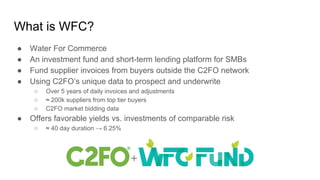
● Water For Commerce
● An investment fund and short-term lending platform for SMBs
● Fund supplier invoices from buyers outside the C2FO network
● Using C2FO’s unique data to prospect and underwrite
○ Over 5 years of daily invoices and adjustments
○ ≈ 200k suppliers from top tier buyers
○ C2FO market bidding data
● Offers favorable yields vs. investments of comparable risk
○ ≈ 40 day duration → 6.25%
B3
B1
B2
Bi
S1
S2
S3
Si
20%
30%
25%
25%
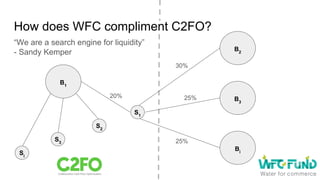
How does WFC compliment C2FO?
“We are a search engine for liquidity”
- Sandy Kemper
SMB lending is hard and crowded, so why bother?
● C2FO is the champion of the supplier
○ We want to help our suppliers succeed financially
● All risk is not created equal
● We believe we can do it better :)
○ Without rate gauging borrowers
○ Without misleading investors
● We have great data
● We have great tools
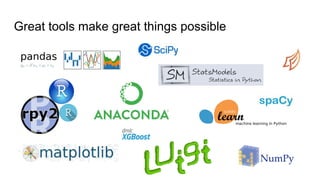
Great tools make great things possible
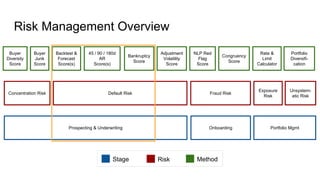
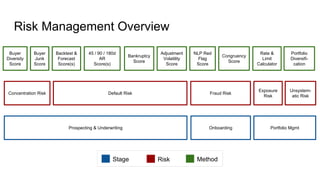
Prospecting & Underwriting Onboarding Portfolio Mgmt
Concentration Risk Default Risk Fraud Risk
Unsystem-
atic Risk
Buyer
Diversity
Score
Buyer
Junk
Score
Backtest &
Forecast
Score(s)
45 / 90 / 180d
AR
Score(s)
Bankruptcy
Score
Congruency
Score
NLP Red
Flag
Score
Rate &
Limit
Calculator
Portfolio
Diversifi-
cation
Exposure
Risk
Adjustment
Volatility
Score
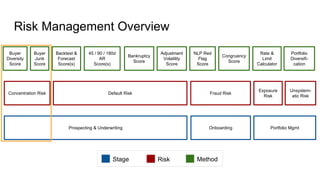
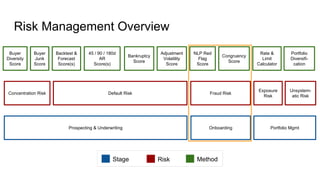
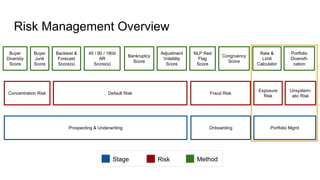
Risk Management Overview
Stage Risk Method
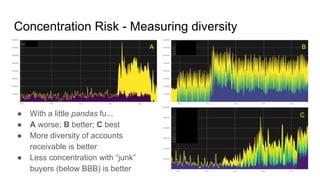
Concentration Risk - Measuring diversity
● With a little pandas fu...
● A worse; B better; C best
● More diversity of accounts
receivable is better
● Less concentration with “junk”
buyers (below BBB) is better
A B
C
Prospecting & Underwriting Onboarding Portfolio Mgmt
Concentration Risk Default Risk Fraud Risk
Unsystem-
atic Risk
Buyer
Diversity
Score
Buyer
Junk
Score
Backtest &
Forecast
Score(s)
45 / 90 / 180d
AR
Score(s)
Bankruptcy
Score
Congruency
Score
NLP Red
Flag
Score
Rate &
Limit
Calculator
Portfolio
Diversifi-
cation
Exposure
Risk
Adjustment
Volatility
Score
Risk Management Overview
Stage Risk Method
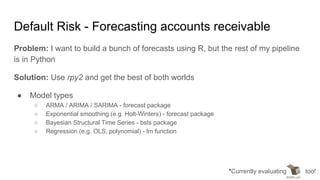
Default Risk - Forecasting accounts receivable
Problem: I want to build a bunch of forecasts using R, but the rest of my pipeline
is in Python
Solution: Use rpy2 and get the best of both worlds
● Model types
○ ARMA / ARIMA / SARIMA - forecast package
○ Exponential smoothing (e.g. Holt-Winters) - forecast package
○ Bayesian Structural Time Series - bsts package
○ Regression (e.g. OLS, polynomial) - lm function
*Currently evaluating too!
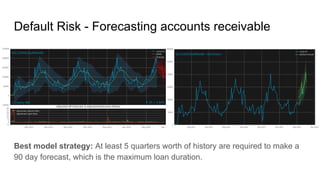
Default Risk - Forecasting accounts receivable
Best model strategy: At least 5 quarters worth of history are required to make a
90 day forecast, which is the maximum loan duration.
Default Risk - Forecasting accounts receivable
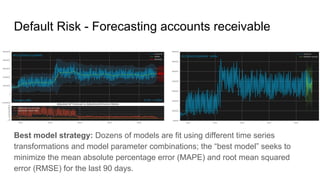
Best model strategy: Dozens of models are fit using different time series
transformations and model parameter combinations; the “best model” seeks to
minimize the mean absolute percentage error (MAPE) and root mean squared
error (RMSE) for the last 90 days.
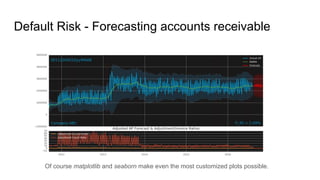
Of course matplotlib and seaborn make even the most customized plots possible.
Default Risk - Forecasting accounts receivable
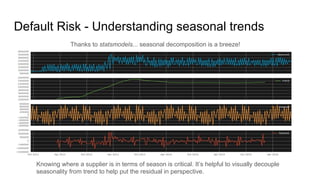
Default Risk - Understanding seasonal trends
Thanks to statsmodels... seasonal decomposition is a breeze!
Knowing where a supplier is in terms of season is critical. It’s helpful to visually decouple
seasonality from trend to help put the residual in perspective.
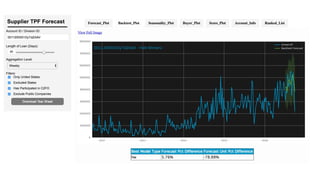
Default Risk - Predicting AR discontinuation
Discontinuation is defined by supplier AR dropping to zero with all C2FO buyers.
Challenges:
● Data leakage
○ Do not observe that which would not have been observable at the time of prediction
■ Establish criteria for prediction labels (e.g. supplier’s AR goes to 0 and stays there)
■ Define prediction cutoff (e.g. 45 days in advance of going to 0)
■ Remove all history after the cutoff date
● Engineering features
○ Variables used to model the probability of discontinuation
■ All history (except after the prediction cutoff date)
■ Various historical windows (e.g. 13 weeks leading up to prediction cutoff date)
■ Values observed on the cutoff date
Default Risk - Predicting AR discontinuation
How is this model trained?
● Using scikit-learn for:
○ Feature engineering
■ Encoding categoricals
■ Creating polynomial features
■ Scaling features
■ Dimensionality reduction / feature selection
○ Model evaluation
● Using xgboost for:
○ Training gradient boosted trees (a very performant machine learning classifier)
■ Since GBT are iterative learners, speed is important
○ Used in conjunction with hyperopt for optimizing hyperparameters
■ Currently evaluating spearmint
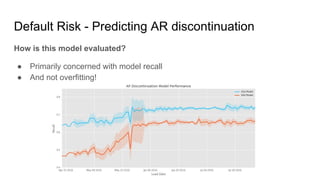
Default Risk - Predicting AR discontinuation
How is this model evaluated?
● Primarily concerned with model recall
● And not overfitting!
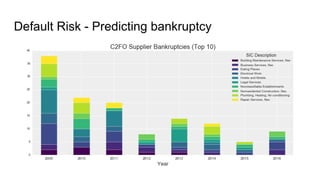
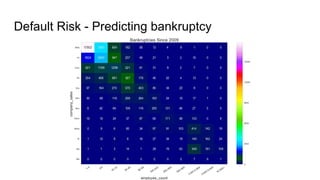
Default Risk - Predicting bankruptcy
Predicting bankruptcy is very different than predicting AR discontinuation:
● Prediction labels are derived differently
● Bankruptcies may not exhibit the same AR signals/patterns
TODO:
● Receive and process daily feeds from the national bankruptcy database
● Undergo a rigorous matching process
● Perform data truncation and feature engineering
● Enrich with macroeconomic data from the right point in time
● Address severe class imbalances
● Train awesome models
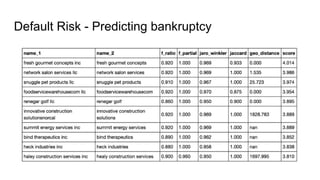
Default Risk - Predicting bankruptcy
How to perform efficient company matching on a daily basis?
● Clean your data
○ Convert to lowercase, remove special characters, ...
● Match on *unique* values first
○ Tax IDs & phone numbers
● Use string matching on company names after using soundex to limit the space
○ Levenshtein distance, jaro-winkler distance, jaccard distance, …
○ Use soundexes to reduce the search space
● Calculate geographical distance between known addresses
○ Haversine distance
● Tinker with a weighting strategy that delivers satisfactory results
Pro tip: Cython-ize code (your library might already be doing this for you) or use Numba for
JIT compilation where applicable; it pays off in the long run.
Default Risk - Predicting bankruptcy
Prospecting & Underwriting Onboarding Portfolio Mgmt
Concentration Risk Default Risk Fraud Risk
Unsystem-
atic Risk
Buyer
Diversity
Score
Buyer
Junk
Score
Backtest &
Forecast
Score(s)
45 / 90 / 180d
AR
Score(s)
Bankruptcy
Score
Congruency
Score
NLP Red
Flag
Score
Rate &
Limit
Calculator
Portfolio
Diversifi-
cation
Exposure
Risk
Adjustment
Volatility
Score
Risk Management Overview
Stage Risk Method
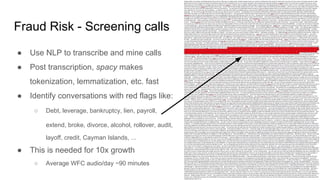
● Use NLP to transcribe and mine calls
● Post transcription, spacy makes
tokenization, lemmatization, etc. fast
● Identify conversations with red flags like:
○ Debt, leverage, bankruptcy, lien, payroll,
extend, broke, divorce, alcohol, rollover, audit,
layoff, credit, Cayman Islands, ...
● This is needed for 10x growth
○ Average WFC audio/day ~90 minutes
Fraud Risk - Screening calls
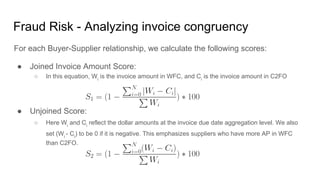
Fraud Risk - Analyzing invoice congruency
For each Buyer-Supplier relationship, we calculate the following scores:
● Joined Invoice Amount Score:
○ In this equation, Wi
is the invoice amount in WFC, and Ci
is the invoice amount in C2FO
● Unjoined Score:
○ Here Wi
and Ci
reflect the dollar amounts at the invoice due date aggregation level. We also
set (Wi
- Ci
) to be 0 if it is negative. This emphasizes suppliers who have more AP in WFC
than C2FO.
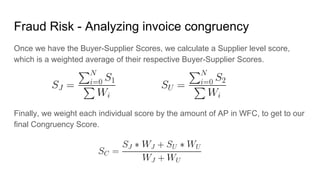
Fraud Risk - Analyzing invoice congruency
Once we have the Buyer-Supplier Scores, we calculate a Supplier level score,
which is a weighted average of their respective Buyer-Supplier Scores.
Finally, we weight each individual score by the amount of AP in WFC, to get to our
final Congruency Score.
Prospecting & Underwriting Onboarding Portfolio Mgmt
Concentration Risk Default Risk Fraud Risk
Unsystem-
atic Risk
Buyer
Diversity
Score
Buyer
Junk
Score
Backtest &
Forecast
Score(s)
45 / 90 / 180d
AR
Score(s)
Bankruptcy
Score
Congruency
Score
NLP Red
Flag
Score
Rate &
Limit
Calculator
Portfolio
Diversifi-
cation
Exposure
Risk
Adjustment
Volatility
Score
Risk Management Overview
Stage Risk Method
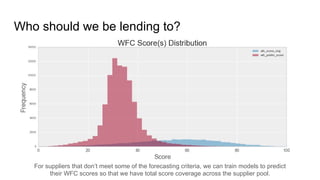
Who should we be lending to?
For suppliers that don’t meet some of the forecasting criteria, we can train models to predict
their WFC scores so that we have total score coverage across the supplier pool.
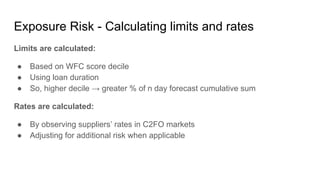
Exposure Risk - Calculating limits and rates
Limits are calculated:
● Based on WFC score decile
● Using loan duration
● So, higher decile → greater % of n day forecast cumulative sum
Rates are calculated:
● By observing suppliers’ rates in C2FO markets
● Adjusting for additional risk when applicable
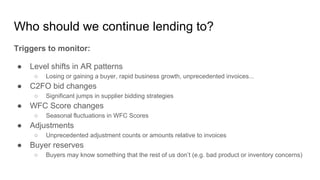
Who should we continue lending to?
Triggers to monitor:
● Level shifts in AR patterns
○ Losing or gaining a buyer, rapid business growth, unprecedented invoices...
● C2FO bid changes
○ Significant jumps in supplier bidding strategies
● WFC Score changes
○ Seasonal fluctuations in WFC Scores
● Adjustments
○ Unprecedented adjustment counts or amounts relative to invoices
● Buyer reserves
○ Buyers may know something that the rest of us don’t (e.g. bad product or inventory concerns)
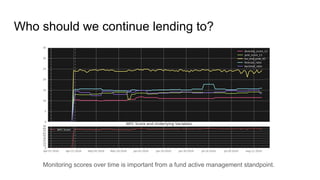
Who should we continue lending to?
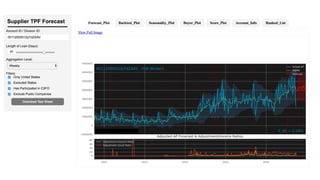
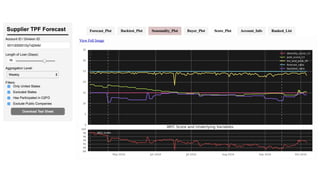
Monitoring scores over time is important from a fund active management standpoint.
Prospecting & Underwriting Onboarding Portfolio Mgmt
Concentration Risk Default Risk Fraud Risk
Unsystem-
atic Risk
Buyer
Diversity
Score
Buyer
Junk
Score
Backtest &
Forecast
Score(s)
45 / 90 / 180d
AR
Score(s)
Bankruptcy
Score
Congruency
Score
NLP Red
Flag
Score
Rate &
Limit
Calculator
Portfolio
Diversifi-
cation
Exposure
Risk
Adjustment
Volatility
Score
Risk Management Overview
Stage Risk Method
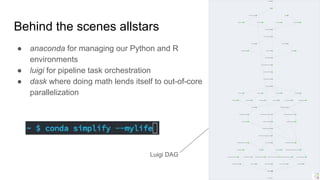
Behind the scenes allstars
● anaconda for managing our Python and R
environments
● luigi for pipeline task orchestration
● dask where doing math lends itself to out-of-core
parallelization
Luigi DAG
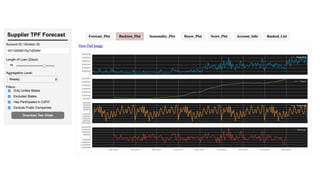
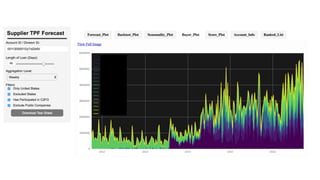
Demo time.
So what?
● Objectivity gives way to innovation
● Better independent data beats more complex algorithms
● Tradeoffs must be evaluated with respect to constraints
● For many tasks, Python can perform nearly as fast lower level languages
● WFC is a win-win for borrowers and investors
● Creating great solutions with open source tools is part of OSS too
Questions?
@the_real_pdf

Creating a contemporary risk management system using python (dc)

  • 1.
    Creating a Contemporary RiskManagement System Using Python Piero Ferrante C2FO, Director of Data Science @the_real_pdf
  • 2.
    What is C2FO? ●Collaborative Cash Flow Optimization ● World’s first global market for working capital ○ C2FO receives daily invoices from a massive network of buyers and suppliers ○ Buyers with excess cash set a desired rate of return ○ Suppliers can name their rate in terms of discount or APR ○ Payment is accelerated through C2FO markets and both parties win ■ Buyers achieve their desired rate of return ■ Suppliers are awarded at their desired cost of capital ■ C2FO markets finance over $1B invoices/month
  • 3.
    What is WFC? ●Water For Commerce ● An investment fund and short-term lending platform for SMBs ● Fund supplier invoices from buyers outside the C2FO network ● Using C2FO’s unique data to prospect and underwrite ○ Over 5 years of daily invoices and adjustments ○ ≈ 200k suppliers from top tier buyers ○ C2FO market bidding data ● Offers favorable yields vs. investments of comparable risk ○ ≈ 40 day duration → 6.25%
  • 4.
    B3 B1 B2 Bi S1 S2 S3 Si 20% 30% 25% 25% How does WFCcompliment C2FO? “We are a search engine for liquidity” - Sandy Kemper
  • 5.
    SMB lending ishard and crowded, so why bother? ● C2FO is the champion of the supplier ○ We want to help our suppliers succeed financially ● All risk is not created equal ● We believe we can do it better :) ○ Without rate gauging borrowers ○ Without misleading investors ● We have great data ● We have great tools
  • 6.
    Great tools makegreat things possible
  • 7.
    Prospecting & UnderwritingOnboarding Portfolio Mgmt Concentration Risk Default Risk Fraud Risk Unsystem- atic Risk Buyer Diversity Score Buyer Junk Score Backtest & Forecast Score(s) 45 / 90 / 180d AR Score(s) Bankruptcy Score Congruency Score NLP Red Flag Score Rate & Limit Calculator Portfolio Diversifi- cation Exposure Risk Adjustment Volatility Score Risk Management Overview Stage Risk Method
  • 8.
    Concentration Risk -Measuring diversity ● With a little pandas fu... ● A worse; B better; C best ● More diversity of accounts receivable is better ● Less concentration with “junk” buyers (below BBB) is better A B C
  • 9.
    Prospecting & UnderwritingOnboarding Portfolio Mgmt Concentration Risk Default Risk Fraud Risk Unsystem- atic Risk Buyer Diversity Score Buyer Junk Score Backtest & Forecast Score(s) 45 / 90 / 180d AR Score(s) Bankruptcy Score Congruency Score NLP Red Flag Score Rate & Limit Calculator Portfolio Diversifi- cation Exposure Risk Adjustment Volatility Score Risk Management Overview Stage Risk Method
  • 10.
    Default Risk -Forecasting accounts receivable Problem: I want to build a bunch of forecasts using R, but the rest of my pipeline is in Python Solution: Use rpy2 and get the best of both worlds ● Model types ○ ARMA / ARIMA / SARIMA - forecast package ○ Exponential smoothing (e.g. Holt-Winters) - forecast package ○ Bayesian Structural Time Series - bsts package ○ Regression (e.g. OLS, polynomial) - lm function *Currently evaluating too!
  • 11.
    Default Risk -Forecasting accounts receivable Best model strategy: At least 5 quarters worth of history are required to make a 90 day forecast, which is the maximum loan duration.
  • 12.
    Default Risk -Forecasting accounts receivable Best model strategy: Dozens of models are fit using different time series transformations and model parameter combinations; the “best model” seeks to minimize the mean absolute percentage error (MAPE) and root mean squared error (RMSE) for the last 90 days.
  • 13.
    Of course matplotliband seaborn make even the most customized plots possible. Default Risk - Forecasting accounts receivable
  • 14.
    Default Risk -Understanding seasonal trends Thanks to statsmodels... seasonal decomposition is a breeze! Knowing where a supplier is in terms of season is critical. It’s helpful to visually decouple seasonality from trend to help put the residual in perspective.
  • 15.
    Default Risk -Predicting AR discontinuation Discontinuation is defined by supplier AR dropping to zero with all C2FO buyers. Challenges: ● Data leakage ○ Do not observe that which would not have been observable at the time of prediction ■ Establish criteria for prediction labels (e.g. supplier’s AR goes to 0 and stays there) ■ Define prediction cutoff (e.g. 45 days in advance of going to 0) ■ Remove all history after the cutoff date ● Engineering features ○ Variables used to model the probability of discontinuation ■ All history (except after the prediction cutoff date) ■ Various historical windows (e.g. 13 weeks leading up to prediction cutoff date) ■ Values observed on the cutoff date
  • 16.
    Default Risk -Predicting AR discontinuation How is this model trained? ● Using scikit-learn for: ○ Feature engineering ■ Encoding categoricals ■ Creating polynomial features ■ Scaling features ■ Dimensionality reduction / feature selection ○ Model evaluation ● Using xgboost for: ○ Training gradient boosted trees (a very performant machine learning classifier) ■ Since GBT are iterative learners, speed is important ○ Used in conjunction with hyperopt for optimizing hyperparameters ■ Currently evaluating spearmint
  • 17.
    Default Risk -Predicting AR discontinuation How is this model evaluated? ● Primarily concerned with model recall ● And not overfitting!
  • 18.
    Default Risk -Predicting bankruptcy Predicting bankruptcy is very different than predicting AR discontinuation: ● Prediction labels are derived differently ● Bankruptcies may not exhibit the same AR signals/patterns TODO: ● Receive and process daily feeds from the national bankruptcy database ● Undergo a rigorous matching process ● Perform data truncation and feature engineering ● Enrich with macroeconomic data from the right point in time ● Address severe class imbalances ● Train awesome models
  • 19.
    Default Risk -Predicting bankruptcy How to perform efficient company matching on a daily basis? ● Clean your data ○ Convert to lowercase, remove special characters, ... ● Match on *unique* values first ○ Tax IDs & phone numbers ● Use string matching on company names after using soundex to limit the space ○ Levenshtein distance, jaro-winkler distance, jaccard distance, … ○ Use soundexes to reduce the search space ● Calculate geographical distance between known addresses ○ Haversine distance ● Tinker with a weighting strategy that delivers satisfactory results Pro tip: Cython-ize code (your library might already be doing this for you) or use Numba for JIT compilation where applicable; it pays off in the long run.
  • 20.
    Default Risk -Predicting bankruptcy
  • 21.
    Default Risk -Predicting bankruptcy
  • 22.
    Default Risk -Predicting bankruptcy
  • 23.
    Prospecting & UnderwritingOnboarding Portfolio Mgmt Concentration Risk Default Risk Fraud Risk Unsystem- atic Risk Buyer Diversity Score Buyer Junk Score Backtest & Forecast Score(s) 45 / 90 / 180d AR Score(s) Bankruptcy Score Congruency Score NLP Red Flag Score Rate & Limit Calculator Portfolio Diversifi- cation Exposure Risk Adjustment Volatility Score Risk Management Overview Stage Risk Method
  • 24.
    ● Use NLPto transcribe and mine calls ● Post transcription, spacy makes tokenization, lemmatization, etc. fast ● Identify conversations with red flags like: ○ Debt, leverage, bankruptcy, lien, payroll, extend, broke, divorce, alcohol, rollover, audit, layoff, credit, Cayman Islands, ... ● This is needed for 10x growth ○ Average WFC audio/day ~90 minutes Fraud Risk - Screening calls
  • 25.
    Fraud Risk -Analyzing invoice congruency For each Buyer-Supplier relationship, we calculate the following scores: ● Joined Invoice Amount Score: ○ In this equation, Wi is the invoice amount in WFC, and Ci is the invoice amount in C2FO ● Unjoined Score: ○ Here Wi and Ci reflect the dollar amounts at the invoice due date aggregation level. We also set (Wi - Ci ) to be 0 if it is negative. This emphasizes suppliers who have more AP in WFC than C2FO.
  • 26.
    Fraud Risk -Analyzing invoice congruency Once we have the Buyer-Supplier Scores, we calculate a Supplier level score, which is a weighted average of their respective Buyer-Supplier Scores. Finally, we weight each individual score by the amount of AP in WFC, to get to our final Congruency Score.
  • 27.
    Prospecting & UnderwritingOnboarding Portfolio Mgmt Concentration Risk Default Risk Fraud Risk Unsystem- atic Risk Buyer Diversity Score Buyer Junk Score Backtest & Forecast Score(s) 45 / 90 / 180d AR Score(s) Bankruptcy Score Congruency Score NLP Red Flag Score Rate & Limit Calculator Portfolio Diversifi- cation Exposure Risk Adjustment Volatility Score Risk Management Overview Stage Risk Method
  • 28.
    Who should webe lending to? For suppliers that don’t meet some of the forecasting criteria, we can train models to predict their WFC scores so that we have total score coverage across the supplier pool.
  • 29.
    Exposure Risk -Calculating limits and rates Limits are calculated: ● Based on WFC score decile ● Using loan duration ● So, higher decile → greater % of n day forecast cumulative sum Rates are calculated: ● By observing suppliers’ rates in C2FO markets ● Adjusting for additional risk when applicable
  • 30.
    Who should wecontinue lending to? Triggers to monitor: ● Level shifts in AR patterns ○ Losing or gaining a buyer, rapid business growth, unprecedented invoices... ● C2FO bid changes ○ Significant jumps in supplier bidding strategies ● WFC Score changes ○ Seasonal fluctuations in WFC Scores ● Adjustments ○ Unprecedented adjustment counts or amounts relative to invoices ● Buyer reserves ○ Buyers may know something that the rest of us don’t (e.g. bad product or inventory concerns)
  • 31.
    Who should wecontinue lending to? Monitoring scores over time is important from a fund active management standpoint.
  • 32.
    Prospecting & UnderwritingOnboarding Portfolio Mgmt Concentration Risk Default Risk Fraud Risk Unsystem- atic Risk Buyer Diversity Score Buyer Junk Score Backtest & Forecast Score(s) 45 / 90 / 180d AR Score(s) Bankruptcy Score Congruency Score NLP Red Flag Score Rate & Limit Calculator Portfolio Diversifi- cation Exposure Risk Adjustment Volatility Score Risk Management Overview Stage Risk Method
  • 33.
    Behind the scenesallstars ● anaconda for managing our Python and R environments ● luigi for pipeline task orchestration ● dask where doing math lends itself to out-of-core parallelization Luigi DAG
  • 34.
  • 40.
    So what? ● Objectivitygives way to innovation ● Better independent data beats more complex algorithms ● Tradeoffs must be evaluated with respect to constraints ● For many tasks, Python can perform nearly as fast lower level languages ● WFC is a win-win for borrowers and investors ● Creating great solutions with open source tools is part of OSS too
  • 41.