www.indiandentalacademy.com
 For centuries, many different techniques have
been used in an attempt to modify bone
growth, both in terms of amount and direction
 Orthodontists uses intra oral and extra oral
appliances to restrict growth of the maxilla in
hope of accentuating mandibular sagittal
growth .
www.indiandentalacademy.com
 The latest technique for combating the same is a
procedure termed “DISTRACTION OSTEOGENESIS”
 DISTRACTION OSTEOGENESIS (Transosseous
synthesis) (Osteodistraction)
 DEFINITION: A process of new bone formation
between the surfaces of bone segments
gradually separated by incremental traction
- COPE (1999)
www.indiandentalacademy.com
Hippocrates more than 2000 years
ago described the placement of
traction forces on broken
bones.
Guy de Chauliac in 14th century
applied traction with a pulley
system that consisted of a
weight attached to the leg by a
chord .The weight was
suspended over a pulley to
create tension.
John Barton in 1826 was the first
to perform surgical division of
bone or osteotomy .
Joseph Malgaigne constructed an
apparatus for external fixation
of displaced transverse patellar
fractures.
www.indiandentalacademy.com
 The first bone distraction was performed by Codivilla in
1905 for the treatment of a shortened femur.
www.indiandentalacademy.com
 Summaries soon appeared, reporting success and
complications during limb lengthening.
 The complications included delayed healing , non-union,
nerve palsy and joint contracture .
 This prevented widespread acceptance of distraction
osteognesis and required further improvements in
osteotomy techniques ,distraction protocol ,appliance
design.
 Subsequently, a significant contribution in the
development of DO was made by the Russian surgeon ,
GAVRIEL ILIZAROV in 1951 .
www.indiandentalacademy.com
 The procedure was initiated by surgical bone division
with maximum preservation of periosteum and
endosteum-a technique called corticotomy.
 His fixation technique has two distinct advantages
over other methods.
www.indiandentalacademy.com
 Stable but not rigid fixation to provide axial micro
movements
 Full control over the manipulation of bone segments,
regardless of their size, shape or anatomic location
 Snyder et al in 1973 used Ilizarov’s principle to the
mandible DO.
www.indiandentalacademy.com
 In 1976 Michieli and Miotti, reproduced Snyder’s
work, using an intra oral device.
 Panikarovski et al in 1982 performed the first
significant histologic evaluation of mandibular
distraction regenerates in 41 days
www.indiandentalacademy.com
 Distraction devices can be classified into
 External devices
 Internal devices
 Extraoral devices can be
 Unidirectional
 Bidirectional
 Multidirectional
 Intraoral devices can be
 Tooth borne
 Bone borne
 Hybrid (Tooth borne and Bone borne)
www.indiandentalacademy.com
 Relatively simple operative technique
-Lengthening of bone and soft tissues
-Good long term stability
-Avoidance of bone grafts
-Multidimensional distraction
-Feasible to distract bone grafts or irradiated bone
-Results are apparently early
-Reduces likelihood of relapse
-Reduces likelihood of blood transfusion
www.indiandentalacademy.com
 Skin scars with extra oral devices
-Damage to Nerve
-Damage To Tooth Germ
-Premature consolidation
-Transient changes in TMJ
-Infection
-Nonunion/inadequate bone formation
-Device failure
www.indiandentalacademy.com
Correction of Maxillo-Mandibular deformities
 a) Mandibular lengthening
 b) Maxillary lengthening
 c) Maxillary and Mandibular widening
 d) Lengthening of the Hard palate
 e) Distraction in other cranio-facial areas.(fronto
orbital osteo distraction)
 f) Alveolar ridge augmentation
 g) Dental Distraction
 h) Obstructive sleep apnoea
www.indiandentalacademy.com
 Indications

-Hemifacial Microsomia
-Treacher Collin Syndrome
-Congenital Micrognathia
- Nager’s Syndrome
-Pierre Robin Syndrome
-Goldenhar Syndrome
-Silver Russell syndrome
-Moebius Syndrome
- Facial Cleft
-Cranio Facial Microsomia
-Trauma ,Pathologic defect
-Alveolar defect
-Transverse defect
www.indiandentalacademy.com
 INDICATIONS
 Orofacial clefts
-Nasomaxillary dysplasia
-Cranio synostosis
-Sagittal synostosis
-Crouzon’s syndrome
-Apert’s syndrome
-Maxillary atrophy
-Alveolar augmentation
www.indiandentalacademy.com
 INDICATIONS
-Hemi facial Microsomia
=Treacher Collins syndrome
 CONTRAINDICATIONS OF DISTRACTION
OSTEOGENESIS
-Osteoporosis
-Hypersensitivity to metals
-Infection
-Neuro psychiatric disorders
-Immuno suppression
www.indiandentalacademy.com
 McCarthy and colleagues were the 1st to apply
extra oral DO clinically on 4 children with
congenital craniofacial anomalies
Hoffman Mini Lengthener
www.indiandentalacademy.com
 About the same time, Guerrero began developing his
midsymphyseal widening technique using an intra oral
tooth – borne hyrax type device ( on 11 pt’s with
transverse defeciencies ranging from 4 to 7mm )
www.indiandentalacademy.com
 Molina and Ortiz-Monasterio simplified the methods
established by McCarthy.
 Their technique used a Corticotomy, which left the
medial cortical plate intact.
 Only one fixation pin was inserted on either side of the
corticotomy and was secured to the distraction device,
which Molina termed a Semirigid extra oral fixation
system.
www.indiandentalacademy.com
 Molina & Ortiz –Monasterio were the 1st to apply
bidirectional mandibular DO in patients with
mandibular microsomia or micrognathia.
www.indiandentalacademy.com
 To correct severe mandibular deformities in three
dimensions, independent lengthening of ramus and
corpus must be combined with gradual planar angular
adjustments.
 Ex ;-ACE/NORMED Multi - Directional distractor
 Multi Vector Mandibular Distracor
www.indiandentalacademy.com
 Application for small children
 Simplicity of attachment
 Ease of manipulation
 Multidirectional distraction
 Multiplanar angular adjustment.
www.indiandentalacademy.com
 Apprehensive
 Permanent facial scars
These disadvantages & limitations were the primary
force driving towards the development of intra oral
devices.
www.indiandentalacademy.com
Further miniaturization of
extra oral devices
Modification of the
available internal
orthodontic expansion
devices
www.indiandentalacademy.com
McCarthy
• Miniaturized boneborn
Uniguide Mandibular
Distraction Device
(NewJersy)
Wangerin
& Gropp
• Intra Oral Titanium
Distraction Device
(Medicon – Germany)
www.indiandentalacademy.com
Buried Bi-directionalTelescopic Distractor
(Innova Technologies, Canada)
• Allows medio – lateal adjustments
MD _ DOS device
• Allows acute uniplanar angular adjustments in the
horizontal direction
Intra Oral Distraction System (Stryker)
• Performs gradual angular adjustments
WALKER &
Colleagues
Mommerts
DINER &
colleagues
www.indiandentalacademy.com
•Multi Axis Intra oral
Distractior
(Zurich,Switzerland)
•Truly 3- dimensional
TRIACA ET AL
•Curvi linear,motorized
&hydraulic distraction device
•Precise control & easy
activation
LOGIC
MANDIBULAR
DISTRACTION
SYSTEM(Texas)
www.indiandentalacademy.com
 After the successful application of distraction
osteogenesis in the human mandible, it was
only a matter of time before the technique
was applied to the midface.
 In 1993,Rachmiel et al reported their findings
on midface advancement in sheep using
external distractors.
www.indiandentalacademy.com
 Molina and Ortiz-Monasterio reported, using an
orthodontic face protraction mask combined with a
Le Fort I osteotomy to achieve distraction
osteogenesis.
 After attempting this technique, Polley and
Figueroa realized that the facemask with elastics
was not sufficiently rigid to achieve the desired
amount of forward movement.
www.indiandentalacademy.com
 They developed an adjustable rigid external fixation
(RED;KLS-Martin LP) system for maxillary
advancement
www.indiandentalacademy.com
 1st internal midface distraction was performed by
Cohen, who developed a Modular Internal Distraction
System (Stryker)
 Later, other types of internal distraction devices, such
as the Midface Distractor (lorenz) and Zurich Maxillary
Distractor (KLS Martin) , were introduced for Maxillary
and Midface distraction
www.indiandentalacademy.com
 In 1994,McCarthy suggested that distraction
could be performed in children as young as 2
years of age.
 Cohen et al introduced a system of miniature
distractors that could be customized for use
anywhere in the craniofacial complex.
 The distraction devices were placed to correct the
sagittal and vertical maxillary deficiency,expand the
orbit and increase mandibular body length.
www.indiandentalacademy.com
 Cohen further developed his miniature distraction
devices,called the Modular Internal Distraction(MID)
system(Stryker Leibinger)
 This is the first internal distraction system approved by
the Food and Drug Administration for marketing. Two
distractor frames are available to provide 15 mm or 30
mm of distraction.
www.indiandentalacademy.com
 Alveolar defects result from variety of pathological
process.
 These deformities can be managed by a variety of
surgical techniques, such as
Autogenous onlay bone grafts
Alloplastic augmentation
Connective tissue grafting
Guided tissue regeneration
 Block et al established the validity of DO for alveolar
distraction in dog experiments.
www.indiandentalacademy.com
 A segment of alveolus was osteotomized and
distracted vertically 0.5mm twice a day for 10
days, followed by a 10 week period of
consolidation.
 Vertical augmentation averaged 8.85mm
www.indiandentalacademy.com
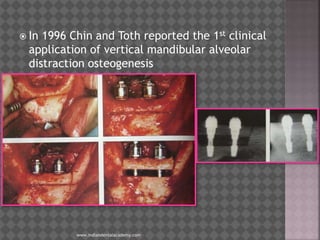
 In 1996 Chin and Toth reported the 1st clinical
application of vertical mandibular alveolar
distraction osteogenesis
www.indiandentalacademy.com
TRACK System
LEAD System
DIS – SIS
SYSTEM
www.indiandentalacademy.com
Addition of hinge
elements
Vertical
distraction +
Angular positional
changes of the
transport segment
Modus
V2(BASIL
,Switzerl
and) I
Increases width of
alveolar ridge
Alveo-
Wider(Ok
ado,Japa
n)
www.indiandentalacademy.com
(RAPID CANINE RETRACTION)
 BY Liou and Huang.
 Technique involves premolar extraction followed by
undermining of the interseptal bone distal to the
canine, next PDL is stretched gradually via
distraction of the tooth –bearing segment and new
bone is created mesial to the distally moving tooth.
www.indiandentalacademy.com
 is applicable in children aged younger than 1 year ,but can
be used in any age group.
 A bilateral coronal incision with elevation of the anterior
scalp flap was performed.
 Through a subciliary incision of the lower lids,exposure was
obtained of the inferior orbital rim and the medial orbital
wall.
 Subperiosteal mobilization of the orbital contents was
completed.
www.indiandentalacademy.com
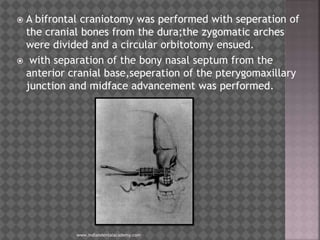
 A bifrontal craniotomy was performed with seperation of
the cranial bones from the dura;the zygomatic arches
were divided and a circular orbitotomy ensued.
 with separation of the bony nasal septum from the
anterior cranial base,seperation of the pterygomaxillary
junction and midface advancement was performed.
www.indiandentalacademy.com
 Steps involved :
a) Corticotomy/Osteotomy
b) Latency period
c) Distraction phase
d) Consolidation phase
e) Remodeling
www.indiandentalacademy.com
 Results in a loss of continuity and mechanical
integrity.
 This process triggers an evolutionary process
of bone repair.
 Fracture healing has been described as
consisting of six sequential phases.
www.indiandentalacademy.com
 Is the period from bone division to the onset of
traction
 Represents time allowed for reparative callus
formation.
 Stage of inflammation lasts from 1 to 3 days
 During the following stage of soft callus that last
about 3 weeks
www.indiandentalacademy.com
 AT THIS STAGE
 Capillaries continue to grow in to fracture
callus.
 Granulation tissue and loose connective
tissue gradually converted in to fibrous and
cartilaginous tissue.
www.indiandentalacademy.com
 Normal process of fracture healing is interrupted by
the application of gradual traction to the bone
segments at the stage of SOFT CALLUS
 Ilizarov’s statement
 ‘Gradual traction of living tissues creates stress that
stimulates and maintains regeneration and active
growth of these tissues’
 Growth stimulating effect
 Shape forming effect
www.indiandentalacademy.com
 Starting from the 2nd week of distraction ,osteoblasts
lay down osteoid tissue on the longitudinally oriented
collagen fibers and primary trabeculae begin to form.
 By the end of 2nd week the osteoid begins to
mineralize
 At that time DO regenerate has a specific 3- zonal
structure simultaneously representing the two stages
of fracture healing --- soft and hard callus
www.indiandentalacademy.com
 In the center, where the influence of tensional stress is
maximal, a poorly mineralized, radiolucent fibrous
interzone with longitudinally oriented bundles of collagen
and spindle shaped fibroblast like cells function as center
of fibroblast proliferation and fibrous tissue formation.
www.indiandentalacademy.com
 At the periphery of this fibrous interzone are two
zones of mineralization with longitudinally oriented
primary trabeculae growing from surfaces of the host
bone segments towards the central interzone.
www.indiandentalacademy.com
 Bone formation occurs along the vector of tension
and is maintained by growing apices of the primary
trabeculae, which remain open during the entire
distraction period.
 With progression of distraction, two additional
radiolucent zones may be evident at the junction of
the host bone and regenerate.( 5 zonal structure)
www.indiandentalacademy.com
 Is the period from cessation of traction forces and
removal of distraction device.
 Represents the time required for complete
mineralization of the distraction regenerate
www.indiandentalacademy.com
The fibrous interzone gradually ossifies and one
distinct zone of woven bone completely bridges the
gap
www.indiandentalacademy.com
 Is the period from removal of the distraction device to
the applicatiothn of full functional loading to the bone
segment that contains the distraction regenerate
 As the regenerate matures, initially formed bony
scaffold is reinforced by parallel – fibered and
lamellar bone
 Usually, the process takes a year.
www.indiandentalacademy.com
 Gradual corticalization of the remodeling zone
with formation of medullary canal
www.indiandentalacademy.com
 LAW OF TENSION – STRESS
 LATENCY PERIOD ;- 5- 7days) (14 days – Dibastiani)
 RATE OF DISTRACTION ;- If the rate is too slow,
premature ossification of the surgical site may occur.
 If the rate is too rapid deleterious changes may
occur in the overlying tissues including decreased
biosynthesis activity with in the cells of arterioles,
fascia, and neuronal elements, all of which can lead
to ischemia.1mm per day
www.indiandentalacademy.com
 RHYTHM OF DISTRACTION ;- It refers to number of
distraction events per day
 1/day = rhythm of 0.5mm OR 0.25mm, 4 times a day
 FRAME STABILITY ;- The capacity of fixator to
stabilize the newly formed bone within the
distraction area is known as frame stability.
 studies have shown that micro movements in the
axial direction encourage fracture healing. For these
reasons, the optimal fixator is rigid enough to allow
bone to heal but compact enough to allow for patient
function.
www.indiandentalacademy.com
 Extrinsic or fixator- related factors
 Intrinsic or tissue related factors
 factors related to device orientation
www.indiandentalacademy.com
 Affect the mechanical integrity of the distraction
device.
 Ex;- Number, Length, and diameter of fixation pins
 Rigidity of distraction mechanism
 Material properties of the device
www.indiandentalacademy.com
 Affects the quality of forming distraction
regenerate.
 Ex;-
 Geometric shape, Cross - sectional area,
 Density of distracted bone segments
 Length of the distraction regenerate
 Tension of the soft tissue envelope.
www.indiandentalacademy.com
TRANSEVERSE PLANE
A B
www.indiandentalacademy.com
For every 1mm of lenghtening =
0.4mm of increase in intercondylar
width
www.indiandentalacademy.com
For every 1mm lengthening =
0.3mm of increase in lower facial
height
www.indiandentalacademy.com
 IN the transverse plane, distracters placed parallel to
the mandible, with out regard to the desired direction
of distraction can create reactive forces leading to the
rotational displacement of the proximal segments and
resulting in clinical problems
 Complications included bending and binding of the
distraction device, loosening of the fixation screws or
pins, bone resorption and joint compression
www.indiandentalacademy.com
 If the distraction device can not be oriented parallel to the
direction of distraction, the lateral tendencies can not be
eliminated, one should compensate for them by acute
correction or gradually by incorporating a hinge element in
to the lengthening device.
 An increase in the lower anterior facial height occurs when
the vectors of distraction is oriented parallel to the
Mandibular plane instead of to the maxillary occlusal plane
 Clinically this vertical increase in LAFH may manifest as the
development of an anterior or posterior open bite
depending upon the location of the osteotomy. When the
osteotomy is performed posterior to the third molars, a
posterior open bite may develop.
www.indiandentalacademy.com
 In contrast , if the osteotomy is performed between the
teeth , Mandibular lengthening may result in an anterior
open bite.
 One also must take in to account that an anterior open
bite still can develop clinically, even in cases in which
the distraction devices are oriented perfectly parallel to
the maxillary occlusal plane
 Open bite development may be due to extrinsic
biomechanical factors such as rigidity of the distraction
device.
www.indiandentalacademy.com
 For example, if the distraction device is not rigid
enough to resist the suprahyoid muscle tension
generated during distraction, clock wise rotation of
distal segment may occur relative to the proximal
segment, leading to the development of an anterior
open bite
 Several intrinsic factors such as soft tissue tension bone
quality, anatomy of the mandible seen in the severe
Mandibular deficiencies often prevent placement of
distraction devices parallel to the maxillary occlusal
plane .
www.indiandentalacademy.com
 For example in severe microsomia associated with an
obtuse gonial angle, the Mandibular corpus frequently is
oriented in a more vertical direction. In these cases ,
placement of distraction device parallel to the maxillary
occlusal plane will create an undesirable distal segment
translation without a significant correction of the
deformity and dramatically will increase the risk of
nonunion.
 In these cases the distraction devices placed at some
angle to the maxillary occlusal plane, keeping in mind
that the developing open bite can be corrected at a
later time by using acute or gradual repositioning of the
bone segments to a more desirable location
www.indiandentalacademy.com
 The Mandibular bone segments can be repositioned
acutely following the completion of distraction.
Hoffmeister termed one modification of this
technique” the floating bone concept”.
 Basically his method involves the removal of device
shortly after distraction , followed by manipulation of
the regenerate and 4 to 5 weeks of the bone segment
fixation with intermaxillary elastics for the
orthodontic correction of the “floating bone”
www.indiandentalacademy.com
 The distal Mandibular segment also can be reoriented by the
insertion of a special bone segment- rotating pin, by bending
the connecting elements of the distraction device, or by the
incorporation of a hinge element in to the body of the
distraction device.
 Biomechanically, three different types of hinges can be
identified based on their location: opening wedge hinge,
closing wedge hinge, and the translation hinge
www.indiandentalacademy.com
 For the opening wedge hinge, the axis of rotation is
located at the level of osteotomy on the concave side
of the deformity.
 Clicinally, opening wedge hinge would be used solely
for angular correction or for the angular correction and
lengthening.
 For the closing wedge hinge, the axis of rotation also is
located at the osteotomy level but on the convex side
of the deformity.
www.indiandentalacademy.com
 Clinically , the closing wedge hinge would be used to
mold an already formed regenerate.
 For the translation hinge, axis of the rotation is located
posteriorly to the osteotomy level on the concave side
of the deformity.
www.indiandentalacademy.com
a. Skeletal changes – Formation of
Regenerate
 Soft tissue adaptations – Distraction
Histogenesis.
 Regeneration following disruptive and
degenerative changes
 Neohistiogenesis.
www.indiandentalacademy.com
• Increased levels of alkaline phosphate,
pyruvic acid.
• TGF- Beta 1 levels increases upto the
consolidation phase.
• Osteocalcin after the consolidation phase.
www.indiandentalacademy.com
 Gueurrissi et al on rabbits evaluted that no
alterations in muscle tissue. An increase in
metobolic and synthetic activities was observed.
 Fisher – muscles oriented parallel to the
distraction adapt with compensatory regeneration
 Muscles perpendicular – decreased protein
synthesis and evedince of atrophy.
www.indiandentalacademy.com
 Gradual stretching mild atrophic reactive
changes followed by a progressive
restoration of normal anatomic structure.
www.indiandentalacademy.com
 The process can be broken down in to several
temporal phases:
 Predistraction diagnosis and treatment planning.
 Predistraction treatment
 Distraction treatment planning
 Distraction treatment
 Postdistraction treatment
www.indiandentalacademy.com
Articulator based devices and stereolithographic
models generated via computed tomography data
www.indiandentalacademy.com
 HYPOTROPHIC REGENERATE –
 Decreased rate of bone formation
leads to delayed consolidation.
Signs- lack of radiographic evidence of distraction gap
mineralization
Correction- Decrease the rate of distraction
Temporary cessation of distraction
www.indiandentalacademy.com
 HYPERTROPHIC REGENERATE
Excessive rate of bone formation
leads to premature consolidation.

Signs –uniform tissue density throughout
the intersegmentary gap
Correction – if soft tissue permits 2-3mm
of acute distraction followed by gradual
distraction.
www.indiandentalacademy.com
 REGENERATE FRACTURE
 Usually occurs after frame removal, or due to
progressively increasing soft tissue tension or due to
inadequate duration of consolidation period.
AXIAL DEVIATIONS
Eliminate the main cause ,it may include replacement of
the device with a larger one ,reorientation of entire
distraction vector .
 SOFT TISSUE OVER STRETCHING
Leads to degenerative necrotic changes that negatively
affect the outcome
www.indiandentalacademy.com
 BLOOD VESSELS
it is least resistant to compressive force.
 correction –releasing the tension followed by reduced
rate of distraction.
PERIPHERALNERVES
D O complication includes 2-15% Of nerve injury
occurs due to direct injury during osteotomy or
indirectly by postoperative odema or hemorrhage or
compression due to fixatures.
www.indiandentalacademy.com
 In most cases lengthening by D O can be continued
but at a slower rate.
Rehabilitation process may take more than a year
SKELETAL MUSCLES
Signs-limited range of motion , tenderness, joint
contracture .
Complication – muscle atrophy
physical therapy with active or passive joint motion
should be done
INFECTION
Mainly associated with external distraction devices
management should be started immediately
antibiotics , releasing incisions should be given.
www.indiandentalacademy.com
 REFERRENCES
 Orthodontics ; current Principles and
Techniques. Graber. Vanadral.Vig. 4th edition.
 Maxillary distraction osteogenesis to treat
maxillary hypoplasia: (Am J Orthod
Dentofacial Orthop 2005;127:493-8)
www.indiandentalacademy.com
 Rapid orthodontic tooth movement into newly
distracted bone after mandibular distraction
osteogenesis in a canine model. (Am J Orthod
Dentofacial Orthop 2000;117:391-8)
 Mandibular distraction osteogenesis: A historic
perspective and future directions. Am J Orthod
Dentofacial Orthop 1999;115:448-60)
 Distraction osteogenesis in Silver Russell syndrome
to expand the mandible. . (Am J Orthod
Dentofacial Orthop 1999;116:25-30)
www.indiandentalacademy.com
 Biomechanical considerations in distraction of
the osteotomized dentomaxillary complex. Am J
Orthod Dentofacial Orthop 1999;116:264-70.
 Evaluation of the consolidation period during
osteodistraction. . (Am J Orthod Dentofacial
Orthop 1999;116:254-63)
www.indiandentalacademy.com

Craniofacial

  • 1.
  • 2.
     For centuries,many different techniques have been used in an attempt to modify bone growth, both in terms of amount and direction  Orthodontists uses intra oral and extra oral appliances to restrict growth of the maxilla in hope of accentuating mandibular sagittal growth . www.indiandentalacademy.com
  • 3.
     The latesttechnique for combating the same is a procedure termed “DISTRACTION OSTEOGENESIS”  DISTRACTION OSTEOGENESIS (Transosseous synthesis) (Osteodistraction)  DEFINITION: A process of new bone formation between the surfaces of bone segments gradually separated by incremental traction - COPE (1999) www.indiandentalacademy.com
  • 4.
    Hippocrates more than2000 years ago described the placement of traction forces on broken bones. Guy de Chauliac in 14th century applied traction with a pulley system that consisted of a weight attached to the leg by a chord .The weight was suspended over a pulley to create tension. John Barton in 1826 was the first to perform surgical division of bone or osteotomy . Joseph Malgaigne constructed an apparatus for external fixation of displaced transverse patellar fractures. www.indiandentalacademy.com
  • 5.
     The firstbone distraction was performed by Codivilla in 1905 for the treatment of a shortened femur. www.indiandentalacademy.com
  • 6.
     Summaries soonappeared, reporting success and complications during limb lengthening.  The complications included delayed healing , non-union, nerve palsy and joint contracture .  This prevented widespread acceptance of distraction osteognesis and required further improvements in osteotomy techniques ,distraction protocol ,appliance design.  Subsequently, a significant contribution in the development of DO was made by the Russian surgeon , GAVRIEL ILIZAROV in 1951 . www.indiandentalacademy.com
  • 7.
     The procedurewas initiated by surgical bone division with maximum preservation of periosteum and endosteum-a technique called corticotomy.  His fixation technique has two distinct advantages over other methods. www.indiandentalacademy.com
  • 8.
     Stable butnot rigid fixation to provide axial micro movements  Full control over the manipulation of bone segments, regardless of their size, shape or anatomic location  Snyder et al in 1973 used Ilizarov’s principle to the mandible DO. www.indiandentalacademy.com
  • 9.
     In 1976Michieli and Miotti, reproduced Snyder’s work, using an intra oral device.  Panikarovski et al in 1982 performed the first significant histologic evaluation of mandibular distraction regenerates in 41 days www.indiandentalacademy.com
  • 10.
     Distraction devicescan be classified into  External devices  Internal devices  Extraoral devices can be  Unidirectional  Bidirectional  Multidirectional  Intraoral devices can be  Tooth borne  Bone borne  Hybrid (Tooth borne and Bone borne) www.indiandentalacademy.com
  • 11.
  • 12.
     Relatively simpleoperative technique -Lengthening of bone and soft tissues -Good long term stability -Avoidance of bone grafts -Multidimensional distraction -Feasible to distract bone grafts or irradiated bone -Results are apparently early -Reduces likelihood of relapse -Reduces likelihood of blood transfusion www.indiandentalacademy.com
  • 13.
     Skin scarswith extra oral devices -Damage to Nerve -Damage To Tooth Germ -Premature consolidation -Transient changes in TMJ -Infection -Nonunion/inadequate bone formation -Device failure www.indiandentalacademy.com
  • 14.
    Correction of Maxillo-Mandibulardeformities  a) Mandibular lengthening  b) Maxillary lengthening  c) Maxillary and Mandibular widening  d) Lengthening of the Hard palate  e) Distraction in other cranio-facial areas.(fronto orbital osteo distraction)  f) Alveolar ridge augmentation  g) Dental Distraction  h) Obstructive sleep apnoea www.indiandentalacademy.com
  • 15.
     Indications  -Hemifacial Microsomia -TreacherCollin Syndrome -Congenital Micrognathia - Nager’s Syndrome -Pierre Robin Syndrome -Goldenhar Syndrome -Silver Russell syndrome -Moebius Syndrome - Facial Cleft -Cranio Facial Microsomia -Trauma ,Pathologic defect -Alveolar defect -Transverse defect www.indiandentalacademy.com
  • 16.
     INDICATIONS  Orofacialclefts -Nasomaxillary dysplasia -Cranio synostosis -Sagittal synostosis -Crouzon’s syndrome -Apert’s syndrome -Maxillary atrophy -Alveolar augmentation www.indiandentalacademy.com
  • 17.
     INDICATIONS -Hemi facialMicrosomia =Treacher Collins syndrome  CONTRAINDICATIONS OF DISTRACTION OSTEOGENESIS -Osteoporosis -Hypersensitivity to metals -Infection -Neuro psychiatric disorders -Immuno suppression www.indiandentalacademy.com
  • 18.
     McCarthy andcolleagues were the 1st to apply extra oral DO clinically on 4 children with congenital craniofacial anomalies Hoffman Mini Lengthener www.indiandentalacademy.com
  • 19.
     About thesame time, Guerrero began developing his midsymphyseal widening technique using an intra oral tooth – borne hyrax type device ( on 11 pt’s with transverse defeciencies ranging from 4 to 7mm ) www.indiandentalacademy.com
  • 20.
     Molina andOrtiz-Monasterio simplified the methods established by McCarthy.  Their technique used a Corticotomy, which left the medial cortical plate intact.  Only one fixation pin was inserted on either side of the corticotomy and was secured to the distraction device, which Molina termed a Semirigid extra oral fixation system. www.indiandentalacademy.com
  • 21.
     Molina &Ortiz –Monasterio were the 1st to apply bidirectional mandibular DO in patients with mandibular microsomia or micrognathia. www.indiandentalacademy.com
  • 22.
     To correctsevere mandibular deformities in three dimensions, independent lengthening of ramus and corpus must be combined with gradual planar angular adjustments.  Ex ;-ACE/NORMED Multi - Directional distractor  Multi Vector Mandibular Distracor www.indiandentalacademy.com
  • 23.
     Application forsmall children  Simplicity of attachment  Ease of manipulation  Multidirectional distraction  Multiplanar angular adjustment. www.indiandentalacademy.com
  • 24.
     Apprehensive  Permanentfacial scars These disadvantages & limitations were the primary force driving towards the development of intra oral devices. www.indiandentalacademy.com
  • 25.
    Further miniaturization of extraoral devices Modification of the available internal orthodontic expansion devices www.indiandentalacademy.com
  • 26.
    McCarthy • Miniaturized boneborn UniguideMandibular Distraction Device (NewJersy) Wangerin & Gropp • Intra Oral Titanium Distraction Device (Medicon – Germany) www.indiandentalacademy.com
  • 27.
    Buried Bi-directionalTelescopic Distractor (InnovaTechnologies, Canada) • Allows medio – lateal adjustments MD _ DOS device • Allows acute uniplanar angular adjustments in the horizontal direction Intra Oral Distraction System (Stryker) • Performs gradual angular adjustments WALKER & Colleagues Mommerts DINER & colleagues www.indiandentalacademy.com
  • 28.
    •Multi Axis Intraoral Distractior (Zurich,Switzerland) •Truly 3- dimensional TRIACA ET AL •Curvi linear,motorized &hydraulic distraction device •Precise control & easy activation LOGIC MANDIBULAR DISTRACTION SYSTEM(Texas) www.indiandentalacademy.com
  • 29.
     After thesuccessful application of distraction osteogenesis in the human mandible, it was only a matter of time before the technique was applied to the midface.  In 1993,Rachmiel et al reported their findings on midface advancement in sheep using external distractors. www.indiandentalacademy.com
  • 30.
     Molina andOrtiz-Monasterio reported, using an orthodontic face protraction mask combined with a Le Fort I osteotomy to achieve distraction osteogenesis.  After attempting this technique, Polley and Figueroa realized that the facemask with elastics was not sufficiently rigid to achieve the desired amount of forward movement. www.indiandentalacademy.com
  • 31.
     They developedan adjustable rigid external fixation (RED;KLS-Martin LP) system for maxillary advancement www.indiandentalacademy.com
  • 32.
     1st internalmidface distraction was performed by Cohen, who developed a Modular Internal Distraction System (Stryker)  Later, other types of internal distraction devices, such as the Midface Distractor (lorenz) and Zurich Maxillary Distractor (KLS Martin) , were introduced for Maxillary and Midface distraction www.indiandentalacademy.com
  • 33.
     In 1994,McCarthysuggested that distraction could be performed in children as young as 2 years of age.  Cohen et al introduced a system of miniature distractors that could be customized for use anywhere in the craniofacial complex.  The distraction devices were placed to correct the sagittal and vertical maxillary deficiency,expand the orbit and increase mandibular body length. www.indiandentalacademy.com
  • 34.
     Cohen furtherdeveloped his miniature distraction devices,called the Modular Internal Distraction(MID) system(Stryker Leibinger)  This is the first internal distraction system approved by the Food and Drug Administration for marketing. Two distractor frames are available to provide 15 mm or 30 mm of distraction. www.indiandentalacademy.com
  • 35.
     Alveolar defectsresult from variety of pathological process.  These deformities can be managed by a variety of surgical techniques, such as Autogenous onlay bone grafts Alloplastic augmentation Connective tissue grafting Guided tissue regeneration  Block et al established the validity of DO for alveolar distraction in dog experiments. www.indiandentalacademy.com
  • 36.
     A segmentof alveolus was osteotomized and distracted vertically 0.5mm twice a day for 10 days, followed by a 10 week period of consolidation.  Vertical augmentation averaged 8.85mm www.indiandentalacademy.com
  • 37.
     In 1996Chin and Toth reported the 1st clinical application of vertical mandibular alveolar distraction osteogenesis www.indiandentalacademy.com
  • 38.
    TRACK System LEAD System DIS– SIS SYSTEM www.indiandentalacademy.com
  • 39.
    Addition of hinge elements Vertical distraction+ Angular positional changes of the transport segment Modus V2(BASIL ,Switzerl and) I Increases width of alveolar ridge Alveo- Wider(Ok ado,Japa n) www.indiandentalacademy.com
  • 40.
    (RAPID CANINE RETRACTION) BY Liou and Huang.  Technique involves premolar extraction followed by undermining of the interseptal bone distal to the canine, next PDL is stretched gradually via distraction of the tooth –bearing segment and new bone is created mesial to the distally moving tooth. www.indiandentalacademy.com
  • 41.
  • 42.
  • 43.
     is applicablein children aged younger than 1 year ,but can be used in any age group.  A bilateral coronal incision with elevation of the anterior scalp flap was performed.  Through a subciliary incision of the lower lids,exposure was obtained of the inferior orbital rim and the medial orbital wall.  Subperiosteal mobilization of the orbital contents was completed. www.indiandentalacademy.com
  • 44.
     A bifrontalcraniotomy was performed with seperation of the cranial bones from the dura;the zygomatic arches were divided and a circular orbitotomy ensued.  with separation of the bony nasal septum from the anterior cranial base,seperation of the pterygomaxillary junction and midface advancement was performed. www.indiandentalacademy.com
  • 45.
     Steps involved: a) Corticotomy/Osteotomy b) Latency period c) Distraction phase d) Consolidation phase e) Remodeling www.indiandentalacademy.com
  • 46.
     Results ina loss of continuity and mechanical integrity.  This process triggers an evolutionary process of bone repair.  Fracture healing has been described as consisting of six sequential phases. www.indiandentalacademy.com
  • 47.
  • 48.
     Is theperiod from bone division to the onset of traction  Represents time allowed for reparative callus formation.  Stage of inflammation lasts from 1 to 3 days  During the following stage of soft callus that last about 3 weeks www.indiandentalacademy.com
  • 49.
     AT THISSTAGE  Capillaries continue to grow in to fracture callus.  Granulation tissue and loose connective tissue gradually converted in to fibrous and cartilaginous tissue. www.indiandentalacademy.com
  • 50.
     Normal processof fracture healing is interrupted by the application of gradual traction to the bone segments at the stage of SOFT CALLUS  Ilizarov’s statement  ‘Gradual traction of living tissues creates stress that stimulates and maintains regeneration and active growth of these tissues’  Growth stimulating effect  Shape forming effect www.indiandentalacademy.com
  • 51.
     Starting fromthe 2nd week of distraction ,osteoblasts lay down osteoid tissue on the longitudinally oriented collagen fibers and primary trabeculae begin to form.  By the end of 2nd week the osteoid begins to mineralize  At that time DO regenerate has a specific 3- zonal structure simultaneously representing the two stages of fracture healing --- soft and hard callus www.indiandentalacademy.com
  • 52.
     In thecenter, where the influence of tensional stress is maximal, a poorly mineralized, radiolucent fibrous interzone with longitudinally oriented bundles of collagen and spindle shaped fibroblast like cells function as center of fibroblast proliferation and fibrous tissue formation. www.indiandentalacademy.com
  • 53.
     At theperiphery of this fibrous interzone are two zones of mineralization with longitudinally oriented primary trabeculae growing from surfaces of the host bone segments towards the central interzone. www.indiandentalacademy.com
  • 54.
     Bone formationoccurs along the vector of tension and is maintained by growing apices of the primary trabeculae, which remain open during the entire distraction period.  With progression of distraction, two additional radiolucent zones may be evident at the junction of the host bone and regenerate.( 5 zonal structure) www.indiandentalacademy.com
  • 55.
     Is theperiod from cessation of traction forces and removal of distraction device.  Represents the time required for complete mineralization of the distraction regenerate www.indiandentalacademy.com
  • 56.
    The fibrous interzonegradually ossifies and one distinct zone of woven bone completely bridges the gap www.indiandentalacademy.com
  • 57.
     Is theperiod from removal of the distraction device to the applicatiothn of full functional loading to the bone segment that contains the distraction regenerate  As the regenerate matures, initially formed bony scaffold is reinforced by parallel – fibered and lamellar bone  Usually, the process takes a year. www.indiandentalacademy.com
  • 58.
     Gradual corticalizationof the remodeling zone with formation of medullary canal www.indiandentalacademy.com
  • 59.
     LAW OFTENSION – STRESS  LATENCY PERIOD ;- 5- 7days) (14 days – Dibastiani)  RATE OF DISTRACTION ;- If the rate is too slow, premature ossification of the surgical site may occur.  If the rate is too rapid deleterious changes may occur in the overlying tissues including decreased biosynthesis activity with in the cells of arterioles, fascia, and neuronal elements, all of which can lead to ischemia.1mm per day www.indiandentalacademy.com
  • 60.
     RHYTHM OFDISTRACTION ;- It refers to number of distraction events per day  1/day = rhythm of 0.5mm OR 0.25mm, 4 times a day  FRAME STABILITY ;- The capacity of fixator to stabilize the newly formed bone within the distraction area is known as frame stability.  studies have shown that micro movements in the axial direction encourage fracture healing. For these reasons, the optimal fixator is rigid enough to allow bone to heal but compact enough to allow for patient function. www.indiandentalacademy.com
  • 61.
     Extrinsic orfixator- related factors  Intrinsic or tissue related factors  factors related to device orientation www.indiandentalacademy.com
  • 62.
     Affect themechanical integrity of the distraction device.  Ex;- Number, Length, and diameter of fixation pins  Rigidity of distraction mechanism  Material properties of the device www.indiandentalacademy.com
  • 63.
     Affects thequality of forming distraction regenerate.  Ex;-  Geometric shape, Cross - sectional area,  Density of distracted bone segments  Length of the distraction regenerate  Tension of the soft tissue envelope. www.indiandentalacademy.com
  • 64.
  • 65.
    For every 1mmof lenghtening = 0.4mm of increase in intercondylar width www.indiandentalacademy.com
  • 66.
    For every 1mmlengthening = 0.3mm of increase in lower facial height www.indiandentalacademy.com
  • 67.
  • 68.
     IN thetransverse plane, distracters placed parallel to the mandible, with out regard to the desired direction of distraction can create reactive forces leading to the rotational displacement of the proximal segments and resulting in clinical problems  Complications included bending and binding of the distraction device, loosening of the fixation screws or pins, bone resorption and joint compression www.indiandentalacademy.com
  • 69.
  • 70.
     If thedistraction device can not be oriented parallel to the direction of distraction, the lateral tendencies can not be eliminated, one should compensate for them by acute correction or gradually by incorporating a hinge element in to the lengthening device.  An increase in the lower anterior facial height occurs when the vectors of distraction is oriented parallel to the Mandibular plane instead of to the maxillary occlusal plane  Clinically this vertical increase in LAFH may manifest as the development of an anterior or posterior open bite depending upon the location of the osteotomy. When the osteotomy is performed posterior to the third molars, a posterior open bite may develop. www.indiandentalacademy.com
  • 71.
     In contrast, if the osteotomy is performed between the teeth , Mandibular lengthening may result in an anterior open bite.  One also must take in to account that an anterior open bite still can develop clinically, even in cases in which the distraction devices are oriented perfectly parallel to the maxillary occlusal plane  Open bite development may be due to extrinsic biomechanical factors such as rigidity of the distraction device. www.indiandentalacademy.com
  • 72.
     For example,if the distraction device is not rigid enough to resist the suprahyoid muscle tension generated during distraction, clock wise rotation of distal segment may occur relative to the proximal segment, leading to the development of an anterior open bite  Several intrinsic factors such as soft tissue tension bone quality, anatomy of the mandible seen in the severe Mandibular deficiencies often prevent placement of distraction devices parallel to the maxillary occlusal plane . www.indiandentalacademy.com
  • 73.
     For examplein severe microsomia associated with an obtuse gonial angle, the Mandibular corpus frequently is oriented in a more vertical direction. In these cases , placement of distraction device parallel to the maxillary occlusal plane will create an undesirable distal segment translation without a significant correction of the deformity and dramatically will increase the risk of nonunion.  In these cases the distraction devices placed at some angle to the maxillary occlusal plane, keeping in mind that the developing open bite can be corrected at a later time by using acute or gradual repositioning of the bone segments to a more desirable location www.indiandentalacademy.com
  • 74.
     The Mandibularbone segments can be repositioned acutely following the completion of distraction. Hoffmeister termed one modification of this technique” the floating bone concept”.  Basically his method involves the removal of device shortly after distraction , followed by manipulation of the regenerate and 4 to 5 weeks of the bone segment fixation with intermaxillary elastics for the orthodontic correction of the “floating bone” www.indiandentalacademy.com
  • 75.
     The distalMandibular segment also can be reoriented by the insertion of a special bone segment- rotating pin, by bending the connecting elements of the distraction device, or by the incorporation of a hinge element in to the body of the distraction device.  Biomechanically, three different types of hinges can be identified based on their location: opening wedge hinge, closing wedge hinge, and the translation hinge www.indiandentalacademy.com
  • 76.
     For theopening wedge hinge, the axis of rotation is located at the level of osteotomy on the concave side of the deformity.  Clicinally, opening wedge hinge would be used solely for angular correction or for the angular correction and lengthening.  For the closing wedge hinge, the axis of rotation also is located at the osteotomy level but on the convex side of the deformity. www.indiandentalacademy.com
  • 77.
     Clinically ,the closing wedge hinge would be used to mold an already formed regenerate.  For the translation hinge, axis of the rotation is located posteriorly to the osteotomy level on the concave side of the deformity. www.indiandentalacademy.com
  • 78.
    a. Skeletal changes– Formation of Regenerate  Soft tissue adaptations – Distraction Histogenesis.  Regeneration following disruptive and degenerative changes  Neohistiogenesis. www.indiandentalacademy.com
  • 79.
    • Increased levelsof alkaline phosphate, pyruvic acid. • TGF- Beta 1 levels increases upto the consolidation phase. • Osteocalcin after the consolidation phase. www.indiandentalacademy.com
  • 80.
     Gueurrissi etal on rabbits evaluted that no alterations in muscle tissue. An increase in metobolic and synthetic activities was observed.  Fisher – muscles oriented parallel to the distraction adapt with compensatory regeneration  Muscles perpendicular – decreased protein synthesis and evedince of atrophy. www.indiandentalacademy.com
  • 81.
     Gradual stretchingmild atrophic reactive changes followed by a progressive restoration of normal anatomic structure. www.indiandentalacademy.com
  • 82.
     The processcan be broken down in to several temporal phases:  Predistraction diagnosis and treatment planning.  Predistraction treatment  Distraction treatment planning  Distraction treatment  Postdistraction treatment www.indiandentalacademy.com
  • 83.
    Articulator based devicesand stereolithographic models generated via computed tomography data www.indiandentalacademy.com
  • 84.
  • 85.
     HYPOTROPHIC REGENERATE–  Decreased rate of bone formation leads to delayed consolidation. Signs- lack of radiographic evidence of distraction gap mineralization Correction- Decrease the rate of distraction Temporary cessation of distraction www.indiandentalacademy.com
  • 86.
     HYPERTROPHIC REGENERATE Excessiverate of bone formation leads to premature consolidation.  Signs –uniform tissue density throughout the intersegmentary gap Correction – if soft tissue permits 2-3mm of acute distraction followed by gradual distraction. www.indiandentalacademy.com
  • 87.
     REGENERATE FRACTURE Usually occurs after frame removal, or due to progressively increasing soft tissue tension or due to inadequate duration of consolidation period. AXIAL DEVIATIONS Eliminate the main cause ,it may include replacement of the device with a larger one ,reorientation of entire distraction vector .  SOFT TISSUE OVER STRETCHING Leads to degenerative necrotic changes that negatively affect the outcome www.indiandentalacademy.com
  • 88.
     BLOOD VESSELS itis least resistant to compressive force.  correction –releasing the tension followed by reduced rate of distraction. PERIPHERALNERVES D O complication includes 2-15% Of nerve injury occurs due to direct injury during osteotomy or indirectly by postoperative odema or hemorrhage or compression due to fixatures. www.indiandentalacademy.com
  • 89.
     In mostcases lengthening by D O can be continued but at a slower rate. Rehabilitation process may take more than a year SKELETAL MUSCLES Signs-limited range of motion , tenderness, joint contracture . Complication – muscle atrophy physical therapy with active or passive joint motion should be done INFECTION Mainly associated with external distraction devices management should be started immediately antibiotics , releasing incisions should be given. www.indiandentalacademy.com
  • 90.
     REFERRENCES  Orthodontics; current Principles and Techniques. Graber. Vanadral.Vig. 4th edition.  Maxillary distraction osteogenesis to treat maxillary hypoplasia: (Am J Orthod Dentofacial Orthop 2005;127:493-8) www.indiandentalacademy.com
  • 91.
     Rapid orthodontictooth movement into newly distracted bone after mandibular distraction osteogenesis in a canine model. (Am J Orthod Dentofacial Orthop 2000;117:391-8)  Mandibular distraction osteogenesis: A historic perspective and future directions. Am J Orthod Dentofacial Orthop 1999;115:448-60)  Distraction osteogenesis in Silver Russell syndrome to expand the mandible. . (Am J Orthod Dentofacial Orthop 1999;116:25-30) www.indiandentalacademy.com
  • 92.
     Biomechanical considerationsin distraction of the osteotomized dentomaxillary complex. Am J Orthod Dentofacial Orthop 1999;116:264-70.  Evaluation of the consolidation period during osteodistraction. . (Am J Orthod Dentofacial Orthop 1999;116:254-63) www.indiandentalacademy.com