THE CRABS
• Crabs live all over the world.
• Some kinds, or species, live
in salt water, others live in
fresh water.
• Some even spend all their
time on dry land.
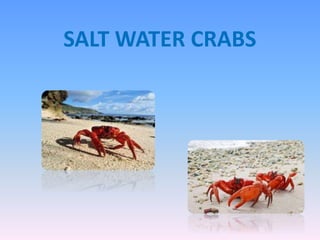
SALT WATER CRABS
FRESH WATER CRABS

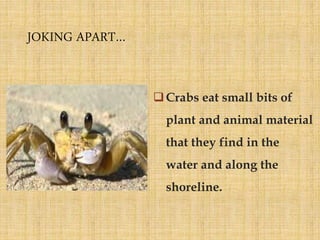
JOKING APART…
Crabs eat small bits of
plant and animal material
that they find in the
water and along the
shoreline.
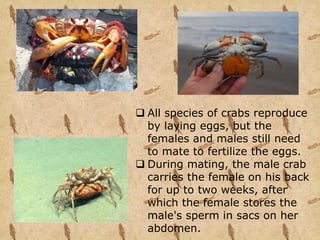
 All species of crabs reproduce
by laying eggs, but the
females and males still need
to mate to fertilize the eggs.
 During mating, the male crab
carries the female on his back
for up to two weeks, after
which the female stores the
male's sperm in sacs on her
abdomen.
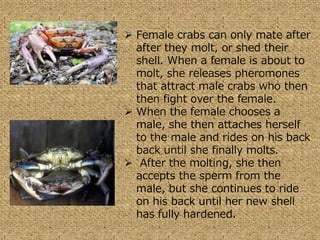
 Female crabs can only mate after
after they molt, or shed their
shell. When a female is about to
molt, she releases pheromones
that attract male crabs who then
then fight over the female.
 When the female chooses a
male, she then attaches herself
to the male and rides on his back
back until she finally molts.
 After the molting, she then
accepts the sperm from the
male, but she continues to ride
on his back until her new shell
has fully hardened.
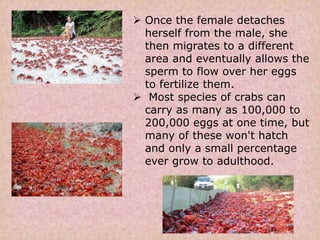
 Once the female detaches
herself from the male, she
then migrates to a different
area and eventually allows the
sperm to flow over her eggs
to fertilize them.
 Most species of crabs can
carry as many as 100,000 to
200,000 eggs at one time, but
many of these won't hatch
and only a small percentage
ever grow to adulthood.
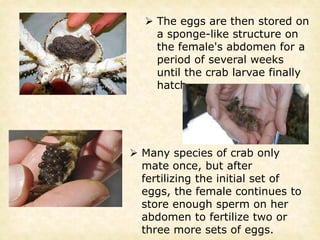
 The eggs are then stored on
a sponge-like structure on
the female's abdomen for a
period of several weeks
until the crab larvae finally
hatch.
 Many species of crab only
mate once, but after
fertilizing the initial set of
eggs, the female continues to
store enough sperm on her
abdomen to fertilize two or
three more sets of eggs.
Crabs
Crabs

Crabs

  • 1.
  • 2.
    • Crabs liveall over the world. • Some kinds, or species, live in salt water, others live in fresh water. • Some even spend all their time on dry land.
  • 3.
  • 4.
  • 6.
  • 9.
    JOKING APART… Crabs eatsmall bits of plant and animal material that they find in the water and along the shoreline.
  • 11.
     All speciesof crabs reproduce by laying eggs, but the females and males still need to mate to fertilize the eggs.  During mating, the male crab carries the female on his back for up to two weeks, after which the female stores the male's sperm in sacs on her abdomen.
  • 12.
     Female crabscan only mate after after they molt, or shed their shell. When a female is about to molt, she releases pheromones that attract male crabs who then then fight over the female.  When the female chooses a male, she then attaches herself to the male and rides on his back back until she finally molts.  After the molting, she then accepts the sperm from the male, but she continues to ride on his back until her new shell has fully hardened.
  • 13.
     Once thefemale detaches herself from the male, she then migrates to a different area and eventually allows the sperm to flow over her eggs to fertilize them.  Most species of crabs can carry as many as 100,000 to 200,000 eggs at one time, but many of these won't hatch and only a small percentage ever grow to adulthood.
  • 14.
     The eggsare then stored on a sponge-like structure on the female's abdomen for a period of several weeks until the crab larvae finally hatch.  Many species of crab only mate once, but after fertilizing the initial set of eggs, the female continues to store enough sperm on her abdomen to fertilize two or three more sets of eggs.