Crabs and Cyclops
Presented by group 11
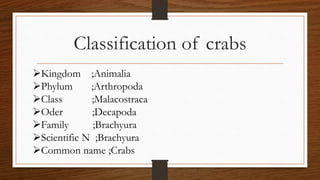
Classification of crabs
Kingdom ;Animalia
Phylum ;Arthropoda
Class ;Malacostraca
Oder ;Decapoda
Family ;Brachyura
Scientific N ;Brachyura
Common name ;Crabs
General introduction .
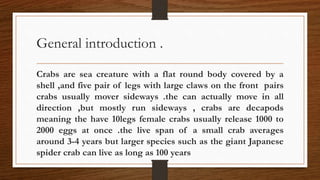
Crabs are sea creature with a flat round body covered by a
shell ,and five pair of legs with large claws on the front pairs
crabs usually mover sideways .the can actually move in all
direction ,but mostly run sideways , crabs are decapods
meaning the have 10legs female crabs usually release 1000 to
2000 eggs at once .the live span of a small crab averages
around 3-4 years but larger species such as the giant Japanese
spider crab can live as long as 100 years
General characteristics of crabs
Most crabs are decapods meaning that the have one legs
Double antennae most grabs processes a pair of antennae
The move slide way
The live both in land and in water
The are generally made of a thin exoskeleton composed primarily of
chitin with a pair of chelae [claws]
The vary in size from pea crabs ,a few millimeters wide ,and the Japanese
spider crab with a leg span up to 4m
The feed on small fish ,dead animals small clams see weeds and some
algae
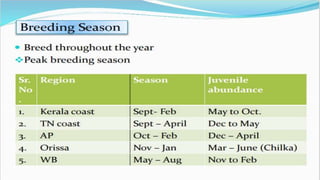
Reproduction in crabs
• All species of crabs reproduce by lieing eggs but the male and the female still
have to fertilize the eggs
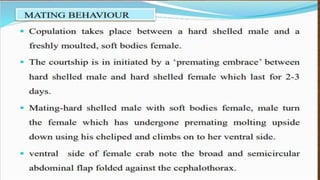
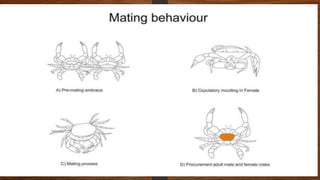
• During meeting the female crab carry the male on his back for up to two
weeks after which the female stores the male sperms in backs on her
abdomen .
• Female crabs can only mate after they molt or shed their shell ,when the
female is about molt ,she release a pheromones that help attract men to
come and fight over the female
When the female finally chooses a male , it attaches herself to the male and
rids with him on her back until she finally molts
After the molt , she then accepts the sperm from the male but she continues
to ride on her back until her new shell is finally hardened
Once the female actually detaches her self from the male she eventually
move to a different area and then allow the sperms to flow over it eggs to
fertilize them
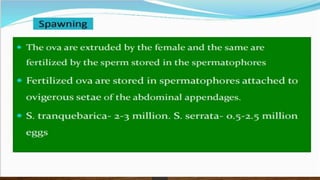
Most species of crabs may carry about 100000tro 2000000 eggs but only a
few of them will ever crow to adulthood
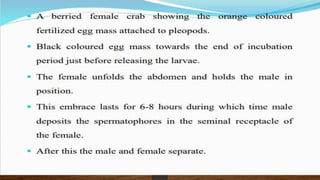
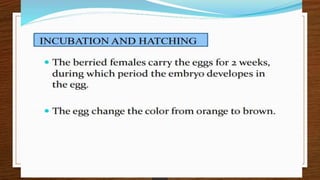
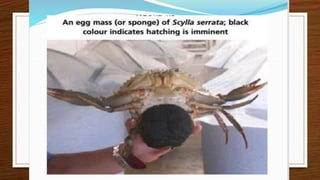
The eggs are then stored on a sponge like structure for several weeks until
the larvae finally hatches
Many species of crabs usually meet only once these is because during
fertilization the female store enough of sperms in her abdomen to fertilize
two or three more sets of eggs
Importance of crabs
there are a vital food source to sea animals like the seals the whales the
penguins
The also help mitigate carbon from the atmosphere which can help to
mitigate the effect of climate change
The are rich in vitamins and minerals and also contain low amounts of fat
and contain omega 3 polyunsaturated acids which help provide protection
from heart disease and aid brain development
The contain selenium which play am important role in the immune system
THANK YOU

chofor.pptx

  • 1.
  • 2.
    Classification of crabs Kingdom;Animalia Phylum ;Arthropoda Class ;Malacostraca Oder ;Decapoda Family ;Brachyura Scientific N ;Brachyura Common name ;Crabs
  • 3.
    General introduction . Crabsare sea creature with a flat round body covered by a shell ,and five pair of legs with large claws on the front pairs crabs usually mover sideways .the can actually move in all direction ,but mostly run sideways , crabs are decapods meaning the have 10legs female crabs usually release 1000 to 2000 eggs at once .the live span of a small crab averages around 3-4 years but larger species such as the giant Japanese spider crab can live as long as 100 years
  • 4.
    General characteristics ofcrabs Most crabs are decapods meaning that the have one legs Double antennae most grabs processes a pair of antennae The move slide way The live both in land and in water The are generally made of a thin exoskeleton composed primarily of chitin with a pair of chelae [claws] The vary in size from pea crabs ,a few millimeters wide ,and the Japanese spider crab with a leg span up to 4m The feed on small fish ,dead animals small clams see weeds and some algae
  • 20.
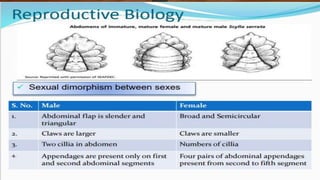
    Reproduction in crabs •All species of crabs reproduce by lieing eggs but the male and the female still have to fertilize the eggs • During meeting the female crab carry the male on his back for up to two weeks after which the female stores the male sperms in backs on her abdomen . • Female crabs can only mate after they molt or shed their shell ,when the female is about molt ,she release a pheromones that help attract men to come and fight over the female
  • 21.
    When the femalefinally chooses a male , it attaches herself to the male and rids with him on her back until she finally molts After the molt , she then accepts the sperm from the male but she continues to ride on her back until her new shell is finally hardened Once the female actually detaches her self from the male she eventually move to a different area and then allow the sperms to flow over it eggs to fertilize them Most species of crabs may carry about 100000tro 2000000 eggs but only a few of them will ever crow to adulthood The eggs are then stored on a sponge like structure for several weeks until the larvae finally hatches Many species of crabs usually meet only once these is because during fertilization the female store enough of sperms in her abdomen to fertilize two or three more sets of eggs
  • 22.
    Importance of crabs thereare a vital food source to sea animals like the seals the whales the penguins The also help mitigate carbon from the atmosphere which can help to mitigate the effect of climate change The are rich in vitamins and minerals and also contain low amounts of fat and contain omega 3 polyunsaturated acids which help provide protection from heart disease and aid brain development The contain selenium which play am important role in the immune system
  • 23.