CERTIFIED QUALITY ENGINEER
Pages: 164
INTRODUCTION
CHAPTER 1 : REQUIREMENTS ENGINEERING
CHAPTER 2 : PROJ ECT QUALITY MANAGEMENT
CHAPTER 3 : QUALITY AS S URANC E
CHAPTER 4 : AUDIT AND COMPLIANC E
CHAPTER 5 : QUALITY CONTROL
CHAPTER 6 : QUALITY CONTROL TOOLS
CHAPTER 7 : QUALITY CONTROL VS . QUALITY AS S URANC E
CHAPTER 8 QUALITY IN PROJ EC T MANAGEMENT
CHAPTER 9 : PROJ ECT GOVERNANCE
CHAPTER 10: PROJ ECT PLANNING
CHAPTER 11: EXECUTING THE PROJ ECT
CHAPTER 12: LEADERS HIP MANAGEMENT
CHAPTER 13: BUS INES S COMMUNICATION
GLOSS ARY
AUTHOR BIOGRAPHY
COPYRIGHT © 2020 ZULK SHAMSUDDIN, PHD / GAFM ACADEMY
All rights reserved.
ISBN: 978-1-304-57161-8
INTRODUCTION
The Certified Quality Engineer (CQE) is a gold-standard certification for an
experienced individual who has earned the accredited credential from The Global
Academy of Finance and Management ®. Earning the CQE designation demonstrates
that you have experience in quality engineering that includes monitoring and testing the
quality of manufacturing products, ensuring compliance with quality standards,
identifying quality issues, recommending solutions, and creating quality
documentations.
It forms the basis of the assessment that candidates must pass to gain the Certified
Quality Engineer status and inclusion in the Directory of Certified Professionals of The
Global Academy of Finance and Management ®.
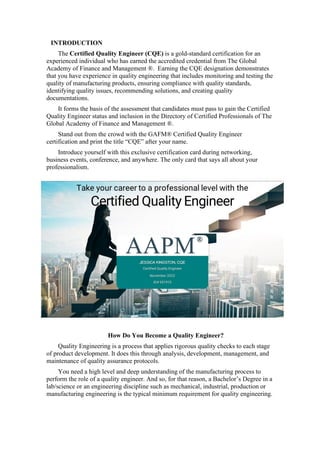
Stand out from the crowd with the GAFM® Certified Quality Engineer
certification and print the title “CQE” after your name.
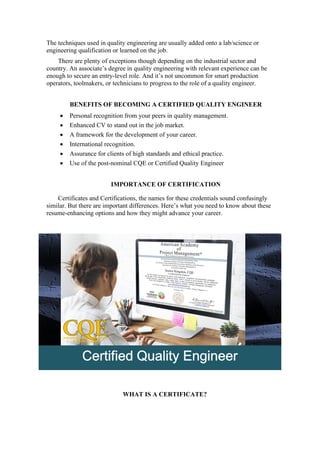
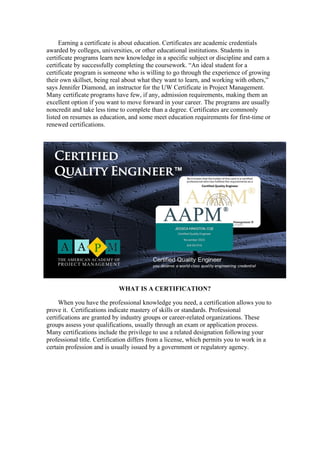
Introduce yourself with this exclusive certification card during networking,
business events, conference, and anywhere. The only card that says all about your
professionalism.
How Do You Become a Quality Engineer?
Quality Engineering is a process that applies rigorous quality checks to each stage
of product development. It does this through analysis, development, management, and
maintenance of quality assurance protocols.
You need a high level and deep understanding of the manufacturing process to
perform the role of a quality engineer. And so, for that reason, a Bachelor’s Degree in a
lab/science or an engineering discipline such as mechanical, industrial, production or
manufacturing engineering is the typical minimum requirement for quality engineering.
The techniques used in quality engineering are usually added onto a lab/science or
engineering qualification or learned on the job.
There are plenty of exceptions though depending on the industrial sector and
country. An associate’s degree in quality engineering with relevant experience can be
enough to secure an entry-level role. And it’s not uncommon for smart production
operators, toolmakers, or technicians to progress to the role of a quality engineer.
BENEFITS OF BECOMING A CERTIFIED QUALITY ENGINEER
• Personal recognition from your peers in quality management.
• Enhanced CV to stand out in the job market.
• A framework for the development of your career.
• International recognition.
• Assurance for clients of high standards and ethical practice.
• Use of the post-nominal CQE or Certified Quality Engineer
IMPORTANCE OF CERTIFICATION
Certificates and Certifications, the names for these credentials sound confusingly
similar. But there are important differences. Here’s what you need to know about these
resume-enhancing options and how they might advance your career.
WHAT IS A CERTIFICATE?
Earning a certificate is about education. Certificates are academic credentials
awarded by colleges, universities, or other educational institutions. Students in
certificate programs learn new knowledge in a specific subject or discipline and earn a
certificate by successfully completing the coursework. “An ideal student for a
certificate program is someone who is willing to go through the experience of growing
their own skillset, being real about what they want to learn, and working with others,”
says Jennifer Diamond, an instructor for the UW Certificate in Project Management.
Many certificate programs have few, if any, admission requirements, making them an
excellent option if you want to move forward in your career. The programs are usually
noncredit and take less time to complete than a degree. Certificates are commonly
listed on resumes as education, and some meet education requirements for first-time or
renewed certifications.
WHAT IS A CERTIFICATION?
When you have the professional knowledge you need, a certification allows you to
prove it. Certifications indicate mastery of skills or standards. Professional
certifications are granted by industry groups or career-related organizations. These
groups assess your qualifications, usually through an exam or application process.
Many certifications include the privilege to use a related designation following your
professional title. Certification differs from a license, which permits you to work in a
certain profession and is usually issued by a government or regulatory agency.
BENEFITS OF CERTIFICATION
• Certification helps in learning new technologies, skills, and abilities for a
specific promotion. Earning a new certification or an advanced certification in
a particular area of expertise can help in advancing your career.
• Professional certification shows consumers and potential employers that you
are committed to your profession and are well-trained. It gives them
confidence in your abilities and knowledge. Certification makes you more
valuable to employers, so you can expect to earn more than someone without
certification.
• Certifications can give you the chance to learn needed skills and be a quick
way to show employers you have those skills. On the other hand, certifications
can require studying or coursework, and cost up to several hundred dollars to
take.
Highlight Skills in Your Cover Letter
You can incorporate soft skills into your cover letter. Include one or two of the
skills mentioned in this article and give specific examples of instances when you
demonstrated these traits at work.
Skills and Competencies
This skills certification program focuses on the following skills and competencies.
• Requirements Engineering
• Quality Management
• Audit and Compliance
• Quality Control
• Leadership Management
• Business Communication
To apply: https://gafm.com.my/application-for-certification/
REQUIREMENTS ENGINEERING
WHAT IS REQUIREMENTS ENGINEERING?
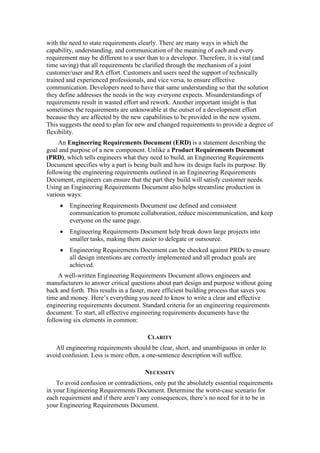
A requirement is a necessary attribute in a system, a statement that identifies a
capability, characteristic, or quality factor of a system in order for it to have value and
utility to a customer or user. Requirements are important because they provide the basis
for all of the development work that follows. Once the requirements are set, developers
initiate the other technical work: system design, development, testing, implementation,
and operation. Too often, there is a tendency to want to start what is often referred to as
“the real work” (developing, or programming, the software) too quickly. Many
customers and project managers (PMs) seem to believe that actual programming work
(“coding”) indicates that progress is being made. According to industry experience,
insufficient time and effort are spent on the requirements-related activities associated
with system development. Industry experience confirms that a better approach is to
invest more time in requirements gathering, analysis, and management activities. The
reason is that, typically, coding work is started much sooner than it should be because
additional time is needed to identify the “real” requirements and to plan for
requirements-related activities.
There is a significant difference between “stated” requirements and “real”
requirements. Stated requirements are those provided by a customer at the beginning of
a system or software development effort, for example, in a request for information,
proposal, or quote or in a statement of work (SOW). Real requirements are those that
reflect the verified needs of users for a particular system or capability. There is often a
huge difference between the stated requirements and the real requirements. Analysis of
the stated requirements is required to determine and refine real customer and user needs
and expectations of the delivered system. The requirements need to be filtered by a
process of clarification of their meaning and identification of other aspects that need to
be considered. To cite a simple example, requirements analysts (RAs) are more familiar
with the need to state requirements clearly. There are many ways in which the
capability, understanding, and communication of the meaning of each and every
requirement may be different to a user than to a developer. Therefore, it is vital (and
time saving) that all requirements be clarified through the mechanism of a joint
customer/user and RA effort. Customers and users need the support of technically
trained and experienced professionals, and vice versa, to ensure effective
communication. Developers need to have that same understanding so that the solution
they define addresses the needs in the way everyone expects. Misunderstandings of
requirements result in wasted effort and rework. Another important insight is that
sometimes the requirements are unknowable at the outset of a development effort
because they are affected by the new capabilities to be provided in the new system.
This suggests the need to plan for new and changed requirements to provide a degree of
flexibility.
An Engineering Requirements Document (ERD) is a statement describing the
goal and purpose of a new component. Unlike a Product Requirements Document
(PRD), which tells engineers what they need to build, an Engineering Requirements
Document specifies why a part is being built and how its design fuels its purpose. By
following the engineering requirements outlined in an Engineering Requirements
Document, engineers can ensure that the part they build will satisfy customer needs.
Using an Engineering Requirements Document also helps streamline production in
various ways:
• Engineering Requirements Document use defined and consistent
communication to promote collaboration, reduce miscommunication, and keep
everyone on the same page.
• Engineering Requirements Document help break down large projects into
smaller tasks, making them easier to delegate or outsource.
• Engineering Requirements Document can be checked against PRDs to ensure
all design intentions are correctly implemented and all product goals are
achieved.
A well-written Engineering Requirements Document allows engineers and
manufacturers to answer critical questions about part design and purpose without going
back and forth. This results in a faster, more efficient building process that saves you
time and money. Here’s everything you need to know to write a clear and effective
engineering requirements document. Standard criteria for an engineering requirements
document. To start, all effective engineering requirements documents have the
following six elements in common:
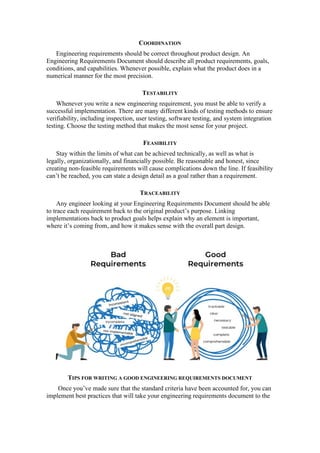
CLARITY
All engineering requirements should be clear, short, and unambiguous in order to
avoid confusion. Less is more often, a one-sentence description will suffice.
NECESSITY
To avoid confusion or contradictions, only put the absolutely essential requirements
in your Engineering Requirements Document. Determine the worst-case scenario for
each requirement and if there aren’t any consequences, there’s no need for it to be in
your Engineering Requirements Document.
COORDINATION
Engineering requirements should be correct throughout product design. An
Engineering Requirements Document should describe all product requirements, goals,
conditions, and capabilities. Whenever possible, explain what the product does in a
numerical manner for the most precision.
TESTABILITY
Whenever you write a new engineering requirement, you must be able to verify a
successful implementation. There are many different kinds of testing methods to ensure
verifiability, including inspection, user testing, software testing, and system integration
testing. Choose the testing method that makes the most sense for your project.
FEASIBILITY
Stay within the limits of what can be achieved technically, as well as what is
legally, organizationally, and financially possible. Be reasonable and honest, since
creating non-feasible requirements will cause complications down the line. If feasibility
can’t be reached, you can state a design detail as a goal rather than a requirement.
TRACEABILITY
Any engineer looking at your Engineering Requirements Document should be able
to trace each requirement back to the original product’s purpose. Linking
implementations back to product goals helps explain why an element is important,
where it’s coming from, and how it makes sense with the overall part design.
TIPS FOR WRITING A GOOD ENGINEERING REQUIREMENTS DOCUMENT
Once you’ve made sure that the standard criteria have been accounted for, you can
implement best practices that will take your engineering requirements document to the
next level. Here are five tips for writing a top-notch engineering requirements
document.
USE AN ENGINEERING REQUIREMENTS TEMPLATE
You can save time and energy at the beginning of a new project by using an
engineering requirements document template. An Engineering Requirements Document
template ensures your Engineering Requirements Document is always properly
structured. At a minimum, an engineering requirements document template should have
a cover page, section headings, and other standardized sections known as
“boilerplates.” Use boilerplates to cover Engineering Requirements Document topics
like verb use, abbreviations, keywords, formatting standards, and other guidelines
necessary for understanding your Engineering Requirements Document.
AVOID WRITING OPERATIONS AND IMPLEMENTATIONS
Your engineering requirements should state a goal, not how the goal will be
achieved. If you explain the steps towards completing a purpose instead of the purpose
itself, you’re not really writing an Engineering Requirements Document you’re writing
an operations and implementation guide. If you write an operations and
implementations guide by mistake, a manufacturer might misunderstand your
intentions and your project goals might not be met.
To ensure your requirements are indeed requirements, ask yourself why this
requirement is a necessary part of your engineering requirements document. Trust that
the system designers and manufacturers will determine how the goal will be achieved
and that they’ll do so in the most efficient way possible.
EVALUATE YOUR ERD
This will help verify that all engineering requirements meet your stated goals and
company aspirations. For a well-rounded evaluation, it’s best to put together a diverse
team. This includes bringing people of all races, ethnicities, and genders together to
evaluate your engineering requirements document, but also includes bringing a
diversity of roles to the evaluation. Include as many roles as you can designers,
developers, testers, end-user representatives, those in charge of maintenance and
management, and of course the client team to bring plenty of valuable insights to your
Engineering Requirements Document evaluation.
DON’T BE OVERLY SPECIFIC
Although there are a lot of language rules to follow when writing your engineering
requirements document, keep it simple. Clarity is key for Engineering Requirements
Document, so only focus on the necessary goals, objectives, and constraints of your
requirement. Always have a reason for putting in a requirement too many requirements
will muddle your Engineering Requirements Document and confuse readers. If you feel
your requirements becoming too long and complicated, use bullet points to split up its
elements. Having a well-written Engineering Requirements Document will help
engineers, product teams, and other collaborators better understand your design
intentions. By clearly connecting a component’s design to its specific goals and overall
part purpose, an Engineering Requirements Document ensures a product is built in a
way to satisfy customer needs.
Most importantly, a great Engineering Requirements Document promotes
collaboration, communication, and clarity throughout the design and manufacturing
process. This will ensure each and every part is fully functional and will complete its
desired objectives. Along with ensuring part-to-part consistency, an Engineering
Requirements Document also promotes faster production runs and lower costs.
Managers often think of requirements-related activities as consisting primarily of
gathering requirements and managing changes to those requirements. In reality, there
are several other requirements-related activities that need to be addressed in the system
life cycle:
IDENTIFYING THE STAKEHOLDERS
This includes anyone who has an interest in the system or in its possessing qualities that
meet particular needs. Gaining an understanding of the customers’ and users’ needs for
the planned system and their expectations of it: This is often referred to as requirements
elicitation. Note that the requirements can include several types.
REQUIREMENTS GATHERING TECHNIQUES
• Identifying requirements: This involves stating requirements in simple sentences
and providing them as a set. Business needs or requirements are the essential
activities of an enterprise. They are derived from business goals (the objectives of
the enterprise). Business scenarios may be used as a technique for understanding
business requirements. A key factor in the success of a system is the extent to
which it supports the business requirements and facilitates an organization in
achieving them.
• Clarifying and restating the requirements: This is done to ensure that they describe
the customer’s real needs and are in a form that can be understood and used by
developers of the system.
• Analyzing the requirements: This is done to ensure that they are well defined and
that they conform to the criteria of a good requirement.
• Defining the requirements in a way that means the same thing to all of the
stakeholders. Note that each stakeholder group may have a significantly different
perspective of the system and the system’s requirements. Sometimes this requires
investing significant time learning a special vocabulary or project lexicon. Often it
requires spending considerable time and effort to achieve a common
understanding.
• Specifying the requirements: This requires including all of the precise detail of
each requirement so that it can be included in a specification document or other
documentation, depending on the size of the project.
• Prioritizing the requirements: All requirements are not of equal importance to the
customers and users of the planned system. Some are critical, some of relatively
high priority, some of normal or average priority, and some even of lower priority.
It is important to prioritize all of the requirements because there is never enough
time or money to do everything we’d like to do in our developed systems.
Prioritizing the requirements provides the opportunity to address the highest
priority first and possibly release a version of a product that addresses lower-
priority needs. Prioritizing helps ensure that an appropriate amount of investment
is made in meeting various customer needs.
• Deriving requirements: There are some requirements that come about because of
the design of a system, but do not provide a direct benefit to the end user. A
requirement for disc storage might result from the need to store a lot of data, for
example.
• Partitioning requirements: We categorize requirements as those that can be met by
hardware, software, training, and documentation, for example. Often this process
turns out to be more complex than we anticipate when some requirements are
satisfied by more than one category.
• Allocating requirements: We allocate requirements to different subsystems and
components of the system. The allocations may not always be satisfied by just one
subsystem or component.
• Tracking requirements: We need the capability to trace or track where in the
system each requirement is satisfied, so that we can verify that each requirement is
being addressed. This is most often accomplished through use of an automated
requirements tool.
• Managing requirements: We need to be able to add, delete, and modify
requirements during all of the phases of system design, development, integration,
testing, deployment, and operation. The requirements repository consists of a set of
artifacts and databases.
• Testing and verifying requirements: This are the process of checking requirements,
designs, code, test plans, and system products to ensure that the requirements are
met.
• Validating requirements: This is the process for confirming that the real
requirements are implemented in the delivered system. The order of validation of
requirements should be prioritized since there is a limited amount of funding
available.
TYPES OF REQUIREMENTS
It’s important for the RA or requirements engineer to settle on definitions of the
types of requirements that he will use consistently. He should advocate consistent
meanings for these types on his project and in his organization. Much confusion can be
avoided by agreeing on a set of definitions and by not using certain terms. In this
chapter, we’ll review several types of requirements and suggest definitions for them.
We’ll suggest why some terms shouldn’t be used and provide other guidelines. One
important reason for agreeing on the definitions of the types of requirements is to avoid
lengthy and heated debates about terminology while we are working together. Establish
a project glossary that everyone can live with (even if some definitions are not
everyone’s favorites) and utilize it in your work.
A requirement is a statement that identifies a capability, characteristic, or quality
factor of a system in order for it to have value and utility for a user. A requirement is
well-defined and more specific than a need, which is a capability desired by a user or
customer to solve a problem or achieve an objective.
The requirements types that are noted are production process requirements (e.g.,
the physical facilities needed), requirements of the products to be provided by the
system or software, the requirements of the processes utilized to produce the products
(e.g., the testing process), and operational and logistics support requirements (e.g.,
equipment, training, and procedures). All of these requirements must be identified
before work on the detailed system design is started. While the product engineers are
developing specifications for the product elements, the manufacturing engineers must
define the manufacturing requirements, the logistics engineers the logistics
requirements, and the verification engineers the qualification requirements. While
doing so, these engineers must communicate among themselves and jointly resolve the
best aggregate expression of the requirements from the product and process
perspective.
BUSINESS REQUIREMENTS
Business requirements are the reason for developing systems and software in the
first place. Business requirements are the essential activities of an enterprise. Business
requirements are derived from business goals (the objectives of the enterprise or
organization). Business scenarios may be used as a technique for understanding
business requirements. A key factor in the success of a system is the extent to which the
system supports the business requirements and facilitates an organization in achieving
them. If our systems and software do not support the business requirements effectively
and efficiently, they have no reason for being.
HIGH-LEVEL OR SYSTEM-LEVEL REQUIREMENTS
To enable comprehending a needed system, we refer to the high-level or system-
level requirements. This term relates to those requirements that are foremost in
importance, capture the vision of the customer, enable defining the scope of the system,
and allow estimating the cost and schedule required to build the system. (Some system
architects believe that the requirements specification should contain every performance
requirement.) It’s recommended that a workable number of requirements (on the order
of 50 to 200) system-level requirements be identified for a large system.
FUNCTIONAL REQUIREMENTS
Functional requirements are an important category of the real requirements.
Functional requirements describe what the system or software must do. A function is a
useful capability provided by one or more components of a system. Functional
requirements are sometimes called behavioral or operational requirements because they
specify the inputs to the system, the outputs (responses) from the system, and
behavioral relationships between them. The document used to communicate the
requirements to customers, system, and software engineers is referred to as a functional
document (FD) or specification. This refers to a comprehensive collection of the
characteristics of a system and the capabilities it will make available to the users. It
provides a detailed analysis of the data the system will be expected to manipulate. It
may include a detailed definition of the user interfaces of the system.
DERIVED REQUIREMENTS
A derived requirement is one that is further refined from a higher-level
requirement or a requirement that results from choosing a specific implementation or
system element. In a sense, all requirements are derived from the system need; thus, the
derived distinction tends to have little significance. However, many systems engineers
distinguish between externally identified requirements and requirements that are
derived under the control of the engineer.
DESIGN REQUIREMENTS AND DESIGN CONSTRAINTS
For most system development efforts, design requirements/constraints appear right
at the beginning of the system formulation. Here are examples of why it’s difficult to
separate requirements engineering from design activities:
• New systems are often installed in environments that already have other
systems. The other systems usually constrain the design of the new system.
For example, a requirement (design constraint) may be that the system to be
developed must obtain its information from an existing database. The database
has already been designed and parts of its specification will usually be
included in the requirements document.
• For large systems, some architectural design is often necessary to identify
subsystems and relationships. Identifying subsystems means that the
requirements engineering process for each subsystem can go on in parallel.
• For reasons of budget, schedule, or quality, an organization may wish to reuse
some or all existing software systems in the implementation of a new system.
This constrains both the system requirements and the design.
• If a system has to be approved by an external regulator (e.g., systems in civil
aircraft), it may be necessary to use standard certified design that has been
tested in other systems.
ENVIRONMENTAL REQUIREMENTS
These are requirements that result from the physical setting and social and cultural
conditions of the system development effort and the setting in which the system or
software will be used.
SYSTEM, SUBSYSTEM, AND COMPONENT REQUIREMENTS
This refers to requirements associated with different levels of the system. The
system is the highest level and is divided into subsystems; the subsystems are made up
of components, such as hardware, software, training, and documentation.
KEY REQUIREMENTS
The term key requirements are sometimes used to refer to requirements that are
important in order to understand a system’s essential capabilities or functions. 4 It is
appropriate to analyze requirements in terms of their benefit-to-cost ratio, risk, or the
estimated time and effort needed to address them, so that we can have informal
discussions within the joint team to negotiate the requirements to be included.
However, I suggest avoiding use of this term, because it’s unclear.
GATHERING REQUIREMENTS
The need to gather requirements is initiated by a request from an internal or
external customer. Requests can come in many forms, including a request for
proposals, an SOW, or an informal or formal inquiry describing a capability that is
needed. The request initiates a set of requirements-gathering activities. It’s vital for the
RA to have a thorough understanding of these activities and to gain experience in
performing related tasks.
A lot of time and effort is wasted in the project startup phase and in performing
requirements gathering activities. There are a number of reasons for this:
• The project is just getting organized and things are confused.
• There is no road map or checklist of startup activities.
• Not all staff are present; some are still being recruited.
• There isn’t much pressure to meet the schedule yet.
• The customer and users are also trying to get organized and get started.
• The staff who will be working on end-product development may not fully
understand the customer’s objectives and, consequently, may not be able to
appreciate the customer’s expectations.
• An effective proven procedure for the requirements gathering steps is not
available or used.

Certified Quality Engineer.PREVIEW .pdf

  • 2.
    CERTIFIED QUALITY ENGINEER Pages:164 INTRODUCTION CHAPTER 1 : REQUIREMENTS ENGINEERING CHAPTER 2 : PROJ ECT QUALITY MANAGEMENT CHAPTER 3 : QUALITY AS S URANC E CHAPTER 4 : AUDIT AND COMPLIANC E CHAPTER 5 : QUALITY CONTROL CHAPTER 6 : QUALITY CONTROL TOOLS CHAPTER 7 : QUALITY CONTROL VS . QUALITY AS S URANC E CHAPTER 8 QUALITY IN PROJ EC T MANAGEMENT CHAPTER 9 : PROJ ECT GOVERNANCE CHAPTER 10: PROJ ECT PLANNING CHAPTER 11: EXECUTING THE PROJ ECT CHAPTER 12: LEADERS HIP MANAGEMENT CHAPTER 13: BUS INES S COMMUNICATION GLOSS ARY AUTHOR BIOGRAPHY
  • 3.
    COPYRIGHT © 2020ZULK SHAMSUDDIN, PHD / GAFM ACADEMY All rights reserved. ISBN: 978-1-304-57161-8
  • 4.
    INTRODUCTION The Certified QualityEngineer (CQE) is a gold-standard certification for an experienced individual who has earned the accredited credential from The Global Academy of Finance and Management ®. Earning the CQE designation demonstrates that you have experience in quality engineering that includes monitoring and testing the quality of manufacturing products, ensuring compliance with quality standards, identifying quality issues, recommending solutions, and creating quality documentations. It forms the basis of the assessment that candidates must pass to gain the Certified Quality Engineer status and inclusion in the Directory of Certified Professionals of The Global Academy of Finance and Management ®. Stand out from the crowd with the GAFM® Certified Quality Engineer certification and print the title “CQE” after your name. Introduce yourself with this exclusive certification card during networking, business events, conference, and anywhere. The only card that says all about your professionalism. How Do You Become a Quality Engineer? Quality Engineering is a process that applies rigorous quality checks to each stage of product development. It does this through analysis, development, management, and maintenance of quality assurance protocols. You need a high level and deep understanding of the manufacturing process to perform the role of a quality engineer. And so, for that reason, a Bachelor’s Degree in a lab/science or an engineering discipline such as mechanical, industrial, production or manufacturing engineering is the typical minimum requirement for quality engineering.
  • 5.
    The techniques usedin quality engineering are usually added onto a lab/science or engineering qualification or learned on the job. There are plenty of exceptions though depending on the industrial sector and country. An associate’s degree in quality engineering with relevant experience can be enough to secure an entry-level role. And it’s not uncommon for smart production operators, toolmakers, or technicians to progress to the role of a quality engineer. BENEFITS OF BECOMING A CERTIFIED QUALITY ENGINEER • Personal recognition from your peers in quality management. • Enhanced CV to stand out in the job market. • A framework for the development of your career. • International recognition. • Assurance for clients of high standards and ethical practice. • Use of the post-nominal CQE or Certified Quality Engineer IMPORTANCE OF CERTIFICATION Certificates and Certifications, the names for these credentials sound confusingly similar. But there are important differences. Here’s what you need to know about these resume-enhancing options and how they might advance your career. WHAT IS A CERTIFICATE?
  • 6.
    Earning a certificateis about education. Certificates are academic credentials awarded by colleges, universities, or other educational institutions. Students in certificate programs learn new knowledge in a specific subject or discipline and earn a certificate by successfully completing the coursework. “An ideal student for a certificate program is someone who is willing to go through the experience of growing their own skillset, being real about what they want to learn, and working with others,” says Jennifer Diamond, an instructor for the UW Certificate in Project Management. Many certificate programs have few, if any, admission requirements, making them an excellent option if you want to move forward in your career. The programs are usually noncredit and take less time to complete than a degree. Certificates are commonly listed on resumes as education, and some meet education requirements for first-time or renewed certifications. WHAT IS A CERTIFICATION? When you have the professional knowledge you need, a certification allows you to prove it. Certifications indicate mastery of skills or standards. Professional certifications are granted by industry groups or career-related organizations. These groups assess your qualifications, usually through an exam or application process. Many certifications include the privilege to use a related designation following your professional title. Certification differs from a license, which permits you to work in a certain profession and is usually issued by a government or regulatory agency.
  • 7.
    BENEFITS OF CERTIFICATION •Certification helps in learning new technologies, skills, and abilities for a specific promotion. Earning a new certification or an advanced certification in a particular area of expertise can help in advancing your career. • Professional certification shows consumers and potential employers that you are committed to your profession and are well-trained. It gives them confidence in your abilities and knowledge. Certification makes you more valuable to employers, so you can expect to earn more than someone without certification. • Certifications can give you the chance to learn needed skills and be a quick way to show employers you have those skills. On the other hand, certifications can require studying or coursework, and cost up to several hundred dollars to take. Highlight Skills in Your Cover Letter You can incorporate soft skills into your cover letter. Include one or two of the skills mentioned in this article and give specific examples of instances when you demonstrated these traits at work. Skills and Competencies This skills certification program focuses on the following skills and competencies. • Requirements Engineering
  • 8.
    • Quality Management •Audit and Compliance • Quality Control • Leadership Management • Business Communication To apply: https://gafm.com.my/application-for-certification/
  • 9.
    REQUIREMENTS ENGINEERING WHAT ISREQUIREMENTS ENGINEERING? A requirement is a necessary attribute in a system, a statement that identifies a capability, characteristic, or quality factor of a system in order for it to have value and utility to a customer or user. Requirements are important because they provide the basis for all of the development work that follows. Once the requirements are set, developers initiate the other technical work: system design, development, testing, implementation, and operation. Too often, there is a tendency to want to start what is often referred to as “the real work” (developing, or programming, the software) too quickly. Many customers and project managers (PMs) seem to believe that actual programming work (“coding”) indicates that progress is being made. According to industry experience, insufficient time and effort are spent on the requirements-related activities associated with system development. Industry experience confirms that a better approach is to invest more time in requirements gathering, analysis, and management activities. The reason is that, typically, coding work is started much sooner than it should be because additional time is needed to identify the “real” requirements and to plan for requirements-related activities. There is a significant difference between “stated” requirements and “real” requirements. Stated requirements are those provided by a customer at the beginning of a system or software development effort, for example, in a request for information, proposal, or quote or in a statement of work (SOW). Real requirements are those that reflect the verified needs of users for a particular system or capability. There is often a huge difference between the stated requirements and the real requirements. Analysis of the stated requirements is required to determine and refine real customer and user needs and expectations of the delivered system. The requirements need to be filtered by a process of clarification of their meaning and identification of other aspects that need to be considered. To cite a simple example, requirements analysts (RAs) are more familiar
  • 10.
    with the needto state requirements clearly. There are many ways in which the capability, understanding, and communication of the meaning of each and every requirement may be different to a user than to a developer. Therefore, it is vital (and time saving) that all requirements be clarified through the mechanism of a joint customer/user and RA effort. Customers and users need the support of technically trained and experienced professionals, and vice versa, to ensure effective communication. Developers need to have that same understanding so that the solution they define addresses the needs in the way everyone expects. Misunderstandings of requirements result in wasted effort and rework. Another important insight is that sometimes the requirements are unknowable at the outset of a development effort because they are affected by the new capabilities to be provided in the new system. This suggests the need to plan for new and changed requirements to provide a degree of flexibility. An Engineering Requirements Document (ERD) is a statement describing the goal and purpose of a new component. Unlike a Product Requirements Document (PRD), which tells engineers what they need to build, an Engineering Requirements Document specifies why a part is being built and how its design fuels its purpose. By following the engineering requirements outlined in an Engineering Requirements Document, engineers can ensure that the part they build will satisfy customer needs. Using an Engineering Requirements Document also helps streamline production in various ways: • Engineering Requirements Document use defined and consistent communication to promote collaboration, reduce miscommunication, and keep everyone on the same page. • Engineering Requirements Document help break down large projects into smaller tasks, making them easier to delegate or outsource. • Engineering Requirements Document can be checked against PRDs to ensure all design intentions are correctly implemented and all product goals are achieved. A well-written Engineering Requirements Document allows engineers and manufacturers to answer critical questions about part design and purpose without going back and forth. This results in a faster, more efficient building process that saves you time and money. Here’s everything you need to know to write a clear and effective engineering requirements document. Standard criteria for an engineering requirements document. To start, all effective engineering requirements documents have the following six elements in common: CLARITY All engineering requirements should be clear, short, and unambiguous in order to avoid confusion. Less is more often, a one-sentence description will suffice. NECESSITY To avoid confusion or contradictions, only put the absolutely essential requirements in your Engineering Requirements Document. Determine the worst-case scenario for each requirement and if there aren’t any consequences, there’s no need for it to be in your Engineering Requirements Document.
  • 11.
    COORDINATION Engineering requirements shouldbe correct throughout product design. An Engineering Requirements Document should describe all product requirements, goals, conditions, and capabilities. Whenever possible, explain what the product does in a numerical manner for the most precision. TESTABILITY Whenever you write a new engineering requirement, you must be able to verify a successful implementation. There are many different kinds of testing methods to ensure verifiability, including inspection, user testing, software testing, and system integration testing. Choose the testing method that makes the most sense for your project. FEASIBILITY Stay within the limits of what can be achieved technically, as well as what is legally, organizationally, and financially possible. Be reasonable and honest, since creating non-feasible requirements will cause complications down the line. If feasibility can’t be reached, you can state a design detail as a goal rather than a requirement. TRACEABILITY Any engineer looking at your Engineering Requirements Document should be able to trace each requirement back to the original product’s purpose. Linking implementations back to product goals helps explain why an element is important, where it’s coming from, and how it makes sense with the overall part design. TIPS FOR WRITING A GOOD ENGINEERING REQUIREMENTS DOCUMENT Once you’ve made sure that the standard criteria have been accounted for, you can implement best practices that will take your engineering requirements document to the
  • 12.
    next level. Hereare five tips for writing a top-notch engineering requirements document. USE AN ENGINEERING REQUIREMENTS TEMPLATE You can save time and energy at the beginning of a new project by using an engineering requirements document template. An Engineering Requirements Document template ensures your Engineering Requirements Document is always properly structured. At a minimum, an engineering requirements document template should have a cover page, section headings, and other standardized sections known as “boilerplates.” Use boilerplates to cover Engineering Requirements Document topics like verb use, abbreviations, keywords, formatting standards, and other guidelines necessary for understanding your Engineering Requirements Document. AVOID WRITING OPERATIONS AND IMPLEMENTATIONS Your engineering requirements should state a goal, not how the goal will be achieved. If you explain the steps towards completing a purpose instead of the purpose itself, you’re not really writing an Engineering Requirements Document you’re writing an operations and implementation guide. If you write an operations and implementations guide by mistake, a manufacturer might misunderstand your intentions and your project goals might not be met. To ensure your requirements are indeed requirements, ask yourself why this requirement is a necessary part of your engineering requirements document. Trust that the system designers and manufacturers will determine how the goal will be achieved and that they’ll do so in the most efficient way possible. EVALUATE YOUR ERD This will help verify that all engineering requirements meet your stated goals and company aspirations. For a well-rounded evaluation, it’s best to put together a diverse team. This includes bringing people of all races, ethnicities, and genders together to evaluate your engineering requirements document, but also includes bringing a diversity of roles to the evaluation. Include as many roles as you can designers, developers, testers, end-user representatives, those in charge of maintenance and management, and of course the client team to bring plenty of valuable insights to your Engineering Requirements Document evaluation. DON’T BE OVERLY SPECIFIC Although there are a lot of language rules to follow when writing your engineering requirements document, keep it simple. Clarity is key for Engineering Requirements Document, so only focus on the necessary goals, objectives, and constraints of your requirement. Always have a reason for putting in a requirement too many requirements will muddle your Engineering Requirements Document and confuse readers. If you feel your requirements becoming too long and complicated, use bullet points to split up its elements. Having a well-written Engineering Requirements Document will help engineers, product teams, and other collaborators better understand your design intentions. By clearly connecting a component’s design to its specific goals and overall
  • 13.
    part purpose, anEngineering Requirements Document ensures a product is built in a way to satisfy customer needs. Most importantly, a great Engineering Requirements Document promotes collaboration, communication, and clarity throughout the design and manufacturing process. This will ensure each and every part is fully functional and will complete its desired objectives. Along with ensuring part-to-part consistency, an Engineering Requirements Document also promotes faster production runs and lower costs. Managers often think of requirements-related activities as consisting primarily of gathering requirements and managing changes to those requirements. In reality, there are several other requirements-related activities that need to be addressed in the system life cycle: IDENTIFYING THE STAKEHOLDERS This includes anyone who has an interest in the system or in its possessing qualities that meet particular needs. Gaining an understanding of the customers’ and users’ needs for the planned system and their expectations of it: This is often referred to as requirements elicitation. Note that the requirements can include several types. REQUIREMENTS GATHERING TECHNIQUES • Identifying requirements: This involves stating requirements in simple sentences and providing them as a set. Business needs or requirements are the essential activities of an enterprise. They are derived from business goals (the objectives of the enterprise). Business scenarios may be used as a technique for understanding business requirements. A key factor in the success of a system is the extent to which it supports the business requirements and facilitates an organization in achieving them. • Clarifying and restating the requirements: This is done to ensure that they describe the customer’s real needs and are in a form that can be understood and used by developers of the system. • Analyzing the requirements: This is done to ensure that they are well defined and that they conform to the criteria of a good requirement. • Defining the requirements in a way that means the same thing to all of the stakeholders. Note that each stakeholder group may have a significantly different perspective of the system and the system’s requirements. Sometimes this requires investing significant time learning a special vocabulary or project lexicon. Often it requires spending considerable time and effort to achieve a common understanding. • Specifying the requirements: This requires including all of the precise detail of each requirement so that it can be included in a specification document or other documentation, depending on the size of the project. • Prioritizing the requirements: All requirements are not of equal importance to the customers and users of the planned system. Some are critical, some of relatively high priority, some of normal or average priority, and some even of lower priority.
  • 14.
    It is importantto prioritize all of the requirements because there is never enough time or money to do everything we’d like to do in our developed systems. Prioritizing the requirements provides the opportunity to address the highest priority first and possibly release a version of a product that addresses lower- priority needs. Prioritizing helps ensure that an appropriate amount of investment is made in meeting various customer needs. • Deriving requirements: There are some requirements that come about because of the design of a system, but do not provide a direct benefit to the end user. A requirement for disc storage might result from the need to store a lot of data, for example. • Partitioning requirements: We categorize requirements as those that can be met by hardware, software, training, and documentation, for example. Often this process turns out to be more complex than we anticipate when some requirements are satisfied by more than one category. • Allocating requirements: We allocate requirements to different subsystems and components of the system. The allocations may not always be satisfied by just one subsystem or component. • Tracking requirements: We need the capability to trace or track where in the system each requirement is satisfied, so that we can verify that each requirement is being addressed. This is most often accomplished through use of an automated requirements tool. • Managing requirements: We need to be able to add, delete, and modify requirements during all of the phases of system design, development, integration, testing, deployment, and operation. The requirements repository consists of a set of artifacts and databases. • Testing and verifying requirements: This are the process of checking requirements, designs, code, test plans, and system products to ensure that the requirements are met. • Validating requirements: This is the process for confirming that the real requirements are implemented in the delivered system. The order of validation of requirements should be prioritized since there is a limited amount of funding available. TYPES OF REQUIREMENTS It’s important for the RA or requirements engineer to settle on definitions of the types of requirements that he will use consistently. He should advocate consistent meanings for these types on his project and in his organization. Much confusion can be avoided by agreeing on a set of definitions and by not using certain terms. In this chapter, we’ll review several types of requirements and suggest definitions for them. We’ll suggest why some terms shouldn’t be used and provide other guidelines. One important reason for agreeing on the definitions of the types of requirements is to avoid lengthy and heated debates about terminology while we are working together. Establish a project glossary that everyone can live with (even if some definitions are not everyone’s favorites) and utilize it in your work.
  • 15.
    A requirement isa statement that identifies a capability, characteristic, or quality factor of a system in order for it to have value and utility for a user. A requirement is well-defined and more specific than a need, which is a capability desired by a user or customer to solve a problem or achieve an objective. The requirements types that are noted are production process requirements (e.g., the physical facilities needed), requirements of the products to be provided by the system or software, the requirements of the processes utilized to produce the products (e.g., the testing process), and operational and logistics support requirements (e.g., equipment, training, and procedures). All of these requirements must be identified before work on the detailed system design is started. While the product engineers are developing specifications for the product elements, the manufacturing engineers must define the manufacturing requirements, the logistics engineers the logistics requirements, and the verification engineers the qualification requirements. While doing so, these engineers must communicate among themselves and jointly resolve the best aggregate expression of the requirements from the product and process perspective. BUSINESS REQUIREMENTS Business requirements are the reason for developing systems and software in the first place. Business requirements are the essential activities of an enterprise. Business requirements are derived from business goals (the objectives of the enterprise or organization). Business scenarios may be used as a technique for understanding business requirements. A key factor in the success of a system is the extent to which the system supports the business requirements and facilitates an organization in achieving them. If our systems and software do not support the business requirements effectively and efficiently, they have no reason for being.
  • 16.
    HIGH-LEVEL OR SYSTEM-LEVELREQUIREMENTS To enable comprehending a needed system, we refer to the high-level or system- level requirements. This term relates to those requirements that are foremost in importance, capture the vision of the customer, enable defining the scope of the system, and allow estimating the cost and schedule required to build the system. (Some system architects believe that the requirements specification should contain every performance requirement.) It’s recommended that a workable number of requirements (on the order of 50 to 200) system-level requirements be identified for a large system. FUNCTIONAL REQUIREMENTS Functional requirements are an important category of the real requirements. Functional requirements describe what the system or software must do. A function is a useful capability provided by one or more components of a system. Functional requirements are sometimes called behavioral or operational requirements because they specify the inputs to the system, the outputs (responses) from the system, and behavioral relationships between them. The document used to communicate the requirements to customers, system, and software engineers is referred to as a functional document (FD) or specification. This refers to a comprehensive collection of the characteristics of a system and the capabilities it will make available to the users. It provides a detailed analysis of the data the system will be expected to manipulate. It may include a detailed definition of the user interfaces of the system. DERIVED REQUIREMENTS A derived requirement is one that is further refined from a higher-level requirement or a requirement that results from choosing a specific implementation or system element. In a sense, all requirements are derived from the system need; thus, the derived distinction tends to have little significance. However, many systems engineers distinguish between externally identified requirements and requirements that are derived under the control of the engineer. DESIGN REQUIREMENTS AND DESIGN CONSTRAINTS For most system development efforts, design requirements/constraints appear right at the beginning of the system formulation. Here are examples of why it’s difficult to separate requirements engineering from design activities: • New systems are often installed in environments that already have other systems. The other systems usually constrain the design of the new system. For example, a requirement (design constraint) may be that the system to be developed must obtain its information from an existing database. The database has already been designed and parts of its specification will usually be included in the requirements document. • For large systems, some architectural design is often necessary to identify subsystems and relationships. Identifying subsystems means that the requirements engineering process for each subsystem can go on in parallel.
  • 17.
    • For reasonsof budget, schedule, or quality, an organization may wish to reuse some or all existing software systems in the implementation of a new system. This constrains both the system requirements and the design. • If a system has to be approved by an external regulator (e.g., systems in civil aircraft), it may be necessary to use standard certified design that has been tested in other systems. ENVIRONMENTAL REQUIREMENTS These are requirements that result from the physical setting and social and cultural conditions of the system development effort and the setting in which the system or software will be used. SYSTEM, SUBSYSTEM, AND COMPONENT REQUIREMENTS This refers to requirements associated with different levels of the system. The system is the highest level and is divided into subsystems; the subsystems are made up of components, such as hardware, software, training, and documentation. KEY REQUIREMENTS The term key requirements are sometimes used to refer to requirements that are important in order to understand a system’s essential capabilities or functions. 4 It is appropriate to analyze requirements in terms of their benefit-to-cost ratio, risk, or the estimated time and effort needed to address them, so that we can have informal discussions within the joint team to negotiate the requirements to be included. However, I suggest avoiding use of this term, because it’s unclear. GATHERING REQUIREMENTS The need to gather requirements is initiated by a request from an internal or external customer. Requests can come in many forms, including a request for proposals, an SOW, or an informal or formal inquiry describing a capability that is needed. The request initiates a set of requirements-gathering activities. It’s vital for the RA to have a thorough understanding of these activities and to gain experience in performing related tasks. A lot of time and effort is wasted in the project startup phase and in performing requirements gathering activities. There are a number of reasons for this: • The project is just getting organized and things are confused. • There is no road map or checklist of startup activities. • Not all staff are present; some are still being recruited. • There isn’t much pressure to meet the schedule yet. • The customer and users are also trying to get organized and get started.
  • 18.
    • The staffwho will be working on end-product development may not fully understand the customer’s objectives and, consequently, may not be able to appreciate the customer’s expectations. • An effective proven procedure for the requirements gathering steps is not available or used.