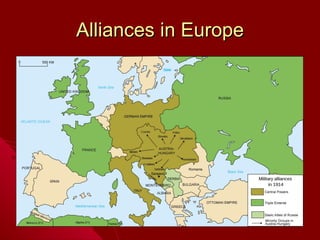
Alliances in Europe
World War I- US Neutrality August 14, 1914- President Wilson proclaims US neutrality Advantage- ability to trade with both sides
World War I- British Leanings Same language and similar culture Millions of Anglo-Americans Rape of Belgium (German Offensive) Angered American citizens and made them sympathetic to the Allied cause
World War I- German Leanings Millions of German-Americans Millions of Irish-Americans (anti-British)
British Naval Blockade of Germany Traditional definition of contraband Explosives, guns, and ammunition Brits began to confiscate  all  goods coming and going into Germany Starvation Blockade Total Warfare tactic to bring German citizens to their knees Employed close to German ports instead of a few miles out to sea (traditional style)
Unrestricted Sub Warfare Germans declared the waters around the British Isles a war zone Warned that any ship entering the war zone would be fired upon May 7, 1915- the sinking of the Lusitania British ship off the coast of Ireland 128 Americans on board (all of whom died)
The Arabic Pledge British non-military ship  Arabic  sunk with two more American casualties German ambassador to US made the Arabic pledge to not sink unarmed ships
The Sussex Pledge French non-military ship  Sussex  sunk in the English Channel  Germans issue the Sussex pledge and stated that they would abide by international law (with their sub policy) Asked the US to get Britain to stop their “total warfare” blockade
US Trade with the Allies US had become the storehouse for England and the other Allied nations Munitions, food, and raw materials Eventually, the US banks loaned the Allies $2 billion  1914 to 1916- trade with Britain increased from $800 million to $3 billion 1914 to 1916- trade with Germany decreased from $170 million to $1 million
US Preparedness Wilson opposed preparing for war early on Republicans (led by TR) demanded the nation be prepared Wilson responded by preparing for war (had the 1916 presidential election to think about) November 1915- Wilson calls for a larger military and navy Appeased the Progressives (who called for continued neutrality) by passing more progressive legislation domestically
Campaign and Election of 1916 Democrat- Woodrow Wilson  Slogan- “He kept us out of war” Republican- C harles Evans Hughes Wilson barely won the election by 23 electoral votes Congress swayed back to the Republicans which would cause problems for Wilson later
Zimmermann Note Letter from German foreign minister to German ambassador in Mexico Purpose- get Mexico to invade the US Reward- land lost to the US during the Mexican War  Letter was intercepted by British and used by Wilson to get a bill passed in Congress to arm US merchant ships
US Declaration of War   March 4, 1917- Wilson’s inauguration speech attempted to achieve peace for the nations at war Claimed preservation of an “armed neutrality” March 15, 1917-  Fall of Czar Nicolas II of Russia March 18, 1917- Three US merchant ships are sunk by German subs April 2, 1917-  Wilson asks Congress for permission to declare war on Germany
Wilson’s Fourteen Points January 1918- Defined the causes of WW I Outlined the solutions to avoid another world war, which included Open diplomacy (no more secret negotiations) Freedom of the seas would be restored Allowance for national self-determination of small nations around the world Creation of the League of Nations to preserve peace and insure justice

CPUS - Ch. 21 - Sec. 1

  • 1.
  • 2.
    World War I-US Neutrality August 14, 1914- President Wilson proclaims US neutrality Advantage- ability to trade with both sides
  • 3.
    World War I-British Leanings Same language and similar culture Millions of Anglo-Americans Rape of Belgium (German Offensive) Angered American citizens and made them sympathetic to the Allied cause
  • 4.
    World War I-German Leanings Millions of German-Americans Millions of Irish-Americans (anti-British)
  • 5.
    British Naval Blockadeof Germany Traditional definition of contraband Explosives, guns, and ammunition Brits began to confiscate all goods coming and going into Germany Starvation Blockade Total Warfare tactic to bring German citizens to their knees Employed close to German ports instead of a few miles out to sea (traditional style)
  • 6.
    Unrestricted Sub WarfareGermans declared the waters around the British Isles a war zone Warned that any ship entering the war zone would be fired upon May 7, 1915- the sinking of the Lusitania British ship off the coast of Ireland 128 Americans on board (all of whom died)
  • 7.
    The Arabic PledgeBritish non-military ship Arabic sunk with two more American casualties German ambassador to US made the Arabic pledge to not sink unarmed ships
  • 8.
    The Sussex PledgeFrench non-military ship Sussex sunk in the English Channel Germans issue the Sussex pledge and stated that they would abide by international law (with their sub policy) Asked the US to get Britain to stop their “total warfare” blockade
  • 9.
    US Trade withthe Allies US had become the storehouse for England and the other Allied nations Munitions, food, and raw materials Eventually, the US banks loaned the Allies $2 billion 1914 to 1916- trade with Britain increased from $800 million to $3 billion 1914 to 1916- trade with Germany decreased from $170 million to $1 million
  • 10.
    US Preparedness Wilsonopposed preparing for war early on Republicans (led by TR) demanded the nation be prepared Wilson responded by preparing for war (had the 1916 presidential election to think about) November 1915- Wilson calls for a larger military and navy Appeased the Progressives (who called for continued neutrality) by passing more progressive legislation domestically
  • 11.
    Campaign and Electionof 1916 Democrat- Woodrow Wilson Slogan- “He kept us out of war” Republican- C harles Evans Hughes Wilson barely won the election by 23 electoral votes Congress swayed back to the Republicans which would cause problems for Wilson later
  • 12.
    Zimmermann Note Letterfrom German foreign minister to German ambassador in Mexico Purpose- get Mexico to invade the US Reward- land lost to the US during the Mexican War Letter was intercepted by British and used by Wilson to get a bill passed in Congress to arm US merchant ships
  • 13.
    US Declaration ofWar March 4, 1917- Wilson’s inauguration speech attempted to achieve peace for the nations at war Claimed preservation of an “armed neutrality” March 15, 1917- Fall of Czar Nicolas II of Russia March 18, 1917- Three US merchant ships are sunk by German subs April 2, 1917- Wilson asks Congress for permission to declare war on Germany
  • 14.
    Wilson’s Fourteen PointsJanuary 1918- Defined the causes of WW I Outlined the solutions to avoid another world war, which included Open diplomacy (no more secret negotiations) Freedom of the seas would be restored Allowance for national self-determination of small nations around the world Creation of the League of Nations to preserve peace and insure justice

Editor's Notes

  • #2 Causes of WWI: Growing Imperialism Small Balkan nations feuded with each other Immediate cause – Archduke Francis Ferdinand of Austria-Hungary were assassinated by a Slavic nationalist from Serbia. Austria-Hungary did not accept Serbia’s attempted mediation, and declared war on Serbia. System of alliances and treaties came into place – Russia began to mobilize to help Serbia. Germany, ally of Austria-Hungary, prepared to defend them. Germany declared war on Russia and France, then moved to destroy France before Russia could attack. Britain joined to aid France due to treaty, declared war vs. Germany. Ottomans also joined Germany’s side.
  • #3 Americans couldn’t see the reason for US to go to war. Wilson advocated a strong policy of neutrality. Wanted to have peace at all costs. Wilson thought America could be a model for Democratic process.
  • #6 International law dictated that neutral vessels could trade with warring nations, though they could be inspected. If ships were to be sunk, warning needed to be given and the civilians accounted for. Britain wanted to starve Germany so they began taking more than they were supposed to at sea. Germans decided to violate International law with U-boats, bombed things without warning.
  • #7 Germans decided to violate International law with U-boats, bombed things without warning.
  • #8 Wilson said Americans wouldn’t restrict themselves on how they travelled, warned Germans to stop attacking boats.
  • #12 Reps. Chose Charles Evans Hughes over Roosevelt due to Roosevelt’s aggressiveness not playing well during war time. Hughes went to sleep thinking he had won, but votes from California came in over night and swayed election to Wilson.
  • #13 German Minister – Arthur Zimmermann
  • #14 Alliance with Britain needed to be preserved for Americans to continue trading at sea. Britain was friendly with America and used its navy to protect it. If Germans won, American freedom of the seas was not guaranteed.