CPCSEA GUIDELINES FOR
ANIMAL HOUSE
Presented by-
Vasanti Patil
M.Pharm First Year
Quality assurance
CONTENTS
INTRODUCTION
OBJECTIVE
WHY ANIMALS ARE USED IN RESEARCH
CPCSEA
COMPOSITION OF COMMITTEE
OBJECTIVES OF CPCSEA
FUNCTIONS OF CPCSEA
FUNCTIONAL REQUIREMENTS OF ANIMAL FACULTY
LOCATION OF ANIMAL FACILITIES TO LABOROTARIES
SOP AND GUIDELINES
ANESTHESIA
VARIOUS ANESTHETIC AGENTS USED FOR ANAESTHESIA
EUTHANASIA
 REGULATORY MECHANISM OF CPCSEA
WHY ANIMALS ARE USED IN RESEARCH?
•To understand the principles of anatomy and physiology
which are true for all mammals.
•Certain strains and breeds of animal get the same disease or
as condition as human.
•It is possible to control environment (temperature and
humidity etc.) of animals and shield them from disease not
related to research.
•We can scientifically study physiology by using valid no of
animal.
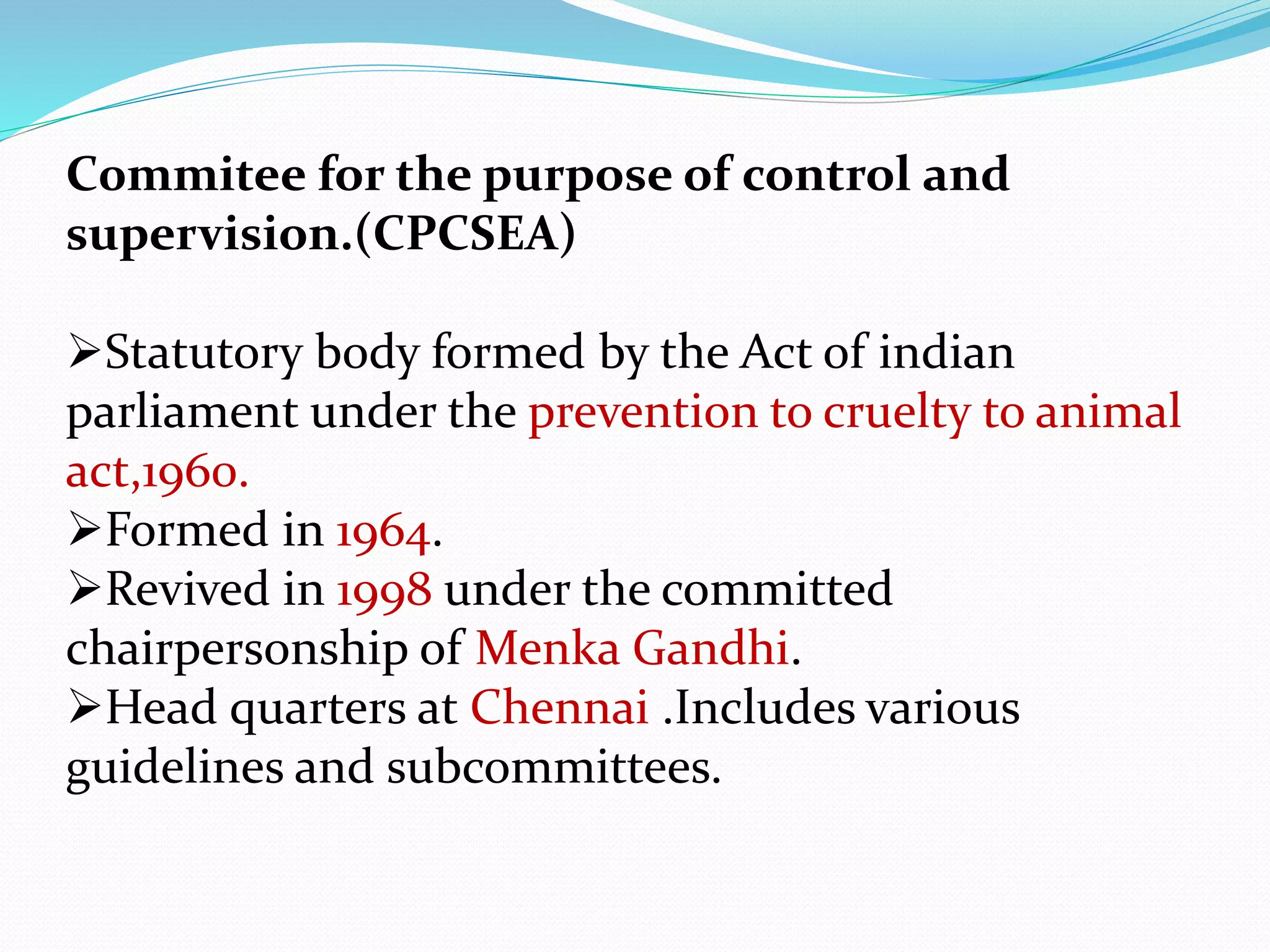
C0mmitee for the purpose of control and
supervision.(CPCSEA)
Statutory body formed by the Act of indian
parliament under the prevention to cruelty to animal
act,1960.
Formed in 1964.
Revived in 1998 under the committed
chairpersonship of Menka Gandhi.
Head quarters at Chennai .Includes various
guidelines and subcommittees.
National level expert committee to scrutinise
and approve the research projects conducting
using animals.
Introduce a national “good laboratory practice”
document.
Introduce the credo of ‘3R principles’.
2004 –CPCSEA officially accept the concept of
4th R.
“Investigator have moral responsibility to take
care of laboratory animals after use”.
This committee is composed of:-
•Regulatory authority
•Member of scientific community.
•Animal activist
•The committee has 10 experts and 3 official
members.
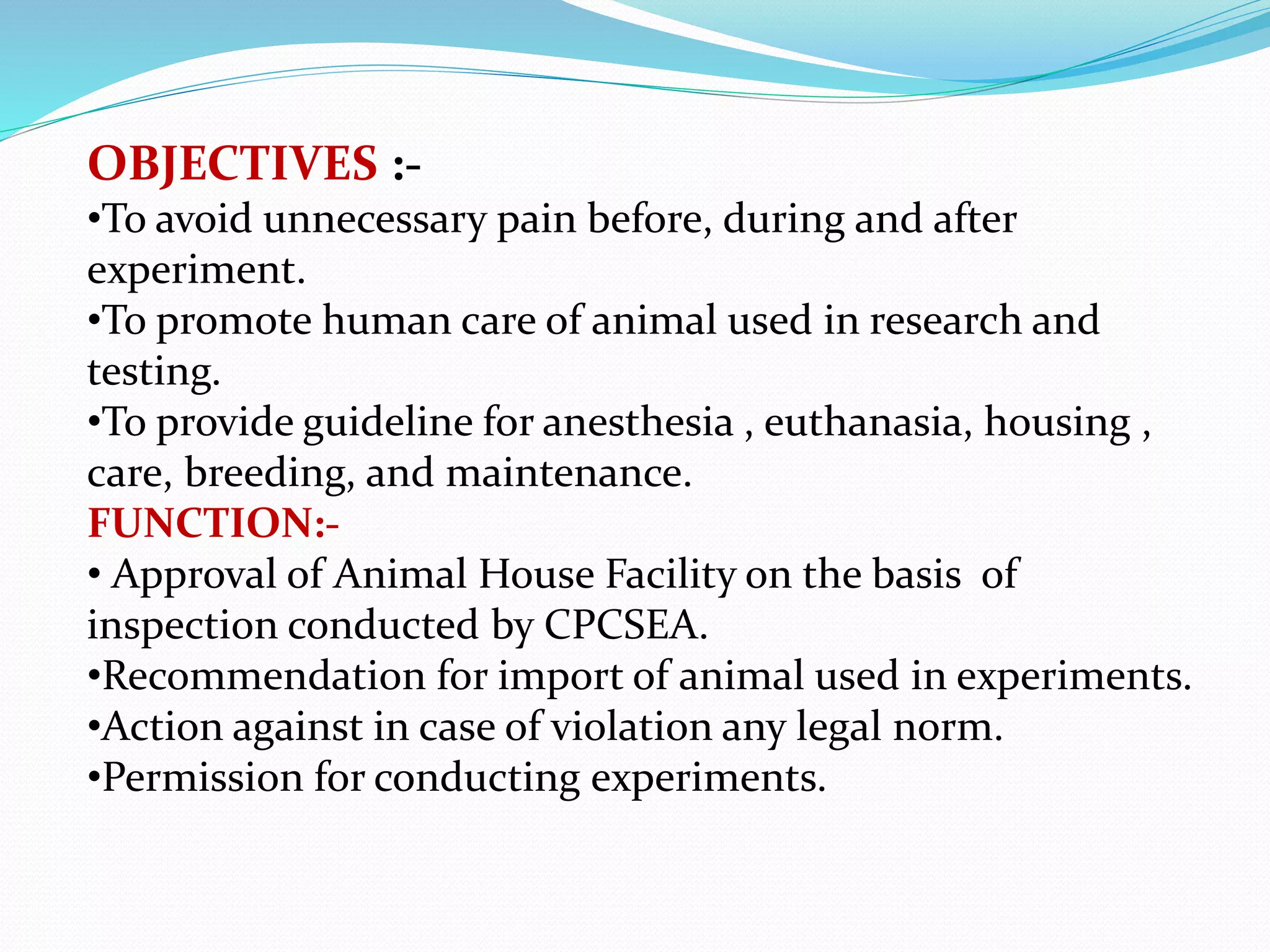
OBJECTIVES :-
•To avoid unnecessary pain before, during and after
experiment.
•To promote human care of animal used in research and
testing.
•To provide guideline for anesthesia , euthanasia, housing ,
care, breeding, and maintenance.
FUNCTION:-
• Approval of Animal House Facility on the basis of
inspection conducted by CPCSEA.
•Recommendation for import of animal used in experiments.
•Action against in case of violation any legal norm.
•Permission for conducting experiments.
 Veterinary care
Animal procurement
Quarantine ,separation and Stabilization
 Transport of animal
Servillince , Diagnosis, Treatment of disease
Laboratory animal Husbandry and management
Food and water
Bedding
Animal care and technical personnel
Sanitation and cleanliness
Duration of experiment
Personal hygiene
Caging and housing system
Restraint
Waste disposal
Emergency ,Weekend ,Holiday care
Location of animal facilities to laboratoris
Functional area requirement of animal facility
FUNCTIONAL AREA REQUIREMENT
OF ANIMAL FACILITY
Building material
Corridor
Utilities
Animal room doors
Exterior window
Floors
Walls and ceilings
Storage area
Experimental area
Environment
Sanitizing equipment
Location Of Animal Facilities to laboratories
Animal house should be located in isolated building far away
from human habitations and not exposed to dust , smoke
,noise, wild rodents and birds.
Housing area should be near to laboratories
The space should be well divided for various activities .
1. The animal room should occupy about 50-60% of total
constructed area .
2. 40 to 50 % area for store, washing, office and staff ,
machine room ,quarantine and corridors .
 Since animals are very sensitive to environmental changes
,sharp fluctuation in temperature ,Humidity ,Light , Sound
and Ventilation should be avoided.
STANDERD OPERATING PROCEDURE
AND GUIDELINES
SOP should contain following items
1. Name of author
2. Title of SOP
3. Date of approval
4. Reference of previous SOP on same subject and date (Issue
number and date )
5. Location and distribution of SOP s with sign of each
recipient
6. Objective
7. Detailed info of the instrument used in relation with
animals with methodology .
8. The name of manufacturer of the reagents
and methodology of analysis pertaining to
animals
9. Normal value of all parameters
10. Hazards identification and risk assesment
Environment .
 Temperature
 Humidity control
 Ventilation
 Power and Lighting
 Noise control
 Between 18-29 celcious
 Range 30-70
 Design with 112-15 air
cycles per hour
 System should be safe
 Fluorescent lights are
eeficient
 Emergency backup needed
 Noise free envioronment
 Concrete walls are more
effective
Food and Water
Feed should contain Feed should not contain
Moisture insecticide ,hormones
,antibiotics
crude fiber,crude fat
,crude protein
Potential toxicants
Essential bits Heavy metal
Anesthesia
 Before use of actual anesthetic , the animal should be
prepared for anesthesia by overnight fasting and using pre
anesthetic .
 Local anesthetic are used to block the nerve supply to a
limited area and should be used only for rapid and minor
procedure .
 For general anesthetic agents are used in the form of
inhalants , intravenous and intra -ocular type of injections.
The animal should remain in veterinary care till it completely
recover from anesthesia
COMMNLY USED ANESTHETIC AGENT FOR LABORATARY ANIMAL
Drug
Mg/ml
mouse rat Guinea
pig
KETAMINE HCL 22-24 im - 22-24 im
PENTO BARBITONE
SODIM
35 Iv
50 ip
35 iv
40 ip 30 iv
THIOPENTONE
SODIUM
25 iv
50 ip
20 iv
40 ip
20 iv
55 ip
URETHANES - 0.75 ip 1.5 ip
Euthanasia
In the event of decision to sacrifice the animal on
termination of the experiment or otherwise , an
approved method of euthanasia should be adopted.
The procedure should be carried out quickly and
painlessly in an atmosphere free from anxiety and fear
Methods used for euthanasia should meet the
following requirements :
Death , without causing anxiety , pain or distress
with minimum time lag phase
Compatibility with purpose of study and minimum
emotional effects on operator .
Location should be separate from animal room and
free from environmental contaminants .
Minimum physiological and psychological
disturbances .
The investigator must ensure that animal is
clinically dead before it is sent for disposal .
Euthanasia of Laboratory Animals
a) INHALATIONAL GASES
Carbon Monoxide
Carbon Dioxide
Carbon Dioxide + chloroform
Halothane
b) DRUG ADMINISTRATION
Barbiturate overdose (Route IP)
Chloral hydrate overdose (Route IP)
ketamine overdose
sodium pentothol overdose
c) PHYSICAL METHODS
Eloctrocution
Decapitation (For analysis of stress)
Cervical dislocation
Regulatory Mechanism of CPCSEA
1)CPCSEA- committee for the purpose of control
and supervision of experiments on animals .
2)Sub –committees of the CPCSEA
3)Sub committee on large animal (SCLA)
4)Sub committee for selection of CPCSEA
Nominees on institutional Animal ethics
committee (IAEC)
REFERENCES
 http://icmr.nic.in /animal _ethics.htm
cpcsea.nic .in
Google.com: Operational Guidelines
for Observance of Good Practices in
CPCSEA
www.aaalac.org /resource/SOP
THANK YOU

CPCSEA Guidelines ( Animal

  • 1.
    CPCSEA GUIDELINES FOR ANIMALHOUSE Presented by- Vasanti Patil M.Pharm First Year Quality assurance
  • 2.
    CONTENTS INTRODUCTION OBJECTIVE WHY ANIMALS AREUSED IN RESEARCH CPCSEA COMPOSITION OF COMMITTEE OBJECTIVES OF CPCSEA FUNCTIONS OF CPCSEA FUNCTIONAL REQUIREMENTS OF ANIMAL FACULTY LOCATION OF ANIMAL FACILITIES TO LABOROTARIES SOP AND GUIDELINES ANESTHESIA VARIOUS ANESTHETIC AGENTS USED FOR ANAESTHESIA EUTHANASIA  REGULATORY MECHANISM OF CPCSEA
  • 3.
    WHY ANIMALS AREUSED IN RESEARCH? •To understand the principles of anatomy and physiology which are true for all mammals. •Certain strains and breeds of animal get the same disease or as condition as human. •It is possible to control environment (temperature and humidity etc.) of animals and shield them from disease not related to research. •We can scientifically study physiology by using valid no of animal.
  • 4.
    C0mmitee for thepurpose of control and supervision.(CPCSEA) Statutory body formed by the Act of indian parliament under the prevention to cruelty to animal act,1960. Formed in 1964. Revived in 1998 under the committed chairpersonship of Menka Gandhi. Head quarters at Chennai .Includes various guidelines and subcommittees.
  • 5.
    National level expertcommittee to scrutinise and approve the research projects conducting using animals. Introduce a national “good laboratory practice” document. Introduce the credo of ‘3R principles’. 2004 –CPCSEA officially accept the concept of 4th R. “Investigator have moral responsibility to take care of laboratory animals after use”.
  • 6.
    This committee iscomposed of:- •Regulatory authority •Member of scientific community. •Animal activist •The committee has 10 experts and 3 official members.
  • 7.
    OBJECTIVES :- •To avoidunnecessary pain before, during and after experiment. •To promote human care of animal used in research and testing. •To provide guideline for anesthesia , euthanasia, housing , care, breeding, and maintenance. FUNCTION:- • Approval of Animal House Facility on the basis of inspection conducted by CPCSEA. •Recommendation for import of animal used in experiments. •Action against in case of violation any legal norm. •Permission for conducting experiments.
  • 8.
     Veterinary care Animalprocurement Quarantine ,separation and Stabilization  Transport of animal Servillince , Diagnosis, Treatment of disease Laboratory animal Husbandry and management Food and water Bedding Animal care and technical personnel Sanitation and cleanliness Duration of experiment Personal hygiene Caging and housing system
  • 9.
    Restraint Waste disposal Emergency ,Weekend,Holiday care Location of animal facilities to laboratoris Functional area requirement of animal facility
  • 10.
    FUNCTIONAL AREA REQUIREMENT OFANIMAL FACILITY Building material Corridor Utilities Animal room doors Exterior window Floors Walls and ceilings Storage area Experimental area Environment Sanitizing equipment
  • 11.
    Location Of AnimalFacilities to laboratories Animal house should be located in isolated building far away from human habitations and not exposed to dust , smoke ,noise, wild rodents and birds. Housing area should be near to laboratories The space should be well divided for various activities . 1. The animal room should occupy about 50-60% of total constructed area . 2. 40 to 50 % area for store, washing, office and staff , machine room ,quarantine and corridors .  Since animals are very sensitive to environmental changes ,sharp fluctuation in temperature ,Humidity ,Light , Sound and Ventilation should be avoided.
  • 12.
    STANDERD OPERATING PROCEDURE ANDGUIDELINES SOP should contain following items 1. Name of author 2. Title of SOP 3. Date of approval 4. Reference of previous SOP on same subject and date (Issue number and date ) 5. Location and distribution of SOP s with sign of each recipient 6. Objective 7. Detailed info of the instrument used in relation with animals with methodology .
  • 13.
    8. The nameof manufacturer of the reagents and methodology of analysis pertaining to animals 9. Normal value of all parameters 10. Hazards identification and risk assesment
  • 14.
    Environment .  Temperature Humidity control  Ventilation  Power and Lighting  Noise control  Between 18-29 celcious  Range 30-70  Design with 112-15 air cycles per hour  System should be safe  Fluorescent lights are eeficient  Emergency backup needed  Noise free envioronment  Concrete walls are more effective
  • 15.
    Food and Water Feedshould contain Feed should not contain Moisture insecticide ,hormones ,antibiotics crude fiber,crude fat ,crude protein Potential toxicants Essential bits Heavy metal
  • 16.
    Anesthesia  Before useof actual anesthetic , the animal should be prepared for anesthesia by overnight fasting and using pre anesthetic .  Local anesthetic are used to block the nerve supply to a limited area and should be used only for rapid and minor procedure .  For general anesthetic agents are used in the form of inhalants , intravenous and intra -ocular type of injections. The animal should remain in veterinary care till it completely recover from anesthesia
  • 17.
    COMMNLY USED ANESTHETICAGENT FOR LABORATARY ANIMAL Drug Mg/ml mouse rat Guinea pig KETAMINE HCL 22-24 im - 22-24 im PENTO BARBITONE SODIM 35 Iv 50 ip 35 iv 40 ip 30 iv THIOPENTONE SODIUM 25 iv 50 ip 20 iv 40 ip 20 iv 55 ip URETHANES - 0.75 ip 1.5 ip
  • 18.
    Euthanasia In the eventof decision to sacrifice the animal on termination of the experiment or otherwise , an approved method of euthanasia should be adopted. The procedure should be carried out quickly and painlessly in an atmosphere free from anxiety and fear
  • 19.
    Methods used foreuthanasia should meet the following requirements : Death , without causing anxiety , pain or distress with minimum time lag phase Compatibility with purpose of study and minimum emotional effects on operator . Location should be separate from animal room and free from environmental contaminants . Minimum physiological and psychological disturbances . The investigator must ensure that animal is clinically dead before it is sent for disposal .
  • 20.
    Euthanasia of LaboratoryAnimals a) INHALATIONAL GASES Carbon Monoxide Carbon Dioxide Carbon Dioxide + chloroform Halothane b) DRUG ADMINISTRATION Barbiturate overdose (Route IP) Chloral hydrate overdose (Route IP) ketamine overdose sodium pentothol overdose c) PHYSICAL METHODS Eloctrocution Decapitation (For analysis of stress) Cervical dislocation
  • 21.
    Regulatory Mechanism ofCPCSEA 1)CPCSEA- committee for the purpose of control and supervision of experiments on animals . 2)Sub –committees of the CPCSEA 3)Sub committee on large animal (SCLA) 4)Sub committee for selection of CPCSEA Nominees on institutional Animal ethics committee (IAEC)
  • 22.
    REFERENCES  http://icmr.nic.in /animal_ethics.htm cpcsea.nic .in Google.com: Operational Guidelines for Observance of Good Practices in CPCSEA www.aaalac.org /resource/SOP
  • 23.