How does ‘Cousin Kate’ reflect
  aspects of Victorian life?
Assessment:
AO1: 3%
• Relevant knowledge and understanding of literary texts
• Appropriate terminology to support interpretations
• Coherent, accurate written expression
AO2: 12%
• Identify relevant features of form, structure and language
• Explore how these shape meanings
• Use specific, carefully chosen quotes
AO3: 3%
• Explore links and connections between different literary texts
• Show understanding of different interpretations
AO4: 27%
• Demonstrate understanding of the relationships between texts and contexts
• Comment on the influence of culture, text type, literary genre or historical period
   on the ways in which literary texts were written and were - and are received.
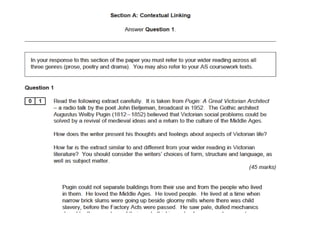
In attempting Question 1, students are advised to split their
   time evenly between the two parts of the question. It is
   perfectly acceptable for students to focus on the extract for
   thirty minutes, then spend the next thirty minutes writing
   about their relevant wider reading; however, more
   confident and sophisticated students may be able to
   produce integrated responses in which the extract and the
   wider reading comparisons are interwoven throughout the
   answer. Contrasts will also be an important part of
   successful responses, but their inclusion should be
   coherent: arbitrary, bolted-on texts with no obvious
   connection to the extract will not help students reach the
   higher bands of the mark scheme.
Analyse the extract:
     How does the writer present his
  thought and feelings about aspects of
             Victorian life?
Comment on….

Language:
Imagery (metaphor/simile)
Alliteration, assonance, sibilance
Triplets
Connotations of words
Etc.


Structure:
Repetition
Sentence structure (how do they start/finish)
Types of sentence (imperatives etc)
Patterns in language- recurring images or ideas
How does the argument/ narrative progress- look at the beginning and end of the extract.

Form:
How is the argument/idea developed?
How does Ruskin support his argument?
Homework:
• Make 3 comparisons between Cousin Kate and
  the extract
• Make one point for each and try to comment
  on either structure or form as well as
  language.
• Post these onto the blog.
Self assess- Find 3 things you have
          done well from the list
           Set yourself a target.
AO1: 3%
• Relevant knowledge and understanding of literary texts
• Appropriate terminology to support interpretations
• Coherent, accurate written expression
AO2: 12%
• Identify relevant features of form, structure and language
• Explore how these shape meanings
• Use specific, carefully chosen quotes
AO3: 3%
• Explore links and connections between different literary texts
• Show understanding of different interpretations
AO4: 27%
• Demonstrate understanding of the relationships between texts and contexts
• Comment on the influence of culture, text type, literary genre or historical period
   on the ways in which literary texts were written and were - and are received.

Cousin kate 2

  • 1.
    How does ‘CousinKate’ reflect aspects of Victorian life?
  • 2.
    Assessment: AO1: 3% • Relevantknowledge and understanding of literary texts • Appropriate terminology to support interpretations • Coherent, accurate written expression AO2: 12% • Identify relevant features of form, structure and language • Explore how these shape meanings • Use specific, carefully chosen quotes AO3: 3% • Explore links and connections between different literary texts • Show understanding of different interpretations AO4: 27% • Demonstrate understanding of the relationships between texts and contexts • Comment on the influence of culture, text type, literary genre or historical period on the ways in which literary texts were written and were - and are received.
  • 4.
    In attempting Question1, students are advised to split their time evenly between the two parts of the question. It is perfectly acceptable for students to focus on the extract for thirty minutes, then spend the next thirty minutes writing about their relevant wider reading; however, more confident and sophisticated students may be able to produce integrated responses in which the extract and the wider reading comparisons are interwoven throughout the answer. Contrasts will also be an important part of successful responses, but their inclusion should be coherent: arbitrary, bolted-on texts with no obvious connection to the extract will not help students reach the higher bands of the mark scheme.
  • 5.
    Analyse the extract: How does the writer present his thought and feelings about aspects of Victorian life? Comment on…. Language: Imagery (metaphor/simile) Alliteration, assonance, sibilance Triplets Connotations of words Etc. Structure: Repetition Sentence structure (how do they start/finish) Types of sentence (imperatives etc) Patterns in language- recurring images or ideas How does the argument/ narrative progress- look at the beginning and end of the extract. Form: How is the argument/idea developed? How does Ruskin support his argument?
  • 6.
    Homework: • Make 3comparisons between Cousin Kate and the extract • Make one point for each and try to comment on either structure or form as well as language. • Post these onto the blog.
  • 7.
    Self assess- Find3 things you have done well from the list Set yourself a target. AO1: 3% • Relevant knowledge and understanding of literary texts • Appropriate terminology to support interpretations • Coherent, accurate written expression AO2: 12% • Identify relevant features of form, structure and language • Explore how these shape meanings • Use specific, carefully chosen quotes AO3: 3% • Explore links and connections between different literary texts • Show understanding of different interpretations AO4: 27% • Demonstrate understanding of the relationships between texts and contexts • Comment on the influence of culture, text type, literary genre or historical period on the ways in which literary texts were written and were - and are received.