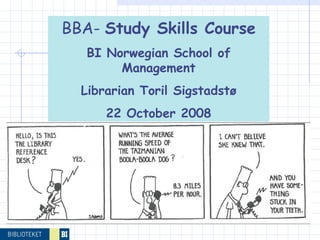
BBA-  Study Skills Course BI Norwegian School of Management Librarian Toril Sigstadstø 22 October 2008
Session outline Part one : Do we need a library? The search process Selection of sources Citation and correct use of sources Part two : Basic search techniques: Exercises Books (Bibsys) Articles (Business Source Complete)
Library focus Facilitate and support: B I’s research  BI’s teaching The student’s own learning BI  Library   webpage
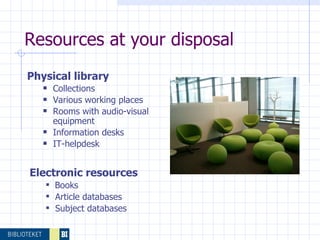
Resources at your disposal Physical library Collections  Various working places Rooms with audio-visual equipment Information desks IT-helpdesk Electronic resources Books Article databases  Subject databases
Public information Library catalogues (Bibsys Ask) Subject databases (i.e. company information) Article databases Dictionaries and encyclopedia  The open internet –  Google Scholar Some of your choices…
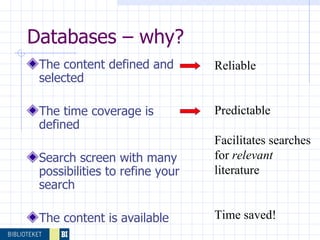
Databases – why? The content defined and selected  The time coverage is defined Search screen with many possibilities to refine your search The content is available Reliable Predictable Facilitates searches for  relevant  literature Time saved!
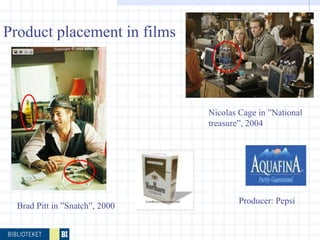
Brad Pitt in ”Snatch”, 2000 Nicolas Cage in ”National treasure”, 2004 Producer: Pepsi Product placement in films
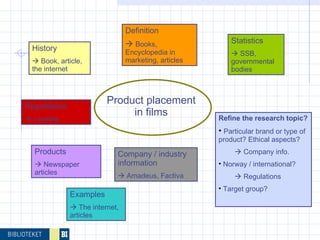
Product placement in films History    Book, article, the internet Regulations    Lovdata  Statistics    SSB, governmental bodies Products    Newspaper articles Examples    The internet, articles Company / industry information    Amadeus, Factiva Refine the research topic? Particular brand or type of product? Ethical aspects?    Company info. Norway / international?    Regulations Target group? Definition    Books, Encyclopedia in marketing, articles
Searching for literature – where? Books:  Bibsys:  References to books, research reports, doctoral  dissertations, student works, series etc    Ebrary:  Elektronic books in fulltext Journal articles : -International:  Business Source Complete      ISI Web of Science   Newspaper articles:   -International:     Factiva -Norwegian:   Atekst
  Company information Norwegian: Proff Forvalt (only in Norwegian) International  Amadeus (European) Factiva (international) Kompass (international) Datastream (international) Company homepage Newspaper archives (Factiva & Atekst (Norwegian) Business Source Complete  Oslo Stock Exchange – annual reports Research reports, student papers
Searching Techniques  Meaningful search terms   Translate your ”research question” into search terms 0 results? Truncate: write an * at the end of the search term.     Ex:  strateg * returns hits on  strategic strategy, strategies … and even in Norwegian! Search for synonymes.     Ex:  company – firm  –  organization Check the spelling, name, language etc Too many results? Combine two or more words or expressions Limit the search to a field ( f ex author, title, subject, abstract) Limit to time period, document type, peer reviewed
Look for: Author or publisher Date Motivation – why? Links out – verify the content and facts VIKO - Your guide to information literacy Source evaluation - webpages
Published by whom?  ( Publisher) Published where? (peer reviewed journal?) Date of publishing (new - outdated?) Data collection – which method? Is there a reference list – what are the sources? Read the abstract, check the keywords Is the author an authority within the field? Source evaluation- journal articles
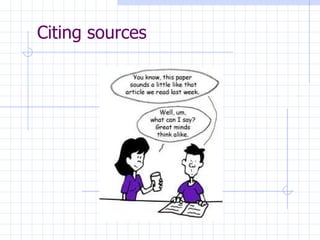
Citing sources
To let the reader know what the student’s own contributions are and what is taken from others  To permit the reader to find the item cited To acknowledge the contributions of the original authors  To let the student share his knowledge about the subject and what is written about it.     Avoid plagiarism Why?
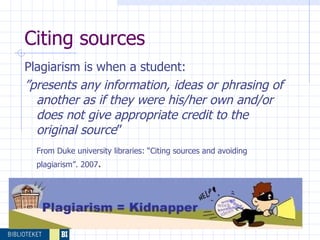
Citing sources  Plagiarism is when a student: ” presents any information, ideas or phrasing of another as if they were his/her own and/or does not give appropriate credit to the original source ” From Duke university libraries: “Citing sources and avoiding plagiarism”. 2007 .
  Citing sources - How? Reference in the text (citation) Reference list at the end of the paper (integrated part of the paper)
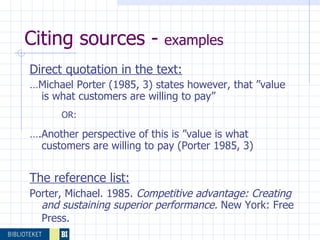
Citing sources -  examples  Direct quotation in the text: … Michael Porter (1985, 3) states however, that ”value is what customers are willing to pay” OR: … .Another perspective of this is ”value is what customers are willing to pay (Porter 1985, 3) The reference list: Porter, Michael. 1985.  Competitive advantage: Creating and sustaining superior performance.  New York: Free Press.
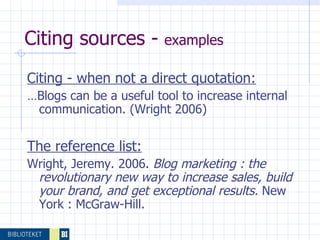
Citing sources -  examples Citing - when not a direct quotation: … Blogs can be a useful tool to increase internal communication. (Wright 2006) The reference list: Wright, Jeremy. 2006.  Blog marketing : the revolutionary new way to increase sales, build your brand, and get exceptional results.   New York : McGraw-Hill.
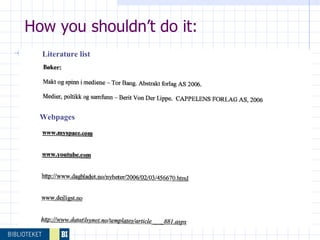
Webpages How you shouldn’t do it: Literature list
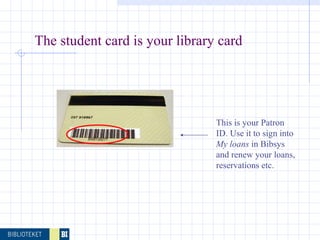
The student card is your library card This is your Patron ID. Use it to sign into  My loans  in Bibsys and renew your loans, reservations etc.
Help! Information desks in the library  Interlibrary loan Book a  librarian   and Ask the library   Remote  Access Training (library training, SPSS) User manuals / help functions : printouts in the library and ”Help/FAQ” in the databases

Couse on Study Skills - BI Library

  • 1.
    BBA- StudySkills Course BI Norwegian School of Management Librarian Toril Sigstadstø 22 October 2008
  • 2.
    Session outline Partone : Do we need a library? The search process Selection of sources Citation and correct use of sources Part two : Basic search techniques: Exercises Books (Bibsys) Articles (Business Source Complete)
  • 3.
    Library focus Facilitateand support: B I’s research BI’s teaching The student’s own learning BI Library webpage
  • 4.
    Resources at yourdisposal Physical library Collections Various working places Rooms with audio-visual equipment Information desks IT-helpdesk Electronic resources Books Article databases Subject databases
  • 5.
    Public information Librarycatalogues (Bibsys Ask) Subject databases (i.e. company information) Article databases Dictionaries and encyclopedia The open internet – Google Scholar Some of your choices…
  • 6.
    Databases – why?The content defined and selected The time coverage is defined Search screen with many possibilities to refine your search The content is available Reliable Predictable Facilitates searches for relevant literature Time saved!
  • 7.
    Brad Pitt in”Snatch”, 2000 Nicolas Cage in ”National treasure”, 2004 Producer: Pepsi Product placement in films
  • 8.
    Product placement infilms History  Book, article, the internet Regulations  Lovdata Statistics  SSB, governmental bodies Products  Newspaper articles Examples  The internet, articles Company / industry information  Amadeus, Factiva Refine the research topic? Particular brand or type of product? Ethical aspects?  Company info. Norway / international?  Regulations Target group? Definition  Books, Encyclopedia in marketing, articles
  • 9.
    Searching for literature– where? Books:  Bibsys: References to books, research reports, doctoral dissertations, student works, series etc  Ebrary: Elektronic books in fulltext Journal articles : -International:  Business Source Complete  ISI Web of Science Newspaper articles: -International:  Factiva -Norwegian:  Atekst
  • 10.
    Companyinformation Norwegian: Proff Forvalt (only in Norwegian) International Amadeus (European) Factiva (international) Kompass (international) Datastream (international) Company homepage Newspaper archives (Factiva & Atekst (Norwegian) Business Source Complete Oslo Stock Exchange – annual reports Research reports, student papers
  • 11.
    Searching Techniques Meaningful search terms Translate your ”research question” into search terms 0 results? Truncate: write an * at the end of the search term.  Ex: strateg * returns hits on strategic strategy, strategies … and even in Norwegian! Search for synonymes.  Ex: company – firm – organization Check the spelling, name, language etc Too many results? Combine two or more words or expressions Limit the search to a field ( f ex author, title, subject, abstract) Limit to time period, document type, peer reviewed
  • 12.
    Look for: Authoror publisher Date Motivation – why? Links out – verify the content and facts VIKO - Your guide to information literacy Source evaluation - webpages
  • 13.
    Published by whom? ( Publisher) Published where? (peer reviewed journal?) Date of publishing (new - outdated?) Data collection – which method? Is there a reference list – what are the sources? Read the abstract, check the keywords Is the author an authority within the field? Source evaluation- journal articles
  • 14.
  • 15.
    To let thereader know what the student’s own contributions are and what is taken from others To permit the reader to find the item cited To acknowledge the contributions of the original authors To let the student share his knowledge about the subject and what is written about it.  Avoid plagiarism Why?
  • 16.
    Citing sources Plagiarism is when a student: ” presents any information, ideas or phrasing of another as if they were his/her own and/or does not give appropriate credit to the original source ” From Duke university libraries: “Citing sources and avoiding plagiarism”. 2007 .
  • 17.
    Citingsources - How? Reference in the text (citation) Reference list at the end of the paper (integrated part of the paper)
  • 18.
    Citing sources - examples Direct quotation in the text: … Michael Porter (1985, 3) states however, that ”value is what customers are willing to pay” OR: … .Another perspective of this is ”value is what customers are willing to pay (Porter 1985, 3) The reference list: Porter, Michael. 1985. Competitive advantage: Creating and sustaining superior performance. New York: Free Press.
  • 19.
    Citing sources - examples Citing - when not a direct quotation: … Blogs can be a useful tool to increase internal communication. (Wright 2006) The reference list: Wright, Jeremy. 2006. Blog marketing : the revolutionary new way to increase sales, build your brand, and get exceptional results. New York : McGraw-Hill.
  • 20.
    Webpages How youshouldn’t do it: Literature list
  • 21.
    The student cardis your library card This is your Patron ID. Use it to sign into My loans in Bibsys and renew your loans, reservations etc.
  • 22.
    Help! Information desksin the library Interlibrary loan Book a librarian and Ask the library Remote Access Training (library training, SPSS) User manuals / help functions : printouts in the library and ”Help/FAQ” in the databases

Editor's Notes

  • #3 I’ve already said that the library plays an importaint role in an academic institution and I’ll try to answer why in this first part of our session. Search process
  • #4 What is the library’s main focus? Well we shall BI’s research: how? We select and buy a wide range of journals, databases, books, all in very close collaboration whith the researchers. BI is a resrarch institution and it is importaint that what we offer our students and researchers is relevant to the subject fields that are being tought and researched at the school. Teaching: Participate at all levels Bachelor, msc, doctoral programme Student’s own learning: physical library together with electronic resourses As you can see, the library is well integrated in the schools activities
  • #5 I mentioned the physical lirary which I hope you all have had a look at the facilities:
  • #6 Closed databases that require subscription in order to access. Use the library webpage as a portal to your literature search. Decide which sources are relevant for your research topic Webpage: potal to the resources Next: why subscribed databases?
  • #7 Next. Let’s have alook at a research topic and how it may be attacted:
  • #8 Lets say you have chosen to write about product plaenent in films. I guess that you all whatch a lot of films and have noticed the obvious placements you sometimes find. Here are some examples: Here we have Brad Pitt in the film called Snatch from 2000 and we can clearly see the package of marlboro cigarettes and if one looks very closely, one would probably recognize the bottle label in the background here. Now how would you start a literature research project for this assigment? Let’s hav a look at one suggestion. Obiviously, the amount and type of information has to be adapted to the type of assignment!
  • #9 Ad siste: Search process:
  • #11 Let’s have a look at the library homepage and do a search on the publishing industry in Norway. Gyldendal – employees,
  • #14 Oxford university press
  • #16 YOu have found the books, articles, websites, whatever you need and start writing. Do you have to cite your sources? The short answer to this is yes. In an academic environment you are expected to acknowledge and give credit to other’s work and writing. So the answer to why cite your sources is …. By doing this you avoid plagiarism. Now how can we define plagiarism?
  • #17 Different ways to show that what you write is taken from somebody else’s work: Quotation, paraphrazing, facts Let’s look at an example: Everybody knows that Norway is a big producer of oil. This is a commonly known fact and does not need to be named. However if you want to state how much we produce per day and how the production has developed over the years, you would have to state your source OPk let’s move on to how to site:
  • #18 Proper reference consists of two elements: Let me show you an example I’ve found in a student paper: Tell me what you think about it
  • #19 3 refers to page 3 in this book
  • #20 End of part 1 – break: next part do some exercises together