By
Mahmoud shaqria
‫شقريه‬ ‫محمود‬
Under supervision :
Dr. Rasha Ebraheem
Presented By :
Mahmoud Shakria
Outlines:
 Definition of course specification
 Principles of for course specification
 Importance of course specification
 Intended Learning Outcomes (ILOs)
 Learning Outcomes
 Importance of Learning Outcomes
 Graduate Attributes
 Templates for Course Specifications
What is course specifications?
Course Specification
Definition:-
 A written specification of the objectives, content,
assessment methods, and other relevant details of a
Course.
Course Specifications is:
 A Contract between University and staff member.
 A course specification details what the University agrees to
provide in the offering of the course and outlines the
expectations on the student.
 A Contract between Students and staff member.
 Students are entitled to expect that the course will be
delivered and assessed as in the Course Specification.
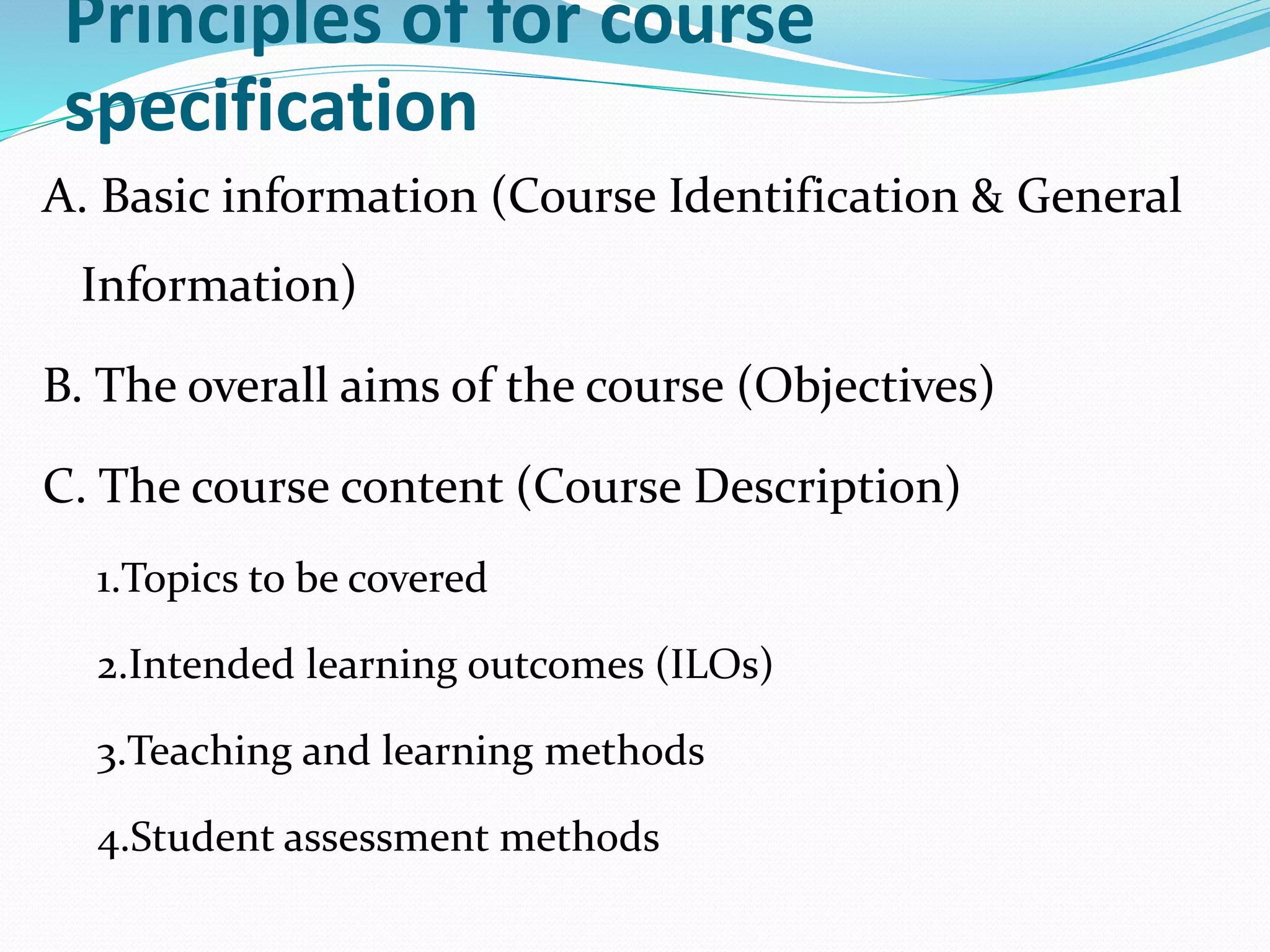
Principles of for course
specification
A. Basic information (Course Identification & General
Information)
B. The overall aims of the course (Objectives)
C. The course content (Course Description)
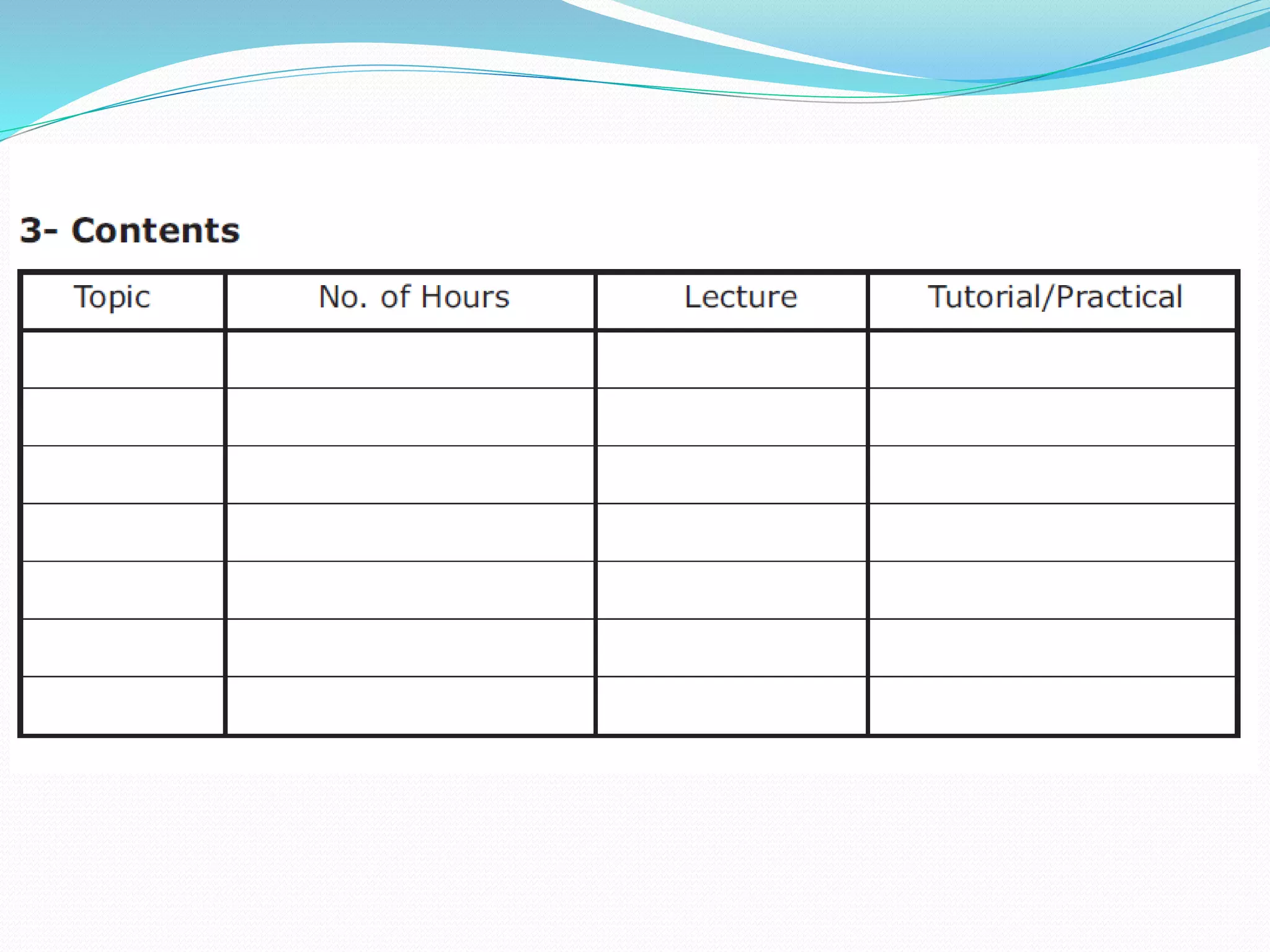
1.Topics to be covered
2.Intended learning outcomes (ILOs)
3.Teaching and learning methods
4.Student assessment methods
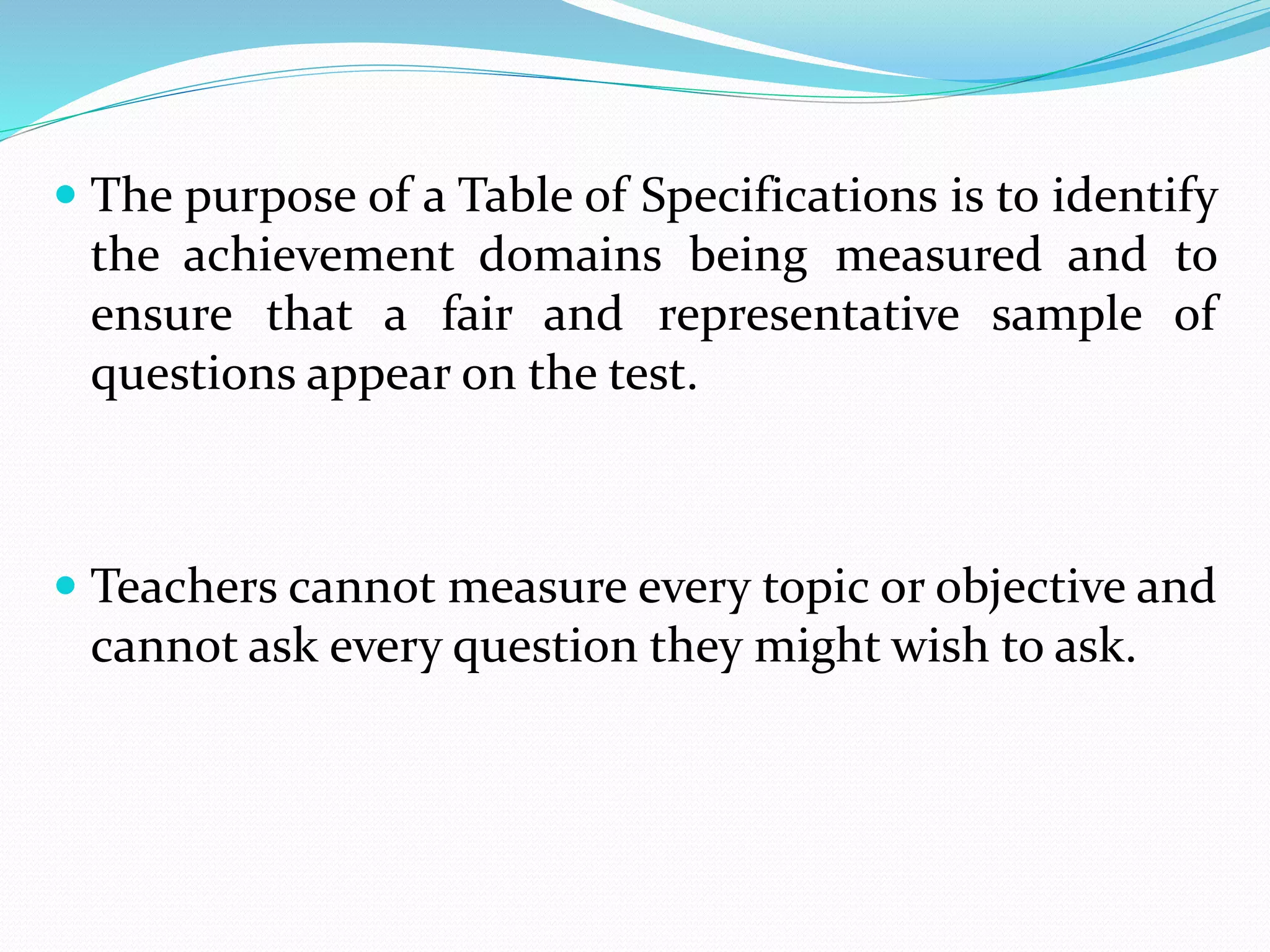
D. Student Academic Counseling and Support
E. A list of books and references
F. The facilities required for teaching and learning.
G. Course Evaluation and Improvement Processes
Importance of course specification for teacher and
learners
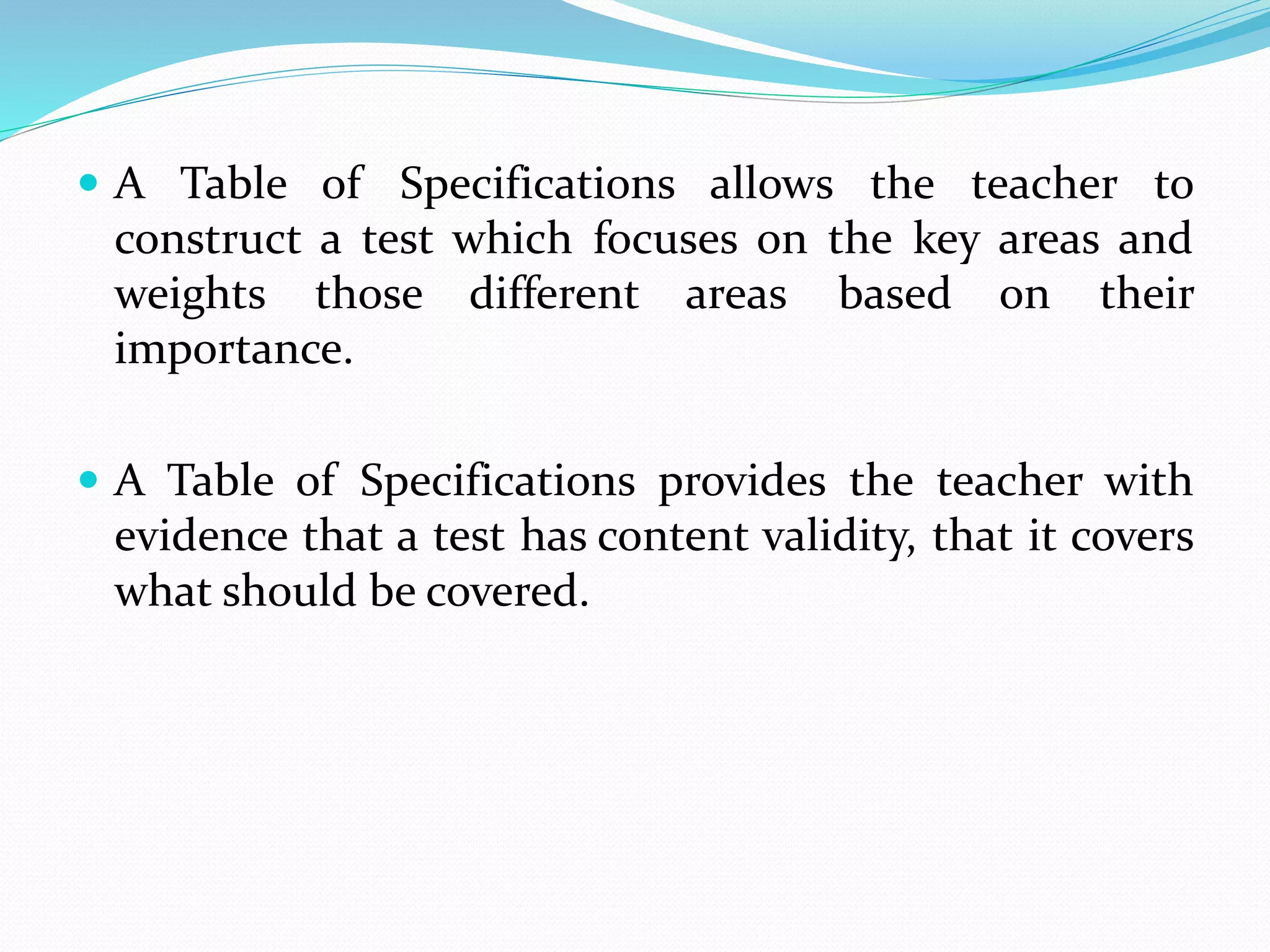
 The purpose of a Table of Specifications is to identify
the achievement domains being measured and to
ensure that a fair and representative sample of
questions appear on the test.
 Teachers cannot measure every topic or objective and
cannot ask every question they might wish to ask.
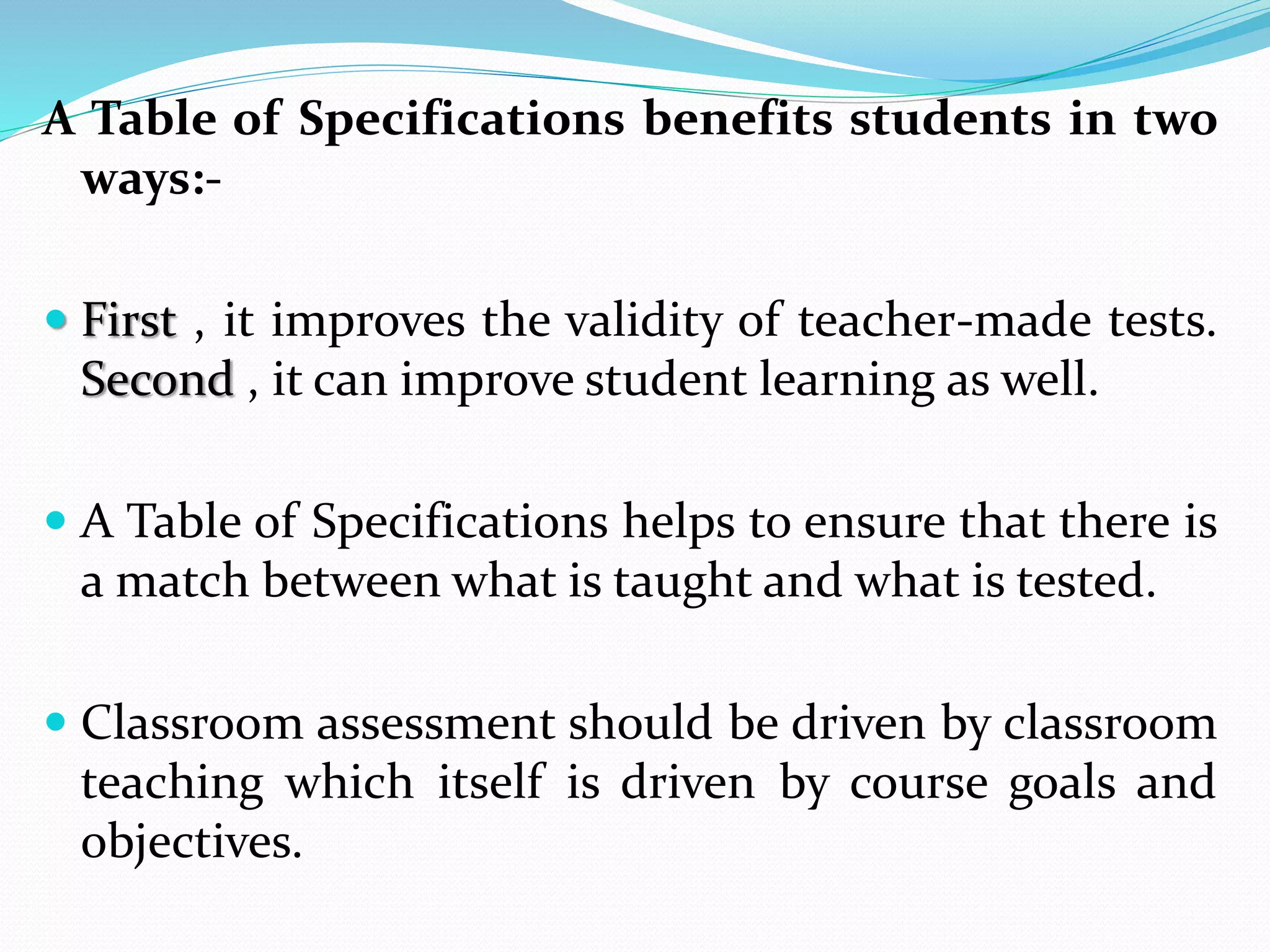
 A Table of Specifications allows the teacher to
construct a test which focuses on the key areas and
weights those different areas based on their
importance.
 A Table of Specifications provides the teacher with
evidence that a test has content validity, that it covers
what should be covered.
A Table of Specifications benefits students in two
ways:-
 First , it improves the validity of teacher-made tests.
Second , it can improve student learning as well.
 A Table of Specifications helps to ensure that there is
a match between what is taught and what is tested.
 Classroom assessment should be driven by classroom
teaching which itself is driven by course goals and
objectives.
Intended Learning Outcomes
(ILOs)
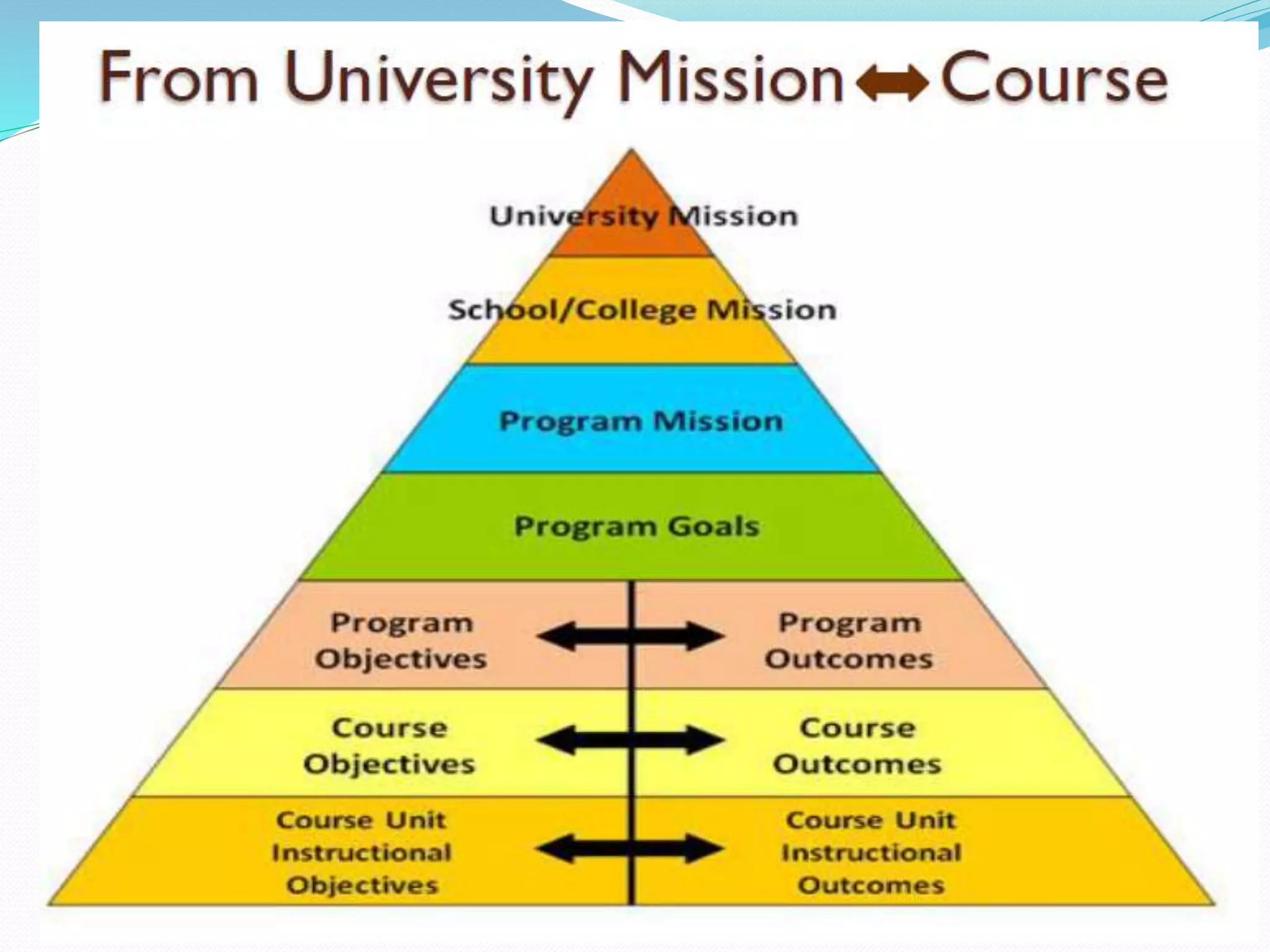
 An outcome-based curriculum design begins with
defining the student learning outcomes for the
programme and the component subjects.
 Defined as the particular knowledge, skills, and
abilities that an instructor intends for students to
learn or develop.
 They are student-centered rather than teacher-
centered, in that they describe what the students
will do, not what the instructor will teach.
Importance of Learning
Outcomes?
 Learning outcomes help faculty to:
 Decide our emphasis in the course: Of all the things we could teach,
what should we teach?
 Decide how best to teach: Teaching students to analyze requires different
teaching approaches from teaching students to memorize.
 Decide how best to assess learning: Do I need a project or a final exam?
 Communicate expectations to students: What are our decisions on the
matters above?
Learning outcomes help students by:
 Creating a connection between teaching and learning,
between professors and students
 Taking much of the guessing out of the student's attempt
to learn
 Enabling them to truly master the content of the course
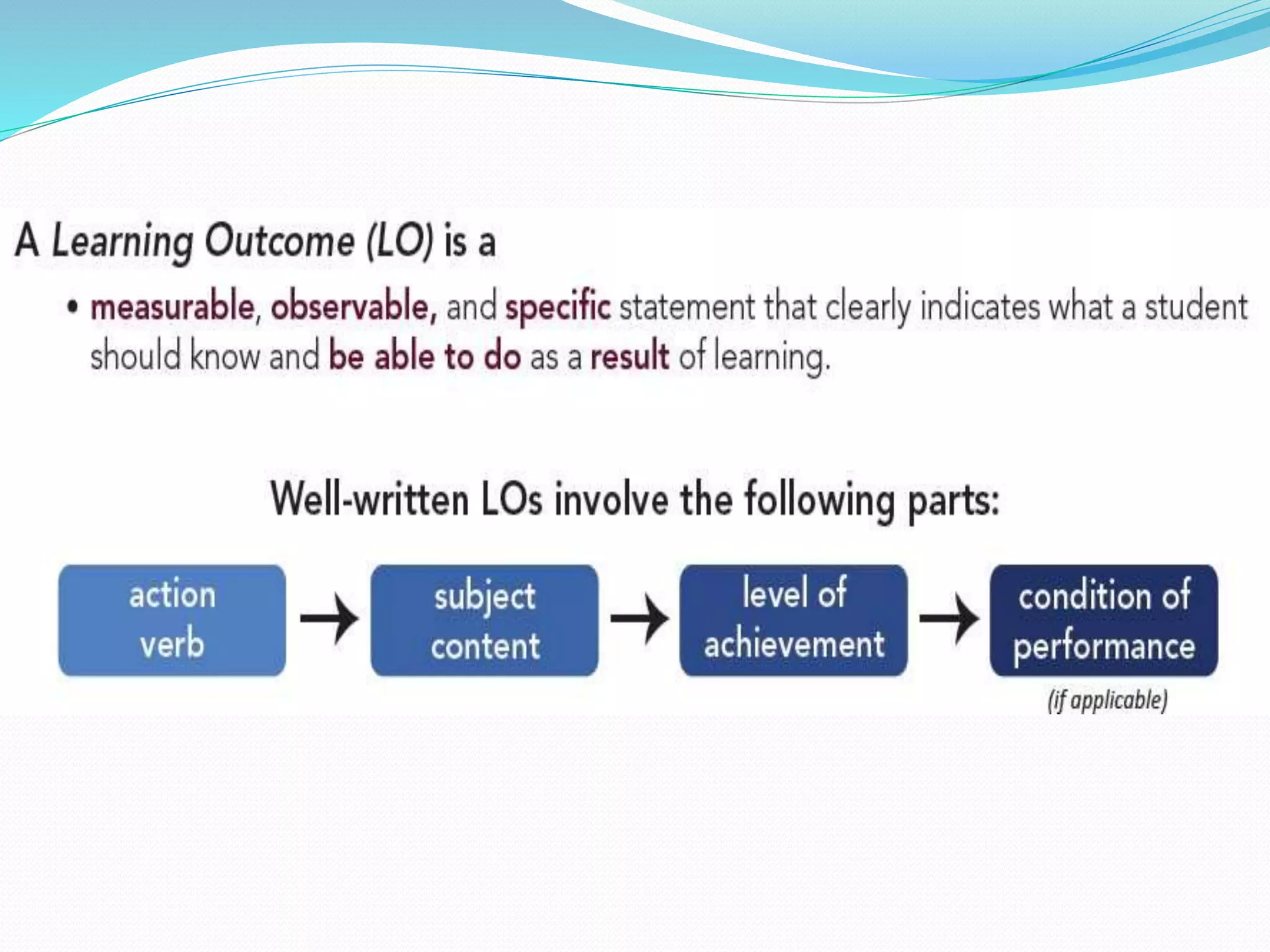
Format of the Learning Outcome
 Statement Bloom’s Revised Taxonomy provides the
framework for writing course-level learning outcomes.
 Each learning outcome is represented by a sentence that
consists of an action verb related to a cognitive process and
a clearly defined content related to a specific knowledge
type.
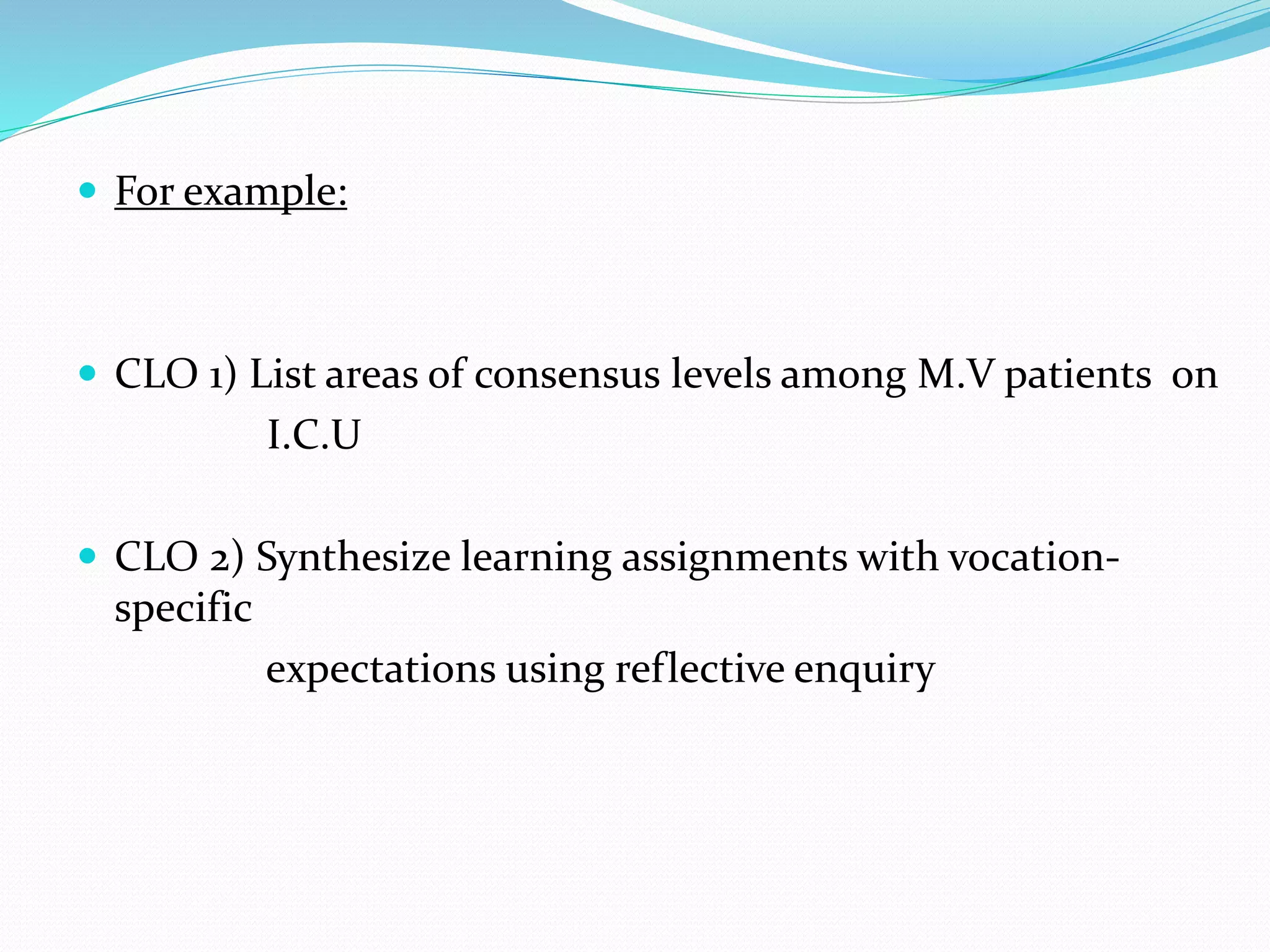
 For example:
 CLO 1) List areas of consensus levels among M.V patients on
I.C.U
 CLO 2) Synthesize learning assignments with vocation-
specific
expectations using reflective enquiry
Graduate Attributes
Graduate Attributes :-
 Defined as qualities, attitudes and dispositions that graduates
should possess, in full or part, when they have completed their
course .
The 12 Graduate Attributes
1. (KB) A knowledge base for engineering:
Demonstrated competence in university level
mathematics, natural sciences, engineering
fundamentals, and specialized engineering
knowledge appropriate to the program.
2. (PA) Problem analysis: An ability to use appropriate
knowledge and skills to identify, formulate, analyze,
and solve complex engineering problems in order to
reach substantiated conclusions
3. (Inv.) Investigation: An ability to conduct
investigations of complex problems by methods
that include appropriate experiments, analysis and
interpretation of data and synthesis of information
in order to reach valid conclusions.
4. (Des.) Design: An ability to design solutions for
complex, open-ended engineering problems and to
design systems, components or processes that meet
specified needs with appropriate attention to health
and safety risks, applicable standards, and
economic, environmental, cultural and societal
considerations.
5. (Tools) Use of engineering tools: An ability to
create, select, apply, adapt, and extend appropriate
techniques, resources, and modern engineering
tools to a range of engineering activities, from
simple to complex, with an understanding of the
associated limitations.
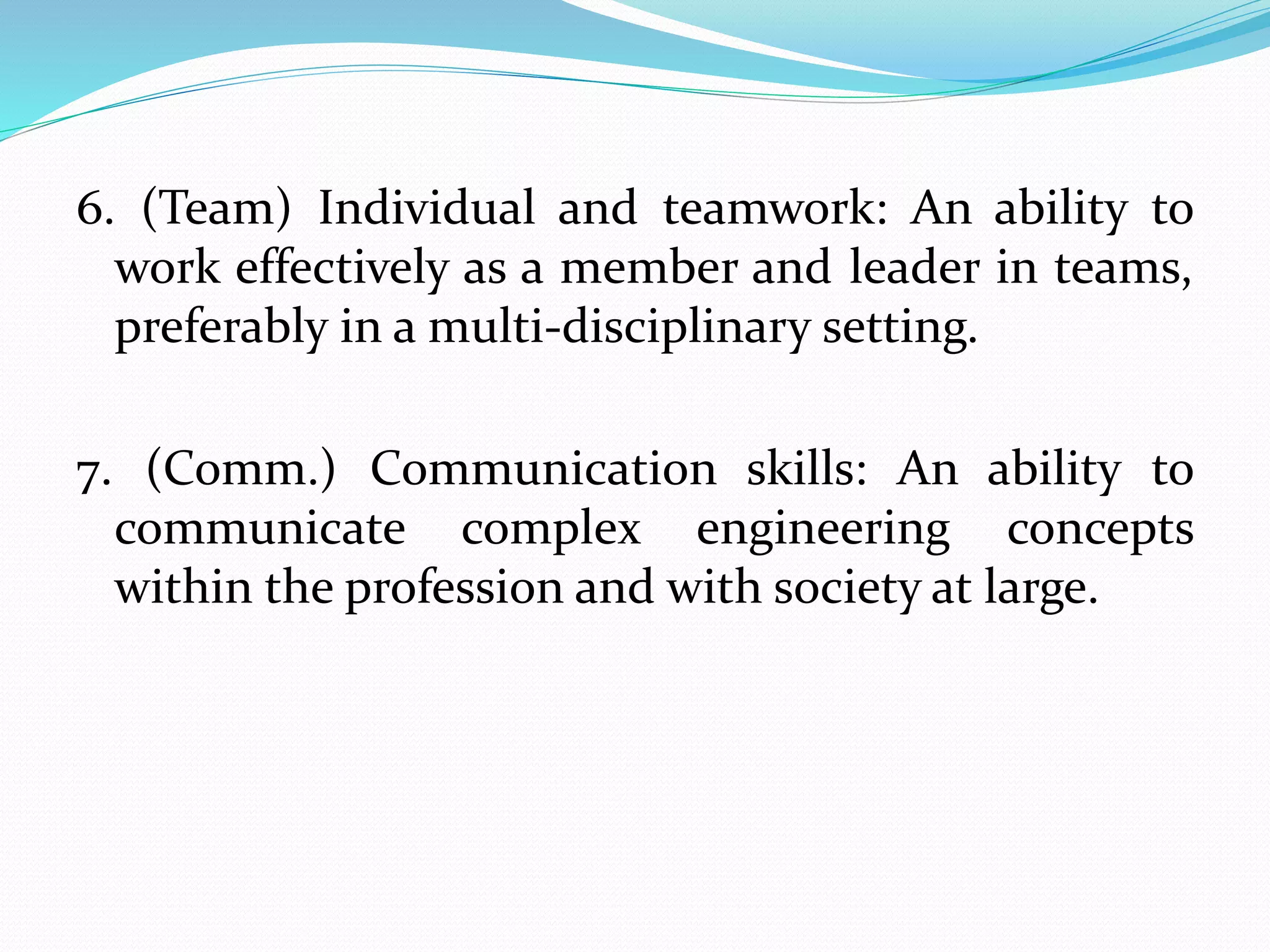
6. (Team) Individual and teamwork: An ability to
work effectively as a member and leader in teams,
preferably in a multi-disciplinary setting.
7. (Comm.) Communication skills: An ability to
communicate complex engineering concepts
within the profession and with society at large.
8. (Prof.) Professionalism: An understanding of the
roles and responsibilities of the professional
engineer in society, especially the primary role of
protection of the public and the public interest.
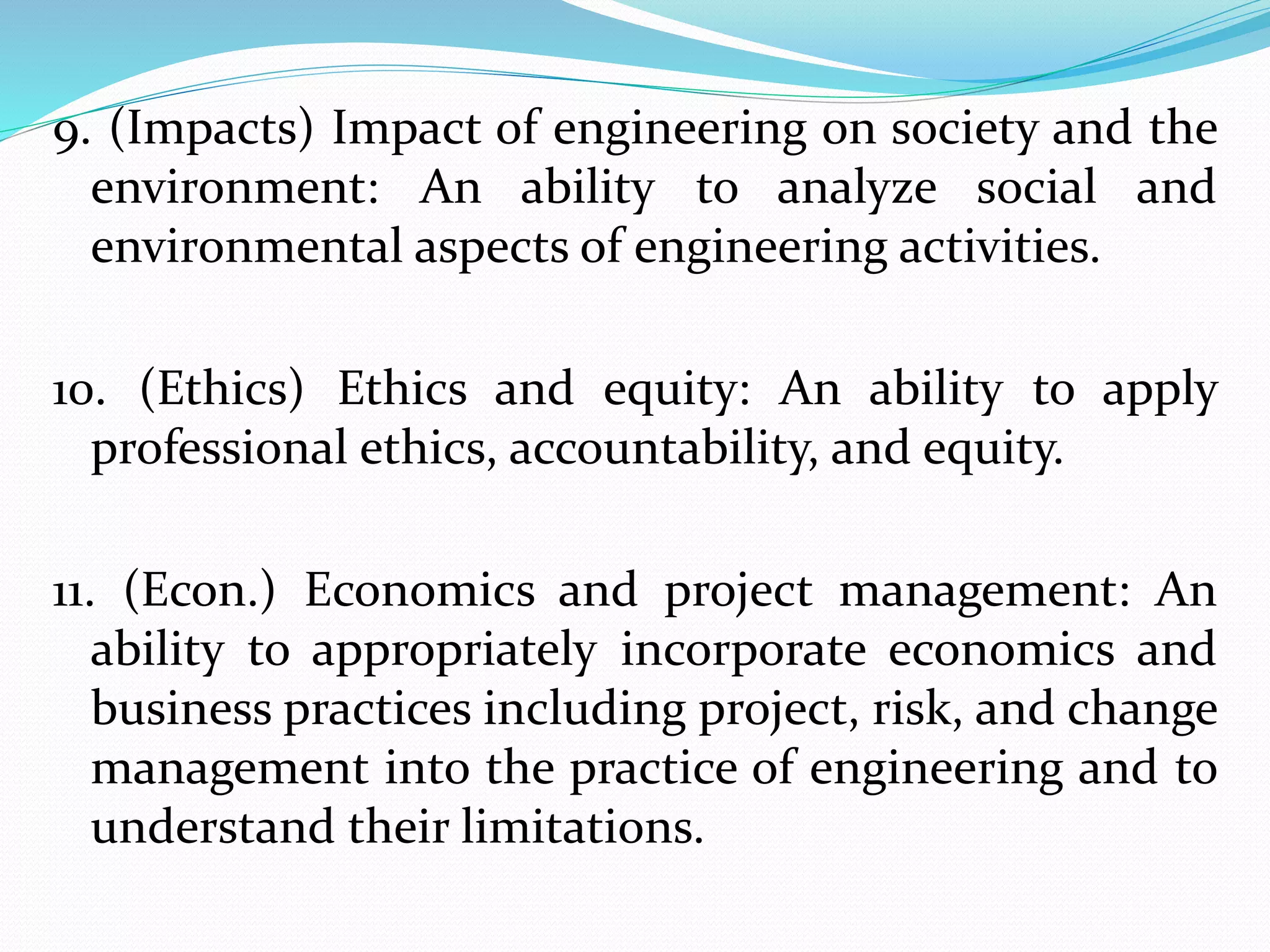
9. (Impacts) Impact of engineering on society and the
environment: An ability to analyze social and
environmental aspects of engineering activities.
10. (Ethics) Ethics and equity: An ability to apply
professional ethics, accountability, and equity.
11. (Econ.) Economics and project management: An
ability to appropriately incorporate economics and
business practices including project, risk, and change
management into the practice of engineering and to
understand their limitations.
12. (LL) Life-long learning: An ability to identify and
to address their own educational needs in a
changing world in ways sufficient to maintain their
competence and to allow them to contribute to the
advancement of knowledge
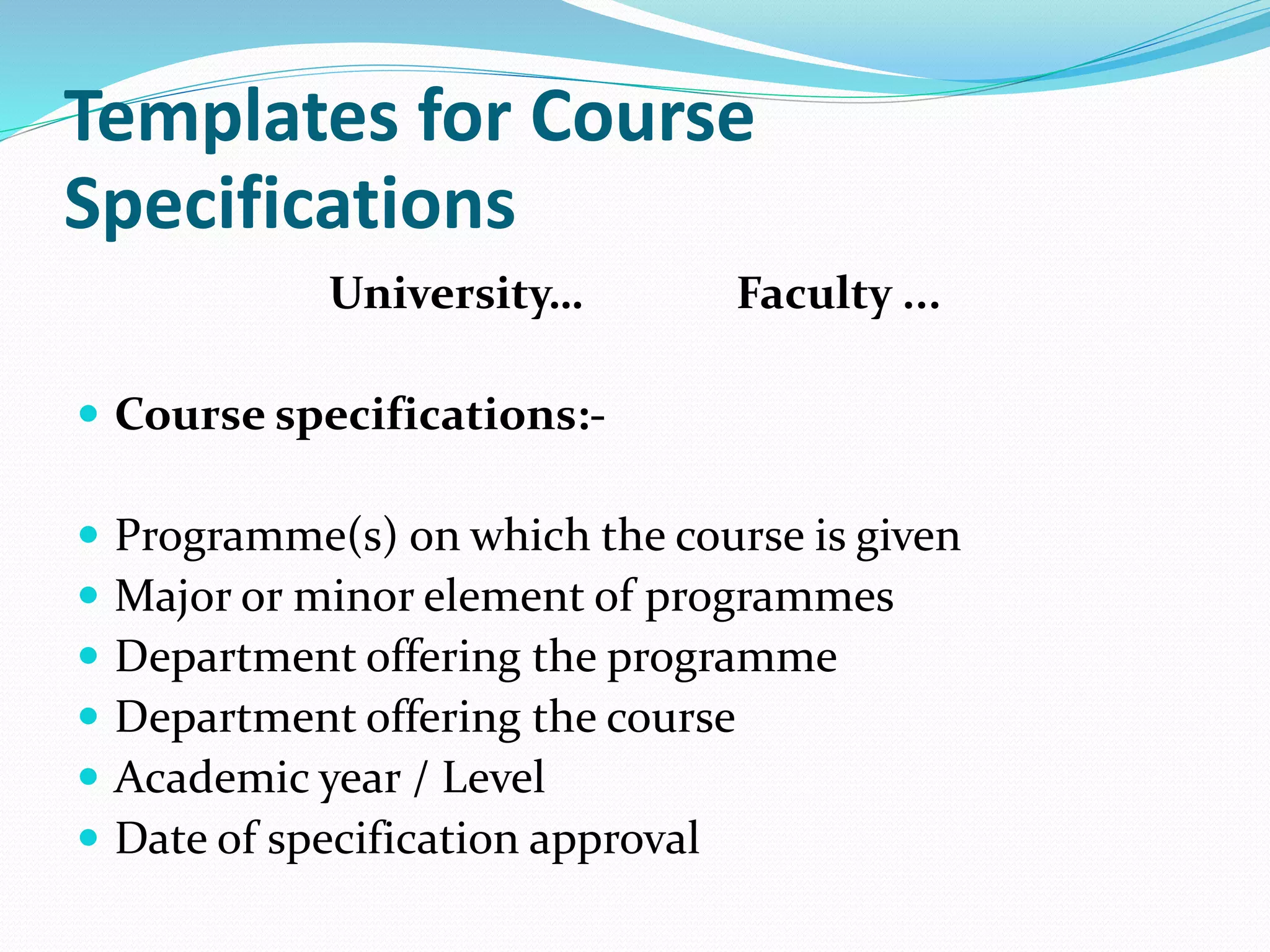
Templates for Course
Specifications
University… Faculty ...
 Course specifications:-
 Programme(s) on which the course is given
 Major or minor element of programmes
 Department offering the programme
 Department offering the course
 Academic year / Level
 Date of specification approval
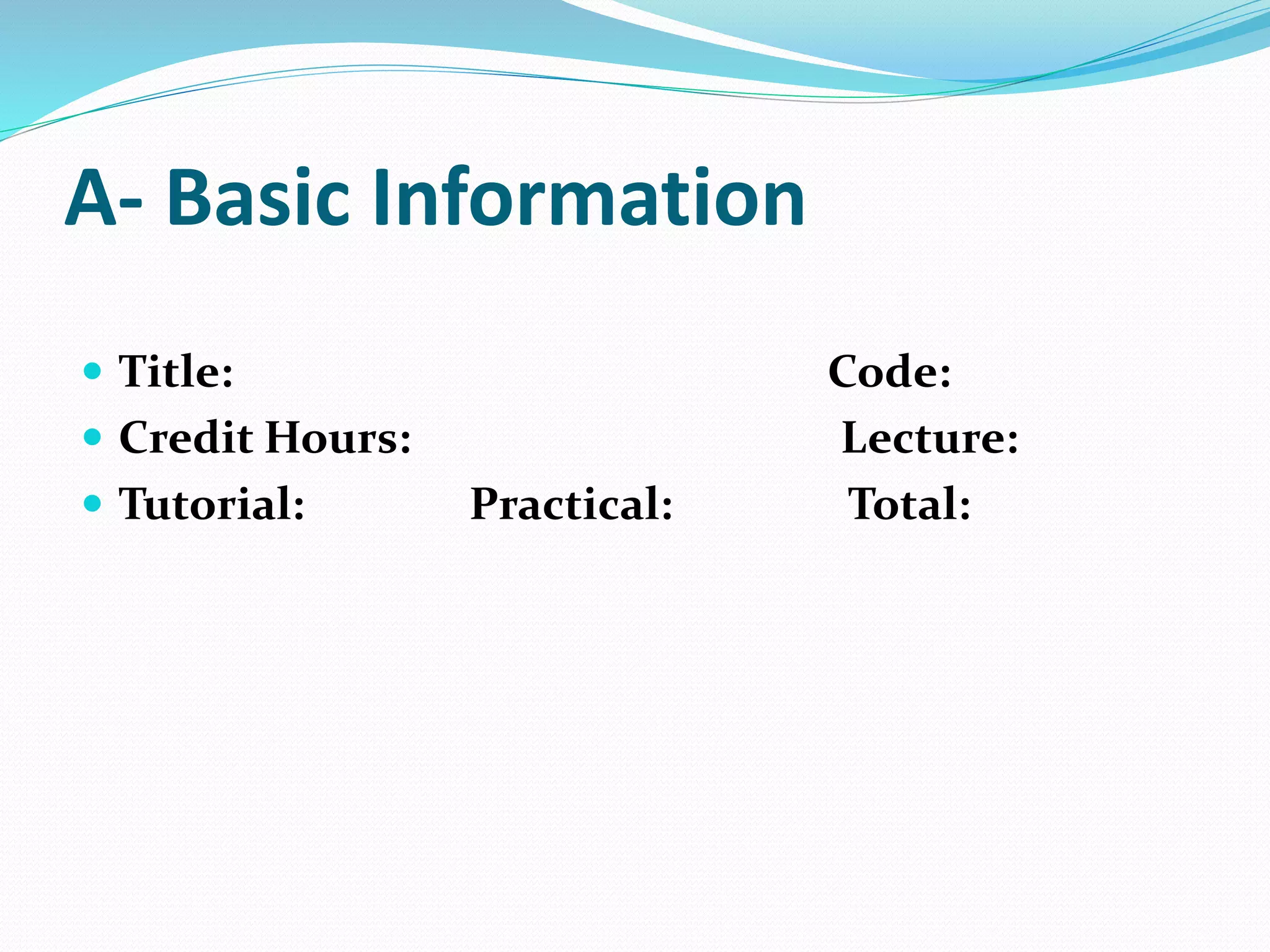
A- Basic Information
 Title: Code:
 Credit Hours: Lecture:
 Tutorial: Practical: Total:
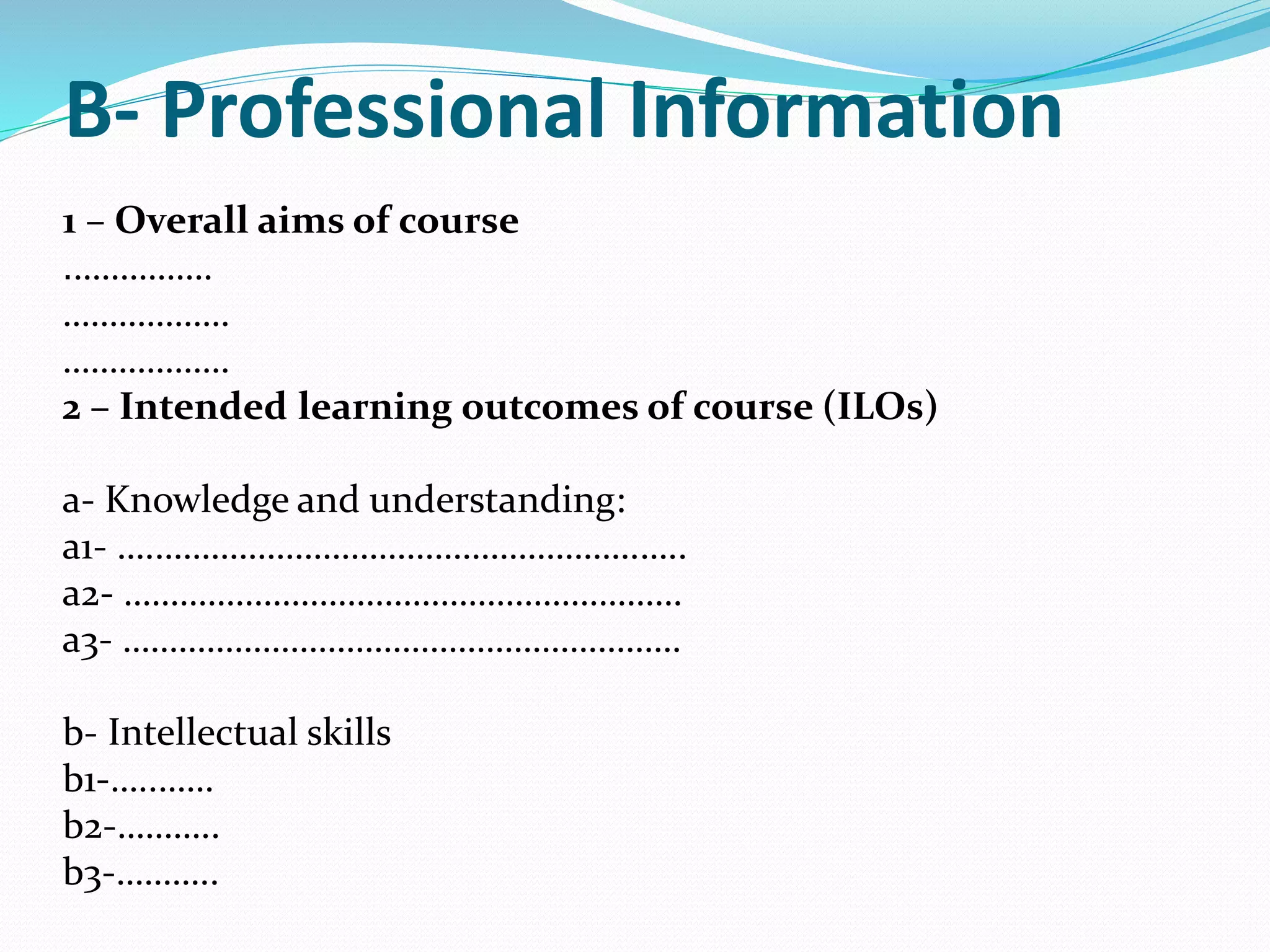
B- Professional Information
1 – Overall aims of course
…………….
………………
………………
2 – Intended learning outcomes of course (ILOs)
a- Knowledge and understanding:
a1- ….…………………………………………….…..
a2- ……………………………………………………
a3- ……………………………………………………
b- Intellectual skills
b1-…..……
b2-………..
b3-………..
c- Professional and practical skills
c1-………..
c2-…….….
c3-……..…
d- General and transferable skills
d1-………..
d2-…….….
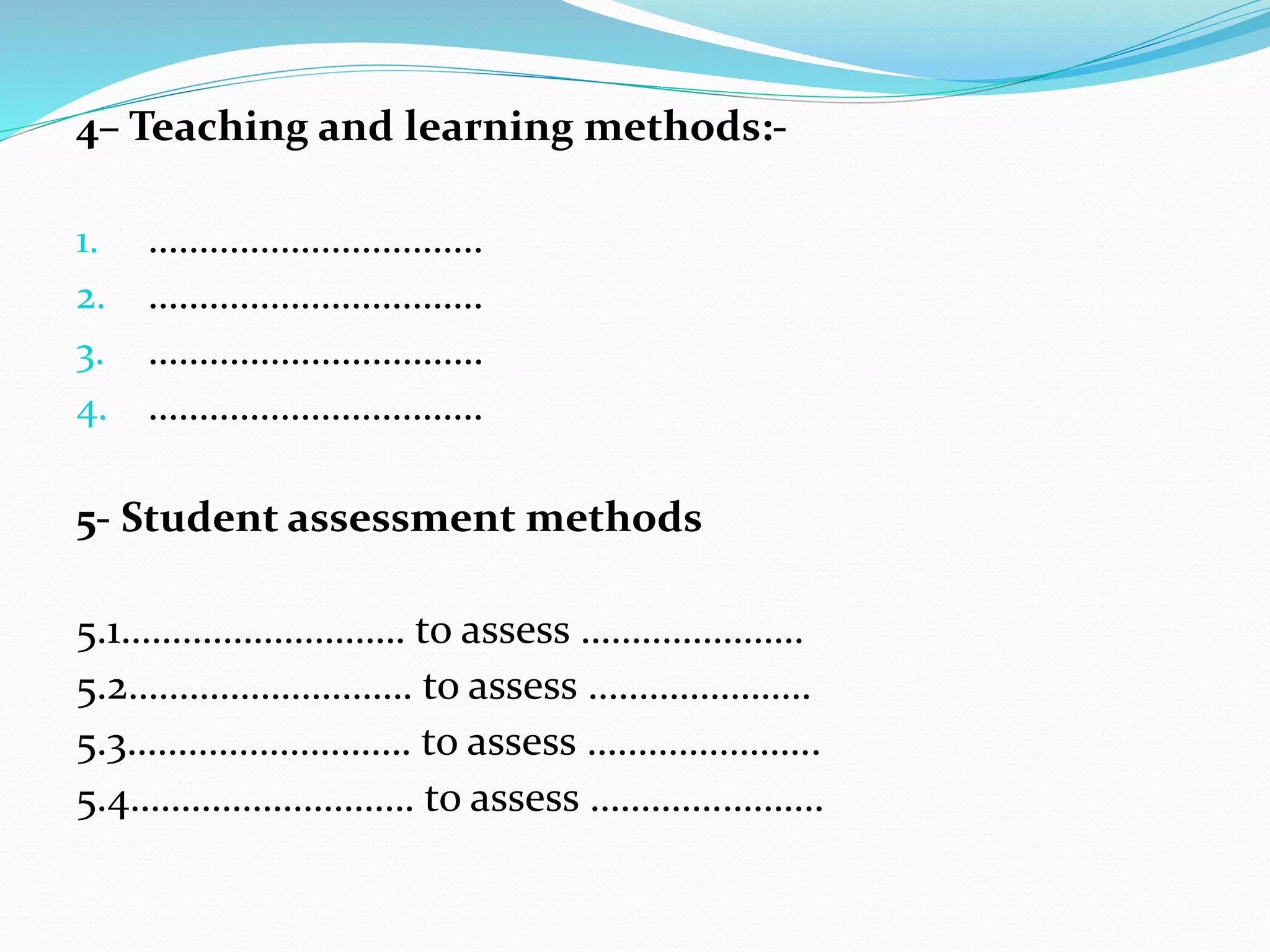
4– Teaching and learning methods:-
1. ……………………………
2. ……………………………
3. ……………………………
4. ……………………………
5- Student assessment methods
5.1………………………. to assess ………………….
5.2………………………. to assess ………………….
5.3………………………. to assess …………………..
5.4………………………. to assess ………….……….
Assessment schedule:
Assessment 1…………………. Week …………….
Assessment 2 ………………… week …………….
Assessment 3…………………. Week …………….
Assessment 4…………………. Week …………….
Weighting of assessments:
 Mid-term examination %
 Final-term examination %
 Oral examination. %
 Practical examination %
 Semester work %
 Other types of assessment %
 Total 100%
 Any formative only assessments
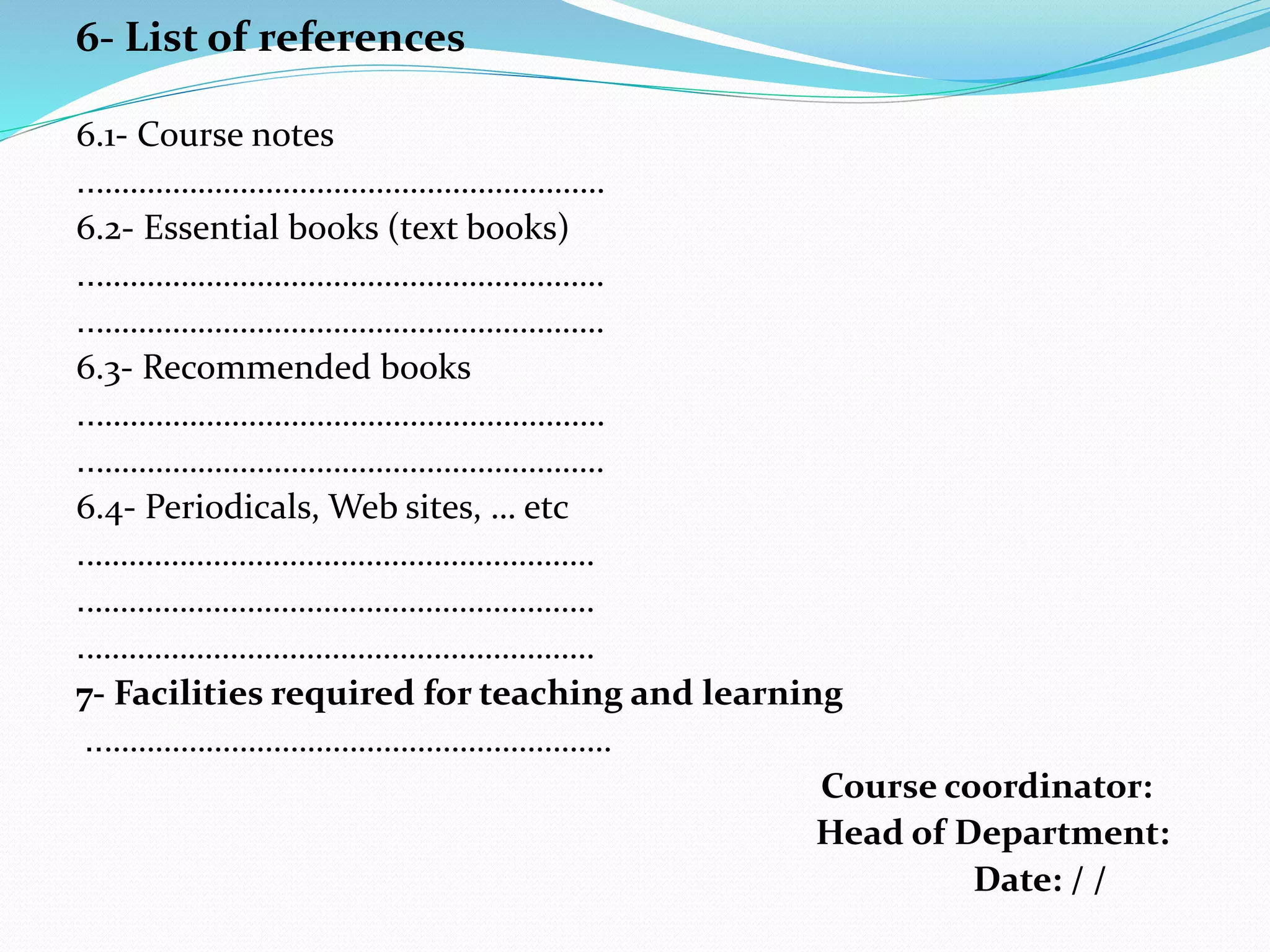
6- List of references
6.1- Course notes
……………………………………………………..
6.2- Essential books (text books)
……………………………………………………..
……………………………………………………..
6.3- Recommended books
……………………………………………………..
……………………………………………………..
6.4- Periodicals, Web sites, … etc
…………………………………………………….
…………………………………………………….
…………………………………………………….
7- Facilities required for teaching and learning
……………………………………………………..
Course coordinator:
Head of Department:
Date: / /
Course specification

Course specification

  • 1.
  • 2.
    Under supervision : Dr.Rasha Ebraheem Presented By : Mahmoud Shakria
  • 3.
    Outlines:  Definition ofcourse specification  Principles of for course specification  Importance of course specification  Intended Learning Outcomes (ILOs)  Learning Outcomes  Importance of Learning Outcomes  Graduate Attributes  Templates for Course Specifications
  • 6.
    What is coursespecifications?
  • 7.
    Course Specification Definition:-  Awritten specification of the objectives, content, assessment methods, and other relevant details of a Course.
  • 8.
    Course Specifications is: A Contract between University and staff member.  A course specification details what the University agrees to provide in the offering of the course and outlines the expectations on the student.  A Contract between Students and staff member.  Students are entitled to expect that the course will be delivered and assessed as in the Course Specification.
  • 9.
    Principles of forcourse specification A. Basic information (Course Identification & General Information) B. The overall aims of the course (Objectives) C. The course content (Course Description) 1.Topics to be covered 2.Intended learning outcomes (ILOs) 3.Teaching and learning methods 4.Student assessment methods
  • 10.
    D. Student AcademicCounseling and Support E. A list of books and references F. The facilities required for teaching and learning. G. Course Evaluation and Improvement Processes
  • 11.
    Importance of coursespecification for teacher and learners
  • 12.
     The purposeof a Table of Specifications is to identify the achievement domains being measured and to ensure that a fair and representative sample of questions appear on the test.  Teachers cannot measure every topic or objective and cannot ask every question they might wish to ask.
  • 13.
     A Tableof Specifications allows the teacher to construct a test which focuses on the key areas and weights those different areas based on their importance.  A Table of Specifications provides the teacher with evidence that a test has content validity, that it covers what should be covered.
  • 14.
    A Table ofSpecifications benefits students in two ways:-  First , it improves the validity of teacher-made tests. Second , it can improve student learning as well.  A Table of Specifications helps to ensure that there is a match between what is taught and what is tested.  Classroom assessment should be driven by classroom teaching which itself is driven by course goals and objectives.
  • 15.
  • 16.
     An outcome-basedcurriculum design begins with defining the student learning outcomes for the programme and the component subjects.  Defined as the particular knowledge, skills, and abilities that an instructor intends for students to learn or develop.
  • 17.
     They arestudent-centered rather than teacher- centered, in that they describe what the students will do, not what the instructor will teach.
  • 18.
    Importance of Learning Outcomes? Learning outcomes help faculty to:  Decide our emphasis in the course: Of all the things we could teach, what should we teach?  Decide how best to teach: Teaching students to analyze requires different teaching approaches from teaching students to memorize.  Decide how best to assess learning: Do I need a project or a final exam?  Communicate expectations to students: What are our decisions on the matters above?
  • 19.
    Learning outcomes helpstudents by:  Creating a connection between teaching and learning, between professors and students  Taking much of the guessing out of the student's attempt to learn  Enabling them to truly master the content of the course
  • 20.
    Format of theLearning Outcome  Statement Bloom’s Revised Taxonomy provides the framework for writing course-level learning outcomes.  Each learning outcome is represented by a sentence that consists of an action verb related to a cognitive process and a clearly defined content related to a specific knowledge type.
  • 22.
     For example: CLO 1) List areas of consensus levels among M.V patients on I.C.U  CLO 2) Synthesize learning assignments with vocation- specific expectations using reflective enquiry
  • 23.
    Graduate Attributes Graduate Attributes:-  Defined as qualities, attitudes and dispositions that graduates should possess, in full or part, when they have completed their course .
  • 24.
    The 12 GraduateAttributes 1. (KB) A knowledge base for engineering: Demonstrated competence in university level mathematics, natural sciences, engineering fundamentals, and specialized engineering knowledge appropriate to the program. 2. (PA) Problem analysis: An ability to use appropriate knowledge and skills to identify, formulate, analyze, and solve complex engineering problems in order to reach substantiated conclusions
  • 25.
    3. (Inv.) Investigation:An ability to conduct investigations of complex problems by methods that include appropriate experiments, analysis and interpretation of data and synthesis of information in order to reach valid conclusions.
  • 26.
    4. (Des.) Design:An ability to design solutions for complex, open-ended engineering problems and to design systems, components or processes that meet specified needs with appropriate attention to health and safety risks, applicable standards, and economic, environmental, cultural and societal considerations.
  • 27.
    5. (Tools) Useof engineering tools: An ability to create, select, apply, adapt, and extend appropriate techniques, resources, and modern engineering tools to a range of engineering activities, from simple to complex, with an understanding of the associated limitations.
  • 28.
    6. (Team) Individualand teamwork: An ability to work effectively as a member and leader in teams, preferably in a multi-disciplinary setting. 7. (Comm.) Communication skills: An ability to communicate complex engineering concepts within the profession and with society at large.
  • 29.
    8. (Prof.) Professionalism:An understanding of the roles and responsibilities of the professional engineer in society, especially the primary role of protection of the public and the public interest.
  • 30.
    9. (Impacts) Impactof engineering on society and the environment: An ability to analyze social and environmental aspects of engineering activities. 10. (Ethics) Ethics and equity: An ability to apply professional ethics, accountability, and equity. 11. (Econ.) Economics and project management: An ability to appropriately incorporate economics and business practices including project, risk, and change management into the practice of engineering and to understand their limitations.
  • 31.
    12. (LL) Life-longlearning: An ability to identify and to address their own educational needs in a changing world in ways sufficient to maintain their competence and to allow them to contribute to the advancement of knowledge
  • 32.
    Templates for Course Specifications University…Faculty ...  Course specifications:-  Programme(s) on which the course is given  Major or minor element of programmes  Department offering the programme  Department offering the course  Academic year / Level  Date of specification approval
  • 33.
    A- Basic Information Title: Code:  Credit Hours: Lecture:  Tutorial: Practical: Total:
  • 34.
    B- Professional Information 1– Overall aims of course ……………. ……………… ……………… 2 – Intended learning outcomes of course (ILOs) a- Knowledge and understanding: a1- ….…………………………………………….….. a2- …………………………………………………… a3- …………………………………………………… b- Intellectual skills b1-…..…… b2-……….. b3-………..
  • 35.
    c- Professional andpractical skills c1-……….. c2-…….…. c3-……..… d- General and transferable skills d1-……….. d2-…….….
  • 37.
    4– Teaching andlearning methods:- 1. …………………………… 2. …………………………… 3. …………………………… 4. …………………………… 5- Student assessment methods 5.1………………………. to assess …………………. 5.2………………………. to assess …………………. 5.3………………………. to assess ………………….. 5.4………………………. to assess ………….……….
  • 38.
    Assessment schedule: Assessment 1………………….Week ……………. Assessment 2 ………………… week ……………. Assessment 3…………………. Week ……………. Assessment 4…………………. Week …………….
  • 39.
    Weighting of assessments: Mid-term examination %  Final-term examination %  Oral examination. %  Practical examination %  Semester work %  Other types of assessment %  Total 100%  Any formative only assessments
  • 40.
    6- List ofreferences 6.1- Course notes …………………………………………………….. 6.2- Essential books (text books) …………………………………………………….. …………………………………………………….. 6.3- Recommended books …………………………………………………….. …………………………………………………….. 6.4- Periodicals, Web sites, … etc ……………………………………………………. ……………………………………………………. ……………………………………………………. 7- Facilities required for teaching and learning …………………………………………………….. Course coordinator: Head of Department: Date: / /