The Next 25 YearsBonner Commitment to Access & Engagement
Signature Work
AAC&U’s call to action:
The LEAP Challenge—calling on
colleges and universities to engage
students in Signature Work that will
prepare them to integrate and apply
their learning to a significant project
with meaning to the student and to
society.
Definition
How will you define “engaged signature
work”?
➡ Types of engagement projects?
➡ How are partners involved in defining
projects?
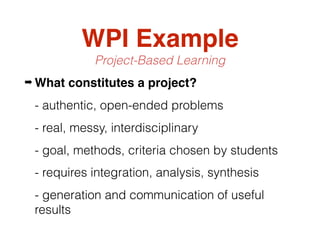
WPI Example
Project-Based Learning
➡ What constitutes a project?
- authentic, open-ended problems
- real, messy, interdisciplinary
- goal, methods, criteria chosen by students
- requires integration, analysis, synthesis
- generation and communication of useful
results
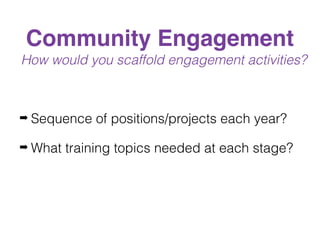
Community Engagement
How would you scaffold engagement activities?
➡ Sequence of positions/projects each year?
➡ What training topics needed at each stage?
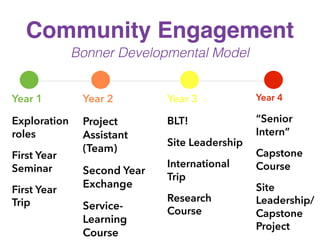
Community Engagement
Bonner Developmental Model
Year 1
Exploration
roles
First Year
Seminar
First Year
Trip
Year 4
“Senior
Intern”
Capstone
Course
Site
Leadership/
Capstone
Project
Year 2
Project
Assistant
(Team)
Second Year
Exchange
Service-
Learning
Course
Year 3
BLT!
Site Leadership
International
Trip
Research
Course
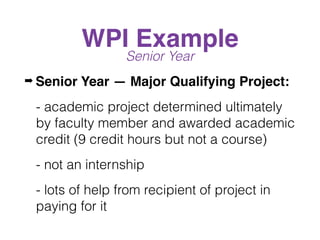
WPI Example
Senior Year
➡ Senior Year — Major Qualifying Project:
- academic project determined ultimately
by faculty member and awarded academic
credit (9 credit hours but not a course)
- not an internship
- lots of help from recipient of project in
paying for it
WPI Example
Junior Year
➡ Junior Year — Interactive Qualifying Project
- 9 credits but not a course
- students conduct inquiry under faculty
direction
- teams of 3-4 students
- projects identified by community partners
WPI Example
First Year Great Problems Seminar Project
-provide context and motivation for subsequent
course and project work
-leverage the students’ expectations that college will
be different
-increase intellectual engagement
-increase community engagement
-build confidence
-earlier access to internships and relevant jobs
-acknowledge their knowledge, they already know
quite a bit
WPI Example
First Year Great Problems Seminar Project
- students divide into team (3-5)
- select/receive project topic (a small piece of a
big problem);
- research the problem, identify potential
solutions, evaluate them, select one, develop
an assessment plan;
- produce a report/poster;
- present to campus community
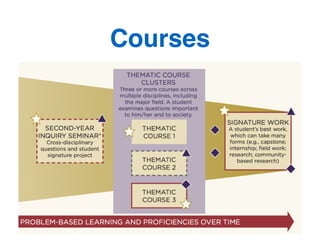
Courses
How would you sequence academic
courses?
➡ What kinds of courses are needed at each
stage?
➡ issue-based, project-based, competency-
based, process-based
Courses
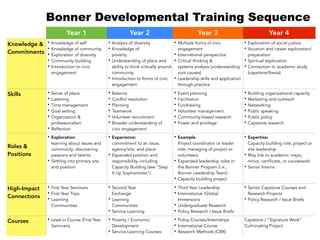
AAC&U Example
Year 1 Year 2 Year 3 Year 4
Knowledge &
Commitments
• Knowledge of self
• Knowledge of community
• Exploration of diversity
• Community building
• Introduction to civic
engagement
• Analysis of diversity
• Knowledge of 

poverty
• Understanding of place and
ability to think critically around
community
• Introduction to forms of civic 

engagement
• Multiple forms of civic
engagement
• International perspective
• Critical thinking & 

systems analysis (understanding
root causes)
• Leadership skills and application
through practice
• Exploration of social justice
• Vocation and career exploration/
preparation
• Spiritual exploration
• Connection to academic study
(capstone/thesis)
Skills 
 • Sense of place
• Listening
• Time management
• Goal setting
• Organization &
professionalism
• Reflection
• Balance
• Conflict resolution
• Planning
• Teamwork
• Volunteer recruitment
• Broader understanding of
civic engagement
• Event planning
• Facilitation
• Fundraising
• Volunteer management
• Community-based research
• Power and privilege
• Building organizational capacity
• Marketing and outreach
• Networking
• Public speaking
• Public policy
• Capstone research


Roles &
Positions
• Exploration:

learning about issues and
community; discovering
passions and talents
• Settling into primary site
and position
• Experience:

commitment to an issue,
agency/site, and place
• Expanded position and
responsibility, including
Capacity Building (see “Step
It Up Sophomores”)
• Example:

Project coordinator or leader
role; managing of project or
volunteers
• Expanded leadership roles in
the Bonner Program (i.e.,
Bonner Leadership Team)
• Capacity building project
• Expertise: 

Capacity building role; project or
site leadership
• May link to academic major,
minor, certificate, or coursework
• Senior Interns
High-Impact
Connections
• First Year Seminars
• First Year Trips
• Learning 

Communities
• Second Year 

Exchange
• Learning 

Communities
• Service-Learning
• Third Year Leadership
• International /Global
Immersions
• Undergraduate Research
• Policy Research / Issue Briefs
• Senior Capstone Courses and
Research Projects
• Policy Research / Issue Briefs
Courses • Lead-in Course (First Year
Seminars)
• Poverty / Economic
Development
• Service-Learning Courses
• Policy Courses/Internships
• International Course
• Research Methods (CBR)
Capstone / “Signature Work”
Culminating Project
Bonner Developmental Training Sequence
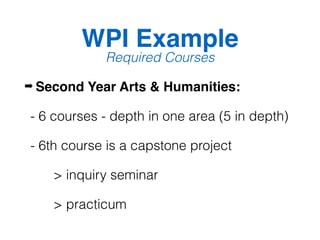
WPI Example
Required Courses
➡ Second Year Arts & Humanities:
- 6 courses - depth in one area (5 in depth)
- 6th course is a capstone project
> inquiry seminar
> practicum
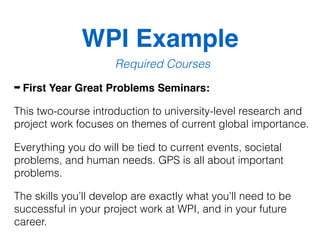
WPI Example
Required Courses
➡ First Year Great Problems Seminars:
This two-course introduction to university-level research and
project work focuses on themes of current global importance.
Everything you do will be tied to current events, societal
problems, and human needs. GPS is all about important
problems.
The skills you’ll develop are exactly what you’ll need to be
successful in your project work at WPI, and in your future
career.
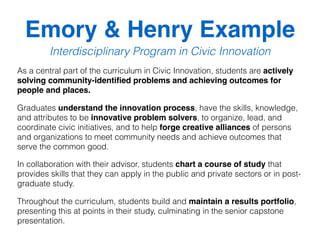
Emory & Henry Example
Interdisciplinary Program in Civic Innovation
As a central part of the curriculum in Civic Innovation, students are actively
solving community-identified problems and achieving outcomes for
people and places.  
Graduates understand the innovation process, have the skills, knowledge,
and attributes to be innovative problem solvers, to organize, lead, and
coordinate civic initiatives, and to help forge creative alliances of persons
and organizations to meet community needs and achieve outcomes that
serve the common good.  
In collaboration with their advisor, students chart a course of study that
provides skills that they can apply in the public and private sectors or in post-
graduate study.  
Throughout the curriculum, students build and maintain a results portfolio,
presenting this at points in their study, culminating in the senior capstone
presentation.
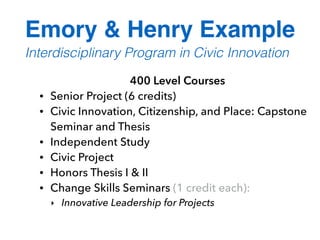
400 Level Courses
• Senior Project (6 credits)
• Civic Innovation, Citizenship, and Place: Capstone
Seminar and Thesis
• Independent Study
• Civic Project
• Honors Thesis I & II
• Change Skills Seminars (1 credit each):
‣ Innovative Leadership for Projects
Interdisciplinary Program in Civic Innovation
Emory & Henry Example
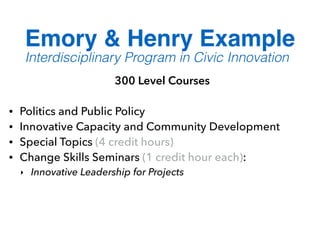
300 Level Courses
• Politics and Public Policy
• Innovative Capacity and Community Development
• Special Topics (4 credit hours)
• Change Skills Seminars (1 credit hour each):
‣ Innovative Leadership for Projects
Emory & Henry Example
Interdisciplinary Program in Civic Innovation
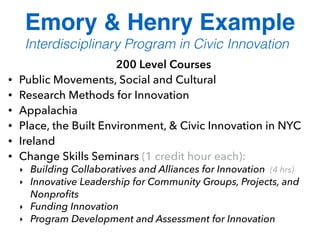
200 Level Courses
• Public Movements, Social and Cultural
• Research Methods for Innovation
• Appalachia
• Place, the Built Environment, & Civic Innovation in NYC
• Ireland
• Change Skills Seminars (1 credit hour each):
‣ Building Collaboratives and Alliances for Innovation (4 hrs)
‣ Innovative Leadership for Community Groups, Projects, and
Nonprofits
‣ Funding Innovation
‣ Program Development and Assessment for Innovation
Emory & Henry Example
Interdisciplinary Program in Civic Innovation
Emory & Henry Example
Interdisciplinary Program in Civic Innovation
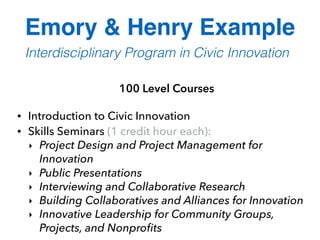
100 Level Courses
• Introduction to Civic Innovation
• Skills Seminars (1 credit hour each):
‣ Project Design and Project Management for
Innovation
‣ Public Presentations
‣ Interviewing and Collaborative Research
‣ Building Collaboratives and Alliances for Innovation
‣ Innovative Leadership for Community Groups,
Projects, and Nonprofits
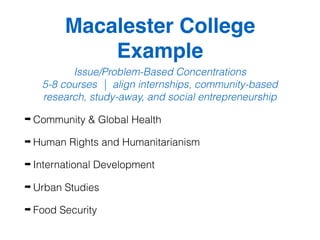
Macalester College
Example
Issue/Problem-Based Concentrations
5-8 courses | align internships, community-based
research, study-away, and social entrepreneurship
➡ Community & Global Health
➡ Human Rights and Humanitarianism
➡ International Development
➡ Urban Studies
➡ Food Security
Community Partnerships
How will you manage having 25% of your
senior class doing engaged signature work?
➡ Team vs individual projects?
➡ Issue/Problem-based vs Competency-
based
➡ Place-based
➡ Annual vs long-term planning?
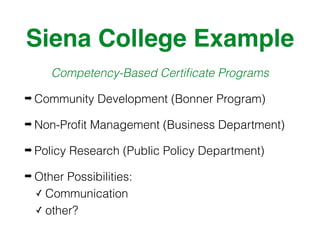
Siena College Example
Competency-Based Certificate Programs
➡ Community Development (Bonner Program)
➡ Non-Profit Management (Business Department)
➡ Policy Research (Public Policy Department)
➡ Other Possibilities:
✓ Communication
✓ other?
Campus-Wide Center
What would be the role of campus-wide
community engagement center?
➡ What office on campus will have primary
responsibility to manage “Engaged
Signature Work”?
➡ What (new) staff positions would be
needed?
Outline
• Definition of “Engaged Signature Work”
• Sequence/scaffolding: community
engagement
• Sequence/scaffolding: courses & training
• Infrastructure: community partnerships
• Infrastructure: campus-wide center role
Engaged Signature Work
Follow-Up Discussion
Observations
Thoughts on whether “engaged signature work” is….
• a worthwhile goal?
• a current or realistic goal for your Bonner Program?
• a realistic goal for an academic department on your
campus?
• a realistic goal for your institution?
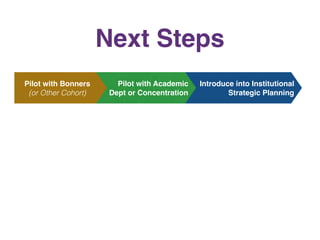
Introduce into Institutional
Strategic Planning
Pilot with Academic
Dept or Concentration
Pilot with Bonners
(or Other Cohort)
Next Steps
Support Needed
• Outreach directly to your campus
✓ visit for meetings & campus workshop?
✓ publications for provosts or other academic
leaders?
✓ …?
• National support
✓ Foundation-hosted national gathering or as part of
AAC&U or other conference?
✓ start-up guide with examples?
✓ …?

The Next 25 Years: Bonner's Commitment to Access & Engagement

  • 1.
    The Next 25YearsBonner Commitment to Access & Engagement
  • 2.
    Signature Work AAC&U’s callto action: The LEAP Challenge—calling on colleges and universities to engage students in Signature Work that will prepare them to integrate and apply their learning to a significant project with meaning to the student and to society.
  • 3.
    Definition How will youdefine “engaged signature work”? ➡ Types of engagement projects? ➡ How are partners involved in defining projects?
  • 4.
    WPI Example Project-Based Learning ➡What constitutes a project? - authentic, open-ended problems - real, messy, interdisciplinary - goal, methods, criteria chosen by students - requires integration, analysis, synthesis - generation and communication of useful results
  • 5.
    Community Engagement How wouldyou scaffold engagement activities? ➡ Sequence of positions/projects each year? ➡ What training topics needed at each stage?
  • 6.
    Community Engagement Bonner DevelopmentalModel Year 1 Exploration roles First Year Seminar First Year Trip Year 4 “Senior Intern” Capstone Course Site Leadership/ Capstone Project Year 2 Project Assistant (Team) Second Year Exchange Service- Learning Course Year 3 BLT! Site Leadership International Trip Research Course
  • 7.
    WPI Example Senior Year ➡Senior Year — Major Qualifying Project: - academic project determined ultimately by faculty member and awarded academic credit (9 credit hours but not a course) - not an internship - lots of help from recipient of project in paying for it
  • 8.
    WPI Example Junior Year ➡Junior Year — Interactive Qualifying Project - 9 credits but not a course - students conduct inquiry under faculty direction - teams of 3-4 students - projects identified by community partners
  • 9.
    WPI Example First YearGreat Problems Seminar Project -provide context and motivation for subsequent course and project work -leverage the students’ expectations that college will be different -increase intellectual engagement -increase community engagement -build confidence -earlier access to internships and relevant jobs -acknowledge their knowledge, they already know quite a bit
  • 10.
    WPI Example First YearGreat Problems Seminar Project - students divide into team (3-5) - select/receive project topic (a small piece of a big problem); - research the problem, identify potential solutions, evaluate them, select one, develop an assessment plan; - produce a report/poster; - present to campus community
  • 11.
    Courses How would yousequence academic courses? ➡ What kinds of courses are needed at each stage? ➡ issue-based, project-based, competency- based, process-based
  • 12.
  • 13.
    Year 1 Year2 Year 3 Year 4 Knowledge & Commitments • Knowledge of self • Knowledge of community • Exploration of diversity • Community building • Introduction to civic engagement • Analysis of diversity • Knowledge of 
 poverty • Understanding of place and ability to think critically around community • Introduction to forms of civic 
 engagement • Multiple forms of civic engagement • International perspective • Critical thinking & 
 systems analysis (understanding root causes) • Leadership skills and application through practice • Exploration of social justice • Vocation and career exploration/ preparation • Spiritual exploration • Connection to academic study (capstone/thesis) Skills 
 • Sense of place • Listening • Time management • Goal setting • Organization & professionalism • Reflection • Balance • Conflict resolution • Planning • Teamwork • Volunteer recruitment • Broader understanding of civic engagement • Event planning • Facilitation • Fundraising • Volunteer management • Community-based research • Power and privilege • Building organizational capacity • Marketing and outreach • Networking • Public speaking • Public policy • Capstone research 
 Roles & Positions • Exploration:
 learning about issues and community; discovering passions and talents • Settling into primary site and position • Experience:
 commitment to an issue, agency/site, and place • Expanded position and responsibility, including Capacity Building (see “Step It Up Sophomores”) • Example:
 Project coordinator or leader role; managing of project or volunteers • Expanded leadership roles in the Bonner Program (i.e., Bonner Leadership Team) • Capacity building project • Expertise: 
 Capacity building role; project or site leadership • May link to academic major, minor, certificate, or coursework • Senior Interns High-Impact Connections • First Year Seminars • First Year Trips • Learning 
 Communities • Second Year 
 Exchange • Learning 
 Communities • Service-Learning • Third Year Leadership • International /Global Immersions • Undergraduate Research • Policy Research / Issue Briefs • Senior Capstone Courses and Research Projects • Policy Research / Issue Briefs Courses • Lead-in Course (First Year Seminars) • Poverty / Economic Development • Service-Learning Courses • Policy Courses/Internships • International Course • Research Methods (CBR) Capstone / “Signature Work” Culminating Project Bonner Developmental Training Sequence
  • 14.
    WPI Example Required Courses ➡Second Year Arts & Humanities: - 6 courses - depth in one area (5 in depth) - 6th course is a capstone project > inquiry seminar > practicum
  • 15.
    WPI Example Required Courses ➡First Year Great Problems Seminars: This two-course introduction to university-level research and project work focuses on themes of current global importance. Everything you do will be tied to current events, societal problems, and human needs. GPS is all about important problems. The skills you’ll develop are exactly what you’ll need to be successful in your project work at WPI, and in your future career.
  • 16.
    Emory & HenryExample Interdisciplinary Program in Civic Innovation As a central part of the curriculum in Civic Innovation, students are actively solving community-identified problems and achieving outcomes for people and places.   Graduates understand the innovation process, have the skills, knowledge, and attributes to be innovative problem solvers, to organize, lead, and coordinate civic initiatives, and to help forge creative alliances of persons and organizations to meet community needs and achieve outcomes that serve the common good.   In collaboration with their advisor, students chart a course of study that provides skills that they can apply in the public and private sectors or in post- graduate study.   Throughout the curriculum, students build and maintain a results portfolio, presenting this at points in their study, culminating in the senior capstone presentation.
  • 17.
    400 Level Courses •Senior Project (6 credits) • Civic Innovation, Citizenship, and Place: Capstone Seminar and Thesis • Independent Study • Civic Project • Honors Thesis I & II • Change Skills Seminars (1 credit each): ‣ Innovative Leadership for Projects Interdisciplinary Program in Civic Innovation Emory & Henry Example
  • 18.
    300 Level Courses •Politics and Public Policy • Innovative Capacity and Community Development • Special Topics (4 credit hours) • Change Skills Seminars (1 credit hour each): ‣ Innovative Leadership for Projects Emory & Henry Example Interdisciplinary Program in Civic Innovation
  • 19.
    200 Level Courses •Public Movements, Social and Cultural • Research Methods for Innovation • Appalachia • Place, the Built Environment, & Civic Innovation in NYC • Ireland • Change Skills Seminars (1 credit hour each): ‣ Building Collaboratives and Alliances for Innovation (4 hrs) ‣ Innovative Leadership for Community Groups, Projects, and Nonprofits ‣ Funding Innovation ‣ Program Development and Assessment for Innovation Emory & Henry Example Interdisciplinary Program in Civic Innovation
  • 20.
    Emory & HenryExample Interdisciplinary Program in Civic Innovation 100 Level Courses • Introduction to Civic Innovation • Skills Seminars (1 credit hour each): ‣ Project Design and Project Management for Innovation ‣ Public Presentations ‣ Interviewing and Collaborative Research ‣ Building Collaboratives and Alliances for Innovation ‣ Innovative Leadership for Community Groups, Projects, and Nonprofits
  • 21.
    Macalester College Example Issue/Problem-Based Concentrations 5-8courses | align internships, community-based research, study-away, and social entrepreneurship ➡ Community & Global Health ➡ Human Rights and Humanitarianism ➡ International Development ➡ Urban Studies ➡ Food Security
  • 22.
    Community Partnerships How willyou manage having 25% of your senior class doing engaged signature work? ➡ Team vs individual projects? ➡ Issue/Problem-based vs Competency- based ➡ Place-based ➡ Annual vs long-term planning?
  • 23.
    Siena College Example Competency-BasedCertificate Programs ➡ Community Development (Bonner Program) ➡ Non-Profit Management (Business Department) ➡ Policy Research (Public Policy Department) ➡ Other Possibilities: ✓ Communication ✓ other?
  • 24.
    Campus-Wide Center What wouldbe the role of campus-wide community engagement center? ➡ What office on campus will have primary responsibility to manage “Engaged Signature Work”? ➡ What (new) staff positions would be needed?
  • 25.
    Outline • Definition of“Engaged Signature Work” • Sequence/scaffolding: community engagement • Sequence/scaffolding: courses & training • Infrastructure: community partnerships • Infrastructure: campus-wide center role
  • 26.
  • 27.
    Observations Thoughts on whether“engaged signature work” is…. • a worthwhile goal? • a current or realistic goal for your Bonner Program? • a realistic goal for an academic department on your campus? • a realistic goal for your institution?
  • 28.
    Introduce into Institutional StrategicPlanning Pilot with Academic Dept or Concentration Pilot with Bonners (or Other Cohort) Next Steps
  • 29.
    Support Needed • Outreachdirectly to your campus ✓ visit for meetings & campus workshop? ✓ publications for provosts or other academic leaders? ✓ …? • National support ✓ Foundation-hosted national gathering or as part of AAC&U or other conference? ✓ start-up guide with examples? ✓ …?