Cost Effective Resource Allocation of Overlay Routing Relay Nodes 
Overlay routing is a very attractive scheme that allows improving certain properties of the 
routing (such as delay or TCP throughput) without the need to change the standards of the 
current underlying routing. However, deploying overlay routing requires the placement and 
maintenance of overlay infrastructure. This gives rise to the following optimization problem: 
Find a minimal set of overlay nodes such that the required routing properties are satisfied. In this 
paper, we rigorously study this optimization problem. We show that it is NP-hard and derive a 
nontrivial approximation algorithm for it, where the approximation ratio depends on specific 
properties of the problem at hand. We examine the practical aspects of the scheme by evaluating 
the gain one can get over several real scenarios. The first one is BGP routing, and we show, 
using up-to-date data reflecting the current BGP routing policy in the Internet, that a relative 
small number of less than 100 relay servers is sufficient to enable routing over shortest paths 
from a single source to all autonomous systems (ASs), reducing the average path length of 
inflated paths by 40%. We also demonstrate that the scheme is very useful for TCP performance 
improvement (results in an almost optimal placement of overlay nodes) and for Voice-over-IP 
(VoIP) applications where a small number of overlay nodes can significantly reduce the maximal 
peer-to-peer delay. 
Using overlay routing to improve routing and network performance has been studied before in 
several works. The authors studied the routing inefficiency in the Internet and used an overlay 
routing in order to evaluate and study experimental techniques improving the network over the 
real environment. While the concept of using overlay routing to improve routing scheme was 
presented in this work, it did not deal with the deployment aspects and the optimization aspect of 
such infrastructure. A resilient overlay network (RON), which is architecture for application-layer 
overlay routing to be used on top of the existing Internet routing infrastructure, has been 
presented. Similar to our work, the main goal of this architecture is to replace the existing routing 
scheme, if necessary, using the overlay infrastructure. This work mainly focuses on the overlay 
Contact: 9703109334, 9533694296 
ABSTRACT: 
EXISTING SYSTEM: 
Email id: academicliveprojects@gmail.com, www.logicsystems.org.in
Cost Effective Resource Allocation of Overlay Routing Relay Nodes 
infrastructure (monitoring and detecting routing problems, and maintaining the overlay system), 
and it does not consider the cost associated with the deployment of such system. 
DISADVANTAGES OF EXISTING SYSTEM: 
 In order to deploy overlay routing over the actual physical infrastructure, one needs to 
deploy and manage overlay nodes that will have the new extra functionality. This comes 
with a non negligible cost both in terms of capital and operating costs. 
 Our proposed algorithmic framework that can be used in order to deal with efficient 
resource allocation in overlay routing. 
In this paper, we concentrate on this point and study the minimum number of infrastructure 
nodes that need to be added in order to maintain a specific property in the overlay routing. In the 
shortest-path routing over the Internet BGP-based routing example, this question is mapped to: 
What is the minimum number of relay nodes that are needed in order to make the routing 
between a groups of autonomous systems (ASs) use the underlying shortest path between them? 
In the TCP performance example, this may translate to: What is the minimal number of relay 
nodes needed in order to make sure that for each TCP connection, there is a path between the 
connection endpoints for which every predefined round-trip time(RTT), there is an overlay node 
capable of TCP Piping? Regardless of the specific implication in mind, we define a general 
optimization problem called the Overlay Routing Resource Allocation (ORRA) problem and 
study its complexity. It turns out that the problem is NP-hard, and we present a nontrivial 
approximation algorithm for it. 
ADVANTAGES OF PROPOSED SYSTEM: 
 We are only interested in improving routing properties between a single source node and 
a single destination, then the problem is not complicated, and finding the optimal number 
of nodes becomes trivial since the potential candidate for overlay placement is small, and 
in general any assignment would be good. 
Contact: 9703109334, 9533694296 
PROPOSED SYSTEM: 
Email id: academicliveprojects@gmail.com, www.logicsystems.org.in
Cost Effective Resource Allocation of Overlay Routing Relay Nodes 
 However, when we consider one-to-many or many-to-many scenarios, then a single 
overlay node may affect the path property of many paths, and thus choosing the best 
locations becomes much less trivial. 
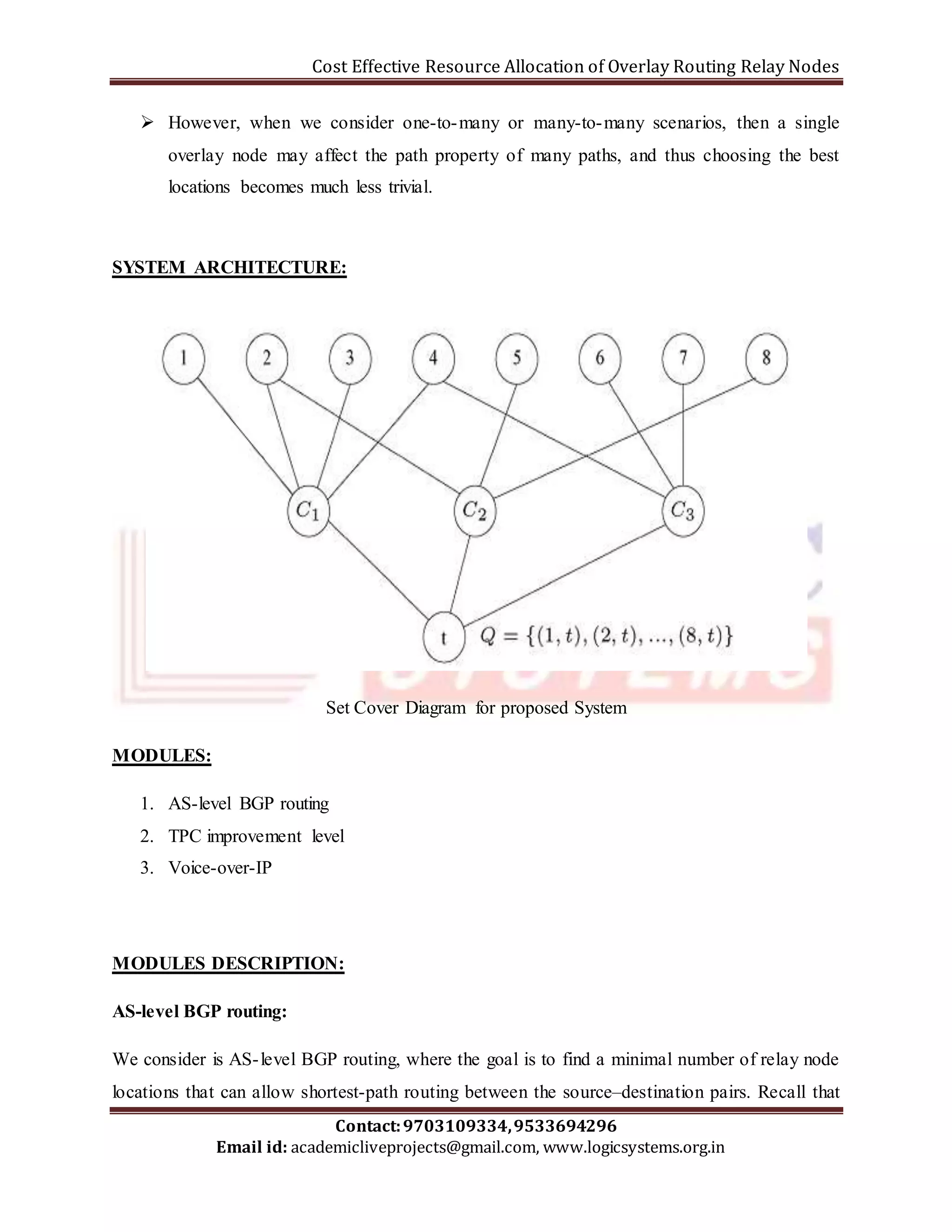
SYSTEM ARCHITECTURE: 
Set Cover Diagram for proposed System 
Contact: 9703109334, 9533694296 
Email id: academicliveprojects@gmail.com, www.logicsystems.org.in 
MODULES: 
1. AS-level BGP routing 
2. TPC improvement level 
3. Voice-over-IP 
MODULES DESCRIPTION: 
AS-level BGP routing: 
We consider is AS- level BGP routing, where the goal is to find a minimal number of relay node 
locations that can allow shortest-path routing between the source–destination pairs. Recall that
Cost Effective Resource Allocation of Overlay Routing Relay Nodes 
routing in BGP is policy-based and depends on the business relationship between peering ASs, 
and as a result, a considerable fraction of the paths in the Internet do not go along a shortest path. 
This phenomenon, called path inflation, is the motivation for this scenario. We consider a one-to-many 
setting where we want to improve routing between a single source and many destinations. 
This is the case where the algorithm power is most significant since, in the many-to-many 
setting, there is very little overlap between shortest paths, and thus not much improvement can 
be made over a basic greedy approach. We demonstrate, using real up-to-date Internet data, that 
the algorithm can suggest a relatively small set of relay nodes that can significantly reduce 
latency in current BGP routing. 
We consider is the TPC level improvement in the wireless networks as explained in the above 
module. In this case, we test our proposed algorithm on a synthetic random graph, and we show 
that the general framework can be applied also to this case, resulting in very close-to-optimal 
results. 
Voice-Over-IP type of applications are becoming more and more popular offering IP te lephone 
services for free, but they need a bounded end-to-end delay (or latency) between any pair of 
users to maintain a reasonable service quality. We show that our scheme can be very useful also 
in this case, allowing applications to choose a smaller number of hubs, yet improving 
performance for many users. 
SYSTEM CONFIGURATION:- 
HARDWARE CONFIGURATION:- 
 Processor - Pentium –IV 
 Speed - 1.1 Ghz 
 RAM - 256 MB(min) 
 Hard Disk - 20 GB 
 Key Board - Standard Windows Keyboard 
Contact: 9703109334, 9533694296 
TPC level improvement: 
Voice-over-IP: 
Email id: academicliveprojects@gmail.com, www.logicsystems.org.in
Cost Effective Resource Allocation of Overlay Routing Relay Nodes 
 Mouse - Two or Three Button Mouse 
 Monitor - SVGA 
SOFTWARE CONFIGURATION:- 
 Operating System : Windows 7 
 Programming Language : JAVA 
 Java Version : JDK 1.6 & above. 
Rami Cohen and Danny Raz, Member, IEEE “Cost-Effective Resource Allocation of Overlay 
Routing Relay Nodes”- IEEE/ACM TRANSACTIONS ON NETWORKING, VOL. 22, NO. 
2, APRIL 2014 
Contact: 9703109334, 9533694296 
REFERENCE: 
Email id: academicliveprojects@gmail.com, www.logicsystems.org.in

cost effective resource allocation of overlay routing relay nodes

  • 1.
    Cost Effective ResourceAllocation of Overlay Routing Relay Nodes Cost Effective Resource Allocation of Overlay Routing Relay Nodes Overlay routing is a very attractive scheme that allows improving certain properties of the routing (such as delay or TCP throughput) without the need to change the standards of the current underlying routing. However, deploying overlay routing requires the placement and maintenance of overlay infrastructure. This gives rise to the following optimization problem: Find a minimal set of overlay nodes such that the required routing properties are satisfied. In this paper, we rigorously study this optimization problem. We show that it is NP-hard and derive a nontrivial approximation algorithm for it, where the approximation ratio depends on specific properties of the problem at hand. We examine the practical aspects of the scheme by evaluating the gain one can get over several real scenarios. The first one is BGP routing, and we show, using up-to-date data reflecting the current BGP routing policy in the Internet, that a relative small number of less than 100 relay servers is sufficient to enable routing over shortest paths from a single source to all autonomous systems (ASs), reducing the average path length of inflated paths by 40%. We also demonstrate that the scheme is very useful for TCP performance improvement (results in an almost optimal placement of overlay nodes) and for Voice-over-IP (VoIP) applications where a small number of overlay nodes can significantly reduce the maximal peer-to-peer delay. Using overlay routing to improve routing and network performance has been studied before in several works. The authors studied the routing inefficiency in the Internet and used an overlay routing in order to evaluate and study experimental techniques improving the network over the real environment. While the concept of using overlay routing to improve routing scheme was presented in this work, it did not deal with the deployment aspects and the optimization aspect of such infrastructure. A resilient overlay network (RON), which is architecture for application-layer overlay routing to be used on top of the existing Internet routing infrastructure, has been presented. Similar to our work, the main goal of this architecture is to replace the existing routing scheme, if necessary, using the overlay infrastructure. This work mainly focuses on the overlay Contact: 9703109334, 9533694296 ABSTRACT: EXISTING SYSTEM: Email id: academicliveprojects@gmail.com, www.logicsystems.org.in
  • 2.
    Cost Effective ResourceAllocation of Overlay Routing Relay Nodes infrastructure (monitoring and detecting routing problems, and maintaining the overlay system), and it does not consider the cost associated with the deployment of such system. DISADVANTAGES OF EXISTING SYSTEM:  In order to deploy overlay routing over the actual physical infrastructure, one needs to deploy and manage overlay nodes that will have the new extra functionality. This comes with a non negligible cost both in terms of capital and operating costs.  Our proposed algorithmic framework that can be used in order to deal with efficient resource allocation in overlay routing. In this paper, we concentrate on this point and study the minimum number of infrastructure nodes that need to be added in order to maintain a specific property in the overlay routing. In the shortest-path routing over the Internet BGP-based routing example, this question is mapped to: What is the minimum number of relay nodes that are needed in order to make the routing between a groups of autonomous systems (ASs) use the underlying shortest path between them? In the TCP performance example, this may translate to: What is the minimal number of relay nodes needed in order to make sure that for each TCP connection, there is a path between the connection endpoints for which every predefined round-trip time(RTT), there is an overlay node capable of TCP Piping? Regardless of the specific implication in mind, we define a general optimization problem called the Overlay Routing Resource Allocation (ORRA) problem and study its complexity. It turns out that the problem is NP-hard, and we present a nontrivial approximation algorithm for it. ADVANTAGES OF PROPOSED SYSTEM:  We are only interested in improving routing properties between a single source node and a single destination, then the problem is not complicated, and finding the optimal number of nodes becomes trivial since the potential candidate for overlay placement is small, and in general any assignment would be good. Contact: 9703109334, 9533694296 PROPOSED SYSTEM: Email id: academicliveprojects@gmail.com, www.logicsystems.org.in
  • 3.
    Cost Effective ResourceAllocation of Overlay Routing Relay Nodes  However, when we consider one-to-many or many-to-many scenarios, then a single overlay node may affect the path property of many paths, and thus choosing the best locations becomes much less trivial. SYSTEM ARCHITECTURE: Set Cover Diagram for proposed System Contact: 9703109334, 9533694296 Email id: academicliveprojects@gmail.com, www.logicsystems.org.in MODULES: 1. AS-level BGP routing 2. TPC improvement level 3. Voice-over-IP MODULES DESCRIPTION: AS-level BGP routing: We consider is AS- level BGP routing, where the goal is to find a minimal number of relay node locations that can allow shortest-path routing between the source–destination pairs. Recall that
  • 4.
    Cost Effective ResourceAllocation of Overlay Routing Relay Nodes routing in BGP is policy-based and depends on the business relationship between peering ASs, and as a result, a considerable fraction of the paths in the Internet do not go along a shortest path. This phenomenon, called path inflation, is the motivation for this scenario. We consider a one-to-many setting where we want to improve routing between a single source and many destinations. This is the case where the algorithm power is most significant since, in the many-to-many setting, there is very little overlap between shortest paths, and thus not much improvement can be made over a basic greedy approach. We demonstrate, using real up-to-date Internet data, that the algorithm can suggest a relatively small set of relay nodes that can significantly reduce latency in current BGP routing. We consider is the TPC level improvement in the wireless networks as explained in the above module. In this case, we test our proposed algorithm on a synthetic random graph, and we show that the general framework can be applied also to this case, resulting in very close-to-optimal results. Voice-Over-IP type of applications are becoming more and more popular offering IP te lephone services for free, but they need a bounded end-to-end delay (or latency) between any pair of users to maintain a reasonable service quality. We show that our scheme can be very useful also in this case, allowing applications to choose a smaller number of hubs, yet improving performance for many users. SYSTEM CONFIGURATION:- HARDWARE CONFIGURATION:-  Processor - Pentium –IV  Speed - 1.1 Ghz  RAM - 256 MB(min)  Hard Disk - 20 GB  Key Board - Standard Windows Keyboard Contact: 9703109334, 9533694296 TPC level improvement: Voice-over-IP: Email id: academicliveprojects@gmail.com, www.logicsystems.org.in
  • 5.
    Cost Effective ResourceAllocation of Overlay Routing Relay Nodes  Mouse - Two or Three Button Mouse  Monitor - SVGA SOFTWARE CONFIGURATION:-  Operating System : Windows 7  Programming Language : JAVA  Java Version : JDK 1.6 & above. Rami Cohen and Danny Raz, Member, IEEE “Cost-Effective Resource Allocation of Overlay Routing Relay Nodes”- IEEE/ACM TRANSACTIONS ON NETWORKING, VOL. 22, NO. 2, APRIL 2014 Contact: 9703109334, 9533694296 REFERENCE: Email id: academicliveprojects@gmail.com, www.logicsystems.org.in