Accountants define cost as a resource
sacrificed or forgone to achieve a specific
objective. A cost (such as direct materials
or advertising) is usually measured as the
monetary amount that must be paid to
acquire goods or services.
Measures, analyzes and reports financial
and non-financial information relating to
the costs of acquiring or using recourses in
an organization.

For Example: Oil Refining. The process
costing collects information about all costs
during an accounting period and divides
those costs by total quantity output
Following are the main elements involved
in the manufacturing process where
process costing method is adopted.
  Direct Material
     Secondary Material
     Primary Material
 Direct Labor
 Direct Expenses
 Production Overheads
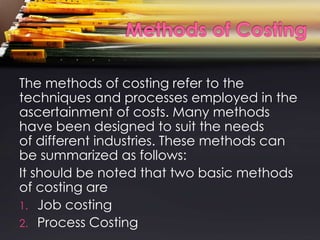
The methods of costing refer to the
techniques and processes employed in the
ascertainment of costs. Many methods
have been designed to suit the needs
of different industries. These methods can
be summarized as follows:
It should be noted that two basic methods
of costing are
1. Job costing
2. Process Costing
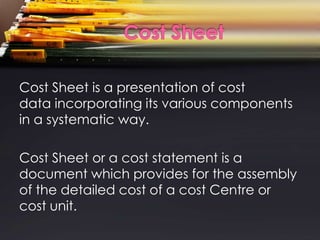
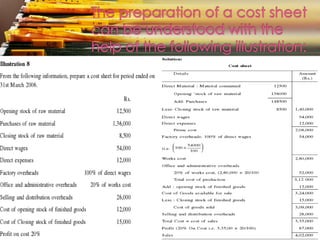
Cost Sheet is a presentation of cost
data incorporating its various components
in a systematic way.

Cost Sheet or a cost statement is a
document which provides for the assembly
of the detailed cost of a cost Centre or
cost unit.
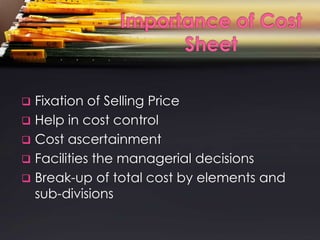
 Fixation of Selling Price
 Help in cost control
 Cost ascertainment
 Facilities the managerial decisions
 Break-up of total cost by elements and
  sub-divisions
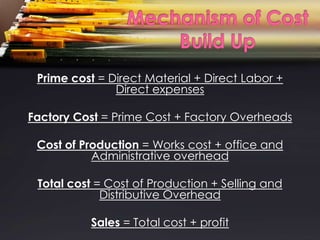
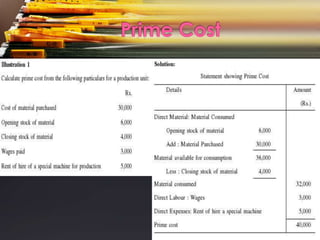
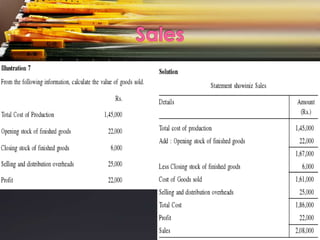
Prime cost = Direct Material + Direct Labor +
               Direct expenses

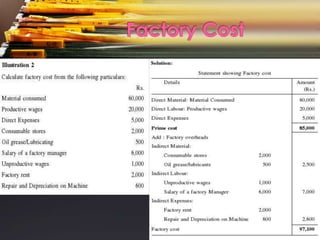
Factory Cost = Prime Cost + Factory Overheads

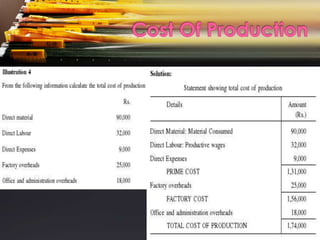
 Cost of Production = Works cost + office and
           Administrative overhead

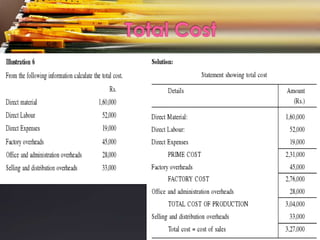
 Total cost = Cost of Production + Selling and
             Distributive Overhead

          Sales = Total cost + profit
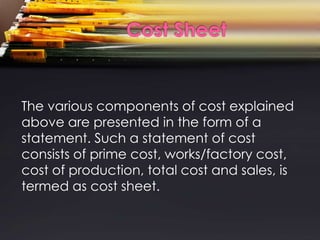
The various components of cost explained
above are presented in the form of a
statement. Such a statement of cost
consists of prime cost, works/factory cost,
cost of production, total cost and sales, is
termed as cost sheet.
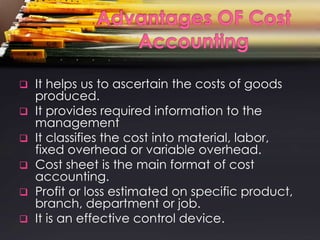
   It helps us to ascertain the costs of goods
    produced.
   It provides required information to the
    management
   It classifies the cost into material, labor,
    fixed overhead or variable overhead.
   Cost sheet is the main format of cost
    accounting.
   Profit or loss estimated on specific product,
    branch, department or job.
   It is an effective control device.
Cost accounting

Cost accounting

  • 2.
    Accountants define costas a resource sacrificed or forgone to achieve a specific objective. A cost (such as direct materials or advertising) is usually measured as the monetary amount that must be paid to acquire goods or services.
  • 3.
    Measures, analyzes andreports financial and non-financial information relating to the costs of acquiring or using recourses in an organization. For Example: Oil Refining. The process costing collects information about all costs during an accounting period and divides those costs by total quantity output
  • 4.
    Following are themain elements involved in the manufacturing process where process costing method is adopted.  Direct Material  Secondary Material  Primary Material  Direct Labor  Direct Expenses  Production Overheads
  • 5.
    The methods ofcosting refer to the techniques and processes employed in the ascertainment of costs. Many methods have been designed to suit the needs of different industries. These methods can be summarized as follows: It should be noted that two basic methods of costing are 1. Job costing 2. Process Costing
  • 6.
    Cost Sheet isa presentation of cost data incorporating its various components in a systematic way. Cost Sheet or a cost statement is a document which provides for the assembly of the detailed cost of a cost Centre or cost unit.
  • 7.
     Fixation ofSelling Price  Help in cost control  Cost ascertainment  Facilities the managerial decisions  Break-up of total cost by elements and sub-divisions
  • 8.
    Prime cost =Direct Material + Direct Labor + Direct expenses Factory Cost = Prime Cost + Factory Overheads Cost of Production = Works cost + office and Administrative overhead Total cost = Cost of Production + Selling and Distributive Overhead Sales = Total cost + profit
  • 14.
    The various componentsof cost explained above are presented in the form of a statement. Such a statement of cost consists of prime cost, works/factory cost, cost of production, total cost and sales, is termed as cost sheet.
  • 16.
    It helps us to ascertain the costs of goods produced.  It provides required information to the management  It classifies the cost into material, labor, fixed overhead or variable overhead.  Cost sheet is the main format of cost accounting.  Profit or loss estimated on specific product, branch, department or job.  It is an effective control device.