EVALUATION
Simran Purewal
In what ways does your media product use, develop or challenge forms and
conventions of real media products?
For my final media product, I have created a short film of the drama genre. I generally
followed the codes and conventions of this genre as I did a lot of research on it,
including watching films of the drama genre and seeing what they have in common, as
well as researching the specific codes and conventions. ‘Burns’ and ‘Dear Mum’ were
the short films that inspired me the most as the themes of suicide and depression really
stood out to me and I had the strongest emotional response to these films. One main
convention that I picked up from all my research was the effective use of close up shots,
which I ensured to include in my own film.
In my short film, I ensured to include themes that make it relatable to my audience,
which is why I decided to include themes of depression, bullying and cyber bullying as
these are common issues that people face (especially within teenagers which is the age
of my protagonist, as well as my target audience). These themes were common in the
(short) films I watched, and therefore knew this was a convention of the drama genre
as the main purpose of a drama film is to create an emotional impact on the audience,
which is something I was constantly thinking about when making my film.
I have not used any sub-genres in my film as I wanted it to purely be a drama short film,
which is why I have included dark themes that are common in the drama genre, such as
depression, bullying, death and suicide.
In what ways does your media product use, develop or challenge forms and
conventions of real media products?
I was heavily influenced by the Netflix series, ‘13 Reasons Why’ as I really
enjoyed the series due to the awareness it brought to real life issues such as
bullying, depression and suicide. I felt like these topics are often avoided
within the media and I therefore wanted to help create awareness to these
topics in order to open up conversations between young people as that is the
typical age group that suffer from depression and bullying.
I was also inspired by the movie, ‘Collateral Beauty’ which is a drama film
about a father who has lost his child. The themes of loneliness and
depression are also visible within this movie which is something I tried to
embed within my short film.
When doing my textual analysis research, all of the short films I watched had
some sort of influence on my film as I watched films that were similar to the
one I wanted to create. I think that choice of audio was significant within this
research and the textual analysis as a whole influenced me the most to
choose the audio that I did for my own film.
In what ways does your media product use, develop or challenge forms and
conventions of real media products?
In order to follow the codes and conventions of the drama genre within my camera work, I used a lot of medium shots
and close up shots of my protagonist to present her emotions through her facial expressions.
At the beginning of my film, I have used a close up shot of my protagonist who is looking directly at the camera whilst
there is a voiceover playing in the background to express her thoughts and feelings. This shot reflects her emotions as
her facial expressions are emphasised and fit in well with the voice over. The voiceover goes on for 48 seconds which is
effective due to the shots that I have used with it. This allows the audience to understand her character, as well as being
able to relate to her.
In this shot, the protagonist is breaking the fourth wall which is a convention of the drama genre as it creates dramatic
effect and helps create a direct connection with the audience. However, it is typical for a drama film to break the fourth
wall at the end rather than the beginning. Therefore, I have developed this convention by using it at the beginning as
well as the ending to allow my audience to have an emotional response from the beginning as it is more effective,
especially with the voiceover.
‘Fight Club’ is a black comedy/drama movie which also breaks the fourth wall in it as Edward Norton’s character
narrates the movie and talks directly to the audience.
In what ways does your media product use, develop or challenge forms and
conventions of real media products?
I have also broken the fourth wall at the end of my film in order to emphasise the
ambiguous ending. By including this in my film, the audience is expected to feel tense
as they don’t know what is going to happen. I decided to include this shot in my film
as it adds to the tension, and also allows the audience to feel more connected to the
protagonist as they feel like they are a part of the protagonist’s life.
When doing my initial research of the common codes and conventions of the drama
genre, I learnt that breaking the fourth wall was a generic conventions, and is typically
used at the end of the film in order to be more effective, which is why I decided to
include this right at the end as I wanted to leave my audience feeling intrigued.
This links to Allan Rowe’s narrative theory about the audience questioning what was
next in the sequence. This final shot in my film supports this theory as the audience
want to know what happens next.
In what ways does your media product use, develop or challenge forms and
conventions of real media products?
Sound is a very important aspect of the drama genre, therefore I had to make sure any
sound I use is effective on my audience.
I decided to include a voiceover in the background of my film which runs through for
the most of the film. I have done this to present the thoughts of my protagonist to
give her POV to the audience. It also fits in well with the background music I have used
as it has a very slow, depressing tone which matches the themes of my film. I had
ensured that the music and voiceover worked well together and reflected a depressing
theme as this is what a lot of the short drama films I watched and analysed included.
I decided to include a voiceover throughout the film as my research proved to me that
this is an effective convention of the drama genre. It helps add to the emotional
impact on the audience which is the aim of my film. The short drama film ‘The Return’
uses a voiceover to add to the emotional, dramatic effect which influenced me to do
the same. This is the music I used:
I also included some sound effects in one scene of the film as I wanted to use a range
of audio in order to make it most effective. As I wanted to present a flashback in my
film through just audio, I used sound effects of a phone ringing, a couple arguing, a car
crashing, a phone line cutting off and some police sirens. I used all of these to present
a car crash which ultimately leads to the death of the protagonist’s father.
Here are some of the sound effects I used:
In what ways does your media product use, develop or challenge forms and
conventions of real media products?
I ensured to do research on the generic codes and conventions of the drama genre in
relation to editing as I was struggling when thinking of the different editing techniques
I could use. However, my research helped me learn about various techniques, and why
they are used within drama films. This is some of the general research I carried out
before planning and creating my film.
In what ways does your media product use, develop or challenge forms and
conventions of real media products?
When editing my film, I followed some of the generic codes and conventions as I
included a lot of cutting, some colour correction as well as some fades between shots
and slow motion. I also used filters on some of the shots, such as adding vignette on
some, and making some black and white.
This is one example of a shot which I
edited to make black and white. I did
this to present my protagonist in pain
to supports her thoughts which are
presented in the voice over.
This is one example of a shot which I
edited by adding a vignette over it. I did
this to emphasise the dark themes
within my film.
In what ways does your media product use, develop or challenge forms and
conventions of real media products?
When I researched into 10 short films of the drama genre, I analysed the editing of
each film and realised that most of the editing techniques were quite basic as the
most common ones were cutting, cross cutting and using fades as transitions. This is
because a drama film is supposed to seem real in order for it to be relatable to the
audience. Therefore, using editing techniques that stand out and are out of the blue
are not common within the drama genre as it creates a distance between the
audience and the characters/storyline.
As a producer/director, my aim was to create a short film which created an emotional
impact on my audience by creating a connection and being relatable. Due to this, I
decided to follow convention and using basic editing techniques in order to achieve
my goal as well as I could.
However, I did use slow motion on a couple of my shots in order to present the shot
more clearly to my audience. One of the shots I used this on was towards the end of
the film where the protagonist is holding some pills in her hand and the camera zooms
in closer to the pills. I used slow motion on this shot to ensure the pills were seen
clearly and emphasised to the audience. I think that this was also helped create a
dramatic effect on the audience.
In what ways does your media product use, develop or challenge forms and
conventions of real media products?
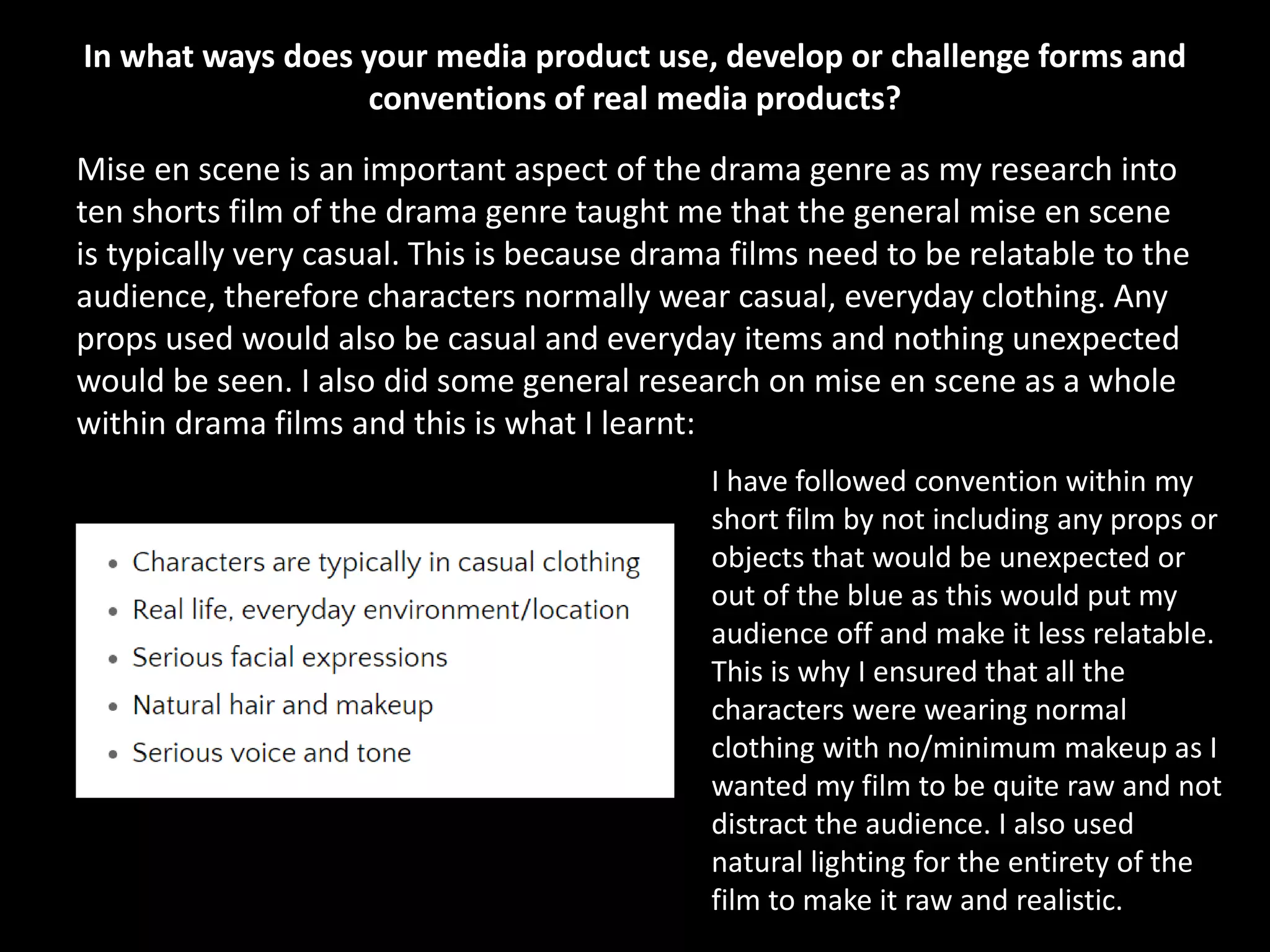
Mise en scene is an important aspect of the drama genre as my research into
ten shorts film of the drama genre taught me that the general mise en scene
is typically very casual. This is because drama films need to be relatable to the
audience, therefore characters normally wear casual, everyday clothing. Any
props used would also be casual and everyday items and nothing unexpected
would be seen. I also did some general research on mise en scene as a whole
within drama films and this is what I learnt:
I have followed convention within my
short film by not including any props or
objects that would be unexpected or
out of the blue as this would put my
audience off and make it less relatable.
This is why I ensured that all the
characters were wearing normal
clothing with no/minimum makeup as I
wanted my film to be quite raw and not
distract the audience. I also used
natural lighting for the entirety of the
film to make it raw and realistic.
In what ways does your media product use, develop or challenge forms and
conventions of real media products?
I continued to follow convention as I ensured to include real life, every day
environments and locations in order to make everything seem normal and relatable to
the audience. I did all my filming in a house, school and graveyard. All of these
locations are normal places that people visit and would expect to see in a drama film.
Throughout my film, my protagonist constantly has serious facial expressions in order
to reflect her personality, as well as emphasise the issues that are brought up within
the film and the impact these issues have on people.
I also made sure that my protagonist had a serious tone of voice in both, the voiceover
and in any dialogue as I wanted the seriousness of the film to be emphasised not only
in my camera work, but mise en scene and audio too.
In what ways does your media product use, develop or challenge forms and
conventions of real media products?
I think that my film is quite stereotypical of teenagers as I have included a
teenaged female who is getting bullied at school, along with facing other
issues in her home life which leads to her being depressed and having suicidal
thoughts. This is stereotypical to females as it is common to see a female
suffering from depression and being emotional rather then a male.
I have also included a scene where a group of teenagers are bullying the
protagonist in a classroom, which conforms to the stereotype of teenagers
being bullies and disrespectful to other. This is also supported by the shot of
the main bully pushing the protagonist into some lockers.
A lot of children/teenagers come from broken homes and are often portrayed
this way through the media, especially through dramas such as EastEnders.
Therefore, my short film conforms to this stereotype of teenagers.
How effective is the combination of your main and ancillary texts?
A main strength of my short film is the audio that I have chosen. I think that the
background music and the voice over together present an emotional feeling that the
audience is able to relate to. It also reflects the themes of my film really well,
especially as the voiceover is spoken in a slow, depressing tone. I think that it really
brings the film together and is extremely effective on my audience and encourages
their emotional response. This links to the fact that I have used the Uses and
Gratifications Model as my film would be an affective reason for my audience to watch
my film as they are looking to connect emotionally with a media text.
I decided to use this specific audio due to my research into short drama films as the
majority of them included music similar to the one I used. Therefore, I followed
convention in order to display the drama genre.
I also followed convention by including a voiceover as quite a few of the short films I
looked into included this to present the protagonist’s thoughts, which is also effective
as the audience are able to get a unique POV from the protagonist as I have used
objective character identification.
The main purpose of this short film was to create awareness for depression and
bullying, especially within teenagers as that is a common age to go through these
issues, as well as opening up conversations between teenagers as it is not commonly
discussed, yet it is such a major issue.
How effective is the combination of your main and ancillary texts?
One weakness of my short film is that the storyline is not very clear. I have
used many shots of the protagonist getting bullied at school, getting cyber
bullied and visiting a graveyard to present the issues she is dealing with,
however I think that it may not be very clear that there is a build up of
problems in her life, as well as her mind which is the reason why she is
suicidal.
I found it challenging to make it clear exactly what had happened in her life
which has lead her to this point as I didn’t really know what shots would
present it in the best way. Therefore, if I could re-make my film in the future, I
would spend a lot more time planning and visualising my film in order to
make sure it was 100% clear as it would be more relatable for my audience.
How effective is the combination of your main and ancillary texts?
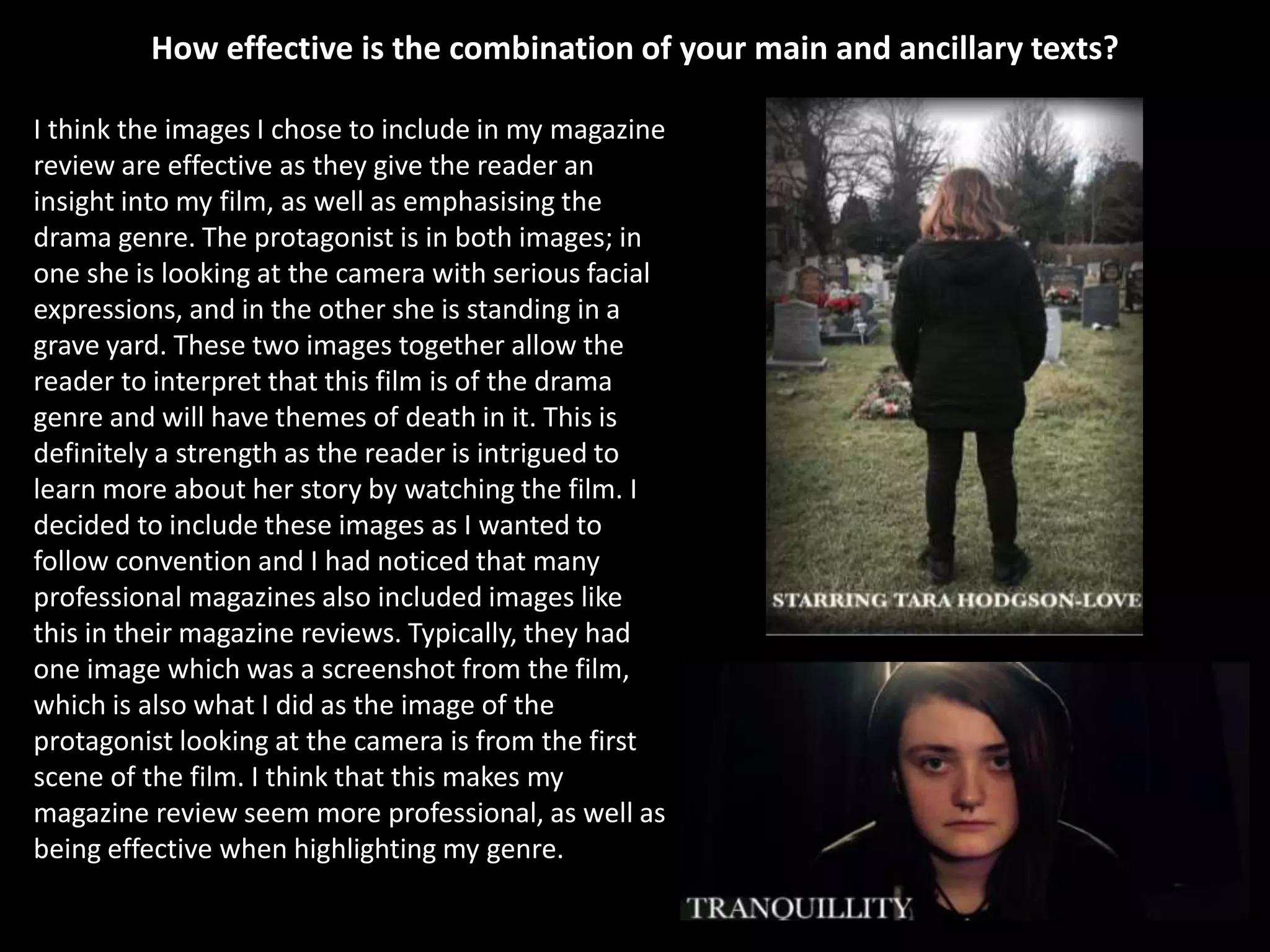
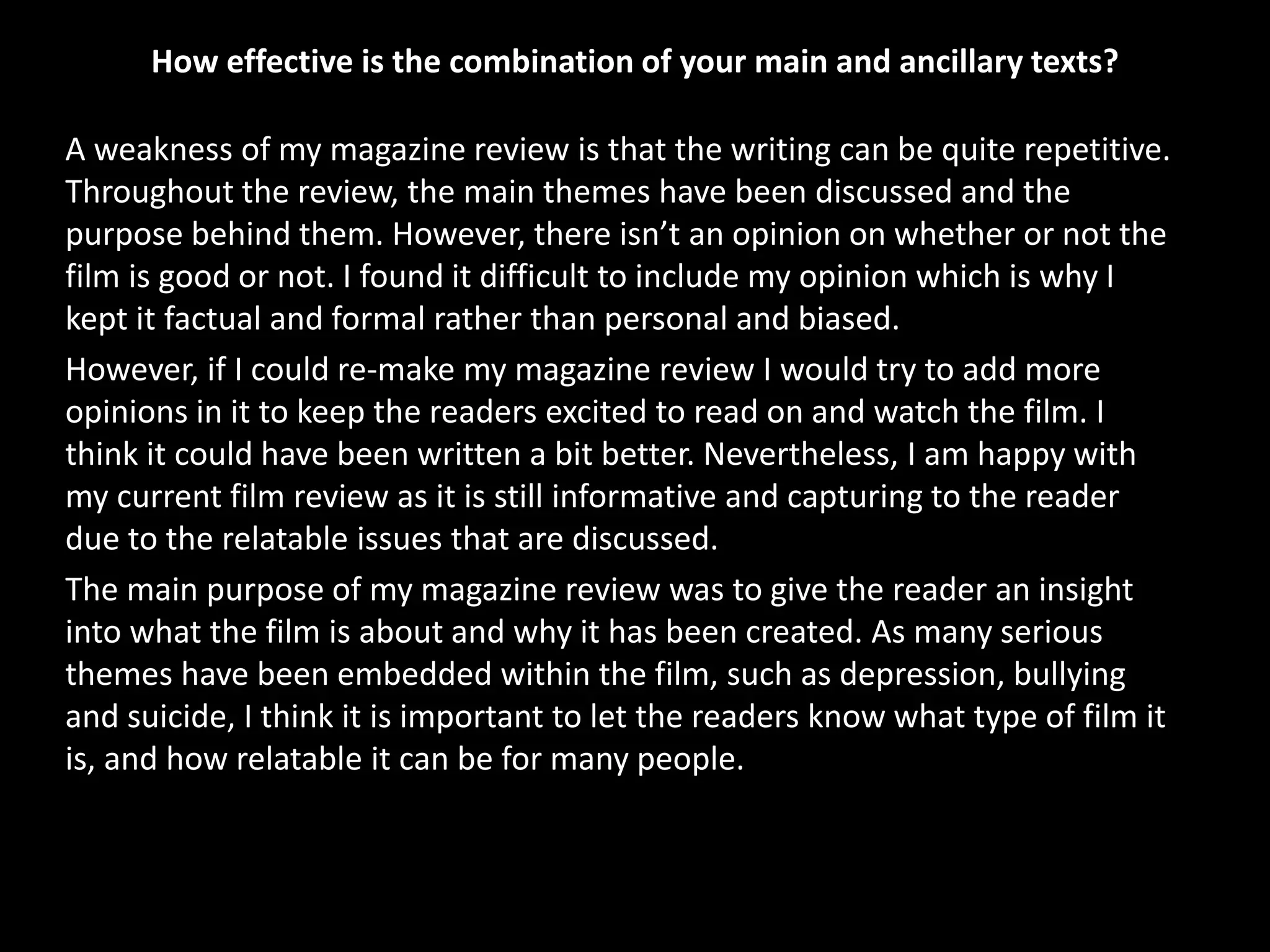
I think the images I chose to include in my magazine
review are effective as they give the reader an
insight into my film, as well as emphasising the
drama genre. The protagonist is in both images; in
one she is looking at the camera with serious facial
expressions, and in the other she is standing in a
grave yard. These two images together allow the
reader to interpret that this film is of the drama
genre and will have themes of death in it. This is
definitely a strength as the reader is intrigued to
learn more about her story by watching the film. I
decided to include these images as I wanted to
follow convention and I had noticed that many
professional magazines also included images like
this in their magazine reviews. Typically, they had
one image which was a screenshot from the film,
which is also what I did as the image of the
protagonist looking at the camera is from the first
scene of the film. I think that this makes my
magazine review seem more professional, as well as
being effective when highlighting my genre.
How effective is the combination of your main and ancillary texts?
A weakness of my magazine review is that the writing can be quite repetitive.
Throughout the review, the main themes have been discussed and the
purpose behind them. However, there isn’t an opinion on whether or not the
film is good or not. I found it difficult to include my opinion which is why I
kept it factual and formal rather than personal and biased.
However, if I could re-make my magazine review I would try to add more
opinions in it to keep the readers excited to read on and watch the film. I
think it could have been written a bit better. Nevertheless, I am happy with
my current film review as it is still informative and capturing to the reader
due to the relatable issues that are discussed.
The main purpose of my magazine review was to give the reader an insight
into what the film is about and why it has been created. As many serious
themes have been embedded within the film, such as depression, bullying
and suicide, I think it is important to let the readers know what type of film it
is, and how relatable it can be for many people.
How effective is the combination of your main and ancillary texts?
One major strength of my website is that it looks visually appealing and
attracts viewers to explore the whole website. The background is very dark,
but the text is white which makes it stand out, as well as portraying a dark
theme. This is effective as the viewers are intrigued to explore the page and
learn more about the film, as well as them realising that the film being
promoted is of the drama genre.
I decided to use these specific colours due to the research I did into websites
promoting films of the drama genre. I realised that a drama film websites
used dull colours, and any films that included dark themes used really dark
colours. Therefore, I decided to follow convention and use black as my film
explores dark themes of suicide, depression and bullying. Therefore, my
website is reflective of my film and the viewers will know what to expect from
the film.
Although I am happy with my website, I did find it quite challenging to
produce this whole website as I faced many difficulties during the process as I
was unable to make it how I initially pictured it in my head. But, as time went
on and as I played around with my options more, I was able to create it how I
had envisioned.
How effective is the combination of your main and ancillary texts?
One of my weaknesses within my website is that the viewers do not get a lot
of behind the scenes footage. Although I have included a ‘Cast’ page and
given some information about the actors, the audience aren’t able to see any
bloopers or interviews of the cast or director.
Although this would intrigue and entertain the viewers, I think by not
including any behind the scenes footage allows the full focus and attention to
be on the film and its themes.
Nevertheless, if I could re-make my website, I would include a page of images
and videos of the process of making the film, as well as an interview with
some of the cast so they can express their thoughts on the film and the issues
that are brought up in it.
The main purpose of my website was to allow my viewers to learn more
about the film before they watch it and give them an insight into it.
Overall, I am happy with my media text and the ancillary texts as they all link
together and allow the audience to understand the general themes of
depression and death through the colours, typography and imagery.
How effective is the combination of your main and ancillary texts?
As all of my media texts need to relate to one another as they are all promoting the
main film, I had to ensure to use similar colours, imagery and font in order to create
synergy. This allowed me to achieve my desired outcome on three media texts,
especially as they all provide information about my film.
I used the same typography for my film title in each media text; this is what it was:
As I am exploring themes of depression and suicide, I feel like the font I have chosen is
representative of the themes embedded in my film. The font itself is quite calm,
however the use of capitals can give off an aggressive vibe which contradicts with the
fragile themes that my film presents.
I have chosen a serif style font as I want to include an air of sophistication to highlight
the deeper themes within my narrative. I also noticed this is a popular style of font
within my research.
I decided to make the title white to make it stand out as I knew I was going to use dark
colours on my ancillary texts, therefore allowing the title to stand out. I knew it would
also stand out in my short film as the title is presented on a black screen. I also
decided to use white as it suggests themes of innocence and safety which would be
contradicted with the dark use of colours in my ancillary texts, as well as the dark
themes.
How effective is the combination of your main and ancillary texts?
To continue the synergy throughout my media texts, I have used dark colours
throughout them all in order to reflect the dark themes in my film. As my film is
based on depression, I decided to use colours such as black and grey for my
ancillary texts.
My website homepage is very dark as the whole background is black, and I have
included an image which is also quite dark. However, this allows the text
to stand out to the viewers.
For the background of the other
website pages, I have used a dark grey
colour to keep the dark colour theme
consistent throughout.
How effective is the combination of your main and ancillary texts?
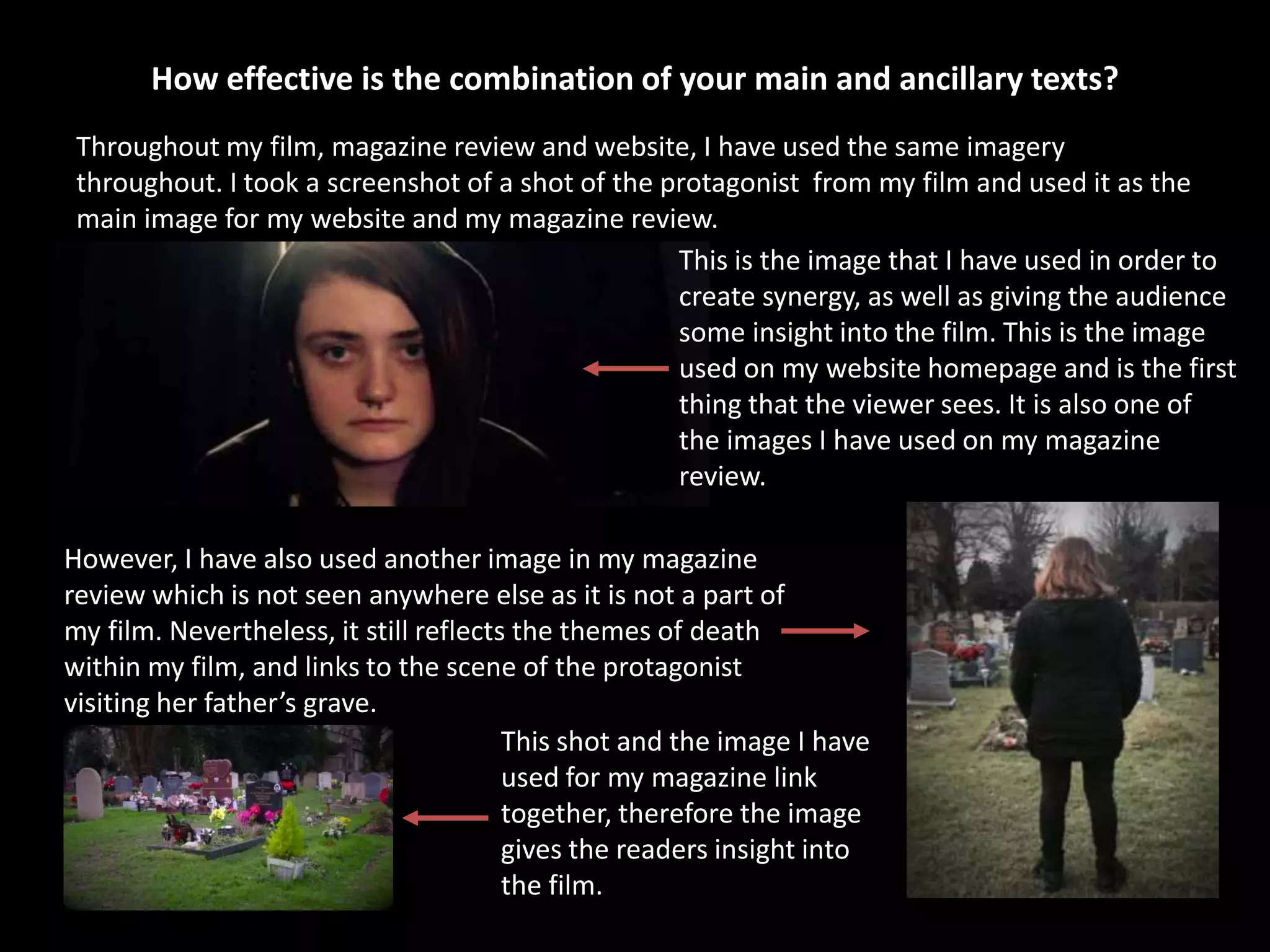
Throughout my film, magazine review and website, I have used the same imagery
throughout. I took a screenshot of a shot of the protagonist from my film and used it as the
main image for my website and my magazine review.
This is the image that I have used in order to
create synergy, as well as giving the audience
some insight into the film. This is the image
used on my website homepage and is the first
thing that the viewer sees. It is also one of
the images I have used on my magazine
review.
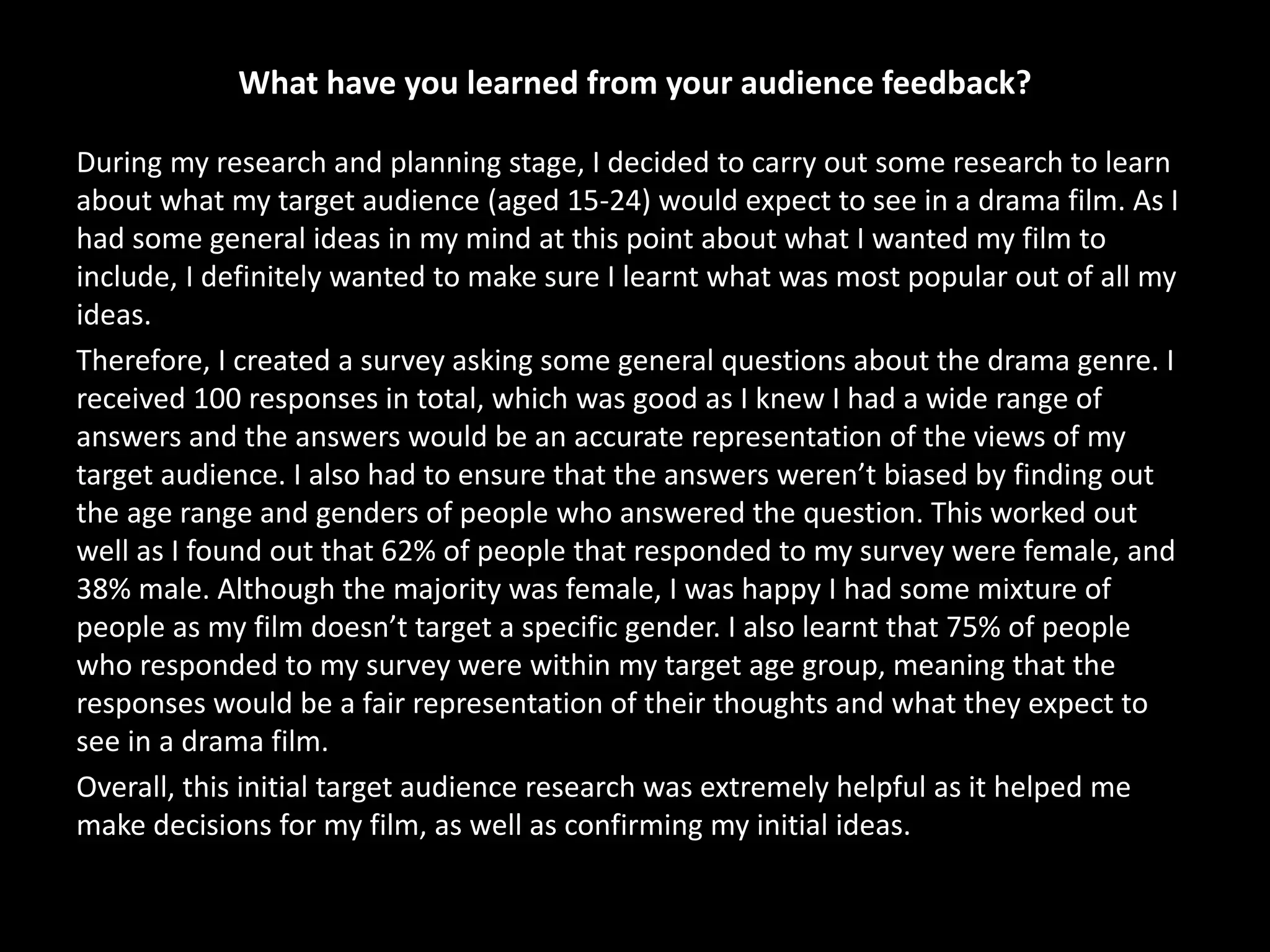
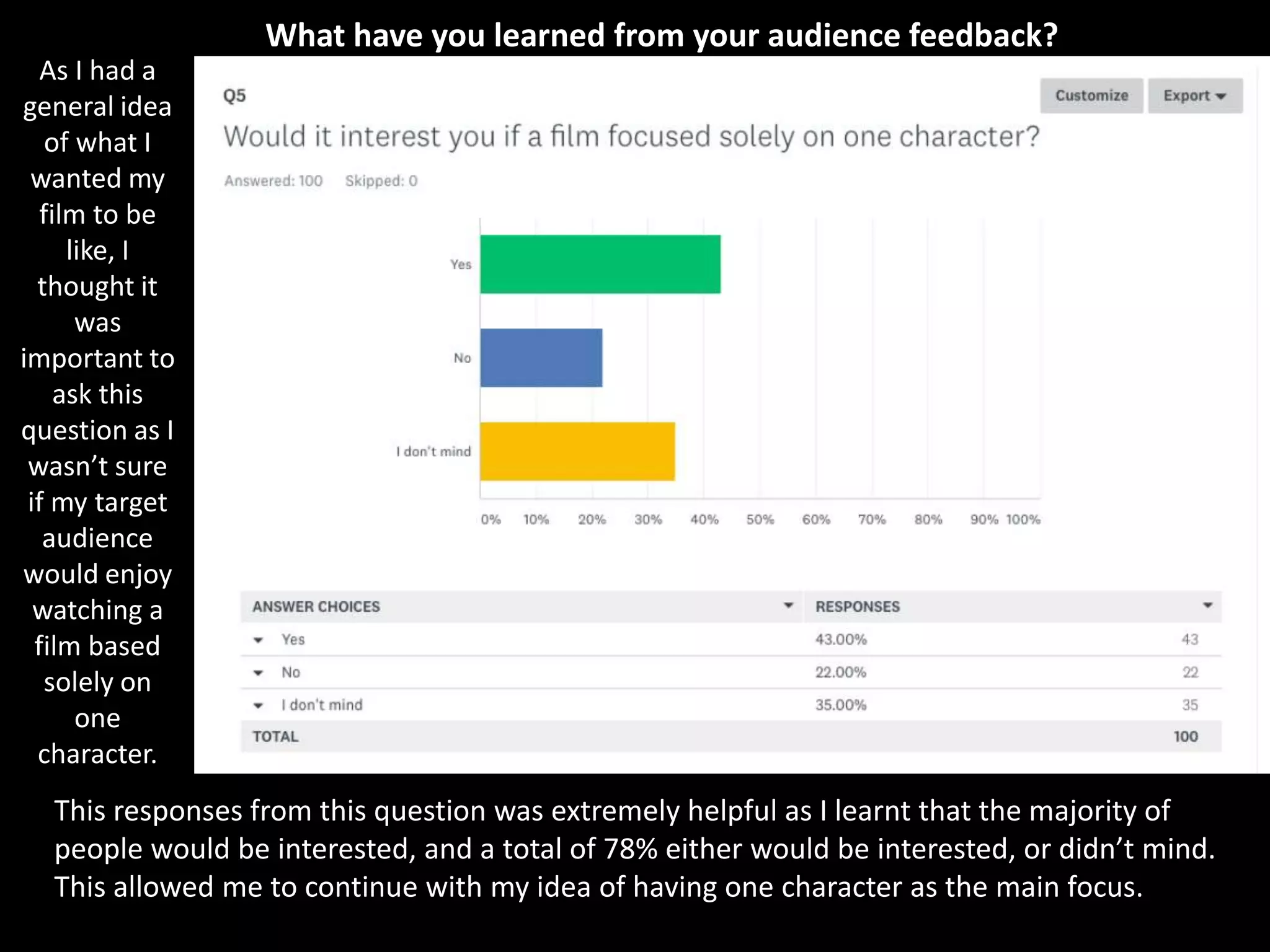
However, I have also used another image in my magazine
review which is not seen anywhere else as it is not a part of
my film. Nevertheless, it still reflects the themes of death
within my film, and links to the scene of the protagonist
visiting her father’s grave.
This shot and the image I have
used for my magazine link
together, therefore the image
gives the readers insight into
the film.
What have you learned from your audience feedback?
During my research and planning stage, I decided to carry out some research to learn
about what my target audience (aged 15-24) would expect to see in a drama film. As I
had some general ideas in my mind at this point about what I wanted my film to
include, I definitely wanted to make sure I learnt what was most popular out of all my
ideas.
Therefore, I created a survey asking some general questions about the drama genre. I
received 100 responses in total, which was good as I knew I had a wide range of
answers and the answers would be an accurate representation of the views of my
target audience. I also had to ensure that the answers weren’t biased by finding out
the age range and genders of people who answered the question. This worked out
well as I found out that 62% of people that responded to my survey were female, and
38% male. Although the majority was female, I was happy I had some mixture of
people as my film doesn’t target a specific gender. I also learnt that 75% of people
who responded to my survey were within my target age group, meaning that the
responses would be a fair representation of their thoughts and what they expect to
see in a drama film.
Overall, this initial target audience research was extremely helpful as it helped me
make decisions for my film, as well as confirming my initial ideas.
I made sure
to ask if
people would
expect to see
a male or
female
playing the
protagonist in
a drama film,
and although
most said
they didn’t
mind, less
people said
male than
female. I was
happy with
this response
as I had
already
chosen my main actress as the usual stereotype is of a female suffering through depression and
having a tough time at school, and I wanted to conform to this stereotype as it would be more
effective on the audience, which has been proved by my research.
What have you learned from your audience feedback?
As I had a
general idea
of what I
wanted my
film to be
like, I
thought it
was
important to
ask this
question as I
wasn’t sure
if my target
audience
would enjoy
watching a
film based
solely on
one
character.
This responses from this question was extremely helpful as I learnt that the majority of
people would be interested, and a total of 78% either would be interested, or didn’t mind.
This allowed me to continue with my idea of having one character as the main focus.
What have you learned from your audience feedback?
Personally, I
really enjoy
films which
have an
ambiguous
ending as it
leaves me
thinking
about the
film after it
has ended.
This is what I
wanted my
audience to
feel, so I
asked this
question to
ensure that
the majority
will not feel
as if this
ruins the
film as it can
have various
effects on
people.
Luckily, my research taught me that the majority of people would not be
disappointed with an ambiguous ending. However, 43% said they would be.
Nevertheless, I made my own decision to include an ambiguous ending as my
research supported it, and I knew it would be an effective way to end the film.
What have you learned from your audience feedback?
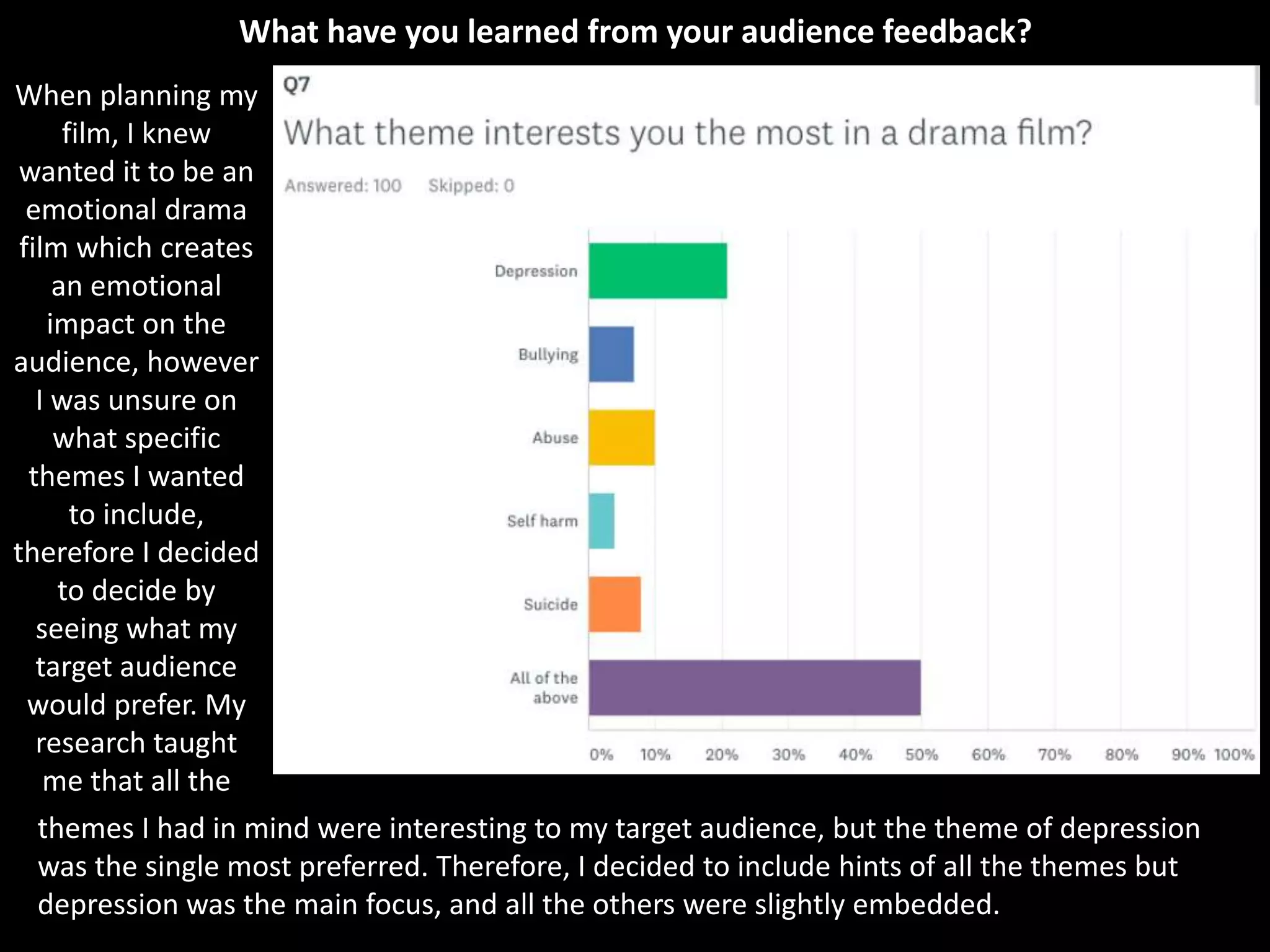
When planning my
film, I knew
wanted it to be an
emotional drama
film which creates
an emotional
impact on the
audience, however
I was unsure on
what specific
themes I wanted
to include,
therefore I decided
to decide by
seeing what my
target audience
would prefer. My
research taught
me that all the
themes I had in mind were interesting to my target audience, but the theme of depression
was the single most preferred. Therefore, I decided to include hints of all the themes but
depression was the main focus, and all the others were slightly embedded.
What have you learned from your audience feedback?
I ensured to get feedback
from my audience after each
draft I created of my film so I
knew what worked well and
what needed improving. The
first draft of my film was not
very long as I only had the
first shot ready and edited,
therefore I decided not to get
any audience feedback.
However, I did set myself
some improvements and
showed some students in my
class, who agreed with the
improvement I had set myself.
One clear improvement I had
set myself was to re-record
the voiceover as it was of low
quality.
What have you learned from your audience feedback?
I also set myself some
smaller improvements that
would help improve my
film. This was also
approved by some of my
class members. This was
helpful for me as I was
able to identify any
improvements, and I knew
there wasn’t anything that
I didn’t identify myself.
What have you learned from your audience feedback?
After creating my first draft of my website, I ensured to get some audience feedback
by holding a focus group of 10 people aged between 15-24 as this is the age of my
target audience. At this point, I was struggling to find an easy software to create my
website, therefore my feedback was based on the homepage only.
This was helpful to me as everyone gave me similar improvements, which I created
into bullet points so I knew exactly what I had to do to improve my website.
These improvements allowed me to make my website of a higher standard, as well as
making it more appealing to my target audience, as this is what they suggested. I also
agreed with all of this feedback and got a better understanding of what my target
audience expect my website to be like.
What have you learned from you audience feedback?
In comparison to my first draft, my website improved significantly as I added a lot
more content on it by creating multiple pages, which made it more appealing to my
audience as it provides more information about my film.
Listening to my audience feedback played a significant part in improving my film as I
would have struggled in knowing how to improve it and what others would enjoy
seeing.
I ensured to add more tabs, which would then lead to more pages on the website,
giving my audience more content to learn about my film and become more interested
and intrigued.
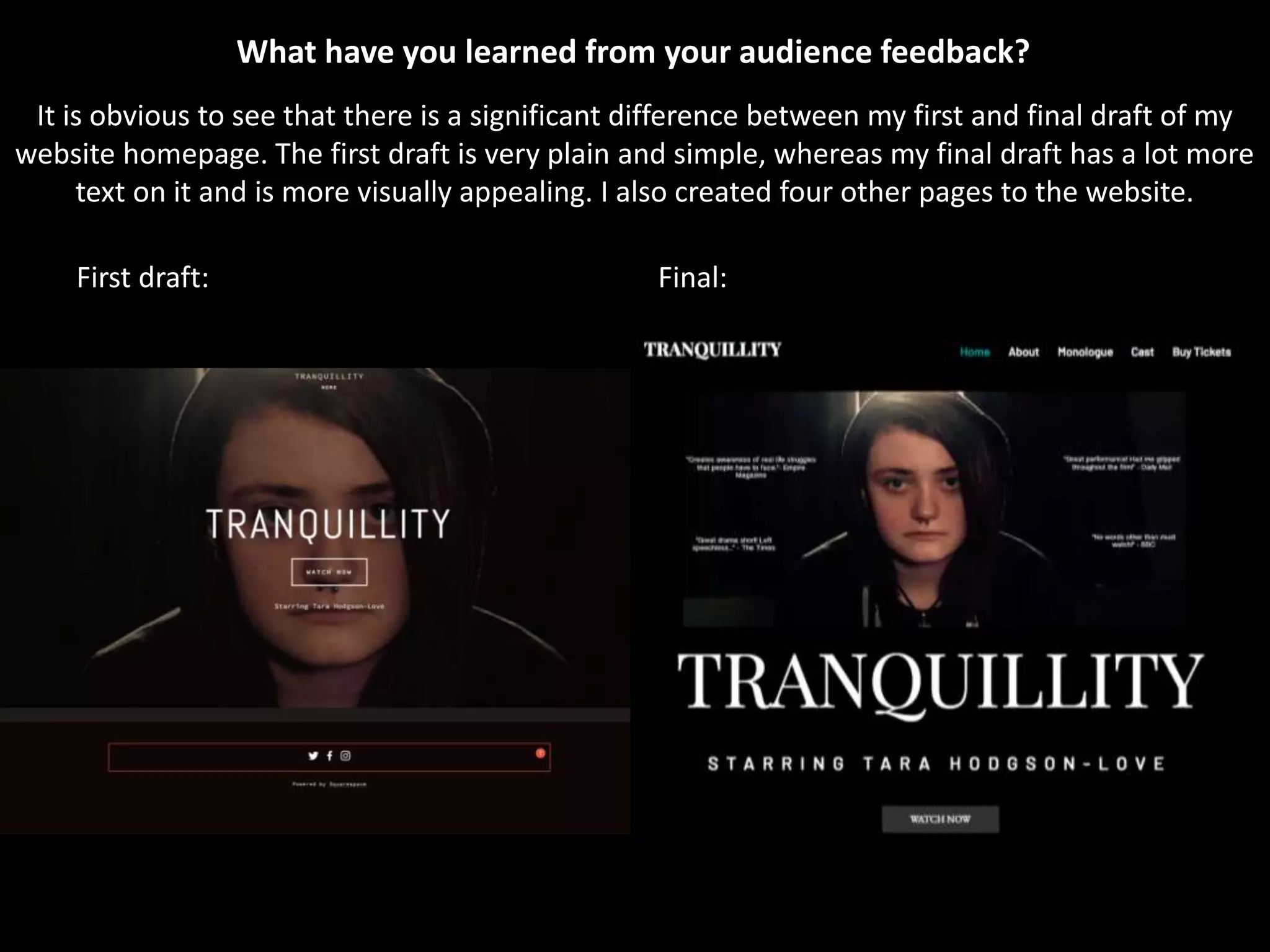
I also changed the text around so the image of the protagonist was not blocked, as
well as making the film title a lot bigger so it would stand out more.
Although there are no social media links on the homepage, I ensured to add them at
the bottom of the page so the audience have the option of visiting these social media
pages once they have gone through the website. When I showed my final website to
some people from my target audience age range, they did not complain about there
being no social media links on the homepage.
I found my audience feedback to be very helpful for my website as I was able to
improve it a lot and make it seem quite professional and appealing.
It is obvious to see that there is a significant difference between my first and final draft of my
website homepage. The first draft is very plain and simple, whereas my final draft has a lot more
text on it and is more visually appealing. I also created four other pages to the website.
First draft: Final:
What have you learned from your audience feedback?
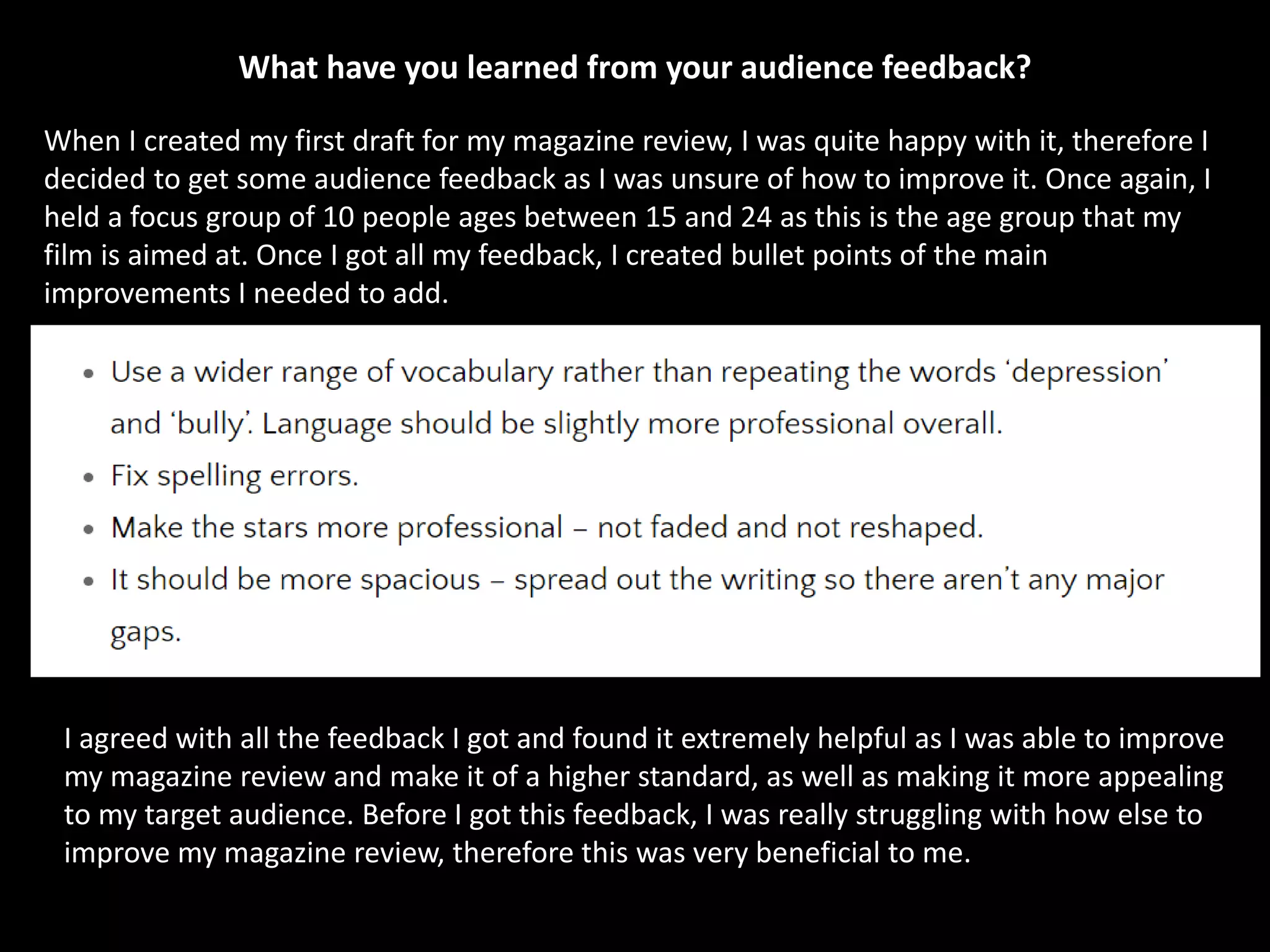
When I created my first draft for my magazine review, I was quite happy with it, therefore I
decided to get some audience feedback as I was unsure of how to improve it. Once again, I
held a focus group of 10 people ages between 15 and 24 as this is the age group that my
film is aimed at. Once I got all my feedback, I created bullet points of the main
improvements I needed to add.
I agreed with all the feedback I got and found it extremely helpful as I was able to improve
my magazine review and make it of a higher standard, as well as making it more appealing
to my target audience. Before I got this feedback, I was really struggling with how else to
improve my magazine review, therefore this was very beneficial to me.
What have you learned from your audience feedback?
Once I added all my improvements, the quality of my magazine review got a lot higher
which can be seen through my final draft.
I ensured that I changed some of the language I used, as well as changing the stars I
used for my star rating as this was a common error that came up.
I fixed all the spelling errors and got rid of any unnecessary gaps and spaces, as well as
lining the text properly so it would be more professional.
I added all my improvements, as well as creating a double page for my review in order
to give my audience more insight into my film. I think that this played a major part in
making my review more professional.
Overall, my audience feedback was extremely helpful as it allowed me to improve my
magazine review and make it of a higher standard than I had originally created. I was
very happy with the final outcome of my magazine review, which wouldn’t have been
possible without getting any audience feedback as it was difficult to see how else I
could improve my magazine review, especially as I had been working on it for so long
and felt like a fresh set of eyes would be able to give me some constructive criticism.
It is obvious that my magazine review has improved significantly since the first draft as I made it
more professional by changing the typography of the title, as well as turning it into a double
page and adding another image, along with some anchorage text. My audience feedback played
a large role in this as that is how I knew what to improve in order to make it of a higher quality.
First draft:
Final:
What have you learned from your audience feedback?
How did you use new media technologies in the construction and research,
planning and evaluation stages?
When doing my research for my film, the internet was an extremely useful tool that
helped me. I used various forms of the internet, one of them being YouTube. This was
extremely beneficial to me as this is what I used to find short films of the drama genre
which I then analysed and was able to learn about the general codes and conventions
of the drama genre.
I also used Wordpress as I presented all my research through my blog. All of my
analysis and research can be found on there which is convenient. This blog is an
important part of my coursework as a whole as I used Wordpress to document the
whole process of creating my final media texts.
I also used Google Forms to carry out my initial target audience research as that is
what I used to create my survey. This was easy to use as it enabled me to create a
survey very quickly, and also presented all the data I collected through the survey
clearly.
Overall, all these forms of new media technology helped me very much as it made the
whole process of research quite simple and easy to do.
How did you use new media technologies in the construction and research,
planning and evaluation stages?
In order to carry out research on websites, I used Google’s search engine to find
some of the best official movie websites so I could analyse them in detail as
research for my own website. This was quite easy as I quickly found some great
websites to analyse, which I have discussed in my blog, which was created on
Wordpress.
Once I had done this, I decided to play around with SquareSpace, Wordpress and
Wix to see which website creator I would find easiest to use, and which one would
enable me to create my website the way I had envisioned it. I did not like
SquareSpace or Wordpress as it gave me limited options on layouts, therefore I did
not use these to create my website. Wix was the most effective website software as
it was easiest to use and allowed me to choose my own colours and layout and
create my website the way I had envisioned.
When researching for my magazine review, the only new media technology I used
was Wordpress as I did most of my research through a physical copy of Empire
magazine. As all my other research, I presented my research and analysis on my
Wordpress blog.
How did you use new media technologies in the construction and research,
planning and evaluation stages?
When constructing my short film, I used a camera, microphone and iMovie to help
me. I used a professional digital camera to film my short film which was extremely
beneficial as it allowed my footage to be of high quality. I used the microphone to
record my voiceover which was extremely beneficial to me as I had tried many ways to
record it but they did not give me the good quality and effectiveness that the
microphone did. I then used iMovie to edit my film as I found it easy to use, as well as
being effective.
When constructing my website, I used Wix, Photoshop and an iPhone. I created my
whole website using Wix as it was the most effective way for me to create a website as
it was easy to use and I had a lot of choices. I also used Photoshop to edit the main
image on the homepage which was quite effective. For my casting page, I used an
iPhone to take images of my cast which were then uploaded to the website. This was
also effective and beneficial as the images came out clear and professional.
When constructing my magazine review, I used Photoshop and an iPhone. The whole
magazine was created on Photoshop which was easy to do, and very effective. I used
an iPhone to take an image that I included in my magazine review which was quick
and easy, and therefore beneficial.
Overall, all of these new media technologies were easy to use and helped make all of
my media products to the best I possibly could.
How did you use new media technologies in the construction and research,
planning and evaluation stages?
When I was planning my short film and ancillary texts, I used Microsoft Word,
Wordpress, YouTube and iMovie during the process.
I created my mindmap and storyboard by hand, therefore no new media
technologies were used for this besides Wordpress as these documents were
uploaded to my blog. However, I created my shot list and script using Microsoft
Word as it was easy to do so and looked more professional.
I also created an animatic, which was created using iMovie and uploaded onto
YouTube. Both of these new media technologies were effective and beneficial to
me as it was an easy process.
To plan for my ancillary texts, I created mock ups on Microsoft Word which was
extremely effective as it allowed me to have a visual representation of how I
wanted my ancillary texts to look.
Overall, all of these new media technologies were effective and beneficial to me
as they made the whole process of planning easy, whilst looking professional.

Evaluation

  • 1.
  • 2.
    In what waysdoes your media product use, develop or challenge forms and conventions of real media products? For my final media product, I have created a short film of the drama genre. I generally followed the codes and conventions of this genre as I did a lot of research on it, including watching films of the drama genre and seeing what they have in common, as well as researching the specific codes and conventions. ‘Burns’ and ‘Dear Mum’ were the short films that inspired me the most as the themes of suicide and depression really stood out to me and I had the strongest emotional response to these films. One main convention that I picked up from all my research was the effective use of close up shots, which I ensured to include in my own film. In my short film, I ensured to include themes that make it relatable to my audience, which is why I decided to include themes of depression, bullying and cyber bullying as these are common issues that people face (especially within teenagers which is the age of my protagonist, as well as my target audience). These themes were common in the (short) films I watched, and therefore knew this was a convention of the drama genre as the main purpose of a drama film is to create an emotional impact on the audience, which is something I was constantly thinking about when making my film. I have not used any sub-genres in my film as I wanted it to purely be a drama short film, which is why I have included dark themes that are common in the drama genre, such as depression, bullying, death and suicide.
  • 3.
    In what waysdoes your media product use, develop or challenge forms and conventions of real media products? I was heavily influenced by the Netflix series, ‘13 Reasons Why’ as I really enjoyed the series due to the awareness it brought to real life issues such as bullying, depression and suicide. I felt like these topics are often avoided within the media and I therefore wanted to help create awareness to these topics in order to open up conversations between young people as that is the typical age group that suffer from depression and bullying. I was also inspired by the movie, ‘Collateral Beauty’ which is a drama film about a father who has lost his child. The themes of loneliness and depression are also visible within this movie which is something I tried to embed within my short film. When doing my textual analysis research, all of the short films I watched had some sort of influence on my film as I watched films that were similar to the one I wanted to create. I think that choice of audio was significant within this research and the textual analysis as a whole influenced me the most to choose the audio that I did for my own film.
  • 4.
    In what waysdoes your media product use, develop or challenge forms and conventions of real media products? In order to follow the codes and conventions of the drama genre within my camera work, I used a lot of medium shots and close up shots of my protagonist to present her emotions through her facial expressions. At the beginning of my film, I have used a close up shot of my protagonist who is looking directly at the camera whilst there is a voiceover playing in the background to express her thoughts and feelings. This shot reflects her emotions as her facial expressions are emphasised and fit in well with the voice over. The voiceover goes on for 48 seconds which is effective due to the shots that I have used with it. This allows the audience to understand her character, as well as being able to relate to her. In this shot, the protagonist is breaking the fourth wall which is a convention of the drama genre as it creates dramatic effect and helps create a direct connection with the audience. However, it is typical for a drama film to break the fourth wall at the end rather than the beginning. Therefore, I have developed this convention by using it at the beginning as well as the ending to allow my audience to have an emotional response from the beginning as it is more effective, especially with the voiceover. ‘Fight Club’ is a black comedy/drama movie which also breaks the fourth wall in it as Edward Norton’s character narrates the movie and talks directly to the audience.
  • 5.
    In what waysdoes your media product use, develop or challenge forms and conventions of real media products? I have also broken the fourth wall at the end of my film in order to emphasise the ambiguous ending. By including this in my film, the audience is expected to feel tense as they don’t know what is going to happen. I decided to include this shot in my film as it adds to the tension, and also allows the audience to feel more connected to the protagonist as they feel like they are a part of the protagonist’s life. When doing my initial research of the common codes and conventions of the drama genre, I learnt that breaking the fourth wall was a generic conventions, and is typically used at the end of the film in order to be more effective, which is why I decided to include this right at the end as I wanted to leave my audience feeling intrigued. This links to Allan Rowe’s narrative theory about the audience questioning what was next in the sequence. This final shot in my film supports this theory as the audience want to know what happens next.
  • 6.
    In what waysdoes your media product use, develop or challenge forms and conventions of real media products? Sound is a very important aspect of the drama genre, therefore I had to make sure any sound I use is effective on my audience. I decided to include a voiceover in the background of my film which runs through for the most of the film. I have done this to present the thoughts of my protagonist to give her POV to the audience. It also fits in well with the background music I have used as it has a very slow, depressing tone which matches the themes of my film. I had ensured that the music and voiceover worked well together and reflected a depressing theme as this is what a lot of the short drama films I watched and analysed included. I decided to include a voiceover throughout the film as my research proved to me that this is an effective convention of the drama genre. It helps add to the emotional impact on the audience which is the aim of my film. The short drama film ‘The Return’ uses a voiceover to add to the emotional, dramatic effect which influenced me to do the same. This is the music I used: I also included some sound effects in one scene of the film as I wanted to use a range of audio in order to make it most effective. As I wanted to present a flashback in my film through just audio, I used sound effects of a phone ringing, a couple arguing, a car crashing, a phone line cutting off and some police sirens. I used all of these to present a car crash which ultimately leads to the death of the protagonist’s father. Here are some of the sound effects I used:
  • 7.
    In what waysdoes your media product use, develop or challenge forms and conventions of real media products? I ensured to do research on the generic codes and conventions of the drama genre in relation to editing as I was struggling when thinking of the different editing techniques I could use. However, my research helped me learn about various techniques, and why they are used within drama films. This is some of the general research I carried out before planning and creating my film.
  • 8.
    In what waysdoes your media product use, develop or challenge forms and conventions of real media products? When editing my film, I followed some of the generic codes and conventions as I included a lot of cutting, some colour correction as well as some fades between shots and slow motion. I also used filters on some of the shots, such as adding vignette on some, and making some black and white. This is one example of a shot which I edited to make black and white. I did this to present my protagonist in pain to supports her thoughts which are presented in the voice over. This is one example of a shot which I edited by adding a vignette over it. I did this to emphasise the dark themes within my film.
  • 9.
    In what waysdoes your media product use, develop or challenge forms and conventions of real media products? When I researched into 10 short films of the drama genre, I analysed the editing of each film and realised that most of the editing techniques were quite basic as the most common ones were cutting, cross cutting and using fades as transitions. This is because a drama film is supposed to seem real in order for it to be relatable to the audience. Therefore, using editing techniques that stand out and are out of the blue are not common within the drama genre as it creates a distance between the audience and the characters/storyline. As a producer/director, my aim was to create a short film which created an emotional impact on my audience by creating a connection and being relatable. Due to this, I decided to follow convention and using basic editing techniques in order to achieve my goal as well as I could. However, I did use slow motion on a couple of my shots in order to present the shot more clearly to my audience. One of the shots I used this on was towards the end of the film where the protagonist is holding some pills in her hand and the camera zooms in closer to the pills. I used slow motion on this shot to ensure the pills were seen clearly and emphasised to the audience. I think that this was also helped create a dramatic effect on the audience.
  • 10.
    In what waysdoes your media product use, develop or challenge forms and conventions of real media products? Mise en scene is an important aspect of the drama genre as my research into ten shorts film of the drama genre taught me that the general mise en scene is typically very casual. This is because drama films need to be relatable to the audience, therefore characters normally wear casual, everyday clothing. Any props used would also be casual and everyday items and nothing unexpected would be seen. I also did some general research on mise en scene as a whole within drama films and this is what I learnt: I have followed convention within my short film by not including any props or objects that would be unexpected or out of the blue as this would put my audience off and make it less relatable. This is why I ensured that all the characters were wearing normal clothing with no/minimum makeup as I wanted my film to be quite raw and not distract the audience. I also used natural lighting for the entirety of the film to make it raw and realistic.
  • 11.
    In what waysdoes your media product use, develop or challenge forms and conventions of real media products? I continued to follow convention as I ensured to include real life, every day environments and locations in order to make everything seem normal and relatable to the audience. I did all my filming in a house, school and graveyard. All of these locations are normal places that people visit and would expect to see in a drama film. Throughout my film, my protagonist constantly has serious facial expressions in order to reflect her personality, as well as emphasise the issues that are brought up within the film and the impact these issues have on people. I also made sure that my protagonist had a serious tone of voice in both, the voiceover and in any dialogue as I wanted the seriousness of the film to be emphasised not only in my camera work, but mise en scene and audio too.
  • 12.
    In what waysdoes your media product use, develop or challenge forms and conventions of real media products? I think that my film is quite stereotypical of teenagers as I have included a teenaged female who is getting bullied at school, along with facing other issues in her home life which leads to her being depressed and having suicidal thoughts. This is stereotypical to females as it is common to see a female suffering from depression and being emotional rather then a male. I have also included a scene where a group of teenagers are bullying the protagonist in a classroom, which conforms to the stereotype of teenagers being bullies and disrespectful to other. This is also supported by the shot of the main bully pushing the protagonist into some lockers. A lot of children/teenagers come from broken homes and are often portrayed this way through the media, especially through dramas such as EastEnders. Therefore, my short film conforms to this stereotype of teenagers.
  • 13.
    How effective isthe combination of your main and ancillary texts? A main strength of my short film is the audio that I have chosen. I think that the background music and the voice over together present an emotional feeling that the audience is able to relate to. It also reflects the themes of my film really well, especially as the voiceover is spoken in a slow, depressing tone. I think that it really brings the film together and is extremely effective on my audience and encourages their emotional response. This links to the fact that I have used the Uses and Gratifications Model as my film would be an affective reason for my audience to watch my film as they are looking to connect emotionally with a media text. I decided to use this specific audio due to my research into short drama films as the majority of them included music similar to the one I used. Therefore, I followed convention in order to display the drama genre. I also followed convention by including a voiceover as quite a few of the short films I looked into included this to present the protagonist’s thoughts, which is also effective as the audience are able to get a unique POV from the protagonist as I have used objective character identification. The main purpose of this short film was to create awareness for depression and bullying, especially within teenagers as that is a common age to go through these issues, as well as opening up conversations between teenagers as it is not commonly discussed, yet it is such a major issue.
  • 14.
    How effective isthe combination of your main and ancillary texts? One weakness of my short film is that the storyline is not very clear. I have used many shots of the protagonist getting bullied at school, getting cyber bullied and visiting a graveyard to present the issues she is dealing with, however I think that it may not be very clear that there is a build up of problems in her life, as well as her mind which is the reason why she is suicidal. I found it challenging to make it clear exactly what had happened in her life which has lead her to this point as I didn’t really know what shots would present it in the best way. Therefore, if I could re-make my film in the future, I would spend a lot more time planning and visualising my film in order to make sure it was 100% clear as it would be more relatable for my audience.
  • 15.
    How effective isthe combination of your main and ancillary texts? I think the images I chose to include in my magazine review are effective as they give the reader an insight into my film, as well as emphasising the drama genre. The protagonist is in both images; in one she is looking at the camera with serious facial expressions, and in the other she is standing in a grave yard. These two images together allow the reader to interpret that this film is of the drama genre and will have themes of death in it. This is definitely a strength as the reader is intrigued to learn more about her story by watching the film. I decided to include these images as I wanted to follow convention and I had noticed that many professional magazines also included images like this in their magazine reviews. Typically, they had one image which was a screenshot from the film, which is also what I did as the image of the protagonist looking at the camera is from the first scene of the film. I think that this makes my magazine review seem more professional, as well as being effective when highlighting my genre.
  • 16.
    How effective isthe combination of your main and ancillary texts? A weakness of my magazine review is that the writing can be quite repetitive. Throughout the review, the main themes have been discussed and the purpose behind them. However, there isn’t an opinion on whether or not the film is good or not. I found it difficult to include my opinion which is why I kept it factual and formal rather than personal and biased. However, if I could re-make my magazine review I would try to add more opinions in it to keep the readers excited to read on and watch the film. I think it could have been written a bit better. Nevertheless, I am happy with my current film review as it is still informative and capturing to the reader due to the relatable issues that are discussed. The main purpose of my magazine review was to give the reader an insight into what the film is about and why it has been created. As many serious themes have been embedded within the film, such as depression, bullying and suicide, I think it is important to let the readers know what type of film it is, and how relatable it can be for many people.
  • 17.
    How effective isthe combination of your main and ancillary texts? One major strength of my website is that it looks visually appealing and attracts viewers to explore the whole website. The background is very dark, but the text is white which makes it stand out, as well as portraying a dark theme. This is effective as the viewers are intrigued to explore the page and learn more about the film, as well as them realising that the film being promoted is of the drama genre. I decided to use these specific colours due to the research I did into websites promoting films of the drama genre. I realised that a drama film websites used dull colours, and any films that included dark themes used really dark colours. Therefore, I decided to follow convention and use black as my film explores dark themes of suicide, depression and bullying. Therefore, my website is reflective of my film and the viewers will know what to expect from the film. Although I am happy with my website, I did find it quite challenging to produce this whole website as I faced many difficulties during the process as I was unable to make it how I initially pictured it in my head. But, as time went on and as I played around with my options more, I was able to create it how I had envisioned.
  • 18.
    How effective isthe combination of your main and ancillary texts? One of my weaknesses within my website is that the viewers do not get a lot of behind the scenes footage. Although I have included a ‘Cast’ page and given some information about the actors, the audience aren’t able to see any bloopers or interviews of the cast or director. Although this would intrigue and entertain the viewers, I think by not including any behind the scenes footage allows the full focus and attention to be on the film and its themes. Nevertheless, if I could re-make my website, I would include a page of images and videos of the process of making the film, as well as an interview with some of the cast so they can express their thoughts on the film and the issues that are brought up in it. The main purpose of my website was to allow my viewers to learn more about the film before they watch it and give them an insight into it. Overall, I am happy with my media text and the ancillary texts as they all link together and allow the audience to understand the general themes of depression and death through the colours, typography and imagery.
  • 19.
    How effective isthe combination of your main and ancillary texts? As all of my media texts need to relate to one another as they are all promoting the main film, I had to ensure to use similar colours, imagery and font in order to create synergy. This allowed me to achieve my desired outcome on three media texts, especially as they all provide information about my film. I used the same typography for my film title in each media text; this is what it was: As I am exploring themes of depression and suicide, I feel like the font I have chosen is representative of the themes embedded in my film. The font itself is quite calm, however the use of capitals can give off an aggressive vibe which contradicts with the fragile themes that my film presents. I have chosen a serif style font as I want to include an air of sophistication to highlight the deeper themes within my narrative. I also noticed this is a popular style of font within my research. I decided to make the title white to make it stand out as I knew I was going to use dark colours on my ancillary texts, therefore allowing the title to stand out. I knew it would also stand out in my short film as the title is presented on a black screen. I also decided to use white as it suggests themes of innocence and safety which would be contradicted with the dark use of colours in my ancillary texts, as well as the dark themes.
  • 20.
    How effective isthe combination of your main and ancillary texts? To continue the synergy throughout my media texts, I have used dark colours throughout them all in order to reflect the dark themes in my film. As my film is based on depression, I decided to use colours such as black and grey for my ancillary texts. My website homepage is very dark as the whole background is black, and I have included an image which is also quite dark. However, this allows the text to stand out to the viewers. For the background of the other website pages, I have used a dark grey colour to keep the dark colour theme consistent throughout.
  • 21.
    How effective isthe combination of your main and ancillary texts? Throughout my film, magazine review and website, I have used the same imagery throughout. I took a screenshot of a shot of the protagonist from my film and used it as the main image for my website and my magazine review. This is the image that I have used in order to create synergy, as well as giving the audience some insight into the film. This is the image used on my website homepage and is the first thing that the viewer sees. It is also one of the images I have used on my magazine review. However, I have also used another image in my magazine review which is not seen anywhere else as it is not a part of my film. Nevertheless, it still reflects the themes of death within my film, and links to the scene of the protagonist visiting her father’s grave. This shot and the image I have used for my magazine link together, therefore the image gives the readers insight into the film.
  • 22.
    What have youlearned from your audience feedback? During my research and planning stage, I decided to carry out some research to learn about what my target audience (aged 15-24) would expect to see in a drama film. As I had some general ideas in my mind at this point about what I wanted my film to include, I definitely wanted to make sure I learnt what was most popular out of all my ideas. Therefore, I created a survey asking some general questions about the drama genre. I received 100 responses in total, which was good as I knew I had a wide range of answers and the answers would be an accurate representation of the views of my target audience. I also had to ensure that the answers weren’t biased by finding out the age range and genders of people who answered the question. This worked out well as I found out that 62% of people that responded to my survey were female, and 38% male. Although the majority was female, I was happy I had some mixture of people as my film doesn’t target a specific gender. I also learnt that 75% of people who responded to my survey were within my target age group, meaning that the responses would be a fair representation of their thoughts and what they expect to see in a drama film. Overall, this initial target audience research was extremely helpful as it helped me make decisions for my film, as well as confirming my initial ideas.
  • 23.
    I made sure toask if people would expect to see a male or female playing the protagonist in a drama film, and although most said they didn’t mind, less people said male than female. I was happy with this response as I had already chosen my main actress as the usual stereotype is of a female suffering through depression and having a tough time at school, and I wanted to conform to this stereotype as it would be more effective on the audience, which has been proved by my research. What have you learned from your audience feedback?
  • 24.
    What have youlearned from your audience feedback? As I had a general idea of what I wanted my film to be like, I thought it was important to ask this question as I wasn’t sure if my target audience would enjoy watching a film based solely on one character. This responses from this question was extremely helpful as I learnt that the majority of people would be interested, and a total of 78% either would be interested, or didn’t mind. This allowed me to continue with my idea of having one character as the main focus.
  • 25.
    What have youlearned from your audience feedback? Personally, I really enjoy films which have an ambiguous ending as it leaves me thinking about the film after it has ended. This is what I wanted my audience to feel, so I asked this question to ensure that the majority will not feel as if this ruins the film as it can have various effects on people. Luckily, my research taught me that the majority of people would not be disappointed with an ambiguous ending. However, 43% said they would be. Nevertheless, I made my own decision to include an ambiguous ending as my research supported it, and I knew it would be an effective way to end the film.
  • 26.
    What have youlearned from your audience feedback? When planning my film, I knew wanted it to be an emotional drama film which creates an emotional impact on the audience, however I was unsure on what specific themes I wanted to include, therefore I decided to decide by seeing what my target audience would prefer. My research taught me that all the themes I had in mind were interesting to my target audience, but the theme of depression was the single most preferred. Therefore, I decided to include hints of all the themes but depression was the main focus, and all the others were slightly embedded.
  • 27.
    What have youlearned from your audience feedback? I ensured to get feedback from my audience after each draft I created of my film so I knew what worked well and what needed improving. The first draft of my film was not very long as I only had the first shot ready and edited, therefore I decided not to get any audience feedback. However, I did set myself some improvements and showed some students in my class, who agreed with the improvement I had set myself. One clear improvement I had set myself was to re-record the voiceover as it was of low quality.
  • 28.
    What have youlearned from your audience feedback? I also set myself some smaller improvements that would help improve my film. This was also approved by some of my class members. This was helpful for me as I was able to identify any improvements, and I knew there wasn’t anything that I didn’t identify myself.
  • 29.
    What have youlearned from your audience feedback? After creating my first draft of my website, I ensured to get some audience feedback by holding a focus group of 10 people aged between 15-24 as this is the age of my target audience. At this point, I was struggling to find an easy software to create my website, therefore my feedback was based on the homepage only. This was helpful to me as everyone gave me similar improvements, which I created into bullet points so I knew exactly what I had to do to improve my website. These improvements allowed me to make my website of a higher standard, as well as making it more appealing to my target audience, as this is what they suggested. I also agreed with all of this feedback and got a better understanding of what my target audience expect my website to be like.
  • 30.
    What have youlearned from you audience feedback? In comparison to my first draft, my website improved significantly as I added a lot more content on it by creating multiple pages, which made it more appealing to my audience as it provides more information about my film. Listening to my audience feedback played a significant part in improving my film as I would have struggled in knowing how to improve it and what others would enjoy seeing. I ensured to add more tabs, which would then lead to more pages on the website, giving my audience more content to learn about my film and become more interested and intrigued. I also changed the text around so the image of the protagonist was not blocked, as well as making the film title a lot bigger so it would stand out more. Although there are no social media links on the homepage, I ensured to add them at the bottom of the page so the audience have the option of visiting these social media pages once they have gone through the website. When I showed my final website to some people from my target audience age range, they did not complain about there being no social media links on the homepage. I found my audience feedback to be very helpful for my website as I was able to improve it a lot and make it seem quite professional and appealing.
  • 31.
    It is obviousto see that there is a significant difference between my first and final draft of my website homepage. The first draft is very plain and simple, whereas my final draft has a lot more text on it and is more visually appealing. I also created four other pages to the website. First draft: Final: What have you learned from your audience feedback?
  • 32.
    What have youlearned from your audience feedback? When I created my first draft for my magazine review, I was quite happy with it, therefore I decided to get some audience feedback as I was unsure of how to improve it. Once again, I held a focus group of 10 people ages between 15 and 24 as this is the age group that my film is aimed at. Once I got all my feedback, I created bullet points of the main improvements I needed to add. I agreed with all the feedback I got and found it extremely helpful as I was able to improve my magazine review and make it of a higher standard, as well as making it more appealing to my target audience. Before I got this feedback, I was really struggling with how else to improve my magazine review, therefore this was very beneficial to me.
  • 33.
    What have youlearned from your audience feedback? Once I added all my improvements, the quality of my magazine review got a lot higher which can be seen through my final draft. I ensured that I changed some of the language I used, as well as changing the stars I used for my star rating as this was a common error that came up. I fixed all the spelling errors and got rid of any unnecessary gaps and spaces, as well as lining the text properly so it would be more professional. I added all my improvements, as well as creating a double page for my review in order to give my audience more insight into my film. I think that this played a major part in making my review more professional. Overall, my audience feedback was extremely helpful as it allowed me to improve my magazine review and make it of a higher standard than I had originally created. I was very happy with the final outcome of my magazine review, which wouldn’t have been possible without getting any audience feedback as it was difficult to see how else I could improve my magazine review, especially as I had been working on it for so long and felt like a fresh set of eyes would be able to give me some constructive criticism.
  • 34.
    It is obviousthat my magazine review has improved significantly since the first draft as I made it more professional by changing the typography of the title, as well as turning it into a double page and adding another image, along with some anchorage text. My audience feedback played a large role in this as that is how I knew what to improve in order to make it of a higher quality. First draft: Final: What have you learned from your audience feedback?
  • 35.
    How did youuse new media technologies in the construction and research, planning and evaluation stages? When doing my research for my film, the internet was an extremely useful tool that helped me. I used various forms of the internet, one of them being YouTube. This was extremely beneficial to me as this is what I used to find short films of the drama genre which I then analysed and was able to learn about the general codes and conventions of the drama genre. I also used Wordpress as I presented all my research through my blog. All of my analysis and research can be found on there which is convenient. This blog is an important part of my coursework as a whole as I used Wordpress to document the whole process of creating my final media texts. I also used Google Forms to carry out my initial target audience research as that is what I used to create my survey. This was easy to use as it enabled me to create a survey very quickly, and also presented all the data I collected through the survey clearly. Overall, all these forms of new media technology helped me very much as it made the whole process of research quite simple and easy to do.
  • 36.
    How did youuse new media technologies in the construction and research, planning and evaluation stages? In order to carry out research on websites, I used Google’s search engine to find some of the best official movie websites so I could analyse them in detail as research for my own website. This was quite easy as I quickly found some great websites to analyse, which I have discussed in my blog, which was created on Wordpress. Once I had done this, I decided to play around with SquareSpace, Wordpress and Wix to see which website creator I would find easiest to use, and which one would enable me to create my website the way I had envisioned it. I did not like SquareSpace or Wordpress as it gave me limited options on layouts, therefore I did not use these to create my website. Wix was the most effective website software as it was easiest to use and allowed me to choose my own colours and layout and create my website the way I had envisioned. When researching for my magazine review, the only new media technology I used was Wordpress as I did most of my research through a physical copy of Empire magazine. As all my other research, I presented my research and analysis on my Wordpress blog.
  • 37.
    How did youuse new media technologies in the construction and research, planning and evaluation stages? When constructing my short film, I used a camera, microphone and iMovie to help me. I used a professional digital camera to film my short film which was extremely beneficial as it allowed my footage to be of high quality. I used the microphone to record my voiceover which was extremely beneficial to me as I had tried many ways to record it but they did not give me the good quality and effectiveness that the microphone did. I then used iMovie to edit my film as I found it easy to use, as well as being effective. When constructing my website, I used Wix, Photoshop and an iPhone. I created my whole website using Wix as it was the most effective way for me to create a website as it was easy to use and I had a lot of choices. I also used Photoshop to edit the main image on the homepage which was quite effective. For my casting page, I used an iPhone to take images of my cast which were then uploaded to the website. This was also effective and beneficial as the images came out clear and professional. When constructing my magazine review, I used Photoshop and an iPhone. The whole magazine was created on Photoshop which was easy to do, and very effective. I used an iPhone to take an image that I included in my magazine review which was quick and easy, and therefore beneficial. Overall, all of these new media technologies were easy to use and helped make all of my media products to the best I possibly could.
  • 38.
    How did youuse new media technologies in the construction and research, planning and evaluation stages? When I was planning my short film and ancillary texts, I used Microsoft Word, Wordpress, YouTube and iMovie during the process. I created my mindmap and storyboard by hand, therefore no new media technologies were used for this besides Wordpress as these documents were uploaded to my blog. However, I created my shot list and script using Microsoft Word as it was easy to do so and looked more professional. I also created an animatic, which was created using iMovie and uploaded onto YouTube. Both of these new media technologies were effective and beneficial to me as it was an easy process. To plan for my ancillary texts, I created mock ups on Microsoft Word which was extremely effective as it allowed me to have a visual representation of how I wanted my ancillary texts to look. Overall, all of these new media technologies were effective and beneficial to me as they made the whole process of planning easy, whilst looking professional.