COSMETIC LABELING & CLAIMS
Cosmetic
Defined in the FD&C Act, Section 201(i)
An article intended to be rubbed, poured, sprinkled, sprayed on, introduced
on, or otherwise applied to the human body in order to:
Cleanse
Beautify
Promote Attractiveness
Alter Appearance
For the most part, the intended use of the product determines whether or
not a product is a cosmetic.
Cosmetic Product Groupings
• Oral Care Products – Mouth washes -limited to freshens breath-, toothpastes-limited to cleans
teeth (Gingivitis and anti-cavity claims are drug claims)
• Eye area cosmetics – Mascara, eye shadow, under-eye creams
• Skin care products – Moisturizers, body washes**, sunless tanners, foundations, depilatories,
deodorants (limited to protecting against odor and not the prevention of sweat or bacteria),
fragrances, shaving preparations
• Hair care products –Shampoo (not intended for psoriasis or dandruff), conditioner, hair dye,
straighteners, styling products
• Color cosmetics –Lipstick, nail polish for example
**excludes soap (defined under 21 CFR 701.20 and regulated by the CPSC)
Examples of Cosmetic Device Labeling Claims that can
Cause a Product to Be Misbranded as a Unapproved
Drug
• Any claim related to changing the structure or function of the body
• Any claim touting to kill bacteria or reduce inflammation
• Any claim that suggest a cosmetic product prevents (heals) scarring and stretch marks or any
claim related to treating, preventing, healing, correcting, curing, relieving, etc. (including claims
associated with a disease state like eczema, psoriasis, hyperpigmentation, etc.)
• Claims that suggest a cosmetic stimulates the production of “youth proteins” boosts the activity
of genes ,increases collagen production or the like
• Anti-Aging claims or claims that suggest a product retards or slows the aging process
• Any cosmetic product that suggests a mechanism of action whereby it mechanicallyexerts
upward pressure to lift wrinkles (inner structural change)
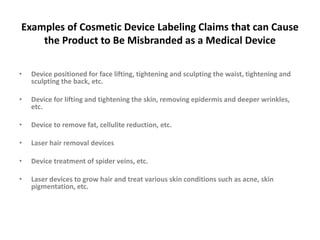
Examples of Cosmetic Device Labeling Claims that can Cause
the Product to Be Misbranded as a Medical Device
• Device positioned for face lifting, tightening and sculpting the waist, tightening and
sculpting the back, etc.
• Device for lifting and tightening the skin, removing epidermis and deeper wrinkles,
etc.
• Device to remove fat, cellulite reduction, etc.
• Laser hair removal devices
• Device treatment of spider veins, etc.
• Laser devices to grow hair and treat various skin conditions such as acne, skin
pigmentation, etc.
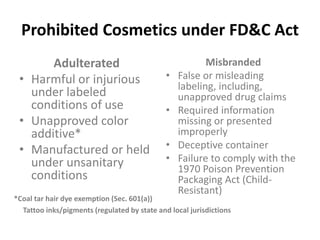
Prohibited Cosmetics under FD&C Act
Adulterated
• Harmful or injurious
under labeled
conditions of use
• Unapproved color
additive*
• Manufactured or held
under unsanitary
conditions
Misbranded
• False or misleading
labeling, including,
unapproved drug claims
• Required information
missing or presented
improperly
• Deceptive container
• Failure to comply with the
1970 Poison Prevention
Packaging Act (Child-
Resistant)
*Coal tar hair dye exemption (Sec. 601(a))
Tattoo inks/pigments (regulated by state and local jurisdictions
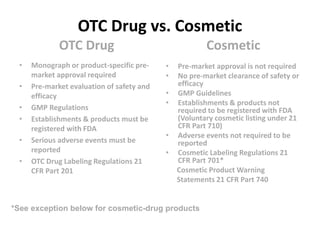
OTC Drug vs. Cosmetic
OTC Drug Cosmetic
• Monograph or product-specific pre-
market approval required
• Pre-market evaluation of safety and
efficacy
• GMP Regulations
• Establishments & products must be
registered with FDA
• Serious adverse events must be
reported
• OTC Drug Labeling Regulations 21
CFR Part 201
• Pre-market approval is not required
• No pre-market clearance of safety or
efficacy
• GMP Guidelines
• Establishments & products not
required to be registered with FDA
(Voluntary cosmetic listing under 21
CFR Part 710)
• Adverse events not required to be
reported
• Cosmetic Labeling Regulations 21
CFR Part 701*
Cosmetic Product Warning
Statements 21 CFR Part 740
*See exception below for cosmetic-drug products
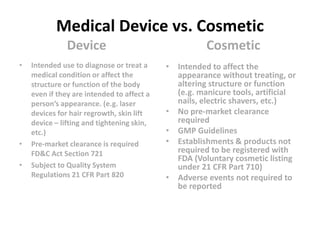
Medical Device vs. Cosmetic
Device Cosmetic
• Intended use to diagnose or treat a
medical condition or affect the
structure or function of the body
even if they are intended to affect a
person’s appearance. (e.g. laser
devices for hair regrowth, skin lift
device – lifting and tightening skin,
etc.)
• Pre-market clearance is required
FD&C Act Section 721
• Subject to Quality System
Regulations 21 CFR Part 820
• Intended to affect the
appearance without treating, or
altering structure or function
(e.g. manicure tools, artificial
nails, electric shavers, etc.)
• No pre-market clearance
required
• GMP Guidelines
• Establishments & products not
required to be registered with
FDA (Voluntary cosmetic listing
under 21 CFR Part 710)
• Adverse events not required to
be reported
Cosmetic Labeling SubpartsPART 701 COSMETIC LABELING and Part 740 COSMETIC WARNING STATEMENTS
701 Subpart A--General Provisions
§ 701.1 - Misbranding
§ 701.2 - Form of stating labeling requirements (contains section on labeling of foreign language)
§ 701.3 - Designation of ingredients
§ 701.9 - Exemptions from labeling requirements
701 Subpart B--Package Form
§ 701.10 - Principal display panel
§ 701.11 - Identity labeling
§ 701.12 - Name and place of business of manufacturer, packer, or distributor
§ 701.13 - Declaration of net quantity of contents
701 Subpart C--Labeling of Specific Ingredients
§ 701.20 - Detergent substances, other than soap, intended for use in cleansing the body
§ 701.30 - Ingredient names established for cosmetic ingredient labeling
740 Subparts
§ 740.1 – Establishment of Warning Statements
§ 740.2 – Conspicuousness of Warning Statements
§ 740.10 –Labeling of Cosmetic Products for which adequate substantiation of safety has not been obtained
§ 740.11 –Cosmetics in self-pressurized containers
§ 740.12 –Feminine deodorant sprays
§ 740.18 –Coal tar hair dyes a risk of cancer
§ 740.19 –Suntanning preparations including sunless tanners
Other Warnings
§ 700.25 Tamper Evident Statements Required for Cosmetic Liquid Oral Hygiene and Feminine Vaginal Products
§ 700.35 Cosmetic Products Containing Sunscreen Ingredients for Preservative Purposes
16 CFR 1700.14 (18) – Child Resistant Packaging – Artificial Nail Removers
Warnings statements for Cosmetics containing Alpha Hydroxy Acids (AHA’s)
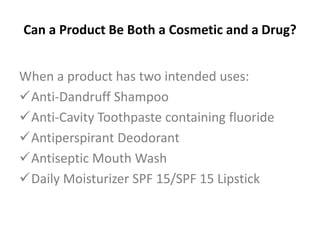
Can a Product Be Both a Cosmetic and a Drug?
When a product has two intended uses:
Anti-Dandruff Shampoo
Anti-Cavity Toothpaste containing fluoride
Antiperspirant Deodorant
Antiseptic Mouth Wash
Daily Moisturizer SPF 15/SPF 15 Lipstick
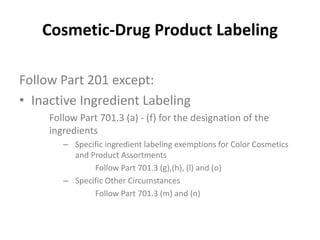
Cosmetic-Drug Product Labeling
Follow Part 201 except:
• Inactive Ingredient Labeling
Follow Part 701.3 (a) - (f) for the designation of the
ingredients
– Specific ingredient labeling exemptions for Color Cosmetics
and Product Assortments
Follow Part 701.3 (g),(h), (l) and (o)
– Specific Other Circumstances
Follow Part 701.3 (m) and (n)
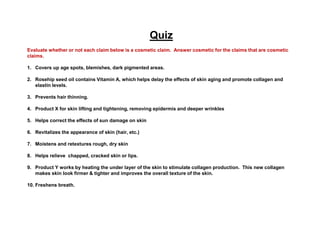
Quiz
Evaluate whether or not each claim below is a cosmetic claim. Answer cosmetic for the claims that are cosmetic
claims.
1. Covers up age spots, blemishes, dark pigmented areas.
2. Rosehip seed oil contains Vitamin A, which helps delay the effects of skin aging and promote collagen and
elastin levels.
3. Prevents hair thinning.
4. Product X for skin lifting and tightening, removing epidermis and deeper wrinkles
5. Helps correct the effects of sun damage on skin
6. Revitalizes the appearance of skin (hair, etc.)
7. Moistens and retextures rough, dry skin
8. Helps relieve chapped, cracked skin or lips.
9. Product Y works by heating the under layer of the skin to stimulate collagen production. This new collagen
makes skin look firmer & tighter and improves the overall texture of the skin.
10. Freshens breath.
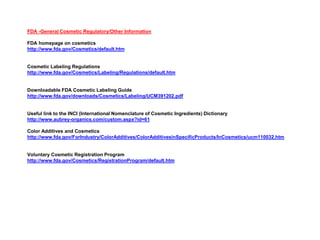
FDA -General Cosmetic Regulatory/Other Information
FDA homepage on cosmetics
http://www.fda.gov/Cosmetics/default.htm
Cosmetic Labeling Regulations
http://www.fda.gov/Cosmetics/Labeling/Regulations/default.htm
Downloadable FDA Cosmetic Labeling Guide
http://www.fda.gov/downloads/Cosmetics/Labeling/UCM391202.pdf
Useful link to the INCI (International Nomenclature of Cosmetic Ingredients) Dictionary
http://www.aubrey-organics.com/custom.aspx?id=61
Color Additives and Cosmetics
http://www.fda.gov/ForIndustry/ColorAdditives/ColorAdditivesinSpecificProducts/InCosmetics/ucm110032.htm
Voluntary Cosmetic Registration Program
http://www.fda.gov/Cosmetics/RegistrationProgram/default.htm
FDA Warning Letters
Warning Letters Related to Cosmetics Ascribing Drug Functions
http://www.fda.gov/Cosmetics/ComplianceEnforcement/WarningLetters/default.htm
Warning Letters Highlight Differences Between Cosmetics and Medical Devices
http://www.fda.gov/Cosmetics/ComplianceEnforcement/WarningLetters/ucm081141.htm
State Specific Regulations
California Specific Regulations
FAQs For Cosmetics Companies About The Safe Cosmetics And Personal Care Products Act Of 2013
http://safecosmetics.org/article.php?id=695
California Safe Cosmetics Program
http://www.cdph.ca.gov/programs/cosmetics/Pages/default.aspx
Washington Specific Regulation
Children’s Safe Products Act
http://www.ecy.wa.gov/programs/swfa/cspa/
Maine Specific Regulation
Safer Chemicals in Children's Products
http://www.maine.gov/dep/safechem/

COSMETIC LABELING & CLAIMS

  • 1.
  • 2.
    Cosmetic Defined in theFD&C Act, Section 201(i) An article intended to be rubbed, poured, sprinkled, sprayed on, introduced on, or otherwise applied to the human body in order to: Cleanse Beautify Promote Attractiveness Alter Appearance For the most part, the intended use of the product determines whether or not a product is a cosmetic.
  • 3.
    Cosmetic Product Groupings •Oral Care Products – Mouth washes -limited to freshens breath-, toothpastes-limited to cleans teeth (Gingivitis and anti-cavity claims are drug claims) • Eye area cosmetics – Mascara, eye shadow, under-eye creams • Skin care products – Moisturizers, body washes**, sunless tanners, foundations, depilatories, deodorants (limited to protecting against odor and not the prevention of sweat or bacteria), fragrances, shaving preparations • Hair care products –Shampoo (not intended for psoriasis or dandruff), conditioner, hair dye, straighteners, styling products • Color cosmetics –Lipstick, nail polish for example **excludes soap (defined under 21 CFR 701.20 and regulated by the CPSC)
  • 4.
    Examples of CosmeticDevice Labeling Claims that can Cause a Product to Be Misbranded as a Unapproved Drug • Any claim related to changing the structure or function of the body • Any claim touting to kill bacteria or reduce inflammation • Any claim that suggest a cosmetic product prevents (heals) scarring and stretch marks or any claim related to treating, preventing, healing, correcting, curing, relieving, etc. (including claims associated with a disease state like eczema, psoriasis, hyperpigmentation, etc.) • Claims that suggest a cosmetic stimulates the production of “youth proteins” boosts the activity of genes ,increases collagen production or the like • Anti-Aging claims or claims that suggest a product retards or slows the aging process • Any cosmetic product that suggests a mechanism of action whereby it mechanicallyexerts upward pressure to lift wrinkles (inner structural change)
  • 5.
    Examples of CosmeticDevice Labeling Claims that can Cause the Product to Be Misbranded as a Medical Device • Device positioned for face lifting, tightening and sculpting the waist, tightening and sculpting the back, etc. • Device for lifting and tightening the skin, removing epidermis and deeper wrinkles, etc. • Device to remove fat, cellulite reduction, etc. • Laser hair removal devices • Device treatment of spider veins, etc. • Laser devices to grow hair and treat various skin conditions such as acne, skin pigmentation, etc.
  • 6.
    Prohibited Cosmetics underFD&C Act Adulterated • Harmful or injurious under labeled conditions of use • Unapproved color additive* • Manufactured or held under unsanitary conditions Misbranded • False or misleading labeling, including, unapproved drug claims • Required information missing or presented improperly • Deceptive container • Failure to comply with the 1970 Poison Prevention Packaging Act (Child- Resistant) *Coal tar hair dye exemption (Sec. 601(a)) Tattoo inks/pigments (regulated by state and local jurisdictions
  • 7.
    OTC Drug vs.Cosmetic OTC Drug Cosmetic • Monograph or product-specific pre- market approval required • Pre-market evaluation of safety and efficacy • GMP Regulations • Establishments & products must be registered with FDA • Serious adverse events must be reported • OTC Drug Labeling Regulations 21 CFR Part 201 • Pre-market approval is not required • No pre-market clearance of safety or efficacy • GMP Guidelines • Establishments & products not required to be registered with FDA (Voluntary cosmetic listing under 21 CFR Part 710) • Adverse events not required to be reported • Cosmetic Labeling Regulations 21 CFR Part 701* Cosmetic Product Warning Statements 21 CFR Part 740 *See exception below for cosmetic-drug products
  • 8.
    Medical Device vs.Cosmetic Device Cosmetic • Intended use to diagnose or treat a medical condition or affect the structure or function of the body even if they are intended to affect a person’s appearance. (e.g. laser devices for hair regrowth, skin lift device – lifting and tightening skin, etc.) • Pre-market clearance is required FD&C Act Section 721 • Subject to Quality System Regulations 21 CFR Part 820 • Intended to affect the appearance without treating, or altering structure or function (e.g. manicure tools, artificial nails, electric shavers, etc.) • No pre-market clearance required • GMP Guidelines • Establishments & products not required to be registered with FDA (Voluntary cosmetic listing under 21 CFR Part 710) • Adverse events not required to be reported
  • 9.
    Cosmetic Labeling SubpartsPART701 COSMETIC LABELING and Part 740 COSMETIC WARNING STATEMENTS 701 Subpart A--General Provisions § 701.1 - Misbranding § 701.2 - Form of stating labeling requirements (contains section on labeling of foreign language) § 701.3 - Designation of ingredients § 701.9 - Exemptions from labeling requirements 701 Subpart B--Package Form § 701.10 - Principal display panel § 701.11 - Identity labeling § 701.12 - Name and place of business of manufacturer, packer, or distributor § 701.13 - Declaration of net quantity of contents 701 Subpart C--Labeling of Specific Ingredients § 701.20 - Detergent substances, other than soap, intended for use in cleansing the body § 701.30 - Ingredient names established for cosmetic ingredient labeling 740 Subparts § 740.1 – Establishment of Warning Statements § 740.2 – Conspicuousness of Warning Statements § 740.10 –Labeling of Cosmetic Products for which adequate substantiation of safety has not been obtained § 740.11 –Cosmetics in self-pressurized containers § 740.12 –Feminine deodorant sprays § 740.18 –Coal tar hair dyes a risk of cancer § 740.19 –Suntanning preparations including sunless tanners Other Warnings § 700.25 Tamper Evident Statements Required for Cosmetic Liquid Oral Hygiene and Feminine Vaginal Products § 700.35 Cosmetic Products Containing Sunscreen Ingredients for Preservative Purposes 16 CFR 1700.14 (18) – Child Resistant Packaging – Artificial Nail Removers Warnings statements for Cosmetics containing Alpha Hydroxy Acids (AHA’s)
  • 10.
    Can a ProductBe Both a Cosmetic and a Drug? When a product has two intended uses: Anti-Dandruff Shampoo Anti-Cavity Toothpaste containing fluoride Antiperspirant Deodorant Antiseptic Mouth Wash Daily Moisturizer SPF 15/SPF 15 Lipstick
  • 11.
    Cosmetic-Drug Product Labeling FollowPart 201 except: • Inactive Ingredient Labeling Follow Part 701.3 (a) - (f) for the designation of the ingredients – Specific ingredient labeling exemptions for Color Cosmetics and Product Assortments Follow Part 701.3 (g),(h), (l) and (o) – Specific Other Circumstances Follow Part 701.3 (m) and (n)
  • 12.
    Quiz Evaluate whether ornot each claim below is a cosmetic claim. Answer cosmetic for the claims that are cosmetic claims. 1. Covers up age spots, blemishes, dark pigmented areas. 2. Rosehip seed oil contains Vitamin A, which helps delay the effects of skin aging and promote collagen and elastin levels. 3. Prevents hair thinning. 4. Product X for skin lifting and tightening, removing epidermis and deeper wrinkles 5. Helps correct the effects of sun damage on skin 6. Revitalizes the appearance of skin (hair, etc.) 7. Moistens and retextures rough, dry skin 8. Helps relieve chapped, cracked skin or lips. 9. Product Y works by heating the under layer of the skin to stimulate collagen production. This new collagen makes skin look firmer & tighter and improves the overall texture of the skin. 10. Freshens breath.
  • 13.
    FDA -General CosmeticRegulatory/Other Information FDA homepage on cosmetics http://www.fda.gov/Cosmetics/default.htm Cosmetic Labeling Regulations http://www.fda.gov/Cosmetics/Labeling/Regulations/default.htm Downloadable FDA Cosmetic Labeling Guide http://www.fda.gov/downloads/Cosmetics/Labeling/UCM391202.pdf Useful link to the INCI (International Nomenclature of Cosmetic Ingredients) Dictionary http://www.aubrey-organics.com/custom.aspx?id=61 Color Additives and Cosmetics http://www.fda.gov/ForIndustry/ColorAdditives/ColorAdditivesinSpecificProducts/InCosmetics/ucm110032.htm Voluntary Cosmetic Registration Program http://www.fda.gov/Cosmetics/RegistrationProgram/default.htm
  • 14.
    FDA Warning Letters WarningLetters Related to Cosmetics Ascribing Drug Functions http://www.fda.gov/Cosmetics/ComplianceEnforcement/WarningLetters/default.htm Warning Letters Highlight Differences Between Cosmetics and Medical Devices http://www.fda.gov/Cosmetics/ComplianceEnforcement/WarningLetters/ucm081141.htm State Specific Regulations California Specific Regulations FAQs For Cosmetics Companies About The Safe Cosmetics And Personal Care Products Act Of 2013 http://safecosmetics.org/article.php?id=695 California Safe Cosmetics Program http://www.cdph.ca.gov/programs/cosmetics/Pages/default.aspx Washington Specific Regulation Children’s Safe Products Act http://www.ecy.wa.gov/programs/swfa/cspa/ Maine Specific Regulation Safer Chemicals in Children's Products http://www.maine.gov/dep/safechem/