©Copyright: Department of Open and Distance Learning, Makerere University. All rights reserved.
Page | 1
MAKERERE UNIVERSITY
COLLEGE OF EDUCATION AND EXTERNAL STUDIES
SCHOOL OF OPEN AND DISTANCE LEARNING/SCHOOL OF BUSINESS
DEPARTMENT OF OPEN AND DISTANCE LEARNING
BACHELOR OF COMMERCE (EXTERNAL)
BLENDED STUDY MATERIALS
FOURTH YEAR
COURSE: CORPORATE FINANCE (LECTURE NOTES)
CODE: COX 4131
BY:
MR. TWINOBUHIGIRO MEDARD
&
MR. TUHIRIRWE INNOCENT
©Copyright: Department of Open and Distance Learning, Makerere University. All rights reserved.
Page | 2
COURSE OUTLINE
Course Description
Corporate finance and investment decisions deals with advanced financial management skills
needed in larger corporations. It considers the use of further investment appraisal techniques and
share valuations in listed corporations.
Objectives or Aims
The course is designed to make students understand different categories of corporate
stakeholders, financial objectives, capital structure theories and cost of capital, further aspects of
investment appraisals, mergers and takeovers of business corporations, share/bond valuations
and financial distress
Learning Outcomes
Upon completion of this course, students will be able to complete the following key tasks:
 Describe corporate stakeholders, financial objectives and reconciling multiple objectives.
 Discuss theories of capital structure.
 Determine cost of capital of any given business venture.
 Describe further aspects of investment appraisal like use of sensitivity analysis and
expected values, inflation and interest rates and issues of capital rationing.
 Discuss various aspects of business mergers and takeovers
 Explain aspects of share/bond valuations.
 Discuss different aspects of financial distress and corporate restructuring
Intellectual, practical and transferable skills
 Problem solving skills
 Team work
 Analytical
Teaching and Learning Patterns
©Copyright: Department of Open and Distance Learning, Makerere University. All rights reserved.
Page | 3
 Use of case studies
 class discussions
 straight lecture
 Group presentations
COURSE CONTENT
1. INTRODUCTION TO CORPORATE FINANCE
 Decision making and Corporate objectives
 Profit maximization and managerial objectives
 Reconciling multiple objectives
 Investment appraisal using NPV, IRR, PI, CB ratio
 Investment appraisal and sensitivity analysis
 The relationship between inflation rates and interest rates
 Dealing with inflation in NPV calculation
 Dealing with tax in NPV calculation
 Capital allowances/ WDA’s and tax savings
 Asset replacement decisions
 Capital rationing
2. FINANCE IN A WORLD OF UNCERTAINTY
 Risk- return tradeoff
 Attitudes of risk
 Expected Net Present Value
 Introduction to Portfolio theory
3. SHORT/ MEDIUM AND LONG TERM FINANCIAL DECISIONS
 Sources of short and medium term finance
 long term sources of finance
4. DIVIDEND AND CAPITAL STRUCTURE DECISIONS
©Copyright: Department of Open and Distance Learning, Makerere University. All rights reserved.
Page | 4
 Dividend decisions and shareholder value
 Capital structure and the required return
 Modigliani and Miller models of capital structure
5. CAPITAL MARKET THEORY
 Introduction to capital markets
 Operations of capital markets
 The Uganda securities exchange
 Financial markets hypothesis
 Empirical testing of efficient market hypothesis
6. COMPANY ANALYSIS ASSET VALUATION, MERGERS AND ACQUISITION
 Company analysis and valuation
 Analysis and valuation of stocks
 Analysis and valuation of fixed income securities
 Mergers and acquisitions
Assessment Method
The assessment method is structured to include coursework and final examination. Coursework
consists of assignments, presentations and tests.
Course work assessment: 30%
Final Examination: 70%
Total Mark: 100%
The minimum mark required to pass is 50%, this includes course work and final examination.
REFERENCES:
 ACCA Reading Text (Paper F9) on Financial Management 2007-2008
 Brealey, R and Myers, S (2003): Principles of corporate Finance. 7th
edition McGraw
Hill/Irwin
©Copyright: Department of Open and Distance Learning, Makerere University. All rights reserved.
Page | 5
 Pike, R and Neale, B (1999): Corporate finance and investments: Decisions and
strategies. 3rd
edition prentice hall.
 Van Horne, J (2001): Financial Management and Policy .12th
edition Prentice Hall
 Tony Davies, Tony Boczko and Jean Chen (2008) Strategic Corporate Finance.
International Edition. UK, McGraw Hill Publishing.
 Richard A. Brealy and Stewart C. Myers (2008) Principles of Corporate Finance.
International Edition. Athens, Greece, McGraw Hill Publishing.
 Stephen A. Ross and Randolph W. Westerfield (2008) Essentials of Corporate Finance.
International Edition. Athens, Greece, McGraw Hill Publishing.
©Copyright: Department of Open and Distance Learning, Makerere University. All rights reserved.
Page | 6
TOPIC ONE
INTRODUCTION TO CORPORATE FINANCE
LEARNING OUTCOMES:
At end of this topic a student will be able to:
 Explain the term finance and its functions
 Discuss the objective of decision making in corporate finance
 Explain the role of finance manager, financial controller and treasurer, the agency theory
and Corporate Governance
 Discuss the goals of a firm.
PREAMBLE
Corporate finance is the field of finance dealing with financial decisions that business enterprise
make and the tools and analysis used to make these decisions. The primary goal of corporate
finance is to maximize corporate value while managing the firm’s financial risks.
Although it is in principle different from managerial finance which studies the financial
decisions of all firms, rather than corporations alone, the main concepts in the study of corporate
finance are applicable to the financial problems of all kinds of firms. The discipline can be
divided into long-term and short-term decisions and techniques. Capital investment decisions are
long-term choices about which projects receive investment, whether to finance that investment
with equity or debt, and when or whether to pay dividends to shareholders. On the other hand,
short term decisions deal with the short-term balance of .current assets and current liabilities; the
focus here is on managing cash, inventories, and short-term borrowing and lending.
Corporate finance covers every decision a firm makes that may affect its finances which can be
grouped into five areas for the conceptual understanding.
©Copyright: Department of Open and Distance Learning, Makerere University. All rights reserved.
Page | 7
1. The first is the objective function, where we define what exactly the objective in decision
making should be.
2. The second is the investment decision, where we look at how a business should allocate of
resources across competing uses.
3. The third is the financing decision, where we examine the sources of financing and whether
there is an optimal mix of financing.
4. The fourth is the dividend decision, which relates to how much a business should reinvest
back into operations and how much should be returned to the owners.
5. Finally, there is valuation, where all of the decisions made by a firm are traced through to a
final value
Functions of Corporate Finance:
1. Acquisition of Resources: Acquisition of resource indicates fund generation at the lowest
possible cost. Resource generation is possible through:
(a) Equity: This includes proceeds received from retained earnings, stock selling, and
investment returns.
(b) Liability: This includes warranties of products, bank loans, and payable account.
2. Allocation of Resources: Allocation of resources is nothing but investment of funds for
profit maximization. Investment can be categorized into 2 groups:
(a) Fixed Assets – Buildings, Land, Machinery etc.
(b) Current Assets – cash, receivable accounts, inventory, etc. Broad Functions of Corporate
Finance are:
(1) Raising of Capital or Financing
©Copyright: Department of Open and Distance Learning, Makerere University. All rights reserved.
Page | 8
(2) Budgeting of Capital
(3) Corporate Governance
(4) Financial management
(5) Risk Management
Objective of Decision making in corporate Finance:
1. Long term decisions: This includes capital investment decisions like viability assessment
of projects, financing it through equity and/or debt, pay dividend or reinvest the profit. Long
term corporate finance decisions that are normally related to fixed assets and capital structure are
known as Capital Investment Decisions. Senior management always targets to maximize the
value of the firm by investing in projects having positive Net Present Value. If such opportunities
are not arising then reinvestment of profits should be stalled and excess cash should be returned
to shareholders in form of dividends. Thus, Capital Investment Decisions constitute 3 decisions:
(a) Decision on Investment
(b) Decision on Financing
(c) Decision on Dividend
2. Short term decisions:
These are also called working capital management decisions which try to strike a balance
between current assets such as cash, inventories, etc and current liabilities i.e. a company’s
debts/obligations impending for less than a year.
1. Investment Decision: The firm has limited resources that must be allocated among
challenging uses. On the one hand the funds may be used to generate added capacity which in
turn generates additional revenue and profits and on the other hand some investments results in
lesser costs. In financial management the returns, from a proposed investment are compared to a
©Copyright: Department of Open and Distance Learning, Makerere University. All rights reserved.
Page | 9
minimum acceptable hurdle rate in order to accept or reject a project. The hurdle rate is the
minimum rate of return below which no investment proposal would be accepted.
2. Financing Decision: Another important area where financial management plays an
important role is in deciding when, where, from and how to acquire funds to meet the firm’s
investment needs. These aspects of financial management have acquired greater importance in
recent times due to the multiple avenues from which funds can be raised. Some of the widely
used instruments for raising finds are ADRs, GDRs, ECBs Equity Bonds and Debentures etc.
The core issue in financing decision is to maintain the optimum capital structure of the firm that
is in other words, to have a right mix of debt and equity in the firm’s capital structure. In case of
pure equity firm the shareholders returns should be equal to the firm’s returns. The use of debt
affects the risk and return of shareholders. In case, cost of debt is used the firm’s rate of return
the shareholder’s return is going to increase and vice versa. The change in shareholders return
caused by change in profit due to use of debt is called the financial deverage.
3. Dividend Decision: Dividend decisions is the third major financial decision The share
price of a firm is a function of the cash flows associated with the share. The share price at a
given point of time is the present value of future cash flows associated with the holding of
share. These cash flows are dividends. The finance manager has to decide what proportion of
profits has to be distributed to the shareholders. The proportion of profits distributed as dividends
is called the dividend payout ratio and the retained proportion of profits is known as retention
ratio.
4. Liquidity Decision: A firm must be able to fulfill its financial commitments at all points of
time. In order to ensure this the firm should maintain sufficient amount of liquid assets. Liquidity
decisions are concerned with satisfying both long and short-term financial commitments. The
finance manager should try to synchronize the cash inflows with cash outflows. An investment in
current assets affects the firm’s profitability and liquidity. A conflict exists between profitability
and liquidity while managing current assets. In case, the firm has insufficient current assets it
may default on its financial obligations. On the other hand excess funds result in foregoing of
alternative investment opportunities.
©Copyright: Department of Open and Distance Learning, Makerere University. All rights reserved.
Page | 10
Role of finance manager, financial controller and treasurer, The agency theory and
Corporate Governance
Role of Shareholders and the Role of Managers
Although ordinary shareholders are the owners of the company to whom the board of directors
are accountable, the actual powers of shareholders tend to be restricted, except in companies
where the shareholders are also the directors. They have no right to inspect the books of account,
and their forecasts of future prospects are gleaned from the annual report and accounts, stock
brokers, journals and daily newspapers.
The day to day running of a company is the responsibility of the directors and other management
staff to whom they delegate, not the shareholders. For these reasons, therefore, there is potential
for conflicts of interest between management and shareholders.
Shareholders used to take a passive role in the affairs of the company. It was once common to
play down their influence, though legally the owner of the business, it was assumed that they did
not much concern themselves with the way that the company was run. The result has changed
partly because of a change in the type of shareholder, partly due to result of takeover activity and
partly because of social pressures. Shareholding has changed from private investors to
institutional investors, who are able to employ experts to advice on the investment funds. The
company must accordingly be run in a way that guarantees the satisfaction of the shareholder- an
increasing sophisticated shareholder, who will both be competent and keen to assess for himself
the truth behind any optimistic statements.
The power that the institutional shareholders have over a company rests on the effect that their
investment decisions can have on the share price of a company, on the fact that at times of
takeover bid the decision of a few shareholders can have a major influence on whether the bid
succeeds or fail, and on the fact that the institutions have large amount of funds that can be made
available to a company. The type of shareholders and the way they behave is changing.
©Copyright: Department of Open and Distance Learning, Makerere University. All rights reserved.
Page | 11
Traditional relationships are changing. The institution needs the companies, as they need good
investment opportunities in a healthy economic climate, in order to be able to meet their future
pension and assurance obligations. The relationship between the shareholders of a company and
the management is one which is complex.
Agency Theory and Agency Problems
The relationship between management and shareholders is sometimes referred to as an agency
relationship, in which managers act as agents for the shareholders, using delegation powers to
run the affairs of the company in the best interest of the shareholders.
Agency problem: a potential conflict of interest between the agent (manager) and the outsider
shareholders. (i.e. those not involved in running the business) and the creditors. For example, if
managers hold none or very little equity shares of the company they work for, what is to stop
them from working inefficiently, not bothering to look for profitable new investments
opportunities, or giving themselves high salary or perks?
Agency theory: proposes that, although the individual members of the business team act in their
own self interest, the well being of each individual depends on the well being of other team
members and on the performance of the team in competition with other teams.
One power that shareholders possess is the right to remove the directors from office but
shareholders have to take initiative to do this, and in many companies, the shareholders lack
energy and organization to take such a step. Even so, directors will want the company’s report
and accounts, and the proposed final dividend, to meet with the shareholders’ approval at annual
general meeting.
Another reason why managers might do their best to improve the financial performance of their
company is that managers’ pay is often related to the size or profitability of the company.
Managers in very big companies, or in very profitable companies, will normally expect to earn
higher salaries than managers in smaller or less successful companies.
©Copyright: Department of Open and Distance Learning, Makerere University. All rights reserved.
Page | 12
Another source of conflict between managers and shareholders is that they have different attitude
towards risk. A shareholder can spread his risk by investing his money in a number of
companies; one company may go into liquidation but the shareholders’ financial security is not
threatened. A manager’s financial security however, usually depends on what happens to the one
company that employs him. The manager could therefore be less inclined than the shareholder to
invest company’s funds in a risky investment.
A further situation in which conflict can arise is when a company is subject to takeover bid. The
shareholders of the acquired firm very often receive above normal gains for the share price while
managers loose their job, if lucky they may be picked by the new shareholders. It can therefore
be argued that it is therefore not always the shareholders interest for the sought-after companies
put up such a defense to drive the bidder away.
Agency theory suggests that audited accounts of a limited company are an important source of
post- decision information minimizing investors’ agency costs, in contrast to the alternative
approaches which see financial reports as primarily a source of ‘pre-decision’ information for the
equity investors.
Goal Congruence
Goal congruence is accordance between the objective of agents acting within an organization and
the objectives of the organization as a whole. Managers can be encouraged to act in
shareholders’ best interests through incentives which reward them for good performance but
punish them for their poor performance. Examples of such rewards or incentives are:
 Profit related pay: If management are rewarded according to the level of profit made
they will strive to achieve high profit levels, so that they should earn more. Shareholders
wealth is going to increase, so too is the value of the firm. Sometimes such act might just
encourage creative accounting whereby management will distort the reported
performance of the company in the service of the managers’ own ends.
©Copyright: Department of Open and Distance Learning, Makerere University. All rights reserved.
Page | 13
 Rewarding managers shares: This might be done when a public company goes public
and managers are invited to subscribe for shares in the company at an attractive offer
price. Managers will have a stake in the business and will venture only into those projects
which enhance the share value of the business.
 Direct intervention by shareholders. As outlined above the pattern of shareholding has
changed from passive private investors to aggressive intuitional investors. These
shareholders have direct influence over the performance of an enterprise and take active
role in checking the performance of the company and are very quick to lobby other small
shareholders when they suspect poor service or any malpractice by the directors.
 Threat of firing. Shareholders can take a direct approach by threatening the managers
with dismissal if they put their personal interest above that of maximizing the value of the
firm. The increase in institutional investors has improved the shareholders powers to
dismiss directors as they are able to dominate but also lobby other shareholders in
decision making.
 Threats of takeover: As stated managers would do everything possible to frustrate
takeovers as they are aware that they are going to lose their job. To promote goal
congruence the share holders may threaten to accept takeover bid if their set targets are
not met by managers.
Goals of a firm.
A corporate chief executive encompasses the final responsibility for a successful company
development. He sets the objectives for the business and specifies strategies for their
achievement. In this unique role he is also responsible for the funding of the business. Being
under the pressure of different interest groups the question arises which interest should be given
priority? Creating real wealth for all stakeholders.
 Shareholder wealth maximization
 Profit maximization
 Sales maximization
 Survival
 Environmental protection
©Copyright: Department of Open and Distance Learning, Makerere University. All rights reserved.
Page | 14
 The Growth of Corporate Responsibility: Corporate responsibility’ is the phrase used
to describe businesses which have decide to behave in a deliberately socially responsible
manner. Obeying the strict letter of the law doesn’t always solve these problems, although it
does keep the business out of trouble with the authorities. Laws are general, and don’t always
act as a good guide to decisions in any one individual case. Laws have to interpreted by courts,
and it is not always obvious what is illegal until the case goes to court. Laws don’t cover all the
areas that people consider important in ethical behavior. For example, it may be perfectly legal
to dump waste at sea, but many people would consider this to be unacceptable behavior.

 In many cases different ethical principles pull in opposite directions. For example, closing a
polluting factory may be good for the environment, but it is not going to help the local community
who need the jobs and the incomes. What should the business do? Whatever it does, it is going to
upset one group of people or another, because society at large cannot clearly answer these
questions, and there is no clear guide to the business how to behave.
Profit Maximization and Managerial Objectives
In the conventional theory of the firm, the principle objective of a business firm is to maximize
profit. Under the assumptions of given taste and technology, price and output of a given product
under competition are determined with the sole objective of maximization of profit.
Profit maximization refers to the maximization of income of the firm. Under profit maximization
objective, business firms attempt to adopt those investment projects, which yields larger profits,
and drop all other unprofitable activities. In maximizing profits, input-output relationship is
crucial, either input is minimized to achieve a given amount of profit or the output is maximized
with a given amount of input. Thus, this objective of the firm enhances productivity and
improves the efficiency of the firm.
The conventional theory of the firm defends profit maximization objective on the following
grounds:
©Copyright: Department of Open and Distance Learning, Makerere University. All rights reserved.
Page | 15
* In a competitive market only those firms survive which are able to make profit. Hence, they
always try to make it as large as possible. All other objectives are subjected to this primary
objective.
* Profit maximization objective is a time-honored objective of a firm and evidence against this
objective is not conclusive or unambiguous.
* Though not perfect, profit is the most efficient and reliable measure of the efficiency of a firm.
* Under the condition of competitive market, profit can be used as a performance evaluation
criterion, and profit maximization leads to efficient allocation of resources.
* Profit maximization objective has been found extremly accurate in predicting certain aspect of
firm's behaviour and trends; as such the behaviour of most firms are directed towards the
objective of profit maximization.
Managerial Objectives
Small-business management must achieve strategic objectives with limited resources. The
objectives provide a company its identity, direct the organization's efforts and motivate
employees. The objectives are the basis of managerial functions and the criteria incorporated in
organizational controls. The manner in which managers accomplish such objectives varies from
one company to another. However, a large majority of businesses, regardless of industry,
company size or location, adopt profitability, productivity, survival and growth objectives.
Profitability
Profit is a small-business manager's major incentive. Managers do what is necessary for a
company's revenues to be sufficient not only to earn profits in the present, but the long term as
well. Such leaders view profits as a means to finance company growth, provide employee
©Copyright: Department of Open and Distance Learning, Makerere University. All rights reserved.
Page | 16
benefits and finance the company's social responsibilities. In addition, managers view profits as a
quantitative measure of a company's operational efficiency. Therefore, these leaders work to
make the most of current revenue-generating business opportunities while identifying future
profit-earning prospects. For example, a company might implement a new production line to
manufacture custom products with less scrap or introduce new products and expand current
markets. Business leaders also carefully manage expenses to increase profits. For example, a
company might contract with lower-cost vendors or form a joint venture to control costs.
Productivity
As a company’s use of resources becomes more efficient, the greater its productivity and
profitability should become. As a result, management is concerned not only with output per man
hour, but also the productive use of other resources as well. For example, management focuses
on ways to make production, distribution and administration processes more efficient. In doing
so, production cost per unit declines, which can lead to lower prices and a competitive
advantage. A company also might become more productive by implementing materials
requirements, planning to ensure required production materials are available as needed or
instituting quality controls to minimize defect costs.
Growth
The primary intent of business is to grow market share, revenues and profits. As a result, a key
managerial objective is to increase the sales of existing products and services in current markets.
To do so, a company might implement a market penetration strategy by promoting a new use of a
product or attempt to attract non-users and competitors’ customers to the company's brands. For
example, customers use pegboard for tool storage in garages and craft supplies in a workroom.
Managers may also support the development of new products that reflect current consumer
demand, such as gluten-free foods, or develop new markets to achieve growth. For example, a
company might promote the use of garden fixtures as home or holiday decor or offer computers
and peripheral devices, which are traditionally, manufactured using black exterior materials for
corporate use, in neon colors for personal use
Survival
©Copyright: Department of Open and Distance Learning, Makerere University. All rights reserved.
Page | 17
Managers recognize that a company survives only if it produces and distributes products at price
greater than its variable and fixed costs. Therefore, company survival is a critical managerial
objective. Managers must identify ways to fend off the negative effects of environmental issues,
such as recession, changes in customer preferences and antiquated technology. Managers also
must avoid the negative effects of a lack of materials availability and issues with production
facilities. If leaders are effective in meeting such changes in their operating environment, a
company will recover its costs, meet its obligations to creditors, suppliers and employees, and
remain a going concern. If not, the company will not survive.
©Copyright: Department of Open and Distance Learning, Makerere University. All rights reserved.
Page | 18
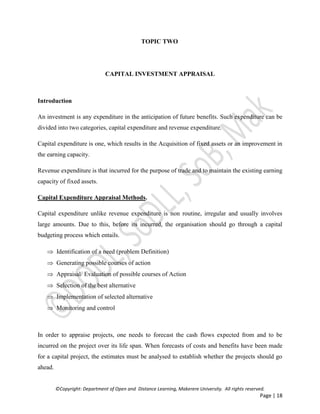
TOPIC TWO
CAPITAL INVESTMENT APPRAISAL
Introduction
An investment is any expenditure in the anticipation of future benefits. Such expenditure can be
divided into two categories, capital expenditure and revenue expenditure.
Capital expenditure is one, which results in the Acquisition of fixed assets or an improvement in
the earning capacity.
Revenue expenditure is that incurred for the purpose of trade and to maintain the existing earning
capacity of fixed assets.
Capital Expenditure Appraisal Methods.
Capital expenditure unlike revenue expenditure is non routine, irregular and usually involves
large amounts. Due to this, before its incurred, the organisation should go through a capital
budgeting process which entails.
 Identification of a need (problem Definition)
 Generating possible courses of action
 Appraisal/ Evaluation of possible courses of Action
 Selection of the best alternative
 Implementation of selected alternative
 Monitoring and control
In order to appraise projects, one needs to forecast the cash flows expected from and to be
incurred on the project over its life span. When forecasts of costs and benefits have been made
for a capital project, the estimates must be analysed to establish whether the projects should go
ahead.
©Copyright: Department of Open and Distance Learning, Makerere University. All rights reserved.
Page | 19
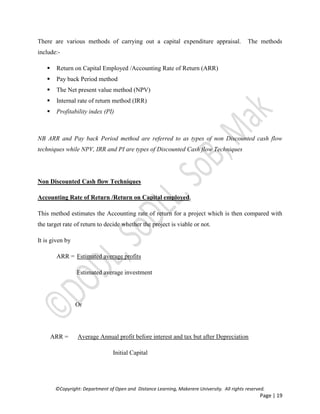
There are various methods of carrying out a capital expenditure appraisal. The methods
include:-
 Return on Capital Employed /Accounting Rate of Return (ARR)
 Pay back Period method
 The Net present value method (NPV)
 Internal rate of return method (IRR)
 Profitability index (PI)
NB ARR and Pay back Period method are referred to as types of non Discounted cash flow
techniques while NPV, IRR and PI are types of Discounted Cash flow Techniques
Non Discounted Cash flow Techniques
Accounting Rate of Return /Return on Capital employed.
This method estimates the Accounting rate of return for a project which is then compared with
the target rate of return to decide whether the project is viable or not.
It is given by
ARR = Estimated average profits
Estimated average investment
Or
ARR = Average Annual profit before interest and tax but after Depreciation
Initial Capital
©Copyright: Department of Open and Distance Learning, Makerere University. All rights reserved.
Page | 20
Illustration.
R plc’s target accounting rate of return is 20%. The Company is considering a project with the
following cash flows.
Cost of Assets (investment) £80,000
Estimated life 4years
Estimated profit before depreciation
Year 1 £20,000
Year 2 £25,000
Year 3 £35,000
Year 4 £25,000
The capital asset would be depreciated by 25% of its cost each year – straight line method.
You are required to assess whether the project should be undertaken
Solution.
Year Profit after depreciation
1 0
2 5,000
3 15,000
4 5,000
Total 25,000
Using the formula
©Copyright: Department of Open and Distance Learning, Makerere University. All rights reserved.
Page | 21
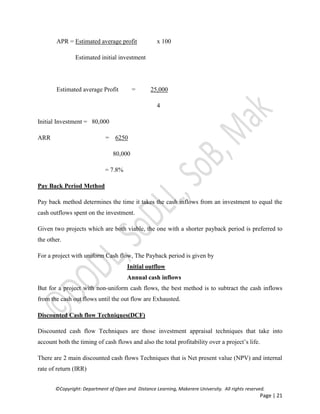
APR = Estimated average profit x 100
Estimated initial investment
Estimated average Profit = 25,000
4
Initial Investment = 80,000
ARR = 6250
80,000
= 7.8%
Pay Back Period Method
Pay back method determines the time it takes the cash inflows from an investment to equal the
cash outflows spent on the investment.
Given two projects which are both viable, the one with a shorter payback period is preferred to
the other.
For a project with uniform Cash flow, The Payback period is given by
Initial outflow
Annual cash inflows
But for a project with non-uniform cash flows, the best method is to subtract the cash inflows
from the cash out flows until the out flow are Exhausted.
Discounted Cash flow Techniques(DCF)
Discounted cash flow Techniques are those investment appraisal techniques that take into
account both the timing of cash flows and also the total profitability over a project’s life.
There are 2 main discounted cash flows Techniques that is Net present value (NPV) and internal
rate of return (IRR)
©Copyright: Department of Open and Distance Learning, Makerere University. All rights reserved.
Page | 22
Using DCF techniques, all expected payments and Receipts from a capital investment are
discounted to a present value using the formula:
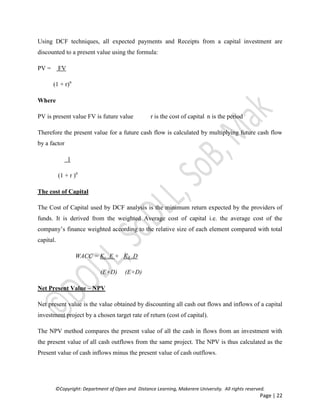
PV = FV
(1 + r)n
Where
PV is present value FV is future value r is the cost of capital n is the period
Therefore the present value for a future cash flow is calculated by multiplying future cash flow
by a factor
1
(1 + r )n
The cost of Capital
The Cost of Capital used by DCF analysis is the minimum return expected by the providers of
funds. It is derived from the weighted Average cost of capital i.e. the average cost of the
company’s finance weighted according to the relative size of each element compared with total
capital.
WACC = Ke .E + Kd .D
(E+D) (E+D)
Net Present Value – NPV
Net present value is the value obtained by discounting all cash out flows and inflows of a capital
investment project by a chosen target rate of return (cost of capital).
The NPV method compares the present value of all the cash in flows from an investment with
the present value of all cash outflows from the same project. The NPV is thus calculated as the
Present value of cash inflows minus the present value of cash outflows.
©Copyright: Department of Open and Distance Learning, Makerere University. All rights reserved.
Page | 23
If NPV is positive then the cash flows from capital investment will yield a return in excess of the
cost of capital. In this case, the project should be undertaken.
If NPV is negative, then the cash flows from capital investment will yield a return below the cost
of capital. The project should be rejected.
If NPV is zero, then the cash flows from the capital investment will yield a return exactly equal
to the cost of capital and the decision in this case will depend on the circumstances at hand.
Assumptions in DCF about the timing of cash flows.
As a general rule the following assumption are taken
a) A cash outlay to be incurred at the beginning of an investment project ‘now’ occurs in
year 0 and the present value of £1 now is £1 regardless of the value of r.
b) A Cash out lay or inflow which occurs during the course of the period is assumed to
occur all at once at the end of the time period e.g. receipts of £5,000 during year 2 are
therefore assumed to occur at the end of year 2.
c) If a cash outlay or receipt occurs at the beginning of a time period it is taken to occur at
the end of the previous period. Therefore a cash outlay of £10,000 at the beginning of
year 2 is taken to occur at the end of year 1.
Illustration.
S Ltd is considering a capital investment, where the estimated cash flows are as follows
Year Cash flows in £
0 (100,000)
1 60,000
2 80,000
3 40,000
4 30,000
©Copyright: Department of Open and Distance Learning, Makerere University. All rights reserved.
Page | 24
The company’s cost of capital is 15%. You are required to calculate the NPV of the project and
assess whether it should be undertaken.
Solution
Year Cash flows in £ discounted factor at 15% Present value in £
0 (100,000) 1 (100,000)
1 60,000 0.870 52,200
2 80,000 0.756 60,480
3 40,000 0.658 26,320
4 30,000 0.572 17,160
NPV 56,160
Use Of Annuity Factors
Where there is a constant/uniform cash flow from year to year, the present value/discount factor
can be found by summing the discount factors for all those years and multiplying this with the
constant cash flow. This can also be read from the annuity factor table.
Illustration
EL Limited is considering the manufacture of a new product. Which would involve the use of
both a new machine costing £150,000 and an existing machine which cost £80,000 two years ago
and has a current net book value of £60,000. There is sufficient capacity on this machine which
has so far been under-utilised. Annual sales of the product would be 5,000 units selling at £32
per unit.
©Copyright: Department of Open and Distance Learning, Makerere University. All rights reserved.
Page | 25
Unit costs would be as follows
£
Direct Labour – 4 hours at £2 per hour 8
Direct materials 7
Fixed costs including Depreciation 9
24
The project would have a five year life after which the new machine would have a net residual
value of £10,000. Because direct labour is continuously in short supply, labour resources would
have to be diverted from other work which currently earns a contribution of £1.50 per direct
labour hour. The fixed overhead absorption rate would be 2.25 per hour (£9 per unit) but actual
expenditure on fixed overhead would not alter:
Working capital requirements would be £10,000 in the first year, raising to £15,000 in the second
year and remaining at this level until the end of the project, when it will all be recovered. The
company’s cost of capital is 20%. Ignore taxation.
Assess whether the project is worthwhile.
Solution
Relevant cash flows are as follows
a) Year 0. purchase of machine £150,000
b) Year 1-5 contribution from new product
[5000 x (32-15)] 85,000
Less contribution foregone
[5.000 X (4x 1.5)] 30,000
55,000
©Copyright: Department of Open and Distance Learning, Makerere University. All rights reserved.
Page | 26
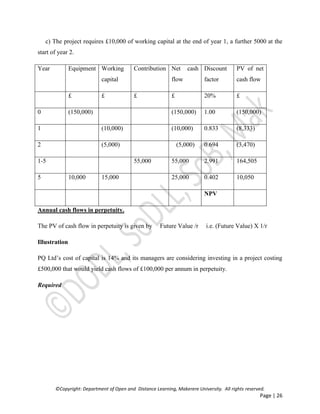
c) The project requires £10,000 of working capital at the end of year 1, a further 5000 at the
start of year 2.
Year Equipment Working
capital
Contribution Net cash
flow
Discount
factor
PV of net
cash flow
£ £ £ £ 20% £
0 (150,000) (150,000) 1.00 (150,000)
1 (10,000) (10,000) 0.833 (8,333)
2 (5,000) (5,000) 0.694 (3,470)
1-5 55,000 55,000 2.991 164,505
5 10,000 15,000 25,000 0.402 10,050
NPV
Annual cash flows in perpetuity.
The PV of cash flow in perpetuity is given by Future Value /r i.e. (Future Value) X 1/r
Illustration
PQ Ltd’s cost of capital is 14% and its managers are considering investing in a project costing
£500,000 that would yield cash flows of £100,000 per annum in perpetuity.
Required
©Copyright: Department of Open and Distance Learning, Makerere University. All rights reserved.
Page | 27
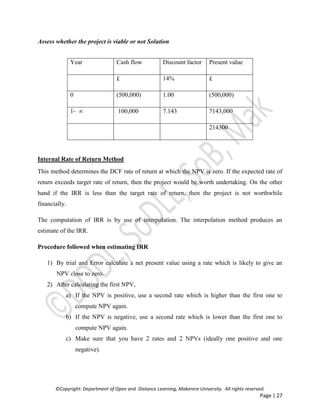
Assess whether the project is viable or not Solution
Internal Rate of Return Method
This method determines the DCF rate of return at which the NPV is zero. If the expected rate of
return exceeds target rate of return, then the project would be worth undertaking. On the other
hand if the IRR is less than the target rate of return, then the project is not worthwhile
financially.
The computation of IRR is by use of interpolation. The interpolation method produces an
estimate of the IRR.
Procedure followed when estimating IRR
1) By trial and Error calculate a net present value using a rate which is likely to give an
NPV close to zero.
2) After calculating the first NPV,
a) If the NPV is positive, use a second rate which is higher than the first one to
compute NPV again.
b) If the NPV is negative, use a second rate which is lower than the first one to
compute NPV again.
c) Make sure that you have 2 rates and 2 NPVs (ideally one positive and one
negative).
Year Cash flow Discount factor Present value
£ 14% £
0 (500,000) 1.00 (500,000)
1- ∞ 100,000 7.143 7143,000
214300
©Copyright: Department of Open and Distance Learning, Makerere University. All rights reserved.
Page | 28
Then use the 2 sets to estimate the IRR using the formula.
IRR = a + [A/ (A-B) X (b-a)]
Where
a is the lower rate b is the higher rate A is NPV obtained using lower rate
B is NPV obtained using higher rate.
OR
IRR = N1R2 –N2 R1
N1-N2
Where N1 is the NPV at rate R1 N2 is the NPV at rate R2 R1 is the lower rate R2 is the higher
rate.
Illustration
A company is trying to decide whether to buy a machine for £80,000 which will save costs of
£20,000 per annum for 5 years and which will have a resale value of £10,000 at the end of year
5. It is the company’s policy to undertake projects only if they are expected to yield a DCF return
of 10% or more, ascertain whether this project should be undertaken.
Solution
At rate of 9%.
Year Cash flow PV factor at 9% PV of cash flow
0 (80,000) 1.000 (80,000)
1-5 20,000 3.890 77800
5 I0.000 0.650 6500
NPV 4300
©Copyright: Department of Open and Distance Learning, Makerere University. All rights reserved.
Page | 29
At rate of 12%
Year Cash flow PV factor at 12% PV of cash flows
0 80,000 1.000 (80,000)
1-5 20,000 3.605 72100
5 10,000 0.567 5670
NPV (2230)
Using the formula
IRR = a + [A/(A-B) X (b-a)]
= 9% + [4300/4300 +2230 X 3 %]
= 0.1098 ~ 11 %
OR, using
N1 R2 –N2 R1
N1 – N2
(4300 X 0.12 + 2230 X 0.09)
4300 + 2230 = 0.1098 ~ 11 %
NB
1) IRR of a project with cash flows to perpetuity is given by
Annual inflow x 100
Initial investment
2) NPV is a superior technique compared to IRR. So in case of conflict, the NPV indicator
should be taken.
©Copyright: Department of Open and Distance Learning, Makerere University. All rights reserved.
Page | 30
Read about
1. Comparing NPV and IRR where
- There are Non-conventional cash flow
- The projects are not all exclusive
-The Re investment assumptions
2. The advantages and disadvantages of NPV and IRR.
ALLOWING FOR INFLATION IN INVESTMENT APPRAISAL
As the inflation rate increases, so will the minimum return required by an investor.
In general there are two effects of inflation on project appraisal.
a) The discount rate will be affected by the inflation
b) The cash flows will also be affected by the inflation over time.
Effect of Inflation on the Discount Rate
Since the discount rate reflects the funds providers’ required rate of return, in terms of inflation,
the fund providers will require a return that
1. Compensates them for the inflation to maintain their purchasing power – inflation rate.
2. A return for the use of their funds i.e. real return.
A rate that combines the two elements is called the money rate of return/ Nominal rate of return.
The money rate of return is the summation of the real rate of return and the inflation rate. The
money rate of return is given by the formula.
(1 + money rate) = (1 + real rate) x (1 + inflation rate)
(1 + m) = (1 + r) x (1 + i)
1+ r =1 + m
1 +i
©Copyright: Department of Open and Distance Learning, Makerere University. All rights reserved.
Page | 31
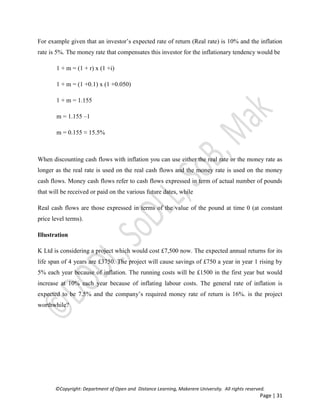
For example given that an investor’s expected rate of return (Real rate) is 10% and the inflation
rate is 5%. The money rate that compensates this investor for the inflationary tendency would be
1 + m = (1 + r) x (1 +i)
1 + m = (1 +0.1) x (1 +0.050)
1 + m = 1.155
m = 1.155 –1
m = 0.155 ≈ 15.5%
When discounting cash flows with inflation you can use either the real rate or the money rate as
longer as the real rate is used on the real cash flows and the money rate is used on the money
cash flows. Money cash flows refer to cash flows expressed in term of actual number of pounds
that will be received or paid on the various future dates, while
Real cash flows are those expressed in terms of the value of the pound at time 0 (at constant
price level terms).
Illustration
K Ltd is considering a project which would cost £7,500 now. The expected annual returns for its
life span of 4 years are £3750. The project will cause savings of £750 a year in year 1 rising by
5% each year because of inflation. The running costs will be £1500 in the first year but would
increase at 10% each year because of inflating labour costs. The general rate of inflation is
expected to be 7.5% and the company’s required money rate of return is 16%. is the project
worthwhile?
©Copyright: Department of Open and Distance Learning, Makerere University. All rights reserved.
Page | 32
Solution
Year Cash flow Discount factor PV Cash flows
£ At 16% £
0 (7,500) 1.000 (7,500)
1 3,000 0.862 2,586
2 2,888 0.743 2,146
3 2,762 0.641 1,770
4 2,621 0.552 1,447
NPV 449
Working
Year Fixed Income Savings Running Cost Net Cash
Flows
1 3750 750 1500 3000
2 3750 788 1650 2888
3 3750 827 1815 2762
4 3750 868 1997 2621
Illustration
A Company is considering investing in a project which will require purchasing a machine at
750,000. The project will result in following cost savings before allowing for inflation.
Year Materia £ Wages £ Total saving £
©Copyright: Department of Open and Distance Learning, Makerere University. All rights reserved.
Page | 33
1 220,000 110,000 330,000
2 140,000 102,000 242,000
3 380,000 152,000 532,000
The general inflation rate is expected to remain constant at 5%. Given that the shareholders
required rate of return is 10% before considering inflation, evaluate the project in terms of
a) Real cash flows and discount rates
b) Money cash flows and discount rates
a) The real cash flows and discount rate are given.
Year Cash flow £ PV factor 10% PV cash flows £
0 (750,000) 1.000 (750,000)
1 330,000 0.909 299970
2 242,000 0.826 199892
3 532,000 0.751 399532
NPV 149,394
b) Money cash flows and discount rate
From 1 + m = (1 + r) x (1 + i)
1 + m (1 +0.1) x (1 + 0.05)
1 + m = 1.155
m = 0.155 = 15.5%. In order to generate money cash flows, we increase the real cash
flows by the percentage rate of inflation.
©Copyright: Department of Open and Distance Learning, Makerere University. All rights reserved.
Page | 34
Year Real cash
flow
Inflation
factor
Money cash
flow
Discount
factor15.5%
PV cash
flows
0 (750,000) 1 (750,000) 1.000 (750,000)
1 330,000 (1.05)1
346,500 0.866 297,990
2 242,000 (1.05)2
266,805 0.750 200,104
3 532,000 (1.05)3
615,856 0.649 399,691
NPV 147,785
ALLOWING FOR TAXATION IN INVESTMENT APPRAISAL
Taxation affects the investment appraisal in two ways.
a) Tax charged on the company’s profit will affect the cash flows depending on when it is
actually paid. Generally cash receipts /payments will give rise to tax payable /tax relief
b) Tax relief in interest which a firm pays and hence the opportunity cost of capital.
N.B. Tax relief gives rise to tax savings and hence cash inflows.
Assumptions normally adopted where taxation is relevant
 Taxable profits are the net project cash flows
 Current tax rate applies
 Where a tax loss arises from the project, there are sufficient taxable profits elsewhere in
the organisation to allow the loss to reduce any relevant tax payment
 The first capital allowance claim is immediate, with the first benefit one year later.
 The company has sufficient profits to obtain full benefit form capital allowances, and
there are balancing adjustments on the disposal of all assets.
Illustration
PL Ltd is considering the purchase of a machine costing £40,000. It would have a life of 4 years
after which it would be sold for £5,000. The machine would create annual cost savings of
£14,000. It would also attract writing down allowance of 25% on reducing balance basis which
would be claimed against taxable profits of the current year which is soon to end. A balancing
©Copyright: Department of Open and Distance Learning, Makerere University. All rights reserved.
Page | 35
allowance or charge would arise on disposal. The rate of corporation tax is 30% and tax is
payable one year in arrears. The after tax cost of capital is 8%. Assume that tax payments occur
in the year following the transactions.
Solution
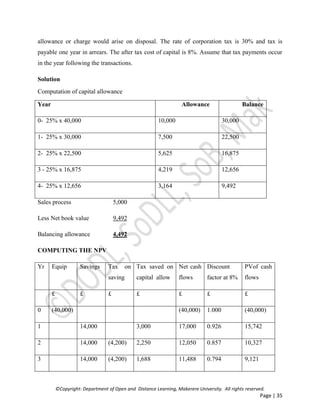
Computation of capital allowance
Year Allowance Balance
0- 25% x 40,000 10,000 30,000
1- 25% x 30,000 7,500 22,500
2- 25% x 22,500 5,625 16,875
3 - 25% x 16,875 4,219 12,656
4- 25% x 12,656 3,164 9,492
Sales process 5,000
Less Net book value 9,492
Balancing allowance 4,492
COMPUTING THE NPV
Yr Equip Savings Tax on
saving
Tax saved on
capital allow
Net cash
flows
Discount
factor at 8%
PVof cash
flows
£ £ £ £ £ £ £
0 (40,000) (40,000) 1.000 (40,000)
1 14,000 3,000 17,000 0.926 15,742
2 14,000 (4,200) 2,250 12,050 0.857 10,327
3 14,000 (4,200) 1,688 11,488 0.794 9,121
©Copyright: Department of Open and Distance Learning, Makerere University. All rights reserved.
Page | 36
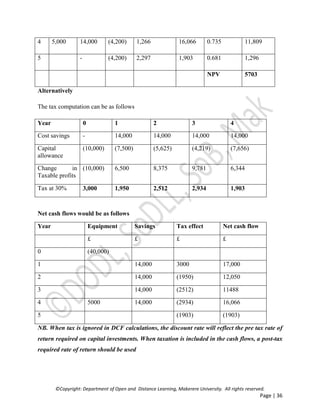
4 5,000 14,000 (4,200) 1,266 16,066 0.735 11,809
5 - (4,200) 2,297 1,903 0.681 1,296
NPV 5703
Alternatively
The tax computation can be as follows
Year 0 1 2 3 4
Cost savings - 14,000 14,000 14,000 14,000
Capital
allowance
(10,000) (7,500) (5,625) (4,219) (7,656)
Change in
Taxable profits
(10,000) 6,500 8,375 9,781 6,344
Tax at 30% 3,000 1,950 2,512 2,934 1,903
Net cash flows would be as follows
Year Equipment Savings Tax effect Net cash flow
£ £ £ £
0 (40,000)
1 14,000 3000 17,000
2 14,000 (1950) 12,050
3 14,000 (2512) 11488
4 5000 14,000 (2934) 16,066
5 (1903) (1903)
NB. When tax is ignored in DCF calculations, the discount rate will reflect the pre tax rate of
return required on capital investments. When taxation is included in the cash flows, a post-tax
required rate of return should be used
©Copyright: Department of Open and Distance Learning, Makerere University. All rights reserved.
Page | 37
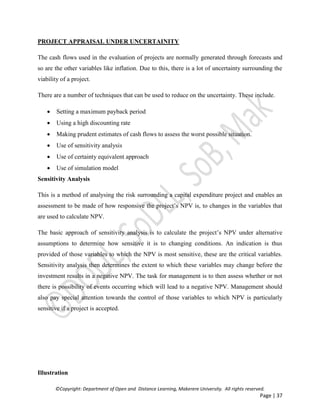
PROJECT APPRAISAL UNDER UNCERTAINITY
The cash flows used in the evaluation of projects are normally generated through forecasts and
so are the other variables like inflation. Due to this, there is a lot of uncertainty surrounding the
viability of a project.
There are a number of techniques that can be used to reduce on the uncertainty. These include.
 Setting a maximum payback period
 Using a high discounting rate
 Making prudent estimates of cash flows to assess the worst possible situation.
 Use of sensitivity analysis
 Use of certainty equivalent approach
 Use of simulation model
Sensitivity Analysis
This is a method of analysing the risk surrounding a capital expenditure project and enables an
assessment to be made of how responsive the project’s NPV is, to changes in the variables that
are used to calculate NPV.
The basic approach of sensitivity analysis is to calculate the project’s NPV under alternative
assumptions to determine how sensitive it is to changing conditions. An indication is thus
provided of those variables to which the NPV is most sensitive, these are the critical variables.
Sensitivity analysis then determines the extent to which these variables may change before the
investment results in a negative NPV. The task for management is to then assess whether or not
there is possibility of events occurring which will lead to a negative NPV. Management should
also pay special attention towards the control of those variables to which NPV is particularly
sensitive if a project is accepted.
Illustration
©Copyright: Department of Open and Distance Learning, Makerere University. All rights reserved.
Page | 38
K Ltd is considering a project with the following cash flows.
Year 0 1 2
Initial investment (7,000,000) - -
Variable costs (2,000,000) (2,000,000)
Cash inflows (650,000 units at £10 per unit) 6,500,000 6,500,000
Net cash flows 7,000,000 4,500,000 4,500,000
Cost of capital is 8%
Measure the sensitivity of the project to changes in the variables given.
Year Investment
£
Variable
costs
Cash flows
£
PV factor at
8%
PV flows
£
0 (7,000,000) - - 1.000 (7,000,000)
1-2 2,000,000 1.783 (3,566,000)
1-2 6,500,000 1.783 11,589,500
NPV £1,023,500
Without further analysis, the project is worthwhile. Changes in cash flows would need to occur
before the project can be rejected
Using the breakeven point for sensitivity analysis,
a) Initial investment would have to increase by £1,023,500 for the project to have NPV of
zero. Hence initial investment would increase by
1,023,500 X 100 = 14.6%
©Copyright: Department of Open and Distance Learning, Makerere University. All rights reserved.
Page | 39
7,000,000
b) Sales Volume
If sales volume reduces, variable costs would also have to reduce, hence we use the
contribution. The present value of contribution would have to reduce to 7,000,000 before
NPV becomes zero. This gives an annual contribution of
7,000,000 = 3,925,967
1.783
The decline would be 4500,000 – 3925967 = £574032.
This would give total revenue of 574032 x 6,500,000 = £829157
4,500,000
Total number of units would hence be 829156 = 82916 Units
10
Sensitivity would be 82916 X 100 = 12.8%
650,000
OR simply
1,023,500 X 100 = 12.8%
(11,589,500 -3,566,000)
c) Selling price
If sales volume is 650,000 per annum, total sales would have to reduce to 10,566,000 for
NPV to be Zero. This gives a future value of 10,566,000 per annum i.e. 5925967
1.783
This would represent a price of 5925967/650,000 = £9.12 per unit
A reduction of 10-9.12 X 100 = 8.8%
1
©Copyright: Department of Open and Distance Learning, Makerere University. All rights reserved.
Page | 40
d) Variable costs
Total variable cost would have to increase by 1,024,000 for NPV to be zero that is an
annual increase of 1,024,000 = 574033
1.783
That would be an increase of 574’033 X 100 = 28.7%
2,000,000
e) Cost of capital
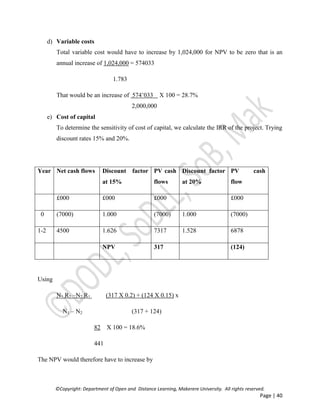
To determine the sensitivity of cost of capital, we calculate the IRR of the project. Trying
discount rates 15% and 20%.
Year Net cash flows Discount factor
at 15%
PV cash
flows
Discount factor
at 20%
PV cash
flow
£000 £000 £000 £000
0 (7000) 1.000 (7000) 1.000 (7000)
1-2 4500 1.626 7317 1.528 6878
NPV 317 (124)
Using
N1 R2 –N2 R1 (317 X 0.2) + (124 X 0.15) x
N1 – N2 (317 + 124)
82 X 100 = 18.6%
441
The NPV would therefore have to increase by
©Copyright: Department of Open and Distance Learning, Makerere University. All rights reserved.
Page | 41
18.6 -8 x 100 – 132.5% for NPV to become zero
8
If we are to rank the variables in order of sensitivity, then
1. Selling price
2. Sales volume
3. Initial investment
4. Variable costs
5. Cost of capital
Illustration 2
Simple Ltd is considering a project with the following cash flows
Year Purchase of 1 plant Running costs Savings
0 (7000)
1 2,000 6,000
2 2,500 7,000
The cost of capital is 8%. Measure the sensitivity of the project to changes in the level of
expected costs and savings.
SOLUTION
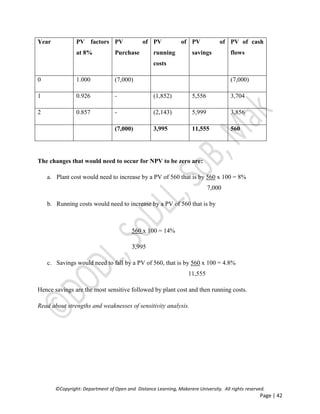
The PV of the cash flows is as follows:
©Copyright: Department of Open and Distance Learning, Makerere University. All rights reserved.
Page | 42
Year PV factors
at 8%
PV of
Purchase
PV of
running
costs
PV of
savings
PV of cash
flows
0 1.000 (7,000) (7,000)
1 0.926 - (1,852) 5,556 3,704
2 0.857 - (2,143) 5,999 3,856
(7,000) 3,995 11,555 560
The changes that would need to occur for NPV to be zero are:
a. Plant cost would need to increase by a PV of 560 that is by 560 x 100 = 8%
7,000
b. Running costs would need to increase by a PV of 560 that is by
560 x 100 = 14%
3,995
c. Savings would need to fall by a PV of 560, that is by 560 x 100 = 4.8%
11,555
Hence savings are the most sensitive followed by plant cost and then running costs.
Read about strengths and weaknesses of sensitivity analysis.
©Copyright: Department of Open and Distance Learning, Makerere University. All rights reserved.
Page | 43
Certainty Equivalent Approach
Here the expected cash flows of the project are converted to risk less equivalent amounts. The
greater the risk of an expected cash flow, the smaller the certainty equivalent values for receipts
or the larger the certainty equivalent value for payments.
Illustration
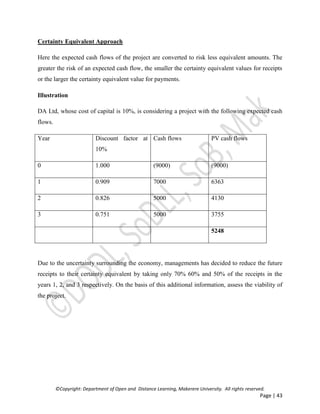
DA Ltd, whose cost of capital is 10%, is considering a project with the following expected cash
flows.
Year Discount factor at
10%
Cash flows PV cash flows
0 1.000 (9000) (9000)
1 0.909 7000 6363
2 0.826 5000 4130
3 0.751 5000 3755
5248
Due to the uncertainty surrounding the economy, managements has decided to reduce the future
receipts to their certainty equivalent by taking only 70% 60% and 50% of the receipts in the
years 1, 2, and 3 respectively. On the basis of this additional information, assess the viability of
the project.
©Copyright: Department of Open and Distance Learning, Makerere University. All rights reserved.
Page | 44
SOLUTION
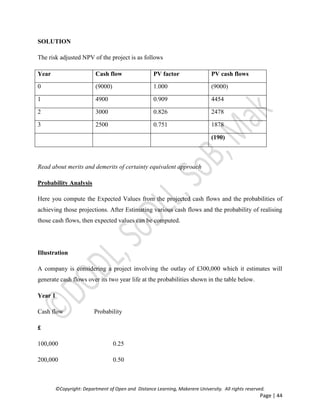
The risk adjusted NPV of the project is as follows
Year Cash flow PV factor PV cash flows
0 (9000) 1.000 (9000)
1 4900 0.909 4454
2 3000 0.826 2478
3 2500 0.751 1878
(190)
Read about merits and demerits of certainty equivalent approach
Probability Analysis
Here you compute the Expected Values from the projected cash flows and the probabilities of
achieving those projections. After Estimating various cash flows and the probability of realising
those cash flows, then expected values can be computed.
Illustration
A company is considering a project involving the outlay of £300,000 which it estimates will
generate cash flows over its two year life at the probabilities shown in the table below.
Year 1
Cash flow Probability
£
100,000 0.25
200,000 0.50
©Copyright: Department of Open and Distance Learning, Makerere University. All rights reserved.
Page | 45
300,000 0.25
1.00
The company’s investment criterion for this type of project is 10% DCF.
You are required to calculate the expected value of the project
Simulation Models
The Simulation technique allows the person appraising to incorporate may combination of
variables that may cause changes in the possible outcomes. It is the equivalent of sensitivity
analysis though with a number of variables changing at ago. Simulation is facilitated by use of
computers
ASSET REPLACEMENT DECISIONS
Once decision has been made to acquire an asset then we have to plan the replacement of the
asset i.e. when and how frequently to replace it. When an asset is to be replaced by an identical
asset, the problem is to decide the optimum interval between replacements.
Non- Identical Replacement
If an asset is to be replaced by one of a different type, then we need to decide when the existing
asset should be replaced rather than how frequently it should be replaced.
In order to find the optimum date for replacement, we first calculate the annual cost and then
follow the following.
a) Calculate the NPV of the equivalent annual cost in perpetuity for the new machine.
b) Calculate the total net present value of the various options taking into account
i. The cost in perpetuity of the new machine
ii. The final expenses of the old machine and any residual sales proceeds from the
old machine.
©Copyright: Department of Open and Distance Learning, Makerere University. All rights reserved.
Page | 46
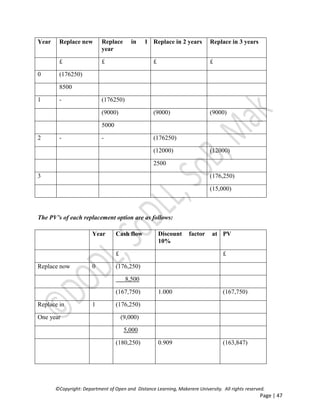
Illustration
Assume J Ltd’s machine (Illustration on LCM) is a new machine and will be introduced to
replace a non-identical machine that is nearing the end of its life and has a maximum remaining
life of three years. The organisation wishes to decide when the best time to replace the old
machine is and estimates of relevant costs have been drawn up as follows
Year Residual of
current machine
Extra expenditure and opportunity costs of keeping
the existing machine in operation during the year
£ £
0 8500 -
1 5000 9,000
2 2500 12,000
3 0 15,000
Calculate the best time to replace the existing machine.
Solution
The optimum replacement cycle is 3 years. Best time to replace the existing machine will be the
option that gives the lowest NPV of cost in perpetuity, for both the existing machine and the
machine that eventually replaces it.
Computing the NPV of the cost in perpetuity of the new machine using a
r
PV of cost = £ 17,625 = £ 176,250
0.1
Calculating the present values of each replacement option.
These cash flows show the present value of cost in perpetuity of the new machine, the running
costs of the existing machine and the resale value of the existing machine, at the end of years 0,
1, 2 or 3 as appropriate.
©Copyright: Department of Open and Distance Learning, Makerere University. All rights reserved.
Page | 47
Year Replace new Replace in 1
year
Replace in 2 years Replace in 3 years
£ £ £ £
0 (176250)
8500
1 - (176250)
(9000) (9000) (9000)
5000
2 - - (176250)
(12000) (12000)
2500
3 (176,250)
(15,000)
The PV’s of each replacement option are as follows:
Year Cash flow Discount factor at
10%
PV
£ £
Replace now 0 (176,250)
8,500
(167,750) 1.000 (167,750)
Replace in 1 (176,250)
One year (9,000)
5,000
(180,250) 0.909 (163,847)
©Copyright: Department of Open and Distance Learning, Makerere University. All rights reserved.
Page | 48
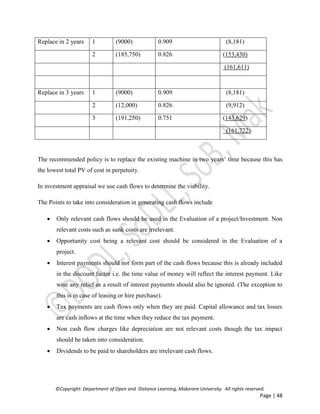
Replace in 2 years 1 (9000) 0.909 (8,181)
2 (185,750) 0.826 (153,430)
(161,611)
Replace in 3 years 1 (9000) 0.909 (8,181)
2 (12,000) 0.826 (9,912)
3 (191,250) 0.751 (143,629)
(161,722)
The recommended policy is to replace the existing machine in two years’ time because this has
the lowest total PV of cost in perpetuity.
In investment appraisal we use cash flows to determine the viability.
The Points to take into consideration in generating cash flows include
 Only relevant cash flows should be used in the Evaluation of a project/Investment. Non
relevant costs such as sunk costs are irrelevant.
 Opportunity cost being a relevant cost should be considered in the Evaluation of a
project.
 Interest payments should not form part of the cash flows because this is already included
in the discount factor i.e. the time value of money will reflect the interest payment. Like
wise any relief as a result of interest payments should also be ignored. (The exception to
this is in case of leasing or hire purchase).
 Tax payments are cash flows only when they are paid. Capital allowance and tax losses
are cash inflows at the time when they reduce the tax payment.
 Non cash flow charges like depreciation are not relevant costs though the tax impact
should be taken into consideration.
 Dividends to be paid to shareholders are irrelevant cash flows.
©Copyright: Department of Open and Distance Learning, Makerere University. All rights reserved.
Page | 49
CAPITAL RATIONING
Capital rationing is a situation where a company has a limited amount of capital to invest in
potential projects, such that the different possible investments need to be compared with one
another in order to allocate the capital available most effectively. This means that the company
will not be able to invest into all projects with positive NPVs because there is not enough capital
for all the investments.
There are two causes/types of capital rationing,
a) Soft (internal) capital rationing, which is mainly due to management’s unwillingness to
raise more funds to finance investments. The reasons may include fear of outsiders
gaining control of a business, fear of large fixed interest payments, if the firm’s budget
limits spending etc. Management may adopt conservative growth and financial policies
especially where an economy is facing of coming from a depression.
b) Hard capital (external) rationing is one where the firm’s ability to raise finds is limited by
external factors such as where lending institutions put a limit to the amount that can be
raised by a firm, where the company’s share prices are depressed, where the cost of
getting additional funds is too high.
The effects of these causes can be reduced by the firm through:
i.) Seeking joint venture partners to share projects
ii.) Licensing or franchising agreements with other enterprises
iii.) Contracting out parts of a project to reduce the initial capital out lay required.
Other means may include
 Sale and lease back of property
 Seeking Grant aid.
 Adopting more effective capital management techniques.
Capital Rationing can occur either in a single period or in a multiple periods
Single period capital rationing is where a firm experiences a shortage of funds ‘now’ but funds
are expected to be freely available in all later periods
©Copyright: Department of Open and Distance Learning, Makerere University. All rights reserved.
Page | 50
When analysing a project with capital rationing, there are assumptions to take into consideration,
these are
i.) If a company does not accept and undertake a project during a period of capital
rationing, the opportunity to undertake it is lost i.e. the project cannot be
postponed.
ii.) There is complete certainty about the outcome of each project, so that the choice
between projects is not affected by considerations of risk.
iii.) Either projects are Divisible or indivisible. Projects are divisible if either the
whole project or part of the project can be undertaken. An indivisible project is
one which either must be undertaken in its entirety or not at all.
Divisible projects
In capital rationing where projects are divisible, the approach adopted is to rank all investment
opportunities so that the NPVs can be maximised from the use of the available funds. The
ranking should not be based on the absolute NPVs but on the profitability index so that the most
profitable projects are ranked highly.
Profitability index is the ratio of present value cash inflows to present value cash out flows.
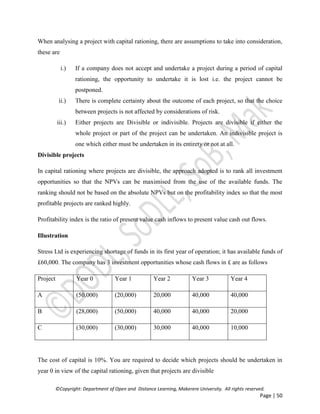
Illustration
Stress Ltd is experiencing shortage of funds in its first year of operation; it has available funds of
£60,000. The company has 3 investment opportunities whose cash flows in £ are as follows
Project Year 0 Year 1 Year 2 Year 3 Year 4
A (50,000) (20,000) 20,000 40,000 40,000
B (28,000) (50,000) 40,000 40,000 20,000
C (30,000) (30,000) 30,000 40,000 10,000
The cost of capital is 10%. You are required to decide which projects should be undertaken in
year 0 in view of the capital rationing, given that projects are divisible
©Copyright: Department of Open and Distance Learning, Makerere University. All rights reserved.
Page | 51
Computing the NPV
Out lay Present Value Cash flows
Project Year 0 Year 1 Year 2 Year 3 Year 4 NPV
A (50,000) (18,180) 16,520 30,040 27,320 5,700
B (28,000) (45,450) 33,040 30,040 13,660 3,290
C (30,000) (27,270) 24,780 30,040 6,830 4,380
Project PI Ranking
A 1.114 3rd
B 1.118 2nd
C 1.146 1st
The optimal investment policy would be as follows
Ranking Project Year 0
out lay
NPV
1 C 30,000 4380
2 B 28,000 3290
3 A 2,000 228
NPV 7898
Where the projects are not divisible, then by trial an error you determine the combination of
projects that best utilise the available funds and provide the highest total NPV.
Read about – Capital rationing where projects can be postponed.
©Copyright: Department of Open and Distance Learning, Makerere University. All rights reserved.
Page | 52
Problems of using profitability index.
INVESTMENT APPRAISAL WITH LEASING OPTION
Leasing is a contract between a lessor and a lessee for hire of a specific asset selected from a
manufacturer or vendor of such assets by the lessee. The lessor has ownership of the asset while
the lessee has possession and use of the asset on payment of specified rentals over a period.
Leasing takes two forms.
i. Finance lease, which is one where the lease transfers substantially all the risks and
rewards of ownership of an asset to the lessee and normally takes the form of an
agreement between the lessee and lessor for most or all the assets expected useful life.
ii. Operating Lease, which is one where the lessor retains most of the risks and rewards of
ownership.
Generally in project appraisal where the leasing option is involved, the evaluation takes two
stages
a) An acquisition decision has to be made, i.e. whether the asset is worth having.
b) A financing decision is then made if the acquisition is justified by a positive NPV. And
this is the decision on whether to lease or buy.
Illustration
M and M Ltd has decided to install a new milling machine. The machine costs 20,000 and it
would have a useful life of five years with a trade in value of 4,000 at the end of the fifth year.
Additional cash profits from the machine would be 8,000 a year for five years. There are 3
options of financing this investment
a) The company could purchase the machine for cash using a bank loan facility on which
the current rate of interest is 13% before tax.
b) The company could lease the machine under an agreement which would entail payment
of £4,800 at the end of each year for the next five years.
©Copyright: Department of Open and Distance Learning, Makerere University. All rights reserved.
Page | 53
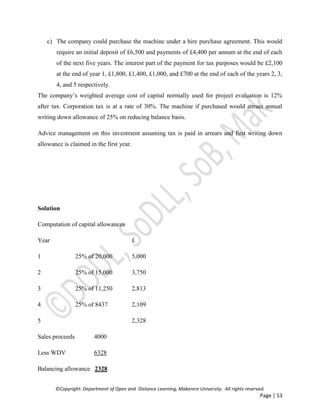
c) The company could purchase the machine under a hire purchase agreement. This would
require an initial deposit of £6,500 and payments of £4,400 per annum at the end of each
of the next five years. The interest part of the payment for tax purposes would be £2,100
at the end of year 1, £1,800, £1,400, £1,000, and £700 at the end of each of the years 2, 3,
4, and 5 respectively.
The company’s weighted average cost of capital normally used for project evaluation is 12%
after tax. Corporation tax is at a rate of 30%. The machine if purchased would attract annual
writing down allowance of 25% on reducing balance basis.
Advice management on this investment assuming tax is paid in arrears and first writing down
allowance is claimed in the first year.
Solution
Computation of capital allowances
Year £
1 25% of 20,000 5,000
2 25% of 15,000 3,750
3 25% of 11,250 2,813
4 25% of 8437 2,109
5 2,328
Sales proceeds 4000
Less WDV 6328
Balancing allowance 2328
©Copyright: Department of Open and Distance Learning, Makerere University. All rights reserved.
Page | 54
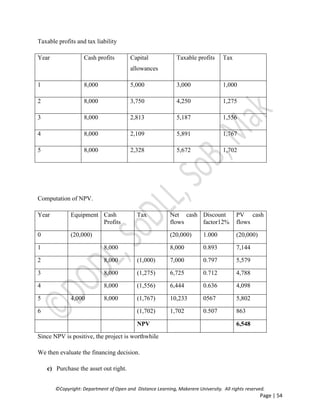
Taxable profits and tax liability
Year Cash profits Capital
allowances
Taxable profits Tax
1 8,000 5,000 3,000 1,000
2 8,000 3,750 4,250 1,275
3 8,000 2,813 5,187 1,556
4 8,000 2,109 5,891 1,767
5 8,000 2,328 5,672 1,702
Computation of NPV.
Year Equipment Cash
Profits
Tax Net cash
flows
Discount
factor12%
PV cash
flows
0 (20,000) (20,000) 1.000 (20,000)
1 8,000 8,000 0.893 7,144
2 8,000 (1,000) 7,000 0.797 5,579
3 8,000 (1,275) 6,725 0.712 4,788
4 8,000 (1,556) 6,444 0.636 4,098
5 4,000 8,000 (1,767) 10,233 0567 5,802
6 (1,702) 1,702 0.507 863
NPV 6,548
Since NPV is positive, the project is worthwhile
We then evaluate the financing decision.
c) Purchase the asset out right.
©Copyright: Department of Open and Distance Learning, Makerere University. All rights reserved.
Page | 55
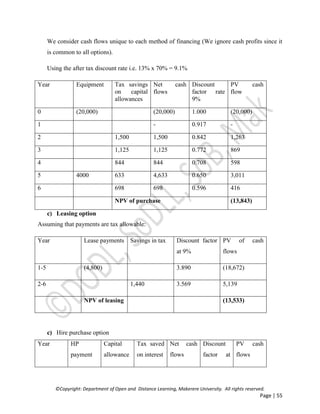
We consider cash flows unique to each method of financing (We ignore cash profits since it
is common to all options).
Using the after tax discount rate i.e. 13% x 70% = 9.1%
Year Equipment Tax savings
on capital
allowances
Net cash
flows
Discount
factor rate
9%
PV cash
flow
0 (20,000) (20,000) 1.000 (20,000)
1 - 0.917 -
2 1,500 1,500 0.842 1,263
3 1,125 1,125 0.772 869
4 844 844 0.708 598
5 4000 633 4,633 0.650 3,011
6 698 698 0.596 416
NPV of purchase (13,843)
c) Leasing option
Assuming that payments are tax allowable:
Year Lease payments Savings in tax Discount factor
at 9%
PV of cash
flows
1-5 (4,800) 3.890 (18,672)
2-6 1,440 3.569 5,139
NPV of leasing (13,533)
c) Hire purchase option
Year HP
payment
Capital
allowance
Tax saved
on interest
Net cash
flows
Discount
factor at
PV cash
flows
©Copyright: Department of Open and Distance Learning, Makerere University. All rights reserved.
Page | 56
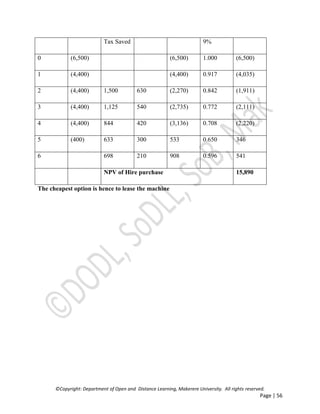
Tax Saved 9%
0 (6,500) (6,500) 1.000 (6,500)
1 (4,400) (4,400) 0.917 (4,035)
2 (4,400) 1,500 630 (2,270) 0.842 (1,911)
3 (4,400) 1,125 540 (2,735) 0.772 (2,111)
4 (4,400) 844 420 (3,136) 0.708 (2,220)
5 (400) 633 300 533 0.650 346
6 698 210 908 0.596 541
NPV of Hire purchase 15,890
The cheapest option is hence to lease the machine
©Copyright: Department of Open and Distance Learning, Makerere University. All rights reserved.
Page | 57
TOPIC THREE
SOURCES OF FINANCE
LEARNING OUTCOMES:
At the end of this topic a student will be able to:
 Explain well the short and long term sources of finance.
PREAMBLE
One of the most important problems accountants are likely to deal with in acting as advisors to a
small or medium-sized enterprise (SME) concerns the issue of financing. More succinctly,
directors and owner managers in SMEs often complain of the lack of finance for what are
profitable investment opportunities. For candidates preparing for professional examinations, the
problem of learning about sources of finance for small businesses is one of merely thinking of
different ways of listing the available sources of finance. Of course, there is more to the problem
than that although, in my experience, when directors and owner managers talk about sources of
finance they do want to know what is available. Just as it is important for accountants to be able
to advise on what financing is available - and I will identify some below - is the need to be able
to understand and explain why the SME sector encounters difficulties in finding appropriate
finance and what are the options in tackling the barriers that exist to financing. As I will argue,
dealing with such barriers are natural territory for accountants acting in an advisory role and
hence it is vital that aspiring professionals should understand the issues involved.
Introduction
Often the hardest part of starting a business is raising the money to get going. The entrepreneur
might have a great idea and clear idea of how to turn it into a successful business. However, if
sufficient finance can’t be raised, it is unlikely that the business will get off the ground. Sourcing
money may be done for a variety of reasons. Traditional areas of need may be for capital asset
©Copyright: Department of Open and Distance Learning, Makerere University. All rights reserved.
Page | 58
acquirement - new machinery or the construction of a new building or depot. The development
of new products can be enormously costly and here again capital may be required. Normally,
such developments are financed internally, whereas capital for the acquisition of machinery may
come from external sources.
SHORT-TERM SOURCES OF FINANCE
a) Finance from operations/ Retained earnings
Retained earnings means that part of trading profits which is not distributed in the form of
dividends but retained by directors for future expansion of the company. Retained earnings
ultimately come back to the equity shares in the form of enhanced dividend or capital gains. The
portion of the profits which is not distributed among the shareholders but is retained and is used
in business is called retained earnings or ploughing back of profits. Companies are required to
transfer a part of their profits in reserves.
Advantages of Retained Earnings
 Ready Availability: Being an internal source, these earnings are readily available to the
management and directors don't have to ask outsiders for finance.
 Cheaper than external equity: Retained earnings are cheaper than external equity because the
floatation costs, brokerage costs, underwriting commission are other issue expenses are
eliminated.
 No ownership dilution: Relying on retained earnings eliminates the fear of ownership
dilution and loss of control by the existing shareholders.
 Positive Connotation: Retained earnings carry positive connotation as compared to equity
issue as far as stock market is concerned.
 No expenses are incurred when capital is available from this source. There is no obligation
on the part of the company either to pay interest or pay back the money. It can safely be used
for expansion and modernization of business.
 A company which has enough reserves can face ups and downs in business. Such companies
can continue with their business even in depression, thus building up its goodwill.
 Shareholders may get dividend out of reserves even if the company does not earn enough
profit. Due to reserves, there is capital appreciation, i.e. the value of shares goes up in the
share market.
 Increase financial strength: Through ploughing back of profits, companies increase their
financial strength. Companies may throw out their competitors from the market and
monopolize their position.
Disadvantages of retained earnings
 Limited finance: The amount which can be raised by way of retained earnings will be limited
to an extent only. Keeping in view a stable dividend policy, the directors can't exhaust the
whole balance retained. As a result, the variability of profit after tax is substantially
transmitted to retained earnings.
©Copyright: Department of Open and Distance Learning, Makerere University. All rights reserved.
Page | 59
 High opportunity cost: The retained earnings are nothing but sacrifice of profits made by
equity shareholders. In other words, retained earnings are dividend foregone by equity
shareholders. This sacrifice increases the opportunity cost of retained earnings.
 This method of financing is possible only when there are huge profits and that too for many
years.
 When funds accumulate in reserves, bonus shares are issued to the shareholders to capitalize
such funds. Hence the company has to pay more dividends. By retained earnings the real
capital does not increase while the liability increases. In case bonus shares are not issued, it
may create a situation of under-capitalization because the rate of dividend will be much
higher as compared to other companies.
 Encourage extravagant spending: Capital accumulated through retained earnings encourages
management to spend carelessly.
b) Trade credit
This is always obtained when the suppliers offer credit facilities to the firm by not demanding
immediate payment for the goods and services supplied to the business.
Advantages of Trade Credit
 It has no explicit costs
 It is flexible; it only needs an understanding between the firm and the supplier.
 There are no complicated modalities in securing trade credit for example collateral securities.
Disadvantages of trade credit
 Higher price may lead to charging for the goods and service just because there is no
immediate payment of cash.
 The firm may forego cash discounts because of credit transactions.
 Over stretching of the credit period may lead to poor credit rating.
c) Delay deferred payments
The firm may defer or delay some payments for example wages may be paid at later date,
taxation can be paid after for example six months. This is an indirect source of finance.
d) Bank credit/overdraft
A common source of short term financing for many businesses is a bank over draft. They are
normally provided by clearing banks and represent permission by the bank to write the cheque
even though the firm has insufficient funds deposited in the account to meet the cheque needs.
The firm is allowed to withdraw more money than what is available on the account.
©Copyright: Department of Open and Distance Learning, Makerere University. All rights reserved.
Page | 60
Advantages of bank overdrafts
 Flexibility- they can be used as required. It is dependent on the client and the bank
relationship.
 Cheapness-interest is usually 2-5% by most banks above the base rate (all loan interest is a
tax deductible expense).
 There is no collateral security needed.
Disadvantages of bank overdrafts
 Interest rates vary with the bank base rates.
 Overdrafts are legally repayable on demand. Normally the bank will give customers
assurance that they can rely on the facility for ascertain time period, say six months.
 Security is usually required by way of fixed or floating charges on assets or
sometimes, in private companies and partnership, by personal guarantees from owners
especially when large amount are overdrawn.
e) Factoring of debtors
Factoring involves taking over responsibilities for collecting the company’s debts to a specialist
institution (the factor). The finance house/ factor undertake to collect the amounts from debtors
and bear the bad debts losses when they occur.
Advantage of debtor factoring
 Taking over the running of the client’s ledgers hence reducing on the cost by the company.
 Offering 100% protection against the bad debts instead of being incurred by the company.
 Readily finance can be obtained from the factors in form advances, the security for which
are the debtor’s balances owing.
Disadvantages of debt factoring
 To take over the running of the sales ledger and the give bad debt protection, the factor
will require a fee f about 1.5-2.5% of turnover.
 Usually not all the amount of debt will be collected and the timing of collection may be
uncertain.
 Risk of exposure of the company vital information about its sales ledger accounts to the
factor.
f) Money market based finance
This involves sourcing short-term finance from the money market by selling short-term securities
for example bill of exchange, treasury bills, promissory notes, certificate of deposit, and short-
term government bonds. For efficiency there is need for an efficiently operating market.
©Copyright: Department of Open and Distance Learning, Makerere University. All rights reserved.
Page | 61
g) Miscellaneous and sale of assets
Other sources of short-term finance may include; loan from individuals. Sale of Assets is another
internal source of finance is the sale of assets. Whenever a business sells of its assets and the
cash generated is used internally for financing the capital needs, we call it an internal source of
finance by sale of assets. It can work as a short term or long term finance depending on what
kind of assets is sold. Say, selling a car can cater short term and smaller finance needs and selling
land, buildings, or machinery can cater to long term and bigger finance needs.
h) Leasing and hire purchase finance
Leasing is a means of financing which involve the use of capital equipment and other noncurrent
assets such as buildings, motor vehicles, the underlying principle being that use is more
important that ownership. It is a medium term financial arrangement, usually for one to ten years.
There are usually two types of lease that is to say finance and operating lea lease. Hire purchase
agreements and leasing provide finance for the acquisition of specific assets such as cars,
equipment and machinery involving a deposit and repayments over, typically, three to ten years.
Technically, ownership of the asset remains with the lessor whereas title to the goods is
eventually transferred to the hirer in a hire purchase agreement.
A lease is an agreement between two parties, the "lessor" and the "lessee". The lessor owns a
capital asset, but allows the lessee to use it. The lessee makes payments under the terms of the
lease to the lessor, for a specified period of time. Leasing is, therefore, a form of rental. Leased
assets have usually been plant and machinery, cars and commercial vehicles, but might also be
computers and office equipment. There are two basic forms of lease: "operating leases" and
"finance leases".
Types of leases
Operating leases: Operating leases are rental agreements between the lessor and the lessee
whereby:
a) The lessor supplies the equipment to the lessee
b) The lessor is responsible for servicing and maintaining the leased equipment
c) The period of the lease is fairly short, less than the economic life of the asset, so that at the end
of the lease agreement, the lessor can either
i) Lease the equipment to someone else, and obtain a good rent for it, or
ii) Sell the equipment secondhand.
Finance leases: Finance leases are lease agreements between the user of the leased asset (the
lessee) and a provider of finance (the lessor) for most, or all, of the assets expected useful life.
Suppose that a company decides to obtain a company car and finance the acquisition by means of
a finance lease. A car dealer will supply the car. A finance house will agree to act as lessor in a
finance leasing arrangement, and so will purchase the car from the dealer and lease it to the
company. The company will take possession of the car from the car dealer, and make regular
©Copyright: Department of Open and Distance Learning, Makerere University. All rights reserved.
Page | 62
payments (monthly, quarterly, six monthly or annually) to the finance house under the terms of
the lease.
Advantages of using leasing & HP as a source of finance
The use of hire purchase or leasing is a popular method of funding the acquisition of capital
assets. However, these methods are not necessarily suitable for every business or for every asset
purchase. There are a number of advantages to be made, as described below:
 Certainty: One important advantage is that a hire purchase or leasing agreement is a medium
term funding facility, which cannot be withdrawn, provided the business makes the payments
as they fall due. The uncertainty that may be associated with alternative funding facilities
such as overdrafts, which are repayable on demand, is removed.
 Budgeting: The regular nature of the hire purchase or lease payments (which are also usually
of fixed amounts as well) helps a business to forecast cash flow. The business is able to
compare the payments with the expected revenue and profits generated by the use of the
asset.
 Fixed rate finance: In most cases the payments are fixed throughout the hire purchase or
lease agreement, so a business will know at the beginning of the agreement what their
repayments will be. This can be beneficial in times of low, stable or rising interest rates but
may appear expensive if interest rates are falling.
 The effect of security: Under both hire purchase and leasing, the finance company retains
legal ownership of the equipment, at least until the end of the agreement. This normally gives
the finance company better security than lenders of other types of loan or overdraft facilities.
The finance company may therefore be able to offer better terms.
 Maximum finance: Hire purchase and leasing could provide finance for the entire cost of the
equipment. There may however, be a need to put down a deposit for hire purchase or to make
one or more payments in advance under a lease. It may be possible for the business to 'trade-
in' other assets which they own, as a means of raising the deposit.
 Tax advantages: Hire purchase and leasing give the business the choice of how to take
advantage of capital allowances. If the business is profitable, it can claim its own capital
allowances through hire purchase or outright purchase.
Disadvantages of leasing and hire purchase
 However, it should be borne in mind that both hire purchase and leasing agreements are long
term commitments. It may not be possible, or could prove costly, to terminate them early.
 On some agreements, such as those for a longer term, the finance company may offer the
option of variable rate agreements. In such cases, rentals or installments will vary with
current interest rates; hence it may be more difficult to budget for the level of payment.
©Copyright: Department of Open and Distance Learning, Makerere University. All rights reserved.
Page | 63
 The decision to provide finance to a small or medium sized business depends on that
business' credit standing and potential. Because the finance company has security in the
equipment, it could tip the balance in favour of a positive credit decision.
i) Borrowing from friends and family
This is also common. Friends and family who are supportive of the business idea provide money
either directly to the entrepreneur or into the business. This can be quicker and cheaper to
arrange (certainly compared with a standard bank loan) and the interest and repayment terms
may be more flexible than a bank loan. However, borrowing in this way can add to the stress
faced by an entrepreneur, particularly if the business gets into difficulties.
j) Government assistance
The government provides finance to companies in cash grants and other forms of direct
assistance, as part of its policy of helping to develop the national economy, especially in high
technology industries and in areas of high unemployment.
LONG TERM SOURCES OF FINANCE
When a company is growing rapidly, for example when contemplating investment in capital
equipment or an acquisition, its current financial resources may be inadequate. Few growing
companies are able to finance their expansion plans from cash flow alone. They will therefore
need to consider raising finance from other external sources. Long-term source of finance is
always sought by the company capital expenditures especially to expand capacity, replacement
of the existing capacity, facilitation of research and development, maintenance of the existing
capacity. The main source may include;
a) Funds from operations
These are source of finance as reflected in accumulated reserves. The main advantages of
reserves are that they are cheap and reliable source of long-term fund; they have no explicit costs
except the indirect cost of dividends due to shareholders. They are very flexible - management
has complete control over how they are reinvested and what proportion is kept rather than paid as
dividends. They do not dilute the ownership of the company
Reason for paying and not paying dividends
Dividends are corporate earnings that companies pass on to their shareholders. There are a
number of reasons why a corporation might choose to pass some of its earnings on as dividends.
There are also a number of reasons why it might prefer to reinvest all of its earnings back into
the company.
 A company that is still growing rapidly usually won't pay dividends, because it wants to
invest as much as possible into further growth. Even a mature firm that believes it will do a
©Copyright: Department of Open and Distance Learning, Makerere University. All rights reserved.
Page | 64
better job of increasing its value (and therefore a better job of increasing its share price) by
reinvesting its earnings will choose not to pay dividends.
 Companies that don't pay dividends might use the money to start a new project, acquire new
assets, repurchase some of their shares or even buy out another company.
 Also, the choice to not pay dividends may be more beneficial to investors from a tax
perspective. Dividends are taxable to investors as ordinary income, which means an
investor's tax rate on dividends is the same as his marginal tax rate.
 Firms that choose to reinvest all of their earnings, instead of issuing dividends, may also be
thinking about the high potential expense of issuing new stock. To avoid the risk of needing
to raise money this way, they choose to keep all of their earnings.
However, for a mature company that doesn't need to reinvest as much in itself, and that has
stable earnings, there are several reasons why issuing dividends can be a good idea.
 Many investors like the steady income associated with dividends, so they will be more
likely to buy that company's stock. Investors also see a dividend payment as a sign of a
company's strength and a sign that management has positive expectations for future
earnings, which again makes the stock more attractive. A greater demand for a company's
stock will increase its price.
 A company may also choose not to pay dividends because the decision to start paying
dividends or to increase an existing dividend payment is a serious one. A company that
eliminates or reduces its existing dividend payment may be viewed unfavorably and its
stock price may decrease.
b) Ordinary share capital
These shares represent ownership and have no maturity date. Shareholders however have a voice
in management (involvement in decision making). They also have a definite cost in form of
dividends. These funds can only be obtained from the primary capital markets i.e. the market for
original buyers and sellers of securities. Secondary, markets like the stock exchange only
facilitate liquidity of these shares. These funds can be obtained through the following
mechanisms: making a public offer, private placement, by action and bonus issue.
Advantages of Ordinary share capital finance
Ordinary share capital is the most important long-term source of financing. The main
disadvantage to equity financing is that the investors become part-owners of the business, and
thus gain a say in business decisions and thus they become decision maker for the business rather
than lenders. It offers the following advantages to the company:
Permanent capital: Since ordinary shares are not redeemable, the company has no liability for
cash outflow associated with its redemption. It is a permanent capital, and is available for use as
long as the company goes.
Borrowing base: The ordinary share capital increases the company’s financial base, and thus its
borrowing limit. Lenders generally lend in proportion to the company’s equity capital. By
©Copyright: Department of Open and Distance Learning, Makerere University. All rights reserved.
Page | 65
issuing ordinary shares, the company increases its financial capability. It can borrow when it
needs additional funds.
Dividend payment discretion: A company is not legally obliged to pay dividend. In times of
financial difficulties, it can reduce or suspend payment of dividend. Thus, is can avoid cash
outflow associated with ordinary shares. In practice, dividend cuts are not very frequent. A
company tries to pay dividend regularly. It cuts dividend only when it cannot manage cash to pay
dividends
Disadvantages of share capital finance
Ordinary share capital has some disadvantages to the firm compared to other sources of finance;
Cost: Shares have a higher cost at least at two reasons: Dividends are not tax deductible as are
interest payment, and flotation costs on ordinary shares are higher than those on debt.
Risk: Ordinary shares are riskier from investor’s point of view as there is uncertainty regarding
dividend and capital gains. Therefore, they require a relatively higher rate of return. This makes
equity capital as the highest cost source of finance.
Earnings dilution: The issue of new ordinary shares dilutes the existing shareholders’ earnings
per share if the profits do not increase immediately in proportion to the increase in the number of
ordinary shares are higher than those on debt.
Ownership dilution: The issuance of new ordinary shares may dilute the ownership and control
of the existing shareholders. While the shareholders have a preemptive right to written their
proportionate ownership, they may not have funds to invest in additional shares. Dilution of
ownership assumes great significance in the case of closely-held companies. The issuance of
ordinary shares can change the ownership.
c) Issue of Preference shares
These are similar to ordinary shares only that the holders have got a preferential claim on the
income and assets of the company. Preference share are classified into cumulative and non-
cumulative shares. Cumulative preference share are shares on which the dividend can be paid in
arrears in case of no sufficient fund available. While as non-cumulative preference shares the
dividends can be paid in arrears. Whether there are no profits they must be paid.
Advantages of Preference share capital
 A long-term source of finance; its advantage is that shareholders cannot force the
company into liquidations.
 Secondly, dividend payment can be postponed for the cumulative preference
shareholders.
 Thirdly, the cost of capital for preference share is expected to be lower than individual
shares as they carry less risk.
©Copyright: Department of Open and Distance Learning, Makerere University. All rights reserved.
Page | 66
Disadvantages of Preference shares
 The preference shareholders do not participate in the management of the company and in
most cases they do not share in the surplus earnings.
 The divided can be accumulated and paid in periods of high profits. The means that the
dividends will never be written off.
 During liquidation of the company they have preferential claim against the company
assets.
d) Long term bank loans
Long term bank loans as a source of finance is the mostly used by medium and large enterprise
to finance capital projects. Usually the firm negotiates with the bank to obtained loan but on
presentation of security in form of a valuable asset.
Advantages of long-term loans
 It may be easy to negotiate with the bank mangers.
 The interest rate may not be so high as compared to those of debentures and bonds.
 The lenders are mere creditors and therefore they do participate in the management of the
company operations. This means that obtaining long-term loan does not affect the control
of the firm as compared to ordinary shareholders.
Disadvantages of long-term loans
 The process of acquiring the long-term loans is much detailed and tedious.
 The cost of borrowing in terms of interest, commitment fees, compensating balances and
the encumbrance on securities pledged can also be high.
 Interest payment obligation must be met in all circumstances otherwise, they loan lenders
can force the company into liquidation.
e) Issue of bonds and debentures
Long term debt (loan stock), usually in the form of debentures or bonds, is frequently used as
source of long-term finance as an alternative to equity. Bonds and debentures are certificates of
indebtedness, which show when the interest and principal amount will be paid.
Advantages of Debenture/Debt for the view of the company
 Cost is limited to the stipulated interest payment.
 There is no dilution of control when debt is issued.
 Debt is cheap. Because it is less risky than equity for the investor, debenture holders will
accept a lower rate of return than the shareholders.
 The debt interest is an allowable expense for tax purposes.
©Copyright: Department of Open and Distance Learning, Makerere University. All rights reserved.
Page | 67
 Debt is more flexible because it can in general terms be borrowed, repaid and re-
borrowed in variable amounts at any time.
Disadvantages of bonds/debentures
 Shareholders may be concerned that the geared company cannot pay all its interest and
still pay a dividend and will raise the rate of return that they require from the company to
compensate for this increase in risk.
 Interest on debt must be paid whatever the earnings of the company, unlike dividends,
which can be paid in good years and not in bad years.
 Failure of the firm to meet the fixed financing charge (inertest) on debentures and bonds
will lead to liquidation of the firm.
f) Business Angels
Business angels are financing organizations that are willing to invest in small businesses in
return for an equity stake. They can also offer the businesses the benefits of their own
management expertise. A number of Business Angels’ networks operate in UK to match the
businesses equity finance with potential investors.
The main advantage of business angel is that they have knowledge about business management.
However they normally require a stake the business in terms f control.
g) Venture Capital Funds
Venture capital is a general term to describe a range of ordinary and preference shares where the
investing institution acquires a share in the business. Venture capital is intended for higher risks
such as start up situations and development capital for more mature investments. Replacement
capital brings in an institution in place of one of the original shareholders of a business who
wishes to realize their personal equity before the other shareholders. The combination of
increasing the prospective marketability of Small Medium Enterprises share and tax relief
schemes has lead to the proliferation of Venture Capital Fund, which provides equity capital for
small and growing business. The range of possible funds includes; those run by merchants and
other bank, pension’s funds individuals and local authorities.
There are a number of different types of venture capital (VC):
1. Seedcorn – This is financing to allow the development of a business concept.
Development may also involve expenditure on the production of prototypes and
additional research.
2. Start-up – A product or idea is further developed and/or initial marketing is
carried out. Companies are very young and have not yet sold their product
commercially.
3. Other early-stage – Funds for initial commercial manufacturing and sales. Many
companies at this stage will remain unprofitable.
©Copyright: Department of Open and Distance Learning, Makerere University. All rights reserved.
Page | 68
4. Expansion – Companies at this stage are on to a fast-growth track and need capital
to fund increased production capacity, working capital and for further
development of the product or market.
5. Management buy-outs (MBO)– Here a team of managers make an offer to their
employees to buy a whole business, a subsidiary, or a section so that they own
and run for it for themselves. Large companies are often willing to sell to these
teams, particularly if the business is under-performing and does not fit with the
strategic core business. Usually the management team have limited funds of their
own and so call on venture capitalists to provide the bulk of finance.
6. Management buy-ins (MBI)– A new team of managers from outside an existing
business buy a stake, usually backed by a venture capital fund. A combination of
an MBO and MBI is called a BIMBO – buy-in management buy-out – where a
new group of managers join forces with an
7. existing team to acquire a business.
h) Grants and Soft Loans
Government, local authorities, local development agencies and the European Union are the major
sources of grants and soft loans. Grants are normally made to facilitate the purchase of assets and
either the generation of jobs or the training of employees. Soft loans are normally subsidized by
a third party so that the terms of interest and security levels are less than the market rate.
i) Franchising
Franchising is a method of expanding business on less capital than would otherwise be needed.
For suitable businesses, it is an alternative to raising extra capital for growth. Franchisors include
Budget Rent-a-Car, Wimpy, Nando's Chicken and Chicken Inn. Under a franchising
arrangement, a franchisee pays a franchisor for the right to operate a local business, under the
franchisor's trade name. The franchisor must bear certain costs (possibly for architect's work,
establishment costs, legal costs, marketing costs and the cost of other support services) and will
charge the franchisee an initial franchise fee to cover set-up costs, relying on the subsequent
regular payments by the franchisee for an operating profit. These regular payments will usually
be a percentage of the franchisee's turnover.
The advantages of franchises to the franchisor are as follows:
 The capital outlay needed to expand the business is reduced substantially.
 The image of the business is improved because the franchisees will be motivated to achieve
good results and will have the authority to take whatever action they think fit to improve the
results.
 The advantage of a franchise to a franchisee is that he obtains ownership of a business for an
agreed number of years (including stock and premises, although premises might be leased
©Copyright: Department of Open and Distance Learning, Makerere University. All rights reserved.
Page | 69
from the franchisor) together with the backing of a large organization’s marketing effort and
experience.
 The franchisee is able to avoid some of the mistakes of many small businesses, because the
franchisor has already learned from its own past mistakes and developed a scheme that
works.
(j) Mezzanine finance
This is unsecured debt (or preference shares) offering a high return with a high risk.
This type of debt generally offers interest rates two to five percentage points more than
that on senior debt and frequently gives the lenders some right to a share in equity values
should the firm perform well.
Mezzanine finance tends to be used when bank borrowing limits are reached and the firm
cannot or will not issue more equity. The finance it provides is cheaper (in terms of required
return) than would be available on the equity market and it allows the owners of a business
to raise large sums of money without sacrificing control. It is a form of finance which
permits the firm to move beyond what is normally considered acceptable debt/equity ratios
(gearing or leverage levels).
Mezzanine finance is used to describe forms of finance that have characteristics of both
debt and equity. They are typically used to finance MBOs or expansion.
Mezzanine finance often has one or more of these characteristics it:
 ranks after normal debt but before equity in the event a company fails
 pays higher interest rates than other debt
 is convertible into shares
 Is repayable after a long term, typically seven to ten years, so it does not drain cash flows
on the meantime.
It is most often provided in the form of subordinated debt, preference shares or
convertibles.
FACTORS AFFECTING THE CHOICE OF FINANCE
The purpose of the finance: A golden rule is that sources must be matched with uses e.g. a
long-term business expansion plan is not financed by a bank overdraft.
The cost of the finance: In return for providing equity capital, the owner expects a return in the
form of a share of profits (dividends in the case of shareholders). In return for providing loan
capital, a financial institution will charge interest on the amount borrowed (a flat rate of interest)
or on the amount outstanding (a true rate of interest).
©Copyright: Department of Open and Distance Learning, Makerere University. All rights reserved.
Page | 70
The control of the business: Issuing new voting shares in a company could lead to a change of
power in the board of directors if the existing shareholders are unable to buy part of the issue.
Using retained earnings does not affect control but may upset the owners if their dividends are
reduced. The use of loan capital will not affect voting control but the financial institution may
take control of fixed assets or impose conditions (e.g. restricting dividend payments) as part of
the loan agreement.
The tax benefits: The payment of dividends is not deductible against the corporation's tax on
profits whereas the interest on a loan is deductible.
The exposure to risk: Equity exposes the company to less risk as the share capital only has to be
repaid when the company closes. If no profits are available, dividends do not have to be repaid.
A loan on the other hand will have a repayment schedule for both the capital and the interest,
which must be met if the company is to avoid receivership or liquidation.
TOPIC FOUR
©Copyright: Department of Open and Distance Learning, Makerere University. All rights reserved.
Page | 71
DIVIDEND DECISION AND CAPITAL STRUCTURE
LEARNING OUTCOMES
At the end of this chapter a student will be able to:
The Dividend Decision is a decision made by the directors of a company. It relates to the amount
and timing of any cash payments made to the company's stockholders. The decision is an
important one for the firm as it may influence its capital structure and stock price. In addition,
the decision may determine the amount of taxation that stockholders pay.
There are four main factors that may influence a firm's dividend decision:
 Free-cash flow
 Dividend clienteles
 Information signalling
 Stability of earnings
1. The free cash flow theory of dividends
Under this theory, the dividend decision is very simple. The firm simply pays out, as dividends,
any cash that is surplus after it invests in all available positive net present value projects.
A key criticism of this theory is that it does not explain the observed dividend policies of real-
world companies. Most companies pay relatively consistent dividends from one year to the next
and managers tend to prefer to pay a steadily increasing dividend rather than paying a dividend
that fluctuates dramatically from one year to the next. These criticisms have led to the
development of other models that seek to explain the dividend decision.
2. Dividend clienteles
A particular pattern of dividend payments may suit one type of stock holder more than another;
this is sometimes called the clientele effect. A retiree may prefer to invest in a firm that provides
a consistently high dividend yield, whereas a person with a high income from employment may
©Copyright: Department of Open and Distance Learning, Makerere University. All rights reserved.
Page | 72
prefer to avoid dividends due to their high marginal tax rate on income. If clienteles exist for
particular patterns of dividend payments, a firm may be able to maximise its stock price and
minimise its cost of capital by catering to a particular clientele. This model may help to explain
the relatively consistent dividend policies followed by most listed companies.'
A key criticism of the idea of dividend clienteles is that investors do not need to rely upon the
firm to provide the pattern of cash flows that they desire. An investor who would like to receive
some cash from their investment always has the option of selling a portion of their holding. This
argument is even more cogent in recent times, with the advent of very low-cost discount
stockbrokers. It remains possible that there are taxation-based clienteles for certain types of
dividend policies.
3. Information signaling
When investors have incomplete information about the firm (perhaps due to opaque accounting
practices) they will look for other information that may provide a clue as to the firm's future
prospects. Managers have more information than investors about the firm, and such information
may inform their dividend decisions. When managers lack confidence in the firm's ability to
generate cash flows in the future they may keep dividends constant, or possibly even reduce the
amount of dividends paid out. Conversely, managers that have access to information that
indicates very good future prospects for the firm (e.g. a full order book) are more likely to
increase dividends. According to Grullon (2002) the information value lies in the fact that a
dividend increase signals a decrease in systematic risk (a decrease in discount rate), the
correlation between dividend changes and earnings changes has not been proved.
Investors can use this knowledge about managers' behaviour to inform their decision to buy or
sell the firm's stock, bidding the price up in the case of a positive dividend surprise, or selling it
down when dividends do not meet expectations. This, in turn, may influence the dividend
decision as managers know that stock holders closely watch dividend announcements looking for
good or bad news. As managers tend to avoid sending a negative signal to the market about the
future prospects of their firm, this also tends to lead to a dividend policy of a steady, gradually
increasing payment.
©Copyright: Department of Open and Distance Learning, Makerere University. All rights reserved.
Page | 73
A U.S. company has an account payable of £10,000 for a British company. The current spot
rate for the pound is $2.01 and the three-month forward rate for the pound is $2.02. What
will be the approximate value of the account payable in dollars if the company makes a
forward hedge?
$value = $2.02 x £10,000 = $20,200
A money-market hedge involves a loan contract and a source of fund to carry out that contract in
order to hedge transaction exposure.
The contract represents a loan agreement.
The difference between this process and a forward exchange market hedge is that the cost of the
money market hedge is determined by differential interest rates, not by the forward premium or
discount.
A U.S. company has an account payable of £10,000 for a British company. The current spot
rate for the pound is $2.01, the 3-month forward rate for the pound is $2.02, the 3-month
interest rate in the United States is 2%, and the 3-month interest rate in Britain is 3%. What
will be the approximate value of the account payable in dollars if the company makes a money-
market hedge?
Conclusion
In a fully informed, efficient market with no taxes and no transaction costs, the free cash flow
model of the dividend decision would prevail and firms would simply pay as a dividend any
excess cash available. The observed behaviours of firm differs markedly from such a pattern.
Most firms pay a dividend that is relatively constant over time. This pattern of behavior is likely
explained by the existence of clienteles for certain dividend policies and the information effects
of announcements of changes to dividends.
The dividend decision is usually taken by considering at least the three questions of: how much
excess cash is available? What do our investors prefer? and What will be the effect on our stock
price of announcing the amount of the dividend?
©Copyright: Department of Open and Distance Learning, Makerere University. All rights reserved.
Page | 74
The result for most firms tends to be a payment that steadily increases over time, as opposed to
varying wildly with year-to-year changes in free cash flow.
Definition of 'Capital Structure'
A mix of a company's long-term debt, specific short-term debt, common equity and preferred
equity. The capital structure is how a firm finances its overall operations and growth by using
different sources of funds.
Debt comes in the form of bond issues or long-term notes payable, while equity is classified as
common stock, preferred stock or retained earnings. Short-term debt such as working capital
requirements is also considered to be part of the capital structure.
A company's proportion of short and long-term debt is considered when analyzing capital
structure. When people refer to capital structure they are most likely referring to a firm's debt-to-
equity ratio, which provides insight into how risky a company is. Usually a company more
heavily financed by debt poses greater risk, as this firm is relatively highly levered.
THE CAPITAL STRUCTURE AND FINANCIAL RATIOS
Financial ratios are measures used to assess performance of an organization and its financial
position against the financial risk. They include:
Operating gearing, financial gearing, interest cover, interest yield, dividend per share, dividend
yield, earnings per share and price earnings ratio.
Operating Gearing
This is a measure of the extent to which a firm’s operating costs are fixed rather than variable as
this affects the level of business risk in the firm. Operating gearing can be measured in a number
of ways including:
©Copyright: Department of Open and Distance Learning, Makerere University. All rights reserved.
Page | 75
Operating gearing = Fixed cost or Fixed costs
Variable cost Total costs
Or % change in EBIT
% change in turnover
If the firm has a high proportion of fixed costs in the cost structure, its said to have a high
Operating gearing. High operating gearing increases the business risk in the organization. If the
sales of a company vary, the EBIT will also vary according.
Financial Gearing
This is a measure of the extent to which debt is used in the capital structure. It’s measured by
Equity gearing( Debt/Equity) = Preference share capital plus long term debt
Ordinary share capital plus Reserves
Total gearing = Preference share capital plus long term debt
Total long term capital
Interest gearing = Debt Interest
Operating profit before interest and tax
For comparison purposes, the same ratio must be used consistently.
In computing the financial gearing, one may use the market value of the securities or their book
values. Whichever value used, there are disadvantages and advantages.
Implication of financial gearing
A company with a higher financial gearing will have a higher risk than one with a lower gearing.
This is because it will have impact on the earnings before interest and tax.
©Copyright: Department of Open and Distance Learning, Makerere University. All rights reserved.
Page | 76
Interest cover
This is the number of times that operating profits (EBIT) cover the interest expense of an
organization.
It’s given by: Operating profit before interest & tax
Interest charge
The higher the interest cover, the less the risk that a firm faces that the profits will be insufficient
to cover the interest payment as much as a high interest cover is good, it is also a sign that the
company is not taking advantage of gearing opportunities to fund investments at a lower cost
than from equity.
Interest yield:
This is the ratio of the interest rate to the market price of a security i.e.
Interest rate x 100
Market value of security
Dividend Cover
This is the number of times that profit after preference dividends cover the dividend paid out (to
be paid out) i.e.
Earnings after preference dividends
Dividend (ordinary share)
The higher the Dividend cover the higher the ability of the form to maintain dividends to
ordinary shareholders.
THE COST OF CAPITAL
©Copyright: Department of Open and Distance Learning, Makerere University. All rights reserved.
Page | 77
Cost of capital refers to the opportunity cost that a firm incurs in using funds for investment
purposes. The cost of finance is influenced by the prevailing risk free rate of return and the
reward investors demand for the risk they take.
Risk and Return
There is a relationship between the risk taken by an investor and the expected return. Given two
projects with the same risk level, an investor would select one with a higher return.
On the other hand if two investments have the same return but different risk levels, the investor
would select the one with a lower risk level.
However, if two projects have different risk levels and different returns, the investor will only go
for a high risk project if the return is relatively higher than the other project’s.
Risk free rate of return (RF)
This is the minimum rate required by all investors for an investment whose returns are certain.
The RF rate of return is usually the Rate on the treasury bills or government bond.
Return on risky investment:
Equity shareholders are paid only after all other commitments have been settled out of the
company’s profits. Due to this, they are the ones who bear the most risk in the organization
action. (Secured lenders, liquidation costs, legally protected creditors, preferential shareholders
and ordinary shareholders).
The Return by these investors can be determined from the formula
Required Return = Risk free return + Risk Premium
Dividend valuation model:
Shareholders invest in organization expecting returns in form of dividends. One way of
determining what return they expect to receive is by looking at how much they are prepared to
pay for a share.
©Copyright: Department of Open and Distance Learning, Makerere University. All rights reserved.
Page | 78
Assumptions
- dividends are paid in perpetuity
- dividends are either constant or growing at a fixed rate
- The future income stream of the investor is the dividend paid by the company.
- the value of the dividends to perpetuity is the value of a share to the investor
Dividends valuation model with no growth
This is given by:
Po = D/Ke
Where
D = constant dividend
Po = share price now
Ke = shareholders RRR
Dividend valuation model with growth
This is given by:
Po = Do (1+g) = D1/Ke-g
(Ke-g)
Where g is the constant rate of growth in dividends
D1 = dividend to be received in year one
Do = dividends Just paid in period zero
From the above formula
Ke = Do (1+g) +g
Po
Example:
If a company has Just paid dividends of 20Cents, it is expected dividend growth rate is 7% and
current cost of equity is 12%, Calculate the market value of its share
©Copyright: Department of Open and Distance Learning, Makerere University. All rights reserved.
Page | 79
Po = Do (1+g) =
(Ke-g)
= 20 (1 + 0.07)/0.12 – 0.07 = 428
= £ 4.28
The Dividend Valuation Model assumes that the first payment will arise in one year’s time.
Hence the share price quoted is called Ex – div share price. However, if the dividend is
about to be paid, the share price is called cum dividend share price.
If a share price is cum-div, it can be converted into ex-div equivalent by subtracting the dividend
amount due for payment.
The current share price of a company is £1.25 when the company is about to pay a dividend of
15C. Share holders expect dividends to grow at 6% pa, determine the cost of equity of the form.
Ke = 15(1 + 0.06) + 0.06 = 20.5%
125-15
If the growth rate of dividends is not provided, there are two possible ways of computing it.
- Through extrapolation of past dividends
- Taking the growth as per the retained earnings.
Extrapolation
If a company pays a dividend of 32C but five years of the dividend was 20C. Estimate the
annual growth in dividends.
20 (1 + g)5
= 32
(1 + g)5
= 32/20
(1 + g) = (32/20) 1/5
©Copyright: Department of Open and Distance Learning, Makerere University. All rights reserved.
Page | 80
g = (32/20) 1/5
- 1
= 1.1-1 = 10%.
Earnings
The higher the level of retaining business, the higher the potential growth rate. The formula is g
= r x b
Where r = return on equity
b = earnings retention rate
Balance sheet as at 31 December 2005
Assets 200 capital 100
Reserves 100
200 200
Profit After tax
Dividend pay ratio (40%)
Balance sheet as at 31 December 2006
Asset 212 capital 100
Reserves 112
212 212
If the company’s return on equity and earnings retention rate remains the same what will be the
growth in dividend in the next year
g = r x b
= 10% X 60%
i.e. profit after tax to capital employed = 20/200
©Copyright: Department of Open and Distance Learning, Makerere University. All rights reserved.
Page | 81
= 10%
Earning retention ration = 60%
Estimating cost of equity - using CAPM
If an investor’s RRR reflects the risk they face, then their RRR will not be fixed overtime for all
investments. Instead it will vary with time and the type of project. In order to reduce on the risk
of one share, an investor may acquire a second share with a different risk profile. If this is
repeated, an investor may diversity risk by holding a portfolio of share holders in different
industries.
As an investor acquires more and more shares in different companies, the initial diversification
will bring about substantial risk reduction up to a certain point.
The risk reduction slows and eventually stops altogether once 15-20 carefully selected.
Investments have been combined due to the type of risk faced.
According to the capital assets pricing Model, there are two types of risks, Systematic and non-
systematic risk.
Systematic risk is that one which affects all companies in the same way but in varying degrees
e.g. inflation, economic boom, interest rates, while nonsystematic risk is that one which impact
each firm differently, depending on their circumstances, e.g. inefficiency of management.
In diversification, one can virtually eliminate the unsystematic risk but the systematic risk
remains.
A rational investor would wish to reduce the risk faced to a minimum and would therefore try to
diversify his investments. If he is successful in doing this, he will only need compensation for
the systematic risk faced.
©Copyright: Department of Open and Distance Learning, Makerere University. All rights reserved.
Page | 82
The capital assets pricing model (CAPM) assumes that all investors will hold a well diversified
portfolio of shares known as the market portfolio.
It assumes
- well diversified investors
- perfect capital market
- unrestricted borrowing or lending at the Risk free return rate of interest
- uniformity of investor expectations
The RRR of a rational, risk averse, well informed investor can therefore be found by
Required return = risk free return + risk premium
i.e RRR = Rf + ß (Rm-Rf)
Where Rf = Risk free rate
Rm = average market return
(Rm-Rf)= Average market risk premium or equity risk premium
Beta = Systematic risk of the investment Compared to market and therefore
amount of this premium needed.
If Beta >1, the investment is riskier than an average investment
If Beta <1, the investment is less risky than the average investment
If Beta =1, the investment is risk free
This Beta is the measure of the systematic risk of a security relative to that of the market
portfolio. The CAPM shows the linear relationship between the risk premium of the security and
the risk premium of the market portfolio.
Risk premium of share – market risk premium
i.e
Ry = Rf + (Rm-Rf) ß
©Copyright: Department of Open and Distance Learning, Makerere University. All rights reserved.
Page | 83
or E (r ) = Rf + B (E(Rm) – Rf)
Illustration
The current average market return on risky investment is 122. Compared with 5% on treasury
bills. G Company has a beta of 1.2. What is the cost of equity of equity of G Company?
Required return = Rf + ß (Rm-Rf)
= 5% + 1.2 (12-5)
= 13.4%
COST OF DEBT
Debt can broadly be categorized into redeemable and irredeemable debt. Where redeemable debt
is that one which has a maturity period at the end of which it’s paid back to the holder of the
security.
In the case of irredeemable debt, the holder is entitled to interest in perpetuity and it has no
maturity period hence never paid back to the holder.
Irredeemable Debt
Here the market price is assumed to equal to the future income stream from the debt discounted
at the investors required rate of return where this stream is the interest paid in perpetuity i.e.
MV = I/r
Where I = is the annual interest rate stating in year one
MV = Market price of the loan now
r = Debt holders RRR
In order to adjust the cost of debt for tax purposes,
©Copyright: Department of Open and Distance Learning, Makerere University. All rights reserved.
Page | 84
Kd (r) = I (1-t)
MV .
Please note that the MV of the loan is set by the investor, who does not get tax relief and
therefore based on the interest before tax.
A company has in issue 10% irredeemable debt quoted at £80 after interest, what is the required
rate of return for the investor.
r = 1/MV r = 10/80 = 12.5%
If the company has irredeemable debt correctly trading at £40 after interest. The company rate is
5% and the rate of tax is 30%. What is the cost of debt to the company?
Kd = 1 (1-T)/MV = 5%(0.7)/40
= 8.7%
Redeemable Debt
The value of this debt is assumed to equal to the income stream from the debt discounted at the
investors Rm where this income is the interest paid to redemption and the repayment principal.
A company has in issue 12% redeemable loan notes with 5 years to redemption, redemption will
be at par. The investor requires a return of 10%. What is the MV of the loan notes.
MV = 1. PVIFA5 + P.PVIF5
= 12(3.791) + 100(0.621)
= 107.59
If the rate of return required by the investors is asked for, then you determine the IRR.
©Copyright: Department of Open and Distance Learning, Makerere University. All rights reserved.
Page | 85
If on the other hand it’s the cost of debt to the company that is required, the IRR is still
calculated but after taking into consideration the impact of tax on the cash flows.
Example
A company had in issue 12% redeemable debt with 5 years to redemption. Redemption is at par.
The current MV of the debt is $107.59. The corporation tax rate is 30%. What is the cost of
debt?
At 10%
= (I (1-T) PVIFA5 + P.PVIF5 ) - Io
= (8.40 x 3.791 + 100 x 0.621) – 107.59
= -13.65
At 5%
= 8.40 (4.329) + 100 (0.784)-107.59
= 7.17
IRR = 5% + 7.17/7.17 + 13.62 (105-5%)
= 6.72
Debt redeemable at current market price same as irredeemable debt
For example
Consider
A. an irredeemable loan note trading at £40 with a company rate of 5%
B. A redeemable loan note trading at £40 with a coupon rate of 5% due to be redeemed at $ 40 in
3 years time
A = 1/MV = 5/40 = 12.5%
©Copyright: Department of Open and Distance Learning, Makerere University. All rights reserved.
Page | 86
For B = value = 5% of 40 (PVIFA3 + P.PVIF3)
= 2 x 2.723 + 40 x 0.864
= 5.446 + 3.4.56
= 40
Convertible Debt
This is a firm of loan which after an agreed occurrence, it may be converted into equity.
It’s treated as redeemable debt except that the redemption value is taken as the higher of
1. The cash redemption and
2. The future value of shares if converted.
Preference shares
The cost of preference shares is given by
Kp = D/Po or Po = D/Kp
Where D = the constant annual preference dividend
Po = Market value of the share
KP = cost of the preference share
Estimating cost of capital
The company’s cost of capital incorporating both the cost of debt and cost of capital is
determined by the WACC given by
WACC Ke.E + Kd.D
D + E D + E
Where Ke = cost of equity
Kd = cost of debt
D = Proportion of debt in capital structure
©Copyright: Department of Open and Distance Learning, Makerere University. All rights reserved.
Page | 87
E = Proportion of equity in capital structure
Example
B Ltd has a capital structure as follows
Cost of Capital Book Value Market Value
Bank loans 9% 5 5
Loan notes 12% 8 6
Ordinary shares 15% 18 39
The company’s current operations are carried out from 2 locations.
The oxford factory has cash surplus of £1,750,000 on capital employed of £27.5 million while
the Cambridge factory produces a cash surplus of £640,000 on its capital employed of
£3.5million. It is proposed to invest a further £1.5 million In facilities at Cambridge which will
increase cash flow by £150,000 to perpetuity.
a) Calculate B Ltd’s WACC
b) Comment on the proposed expansion.
CAPITAL STRUCTURE AND COST OF CAPITAL
What is an optimal capital structure?
The company’s objective is to maximize share holder’s wealth. This is done through
maximizing the value of a firm.
In capital structure, the intention is to achieve the above objective.
The market value of a company is the sum of the market values of its various securities i.e debt
plus equity.
©Copyright: Department of Open and Distance Learning, Makerere University. All rights reserved.
Page | 88
This value reflects the present value of the future earnings of the organization, discounted at the
RRR or WACC.
Therefore if you reduce the WACC, the market value increases and so will the share holder’s
wealth.
Since the WACC is composed of the various proportions of debt and equity, for one to attempt to
change it, you have to alter the proportions.
Debt is cheaper than equity due to the lower risk shouldered by its providers and the tax shield it
provides to the company. However, if debt is increased, it makes equity more risk due to the risk
envisaged by the equity holders.
Various theories have been developed to explain how WACC behaves with changing proportions
of equity and debt. These include
1. Traditional view of capital structure
This ignores taxation and it’s of the view that
At low levels of gearing
Equity holders perceive risk as unchanged so the increase in the proportion of cheaper debt will
lower the WACC.
©Copyright: Department of Open and Distance Learning, Makerere University. All rights reserved.
Page | 89
At higher levels of gearing
Equity holders see increased volatility of returns as debt interest must be paid first. This
increases financial risk and the increase in cost of equity will out weigh the savings from the
increased cheaper debt proportion. The WACC will increase.
At very high levels of gearing
There are serious bankruptcy risks which worry the equity and debt holders alike. This increases
both the Ke and Kd hence the WACC rises further.
There is however, an option level of gearing where the RRR by the investor is minimized and it’s
at this point that the value of a firm is maximized.
The problem with the traditional view is that there is no clear formula followed to reach the point
where WACC is minimized. Instead you go through trial and error.
2. M & M view - No taxes
This view assumes that in the capital market
- No transaction costs exist
- No individual dominates the market
- There is full information efficiency
- All investors can borrow and lend at the risk free rate of return.
- No taxes exist.
- That since the investors are rationale, the RRR of equity is directly proportional to the
increase in gearing. There is thus linear relation between Ke and gearing .
- That increase in Ke exactly offsets the benefit of the cheaper debt and hence WACC
remains unchanged.
©Copyright: Department of Open and Distance Learning, Makerere University. All rights reserved.
Page | 90
According to this view, the changing of the ratio of D, E or gearing ratio has no impact on the
value of the firm and hence the choice of finance is irrelevant so the firm can use any mix of
funds.
The major short coming of this view is the fact that it assumes that firms are not taxed due to
this, M & M revised their theory in take into consideration the tax effect.
3. M & M – with tax
That the investors are rationale, the RRR of equity is directly linked to the increase in gearing-as
gearing increase, Ke increases in direct proportion.
However, this is adjusted to reflect the fact that cost of debt to the company is lower than in M &
M-no tax.
Lower debt levels lead to less volatility in returns for the same level of gearing and lower
increase in Ke.
The increase in Ke does not offset the benefit of cheaper debt entirely and hence the WACC falls
as gearing increases.
The conclusion here is that the increasing gearing reduces the WACC and hence increases the
value of a firm. The firm should use as much as debt as possible.
Pecking Order Theory
This theory argues that in reality, there is not such a thing as searching for optimal capital
structure instead firms raise new funds in the following order.
- they start with internally generated funds
- followed by debt and
- new issue of equity
©Copyright: Department of Open and Distance Learning, Makerere University. All rights reserved.
Page | 91
Firms first use their internally generated funds before moving down the pecking order to debt
and finally they issue new equity.
CAPM and gearing risk
To evaluate a project with a different risk, a company will select a suitable beta. Because beta
values are not easy to obtain, they are calculated with reference to existing companies operating
in those business areas. Firms with above average returns are assumed to have correspondingly
higher than average systematic risk and their beta is accordingly higher than the market risk.
The systematic risk arises from 2 sources
- The risk resulting from the firm’s business activities and
- The finance risk caused by the level of gearing.
If a firm is not geared (only depends on equity financing), it will have only the business risk
which is likely to be lower than the systematic risk of a geared firm of comparable size. If a
company is not geared, its beta is ß Asset reflecting only the business risk.
If a company is geared, its beta is ß equity reflecting the systematic risk of the business and
financial risk.
Hence when given various asset betas, the following procedure is followed;
- identify the appropriate beta
- Adjust it to reflect the firm’s own gearing levels i.e. – gear the beta to convert it into
an equity beta.
If the beta selected is from a geared company, the following is relevant.
- identity the appropriate equity beta
- Adjust it to convert to an asset beta-degear it.
- Re-adjust the asset beta to reflect its own gearing level-gear the beta.
©Copyright: Department of Open and Distance Learning, Makerere University. All rights reserved.
Page | 92
To gear or degear the beta, the following formula is used
ß Asset = ß Equity x . E .
E + D (1-t)
where
E = Market value of equity
D = Market value of debt
t = corporation tax rate
Prime Ltd on the construction industry has an equity debt ratio of 5:2. The debt which is
assumed to be risk free has a gross redemption yield of 11%. The beta value of the company’s
equity is 1.1. The average return on the stock market is 16%. The corporation tax rate is 30%.
The company is considering a project whose equity beta is 1.59 and an equity debt ratio of 2:1.
Prime is to maintain its capital structure after the implementation of the new project. What is the
appropriate cost of capital for this new project.
The equity beta for the new project is ß Equity = 1.59 with gearing ratio of 2.1
- De-gear the ß equity of the project to find only the business risk.
ß asset = ß Equity x E/(E + D (1-t))
= 1.59 x 2/(2 + (1-0.30))
= 1.18
ß Equity of the new project at Prime Ltd’s gearing ration
ß asset = ß Equity x E/(E + D (1-t))
1.18 = ß Equity x 5/(5 + (1-0.3))
©Copyright: Department of Open and Distance Learning, Makerere University. All rights reserved.
Page | 93
ß Equity = 1.18/0.78 = 1.51
Cost of equity of the project
Ke = Rf + ß (Rm –Rf)
= 11% + 1.51 (16% - 11%) = 18.55%
Kd = 1(1-t)
= 11% (1-0.3) = 7.70
WACC of the project
= 18.55% x 5/7 + 7.70 x 2/7
= 15.45%
Honey bee an all equity food chain store is about to embark on a ,a major diversification into the
consumer electronics industry. Its current ß equity is 1.2 while the average equity beta of
consumer electronics is 1.6. Gearing in the electronics industry averages 30% debt 70% equity.
Corporate debt is considered to be risk free. Rm =2.5%, Rf= 10% corporation tax rate = 30.
What would be the suitable discount value for the new investment if honey bee were to finance
the new project in each of the following ways?
a) entirely by equity
b) by 30% debt &70% equity
c) 40% debt and 60% equity
©Copyright: Department of Open and Distance Learning, Makerere University. All rights reserved.
Page | 94
TOPIC FIVE
CAPITAL MARKET THEORY
LEARNING OUTCOMES:
At the end of this topic a student will be able to:
 Define a capital market
 Discuss the cycle operations of capital markets
 Explain the Uganda securities exchange
 Discuss the financial markets hypothesis
 Explain Empirical testing of efficient market hypothesis
PREAMBLE
The market where investment instruments like bonds, equities and mortgages are traded is
known as the capital market. The primal role of this market is to make investment from
investors who have surplus funds to the ones who are running a deficit.
Examples of Capital Markets
 New York Stock Exchange (NYSE)
 American Stock Exchange (AMEX)
 Chicago Board of Trade
 Chicago Board Options Exchange (CBOE)
The capital market offers both long term and overnight funds. The different types of financial
instruments that are traded in the capital markets are:
 Equity instruments
 Credit market instruments,
 Insurance instruments,
 Foreign exchange instruments,
©Copyright: Department of Open and Distance Learning, Makerere University. All rights reserved.
Page | 95
 Hybrid instruments and
 Derivative instruments.
NATURE OF CAPITAL MARKETS
The nature of capital market is brought out by the following facts:
 It has two segments
 It deals in long-term securities
 It performs trade-off function
 It creates dispersion in business ownership
 It helps in capital formation
 It helps in creating liquidity
ADVANTAGES OF CAPITAL MARKETS
 Help firms and government raise cash by selling securities
 Allow investors with excess funds to invest and earn a return
 Channel funds from savers to borrowers
 Allocate resources optimally (i.e. provide funds to those who can make the best use of
them)
 Help allocate cash to where it is most productive
 Help lower the cost of exchange
 Secondary markets, where investors trade existing securities assure investors that they
can quickly sell their securities if the need arises.
©Copyright: Department of Open and Distance Learning, Makerere University. All rights reserved.
Page | 96
TYPES OF CAPITAL MARKETS
There are two types of capital market:
 Primary market,
 Secondary market
PRIMARY MARKET
It is that market in which shares, debentures and other securities are sold for the first time for
collecting long-term capital. This market is concerned with new issues. Therefore, the primary
market is also called NEW ISSUE MARKET.
In this market, the flow of funds is from savers to borrowers (industries), hence, it helps directly
in the capital formation of the country. The money collected from this market is generally used
by the companies to modernize the plant, machinery and buildings, for extending business, and
for setting up new business unit.
METHODS OF RASISING CAPITAL IN THE PRIMARY MARKET
Methods of raising capital from primary market are given in the image below.
©Copyright: Department of Open and Distance Learning, Makerere University. All rights reserved.
Page | 97
Methods of raising capital through primary market are:
1. Public issue,
2. Rights issue,
3. Private placement.
Different methods of raising capital in primary market are:
Public Issue: Here prospectus is issued, and a public appeal is made to subscribe the new shares
/ debentures issued by the company. Shares are allocated in response to application received.
Some companies sell shares directly to the public while some take help of share brokers. The
company appoints an advertising agency to advertise about the issue of shares.
Rights Issue: Rights issue means new shares are offered to the existing shareholders on the pro-
rata basis. When company wants to raise additional capital, securities are first offered to the
existing shareholders. If the shareholders do not want to buy shares, then the company can sell
the shares to the outside public.
Private Placement: Private Placement of shares means the company sells its shares to a small
group of investors. It can sell to banks, insurance companies, financial institutions, etc. It is an
economical and quick method of selling securities. The company does not sell its shares to the
public.
FEATURES OF PRIMARY MARKET
 This is the market for new long term equity capital.
 It becomes before secondary market
 The primary market is the market where the securities are sold for the first time.
 In a primary issue, the securities are issued by the company directly to investors.
 The company receives the money and issues new security certificates to the investors.
©Copyright: Department of Open and Distance Learning, Makerere University. All rights reserved.
Page | 98
 Primary issues are used by companies for the purpose of setting up new business or for
expanding or modernizing the existing business.
 The new issue market does not include certain other sources of new long term external
finance
 Borrowers in the new issue market may be raising capital for converting private capital
into public capital; this is known as "going public."
NEED FOR PRIMARY MARKET
 To raise funds for certain purpose.
 To create market for new issues of securities.
 To establish the magnitude of the market.
 To mobilize resource the economy.
 For overall development of companies.
SECONDARY MARKET
The secondary market, also called aftermarket, is the financial market in which previously issued
financial instruments such as stock, bonds, options, and futures are bought and sold. Another
frequent usage of "secondary market" is to refer to loans which are sold by a mortgage bank to
investors.
The term "secondary market" is also used to refer to the market for any used goods or assets, or
an alternative use for an existing product or asset where the customer base is the second market
(for example, corn has been traditionally used primarily for food production and feedstock, but a
"second" or "third" market has developed for use in ethanol production).
©Copyright: Department of Open and Distance Learning, Makerere University. All rights reserved.
Page | 99
Products deal in Secondary Markets.
 Equity shares
 Government securities
 Debentures
 Bonds
FEATURES OF SECONDARY MARKET
It Creates Liquidity: The most important feature of the secondary market is to create liquidity
in securities. Liquidity means immediate conversion of securities into cash. This job is
performed by the secondary market.
It Comes after Primary Market: Any new security cannot be sold for the first time in the
secondary market. New securities are first sold in the primary market and thereafter comes the
turn of the secondary market.
It has a Particular Place: The secondary market has a particular place which is called Stock
Exchange. However, it must be noted that it is not essential that all the buying and selling of
securities will be done only through stock exchange.
Two individuals can buy or sell them mutually. This will also be called a transaction of the
secondary market. Generally, most of the transactions are made through the medium of stock
exchange.
It Encourages New Investment: The rates of shares and other securities often fluctuate in the
share market. Many new investors enter this market to exploit this situation. This leads to an
increase in investment in the industrial sector of the country.
UNCTIONS OF SECONDARY MARKET
©Copyright: Department of Open and Distance Learning, Makerere University. All rights reserved.
Page | 100
 Provides regular information about the value of security
 Helps to observe prices of bonds and their interest rates
 Offers to investors liquidity for their assets
 Secondary markets together many interested parties
 It keep the cost of transactions low
FAMOUS SECONDARY MARKETS WORLD WIDE
 New York Stock exchange
 NASDAQ
 The London Stock Exchange
 The Tokyo Stock Exchange
 Shanghai Stock Exchange
OPERATIONS OF CAPITAL MARKETS
Capital markets are markets used by companies to raise long term funds needed to finance long
term investments. It is a market in which corporate equity and long term securities (those
maturing in more than one year) are issues and traded. The money raised is also to conduct
research and developments. Much of the funds in capital markets come from major institutions
such as pension funds, insurance companies and universities, banks etc.
In US as well as other developed countries, capital markets play several roles such as sources of
income to investors and providing instant feedback to corporate executives about how investors
judge performance of different corporate companies. Stock/Share values in capital markets
reflect investor reactions to government policy. If government adopts policies that investors
believe will hurt the economy and the company profits capital markets declines and if policies
will help the economy capital market rises.
©Copyright: Department of Open and Distance Learning, Makerere University. All rights reserved.
Page | 101
To work effectively capital markets require free flow of information and numerous sources of
capital market information include:
 Quarterly and annual financial reports
 Market pages of daily news papers
 Business magazines and newsletter devoted to analyzing particular stocks and capital
markets.
ILLUSTRATION
UGANDA SECURITY EXCHANGE
The Uganda Securities Exchange (USE) is the principal stock exchange of Uganda. It was
founded in June 1997. The USE is operated under the jurisdiction of Uganda's Capital Markets
Authority, which in turn reports to the Bank of Uganda, Uganda's central bank.
The exchange's doors opened to trading in January 1998. At the time, the exchange had just one
listing, a bond issued by the East African Development Bank. Trading was limited to only a
handful of trades per week.
©Copyright: Department of Open and Distance Learning, Makerere University. All rights reserved.
Page | 102
As of June 2011, the USE trades fourteen (14) listed local and East African companies and has
started the trading of fixed income instruments. The exchange, which is open five days a week, is
a member of the African Stock Exchanges Association.
The USE operates in close association with the Dar es Salaam Stock Exchange in Tanzania and
the Nairobi Stock Exchange in Kenya and plans are underway to integrate the three to form a
single East African bourse.
MARKET LISTING
As of August 2013
Number Symbol Company
1 BOBU Bank of Baroda
2 BATU British American Tobacco
3 DFCU DFCU Group
4 EABL East African Breweries
5 JHL Jubilee Holdings
6 KA Kenya Airways
7 KCB KCB Group
8 NVL New Vision Group
9 SBU Stanbic Bank Group
10 UCL Uganda Clays Limited
11 EBL Equity Bank Group
12 NIC National Insurance Corporation
13 HFB Housing Finance Bank
14 UCHU Uchumi Supermarkets
15 NMG National Media Group
16 CENT Centum Investment Company Limited
17 UMEME Umeme
18 CRANE Crane Bank
©Copyright: Department of Open and Distance Learning, Makerere University. All rights reserved.
Page | 103
FUNCTIONS OF UGANDA SECURITY EXCHANGE
The basic function of USE is to provide a facility for raising funds for investment in long-term
assets. While this is extremely important as the engine through which the stock exchange is
driven, there are other important functions of the USE:
The mobilization of savings
The mobilization of savings for investment in productive enterprises as an alternative to putting
savings in bank deposits, purchase of real estate, and outright consumption. It is an addition to
the Banking System as it provides more diversity to the already available financial instruments.
Improvement of access to finance for new and smaller companies
This is futuristic in most developing countries because venture capital is mostly unavailable.
The listing requirements of USE have been specially designed to meet the needs of this sector.
Creation of Liquidity
The creation of liquidity, this is the ability of securities to be converted into cash at a market
price. Acquiring and selling of shares is fairly simple, inexpensive and swift and can be done at
any time to suit the investor’s convenience.
The growth of the related financial services sector
Institutions like the insurance, pension and provident fund schemes nurture the spirit of savings.
USE provides an avenue through which financial securities can be traded by such institutions in
order to facilitate their activities as financial intermediaries.
Encouragement of higher standards of accounting, resource management and public
disclosure
Institutions like the insurance, pension and provident fund schemes nurture the spirit of savings.
©Copyright: Department of Open and Distance Learning, Makerere University. All rights reserved.
Page | 104
USE provides an avenue through which financial securities can be traded by such institutions in
order to facilitate their activities as financial intermediaries.
Facilitation of equity financing as opposed to debt financing
Equity financing has a component of flexibility. The company pays holders depending on its
performance; whereas debt financing requires that the holder of the security be entitled to a fixed
sum in interest disregarding the performance of the company.
Divestiture of Government Owned Companies
The USE assists in the divestiture of government owned companies. The privatization process
through capital markets includes the flotation of shares and needs a secondary market for its
success. Through this process indigenous people are able to attain a stake in the privatized
companies.
Price Discovery
Providing a mechanism for price discovery through open market operations at the Exchange. The
price at which a deal is made indicates not only the value of the shares in question but also the
value the market is willing to pay for the shares in question.
Factors responsible for the sluggish growth of USE since its Inception
EFFICIENT MARKETS HYPOTHESIS
The concept of an efficient Market
An efficient market is one in which security prices fully reflect all the available information in
the market. In an efficient market new information is rapidly and rationally incorporated into
share prices in an unbiased way.
Benefits of efficient markets
An efficient market is needed to:
©Copyright: Department of Open and Distance Learning, Makerere University. All rights reserved.
Page | 105
Ensure investor confidence: Investors need to know they will pay and receive a fair price when
they buy and sell shares. If shares are incorrectly priced, many savers would refuse to invest this
seriously reducing the availability of funds. Investor confidence in the pricing efficiency is
essential.
Motivation and control: The primary objective of directors is to maximize shareholders wealth
i.e. maximizing the share price. In implementing a positive (NPV) decision directors can be
assured that the decision once communicated to the market will result in an increased share price
will fall. Like all feedback systems the stock market has dual function. It motivates directors to
maximize share price while providing early warning system of potential problems.
EFFICIECT MARKET HYPOTHESIS
Assumptions of Efficient Market Hypothesis
 There are perfect capital markets
 Information about the companies is available to all at no cost
 There is no inside trading
 No investor is large enough to influence market prices
 Investors behave rationally
 There are no transaction costs in the market.
TYPES OF MARKET EFFICIENCY
WEAK FORM
It assumes that current stock prices reflect all security market information including historical
information. In this form, the efficient market, all past price movements are already incorporated
into the share price. The form contends that past information cannot be used to predict the future.
©Copyright: Department of Open and Distance Learning, Makerere University. All rights reserved.
Page | 106
The form implies that there is no relationship between past/historical information (historical
price changes and future changes). Therefore any trading rule that enables an investor to predict
the future security prices in the past data are useless and no value.
SEMI STRONG FORM
This hypothesis centre’s on how rapidly and efficiently market prices of shares can be adjusted
to new publicly available information. Share prices react not only on released information but
also to the expectation to changes in the company’s fortunes. Investors will be able to see beyond
creative accounting or window dressing by companies in an attempt to overstate profits, e.g.
contents of future financial reports such as changes in earnings per share, payment of dividends
etc.
Evidence from European stock markets has indicated that; share prices react with in 5 -10
minutes of any new information released and share prices will;
 Rise in response to breaking news
 Fall in response to breaking bad news
The theory of semi strong market efficiency concludes that:
 Fundamental analysts who examine publicly available information will not provide
opportunities to consistently beat the market.
 Only those trading in the first few minutes after the news breaks can beat the market
 Since published information includes past share prices, a semi strong form efficient
market is also weakly efficient.
STRONG FORM EFFICIENCY
In this form of the market, the share price incorporates all the information whether public or
private, including information that is not yet published. This type of the market efficiency
includes the assumptions made in both the weak and semi strong market efficiency. The form
requires the market not only to be efficient but perfect where all the information is available to
everyone at the same time.
©Copyright: Department of Open and Distance Learning, Makerere University. All rights reserved.
Page | 107
CONCLUSIONS
 Inside dealers are normally fined and imprisoned for making money by trading in shares
before the news affecting them are made public.
 The stock exchange normally encourages quick release of new information to prevent
insider trading opportunities.
 Insiders are forbidden from trading in their shares at crucial times.
LIMITATIONS OF EFFICIENT MARKET HYPOTHESIS
 It assumes that all capital markets are developed as in developed countries like UK, US
etc, which is not true.
 It ignores the impact of information in influencing the market outcome ie markets tend to
over react to both good and bad news.
 The hypothesis ignores the main objective of the business which is profit maximization
i.e. every one will always strive to earn higher profit then the rest.
 The capital markets ignore shares of small companies or small volumes of the share. This
limits the growth of capital markets by ignoring potential entrants to the market.
 It assumes that all days of trading are good and the same which is not true because there
are times when it’s more advantageous to buy or sell shares and there are other days
when it’s better to avoid trading altogether.
 It is not important to acquire and analyze public information.
©Copyright: Department of Open and Distance Learning, Makerere University. All rights reserved.
Page | 108
TOPIC SIX
CORPORATE RESTRUCTURING AND COMPANY VALUATION
LEARNING OUTCOMES:
At the end of this topic a student will be able to:
 Explain company analysis and valuation
 Analyze and value of stocks
 Analyze and value of fixed income securities
 Distinguish between mergers and acquisitions
PREAMBLE
Corporate restructuring is the process of redesigning one or more aspects of a company. The
process of reorganizing a company may be implemented due to a number of different factors,
such as:
 Positioning the company to be more competitive,
 Survive a currently adverse economic climate, or
 Poise the corporation to move in an entirely new direction.
Restructuring a corporate entity is often a necessity when the company has grown to the point
that the original structure can no longer efficiently manage the output and general interests of the
company. For example, a corporate restructuring may call for spinning off some departments
into subsidiaries as a means of creating a more effective management model as well as taking
advantage of tax breaks that would allow the corporation to divert more revenue to the
production process. In this scenario, the restructuring is seen as a positive sign of growth of the
company and is often welcome by those who wish to see the corporation gain a larger market
share.
©Copyright: Department of Open and Distance Learning, Makerere University. All rights reserved.
Page | 109
Corporate restructuring may take place as a result of the acquisition of the company by new
owners. The acquisition may be in the form of a leveraged buyout, a hostile takeover, or a
merger of some type that keeps the company intact as a subsidiary of the controlling corporation.
When the restructuring is due to a hostile takeover, corporate raiders often implement a
dismantling of the company, selling off properties and other assets in order to make a profit from
the buyout. What remains after this restructuring may be a smaller entity that can continue to
function, albeit not at the level possible before the takeover took place.
In general, the idea of corporate restructuring is to allow the company to continue functioning in
some manner. Even when corporate raiders break up the company and leave behind a shell of the
original structure, there is still usually the hope that what remains can function well enough for a
new buyer to purchase the diminished corporation and return it to profitability.
However, financial restructuring may take place in response to a drop in sales, due to a sluggish
economy or temporary concerns about the economy in general. When this happens, the
corporation may need to reorder finances as a means of keeping the company operational
through this rough time. Costs may be cut by combining divisions or departments, reassigning
responsibilities and eliminating personnel, or scaling back production at various facilities owned
by the company. With this type of corporate restructuring, the focus is on survival in a difficult
market rather than on expanding the company to meet growing consumer demand.
Financial restructuring is the reorganization of the financial assets and liabilities of a
corporation in order to create the most beneficial financial environment for the company. The
process of financial restructuring is often associated with corporate restructuring, in that
restructuring the general function and composition of the company is likely to impact the
financial health of the corporation. When completed, this reordering of corporate assets and
liabilities can help the company to remain competitive, even in a depressed economy.
The process of financial restructuring may be undertaken as a means of eliminating waste from
the operations of the company. For example, the restructuring effort may find that two divisions
or departments of the company perform related functions and in some cases duplicate efforts.
Rather than continue to use financial resources to fund the operation of both departments, their
©Copyright: Department of Open and Distance Learning, Makerere University. All rights reserved.
Page | 110
efforts are combined. This helps to reduce costs without impairing the ability of the company to
still achieve the same ends in a timely manner.
In some cases, financial restructuring is a strategy that must take place in order for the company
to continue operations. This is especially true when sales decline and the corporation no longer
generates a consistent net profit. A financial restructuring may include a review of the costs
associated with each sector of the business and identify ways to cut costs and increase the net
profit. The restructuring may also call for the reduction or suspension of production facilities that
are obsolete or currently produce goods that are not selling well and are scheduled to be phased
out.
Financial risk is the amount of chance that is present with any type of financial investment.
Typically, the goal is to secure investments that appear to have a low amount of risk since these
are more likely to earn a return. Both individual and corporate investors assess the degree of risk
present before executing an order to buy shares on any investment market.
MAJOR CATEGORIES OF RESTRUCTURING
1- EXPANSIONS:
Expansions include mergers, consolidations, acquisitions and various other activities which
result in an enlargement of a firm or its scope of operations. There is a lot of ambiquity in the
usage of the terms associated with corporate expansions.
- A Merger involves a combination of two firms such that only one firm survives.
Mergers tend to occur when one firm is significantly larger than the other and the
survivor is usually the larger of the two. A Merger can take the form of
(a) Horizontal merger involves two firms in similar businesses. The combination of
two oil companies or two solid waste disposal companies, for example would
represent horizontal mergers.
(b) Vertical mergers involves two firms involve in different stages of production of
the same end product or related end product.
©Copyright: Department of Open and Distance Learning, Makerere University. All rights reserved.
Page | 111
- Conglomerate mergers involves two firms in unrelated business activities.
- A consolidations involves the creation of an altogether new firm owning the assets of both of
the first two firms and neither of the first two survive. This form of combination is most common
when the two firms are of approximately equal size.
The joint ventures, in which two separate firms pool some of their resources, is another such
form that does not ordinarily lead to the dissolution of either firm. Such ventures typically
involve only a small portion of the cooperating firms overall businesses and usually have limited
lives.
The term acquisitions means an attempts by one firm, called the acquiring firm to gain a
majority interest in another firm called the target firm. The effort to gain control may be a
prelude to a subsequent merger to establish a parent subsidiary relationship, to break up the
target firm and dispose of its assets or to take the target firm private by a small gropu of
investots. There are a number of strategies that can be employed in corporate acuisitions like
friendly takkeovers, hostile takeovers etc.
1. CONTRACTIONS:
Contraction, as the term implies, results in a smaller firm rather than a larger one. If we ignore
the abandonment of assets, occasionally a logical course of action, corporate contraction occurs
as the result of disposition of assets. The disposition of assets, sometimes called sell-offs, can
take either of three board form:
(i) A sell-off, also known as a divestiture, is the outright sale of a company
subsidiary. Normally, sell-offs are done because the subsidiary doesn't fit into
the parent company's core strategy. The market may be undervaluing the
combined businesses due to a lack of synergy between the parent and
subsidiary. As a result, management and the board decide that the subsidiary
is better off under different ownership.Besides getting rid of an unwanted
subsidiary, sell-offs also raise cash, which can be used to pay off debt.
(ii) Spin-offsA spinoff occurs when a subsidiary becomes an independent entity. The parent
firm distributes shares of the subsidiary to its shareholders through a stock dividend. Since this
transaction is a dividend distribution, no cash is generated. Thus, spinoffs are unlikely to be used
©Copyright: Department of Open and Distance Learning, Makerere University. All rights reserved.
Page | 112
when a firm needs to finance growth or deals. Like the carve-out, the subsidiary becomes a
separate legal entity with a distinct management and board.
(iii) Divestitures divestment or divestiture is the reduction of some kind of asset for either
financial or ethical objectives or sale of an existing business by a firm. A divestment is the
opposite of an investment. First, a firm may divest (sell) businesses that are not part of its core
operations so that it can focus on what it does best. A second motive for divestitures is to obtain
funds. Divestitures generate funds for the firm because it is selling one of its businesses in
exchange for cash. A third motive for divesting is that a firm's "break-up" value is sometimes
believed to be greater than the value of the firm as a whole. In other words, the sum of a firm's
individual asset liquidation values exceeds the market value of the firm's combined assets. This
encourages firms to sell off what would be worth more when liquidated than when retained.
(iv) Carve outs. More and more companies are using equity carve-outs to boost shareholder
value. A parent firm makes a subsidiary public through an initial public offering (IPO) of shares,
amounting to a partial sell-off. A new publicly-listed company is created, but the parent keeps a
controlling stake in the newly traded subsidiary.
A carve-out is a strategic avenue a parent firm may take when one of its subsidiaries is growing
faster and carrying higher valuations than other businesses owned by the parent. A carve-out
generates cash because shares in the subsidiary are sold to the public, but the issue also unlocks
the value of the subsidiary unit and enhances the parent's shareholder value.
The new legal entity of a carve-out has a separate board, but in most carve-outs, the parent
retains some control. In these cases, some portion of the parent firm's board of directors may be
shared. Since the parent has a controlling stake, meaning both firms have common shareholders,
the connection between the two will likely be strong.
©Copyright: Department of Open and Distance Learning, Makerere University. All rights reserved.
Page | 113
Spin-offs and carve outs create new legal entities while divestitres do not.
(3) OWNERSHIP AND CONTROL
The third major area encompassed vy the term corporate restructuring is that of ownership and
control. It has been wrested from the current board; the new management will often embark on a
full or partial liquidating strategy involving the sale of assets. The leveraged buyout preserves
the integrity of the firm as legal entity but consolidates ownership in the hands of a small group.
In the 1980s, many large publicly tradedd firms went private and employees a similar strategy
called a leveraged buyout or LBO.
Whether a purchase is considered a merger or an acquisition really depends on whether the
purchase is friendly or hostile and how it is announced. In other words, the real difference lies in
how the purchase is communicated to and received by the target company's board of directors,
employees and shareholders.
Synergy
Synergy is the magic force that allows for enhanced cost efficiencies of the new business.
Synergy takes the form of revenue enhancement and cost savings. By merging, the companies
hope to benefit from the following:
Staff reductions - As every employee knows, mergers tend to mean job losses. Consider all the
money saved from reducing the number of staff members from accounting, marketing and other
departments. Job cuts will also include the former CEO, who typically leaves with a
compensation package.
Economies of scale - Yes, size matters. Whether it's purchasing stationery or a new corporate IT
system, a bigger company placing the orders can save more on costs. Mergers also translate into
improved purchasing power to buy equipment or office supplies - when placing larger orders,
companies have a greater ability to negotiate prices with their suppliers.
©Copyright: Department of Open and Distance Learning, Makerere University. All rights reserved.
Page | 114
Acquiring new technology - To stay competitive, companies need to stay on top of technological
developments and their business applications. By buying a smaller company with unique
technologies, a large company can maintain or develop a competitive edge.
Improved market reach and industry visibility - Companies buy companies to reach new markets
and grow revenues and earnings. A merge may expand two companies' marketing and
distribution, giving them new sales opportunities. A merger can also improve a company's
standing in the investment community: bigger firms often have an easier time raising capital than
smaller ones.
Other takeovers are strategic in that they are thought to have secondary effects beyond the
simple effect of the profitability of the target company being added to the acquiring company's
profitability. For example, an acquiring company may decide to purchase a company that is
profitable and has good distribution capabilities in new areas which the acquiring company can
utilize for its own products as well.
A target company might be attractive because it allows the acquiring company to enter a new
market without having to take on the risk, time and expense of starting a new division.
An acquiring company could decide to take over a competitor not only because the competitor is
profitable, but in order to eliminate competition in its field and make it easier, in the long term,
to raise prices.
Also a takeover could fulfill the belief that the combined company can be more profitable than
the two companies would be separately due to a reduction of redundant functions.
How to resist a hostile take over bid.( Please read)
i) revaluing the company to a very high value to scare off predator
ii) arranging an MBO or Buy in
iii) inviting another company to make a counter offer
©Copyright: Department of Open and Distance Learning, Makerere University. All rights reserved.
Page | 115
iv) convincing shareholders to refuse the offer
v) paying high dividends to share holders so they don’t see reason for selling their share
holding
 A reverse takeover can occur in different forms:
o a smaller corporate entity takes over a larger one.
o a private company purchases a public one.
o a method of listing a private company while bypassing most securities
regulations, in which a shell public company buys out a functioning private
company whose management then controls the public company.
There are a variety of reasons that an acquiring company may wish to purchase another
company. Some takeovers are opportunistic - the target company may simply be very reasonably
priced for one reason or another and the acquiring company may decide that in the long run, it
will end up making money by purchasing the target company.
Merging
In business or economics a merger is a combination of two companies into one larger company.
Such actions are commonly voluntary and involve stock swap or cash payment to the target. A
merger can resemble a takeover but result in a new company name (often combining the names
of the original companies) and in new branding; in some cases, terming the combination a
"merger" rather than an acquisition is done purely for political or marketing reasons.
 Horizontal mergers take place where the two merging companies produce similar product
in the same industry.
 Vertical mergers occur when two firms, each working at different stages in the
production of the same good, combine.
 Conglomerate mergers take place when the two firms operate in different industries.
©Copyright: Department of Open and Distance Learning, Makerere University. All rights reserved.
Page | 116
Motives behind Mergers
 Economies of scale: This refers to the fact that the combined company can often reduce
duplicate departments or operations, lowering the costs of the company relative to
theoretically the same revenue stream, thus increasing profit.
 Increased revenue/Increased Market Share: This motive assumes that the company will
be absorbing a major competitor and increasing its power (by capturing increased market
share) to set prices.
 Cross Selling: For example, a bank buying a stock broker could then sell its banking
products to the stock broker's customers, while the broker can sign up the bank's
customers for brokerage accounts. Or, a manufacturer can acquire and sell
complementary products.
 Synergy: Better use of complementary resources.
 Taxes: A profitable company can buy a loss maker to use the target's tax write-offs.
Mergers and Acquisitions: Valuation matters
Investors in a company that is aiming to take over another one must determine whether the
purchase will be beneficial to them. In order to do so, they must ask themselves how much the
company being acquired is really worth.
Naturally, both sides of an M&A deal will have different ideas about the worth of a target
company: its seller will tend to value the company at as high of a price as possible, while the
buyer will try to get the lowest price that he can.
Reasons for Share Valuations
a) For Quoted companies when there is a takeover bid and the offer price is an estimated
‘Fair Value’ in excess of the current market price of the shares. Otherwise the share price
is determines by market conditions on the stock exchange. A takeover is an acquisition
by the company of a controlling interest in the voting shares of another company, usually
achieved by the purchase of the majority of the voting shares.
b) For Un-quoted companies, When
©Copyright: Department of Open and Distance Learning, Makerere University. All rights reserved.
Page | 117
(i) The company wishes to get floated on stock exchange and must fix an issue price for
its shares.
(ii) There is a proposal scheme for a merger
(iii) Shares are to be sold
(iv) Shares need to be valued for purposes of taxation.
(v) Shares are pledged as collateral for a loan.
c) For Subsidiary companies, when the holding company is negotiating the sale of the
subsidiary to a management Buyout team or to an external buyer.
There are, however, many legitimate ways to value companies. The most common method is to
look at comparable companies in an industry, but deal makers employ a variety of other methods
and tools when assessing a target company . Usually, valuing unquoted companies presents some
special considerations. For example,
 It may not be sensible to use a P/E ratio of a quoted company fopr comparative purposes
because the market value of a quoted company is likely to include a premium to reflect
marketability of its shares.
 It may not be sensible to use the Cost of Equity of a quoted company to compare because
the Cost of capital for a quoted company is likely to be much lower to reflect the fact that
it is viewed as les risky by investors.
COMMON BASES FOR VALUING SHARES
 Asset Based
 Earnings Based – P/E Ratios, Earnings Yield, ARR
 Cash flow Based- Dividends DCF
 Dividends Growth model
©Copyright: Department of Open and Distance Learning, Makerere University. All rights reserved.
Page | 118
1) Asset Valuation Bases
Using this method of valuation, the value of a share in a particular class is equal to the net
tangible assets attributable to that class, divided by the number of shares in that class.
Intangible assets should be excluded, unless they have a market value (for example patents
and copyrights which could be sold.)
 Goodwill if shown in accounts, is unlikely to be shown at a true figure for
puposes of valuation and so the value of goodwill should not be reflected in net
assets method.
 Development expenditure if shown in accounts would have a value which is
related to future profits rather than the worth of the company’s physical assets.
Example of net asset method
The Summary balance sheet of Katwe Car Manufacturers is shown below
Shs ‘000000 Shs ‘000000 Shs ‘000000
Fixed Assets
Land and Buildings 160,000
Plant 80,000
Vehicles 20,000
260,000
Goodwill 20,000
Current Assets
©Copyright: Department of Open and Distance Learning, Makerere University. All rights reserved.
Page | 119
Stocks 80,000
Debtors 60,000
Short Investments 15,000
Cash 5,000
160,000
Current Liabilities
Creditors 60,000
Taxation 20,000
Proposed 20,000 (100,000)
60,000
340,000
12% debentures 60,000
Defered Tax 10,000
Ordinary shares of 1000 @ 80,000
Reserves 140,000
14% Preferred shares of 1000@ 50,000
340,000
©Copyright: Department of Open and Distance Learning, Makerere University. All rights reserved.
Page | 120
What is the value of an ordinary share using the net assets method of valuation?
The difficulty with asset based measures is establishing the asset values to use. Values ought to
be realistic. Possibilities include;
 Historic basis – unlikely to give a realistic measure of the real value of the asset
 Replacement Basis – if the asset is to be used on an ongoing basis
 Realisable Value – If the Asset is to be sold or the business as a whole broken up.
Some times the assets may need Professional valuation, which can be an additional cost.
The Net Asset method may be used in the following circumstances
a) AS a measure of the security in a share value. A share could be measured using an
earnings basis and this valuation could be:
 Higher than the net asset value per share, i.e if the company went into liquidation,
the investor could not expect to receive the the full value of his shares from sale
of underlying assets.
 Lower than the net asset value per share i.e if the company is sold, the investor
could expect to receive the full value of his shares and perhaps much more, when
underlying assets are sold.
b) As a measure of comparison in a merger scheme. A merger is basically a business
combination between two or more companies, of which none obtains control over any
other.
c) As a ‘Floor value’ or reserve value for a business that is up for sale. Shareholders will be
reluctant to sell at a value less than Net asset value.
©Copyright: Department of Open and Distance Learning, Makerere University. All rights reserved.
Page | 121
2. EARNINGS VALUATION BASES
A. The P/E Ratio method
This is a common method of valuing a controlling interest in a company, where the owner
can decide on a dividend and retention policy.
Since P/E ratio = Market Value (p)
EPS
Then the Market price per share = EPS x P/E ratio
NB Please recall that EPS = Profit/Loss attributable to ordinary share holders
Weighted Average number of ordinary shares in the year
The P/E ratio produces an earnings based valuation of shares. The higher the P/E ratio, the
higher will be the price. A high P/E ratio indicates;
a) Expectations that EPS will grow rapidly. In other words, a high price is being paid
now for future profit prospects. Many small but successful companies are valued on
stock market at higher P/E ratio on the strength of expected future earnings.
b) Security of Earnings, - a well established low-risk company would be valued on a
higher P/E Ratio than a similar company whose earnings are subject to high uncertainty.
c) Status; If a quoted company ( the predator) made a share for share take over bid, for an
unquoted company(the target), it would normally expect its own shares to be valued on a
higher P/E ratio than the target company’s shares. This is because a quoted company
ought to be a lower risk company; and in addition there is an advantage in holding shares
which are quoted on the stock exchange, as these can be readily sold on the secondary
market.
©Copyright: Department of Open and Distance Learning, Makerere University. All rights reserved.
Page | 122
The P/E ratio of an unquoted company’s share could be about 50%-60% of the P/E ratio
of a similar Quoted company. This ought to be considered in exam calculations. Please
remember to adjust the P/E downwards if valuing an unquoted company using the P/E of
a quoted company
Example
Waks plc is considering the takeover of an unquoted company, Seya Ltd. Waks shares are
quoted on the stock exchange at 320shs per share and since the most recent published EPS of
the company is 20 shs, the P/E ratio for Waks is 16. Seya ltd has 100,000 shares and current
earnings of 50,000,000 shs. How much should Waks plc pay for seya ltd?
When a company is thinking of taking over an unquoted company, the final price will be
agreed by negotiation after taking into consideration factors such as economic and financial
conditions, asset backing and liquidity, the size and status of industry.
For exam purposes, a figure around 2/3 to 1/2 of the industry average P/E should be taken
when valuing an unquoted company.
Forecast growth in earnings
When a company is thinking of taking over another, it should look at the target company’s
forecast earnings, not just its historical results.
Forecasts of earnings should only be used if;
a) There are good reasons to believe that earnings growth will be achieved.
b) A reasonable estimate of growth can be made
c) Forecasts supplied by the target company’s directors are made in good faith.
B. ARR method
This method considers the ARR which will be required from the company whose shares are
to be valued. It is different from the P/E ratio which is concerned with the market rate of
return required. The following formula should be used;
©Copyright: Department of Open and Distance Learning, Makerere University. All rights reserved.
Page | 123
Value = Estimated future Profits
Required return on capital employed
For a takeover bid valuation, it is often necessary to adjust the profits figure to allow for
expected changes after the takeover. For example some changes in exam questions will be;
 New levels of director’s remuneration
 New levels of interest charges (for example if predator will be able to replace existing
loans at lower interest rates or because the previous owners had lent the company
money at noncommercial rates.
 Effects of product rationalization and improved management.
Example
Chambers ltd is considering acquiring hall ltd. At present, Hall ltd is earning on average
480,000,000 shs after tax. The directors of chambers feel that after re-organization, this figure
could be increased to 600,000,000 shs. All companies in chambers group are expected to yield a
post-tax ARR of 15% on capital employed. What should Hall ltd be valued at?
Solution
Valuation of Hall = 600,000,000 = 4,000,000,000/=
15%
This is the maximum that chamber would be prepared to pay. The first offer could be probably
much lower than this.
An ARRR Valuation could be used in a takeover when the Acquiring Company is trying to
assess the maximum amount it can afford to pay.
©Copyright: Department of Open and Distance Learning, Makerere University. All rights reserved.
Page | 124
3. CASH FLOW VALUATION METHODS
The Dividend yield method of share valuation
The Dividend yield method is suitable for the valuation of small share holdings in unquoted
companies. It is based on the principle that small shareholders are mainly interested in
dividends, since they cannot control decisions affecting the company’s profits and earnings. A
suitable offer price would therefore be one which compensates them for future dividends they
will be giving up if they sell their shares.
Dividend yield = Dividend per share x 100%
Market Value per share
Market value = Dividend
Dividend yield
This method and earnings yield method have same problems. The determination of a suitable
earnings/dividend yield and the appropriate level of sustainable dividends/earnings to use
remains a major setback.
The Dividend Valuation Model
The dividend valuation model assumes that the value of a share will be the discounted present
value of all expected future dividends on the share, discounted at the shareholder’s cost of
Capital.
 When a company is expected to pay a constant dividend every year into the future, in
perpetuity, the following formula applies
Po = d/ke where Po is market price, and d is dividend.
When a company is expected to pay a dividend which increases at an average constant rate g,
every year, the following dividend growth model will be used.
©Copyright: Department of Open and Distance Learning, Makerere University. All rights reserved.
Page | 125
Po= D1 = D0(1+g) or D1
Ke-g ke-g r-g
From paper 14 it can be recalled that Do is the dividend in current year and Dl or Do (1+g) is the
expected next dividend.
Example
Target ltd paid a dividend of 25,000,000 this year. The current return to shareholders of
companies in the same industry as target plc is 12%, although it is expected that an additional
risk premium of 2% will be applicable to Target, being a smaller and unquoted company.
Compute the value of target ltd
i) If the current level of dividend is to continue in perpetuity
ii) If the dividend is expected to grow at a rate of 4% pa.
Solution.
Ke = 12% +2% =14% or 0.14 Do= 25,000,000 g in ii) =4%
i) Po = Do/ke = 25,000,000 =178,571,400/=
0.14
ii) D0(1+g) =25,000,000(1+0.04) = 260,000,000/=
Ke-g 0.14-0.04
What are limitations of dividends valuation model?
Discounted cash flow method of share valuation
This method is most appropriate when one company intends to buy the assets of another
company and to make further investments in order to improve cash flows in future. (Recall all
NPV fundamentals from paper 9 and 14. Positive NPV, negative NPV, Acceptance criteria and
Discounting).
©Copyright: Department of Open and Distance Learning, Makerere University. All rights reserved.
Page | 126
Example
Diversification ltd wishes to make a bid for Tadpole ltd. Tadpole makes an after tax profit of
40,000,000 a year. Diversification believes that if further money is spent on additional
investments, the after tax cash flows (ignoring purchase consideration) would be as follows
Year Cash flow ‘000 (net of tax)
0 (100,000)
1 (80,000)
2 60,000
3 100,000
4 150,000
5 150,000
The After tax cost of capital of Diversification ltd is 15% and the company expects all its
investments to pay back, in discounted terms, within five years. What is the maximum price that
company should be willing to pay for Tadpole?
Soln.
The maximum price is one which would make the return from the total investment exactly 15%
over the five years so that the NPV at 15% would be zero.
Year Cash flow ‘000(net of tax) PV factor (15%) PV ‘000
0 (100,000) 1.000 (100,000)
1 (80,000) 0.870 (69,600)
2 60,000 0.756 45,360
3 100,000 0.658 65,800
4 150,000 0.572 85,800
5 150,000 0.497 74,550
Maximum purchase price 101,910
©Copyright: Department of Open and Distance Learning, Makerere University. All rights reserved.
Page | 127
REFERENCES
 ACCA Reading Text (Paper F9) on Financial Management 2007-2008
 Brealey, R and Myers, S (2003): Principles of corporate Finance. 7th
edition McGraw
Hill/Irwin
 Pike, R and Neale, B (1999): Corporate finance and investments: Decisions and
strategies. 3rd
edition prentice hall.
 Van Horne, J (2001): Financial Management and Policy .12th
edition Prentice Hall
 Tony Davies, Tony Boczko and Jean Chen (2008) Strategic Corporate Finance.
International Edition. UK, McGraw Hill Publishing.
 Richard A. Brealy and Stewart C. Myers (2008) Principles of Corporate Finance.
International Edition. Athens, Greece, McGraw Hill Publishing.
 Stephen A. Ross and Randolph W. Westerfield (2008) Essentials of Corporate Finance.
International Edition. Athens, Greece, McGraw Hill Publishing.

CORPORATE FINANCE-COX 4131

  • 1.
    ©Copyright: Department ofOpen and Distance Learning, Makerere University. All rights reserved. Page | 1 MAKERERE UNIVERSITY COLLEGE OF EDUCATION AND EXTERNAL STUDIES SCHOOL OF OPEN AND DISTANCE LEARNING/SCHOOL OF BUSINESS DEPARTMENT OF OPEN AND DISTANCE LEARNING BACHELOR OF COMMERCE (EXTERNAL) BLENDED STUDY MATERIALS FOURTH YEAR COURSE: CORPORATE FINANCE (LECTURE NOTES) CODE: COX 4131 BY: MR. TWINOBUHIGIRO MEDARD & MR. TUHIRIRWE INNOCENT
  • 2.
    ©Copyright: Department ofOpen and Distance Learning, Makerere University. All rights reserved. Page | 2 COURSE OUTLINE Course Description Corporate finance and investment decisions deals with advanced financial management skills needed in larger corporations. It considers the use of further investment appraisal techniques and share valuations in listed corporations. Objectives or Aims The course is designed to make students understand different categories of corporate stakeholders, financial objectives, capital structure theories and cost of capital, further aspects of investment appraisals, mergers and takeovers of business corporations, share/bond valuations and financial distress Learning Outcomes Upon completion of this course, students will be able to complete the following key tasks:  Describe corporate stakeholders, financial objectives and reconciling multiple objectives.  Discuss theories of capital structure.  Determine cost of capital of any given business venture.  Describe further aspects of investment appraisal like use of sensitivity analysis and expected values, inflation and interest rates and issues of capital rationing.  Discuss various aspects of business mergers and takeovers  Explain aspects of share/bond valuations.  Discuss different aspects of financial distress and corporate restructuring Intellectual, practical and transferable skills  Problem solving skills  Team work  Analytical Teaching and Learning Patterns
  • 3.
    ©Copyright: Department ofOpen and Distance Learning, Makerere University. All rights reserved. Page | 3  Use of case studies  class discussions  straight lecture  Group presentations COURSE CONTENT 1. INTRODUCTION TO CORPORATE FINANCE  Decision making and Corporate objectives  Profit maximization and managerial objectives  Reconciling multiple objectives  Investment appraisal using NPV, IRR, PI, CB ratio  Investment appraisal and sensitivity analysis  The relationship between inflation rates and interest rates  Dealing with inflation in NPV calculation  Dealing with tax in NPV calculation  Capital allowances/ WDA’s and tax savings  Asset replacement decisions  Capital rationing 2. FINANCE IN A WORLD OF UNCERTAINTY  Risk- return tradeoff  Attitudes of risk  Expected Net Present Value  Introduction to Portfolio theory 3. SHORT/ MEDIUM AND LONG TERM FINANCIAL DECISIONS  Sources of short and medium term finance  long term sources of finance 4. DIVIDEND AND CAPITAL STRUCTURE DECISIONS
  • 4.
    ©Copyright: Department ofOpen and Distance Learning, Makerere University. All rights reserved. Page | 4  Dividend decisions and shareholder value  Capital structure and the required return  Modigliani and Miller models of capital structure 5. CAPITAL MARKET THEORY  Introduction to capital markets  Operations of capital markets  The Uganda securities exchange  Financial markets hypothesis  Empirical testing of efficient market hypothesis 6. COMPANY ANALYSIS ASSET VALUATION, MERGERS AND ACQUISITION  Company analysis and valuation  Analysis and valuation of stocks  Analysis and valuation of fixed income securities  Mergers and acquisitions Assessment Method The assessment method is structured to include coursework and final examination. Coursework consists of assignments, presentations and tests. Course work assessment: 30% Final Examination: 70% Total Mark: 100% The minimum mark required to pass is 50%, this includes course work and final examination. REFERENCES:  ACCA Reading Text (Paper F9) on Financial Management 2007-2008  Brealey, R and Myers, S (2003): Principles of corporate Finance. 7th edition McGraw Hill/Irwin
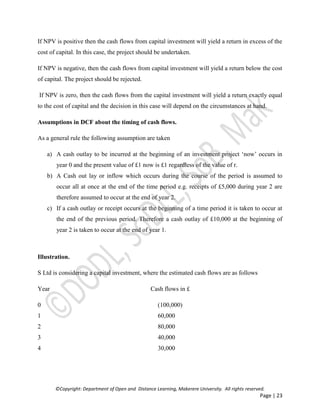
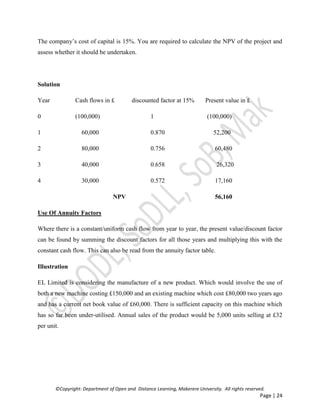
  • 5.
    ©Copyright: Department ofOpen and Distance Learning, Makerere University. All rights reserved. Page | 5  Pike, R and Neale, B (1999): Corporate finance and investments: Decisions and strategies. 3rd edition prentice hall.  Van Horne, J (2001): Financial Management and Policy .12th edition Prentice Hall  Tony Davies, Tony Boczko and Jean Chen (2008) Strategic Corporate Finance. International Edition. UK, McGraw Hill Publishing.  Richard A. Brealy and Stewart C. Myers (2008) Principles of Corporate Finance. International Edition. Athens, Greece, McGraw Hill Publishing.  Stephen A. Ross and Randolph W. Westerfield (2008) Essentials of Corporate Finance. International Edition. Athens, Greece, McGraw Hill Publishing.
  • 6.
    ©Copyright: Department ofOpen and Distance Learning, Makerere University. All rights reserved. Page | 6 TOPIC ONE INTRODUCTION TO CORPORATE FINANCE LEARNING OUTCOMES: At end of this topic a student will be able to:  Explain the term finance and its functions  Discuss the objective of decision making in corporate finance  Explain the role of finance manager, financial controller and treasurer, the agency theory and Corporate Governance  Discuss the goals of a firm. PREAMBLE Corporate finance is the field of finance dealing with financial decisions that business enterprise make and the tools and analysis used to make these decisions. The primary goal of corporate finance is to maximize corporate value while managing the firm’s financial risks. Although it is in principle different from managerial finance which studies the financial decisions of all firms, rather than corporations alone, the main concepts in the study of corporate finance are applicable to the financial problems of all kinds of firms. The discipline can be divided into long-term and short-term decisions and techniques. Capital investment decisions are long-term choices about which projects receive investment, whether to finance that investment with equity or debt, and when or whether to pay dividends to shareholders. On the other hand, short term decisions deal with the short-term balance of .current assets and current liabilities; the focus here is on managing cash, inventories, and short-term borrowing and lending. Corporate finance covers every decision a firm makes that may affect its finances which can be grouped into five areas for the conceptual understanding.
  • 7.
    ©Copyright: Department ofOpen and Distance Learning, Makerere University. All rights reserved. Page | 7 1. The first is the objective function, where we define what exactly the objective in decision making should be. 2. The second is the investment decision, where we look at how a business should allocate of resources across competing uses. 3. The third is the financing decision, where we examine the sources of financing and whether there is an optimal mix of financing. 4. The fourth is the dividend decision, which relates to how much a business should reinvest back into operations and how much should be returned to the owners. 5. Finally, there is valuation, where all of the decisions made by a firm are traced through to a final value Functions of Corporate Finance: 1. Acquisition of Resources: Acquisition of resource indicates fund generation at the lowest possible cost. Resource generation is possible through: (a) Equity: This includes proceeds received from retained earnings, stock selling, and investment returns. (b) Liability: This includes warranties of products, bank loans, and payable account. 2. Allocation of Resources: Allocation of resources is nothing but investment of funds for profit maximization. Investment can be categorized into 2 groups: (a) Fixed Assets – Buildings, Land, Machinery etc. (b) Current Assets – cash, receivable accounts, inventory, etc. Broad Functions of Corporate Finance are: (1) Raising of Capital or Financing
  • 8.
    ©Copyright: Department ofOpen and Distance Learning, Makerere University. All rights reserved. Page | 8 (2) Budgeting of Capital (3) Corporate Governance (4) Financial management (5) Risk Management Objective of Decision making in corporate Finance: 1. Long term decisions: This includes capital investment decisions like viability assessment of projects, financing it through equity and/or debt, pay dividend or reinvest the profit. Long term corporate finance decisions that are normally related to fixed assets and capital structure are known as Capital Investment Decisions. Senior management always targets to maximize the value of the firm by investing in projects having positive Net Present Value. If such opportunities are not arising then reinvestment of profits should be stalled and excess cash should be returned to shareholders in form of dividends. Thus, Capital Investment Decisions constitute 3 decisions: (a) Decision on Investment (b) Decision on Financing (c) Decision on Dividend 2. Short term decisions: These are also called working capital management decisions which try to strike a balance between current assets such as cash, inventories, etc and current liabilities i.e. a company’s debts/obligations impending for less than a year. 1. Investment Decision: The firm has limited resources that must be allocated among challenging uses. On the one hand the funds may be used to generate added capacity which in turn generates additional revenue and profits and on the other hand some investments results in lesser costs. In financial management the returns, from a proposed investment are compared to a
  • 9.
    ©Copyright: Department ofOpen and Distance Learning, Makerere University. All rights reserved. Page | 9 minimum acceptable hurdle rate in order to accept or reject a project. The hurdle rate is the minimum rate of return below which no investment proposal would be accepted. 2. Financing Decision: Another important area where financial management plays an important role is in deciding when, where, from and how to acquire funds to meet the firm’s investment needs. These aspects of financial management have acquired greater importance in recent times due to the multiple avenues from which funds can be raised. Some of the widely used instruments for raising finds are ADRs, GDRs, ECBs Equity Bonds and Debentures etc. The core issue in financing decision is to maintain the optimum capital structure of the firm that is in other words, to have a right mix of debt and equity in the firm’s capital structure. In case of pure equity firm the shareholders returns should be equal to the firm’s returns. The use of debt affects the risk and return of shareholders. In case, cost of debt is used the firm’s rate of return the shareholder’s return is going to increase and vice versa. The change in shareholders return caused by change in profit due to use of debt is called the financial deverage. 3. Dividend Decision: Dividend decisions is the third major financial decision The share price of a firm is a function of the cash flows associated with the share. The share price at a given point of time is the present value of future cash flows associated with the holding of share. These cash flows are dividends. The finance manager has to decide what proportion of profits has to be distributed to the shareholders. The proportion of profits distributed as dividends is called the dividend payout ratio and the retained proportion of profits is known as retention ratio. 4. Liquidity Decision: A firm must be able to fulfill its financial commitments at all points of time. In order to ensure this the firm should maintain sufficient amount of liquid assets. Liquidity decisions are concerned with satisfying both long and short-term financial commitments. The finance manager should try to synchronize the cash inflows with cash outflows. An investment in current assets affects the firm’s profitability and liquidity. A conflict exists between profitability and liquidity while managing current assets. In case, the firm has insufficient current assets it may default on its financial obligations. On the other hand excess funds result in foregoing of alternative investment opportunities.
  • 10.
    ©Copyright: Department ofOpen and Distance Learning, Makerere University. All rights reserved. Page | 10 Role of finance manager, financial controller and treasurer, The agency theory and Corporate Governance Role of Shareholders and the Role of Managers Although ordinary shareholders are the owners of the company to whom the board of directors are accountable, the actual powers of shareholders tend to be restricted, except in companies where the shareholders are also the directors. They have no right to inspect the books of account, and their forecasts of future prospects are gleaned from the annual report and accounts, stock brokers, journals and daily newspapers. The day to day running of a company is the responsibility of the directors and other management staff to whom they delegate, not the shareholders. For these reasons, therefore, there is potential for conflicts of interest between management and shareholders. Shareholders used to take a passive role in the affairs of the company. It was once common to play down their influence, though legally the owner of the business, it was assumed that they did not much concern themselves with the way that the company was run. The result has changed partly because of a change in the type of shareholder, partly due to result of takeover activity and partly because of social pressures. Shareholding has changed from private investors to institutional investors, who are able to employ experts to advice on the investment funds. The company must accordingly be run in a way that guarantees the satisfaction of the shareholder- an increasing sophisticated shareholder, who will both be competent and keen to assess for himself the truth behind any optimistic statements. The power that the institutional shareholders have over a company rests on the effect that their investment decisions can have on the share price of a company, on the fact that at times of takeover bid the decision of a few shareholders can have a major influence on whether the bid succeeds or fail, and on the fact that the institutions have large amount of funds that can be made available to a company. The type of shareholders and the way they behave is changing.
  • 11.
    ©Copyright: Department ofOpen and Distance Learning, Makerere University. All rights reserved. Page | 11 Traditional relationships are changing. The institution needs the companies, as they need good investment opportunities in a healthy economic climate, in order to be able to meet their future pension and assurance obligations. The relationship between the shareholders of a company and the management is one which is complex. Agency Theory and Agency Problems The relationship between management and shareholders is sometimes referred to as an agency relationship, in which managers act as agents for the shareholders, using delegation powers to run the affairs of the company in the best interest of the shareholders. Agency problem: a potential conflict of interest between the agent (manager) and the outsider shareholders. (i.e. those not involved in running the business) and the creditors. For example, if managers hold none or very little equity shares of the company they work for, what is to stop them from working inefficiently, not bothering to look for profitable new investments opportunities, or giving themselves high salary or perks? Agency theory: proposes that, although the individual members of the business team act in their own self interest, the well being of each individual depends on the well being of other team members and on the performance of the team in competition with other teams. One power that shareholders possess is the right to remove the directors from office but shareholders have to take initiative to do this, and in many companies, the shareholders lack energy and organization to take such a step. Even so, directors will want the company’s report and accounts, and the proposed final dividend, to meet with the shareholders’ approval at annual general meeting. Another reason why managers might do their best to improve the financial performance of their company is that managers’ pay is often related to the size or profitability of the company. Managers in very big companies, or in very profitable companies, will normally expect to earn higher salaries than managers in smaller or less successful companies.
  • 12.
    ©Copyright: Department ofOpen and Distance Learning, Makerere University. All rights reserved. Page | 12 Another source of conflict between managers and shareholders is that they have different attitude towards risk. A shareholder can spread his risk by investing his money in a number of companies; one company may go into liquidation but the shareholders’ financial security is not threatened. A manager’s financial security however, usually depends on what happens to the one company that employs him. The manager could therefore be less inclined than the shareholder to invest company’s funds in a risky investment. A further situation in which conflict can arise is when a company is subject to takeover bid. The shareholders of the acquired firm very often receive above normal gains for the share price while managers loose their job, if lucky they may be picked by the new shareholders. It can therefore be argued that it is therefore not always the shareholders interest for the sought-after companies put up such a defense to drive the bidder away. Agency theory suggests that audited accounts of a limited company are an important source of post- decision information minimizing investors’ agency costs, in contrast to the alternative approaches which see financial reports as primarily a source of ‘pre-decision’ information for the equity investors. Goal Congruence Goal congruence is accordance between the objective of agents acting within an organization and the objectives of the organization as a whole. Managers can be encouraged to act in shareholders’ best interests through incentives which reward them for good performance but punish them for their poor performance. Examples of such rewards or incentives are:  Profit related pay: If management are rewarded according to the level of profit made they will strive to achieve high profit levels, so that they should earn more. Shareholders wealth is going to increase, so too is the value of the firm. Sometimes such act might just encourage creative accounting whereby management will distort the reported performance of the company in the service of the managers’ own ends.
  • 13.
    ©Copyright: Department ofOpen and Distance Learning, Makerere University. All rights reserved. Page | 13  Rewarding managers shares: This might be done when a public company goes public and managers are invited to subscribe for shares in the company at an attractive offer price. Managers will have a stake in the business and will venture only into those projects which enhance the share value of the business.  Direct intervention by shareholders. As outlined above the pattern of shareholding has changed from passive private investors to aggressive intuitional investors. These shareholders have direct influence over the performance of an enterprise and take active role in checking the performance of the company and are very quick to lobby other small shareholders when they suspect poor service or any malpractice by the directors.  Threat of firing. Shareholders can take a direct approach by threatening the managers with dismissal if they put their personal interest above that of maximizing the value of the firm. The increase in institutional investors has improved the shareholders powers to dismiss directors as they are able to dominate but also lobby other shareholders in decision making.  Threats of takeover: As stated managers would do everything possible to frustrate takeovers as they are aware that they are going to lose their job. To promote goal congruence the share holders may threaten to accept takeover bid if their set targets are not met by managers. Goals of a firm. A corporate chief executive encompasses the final responsibility for a successful company development. He sets the objectives for the business and specifies strategies for their achievement. In this unique role he is also responsible for the funding of the business. Being under the pressure of different interest groups the question arises which interest should be given priority? Creating real wealth for all stakeholders.  Shareholder wealth maximization  Profit maximization  Sales maximization  Survival  Environmental protection
  • 14.
    ©Copyright: Department ofOpen and Distance Learning, Makerere University. All rights reserved. Page | 14  The Growth of Corporate Responsibility: Corporate responsibility’ is the phrase used to describe businesses which have decide to behave in a deliberately socially responsible manner. Obeying the strict letter of the law doesn’t always solve these problems, although it does keep the business out of trouble with the authorities. Laws are general, and don’t always act as a good guide to decisions in any one individual case. Laws have to interpreted by courts, and it is not always obvious what is illegal until the case goes to court. Laws don’t cover all the areas that people consider important in ethical behavior. For example, it may be perfectly legal to dump waste at sea, but many people would consider this to be unacceptable behavior.   In many cases different ethical principles pull in opposite directions. For example, closing a polluting factory may be good for the environment, but it is not going to help the local community who need the jobs and the incomes. What should the business do? Whatever it does, it is going to upset one group of people or another, because society at large cannot clearly answer these questions, and there is no clear guide to the business how to behave. Profit Maximization and Managerial Objectives In the conventional theory of the firm, the principle objective of a business firm is to maximize profit. Under the assumptions of given taste and technology, price and output of a given product under competition are determined with the sole objective of maximization of profit. Profit maximization refers to the maximization of income of the firm. Under profit maximization objective, business firms attempt to adopt those investment projects, which yields larger profits, and drop all other unprofitable activities. In maximizing profits, input-output relationship is crucial, either input is minimized to achieve a given amount of profit or the output is maximized with a given amount of input. Thus, this objective of the firm enhances productivity and improves the efficiency of the firm. The conventional theory of the firm defends profit maximization objective on the following grounds:
  • 15.
    ©Copyright: Department ofOpen and Distance Learning, Makerere University. All rights reserved. Page | 15 * In a competitive market only those firms survive which are able to make profit. Hence, they always try to make it as large as possible. All other objectives are subjected to this primary objective. * Profit maximization objective is a time-honored objective of a firm and evidence against this objective is not conclusive or unambiguous. * Though not perfect, profit is the most efficient and reliable measure of the efficiency of a firm. * Under the condition of competitive market, profit can be used as a performance evaluation criterion, and profit maximization leads to efficient allocation of resources. * Profit maximization objective has been found extremly accurate in predicting certain aspect of firm's behaviour and trends; as such the behaviour of most firms are directed towards the objective of profit maximization. Managerial Objectives Small-business management must achieve strategic objectives with limited resources. The objectives provide a company its identity, direct the organization's efforts and motivate employees. The objectives are the basis of managerial functions and the criteria incorporated in organizational controls. The manner in which managers accomplish such objectives varies from one company to another. However, a large majority of businesses, regardless of industry, company size or location, adopt profitability, productivity, survival and growth objectives. Profitability Profit is a small-business manager's major incentive. Managers do what is necessary for a company's revenues to be sufficient not only to earn profits in the present, but the long term as well. Such leaders view profits as a means to finance company growth, provide employee
  • 16.
    ©Copyright: Department ofOpen and Distance Learning, Makerere University. All rights reserved. Page | 16 benefits and finance the company's social responsibilities. In addition, managers view profits as a quantitative measure of a company's operational efficiency. Therefore, these leaders work to make the most of current revenue-generating business opportunities while identifying future profit-earning prospects. For example, a company might implement a new production line to manufacture custom products with less scrap or introduce new products and expand current markets. Business leaders also carefully manage expenses to increase profits. For example, a company might contract with lower-cost vendors or form a joint venture to control costs. Productivity As a company’s use of resources becomes more efficient, the greater its productivity and profitability should become. As a result, management is concerned not only with output per man hour, but also the productive use of other resources as well. For example, management focuses on ways to make production, distribution and administration processes more efficient. In doing so, production cost per unit declines, which can lead to lower prices and a competitive advantage. A company also might become more productive by implementing materials requirements, planning to ensure required production materials are available as needed or instituting quality controls to minimize defect costs. Growth The primary intent of business is to grow market share, revenues and profits. As a result, a key managerial objective is to increase the sales of existing products and services in current markets. To do so, a company might implement a market penetration strategy by promoting a new use of a product or attempt to attract non-users and competitors’ customers to the company's brands. For example, customers use pegboard for tool storage in garages and craft supplies in a workroom. Managers may also support the development of new products that reflect current consumer demand, such as gluten-free foods, or develop new markets to achieve growth. For example, a company might promote the use of garden fixtures as home or holiday decor or offer computers and peripheral devices, which are traditionally, manufactured using black exterior materials for corporate use, in neon colors for personal use Survival
  • 17.
    ©Copyright: Department ofOpen and Distance Learning, Makerere University. All rights reserved. Page | 17 Managers recognize that a company survives only if it produces and distributes products at price greater than its variable and fixed costs. Therefore, company survival is a critical managerial objective. Managers must identify ways to fend off the negative effects of environmental issues, such as recession, changes in customer preferences and antiquated technology. Managers also must avoid the negative effects of a lack of materials availability and issues with production facilities. If leaders are effective in meeting such changes in their operating environment, a company will recover its costs, meet its obligations to creditors, suppliers and employees, and remain a going concern. If not, the company will not survive.
  • 18.
    ©Copyright: Department ofOpen and Distance Learning, Makerere University. All rights reserved. Page | 18 TOPIC TWO CAPITAL INVESTMENT APPRAISAL Introduction An investment is any expenditure in the anticipation of future benefits. Such expenditure can be divided into two categories, capital expenditure and revenue expenditure. Capital expenditure is one, which results in the Acquisition of fixed assets or an improvement in the earning capacity. Revenue expenditure is that incurred for the purpose of trade and to maintain the existing earning capacity of fixed assets. Capital Expenditure Appraisal Methods. Capital expenditure unlike revenue expenditure is non routine, irregular and usually involves large amounts. Due to this, before its incurred, the organisation should go through a capital budgeting process which entails.  Identification of a need (problem Definition)  Generating possible courses of action  Appraisal/ Evaluation of possible courses of Action  Selection of the best alternative  Implementation of selected alternative  Monitoring and control In order to appraise projects, one needs to forecast the cash flows expected from and to be incurred on the project over its life span. When forecasts of costs and benefits have been made for a capital project, the estimates must be analysed to establish whether the projects should go ahead.
  • 19.
    ©Copyright: Department ofOpen and Distance Learning, Makerere University. All rights reserved. Page | 19 There are various methods of carrying out a capital expenditure appraisal. The methods include:-  Return on Capital Employed /Accounting Rate of Return (ARR)  Pay back Period method  The Net present value method (NPV)  Internal rate of return method (IRR)  Profitability index (PI) NB ARR and Pay back Period method are referred to as types of non Discounted cash flow techniques while NPV, IRR and PI are types of Discounted Cash flow Techniques Non Discounted Cash flow Techniques Accounting Rate of Return /Return on Capital employed. This method estimates the Accounting rate of return for a project which is then compared with the target rate of return to decide whether the project is viable or not. It is given by ARR = Estimated average profits Estimated average investment Or ARR = Average Annual profit before interest and tax but after Depreciation Initial Capital
  • 20.
    ©Copyright: Department ofOpen and Distance Learning, Makerere University. All rights reserved. Page | 20 Illustration. R plc’s target accounting rate of return is 20%. The Company is considering a project with the following cash flows. Cost of Assets (investment) £80,000 Estimated life 4years Estimated profit before depreciation Year 1 £20,000 Year 2 £25,000 Year 3 £35,000 Year 4 £25,000 The capital asset would be depreciated by 25% of its cost each year – straight line method. You are required to assess whether the project should be undertaken Solution. Year Profit after depreciation 1 0 2 5,000 3 15,000 4 5,000 Total 25,000 Using the formula
  • 21.
    ©Copyright: Department ofOpen and Distance Learning, Makerere University. All rights reserved. Page | 21 APR = Estimated average profit x 100 Estimated initial investment Estimated average Profit = 25,000 4 Initial Investment = 80,000 ARR = 6250 80,000 = 7.8% Pay Back Period Method Pay back method determines the time it takes the cash inflows from an investment to equal the cash outflows spent on the investment. Given two projects which are both viable, the one with a shorter payback period is preferred to the other. For a project with uniform Cash flow, The Payback period is given by Initial outflow Annual cash inflows But for a project with non-uniform cash flows, the best method is to subtract the cash inflows from the cash out flows until the out flow are Exhausted. Discounted Cash flow Techniques(DCF) Discounted cash flow Techniques are those investment appraisal techniques that take into account both the timing of cash flows and also the total profitability over a project’s life. There are 2 main discounted cash flows Techniques that is Net present value (NPV) and internal rate of return (IRR)
  • 22.
    ©Copyright: Department ofOpen and Distance Learning, Makerere University. All rights reserved. Page | 22 Using DCF techniques, all expected payments and Receipts from a capital investment are discounted to a present value using the formula: PV = FV (1 + r)n Where PV is present value FV is future value r is the cost of capital n is the period Therefore the present value for a future cash flow is calculated by multiplying future cash flow by a factor 1 (1 + r )n The cost of Capital The Cost of Capital used by DCF analysis is the minimum return expected by the providers of funds. It is derived from the weighted Average cost of capital i.e. the average cost of the company’s finance weighted according to the relative size of each element compared with total capital. WACC = Ke .E + Kd .D (E+D) (E+D) Net Present Value – NPV Net present value is the value obtained by discounting all cash out flows and inflows of a capital investment project by a chosen target rate of return (cost of capital). The NPV method compares the present value of all the cash in flows from an investment with the present value of all cash outflows from the same project. The NPV is thus calculated as the Present value of cash inflows minus the present value of cash outflows.
  • 23.
    ©Copyright: Department ofOpen and Distance Learning, Makerere University. All rights reserved. Page | 23 If NPV is positive then the cash flows from capital investment will yield a return in excess of the cost of capital. In this case, the project should be undertaken. If NPV is negative, then the cash flows from capital investment will yield a return below the cost of capital. The project should be rejected. If NPV is zero, then the cash flows from the capital investment will yield a return exactly equal to the cost of capital and the decision in this case will depend on the circumstances at hand. Assumptions in DCF about the timing of cash flows. As a general rule the following assumption are taken a) A cash outlay to be incurred at the beginning of an investment project ‘now’ occurs in year 0 and the present value of £1 now is £1 regardless of the value of r. b) A Cash out lay or inflow which occurs during the course of the period is assumed to occur all at once at the end of the time period e.g. receipts of £5,000 during year 2 are therefore assumed to occur at the end of year 2. c) If a cash outlay or receipt occurs at the beginning of a time period it is taken to occur at the end of the previous period. Therefore a cash outlay of £10,000 at the beginning of year 2 is taken to occur at the end of year 1. Illustration. S Ltd is considering a capital investment, where the estimated cash flows are as follows Year Cash flows in £ 0 (100,000) 1 60,000 2 80,000 3 40,000 4 30,000
  • 24.
    ©Copyright: Department ofOpen and Distance Learning, Makerere University. All rights reserved. Page | 24 The company’s cost of capital is 15%. You are required to calculate the NPV of the project and assess whether it should be undertaken. Solution Year Cash flows in £ discounted factor at 15% Present value in £ 0 (100,000) 1 (100,000) 1 60,000 0.870 52,200 2 80,000 0.756 60,480 3 40,000 0.658 26,320 4 30,000 0.572 17,160 NPV 56,160 Use Of Annuity Factors Where there is a constant/uniform cash flow from year to year, the present value/discount factor can be found by summing the discount factors for all those years and multiplying this with the constant cash flow. This can also be read from the annuity factor table. Illustration EL Limited is considering the manufacture of a new product. Which would involve the use of both a new machine costing £150,000 and an existing machine which cost £80,000 two years ago and has a current net book value of £60,000. There is sufficient capacity on this machine which has so far been under-utilised. Annual sales of the product would be 5,000 units selling at £32 per unit.
  • 25.
    ©Copyright: Department ofOpen and Distance Learning, Makerere University. All rights reserved. Page | 25 Unit costs would be as follows £ Direct Labour – 4 hours at £2 per hour 8 Direct materials 7 Fixed costs including Depreciation 9 24 The project would have a five year life after which the new machine would have a net residual value of £10,000. Because direct labour is continuously in short supply, labour resources would have to be diverted from other work which currently earns a contribution of £1.50 per direct labour hour. The fixed overhead absorption rate would be 2.25 per hour (£9 per unit) but actual expenditure on fixed overhead would not alter: Working capital requirements would be £10,000 in the first year, raising to £15,000 in the second year and remaining at this level until the end of the project, when it will all be recovered. The company’s cost of capital is 20%. Ignore taxation. Assess whether the project is worthwhile. Solution Relevant cash flows are as follows a) Year 0. purchase of machine £150,000 b) Year 1-5 contribution from new product [5000 x (32-15)] 85,000 Less contribution foregone [5.000 X (4x 1.5)] 30,000 55,000
  • 26.
    ©Copyright: Department ofOpen and Distance Learning, Makerere University. All rights reserved. Page | 26 c) The project requires £10,000 of working capital at the end of year 1, a further 5000 at the start of year 2. Year Equipment Working capital Contribution Net cash flow Discount factor PV of net cash flow £ £ £ £ 20% £ 0 (150,000) (150,000) 1.00 (150,000) 1 (10,000) (10,000) 0.833 (8,333) 2 (5,000) (5,000) 0.694 (3,470) 1-5 55,000 55,000 2.991 164,505 5 10,000 15,000 25,000 0.402 10,050 NPV Annual cash flows in perpetuity. The PV of cash flow in perpetuity is given by Future Value /r i.e. (Future Value) X 1/r Illustration PQ Ltd’s cost of capital is 14% and its managers are considering investing in a project costing £500,000 that would yield cash flows of £100,000 per annum in perpetuity. Required
  • 27.
    ©Copyright: Department ofOpen and Distance Learning, Makerere University. All rights reserved. Page | 27 Assess whether the project is viable or not Solution Internal Rate of Return Method This method determines the DCF rate of return at which the NPV is zero. If the expected rate of return exceeds target rate of return, then the project would be worth undertaking. On the other hand if the IRR is less than the target rate of return, then the project is not worthwhile financially. The computation of IRR is by use of interpolation. The interpolation method produces an estimate of the IRR. Procedure followed when estimating IRR 1) By trial and Error calculate a net present value using a rate which is likely to give an NPV close to zero. 2) After calculating the first NPV, a) If the NPV is positive, use a second rate which is higher than the first one to compute NPV again. b) If the NPV is negative, use a second rate which is lower than the first one to compute NPV again. c) Make sure that you have 2 rates and 2 NPVs (ideally one positive and one negative). Year Cash flow Discount factor Present value £ 14% £ 0 (500,000) 1.00 (500,000) 1- ∞ 100,000 7.143 7143,000 214300
  • 28.
    ©Copyright: Department ofOpen and Distance Learning, Makerere University. All rights reserved. Page | 28 Then use the 2 sets to estimate the IRR using the formula. IRR = a + [A/ (A-B) X (b-a)] Where a is the lower rate b is the higher rate A is NPV obtained using lower rate B is NPV obtained using higher rate. OR IRR = N1R2 –N2 R1 N1-N2 Where N1 is the NPV at rate R1 N2 is the NPV at rate R2 R1 is the lower rate R2 is the higher rate. Illustration A company is trying to decide whether to buy a machine for £80,000 which will save costs of £20,000 per annum for 5 years and which will have a resale value of £10,000 at the end of year 5. It is the company’s policy to undertake projects only if they are expected to yield a DCF return of 10% or more, ascertain whether this project should be undertaken. Solution At rate of 9%. Year Cash flow PV factor at 9% PV of cash flow 0 (80,000) 1.000 (80,000) 1-5 20,000 3.890 77800 5 I0.000 0.650 6500 NPV 4300
  • 29.
    ©Copyright: Department ofOpen and Distance Learning, Makerere University. All rights reserved. Page | 29 At rate of 12% Year Cash flow PV factor at 12% PV of cash flows 0 80,000 1.000 (80,000) 1-5 20,000 3.605 72100 5 10,000 0.567 5670 NPV (2230) Using the formula IRR = a + [A/(A-B) X (b-a)] = 9% + [4300/4300 +2230 X 3 %] = 0.1098 ~ 11 % OR, using N1 R2 –N2 R1 N1 – N2 (4300 X 0.12 + 2230 X 0.09) 4300 + 2230 = 0.1098 ~ 11 % NB 1) IRR of a project with cash flows to perpetuity is given by Annual inflow x 100 Initial investment 2) NPV is a superior technique compared to IRR. So in case of conflict, the NPV indicator should be taken.
  • 30.
    ©Copyright: Department ofOpen and Distance Learning, Makerere University. All rights reserved. Page | 30 Read about 1. Comparing NPV and IRR where - There are Non-conventional cash flow - The projects are not all exclusive -The Re investment assumptions 2. The advantages and disadvantages of NPV and IRR. ALLOWING FOR INFLATION IN INVESTMENT APPRAISAL As the inflation rate increases, so will the minimum return required by an investor. In general there are two effects of inflation on project appraisal. a) The discount rate will be affected by the inflation b) The cash flows will also be affected by the inflation over time. Effect of Inflation on the Discount Rate Since the discount rate reflects the funds providers’ required rate of return, in terms of inflation, the fund providers will require a return that 1. Compensates them for the inflation to maintain their purchasing power – inflation rate. 2. A return for the use of their funds i.e. real return. A rate that combines the two elements is called the money rate of return/ Nominal rate of return. The money rate of return is the summation of the real rate of return and the inflation rate. The money rate of return is given by the formula. (1 + money rate) = (1 + real rate) x (1 + inflation rate) (1 + m) = (1 + r) x (1 + i) 1+ r =1 + m 1 +i
  • 31.
    ©Copyright: Department ofOpen and Distance Learning, Makerere University. All rights reserved. Page | 31 For example given that an investor’s expected rate of return (Real rate) is 10% and the inflation rate is 5%. The money rate that compensates this investor for the inflationary tendency would be 1 + m = (1 + r) x (1 +i) 1 + m = (1 +0.1) x (1 +0.050) 1 + m = 1.155 m = 1.155 –1 m = 0.155 ≈ 15.5% When discounting cash flows with inflation you can use either the real rate or the money rate as longer as the real rate is used on the real cash flows and the money rate is used on the money cash flows. Money cash flows refer to cash flows expressed in term of actual number of pounds that will be received or paid on the various future dates, while Real cash flows are those expressed in terms of the value of the pound at time 0 (at constant price level terms). Illustration K Ltd is considering a project which would cost £7,500 now. The expected annual returns for its life span of 4 years are £3750. The project will cause savings of £750 a year in year 1 rising by 5% each year because of inflation. The running costs will be £1500 in the first year but would increase at 10% each year because of inflating labour costs. The general rate of inflation is expected to be 7.5% and the company’s required money rate of return is 16%. is the project worthwhile?
  • 32.
    ©Copyright: Department ofOpen and Distance Learning, Makerere University. All rights reserved. Page | 32 Solution Year Cash flow Discount factor PV Cash flows £ At 16% £ 0 (7,500) 1.000 (7,500) 1 3,000 0.862 2,586 2 2,888 0.743 2,146 3 2,762 0.641 1,770 4 2,621 0.552 1,447 NPV 449 Working Year Fixed Income Savings Running Cost Net Cash Flows 1 3750 750 1500 3000 2 3750 788 1650 2888 3 3750 827 1815 2762 4 3750 868 1997 2621 Illustration A Company is considering investing in a project which will require purchasing a machine at 750,000. The project will result in following cost savings before allowing for inflation. Year Materia £ Wages £ Total saving £
  • 33.
    ©Copyright: Department ofOpen and Distance Learning, Makerere University. All rights reserved. Page | 33 1 220,000 110,000 330,000 2 140,000 102,000 242,000 3 380,000 152,000 532,000 The general inflation rate is expected to remain constant at 5%. Given that the shareholders required rate of return is 10% before considering inflation, evaluate the project in terms of a) Real cash flows and discount rates b) Money cash flows and discount rates a) The real cash flows and discount rate are given. Year Cash flow £ PV factor 10% PV cash flows £ 0 (750,000) 1.000 (750,000) 1 330,000 0.909 299970 2 242,000 0.826 199892 3 532,000 0.751 399532 NPV 149,394 b) Money cash flows and discount rate From 1 + m = (1 + r) x (1 + i) 1 + m (1 +0.1) x (1 + 0.05) 1 + m = 1.155 m = 0.155 = 15.5%. In order to generate money cash flows, we increase the real cash flows by the percentage rate of inflation.
  • 34.
    ©Copyright: Department ofOpen and Distance Learning, Makerere University. All rights reserved. Page | 34 Year Real cash flow Inflation factor Money cash flow Discount factor15.5% PV cash flows 0 (750,000) 1 (750,000) 1.000 (750,000) 1 330,000 (1.05)1 346,500 0.866 297,990 2 242,000 (1.05)2 266,805 0.750 200,104 3 532,000 (1.05)3 615,856 0.649 399,691 NPV 147,785 ALLOWING FOR TAXATION IN INVESTMENT APPRAISAL Taxation affects the investment appraisal in two ways. a) Tax charged on the company’s profit will affect the cash flows depending on when it is actually paid. Generally cash receipts /payments will give rise to tax payable /tax relief b) Tax relief in interest which a firm pays and hence the opportunity cost of capital. N.B. Tax relief gives rise to tax savings and hence cash inflows. Assumptions normally adopted where taxation is relevant  Taxable profits are the net project cash flows  Current tax rate applies  Where a tax loss arises from the project, there are sufficient taxable profits elsewhere in the organisation to allow the loss to reduce any relevant tax payment  The first capital allowance claim is immediate, with the first benefit one year later.  The company has sufficient profits to obtain full benefit form capital allowances, and there are balancing adjustments on the disposal of all assets. Illustration PL Ltd is considering the purchase of a machine costing £40,000. It would have a life of 4 years after which it would be sold for £5,000. The machine would create annual cost savings of £14,000. It would also attract writing down allowance of 25% on reducing balance basis which would be claimed against taxable profits of the current year which is soon to end. A balancing
  • 35.
    ©Copyright: Department ofOpen and Distance Learning, Makerere University. All rights reserved. Page | 35 allowance or charge would arise on disposal. The rate of corporation tax is 30% and tax is payable one year in arrears. The after tax cost of capital is 8%. Assume that tax payments occur in the year following the transactions. Solution Computation of capital allowance Year Allowance Balance 0- 25% x 40,000 10,000 30,000 1- 25% x 30,000 7,500 22,500 2- 25% x 22,500 5,625 16,875 3 - 25% x 16,875 4,219 12,656 4- 25% x 12,656 3,164 9,492 Sales process 5,000 Less Net book value 9,492 Balancing allowance 4,492 COMPUTING THE NPV Yr Equip Savings Tax on saving Tax saved on capital allow Net cash flows Discount factor at 8% PVof cash flows £ £ £ £ £ £ £ 0 (40,000) (40,000) 1.000 (40,000) 1 14,000 3,000 17,000 0.926 15,742 2 14,000 (4,200) 2,250 12,050 0.857 10,327 3 14,000 (4,200) 1,688 11,488 0.794 9,121
  • 36.
    ©Copyright: Department ofOpen and Distance Learning, Makerere University. All rights reserved. Page | 36 4 5,000 14,000 (4,200) 1,266 16,066 0.735 11,809 5 - (4,200) 2,297 1,903 0.681 1,296 NPV 5703 Alternatively The tax computation can be as follows Year 0 1 2 3 4 Cost savings - 14,000 14,000 14,000 14,000 Capital allowance (10,000) (7,500) (5,625) (4,219) (7,656) Change in Taxable profits (10,000) 6,500 8,375 9,781 6,344 Tax at 30% 3,000 1,950 2,512 2,934 1,903 Net cash flows would be as follows Year Equipment Savings Tax effect Net cash flow £ £ £ £ 0 (40,000) 1 14,000 3000 17,000 2 14,000 (1950) 12,050 3 14,000 (2512) 11488 4 5000 14,000 (2934) 16,066 5 (1903) (1903) NB. When tax is ignored in DCF calculations, the discount rate will reflect the pre tax rate of return required on capital investments. When taxation is included in the cash flows, a post-tax required rate of return should be used
  • 37.
    ©Copyright: Department ofOpen and Distance Learning, Makerere University. All rights reserved. Page | 37 PROJECT APPRAISAL UNDER UNCERTAINITY The cash flows used in the evaluation of projects are normally generated through forecasts and so are the other variables like inflation. Due to this, there is a lot of uncertainty surrounding the viability of a project. There are a number of techniques that can be used to reduce on the uncertainty. These include.  Setting a maximum payback period  Using a high discounting rate  Making prudent estimates of cash flows to assess the worst possible situation.  Use of sensitivity analysis  Use of certainty equivalent approach  Use of simulation model Sensitivity Analysis This is a method of analysing the risk surrounding a capital expenditure project and enables an assessment to be made of how responsive the project’s NPV is, to changes in the variables that are used to calculate NPV. The basic approach of sensitivity analysis is to calculate the project’s NPV under alternative assumptions to determine how sensitive it is to changing conditions. An indication is thus provided of those variables to which the NPV is most sensitive, these are the critical variables. Sensitivity analysis then determines the extent to which these variables may change before the investment results in a negative NPV. The task for management is to then assess whether or not there is possibility of events occurring which will lead to a negative NPV. Management should also pay special attention towards the control of those variables to which NPV is particularly sensitive if a project is accepted. Illustration
  • 38.
    ©Copyright: Department ofOpen and Distance Learning, Makerere University. All rights reserved. Page | 38 K Ltd is considering a project with the following cash flows. Year 0 1 2 Initial investment (7,000,000) - - Variable costs (2,000,000) (2,000,000) Cash inflows (650,000 units at £10 per unit) 6,500,000 6,500,000 Net cash flows 7,000,000 4,500,000 4,500,000 Cost of capital is 8% Measure the sensitivity of the project to changes in the variables given. Year Investment £ Variable costs Cash flows £ PV factor at 8% PV flows £ 0 (7,000,000) - - 1.000 (7,000,000) 1-2 2,000,000 1.783 (3,566,000) 1-2 6,500,000 1.783 11,589,500 NPV £1,023,500 Without further analysis, the project is worthwhile. Changes in cash flows would need to occur before the project can be rejected Using the breakeven point for sensitivity analysis, a) Initial investment would have to increase by £1,023,500 for the project to have NPV of zero. Hence initial investment would increase by 1,023,500 X 100 = 14.6%
  • 39.
    ©Copyright: Department ofOpen and Distance Learning, Makerere University. All rights reserved. Page | 39 7,000,000 b) Sales Volume If sales volume reduces, variable costs would also have to reduce, hence we use the contribution. The present value of contribution would have to reduce to 7,000,000 before NPV becomes zero. This gives an annual contribution of 7,000,000 = 3,925,967 1.783 The decline would be 4500,000 – 3925967 = £574032. This would give total revenue of 574032 x 6,500,000 = £829157 4,500,000 Total number of units would hence be 829156 = 82916 Units 10 Sensitivity would be 82916 X 100 = 12.8% 650,000 OR simply 1,023,500 X 100 = 12.8% (11,589,500 -3,566,000) c) Selling price If sales volume is 650,000 per annum, total sales would have to reduce to 10,566,000 for NPV to be Zero. This gives a future value of 10,566,000 per annum i.e. 5925967 1.783 This would represent a price of 5925967/650,000 = £9.12 per unit A reduction of 10-9.12 X 100 = 8.8% 1
  • 40.
    ©Copyright: Department ofOpen and Distance Learning, Makerere University. All rights reserved. Page | 40 d) Variable costs Total variable cost would have to increase by 1,024,000 for NPV to be zero that is an annual increase of 1,024,000 = 574033 1.783 That would be an increase of 574’033 X 100 = 28.7% 2,000,000 e) Cost of capital To determine the sensitivity of cost of capital, we calculate the IRR of the project. Trying discount rates 15% and 20%. Year Net cash flows Discount factor at 15% PV cash flows Discount factor at 20% PV cash flow £000 £000 £000 £000 0 (7000) 1.000 (7000) 1.000 (7000) 1-2 4500 1.626 7317 1.528 6878 NPV 317 (124) Using N1 R2 –N2 R1 (317 X 0.2) + (124 X 0.15) x N1 – N2 (317 + 124) 82 X 100 = 18.6% 441 The NPV would therefore have to increase by
  • 41.
    ©Copyright: Department ofOpen and Distance Learning, Makerere University. All rights reserved. Page | 41 18.6 -8 x 100 – 132.5% for NPV to become zero 8 If we are to rank the variables in order of sensitivity, then 1. Selling price 2. Sales volume 3. Initial investment 4. Variable costs 5. Cost of capital Illustration 2 Simple Ltd is considering a project with the following cash flows Year Purchase of 1 plant Running costs Savings 0 (7000) 1 2,000 6,000 2 2,500 7,000 The cost of capital is 8%. Measure the sensitivity of the project to changes in the level of expected costs and savings. SOLUTION The PV of the cash flows is as follows:
  • 42.
    ©Copyright: Department ofOpen and Distance Learning, Makerere University. All rights reserved. Page | 42 Year PV factors at 8% PV of Purchase PV of running costs PV of savings PV of cash flows 0 1.000 (7,000) (7,000) 1 0.926 - (1,852) 5,556 3,704 2 0.857 - (2,143) 5,999 3,856 (7,000) 3,995 11,555 560 The changes that would need to occur for NPV to be zero are: a. Plant cost would need to increase by a PV of 560 that is by 560 x 100 = 8% 7,000 b. Running costs would need to increase by a PV of 560 that is by 560 x 100 = 14% 3,995 c. Savings would need to fall by a PV of 560, that is by 560 x 100 = 4.8% 11,555 Hence savings are the most sensitive followed by plant cost and then running costs. Read about strengths and weaknesses of sensitivity analysis.
  • 43.
    ©Copyright: Department ofOpen and Distance Learning, Makerere University. All rights reserved. Page | 43 Certainty Equivalent Approach Here the expected cash flows of the project are converted to risk less equivalent amounts. The greater the risk of an expected cash flow, the smaller the certainty equivalent values for receipts or the larger the certainty equivalent value for payments. Illustration DA Ltd, whose cost of capital is 10%, is considering a project with the following expected cash flows. Year Discount factor at 10% Cash flows PV cash flows 0 1.000 (9000) (9000) 1 0.909 7000 6363 2 0.826 5000 4130 3 0.751 5000 3755 5248 Due to the uncertainty surrounding the economy, managements has decided to reduce the future receipts to their certainty equivalent by taking only 70% 60% and 50% of the receipts in the years 1, 2, and 3 respectively. On the basis of this additional information, assess the viability of the project.
  • 44.
    ©Copyright: Department ofOpen and Distance Learning, Makerere University. All rights reserved. Page | 44 SOLUTION The risk adjusted NPV of the project is as follows Year Cash flow PV factor PV cash flows 0 (9000) 1.000 (9000) 1 4900 0.909 4454 2 3000 0.826 2478 3 2500 0.751 1878 (190) Read about merits and demerits of certainty equivalent approach Probability Analysis Here you compute the Expected Values from the projected cash flows and the probabilities of achieving those projections. After Estimating various cash flows and the probability of realising those cash flows, then expected values can be computed. Illustration A company is considering a project involving the outlay of £300,000 which it estimates will generate cash flows over its two year life at the probabilities shown in the table below. Year 1 Cash flow Probability £ 100,000 0.25 200,000 0.50
  • 45.
    ©Copyright: Department ofOpen and Distance Learning, Makerere University. All rights reserved. Page | 45 300,000 0.25 1.00 The company’s investment criterion for this type of project is 10% DCF. You are required to calculate the expected value of the project Simulation Models The Simulation technique allows the person appraising to incorporate may combination of variables that may cause changes in the possible outcomes. It is the equivalent of sensitivity analysis though with a number of variables changing at ago. Simulation is facilitated by use of computers ASSET REPLACEMENT DECISIONS Once decision has been made to acquire an asset then we have to plan the replacement of the asset i.e. when and how frequently to replace it. When an asset is to be replaced by an identical asset, the problem is to decide the optimum interval between replacements. Non- Identical Replacement If an asset is to be replaced by one of a different type, then we need to decide when the existing asset should be replaced rather than how frequently it should be replaced. In order to find the optimum date for replacement, we first calculate the annual cost and then follow the following. a) Calculate the NPV of the equivalent annual cost in perpetuity for the new machine. b) Calculate the total net present value of the various options taking into account i. The cost in perpetuity of the new machine ii. The final expenses of the old machine and any residual sales proceeds from the old machine.
  • 46.
    ©Copyright: Department ofOpen and Distance Learning, Makerere University. All rights reserved. Page | 46 Illustration Assume J Ltd’s machine (Illustration on LCM) is a new machine and will be introduced to replace a non-identical machine that is nearing the end of its life and has a maximum remaining life of three years. The organisation wishes to decide when the best time to replace the old machine is and estimates of relevant costs have been drawn up as follows Year Residual of current machine Extra expenditure and opportunity costs of keeping the existing machine in operation during the year £ £ 0 8500 - 1 5000 9,000 2 2500 12,000 3 0 15,000 Calculate the best time to replace the existing machine. Solution The optimum replacement cycle is 3 years. Best time to replace the existing machine will be the option that gives the lowest NPV of cost in perpetuity, for both the existing machine and the machine that eventually replaces it. Computing the NPV of the cost in perpetuity of the new machine using a r PV of cost = £ 17,625 = £ 176,250 0.1 Calculating the present values of each replacement option. These cash flows show the present value of cost in perpetuity of the new machine, the running costs of the existing machine and the resale value of the existing machine, at the end of years 0, 1, 2 or 3 as appropriate.
  • 47.
    ©Copyright: Department ofOpen and Distance Learning, Makerere University. All rights reserved. Page | 47 Year Replace new Replace in 1 year Replace in 2 years Replace in 3 years £ £ £ £ 0 (176250) 8500 1 - (176250) (9000) (9000) (9000) 5000 2 - - (176250) (12000) (12000) 2500 3 (176,250) (15,000) The PV’s of each replacement option are as follows: Year Cash flow Discount factor at 10% PV £ £ Replace now 0 (176,250) 8,500 (167,750) 1.000 (167,750) Replace in 1 (176,250) One year (9,000) 5,000 (180,250) 0.909 (163,847)
  • 48.
    ©Copyright: Department ofOpen and Distance Learning, Makerere University. All rights reserved. Page | 48 Replace in 2 years 1 (9000) 0.909 (8,181) 2 (185,750) 0.826 (153,430) (161,611) Replace in 3 years 1 (9000) 0.909 (8,181) 2 (12,000) 0.826 (9,912) 3 (191,250) 0.751 (143,629) (161,722) The recommended policy is to replace the existing machine in two years’ time because this has the lowest total PV of cost in perpetuity. In investment appraisal we use cash flows to determine the viability. The Points to take into consideration in generating cash flows include  Only relevant cash flows should be used in the Evaluation of a project/Investment. Non relevant costs such as sunk costs are irrelevant.  Opportunity cost being a relevant cost should be considered in the Evaluation of a project.  Interest payments should not form part of the cash flows because this is already included in the discount factor i.e. the time value of money will reflect the interest payment. Like wise any relief as a result of interest payments should also be ignored. (The exception to this is in case of leasing or hire purchase).  Tax payments are cash flows only when they are paid. Capital allowance and tax losses are cash inflows at the time when they reduce the tax payment.  Non cash flow charges like depreciation are not relevant costs though the tax impact should be taken into consideration.  Dividends to be paid to shareholders are irrelevant cash flows.
  • 49.
    ©Copyright: Department ofOpen and Distance Learning, Makerere University. All rights reserved. Page | 49 CAPITAL RATIONING Capital rationing is a situation where a company has a limited amount of capital to invest in potential projects, such that the different possible investments need to be compared with one another in order to allocate the capital available most effectively. This means that the company will not be able to invest into all projects with positive NPVs because there is not enough capital for all the investments. There are two causes/types of capital rationing, a) Soft (internal) capital rationing, which is mainly due to management’s unwillingness to raise more funds to finance investments. The reasons may include fear of outsiders gaining control of a business, fear of large fixed interest payments, if the firm’s budget limits spending etc. Management may adopt conservative growth and financial policies especially where an economy is facing of coming from a depression. b) Hard capital (external) rationing is one where the firm’s ability to raise finds is limited by external factors such as where lending institutions put a limit to the amount that can be raised by a firm, where the company’s share prices are depressed, where the cost of getting additional funds is too high. The effects of these causes can be reduced by the firm through: i.) Seeking joint venture partners to share projects ii.) Licensing or franchising agreements with other enterprises iii.) Contracting out parts of a project to reduce the initial capital out lay required. Other means may include  Sale and lease back of property  Seeking Grant aid.  Adopting more effective capital management techniques. Capital Rationing can occur either in a single period or in a multiple periods Single period capital rationing is where a firm experiences a shortage of funds ‘now’ but funds are expected to be freely available in all later periods
  • 50.
    ©Copyright: Department ofOpen and Distance Learning, Makerere University. All rights reserved. Page | 50 When analysing a project with capital rationing, there are assumptions to take into consideration, these are i.) If a company does not accept and undertake a project during a period of capital rationing, the opportunity to undertake it is lost i.e. the project cannot be postponed. ii.) There is complete certainty about the outcome of each project, so that the choice between projects is not affected by considerations of risk. iii.) Either projects are Divisible or indivisible. Projects are divisible if either the whole project or part of the project can be undertaken. An indivisible project is one which either must be undertaken in its entirety or not at all. Divisible projects In capital rationing where projects are divisible, the approach adopted is to rank all investment opportunities so that the NPVs can be maximised from the use of the available funds. The ranking should not be based on the absolute NPVs but on the profitability index so that the most profitable projects are ranked highly. Profitability index is the ratio of present value cash inflows to present value cash out flows. Illustration Stress Ltd is experiencing shortage of funds in its first year of operation; it has available funds of £60,000. The company has 3 investment opportunities whose cash flows in £ are as follows Project Year 0 Year 1 Year 2 Year 3 Year 4 A (50,000) (20,000) 20,000 40,000 40,000 B (28,000) (50,000) 40,000 40,000 20,000 C (30,000) (30,000) 30,000 40,000 10,000 The cost of capital is 10%. You are required to decide which projects should be undertaken in year 0 in view of the capital rationing, given that projects are divisible
  • 51.
    ©Copyright: Department ofOpen and Distance Learning, Makerere University. All rights reserved. Page | 51 Computing the NPV Out lay Present Value Cash flows Project Year 0 Year 1 Year 2 Year 3 Year 4 NPV A (50,000) (18,180) 16,520 30,040 27,320 5,700 B (28,000) (45,450) 33,040 30,040 13,660 3,290 C (30,000) (27,270) 24,780 30,040 6,830 4,380 Project PI Ranking A 1.114 3rd B 1.118 2nd C 1.146 1st The optimal investment policy would be as follows Ranking Project Year 0 out lay NPV 1 C 30,000 4380 2 B 28,000 3290 3 A 2,000 228 NPV 7898 Where the projects are not divisible, then by trial an error you determine the combination of projects that best utilise the available funds and provide the highest total NPV. Read about – Capital rationing where projects can be postponed.
  • 52.
    ©Copyright: Department ofOpen and Distance Learning, Makerere University. All rights reserved. Page | 52 Problems of using profitability index. INVESTMENT APPRAISAL WITH LEASING OPTION Leasing is a contract between a lessor and a lessee for hire of a specific asset selected from a manufacturer or vendor of such assets by the lessee. The lessor has ownership of the asset while the lessee has possession and use of the asset on payment of specified rentals over a period. Leasing takes two forms. i. Finance lease, which is one where the lease transfers substantially all the risks and rewards of ownership of an asset to the lessee and normally takes the form of an agreement between the lessee and lessor for most or all the assets expected useful life. ii. Operating Lease, which is one where the lessor retains most of the risks and rewards of ownership. Generally in project appraisal where the leasing option is involved, the evaluation takes two stages a) An acquisition decision has to be made, i.e. whether the asset is worth having. b) A financing decision is then made if the acquisition is justified by a positive NPV. And this is the decision on whether to lease or buy. Illustration M and M Ltd has decided to install a new milling machine. The machine costs 20,000 and it would have a useful life of five years with a trade in value of 4,000 at the end of the fifth year. Additional cash profits from the machine would be 8,000 a year for five years. There are 3 options of financing this investment a) The company could purchase the machine for cash using a bank loan facility on which the current rate of interest is 13% before tax. b) The company could lease the machine under an agreement which would entail payment of £4,800 at the end of each year for the next five years.
  • 53.
    ©Copyright: Department ofOpen and Distance Learning, Makerere University. All rights reserved. Page | 53 c) The company could purchase the machine under a hire purchase agreement. This would require an initial deposit of £6,500 and payments of £4,400 per annum at the end of each of the next five years. The interest part of the payment for tax purposes would be £2,100 at the end of year 1, £1,800, £1,400, £1,000, and £700 at the end of each of the years 2, 3, 4, and 5 respectively. The company’s weighted average cost of capital normally used for project evaluation is 12% after tax. Corporation tax is at a rate of 30%. The machine if purchased would attract annual writing down allowance of 25% on reducing balance basis. Advice management on this investment assuming tax is paid in arrears and first writing down allowance is claimed in the first year. Solution Computation of capital allowances Year £ 1 25% of 20,000 5,000 2 25% of 15,000 3,750 3 25% of 11,250 2,813 4 25% of 8437 2,109 5 2,328 Sales proceeds 4000 Less WDV 6328 Balancing allowance 2328
  • 54.
    ©Copyright: Department ofOpen and Distance Learning, Makerere University. All rights reserved. Page | 54 Taxable profits and tax liability Year Cash profits Capital allowances Taxable profits Tax 1 8,000 5,000 3,000 1,000 2 8,000 3,750 4,250 1,275 3 8,000 2,813 5,187 1,556 4 8,000 2,109 5,891 1,767 5 8,000 2,328 5,672 1,702 Computation of NPV. Year Equipment Cash Profits Tax Net cash flows Discount factor12% PV cash flows 0 (20,000) (20,000) 1.000 (20,000) 1 8,000 8,000 0.893 7,144 2 8,000 (1,000) 7,000 0.797 5,579 3 8,000 (1,275) 6,725 0.712 4,788 4 8,000 (1,556) 6,444 0.636 4,098 5 4,000 8,000 (1,767) 10,233 0567 5,802 6 (1,702) 1,702 0.507 863 NPV 6,548 Since NPV is positive, the project is worthwhile We then evaluate the financing decision. c) Purchase the asset out right.
  • 55.
    ©Copyright: Department ofOpen and Distance Learning, Makerere University. All rights reserved. Page | 55 We consider cash flows unique to each method of financing (We ignore cash profits since it is common to all options). Using the after tax discount rate i.e. 13% x 70% = 9.1% Year Equipment Tax savings on capital allowances Net cash flows Discount factor rate 9% PV cash flow 0 (20,000) (20,000) 1.000 (20,000) 1 - 0.917 - 2 1,500 1,500 0.842 1,263 3 1,125 1,125 0.772 869 4 844 844 0.708 598 5 4000 633 4,633 0.650 3,011 6 698 698 0.596 416 NPV of purchase (13,843) c) Leasing option Assuming that payments are tax allowable: Year Lease payments Savings in tax Discount factor at 9% PV of cash flows 1-5 (4,800) 3.890 (18,672) 2-6 1,440 3.569 5,139 NPV of leasing (13,533) c) Hire purchase option Year HP payment Capital allowance Tax saved on interest Net cash flows Discount factor at PV cash flows
  • 56.
    ©Copyright: Department ofOpen and Distance Learning, Makerere University. All rights reserved. Page | 56 Tax Saved 9% 0 (6,500) (6,500) 1.000 (6,500) 1 (4,400) (4,400) 0.917 (4,035) 2 (4,400) 1,500 630 (2,270) 0.842 (1,911) 3 (4,400) 1,125 540 (2,735) 0.772 (2,111) 4 (4,400) 844 420 (3,136) 0.708 (2,220) 5 (400) 633 300 533 0.650 346 6 698 210 908 0.596 541 NPV of Hire purchase 15,890 The cheapest option is hence to lease the machine
  • 57.
    ©Copyright: Department ofOpen and Distance Learning, Makerere University. All rights reserved. Page | 57 TOPIC THREE SOURCES OF FINANCE LEARNING OUTCOMES: At the end of this topic a student will be able to:  Explain well the short and long term sources of finance. PREAMBLE One of the most important problems accountants are likely to deal with in acting as advisors to a small or medium-sized enterprise (SME) concerns the issue of financing. More succinctly, directors and owner managers in SMEs often complain of the lack of finance for what are profitable investment opportunities. For candidates preparing for professional examinations, the problem of learning about sources of finance for small businesses is one of merely thinking of different ways of listing the available sources of finance. Of course, there is more to the problem than that although, in my experience, when directors and owner managers talk about sources of finance they do want to know what is available. Just as it is important for accountants to be able to advise on what financing is available - and I will identify some below - is the need to be able to understand and explain why the SME sector encounters difficulties in finding appropriate finance and what are the options in tackling the barriers that exist to financing. As I will argue, dealing with such barriers are natural territory for accountants acting in an advisory role and hence it is vital that aspiring professionals should understand the issues involved. Introduction Often the hardest part of starting a business is raising the money to get going. The entrepreneur might have a great idea and clear idea of how to turn it into a successful business. However, if sufficient finance can’t be raised, it is unlikely that the business will get off the ground. Sourcing money may be done for a variety of reasons. Traditional areas of need may be for capital asset
  • 58.
    ©Copyright: Department ofOpen and Distance Learning, Makerere University. All rights reserved. Page | 58 acquirement - new machinery or the construction of a new building or depot. The development of new products can be enormously costly and here again capital may be required. Normally, such developments are financed internally, whereas capital for the acquisition of machinery may come from external sources. SHORT-TERM SOURCES OF FINANCE a) Finance from operations/ Retained earnings Retained earnings means that part of trading profits which is not distributed in the form of dividends but retained by directors for future expansion of the company. Retained earnings ultimately come back to the equity shares in the form of enhanced dividend or capital gains. The portion of the profits which is not distributed among the shareholders but is retained and is used in business is called retained earnings or ploughing back of profits. Companies are required to transfer a part of their profits in reserves. Advantages of Retained Earnings  Ready Availability: Being an internal source, these earnings are readily available to the management and directors don't have to ask outsiders for finance.  Cheaper than external equity: Retained earnings are cheaper than external equity because the floatation costs, brokerage costs, underwriting commission are other issue expenses are eliminated.  No ownership dilution: Relying on retained earnings eliminates the fear of ownership dilution and loss of control by the existing shareholders.  Positive Connotation: Retained earnings carry positive connotation as compared to equity issue as far as stock market is concerned.  No expenses are incurred when capital is available from this source. There is no obligation on the part of the company either to pay interest or pay back the money. It can safely be used for expansion and modernization of business.  A company which has enough reserves can face ups and downs in business. Such companies can continue with their business even in depression, thus building up its goodwill.  Shareholders may get dividend out of reserves even if the company does not earn enough profit. Due to reserves, there is capital appreciation, i.e. the value of shares goes up in the share market.  Increase financial strength: Through ploughing back of profits, companies increase their financial strength. Companies may throw out their competitors from the market and monopolize their position. Disadvantages of retained earnings  Limited finance: The amount which can be raised by way of retained earnings will be limited to an extent only. Keeping in view a stable dividend policy, the directors can't exhaust the whole balance retained. As a result, the variability of profit after tax is substantially transmitted to retained earnings.
  • 59.
    ©Copyright: Department ofOpen and Distance Learning, Makerere University. All rights reserved. Page | 59  High opportunity cost: The retained earnings are nothing but sacrifice of profits made by equity shareholders. In other words, retained earnings are dividend foregone by equity shareholders. This sacrifice increases the opportunity cost of retained earnings.  This method of financing is possible only when there are huge profits and that too for many years.  When funds accumulate in reserves, bonus shares are issued to the shareholders to capitalize such funds. Hence the company has to pay more dividends. By retained earnings the real capital does not increase while the liability increases. In case bonus shares are not issued, it may create a situation of under-capitalization because the rate of dividend will be much higher as compared to other companies.  Encourage extravagant spending: Capital accumulated through retained earnings encourages management to spend carelessly. b) Trade credit This is always obtained when the suppliers offer credit facilities to the firm by not demanding immediate payment for the goods and services supplied to the business. Advantages of Trade Credit  It has no explicit costs  It is flexible; it only needs an understanding between the firm and the supplier.  There are no complicated modalities in securing trade credit for example collateral securities. Disadvantages of trade credit  Higher price may lead to charging for the goods and service just because there is no immediate payment of cash.  The firm may forego cash discounts because of credit transactions.  Over stretching of the credit period may lead to poor credit rating. c) Delay deferred payments The firm may defer or delay some payments for example wages may be paid at later date, taxation can be paid after for example six months. This is an indirect source of finance. d) Bank credit/overdraft A common source of short term financing for many businesses is a bank over draft. They are normally provided by clearing banks and represent permission by the bank to write the cheque even though the firm has insufficient funds deposited in the account to meet the cheque needs. The firm is allowed to withdraw more money than what is available on the account.
  • 60.
    ©Copyright: Department ofOpen and Distance Learning, Makerere University. All rights reserved. Page | 60 Advantages of bank overdrafts  Flexibility- they can be used as required. It is dependent on the client and the bank relationship.  Cheapness-interest is usually 2-5% by most banks above the base rate (all loan interest is a tax deductible expense).  There is no collateral security needed. Disadvantages of bank overdrafts  Interest rates vary with the bank base rates.  Overdrafts are legally repayable on demand. Normally the bank will give customers assurance that they can rely on the facility for ascertain time period, say six months.  Security is usually required by way of fixed or floating charges on assets or sometimes, in private companies and partnership, by personal guarantees from owners especially when large amount are overdrawn. e) Factoring of debtors Factoring involves taking over responsibilities for collecting the company’s debts to a specialist institution (the factor). The finance house/ factor undertake to collect the amounts from debtors and bear the bad debts losses when they occur. Advantage of debtor factoring  Taking over the running of the client’s ledgers hence reducing on the cost by the company.  Offering 100% protection against the bad debts instead of being incurred by the company.  Readily finance can be obtained from the factors in form advances, the security for which are the debtor’s balances owing. Disadvantages of debt factoring  To take over the running of the sales ledger and the give bad debt protection, the factor will require a fee f about 1.5-2.5% of turnover.  Usually not all the amount of debt will be collected and the timing of collection may be uncertain.  Risk of exposure of the company vital information about its sales ledger accounts to the factor. f) Money market based finance This involves sourcing short-term finance from the money market by selling short-term securities for example bill of exchange, treasury bills, promissory notes, certificate of deposit, and short- term government bonds. For efficiency there is need for an efficiently operating market.
  • 61.
    ©Copyright: Department ofOpen and Distance Learning, Makerere University. All rights reserved. Page | 61 g) Miscellaneous and sale of assets Other sources of short-term finance may include; loan from individuals. Sale of Assets is another internal source of finance is the sale of assets. Whenever a business sells of its assets and the cash generated is used internally for financing the capital needs, we call it an internal source of finance by sale of assets. It can work as a short term or long term finance depending on what kind of assets is sold. Say, selling a car can cater short term and smaller finance needs and selling land, buildings, or machinery can cater to long term and bigger finance needs. h) Leasing and hire purchase finance Leasing is a means of financing which involve the use of capital equipment and other noncurrent assets such as buildings, motor vehicles, the underlying principle being that use is more important that ownership. It is a medium term financial arrangement, usually for one to ten years. There are usually two types of lease that is to say finance and operating lea lease. Hire purchase agreements and leasing provide finance for the acquisition of specific assets such as cars, equipment and machinery involving a deposit and repayments over, typically, three to ten years. Technically, ownership of the asset remains with the lessor whereas title to the goods is eventually transferred to the hirer in a hire purchase agreement. A lease is an agreement between two parties, the "lessor" and the "lessee". The lessor owns a capital asset, but allows the lessee to use it. The lessee makes payments under the terms of the lease to the lessor, for a specified period of time. Leasing is, therefore, a form of rental. Leased assets have usually been plant and machinery, cars and commercial vehicles, but might also be computers and office equipment. There are two basic forms of lease: "operating leases" and "finance leases". Types of leases Operating leases: Operating leases are rental agreements between the lessor and the lessee whereby: a) The lessor supplies the equipment to the lessee b) The lessor is responsible for servicing and maintaining the leased equipment c) The period of the lease is fairly short, less than the economic life of the asset, so that at the end of the lease agreement, the lessor can either i) Lease the equipment to someone else, and obtain a good rent for it, or ii) Sell the equipment secondhand. Finance leases: Finance leases are lease agreements between the user of the leased asset (the lessee) and a provider of finance (the lessor) for most, or all, of the assets expected useful life. Suppose that a company decides to obtain a company car and finance the acquisition by means of a finance lease. A car dealer will supply the car. A finance house will agree to act as lessor in a finance leasing arrangement, and so will purchase the car from the dealer and lease it to the company. The company will take possession of the car from the car dealer, and make regular
  • 62.
    ©Copyright: Department ofOpen and Distance Learning, Makerere University. All rights reserved. Page | 62 payments (monthly, quarterly, six monthly or annually) to the finance house under the terms of the lease. Advantages of using leasing & HP as a source of finance The use of hire purchase or leasing is a popular method of funding the acquisition of capital assets. However, these methods are not necessarily suitable for every business or for every asset purchase. There are a number of advantages to be made, as described below:  Certainty: One important advantage is that a hire purchase or leasing agreement is a medium term funding facility, which cannot be withdrawn, provided the business makes the payments as they fall due. The uncertainty that may be associated with alternative funding facilities such as overdrafts, which are repayable on demand, is removed.  Budgeting: The regular nature of the hire purchase or lease payments (which are also usually of fixed amounts as well) helps a business to forecast cash flow. The business is able to compare the payments with the expected revenue and profits generated by the use of the asset.  Fixed rate finance: In most cases the payments are fixed throughout the hire purchase or lease agreement, so a business will know at the beginning of the agreement what their repayments will be. This can be beneficial in times of low, stable or rising interest rates but may appear expensive if interest rates are falling.  The effect of security: Under both hire purchase and leasing, the finance company retains legal ownership of the equipment, at least until the end of the agreement. This normally gives the finance company better security than lenders of other types of loan or overdraft facilities. The finance company may therefore be able to offer better terms.  Maximum finance: Hire purchase and leasing could provide finance for the entire cost of the equipment. There may however, be a need to put down a deposit for hire purchase or to make one or more payments in advance under a lease. It may be possible for the business to 'trade- in' other assets which they own, as a means of raising the deposit.  Tax advantages: Hire purchase and leasing give the business the choice of how to take advantage of capital allowances. If the business is profitable, it can claim its own capital allowances through hire purchase or outright purchase. Disadvantages of leasing and hire purchase  However, it should be borne in mind that both hire purchase and leasing agreements are long term commitments. It may not be possible, or could prove costly, to terminate them early.  On some agreements, such as those for a longer term, the finance company may offer the option of variable rate agreements. In such cases, rentals or installments will vary with current interest rates; hence it may be more difficult to budget for the level of payment.
  • 63.
    ©Copyright: Department ofOpen and Distance Learning, Makerere University. All rights reserved. Page | 63  The decision to provide finance to a small or medium sized business depends on that business' credit standing and potential. Because the finance company has security in the equipment, it could tip the balance in favour of a positive credit decision. i) Borrowing from friends and family This is also common. Friends and family who are supportive of the business idea provide money either directly to the entrepreneur or into the business. This can be quicker and cheaper to arrange (certainly compared with a standard bank loan) and the interest and repayment terms may be more flexible than a bank loan. However, borrowing in this way can add to the stress faced by an entrepreneur, particularly if the business gets into difficulties. j) Government assistance The government provides finance to companies in cash grants and other forms of direct assistance, as part of its policy of helping to develop the national economy, especially in high technology industries and in areas of high unemployment. LONG TERM SOURCES OF FINANCE When a company is growing rapidly, for example when contemplating investment in capital equipment or an acquisition, its current financial resources may be inadequate. Few growing companies are able to finance their expansion plans from cash flow alone. They will therefore need to consider raising finance from other external sources. Long-term source of finance is always sought by the company capital expenditures especially to expand capacity, replacement of the existing capacity, facilitation of research and development, maintenance of the existing capacity. The main source may include; a) Funds from operations These are source of finance as reflected in accumulated reserves. The main advantages of reserves are that they are cheap and reliable source of long-term fund; they have no explicit costs except the indirect cost of dividends due to shareholders. They are very flexible - management has complete control over how they are reinvested and what proportion is kept rather than paid as dividends. They do not dilute the ownership of the company Reason for paying and not paying dividends Dividends are corporate earnings that companies pass on to their shareholders. There are a number of reasons why a corporation might choose to pass some of its earnings on as dividends. There are also a number of reasons why it might prefer to reinvest all of its earnings back into the company.  A company that is still growing rapidly usually won't pay dividends, because it wants to invest as much as possible into further growth. Even a mature firm that believes it will do a
  • 64.
    ©Copyright: Department ofOpen and Distance Learning, Makerere University. All rights reserved. Page | 64 better job of increasing its value (and therefore a better job of increasing its share price) by reinvesting its earnings will choose not to pay dividends.  Companies that don't pay dividends might use the money to start a new project, acquire new assets, repurchase some of their shares or even buy out another company.  Also, the choice to not pay dividends may be more beneficial to investors from a tax perspective. Dividends are taxable to investors as ordinary income, which means an investor's tax rate on dividends is the same as his marginal tax rate.  Firms that choose to reinvest all of their earnings, instead of issuing dividends, may also be thinking about the high potential expense of issuing new stock. To avoid the risk of needing to raise money this way, they choose to keep all of their earnings. However, for a mature company that doesn't need to reinvest as much in itself, and that has stable earnings, there are several reasons why issuing dividends can be a good idea.  Many investors like the steady income associated with dividends, so they will be more likely to buy that company's stock. Investors also see a dividend payment as a sign of a company's strength and a sign that management has positive expectations for future earnings, which again makes the stock more attractive. A greater demand for a company's stock will increase its price.  A company may also choose not to pay dividends because the decision to start paying dividends or to increase an existing dividend payment is a serious one. A company that eliminates or reduces its existing dividend payment may be viewed unfavorably and its stock price may decrease. b) Ordinary share capital These shares represent ownership and have no maturity date. Shareholders however have a voice in management (involvement in decision making). They also have a definite cost in form of dividends. These funds can only be obtained from the primary capital markets i.e. the market for original buyers and sellers of securities. Secondary, markets like the stock exchange only facilitate liquidity of these shares. These funds can be obtained through the following mechanisms: making a public offer, private placement, by action and bonus issue. Advantages of Ordinary share capital finance Ordinary share capital is the most important long-term source of financing. The main disadvantage to equity financing is that the investors become part-owners of the business, and thus gain a say in business decisions and thus they become decision maker for the business rather than lenders. It offers the following advantages to the company: Permanent capital: Since ordinary shares are not redeemable, the company has no liability for cash outflow associated with its redemption. It is a permanent capital, and is available for use as long as the company goes. Borrowing base: The ordinary share capital increases the company’s financial base, and thus its borrowing limit. Lenders generally lend in proportion to the company’s equity capital. By
  • 65.
    ©Copyright: Department ofOpen and Distance Learning, Makerere University. All rights reserved. Page | 65 issuing ordinary shares, the company increases its financial capability. It can borrow when it needs additional funds. Dividend payment discretion: A company is not legally obliged to pay dividend. In times of financial difficulties, it can reduce or suspend payment of dividend. Thus, is can avoid cash outflow associated with ordinary shares. In practice, dividend cuts are not very frequent. A company tries to pay dividend regularly. It cuts dividend only when it cannot manage cash to pay dividends Disadvantages of share capital finance Ordinary share capital has some disadvantages to the firm compared to other sources of finance; Cost: Shares have a higher cost at least at two reasons: Dividends are not tax deductible as are interest payment, and flotation costs on ordinary shares are higher than those on debt. Risk: Ordinary shares are riskier from investor’s point of view as there is uncertainty regarding dividend and capital gains. Therefore, they require a relatively higher rate of return. This makes equity capital as the highest cost source of finance. Earnings dilution: The issue of new ordinary shares dilutes the existing shareholders’ earnings per share if the profits do not increase immediately in proportion to the increase in the number of ordinary shares are higher than those on debt. Ownership dilution: The issuance of new ordinary shares may dilute the ownership and control of the existing shareholders. While the shareholders have a preemptive right to written their proportionate ownership, they may not have funds to invest in additional shares. Dilution of ownership assumes great significance in the case of closely-held companies. The issuance of ordinary shares can change the ownership. c) Issue of Preference shares These are similar to ordinary shares only that the holders have got a preferential claim on the income and assets of the company. Preference share are classified into cumulative and non- cumulative shares. Cumulative preference share are shares on which the dividend can be paid in arrears in case of no sufficient fund available. While as non-cumulative preference shares the dividends can be paid in arrears. Whether there are no profits they must be paid. Advantages of Preference share capital  A long-term source of finance; its advantage is that shareholders cannot force the company into liquidations.  Secondly, dividend payment can be postponed for the cumulative preference shareholders.  Thirdly, the cost of capital for preference share is expected to be lower than individual shares as they carry less risk.
  • 66.
    ©Copyright: Department ofOpen and Distance Learning, Makerere University. All rights reserved. Page | 66 Disadvantages of Preference shares  The preference shareholders do not participate in the management of the company and in most cases they do not share in the surplus earnings.  The divided can be accumulated and paid in periods of high profits. The means that the dividends will never be written off.  During liquidation of the company they have preferential claim against the company assets. d) Long term bank loans Long term bank loans as a source of finance is the mostly used by medium and large enterprise to finance capital projects. Usually the firm negotiates with the bank to obtained loan but on presentation of security in form of a valuable asset. Advantages of long-term loans  It may be easy to negotiate with the bank mangers.  The interest rate may not be so high as compared to those of debentures and bonds.  The lenders are mere creditors and therefore they do participate in the management of the company operations. This means that obtaining long-term loan does not affect the control of the firm as compared to ordinary shareholders. Disadvantages of long-term loans  The process of acquiring the long-term loans is much detailed and tedious.  The cost of borrowing in terms of interest, commitment fees, compensating balances and the encumbrance on securities pledged can also be high.  Interest payment obligation must be met in all circumstances otherwise, they loan lenders can force the company into liquidation. e) Issue of bonds and debentures Long term debt (loan stock), usually in the form of debentures or bonds, is frequently used as source of long-term finance as an alternative to equity. Bonds and debentures are certificates of indebtedness, which show when the interest and principal amount will be paid. Advantages of Debenture/Debt for the view of the company  Cost is limited to the stipulated interest payment.  There is no dilution of control when debt is issued.  Debt is cheap. Because it is less risky than equity for the investor, debenture holders will accept a lower rate of return than the shareholders.  The debt interest is an allowable expense for tax purposes.
  • 67.
    ©Copyright: Department ofOpen and Distance Learning, Makerere University. All rights reserved. Page | 67  Debt is more flexible because it can in general terms be borrowed, repaid and re- borrowed in variable amounts at any time. Disadvantages of bonds/debentures  Shareholders may be concerned that the geared company cannot pay all its interest and still pay a dividend and will raise the rate of return that they require from the company to compensate for this increase in risk.  Interest on debt must be paid whatever the earnings of the company, unlike dividends, which can be paid in good years and not in bad years.  Failure of the firm to meet the fixed financing charge (inertest) on debentures and bonds will lead to liquidation of the firm. f) Business Angels Business angels are financing organizations that are willing to invest in small businesses in return for an equity stake. They can also offer the businesses the benefits of their own management expertise. A number of Business Angels’ networks operate in UK to match the businesses equity finance with potential investors. The main advantage of business angel is that they have knowledge about business management. However they normally require a stake the business in terms f control. g) Venture Capital Funds Venture capital is a general term to describe a range of ordinary and preference shares where the investing institution acquires a share in the business. Venture capital is intended for higher risks such as start up situations and development capital for more mature investments. Replacement capital brings in an institution in place of one of the original shareholders of a business who wishes to realize their personal equity before the other shareholders. The combination of increasing the prospective marketability of Small Medium Enterprises share and tax relief schemes has lead to the proliferation of Venture Capital Fund, which provides equity capital for small and growing business. The range of possible funds includes; those run by merchants and other bank, pension’s funds individuals and local authorities. There are a number of different types of venture capital (VC): 1. Seedcorn – This is financing to allow the development of a business concept. Development may also involve expenditure on the production of prototypes and additional research. 2. Start-up – A product or idea is further developed and/or initial marketing is carried out. Companies are very young and have not yet sold their product commercially. 3. Other early-stage – Funds for initial commercial manufacturing and sales. Many companies at this stage will remain unprofitable.
  • 68.
    ©Copyright: Department ofOpen and Distance Learning, Makerere University. All rights reserved. Page | 68 4. Expansion – Companies at this stage are on to a fast-growth track and need capital to fund increased production capacity, working capital and for further development of the product or market. 5. Management buy-outs (MBO)– Here a team of managers make an offer to their employees to buy a whole business, a subsidiary, or a section so that they own and run for it for themselves. Large companies are often willing to sell to these teams, particularly if the business is under-performing and does not fit with the strategic core business. Usually the management team have limited funds of their own and so call on venture capitalists to provide the bulk of finance. 6. Management buy-ins (MBI)– A new team of managers from outside an existing business buy a stake, usually backed by a venture capital fund. A combination of an MBO and MBI is called a BIMBO – buy-in management buy-out – where a new group of managers join forces with an 7. existing team to acquire a business. h) Grants and Soft Loans Government, local authorities, local development agencies and the European Union are the major sources of grants and soft loans. Grants are normally made to facilitate the purchase of assets and either the generation of jobs or the training of employees. Soft loans are normally subsidized by a third party so that the terms of interest and security levels are less than the market rate. i) Franchising Franchising is a method of expanding business on less capital than would otherwise be needed. For suitable businesses, it is an alternative to raising extra capital for growth. Franchisors include Budget Rent-a-Car, Wimpy, Nando's Chicken and Chicken Inn. Under a franchising arrangement, a franchisee pays a franchisor for the right to operate a local business, under the franchisor's trade name. The franchisor must bear certain costs (possibly for architect's work, establishment costs, legal costs, marketing costs and the cost of other support services) and will charge the franchisee an initial franchise fee to cover set-up costs, relying on the subsequent regular payments by the franchisee for an operating profit. These regular payments will usually be a percentage of the franchisee's turnover. The advantages of franchises to the franchisor are as follows:  The capital outlay needed to expand the business is reduced substantially.  The image of the business is improved because the franchisees will be motivated to achieve good results and will have the authority to take whatever action they think fit to improve the results.  The advantage of a franchise to a franchisee is that he obtains ownership of a business for an agreed number of years (including stock and premises, although premises might be leased
  • 69.
    ©Copyright: Department ofOpen and Distance Learning, Makerere University. All rights reserved. Page | 69 from the franchisor) together with the backing of a large organization’s marketing effort and experience.  The franchisee is able to avoid some of the mistakes of many small businesses, because the franchisor has already learned from its own past mistakes and developed a scheme that works. (j) Mezzanine finance This is unsecured debt (or preference shares) offering a high return with a high risk. This type of debt generally offers interest rates two to five percentage points more than that on senior debt and frequently gives the lenders some right to a share in equity values should the firm perform well. Mezzanine finance tends to be used when bank borrowing limits are reached and the firm cannot or will not issue more equity. The finance it provides is cheaper (in terms of required return) than would be available on the equity market and it allows the owners of a business to raise large sums of money without sacrificing control. It is a form of finance which permits the firm to move beyond what is normally considered acceptable debt/equity ratios (gearing or leverage levels). Mezzanine finance is used to describe forms of finance that have characteristics of both debt and equity. They are typically used to finance MBOs or expansion. Mezzanine finance often has one or more of these characteristics it:  ranks after normal debt but before equity in the event a company fails  pays higher interest rates than other debt  is convertible into shares  Is repayable after a long term, typically seven to ten years, so it does not drain cash flows on the meantime. It is most often provided in the form of subordinated debt, preference shares or convertibles. FACTORS AFFECTING THE CHOICE OF FINANCE The purpose of the finance: A golden rule is that sources must be matched with uses e.g. a long-term business expansion plan is not financed by a bank overdraft. The cost of the finance: In return for providing equity capital, the owner expects a return in the form of a share of profits (dividends in the case of shareholders). In return for providing loan capital, a financial institution will charge interest on the amount borrowed (a flat rate of interest) or on the amount outstanding (a true rate of interest).
  • 70.
    ©Copyright: Department ofOpen and Distance Learning, Makerere University. All rights reserved. Page | 70 The control of the business: Issuing new voting shares in a company could lead to a change of power in the board of directors if the existing shareholders are unable to buy part of the issue. Using retained earnings does not affect control but may upset the owners if their dividends are reduced. The use of loan capital will not affect voting control but the financial institution may take control of fixed assets or impose conditions (e.g. restricting dividend payments) as part of the loan agreement. The tax benefits: The payment of dividends is not deductible against the corporation's tax on profits whereas the interest on a loan is deductible. The exposure to risk: Equity exposes the company to less risk as the share capital only has to be repaid when the company closes. If no profits are available, dividends do not have to be repaid. A loan on the other hand will have a repayment schedule for both the capital and the interest, which must be met if the company is to avoid receivership or liquidation. TOPIC FOUR
  • 71.
    ©Copyright: Department ofOpen and Distance Learning, Makerere University. All rights reserved. Page | 71 DIVIDEND DECISION AND CAPITAL STRUCTURE LEARNING OUTCOMES At the end of this chapter a student will be able to: The Dividend Decision is a decision made by the directors of a company. It relates to the amount and timing of any cash payments made to the company's stockholders. The decision is an important one for the firm as it may influence its capital structure and stock price. In addition, the decision may determine the amount of taxation that stockholders pay. There are four main factors that may influence a firm's dividend decision:  Free-cash flow  Dividend clienteles  Information signalling  Stability of earnings 1. The free cash flow theory of dividends Under this theory, the dividend decision is very simple. The firm simply pays out, as dividends, any cash that is surplus after it invests in all available positive net present value projects. A key criticism of this theory is that it does not explain the observed dividend policies of real- world companies. Most companies pay relatively consistent dividends from one year to the next and managers tend to prefer to pay a steadily increasing dividend rather than paying a dividend that fluctuates dramatically from one year to the next. These criticisms have led to the development of other models that seek to explain the dividend decision. 2. Dividend clienteles A particular pattern of dividend payments may suit one type of stock holder more than another; this is sometimes called the clientele effect. A retiree may prefer to invest in a firm that provides a consistently high dividend yield, whereas a person with a high income from employment may
  • 72.
    ©Copyright: Department ofOpen and Distance Learning, Makerere University. All rights reserved. Page | 72 prefer to avoid dividends due to their high marginal tax rate on income. If clienteles exist for particular patterns of dividend payments, a firm may be able to maximise its stock price and minimise its cost of capital by catering to a particular clientele. This model may help to explain the relatively consistent dividend policies followed by most listed companies.' A key criticism of the idea of dividend clienteles is that investors do not need to rely upon the firm to provide the pattern of cash flows that they desire. An investor who would like to receive some cash from their investment always has the option of selling a portion of their holding. This argument is even more cogent in recent times, with the advent of very low-cost discount stockbrokers. It remains possible that there are taxation-based clienteles for certain types of dividend policies. 3. Information signaling When investors have incomplete information about the firm (perhaps due to opaque accounting practices) they will look for other information that may provide a clue as to the firm's future prospects. Managers have more information than investors about the firm, and such information may inform their dividend decisions. When managers lack confidence in the firm's ability to generate cash flows in the future they may keep dividends constant, or possibly even reduce the amount of dividends paid out. Conversely, managers that have access to information that indicates very good future prospects for the firm (e.g. a full order book) are more likely to increase dividends. According to Grullon (2002) the information value lies in the fact that a dividend increase signals a decrease in systematic risk (a decrease in discount rate), the correlation between dividend changes and earnings changes has not been proved. Investors can use this knowledge about managers' behaviour to inform their decision to buy or sell the firm's stock, bidding the price up in the case of a positive dividend surprise, or selling it down when dividends do not meet expectations. This, in turn, may influence the dividend decision as managers know that stock holders closely watch dividend announcements looking for good or bad news. As managers tend to avoid sending a negative signal to the market about the future prospects of their firm, this also tends to lead to a dividend policy of a steady, gradually increasing payment.
  • 73.
    ©Copyright: Department ofOpen and Distance Learning, Makerere University. All rights reserved. Page | 73 A U.S. company has an account payable of £10,000 for a British company. The current spot rate for the pound is $2.01 and the three-month forward rate for the pound is $2.02. What will be the approximate value of the account payable in dollars if the company makes a forward hedge? $value = $2.02 x £10,000 = $20,200 A money-market hedge involves a loan contract and a source of fund to carry out that contract in order to hedge transaction exposure. The contract represents a loan agreement. The difference between this process and a forward exchange market hedge is that the cost of the money market hedge is determined by differential interest rates, not by the forward premium or discount. A U.S. company has an account payable of £10,000 for a British company. The current spot rate for the pound is $2.01, the 3-month forward rate for the pound is $2.02, the 3-month interest rate in the United States is 2%, and the 3-month interest rate in Britain is 3%. What will be the approximate value of the account payable in dollars if the company makes a money- market hedge? Conclusion In a fully informed, efficient market with no taxes and no transaction costs, the free cash flow model of the dividend decision would prevail and firms would simply pay as a dividend any excess cash available. The observed behaviours of firm differs markedly from such a pattern. Most firms pay a dividend that is relatively constant over time. This pattern of behavior is likely explained by the existence of clienteles for certain dividend policies and the information effects of announcements of changes to dividends. The dividend decision is usually taken by considering at least the three questions of: how much excess cash is available? What do our investors prefer? and What will be the effect on our stock price of announcing the amount of the dividend?
  • 74.
    ©Copyright: Department ofOpen and Distance Learning, Makerere University. All rights reserved. Page | 74 The result for most firms tends to be a payment that steadily increases over time, as opposed to varying wildly with year-to-year changes in free cash flow. Definition of 'Capital Structure' A mix of a company's long-term debt, specific short-term debt, common equity and preferred equity. The capital structure is how a firm finances its overall operations and growth by using different sources of funds. Debt comes in the form of bond issues or long-term notes payable, while equity is classified as common stock, preferred stock or retained earnings. Short-term debt such as working capital requirements is also considered to be part of the capital structure. A company's proportion of short and long-term debt is considered when analyzing capital structure. When people refer to capital structure they are most likely referring to a firm's debt-to- equity ratio, which provides insight into how risky a company is. Usually a company more heavily financed by debt poses greater risk, as this firm is relatively highly levered. THE CAPITAL STRUCTURE AND FINANCIAL RATIOS Financial ratios are measures used to assess performance of an organization and its financial position against the financial risk. They include: Operating gearing, financial gearing, interest cover, interest yield, dividend per share, dividend yield, earnings per share and price earnings ratio. Operating Gearing This is a measure of the extent to which a firm’s operating costs are fixed rather than variable as this affects the level of business risk in the firm. Operating gearing can be measured in a number of ways including:
  • 75.
    ©Copyright: Department ofOpen and Distance Learning, Makerere University. All rights reserved. Page | 75 Operating gearing = Fixed cost or Fixed costs Variable cost Total costs Or % change in EBIT % change in turnover If the firm has a high proportion of fixed costs in the cost structure, its said to have a high Operating gearing. High operating gearing increases the business risk in the organization. If the sales of a company vary, the EBIT will also vary according. Financial Gearing This is a measure of the extent to which debt is used in the capital structure. It’s measured by Equity gearing( Debt/Equity) = Preference share capital plus long term debt Ordinary share capital plus Reserves Total gearing = Preference share capital plus long term debt Total long term capital Interest gearing = Debt Interest Operating profit before interest and tax For comparison purposes, the same ratio must be used consistently. In computing the financial gearing, one may use the market value of the securities or their book values. Whichever value used, there are disadvantages and advantages. Implication of financial gearing A company with a higher financial gearing will have a higher risk than one with a lower gearing. This is because it will have impact on the earnings before interest and tax.
  • 76.
    ©Copyright: Department ofOpen and Distance Learning, Makerere University. All rights reserved. Page | 76 Interest cover This is the number of times that operating profits (EBIT) cover the interest expense of an organization. It’s given by: Operating profit before interest & tax Interest charge The higher the interest cover, the less the risk that a firm faces that the profits will be insufficient to cover the interest payment as much as a high interest cover is good, it is also a sign that the company is not taking advantage of gearing opportunities to fund investments at a lower cost than from equity. Interest yield: This is the ratio of the interest rate to the market price of a security i.e. Interest rate x 100 Market value of security Dividend Cover This is the number of times that profit after preference dividends cover the dividend paid out (to be paid out) i.e. Earnings after preference dividends Dividend (ordinary share) The higher the Dividend cover the higher the ability of the form to maintain dividends to ordinary shareholders. THE COST OF CAPITAL
  • 77.
    ©Copyright: Department ofOpen and Distance Learning, Makerere University. All rights reserved. Page | 77 Cost of capital refers to the opportunity cost that a firm incurs in using funds for investment purposes. The cost of finance is influenced by the prevailing risk free rate of return and the reward investors demand for the risk they take. Risk and Return There is a relationship between the risk taken by an investor and the expected return. Given two projects with the same risk level, an investor would select one with a higher return. On the other hand if two investments have the same return but different risk levels, the investor would select the one with a lower risk level. However, if two projects have different risk levels and different returns, the investor will only go for a high risk project if the return is relatively higher than the other project’s. Risk free rate of return (RF) This is the minimum rate required by all investors for an investment whose returns are certain. The RF rate of return is usually the Rate on the treasury bills or government bond. Return on risky investment: Equity shareholders are paid only after all other commitments have been settled out of the company’s profits. Due to this, they are the ones who bear the most risk in the organization action. (Secured lenders, liquidation costs, legally protected creditors, preferential shareholders and ordinary shareholders). The Return by these investors can be determined from the formula Required Return = Risk free return + Risk Premium Dividend valuation model: Shareholders invest in organization expecting returns in form of dividends. One way of determining what return they expect to receive is by looking at how much they are prepared to pay for a share.
  • 78.
    ©Copyright: Department ofOpen and Distance Learning, Makerere University. All rights reserved. Page | 78 Assumptions - dividends are paid in perpetuity - dividends are either constant or growing at a fixed rate - The future income stream of the investor is the dividend paid by the company. - the value of the dividends to perpetuity is the value of a share to the investor Dividends valuation model with no growth This is given by: Po = D/Ke Where D = constant dividend Po = share price now Ke = shareholders RRR Dividend valuation model with growth This is given by: Po = Do (1+g) = D1/Ke-g (Ke-g) Where g is the constant rate of growth in dividends D1 = dividend to be received in year one Do = dividends Just paid in period zero From the above formula Ke = Do (1+g) +g Po Example: If a company has Just paid dividends of 20Cents, it is expected dividend growth rate is 7% and current cost of equity is 12%, Calculate the market value of its share
  • 79.
    ©Copyright: Department ofOpen and Distance Learning, Makerere University. All rights reserved. Page | 79 Po = Do (1+g) = (Ke-g) = 20 (1 + 0.07)/0.12 – 0.07 = 428 = £ 4.28 The Dividend Valuation Model assumes that the first payment will arise in one year’s time. Hence the share price quoted is called Ex – div share price. However, if the dividend is about to be paid, the share price is called cum dividend share price. If a share price is cum-div, it can be converted into ex-div equivalent by subtracting the dividend amount due for payment. The current share price of a company is £1.25 when the company is about to pay a dividend of 15C. Share holders expect dividends to grow at 6% pa, determine the cost of equity of the form. Ke = 15(1 + 0.06) + 0.06 = 20.5% 125-15 If the growth rate of dividends is not provided, there are two possible ways of computing it. - Through extrapolation of past dividends - Taking the growth as per the retained earnings. Extrapolation If a company pays a dividend of 32C but five years of the dividend was 20C. Estimate the annual growth in dividends. 20 (1 + g)5 = 32 (1 + g)5 = 32/20 (1 + g) = (32/20) 1/5
  • 80.
    ©Copyright: Department ofOpen and Distance Learning, Makerere University. All rights reserved. Page | 80 g = (32/20) 1/5 - 1 = 1.1-1 = 10%. Earnings The higher the level of retaining business, the higher the potential growth rate. The formula is g = r x b Where r = return on equity b = earnings retention rate Balance sheet as at 31 December 2005 Assets 200 capital 100 Reserves 100 200 200 Profit After tax Dividend pay ratio (40%) Balance sheet as at 31 December 2006 Asset 212 capital 100 Reserves 112 212 212 If the company’s return on equity and earnings retention rate remains the same what will be the growth in dividend in the next year g = r x b = 10% X 60% i.e. profit after tax to capital employed = 20/200
  • 81.
    ©Copyright: Department ofOpen and Distance Learning, Makerere University. All rights reserved. Page | 81 = 10% Earning retention ration = 60% Estimating cost of equity - using CAPM If an investor’s RRR reflects the risk they face, then their RRR will not be fixed overtime for all investments. Instead it will vary with time and the type of project. In order to reduce on the risk of one share, an investor may acquire a second share with a different risk profile. If this is repeated, an investor may diversity risk by holding a portfolio of share holders in different industries. As an investor acquires more and more shares in different companies, the initial diversification will bring about substantial risk reduction up to a certain point. The risk reduction slows and eventually stops altogether once 15-20 carefully selected. Investments have been combined due to the type of risk faced. According to the capital assets pricing Model, there are two types of risks, Systematic and non- systematic risk. Systematic risk is that one which affects all companies in the same way but in varying degrees e.g. inflation, economic boom, interest rates, while nonsystematic risk is that one which impact each firm differently, depending on their circumstances, e.g. inefficiency of management. In diversification, one can virtually eliminate the unsystematic risk but the systematic risk remains. A rational investor would wish to reduce the risk faced to a minimum and would therefore try to diversify his investments. If he is successful in doing this, he will only need compensation for the systematic risk faced.
  • 82.
    ©Copyright: Department ofOpen and Distance Learning, Makerere University. All rights reserved. Page | 82 The capital assets pricing model (CAPM) assumes that all investors will hold a well diversified portfolio of shares known as the market portfolio. It assumes - well diversified investors - perfect capital market - unrestricted borrowing or lending at the Risk free return rate of interest - uniformity of investor expectations The RRR of a rational, risk averse, well informed investor can therefore be found by Required return = risk free return + risk premium i.e RRR = Rf + ß (Rm-Rf) Where Rf = Risk free rate Rm = average market return (Rm-Rf)= Average market risk premium or equity risk premium Beta = Systematic risk of the investment Compared to market and therefore amount of this premium needed. If Beta >1, the investment is riskier than an average investment If Beta <1, the investment is less risky than the average investment If Beta =1, the investment is risk free This Beta is the measure of the systematic risk of a security relative to that of the market portfolio. The CAPM shows the linear relationship between the risk premium of the security and the risk premium of the market portfolio. Risk premium of share – market risk premium i.e Ry = Rf + (Rm-Rf) ß
  • 83.
    ©Copyright: Department ofOpen and Distance Learning, Makerere University. All rights reserved. Page | 83 or E (r ) = Rf + B (E(Rm) – Rf) Illustration The current average market return on risky investment is 122. Compared with 5% on treasury bills. G Company has a beta of 1.2. What is the cost of equity of equity of G Company? Required return = Rf + ß (Rm-Rf) = 5% + 1.2 (12-5) = 13.4% COST OF DEBT Debt can broadly be categorized into redeemable and irredeemable debt. Where redeemable debt is that one which has a maturity period at the end of which it’s paid back to the holder of the security. In the case of irredeemable debt, the holder is entitled to interest in perpetuity and it has no maturity period hence never paid back to the holder. Irredeemable Debt Here the market price is assumed to equal to the future income stream from the debt discounted at the investors required rate of return where this stream is the interest paid in perpetuity i.e. MV = I/r Where I = is the annual interest rate stating in year one MV = Market price of the loan now r = Debt holders RRR In order to adjust the cost of debt for tax purposes,
  • 84.
    ©Copyright: Department ofOpen and Distance Learning, Makerere University. All rights reserved. Page | 84 Kd (r) = I (1-t) MV . Please note that the MV of the loan is set by the investor, who does not get tax relief and therefore based on the interest before tax. A company has in issue 10% irredeemable debt quoted at £80 after interest, what is the required rate of return for the investor. r = 1/MV r = 10/80 = 12.5% If the company has irredeemable debt correctly trading at £40 after interest. The company rate is 5% and the rate of tax is 30%. What is the cost of debt to the company? Kd = 1 (1-T)/MV = 5%(0.7)/40 = 8.7% Redeemable Debt The value of this debt is assumed to equal to the income stream from the debt discounted at the investors Rm where this income is the interest paid to redemption and the repayment principal. A company has in issue 12% redeemable loan notes with 5 years to redemption, redemption will be at par. The investor requires a return of 10%. What is the MV of the loan notes. MV = 1. PVIFA5 + P.PVIF5 = 12(3.791) + 100(0.621) = 107.59 If the rate of return required by the investors is asked for, then you determine the IRR.
  • 85.
    ©Copyright: Department ofOpen and Distance Learning, Makerere University. All rights reserved. Page | 85 If on the other hand it’s the cost of debt to the company that is required, the IRR is still calculated but after taking into consideration the impact of tax on the cash flows. Example A company had in issue 12% redeemable debt with 5 years to redemption. Redemption is at par. The current MV of the debt is $107.59. The corporation tax rate is 30%. What is the cost of debt? At 10% = (I (1-T) PVIFA5 + P.PVIF5 ) - Io = (8.40 x 3.791 + 100 x 0.621) – 107.59 = -13.65 At 5% = 8.40 (4.329) + 100 (0.784)-107.59 = 7.17 IRR = 5% + 7.17/7.17 + 13.62 (105-5%) = 6.72 Debt redeemable at current market price same as irredeemable debt For example Consider A. an irredeemable loan note trading at £40 with a company rate of 5% B. A redeemable loan note trading at £40 with a coupon rate of 5% due to be redeemed at $ 40 in 3 years time A = 1/MV = 5/40 = 12.5%
  • 86.
    ©Copyright: Department ofOpen and Distance Learning, Makerere University. All rights reserved. Page | 86 For B = value = 5% of 40 (PVIFA3 + P.PVIF3) = 2 x 2.723 + 40 x 0.864 = 5.446 + 3.4.56 = 40 Convertible Debt This is a firm of loan which after an agreed occurrence, it may be converted into equity. It’s treated as redeemable debt except that the redemption value is taken as the higher of 1. The cash redemption and 2. The future value of shares if converted. Preference shares The cost of preference shares is given by Kp = D/Po or Po = D/Kp Where D = the constant annual preference dividend Po = Market value of the share KP = cost of the preference share Estimating cost of capital The company’s cost of capital incorporating both the cost of debt and cost of capital is determined by the WACC given by WACC Ke.E + Kd.D D + E D + E Where Ke = cost of equity Kd = cost of debt D = Proportion of debt in capital structure
  • 87.
    ©Copyright: Department ofOpen and Distance Learning, Makerere University. All rights reserved. Page | 87 E = Proportion of equity in capital structure Example B Ltd has a capital structure as follows Cost of Capital Book Value Market Value Bank loans 9% 5 5 Loan notes 12% 8 6 Ordinary shares 15% 18 39 The company’s current operations are carried out from 2 locations. The oxford factory has cash surplus of £1,750,000 on capital employed of £27.5 million while the Cambridge factory produces a cash surplus of £640,000 on its capital employed of £3.5million. It is proposed to invest a further £1.5 million In facilities at Cambridge which will increase cash flow by £150,000 to perpetuity. a) Calculate B Ltd’s WACC b) Comment on the proposed expansion. CAPITAL STRUCTURE AND COST OF CAPITAL What is an optimal capital structure? The company’s objective is to maximize share holder’s wealth. This is done through maximizing the value of a firm. In capital structure, the intention is to achieve the above objective. The market value of a company is the sum of the market values of its various securities i.e debt plus equity.
  • 88.
    ©Copyright: Department ofOpen and Distance Learning, Makerere University. All rights reserved. Page | 88 This value reflects the present value of the future earnings of the organization, discounted at the RRR or WACC. Therefore if you reduce the WACC, the market value increases and so will the share holder’s wealth. Since the WACC is composed of the various proportions of debt and equity, for one to attempt to change it, you have to alter the proportions. Debt is cheaper than equity due to the lower risk shouldered by its providers and the tax shield it provides to the company. However, if debt is increased, it makes equity more risk due to the risk envisaged by the equity holders. Various theories have been developed to explain how WACC behaves with changing proportions of equity and debt. These include 1. Traditional view of capital structure This ignores taxation and it’s of the view that At low levels of gearing Equity holders perceive risk as unchanged so the increase in the proportion of cheaper debt will lower the WACC.
  • 89.
    ©Copyright: Department ofOpen and Distance Learning, Makerere University. All rights reserved. Page | 89 At higher levels of gearing Equity holders see increased volatility of returns as debt interest must be paid first. This increases financial risk and the increase in cost of equity will out weigh the savings from the increased cheaper debt proportion. The WACC will increase. At very high levels of gearing There are serious bankruptcy risks which worry the equity and debt holders alike. This increases both the Ke and Kd hence the WACC rises further. There is however, an option level of gearing where the RRR by the investor is minimized and it’s at this point that the value of a firm is maximized. The problem with the traditional view is that there is no clear formula followed to reach the point where WACC is minimized. Instead you go through trial and error. 2. M & M view - No taxes This view assumes that in the capital market - No transaction costs exist - No individual dominates the market - There is full information efficiency - All investors can borrow and lend at the risk free rate of return. - No taxes exist. - That since the investors are rationale, the RRR of equity is directly proportional to the increase in gearing. There is thus linear relation between Ke and gearing . - That increase in Ke exactly offsets the benefit of the cheaper debt and hence WACC remains unchanged.
  • 90.
    ©Copyright: Department ofOpen and Distance Learning, Makerere University. All rights reserved. Page | 90 According to this view, the changing of the ratio of D, E or gearing ratio has no impact on the value of the firm and hence the choice of finance is irrelevant so the firm can use any mix of funds. The major short coming of this view is the fact that it assumes that firms are not taxed due to this, M & M revised their theory in take into consideration the tax effect. 3. M & M – with tax That the investors are rationale, the RRR of equity is directly linked to the increase in gearing-as gearing increase, Ke increases in direct proportion. However, this is adjusted to reflect the fact that cost of debt to the company is lower than in M & M-no tax. Lower debt levels lead to less volatility in returns for the same level of gearing and lower increase in Ke. The increase in Ke does not offset the benefit of cheaper debt entirely and hence the WACC falls as gearing increases. The conclusion here is that the increasing gearing reduces the WACC and hence increases the value of a firm. The firm should use as much as debt as possible. Pecking Order Theory This theory argues that in reality, there is not such a thing as searching for optimal capital structure instead firms raise new funds in the following order. - they start with internally generated funds - followed by debt and - new issue of equity
  • 91.
    ©Copyright: Department ofOpen and Distance Learning, Makerere University. All rights reserved. Page | 91 Firms first use their internally generated funds before moving down the pecking order to debt and finally they issue new equity. CAPM and gearing risk To evaluate a project with a different risk, a company will select a suitable beta. Because beta values are not easy to obtain, they are calculated with reference to existing companies operating in those business areas. Firms with above average returns are assumed to have correspondingly higher than average systematic risk and their beta is accordingly higher than the market risk. The systematic risk arises from 2 sources - The risk resulting from the firm’s business activities and - The finance risk caused by the level of gearing. If a firm is not geared (only depends on equity financing), it will have only the business risk which is likely to be lower than the systematic risk of a geared firm of comparable size. If a company is not geared, its beta is ß Asset reflecting only the business risk. If a company is geared, its beta is ß equity reflecting the systematic risk of the business and financial risk. Hence when given various asset betas, the following procedure is followed; - identify the appropriate beta - Adjust it to reflect the firm’s own gearing levels i.e. – gear the beta to convert it into an equity beta. If the beta selected is from a geared company, the following is relevant. - identity the appropriate equity beta - Adjust it to convert to an asset beta-degear it. - Re-adjust the asset beta to reflect its own gearing level-gear the beta.
  • 92.
    ©Copyright: Department ofOpen and Distance Learning, Makerere University. All rights reserved. Page | 92 To gear or degear the beta, the following formula is used ß Asset = ß Equity x . E . E + D (1-t) where E = Market value of equity D = Market value of debt t = corporation tax rate Prime Ltd on the construction industry has an equity debt ratio of 5:2. The debt which is assumed to be risk free has a gross redemption yield of 11%. The beta value of the company’s equity is 1.1. The average return on the stock market is 16%. The corporation tax rate is 30%. The company is considering a project whose equity beta is 1.59 and an equity debt ratio of 2:1. Prime is to maintain its capital structure after the implementation of the new project. What is the appropriate cost of capital for this new project. The equity beta for the new project is ß Equity = 1.59 with gearing ratio of 2.1 - De-gear the ß equity of the project to find only the business risk. ß asset = ß Equity x E/(E + D (1-t)) = 1.59 x 2/(2 + (1-0.30)) = 1.18 ß Equity of the new project at Prime Ltd’s gearing ration ß asset = ß Equity x E/(E + D (1-t)) 1.18 = ß Equity x 5/(5 + (1-0.3))
  • 93.
    ©Copyright: Department ofOpen and Distance Learning, Makerere University. All rights reserved. Page | 93 ß Equity = 1.18/0.78 = 1.51 Cost of equity of the project Ke = Rf + ß (Rm –Rf) = 11% + 1.51 (16% - 11%) = 18.55% Kd = 1(1-t) = 11% (1-0.3) = 7.70 WACC of the project = 18.55% x 5/7 + 7.70 x 2/7 = 15.45% Honey bee an all equity food chain store is about to embark on a ,a major diversification into the consumer electronics industry. Its current ß equity is 1.2 while the average equity beta of consumer electronics is 1.6. Gearing in the electronics industry averages 30% debt 70% equity. Corporate debt is considered to be risk free. Rm =2.5%, Rf= 10% corporation tax rate = 30. What would be the suitable discount value for the new investment if honey bee were to finance the new project in each of the following ways? a) entirely by equity b) by 30% debt &70% equity c) 40% debt and 60% equity
  • 94.
    ©Copyright: Department ofOpen and Distance Learning, Makerere University. All rights reserved. Page | 94 TOPIC FIVE CAPITAL MARKET THEORY LEARNING OUTCOMES: At the end of this topic a student will be able to:  Define a capital market  Discuss the cycle operations of capital markets  Explain the Uganda securities exchange  Discuss the financial markets hypothesis  Explain Empirical testing of efficient market hypothesis PREAMBLE The market where investment instruments like bonds, equities and mortgages are traded is known as the capital market. The primal role of this market is to make investment from investors who have surplus funds to the ones who are running a deficit. Examples of Capital Markets  New York Stock Exchange (NYSE)  American Stock Exchange (AMEX)  Chicago Board of Trade  Chicago Board Options Exchange (CBOE) The capital market offers both long term and overnight funds. The different types of financial instruments that are traded in the capital markets are:  Equity instruments  Credit market instruments,  Insurance instruments,  Foreign exchange instruments,
  • 95.
    ©Copyright: Department ofOpen and Distance Learning, Makerere University. All rights reserved. Page | 95  Hybrid instruments and  Derivative instruments. NATURE OF CAPITAL MARKETS The nature of capital market is brought out by the following facts:  It has two segments  It deals in long-term securities  It performs trade-off function  It creates dispersion in business ownership  It helps in capital formation  It helps in creating liquidity ADVANTAGES OF CAPITAL MARKETS  Help firms and government raise cash by selling securities  Allow investors with excess funds to invest and earn a return  Channel funds from savers to borrowers  Allocate resources optimally (i.e. provide funds to those who can make the best use of them)  Help allocate cash to where it is most productive  Help lower the cost of exchange  Secondary markets, where investors trade existing securities assure investors that they can quickly sell their securities if the need arises.
  • 96.
    ©Copyright: Department ofOpen and Distance Learning, Makerere University. All rights reserved. Page | 96 TYPES OF CAPITAL MARKETS There are two types of capital market:  Primary market,  Secondary market PRIMARY MARKET It is that market in which shares, debentures and other securities are sold for the first time for collecting long-term capital. This market is concerned with new issues. Therefore, the primary market is also called NEW ISSUE MARKET. In this market, the flow of funds is from savers to borrowers (industries), hence, it helps directly in the capital formation of the country. The money collected from this market is generally used by the companies to modernize the plant, machinery and buildings, for extending business, and for setting up new business unit. METHODS OF RASISING CAPITAL IN THE PRIMARY MARKET Methods of raising capital from primary market are given in the image below.
  • 97.
    ©Copyright: Department ofOpen and Distance Learning, Makerere University. All rights reserved. Page | 97 Methods of raising capital through primary market are: 1. Public issue, 2. Rights issue, 3. Private placement. Different methods of raising capital in primary market are: Public Issue: Here prospectus is issued, and a public appeal is made to subscribe the new shares / debentures issued by the company. Shares are allocated in response to application received. Some companies sell shares directly to the public while some take help of share brokers. The company appoints an advertising agency to advertise about the issue of shares. Rights Issue: Rights issue means new shares are offered to the existing shareholders on the pro- rata basis. When company wants to raise additional capital, securities are first offered to the existing shareholders. If the shareholders do not want to buy shares, then the company can sell the shares to the outside public. Private Placement: Private Placement of shares means the company sells its shares to a small group of investors. It can sell to banks, insurance companies, financial institutions, etc. It is an economical and quick method of selling securities. The company does not sell its shares to the public. FEATURES OF PRIMARY MARKET  This is the market for new long term equity capital.  It becomes before secondary market  The primary market is the market where the securities are sold for the first time.  In a primary issue, the securities are issued by the company directly to investors.  The company receives the money and issues new security certificates to the investors.
  • 98.
    ©Copyright: Department ofOpen and Distance Learning, Makerere University. All rights reserved. Page | 98  Primary issues are used by companies for the purpose of setting up new business or for expanding or modernizing the existing business.  The new issue market does not include certain other sources of new long term external finance  Borrowers in the new issue market may be raising capital for converting private capital into public capital; this is known as "going public." NEED FOR PRIMARY MARKET  To raise funds for certain purpose.  To create market for new issues of securities.  To establish the magnitude of the market.  To mobilize resource the economy.  For overall development of companies. SECONDARY MARKET The secondary market, also called aftermarket, is the financial market in which previously issued financial instruments such as stock, bonds, options, and futures are bought and sold. Another frequent usage of "secondary market" is to refer to loans which are sold by a mortgage bank to investors. The term "secondary market" is also used to refer to the market for any used goods or assets, or an alternative use for an existing product or asset where the customer base is the second market (for example, corn has been traditionally used primarily for food production and feedstock, but a "second" or "third" market has developed for use in ethanol production).
  • 99.
    ©Copyright: Department ofOpen and Distance Learning, Makerere University. All rights reserved. Page | 99 Products deal in Secondary Markets.  Equity shares  Government securities  Debentures  Bonds FEATURES OF SECONDARY MARKET It Creates Liquidity: The most important feature of the secondary market is to create liquidity in securities. Liquidity means immediate conversion of securities into cash. This job is performed by the secondary market. It Comes after Primary Market: Any new security cannot be sold for the first time in the secondary market. New securities are first sold in the primary market and thereafter comes the turn of the secondary market. It has a Particular Place: The secondary market has a particular place which is called Stock Exchange. However, it must be noted that it is not essential that all the buying and selling of securities will be done only through stock exchange. Two individuals can buy or sell them mutually. This will also be called a transaction of the secondary market. Generally, most of the transactions are made through the medium of stock exchange. It Encourages New Investment: The rates of shares and other securities often fluctuate in the share market. Many new investors enter this market to exploit this situation. This leads to an increase in investment in the industrial sector of the country. UNCTIONS OF SECONDARY MARKET
  • 100.
    ©Copyright: Department ofOpen and Distance Learning, Makerere University. All rights reserved. Page | 100  Provides regular information about the value of security  Helps to observe prices of bonds and their interest rates  Offers to investors liquidity for their assets  Secondary markets together many interested parties  It keep the cost of transactions low FAMOUS SECONDARY MARKETS WORLD WIDE  New York Stock exchange  NASDAQ  The London Stock Exchange  The Tokyo Stock Exchange  Shanghai Stock Exchange OPERATIONS OF CAPITAL MARKETS Capital markets are markets used by companies to raise long term funds needed to finance long term investments. It is a market in which corporate equity and long term securities (those maturing in more than one year) are issues and traded. The money raised is also to conduct research and developments. Much of the funds in capital markets come from major institutions such as pension funds, insurance companies and universities, banks etc. In US as well as other developed countries, capital markets play several roles such as sources of income to investors and providing instant feedback to corporate executives about how investors judge performance of different corporate companies. Stock/Share values in capital markets reflect investor reactions to government policy. If government adopts policies that investors believe will hurt the economy and the company profits capital markets declines and if policies will help the economy capital market rises.
  • 101.
    ©Copyright: Department ofOpen and Distance Learning, Makerere University. All rights reserved. Page | 101 To work effectively capital markets require free flow of information and numerous sources of capital market information include:  Quarterly and annual financial reports  Market pages of daily news papers  Business magazines and newsletter devoted to analyzing particular stocks and capital markets. ILLUSTRATION UGANDA SECURITY EXCHANGE The Uganda Securities Exchange (USE) is the principal stock exchange of Uganda. It was founded in June 1997. The USE is operated under the jurisdiction of Uganda's Capital Markets Authority, which in turn reports to the Bank of Uganda, Uganda's central bank. The exchange's doors opened to trading in January 1998. At the time, the exchange had just one listing, a bond issued by the East African Development Bank. Trading was limited to only a handful of trades per week.
  • 102.
    ©Copyright: Department ofOpen and Distance Learning, Makerere University. All rights reserved. Page | 102 As of June 2011, the USE trades fourteen (14) listed local and East African companies and has started the trading of fixed income instruments. The exchange, which is open five days a week, is a member of the African Stock Exchanges Association. The USE operates in close association with the Dar es Salaam Stock Exchange in Tanzania and the Nairobi Stock Exchange in Kenya and plans are underway to integrate the three to form a single East African bourse. MARKET LISTING As of August 2013 Number Symbol Company 1 BOBU Bank of Baroda 2 BATU British American Tobacco 3 DFCU DFCU Group 4 EABL East African Breweries 5 JHL Jubilee Holdings 6 KA Kenya Airways 7 KCB KCB Group 8 NVL New Vision Group 9 SBU Stanbic Bank Group 10 UCL Uganda Clays Limited 11 EBL Equity Bank Group 12 NIC National Insurance Corporation 13 HFB Housing Finance Bank 14 UCHU Uchumi Supermarkets 15 NMG National Media Group 16 CENT Centum Investment Company Limited 17 UMEME Umeme 18 CRANE Crane Bank
  • 103.
    ©Copyright: Department ofOpen and Distance Learning, Makerere University. All rights reserved. Page | 103 FUNCTIONS OF UGANDA SECURITY EXCHANGE The basic function of USE is to provide a facility for raising funds for investment in long-term assets. While this is extremely important as the engine through which the stock exchange is driven, there are other important functions of the USE: The mobilization of savings The mobilization of savings for investment in productive enterprises as an alternative to putting savings in bank deposits, purchase of real estate, and outright consumption. It is an addition to the Banking System as it provides more diversity to the already available financial instruments. Improvement of access to finance for new and smaller companies This is futuristic in most developing countries because venture capital is mostly unavailable. The listing requirements of USE have been specially designed to meet the needs of this sector. Creation of Liquidity The creation of liquidity, this is the ability of securities to be converted into cash at a market price. Acquiring and selling of shares is fairly simple, inexpensive and swift and can be done at any time to suit the investor’s convenience. The growth of the related financial services sector Institutions like the insurance, pension and provident fund schemes nurture the spirit of savings. USE provides an avenue through which financial securities can be traded by such institutions in order to facilitate their activities as financial intermediaries. Encouragement of higher standards of accounting, resource management and public disclosure Institutions like the insurance, pension and provident fund schemes nurture the spirit of savings.
  • 104.
    ©Copyright: Department ofOpen and Distance Learning, Makerere University. All rights reserved. Page | 104 USE provides an avenue through which financial securities can be traded by such institutions in order to facilitate their activities as financial intermediaries. Facilitation of equity financing as opposed to debt financing Equity financing has a component of flexibility. The company pays holders depending on its performance; whereas debt financing requires that the holder of the security be entitled to a fixed sum in interest disregarding the performance of the company. Divestiture of Government Owned Companies The USE assists in the divestiture of government owned companies. The privatization process through capital markets includes the flotation of shares and needs a secondary market for its success. Through this process indigenous people are able to attain a stake in the privatized companies. Price Discovery Providing a mechanism for price discovery through open market operations at the Exchange. The price at which a deal is made indicates not only the value of the shares in question but also the value the market is willing to pay for the shares in question. Factors responsible for the sluggish growth of USE since its Inception EFFICIENT MARKETS HYPOTHESIS The concept of an efficient Market An efficient market is one in which security prices fully reflect all the available information in the market. In an efficient market new information is rapidly and rationally incorporated into share prices in an unbiased way. Benefits of efficient markets An efficient market is needed to:
  • 105.
    ©Copyright: Department ofOpen and Distance Learning, Makerere University. All rights reserved. Page | 105 Ensure investor confidence: Investors need to know they will pay and receive a fair price when they buy and sell shares. If shares are incorrectly priced, many savers would refuse to invest this seriously reducing the availability of funds. Investor confidence in the pricing efficiency is essential. Motivation and control: The primary objective of directors is to maximize shareholders wealth i.e. maximizing the share price. In implementing a positive (NPV) decision directors can be assured that the decision once communicated to the market will result in an increased share price will fall. Like all feedback systems the stock market has dual function. It motivates directors to maximize share price while providing early warning system of potential problems. EFFICIECT MARKET HYPOTHESIS Assumptions of Efficient Market Hypothesis  There are perfect capital markets  Information about the companies is available to all at no cost  There is no inside trading  No investor is large enough to influence market prices  Investors behave rationally  There are no transaction costs in the market. TYPES OF MARKET EFFICIENCY WEAK FORM It assumes that current stock prices reflect all security market information including historical information. In this form, the efficient market, all past price movements are already incorporated into the share price. The form contends that past information cannot be used to predict the future.
  • 106.
    ©Copyright: Department ofOpen and Distance Learning, Makerere University. All rights reserved. Page | 106 The form implies that there is no relationship between past/historical information (historical price changes and future changes). Therefore any trading rule that enables an investor to predict the future security prices in the past data are useless and no value. SEMI STRONG FORM This hypothesis centre’s on how rapidly and efficiently market prices of shares can be adjusted to new publicly available information. Share prices react not only on released information but also to the expectation to changes in the company’s fortunes. Investors will be able to see beyond creative accounting or window dressing by companies in an attempt to overstate profits, e.g. contents of future financial reports such as changes in earnings per share, payment of dividends etc. Evidence from European stock markets has indicated that; share prices react with in 5 -10 minutes of any new information released and share prices will;  Rise in response to breaking news  Fall in response to breaking bad news The theory of semi strong market efficiency concludes that:  Fundamental analysts who examine publicly available information will not provide opportunities to consistently beat the market.  Only those trading in the first few minutes after the news breaks can beat the market  Since published information includes past share prices, a semi strong form efficient market is also weakly efficient. STRONG FORM EFFICIENCY In this form of the market, the share price incorporates all the information whether public or private, including information that is not yet published. This type of the market efficiency includes the assumptions made in both the weak and semi strong market efficiency. The form requires the market not only to be efficient but perfect where all the information is available to everyone at the same time.
  • 107.
    ©Copyright: Department ofOpen and Distance Learning, Makerere University. All rights reserved. Page | 107 CONCLUSIONS  Inside dealers are normally fined and imprisoned for making money by trading in shares before the news affecting them are made public.  The stock exchange normally encourages quick release of new information to prevent insider trading opportunities.  Insiders are forbidden from trading in their shares at crucial times. LIMITATIONS OF EFFICIENT MARKET HYPOTHESIS  It assumes that all capital markets are developed as in developed countries like UK, US etc, which is not true.  It ignores the impact of information in influencing the market outcome ie markets tend to over react to both good and bad news.  The hypothesis ignores the main objective of the business which is profit maximization i.e. every one will always strive to earn higher profit then the rest.  The capital markets ignore shares of small companies or small volumes of the share. This limits the growth of capital markets by ignoring potential entrants to the market.  It assumes that all days of trading are good and the same which is not true because there are times when it’s more advantageous to buy or sell shares and there are other days when it’s better to avoid trading altogether.  It is not important to acquire and analyze public information.
  • 108.
    ©Copyright: Department ofOpen and Distance Learning, Makerere University. All rights reserved. Page | 108 TOPIC SIX CORPORATE RESTRUCTURING AND COMPANY VALUATION LEARNING OUTCOMES: At the end of this topic a student will be able to:  Explain company analysis and valuation  Analyze and value of stocks  Analyze and value of fixed income securities  Distinguish between mergers and acquisitions PREAMBLE Corporate restructuring is the process of redesigning one or more aspects of a company. The process of reorganizing a company may be implemented due to a number of different factors, such as:  Positioning the company to be more competitive,  Survive a currently adverse economic climate, or  Poise the corporation to move in an entirely new direction. Restructuring a corporate entity is often a necessity when the company has grown to the point that the original structure can no longer efficiently manage the output and general interests of the company. For example, a corporate restructuring may call for spinning off some departments into subsidiaries as a means of creating a more effective management model as well as taking advantage of tax breaks that would allow the corporation to divert more revenue to the production process. In this scenario, the restructuring is seen as a positive sign of growth of the company and is often welcome by those who wish to see the corporation gain a larger market share.
  • 109.
    ©Copyright: Department ofOpen and Distance Learning, Makerere University. All rights reserved. Page | 109 Corporate restructuring may take place as a result of the acquisition of the company by new owners. The acquisition may be in the form of a leveraged buyout, a hostile takeover, or a merger of some type that keeps the company intact as a subsidiary of the controlling corporation. When the restructuring is due to a hostile takeover, corporate raiders often implement a dismantling of the company, selling off properties and other assets in order to make a profit from the buyout. What remains after this restructuring may be a smaller entity that can continue to function, albeit not at the level possible before the takeover took place. In general, the idea of corporate restructuring is to allow the company to continue functioning in some manner. Even when corporate raiders break up the company and leave behind a shell of the original structure, there is still usually the hope that what remains can function well enough for a new buyer to purchase the diminished corporation and return it to profitability. However, financial restructuring may take place in response to a drop in sales, due to a sluggish economy or temporary concerns about the economy in general. When this happens, the corporation may need to reorder finances as a means of keeping the company operational through this rough time. Costs may be cut by combining divisions or departments, reassigning responsibilities and eliminating personnel, or scaling back production at various facilities owned by the company. With this type of corporate restructuring, the focus is on survival in a difficult market rather than on expanding the company to meet growing consumer demand. Financial restructuring is the reorganization of the financial assets and liabilities of a corporation in order to create the most beneficial financial environment for the company. The process of financial restructuring is often associated with corporate restructuring, in that restructuring the general function and composition of the company is likely to impact the financial health of the corporation. When completed, this reordering of corporate assets and liabilities can help the company to remain competitive, even in a depressed economy. The process of financial restructuring may be undertaken as a means of eliminating waste from the operations of the company. For example, the restructuring effort may find that two divisions or departments of the company perform related functions and in some cases duplicate efforts. Rather than continue to use financial resources to fund the operation of both departments, their
  • 110.
    ©Copyright: Department ofOpen and Distance Learning, Makerere University. All rights reserved. Page | 110 efforts are combined. This helps to reduce costs without impairing the ability of the company to still achieve the same ends in a timely manner. In some cases, financial restructuring is a strategy that must take place in order for the company to continue operations. This is especially true when sales decline and the corporation no longer generates a consistent net profit. A financial restructuring may include a review of the costs associated with each sector of the business and identify ways to cut costs and increase the net profit. The restructuring may also call for the reduction or suspension of production facilities that are obsolete or currently produce goods that are not selling well and are scheduled to be phased out. Financial risk is the amount of chance that is present with any type of financial investment. Typically, the goal is to secure investments that appear to have a low amount of risk since these are more likely to earn a return. Both individual and corporate investors assess the degree of risk present before executing an order to buy shares on any investment market. MAJOR CATEGORIES OF RESTRUCTURING 1- EXPANSIONS: Expansions include mergers, consolidations, acquisitions and various other activities which result in an enlargement of a firm or its scope of operations. There is a lot of ambiquity in the usage of the terms associated with corporate expansions. - A Merger involves a combination of two firms such that only one firm survives. Mergers tend to occur when one firm is significantly larger than the other and the survivor is usually the larger of the two. A Merger can take the form of (a) Horizontal merger involves two firms in similar businesses. The combination of two oil companies or two solid waste disposal companies, for example would represent horizontal mergers. (b) Vertical mergers involves two firms involve in different stages of production of the same end product or related end product.
  • 111.
    ©Copyright: Department ofOpen and Distance Learning, Makerere University. All rights reserved. Page | 111 - Conglomerate mergers involves two firms in unrelated business activities. - A consolidations involves the creation of an altogether new firm owning the assets of both of the first two firms and neither of the first two survive. This form of combination is most common when the two firms are of approximately equal size. The joint ventures, in which two separate firms pool some of their resources, is another such form that does not ordinarily lead to the dissolution of either firm. Such ventures typically involve only a small portion of the cooperating firms overall businesses and usually have limited lives. The term acquisitions means an attempts by one firm, called the acquiring firm to gain a majority interest in another firm called the target firm. The effort to gain control may be a prelude to a subsequent merger to establish a parent subsidiary relationship, to break up the target firm and dispose of its assets or to take the target firm private by a small gropu of investots. There are a number of strategies that can be employed in corporate acuisitions like friendly takkeovers, hostile takeovers etc. 1. CONTRACTIONS: Contraction, as the term implies, results in a smaller firm rather than a larger one. If we ignore the abandonment of assets, occasionally a logical course of action, corporate contraction occurs as the result of disposition of assets. The disposition of assets, sometimes called sell-offs, can take either of three board form: (i) A sell-off, also known as a divestiture, is the outright sale of a company subsidiary. Normally, sell-offs are done because the subsidiary doesn't fit into the parent company's core strategy. The market may be undervaluing the combined businesses due to a lack of synergy between the parent and subsidiary. As a result, management and the board decide that the subsidiary is better off under different ownership.Besides getting rid of an unwanted subsidiary, sell-offs also raise cash, which can be used to pay off debt. (ii) Spin-offsA spinoff occurs when a subsidiary becomes an independent entity. The parent firm distributes shares of the subsidiary to its shareholders through a stock dividend. Since this transaction is a dividend distribution, no cash is generated. Thus, spinoffs are unlikely to be used
  • 112.
    ©Copyright: Department ofOpen and Distance Learning, Makerere University. All rights reserved. Page | 112 when a firm needs to finance growth or deals. Like the carve-out, the subsidiary becomes a separate legal entity with a distinct management and board. (iii) Divestitures divestment or divestiture is the reduction of some kind of asset for either financial or ethical objectives or sale of an existing business by a firm. A divestment is the opposite of an investment. First, a firm may divest (sell) businesses that are not part of its core operations so that it can focus on what it does best. A second motive for divestitures is to obtain funds. Divestitures generate funds for the firm because it is selling one of its businesses in exchange for cash. A third motive for divesting is that a firm's "break-up" value is sometimes believed to be greater than the value of the firm as a whole. In other words, the sum of a firm's individual asset liquidation values exceeds the market value of the firm's combined assets. This encourages firms to sell off what would be worth more when liquidated than when retained. (iv) Carve outs. More and more companies are using equity carve-outs to boost shareholder value. A parent firm makes a subsidiary public through an initial public offering (IPO) of shares, amounting to a partial sell-off. A new publicly-listed company is created, but the parent keeps a controlling stake in the newly traded subsidiary. A carve-out is a strategic avenue a parent firm may take when one of its subsidiaries is growing faster and carrying higher valuations than other businesses owned by the parent. A carve-out generates cash because shares in the subsidiary are sold to the public, but the issue also unlocks the value of the subsidiary unit and enhances the parent's shareholder value. The new legal entity of a carve-out has a separate board, but in most carve-outs, the parent retains some control. In these cases, some portion of the parent firm's board of directors may be shared. Since the parent has a controlling stake, meaning both firms have common shareholders, the connection between the two will likely be strong.
  • 113.
    ©Copyright: Department ofOpen and Distance Learning, Makerere University. All rights reserved. Page | 113 Spin-offs and carve outs create new legal entities while divestitres do not. (3) OWNERSHIP AND CONTROL The third major area encompassed vy the term corporate restructuring is that of ownership and control. It has been wrested from the current board; the new management will often embark on a full or partial liquidating strategy involving the sale of assets. The leveraged buyout preserves the integrity of the firm as legal entity but consolidates ownership in the hands of a small group. In the 1980s, many large publicly tradedd firms went private and employees a similar strategy called a leveraged buyout or LBO. Whether a purchase is considered a merger or an acquisition really depends on whether the purchase is friendly or hostile and how it is announced. In other words, the real difference lies in how the purchase is communicated to and received by the target company's board of directors, employees and shareholders. Synergy Synergy is the magic force that allows for enhanced cost efficiencies of the new business. Synergy takes the form of revenue enhancement and cost savings. By merging, the companies hope to benefit from the following: Staff reductions - As every employee knows, mergers tend to mean job losses. Consider all the money saved from reducing the number of staff members from accounting, marketing and other departments. Job cuts will also include the former CEO, who typically leaves with a compensation package. Economies of scale - Yes, size matters. Whether it's purchasing stationery or a new corporate IT system, a bigger company placing the orders can save more on costs. Mergers also translate into improved purchasing power to buy equipment or office supplies - when placing larger orders, companies have a greater ability to negotiate prices with their suppliers.
  • 114.
    ©Copyright: Department ofOpen and Distance Learning, Makerere University. All rights reserved. Page | 114 Acquiring new technology - To stay competitive, companies need to stay on top of technological developments and their business applications. By buying a smaller company with unique technologies, a large company can maintain or develop a competitive edge. Improved market reach and industry visibility - Companies buy companies to reach new markets and grow revenues and earnings. A merge may expand two companies' marketing and distribution, giving them new sales opportunities. A merger can also improve a company's standing in the investment community: bigger firms often have an easier time raising capital than smaller ones. Other takeovers are strategic in that they are thought to have secondary effects beyond the simple effect of the profitability of the target company being added to the acquiring company's profitability. For example, an acquiring company may decide to purchase a company that is profitable and has good distribution capabilities in new areas which the acquiring company can utilize for its own products as well. A target company might be attractive because it allows the acquiring company to enter a new market without having to take on the risk, time and expense of starting a new division. An acquiring company could decide to take over a competitor not only because the competitor is profitable, but in order to eliminate competition in its field and make it easier, in the long term, to raise prices. Also a takeover could fulfill the belief that the combined company can be more profitable than the two companies would be separately due to a reduction of redundant functions. How to resist a hostile take over bid.( Please read) i) revaluing the company to a very high value to scare off predator ii) arranging an MBO or Buy in iii) inviting another company to make a counter offer
  • 115.
    ©Copyright: Department ofOpen and Distance Learning, Makerere University. All rights reserved. Page | 115 iv) convincing shareholders to refuse the offer v) paying high dividends to share holders so they don’t see reason for selling their share holding  A reverse takeover can occur in different forms: o a smaller corporate entity takes over a larger one. o a private company purchases a public one. o a method of listing a private company while bypassing most securities regulations, in which a shell public company buys out a functioning private company whose management then controls the public company. There are a variety of reasons that an acquiring company may wish to purchase another company. Some takeovers are opportunistic - the target company may simply be very reasonably priced for one reason or another and the acquiring company may decide that in the long run, it will end up making money by purchasing the target company. Merging In business or economics a merger is a combination of two companies into one larger company. Such actions are commonly voluntary and involve stock swap or cash payment to the target. A merger can resemble a takeover but result in a new company name (often combining the names of the original companies) and in new branding; in some cases, terming the combination a "merger" rather than an acquisition is done purely for political or marketing reasons.  Horizontal mergers take place where the two merging companies produce similar product in the same industry.  Vertical mergers occur when two firms, each working at different stages in the production of the same good, combine.  Conglomerate mergers take place when the two firms operate in different industries.
  • 116.
    ©Copyright: Department ofOpen and Distance Learning, Makerere University. All rights reserved. Page | 116 Motives behind Mergers  Economies of scale: This refers to the fact that the combined company can often reduce duplicate departments or operations, lowering the costs of the company relative to theoretically the same revenue stream, thus increasing profit.  Increased revenue/Increased Market Share: This motive assumes that the company will be absorbing a major competitor and increasing its power (by capturing increased market share) to set prices.  Cross Selling: For example, a bank buying a stock broker could then sell its banking products to the stock broker's customers, while the broker can sign up the bank's customers for brokerage accounts. Or, a manufacturer can acquire and sell complementary products.  Synergy: Better use of complementary resources.  Taxes: A profitable company can buy a loss maker to use the target's tax write-offs. Mergers and Acquisitions: Valuation matters Investors in a company that is aiming to take over another one must determine whether the purchase will be beneficial to them. In order to do so, they must ask themselves how much the company being acquired is really worth. Naturally, both sides of an M&A deal will have different ideas about the worth of a target company: its seller will tend to value the company at as high of a price as possible, while the buyer will try to get the lowest price that he can. Reasons for Share Valuations a) For Quoted companies when there is a takeover bid and the offer price is an estimated ‘Fair Value’ in excess of the current market price of the shares. Otherwise the share price is determines by market conditions on the stock exchange. A takeover is an acquisition by the company of a controlling interest in the voting shares of another company, usually achieved by the purchase of the majority of the voting shares. b) For Un-quoted companies, When
  • 117.
    ©Copyright: Department ofOpen and Distance Learning, Makerere University. All rights reserved. Page | 117 (i) The company wishes to get floated on stock exchange and must fix an issue price for its shares. (ii) There is a proposal scheme for a merger (iii) Shares are to be sold (iv) Shares need to be valued for purposes of taxation. (v) Shares are pledged as collateral for a loan. c) For Subsidiary companies, when the holding company is negotiating the sale of the subsidiary to a management Buyout team or to an external buyer. There are, however, many legitimate ways to value companies. The most common method is to look at comparable companies in an industry, but deal makers employ a variety of other methods and tools when assessing a target company . Usually, valuing unquoted companies presents some special considerations. For example,  It may not be sensible to use a P/E ratio of a quoted company fopr comparative purposes because the market value of a quoted company is likely to include a premium to reflect marketability of its shares.  It may not be sensible to use the Cost of Equity of a quoted company to compare because the Cost of capital for a quoted company is likely to be much lower to reflect the fact that it is viewed as les risky by investors. COMMON BASES FOR VALUING SHARES  Asset Based  Earnings Based – P/E Ratios, Earnings Yield, ARR  Cash flow Based- Dividends DCF  Dividends Growth model
  • 118.
    ©Copyright: Department ofOpen and Distance Learning, Makerere University. All rights reserved. Page | 118 1) Asset Valuation Bases Using this method of valuation, the value of a share in a particular class is equal to the net tangible assets attributable to that class, divided by the number of shares in that class. Intangible assets should be excluded, unless they have a market value (for example patents and copyrights which could be sold.)  Goodwill if shown in accounts, is unlikely to be shown at a true figure for puposes of valuation and so the value of goodwill should not be reflected in net assets method.  Development expenditure if shown in accounts would have a value which is related to future profits rather than the worth of the company’s physical assets. Example of net asset method The Summary balance sheet of Katwe Car Manufacturers is shown below Shs ‘000000 Shs ‘000000 Shs ‘000000 Fixed Assets Land and Buildings 160,000 Plant 80,000 Vehicles 20,000 260,000 Goodwill 20,000 Current Assets
  • 119.
    ©Copyright: Department ofOpen and Distance Learning, Makerere University. All rights reserved. Page | 119 Stocks 80,000 Debtors 60,000 Short Investments 15,000 Cash 5,000 160,000 Current Liabilities Creditors 60,000 Taxation 20,000 Proposed 20,000 (100,000) 60,000 340,000 12% debentures 60,000 Defered Tax 10,000 Ordinary shares of 1000 @ 80,000 Reserves 140,000 14% Preferred shares of 1000@ 50,000 340,000
  • 120.
    ©Copyright: Department ofOpen and Distance Learning, Makerere University. All rights reserved. Page | 120 What is the value of an ordinary share using the net assets method of valuation? The difficulty with asset based measures is establishing the asset values to use. Values ought to be realistic. Possibilities include;  Historic basis – unlikely to give a realistic measure of the real value of the asset  Replacement Basis – if the asset is to be used on an ongoing basis  Realisable Value – If the Asset is to be sold or the business as a whole broken up. Some times the assets may need Professional valuation, which can be an additional cost. The Net Asset method may be used in the following circumstances a) AS a measure of the security in a share value. A share could be measured using an earnings basis and this valuation could be:  Higher than the net asset value per share, i.e if the company went into liquidation, the investor could not expect to receive the the full value of his shares from sale of underlying assets.  Lower than the net asset value per share i.e if the company is sold, the investor could expect to receive the full value of his shares and perhaps much more, when underlying assets are sold. b) As a measure of comparison in a merger scheme. A merger is basically a business combination between two or more companies, of which none obtains control over any other. c) As a ‘Floor value’ or reserve value for a business that is up for sale. Shareholders will be reluctant to sell at a value less than Net asset value.
  • 121.
    ©Copyright: Department ofOpen and Distance Learning, Makerere University. All rights reserved. Page | 121 2. EARNINGS VALUATION BASES A. The P/E Ratio method This is a common method of valuing a controlling interest in a company, where the owner can decide on a dividend and retention policy. Since P/E ratio = Market Value (p) EPS Then the Market price per share = EPS x P/E ratio NB Please recall that EPS = Profit/Loss attributable to ordinary share holders Weighted Average number of ordinary shares in the year The P/E ratio produces an earnings based valuation of shares. The higher the P/E ratio, the higher will be the price. A high P/E ratio indicates; a) Expectations that EPS will grow rapidly. In other words, a high price is being paid now for future profit prospects. Many small but successful companies are valued on stock market at higher P/E ratio on the strength of expected future earnings. b) Security of Earnings, - a well established low-risk company would be valued on a higher P/E Ratio than a similar company whose earnings are subject to high uncertainty. c) Status; If a quoted company ( the predator) made a share for share take over bid, for an unquoted company(the target), it would normally expect its own shares to be valued on a higher P/E ratio than the target company’s shares. This is because a quoted company ought to be a lower risk company; and in addition there is an advantage in holding shares which are quoted on the stock exchange, as these can be readily sold on the secondary market.
  • 122.
    ©Copyright: Department ofOpen and Distance Learning, Makerere University. All rights reserved. Page | 122 The P/E ratio of an unquoted company’s share could be about 50%-60% of the P/E ratio of a similar Quoted company. This ought to be considered in exam calculations. Please remember to adjust the P/E downwards if valuing an unquoted company using the P/E of a quoted company Example Waks plc is considering the takeover of an unquoted company, Seya Ltd. Waks shares are quoted on the stock exchange at 320shs per share and since the most recent published EPS of the company is 20 shs, the P/E ratio for Waks is 16. Seya ltd has 100,000 shares and current earnings of 50,000,000 shs. How much should Waks plc pay for seya ltd? When a company is thinking of taking over an unquoted company, the final price will be agreed by negotiation after taking into consideration factors such as economic and financial conditions, asset backing and liquidity, the size and status of industry. For exam purposes, a figure around 2/3 to 1/2 of the industry average P/E should be taken when valuing an unquoted company. Forecast growth in earnings When a company is thinking of taking over another, it should look at the target company’s forecast earnings, not just its historical results. Forecasts of earnings should only be used if; a) There are good reasons to believe that earnings growth will be achieved. b) A reasonable estimate of growth can be made c) Forecasts supplied by the target company’s directors are made in good faith. B. ARR method This method considers the ARR which will be required from the company whose shares are to be valued. It is different from the P/E ratio which is concerned with the market rate of return required. The following formula should be used;
  • 123.
    ©Copyright: Department ofOpen and Distance Learning, Makerere University. All rights reserved. Page | 123 Value = Estimated future Profits Required return on capital employed For a takeover bid valuation, it is often necessary to adjust the profits figure to allow for expected changes after the takeover. For example some changes in exam questions will be;  New levels of director’s remuneration  New levels of interest charges (for example if predator will be able to replace existing loans at lower interest rates or because the previous owners had lent the company money at noncommercial rates.  Effects of product rationalization and improved management. Example Chambers ltd is considering acquiring hall ltd. At present, Hall ltd is earning on average 480,000,000 shs after tax. The directors of chambers feel that after re-organization, this figure could be increased to 600,000,000 shs. All companies in chambers group are expected to yield a post-tax ARR of 15% on capital employed. What should Hall ltd be valued at? Solution Valuation of Hall = 600,000,000 = 4,000,000,000/= 15% This is the maximum that chamber would be prepared to pay. The first offer could be probably much lower than this. An ARRR Valuation could be used in a takeover when the Acquiring Company is trying to assess the maximum amount it can afford to pay.
  • 124.
    ©Copyright: Department ofOpen and Distance Learning, Makerere University. All rights reserved. Page | 124 3. CASH FLOW VALUATION METHODS The Dividend yield method of share valuation The Dividend yield method is suitable for the valuation of small share holdings in unquoted companies. It is based on the principle that small shareholders are mainly interested in dividends, since they cannot control decisions affecting the company’s profits and earnings. A suitable offer price would therefore be one which compensates them for future dividends they will be giving up if they sell their shares. Dividend yield = Dividend per share x 100% Market Value per share Market value = Dividend Dividend yield This method and earnings yield method have same problems. The determination of a suitable earnings/dividend yield and the appropriate level of sustainable dividends/earnings to use remains a major setback. The Dividend Valuation Model The dividend valuation model assumes that the value of a share will be the discounted present value of all expected future dividends on the share, discounted at the shareholder’s cost of Capital.  When a company is expected to pay a constant dividend every year into the future, in perpetuity, the following formula applies Po = d/ke where Po is market price, and d is dividend. When a company is expected to pay a dividend which increases at an average constant rate g, every year, the following dividend growth model will be used.
  • 125.
    ©Copyright: Department ofOpen and Distance Learning, Makerere University. All rights reserved. Page | 125 Po= D1 = D0(1+g) or D1 Ke-g ke-g r-g From paper 14 it can be recalled that Do is the dividend in current year and Dl or Do (1+g) is the expected next dividend. Example Target ltd paid a dividend of 25,000,000 this year. The current return to shareholders of companies in the same industry as target plc is 12%, although it is expected that an additional risk premium of 2% will be applicable to Target, being a smaller and unquoted company. Compute the value of target ltd i) If the current level of dividend is to continue in perpetuity ii) If the dividend is expected to grow at a rate of 4% pa. Solution. Ke = 12% +2% =14% or 0.14 Do= 25,000,000 g in ii) =4% i) Po = Do/ke = 25,000,000 =178,571,400/= 0.14 ii) D0(1+g) =25,000,000(1+0.04) = 260,000,000/= Ke-g 0.14-0.04 What are limitations of dividends valuation model? Discounted cash flow method of share valuation This method is most appropriate when one company intends to buy the assets of another company and to make further investments in order to improve cash flows in future. (Recall all NPV fundamentals from paper 9 and 14. Positive NPV, negative NPV, Acceptance criteria and Discounting).
  • 126.
    ©Copyright: Department ofOpen and Distance Learning, Makerere University. All rights reserved. Page | 126 Example Diversification ltd wishes to make a bid for Tadpole ltd. Tadpole makes an after tax profit of 40,000,000 a year. Diversification believes that if further money is spent on additional investments, the after tax cash flows (ignoring purchase consideration) would be as follows Year Cash flow ‘000 (net of tax) 0 (100,000) 1 (80,000) 2 60,000 3 100,000 4 150,000 5 150,000 The After tax cost of capital of Diversification ltd is 15% and the company expects all its investments to pay back, in discounted terms, within five years. What is the maximum price that company should be willing to pay for Tadpole? Soln. The maximum price is one which would make the return from the total investment exactly 15% over the five years so that the NPV at 15% would be zero. Year Cash flow ‘000(net of tax) PV factor (15%) PV ‘000 0 (100,000) 1.000 (100,000) 1 (80,000) 0.870 (69,600) 2 60,000 0.756 45,360 3 100,000 0.658 65,800 4 150,000 0.572 85,800 5 150,000 0.497 74,550 Maximum purchase price 101,910
  • 127.
    ©Copyright: Department ofOpen and Distance Learning, Makerere University. All rights reserved. Page | 127 REFERENCES  ACCA Reading Text (Paper F9) on Financial Management 2007-2008  Brealey, R and Myers, S (2003): Principles of corporate Finance. 7th edition McGraw Hill/Irwin  Pike, R and Neale, B (1999): Corporate finance and investments: Decisions and strategies. 3rd edition prentice hall.  Van Horne, J (2001): Financial Management and Policy .12th edition Prentice Hall  Tony Davies, Tony Boczko and Jean Chen (2008) Strategic Corporate Finance. International Edition. UK, McGraw Hill Publishing.  Richard A. Brealy and Stewart C. Myers (2008) Principles of Corporate Finance. International Edition. Athens, Greece, McGraw Hill Publishing.  Stephen A. Ross and Randolph W. Westerfield (2008) Essentials of Corporate Finance. International Edition. Athens, Greece, McGraw Hill Publishing.