WELCOME
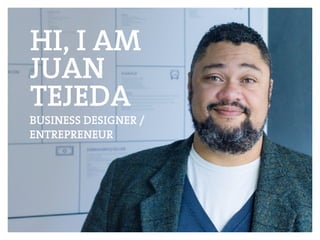
HI, I AM
JUAN
TEJEDA
BUSINESS DESIGNER /
ENTREPRENEUR
HOUSEKEEPING
*Guest_2015
WIFI
3V-WLAN_G5
3V-WLAN_G2
Password:
#CorporateEntrepreneur
#intrapreneurship
#PWN_Workshops
#PWNMunich
If you tweet…
BUSINESS
DESIGN
JAM
businessdesignjam.org
fb.com/businessdesignjam
meetup.com/Business-Design-Jam/
ATTENTION SMOKERS:
You can smoke in the roof terrace
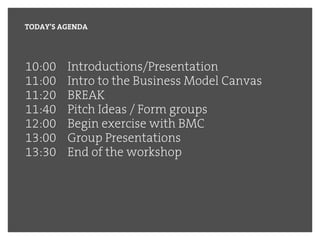
TODAY’S AGENDA
Introductions/Presentation
Intro to the Business Model Canvas
BREAK
Pitch Ideas / Form groups
Begin exercise with BMC
Group Presentations
End of the workshop
10:00
11:00
11:20
11:40
12:00
13:00
13:30
INTRODUCTIONS
YOUR NAME +
3 HASHTAGS (#)
#WHATYOUDO #COMPANY #SOMETHINGABOUTYOU
LEONARDO
DICAPRIO
FOR EXAMPLE:
#ACTOR
#HOLLYWOOD
#FINALLYANOSCAR2016
CORPORATE
ENTREPRENEURSHIP
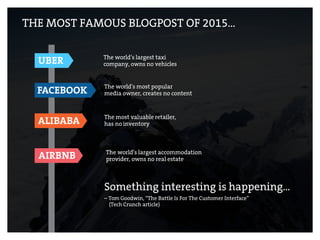
THE MOST FAMOUS BLOGPOST OF 2015…
Something interesting is happening…
– Tom Goodwin, “The Battle Is For The Customer Interface” 

(Tech Crunch article)
The most valuable retailer,
has no inventoryALIBABA
The world’s most popular
media owner, creates no contentFACEBOOK
The world’s largest accommodation
provider, owns no real estateAIRBNB
The world’s largest taxi
company, owns no vehiclesUBER
Companies valued at over $1 billion in 2015:
Zenefits, a human resources software.
Oscar Health Insurance, insurance sector.
MarkLogic, enterprise software company.
In the digital age, “unicorns”
are changing and disrupting
traditional industries and
businesses at a record speed.
SOURCE: research firm CB Insights
In order to stay relevant
and growing in the digital
age, companies have to
transform or perish.
Every company is just a
startup away to be put
out of business.
SO, WHAT ARE COMPANIES DOING?
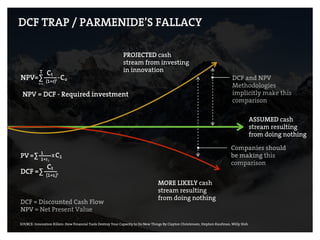
DCF TRAP / PARMENIDE’S FALLACY
SOURCE: Innovation Killers: How Financial Tools Destroy Your Capacity to Do New Things By Clayton Christensen, Stephen Kaufman, Willy Shih
ASSUMED cash
stream resulting
from doing nothing
MORE LIKELY cash
stream resulting
from doing nothing
PROJECTED cash
stream from investing
in innovation
Companies should
be making this
comparison
DCF and NPV
Methodologies
implicitly make this
comparison
NPV = DCF - Required investment
DCF = Discounted Cash Flow
NPV = Net Present Value
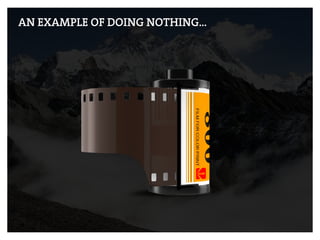
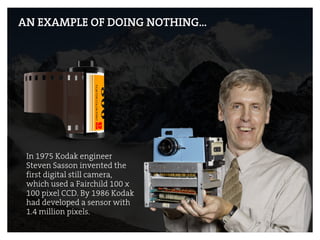
AN EXAMPLE OF DOING NOTHING…
In 1975 Kodak engineer
Steven Sasson invented the
first digital still camera,
which used a Fairchild 100 x
100 pixel CCD. By 1986 Kodak
had developed a sensor with
1.4 million pixels.
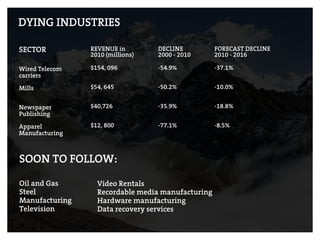
DYING INDUSTRIES
SOON TO FOLLOW:
Oil and Gas
Steel
Manufacturing
Television
Video Rentals
Recordable media manufacturing
Hardware manufacturing
Data recovery services
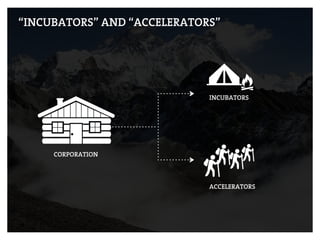
“INCUBATORS” AND “ACCELERATORS”
INCUBATORS
ACCELERATORS
CORPORATION
A lot of young and unexperienced talent…
Timmy here, is
looking to solve a
personal problem,
which might not be
the one of your
current customer.
He dreams to be the
next Zuckerberg…
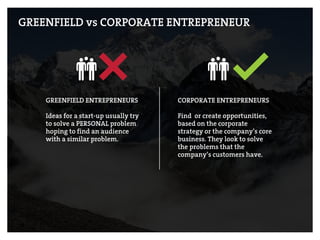
GREENFIELD vs CORPORATE ENTREPRENEUR
GREENFIELD ENTREPRENEURS
Ideas for a start-up usually try
to solve a PERSONAL problem
hoping to find an audience
with a similar problem.
CORPORATE ENTREPRENEURS
Find or create opportunities,
based on the corporate
strategy or the company’s core
business. They look to solve
the problems that the
company’s customers have.
Meet the
Corporate
Entrepreneurs…
Employees that can:
• Identify or create
opportunities aligned
with the corporate
strategy
• Have an understandingof
neededresources
• Providethe driveto bring
an idea to life
All in the form of a business
INTERNAL ENTREPRENEURS
= INTRAPRENEURS
Why Corporate
Entrepreneurs?
Reason #1
Next competitive
advantagefrom
inside knowledge
Developing for the
enterprise relies heavily on
the insights, knowledge
and experience of industry
insiders. It is therefore
better for companies to
look inward instead of
looking for outsiders.
Reason #2
Accelerate internal
innovationprocess
Corporate Entrepreneurs
help accelerate the
innovation process by
creating new business
opportunities in a neutral
setting, rid of procedural
complications and
company politics.
Reason #3
Employee
Retention
Millennials realised that
starting a company, even if
it crashes and burn,
teaches them more in two
years than sitting in a
cubicle for 20 years.
Why should this
interest you?…
Reason #1
Advanceyourcareer
Intrapreneurs like
entrepreneurs take
initiative and calculated
risks. They’re creative and
problem solvers, but most
importantly, they don’t
give up.
These are attributes the
business world has always
valued, and they are
equally important today.
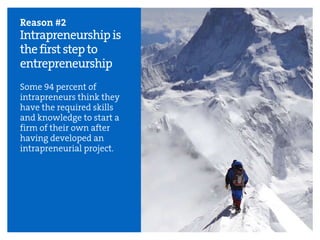
Reason #2
Intrapreneurshipis
thefirststepto
entrepreneurship
Some 94 percent of
intrapreneurs think they
have the required skills
and knowledge to start a
firm of their own after
having developed an
intrapreneurial project.
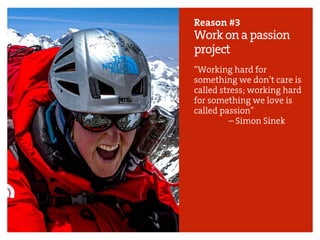
Reason #3
Workonapassion
project
“Working hard for
something we don’t care is
called stress; working hard
for something we love is
called passion”
– Simon Sinek
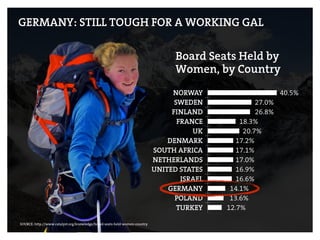
GERMANY: STILL TOUGH FOR A WORKING GAL
Board Seats Held by
Women, by Country
SOURCE: http://www.catalyst.org/knowledge/board-seats-held-women-country
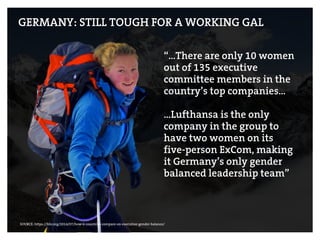
GERMANY: STILL TOUGH FOR A WORKING GAL
“…There are only 10 women
out of 135 executive
committee members in the
country’s top companies…
…Lufthansa is the only
company in the group to
have two women on its
five-person ExCom, making
it Germany’s only gender
balanced leadership team”
SOURCE: https://hbr.org/2014/07/how-6-countries-compare-on-executive-gender-balance/
PLEASE CONSIDER THESE FACTS:
Women are better
investors than the
average man, according
to LouAnn Lofton,
author of “Warren
Buffett Invests Like a
Girl — And Why You
Should, Too”
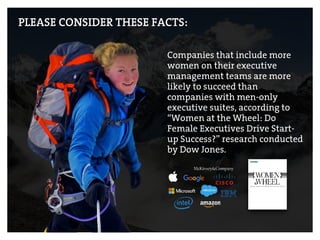
PLEASE CONSIDER THESE FACTS:
Companies that include more
women on their executive
management teams are more
likely to succeed than
companies with men-only
executive suites, according to
“Women at the Wheel: Do
Female Executives Drive Start-
up Success?” research conducted
by Dow Jones.
v
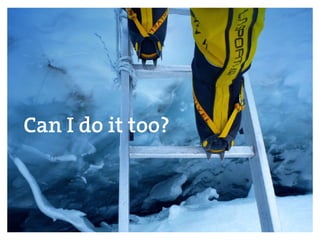
Can I do it too?
v
in short…
HELL YEAH!
THE ROAD AHEAD
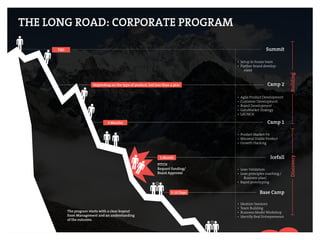
THE LONG ROAD: CORPORATE PROGRAM
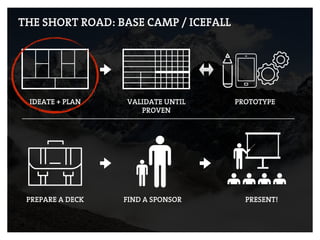
VTHE SHORT ROAD: BASE CAMP / ICEFALL
IDEATE + PLAN VALIDATE UNTIL
PROVEN
PROTOTYPE
PREPARE A DECK FIND A SPONSOR PRESENT!
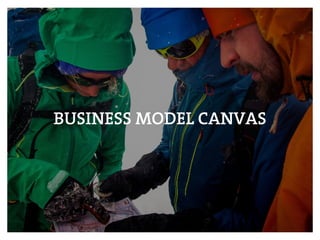
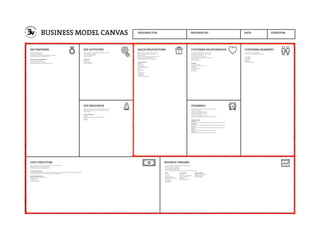
BUSINESS MODEL CANVAS
DESIGNED FOR: DESIGNED BY: DATE: ITERATION:
Who are our Key Partners?
Who are our key suppliers?
Which Key Resources are we acquairing from partners?
Which Key Activities do partners perform?
MOTIVATIONS FOR PARTNERSHIPS
Optimization and economy
Reduction of risk and uncertainty
Acquisition of particular resources and activities
What Key Activities do our Value Propositions require?
Our Distribution Channels?
Customer Relationships?
Revenue streams?
CATEGORIES
Production
Problem Solving
Platform/Network
For what value are our customers really willing to pay?
For what do they currently pay?
How are they currently paying?
How would they prefer to pay?
How much does each Revenue Stream contribute to overall revenues?
TYPES
Asset sale
Usage fee
Subscription Fees
Lending/Renting/Leasing
Licensing
Brokerage fees
Advertising
FIXED PRICING
List Price
Product feature dependent
Customer segment
dependent
Volume dependent
DYNAMIC PRICING
Negotiation (bargaining)
Yield Management
Real-time-Market
What are the most important costs inherent in our business model?
Which Key Resources are most expensive?
Which Key Activities are most expensive?
IS YOUR BUSINESS MORE
Cost Driven (leanest cost structure, low price value proposition, maximum automation, extensive outsourcing)
Value Driven (focused on value creation, premium value proposition)
SAMPLE CHARACTERISTICS
Fixed Costs (salaries, rents, utilities)
Variable costs
Economies of scale
Economies of scope
What Key Resources do our Value Propositions require?
Our Distribution Channels? Customer Relationships?
Revenue Streams?
TYPES OF RESOURCES
Physical
Intellectual (brand patents, copyrights, data)
Human
Financial
Through which Channels do our Customer Segments
want to be reached?
How are we reaching them now?
How are our Channels integrated?
Which ones work best?
Which ones are most cost-efficient?
How are we integrating them with customer routines?
CHANNEL PHASES
Awareness
How do we raise awareness about our company’s products and services?
Evaluation
How do we help customers evaluate our organization’s Value Proposition?
Purchase
How do we allow customers to purchase specific products and services?
Delivery
How do we deliver a Value Proposition to customers?
After sales
How do we provide post-purchase customer support?
For whom are we creating value?
Who are our most important customers?
Mass Market
Niche Market
Segmented
Diversified
Multi-sided Platform
What value do we deliver to the customer?
Which one of our customer’s problems are we
helping to solve?
What bundles of products and services are we
offering to each Customer Segment?
Which customer needs are we satisfying?
CHARACTERISTICS
Newness
Performance
Customization
“Getting the Job Done”
Design
Brand/Status
Price
Cost Reduction
Risk Reduction
Accessibility
Convenience/Usability
What type of relationship does each of our
Customer Segments expect us to establish
and maintain with them?
Which ones have we established?
How are they integrated with the rest of our
business model?
How costly are they?
EXAMPLES
Personal assistance
Dedicated Personal Assistance
Self-Service
Automated Services
Communities
Co-creation
DESIGNED FOR: DESIGNED BY: DATE: ITERATION:
Who are our Key Partners?
Who are our key suppliers?
Which Key Resources are we acquairing from partners?
Which Key Activities do partners perform?
MOTIVATIONS FOR PARTNERSHIPS
Optimization and economy
Reduction of risk and uncertainty
Acquisition of particular resources and activities
What Key Activities do our Value Propositions require?
Our Distribution Channels?
Customer Relationships?
Revenue streams?
CATEGORIES
Production
Problem Solving
Platform/Network
For what value are our customers really willing to pay?
For what do they currently pay?
How are they currently paying?
How would they prefer to pay?
How much does each Revenue Stream contribute to overall revenues?
TYPES
Asset sale
Usage fee
Subscription Fees
Lending/Renting/Leasing
Licensing
Brokerage fees
Advertising
FIXED PRICING
List Price
Product feature dependent
Customer segment
dependent
Volume dependent
DYNAMIC PRICING
Negotiation (bargaining)
Yield Management
Real-time-Market
What are the most important costs inherent in our business model?
Which Key Resources are most expensive?
Which Key Activities are most expensive?
IS YOUR BUSINESS MORE
Cost Driven (leanest cost structure, low price value proposition, maximum automation, extensive outsourcing)
Value Driven (focused on value creation, premium value proposition)
SAMPLE CHARACTERISTICS
Fixed Costs (salaries, rents, utilities)
Variable costs
Economies of scale
Economies of scope
What Key Resources do our Value Propositions require?
Our Distribution Channels? Customer Relationships?
Revenue Streams?
TYPES OF RESOURCES
Physical
Intellectual (brand patents, copyrights, data)
Human
Financial
Through which Channels do our Customer Segments
want to be reached?
How are we reaching them now?
How are our Channels integrated?
Which ones work best?
Which ones are most cost-efficient?
How are we integrating them with customer routines?
CHANNEL PHASES
Awareness
How do we raise awareness about our company’s products and services?
Evaluation
How do we help customers evaluate our organization’s Value Proposition?
Purchase
How do we allow customers to purchase specific products and services?
Delivery
How do we deliver a Value Proposition to customers?
After sales
How do we provide post-purchase customer support?
For whom are we creating value?
Who are our most important customers?
Mass Market
Niche Market
Segmented
Diversified
Multi-sided Platform
What value do we deliver to the customer?
Which one of our customer’s problems are we
helping to solve?
What bundles of products and services are we
offering to each Customer Segment?
Which customer needs are we satisfying?
CHARACTERISTICS
Newness
Performance
Customization
“Getting the Job Done”
Design
Brand/Status
Price
Cost Reduction
Risk Reduction
Accessibility
Convenience/Usability
What type of relationship does each of our
Customer Segments expect us to establish
and maintain with them?
Which ones have we established?
How are they integrated with the rest of our
business model?
How costly are they?
EXAMPLES
Personal assistance
Dedicated Personal Assistance
Self-Service
Automated Services
Communities
Co-creation
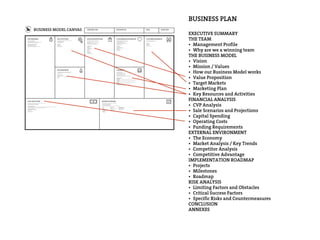
BUSINESS PLAN
EXECUTIVE SUMMARY
THE TEAM
• Management Profile
• Why are we a winning team
THE BUSINESS MODEL
• Vision
• Mission / Values
• How our Business Model works
• Value Proposition
• Target Markets
• Marketing Plan
• Key Resources and Activities
FINANCIAL ANALYSIS
• CVP Analysis
• Sale Scenarios and Projections
• Capital Spending
• Operating Costs
• Funding Requirements
EXTERNAL ENVIRONMENT
• The Economy
• Market Analysis / Key Trends
• Competitor Analysis
• Competitive Advantage
IMPLEMENTATION ROADMAP
• Projects
• Milestones
• Roadmap
RISK ANALYSIS
• Limiting Factors and Obstacles
• Critical Success Factors
• Specific Risks and Countermeasures
CONCLUSION
ANNEXES
DESIGNED FOR: DESIGNED BY: DATE: ITERATION:
Who are our Key Partners?
Who are our key suppliers?
Which Key Resources are we acquairing from partners?
Which Key Activities do partners perform?
MOTIVATIONS FOR PARTNERSHIPS
Optimization and economy
Reduction of risk and uncertainty
Acquisition of particular resources and activities
What Key Activities do our Value Propositions require?
Our Distribution Channels?
Customer Relationships?
Revenue streams?
CATEGORIES
Production
Problem Solving
Platform/Network
For what value are our customers really willing to pay?
For what do they currently pay?
How are they currently paying?
How would they prefer to pay?
How much does each Revenue Stream contribute to overall revenues?
TYPES
Asset sale
Usage fee
Subscription Fees
Lending/Renting/Leasing
Licensing
Brokerage fees
Advertising
FIXED PRICING
List Price
Product feature dependent
Customer segment
dependent
Volume dependent
DYNAMIC PRICING
Negotiation (bargaining)
Yield Management
Real-time-Market
What are the most important costs inherent in our business model?
Which Key Resources are most expensive?
Which Key Activities are most expensive?
IS YOUR BUSINESS MORE
Cost Driven (leanest cost structure, low price value proposition, maximum automation, extensive outsourcing)
Value Driven (focused on value creation, premium value proposition)
SAMPLE CHARACTERISTICS
Fixed Costs (salaries, rents, utilities)
Variable costs
Economies of scale
Economies of scope
What Key Resources do our Value Propositions require?
Our Distribution Channels? Customer Relationships?
Revenue Streams?
TYPES OF RESOURCES
Physical
Intellectual (brand patents, copyrights, data)
Human
Financial
Through which Channels do our Customer Segments
want to be reached?
How are we reaching them now?
How are our Channels integrated?
Which ones work best?
Which ones are most cost-efficient?
How are we integrating them with customer routines?
CHANNEL PHASES
Awareness
How do we raise awareness about our company’s products and services?
Evaluation
How do we help customers evaluate our organization’s Value Proposition?
Purchase
How do we allow customers to purchase specific products and services?
Delivery
How do we deliver a Value Proposition to customers?
After sales
How do we provide post-purchase customer support?
For whom are we creating value?
Who are our most important customers?
Mass Market
Niche Market
Segmented
Diversified
Multi-sided Platform
What value do we deliver to the customer?
Which one of our customer’s problems are we
helping to solve?
What bundles of products and services are we
offering to each Customer Segment?
Which customer needs are we satisfying?
CHARACTERISTICS
Newness
Performance
Customization
“Getting the Job Done”
Design
Brand/Status
Price
Cost Reduction
Risk Reduction
Accessibility
Convenience/Usability
What type of relationship does each of our
Customer Segments expect us to establish
and maintain with them?
Which ones have we established?
How are they integrated with the rest of our
business model?
How costly are they?
EXAMPLES
Personal assistance
Dedicated Personal Assistance
Self-Service
Automated Services
Communities
Co-creation
For whom are we creating value?
Who are our most important customers?
Mass Market
Niche Market
Segmented
Diversified
Multi-sided Platform
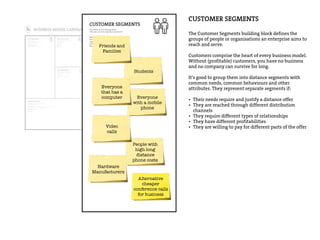
CUSTOMER SEGMENTS
The Customer Segments building block defines the
groups of people or organisations an enterprise aims to
reach and serve.
Customers comprise the heart of every business model.
Without (profitable) customers, you have no business
and no company can survive for long.
It’s good to group them into distance segments with
common needs, common behaviours and other
attributes. They represent separate segments if:
• Their needs require and justify a distance offer
• They are reached through different distribution
channels
• They require different types of relationships
• They have different profitabilities
• They are willing to pay for different parts of the offer
Alternative
cheaper
conference calls
for business
Students
Friends and
Families
Everyone
with a mobile
phone
Everyone
that has a
computer
People with
high long
distance
phone costs
Video
calls
Hardware
Manufacturers
DESIGNED FOR: DESIGNED BY: DATE: ITERATION:
Who are our Key Partners?
Who are our key suppliers?
Which Key Resources are we acquairing from partners?
Which Key Activities do partners perform?
MOTIVATIONS FOR PARTNERSHIPS
Optimization and economy
Reduction of risk and uncertainty
Acquisition of particular resources and activities
What Key Activities do our Value Propositions require?
Our Distribution Channels?
Customer Relationships?
Revenue streams?
CATEGORIES
Production
Problem Solving
Platform/Network
For what value are our customers really willing to pay?
For what do they currently pay?
How are they currently paying?
How would they prefer to pay?
How much does each Revenue Stream contribute to overall revenues?
TYPES
Asset sale
Usage fee
Subscription Fees
Lending/Renting/Leasing
Licensing
Brokerage fees
Advertising
FIXED PRICING
List Price
Product feature dependent
Customer segment
dependent
Volume dependent
DYNAMIC PRICING
Negotiation (bargaining)
Yield Management
Real-time-Market
What are the most important costs inherent in our business model?
Which Key Resources are most expensive?
Which Key Activities are most expensive?
IS YOUR BUSINESS MORE
Cost Driven (leanest cost structure, low price value proposition, maximum automation, extensive outsourcing)
Value Driven (focused on value creation, premium value proposition)
SAMPLE CHARACTERISTICS
Fixed Costs (salaries, rents, utilities)
Variable costs
Economies of scale
Economies of scope
What Key Resources do our Value Propositions require?
Our Distribution Channels? Customer Relationships?
Revenue Streams?
TYPES OF RESOURCES
Physical
Intellectual (brand patents, copyrights, data)
Human
Financial
Through which Channels do our Customer Segments
want to be reached?
How are we reaching them now?
How are our Channels integrated?
Which ones work best?
Which ones are most cost-efficient?
How are we integrating them with customer routines?
CHANNEL PHASES
Awareness
How do we raise awareness about our company’s products and services?
Evaluation
How do we help customers evaluate our organization’s Value Proposition?
Purchase
How do we allow customers to purchase specific products and services?
Delivery
How do we deliver a Value Proposition to customers?
After sales
How do we provide post-purchase customer support?
For whom are we creating value?
Who are our most important customers?
Mass Market
Niche Market
Segmented
Diversified
Multi-sided Platform
What value do we deliver to the customer?
Which one of our customer’s problems are we
helping to solve?
What bundles of products and services are we
offering to each Customer Segment?
Which customer needs are we satisfying?
CHARACTERISTICS
Newness
Performance
Customization
“Getting the Job Done”
Design
Brand/Status
Price
Cost Reduction
Risk Reduction
Accessibility
Convenience/Usability
What type of relationship does each of our
Customer Segments expect us to establish
and maintain with them?
Which ones have we established?
How are they integrated with the rest of our
business model?
How costly are they?
EXAMPLES
Personal assistance
Dedicated Personal Assistance
Self-Service
Automated Services
Communities
Co-creation
What type of relationship does each of our
Customer Segments expect us to establish
and maintain with them?
Which ones have we established?
How are they integrated with the rest of our
business model?
How costly are they?
EXAMPLES
Personal assistance
Dedicated Personal Assistance
Self-Service
Automated Services
Communities
Co-creation
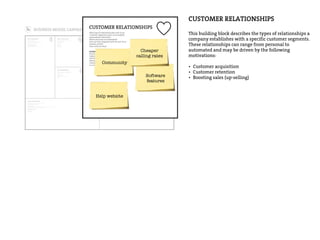
CUSTOMER RELATIONSHIPS
This building block describes the types of relationships a
company establishes with a specific customer segments.
These relationships can range from personal to
automated and may be driven by the following
motivations:
• Customer acquisition
• Customer retention
• Boosting sales (up-selling)Software
features
Community
Cheaper
calling rates
Help website
DESIGNED FOR: DESIGNED BY: DATE: ITERATION:
Who are our Key Partners?
Who are our key suppliers?
Which Key Resources are we acquairing from partners?
Which Key Activities do partners perform?
MOTIVATIONS FOR PARTNERSHIPS
Optimization and economy
Reduction of risk and uncertainty
Acquisition of particular resources and activities
What Key Activities do our Value Propositions require?
Our Distribution Channels?
Customer Relationships?
Revenue streams?
CATEGORIES
Production
Problem Solving
Platform/Network
For what value are our customers really willing to pay?
For what do they currently pay?
How are they currently paying?
How would they prefer to pay?
How much does each Revenue Stream contribute to overall revenues?
TYPES
Asset sale
Usage fee
Subscription Fees
Lending/Renting/Leasing
Licensing
Brokerage fees
Advertising
FIXED PRICING
List Price
Product feature dependent
Customer segment
dependent
Volume dependent
DYNAMIC PRICING
Negotiation (bargaining)
Yield Management
Real-time-Market
What are the most important costs inherent in our business model?
Which Key Resources are most expensive?
Which Key Activities are most expensive?
IS YOUR BUSINESS MORE
Cost Driven (leanest cost structure, low price value proposition, maximum automation, extensive outsourcing)
Value Driven (focused on value creation, premium value proposition)
SAMPLE CHARACTERISTICS
Fixed Costs (salaries, rents, utilities)
Variable costs
Economies of scale
Economies of scope
What Key Resources do our Value Propositions require?
Our Distribution Channels? Customer Relationships?
Revenue Streams?
TYPES OF RESOURCES
Physical
Intellectual (brand patents, copyrights, data)
Human
Financial
Through which Channels do our Customer Segments
want to be reached?
How are we reaching them now?
How are our Channels integrated?
Which ones work best?
Which ones are most cost-efficient?
How are we integrating them with customer routines?
CHANNEL PHASES
Awareness
How do we raise awareness about our company’s products and services?
Evaluation
How do we help customers evaluate our organization’s Value Proposition?
Purchase
How do we allow customers to purchase specific products and services?
Delivery
How do we deliver a Value Proposition to customers?
After sales
How do we provide post-purchase customer support?
For whom are we creating value?
Who are our most important customers?
Mass Market
Niche Market
Segmented
Diversified
Multi-sided Platform
What value do we deliver to the customer?
Which one of our customer’s problems are we
helping to solve?
What bundles of products and services are we
offering to each Customer Segment?
Which customer needs are we satisfying?
CHARACTERISTICS
Newness
Performance
Customization
“Getting the Job Done”
Design
Brand/Status
Price
Cost Reduction
Risk Reduction
Accessibility
Convenience/Usability
What type of relationship does each of our
Customer Segments expect us to establish
and maintain with them?
Which ones have we established?
How are they integrated with the rest of our
business model?
How costly are they?
EXAMPLES
Personal assistance
Dedicated Personal Assistance
Self-Service
Automated Services
Communities
Co-creation
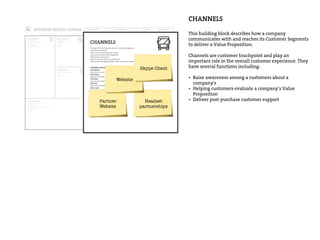
CHANNELS
This building block describes how a company
communicates with and reaches its Customer Segments
to deliver a Value Proposition.
Channels are customer touchpoint and play an
important role in the overall customer experience. They
have several functions including:
• Raise awareness among a customers about a
company’s
• Helping customers evaluate a company’s Value
Proposition
• Deliver post-purchase customer support
Through which Channels do our Customer Segments
want to be reached?
How are we reaching them now?
How are our Channels integrated?
Which ones work best?
Which ones are most cost-efficient?
How are we integrating them with customer routines?
CHANNEL PHASES
Awareness
How do we raise awareness about our company’s products and services?
Evaluation
How do we help customers evaluate our organization’s Value Proposition?
Purchase
How do we allow customers to purchase specific products and services?
Delivery
How do we deliver a Value Proposition to customers?
After sales
How do we provide post-purchase customer support?
Partner
Website
Headset
partnerships
Website
Skype Client
DESIGNED FOR: DESIGNED BY: DATE: ITERATION:
Who are our Key Partners?
Who are our key suppliers?
Which Key Resources are we acquairing from partners?
Which Key Activities do partners perform?
MOTIVATIONS FOR PARTNERSHIPS
Optimization and economy
Reduction of risk and uncertainty
Acquisition of particular resources and activities
What Key Activities do our Value Propositions require?
Our Distribution Channels?
Customer Relationships?
Revenue streams?
CATEGORIES
Production
Problem Solving
Platform/Network
For what value are our customers really willing to pay?
For what do they currently pay?
How are they currently paying?
How would they prefer to pay?
How much does each Revenue Stream contribute to overall revenues?
TYPES
Asset sale
Usage fee
Subscription Fees
Lending/Renting/Leasing
Licensing
Brokerage fees
Advertising
FIXED PRICING
List Price
Product feature dependent
Customer segment
dependent
Volume dependent
DYNAMIC PRICING
Negotiation (bargaining)
Yield Management
Real-time-Market
What are the most important costs inherent in our business model?
Which Key Resources are most expensive?
Which Key Activities are most expensive?
IS YOUR BUSINESS MORE
Cost Driven (leanest cost structure, low price value proposition, maximum automation, extensive outsourcing)
Value Driven (focused on value creation, premium value proposition)
SAMPLE CHARACTERISTICS
Fixed Costs (salaries, rents, utilities)
Variable costs
Economies of scale
Economies of scope
What Key Resources do our Value Propositions require?
Our Distribution Channels? Customer Relationships?
Revenue Streams?
TYPES OF RESOURCES
Physical
Intellectual (brand patents, copyrights, data)
Human
Financial
Through which Channels do our Customer Segments
want to be reached?
How are we reaching them now?
How are our Channels integrated?
Which ones work best?
Which ones are most cost-efficient?
How are we integrating them with customer routines?
CHANNEL PHASES
Awareness
How do we raise awareness about our company’s products and services?
Evaluation
How do we help customers evaluate our organization’s Value Proposition?
Purchase
How do we allow customers to purchase specific products and services?
Delivery
How do we deliver a Value Proposition to customers?
After sales
How do we provide post-purchase customer support?
For whom are we creating value?
Who are our most important customers?
Mass Market
Niche Market
Segmented
Diversified
Multi-sided Platform
What value do we deliver to the customer?
Which one of our customer’s problems are we
helping to solve?
What bundles of products and services are we
offering to each Customer Segment?
Which customer needs are we satisfying?
CHARACTERISTICS
Newness
Performance
Customization
“Getting the Job Done”
Design
Brand/Status
Price
Cost Reduction
Risk Reduction
Accessibility
Convenience/Usability
What type of relationship does each of our
Customer Segments expect us to establish
and maintain with them?
Which ones have we established?
How are they integrated with the rest of our
business model?
How costly are they?
EXAMPLES
Personal assistance
Dedicated Personal Assistance
Self-Service
Automated Services
Communities
Co-creation
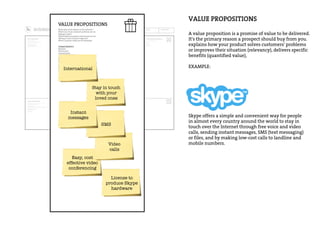
VALUE PROPOSITIONS
A value proposition is a promise of value to be delivered.
It's the primary reason a prospect should buy from you.
explains how your product solves customers' problems
or improves their situation (relevancy), delivers specific
benefits (quantified value),
EXAMPLE:
What value do we deliver to the customer?
Which one of our customer’s problems are we
helping to solve?
What bundles of products and services are we
offering to each Customer Segment?
Which customer needs are we satisfying?
CHARACTERISTICS
Newness
Performance
Customization
“Getting the Job Done”
Design
Brand/Status
Price
Cost Reduction
Risk Reduction
Accessibility
Convenience/Usability
Skype offers a simple and convenient way for people
in almost every country around the world to stay in
touch over the Internet through free voice and video
calls, sending instant messages, SMS (text messaging)
or files, and by making low-cost calls to landline and
mobile numbers.
Stay in touch
with your
loved ones
Easy, cost
effective video
conferencing
Video
calls
International
SMS
Instant
messages
License to
produce Skype
hardware
DESIGNED FOR: DESIGNED BY: DATE: ITERATION:
Who are our Key Partners?
Who are our key suppliers?
Which Key Resources are we acquairing from partners?
Which Key Activities do partners perform?
MOTIVATIONS FOR PARTNERSHIPS
Optimization and economy
Reduction of risk and uncertainty
Acquisition of particular resources and activities
What Key Activities do our Value Propositions require?
Our Distribution Channels?
Customer Relationships?
Revenue streams?
CATEGORIES
Production
Problem Solving
Platform/Network
For what value are our customers really willing to pay?
For what do they currently pay?
How are they currently paying?
How would they prefer to pay?
How much does each Revenue Stream contribute to overall revenues?
TYPES
Asset sale
Usage fee
Subscription Fees
Lending/Renting/Leasing
Licensing
Brokerage fees
Advertising
FIXED PRICING
List Price
Product feature dependent
Customer segment
dependent
Volume dependent
DYNAMIC PRICING
Negotiation (bargaining)
Yield Management
Real-time-Market
What are the most important costs inherent in our business model?
Which Key Resources are most expensive?
Which Key Activities are most expensive?
IS YOUR BUSINESS MORE
Cost Driven (leanest cost structure, low price value proposition, maximum automation, extensive outsourcing)
Value Driven (focused on value creation, premium value proposition)
SAMPLE CHARACTERISTICS
Fixed Costs (salaries, rents, utilities)
Variable costs
Economies of scale
Economies of scope
What Key Resources do our Value Propositions require?
Our Distribution Channels? Customer Relationships?
Revenue Streams?
TYPES OF RESOURCES
Physical
Intellectual (brand patents, copyrights, data)
Human
Financial
Through which Channels do our Customer Segments
want to be reached?
How are we reaching them now?
How are our Channels integrated?
Which ones work best?
Which ones are most cost-efficient?
How are we integrating them with customer routines?
CHANNEL PHASES
Awareness
How do we raise awareness about our company’s products and services?
Evaluation
How do we help customers evaluate our organization’s Value Proposition?
Purchase
How do we allow customers to purchase specific products and services?
Delivery
How do we deliver a Value Proposition to customers?
After sales
How do we provide post-purchase customer support?
For whom are we creating value?
Who are our most important customers?
Mass Market
Niche Market
Segmented
Diversified
Multi-sided Platform
What value do we deliver to the customer?
Which one of our customer’s problems are we
helping to solve?
What bundles of products and services are we
offering to each Customer Segment?
Which customer needs are we satisfying?
CHARACTERISTICS
Newness
Performance
Customization
“Getting the Job Done”
Design
Brand/Status
Price
Cost Reduction
Risk Reduction
Accessibility
Convenience/Usability
What type of relationship does each of our
Customer Segments expect us to establish
and maintain with them?
Which ones have we established?
How are they integrated with the rest of our
business model?
How costly are they?
EXAMPLES
Personal assistance
Dedicated Personal Assistance
Self-Service
Automated Services
Communities
Co-creation
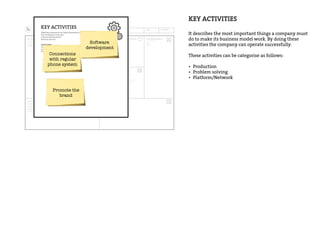
KEY ACTIVITIES
It describes the most important things a company must
do to make its business model work. By doing these
activities the company can operate successfully.
These activities can be categorise as follows:
• Production
• Problem solving
• Platform/Network
What Key Activities do our Value Propositions require?
Our Distribution Channels?
Customer Relationships?
Revenue streams?
CATEGORIES
Production
Problem Solving
Platform/Network
Connections
with regular
phone system
Software
development
Promote the
brand
DESIGNED FOR: DESIGNED BY: DATE: ITERATION:
Who are our Key Partners?
Who are our key suppliers?
Which Key Resources are we acquairing from partners?
Which Key Activities do partners perform?
MOTIVATIONS FOR PARTNERSHIPS
Optimization and economy
Reduction of risk and uncertainty
Acquisition of particular resources and activities
What Key Activities do our Value Propositions require?
Our Distribution Channels?
Customer Relationships?
Revenue streams?
CATEGORIES
Production
Problem Solving
Platform/Network
For what value are our customers really willing to pay?
For what do they currently pay?
How are they currently paying?
How would they prefer to pay?
How much does each Revenue Stream contribute to overall revenues?
TYPES
Asset sale
Usage fee
Subscription Fees
Lending/Renting/Leasing
Licensing
Brokerage fees
Advertising
FIXED PRICING
List Price
Product feature dependent
Customer segment
dependent
Volume dependent
DYNAMIC PRICING
Negotiation (bargaining)
Yield Management
Real-time-Market
What are the most important costs inherent in our business model?
Which Key Resources are most expensive?
Which Key Activities are most expensive?
IS YOUR BUSINESS MORE
Cost Driven (leanest cost structure, low price value proposition, maximum automation, extensive outsourcing)
Value Driven (focused on value creation, premium value proposition)
SAMPLE CHARACTERISTICS
Fixed Costs (salaries, rents, utilities)
Variable costs
Economies of scale
Economies of scope
What Key Resources do our Value Propositions require?
Our Distribution Channels? Customer Relationships?
Revenue Streams?
TYPES OF RESOURCES
Physical
Intellectual (brand patents, copyrights, data)
Human
Financial
Through which Channels do our Customer Segments
want to be reached?
How are we reaching them now?
How are our Channels integrated?
Which ones work best?
Which ones are most cost-efficient?
How are we integrating them with customer routines?
CHANNEL PHASES
Awareness
How do we raise awareness about our company’s products and services?
Evaluation
How do we help customers evaluate our organization’s Value Proposition?
Purchase
How do we allow customers to purchase specific products and services?
Delivery
How do we deliver a Value Proposition to customers?
After sales
How do we provide post-purchase customer support?
For whom are we creating value?
Who are our most important customers?
Mass Market
Niche Market
Segmented
Diversified
Multi-sided Platform
What value do we deliver to the customer?
Which one of our customer’s problems are we
helping to solve?
What bundles of products and services are we
offering to each Customer Segment?
Which customer needs are we satisfying?
CHARACTERISTICS
Newness
Performance
Customization
“Getting the Job Done”
Design
Brand/Status
Price
Cost Reduction
Risk Reduction
Accessibility
Convenience/Usability
What type of relationship does each of our
Customer Segments expect us to establish
and maintain with them?
Which ones have we established?
How are they integrated with the rest of our
business model?
How costly are they?
EXAMPLES
Personal assistance
Dedicated Personal Assistance
Self-Service
Automated Services
Communities
Co-creation
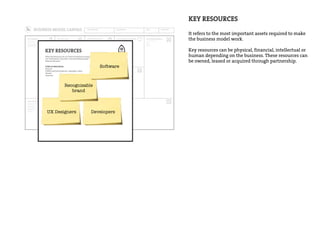
KEY RESOURCES
It refers to the most important assets required to make
the business model work.
Key resources can be physical, financial, intellectual or
human depending on the business. These resources can
be owned, leased or acquired through partnership.
What Key Resources do our Value Propositions require?
Our Distribution Channels? Customer Relationships?
Revenue Streams?
TYPES OF RESOURCES
Physical
Intellectual (brand patents, copyrights, data)
Human
Financial
DevelopersUX Designers
Recognisable
brand
Software
DESIGNED FOR: DESIGNED BY: DATE: ITERATION:
Who are our Key Partners?
Who are our key suppliers?
Which Key Resources are we acquairing from partners?
Which Key Activities do partners perform?
MOTIVATIONS FOR PARTNERSHIPS
Optimization and economy
Reduction of risk and uncertainty
Acquisition of particular resources and activities
What Key Activities do our Value Propositions require?
Our Distribution Channels?
Customer Relationships?
Revenue streams?
CATEGORIES
Production
Problem Solving
Platform/Network
For what value are our customers really willing to pay?
For what do they currently pay?
How are they currently paying?
How would they prefer to pay?
How much does each Revenue Stream contribute to overall revenues?
TYPES
Asset sale
Usage fee
Subscription Fees
Lending/Renting/Leasing
Licensing
Brokerage fees
Advertising
FIXED PRICING
List Price
Product feature dependent
Customer segment
dependent
Volume dependent
DYNAMIC PRICING
Negotiation (bargaining)
Yield Management
Real-time-Market
What are the most important costs inherent in our business model?
Which Key Resources are most expensive?
Which Key Activities are most expensive?
IS YOUR BUSINESS MORE
Cost Driven (leanest cost structure, low price value proposition, maximum automation, extensive outsourcing)
Value Driven (focused on value creation, premium value proposition)
SAMPLE CHARACTERISTICS
Fixed Costs (salaries, rents, utilities)
Variable costs
Economies of scale
Economies of scope
What Key Resources do our Value Propositions require?
Our Distribution Channels? Customer Relationships?
Revenue Streams?
TYPES OF RESOURCES
Physical
Intellectual (brand patents, copyrights, data)
Human
Financial
Through which Channels do our Customer Segments
want to be reached?
How are we reaching them now?
How are our Channels integrated?
Which ones work best?
Which ones are most cost-efficient?
How are we integrating them with customer routines?
CHANNEL PHASES
Awareness
How do we raise awareness about our company’s products and services?
Evaluation
How do we help customers evaluate our organization’s Value Proposition?
Purchase
How do we allow customers to purchase specific products and services?
Delivery
How do we deliver a Value Proposition to customers?
After sales
How do we provide post-purchase customer support?
For whom are we creating value?
Who are our most important customers?
Mass Market
Niche Market
Segmented
Diversified
Multi-sided Platform
What value do we deliver to the customer?
Which one of our customer’s problems are we
helping to solve?
What bundles of products and services are we
offering to each Customer Segment?
Which customer needs are we satisfying?
CHARACTERISTICS
Newness
Performance
Customization
“Getting the Job Done”
Design
Brand/Status
Price
Cost Reduction
Risk Reduction
Accessibility
Convenience/Usability
What type of relationship does each of our
Customer Segments expect us to establish
and maintain with them?
Which ones have we established?
How are they integrated with the rest of our
business model?
How costly are they?
EXAMPLES
Personal assistance
Dedicated Personal Assistance
Self-Service
Automated Services
Communities
Co-creation
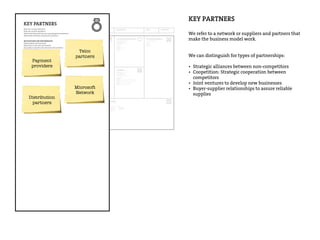
KEY PARTNERS
We refer to a network or suppliers and partners that
make the business model work.
We can distinguish for types of partnerships:
• Strategic alliances between non-competitors
• Coopetition: Strategic cooperation between
competitors
• Joint ventures to develop new businesses
• Buyer-supplier relationships to assure reliable
supplies
Who are our Key Partners?
Who are our key suppliers?
Which Key Resources are we acquairing from partners?
Which Key Activities do partners perform?
MOTIVATIONS FOR PARTNERSHIPS
Optimization and economy
Reduction of risk and uncertainty
Acquisition of particular resources and activities
Telco 

partners
Payment
providers
Distribution
partners
Microsoft
Network
DESIGNED FOR: DESIGNED BY: DATE: ITERATION:
Who are our Key Partners?
Who are our key suppliers?
Which Key Resources are we acquairing from partners?
Which Key Activities do partners perform?
MOTIVATIONS FOR PARTNERSHIPS
Optimization and economy
Reduction of risk and uncertainty
Acquisition of particular resources and activities
What Key Activities do our Value Propositions require?
Our Distribution Channels?
Customer Relationships?
Revenue streams?
CATEGORIES
Production
Problem Solving
Platform/Network
For what value are our customers really willing to pay?
For what do they currently pay?
How are they currently paying?
How would they prefer to pay?
How much does each Revenue Stream contribute to overall revenues?
TYPES
Asset sale
Usage fee
Subscription Fees
Lending/Renting/Leasing
Licensing
Brokerage fees
Advertising
FIXED PRICING
List Price
Product feature dependent
Customer segment
dependent
Volume dependent
DYNAMIC PRICING
Negotiation (bargaining)
Yield Management
Real-time-Market
What are the most important costs inherent in our business model?
Which Key Resources are most expensive?
Which Key Activities are most expensive?
IS YOUR BUSINESS MORE
Cost Driven (leanest cost structure, low price value proposition, maximum automation, extensive outsourcing)
Value Driven (focused on value creation, premium value proposition)
SAMPLE CHARACTERISTICS
Fixed Costs (salaries, rents, utilities)
Variable costs
Economies of scale
Economies of scope
What Key Resources do our Value Propositions require?
Our Distribution Channels? Customer Relationships?
Revenue Streams?
TYPES OF RESOURCES
Physical
Intellectual (brand patents, copyrights, data)
Human
Financial
Through which Channels do our Customer Segments
want to be reached?
How are we reaching them now?
How are our Channels integrated?
Which ones work best?
Which ones are most cost-efficient?
How are we integrating them with customer routines?
CHANNEL PHASES
Awareness
How do we raise awareness about our company’s products and services?
Evaluation
How do we help customers evaluate our organization’s Value Proposition?
Purchase
How do we allow customers to purchase specific products and services?
Delivery
How do we deliver a Value Proposition to customers?
After sales
How do we provide post-purchase customer support?
For whom are we creating value?
Who are our most important customers?
Mass Market
Niche Market
Segmented
Diversified
Multi-sided Platform
What value do we deliver to the customer?
Which one of our customer’s problems are we
helping to solve?
What bundles of products and services are we
offering to each Customer Segment?
Which customer needs are we satisfying?
CHARACTERISTICS
Newness
Performance
Customization
“Getting the Job Done”
Design
Brand/Status
Price
Cost Reduction
Risk Reduction
Accessibility
Convenience/Usability
What type of relationship does each of our
Customer Segments expect us to establish
and maintain with them?
Which ones have we established?
How are they integrated with the rest of our
business model?
How costly are they?
EXAMPLES
Personal assistance
Dedicated Personal Assistance
Self-Service
Automated Services
Communities
Co-creation
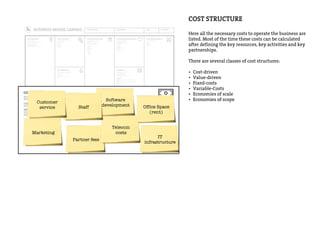
COST STRUCTURE
Here all the necessary costs to operate the business are
listed. Most of the time these costs can be calculated
after defining the key resources, key activities and key
partnerships.
There are several classes of cost structures:
• Cost-driven
• Value-driven
• Fixed-costs
• Variable-Costs
• Economies of scale
• Economies of scope
What are the most important costs inherent in our business model?
Which Key Resources are most expensive?
Which Key Activities are most expensive?
IS YOUR BUSINESS MORE
Cost Driven (leanest cost structure, low price value proposition, maximum automation, extensive outsourcing)
Value Driven (focused on value creation, premium value proposition)
SAMPLE CHARACTERISTICS
Fixed Costs (salaries, rents, utilities)
Variable costs
Economies of scale
Economies of scope
Software
development
Marketing
Partner fees
Telecom
costs
Staff
Customer
service Office Space
(rent)
IT
infrastructure
DESIGNED FOR: DESIGNED BY: DATE: ITERATION:
Who are our Key Partners?
Who are our key suppliers?
Which Key Resources are we acquairing from partners?
Which Key Activities do partners perform?
MOTIVATIONS FOR PARTNERSHIPS
Optimization and economy
Reduction of risk and uncertainty
Acquisition of particular resources and activities
What Key Activities do our Value Propositions require?
Our Distribution Channels?
Customer Relationships?
Revenue streams?
CATEGORIES
Production
Problem Solving
Platform/Network
For what value are our customers really willing to pay?
For what do they currently pay?
How are they currently paying?
How would they prefer to pay?
How much does each Revenue Stream contribute to overall revenues?
TYPES
Asset sale
Usage fee
Subscription Fees
Lending/Renting/Leasing
Licensing
Brokerage fees
Advertising
FIXED PRICING
List Price
Product feature dependent
Customer segment
dependent
Volume dependent
DYNAMIC PRICING
Negotiation (bargaining)
Yield Management
Real-time-Market
What are the most important costs inherent in our business model?
Which Key Resources are most expensive?
Which Key Activities are most expensive?
IS YOUR BUSINESS MORE
Cost Driven (leanest cost structure, low price value proposition, maximum automation, extensive outsourcing)
Value Driven (focused on value creation, premium value proposition)
SAMPLE CHARACTERISTICS
Fixed Costs (salaries, rents, utilities)
Variable costs
Economies of scale
Economies of scope
What Key Resources do our Value Propositions require?
Our Distribution Channels? Customer Relationships?
Revenue Streams?
TYPES OF RESOURCES
Physical
Intellectual (brand patents, copyrights, data)
Human
Financial
Through which Channels do our Customer Segments
want to be reached?
How are we reaching them now?
How are our Channels integrated?
Which ones work best?
Which ones are most cost-efficient?
How are we integrating them with customer routines?
CHANNEL PHASES
Awareness
How do we raise awareness about our company’s products and services?
Evaluation
How do we help customers evaluate our organization’s Value Proposition?
Purchase
How do we allow customers to purchase specific products and services?
Delivery
How do we deliver a Value Proposition to customers?
After sales
How do we provide post-purchase customer support?
For whom are we creating value?
Who are our most important customers?
Mass Market
Niche Market
Segmented
Diversified
Multi-sided Platform
What value do we deliver to the customer?
Which one of our customer’s problems are we
helping to solve?
What bundles of products and services are we
offering to each Customer Segment?
Which customer needs are we satisfying?
CHARACTERISTICS
Newness
Performance
Customization
“Getting the Job Done”
Design
Brand/Status
Price
Cost Reduction
Risk Reduction
Accessibility
Convenience/Usability
What type of relationship does each of our
Customer Segments expect us to establish
and maintain with them?
Which ones have we established?
How are they integrated with the rest of our
business model?
How costly are they?
EXAMPLES
Personal assistance
Dedicated Personal Assistance
Self-Service
Automated Services
Communities
Co-creation
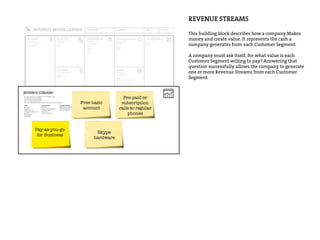
REVENUE STREAMS
This building block describes how a company Makes
money and create value. It represents the cash a
company generates from each Customer Segment.
A company must ask itself, for what value is each
Customer Segment willing to pay? Answering that
question successfully allows the company to generate
one or more Revenue Streams from each Customer
Segment.
For what value are our customers really willing to pay?
For what do they currently pay?
How are they currently paying?
How would they prefer to pay?
How much does each Revenue Stream contribute to overall revenues?
TYPES
Asset sale
Usage fee
Subscription Fees
Lending/Renting/Leasing
Licensing
Brokerage fees
Advertising
FIXED PRICING
List Price
Product feature dependent
Customer segment
dependent
Volume dependent
DYNAMIC PRICING
Negotiation (bargaining)
Yield Management
Real-time-Market
Pay-as-you-go
for Business
Pre-paid or
subscription
calls to regular
phones
Free basic
account
Skype
hardware
DESIGNED FOR: DESIGNED BY: DATE: ITERATION:
Who are our Key Partners?
Who are our key suppliers?
Which Key Resources are we acquairing from partners?
Which Key Activities do partners perform?
MOTIVATIONS FOR PARTNERSHIPS
Optimization and economy
Reduction of risk and uncertainty
Acquisition of particular resources and activities
What Key Activities do our Value Propositions require?
Our Distribution Channels?
Customer Relationships?
Revenue streams?
CATEGORIES
Production
Problem Solving
Platform/Network
For what value are our customers really willing to pay?
For what do they currently pay?
How are they currently paying?
How would they prefer to pay?
How much does each Revenue Stream contribute to overall revenues?
TYPES
Asset sale
Usage fee
Subscription Fees
Lending/Renting/Leasing
Licensing
Brokerage fees
Advertising
FIXED PRICING
List Price
Product feature dependent
Customer segment
dependent
Volume dependent
DYNAMIC PRICING
Negotiation (bargaining)
Yield Management
Real-time-Market
What are the most important costs inherent in our business model?
Which Key Resources are most expensive?
Which Key Activities are most expensive?
IS YOUR BUSINESS MORE
Cost Driven (leanest cost structure, low price value proposition, maximum automation, extensive outsourcing)
Value Driven (focused on value creation, premium value proposition)
SAMPLE CHARACTERISTICS
Fixed Costs (salaries, rents, utilities)
Variable costs
Economies of scale
Economies of scope
What Key Resources do our Value Propositions require?
Our Distribution Channels? Customer Relationships?
Revenue Streams?
TYPES OF RESOURCES
Physical
Intellectual (brand patents, copyrights, data)
Human
Financial
Through which Channels do our Customer Segments
want to be reached?
How are we reaching them now?
How are our Channels integrated?
Which ones work best?
Which ones are most cost-efficient?
How are we integrating them with customer routines?
CHANNEL PHASES
Awareness
How do we raise awareness about our company’s products and services?
Evaluation
How do we help customers evaluate our organization’s Value Proposition?
Purchase
How do we allow customers to purchase specific products and services?
Delivery
How do we deliver a Value Proposition to customers?
After sales
How do we provide post-purchase customer support?
For whom are we creating value?
Who are our most important customers?
Mass Market
Niche Market
Segmented
Diversified
Multi-sided Platform
What value do we deliver to the customer?
Which one of our customer’s problems are we
helping to solve?
What bundles of products and services are we
offering to each Customer Segment?
Which customer needs are we satisfying?
CHARACTERISTICS
Newness
Performance
Customization
“Getting the Job Done”
Design
Brand/Status
Price
Cost Reduction
Risk Reduction
Accessibility
Convenience/Usability
What type of relationship does each of our
Customer Segments expect us to establish
and maintain with them?
Which ones have we established?
How are they integrated with the rest of our
business model?
How costly are they?
EXAMPLES
Personal assistance
Dedicated Personal Assistance
Self-Service
Automated Services
Communities
Co-creation
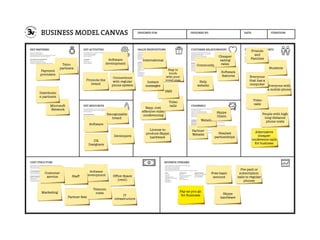
Pay-as-you-go
for Business
Pre-paid or
subscription
calls to regular
phones
Free basic
account
Skype
hardware
Software
development
Marketing
Partner fees
Telecom
costs
Staff
Customer
service Office Space
(rent)
IT
infrastructure
Telco 

partners
Payment
providers
Microsoft
Network
Distributio
n partners
Developers
UX
Designers
Recognisable
brand
Software
Software
development
Promote the
brand
Connections
with regular
phone system
Stay in
touch
with your
loved ones
Easy, cost
effective video
conferencing
Video
calls
International
SMS
Instant
messages
License to
produce Skype
hardware
Partner
Website Headset
partnerships
Website
Skype
Client
Software
features
Community
Cheaper
calling
rates
Help
website
Students
Friends
and
Families
Everyone with
a mobile phone
Everyone
that has a
computer
People with high
long distance
phone costs
Video
calls
Alternative
cheaper
conference calls
for business
IDEA PITCHING
GREENFIELD vs CORPORATE ENTREPRENEUR
GREENFIELD ENTREPRENEURS
Ideas for a start-up usually try
to solve a PERSONAL problem
hoping to find an audience
with a similar problem.
CORPORATE ENTREPRENEURS
Find or create opportunities,
based on the corporate
strategy or the company’s core
business. They look to solve
the problems that the
company’s customers have.
CHOOSE YOUR TEAM.
LET’S DO THIS!
THANK YOU FOR
PARTICIPATING
BRAINS & HEARTS | Holzstrasse 30, 80469 Munich | +49 (0)89 461-34 47-0 | info@brainsandhearts.de

Corporate Entrepreneurship Workshop

  • 2.
  • 3.
    HI, I AM JUAN TEJEDA BUSINESSDESIGNER / ENTREPRENEUR
  • 4.
  • 5.
  • 6.
  • 7.
  • 8.
    ATTENTION SMOKERS: You cansmoke in the roof terrace
  • 9.
    TODAY’S AGENDA Introductions/Presentation Intro tothe Business Model Canvas BREAK Pitch Ideas / Form groups Begin exercise with BMC Group Presentations End of the workshop 10:00 11:00 11:20 11:40 12:00 13:00 13:30
  • 10.
  • 11.
    YOUR NAME + 3HASHTAGS (#) #WHATYOUDO #COMPANY #SOMETHINGABOUTYOU
  • 13.
  • 14.
  • 15.
    THE MOST FAMOUSBLOGPOST OF 2015… Something interesting is happening… – Tom Goodwin, “The Battle Is For The Customer Interface” 
 (Tech Crunch article) The most valuable retailer, has no inventoryALIBABA The world’s most popular media owner, creates no contentFACEBOOK The world’s largest accommodation provider, owns no real estateAIRBNB The world’s largest taxi company, owns no vehiclesUBER
  • 16.
    Companies valued atover $1 billion in 2015: Zenefits, a human resources software. Oscar Health Insurance, insurance sector. MarkLogic, enterprise software company. In the digital age, “unicorns” are changing and disrupting traditional industries and businesses at a record speed. SOURCE: research firm CB Insights
  • 17.
    In order tostay relevant and growing in the digital age, companies have to transform or perish. Every company is just a startup away to be put out of business.
  • 18.
    SO, WHAT ARECOMPANIES DOING?
  • 19.
    DCF TRAP /PARMENIDE’S FALLACY SOURCE: Innovation Killers: How Financial Tools Destroy Your Capacity to Do New Things By Clayton Christensen, Stephen Kaufman, Willy Shih ASSUMED cash stream resulting from doing nothing MORE LIKELY cash stream resulting from doing nothing PROJECTED cash stream from investing in innovation Companies should be making this comparison DCF and NPV Methodologies implicitly make this comparison NPV = DCF - Required investment DCF = Discounted Cash Flow NPV = Net Present Value
  • 20.
    AN EXAMPLE OFDOING NOTHING…
  • 21.
    AN EXAMPLE OFDOING NOTHING… In 1975 Kodak engineer Steven Sasson invented the first digital still camera, which used a Fairchild 100 x 100 pixel CCD. By 1986 Kodak had developed a sensor with 1.4 million pixels.
  • 22.
    DYING INDUSTRIES SOON TOFOLLOW: Oil and Gas Steel Manufacturing Television Video Rentals Recordable media manufacturing Hardware manufacturing Data recovery services
  • 23.
  • 24.
    A lot ofyoung and unexperienced talent… Timmy here, is looking to solve a personal problem, which might not be the one of your current customer. He dreams to be the next Zuckerberg…
  • 25.
    GREENFIELD vs CORPORATEENTREPRENEUR GREENFIELD ENTREPRENEURS Ideas for a start-up usually try to solve a PERSONAL problem hoping to find an audience with a similar problem. CORPORATE ENTREPRENEURS Find or create opportunities, based on the corporate strategy or the company’s core business. They look to solve the problems that the company’s customers have.
  • 26.
  • 27.
    Employees that can: •Identify or create opportunities aligned with the corporate strategy • Have an understandingof neededresources • Providethe driveto bring an idea to life All in the form of a business INTERNAL ENTREPRENEURS = INTRAPRENEURS
  • 28.
  • 29.
    Reason #1 Next competitive advantagefrom insideknowledge Developing for the enterprise relies heavily on the insights, knowledge and experience of industry insiders. It is therefore better for companies to look inward instead of looking for outsiders.
  • 30.
    Reason #2 Accelerate internal innovationprocess CorporateEntrepreneurs help accelerate the innovation process by creating new business opportunities in a neutral setting, rid of procedural complications and company politics.
  • 31.
    Reason #3 Employee Retention Millennials realisedthat starting a company, even if it crashes and burn, teaches them more in two years than sitting in a cubicle for 20 years.
  • 32.
  • 33.
    Reason #1 Advanceyourcareer Intrapreneurs like entrepreneurstake initiative and calculated risks. They’re creative and problem solvers, but most importantly, they don’t give up. These are attributes the business world has always valued, and they are equally important today.
  • 34.
    Reason #2 Intrapreneurshipis thefirststepto entrepreneurship Some 94percent of intrapreneurs think they have the required skills and knowledge to start a firm of their own after having developed an intrapreneurial project.
  • 35.
    Reason #3 Workonapassion project “Working hardfor something we don’t care is called stress; working hard for something we love is called passion” – Simon Sinek
  • 36.
    GERMANY: STILL TOUGHFOR A WORKING GAL Board Seats Held by Women, by Country SOURCE: http://www.catalyst.org/knowledge/board-seats-held-women-country
  • 37.
    GERMANY: STILL TOUGHFOR A WORKING GAL “…There are only 10 women out of 135 executive committee members in the country’s top companies… …Lufthansa is the only company in the group to have two women on its five-person ExCom, making it Germany’s only gender balanced leadership team” SOURCE: https://hbr.org/2014/07/how-6-countries-compare-on-executive-gender-balance/
  • 38.
    PLEASE CONSIDER THESEFACTS: Women are better investors than the average man, according to LouAnn Lofton, author of “Warren Buffett Invests Like a Girl — And Why You Should, Too”
  • 39.
    PLEASE CONSIDER THESEFACTS: Companies that include more women on their executive management teams are more likely to succeed than companies with men-only executive suites, according to “Women at the Wheel: Do Female Executives Drive Start- up Success?” research conducted by Dow Jones.
  • 40.
    v Can I doit too?
  • 41.
  • 42.
  • 43.
    THE LONG ROAD:CORPORATE PROGRAM
  • 44.
    VTHE SHORT ROAD:BASE CAMP / ICEFALL IDEATE + PLAN VALIDATE UNTIL PROVEN PROTOTYPE PREPARE A DECK FIND A SPONSOR PRESENT!
  • 45.
  • 46.
    DESIGNED FOR: DESIGNEDBY: DATE: ITERATION: Who are our Key Partners? Who are our key suppliers? Which Key Resources are we acquairing from partners? Which Key Activities do partners perform? MOTIVATIONS FOR PARTNERSHIPS Optimization and economy Reduction of risk and uncertainty Acquisition of particular resources and activities What Key Activities do our Value Propositions require? Our Distribution Channels? Customer Relationships? Revenue streams? CATEGORIES Production Problem Solving Platform/Network For what value are our customers really willing to pay? For what do they currently pay? How are they currently paying? How would they prefer to pay? How much does each Revenue Stream contribute to overall revenues? TYPES Asset sale Usage fee Subscription Fees Lending/Renting/Leasing Licensing Brokerage fees Advertising FIXED PRICING List Price Product feature dependent Customer segment dependent Volume dependent DYNAMIC PRICING Negotiation (bargaining) Yield Management Real-time-Market What are the most important costs inherent in our business model? Which Key Resources are most expensive? Which Key Activities are most expensive? IS YOUR BUSINESS MORE Cost Driven (leanest cost structure, low price value proposition, maximum automation, extensive outsourcing) Value Driven (focused on value creation, premium value proposition) SAMPLE CHARACTERISTICS Fixed Costs (salaries, rents, utilities) Variable costs Economies of scale Economies of scope What Key Resources do our Value Propositions require? Our Distribution Channels? Customer Relationships? Revenue Streams? TYPES OF RESOURCES Physical Intellectual (brand patents, copyrights, data) Human Financial Through which Channels do our Customer Segments want to be reached? How are we reaching them now? How are our Channels integrated? Which ones work best? Which ones are most cost-efficient? How are we integrating them with customer routines? CHANNEL PHASES Awareness How do we raise awareness about our company’s products and services? Evaluation How do we help customers evaluate our organization’s Value Proposition? Purchase How do we allow customers to purchase specific products and services? Delivery How do we deliver a Value Proposition to customers? After sales How do we provide post-purchase customer support? For whom are we creating value? Who are our most important customers? Mass Market Niche Market Segmented Diversified Multi-sided Platform What value do we deliver to the customer? Which one of our customer’s problems are we helping to solve? What bundles of products and services are we offering to each Customer Segment? Which customer needs are we satisfying? CHARACTERISTICS Newness Performance Customization “Getting the Job Done” Design Brand/Status Price Cost Reduction Risk Reduction Accessibility Convenience/Usability What type of relationship does each of our Customer Segments expect us to establish and maintain with them? Which ones have we established? How are they integrated with the rest of our business model? How costly are they? EXAMPLES Personal assistance Dedicated Personal Assistance Self-Service Automated Services Communities Co-creation
  • 47.
    DESIGNED FOR: DESIGNEDBY: DATE: ITERATION: Who are our Key Partners? Who are our key suppliers? Which Key Resources are we acquairing from partners? Which Key Activities do partners perform? MOTIVATIONS FOR PARTNERSHIPS Optimization and economy Reduction of risk and uncertainty Acquisition of particular resources and activities What Key Activities do our Value Propositions require? Our Distribution Channels? Customer Relationships? Revenue streams? CATEGORIES Production Problem Solving Platform/Network For what value are our customers really willing to pay? For what do they currently pay? How are they currently paying? How would they prefer to pay? How much does each Revenue Stream contribute to overall revenues? TYPES Asset sale Usage fee Subscription Fees Lending/Renting/Leasing Licensing Brokerage fees Advertising FIXED PRICING List Price Product feature dependent Customer segment dependent Volume dependent DYNAMIC PRICING Negotiation (bargaining) Yield Management Real-time-Market What are the most important costs inherent in our business model? Which Key Resources are most expensive? Which Key Activities are most expensive? IS YOUR BUSINESS MORE Cost Driven (leanest cost structure, low price value proposition, maximum automation, extensive outsourcing) Value Driven (focused on value creation, premium value proposition) SAMPLE CHARACTERISTICS Fixed Costs (salaries, rents, utilities) Variable costs Economies of scale Economies of scope What Key Resources do our Value Propositions require? Our Distribution Channels? Customer Relationships? Revenue Streams? TYPES OF RESOURCES Physical Intellectual (brand patents, copyrights, data) Human Financial Through which Channels do our Customer Segments want to be reached? How are we reaching them now? How are our Channels integrated? Which ones work best? Which ones are most cost-efficient? How are we integrating them with customer routines? CHANNEL PHASES Awareness How do we raise awareness about our company’s products and services? Evaluation How do we help customers evaluate our organization’s Value Proposition? Purchase How do we allow customers to purchase specific products and services? Delivery How do we deliver a Value Proposition to customers? After sales How do we provide post-purchase customer support? For whom are we creating value? Who are our most important customers? Mass Market Niche Market Segmented Diversified Multi-sided Platform What value do we deliver to the customer? Which one of our customer’s problems are we helping to solve? What bundles of products and services are we offering to each Customer Segment? Which customer needs are we satisfying? CHARACTERISTICS Newness Performance Customization “Getting the Job Done” Design Brand/Status Price Cost Reduction Risk Reduction Accessibility Convenience/Usability What type of relationship does each of our Customer Segments expect us to establish and maintain with them? Which ones have we established? How are they integrated with the rest of our business model? How costly are they? EXAMPLES Personal assistance Dedicated Personal Assistance Self-Service Automated Services Communities Co-creation BUSINESS PLAN EXECUTIVE SUMMARY THE TEAM • Management Profile • Why are we a winning team THE BUSINESS MODEL • Vision • Mission / Values • How our Business Model works • Value Proposition • Target Markets • Marketing Plan • Key Resources and Activities FINANCIAL ANALYSIS • CVP Analysis • Sale Scenarios and Projections • Capital Spending • Operating Costs • Funding Requirements EXTERNAL ENVIRONMENT • The Economy • Market Analysis / Key Trends • Competitor Analysis • Competitive Advantage IMPLEMENTATION ROADMAP • Projects • Milestones • Roadmap RISK ANALYSIS • Limiting Factors and Obstacles • Critical Success Factors • Specific Risks and Countermeasures CONCLUSION ANNEXES
  • 50.
    DESIGNED FOR: DESIGNEDBY: DATE: ITERATION: Who are our Key Partners? Who are our key suppliers? Which Key Resources are we acquairing from partners? Which Key Activities do partners perform? MOTIVATIONS FOR PARTNERSHIPS Optimization and economy Reduction of risk and uncertainty Acquisition of particular resources and activities What Key Activities do our Value Propositions require? Our Distribution Channels? Customer Relationships? Revenue streams? CATEGORIES Production Problem Solving Platform/Network For what value are our customers really willing to pay? For what do they currently pay? How are they currently paying? How would they prefer to pay? How much does each Revenue Stream contribute to overall revenues? TYPES Asset sale Usage fee Subscription Fees Lending/Renting/Leasing Licensing Brokerage fees Advertising FIXED PRICING List Price Product feature dependent Customer segment dependent Volume dependent DYNAMIC PRICING Negotiation (bargaining) Yield Management Real-time-Market What are the most important costs inherent in our business model? Which Key Resources are most expensive? Which Key Activities are most expensive? IS YOUR BUSINESS MORE Cost Driven (leanest cost structure, low price value proposition, maximum automation, extensive outsourcing) Value Driven (focused on value creation, premium value proposition) SAMPLE CHARACTERISTICS Fixed Costs (salaries, rents, utilities) Variable costs Economies of scale Economies of scope What Key Resources do our Value Propositions require? Our Distribution Channels? Customer Relationships? Revenue Streams? TYPES OF RESOURCES Physical Intellectual (brand patents, copyrights, data) Human Financial Through which Channels do our Customer Segments want to be reached? How are we reaching them now? How are our Channels integrated? Which ones work best? Which ones are most cost-efficient? How are we integrating them with customer routines? CHANNEL PHASES Awareness How do we raise awareness about our company’s products and services? Evaluation How do we help customers evaluate our organization’s Value Proposition? Purchase How do we allow customers to purchase specific products and services? Delivery How do we deliver a Value Proposition to customers? After sales How do we provide post-purchase customer support? For whom are we creating value? Who are our most important customers? Mass Market Niche Market Segmented Diversified Multi-sided Platform What value do we deliver to the customer? Which one of our customer’s problems are we helping to solve? What bundles of products and services are we offering to each Customer Segment? Which customer needs are we satisfying? CHARACTERISTICS Newness Performance Customization “Getting the Job Done” Design Brand/Status Price Cost Reduction Risk Reduction Accessibility Convenience/Usability What type of relationship does each of our Customer Segments expect us to establish and maintain with them? Which ones have we established? How are they integrated with the rest of our business model? How costly are they? EXAMPLES Personal assistance Dedicated Personal Assistance Self-Service Automated Services Communities Co-creation For whom are we creating value? Who are our most important customers? Mass Market Niche Market Segmented Diversified Multi-sided Platform CUSTOMER SEGMENTS The Customer Segments building block defines the groups of people or organisations an enterprise aims to reach and serve. Customers comprise the heart of every business model. Without (profitable) customers, you have no business and no company can survive for long. It’s good to group them into distance segments with common needs, common behaviours and other attributes. They represent separate segments if: • Their needs require and justify a distance offer • They are reached through different distribution channels • They require different types of relationships • They have different profitabilities • They are willing to pay for different parts of the offer Alternative cheaper conference calls for business Students Friends and Families Everyone with a mobile phone Everyone that has a computer People with high long distance phone costs Video calls Hardware Manufacturers
  • 51.
    DESIGNED FOR: DESIGNEDBY: DATE: ITERATION: Who are our Key Partners? Who are our key suppliers? Which Key Resources are we acquairing from partners? Which Key Activities do partners perform? MOTIVATIONS FOR PARTNERSHIPS Optimization and economy Reduction of risk and uncertainty Acquisition of particular resources and activities What Key Activities do our Value Propositions require? Our Distribution Channels? Customer Relationships? Revenue streams? CATEGORIES Production Problem Solving Platform/Network For what value are our customers really willing to pay? For what do they currently pay? How are they currently paying? How would they prefer to pay? How much does each Revenue Stream contribute to overall revenues? TYPES Asset sale Usage fee Subscription Fees Lending/Renting/Leasing Licensing Brokerage fees Advertising FIXED PRICING List Price Product feature dependent Customer segment dependent Volume dependent DYNAMIC PRICING Negotiation (bargaining) Yield Management Real-time-Market What are the most important costs inherent in our business model? Which Key Resources are most expensive? Which Key Activities are most expensive? IS YOUR BUSINESS MORE Cost Driven (leanest cost structure, low price value proposition, maximum automation, extensive outsourcing) Value Driven (focused on value creation, premium value proposition) SAMPLE CHARACTERISTICS Fixed Costs (salaries, rents, utilities) Variable costs Economies of scale Economies of scope What Key Resources do our Value Propositions require? Our Distribution Channels? Customer Relationships? Revenue Streams? TYPES OF RESOURCES Physical Intellectual (brand patents, copyrights, data) Human Financial Through which Channels do our Customer Segments want to be reached? How are we reaching them now? How are our Channels integrated? Which ones work best? Which ones are most cost-efficient? How are we integrating them with customer routines? CHANNEL PHASES Awareness How do we raise awareness about our company’s products and services? Evaluation How do we help customers evaluate our organization’s Value Proposition? Purchase How do we allow customers to purchase specific products and services? Delivery How do we deliver a Value Proposition to customers? After sales How do we provide post-purchase customer support? For whom are we creating value? Who are our most important customers? Mass Market Niche Market Segmented Diversified Multi-sided Platform What value do we deliver to the customer? Which one of our customer’s problems are we helping to solve? What bundles of products and services are we offering to each Customer Segment? Which customer needs are we satisfying? CHARACTERISTICS Newness Performance Customization “Getting the Job Done” Design Brand/Status Price Cost Reduction Risk Reduction Accessibility Convenience/Usability What type of relationship does each of our Customer Segments expect us to establish and maintain with them? Which ones have we established? How are they integrated with the rest of our business model? How costly are they? EXAMPLES Personal assistance Dedicated Personal Assistance Self-Service Automated Services Communities Co-creation What type of relationship does each of our Customer Segments expect us to establish and maintain with them? Which ones have we established? How are they integrated with the rest of our business model? How costly are they? EXAMPLES Personal assistance Dedicated Personal Assistance Self-Service Automated Services Communities Co-creation CUSTOMER RELATIONSHIPS This building block describes the types of relationships a company establishes with a specific customer segments. These relationships can range from personal to automated and may be driven by the following motivations: • Customer acquisition • Customer retention • Boosting sales (up-selling)Software features Community Cheaper calling rates Help website
  • 52.
    DESIGNED FOR: DESIGNEDBY: DATE: ITERATION: Who are our Key Partners? Who are our key suppliers? Which Key Resources are we acquairing from partners? Which Key Activities do partners perform? MOTIVATIONS FOR PARTNERSHIPS Optimization and economy Reduction of risk and uncertainty Acquisition of particular resources and activities What Key Activities do our Value Propositions require? Our Distribution Channels? Customer Relationships? Revenue streams? CATEGORIES Production Problem Solving Platform/Network For what value are our customers really willing to pay? For what do they currently pay? How are they currently paying? How would they prefer to pay? How much does each Revenue Stream contribute to overall revenues? TYPES Asset sale Usage fee Subscription Fees Lending/Renting/Leasing Licensing Brokerage fees Advertising FIXED PRICING List Price Product feature dependent Customer segment dependent Volume dependent DYNAMIC PRICING Negotiation (bargaining) Yield Management Real-time-Market What are the most important costs inherent in our business model? Which Key Resources are most expensive? Which Key Activities are most expensive? IS YOUR BUSINESS MORE Cost Driven (leanest cost structure, low price value proposition, maximum automation, extensive outsourcing) Value Driven (focused on value creation, premium value proposition) SAMPLE CHARACTERISTICS Fixed Costs (salaries, rents, utilities) Variable costs Economies of scale Economies of scope What Key Resources do our Value Propositions require? Our Distribution Channels? Customer Relationships? Revenue Streams? TYPES OF RESOURCES Physical Intellectual (brand patents, copyrights, data) Human Financial Through which Channels do our Customer Segments want to be reached? How are we reaching them now? How are our Channels integrated? Which ones work best? Which ones are most cost-efficient? How are we integrating them with customer routines? CHANNEL PHASES Awareness How do we raise awareness about our company’s products and services? Evaluation How do we help customers evaluate our organization’s Value Proposition? Purchase How do we allow customers to purchase specific products and services? Delivery How do we deliver a Value Proposition to customers? After sales How do we provide post-purchase customer support? For whom are we creating value? Who are our most important customers? Mass Market Niche Market Segmented Diversified Multi-sided Platform What value do we deliver to the customer? Which one of our customer’s problems are we helping to solve? What bundles of products and services are we offering to each Customer Segment? Which customer needs are we satisfying? CHARACTERISTICS Newness Performance Customization “Getting the Job Done” Design Brand/Status Price Cost Reduction Risk Reduction Accessibility Convenience/Usability What type of relationship does each of our Customer Segments expect us to establish and maintain with them? Which ones have we established? How are they integrated with the rest of our business model? How costly are they? EXAMPLES Personal assistance Dedicated Personal Assistance Self-Service Automated Services Communities Co-creation CHANNELS This building block describes how a company communicates with and reaches its Customer Segments to deliver a Value Proposition. Channels are customer touchpoint and play an important role in the overall customer experience. They have several functions including: • Raise awareness among a customers about a company’s • Helping customers evaluate a company’s Value Proposition • Deliver post-purchase customer support Through which Channels do our Customer Segments want to be reached? How are we reaching them now? How are our Channels integrated? Which ones work best? Which ones are most cost-efficient? How are we integrating them with customer routines? CHANNEL PHASES Awareness How do we raise awareness about our company’s products and services? Evaluation How do we help customers evaluate our organization’s Value Proposition? Purchase How do we allow customers to purchase specific products and services? Delivery How do we deliver a Value Proposition to customers? After sales How do we provide post-purchase customer support? Partner Website Headset partnerships Website Skype Client
  • 53.
    DESIGNED FOR: DESIGNEDBY: DATE: ITERATION: Who are our Key Partners? Who are our key suppliers? Which Key Resources are we acquairing from partners? Which Key Activities do partners perform? MOTIVATIONS FOR PARTNERSHIPS Optimization and economy Reduction of risk and uncertainty Acquisition of particular resources and activities What Key Activities do our Value Propositions require? Our Distribution Channels? Customer Relationships? Revenue streams? CATEGORIES Production Problem Solving Platform/Network For what value are our customers really willing to pay? For what do they currently pay? How are they currently paying? How would they prefer to pay? How much does each Revenue Stream contribute to overall revenues? TYPES Asset sale Usage fee Subscription Fees Lending/Renting/Leasing Licensing Brokerage fees Advertising FIXED PRICING List Price Product feature dependent Customer segment dependent Volume dependent DYNAMIC PRICING Negotiation (bargaining) Yield Management Real-time-Market What are the most important costs inherent in our business model? Which Key Resources are most expensive? Which Key Activities are most expensive? IS YOUR BUSINESS MORE Cost Driven (leanest cost structure, low price value proposition, maximum automation, extensive outsourcing) Value Driven (focused on value creation, premium value proposition) SAMPLE CHARACTERISTICS Fixed Costs (salaries, rents, utilities) Variable costs Economies of scale Economies of scope What Key Resources do our Value Propositions require? Our Distribution Channels? Customer Relationships? Revenue Streams? TYPES OF RESOURCES Physical Intellectual (brand patents, copyrights, data) Human Financial Through which Channels do our Customer Segments want to be reached? How are we reaching them now? How are our Channels integrated? Which ones work best? Which ones are most cost-efficient? How are we integrating them with customer routines? CHANNEL PHASES Awareness How do we raise awareness about our company’s products and services? Evaluation How do we help customers evaluate our organization’s Value Proposition? Purchase How do we allow customers to purchase specific products and services? Delivery How do we deliver a Value Proposition to customers? After sales How do we provide post-purchase customer support? For whom are we creating value? Who are our most important customers? Mass Market Niche Market Segmented Diversified Multi-sided Platform What value do we deliver to the customer? Which one of our customer’s problems are we helping to solve? What bundles of products and services are we offering to each Customer Segment? Which customer needs are we satisfying? CHARACTERISTICS Newness Performance Customization “Getting the Job Done” Design Brand/Status Price Cost Reduction Risk Reduction Accessibility Convenience/Usability What type of relationship does each of our Customer Segments expect us to establish and maintain with them? Which ones have we established? How are they integrated with the rest of our business model? How costly are they? EXAMPLES Personal assistance Dedicated Personal Assistance Self-Service Automated Services Communities Co-creation VALUE PROPOSITIONS A value proposition is a promise of value to be delivered. It's the primary reason a prospect should buy from you. explains how your product solves customers' problems or improves their situation (relevancy), delivers specific benefits (quantified value), EXAMPLE: What value do we deliver to the customer? Which one of our customer’s problems are we helping to solve? What bundles of products and services are we offering to each Customer Segment? Which customer needs are we satisfying? CHARACTERISTICS Newness Performance Customization “Getting the Job Done” Design Brand/Status Price Cost Reduction Risk Reduction Accessibility Convenience/Usability Skype offers a simple and convenient way for people in almost every country around the world to stay in touch over the Internet through free voice and video calls, sending instant messages, SMS (text messaging) or files, and by making low-cost calls to landline and mobile numbers. Stay in touch with your loved ones Easy, cost effective video conferencing Video calls International SMS Instant messages License to produce Skype hardware
  • 54.
    DESIGNED FOR: DESIGNEDBY: DATE: ITERATION: Who are our Key Partners? Who are our key suppliers? Which Key Resources are we acquairing from partners? Which Key Activities do partners perform? MOTIVATIONS FOR PARTNERSHIPS Optimization and economy Reduction of risk and uncertainty Acquisition of particular resources and activities What Key Activities do our Value Propositions require? Our Distribution Channels? Customer Relationships? Revenue streams? CATEGORIES Production Problem Solving Platform/Network For what value are our customers really willing to pay? For what do they currently pay? How are they currently paying? How would they prefer to pay? How much does each Revenue Stream contribute to overall revenues? TYPES Asset sale Usage fee Subscription Fees Lending/Renting/Leasing Licensing Brokerage fees Advertising FIXED PRICING List Price Product feature dependent Customer segment dependent Volume dependent DYNAMIC PRICING Negotiation (bargaining) Yield Management Real-time-Market What are the most important costs inherent in our business model? Which Key Resources are most expensive? Which Key Activities are most expensive? IS YOUR BUSINESS MORE Cost Driven (leanest cost structure, low price value proposition, maximum automation, extensive outsourcing) Value Driven (focused on value creation, premium value proposition) SAMPLE CHARACTERISTICS Fixed Costs (salaries, rents, utilities) Variable costs Economies of scale Economies of scope What Key Resources do our Value Propositions require? Our Distribution Channels? Customer Relationships? Revenue Streams? TYPES OF RESOURCES Physical Intellectual (brand patents, copyrights, data) Human Financial Through which Channels do our Customer Segments want to be reached? How are we reaching them now? How are our Channels integrated? Which ones work best? Which ones are most cost-efficient? How are we integrating them with customer routines? CHANNEL PHASES Awareness How do we raise awareness about our company’s products and services? Evaluation How do we help customers evaluate our organization’s Value Proposition? Purchase How do we allow customers to purchase specific products and services? Delivery How do we deliver a Value Proposition to customers? After sales How do we provide post-purchase customer support? For whom are we creating value? Who are our most important customers? Mass Market Niche Market Segmented Diversified Multi-sided Platform What value do we deliver to the customer? Which one of our customer’s problems are we helping to solve? What bundles of products and services are we offering to each Customer Segment? Which customer needs are we satisfying? CHARACTERISTICS Newness Performance Customization “Getting the Job Done” Design Brand/Status Price Cost Reduction Risk Reduction Accessibility Convenience/Usability What type of relationship does each of our Customer Segments expect us to establish and maintain with them? Which ones have we established? How are they integrated with the rest of our business model? How costly are they? EXAMPLES Personal assistance Dedicated Personal Assistance Self-Service Automated Services Communities Co-creation KEY ACTIVITIES It describes the most important things a company must do to make its business model work. By doing these activities the company can operate successfully. These activities can be categorise as follows: • Production • Problem solving • Platform/Network What Key Activities do our Value Propositions require? Our Distribution Channels? Customer Relationships? Revenue streams? CATEGORIES Production Problem Solving Platform/Network Connections with regular phone system Software development Promote the brand
  • 55.
    DESIGNED FOR: DESIGNEDBY: DATE: ITERATION: Who are our Key Partners? Who are our key suppliers? Which Key Resources are we acquairing from partners? Which Key Activities do partners perform? MOTIVATIONS FOR PARTNERSHIPS Optimization and economy Reduction of risk and uncertainty Acquisition of particular resources and activities What Key Activities do our Value Propositions require? Our Distribution Channels? Customer Relationships? Revenue streams? CATEGORIES Production Problem Solving Platform/Network For what value are our customers really willing to pay? For what do they currently pay? How are they currently paying? How would they prefer to pay? How much does each Revenue Stream contribute to overall revenues? TYPES Asset sale Usage fee Subscription Fees Lending/Renting/Leasing Licensing Brokerage fees Advertising FIXED PRICING List Price Product feature dependent Customer segment dependent Volume dependent DYNAMIC PRICING Negotiation (bargaining) Yield Management Real-time-Market What are the most important costs inherent in our business model? Which Key Resources are most expensive? Which Key Activities are most expensive? IS YOUR BUSINESS MORE Cost Driven (leanest cost structure, low price value proposition, maximum automation, extensive outsourcing) Value Driven (focused on value creation, premium value proposition) SAMPLE CHARACTERISTICS Fixed Costs (salaries, rents, utilities) Variable costs Economies of scale Economies of scope What Key Resources do our Value Propositions require? Our Distribution Channels? Customer Relationships? Revenue Streams? TYPES OF RESOURCES Physical Intellectual (brand patents, copyrights, data) Human Financial Through which Channels do our Customer Segments want to be reached? How are we reaching them now? How are our Channels integrated? Which ones work best? Which ones are most cost-efficient? How are we integrating them with customer routines? CHANNEL PHASES Awareness How do we raise awareness about our company’s products and services? Evaluation How do we help customers evaluate our organization’s Value Proposition? Purchase How do we allow customers to purchase specific products and services? Delivery How do we deliver a Value Proposition to customers? After sales How do we provide post-purchase customer support? For whom are we creating value? Who are our most important customers? Mass Market Niche Market Segmented Diversified Multi-sided Platform What value do we deliver to the customer? Which one of our customer’s problems are we helping to solve? What bundles of products and services are we offering to each Customer Segment? Which customer needs are we satisfying? CHARACTERISTICS Newness Performance Customization “Getting the Job Done” Design Brand/Status Price Cost Reduction Risk Reduction Accessibility Convenience/Usability What type of relationship does each of our Customer Segments expect us to establish and maintain with them? Which ones have we established? How are they integrated with the rest of our business model? How costly are they? EXAMPLES Personal assistance Dedicated Personal Assistance Self-Service Automated Services Communities Co-creation KEY RESOURCES It refers to the most important assets required to make the business model work. Key resources can be physical, financial, intellectual or human depending on the business. These resources can be owned, leased or acquired through partnership. What Key Resources do our Value Propositions require? Our Distribution Channels? Customer Relationships? Revenue Streams? TYPES OF RESOURCES Physical Intellectual (brand patents, copyrights, data) Human Financial DevelopersUX Designers Recognisable brand Software
  • 56.
    DESIGNED FOR: DESIGNEDBY: DATE: ITERATION: Who are our Key Partners? Who are our key suppliers? Which Key Resources are we acquairing from partners? Which Key Activities do partners perform? MOTIVATIONS FOR PARTNERSHIPS Optimization and economy Reduction of risk and uncertainty Acquisition of particular resources and activities What Key Activities do our Value Propositions require? Our Distribution Channels? Customer Relationships? Revenue streams? CATEGORIES Production Problem Solving Platform/Network For what value are our customers really willing to pay? For what do they currently pay? How are they currently paying? How would they prefer to pay? How much does each Revenue Stream contribute to overall revenues? TYPES Asset sale Usage fee Subscription Fees Lending/Renting/Leasing Licensing Brokerage fees Advertising FIXED PRICING List Price Product feature dependent Customer segment dependent Volume dependent DYNAMIC PRICING Negotiation (bargaining) Yield Management Real-time-Market What are the most important costs inherent in our business model? Which Key Resources are most expensive? Which Key Activities are most expensive? IS YOUR BUSINESS MORE Cost Driven (leanest cost structure, low price value proposition, maximum automation, extensive outsourcing) Value Driven (focused on value creation, premium value proposition) SAMPLE CHARACTERISTICS Fixed Costs (salaries, rents, utilities) Variable costs Economies of scale Economies of scope What Key Resources do our Value Propositions require? Our Distribution Channels? Customer Relationships? Revenue Streams? TYPES OF RESOURCES Physical Intellectual (brand patents, copyrights, data) Human Financial Through which Channels do our Customer Segments want to be reached? How are we reaching them now? How are our Channels integrated? Which ones work best? Which ones are most cost-efficient? How are we integrating them with customer routines? CHANNEL PHASES Awareness How do we raise awareness about our company’s products and services? Evaluation How do we help customers evaluate our organization’s Value Proposition? Purchase How do we allow customers to purchase specific products and services? Delivery How do we deliver a Value Proposition to customers? After sales How do we provide post-purchase customer support? For whom are we creating value? Who are our most important customers? Mass Market Niche Market Segmented Diversified Multi-sided Platform What value do we deliver to the customer? Which one of our customer’s problems are we helping to solve? What bundles of products and services are we offering to each Customer Segment? Which customer needs are we satisfying? CHARACTERISTICS Newness Performance Customization “Getting the Job Done” Design Brand/Status Price Cost Reduction Risk Reduction Accessibility Convenience/Usability What type of relationship does each of our Customer Segments expect us to establish and maintain with them? Which ones have we established? How are they integrated with the rest of our business model? How costly are they? EXAMPLES Personal assistance Dedicated Personal Assistance Self-Service Automated Services Communities Co-creation KEY PARTNERS We refer to a network or suppliers and partners that make the business model work. We can distinguish for types of partnerships: • Strategic alliances between non-competitors • Coopetition: Strategic cooperation between competitors • Joint ventures to develop new businesses • Buyer-supplier relationships to assure reliable supplies Who are our Key Partners? Who are our key suppliers? Which Key Resources are we acquairing from partners? Which Key Activities do partners perform? MOTIVATIONS FOR PARTNERSHIPS Optimization and economy Reduction of risk and uncertainty Acquisition of particular resources and activities Telco 
 partners Payment providers Distribution partners Microsoft Network
  • 57.
    DESIGNED FOR: DESIGNEDBY: DATE: ITERATION: Who are our Key Partners? Who are our key suppliers? Which Key Resources are we acquairing from partners? Which Key Activities do partners perform? MOTIVATIONS FOR PARTNERSHIPS Optimization and economy Reduction of risk and uncertainty Acquisition of particular resources and activities What Key Activities do our Value Propositions require? Our Distribution Channels? Customer Relationships? Revenue streams? CATEGORIES Production Problem Solving Platform/Network For what value are our customers really willing to pay? For what do they currently pay? How are they currently paying? How would they prefer to pay? How much does each Revenue Stream contribute to overall revenues? TYPES Asset sale Usage fee Subscription Fees Lending/Renting/Leasing Licensing Brokerage fees Advertising FIXED PRICING List Price Product feature dependent Customer segment dependent Volume dependent DYNAMIC PRICING Negotiation (bargaining) Yield Management Real-time-Market What are the most important costs inherent in our business model? Which Key Resources are most expensive? Which Key Activities are most expensive? IS YOUR BUSINESS MORE Cost Driven (leanest cost structure, low price value proposition, maximum automation, extensive outsourcing) Value Driven (focused on value creation, premium value proposition) SAMPLE CHARACTERISTICS Fixed Costs (salaries, rents, utilities) Variable costs Economies of scale Economies of scope What Key Resources do our Value Propositions require? Our Distribution Channels? Customer Relationships? Revenue Streams? TYPES OF RESOURCES Physical Intellectual (brand patents, copyrights, data) Human Financial Through which Channels do our Customer Segments want to be reached? How are we reaching them now? How are our Channels integrated? Which ones work best? Which ones are most cost-efficient? How are we integrating them with customer routines? CHANNEL PHASES Awareness How do we raise awareness about our company’s products and services? Evaluation How do we help customers evaluate our organization’s Value Proposition? Purchase How do we allow customers to purchase specific products and services? Delivery How do we deliver a Value Proposition to customers? After sales How do we provide post-purchase customer support? For whom are we creating value? Who are our most important customers? Mass Market Niche Market Segmented Diversified Multi-sided Platform What value do we deliver to the customer? Which one of our customer’s problems are we helping to solve? What bundles of products and services are we offering to each Customer Segment? Which customer needs are we satisfying? CHARACTERISTICS Newness Performance Customization “Getting the Job Done” Design Brand/Status Price Cost Reduction Risk Reduction Accessibility Convenience/Usability What type of relationship does each of our Customer Segments expect us to establish and maintain with them? Which ones have we established? How are they integrated with the rest of our business model? How costly are they? EXAMPLES Personal assistance Dedicated Personal Assistance Self-Service Automated Services Communities Co-creation COST STRUCTURE Here all the necessary costs to operate the business are listed. Most of the time these costs can be calculated after defining the key resources, key activities and key partnerships. There are several classes of cost structures: • Cost-driven • Value-driven • Fixed-costs • Variable-Costs • Economies of scale • Economies of scope What are the most important costs inherent in our business model? Which Key Resources are most expensive? Which Key Activities are most expensive? IS YOUR BUSINESS MORE Cost Driven (leanest cost structure, low price value proposition, maximum automation, extensive outsourcing) Value Driven (focused on value creation, premium value proposition) SAMPLE CHARACTERISTICS Fixed Costs (salaries, rents, utilities) Variable costs Economies of scale Economies of scope Software development Marketing Partner fees Telecom costs Staff Customer service Office Space (rent) IT infrastructure
  • 58.
    DESIGNED FOR: DESIGNEDBY: DATE: ITERATION: Who are our Key Partners? Who are our key suppliers? Which Key Resources are we acquairing from partners? Which Key Activities do partners perform? MOTIVATIONS FOR PARTNERSHIPS Optimization and economy Reduction of risk and uncertainty Acquisition of particular resources and activities What Key Activities do our Value Propositions require? Our Distribution Channels? Customer Relationships? Revenue streams? CATEGORIES Production Problem Solving Platform/Network For what value are our customers really willing to pay? For what do they currently pay? How are they currently paying? How would they prefer to pay? How much does each Revenue Stream contribute to overall revenues? TYPES Asset sale Usage fee Subscription Fees Lending/Renting/Leasing Licensing Brokerage fees Advertising FIXED PRICING List Price Product feature dependent Customer segment dependent Volume dependent DYNAMIC PRICING Negotiation (bargaining) Yield Management Real-time-Market What are the most important costs inherent in our business model? Which Key Resources are most expensive? Which Key Activities are most expensive? IS YOUR BUSINESS MORE Cost Driven (leanest cost structure, low price value proposition, maximum automation, extensive outsourcing) Value Driven (focused on value creation, premium value proposition) SAMPLE CHARACTERISTICS Fixed Costs (salaries, rents, utilities) Variable costs Economies of scale Economies of scope What Key Resources do our Value Propositions require? Our Distribution Channels? Customer Relationships? Revenue Streams? TYPES OF RESOURCES Physical Intellectual (brand patents, copyrights, data) Human Financial Through which Channels do our Customer Segments want to be reached? How are we reaching them now? How are our Channels integrated? Which ones work best? Which ones are most cost-efficient? How are we integrating them with customer routines? CHANNEL PHASES Awareness How do we raise awareness about our company’s products and services? Evaluation How do we help customers evaluate our organization’s Value Proposition? Purchase How do we allow customers to purchase specific products and services? Delivery How do we deliver a Value Proposition to customers? After sales How do we provide post-purchase customer support? For whom are we creating value? Who are our most important customers? Mass Market Niche Market Segmented Diversified Multi-sided Platform What value do we deliver to the customer? Which one of our customer’s problems are we helping to solve? What bundles of products and services are we offering to each Customer Segment? Which customer needs are we satisfying? CHARACTERISTICS Newness Performance Customization “Getting the Job Done” Design Brand/Status Price Cost Reduction Risk Reduction Accessibility Convenience/Usability What type of relationship does each of our Customer Segments expect us to establish and maintain with them? Which ones have we established? How are they integrated with the rest of our business model? How costly are they? EXAMPLES Personal assistance Dedicated Personal Assistance Self-Service Automated Services Communities Co-creation REVENUE STREAMS This building block describes how a company Makes money and create value. It represents the cash a company generates from each Customer Segment. A company must ask itself, for what value is each Customer Segment willing to pay? Answering that question successfully allows the company to generate one or more Revenue Streams from each Customer Segment. For what value are our customers really willing to pay? For what do they currently pay? How are they currently paying? How would they prefer to pay? How much does each Revenue Stream contribute to overall revenues? TYPES Asset sale Usage fee Subscription Fees Lending/Renting/Leasing Licensing Brokerage fees Advertising FIXED PRICING List Price Product feature dependent Customer segment dependent Volume dependent DYNAMIC PRICING Negotiation (bargaining) Yield Management Real-time-Market Pay-as-you-go for Business Pre-paid or subscription calls to regular phones Free basic account Skype hardware
  • 59.
    DESIGNED FOR: DESIGNEDBY: DATE: ITERATION: Who are our Key Partners? Who are our key suppliers? Which Key Resources are we acquairing from partners? Which Key Activities do partners perform? MOTIVATIONS FOR PARTNERSHIPS Optimization and economy Reduction of risk and uncertainty Acquisition of particular resources and activities What Key Activities do our Value Propositions require? Our Distribution Channels? Customer Relationships? Revenue streams? CATEGORIES Production Problem Solving Platform/Network For what value are our customers really willing to pay? For what do they currently pay? How are they currently paying? How would they prefer to pay? How much does each Revenue Stream contribute to overall revenues? TYPES Asset sale Usage fee Subscription Fees Lending/Renting/Leasing Licensing Brokerage fees Advertising FIXED PRICING List Price Product feature dependent Customer segment dependent Volume dependent DYNAMIC PRICING Negotiation (bargaining) Yield Management Real-time-Market What are the most important costs inherent in our business model? Which Key Resources are most expensive? Which Key Activities are most expensive? IS YOUR BUSINESS MORE Cost Driven (leanest cost structure, low price value proposition, maximum automation, extensive outsourcing) Value Driven (focused on value creation, premium value proposition) SAMPLE CHARACTERISTICS Fixed Costs (salaries, rents, utilities) Variable costs Economies of scale Economies of scope What Key Resources do our Value Propositions require? Our Distribution Channels? Customer Relationships? Revenue Streams? TYPES OF RESOURCES Physical Intellectual (brand patents, copyrights, data) Human Financial Through which Channels do our Customer Segments want to be reached? How are we reaching them now? How are our Channels integrated? Which ones work best? Which ones are most cost-efficient? How are we integrating them with customer routines? CHANNEL PHASES Awareness How do we raise awareness about our company’s products and services? Evaluation How do we help customers evaluate our organization’s Value Proposition? Purchase How do we allow customers to purchase specific products and services? Delivery How do we deliver a Value Proposition to customers? After sales How do we provide post-purchase customer support? For whom are we creating value? Who are our most important customers? Mass Market Niche Market Segmented Diversified Multi-sided Platform What value do we deliver to the customer? Which one of our customer’s problems are we helping to solve? What bundles of products and services are we offering to each Customer Segment? Which customer needs are we satisfying? CHARACTERISTICS Newness Performance Customization “Getting the Job Done” Design Brand/Status Price Cost Reduction Risk Reduction Accessibility Convenience/Usability What type of relationship does each of our Customer Segments expect us to establish and maintain with them? Which ones have we established? How are they integrated with the rest of our business model? How costly are they? EXAMPLES Personal assistance Dedicated Personal Assistance Self-Service Automated Services Communities Co-creation Pay-as-you-go for Business Pre-paid or subscription calls to regular phones Free basic account Skype hardware Software development Marketing Partner fees Telecom costs Staff Customer service Office Space (rent) IT infrastructure Telco 
 partners Payment providers Microsoft Network Distributio n partners Developers UX Designers Recognisable brand Software Software development Promote the brand Connections with regular phone system Stay in touch with your loved ones Easy, cost effective video conferencing Video calls International SMS Instant messages License to produce Skype hardware Partner Website Headset partnerships Website Skype Client Software features Community Cheaper calling rates Help website Students Friends and Families Everyone with a mobile phone Everyone that has a computer People with high long distance phone costs Video calls Alternative cheaper conference calls for business
  • 60.
  • 61.
    GREENFIELD vs CORPORATEENTREPRENEUR GREENFIELD ENTREPRENEURS Ideas for a start-up usually try to solve a PERSONAL problem hoping to find an audience with a similar problem. CORPORATE ENTREPRENEURS Find or create opportunities, based on the corporate strategy or the company’s core business. They look to solve the problems that the company’s customers have.
  • 62.
  • 63.
  • 64.
    BRAINS & HEARTS| Holzstrasse 30, 80469 Munich | +49 (0)89 461-34 47-0 | info@brainsandhearts.de