Corporate
 Compliance
Annual Update
    2012
Corporate Compliance
                         
The federal Deficit Reduction Act and subsequent
Medicaid Integrity Program requires that all
health care entities that annually bill or pay out $5
million or more in Medicaid establish a Corporate
Compliance Program. A program is recommended
for all health care entities.
Corporate Compliance
                      


   The focus of our program is on ethics and
integrity in the workplace and compliance with
  federal and state laws related to fraud, false
  claims, theft or embezzlement, kickbacks, or
                 other violations.
Corporate Compliance is…
                       
A working environment that encourages -

     Ethical and Proper Ways to Do Business
     Commitment
     Encourages Problems to be Reported
     Provides a Process with Constant Monitoring
      Processes which Prevent, Detect or Deter
      Non-Compliant Behavior
What are the Benefits of a Corporate
      Compliance Program?
                        
 Increases awareness of compliance issues
  among Board, staff, vendors, and providers;
 Prevents and detects violations;
 Reduces potential liability;
 Enhances positive reputation by exercising
  due diligence.
The Guilford Center’s Corporate
        Compliance Program Includes: 
   Corporate Compliance Officer;
   Corporate Compliance Committee;
   Policy and procedures;
   Corporate Compliance Plan (found by going to P:/ Drive, then the 2012
    “Policies and Procedures” folder, and lastly the “Board and Director”
    folder);
   Training for all employees, supervisors and providers;
   Code of Ethics;
   Screening procedures for all employees, independent contractors and
    vendors to ensure they have not been sanctioned by a federal or state law
    enforcement, regulatory or licensing agency;
   On-going risk assessment of business functions;
   Anonymous whistle blower hotline.
It is the policy of The Guilford Center…
                       

 To review and investigate all allegations of
  fraud and/or abuse, whether internal or
  external;
 To take corrective actions for any supported
  allegations after a thorough investigation; and
 To report confirmed misconduct to the
  appropriate parties and/or Agencies.
The Guilford Center
               Policies & Procedures
                                 
   Employment and/or Contracting with Excluded Parties
   Compliance Training
   Duty to Report
   County Compliance Hotline
   Non-Retaliation
   Responding to Reports of Non-Compliance
   Employee Consent to Search
   Voluntary Disclosure to Third Parties
   Responding to a Subpoena
   Responding to a Search Warrant
   Responding to Unannounced Visits by Government Officials/Auditors

B-6 Corporate Compliance Policy: Open Policy…
Laws and Regulations
                         

Several federal and North Carolina statutes serve
as the basis for our requirements for compliance.
The following slides will outline statutes relating to
compliance issues.
As an employee of the Guilford Center it is your
responsibility to report any behaviors that
might constitute failure to comply.
North Carolina Laws
                      

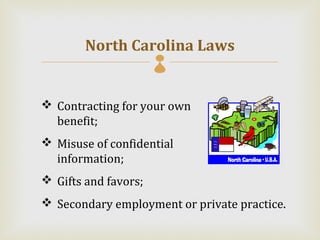
 Contracting for your own
  benefit;
 Misuse of confidential
  information;
 Gifts and favors;
 Secondary employment or private practice.
North Carolina General Statute
                           

          Contracting for your own benefit
North Carolina G.S. 14-234 This statute prohibits
making, or being in any manner concerned or
interested in making, a contract with the employer
(the Guilford Center) for one’s own benefit. The
penalty for violation of this general statute constitutes
a misdemeanor.
North Carolina General Statute
                              
           Misuse of confidential information
North Carolina G.S. 14-234.1 This general statute
applies to employees of the state of North Carolina
and any of the state’s political subdivisions, which
includes the Guilford Center.

This statute prohibits using confidential information obtained
by virtue of a public office (employment) for personal gain, or
aiding another to gain from using such information. Violation of
this general statute constitutes a misdemeanor.
North Carolina General Statute
                                       
                        Gifts and favors regulated
North Carolina G.S. 133-32 This statute states that employees who are
responsible for preparing plans, bid specifications or estimates for contracts, or
awarding or administering agency contracts cannot give or receive gifts or
favors from contractors, subcontractors or suppliers who have contracts with
local government agencies, or have performed under a contract within the past
year or anticipates bidding on one. Violation (by giver or receiver) constitutes a
misdemeanor.
Guilford Center employees are prohibited from accepting gifts from
consumers, providers or vendors, other than common courtesy items
such as coffee or snacks served during a training event.
Secondary Employment or
                Private Practice
                               
 Employees of the Guilford Center are prohibited from
  secondary employment, including private practice, without
  obtaining prior approval of their supervisor and management.
  This approval includes completion of Form MHL 16.
 It is important that all such private practice endeavors be
  distinct from Agency time and premises that have been paid
  with public funds. Therefore, the Guilford Center prohibits any
  employee from engaging in private practice on agency
  property or during those hours that the employee is working
  (or on duty) for the agency.
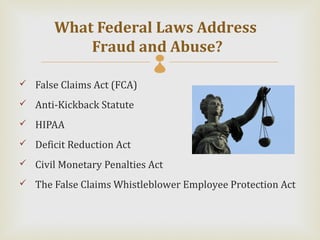
What Federal Laws Address
           Fraud and Abuse?
 False Claims Act (FCA)

 Anti-Kickback Statute

 HIPAA

 Deficit Reduction Act

 Civil Monetary Penalties Act

 The False Claims Whistleblower Employee Protection Act
Civil and Administrative Statutes
                       
              The False Claims Act
              (31 U.S.C. 3729-3733)

This is the law most often used to bring a case
 against a health care provider for the submission
 of false claims. The False Claims Act prohibits
 knowingly presenting (or causing to be presented)
 a false or fraudulent claim for payment or
 approval.
The False Claims Act
                    
  A false claim is a claim for payment for
services or supplies that were not provided
 specifically as presented or for which the
   provider is otherwise not entitled to
                  payment.
False Claims Act Examples
                               
A claim…
   indicating a higher level of service than was actually
    provided
   for a service the provider knows is not reasonable and
    necessary
   for clinical services provided by an individual who does not
    meet the minimum education, experience or licensure
    requirements to provide the service
   for a service or supply that was never provided
   indicating the service was provided for a diagnosis code
    other than the true diagnosis code in order to obtain
    reimbursement for the service (which would not have been
    covered if the true diagnosis were submitted)
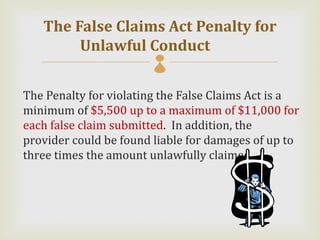
The False Claims Act Penalty for
        Unlawful Conduct
The Penalty for violating the False Claims Act is a
minimum of $5,500 up to a maximum of $11,000 for
each false claim submitted. In addition, the
provider could be found liable for damages of up to
three times the amount unlawfully claimed.
Anti –Kickback
                (U.S.C. 1320)
                        
 Anti-Kickback
 It is a crime to knowingly and willfully solicit,
 receive, offer, or pay remuneration of any kind
 (money, goods or services) for the referral of an
 individual to another for the purpose of supplying
 services that are covered by a Federal Health care
 Program; or purchasing, leasing, ordering, or
 arranging for any good, facility, service, or item
 that is covered by a Federal health care program.
Anti-Kickback
                         

           Penalty for Unlawful Conduct

The penalty may include the imposition of a fine of up
  to $25,000, imprisonment of up to 5 years, or both.
     In addition, the provider can be excluded from
     participation in Federal health care programs.
Anti-Kickback
                      

                  Example

Provider pays a referral fee and records the
  payment as salary or pays a higher than
  normal pay rate to compensate for the
  referrals.
Anti Kickback Statute
                          
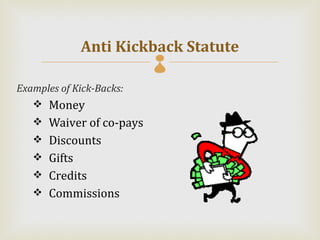
Examples of Kick-Backs:
    Money
    Waiver of co-pays
    Discounts
    Gifts
    Credits
    Commissions
The Deficit Reduction Act
                      

Requires health care organizations who bill
(providers) or pay out (LMEs) more than $5
million annually in Medicaid to have an effective
corporate compliance program in place as of
January 1, 2007 as…

           A Condition of Payment
Civil Monetary Penalties Law
               (42 U.S.C. 1320)

     Not provided as indicated by the coding on the claim
     Not medically necessary
This is a comprehensive statute that covers an array of
fraudulent and abusive activities and is very similar to the False
Claims Act. This law prohibits a provider from presenting, or
causing to be presented, claims for services that the provider
“knows, or should have known” were…
Civil Monetary Penalties Law
                            

  Furnished by a licensed physician who obtained his/her
   license through misrepresentation of a material fact.
 Furnished by a physician who was not certified in the
  medical specialty that he/she claimed to be certified in or
 Furnished by a practitioner who was excluded from
  participation in the Federal Health Care Program to which
  the claim was submitted
Obstruction of a Criminal Investigation of Health
                  Care Offenses
                 (18 U.S.C. 1518)
                         

 It is a crime to willfully prevent, obstruct, mislead,
or delay the communication of records relating to a
        Federal health care offense to a criminal
investigator. This law also applies to most types of
                   health care plans.
Obstruction of a Criminal Investigation
                        
          Penalty for Unlawful Conduct

 The penalty may include the imposition of a fine,
  imprisonment of up to 5 years, or both.
 Add exclusions and how you cannot do any role…
Your Responsibilities as Managers
      with The Guilford Center
                            

 Include staff adherence to rules,
  regulations and overall compliance in
  your evaluations;
 Maintain awareness in order to detect violations and
  properly report them;
 Never retaliate against staff who report issues in good
  faith.
Your Responsibility as Employees of
         The Guilford Center  

 Be certain you have read the compliance plan, policies and
  procedures related to your job and fully understand them.
 Ask questions about anything you are unsure of
 Perform your work with integrity
 If you learn of impropriety or suspect it, report it! Either by
  informing management or through the hotline.
 Be cooperative with investigations
How Do I Report Suspected
            Fraud and Abuse?
 Contact the Division of Medical Assistance by calling the
  DHHS Customer Service Center at 1-800-662-7030
  (English or Spanish) or;
 Call the Medicaid fraud, waste and program abuse tip-
  line at 1-877-DMA-TIP1 (1-877-362-8471); or
 Call the Health Care Financing Administration Office of
  Inspector General's Fraud Line at 1-800-HHS-TIPS; or
 Call the State Auditor's Waste Line: 1-800-730-TIPS; or
 Complete and submit a Medicaid fraud and abuse confidential on
  .
Corporate Compliance Is In the
                 News…           
 The Affordable Care Act was enacted on March 23, 2010.
 CMS created the Center for Program Integrity on April 11, 2010.
 Governor Perdue signed Senate Bill 675, Prohibit Medicaid
  Fraud/Anti-Kickback law (Session Law 2010-185).
 The results of Program Integrity’s efforts can be seen everyday at
  the Office of Inspector General’s (OIG) website.
OIG’s Most Wanted List: http://oig.hhs.gov/fraud/fugitives/index.asp
   In recent news, a Charlotte women was arrested for a $650,000
   Medicaid fraud scheme. Click here to read the Press Release from
   the Department of Justice.

Corporate compliance powerpoint

  • 1.
  • 2.
    Corporate Compliance  The federal Deficit Reduction Act and subsequent Medicaid Integrity Program requires that all health care entities that annually bill or pay out $5 million or more in Medicaid establish a Corporate Compliance Program. A program is recommended for all health care entities.
  • 3.
    Corporate Compliance  The focus of our program is on ethics and integrity in the workplace and compliance with federal and state laws related to fraud, false claims, theft or embezzlement, kickbacks, or other violations.
  • 4.
    Corporate Compliance is…  A working environment that encourages -  Ethical and Proper Ways to Do Business  Commitment  Encourages Problems to be Reported  Provides a Process with Constant Monitoring Processes which Prevent, Detect or Deter Non-Compliant Behavior
  • 5.
    What are theBenefits of a Corporate Compliance Program?   Increases awareness of compliance issues among Board, staff, vendors, and providers;  Prevents and detects violations;  Reduces potential liability;  Enhances positive reputation by exercising due diligence.
  • 6.
    The Guilford Center’sCorporate Compliance Program Includes:   Corporate Compliance Officer;  Corporate Compliance Committee;  Policy and procedures;  Corporate Compliance Plan (found by going to P:/ Drive, then the 2012 “Policies and Procedures” folder, and lastly the “Board and Director” folder);  Training for all employees, supervisors and providers;  Code of Ethics;  Screening procedures for all employees, independent contractors and vendors to ensure they have not been sanctioned by a federal or state law enforcement, regulatory or licensing agency;  On-going risk assessment of business functions;  Anonymous whistle blower hotline.
  • 7.
    It is thepolicy of The Guilford Center…   To review and investigate all allegations of fraud and/or abuse, whether internal or external;  To take corrective actions for any supported allegations after a thorough investigation; and  To report confirmed misconduct to the appropriate parties and/or Agencies.
  • 8.
    The Guilford Center Policies & Procedures   Employment and/or Contracting with Excluded Parties  Compliance Training  Duty to Report  County Compliance Hotline  Non-Retaliation  Responding to Reports of Non-Compliance  Employee Consent to Search  Voluntary Disclosure to Third Parties  Responding to a Subpoena  Responding to a Search Warrant  Responding to Unannounced Visits by Government Officials/Auditors B-6 Corporate Compliance Policy: Open Policy…
  • 9.
    Laws and Regulations  Several federal and North Carolina statutes serve as the basis for our requirements for compliance. The following slides will outline statutes relating to compliance issues. As an employee of the Guilford Center it is your responsibility to report any behaviors that might constitute failure to comply.
  • 10.
    North Carolina Laws   Contracting for your own benefit;  Misuse of confidential information;  Gifts and favors;  Secondary employment or private practice.
  • 11.
    North Carolina GeneralStatute  Contracting for your own benefit North Carolina G.S. 14-234 This statute prohibits making, or being in any manner concerned or interested in making, a contract with the employer (the Guilford Center) for one’s own benefit. The penalty for violation of this general statute constitutes a misdemeanor.
  • 12.
    North Carolina GeneralStatute  Misuse of confidential information North Carolina G.S. 14-234.1 This general statute applies to employees of the state of North Carolina and any of the state’s political subdivisions, which includes the Guilford Center. This statute prohibits using confidential information obtained by virtue of a public office (employment) for personal gain, or aiding another to gain from using such information. Violation of this general statute constitutes a misdemeanor.
  • 13.
    North Carolina GeneralStatute  Gifts and favors regulated North Carolina G.S. 133-32 This statute states that employees who are responsible for preparing plans, bid specifications or estimates for contracts, or awarding or administering agency contracts cannot give or receive gifts or favors from contractors, subcontractors or suppliers who have contracts with local government agencies, or have performed under a contract within the past year or anticipates bidding on one. Violation (by giver or receiver) constitutes a misdemeanor. Guilford Center employees are prohibited from accepting gifts from consumers, providers or vendors, other than common courtesy items such as coffee or snacks served during a training event.
  • 14.
    Secondary Employment or Private Practice   Employees of the Guilford Center are prohibited from secondary employment, including private practice, without obtaining prior approval of their supervisor and management. This approval includes completion of Form MHL 16.  It is important that all such private practice endeavors be distinct from Agency time and premises that have been paid with public funds. Therefore, the Guilford Center prohibits any employee from engaging in private practice on agency property or during those hours that the employee is working (or on duty) for the agency.
  • 15.
    What Federal LawsAddress Fraud and Abuse?  False Claims Act (FCA)  Anti-Kickback Statute  HIPAA  Deficit Reduction Act  Civil Monetary Penalties Act  The False Claims Whistleblower Employee Protection Act
  • 16.
    Civil and AdministrativeStatutes  The False Claims Act (31 U.S.C. 3729-3733) This is the law most often used to bring a case against a health care provider for the submission of false claims. The False Claims Act prohibits knowingly presenting (or causing to be presented) a false or fraudulent claim for payment or approval.
  • 17.
    The False ClaimsAct  A false claim is a claim for payment for services or supplies that were not provided specifically as presented or for which the provider is otherwise not entitled to payment.
  • 18.
    False Claims ActExamples  A claim…  indicating a higher level of service than was actually provided  for a service the provider knows is not reasonable and necessary  for clinical services provided by an individual who does not meet the minimum education, experience or licensure requirements to provide the service  for a service or supply that was never provided  indicating the service was provided for a diagnosis code other than the true diagnosis code in order to obtain reimbursement for the service (which would not have been covered if the true diagnosis were submitted)
  • 19.
    The False ClaimsAct Penalty for Unlawful Conduct The Penalty for violating the False Claims Act is a minimum of $5,500 up to a maximum of $11,000 for each false claim submitted. In addition, the provider could be found liable for damages of up to three times the amount unlawfully claimed.
  • 20.
    Anti –Kickback (U.S.C. 1320)   Anti-Kickback It is a crime to knowingly and willfully solicit, receive, offer, or pay remuneration of any kind (money, goods or services) for the referral of an individual to another for the purpose of supplying services that are covered by a Federal Health care Program; or purchasing, leasing, ordering, or arranging for any good, facility, service, or item that is covered by a Federal health care program.
  • 21.
    Anti-Kickback  Penalty for Unlawful Conduct The penalty may include the imposition of a fine of up to $25,000, imprisonment of up to 5 years, or both. In addition, the provider can be excluded from participation in Federal health care programs.
  • 22.
    Anti-Kickback  Example Provider pays a referral fee and records the payment as salary or pays a higher than normal pay rate to compensate for the referrals.
  • 23.
    Anti Kickback Statute  Examples of Kick-Backs:  Money  Waiver of co-pays  Discounts  Gifts  Credits  Commissions
  • 24.
    The Deficit ReductionAct  Requires health care organizations who bill (providers) or pay out (LMEs) more than $5 million annually in Medicaid to have an effective corporate compliance program in place as of January 1, 2007 as… A Condition of Payment
  • 25.
    Civil Monetary PenaltiesLaw (42 U.S.C. 1320)  Not provided as indicated by the coding on the claim  Not medically necessary This is a comprehensive statute that covers an array of fraudulent and abusive activities and is very similar to the False Claims Act. This law prohibits a provider from presenting, or causing to be presented, claims for services that the provider “knows, or should have known” were…
  • 26.
    Civil Monetary PenaltiesLaw   Furnished by a licensed physician who obtained his/her license through misrepresentation of a material fact.  Furnished by a physician who was not certified in the medical specialty that he/she claimed to be certified in or  Furnished by a practitioner who was excluded from participation in the Federal Health Care Program to which the claim was submitted
  • 27.
    Obstruction of aCriminal Investigation of Health Care Offenses (18 U.S.C. 1518)  It is a crime to willfully prevent, obstruct, mislead, or delay the communication of records relating to a Federal health care offense to a criminal investigator. This law also applies to most types of health care plans.
  • 28.
    Obstruction of aCriminal Investigation  Penalty for Unlawful Conduct  The penalty may include the imposition of a fine, imprisonment of up to 5 years, or both.  Add exclusions and how you cannot do any role…
  • 29.
    Your Responsibilities asManagers with The Guilford Center   Include staff adherence to rules, regulations and overall compliance in your evaluations;  Maintain awareness in order to detect violations and properly report them;  Never retaliate against staff who report issues in good faith.
  • 30.
    Your Responsibility asEmployees of The Guilford Center   Be certain you have read the compliance plan, policies and procedures related to your job and fully understand them.  Ask questions about anything you are unsure of  Perform your work with integrity  If you learn of impropriety or suspect it, report it! Either by informing management or through the hotline.  Be cooperative with investigations
  • 31.
    How Do IReport Suspected Fraud and Abuse?  Contact the Division of Medical Assistance by calling the DHHS Customer Service Center at 1-800-662-7030 (English or Spanish) or;  Call the Medicaid fraud, waste and program abuse tip- line at 1-877-DMA-TIP1 (1-877-362-8471); or  Call the Health Care Financing Administration Office of Inspector General's Fraud Line at 1-800-HHS-TIPS; or  Call the State Auditor's Waste Line: 1-800-730-TIPS; or  Complete and submit a Medicaid fraud and abuse confidential on .
  • 32.
    Corporate Compliance IsIn the News…   The Affordable Care Act was enacted on March 23, 2010.  CMS created the Center for Program Integrity on April 11, 2010.  Governor Perdue signed Senate Bill 675, Prohibit Medicaid Fraud/Anti-Kickback law (Session Law 2010-185).  The results of Program Integrity’s efforts can be seen everyday at the Office of Inspector General’s (OIG) website. OIG’s Most Wanted List: http://oig.hhs.gov/fraud/fugitives/index.asp In recent news, a Charlotte women was arrested for a $650,000 Medicaid fraud scheme. Click here to read the Press Release from the Department of Justice.