HOLDING COMPANY
AND
CONSOLIDATED BALANCE SHEET
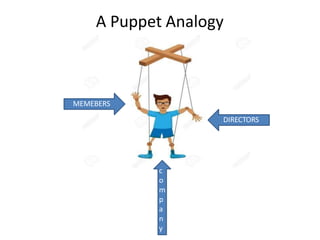
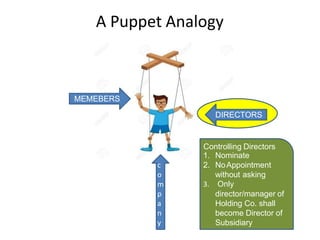
A Puppet Analogy
DIRECTORS
c
o
m
p
a
n
y
MEMEBERS
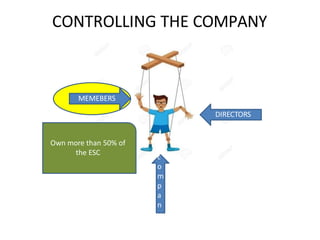
CONTROLLING THE COMPANY
c
o
m
p
a
n
y
MEMEBERS
DIRECTORS
Own more than 50% of
the ESC
A Puppet Analogy
MEMEBERS
c
o
m
p
a
n
y
DIRECTORS
Controlling Directors
1. Nominate
2. NoAppointment
without asking
3. Only
director/manager of
Holding Co. shall
become Director of
Subsidiary
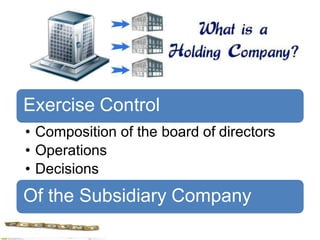
Exercise Control
• Composition of the board of directors
• Operations
• Decisions
Of the Subsidiary Company
HOLDING COMPANY
Section 2(46) of the Companies Act, 2013 defines
Holding Company. The company is said to be the
holding company if that particular company
holds/owns at least 50% of the other companies
and has the authority to make management
decisions, influences and controls the company’s
board of directors. A holding company may exist for
the sole purpose of controlling and managing
subsidiary companies.
SUBSIDIARY COMPANY
Section 2(87) of the Companies Act, 2013 defines
the Subsidiary Company. The subsidiary company is
the company that is controlled by the holding or
parent company. It is defined as a company/body
corporate where the holding company controls the
composition of the Board of Directors. As per the
Companies Amendment Act, 2017, Section 2(87)(ii),
if the holding company have control over more than
one-half of the voting power of another company,
that company will be identified as the subsidiary
company.
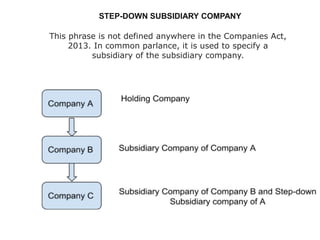
This phrase is not defined anywhere in the Companies Act,
2013. In common parlance, it is used to specify a
subsidiary of the subsidiary company.
STEP-DOWN SUBSIDIARY COMPANY
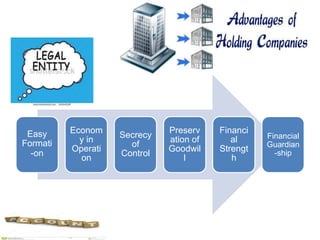
Easy
Formati
-on
Econom
y in
Operati
on
Secrecy
of
Control
Preserv
ation of
Goodwil
l
Financi
al
Strengt
h
Financial
Guardian
-ship
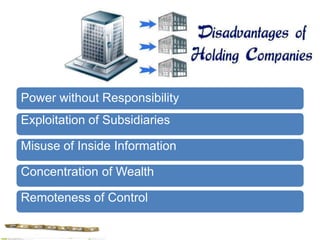
Power without Responsibility
Exploitation of Subsidiaries
Misuse of Inside Information
Concentration of Wealth
Remoteness of Control
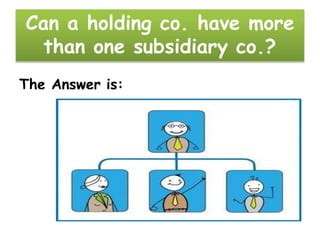
Can a holding co. have more
than one subsidiary co.?
The Answer is:
Consolidated Financial Statements
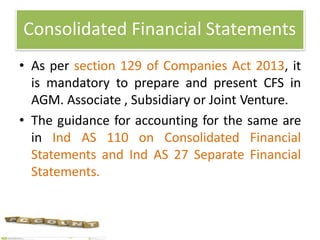
• As per section 129 of Companies Act 2013, it
is mandatory to prepare and present CFS in
AGM. Associate , Subsidiary or Joint Venture.
• The guidance for accounting for the same are
in Ind AS 110 on Consolidated Financial
Statements and Ind AS 27 Separate Financial
Statements.
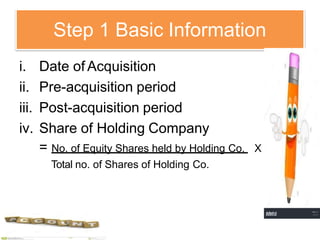
Step 1 Basic Information
100
i. Date of Acquisition
ii. Pre-acquisition period
iii. Post-acquisition period
iv. Share of Holding Company
= No. of Equity Shares held by Holding Co. X
Total no. of Shares of Holding Co.
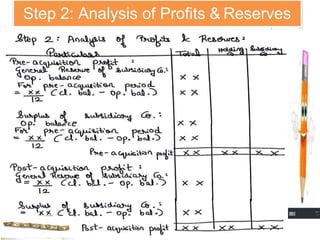
Step 2: Analysis of Profits & Reserves
Particulars Total Holding Co Subsidiary Co.
Pre Acquisition Profit:
General Reserve of Subsidiary Co.
For pre acquisition period = xx/12(Cl. Balance
– Op. Bal.)
Surplus of Subsidiary Co.:
Opening Bal.
For pre-acquisition period
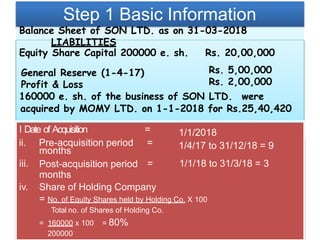
Step 1 Basic Information
Balance Sheet of SON LTD. as on 31-03-2018
LIABILITIES
Equity Share Capital 200000 e. sh. Rs. 20,00,000
General Reserve (1-4-17)
Profit & Loss
Rs. 5,00,000
Rs. 2,00,000
160000 e. sh. of the business of SON LTD. were
acquired by MOMY LTD. on 1-1-2018 for Rs.25,40,420
I Date of Acquisition =
ii. Pre-acquisition period =
1/1/2018
1/4/17 to 31/12/18 = 9
iii. = 1/1/18 to 31/3/18 = 3
months
Post-acquisition period
months
iv. Share of Holding Company
= No. of Equity Shares held by Holding Co. X 100
Total no. of Shares of Holding Co.
= 160000 x 100 = 80%
200000
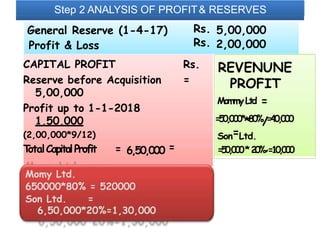
Step 2 ANALYSIS OF PROFIT& RESERVES
=
=
REVENUNE
PROFIT
=
General Reserve (1-4-17) 5,00,000
Profit & Loss
Rs.
Rs. 2,00,000
CAPITAL PROFIT Rs.
Reserve before Acquisition =
5,00,000
Profit up to 1-1-2018
1,50,000
(2,00,000*9/12)
T
otalCapitalProfit = 6,50,000
Momy Ltd.
650000*80% = 520000
Son Ltd. =
6,50,000*20%=1,30,000
MommyLtd
=50,000**80%/=40,000
Son=Ltd.
=50,000*20%,=10,000
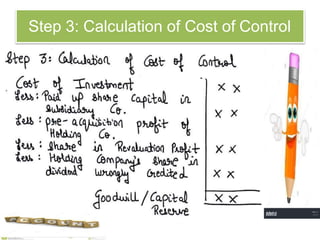
Step 3: Calculation of Cost of Control
Balance S
h
C
e
e
O
t
o
S
f
T
S
O
O
N
F
L
T
C
D
.
O
a
N
s
o
T
n
R3
1
O-
0
L3
-
2
0
1
8
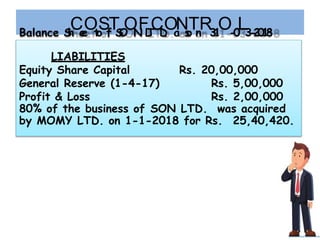
LIABILITIES
Equity Share Capital
General Reserve (1-4-17)
Rs. 20,00,000
Rs. 5,00,000
Profit & Loss Rs. 2,00,000
80% of the business of SON LTD. was acquired
by MOMY LTD. on 1-1-2018 for Rs. 25,40,420.
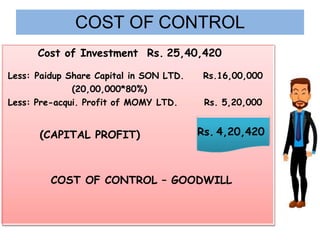
COST OF CONTROL
Cost of Investment Rs. 25,40,420
Less: Paidup Share Capital in SON LTD. Rs.16,00,000
(20,00,000*80%)
Less: Pre-acqui. Profit of MOMY LTD. Rs. 5,20,000
(CAPITAL PROFIT)
COST OF CONTROL – GOODWILL
Rs. 4,20,420
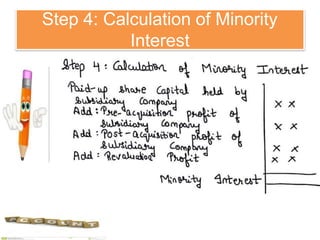
Step 4: Calculation of Minority
Interest
TREATMENT OF FICTITIOUS
ASSETS
• Given on the assets side of the balance
sheet,
• If there, then those items must be
deducted from the capital profits or added
to the capital loss before distributing the
same among the holding company and
minority shareholders.
ELIMINATION OF COMMON TRANSACTIONS
• Common transactions should be eliminated.
Such transactions are :
1. Goods sold on credit by the holding company to
the subsidiary company or vice-versa will appear
as debtors in the Balance Sheet of the company
selling goods and as creditors in the balance
sheet of the company purchasing goods.
2. Loans advanced by the HC to the SC or vice-
versa appears as an asset in the Balance sheet
of the company which gives such loans and as a
liability in the balance sheet of the company that
takes loans.
TREATMENT OF GOODWILL
• Goodwill appearing in the balance sheet of
subsidiary company will be shown along
with goodwill (if any) of the holding
company.
• In case there is capital reserve it will be
adjusted in Capital reserve on
consolidation.
TREATMENT OF UNREALISED
PROFIT
• If the goods sold at a profit by the subsidiary
company to the holding company or vice-versa
remain unsold at the close of the financial year,
the profit charged by the company on unsold
goods remains unrealized.
• So, a stock reserve is created and profit is
reduced by the unrealized profit.
TREATMENT OF CONTINGENT
LIABILITIES
• They are shown as follows :
1. Liability in respect of bills discounted not yet
matured. It is possible that bills may be
discounted on the due date and liability may
arise.
2. Amount uncalled on partly paid shares held.
3. Arrears of dividend on Cumulative
preference shares.
TREATMENT OF UNCLAIMED
DIVIDEND
• If unclaimed dividend is given in the
Balance Sheet of the subsidiary account, it
must the added in full to the total of
minority interest in the consolidated
balance sheet.
OTHERS
• Other than the discussed treatments the
following treatments are also to be done, if
present :
1. Revaluation of assets and liabilities;
2. Bonus shares;
3. Treatment of dividend;
4. Interim dividend;
5. Treatment of debentures.

Holding Companys.pptx....................

  • 1.
  • 3.
  • 5.
  • 6.
    A Puppet Analogy MEMEBERS c o m p a n y DIRECTORS ControllingDirectors 1. Nominate 2. NoAppointment without asking 3. Only director/manager of Holding Co. shall become Director of Subsidiary
  • 7.
    Exercise Control • Compositionof the board of directors • Operations • Decisions Of the Subsidiary Company
  • 8.
    HOLDING COMPANY Section 2(46)of the Companies Act, 2013 defines Holding Company. The company is said to be the holding company if that particular company holds/owns at least 50% of the other companies and has the authority to make management decisions, influences and controls the company’s board of directors. A holding company may exist for the sole purpose of controlling and managing subsidiary companies.
  • 9.
    SUBSIDIARY COMPANY Section 2(87)of the Companies Act, 2013 defines the Subsidiary Company. The subsidiary company is the company that is controlled by the holding or parent company. It is defined as a company/body corporate where the holding company controls the composition of the Board of Directors. As per the Companies Amendment Act, 2017, Section 2(87)(ii), if the holding company have control over more than one-half of the voting power of another company, that company will be identified as the subsidiary company.
  • 10.
    This phrase isnot defined anywhere in the Companies Act, 2013. In common parlance, it is used to specify a subsidiary of the subsidiary company. STEP-DOWN SUBSIDIARY COMPANY
  • 11.
  • 12.
    Power without Responsibility Exploitationof Subsidiaries Misuse of Inside Information Concentration of Wealth Remoteness of Control
  • 13.
    Can a holdingco. have more than one subsidiary co.? The Answer is:
  • 16.
    Consolidated Financial Statements •As per section 129 of Companies Act 2013, it is mandatory to prepare and present CFS in AGM. Associate , Subsidiary or Joint Venture. • The guidance for accounting for the same are in Ind AS 110 on Consolidated Financial Statements and Ind AS 27 Separate Financial Statements.
  • 17.
    Step 1 BasicInformation 100 i. Date of Acquisition ii. Pre-acquisition period iii. Post-acquisition period iv. Share of Holding Company = No. of Equity Shares held by Holding Co. X Total no. of Shares of Holding Co.
  • 18.
    Step 2: Analysisof Profits & Reserves Particulars Total Holding Co Subsidiary Co. Pre Acquisition Profit: General Reserve of Subsidiary Co. For pre acquisition period = xx/12(Cl. Balance – Op. Bal.) Surplus of Subsidiary Co.: Opening Bal. For pre-acquisition period
  • 19.
    Step 1 BasicInformation Balance Sheet of SON LTD. as on 31-03-2018 LIABILITIES Equity Share Capital 200000 e. sh. Rs. 20,00,000 General Reserve (1-4-17) Profit & Loss Rs. 5,00,000 Rs. 2,00,000 160000 e. sh. of the business of SON LTD. were acquired by MOMY LTD. on 1-1-2018 for Rs.25,40,420 I Date of Acquisition = ii. Pre-acquisition period = 1/1/2018 1/4/17 to 31/12/18 = 9 iii. = 1/1/18 to 31/3/18 = 3 months Post-acquisition period months iv. Share of Holding Company = No. of Equity Shares held by Holding Co. X 100 Total no. of Shares of Holding Co. = 160000 x 100 = 80% 200000
  • 20.
    Step 2 ANALYSISOF PROFIT& RESERVES = = REVENUNE PROFIT = General Reserve (1-4-17) 5,00,000 Profit & Loss Rs. Rs. 2,00,000 CAPITAL PROFIT Rs. Reserve before Acquisition = 5,00,000 Profit up to 1-1-2018 1,50,000 (2,00,000*9/12) T otalCapitalProfit = 6,50,000 Momy Ltd. 650000*80% = 520000 Son Ltd. = 6,50,000*20%=1,30,000 MommyLtd =50,000**80%/=40,000 Son=Ltd. =50,000*20%,=10,000
  • 21.
    Step 3: Calculationof Cost of Control
  • 22.
    Balance S h C e e O t o S f T S O O N F L T C D . O a N s o T n R3 1 O- 0 L3 - 2 0 1 8 LIABILITIES Equity ShareCapital General Reserve (1-4-17) Rs. 20,00,000 Rs. 5,00,000 Profit & Loss Rs. 2,00,000 80% of the business of SON LTD. was acquired by MOMY LTD. on 1-1-2018 for Rs. 25,40,420.
  • 23.
    COST OF CONTROL Costof Investment Rs. 25,40,420 Less: Paidup Share Capital in SON LTD. Rs.16,00,000 (20,00,000*80%) Less: Pre-acqui. Profit of MOMY LTD. Rs. 5,20,000 (CAPITAL PROFIT) COST OF CONTROL – GOODWILL Rs. 4,20,420
  • 24.
    Step 4: Calculationof Minority Interest
  • 25.
    TREATMENT OF FICTITIOUS ASSETS •Given on the assets side of the balance sheet, • If there, then those items must be deducted from the capital profits or added to the capital loss before distributing the same among the holding company and minority shareholders.
  • 26.
    ELIMINATION OF COMMONTRANSACTIONS • Common transactions should be eliminated. Such transactions are : 1. Goods sold on credit by the holding company to the subsidiary company or vice-versa will appear as debtors in the Balance Sheet of the company selling goods and as creditors in the balance sheet of the company purchasing goods. 2. Loans advanced by the HC to the SC or vice- versa appears as an asset in the Balance sheet of the company which gives such loans and as a liability in the balance sheet of the company that takes loans.
  • 27.
    TREATMENT OF GOODWILL •Goodwill appearing in the balance sheet of subsidiary company will be shown along with goodwill (if any) of the holding company. • In case there is capital reserve it will be adjusted in Capital reserve on consolidation.
  • 28.
    TREATMENT OF UNREALISED PROFIT •If the goods sold at a profit by the subsidiary company to the holding company or vice-versa remain unsold at the close of the financial year, the profit charged by the company on unsold goods remains unrealized. • So, a stock reserve is created and profit is reduced by the unrealized profit.
  • 29.
    TREATMENT OF CONTINGENT LIABILITIES •They are shown as follows : 1. Liability in respect of bills discounted not yet matured. It is possible that bills may be discounted on the due date and liability may arise. 2. Amount uncalled on partly paid shares held. 3. Arrears of dividend on Cumulative preference shares.
  • 30.
    TREATMENT OF UNCLAIMED DIVIDEND •If unclaimed dividend is given in the Balance Sheet of the subsidiary account, it must the added in full to the total of minority interest in the consolidated balance sheet.
  • 31.
    OTHERS • Other thanthe discussed treatments the following treatments are also to be done, if present : 1. Revaluation of assets and liabilities; 2. Bonus shares; 3. Treatment of dividend; 4. Interim dividend; 5. Treatment of debentures.