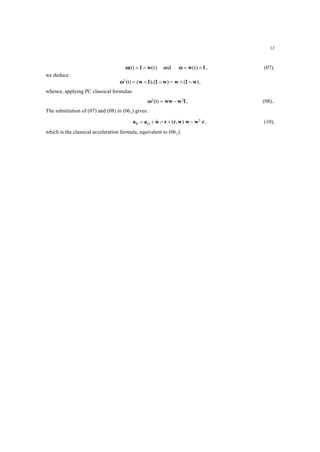
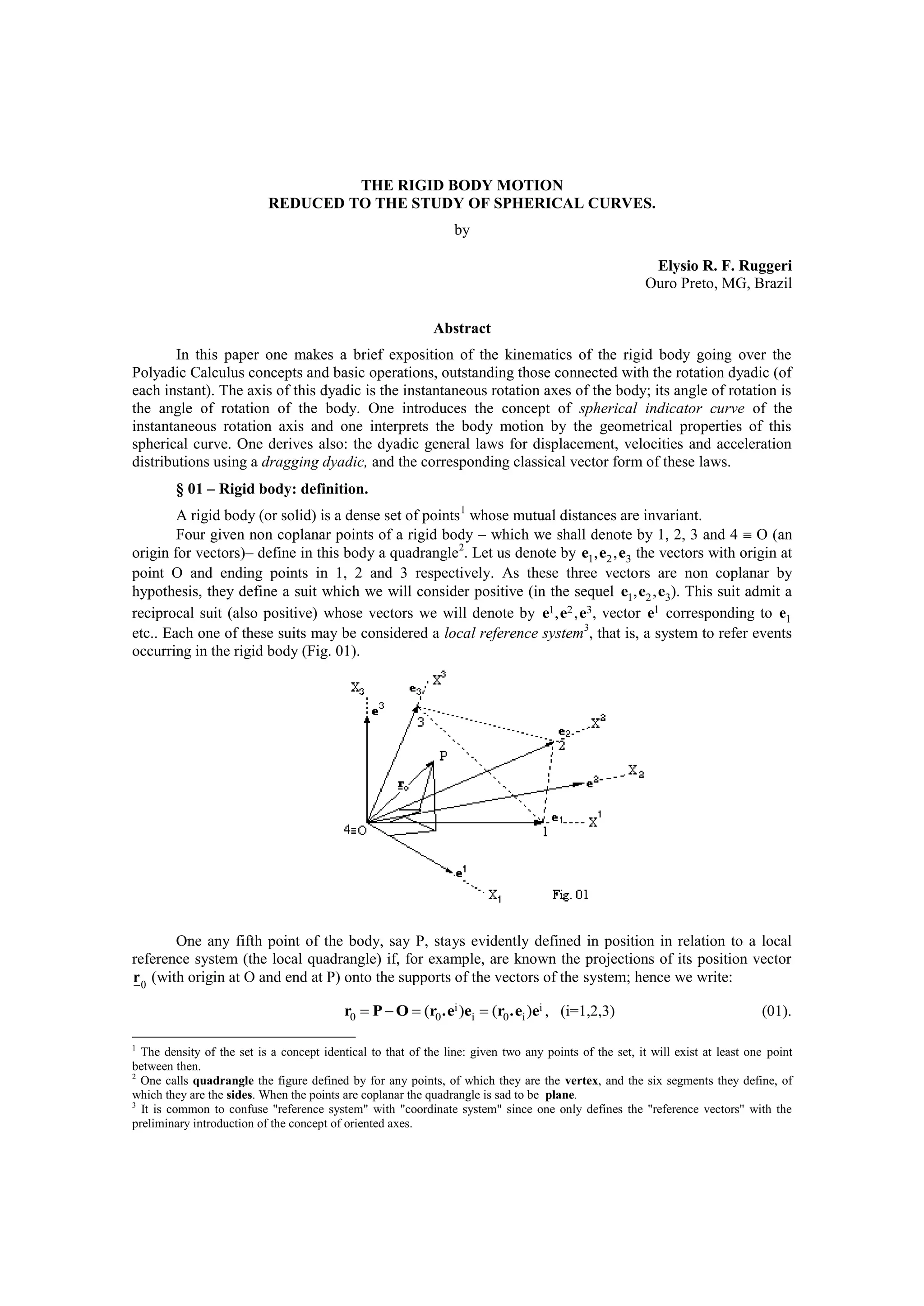
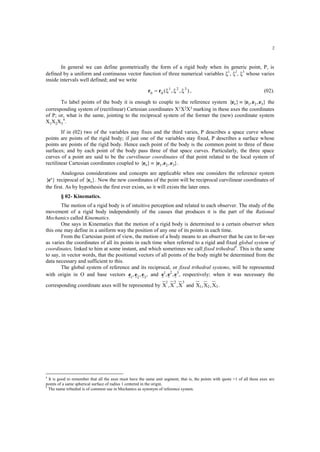
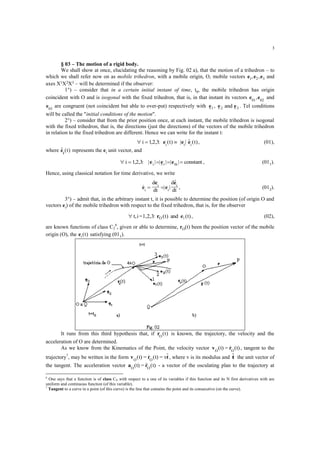
1) The motion of a rigid body can be described by tracking the position of a reference trihedron attached to the body over time.
2) At each instant, the orientation of the mobile trihedron relative to a fixed reference frame is defined by a rotation dyadic with a rotation axis and angle.
3) The rotation dyadic transforms the fixed frame vectors into the mobile frame vectors, allowing the position and orientation of any point on the rigid body to be determined as a function of time.

![7
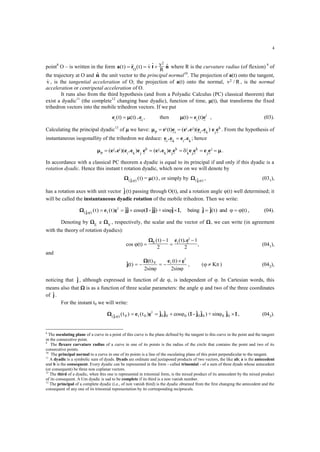
In double points of the indicatrix (Fig. 04 b) to f)) the velocities and accelerations are not the same
in general, as in the case of crunode B15
; but they should be equal in case the multiple point be a
reversing point, point C, or opposed vectors in case of a cuspidal point16
, point D. There are rare cases
in which one of the tangents in a double point, like E (Fig. 04,e)), has a contact of the first order with a
branch of the curve and a contact of the third order with other branch (the point is a inflexion point in this
last branch); the double point is said to be a flecnoidal point. Rare also is the case in which the double
point is biflecnoidal point: both tangents have a third order contact with the respective branch (the
double point is a point of inflexion for the two branches simultaneously) as shown in Fig. 04,f).
An important indicator point is that to which correspond the null velocity (hence, also null
acceleration), like cuspidal indicator points to which we shall call translation indicators. This second
name derives from a mechanical view because the indicator needs to stop at the point on the indicator to
change the sense of its movement. This means that when t tends to a certain value, say ttra, the
corresponding indicator suffers a brake in its movement onto the indicator up to reach the cuspidal
position, to accelerate at once. The rotation motion of the mobile trihedron is annihilated at that cuspidal
instant 17
.
Differentiating the rotation dyadic.
In agreement with PC, the differential of the instantaneous rotation dyadic can be written in the
form
j.
j
ee jj
ˆd)
ˆ
(d)()t(d=)t(d ˆ
i
i),ˆ(
, (08),
the first and the second pieces of the last member representing the partial derivatives of in the instant t,
respectively for fixed jˆ and . We have:
jjjjjjj
ˆdsen)ˆˆ(d
2
sen2]ˆcos+)ˆˆ-(sen[d(t)d 2
),ˆ( , (081).
Putting ii jj kk , the first two pieces of (081) can be written in the following different forms:
]ˆˆ[d])ˆ(cos)ˆˆ(sen[dd)( )2/,ˆ(ˆ jj jjjjj
)ˆˆsenˆˆcosˆˆcosˆˆsen(d kkikkiii (09).
Since kj ˆd
T
Rˆd where T is the torsion radius of the indicator at point K, and in agreement with the PC
rules, we can write:
j
j
jkkjjjj.
j
jj
ˆ
ˆ
and)ˆˆ(d
T
R
)ˆˆ(dˆd
ˆ
)ˆˆ(
.
So, the last piece in the last member of (08), or the last two pieces in the second member of (081), can be
written in the form
kkjj.
j
ˆsend
T
Rˆˆ
2
send
T
R
2ˆd)
ˆ
( 2
,
or, ERRADO
)]ˆˆˆˆ()ˆˆˆˆ(
2
[tgsendˆd)
ˆ
( kjjkkiikj.
j
, (10).
15
A point of a curve is sad to be a crunode when in this point there are two different tangents (at least) to the curve.
16
A point of a curve is sad to be a reversion point when the unit vectors of the tangents in this point are, respectively equal or
opposed vectors.
17
As we shall see ahead, in the cuspidal instant the movement is a instantaneous translation.](https://image.slidesharecdn.com/corpo-rigido-130512174216-phpapp01/85/Corpo-rigido-7-320.jpg)
![8
Finally, adding member by member (09) and (10) it comes
d d ( , ) ( , / )
[ ]k k
kk
2
+d sen [tg
2
( ) ( )]ki ik kj jk , (11),
To this (dyadic) differential is associated, in the instant t and base {, , }i j k , the matrix
[ ] ,
d
d sen d cos 2d sen
d cos d sen d sen
2d sen d sen
( )
2
2
k ijk
2
2
0
, (111).
General law of displacement distribution.
Differentiating (05) in the instant t we have:
d t d t d d t d d t dO O O
T
r r r r .r r . .rk k k
( ) ( ) ( ) ( )( , ) ( , ) ( , )
0
, (12).
Being T. , we deduce by differentiation: d dT T . . . As the differential of the
transpose is equal to the transpose of the differential, it comes: d dT T T . . ( ) , that is, the dyadic
d T . is anti-symmetric. Considering (04) and remembering that e .e e .ei k i k (by hypothesis the
trihedrons are isogonal) we come to
d t t d t tT
i
i ( ) ( ) ( ) ( ). e e , (13).
Putting
d t d t t d tT T ( ) ( ) ( ) ( ) . , (131),
it comes, finally, from (12), the general law of the displacement distribution of the point of the solid,
d t d t d d t d tO Or r .r r .rk
( ) ( ) ( ) ( )( , )
0
, (14).
beeing
d d d tr .r .rk
( , )
( ) 0
, (141).
Definition: (dragging dyadic)
The differential dyadic d, which permits the calculus of the instantaneous drag displacement
of the generic point of the body (with respect to O) will be called the dragging dyadic of the
point.
From (04) and (11) we can calculate the anti-symmetric matrix associated to the draging dyadic
(131) of the generic point with respect to the Frenet-Serret trihedron of that point in the instant t; we find
out, after some developments:
[ ( )]d t
d 2d sen
d d sen
d sen d sen
2
2
ijk
0
0
2
2
0
, (15).
Being d(t) an anti-symmetric dyadic, we can write it in the form
d (t) d t d t c c( ) ( ) , (16),
or, if d(t)V is the vector of d(t):](https://image.slidesharecdn.com/corpo-rigido-130512174216-phpapp01/85/Corpo-rigido-8-320.jpg)

2
, (20),
can represent a first stage. The vector ( , / )k
.r 2 0
is the rotation of r0
about the axes k of the instant t
by an angle of / 2 radians; the vector ( ) r .k k0
is the r0
component in the direction of k . Then, the
vector between brackets is the rotation, by the angle / 2, of the orthogonal projection of r0
onto the
osculating plane of the instant t about the instantaneous rotation axes. The vector
d = d sen [tg02
r ki ik kj jk .r
2 0
( ) ( )] , (21),
represent a second stage. The dyadic that operates on r0
can be written in the form
d = d sen [ tg
2
tg
202
( ) ( )]k i j i j k , (22),
with respect to the Frenet-Serret's trihedron of the indicator curve, and its associated matrix is
[d ] d sen
tg
2
tg
2
02 ijk
0 0
0 0 1
1 0
, (221).
This dyadic has a vanishing third; it second has associate matrix](https://image.slidesharecdn.com/corpo-rigido-130512174216-phpapp01/85/Corpo-rigido-9-320.jpg)
![10
[(d ) ] (d sen
tg
2
tg
2
tg
2
0
02 2 ijk
2 2
)2
1 0
0
0 0
, (23),
and can be written in the Cartesian form
( ) ( ) ( ) ( )d d sen tg
2
tg
202
2 2
2
i j i j , (231).
As the scalar of 202)d( is ( ) ( ) ( )d sen tg
2
d sen cos2 2
2 21 2
2
, this dyadic is linear in general,
being ortolinear in the instants in which K / 2 (K=0,±1,±2, ...). Hence, the dyadic d 02 in study is
planar in general and, evidently, its scalar vanishes. The expression (22) of d 02 clearly shows its
planes, being possible to easily confirm that: 1) - the antecedent and the consequent of its second are,
respectively, perpendicular to the planes of its antecedent and consequent; 2) - that the rectifying and
normal planes are bisectors of the dihedral defined by its planes. The transformed of r0
through this
dyadic is then a vector that belongs to the plane of its antecedent (Fig. 05). We write, then,
d d d01 02( , )k
.r r r 0
.
The dyadic d 02 is ortoplanar in the instant for which K / 2. But as it has vanishing scalar,
in this instants it is anti-triangular.
§ 04 – The general law of distribution of velocities and acceleration.
From the general displacement distribution law ((14),§ 03), we deduce immediately the general
law of distribution of velocities of the points of the solid:
v v v v .r v .rkP O O Ot t t t t( ) ( ) ( ) ( ) ( )( , )
0
, (01),
where, in agreement with ((13) and (131),§ 03),
( ) ( ) ( ) ( ) ( ) t t t t tT T
i
i . e e , (011),
or
( ) ( ) ( ) ( )t dt d t t dt dT
i
i e e , (012).
Definition:](https://image.slidesharecdn.com/corpo-rigido-130512174216-phpapp01/85/Corpo-rigido-10-320.jpg)
![11
The dyadic (t) - being the derivative with respect to time of the dragging dyadic of the generic
point of the body (with respect to O) - will be called instantaneous dragging rotation velocity
dyadic of the body.
With respect to the Frenet-Serret's trihedron of the spherical indicator curve of the instant t, the
associate matrix to the instantaneous dragging rotation velocity dyadic is
[ ( )] [( )]
t t
2 sen
sen
sen sen
2
2
ijk ijk
0
0
2
2
0
, (02).
As (t) is anti-symmetric, we can write it in the form
(t) t t w w( ) ( ) , (03)
where, in different representations,
w i j k(t) (t) (t) sen senV V
2 1
2
1
2
2
2
(04),
or
w u k i j k(t) sen sen tg 2
2 2
)
(041),
(t)V being the vector of (t). Then, the general law (01) assumes the classical form
v v w r v w P OP O Ot t t t t( ) ( ) ( ) ( ) ( ) ( ) , (05).
Notices:
1) -We should call e w ei i Poisson's formulas (generalized) since when the base
{ , , }e e e1 2 3 is normalized such formulas coincide with the classics (the Poisson's) i w i etc.
2) - If one pretend to deduce the expression of w as a function of the vectors of the mobile base
and its derivatives with respect to time, it is enough to consider 2w e ei
i, to substitute
each ei by its (classic) expression as a function of the vectors of the base { , , }e e e1 2 3 and to
develop the calculations; one finds:
w e e e e .e e e .e e e .e e ( )[( ) ( ) ( ) ]1 2 3
2 3 1 3 1 2 1 2 3 , (041).
The classical formula corresponding to (041) is
w j .k i k . i j i . j k ( ) ( ) ( ) .
*
Differentiating (01), it comes:
d t d t d d t d d t d t t dP O O Ov v v v .r v .r . rk
( ) ( ) ( ) ( ) ( ) ( )( , )
0
or, remembering ((141),§ 03), and considering (012):
d d d dtP Ov v .r ( ) 2 , (06).
Expression (06) gives the general differential law of the velocity distribution of the points of the solid
in the interval of time dt. Dividing both members of (06) by the correspondent interval of time we obtain
the general law of acceleration of the points of the solid:
a a .rP O ( ) 2 , (061).
Considering ((16),§ 03) and its derivative with respect to time, that is,](https://image.slidesharecdn.com/corpo-rigido-130512174216-phpapp01/85/Corpo-rigido-11-320.jpg)