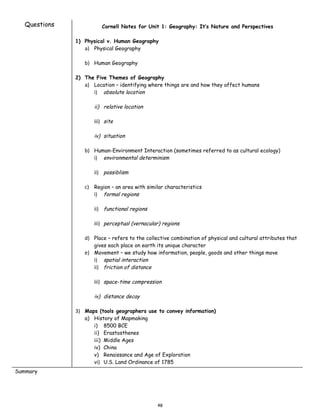
Questions             Cornell Notes for Unit 1: Geography: It’s Nature and Perspectives

               1) Physical v. Human Geography
                  a) Physical Geography

                  b) Human Geography

               2) The Five Themes of Geography
                  a) Location – identifying where things are and how they affect humans
                     i) absolute location

                      ii) relative location

                      iii) site

                      iv) situation

                  b) Human-Environment Interaction (sometimes referred to as cultural ecology)
                     i) environmental determinism

                      ii) possiblism

                  c) Region – an area with similar characteristics
                     i) formal regions

                      ii) functional regions

                      iii) perceptual (vernacular) regions

                  d) Place – refers to the collective combination of physical and cultural attributes that
                      gives each place on earth its unique character
                  e) Movement – we study how information, people, goods and other things move
                     i) spatial interaction
                     ii) friction of distance

                      iii) space-time compression

                      iv) distance decay

               3) Maps (tools geographers use to convey information)
                  a) History of Mapmaking
                     i) 8500 BCE
                     ii) Erastosthenes
                     iii) Middle Ages
                     iv) China
                     v) Renaissance and Age of Exploration
                     vi) U.S. Land Ordinance of 1785
Summary


                                                48
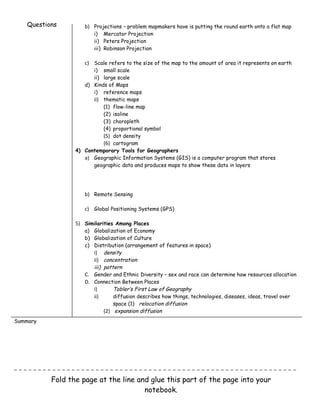
Questions        b) Projections – problem mapmakers have is putting the round earth onto a flat map
                         i) Mercator Projection
                         ii) Peters Projection
                         iii) Robinson Projection

                     c) Scale refers to the size of the map to the amount of area it represents on earth
                        i) small scale
                        ii) large scale
                     d) Kinds of Maps
                        i) reference maps
                        ii) thematic maps
                            (1) flow-line map
                            (2) isoline
                            (3) choropleth
                            (4) proportional symbol
                            (5) dot density
                            (6) cartogram
                  4) Contemporary Tools for Geographers
                     a) Geographic Information Systems (GIS) is a computer program that stores
                        geographic data and produces maps to show these data in layers


                     b) Remote Sensing

                     c) Global Positioning Systems (GPS)

                  5) Similarities Among Places
                     a) Globalization of Economy
                     b) Globalization of Culture
                     c) Distribution (arrangement of features in space)
                        i) density
                        ii) concentration
                        iii) pattern
                     C. Gender and Ethnic Diversity – sex and race can determine how resources allocation
                     D. Connection Between Places
                        i)       Tobler’s First Law of Geography
                        ii)      diffusion describes how things, technologies, diseases, ideas, travel over
                                 space (1) relocation diffusion
                             (2) expansion diffusion
Summary


           Fold the page at the line and glue this part of the page into your
                                       notebook.

Cornell notes

  • 1.
    Questions Cornell Notes for Unit 1: Geography: It’s Nature and Perspectives 1) Physical v. Human Geography a) Physical Geography b) Human Geography 2) The Five Themes of Geography a) Location – identifying where things are and how they affect humans i) absolute location ii) relative location iii) site iv) situation b) Human-Environment Interaction (sometimes referred to as cultural ecology) i) environmental determinism ii) possiblism c) Region – an area with similar characteristics i) formal regions ii) functional regions iii) perceptual (vernacular) regions d) Place – refers to the collective combination of physical and cultural attributes that gives each place on earth its unique character e) Movement – we study how information, people, goods and other things move i) spatial interaction ii) friction of distance iii) space-time compression iv) distance decay 3) Maps (tools geographers use to convey information) a) History of Mapmaking i) 8500 BCE ii) Erastosthenes iii) Middle Ages iv) China v) Renaissance and Age of Exploration vi) U.S. Land Ordinance of 1785 Summary 48
  • 2.
    Questions b) Projections – problem mapmakers have is putting the round earth onto a flat map i) Mercator Projection ii) Peters Projection iii) Robinson Projection c) Scale refers to the size of the map to the amount of area it represents on earth i) small scale ii) large scale d) Kinds of Maps i) reference maps ii) thematic maps (1) flow-line map (2) isoline (3) choropleth (4) proportional symbol (5) dot density (6) cartogram 4) Contemporary Tools for Geographers a) Geographic Information Systems (GIS) is a computer program that stores geographic data and produces maps to show these data in layers b) Remote Sensing c) Global Positioning Systems (GPS) 5) Similarities Among Places a) Globalization of Economy b) Globalization of Culture c) Distribution (arrangement of features in space) i) density ii) concentration iii) pattern C. Gender and Ethnic Diversity – sex and race can determine how resources allocation D. Connection Between Places i) Tobler’s First Law of Geography ii) diffusion describes how things, technologies, diseases, ideas, travel over space (1) relocation diffusion (2) expansion diffusion Summary Fold the page at the line and glue this part of the page into your notebook.