Assignment and Licensing of TM
By Atul S. Jaybhaye
Assistant Professor
Hidayatullah National Law University, Raipur
B.A.,LL.M.,NET
6/25/2020 1
Introduction
• Trademarks like any asset can be transferred from
one person to others.
• The transfers could be temporary through licensing
or permanent through an assignment.
• Transfer of the ownership of the mark either with or
without the goodwill of the business.
• Assignment and Licensing distinguished.
Assignment
• Definition of Assignment:
• Sec 2 (1) (b) "assignment" means an assignment in
writing by act of the parties concerned.
• A mark may be assigned or transferred to another
entity in any of the following manners:
I. Complete Assignment
II. Partial Assignment
III. Assignment with goodwill
IV. Assignment without goodwill
Assignment-Types
• Complete Assignment to another entity
The owner transfers all its rights with respect to a
mark to another entity, including the transfer of
the rights such as right to further transfer, to earn
royalties, etc.
(E.g. X, the proprietor of a brand, sells his mark
completely through an agreement to Y. After this
X does not retain any rights with respect to the
brand)
Assignment-Types
 Partial Assignment
• The transfer of ownership is restricted to specific
product or service only. The owner may retain the
right to further transfer, to earn royalties etc.
Ex. A, owner of a tea and a biscuit brand, transfers
proprietary rights only with respect to the tea brand
and retains the rights over the biscuit brand, this is
said to be a partial assignment.
Assignment-Types
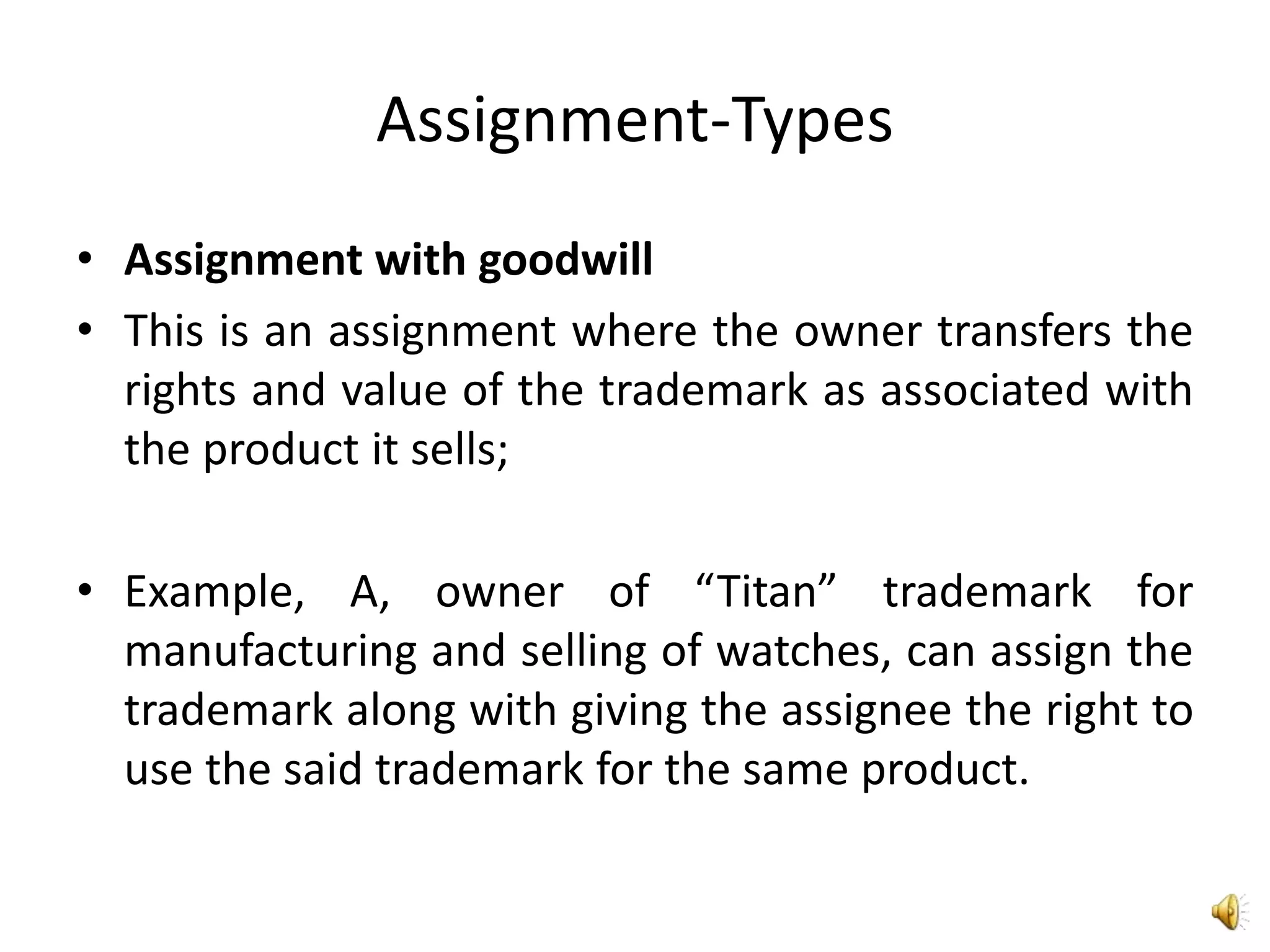
• Assignment with goodwill
• This is an assignment where the owner transfers the
rights and value of the trademark as associated with
the product it sells;
• Example, A, owner of “Titan” trademark for
manufacturing and selling of watches, can assign the
trademark along with giving the assignee the right to
use the said trademark for the same product.
Assignment-Types
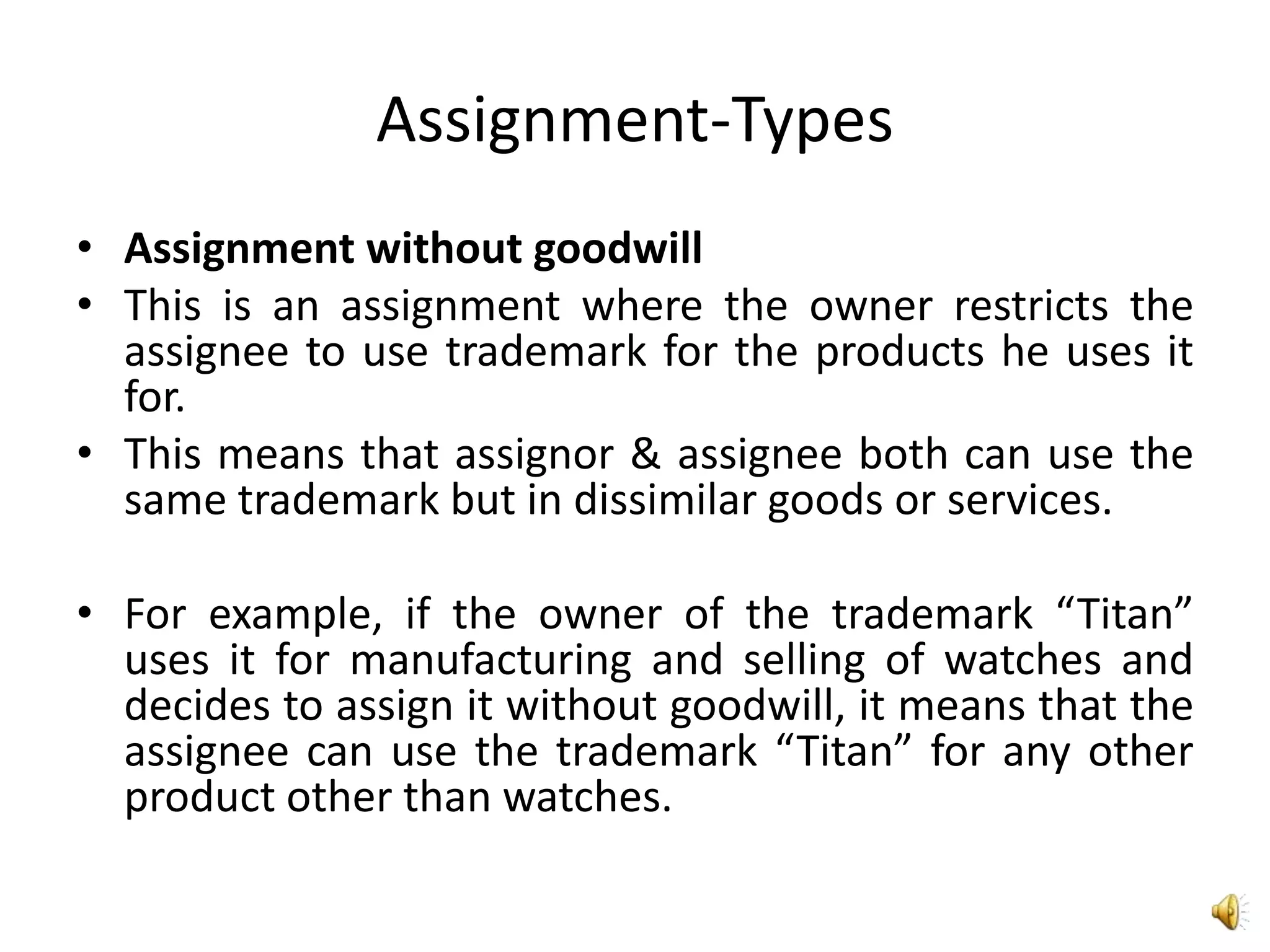
• Assignment without goodwill
• This is an assignment where the owner restricts the
assignee to use trademark for the products he uses it
for.
• This means that assignor & assignee both can use the
same trademark but in dissimilar goods or services.
• For example, if the owner of the trademark “Titan”
uses it for manufacturing and selling of watches and
decides to assign it without goodwill, it means that the
assignee can use the trademark “Titan” for any other
product other than watches.
Relevant Sections
• Secs. 38,39:
 Care to be taken while assigning a TM:
 Application to the Registrar
 Assignment of TM must be in writing.
 Advertisement of assignment.
 Purpose of advertisement – notice to the public.
 Rights can be assigned by executing Deed of
Assignment.
Requirements for assignment
• The territorial extent of the assignment.
• The mark/marks that the proprietor wants to assign
must be mentioned clearly.
• Details of royalty.
• Effective date of the assignment.
• Assignment with or without goodwill.
• Entry in the register by Registrar.
Trademark licensing/Registered Users
• Trademark licensing is when a trademark owner
allows others to use the mark without transferring
ownership.
• The TM Act 1999 does not use any word i.e. licensing
but it uses the word Registered users.
• Relevant Sections 48 to 54 of the Act.
• Two parties are involved i.e. licensor and licensee
Need of licensing
• Economically beneficial both for licensor and
licensee
• It helps in expanding business.
• It increases geographical reach.
• It increases the reputation of the goods/ services.
• Ownership remains with the TM owner etc.
Registered User Defined:
• Sec. 2 (1)(x) "registered user" means a person
who is for the time being registered as such
under section 49.
• Registration as registered user:
• A person other than TM owner may be registered
as registered user.
• Application to the Registrar jointly by licensor and
licensee.
• Copy of the agreement between by licensor and
licensee need to be attached.
Requirements for licensing
• The grant clause that includes the trademarks
licensed, geographical territory, term of the
agreement etc. should be clearly laid down.
• Any other restrictions/conditions imposed by the
proprietor.
• Consideration in form of royalty and the percentage
to be paid.
• Grounds on which the licensor can terminate the
agreement.
Registered Users
• Power of the Registrar to cancel the registration of
registered users: Sec. 50
1. On Application made by the registered users
2. If the TM is not registered
3. Proprietor or registered users failed to disclose
material facts/ misrepresented the Registrar.
4. Notice shall be issued by the Registrar.
5. Opportunity of hearing shall be given.
Registered Users
• Imp points:
 The registered user has a right to file a suit of
infringement.
 However registered user doesn’t have right of
further assignment or licence.
 Permitted user don’t have right to file a suit of
infringement.
Thank you…

Assignment of trademark

  • 1.
    Assignment and Licensingof TM By Atul S. Jaybhaye Assistant Professor Hidayatullah National Law University, Raipur B.A.,LL.M.,NET 6/25/2020 1
  • 2.
    Introduction • Trademarks likeany asset can be transferred from one person to others. • The transfers could be temporary through licensing or permanent through an assignment. • Transfer of the ownership of the mark either with or without the goodwill of the business. • Assignment and Licensing distinguished.
  • 3.
    Assignment • Definition ofAssignment: • Sec 2 (1) (b) "assignment" means an assignment in writing by act of the parties concerned. • A mark may be assigned or transferred to another entity in any of the following manners: I. Complete Assignment II. Partial Assignment III. Assignment with goodwill IV. Assignment without goodwill
  • 4.
    Assignment-Types • Complete Assignmentto another entity The owner transfers all its rights with respect to a mark to another entity, including the transfer of the rights such as right to further transfer, to earn royalties, etc. (E.g. X, the proprietor of a brand, sells his mark completely through an agreement to Y. After this X does not retain any rights with respect to the brand)
  • 5.
    Assignment-Types  Partial Assignment •The transfer of ownership is restricted to specific product or service only. The owner may retain the right to further transfer, to earn royalties etc. Ex. A, owner of a tea and a biscuit brand, transfers proprietary rights only with respect to the tea brand and retains the rights over the biscuit brand, this is said to be a partial assignment.
  • 6.
    Assignment-Types • Assignment withgoodwill • This is an assignment where the owner transfers the rights and value of the trademark as associated with the product it sells; • Example, A, owner of “Titan” trademark for manufacturing and selling of watches, can assign the trademark along with giving the assignee the right to use the said trademark for the same product.
  • 7.
    Assignment-Types • Assignment withoutgoodwill • This is an assignment where the owner restricts the assignee to use trademark for the products he uses it for. • This means that assignor & assignee both can use the same trademark but in dissimilar goods or services. • For example, if the owner of the trademark “Titan” uses it for manufacturing and selling of watches and decides to assign it without goodwill, it means that the assignee can use the trademark “Titan” for any other product other than watches.
  • 8.
    Relevant Sections • Secs.38,39:  Care to be taken while assigning a TM:  Application to the Registrar  Assignment of TM must be in writing.  Advertisement of assignment.  Purpose of advertisement – notice to the public.  Rights can be assigned by executing Deed of Assignment.
  • 9.
    Requirements for assignment •The territorial extent of the assignment. • The mark/marks that the proprietor wants to assign must be mentioned clearly. • Details of royalty. • Effective date of the assignment. • Assignment with or without goodwill. • Entry in the register by Registrar.
  • 10.
    Trademark licensing/Registered Users •Trademark licensing is when a trademark owner allows others to use the mark without transferring ownership. • The TM Act 1999 does not use any word i.e. licensing but it uses the word Registered users. • Relevant Sections 48 to 54 of the Act. • Two parties are involved i.e. licensor and licensee
  • 11.
    Need of licensing •Economically beneficial both for licensor and licensee • It helps in expanding business. • It increases geographical reach. • It increases the reputation of the goods/ services. • Ownership remains with the TM owner etc.
  • 12.
    Registered User Defined: •Sec. 2 (1)(x) "registered user" means a person who is for the time being registered as such under section 49. • Registration as registered user: • A person other than TM owner may be registered as registered user. • Application to the Registrar jointly by licensor and licensee. • Copy of the agreement between by licensor and licensee need to be attached.
  • 13.
    Requirements for licensing •The grant clause that includes the trademarks licensed, geographical territory, term of the agreement etc. should be clearly laid down. • Any other restrictions/conditions imposed by the proprietor. • Consideration in form of royalty and the percentage to be paid. • Grounds on which the licensor can terminate the agreement.
  • 14.
    Registered Users • Powerof the Registrar to cancel the registration of registered users: Sec. 50 1. On Application made by the registered users 2. If the TM is not registered 3. Proprietor or registered users failed to disclose material facts/ misrepresented the Registrar. 4. Notice shall be issued by the Registrar. 5. Opportunity of hearing shall be given.
  • 15.
    Registered Users • Imppoints:  The registered user has a right to file a suit of infringement.  However registered user doesn’t have right of further assignment or licence.  Permitted user don’t have right to file a suit of infringement.
  • 16.