IPR Lectures
1. To highlight the challenges brought about by
digital revolution to the copyright issues,
2. To analyze the complexities in applying
copyright legislation in digital environment
3. To discuss, the extent to which the existing
copyright laws in India, UK and USA have
succeeded in meeting these challenges, and
4. To discuss some of the non-legislative
initiatives/solution to address the digital
challenge
International/Regional
 Berne Convention for the Protection of Literary and Artistic Works,
1886 (Berne)
 WIPO CopyrightTreaty 1996 (WCT)
 WIPO Performances and PhonogramsTreaty 1996 (WPPT)
 EC E-commerce Directive
 EC Information Society Directive
India
 Copyright Act 1956 (ICA)
 InformationTechnology Act 2000 (IITA)
UK
 Copyright , Designs and Patent Act 1988 (CDPA)
USA
 Copyright Act 1976(USCA)
 Digital Millennium Copyright Act 1998 (DMCA)
 New Forms of copyrightable works
 Digital, multimedia,
 New methods and tools of creation,
adaptation, reproduction
 New methods of use, communication,
publishing, distribution
 New methods of protections from
unauthorized access
 New sets of people involved
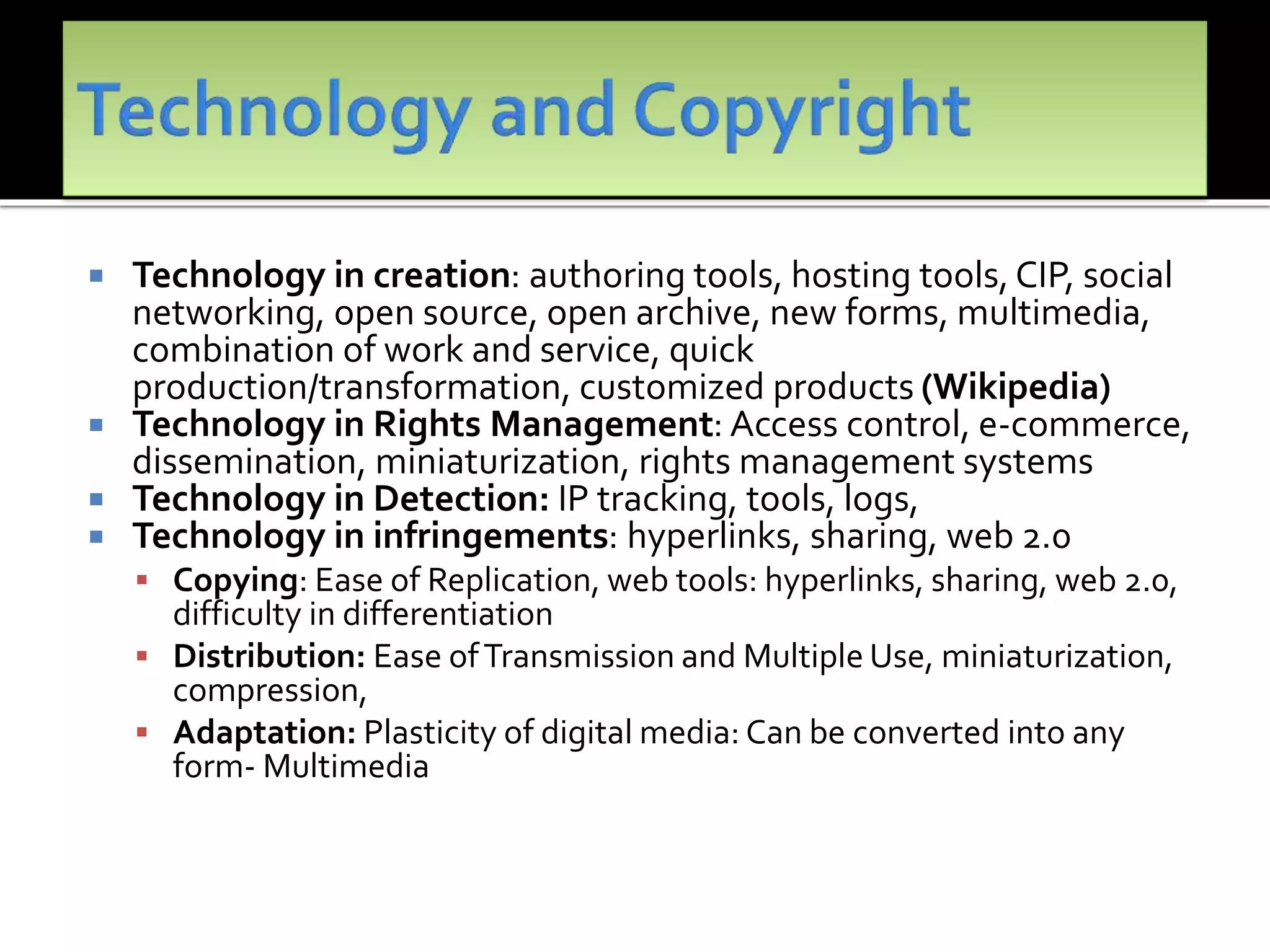
 Technology in creation: authoring tools, hosting tools, CIP, social
networking, open source, open archive, new forms, multimedia,
combination of work and service, quick
production/transformation, customized products (Wikipedia)
 Technology in Rights Management: Access control, e-commerce,
dissemination, miniaturization, rights management systems
 Technology in Detection: IP tracking, tools, logs,
 Technology in infringements: hyperlinks, sharing, web 2.0
 Copying: Ease of Replication, web tools: hyperlinks, sharing, web 2.0,
difficulty in differentiation
 Distribution: Ease ofTransmission and Multiple Use, miniaturization,
compression,
 Adaptation: Plasticity of digital media: Can be converted into any
form- Multimedia
 Provisions becoming ineffective to address the
challenges
 New economic order: Information and
knowledge economy
 Fast pace of development require innovative
legislative measures which remain relevant to
address future challenges
 Increasing use of non-statutory measures and
counter measures as the existing legislation
were found inadequate
 Rebalancing of public rights and owners rights
 Subject of Copyright: Work
 Authorship/ownership
 Undefined,
 Collaborative authorship,
 Pseudonymous, anonymous authorship,
 Open Source, Community,
 Service Provider, browsers, search engines, harvesters
 Machine Generated-Translations,
 Qualification: Citizenship, Place of publication
 Originality
 Infringement: Infringers and their liability, Fair Dealing
 Non statutory restrictions (Protective Measures)
 Original literary, dramatic, musical and artistic works.
 Cinematograph
 Sound Recording
 Broadcast:
▪ Communication to the public by any means of wireless
diffusion, whether in any one or more of the forms of signs,
sound or visual images; or
▪ By wire, and includes a re-broadcast (Sec 2 (dd))
 TypographicArrangement of published edition (UK
CDPA)
 Fonts (CDPA)
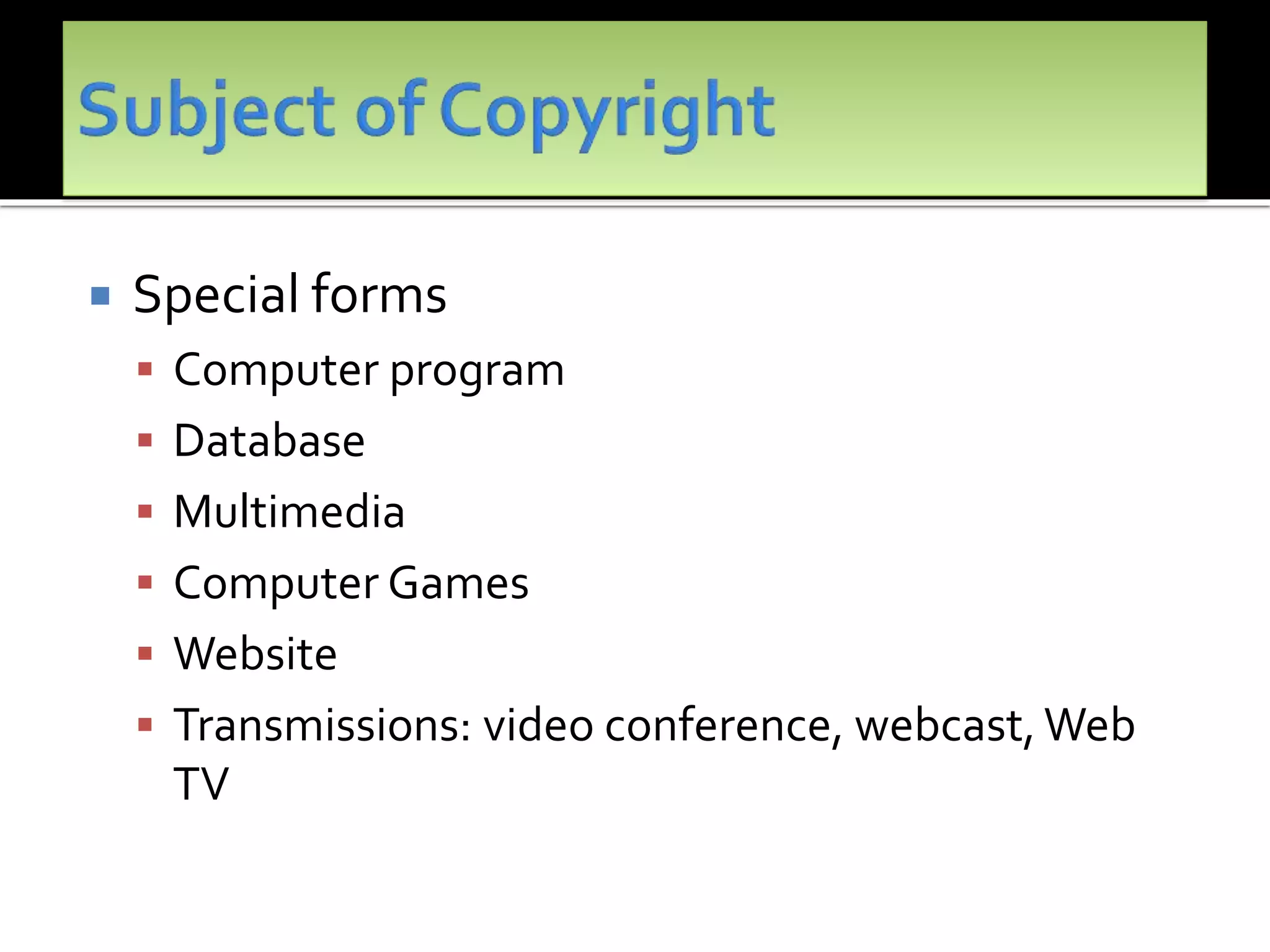
 Special forms
 Computer program
 Database
 Multimedia
 Computer Games
 Website
 Transmissions: video conference, webcast,Web
TV
 ICA: Nothing expressly mentioned. Expression
 IITA [Sec 4] Legal Recognition of Electronic Records:
 Where any law provides that information or any other matter
shall be in writing or in the typewritten or printed form, then,
notwithstanding anything contained in such law, such
requirement shall be deemed to have been satisfied if such
information or matter is (a) rendered or made available in an
electronic form; and (b) accessible so as to be usable for a
subsequent reference
 CDPA : Copyright does not subsist in a literary, dramatic or musical
work unless and until it is recorded, in writing or otherwise; …
 US CA : in any tangible medium of expression, now known or later
developed, from which they can be perceived, reproduced, or
otherwise communicated, either directly or with the aid of a machine
or device
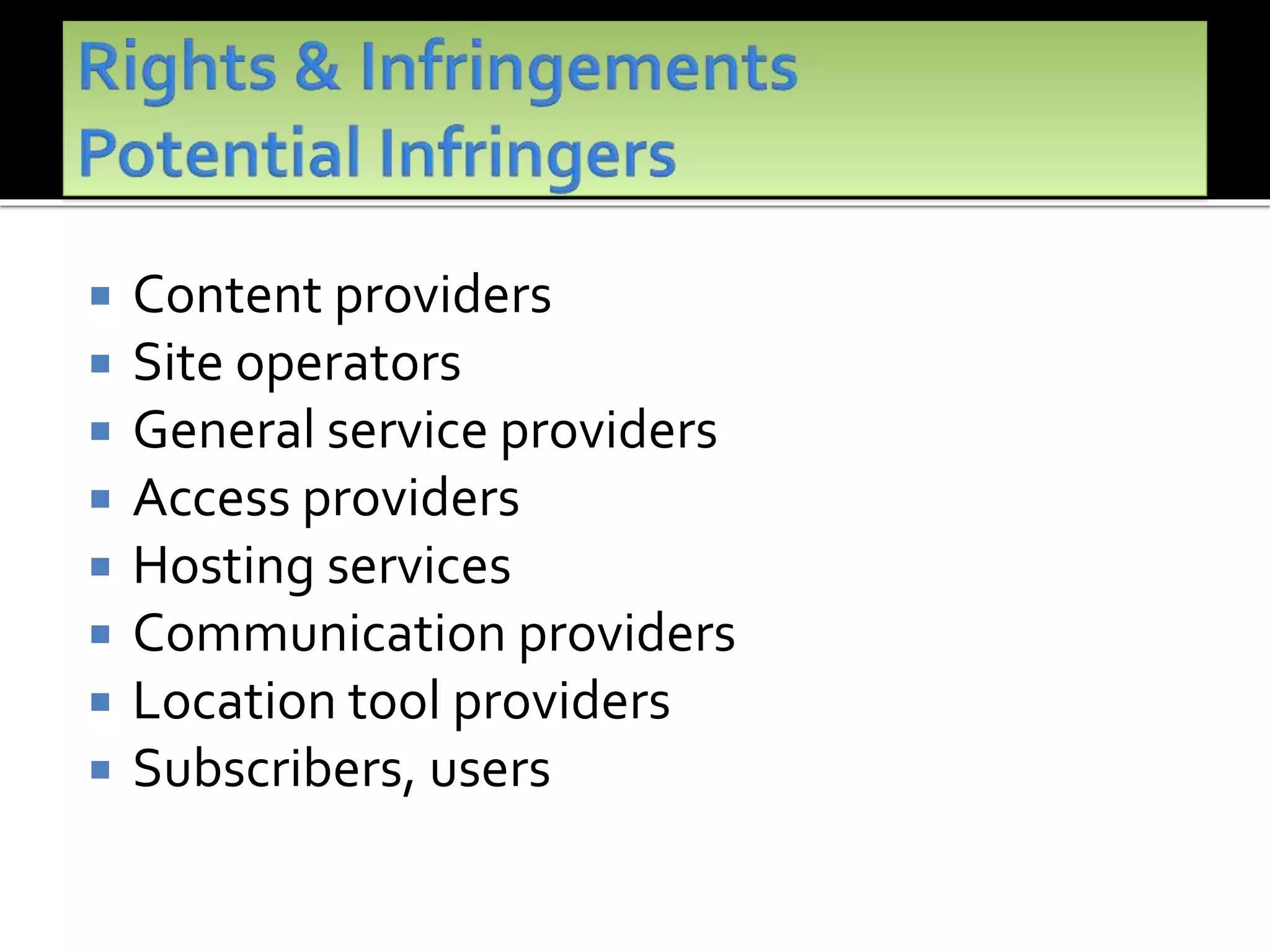
 Content providers
 Site operators
 General service providers
 Access providers
 Hosting services
 Communication providers
 Location tool providers
 Subscribers, users
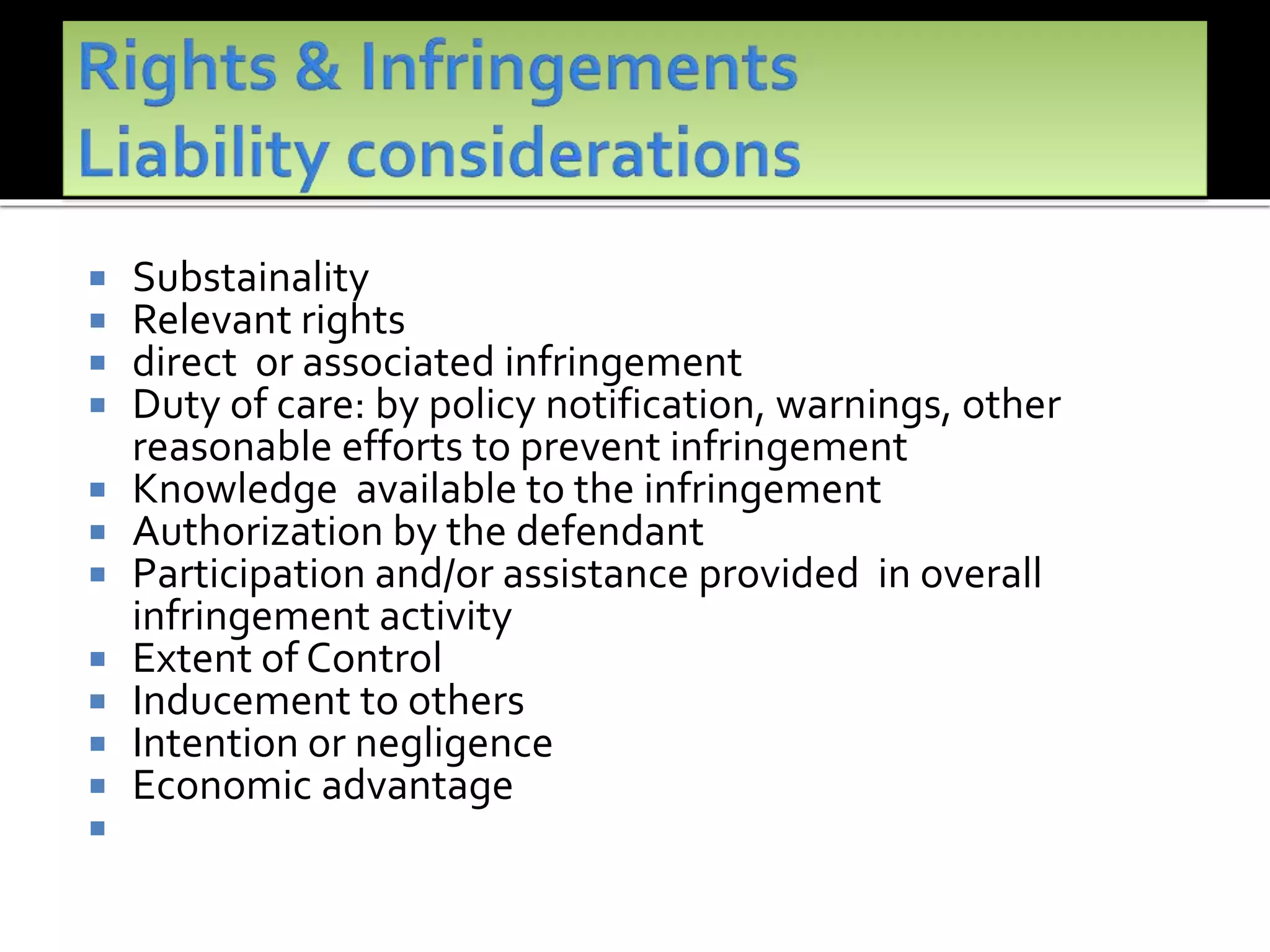
 Substainality
 Relevant rights
 direct or associated infringement
 Duty of care: by policy notification, warnings, other
reasonable efforts to prevent infringement
 Knowledge available to the infringement
 Authorization by the defendant
 Participation and/or assistance provided in overall
infringement activity
 Extent of Control
 Inducement to others
 Intention or negligence
 Economic advantage

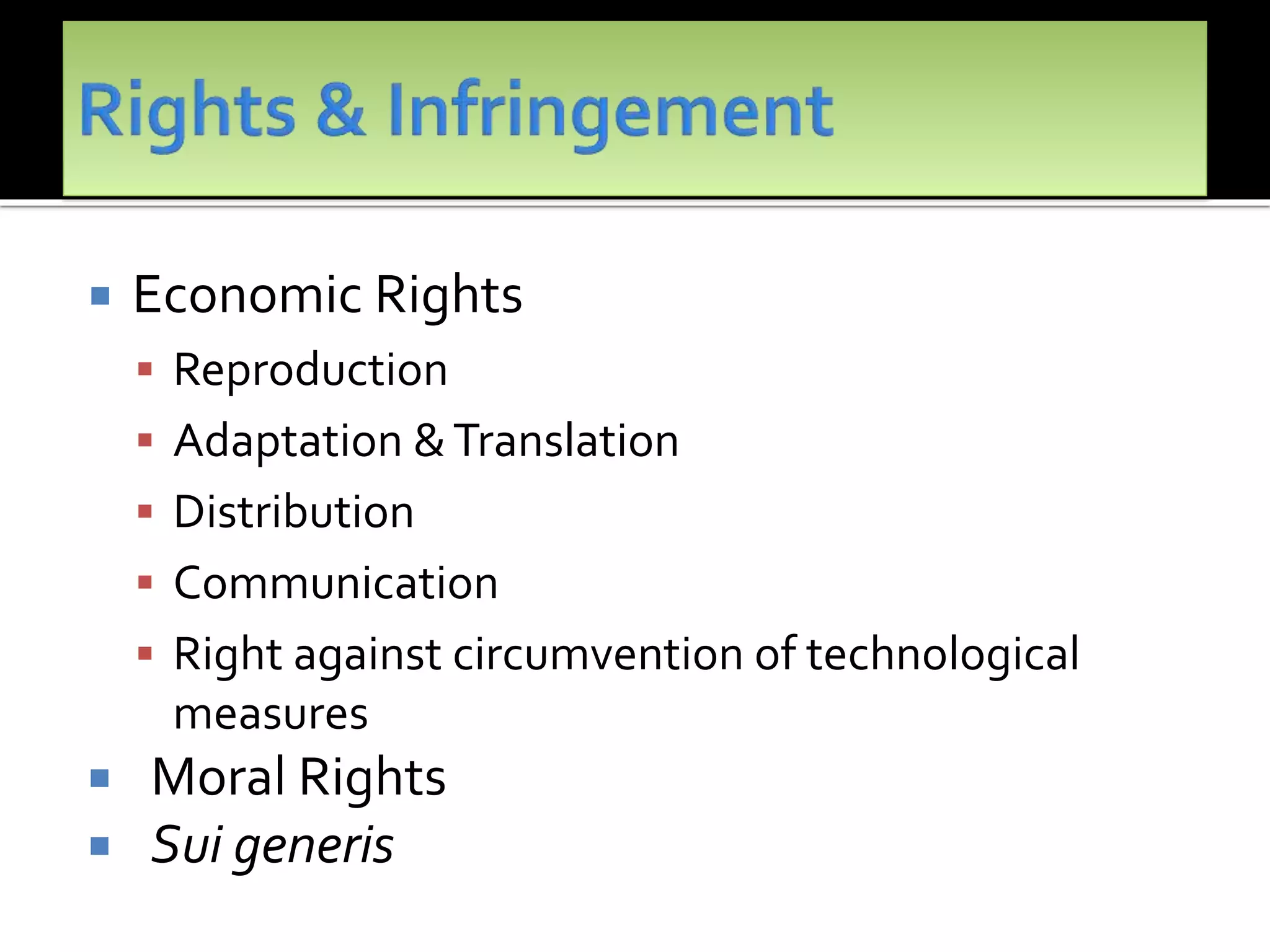
 Economic Rights
 Reproduction
 Adaptation &Translation
 Distribution
 Communication
 Right against circumvention of technological
measures
 Moral Rights
 Sui generis
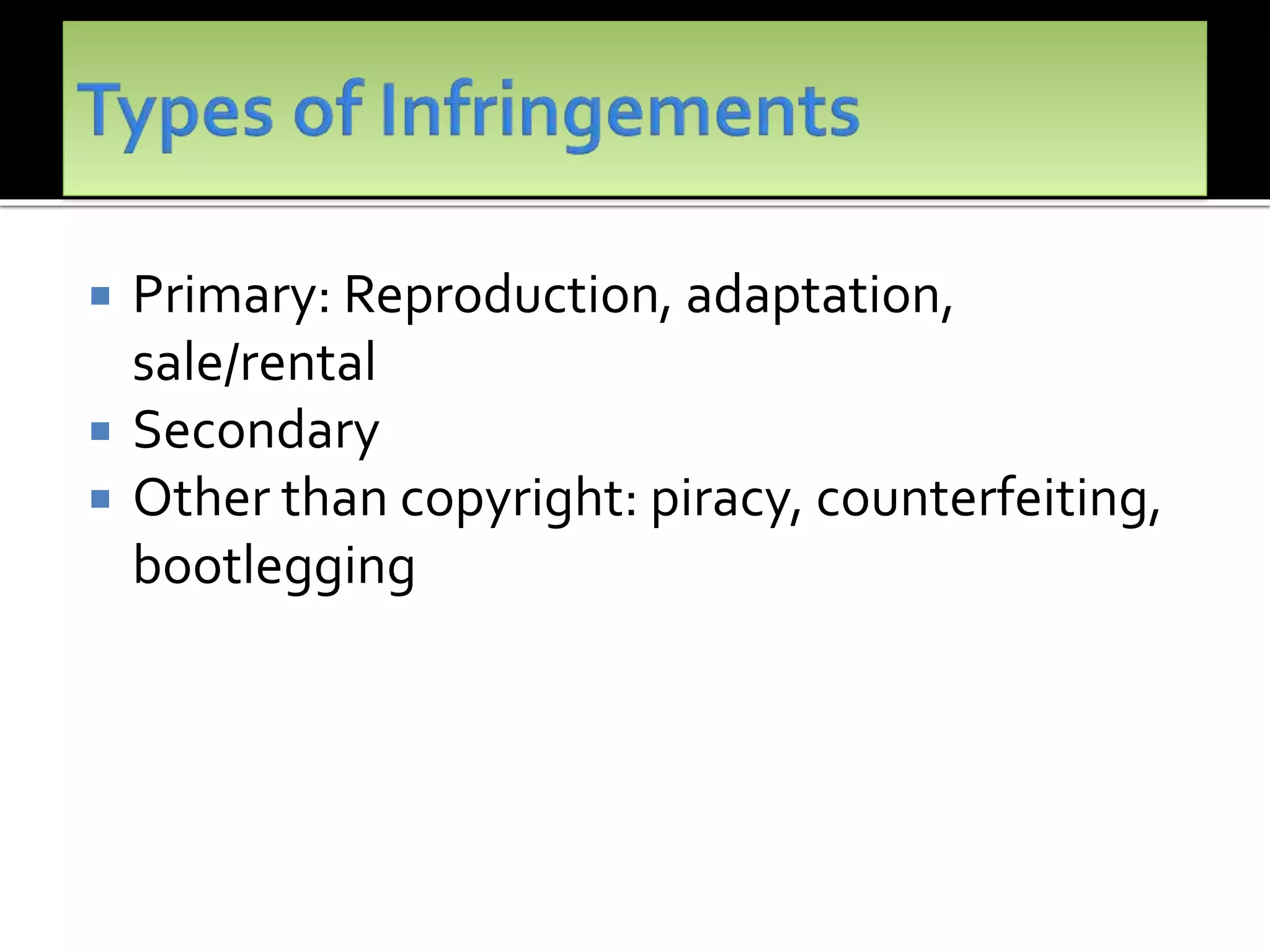
 Primary: Reproduction, adaptation,
sale/rental
 Secondary
 Other than copyright: piracy, counterfeiting,
bootlegging
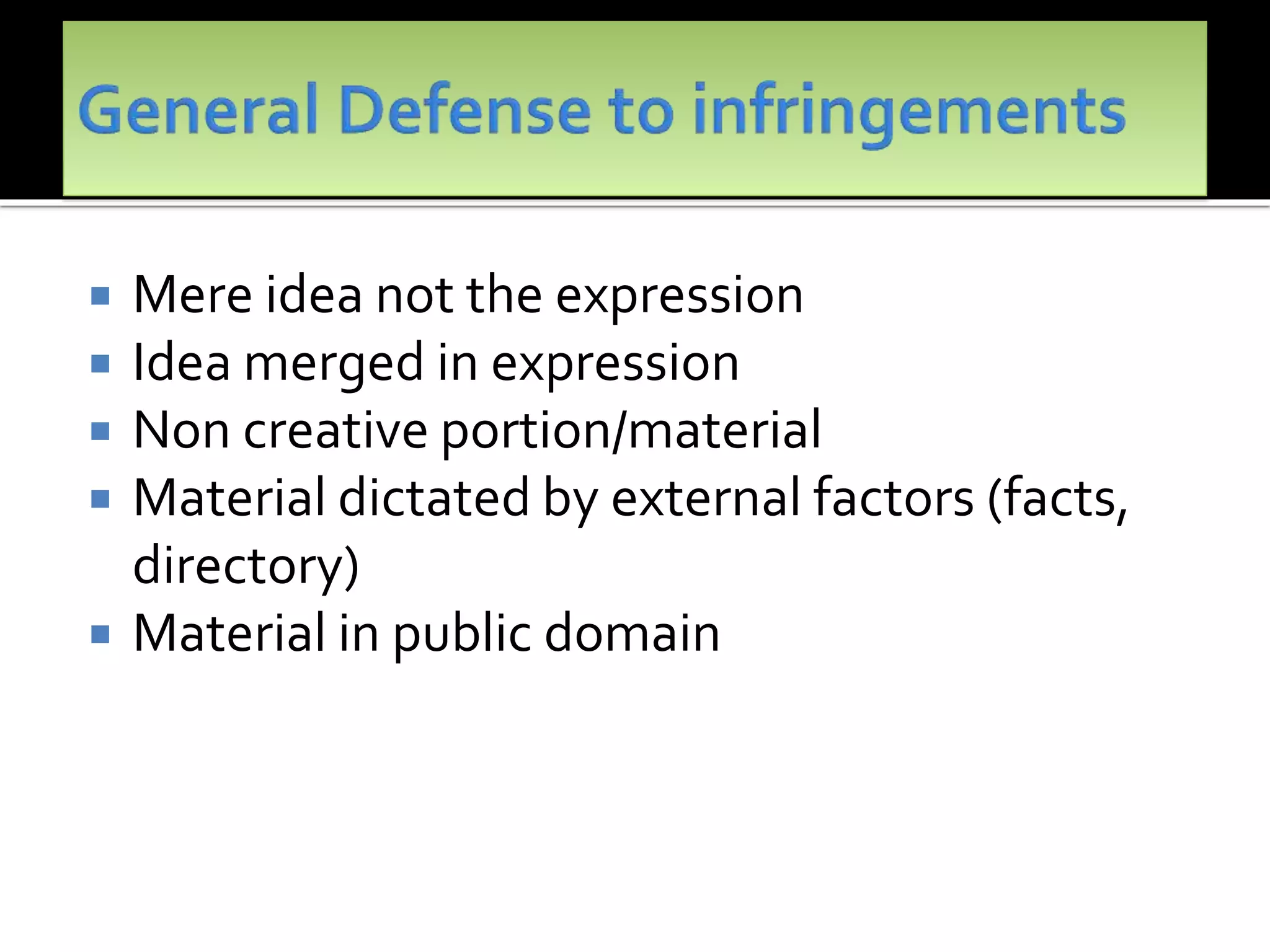
 Mere idea not the expression
 Idea merged in expression
 Non creative portion/material
 Material dictated by external factors (facts,
directory)
 Material in public domain
 Place where work was created is relevant
 Where the infringement takes place is
relevant
 Which court has the jurisdiction
 1968 Brussels Convention
 1988 Lugano Convention on Jurisdiction and
Enforcement of Judgments in Civil and
Commercial Matters
 Brussels I Regulation (EC44/2001)
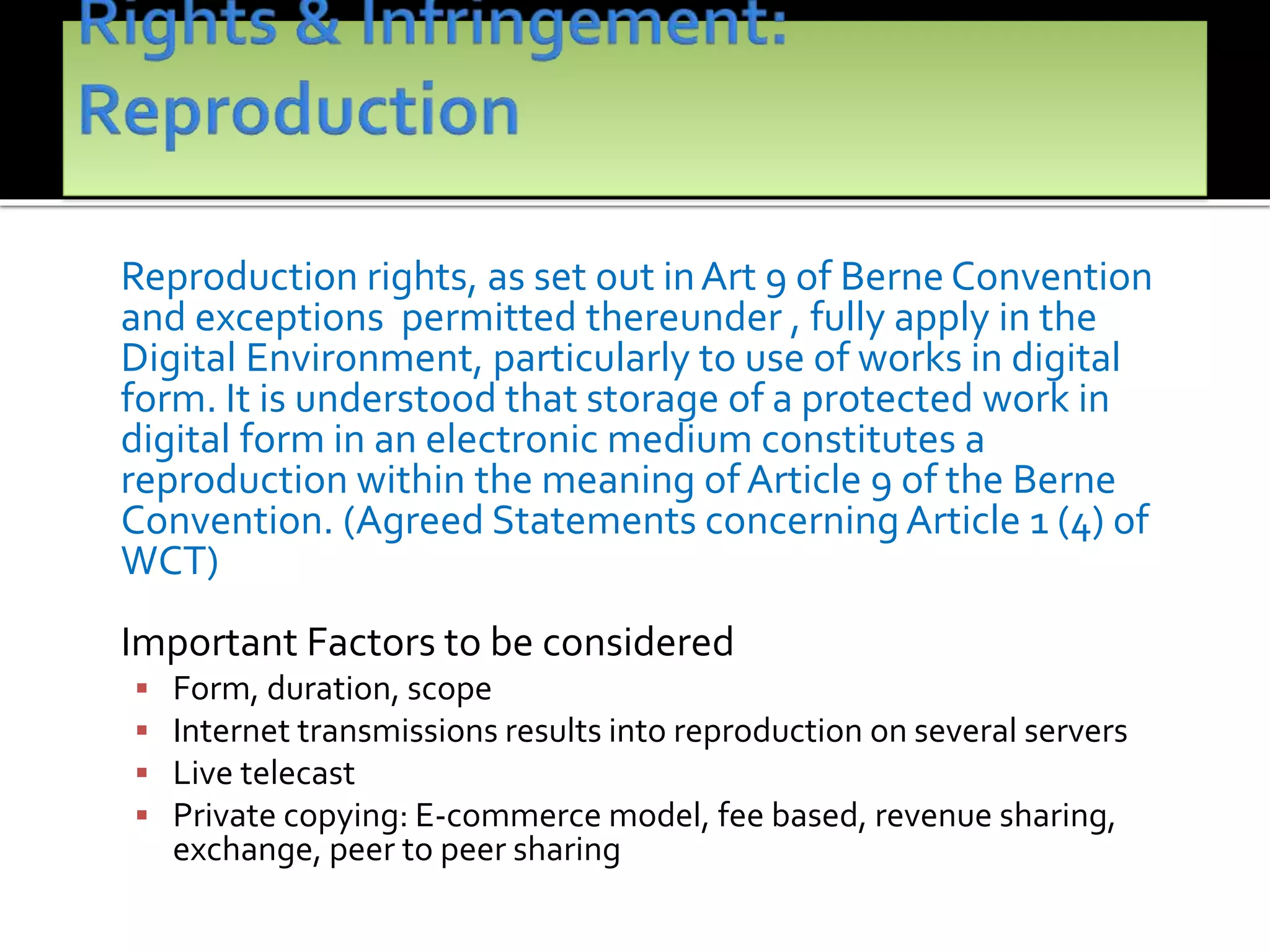
Reproduction rights, as set out inArt 9 of Berne Convention
and exceptions permitted thereunder , fully apply in the
Digital Environment, particularly to use of works in digital
form. It is understood that storage of a protected work in
digital form in an electronic medium constitutes a
reproduction within the meaning of Article 9 of the Berne
Convention. (Agreed Statements concerningArticle 1 (4) of
WCT)
Important Factors to be considered
 Form, duration, scope
 Internet transmissions results into reproduction on several servers
 Live telecast
 Private copying: E-commerce model, fee based, revenue sharing,
exchange, peer to peer sharing
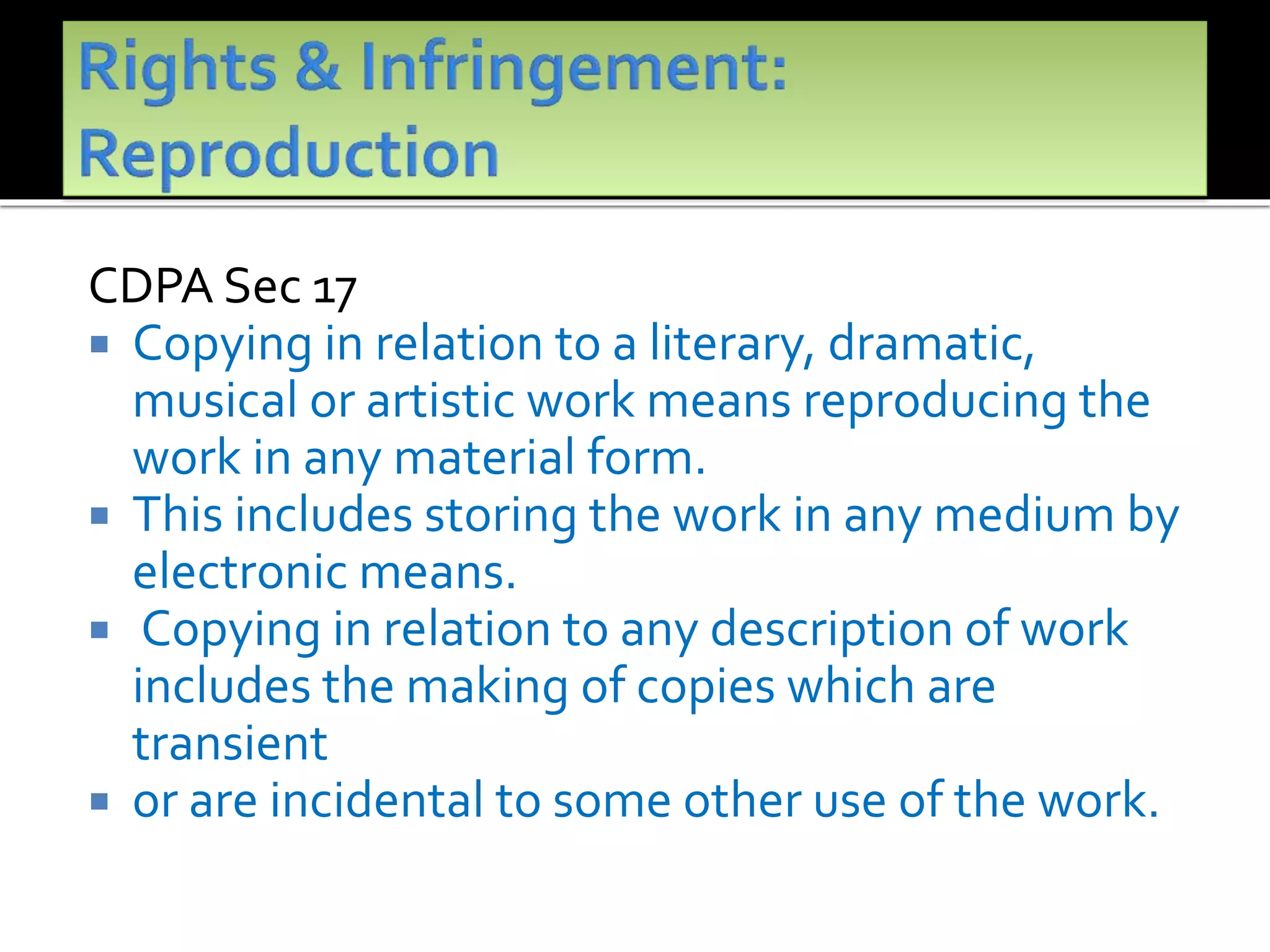
CDPA Sec 17
 Copying in relation to a literary, dramatic,
musical or artistic work means reproducing the
work in any material form.
 This includes storing the work in any medium by
electronic means.
 Copying in relation to any description of work
includes the making of copies which are
transient
 or are incidental to some other use of the work.
Instances in Internet’s context
 Posting or uploading copyrighted contents on a
website
 Linking: surface linking , deep linking
 Framing
 Caching: current pages, past visits, caching on a
server (ISP or webserver) : for faster retrieval,
outdated, may deprive owner of advertising
 Archiving: mirroring
 Thumbnails of images : Perfect10 v/s Google
 Peer to peer sharing: Napster case, KaZaa, Grokster
 BitTorrent file sharing
 Technology enabled, customized, fast,
multimedia convergence
 Fixation not required in adaptation : it is
immaterial whether the adaptation has been
recorded, in writing or otherwise, at the time the
act is done
 On demand, (Liability?)
 Uploading on the site: it is immaterial whether
some one actually downloads or views the
material (see sec 2 Communication to the public,
sec 20 CDPA)
 Complexities of time & space & liability
 Broadcaster Rights & Performers Rights: Same
provisions as in other forms will apply to webcast
also. (who is broadcaster?)
 Public performance
 Operator of the equipment are excepted from
infringement
 “Where copyright in a work is infringed by its being
performed, played or shown in public by means of
apparatus for receiving visual images or sounds
conveyed by electronic means, the person by whom
the visual images or sounds are sent, and in the case
of a performance the performers, shall not be
regarded as responsible for the infringement” CDPA
S. 19(4)
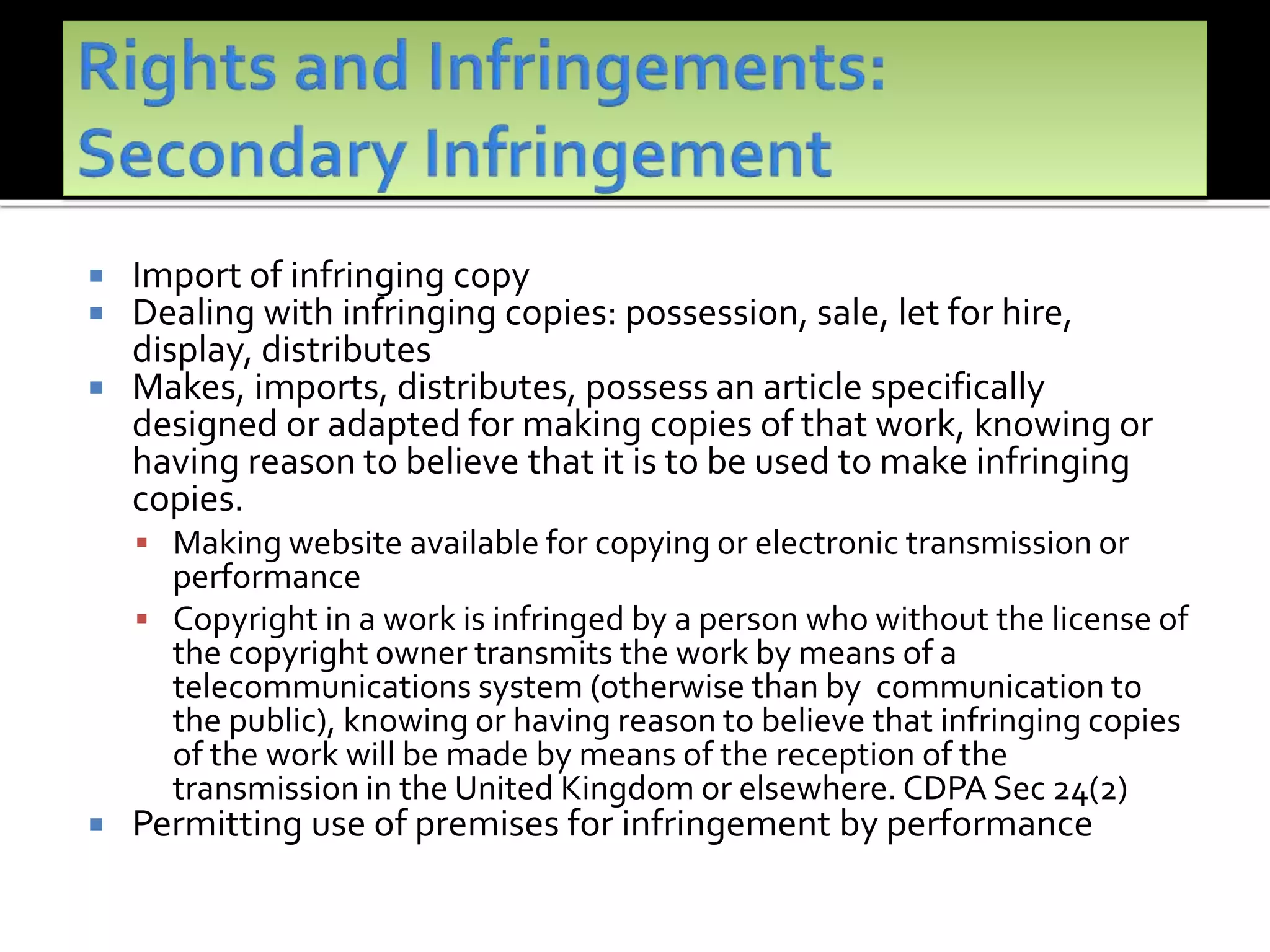
 Import of infringing copy
 Dealing with infringing copies: possession, sale, let for hire,
display, distributes
 Makes, imports, distributes, possess an article specifically
designed or adapted for making copies of that work, knowing or
having reason to believe that it is to be used to make infringing
copies.
 Making website available for copying or electronic transmission or
performance
 Copyright in a work is infringed by a person who without the license of
the copyright owner transmits the work by means of a
telecommunications system (otherwise than by communication to
the public), knowing or having reason to believe that infringing copies
of the work will be made by means of the reception of the
transmission in the United Kingdom or elsewhere. CDPA Sec 24(2)
 Permitting use of premises for infringement by performance
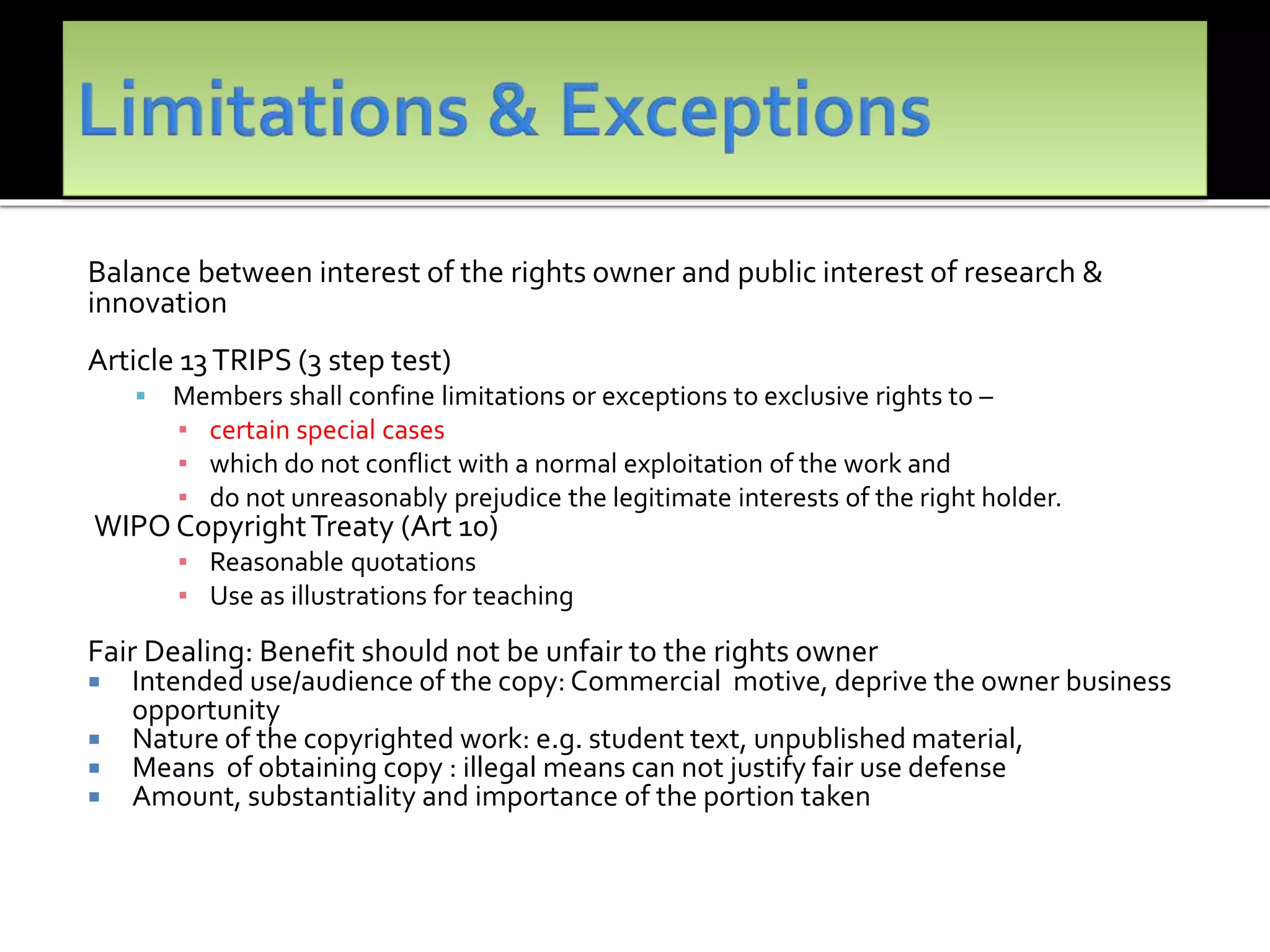
Balance between interest of the rights owner and public interest of research &
innovation
Article 13TRIPS (3 step test)
 Members shall confine limitations or exceptions to exclusive rights to –
▪ certain special cases
▪ which do not conflict with a normal exploitation of the work and
▪ do not unreasonably prejudice the legitimate interests of the right holder.
WIPO CopyrightTreaty (Art 10)
▪ Reasonable quotations
▪ Use as illustrations for teaching
Fair Dealing: Benefit should not be unfair to the rights owner
 Intended use/audience of the copy: Commercial motive, deprive the owner business
opportunity
 Nature of the copyrighted work: e.g. student text, unpublished material,
 Means of obtaining copy : illegal means can not justify fair use defense
 Amount, substantiality and importance of the portion taken
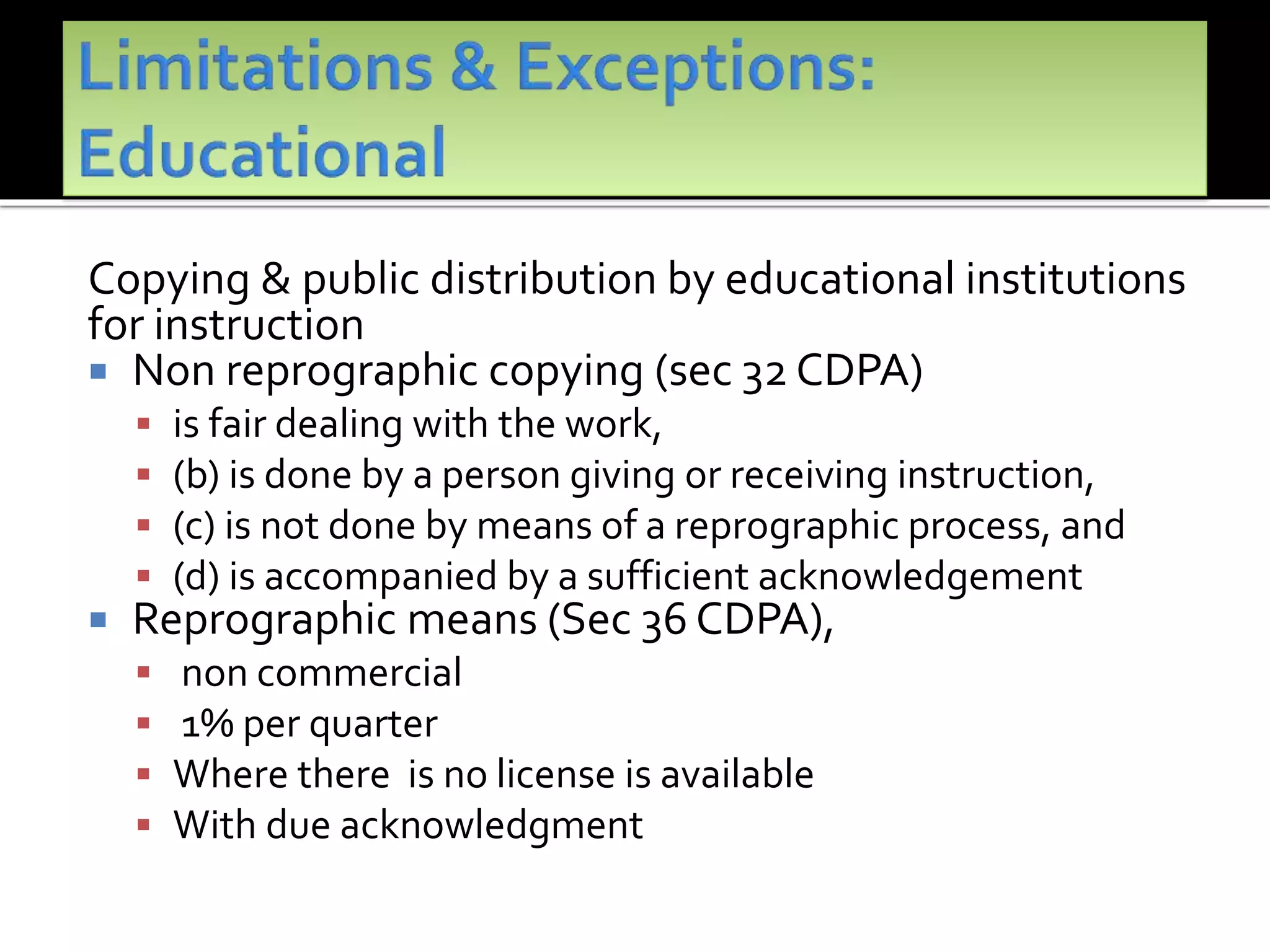
Copying & public distribution by educational institutions
for instruction
 Non reprographic copying (sec 32 CDPA)
 is fair dealing with the work,
 (b) is done by a person giving or receiving instruction,
 (c) is not done by means of a reprographic process, and
 (d) is accompanied by a sufficient acknowledgement
 Reprographic means (Sec 36 CDPA),
 non commercial
 1% per quarter
 Where there is no license is available
 With due acknowledgment
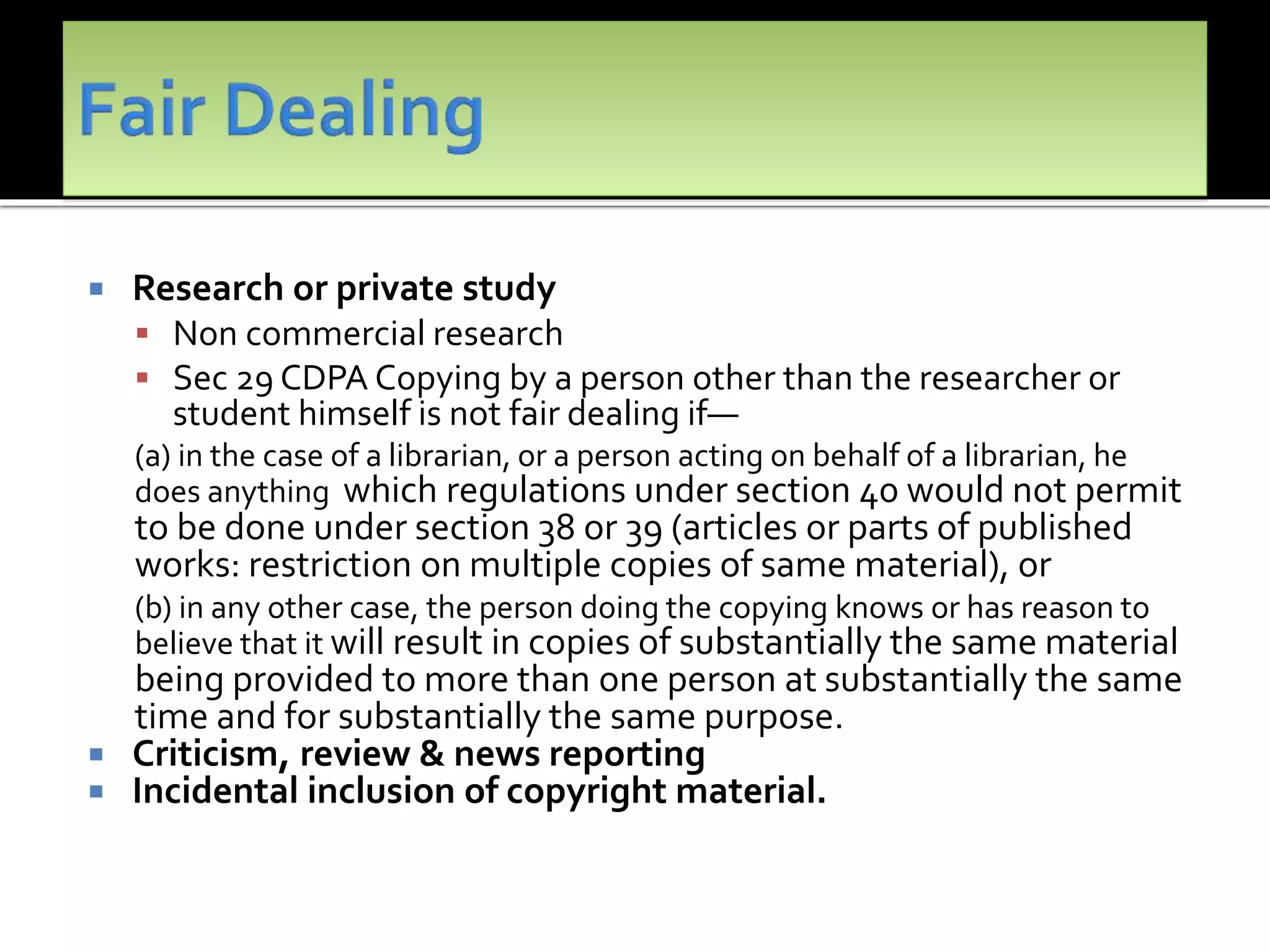
 Research or private study
 Non commercial research
 Sec 29 CDPA Copying by a person other than the researcher or
student himself is not fair dealing if—
(a) in the case of a librarian, or a person acting on behalf of a librarian, he
does anything which regulations under section 40 would not permit
to be done under section 38 or 39 (articles or parts of published
works: restriction on multiple copies of same material), or
(b) in any other case, the person doing the copying knows or has reason to
believe that it will result in copies of substantially the same material
being provided to more than one person at substantially the same
time and for substantially the same purpose.
 Criticism, review & news reporting
 Incidental inclusion of copyright material.
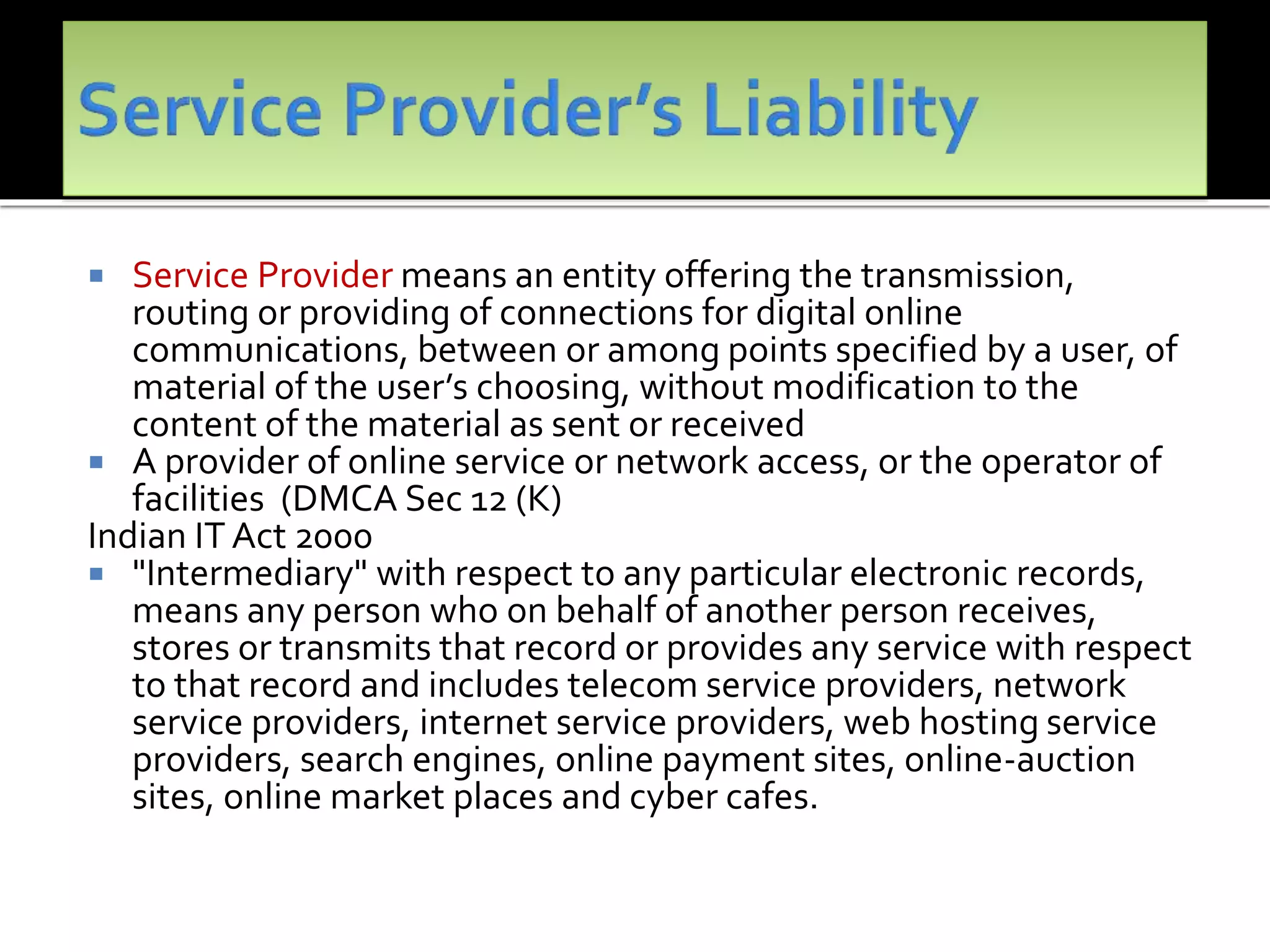
 Service Provider means an entity offering the transmission,
routing or providing of connections for digital online
communications, between or among points specified by a user, of
material of the user’s choosing, without modification to the
content of the material as sent or received
 A provider of online service or network access, or the operator of
facilities (DMCA Sec 12 (K)
Indian IT Act 2000
 "Intermediary" with respect to any particular electronic records,
means any person who on behalf of another person receives,
stores or transmits that record or provides any service with respect
to that record and includes telecom service providers, network
service providers, internet service providers, web hosting service
providers, search engines, online payment sites, online-auction
sites, online market places and cyber cafes.
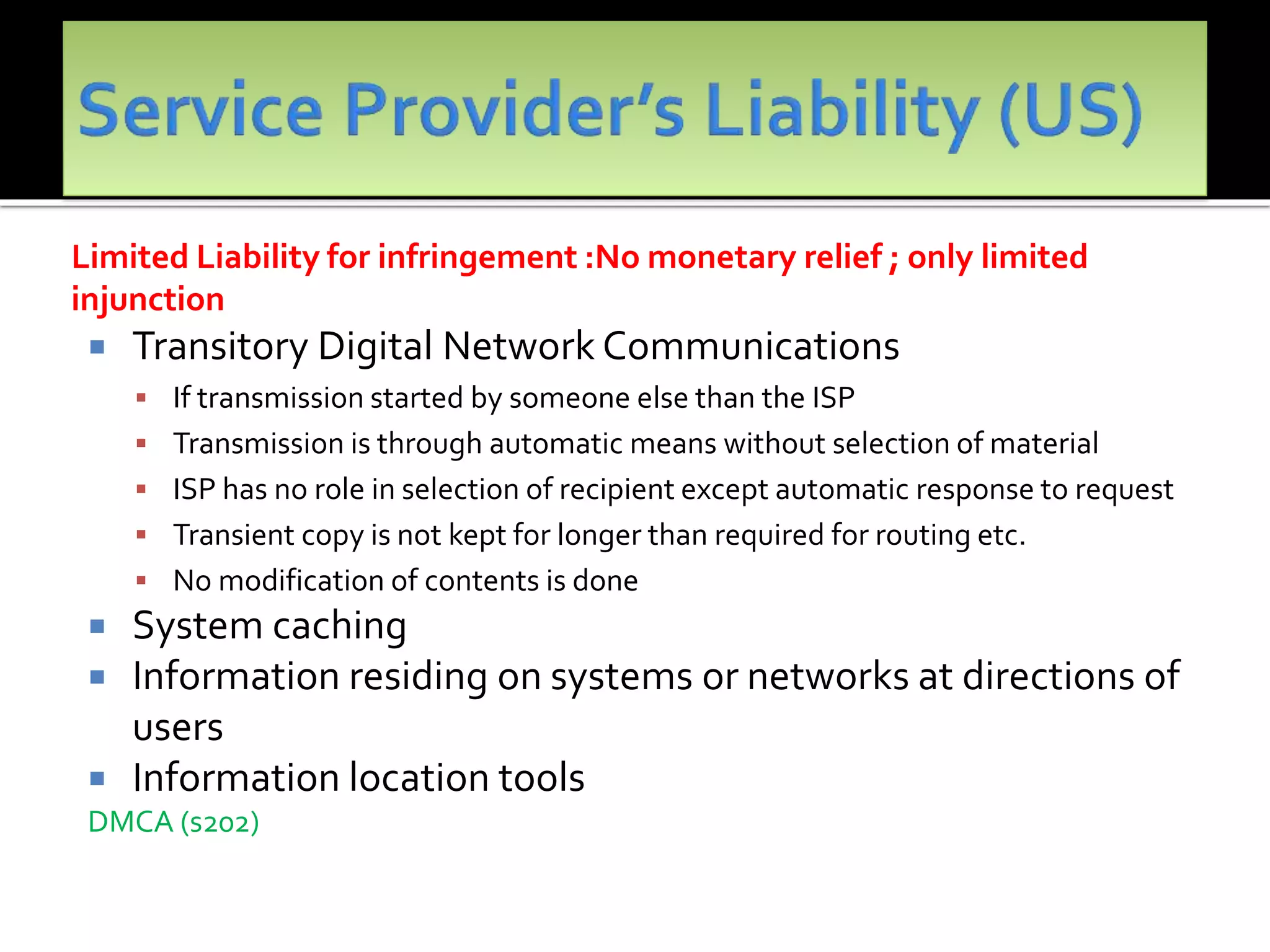
Limited Liability for infringement :No monetary relief ; only limited
injunction
 Transitory Digital Network Communications
 If transmission started by someone else than the ISP
 Transmission is through automatic means without selection of material
 ISP has no role in selection of recipient except automatic response to request
 Transient copy is not kept for longer than required for routing etc.
 No modification of contents is done
 System caching
 Information residing on systems or networks at directions of
users
 Information location tools
DMCA (s202)
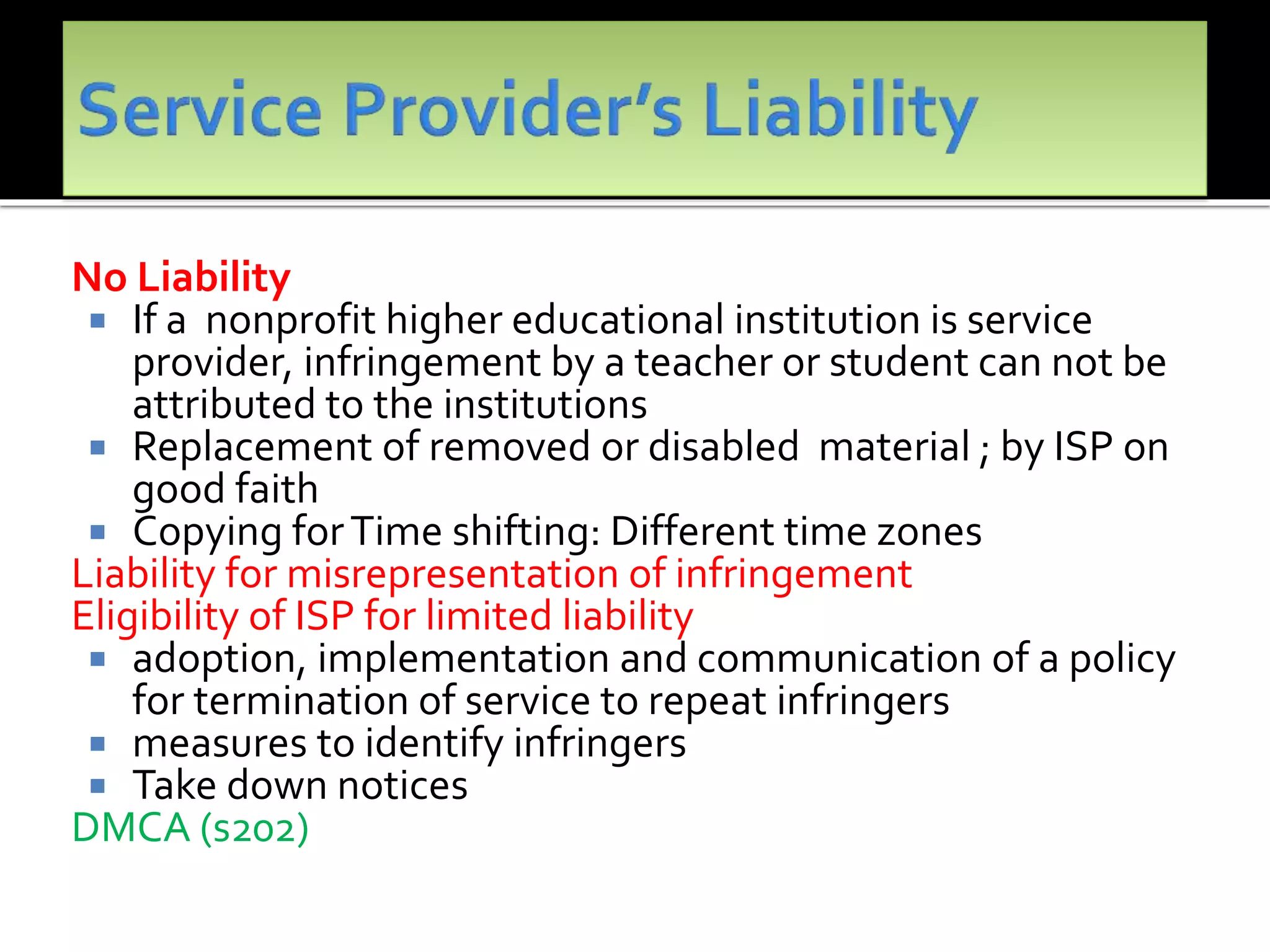
No Liability
 If a nonprofit higher educational institution is service
provider, infringement by a teacher or student can not be
attributed to the institutions
 Replacement of removed or disabled material ; by ISP on
good faith
 Copying forTime shifting: Different time zones
Liability for misrepresentation of infringement
Eligibility of ISP for limited liability
 adoption, implementation and communication of a policy
for termination of service to repeat infringers
 measures to identify infringers
 Take down notices
DMCA (s202)
IITA[Sec 67 C] Preservation and Retention of
information by intermediaries:
 (1) Intermediary shall preserve and retain such
information as may be specified for such
duration and in such manner and format as the
Central Government may prescribe.
 (2) Any intermediary who intentionally or
knowingly contravenes the provisions of sub
section (1) shall be punished with an
imprisonment for a term which may extend to
three years and shall also be liable to fine.
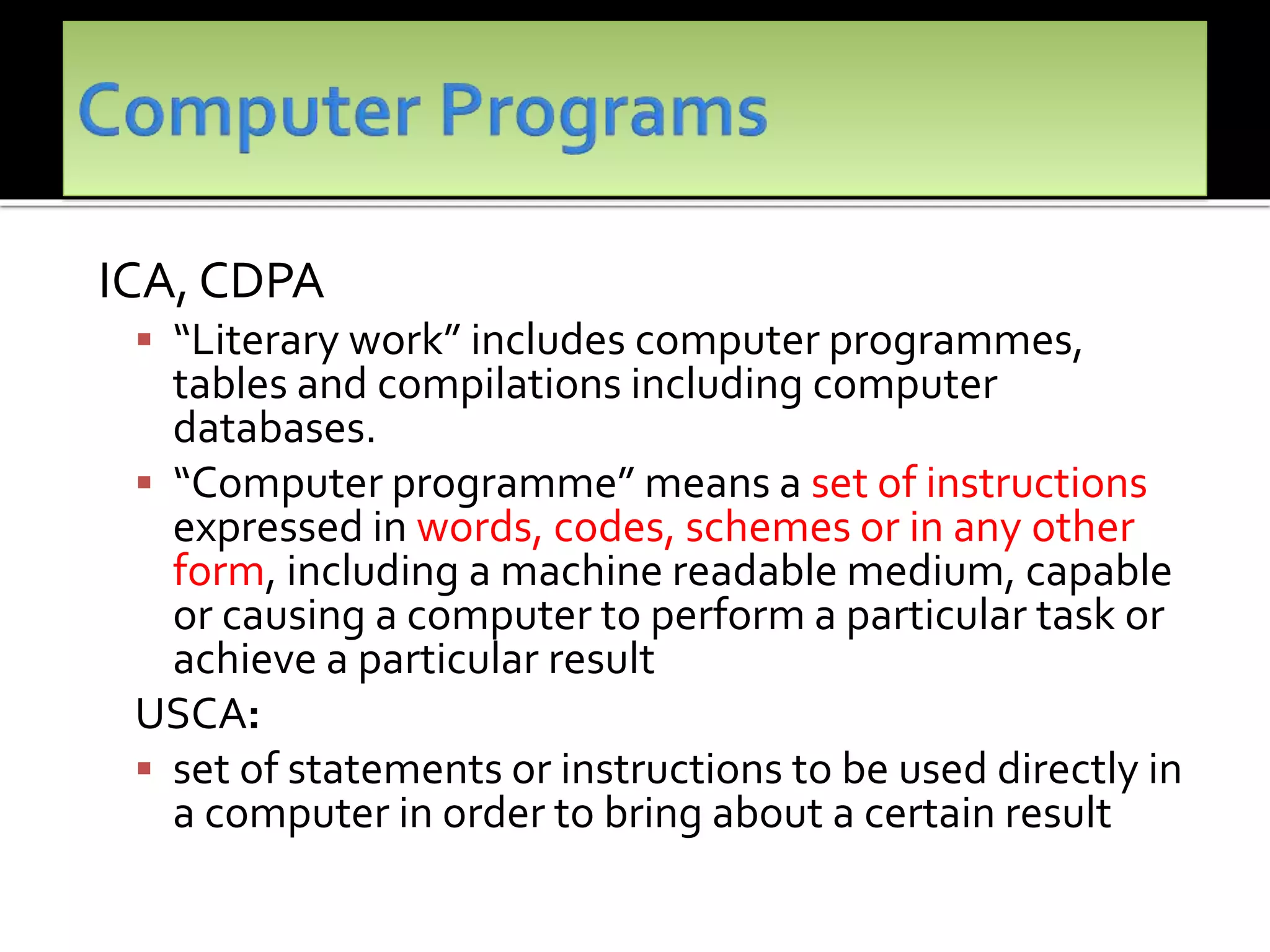
ICA, CDPA
 “Literary work” includes computer programmes,
tables and compilations including computer
databases.
 “Computer programme” means a set of instructions
expressed in words, codes, schemes or in any other
form, including a machine readable medium, capable
or causing a computer to perform a particular task or
achieve a particular result
USCA:
 set of statements or instructions to be used directly in
a computer in order to bring about a certain result
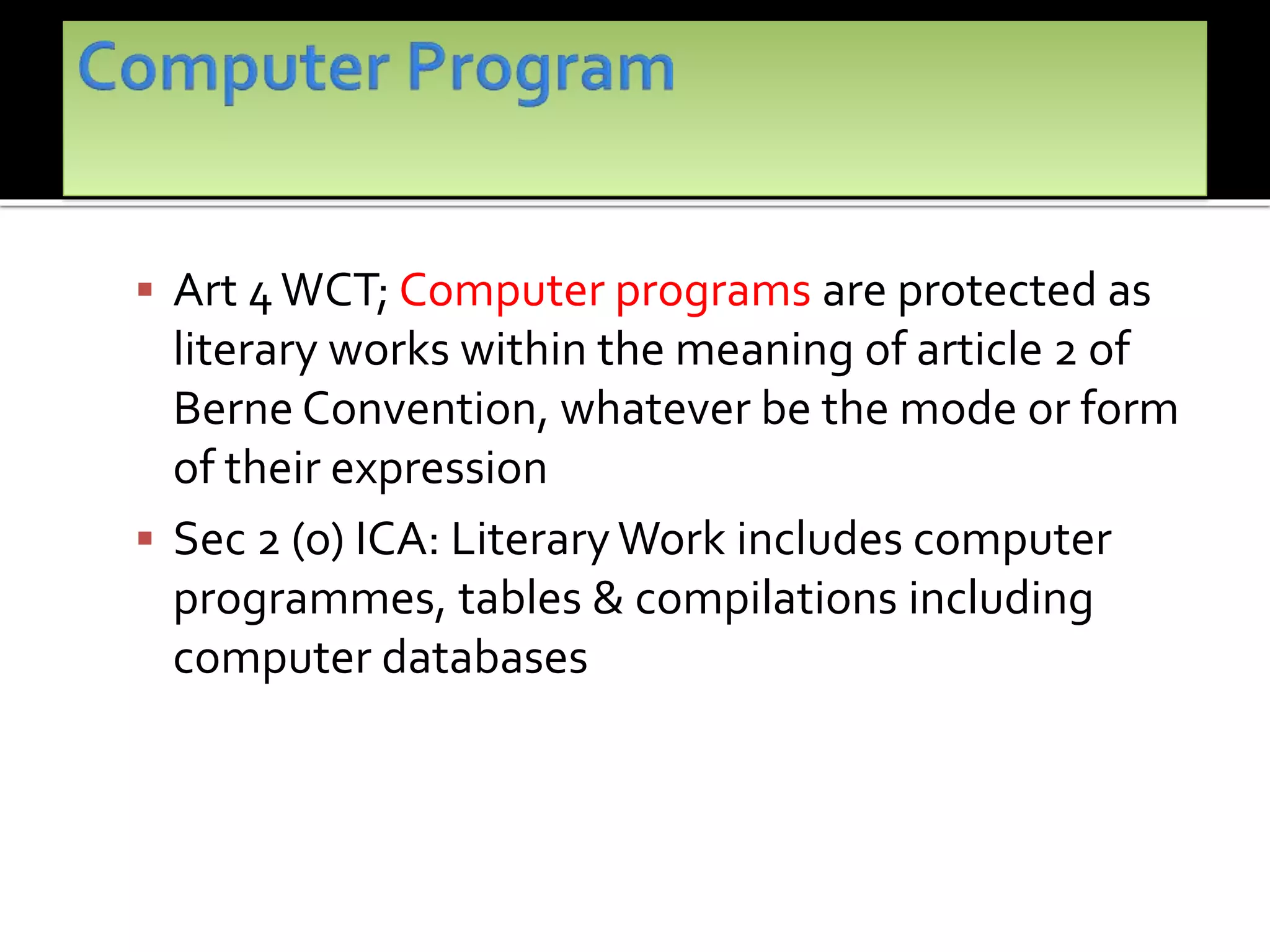
 Art 4 WCT; Computer programs are protected as
literary works within the meaning of article 2 of
Berne Convention, whatever be the mode or form
of their expression
 Sec 2 (o) ICA: LiteraryWork includes computer
programmes, tables & compilations including
computer databases
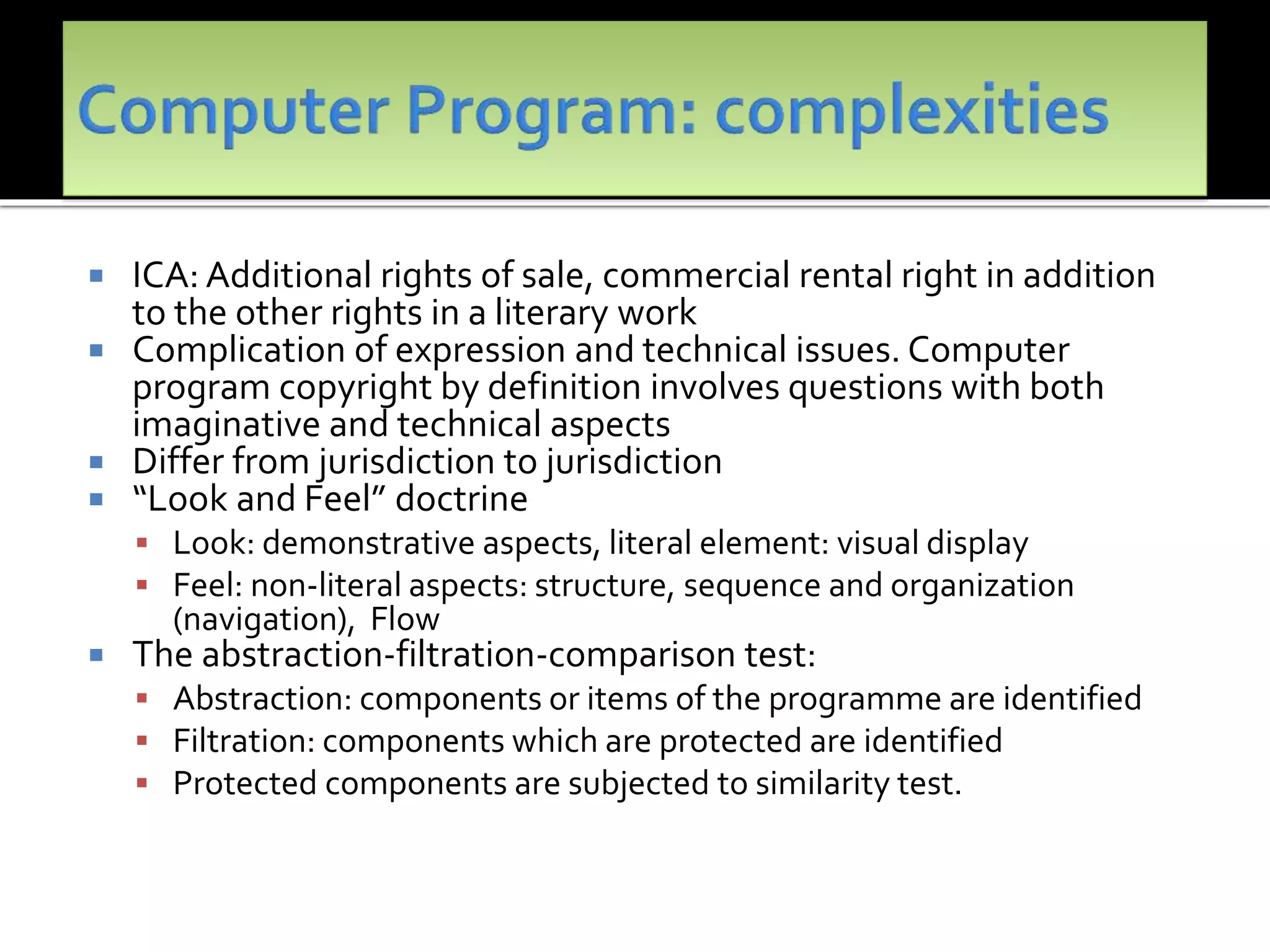
 ICA: Additional rights of sale, commercial rental right in addition
to the other rights in a literary work
 Complication of expression and technical issues. Computer
program copyright by definition involves questions with both
imaginative and technical aspects
 Differ from jurisdiction to jurisdiction
 “Look and Feel” doctrine
 Look: demonstrative aspects, literal element: visual display
 Feel: non-literal aspects: structure, sequence and organization
(navigation), Flow
 The abstraction-filtration-comparison test:
 Abstraction: components or items of the programme are identified
 Filtration: components which are protected are identified
 Protected components are subjected to similarity test.
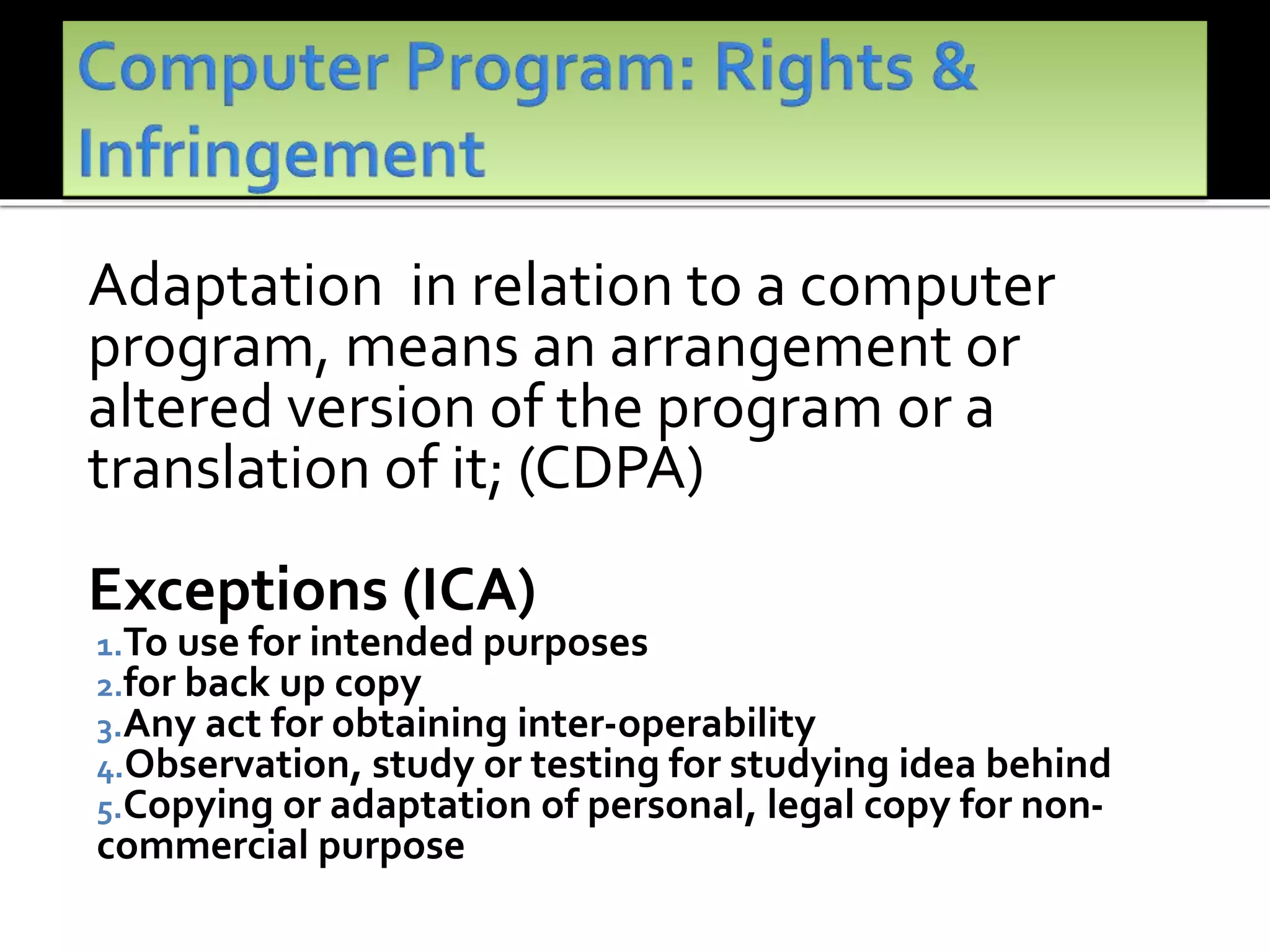
Adaptation in relation to a computer
program, means an arrangement or
altered version of the program or a
translation of it; (CDPA)
Exceptions (ICA)
1.To use for intended purposes
2.for back up copy
3.Any act for obtaining inter-operability
4.Observation, study or testing for studying idea behind
5.Copying or adaptation of personal, legal copy for non-
commercial purpose
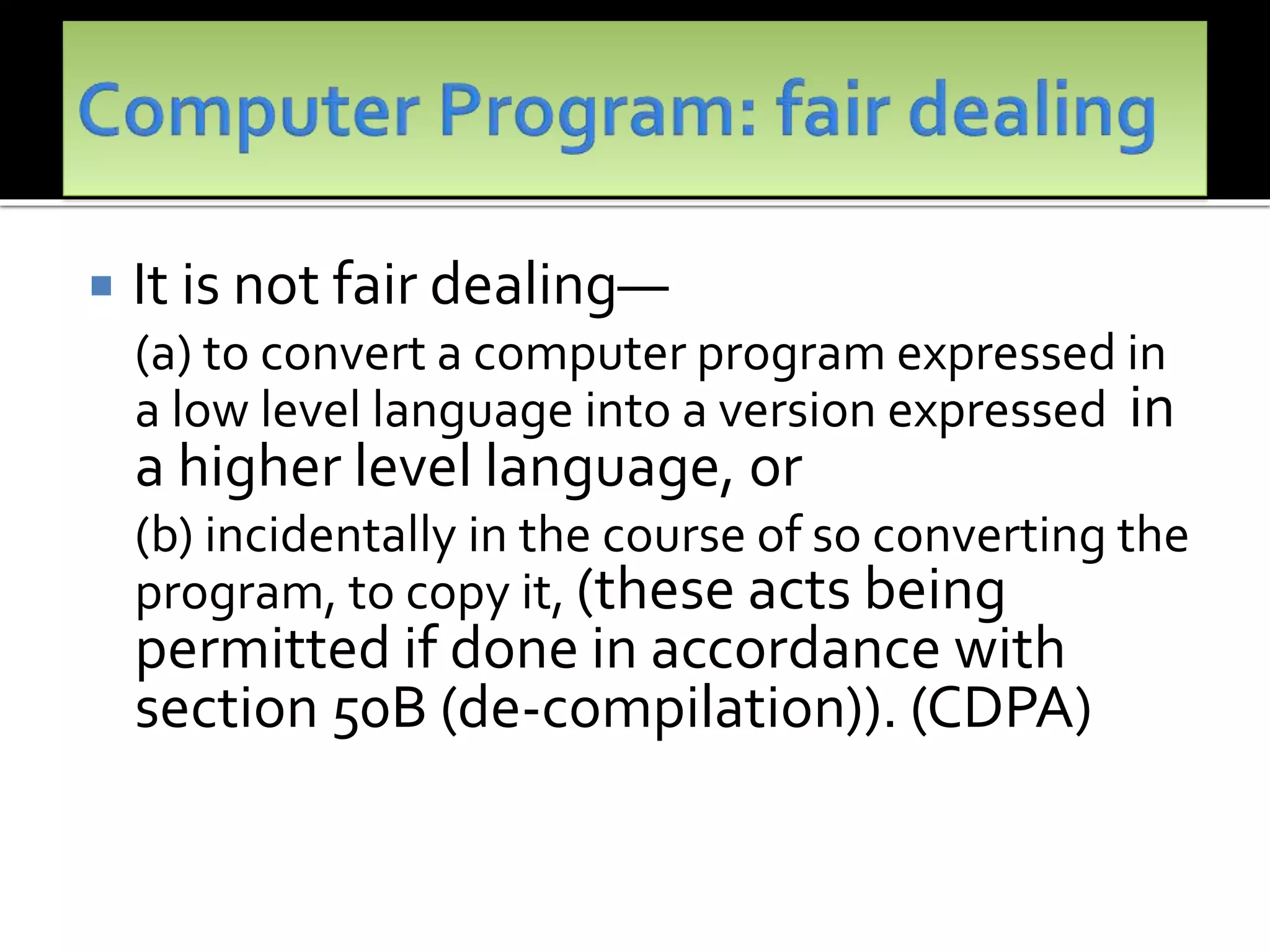
 It is not fair dealing—
(a) to convert a computer program expressed in
a low level language into a version expressed in
a higher level language, or
(b) incidentally in the course of so converting the
program, to copy it, (these acts being
permitted if done in accordance with
section 50B (de-compilation)). (CDPA)
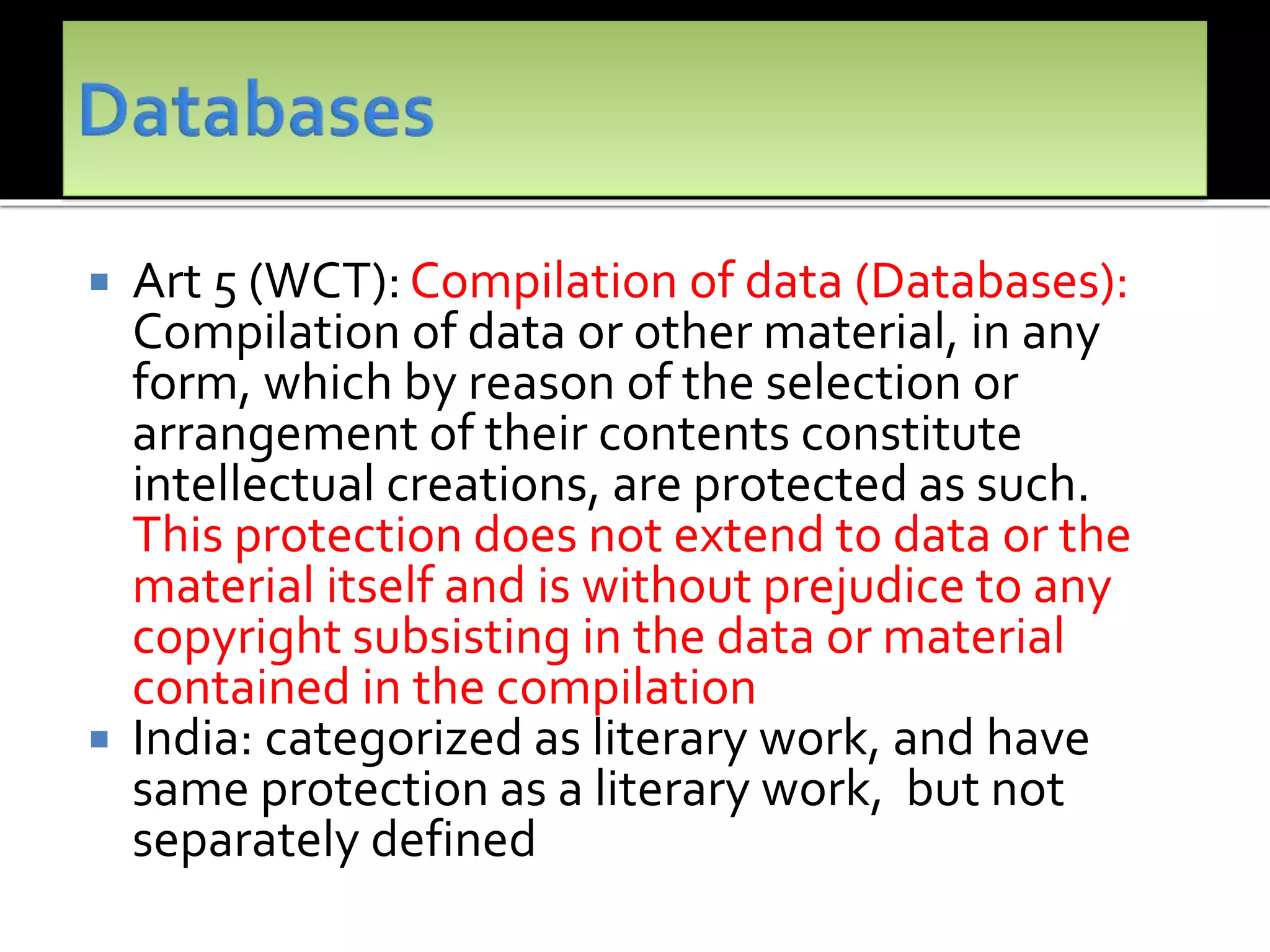
 Art 5 (WCT): Compilation of data (Databases):
Compilation of data or other material, in any
form, which by reason of the selection or
arrangement of their contents constitute
intellectual creations, are protected as such.
This protection does not extend to data or the
material itself and is without prejudice to any
copyright subsisting in the data or material
contained in the compilation
 India: categorized as literary work, and have
same protection as a literary work, but not
separately defined
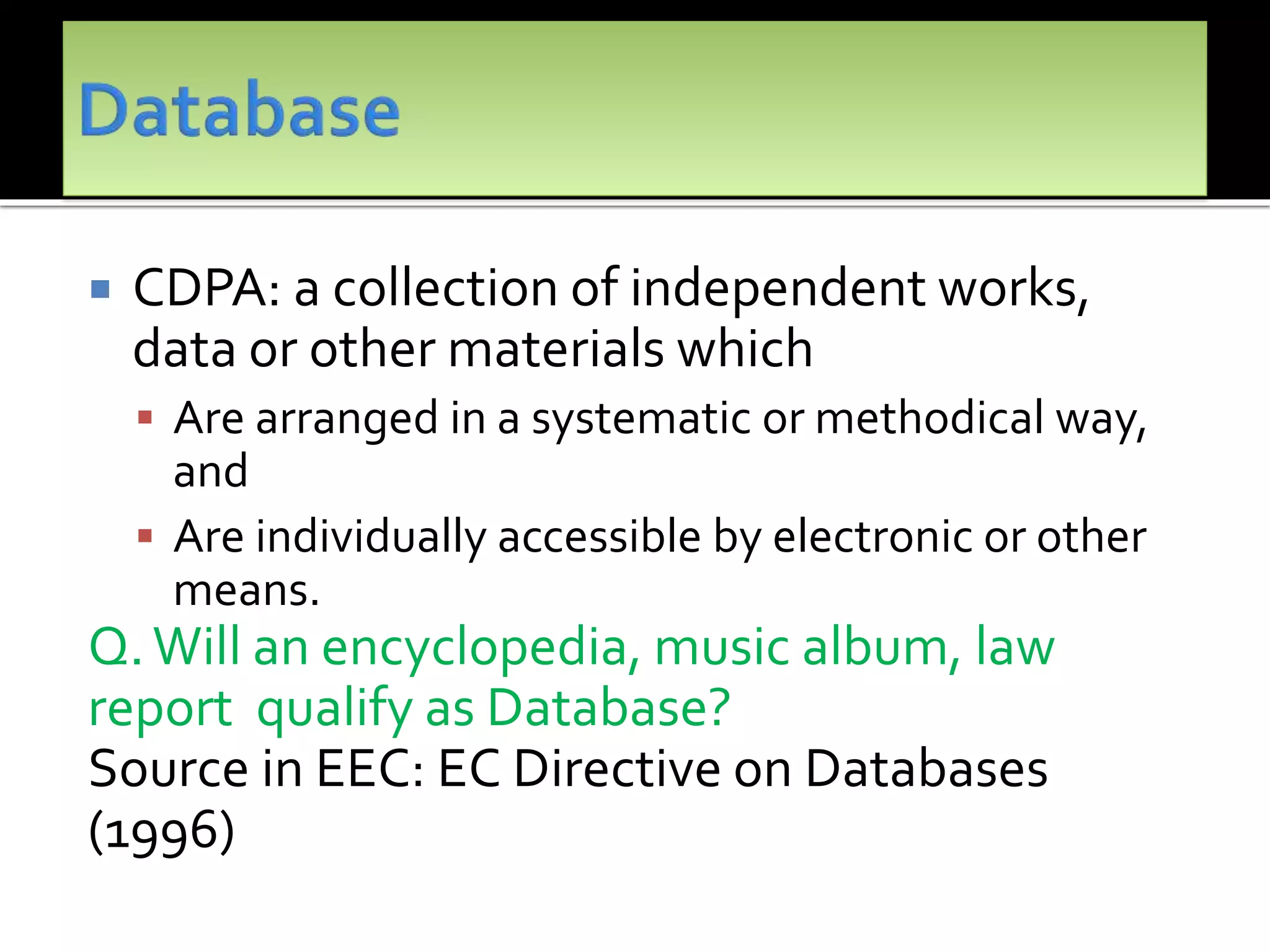
 CDPA: a collection of independent works,
data or other materials which
 Are arranged in a systematic or methodical way,
and
 Are individually accessible by electronic or other
means.
Q.Will an encyclopedia, music album, law
report qualify as Database?
Source in EEC: EC Directive on Databases
(1996)
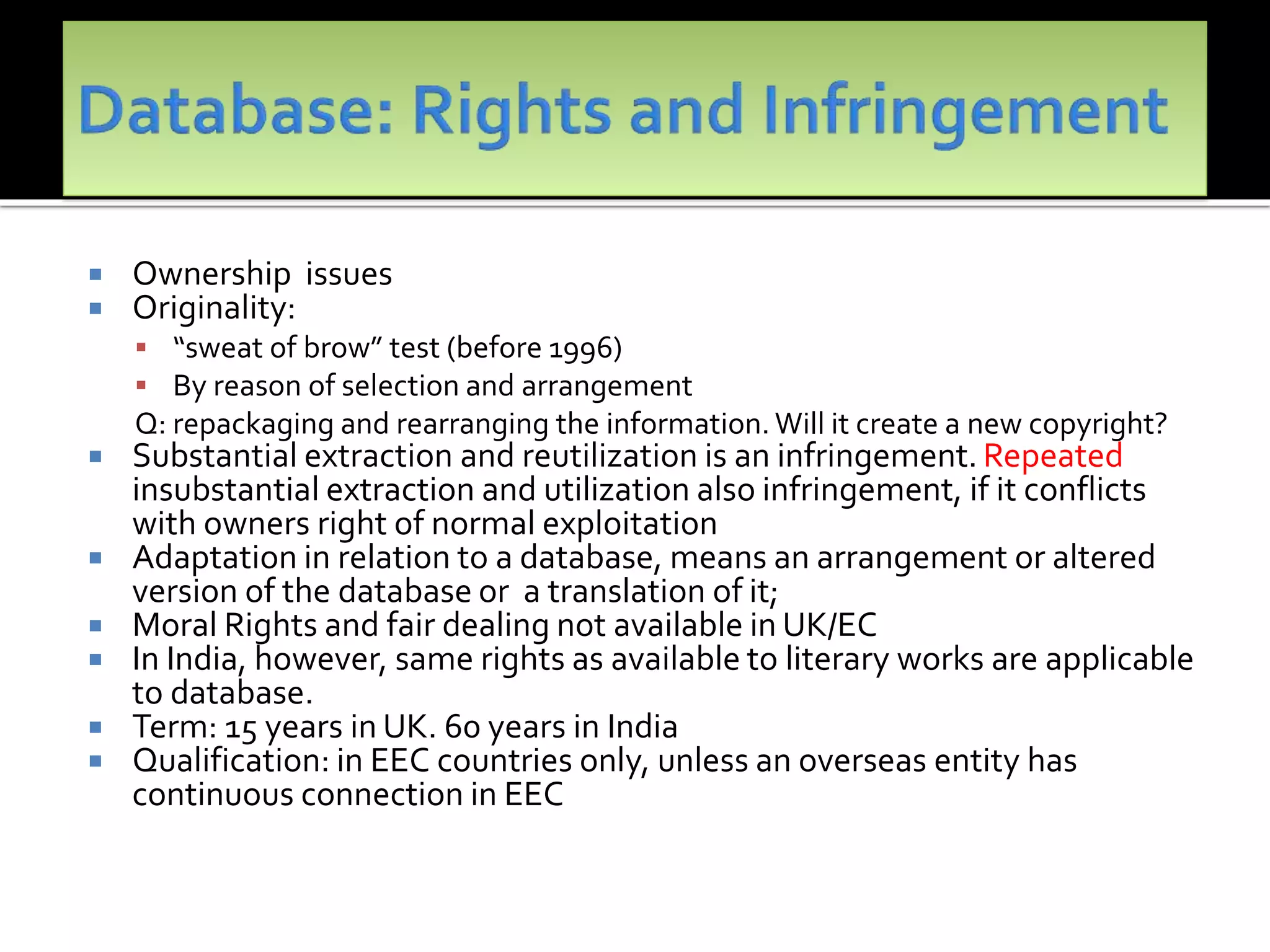
 Ownership issues
 Originality:
 “sweat of brow” test (before 1996)
 By reason of selection and arrangement
Q: repackaging and rearranging the information.Will it create a new copyright?
 Substantial extraction and reutilization is an infringement. Repeated
insubstantial extraction and utilization also infringement, if it conflicts
with owners right of normal exploitation
 Adaptation in relation to a database, means an arrangement or altered
version of the database or a translation of it;
 Moral Rights and fair dealing not available in UK/EC
 In India, however, same rights as available to literary works are applicable
to database.
 Term: 15 years in UK. 60 years in India
 Qualification: in EEC countries only, unless an overseas entity has
continuous connection in EEC
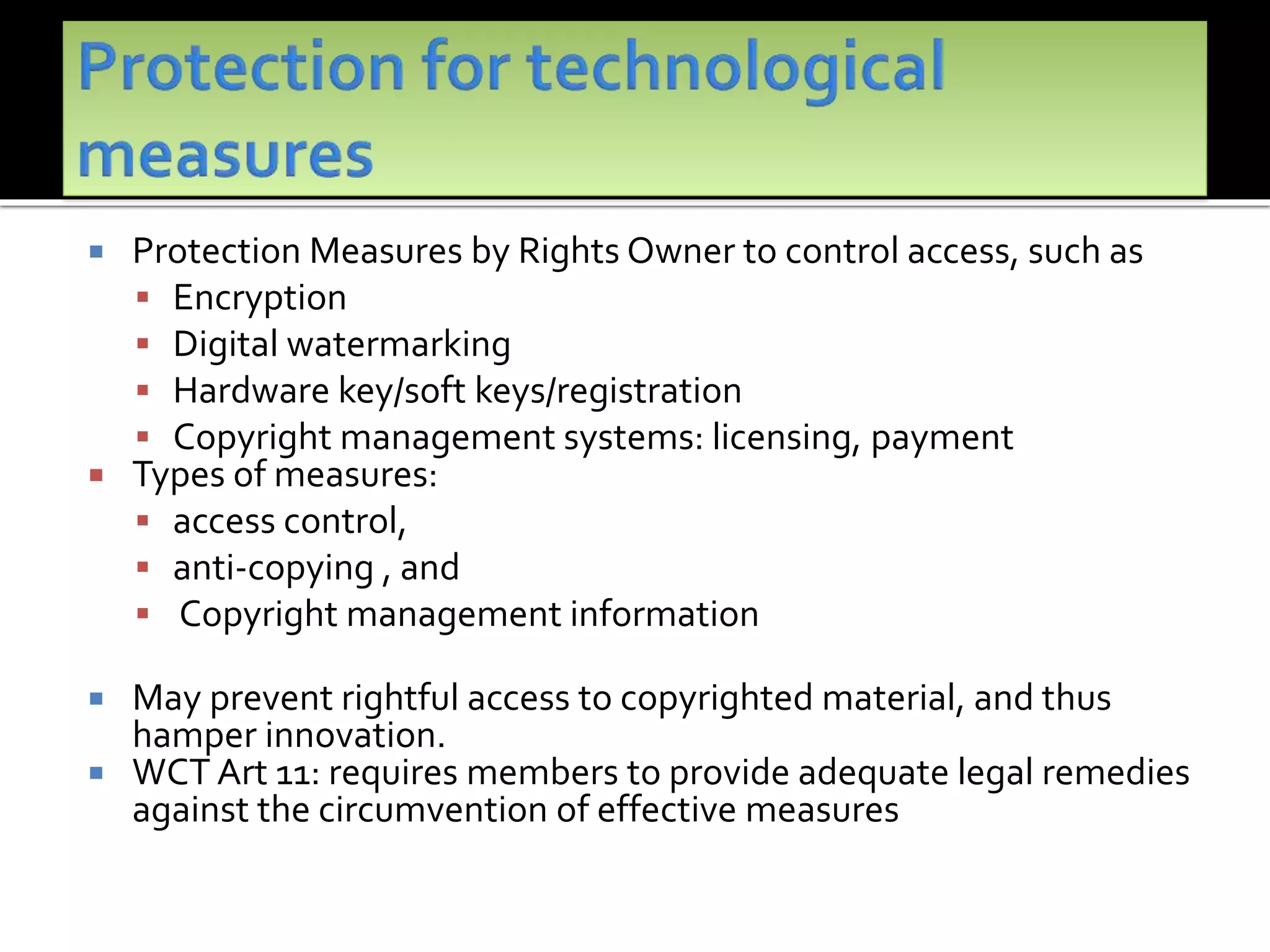
 Protection Measures by Rights Owner to control access, such as
 Encryption
 Digital watermarking
 Hardware key/soft keys/registration
 Copyright management systems: licensing, payment
 Types of measures:
 access control,
 anti-copying , and
 Copyright management information
 May prevent rightful access to copyrighted material, and thus
hamper innovation.
 WCT Art 11: requires members to provide adequate legal remedies
against the circumvention of effective measures
 To descramble, decrypt or otherwise to avoid, by pass, remove,
deactivate, or impair a technological measures without the
authority of the rightful owner
 Unauthorized use of access technology (eg. Password) does not
constitute circumvention
 exceptions:
 Libraries, archives, and educational institutions.
 Law enforcement, security agencies,
 For reverse engineering to achieve inter operability
 For encryption research
 If the measures are for collecting personal information or online activity
 For testing security of the system
(DMCA Sec 103)
 There is no explicit provision for Fair Use defense in circumvention of
technological measures
 DMCA Sec 103 (Sec 1201 Copyright Act):
 Circumventing access control measures: (applies to only anti-access measures
not anti-copying measures)
▪ Work should be legally protected by the CopyrightAct
▪ Should be primarily designed or produced for access control
▪ Circumventing devices should have limited commercially significant
purpose, other than to circumvent
▪ Technological measure should effectively control access
▪ Defendant must have actually circumvent the measures
 Anti-trafficking rules apply to both
 Trafficking in circumvention devices and services
 Applies to both anti-access as well as anti-copying devices
and services
 Should be primarily designed to circumvent and not
incidental, or
 Should have only limited commercial significant purpose
or use other than circumvention, or
 Is marketed for use in circumvention
 Section 1201 DMCA separates circumvention of
technological measures from copyright infringements
and fair use exceptions
 Section 1201 even protects elements that may not be
protected under copyrights
 Case
 Universal City Studios, Inc. v Reimerdes
 Surface linking
 Deep linking
 Framing
 Meta tags: trade mark and other violations
 To claim ownership
 Against distortion, mutilation, modification, misattribution, withdraw,
relinquish-
▪ prejudicial to his honour or reputation
▪ during the term of copyright
 Berne Art 6bis
 Independently of the author’s economic rights, and even after the transfer of the said
rights, the author shall have the right to claim authorship of the work and so to object
to any distortion, mutilation or other modification of, or other der0gatory action in
relation to, the said work, which would be prejudicial to his honour or reputation.
 US:Visual Artists Rights Act of 1990
 Provides moral rights only for works of visual art
 ISP’s Essentials
 Transient or incidental Copies (Caching, hosting,
browsing)
 Copying in relation to any description of work
includes the making of copies which are transient or
are incidental to some other use of the work. (S. 16 (4)
CDPA)
 as an essential part of technological process, For the
purpose of transmission of the work in a network, and
without economic significance. Excepted (S 28A
CDPA)
 User generated contents: social networking sites
 Uploading without authorization
 Hosting of infringing contents
 Downloading of infringing content by the accessor
 Content aggregation
 Virtual worlds: multiple rights
 Copyright complexities in Web 2.0
 Ownership & Licensing
 Collaborative and joint ownership
 Liability for infringement
 Can the definition of Cinematograph be
extended ?
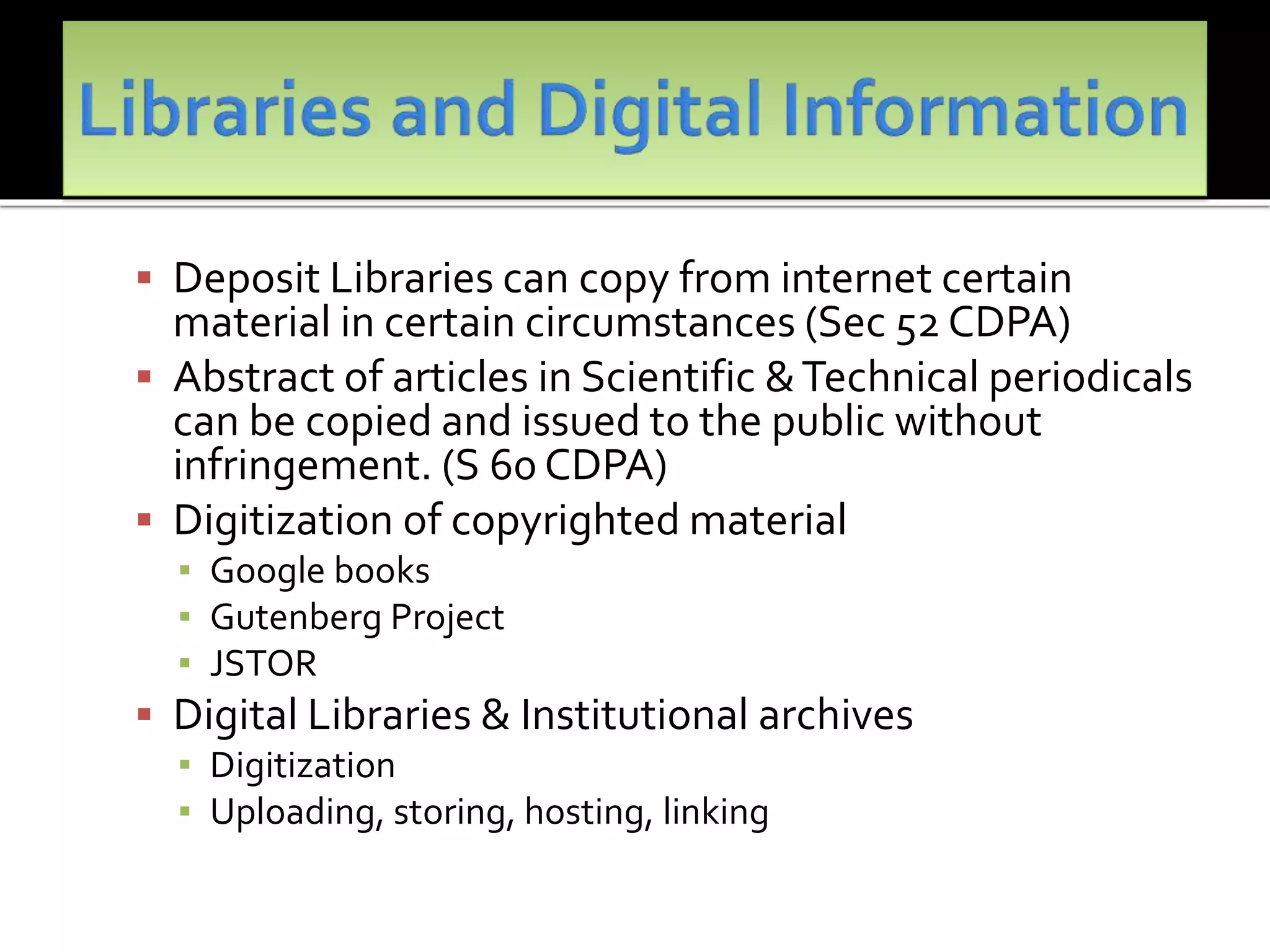
 Deposit Libraries can copy from internet certain
material in certain circumstances (Sec 52 CDPA)
 Abstract of articles in Scientific &Technical periodicals
can be copied and issued to the public without
infringement. (S 60 CDPA)
 Digitization of copyrighted material
▪ Google books
▪ Gutenberg Project
▪ JSTOR
 Digital Libraries & Institutional archives
▪ Digitization
▪ Uploading, storing, hosting, linking
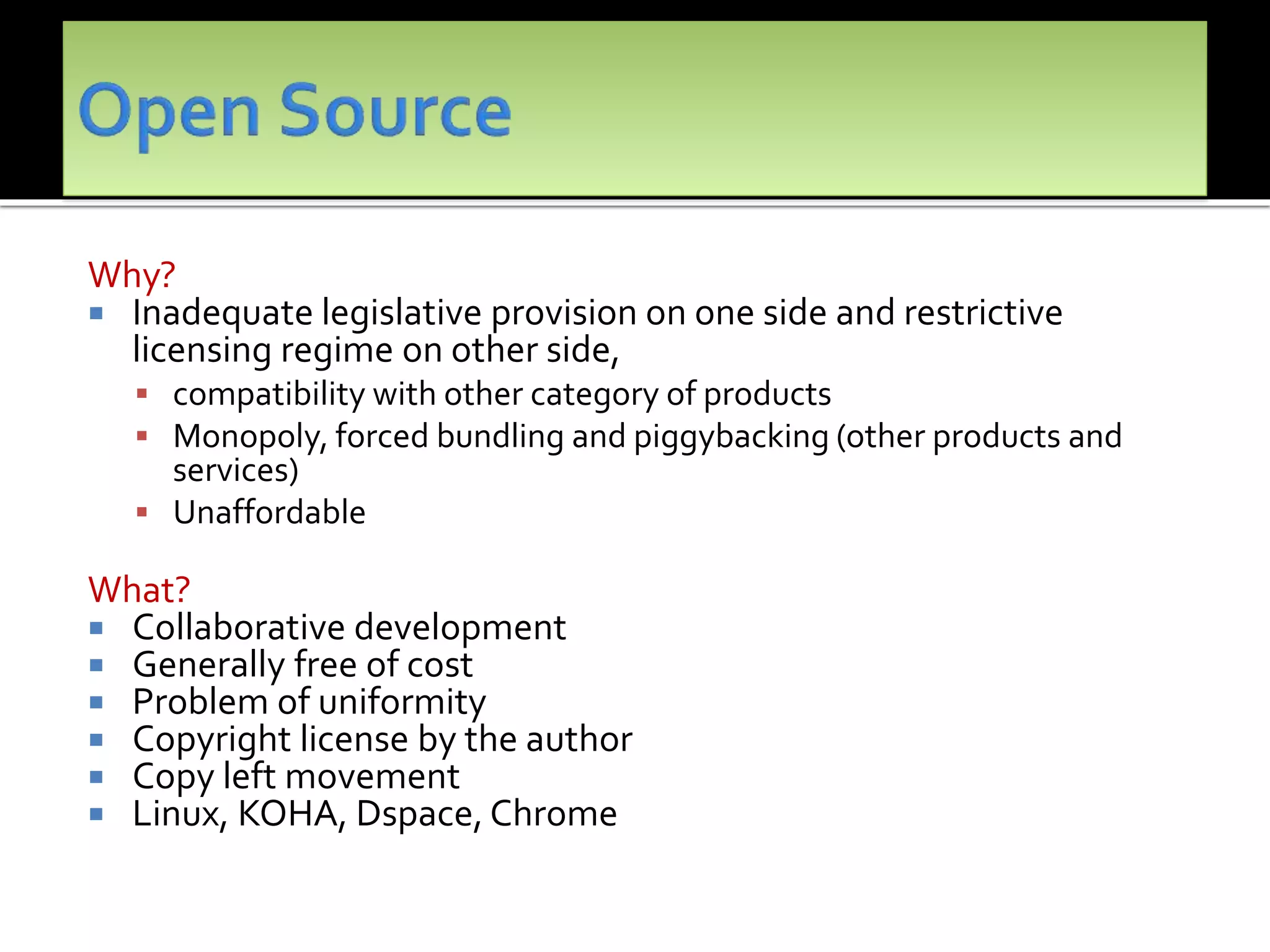
Why?
 Inadequate legislative provision on one side and restrictive
licensing regime on other side,
 compatibility with other category of products
 Monopoly, forced bundling and piggybacking (other products and
services)
 Unaffordable
What?
 Collaborative development
 Generally free of cost
 Problem of uniformity
 Copyright license by the author
 Copy left movement
 Linux, KOHA, Dspace, Chrome
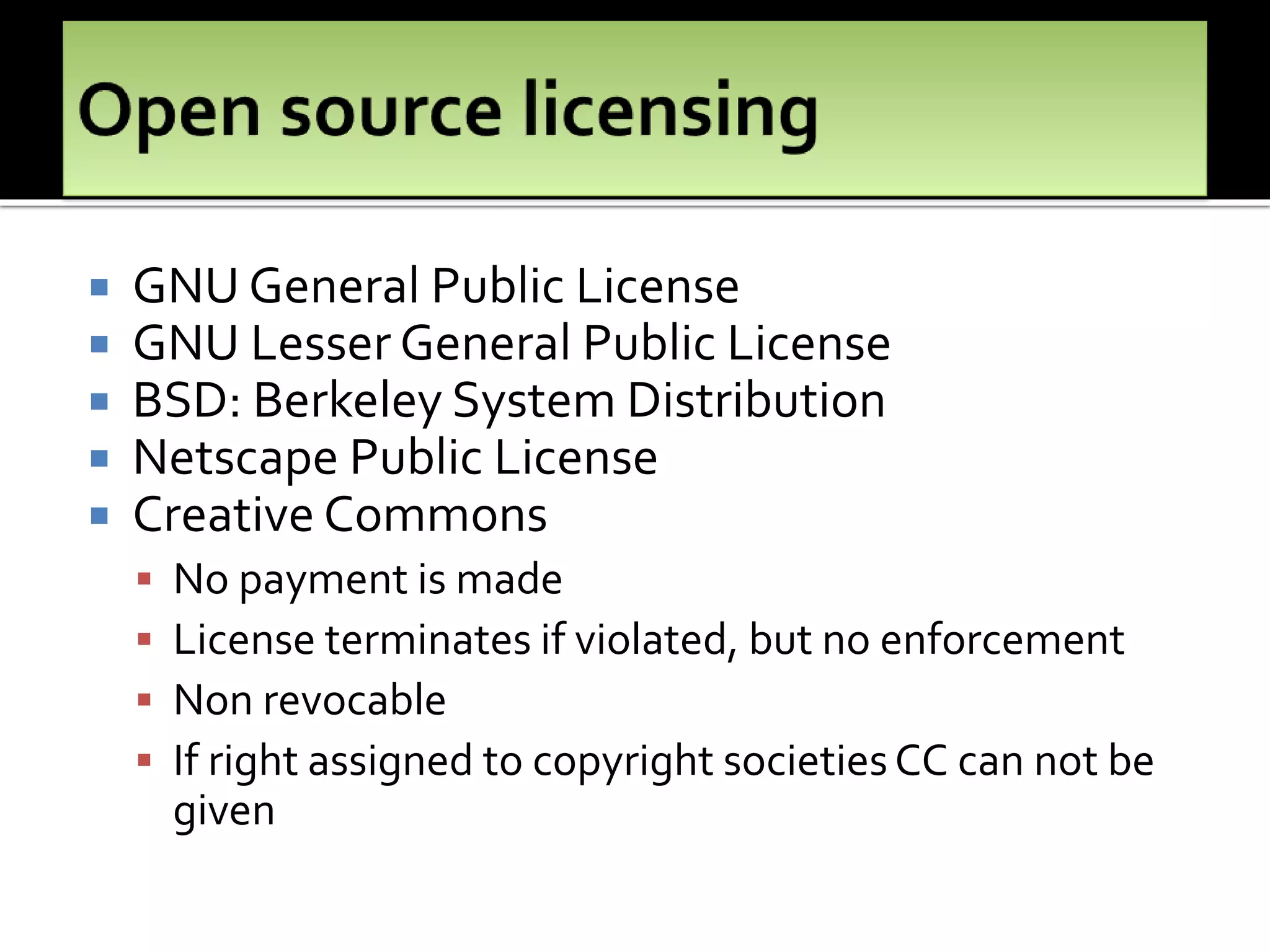
 GNU General Public License
 GNU Lesser General Public License
 BSD: Berkeley System Distribution
 Netscape Public License
 Creative Commons
 No payment is made
 License terminates if violated, but no enforcement
 Non revocable
 If right assigned to copyright societiesCC can not be
given
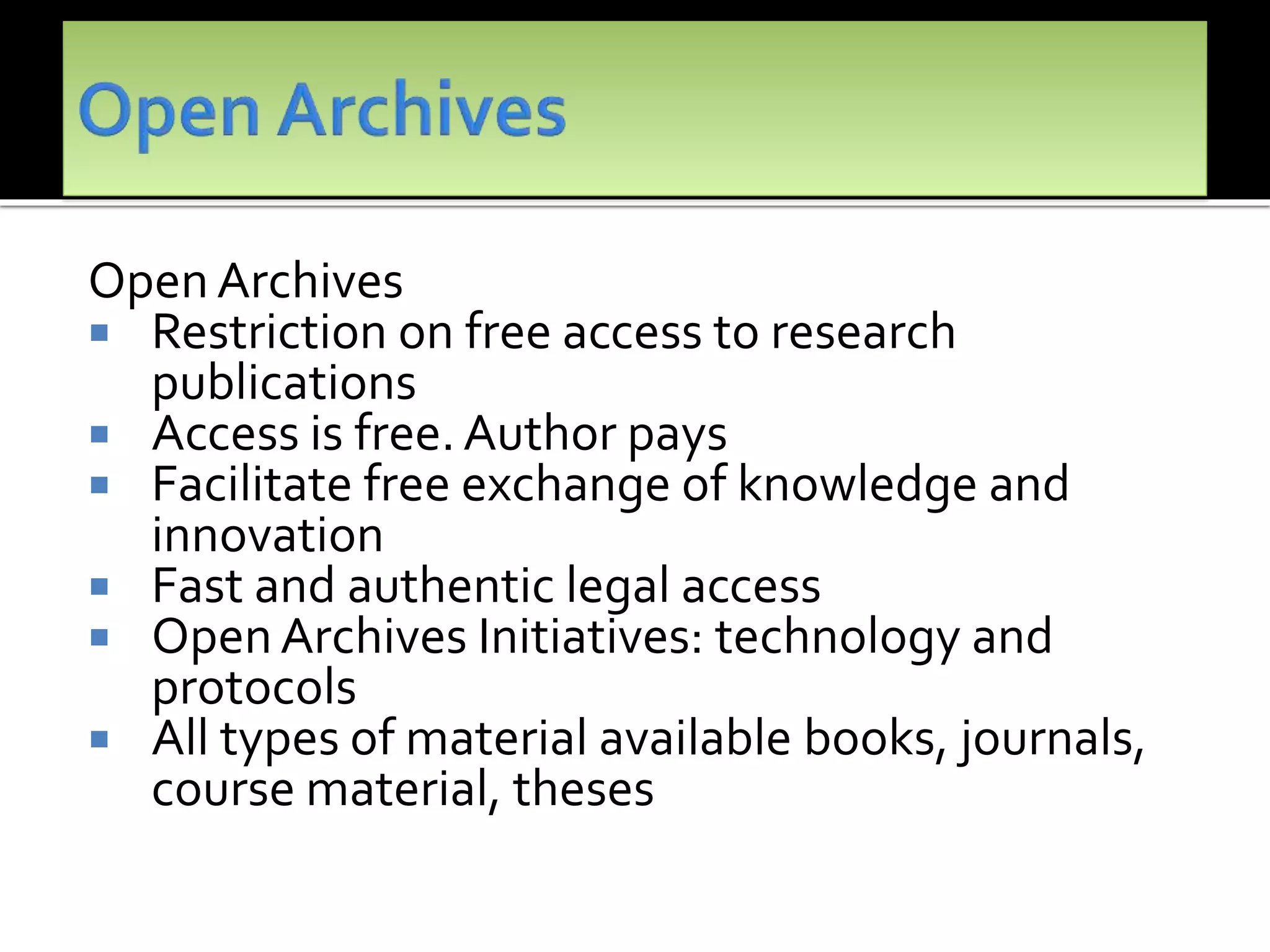
Open Archives
 Restriction on free access to research
publications
 Access is free.Author pays
 Facilitate free exchange of knowledge and
innovation
 Fast and authentic legal access
 Open Archives Initiatives: technology and
protocols
 All types of material available books, journals,
course material, theses
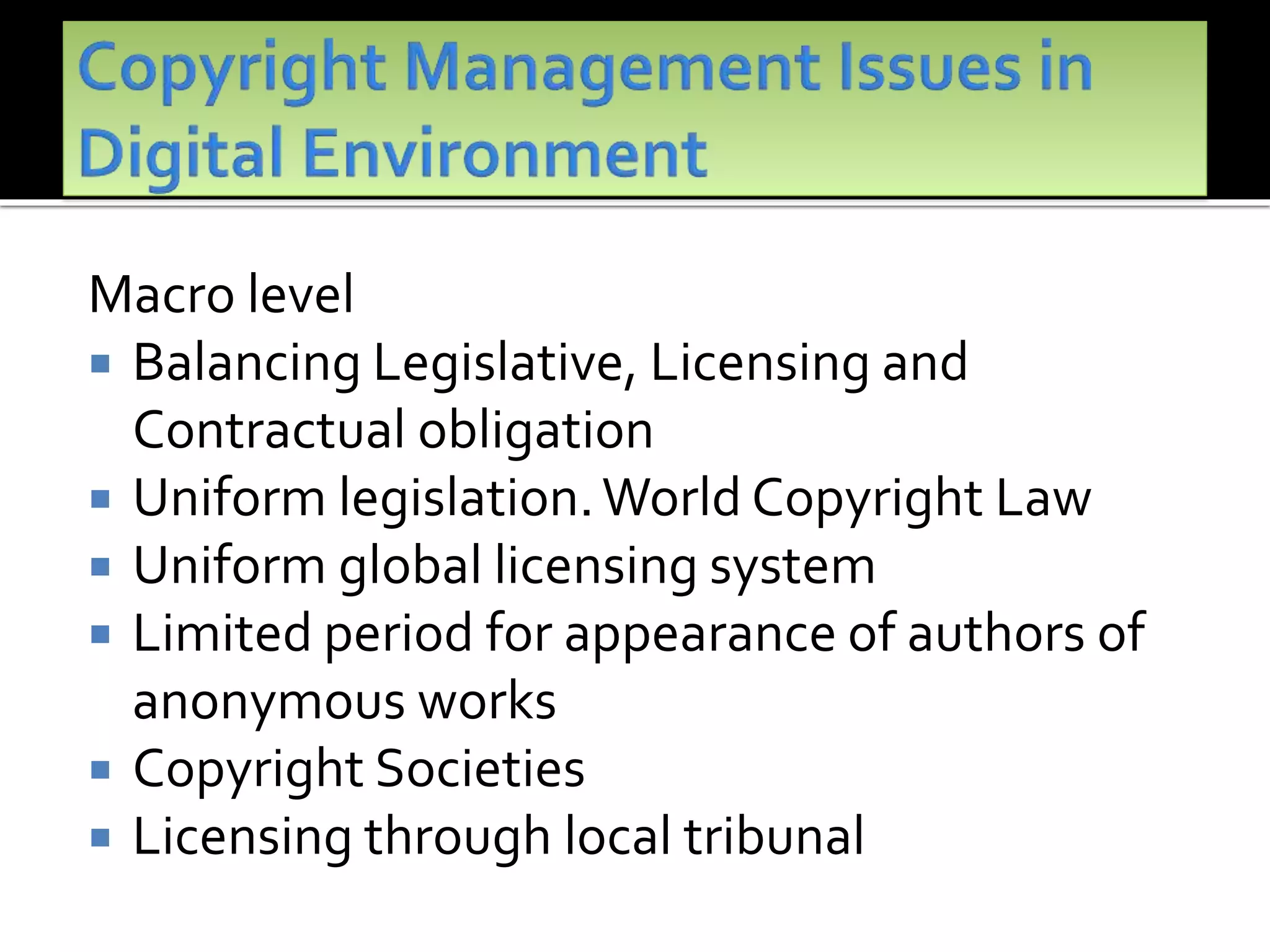
Macro level
 Balancing Legislative, Licensing and
Contractual obligation
 Uniform legislation.World Copyright Law
 Uniform global licensing system
 Limited period for appearance of authors of
anonymous works
 Copyright Societies
 Licensing through local tribunal
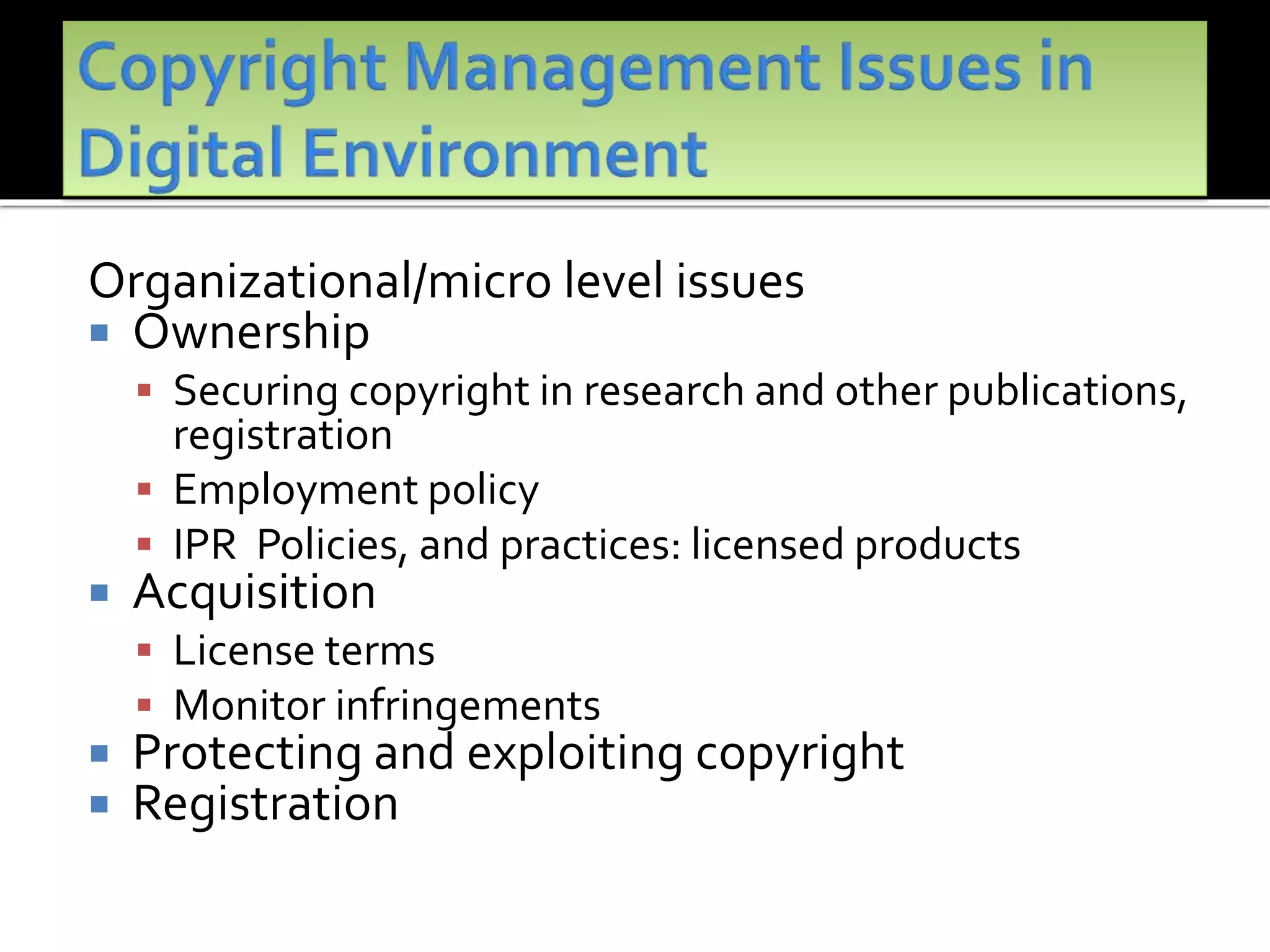
Organizational/micro level issues
 Ownership
 Securing copyright in research and other publications,
registration
 Employment policy
 IPR Policies, and practices: licensed products
 Acquisition
 License terms
 Monitor infringements
 Protecting and exploiting copyright
 Registration
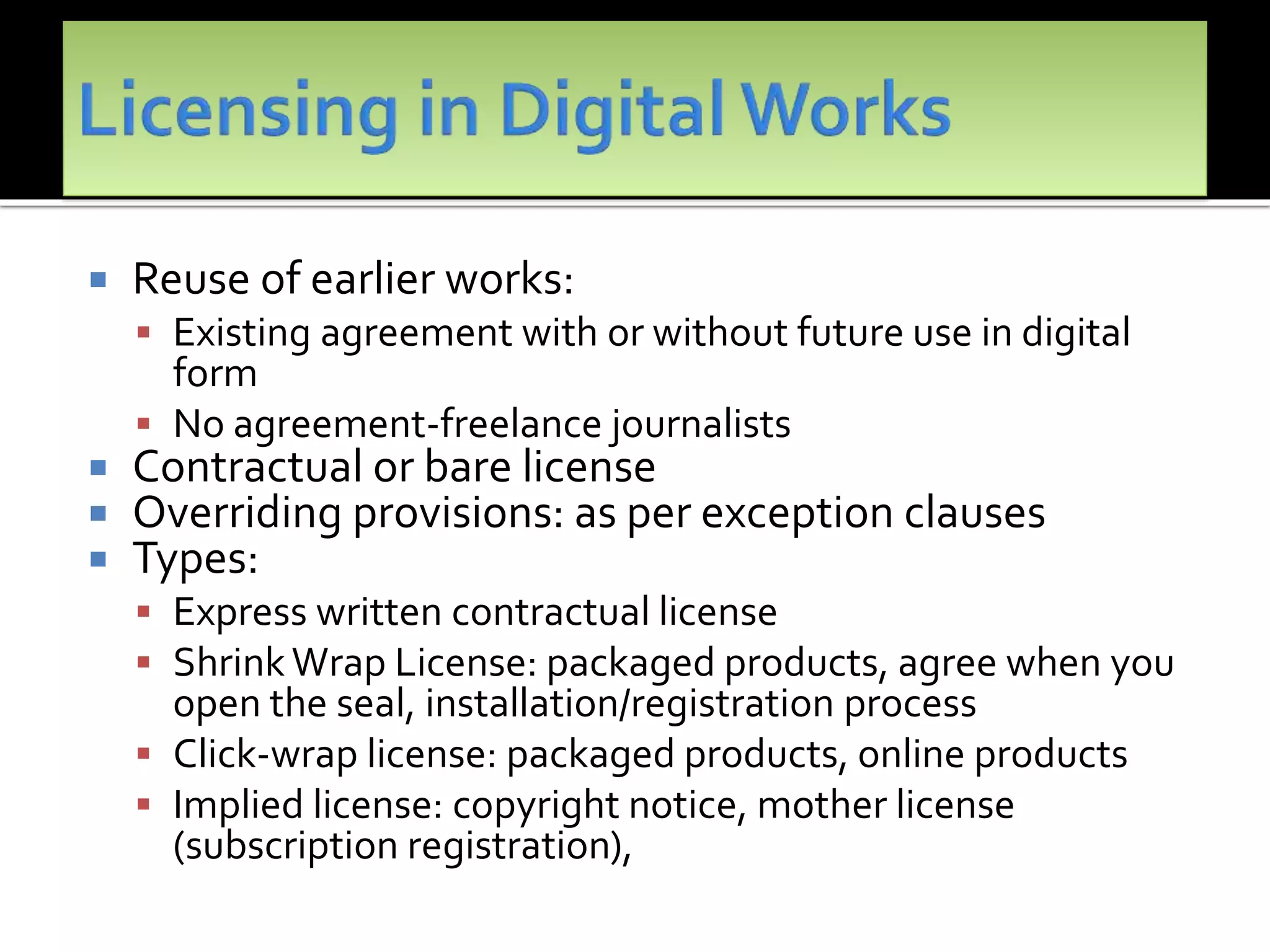
 Reuse of earlier works:
 Existing agreement with or without future use in digital
form
 No agreement-freelance journalists
 Contractual or bare license
 Overriding provisions: as per exception clauses
 Types:
 Express written contractual license
 ShrinkWrap License: packaged products, agree when you
open the seal, installation/registration process
 Click-wrap license: packaged products, online products
 Implied license: copyright notice, mother license
(subscription registration),

Digital Copyright

  • 1.
  • 2.
    1. To highlightthe challenges brought about by digital revolution to the copyright issues, 2. To analyze the complexities in applying copyright legislation in digital environment 3. To discuss, the extent to which the existing copyright laws in India, UK and USA have succeeded in meeting these challenges, and 4. To discuss some of the non-legislative initiatives/solution to address the digital challenge
  • 3.
    International/Regional  Berne Conventionfor the Protection of Literary and Artistic Works, 1886 (Berne)  WIPO CopyrightTreaty 1996 (WCT)  WIPO Performances and PhonogramsTreaty 1996 (WPPT)  EC E-commerce Directive  EC Information Society Directive India  Copyright Act 1956 (ICA)  InformationTechnology Act 2000 (IITA) UK  Copyright , Designs and Patent Act 1988 (CDPA) USA  Copyright Act 1976(USCA)  Digital Millennium Copyright Act 1998 (DMCA)
  • 4.
     New Formsof copyrightable works  Digital, multimedia,  New methods and tools of creation, adaptation, reproduction  New methods of use, communication, publishing, distribution  New methods of protections from unauthorized access  New sets of people involved
  • 5.
     Technology increation: authoring tools, hosting tools, CIP, social networking, open source, open archive, new forms, multimedia, combination of work and service, quick production/transformation, customized products (Wikipedia)  Technology in Rights Management: Access control, e-commerce, dissemination, miniaturization, rights management systems  Technology in Detection: IP tracking, tools, logs,  Technology in infringements: hyperlinks, sharing, web 2.0  Copying: Ease of Replication, web tools: hyperlinks, sharing, web 2.0, difficulty in differentiation  Distribution: Ease ofTransmission and Multiple Use, miniaturization, compression,  Adaptation: Plasticity of digital media: Can be converted into any form- Multimedia
  • 6.
     Provisions becomingineffective to address the challenges  New economic order: Information and knowledge economy  Fast pace of development require innovative legislative measures which remain relevant to address future challenges  Increasing use of non-statutory measures and counter measures as the existing legislation were found inadequate  Rebalancing of public rights and owners rights
  • 7.
     Subject ofCopyright: Work  Authorship/ownership  Undefined,  Collaborative authorship,  Pseudonymous, anonymous authorship,  Open Source, Community,  Service Provider, browsers, search engines, harvesters  Machine Generated-Translations,  Qualification: Citizenship, Place of publication  Originality  Infringement: Infringers and their liability, Fair Dealing  Non statutory restrictions (Protective Measures)
  • 8.
     Original literary,dramatic, musical and artistic works.  Cinematograph  Sound Recording  Broadcast: ▪ Communication to the public by any means of wireless diffusion, whether in any one or more of the forms of signs, sound or visual images; or ▪ By wire, and includes a re-broadcast (Sec 2 (dd))  TypographicArrangement of published edition (UK CDPA)  Fonts (CDPA)
  • 9.
     Special forms Computer program  Database  Multimedia  Computer Games  Website  Transmissions: video conference, webcast,Web TV
  • 10.
     ICA: Nothingexpressly mentioned. Expression  IITA [Sec 4] Legal Recognition of Electronic Records:  Where any law provides that information or any other matter shall be in writing or in the typewritten or printed form, then, notwithstanding anything contained in such law, such requirement shall be deemed to have been satisfied if such information or matter is (a) rendered or made available in an electronic form; and (b) accessible so as to be usable for a subsequent reference  CDPA : Copyright does not subsist in a literary, dramatic or musical work unless and until it is recorded, in writing or otherwise; …  US CA : in any tangible medium of expression, now known or later developed, from which they can be perceived, reproduced, or otherwise communicated, either directly or with the aid of a machine or device
  • 11.
     Content providers Site operators  General service providers  Access providers  Hosting services  Communication providers  Location tool providers  Subscribers, users
  • 12.
     Substainality  Relevantrights  direct or associated infringement  Duty of care: by policy notification, warnings, other reasonable efforts to prevent infringement  Knowledge available to the infringement  Authorization by the defendant  Participation and/or assistance provided in overall infringement activity  Extent of Control  Inducement to others  Intention or negligence  Economic advantage 
  • 13.
     Economic Rights Reproduction  Adaptation &Translation  Distribution  Communication  Right against circumvention of technological measures  Moral Rights  Sui generis
  • 14.
     Primary: Reproduction,adaptation, sale/rental  Secondary  Other than copyright: piracy, counterfeiting, bootlegging
  • 15.
     Mere ideanot the expression  Idea merged in expression  Non creative portion/material  Material dictated by external factors (facts, directory)  Material in public domain
  • 16.
     Place wherework was created is relevant  Where the infringement takes place is relevant  Which court has the jurisdiction  1968 Brussels Convention  1988 Lugano Convention on Jurisdiction and Enforcement of Judgments in Civil and Commercial Matters  Brussels I Regulation (EC44/2001)
  • 17.
    Reproduction rights, asset out inArt 9 of Berne Convention and exceptions permitted thereunder , fully apply in the Digital Environment, particularly to use of works in digital form. It is understood that storage of a protected work in digital form in an electronic medium constitutes a reproduction within the meaning of Article 9 of the Berne Convention. (Agreed Statements concerningArticle 1 (4) of WCT) Important Factors to be considered  Form, duration, scope  Internet transmissions results into reproduction on several servers  Live telecast  Private copying: E-commerce model, fee based, revenue sharing, exchange, peer to peer sharing
  • 18.
    CDPA Sec 17 Copying in relation to a literary, dramatic, musical or artistic work means reproducing the work in any material form.  This includes storing the work in any medium by electronic means.  Copying in relation to any description of work includes the making of copies which are transient  or are incidental to some other use of the work.
  • 19.
    Instances in Internet’scontext  Posting or uploading copyrighted contents on a website  Linking: surface linking , deep linking  Framing  Caching: current pages, past visits, caching on a server (ISP or webserver) : for faster retrieval, outdated, may deprive owner of advertising  Archiving: mirroring  Thumbnails of images : Perfect10 v/s Google  Peer to peer sharing: Napster case, KaZaa, Grokster  BitTorrent file sharing
  • 20.
     Technology enabled,customized, fast, multimedia convergence  Fixation not required in adaptation : it is immaterial whether the adaptation has been recorded, in writing or otherwise, at the time the act is done
  • 21.
     On demand,(Liability?)  Uploading on the site: it is immaterial whether some one actually downloads or views the material (see sec 2 Communication to the public, sec 20 CDPA)  Complexities of time & space & liability  Broadcaster Rights & Performers Rights: Same provisions as in other forms will apply to webcast also. (who is broadcaster?)
  • 22.
     Public performance Operator of the equipment are excepted from infringement  “Where copyright in a work is infringed by its being performed, played or shown in public by means of apparatus for receiving visual images or sounds conveyed by electronic means, the person by whom the visual images or sounds are sent, and in the case of a performance the performers, shall not be regarded as responsible for the infringement” CDPA S. 19(4)
  • 23.
     Import ofinfringing copy  Dealing with infringing copies: possession, sale, let for hire, display, distributes  Makes, imports, distributes, possess an article specifically designed or adapted for making copies of that work, knowing or having reason to believe that it is to be used to make infringing copies.  Making website available for copying or electronic transmission or performance  Copyright in a work is infringed by a person who without the license of the copyright owner transmits the work by means of a telecommunications system (otherwise than by communication to the public), knowing or having reason to believe that infringing copies of the work will be made by means of the reception of the transmission in the United Kingdom or elsewhere. CDPA Sec 24(2)  Permitting use of premises for infringement by performance
  • 24.
    Balance between interestof the rights owner and public interest of research & innovation Article 13TRIPS (3 step test)  Members shall confine limitations or exceptions to exclusive rights to – ▪ certain special cases ▪ which do not conflict with a normal exploitation of the work and ▪ do not unreasonably prejudice the legitimate interests of the right holder. WIPO CopyrightTreaty (Art 10) ▪ Reasonable quotations ▪ Use as illustrations for teaching Fair Dealing: Benefit should not be unfair to the rights owner  Intended use/audience of the copy: Commercial motive, deprive the owner business opportunity  Nature of the copyrighted work: e.g. student text, unpublished material,  Means of obtaining copy : illegal means can not justify fair use defense  Amount, substantiality and importance of the portion taken
  • 25.
    Copying & publicdistribution by educational institutions for instruction  Non reprographic copying (sec 32 CDPA)  is fair dealing with the work,  (b) is done by a person giving or receiving instruction,  (c) is not done by means of a reprographic process, and  (d) is accompanied by a sufficient acknowledgement  Reprographic means (Sec 36 CDPA),  non commercial  1% per quarter  Where there is no license is available  With due acknowledgment
  • 26.
     Research orprivate study  Non commercial research  Sec 29 CDPA Copying by a person other than the researcher or student himself is not fair dealing if— (a) in the case of a librarian, or a person acting on behalf of a librarian, he does anything which regulations under section 40 would not permit to be done under section 38 or 39 (articles or parts of published works: restriction on multiple copies of same material), or (b) in any other case, the person doing the copying knows or has reason to believe that it will result in copies of substantially the same material being provided to more than one person at substantially the same time and for substantially the same purpose.  Criticism, review & news reporting  Incidental inclusion of copyright material.
  • 27.
     Service Providermeans an entity offering the transmission, routing or providing of connections for digital online communications, between or among points specified by a user, of material of the user’s choosing, without modification to the content of the material as sent or received  A provider of online service or network access, or the operator of facilities (DMCA Sec 12 (K) Indian IT Act 2000  "Intermediary" with respect to any particular electronic records, means any person who on behalf of another person receives, stores or transmits that record or provides any service with respect to that record and includes telecom service providers, network service providers, internet service providers, web hosting service providers, search engines, online payment sites, online-auction sites, online market places and cyber cafes.
  • 28.
    Limited Liability forinfringement :No monetary relief ; only limited injunction  Transitory Digital Network Communications  If transmission started by someone else than the ISP  Transmission is through automatic means without selection of material  ISP has no role in selection of recipient except automatic response to request  Transient copy is not kept for longer than required for routing etc.  No modification of contents is done  System caching  Information residing on systems or networks at directions of users  Information location tools DMCA (s202)
  • 29.
    No Liability  Ifa nonprofit higher educational institution is service provider, infringement by a teacher or student can not be attributed to the institutions  Replacement of removed or disabled material ; by ISP on good faith  Copying forTime shifting: Different time zones Liability for misrepresentation of infringement Eligibility of ISP for limited liability  adoption, implementation and communication of a policy for termination of service to repeat infringers  measures to identify infringers  Take down notices DMCA (s202)
  • 30.
    IITA[Sec 67 C]Preservation and Retention of information by intermediaries:  (1) Intermediary shall preserve and retain such information as may be specified for such duration and in such manner and format as the Central Government may prescribe.  (2) Any intermediary who intentionally or knowingly contravenes the provisions of sub section (1) shall be punished with an imprisonment for a term which may extend to three years and shall also be liable to fine.
  • 31.
    ICA, CDPA  “Literarywork” includes computer programmes, tables and compilations including computer databases.  “Computer programme” means a set of instructions expressed in words, codes, schemes or in any other form, including a machine readable medium, capable or causing a computer to perform a particular task or achieve a particular result USCA:  set of statements or instructions to be used directly in a computer in order to bring about a certain result
  • 32.
     Art 4WCT; Computer programs are protected as literary works within the meaning of article 2 of Berne Convention, whatever be the mode or form of their expression  Sec 2 (o) ICA: LiteraryWork includes computer programmes, tables & compilations including computer databases
  • 33.
     ICA: Additionalrights of sale, commercial rental right in addition to the other rights in a literary work  Complication of expression and technical issues. Computer program copyright by definition involves questions with both imaginative and technical aspects  Differ from jurisdiction to jurisdiction  “Look and Feel” doctrine  Look: demonstrative aspects, literal element: visual display  Feel: non-literal aspects: structure, sequence and organization (navigation), Flow  The abstraction-filtration-comparison test:  Abstraction: components or items of the programme are identified  Filtration: components which are protected are identified  Protected components are subjected to similarity test.
  • 34.
    Adaptation in relationto a computer program, means an arrangement or altered version of the program or a translation of it; (CDPA) Exceptions (ICA) 1.To use for intended purposes 2.for back up copy 3.Any act for obtaining inter-operability 4.Observation, study or testing for studying idea behind 5.Copying or adaptation of personal, legal copy for non- commercial purpose
  • 35.
     It isnot fair dealing— (a) to convert a computer program expressed in a low level language into a version expressed in a higher level language, or (b) incidentally in the course of so converting the program, to copy it, (these acts being permitted if done in accordance with section 50B (de-compilation)). (CDPA)
  • 36.
     Art 5(WCT): Compilation of data (Databases): Compilation of data or other material, in any form, which by reason of the selection or arrangement of their contents constitute intellectual creations, are protected as such. This protection does not extend to data or the material itself and is without prejudice to any copyright subsisting in the data or material contained in the compilation  India: categorized as literary work, and have same protection as a literary work, but not separately defined
  • 37.
     CDPA: acollection of independent works, data or other materials which  Are arranged in a systematic or methodical way, and  Are individually accessible by electronic or other means. Q.Will an encyclopedia, music album, law report qualify as Database? Source in EEC: EC Directive on Databases (1996)
  • 38.
     Ownership issues Originality:  “sweat of brow” test (before 1996)  By reason of selection and arrangement Q: repackaging and rearranging the information.Will it create a new copyright?  Substantial extraction and reutilization is an infringement. Repeated insubstantial extraction and utilization also infringement, if it conflicts with owners right of normal exploitation  Adaptation in relation to a database, means an arrangement or altered version of the database or a translation of it;  Moral Rights and fair dealing not available in UK/EC  In India, however, same rights as available to literary works are applicable to database.  Term: 15 years in UK. 60 years in India  Qualification: in EEC countries only, unless an overseas entity has continuous connection in EEC
  • 39.
     Protection Measuresby Rights Owner to control access, such as  Encryption  Digital watermarking  Hardware key/soft keys/registration  Copyright management systems: licensing, payment  Types of measures:  access control,  anti-copying , and  Copyright management information  May prevent rightful access to copyrighted material, and thus hamper innovation.  WCT Art 11: requires members to provide adequate legal remedies against the circumvention of effective measures
  • 40.
     To descramble,decrypt or otherwise to avoid, by pass, remove, deactivate, or impair a technological measures without the authority of the rightful owner  Unauthorized use of access technology (eg. Password) does not constitute circumvention  exceptions:  Libraries, archives, and educational institutions.  Law enforcement, security agencies,  For reverse engineering to achieve inter operability  For encryption research  If the measures are for collecting personal information or online activity  For testing security of the system (DMCA Sec 103)
  • 41.
     There isno explicit provision for Fair Use defense in circumvention of technological measures  DMCA Sec 103 (Sec 1201 Copyright Act):  Circumventing access control measures: (applies to only anti-access measures not anti-copying measures) ▪ Work should be legally protected by the CopyrightAct ▪ Should be primarily designed or produced for access control ▪ Circumventing devices should have limited commercially significant purpose, other than to circumvent ▪ Technological measure should effectively control access ▪ Defendant must have actually circumvent the measures  Anti-trafficking rules apply to both
  • 42.
     Trafficking incircumvention devices and services  Applies to both anti-access as well as anti-copying devices and services  Should be primarily designed to circumvent and not incidental, or  Should have only limited commercial significant purpose or use other than circumvention, or  Is marketed for use in circumvention  Section 1201 DMCA separates circumvention of technological measures from copyright infringements and fair use exceptions  Section 1201 even protects elements that may not be protected under copyrights
  • 43.
     Case  UniversalCity Studios, Inc. v Reimerdes
  • 44.
     Surface linking Deep linking  Framing  Meta tags: trade mark and other violations
  • 45.
     To claimownership  Against distortion, mutilation, modification, misattribution, withdraw, relinquish- ▪ prejudicial to his honour or reputation ▪ during the term of copyright  Berne Art 6bis  Independently of the author’s economic rights, and even after the transfer of the said rights, the author shall have the right to claim authorship of the work and so to object to any distortion, mutilation or other modification of, or other der0gatory action in relation to, the said work, which would be prejudicial to his honour or reputation.  US:Visual Artists Rights Act of 1990  Provides moral rights only for works of visual art
  • 46.
     ISP’s Essentials Transient or incidental Copies (Caching, hosting, browsing)  Copying in relation to any description of work includes the making of copies which are transient or are incidental to some other use of the work. (S. 16 (4) CDPA)  as an essential part of technological process, For the purpose of transmission of the work in a network, and without economic significance. Excepted (S 28A CDPA)
  • 47.
     User generatedcontents: social networking sites  Uploading without authorization  Hosting of infringing contents  Downloading of infringing content by the accessor  Content aggregation  Virtual worlds: multiple rights  Copyright complexities in Web 2.0  Ownership & Licensing  Collaborative and joint ownership  Liability for infringement
  • 48.
     Can thedefinition of Cinematograph be extended ?
  • 49.
     Deposit Librariescan copy from internet certain material in certain circumstances (Sec 52 CDPA)  Abstract of articles in Scientific &Technical periodicals can be copied and issued to the public without infringement. (S 60 CDPA)  Digitization of copyrighted material ▪ Google books ▪ Gutenberg Project ▪ JSTOR  Digital Libraries & Institutional archives ▪ Digitization ▪ Uploading, storing, hosting, linking
  • 50.
    Why?  Inadequate legislativeprovision on one side and restrictive licensing regime on other side,  compatibility with other category of products  Monopoly, forced bundling and piggybacking (other products and services)  Unaffordable What?  Collaborative development  Generally free of cost  Problem of uniformity  Copyright license by the author  Copy left movement  Linux, KOHA, Dspace, Chrome
  • 51.
     GNU GeneralPublic License  GNU Lesser General Public License  BSD: Berkeley System Distribution  Netscape Public License  Creative Commons  No payment is made  License terminates if violated, but no enforcement  Non revocable  If right assigned to copyright societiesCC can not be given
  • 52.
    Open Archives  Restrictionon free access to research publications  Access is free.Author pays  Facilitate free exchange of knowledge and innovation  Fast and authentic legal access  Open Archives Initiatives: technology and protocols  All types of material available books, journals, course material, theses
  • 53.
    Macro level  BalancingLegislative, Licensing and Contractual obligation  Uniform legislation.World Copyright Law  Uniform global licensing system  Limited period for appearance of authors of anonymous works  Copyright Societies  Licensing through local tribunal
  • 54.
    Organizational/micro level issues Ownership  Securing copyright in research and other publications, registration  Employment policy  IPR Policies, and practices: licensed products  Acquisition  License terms  Monitor infringements  Protecting and exploiting copyright  Registration
  • 55.
     Reuse ofearlier works:  Existing agreement with or without future use in digital form  No agreement-freelance journalists  Contractual or bare license  Overriding provisions: as per exception clauses  Types:  Express written contractual license  ShrinkWrap License: packaged products, agree when you open the seal, installation/registration process  Click-wrap license: packaged products, online products  Implied license: copyright notice, mother license (subscription registration),