1
Semantic Analyzer
Syntax Directed Translation
Course : 2CS701 Compiler Construction
Prof Monika Shah
Nirma University
Ref : Ch.5 Compilers Principles, Techniques, and Tools by Alfred Aho, Ravi Sethi, and Jeffrey Ullman
Prof Monika Shah (Nirma University)
Prof Monika Shah (Nirma University) 2
Glimpse
• Introduction to Syntax Directed Translation and applications
• Background : Important terminologies
• Type of Syntax Directed Definition
• Evaluation methods of syntax directed definition
• Translation Scheme
• Transformation of Syntax Directed definition to Translation Schemes
• Evaluation of Translation scheme
• Eliminating Left recursion from Translation scheme
• Implementing syntax directed definition at Top-down parsing, Bottom-up parsing
• Implementing SDD / Translation scheme in YACC
2
Prof Monika Shah (Nirma University) 3
Conceptual View
of Syntax Directed Translation
Character
stream
Token
stream
Dependency
Graph
Parse
tree
Evaluation Order
of semantic rules
Prof Monika Shah (Nirma University) 4
The Structure of our Compiler Revisited
Lexical analyzer
Syntax-directed
translator
Character
stream
Token
stream
Java
bytecode
Yacc specification
with semantic rules
JVM specification
Lex specification
Prof Monika Shah (Nirma University) 5
What is Syntax Directed Translation ?
• Mapping between each Syntax production rule with Translation rule
• Bind Semantic rules to each Syntax production rule
• Applications :
• Generate Intermediate Code
• Generate Target Code
• Semantic Check
• Interpreter Design : Execute Syntax directed execution
• Parse Tree Generation
Prof Monika Shah (Nirma University) 6
Significance of Semantic Analyzer
• Analyze following pair of input string
• Cow eats grass
• Grass eats cow
Lexical
Analysis
Syntax
Analysis
Semantic
Analysis
• Different Target
• 2 + 3
• 2 + 3
• 2 + 3
5
“integer”
+ 2 3
Calculator
Type Checker
Infix-> Prefix
Prof Monika Shah (Nirma University) 7
Realization from previous examples
• Lexically and Syntactically correct program may still contain other types of
errors
• Lexical and Syntax analyzers are not powerful enough to ensure correct
usage of variables, functions etc. For example,
int a;
a = 1.2345;
Prof Monika Shah (Nirma University) 8
Example of Semantic Analysis to ensure
program satisfy certain rules
• Variable must be defined before being used
• A variable should not be defined multiple times
• The same identifier cannot be use to denote different type of syntactic objects.
• In switch statement : Case label must be integer or character type
• IF statement, While statement should have condition expression of Boolean
type
• In assignment statement, the LHS must be a variable and RHS must be
expression of same data type
Prof Monika Shah (Nirma University) 9
Background : Important Terminologies
• Syntax Directed Definition
• Attribute Grammar
• Annotated parse tree
• Attributes
Prof Monika Shah (Nirma University) 10
Syntax-Directed Definitions
• A syntax-directed definition (or attribute grammar) binds a set of
semantic rules to productions
• Terminals and nonterminals have attributes holding values set by
the semantic rules
• A depth-first traversal algorithm traverses the parse tree thereby
executing semantic rules to assign attribute values
• After the traversal is complete the attributes contain the
translated form of the input
Prof Monika Shah (Nirma University) 11
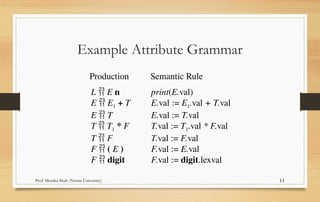
Example Attribute Grammar
L  E n
E  E1 + T
E  T
T  T1 * F
T  F
F  ( E )
F  digit
print(E.val)
E.val := E1.val + T.val
E.val := T.val
T.val := T1.val * F.val
T.val := F.val
F.val := E.val
F.val := digit.lexval
Production Semantic Rule
Prof Monika Shah (Nirma University)
12
Annotated Parse Tree
E.val = 16
T.val = 2
9 + 5 + 2
E.val = 14
E.val = 9 T.val = 5
F.val = 9
Attributes of Non-
terminal nodes are
evaluated by applying
attribute grammar
while traversing parse
tree using Depth First
Search
L
n
T.val = 9 F.val = 5
F.val = 5
Prof Monika Shah (Nirma University) 13
Annotating a Parse Tree With Depth-First
Traversals
procedure visit(n : node);
begin
for each child m of n, from left to right do
visit(m);
evaluate semantic rules at node n
end
Prof Monika Shah (Nirma University)
14
Depth-First Traversals (Example)
E.val = 16
T.val = 2
9 + 5 + 2
E.val = 14
E.val = 9 T.val = 5
F.val = 9
L
n
print(16)
T.val = 9 F.val = 5
F.val = 5
Prof Monika Shah (Nirma University) 15
Attributes
• Attribute values may represent
• Numbers (literal constants)
• Strings (literal constants)
• Memory locations, such as a frame index of a local variable or
function argument
• A data type for type checking of expressions
• Scoping information for local declarations
• Intermediate program representations
Prof Monika Shah (Nirma University) 16
Synthesized Versus Inherited Attributes
• Given a production
A  
then each semantic rule is of the form
b := f(c1,c2,…,ck)
where f is a function and ci are attributes of A and , and either
• b is a synthesized attribute of A
• b is an inherited attribute of one of the grammar symbols in

Prof Monika Shah (Nirma University) 17
Synthesized Versus Inherited Attributes
(cont’d)
D  T L
T  int
…
L  id
L.in := T.type
T.type := ‘integer’
…
… := L.in
Production Semantic Rule inherited
synthesized
Prof Monika Shah (Nirma University) 18
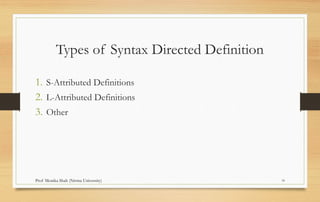
Types of Syntax Directed Definition
1. S-Attributed Definitions
2. L-Attributed Definitions
3. Other
Prof Monika Shah (Nirma University) 19
S-Attributed Definitions
• A syntax-directed definition that uses synthesized
attributes exclusively is called an S-attributed definition
(or S-attributed grammar)
• A parse tree of an S-attributed definition is annotated
with a single bottom-up traversal
• Yacc/Bison only support S-attributed definitions
Prof Monika Shah (Nirma University)
20
Example Attribute Grammar in Yacc
%token DIGIT
%%
L : E ‘n’ { printf(“%dn”, $1); }
;
E : E ‘+’ T { $$ = $1 + $3; }
| T { $$ = $1; }
;
T : T ‘*’ F { $$ = $1 * $3; }
| F { $$ = $1; }
;
F : ‘(’ E ‘)’ { $$ = $2; }
| DIGIT { $$ = $1; }
;
%%
Synthesized attribute of
parent node F
Prof Monika Shah (Nirma University) 21
Bottom-up Evaluation of S-Attributed Definitions in Yacc
Stack
$
$ 3
$ F
$ T
$ T *
$ T * 5
$ T * F
$ T
$ E +
$ E + 4
$ E + F
$ E + T
$ E
$ E n
$ L
Input
3*5+4n$
*5+4n$
*5+4n$
*5+4n$
5+4n$
+4n$
+4n$
+4n$
+4n$
4n$
n$
n$
n$
$
$
Action
shift
reduce F  digit
reduce T  F
shift
shift
reduce F  digit
reduce T  T * F
reduce E  T
shift
reduce F  digit
reduce T  F
reduce E  E + T
shift
reduce L  E n
accept
val
_
3
3
3
3 _
3 _ 5
3 _ 5
15
15 _
15 _ 4
15 _ 4
15 _ 4
19
19 _
19
Semantic Rule
$$ = $1
$$ = $1
$$ = $1
$$ = $1 * $3
$$ = $1
$$ = $1
$$ = $1
$$ = $1 + $3
print $1
Prof Monika Shah (Nirma University) 22
Example Attribute Grammar with
Synthesized+Inherited Attributes
D  T L
T  int
T  real
L  L1 , id
L  id
L.in := T.type
T.type := ‘integer’
T.type := ‘real’
L1.in := L.in; addtype(id.entry, L.in)
addtype(id.entry, L.in)
Production Semantic Rule
Synthesized: T.type, id.entry
Inherited: L.in
Prof Monika Shah (Nirma University) 23
Acyclic Dependency Graphs for Attributed
Parse Trees
A  X Y A.a := f(X.x, Y.y)
X.x := f(A.a, Y.y)
Y.y := f(A.a, X.x)
A.a
X.x Y.y
A.a
X.x Y.y
A.a
X.x Y.y
Direction of
value dependence
Prof Monika Shah (Nirma University) 24
Dependency Graphs with Cycles?
• Edges in the dependency graph determine the evaluation order for
attribute values
• Dependency graphs cannot be cyclic
A.a := f(X.x)
X.x := f(Y.y)
Y.y := f(A.a)
A.a
X.x Y.y
Error: cyclic dependence
Prof Monika Shah (Nirma University) 25
Example Annotated Parse Tree
D
T.type = ‘real’ L.in = ‘real’
L.in = ‘real’
L.in = ‘real’ id2.entry
id1.entry
id3.entry
real
,
,
Input character stream : real a, b, c
Input token stream : DT ID, ID, ID
lexval=a
lexval=b
lexval=c
Prof Monika Shah (Nirma University)
26
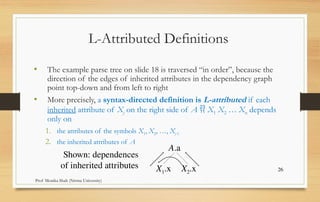
L-Attributed Definitions
• The example parse tree on slide 18 is traversed “in order”, because the
direction of the edges of inherited attributes in the dependency graph
point top-down and from left to right
• More precisely, a syntax-directed definition is L-attributed if each
inherited attribute of Xj on the right side of A  X1 X2 … Xn depends
only on
1. the attributes of the symbols X1, X2, …, Xj-1
2. the inherited attributes of A
A.a
X1.x X2.x
Shown: dependences
of inherited attributes
Prof Monika Shah (Nirma University) 27
L-Attributed Definitions (cont’d)
• L-attributed definitions allow for a natural order of evaluating attributes:
depth-first and left to right
• Note: every S-attributed syntax-directed definition is also L-attributed
A  X Y X.i := A.i
Y.i := X.s
A.s := Y.s
A
X Y
Y.i:=X.s
X.i:=A.i A.s:=Y.s
Prof Monika Shah (Nirma University) 28
Example Annotated Parse Tree with
Dependency Graph
D
T.type = ‘real’ L.in = ‘real’
L.in = ‘real’
L.in = ‘real’ id2.entry
id1.entry
id3.entry
real
,
,
Prof Monika Shah (Nirma University) 29
S-attributed SDD and L-attributed SDD
Every S-attributed SDD is L-attributed , but not Vise Versa
Prof Monika Shah (Nirma University) 30
Example of SDD
S  MN { S.val = M.val + N.val}
What type of attribute S.val ? synthesized
Is this SDD S-attributed SDD ?
Is this SDD L-attributed SDD ?
S -> MN {S.val= M.val + N.val}
S.val
M.val N.val
Prof Monika Shah (Nirma University) 31
Example of SDD
M  PQ { M.val = P.val * Q.val , Q.val = P.val}
What type of attribute M.val ? Inherited
Is this SDD S-attributed SDD ?
Is this SDD L-attributed SDD ?
M.val
P.val Q.val
Prof Monika Shah (Nirma University) 32
Example of SDD
M  PQ { M.val = P.val * Q.val , P.val = Q.val}
What type of attribute Q.val? Inherited
Is this SDD S-attributed SDD ?
Is this SDD L-attributed SDD ?
M.val
P.val Q.val
Prof Monika Shah (Nirma University) 33
Example of SDD
A  XYZ { Y.S = A.S , Y.S = X.S, Y.S = Z.S}
What type of attribute Y.S ? Inherited
Is this SDD S-attributed SDD ?
Is this SDD L-attributed SDD ?
Prof Monika Shah (Nirma University) 34
Exercise
• Write SDD to translate binary number to decimal number using following
Grammar:
Syntax Rules
BN  B
B  B D
B  D
D  0
D  1
Semantic rules
BN.Val = B.Val
B.Val = B1.Val * 2 + D.Val
B.Val = D.Val
D.Val = 0
D.Val =1
Prof Monika Shah (Nirma University) 35
Exercise
• Write SDD to translate fractional binary number to decimal number
using following Grammar:
Syntax Rules
BN  B ‘.’ B
BN  B
B  B D
B  D
D  0
D  1
Semantic rules
BN.Val = B1.Val + B2.Val / power (2, B2.count)
BN.Val = B.Val
B.Val = B1.Val * 2 + D.Val ; B.Count = B1.count + D.count
B.Val = D.Val , B.count=D.count
D.Val = 0 , D.count=1
D.Val =1, D.count=1
Prof Monika Shah (Nirma University) 36
Exercise
Write SDD to evaluate an arithmetic expression using following Grammar:
i.e. a= b= 2+3 should assign 2+3 to b , b to a
Syntax Rules
A ID ‘=‘ A
A  E
E  E ‘+’ T
E  T
T  NUM
T  ID
T  ‘(‘ E ‘)’
Semantic rules
Update(ID.entry, Value=A1.Value), A.Value=A1.Value
A.Value = E.Value
E.Value = E1. Value + T.Value
E.Value = T. Value
T.Value = atoi (NUM.lexval)
T.Value = Lookup(ID.entry, Value)
T,.Value = E.Value
Prof Monika Shah (Nirma University) 37
Exercise
Write SDD to evaluate an arithmetic expression using following Grammar: N + N + N (2+3+4)
Syntax Rules Semantic rule
E  TE’ E’.ival=T.sval
E.sval=E’.sval
E’  ‘+’ TE’ E1’.ival=E.ival+T.val
E’.sval=E1’.sval
E’  e E’.sval=E’.ival
T  NUM
N +
E’
+ N
E
T
N
E’
T
E’
T
2
3
4
9
2
5
5
9
9
9
Prof Monika Shah (Nirma University) 38
Practice questions
• “Every S-attributed SDD is L-attributed SDD” Write your opinion about this
statement with proper justification
• Write SDD for counting number of variables in a program
• Write SDD to assign data types to variable
• Writes SDD to verify variables are defined before its use
• Write SDD to create syntax tree for grammar of binary arithmetic expression
Prof Monika Shah (Nirma University) 39
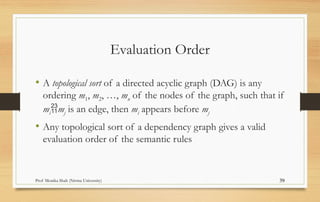
Evaluation Order
• A topological sort of a directed acyclic graph (DAG) is any
ordering m1, m2, …, mn of the nodes of the graph, such that if
mimj is an edge, then mi appears before mj
• Any topological sort of a dependency graph gives a valid
evaluation order of the semantic rules
Prof Monika Shah (Nirma University) 40
Example Parse Tree with Topologically
Sorted Actions
D
T1.type = ‘real’ L1.in = ‘real’
L2.in = ‘real’
L3.in = ‘real’ id2.entry
id1.entry
id3.entry
real
,
,
1
2
3
4 5 6
7 8
9 10
Topological sort:
1. Get id1.entry
2. Get id2.entry
3. Get id3.entry
4. T1.type=‘real’
5. L1.in=T1.type
6. addtype(id3.entry, L1.in)
7. L2.in=L1.in
8. addtype(id2.entry, L2.in)
9. L3.in=L2.in
10. addtype(id1.entry, L3.in)
Prof Monika Shah (Nirma University) 41
Evaluation Methods
• Parse-tree methods determine an evaluation order from a
topological sort of the dependence graph constructed from
the parse tree for each input
• Rule-base methods the evaluation order is pre-determined from
the semantic rules
• Oblivious methods the evaluation order is fixed and semantic
rules must be (re)written to support the evaluation order (for
example S-attributed definitions)
Prof Monika Shah (Nirma University) 42
Translation Scheme
• Shows evaluation order of semantic rules
• Semantic rules are embedded within production rules on RHS
Prof Monika Shah (Nirma University) 43
Transformation of
Syntax Directed Definition to Translation Scheme
• Transformation of L-attributed definition
• Place semantic rule of Synthesis attribute at end of Syntax rule
• Place semantic rule of Inherited attribute just before the attribute
• Transformation of S-attributed definition
• No change
Prof Monika Shah (Nirma University) 44
Using Translation Schemes for L-Attributed Definitions
D  T L
T  int
T  real
L  L1 , id
L  id
L.in := T.type
T.type := ‘integer’
T.type := ‘real’
L1.in := L.in; addtype(id.entry, L.in)
addtype(id.entry, L.in)
Production Semantic Rule
D  T { L.in := T.type } L
T  int { T.type := ‘integer’ }
T  real { T.type := ‘real’ }
L  { L1.in := L.in } L1 , id { addtype(id.entry, L.in) }
L  id { addtype(id.entry, L.in) }
Translation Scheme
Prof Monika Shah (Nirma University) 45
Implementing L-Attributed Definitions in Top-Down Parsers
D  T { L.in := T.type } L
T  int { T.type := ‘integer’ }
T  real { T.type := ‘real’ }
void D()
{ Type Ttype = T();
Type Lin = Ttype;
L(Lin);
}
Type T()
{ Type Ttype;
if (lookahead == INT)
{ Ttype = TYPE_INT;
match(INT);
} else if (lookahead == REAL)
{ Ttype = TYPE_REAL;
match(REAL);
} else error();
return Ttype;
}
void L(Type Lin)
{ … }
• Inherited attributes are
arguments
• Synthesis are return
Input:inherited
attribute
Output:
synthesized
attribute
Prof Monika Shah (Nirma University) 46
Example showing Transformation of SDD
to Translation scheme
Syntax Rules Semantic rule
E  TE’ E’.ival=T.sval
E.sval=E’.sval
E’  ‘+’ TE’ E1’.ival=E.ival+T.val
E’.sval=E1’.sval
E’  e E’.sval=E’.ival
T  NUM T  NUM {T.val =
atoi(N.lexval)}
Translation
Scheme
Translation Scheme
E  T {E’.ival=T.sval} E’ {E.sval=E’.sval}
E’  ‘+’ T {E1’.ival=E’.ival+T.sval} E’
{E’.sval=E1’.sval}
E’  e {E’.sval=E’.ival}
T  NUM {T.sval = atoi(N.lexval)}
Prof Monika Shah (Nirma University) 47
Exercise
• Create annotated tree for following SDD on input “int[2][3]”
• Identify order of evaluation of semantic rules for the annotated tree using
topological sort (parse-tree based order of evaluation)
• Create Translation scheme for above given SDD
• Is the order of evaluation same as per translation scheme (Rule based
method) and topological sort of (parse-tree based order) ?
Prof Monika Shah (Nirma University) 48
Exercise
• Create annotated tree for following SDD on input “2+3*4”
• Identify order of evaluation of semantic rules for the annotated tree using
topological sort (parse-tree based order of evaluation)
• Create Translation scheme for above given SDD
• Is the order of evaluation same as per translation scheme (Rule based
method) and topological sort of (parse-tree based order) ?
Prof Monika Shah (Nirma University) 49
Exercise
• Create annotated tree for following SDD on input “a-4+c”
• Identify order of evaluation of semantic rules for the annotated tree using
topological sort (parse-tree based order of evaluation)
• Create Translation scheme for above given SDD
• Is the order of evaluation same as per translation scheme (Rule based
method) and topological sort of (parse-tree based order) ?
Prof Monika Shah (Nirma University) 50
Exercise
• Create Translation scheme for following SDD
Prof Monika Shah (Nirma University) 51
Implementing L-Attributed Definitions in
Bottom-Up Parsers
• More difficult and also requires rewriting L-attributed definitions into
translation schemes
• Insert marker nonterminals to remove embedded actions from translation
schemes, that is
A  X { actions } Y
is rewritten with marker nonterminal N into
A  X N Y
N   { actions }
• Problem: inserting a marker nonterminal may introduce a conflict in the
parse table
Prof Monika Shah (Nirma University) 52
Emulating the Evaluation of L-Attributed Definitions in Yacc
D  T { L.in := T.type } L
T  int { T.type := ‘integer’ }
T  real { T.type := ‘real’ }
L  { L1.in := L.in } L1 , id
{ addtype(id.entry, L.in) }
L  id { addtype(id.entry, L.in) }
%{
Type Lin; /* global variable */
%}
%%
D : Ts L
;
Ts : T { Lin = $1; }
;
T : INT { $$ = TYPE_INT; }
| REAL { $$ = TYPE_REAL; }
;
L : L ‘,’ ID { addtype($3, Lin);}
| ID { addtype($1, Lin);}
;
%%
Prof Monika Shah (Nirma University) 53
Rewriting a Grammar to Avoid Inherited Attributes
D  T { L.in := T.type } L
T  int { T.type := ‘integer’ }
T  real { T.type := ‘real’ }
L  { L1.in := L.in } L1 , id
{ addtype(id.entry, L.in) }
L  id { addtype(id.entry, L.in) }
D  L id { addtype(id.entry, L.type)}
T  int { T.type := ‘integer’ }
T  real { T.type := ‘real’ }
L  L1 id, { addtype(id.entry, L1.type)
L.type=L1.type }
L  T { L.type = T.type }
D
id,id,… ,id
T
int
D
id
T id, id …id,
int
Prof Monika Shah (Nirma University)
54
Rewriting a Grammar to Avoid Inherited Attributes
D  id L
T  int
T  real
L  , id L1
L  : T
addtype(id.entry, L.type)
T.type := ‘integer’
T.type := ‘real’
addtype(id.entry, L.type)
L.type := T.type
Production Semantic Rule
D  L : T
T  int
T  real
L  L1 , id
L  id
Production
D
T
:
id,id, …
D
id,id,… : T
id
int
int
Prof Monika Shah (Nirma University)
55
Rewriting a Grammar to Avoid Inherited Attributes
D  id L
T  int
T  real
L  , id L1
L  : T
addtype(id.entry, L.type)
T.type := ‘integer’
T.type := ‘real’
addtype(id.entry, L.type)
L.type := T.type
Production Semantic Rule
D  L : T
T  int
T  real
L  L1 , id
L  id
Production
D
T
:
id,id, …
D
id,id,… : T
id
int
int
Prof Monika Shah (Nirma University) 56
Eliminating Leftmost recursion from Translation Scheme/ SDD
A: Ax { A.val = f(A1.val,x.val)}
| y { A.val =g(y.val)}
• After Eliminate leftmost recurson
A : y A’ { A’.ival =g(y.val), A.sval=A’.sval}
A’ : x A’ { A1’.ival=f(A’.ival,x.val), A’.sval=A1’.sval}
A’ : null { A’.sval = A’.ival }
Prof Monika Shah (Nirma University) 57
Eliminating Leftmost recursion from Translation Scheme/ SDD
• E : E +T { E.val = f(E1.val,T.val)=(E.val+T.val)}
• E : T { E.val =g(T.val)=T.val}
• After Eliminate leftmost recurson
• E : T E’ { E’.ival =g(T.val) =T.val ; E.sval=E’ .sval}
• E’ : + T E’ { E1’.ival=f(E’.ival,T.val)=E’.ival+T.ival ; E’.sval=E1’.sval}
• E’ : null { E’.sval = E’.ival }
Prof Monika Shah (Nirma University) 58
Eliminating Leftmost recursion from SDD
SDD Before Left recursion
elimination
SDD After Left recursion
elimination
Translation scheme
E : E + T
{ E.val=E1.val + T.val}
OR
{E.val= f(E1.val,T.val)}
E : TE’ {E.val= E’.sval
E’.ival=g(T.sval)}
E: T {E.ival=g(T.sval)}E’
{E.sval=E’.sval}
E : T
{E.val=T.val}
or
{E.val=g(T.val)}
E’ : +TE’ { E1’.ival =
f(E’.ival, T.sval)
E’.sval =E1.sval}
E’: + T
{E1’.ival=f(E’.ival,T.sval)}
E1’ {E’.sval = E1’.sval}
E’ : e {E’.sval = E’.ival} E’ : e {E’.sval = E’.ival}
Prof Monika Shah (Nirma University) 59
Implementing Semantic rules in YACC
SDD:
E:E+T {E.val=E1.val+T.val}
E:E-T {E.val=E1.val-T.val}
E: T {E.val=T.val}
T: NUM {T.val=NUM.val}
Expr.y
======
%{
%}
%token NUM
%%
E : E ‘+’ T {$$=$1+$3;}
E : E ‘-’ T {$$=$1-$3;}
E : T {$$=$1;}
T : NUM {$$=$1;}
%%
Expr.l
======
%{
#include “y.tab.h”
extern int yylval;
%}
%%
[+-] {return yytext[0];}
[0-9]+ {yylval=atoi(yytext);
return NUM;}
%%
Prof Monika Shah (Nirma University) 60
Implementing Semantic rules(with symbol table) in YACC
SDD:
E:E+T {E.val=E1.val+T.val}
E:E-T {E.val=E1.val-T.val}
E: T {E.val=T.val}
T: NUM {T.val=NUM.val}
T: ID {T.val=lookup(ID.entry,
value)}
Expr.y
======
%{
int symbols[26]={0};
%}
%token NUM
%%
E : E ‘+’ T {$$=$1+$3;}
E : E ‘-’ T {$$=$1-$3;}
E : T {$$=$1;}
T : NUM {$$=$1;}
T : ID {$$= symbols[$1];}
%%
Expr.l
======
%{
#include “y.tab.h”
extern int yylval;
%}
%%
[+-] {return yytext[0];}
[0-9]+ {yylval=atoi(yytext);
return NUM;}
[a-z] {yylval=yytext[0]-’a’;
return ID;}
%%
Prof Monika Shah (Nirma University) 61
Implementing Semantic rules(with symbol table) in YACC
SDD:
A: ID = A {A.val=A1.val
update(ID.entry,value)=A1.value}
A: E ‘;’ {A.val=E.val;
print E.val}
E:E+T {E.val=E1.val+T.val}
E:E-T {E.val=E1.val-T.val}
E: T {E.val=T.val}
T: NUM {T.val=NUM.val}
T: ID {T.val=lookup(ID.entry,
value)}
Expr.y
======
%{
int symbols[26]={0};
%}
%token NUM
%%
A: ID ‘=‘ A {symbols[$1]=$3;
$1=$3;}
A: E ‘;’ {$$=$1;
printf(“ans=%dn”,$1);}
E : E ‘+’ T {$$=$1+$3;}
E : E ‘-’ T {$$=$1-$3;}
E : T {$$=$1;}
T : NUM {$$=$1;}
T : ID {$$= symbols[$1];}
%%
Expr.l
======
%{
#include “y.tab.h”
extern int yylval;
%}
%%
[;=+-] {return yytext[0];}
[0-9]+ {yylval=atoi(yytext);
return NUM;}
[a-z] {yylval=yytext[0]-’a’;
return ID;}
%%
Prof Monika Shah (Nirma University) 62
Implement Calculator using Symbols of variable length in YACC
Name Value Next
Symbol Table = Linklist of node (name, value, ptr)
Expr.l
======
%{
#include “y.tab.h”
#include “mystruct.h”
%}
%%
[;=+-] {return yytext[0];}
[0-9]+ {yylval=atoi(yytext); return NUM;}
([_a-zA-Z][0-9]*)+ {yylval=lookup(yytext);
return ID;}
%%
struct node *lookup( char str[])
{
struct node *temp=head;
while(temp->next!=NULL)
{
if(strcmp(temp->name,str)==0)
return temp;
temp=temp->next
}
newnode=(struct node *) malloc(sizeof(struct node));
newnode->value =0;
strcpy(newnode=>name,str);
newnode->next=NULL;
temp->next=newnode
Return newnode; }
Prof Monika Shah (Nirma University) 63
Implement Calculator using Symbols of variable length in YACC
Name Value Next
Symbol Table = Linklist of node (name, value, ptr)
Expr.y
======
%{
int symbols[26]={0};
%}
%union {
int ival;
struct node *nval;
}
%token <ival> NUM
%token <nval> ID
%type <ival> T E A
%%
A: ID ‘=‘ A {$1->value=$3;
$1=$3;}
A: E ‘;’ {$$=$1;
printf(“ans=%dn”,$1);}
E : E ‘+’ T {$$=$1+$3;}
E : E ‘-’ T {$$=$1-$3;}
E : T {$$=$1;}
T : NUM {$$=$1;}
T : ID {$$= $1->value;}
%%
Prof Monika Shah (Nirma University) 64
Implement Datatype allocation and type
verification
E.g.
{
int a;
float f;
char a; //YACC report error by(semantic analysis ) Mulitple declaration of a
f = a+ c; // YACC report error by (semantic analysis) undeclared c
Name Data Type Value
a 1
f 1
c 0
Prof Monika Shah (Nirma University) 65
Implementation data type allocation and verification
SDD
SS : SS S | S
S : DS | E ‘;’
DS : T {L.in=T.val} L;
L: L ‘,’ ID {L1.in=L.in,
if(ID.entry, type)!=NULL
error=Multiple declaration
else
update(ID.entry,type)=L.in}
| ID {update(ID.entry,type)=L.in}
E : E ‘+’ F
| F
F : ID {if lookup(ID.entry,type)==NULL)
print undeclared;}
| NUM
Expr.y : rule section
%%
SS: SS S
| S
S : DS
| E ‘;’
DS : Ts L
Ts : T { Type=$1;}
L : L ‘,’ ID { if($1->type!=0) $1->type=Type;}
else printf(“Multple dec of %s”, $1->name);}
| ID {if($1->type!=0) $1->type=Type;}
else printf(“Multple dec of %s”, $1->name);}
E : E ‘+’ F
|F
F: ID {if($1->type==0) printf(“undeclared”);}
| NUM

Syntax Directed Definition and Translation

  • 1.
    1 Semantic Analyzer Syntax DirectedTranslation Course : 2CS701 Compiler Construction Prof Monika Shah Nirma University Ref : Ch.5 Compilers Principles, Techniques, and Tools by Alfred Aho, Ravi Sethi, and Jeffrey Ullman Prof Monika Shah (Nirma University)
  • 2.
    Prof Monika Shah(Nirma University) 2 Glimpse • Introduction to Syntax Directed Translation and applications • Background : Important terminologies • Type of Syntax Directed Definition • Evaluation methods of syntax directed definition • Translation Scheme • Transformation of Syntax Directed definition to Translation Schemes • Evaluation of Translation scheme • Eliminating Left recursion from Translation scheme • Implementing syntax directed definition at Top-down parsing, Bottom-up parsing • Implementing SDD / Translation scheme in YACC 2
  • 3.
    Prof Monika Shah(Nirma University) 3 Conceptual View of Syntax Directed Translation Character stream Token stream Dependency Graph Parse tree Evaluation Order of semantic rules
  • 4.
    Prof Monika Shah(Nirma University) 4 The Structure of our Compiler Revisited Lexical analyzer Syntax-directed translator Character stream Token stream Java bytecode Yacc specification with semantic rules JVM specification Lex specification
  • 5.
    Prof Monika Shah(Nirma University) 5 What is Syntax Directed Translation ? • Mapping between each Syntax production rule with Translation rule • Bind Semantic rules to each Syntax production rule • Applications : • Generate Intermediate Code • Generate Target Code • Semantic Check • Interpreter Design : Execute Syntax directed execution • Parse Tree Generation
  • 6.
    Prof Monika Shah(Nirma University) 6 Significance of Semantic Analyzer • Analyze following pair of input string • Cow eats grass • Grass eats cow Lexical Analysis Syntax Analysis Semantic Analysis • Different Target • 2 + 3 • 2 + 3 • 2 + 3 5 “integer” + 2 3 Calculator Type Checker Infix-> Prefix
  • 7.
    Prof Monika Shah(Nirma University) 7 Realization from previous examples • Lexically and Syntactically correct program may still contain other types of errors • Lexical and Syntax analyzers are not powerful enough to ensure correct usage of variables, functions etc. For example, int a; a = 1.2345;
  • 8.
    Prof Monika Shah(Nirma University) 8 Example of Semantic Analysis to ensure program satisfy certain rules • Variable must be defined before being used • A variable should not be defined multiple times • The same identifier cannot be use to denote different type of syntactic objects. • In switch statement : Case label must be integer or character type • IF statement, While statement should have condition expression of Boolean type • In assignment statement, the LHS must be a variable and RHS must be expression of same data type
  • 9.
    Prof Monika Shah(Nirma University) 9 Background : Important Terminologies • Syntax Directed Definition • Attribute Grammar • Annotated parse tree • Attributes
  • 10.
    Prof Monika Shah(Nirma University) 10 Syntax-Directed Definitions • A syntax-directed definition (or attribute grammar) binds a set of semantic rules to productions • Terminals and nonterminals have attributes holding values set by the semantic rules • A depth-first traversal algorithm traverses the parse tree thereby executing semantic rules to assign attribute values • After the traversal is complete the attributes contain the translated form of the input
  • 11.
    Prof Monika Shah(Nirma University) 11 Example Attribute Grammar L  E n E  E1 + T E  T T  T1 * F T  F F  ( E ) F  digit print(E.val) E.val := E1.val + T.val E.val := T.val T.val := T1.val * F.val T.val := F.val F.val := E.val F.val := digit.lexval Production Semantic Rule
  • 12.
    Prof Monika Shah(Nirma University) 12 Annotated Parse Tree E.val = 16 T.val = 2 9 + 5 + 2 E.val = 14 E.val = 9 T.val = 5 F.val = 9 Attributes of Non- terminal nodes are evaluated by applying attribute grammar while traversing parse tree using Depth First Search L n T.val = 9 F.val = 5 F.val = 5
  • 13.
    Prof Monika Shah(Nirma University) 13 Annotating a Parse Tree With Depth-First Traversals procedure visit(n : node); begin for each child m of n, from left to right do visit(m); evaluate semantic rules at node n end
  • 14.
    Prof Monika Shah(Nirma University) 14 Depth-First Traversals (Example) E.val = 16 T.val = 2 9 + 5 + 2 E.val = 14 E.val = 9 T.val = 5 F.val = 9 L n print(16) T.val = 9 F.val = 5 F.val = 5
  • 15.
    Prof Monika Shah(Nirma University) 15 Attributes • Attribute values may represent • Numbers (literal constants) • Strings (literal constants) • Memory locations, such as a frame index of a local variable or function argument • A data type for type checking of expressions • Scoping information for local declarations • Intermediate program representations
  • 16.
    Prof Monika Shah(Nirma University) 16 Synthesized Versus Inherited Attributes • Given a production A   then each semantic rule is of the form b := f(c1,c2,…,ck) where f is a function and ci are attributes of A and , and either • b is a synthesized attribute of A • b is an inherited attribute of one of the grammar symbols in 
  • 17.
    Prof Monika Shah(Nirma University) 17 Synthesized Versus Inherited Attributes (cont’d) D  T L T  int … L  id L.in := T.type T.type := ‘integer’ … … := L.in Production Semantic Rule inherited synthesized
  • 18.
    Prof Monika Shah(Nirma University) 18 Types of Syntax Directed Definition 1. S-Attributed Definitions 2. L-Attributed Definitions 3. Other
  • 19.
    Prof Monika Shah(Nirma University) 19 S-Attributed Definitions • A syntax-directed definition that uses synthesized attributes exclusively is called an S-attributed definition (or S-attributed grammar) • A parse tree of an S-attributed definition is annotated with a single bottom-up traversal • Yacc/Bison only support S-attributed definitions
  • 20.
    Prof Monika Shah(Nirma University) 20 Example Attribute Grammar in Yacc %token DIGIT %% L : E ‘n’ { printf(“%dn”, $1); } ; E : E ‘+’ T { $$ = $1 + $3; } | T { $$ = $1; } ; T : T ‘*’ F { $$ = $1 * $3; } | F { $$ = $1; } ; F : ‘(’ E ‘)’ { $$ = $2; } | DIGIT { $$ = $1; } ; %% Synthesized attribute of parent node F
  • 21.
    Prof Monika Shah(Nirma University) 21 Bottom-up Evaluation of S-Attributed Definitions in Yacc Stack $ $ 3 $ F $ T $ T * $ T * 5 $ T * F $ T $ E + $ E + 4 $ E + F $ E + T $ E $ E n $ L Input 3*5+4n$ *5+4n$ *5+4n$ *5+4n$ 5+4n$ +4n$ +4n$ +4n$ +4n$ 4n$ n$ n$ n$ $ $ Action shift reduce F  digit reduce T  F shift shift reduce F  digit reduce T  T * F reduce E  T shift reduce F  digit reduce T  F reduce E  E + T shift reduce L  E n accept val _ 3 3 3 3 _ 3 _ 5 3 _ 5 15 15 _ 15 _ 4 15 _ 4 15 _ 4 19 19 _ 19 Semantic Rule $$ = $1 $$ = $1 $$ = $1 $$ = $1 * $3 $$ = $1 $$ = $1 $$ = $1 $$ = $1 + $3 print $1
  • 22.
    Prof Monika Shah(Nirma University) 22 Example Attribute Grammar with Synthesized+Inherited Attributes D  T L T  int T  real L  L1 , id L  id L.in := T.type T.type := ‘integer’ T.type := ‘real’ L1.in := L.in; addtype(id.entry, L.in) addtype(id.entry, L.in) Production Semantic Rule Synthesized: T.type, id.entry Inherited: L.in
  • 23.
    Prof Monika Shah(Nirma University) 23 Acyclic Dependency Graphs for Attributed Parse Trees A  X Y A.a := f(X.x, Y.y) X.x := f(A.a, Y.y) Y.y := f(A.a, X.x) A.a X.x Y.y A.a X.x Y.y A.a X.x Y.y Direction of value dependence
  • 24.
    Prof Monika Shah(Nirma University) 24 Dependency Graphs with Cycles? • Edges in the dependency graph determine the evaluation order for attribute values • Dependency graphs cannot be cyclic A.a := f(X.x) X.x := f(Y.y) Y.y := f(A.a) A.a X.x Y.y Error: cyclic dependence
  • 25.
    Prof Monika Shah(Nirma University) 25 Example Annotated Parse Tree D T.type = ‘real’ L.in = ‘real’ L.in = ‘real’ L.in = ‘real’ id2.entry id1.entry id3.entry real , , Input character stream : real a, b, c Input token stream : DT ID, ID, ID lexval=a lexval=b lexval=c
  • 26.
    Prof Monika Shah(Nirma University) 26 L-Attributed Definitions • The example parse tree on slide 18 is traversed “in order”, because the direction of the edges of inherited attributes in the dependency graph point top-down and from left to right • More precisely, a syntax-directed definition is L-attributed if each inherited attribute of Xj on the right side of A  X1 X2 … Xn depends only on 1. the attributes of the symbols X1, X2, …, Xj-1 2. the inherited attributes of A A.a X1.x X2.x Shown: dependences of inherited attributes
  • 27.
    Prof Monika Shah(Nirma University) 27 L-Attributed Definitions (cont’d) • L-attributed definitions allow for a natural order of evaluating attributes: depth-first and left to right • Note: every S-attributed syntax-directed definition is also L-attributed A  X Y X.i := A.i Y.i := X.s A.s := Y.s A X Y Y.i:=X.s X.i:=A.i A.s:=Y.s
  • 28.
    Prof Monika Shah(Nirma University) 28 Example Annotated Parse Tree with Dependency Graph D T.type = ‘real’ L.in = ‘real’ L.in = ‘real’ L.in = ‘real’ id2.entry id1.entry id3.entry real , ,
  • 29.
    Prof Monika Shah(Nirma University) 29 S-attributed SDD and L-attributed SDD Every S-attributed SDD is L-attributed , but not Vise Versa
  • 30.
    Prof Monika Shah(Nirma University) 30 Example of SDD S  MN { S.val = M.val + N.val} What type of attribute S.val ? synthesized Is this SDD S-attributed SDD ? Is this SDD L-attributed SDD ? S -> MN {S.val= M.val + N.val} S.val M.val N.val
  • 31.
    Prof Monika Shah(Nirma University) 31 Example of SDD M  PQ { M.val = P.val * Q.val , Q.val = P.val} What type of attribute M.val ? Inherited Is this SDD S-attributed SDD ? Is this SDD L-attributed SDD ? M.val P.val Q.val
  • 32.
    Prof Monika Shah(Nirma University) 32 Example of SDD M  PQ { M.val = P.val * Q.val , P.val = Q.val} What type of attribute Q.val? Inherited Is this SDD S-attributed SDD ? Is this SDD L-attributed SDD ? M.val P.val Q.val
  • 33.
    Prof Monika Shah(Nirma University) 33 Example of SDD A  XYZ { Y.S = A.S , Y.S = X.S, Y.S = Z.S} What type of attribute Y.S ? Inherited Is this SDD S-attributed SDD ? Is this SDD L-attributed SDD ?
  • 34.
    Prof Monika Shah(Nirma University) 34 Exercise • Write SDD to translate binary number to decimal number using following Grammar: Syntax Rules BN  B B  B D B  D D  0 D  1 Semantic rules BN.Val = B.Val B.Val = B1.Val * 2 + D.Val B.Val = D.Val D.Val = 0 D.Val =1
  • 35.
    Prof Monika Shah(Nirma University) 35 Exercise • Write SDD to translate fractional binary number to decimal number using following Grammar: Syntax Rules BN  B ‘.’ B BN  B B  B D B  D D  0 D  1 Semantic rules BN.Val = B1.Val + B2.Val / power (2, B2.count) BN.Val = B.Val B.Val = B1.Val * 2 + D.Val ; B.Count = B1.count + D.count B.Val = D.Val , B.count=D.count D.Val = 0 , D.count=1 D.Val =1, D.count=1
  • 36.
    Prof Monika Shah(Nirma University) 36 Exercise Write SDD to evaluate an arithmetic expression using following Grammar: i.e. a= b= 2+3 should assign 2+3 to b , b to a Syntax Rules A ID ‘=‘ A A  E E  E ‘+’ T E  T T  NUM T  ID T  ‘(‘ E ‘)’ Semantic rules Update(ID.entry, Value=A1.Value), A.Value=A1.Value A.Value = E.Value E.Value = E1. Value + T.Value E.Value = T. Value T.Value = atoi (NUM.lexval) T.Value = Lookup(ID.entry, Value) T,.Value = E.Value
  • 37.
    Prof Monika Shah(Nirma University) 37 Exercise Write SDD to evaluate an arithmetic expression using following Grammar: N + N + N (2+3+4) Syntax Rules Semantic rule E  TE’ E’.ival=T.sval E.sval=E’.sval E’  ‘+’ TE’ E1’.ival=E.ival+T.val E’.sval=E1’.sval E’  e E’.sval=E’.ival T  NUM N + E’ + N E T N E’ T E’ T 2 3 4 9 2 5 5 9 9 9
  • 38.
    Prof Monika Shah(Nirma University) 38 Practice questions • “Every S-attributed SDD is L-attributed SDD” Write your opinion about this statement with proper justification • Write SDD for counting number of variables in a program • Write SDD to assign data types to variable • Writes SDD to verify variables are defined before its use • Write SDD to create syntax tree for grammar of binary arithmetic expression
  • 39.
    Prof Monika Shah(Nirma University) 39 Evaluation Order • A topological sort of a directed acyclic graph (DAG) is any ordering m1, m2, …, mn of the nodes of the graph, such that if mimj is an edge, then mi appears before mj • Any topological sort of a dependency graph gives a valid evaluation order of the semantic rules
  • 40.
    Prof Monika Shah(Nirma University) 40 Example Parse Tree with Topologically Sorted Actions D T1.type = ‘real’ L1.in = ‘real’ L2.in = ‘real’ L3.in = ‘real’ id2.entry id1.entry id3.entry real , , 1 2 3 4 5 6 7 8 9 10 Topological sort: 1. Get id1.entry 2. Get id2.entry 3. Get id3.entry 4. T1.type=‘real’ 5. L1.in=T1.type 6. addtype(id3.entry, L1.in) 7. L2.in=L1.in 8. addtype(id2.entry, L2.in) 9. L3.in=L2.in 10. addtype(id1.entry, L3.in)
  • 41.
    Prof Monika Shah(Nirma University) 41 Evaluation Methods • Parse-tree methods determine an evaluation order from a topological sort of the dependence graph constructed from the parse tree for each input • Rule-base methods the evaluation order is pre-determined from the semantic rules • Oblivious methods the evaluation order is fixed and semantic rules must be (re)written to support the evaluation order (for example S-attributed definitions)
  • 42.
    Prof Monika Shah(Nirma University) 42 Translation Scheme • Shows evaluation order of semantic rules • Semantic rules are embedded within production rules on RHS
  • 43.
    Prof Monika Shah(Nirma University) 43 Transformation of Syntax Directed Definition to Translation Scheme • Transformation of L-attributed definition • Place semantic rule of Synthesis attribute at end of Syntax rule • Place semantic rule of Inherited attribute just before the attribute • Transformation of S-attributed definition • No change
  • 44.
    Prof Monika Shah(Nirma University) 44 Using Translation Schemes for L-Attributed Definitions D  T L T  int T  real L  L1 , id L  id L.in := T.type T.type := ‘integer’ T.type := ‘real’ L1.in := L.in; addtype(id.entry, L.in) addtype(id.entry, L.in) Production Semantic Rule D  T { L.in := T.type } L T  int { T.type := ‘integer’ } T  real { T.type := ‘real’ } L  { L1.in := L.in } L1 , id { addtype(id.entry, L.in) } L  id { addtype(id.entry, L.in) } Translation Scheme
  • 45.
    Prof Monika Shah(Nirma University) 45 Implementing L-Attributed Definitions in Top-Down Parsers D  T { L.in := T.type } L T  int { T.type := ‘integer’ } T  real { T.type := ‘real’ } void D() { Type Ttype = T(); Type Lin = Ttype; L(Lin); } Type T() { Type Ttype; if (lookahead == INT) { Ttype = TYPE_INT; match(INT); } else if (lookahead == REAL) { Ttype = TYPE_REAL; match(REAL); } else error(); return Ttype; } void L(Type Lin) { … } • Inherited attributes are arguments • Synthesis are return Input:inherited attribute Output: synthesized attribute
  • 46.
    Prof Monika Shah(Nirma University) 46 Example showing Transformation of SDD to Translation scheme Syntax Rules Semantic rule E  TE’ E’.ival=T.sval E.sval=E’.sval E’  ‘+’ TE’ E1’.ival=E.ival+T.val E’.sval=E1’.sval E’  e E’.sval=E’.ival T  NUM T  NUM {T.val = atoi(N.lexval)} Translation Scheme Translation Scheme E  T {E’.ival=T.sval} E’ {E.sval=E’.sval} E’  ‘+’ T {E1’.ival=E’.ival+T.sval} E’ {E’.sval=E1’.sval} E’  e {E’.sval=E’.ival} T  NUM {T.sval = atoi(N.lexval)}
  • 47.
    Prof Monika Shah(Nirma University) 47 Exercise • Create annotated tree for following SDD on input “int[2][3]” • Identify order of evaluation of semantic rules for the annotated tree using topological sort (parse-tree based order of evaluation) • Create Translation scheme for above given SDD • Is the order of evaluation same as per translation scheme (Rule based method) and topological sort of (parse-tree based order) ?
  • 48.
    Prof Monika Shah(Nirma University) 48 Exercise • Create annotated tree for following SDD on input “2+3*4” • Identify order of evaluation of semantic rules for the annotated tree using topological sort (parse-tree based order of evaluation) • Create Translation scheme for above given SDD • Is the order of evaluation same as per translation scheme (Rule based method) and topological sort of (parse-tree based order) ?
  • 49.
    Prof Monika Shah(Nirma University) 49 Exercise • Create annotated tree for following SDD on input “a-4+c” • Identify order of evaluation of semantic rules for the annotated tree using topological sort (parse-tree based order of evaluation) • Create Translation scheme for above given SDD • Is the order of evaluation same as per translation scheme (Rule based method) and topological sort of (parse-tree based order) ?
  • 50.
    Prof Monika Shah(Nirma University) 50 Exercise • Create Translation scheme for following SDD
  • 51.
    Prof Monika Shah(Nirma University) 51 Implementing L-Attributed Definitions in Bottom-Up Parsers • More difficult and also requires rewriting L-attributed definitions into translation schemes • Insert marker nonterminals to remove embedded actions from translation schemes, that is A  X { actions } Y is rewritten with marker nonterminal N into A  X N Y N   { actions } • Problem: inserting a marker nonterminal may introduce a conflict in the parse table
  • 52.
    Prof Monika Shah(Nirma University) 52 Emulating the Evaluation of L-Attributed Definitions in Yacc D  T { L.in := T.type } L T  int { T.type := ‘integer’ } T  real { T.type := ‘real’ } L  { L1.in := L.in } L1 , id { addtype(id.entry, L.in) } L  id { addtype(id.entry, L.in) } %{ Type Lin; /* global variable */ %} %% D : Ts L ; Ts : T { Lin = $1; } ; T : INT { $$ = TYPE_INT; } | REAL { $$ = TYPE_REAL; } ; L : L ‘,’ ID { addtype($3, Lin);} | ID { addtype($1, Lin);} ; %%
  • 53.
    Prof Monika Shah(Nirma University) 53 Rewriting a Grammar to Avoid Inherited Attributes D  T { L.in := T.type } L T  int { T.type := ‘integer’ } T  real { T.type := ‘real’ } L  { L1.in := L.in } L1 , id { addtype(id.entry, L.in) } L  id { addtype(id.entry, L.in) } D  L id { addtype(id.entry, L.type)} T  int { T.type := ‘integer’ } T  real { T.type := ‘real’ } L  L1 id, { addtype(id.entry, L1.type) L.type=L1.type } L  T { L.type = T.type } D id,id,… ,id T int D id T id, id …id, int
  • 54.
    Prof Monika Shah(Nirma University) 54 Rewriting a Grammar to Avoid Inherited Attributes D  id L T  int T  real L  , id L1 L  : T addtype(id.entry, L.type) T.type := ‘integer’ T.type := ‘real’ addtype(id.entry, L.type) L.type := T.type Production Semantic Rule D  L : T T  int T  real L  L1 , id L  id Production D T : id,id, … D id,id,… : T id int int
  • 55.
    Prof Monika Shah(Nirma University) 55 Rewriting a Grammar to Avoid Inherited Attributes D  id L T  int T  real L  , id L1 L  : T addtype(id.entry, L.type) T.type := ‘integer’ T.type := ‘real’ addtype(id.entry, L.type) L.type := T.type Production Semantic Rule D  L : T T  int T  real L  L1 , id L  id Production D T : id,id, … D id,id,… : T id int int
  • 56.
    Prof Monika Shah(Nirma University) 56 Eliminating Leftmost recursion from Translation Scheme/ SDD A: Ax { A.val = f(A1.val,x.val)} | y { A.val =g(y.val)} • After Eliminate leftmost recurson A : y A’ { A’.ival =g(y.val), A.sval=A’.sval} A’ : x A’ { A1’.ival=f(A’.ival,x.val), A’.sval=A1’.sval} A’ : null { A’.sval = A’.ival }
  • 57.
    Prof Monika Shah(Nirma University) 57 Eliminating Leftmost recursion from Translation Scheme/ SDD • E : E +T { E.val = f(E1.val,T.val)=(E.val+T.val)} • E : T { E.val =g(T.val)=T.val} • After Eliminate leftmost recurson • E : T E’ { E’.ival =g(T.val) =T.val ; E.sval=E’ .sval} • E’ : + T E’ { E1’.ival=f(E’.ival,T.val)=E’.ival+T.ival ; E’.sval=E1’.sval} • E’ : null { E’.sval = E’.ival }
  • 58.
    Prof Monika Shah(Nirma University) 58 Eliminating Leftmost recursion from SDD SDD Before Left recursion elimination SDD After Left recursion elimination Translation scheme E : E + T { E.val=E1.val + T.val} OR {E.val= f(E1.val,T.val)} E : TE’ {E.val= E’.sval E’.ival=g(T.sval)} E: T {E.ival=g(T.sval)}E’ {E.sval=E’.sval} E : T {E.val=T.val} or {E.val=g(T.val)} E’ : +TE’ { E1’.ival = f(E’.ival, T.sval) E’.sval =E1.sval} E’: + T {E1’.ival=f(E’.ival,T.sval)} E1’ {E’.sval = E1’.sval} E’ : e {E’.sval = E’.ival} E’ : e {E’.sval = E’.ival}
  • 59.
    Prof Monika Shah(Nirma University) 59 Implementing Semantic rules in YACC SDD: E:E+T {E.val=E1.val+T.val} E:E-T {E.val=E1.val-T.val} E: T {E.val=T.val} T: NUM {T.val=NUM.val} Expr.y ====== %{ %} %token NUM %% E : E ‘+’ T {$$=$1+$3;} E : E ‘-’ T {$$=$1-$3;} E : T {$$=$1;} T : NUM {$$=$1;} %% Expr.l ====== %{ #include “y.tab.h” extern int yylval; %} %% [+-] {return yytext[0];} [0-9]+ {yylval=atoi(yytext); return NUM;} %%
  • 60.
    Prof Monika Shah(Nirma University) 60 Implementing Semantic rules(with symbol table) in YACC SDD: E:E+T {E.val=E1.val+T.val} E:E-T {E.val=E1.val-T.val} E: T {E.val=T.val} T: NUM {T.val=NUM.val} T: ID {T.val=lookup(ID.entry, value)} Expr.y ====== %{ int symbols[26]={0}; %} %token NUM %% E : E ‘+’ T {$$=$1+$3;} E : E ‘-’ T {$$=$1-$3;} E : T {$$=$1;} T : NUM {$$=$1;} T : ID {$$= symbols[$1];} %% Expr.l ====== %{ #include “y.tab.h” extern int yylval; %} %% [+-] {return yytext[0];} [0-9]+ {yylval=atoi(yytext); return NUM;} [a-z] {yylval=yytext[0]-’a’; return ID;} %%
  • 61.
    Prof Monika Shah(Nirma University) 61 Implementing Semantic rules(with symbol table) in YACC SDD: A: ID = A {A.val=A1.val update(ID.entry,value)=A1.value} A: E ‘;’ {A.val=E.val; print E.val} E:E+T {E.val=E1.val+T.val} E:E-T {E.val=E1.val-T.val} E: T {E.val=T.val} T: NUM {T.val=NUM.val} T: ID {T.val=lookup(ID.entry, value)} Expr.y ====== %{ int symbols[26]={0}; %} %token NUM %% A: ID ‘=‘ A {symbols[$1]=$3; $1=$3;} A: E ‘;’ {$$=$1; printf(“ans=%dn”,$1);} E : E ‘+’ T {$$=$1+$3;} E : E ‘-’ T {$$=$1-$3;} E : T {$$=$1;} T : NUM {$$=$1;} T : ID {$$= symbols[$1];} %% Expr.l ====== %{ #include “y.tab.h” extern int yylval; %} %% [;=+-] {return yytext[0];} [0-9]+ {yylval=atoi(yytext); return NUM;} [a-z] {yylval=yytext[0]-’a’; return ID;} %%
  • 62.
    Prof Monika Shah(Nirma University) 62 Implement Calculator using Symbols of variable length in YACC Name Value Next Symbol Table = Linklist of node (name, value, ptr) Expr.l ====== %{ #include “y.tab.h” #include “mystruct.h” %} %% [;=+-] {return yytext[0];} [0-9]+ {yylval=atoi(yytext); return NUM;} ([_a-zA-Z][0-9]*)+ {yylval=lookup(yytext); return ID;} %% struct node *lookup( char str[]) { struct node *temp=head; while(temp->next!=NULL) { if(strcmp(temp->name,str)==0) return temp; temp=temp->next } newnode=(struct node *) malloc(sizeof(struct node)); newnode->value =0; strcpy(newnode=>name,str); newnode->next=NULL; temp->next=newnode Return newnode; }
  • 63.
    Prof Monika Shah(Nirma University) 63 Implement Calculator using Symbols of variable length in YACC Name Value Next Symbol Table = Linklist of node (name, value, ptr) Expr.y ====== %{ int symbols[26]={0}; %} %union { int ival; struct node *nval; } %token <ival> NUM %token <nval> ID %type <ival> T E A %% A: ID ‘=‘ A {$1->value=$3; $1=$3;} A: E ‘;’ {$$=$1; printf(“ans=%dn”,$1);} E : E ‘+’ T {$$=$1+$3;} E : E ‘-’ T {$$=$1-$3;} E : T {$$=$1;} T : NUM {$$=$1;} T : ID {$$= $1->value;} %%
  • 64.
    Prof Monika Shah(Nirma University) 64 Implement Datatype allocation and type verification E.g. { int a; float f; char a; //YACC report error by(semantic analysis ) Mulitple declaration of a f = a+ c; // YACC report error by (semantic analysis) undeclared c Name Data Type Value a 1 f 1 c 0
  • 65.
    Prof Monika Shah(Nirma University) 65 Implementation data type allocation and verification SDD SS : SS S | S S : DS | E ‘;’ DS : T {L.in=T.val} L; L: L ‘,’ ID {L1.in=L.in, if(ID.entry, type)!=NULL error=Multiple declaration else update(ID.entry,type)=L.in} | ID {update(ID.entry,type)=L.in} E : E ‘+’ F | F F : ID {if lookup(ID.entry,type)==NULL) print undeclared;} | NUM Expr.y : rule section %% SS: SS S | S S : DS | E ‘;’ DS : Ts L Ts : T { Type=$1;} L : L ‘,’ ID { if($1->type!=0) $1->type=Type;} else printf(“Multple dec of %s”, $1->name);} | ID {if($1->type!=0) $1->type=Type;} else printf(“Multple dec of %s”, $1->name);} E : E ‘+’ F |F F: ID {if($1->type==0) printf(“undeclared”);} | NUM