THE  CORPORATE INTEGRATION  TRAINING SYSTEM   WORK SHOPS SEMINARS CERTIFICATION   PROGRAMS
Communication Skills Conflict and Stress Management Presentation Skills Creative Leadership and Management Professional Development Supervision and Management Customer Service Stress Management Team Building  Leadership Business Etiquette Corporate Women's Workshop WORK SHOPS HOME
Relaxation and Meditation  Stress Management Meditation based on clinical/scientific methodology Managing Stress and Anxiety SEMINARS HOME
Human Resources Train The Trainer  Neuro Linguistic Program Soft Skills CERTIFICATION PROGRAMS HOME
COMMUNICATION SKILLS   Effective Communication Skills for Managing Conflict and Confrontation  Improved Interviewing Utilizing Screening and Job Placement Accuracy Business Writing for Results  Communication Skills for Women  Dealing with Difficult People Conflict and Negotiation: The “WIN/WIN” principle How to Bargain & Negotiate with Vendors & Suppliers  How to Communicate with Tact and Professionalism (2-day)   Conducting Effective Trainings and Supervision Reviews  Speak with Confidence and Clarity – NEUROLINGUISTIC ROGRAMMING   The Ultimate Supervisor  Training the Trainer   HOME
Criticism & Discipline Skills for Managers and Supervisors  Dealing with Difficult People Effective Communication Skills for Managing Conflict and Confrontation How To Deal With Unacceptable Employee Behavior Managing Emotions Under Pressure CONFLICT & STRESS MANAGEMENT   HOME
The Art of the Presentation: The “Dress Rehearsal”  Preparing a Presentation  Creating and Designing the Presentation Delivering the Perfect Presentation with Confidence  Handling Question and Answers and Overcoming Anxiety   PRESENTATION SKILLS   HOME
  Creative Leadership Workshop for: Managers Supervisors Team Leaders First Time Managers One or Two Day Seminar  CREATIVE LEADERSHIP & MANAGEMENT   HOME
Business Writing and Grammar Workshop  (2-Day)  Creative Leadership Workshop for Managers, Supervisors, and Team Leaders Dealing with Difficult People Effective Strategies for Collecting Accounts Receivable Event Planning, A One-Day Workshop Facilities Management  Effective Hiring and Screening Front Desk Safety & Security Guerrilla Selling How to Bargain & Negotiate with Vendors & Suppliers How to Communicate with Tact and Professionalism (2-day) How to Deliver Exceptional Customer Service How to Organize & Maintain Files & Records How to Successfully Manage Multiple Locations Management Skills for New Managers and Supervisors (2-day) Management Skills for Secretaries Administrative Assistants & Support Staff Managing Multiple Priorities, Projects, and Deadlines Managing the Front Desk Speak with Confidence and Clarity The Art of Leadership  The Exceptional Assistant  Minimum Effort with Maximum Effectiveness The Outstanding Receptionist  The Productivity Super Conference Training the Trainer  PROFESSIONAL DEVELOPMENT   HOME
Assertive Leadership Skills: A One-Day Seminar for Managers &  Supervisors Creative Leadership Workshop for Managers, Supervisors, and Team Leaders Criticism & Discipline Skills for Managers and Supervisors Essential Skills for First-Time Managers and Supervisors  Event Planning, A One-Day Workshop Facilities Management - A 2-Day Comprehensive Course Finance and Accounting for Non-Financial People How to Bargain & Negotiate with Vendors & Suppliers How To Deal With Unacceptable Employee Behavior How to Successfully Manage Multiple Locations How to Supervise People   Leadership & Team-building Skills for Women Making the Transition from Staff to Supervisor Management Skills for New Managers and Supervisors (2-day) Management Skills for Secretaries Administrative Assistants & Support Staff Managing Multiple Priorities, Projects, and Deadlines The Ultimate Supervisor Project Management Real-World Project Management (2-Day Seminar) Team-Building, Mentoring, and Coaching Skills for Managers & Supervisors The Art of Leadership The Management Conference Giving the Perfect Presentation (half-day or full-day course) with  practice presentations given by attendees. SUPERVISION & MANAGEMENT SUPPORT   HOME
  Dealing with the Difficult Client/Customer   How to Deliver Exceptional Customer Service   CUSTOMER SERVICE   HOME
Assertive Leadership Skills: A One-Day Seminar for Managers & Supervisors Essential Skills for First-Time Managers and Supervisors How to Supervise People  Team-Building, Mentoring, and Coaching Skills for Managers & Supervisors The Art of Leadership LEADERSHIP   HOME
Effective Communication Skills for the Corporate Woman Leadership & Team-building Skills for Women The Outstanding Receptionist / Secretary/Assistant The Outstanding Manager / Executive The Women's Conference : A “round-table” discussion and workshop focusing on the various issues faced by the professional woman of today.  CORPORATE WOMEN’S WORKSHOP HOME
TEAM BUILDING   Including Workplace Conflict Resolution and Communication A reduction or disturbance in  Workplace “Harmony”  and  resolution of conflict  resulting from  1) multiple cultural backgrounds,  2) unclear office hierarchy,  3) employee-management understanding, and  4) interpersonal communication skills,  5) opposing goals and disorganized team cohesiveness all lead to a  reduction in enjoyment of the individual employee’s job involvement and job satisfaction ,  company productivity  and an  increase in sick leave and turnover.   “ Workplace Harmony” is achieved through team building exercises which stress the following: Clarifying the team goals  Building ownership and commitment to those goals across the team  Identifying any issues which inhibit the team from reaching their goals  Addressing those issues, removing the inhibitors and thereby enabling the goals to be achieved  NEXT
An introduction to teamwork  The Basics of Team Building  Team Dynamics Resolving conflict  Application of Tuckman's model  Good Practice in Staff Surveys  Overcoming Team Islands  How to Choose the right Team Building Exercises  Six Sigma and Culture  The difference between small group and corporate Team building  Team Building Activities  Stress Management for Team Members  Assertiveness for Team Members  Collective Team Competencies  Performance Management System  How to achieve cultural change  Running Corporate Team Building Events  Tuckman's model  TEAM BUILDING   NEXT
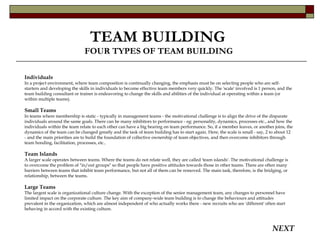
TEAM BUILDING   FOUR TYPES OF TEAM BUILDING Individuals In a project environment, where team composition is continually changing, the emphasis must be on selecting people who are self-starters and developing the skills in individuals to become effective team members very quickly. The 'scale' involved is 1 person, and the team building consultant or trainer is endeavoring to change the skills and abilities of the individual at operating within a team (or within multiple teams).  Small Teams In teams where membership is static - typically in management teams - the motivational challenge is to align the drive of the disparate individuals around the same goals. There can be many inhibitors to performance - eg: personality, dynamics, processes etc., and how the individuals within the team relate to each other can have a big bearing on team performance. So, if a member leaves, or another joins, the dynamics of the team can be changed greatly and the task of team building has to start again. Here, the scale is small - say, 2 to about 12 - and the main priorities are to build the foundation of collective ownership of team objectives, and then overcome inhibitors through team bonding, facilitation, processes, etc..  Team Islands A larger scale operates between teams. Where the teams do not relate well, they are called 'team islands'. The motivational challenge is to overcome the problem of "in/out groups" so that people have positive attitudes towards those in other teams. There are often many barriers between teams that inhibit team performance, but not all of them can be removed. The main task, therefore, is the bridging, or relationship, between the teams.  Large Teams The largest scale is organizational culture change. With the exception of the senior management team, any changes to personnel have limited impact on the corporate culture. The key aim of company-wide team building is to change the behaviours and attitudes prevalent in the organization, which are almost independent of who actually works there - new recruits who are 'different' often start behaving in accord with the existing culture.  NEXT
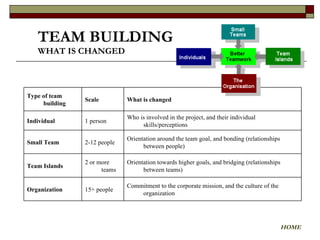
TEAM BUILDING   WHAT IS CHANGED HOME Type of team building Scale What is changed Individual 1 person Who is involved in the project, and their individual skills/perceptions Small Team 2-12 people Orientation around the team goal, and bonding (relationships between people) Team Islands 2 or more teams Orientation towards higher goals, and bridging (relationships between teams) Organization 15+ people Commitment to the corporate mission, and the culture of the organization
BUSINESS ETIQUETTE:   “CORPORATE BEHAVIORAL INTEGRATION” Business etiquette (or corporate etiquette)  Communication etiquette  Dining etiquette (With: Entertaining Clients) International etiquette (or international protocol)  Social etiquette  Corporate Behavioral Integration  Interview Etiquette First & Lasting Impressions …How to Manage Your Personal Brand with Poise, Presence, and Polish   Dining for Dollars …The Art of the Business Meal Mastering Your Mingle-Ability …How to Improve Your Networking   Suit Up for Success  … How to Look Your Best during any Business Occasion   Business Class for Women  …Etiquette Essentials Your Mother Never Taught You   The Power of Positive Thanking …How to Turn Contacts Into Contracts   HOME
STRESS MANAGEMENT AT WORK AND HOME Workshop for Businesses/Departments and Individuals For the Business Customer we offer a "Walk Thru" of your facility to pinpoint activities and environmental conditions which could have a negative influence on stress levels of your staff. This is offered with the suggestion that an outsider may notice situations and daily routines over looked by the staff. Any information or suggestions formed as a result of the ?Walk Thru? are provided to the management team prior to the seminar.  Points covered in each Workshop:  ·  Identify causes and triggers of stress.  ·  Explain physical manifestations of stress.  ·  Provide training for each echelon of worker to assist in reducing stress in the workplace.  ·  Discuss strategies for reducing stressful situations. ·   Assist the worker in determining their stress level.(1-10) ·  Direct practice exercises ranging from “Instant Stress  Relief” to the “Life Calm Technique.” ·  Provide each attendee with reference materials including meditative  and Guided Relaxation CD’s and readings. ·  Train department heads in conducting daily/weekly “focusing” and “stress-reduction” sessions for employees. HOME
New Employee Training, Screening and Orientation  Effective Orientation and Induction Re: Company Regulations Conducting Trainings for Current Employees How To Deal With Unacceptable Employee Behavior Criticism & Discipline Protocol for Managers and Supervisors  How to Write Policies and Procedures The Necessary Requirements of Human Resources Training the Trainer  Streamlining the HR For More Accurate New Hire Placement and Recruiting HUMAN RESOURCES & TRAINING   HOME
Dr. Prashant Kocherlakota, M.Ed., Ph.D.   Clinical-Industrial Psychologist Renaissance man or simple Psychologist?  Dr. Prashant Kocherlakota a Renowned Clinical Psychologist, distinguished professor, world class motivational and educational speaker, returned to India recently after living for 40 years in the US to work with Indian corporations and universities to guide in implementing the same principles of success which he inculcate into numerous international businesses across the world.  Originally an honors post-graduate (M.Ed., and Ph.D) from the prestigious Cambridge College of Professional Psychology, Using principles perfected during 22 years of clinical practice at American Corporations, Hospitals, Mental Health centers and Universities, Dr. Prashant researched and developed over 100 programs specifically designed to facilitate the various levels of an individual corporation, as each program has been mentored and adjusted with great precision to fit the exact needs of the company, so that they could be applied at various levels from the top level managers and executives down to the basic-level workers. Aimed to improve work efficiency to the maximum output while reducing costs, worker stress, and inter-office communication errors and elevating to a remarkable degree   the individual company’s operational effectiveness  Dr. Prashant stands out as the foremost and most sought after educator in the corporate world due to the simplicity of his programs and the brilliance of the solutions offered.  His seminars and workshops are “Bio-Psycho-Socially based.” teaching the individual employee in dilemma on a biological, psychological and social level. Thus relieving stress and opening up innumerable approaches to increasing effectiveness and motivation while reducing personal stress. The programs offer solutions to problems and issues ranging from the highly complex which affect the company as a whole to the simplest issues affecting individual employees be the supervisor or trainee on the holistic, psychological and therapeutic level. Opening up the Western world to the Indian client in a way which only Dr Prashant could. With a Doctorate in Clinical Psychology, Dr. Prashant, though brought up in the U.S. hails from a family of India’s leading classical musicians and has, himself also risen to be a leading classical Indian musician, awarded by the Government of India and the Honorable Prime Ministers. He also has the distinction of being one of the most sought after Professors at the University of Pennsylvania, one of the top five colleges in the U.S. where he taught for over a decade based on these very principles to students of the Wharton School of Business and The Penn Medical and Law Schools. It was this tremendous and highly sensitive understanding of the pulse of Indian culture and thinking which led him back to India after decades abroad. This dual-culture exposure gave Dr. Prashant the highly unique insights into the Western and Eastern mind-sets thus allowing him to utilize the best of each world to produce highest professional results for his clients. Founder and director of the renowned Corporate Integration Systems Group, Dr. Prashant is considered one of the most effective speakers in the world…not to mention one of the most entertaining!

Copy Of Anna

  • 1.
    THE CORPORATEINTEGRATION TRAINING SYSTEM WORK SHOPS SEMINARS CERTIFICATION PROGRAMS
  • 2.
    Communication Skills Conflictand Stress Management Presentation Skills Creative Leadership and Management Professional Development Supervision and Management Customer Service Stress Management Team Building Leadership Business Etiquette Corporate Women's Workshop WORK SHOPS HOME
  • 3.
    Relaxation and Meditation Stress Management Meditation based on clinical/scientific methodology Managing Stress and Anxiety SEMINARS HOME
  • 4.
    Human Resources TrainThe Trainer Neuro Linguistic Program Soft Skills CERTIFICATION PROGRAMS HOME
  • 5.
    COMMUNICATION SKILLS Effective Communication Skills for Managing Conflict and Confrontation Improved Interviewing Utilizing Screening and Job Placement Accuracy Business Writing for Results Communication Skills for Women Dealing with Difficult People Conflict and Negotiation: The “WIN/WIN” principle How to Bargain & Negotiate with Vendors & Suppliers How to Communicate with Tact and Professionalism (2-day)   Conducting Effective Trainings and Supervision Reviews  Speak with Confidence and Clarity – NEUROLINGUISTIC ROGRAMMING   The Ultimate Supervisor Training the Trainer HOME
  • 6.
    Criticism & DisciplineSkills for Managers and Supervisors Dealing with Difficult People Effective Communication Skills for Managing Conflict and Confrontation How To Deal With Unacceptable Employee Behavior Managing Emotions Under Pressure CONFLICT & STRESS MANAGEMENT HOME
  • 7.
    The Art ofthe Presentation: The “Dress Rehearsal” Preparing a Presentation Creating and Designing the Presentation Delivering the Perfect Presentation with Confidence Handling Question and Answers and Overcoming Anxiety PRESENTATION SKILLS HOME
  • 8.
      Creative LeadershipWorkshop for: Managers Supervisors Team Leaders First Time Managers One or Two Day Seminar CREATIVE LEADERSHIP & MANAGEMENT HOME
  • 9.
    Business Writing andGrammar Workshop (2-Day) Creative Leadership Workshop for Managers, Supervisors, and Team Leaders Dealing with Difficult People Effective Strategies for Collecting Accounts Receivable Event Planning, A One-Day Workshop Facilities Management Effective Hiring and Screening Front Desk Safety & Security Guerrilla Selling How to Bargain & Negotiate with Vendors & Suppliers How to Communicate with Tact and Professionalism (2-day) How to Deliver Exceptional Customer Service How to Organize & Maintain Files & Records How to Successfully Manage Multiple Locations Management Skills for New Managers and Supervisors (2-day) Management Skills for Secretaries Administrative Assistants & Support Staff Managing Multiple Priorities, Projects, and Deadlines Managing the Front Desk Speak with Confidence and Clarity The Art of Leadership The Exceptional Assistant Minimum Effort with Maximum Effectiveness The Outstanding Receptionist The Productivity Super Conference Training the Trainer PROFESSIONAL DEVELOPMENT HOME
  • 10.
    Assertive Leadership Skills:A One-Day Seminar for Managers & Supervisors Creative Leadership Workshop for Managers, Supervisors, and Team Leaders Criticism & Discipline Skills for Managers and Supervisors Essential Skills for First-Time Managers and Supervisors Event Planning, A One-Day Workshop Facilities Management - A 2-Day Comprehensive Course Finance and Accounting for Non-Financial People How to Bargain & Negotiate with Vendors & Suppliers How To Deal With Unacceptable Employee Behavior How to Successfully Manage Multiple Locations How to Supervise People Leadership & Team-building Skills for Women Making the Transition from Staff to Supervisor Management Skills for New Managers and Supervisors (2-day) Management Skills for Secretaries Administrative Assistants & Support Staff Managing Multiple Priorities, Projects, and Deadlines The Ultimate Supervisor Project Management Real-World Project Management (2-Day Seminar) Team-Building, Mentoring, and Coaching Skills for Managers & Supervisors The Art of Leadership The Management Conference Giving the Perfect Presentation (half-day or full-day course) with practice presentations given by attendees. SUPERVISION & MANAGEMENT SUPPORT HOME
  • 11.
      Dealing withthe Difficult Client/Customer   How to Deliver Exceptional Customer Service CUSTOMER SERVICE HOME
  • 12.
    Assertive Leadership Skills:A One-Day Seminar for Managers & Supervisors Essential Skills for First-Time Managers and Supervisors How to Supervise People Team-Building, Mentoring, and Coaching Skills for Managers & Supervisors The Art of Leadership LEADERSHIP HOME
  • 13.
    Effective Communication Skillsfor the Corporate Woman Leadership & Team-building Skills for Women The Outstanding Receptionist / Secretary/Assistant The Outstanding Manager / Executive The Women's Conference : A “round-table” discussion and workshop focusing on the various issues faced by the professional woman of today. CORPORATE WOMEN’S WORKSHOP HOME
  • 14.
    TEAM BUILDING Including Workplace Conflict Resolution and Communication A reduction or disturbance in Workplace “Harmony” and resolution of conflict resulting from 1) multiple cultural backgrounds, 2) unclear office hierarchy, 3) employee-management understanding, and 4) interpersonal communication skills, 5) opposing goals and disorganized team cohesiveness all lead to a reduction in enjoyment of the individual employee’s job involvement and job satisfaction , company productivity and an increase in sick leave and turnover. “ Workplace Harmony” is achieved through team building exercises which stress the following: Clarifying the team goals Building ownership and commitment to those goals across the team Identifying any issues which inhibit the team from reaching their goals Addressing those issues, removing the inhibitors and thereby enabling the goals to be achieved NEXT
  • 15.
    An introduction toteamwork The Basics of Team Building Team Dynamics Resolving conflict Application of Tuckman's model Good Practice in Staff Surveys Overcoming Team Islands How to Choose the right Team Building Exercises Six Sigma and Culture The difference between small group and corporate Team building Team Building Activities Stress Management for Team Members Assertiveness for Team Members Collective Team Competencies Performance Management System How to achieve cultural change Running Corporate Team Building Events Tuckman's model TEAM BUILDING NEXT
  • 16.
    TEAM BUILDING FOUR TYPES OF TEAM BUILDING Individuals In a project environment, where team composition is continually changing, the emphasis must be on selecting people who are self-starters and developing the skills in individuals to become effective team members very quickly. The 'scale' involved is 1 person, and the team building consultant or trainer is endeavoring to change the skills and abilities of the individual at operating within a team (or within multiple teams). Small Teams In teams where membership is static - typically in management teams - the motivational challenge is to align the drive of the disparate individuals around the same goals. There can be many inhibitors to performance - eg: personality, dynamics, processes etc., and how the individuals within the team relate to each other can have a big bearing on team performance. So, if a member leaves, or another joins, the dynamics of the team can be changed greatly and the task of team building has to start again. Here, the scale is small - say, 2 to about 12 - and the main priorities are to build the foundation of collective ownership of team objectives, and then overcome inhibitors through team bonding, facilitation, processes, etc.. Team Islands A larger scale operates between teams. Where the teams do not relate well, they are called 'team islands'. The motivational challenge is to overcome the problem of "in/out groups" so that people have positive attitudes towards those in other teams. There are often many barriers between teams that inhibit team performance, but not all of them can be removed. The main task, therefore, is the bridging, or relationship, between the teams. Large Teams The largest scale is organizational culture change. With the exception of the senior management team, any changes to personnel have limited impact on the corporate culture. The key aim of company-wide team building is to change the behaviours and attitudes prevalent in the organization, which are almost independent of who actually works there - new recruits who are 'different' often start behaving in accord with the existing culture. NEXT
  • 17.
    TEAM BUILDING WHAT IS CHANGED HOME Type of team building Scale What is changed Individual 1 person Who is involved in the project, and their individual skills/perceptions Small Team 2-12 people Orientation around the team goal, and bonding (relationships between people) Team Islands 2 or more teams Orientation towards higher goals, and bridging (relationships between teams) Organization 15+ people Commitment to the corporate mission, and the culture of the organization
  • 18.
    BUSINESS ETIQUETTE: “CORPORATE BEHAVIORAL INTEGRATION” Business etiquette (or corporate etiquette) Communication etiquette Dining etiquette (With: Entertaining Clients) International etiquette (or international protocol) Social etiquette Corporate Behavioral Integration Interview Etiquette First & Lasting Impressions …How to Manage Your Personal Brand with Poise, Presence, and Polish Dining for Dollars …The Art of the Business Meal Mastering Your Mingle-Ability …How to Improve Your Networking Suit Up for Success … How to Look Your Best during any Business Occasion Business Class for Women …Etiquette Essentials Your Mother Never Taught You The Power of Positive Thanking …How to Turn Contacts Into Contracts HOME
  • 19.
    STRESS MANAGEMENT ATWORK AND HOME Workshop for Businesses/Departments and Individuals For the Business Customer we offer a "Walk Thru" of your facility to pinpoint activities and environmental conditions which could have a negative influence on stress levels of your staff. This is offered with the suggestion that an outsider may notice situations and daily routines over looked by the staff. Any information or suggestions formed as a result of the ?Walk Thru? are provided to the management team prior to the seminar. Points covered in each Workshop: · Identify causes and triggers of stress. · Explain physical manifestations of stress. · Provide training for each echelon of worker to assist in reducing stress in the workplace. · Discuss strategies for reducing stressful situations. · Assist the worker in determining their stress level.(1-10) · Direct practice exercises ranging from “Instant Stress Relief” to the “Life Calm Technique.” · Provide each attendee with reference materials including meditative and Guided Relaxation CD’s and readings. · Train department heads in conducting daily/weekly “focusing” and “stress-reduction” sessions for employees. HOME
  • 20.
    New Employee Training,Screening and Orientation  Effective Orientation and Induction Re: Company Regulations Conducting Trainings for Current Employees How To Deal With Unacceptable Employee Behavior Criticism & Discipline Protocol for Managers and Supervisors How to Write Policies and Procedures The Necessary Requirements of Human Resources Training the Trainer Streamlining the HR For More Accurate New Hire Placement and Recruiting HUMAN RESOURCES & TRAINING HOME
  • 21.
    Dr. Prashant Kocherlakota,M.Ed., Ph.D. Clinical-Industrial Psychologist Renaissance man or simple Psychologist? Dr. Prashant Kocherlakota a Renowned Clinical Psychologist, distinguished professor, world class motivational and educational speaker, returned to India recently after living for 40 years in the US to work with Indian corporations and universities to guide in implementing the same principles of success which he inculcate into numerous international businesses across the world. Originally an honors post-graduate (M.Ed., and Ph.D) from the prestigious Cambridge College of Professional Psychology, Using principles perfected during 22 years of clinical practice at American Corporations, Hospitals, Mental Health centers and Universities, Dr. Prashant researched and developed over 100 programs specifically designed to facilitate the various levels of an individual corporation, as each program has been mentored and adjusted with great precision to fit the exact needs of the company, so that they could be applied at various levels from the top level managers and executives down to the basic-level workers. Aimed to improve work efficiency to the maximum output while reducing costs, worker stress, and inter-office communication errors and elevating to a remarkable degree the individual company’s operational effectiveness Dr. Prashant stands out as the foremost and most sought after educator in the corporate world due to the simplicity of his programs and the brilliance of the solutions offered. His seminars and workshops are “Bio-Psycho-Socially based.” teaching the individual employee in dilemma on a biological, psychological and social level. Thus relieving stress and opening up innumerable approaches to increasing effectiveness and motivation while reducing personal stress. The programs offer solutions to problems and issues ranging from the highly complex which affect the company as a whole to the simplest issues affecting individual employees be the supervisor or trainee on the holistic, psychological and therapeutic level. Opening up the Western world to the Indian client in a way which only Dr Prashant could. With a Doctorate in Clinical Psychology, Dr. Prashant, though brought up in the U.S. hails from a family of India’s leading classical musicians and has, himself also risen to be a leading classical Indian musician, awarded by the Government of India and the Honorable Prime Ministers. He also has the distinction of being one of the most sought after Professors at the University of Pennsylvania, one of the top five colleges in the U.S. where he taught for over a decade based on these very principles to students of the Wharton School of Business and The Penn Medical and Law Schools. It was this tremendous and highly sensitive understanding of the pulse of Indian culture and thinking which led him back to India after decades abroad. This dual-culture exposure gave Dr. Prashant the highly unique insights into the Western and Eastern mind-sets thus allowing him to utilize the best of each world to produce highest professional results for his clients. Founder and director of the renowned Corporate Integration Systems Group, Dr. Prashant is considered one of the most effective speakers in the world…not to mention one of the most entertaining!